
★★★★★
The whole process from placing the order to receiving the package was quite straightforward, and I appreciated how the items were handled carefully, giving a sense of professionalism and attention to detail throughout.
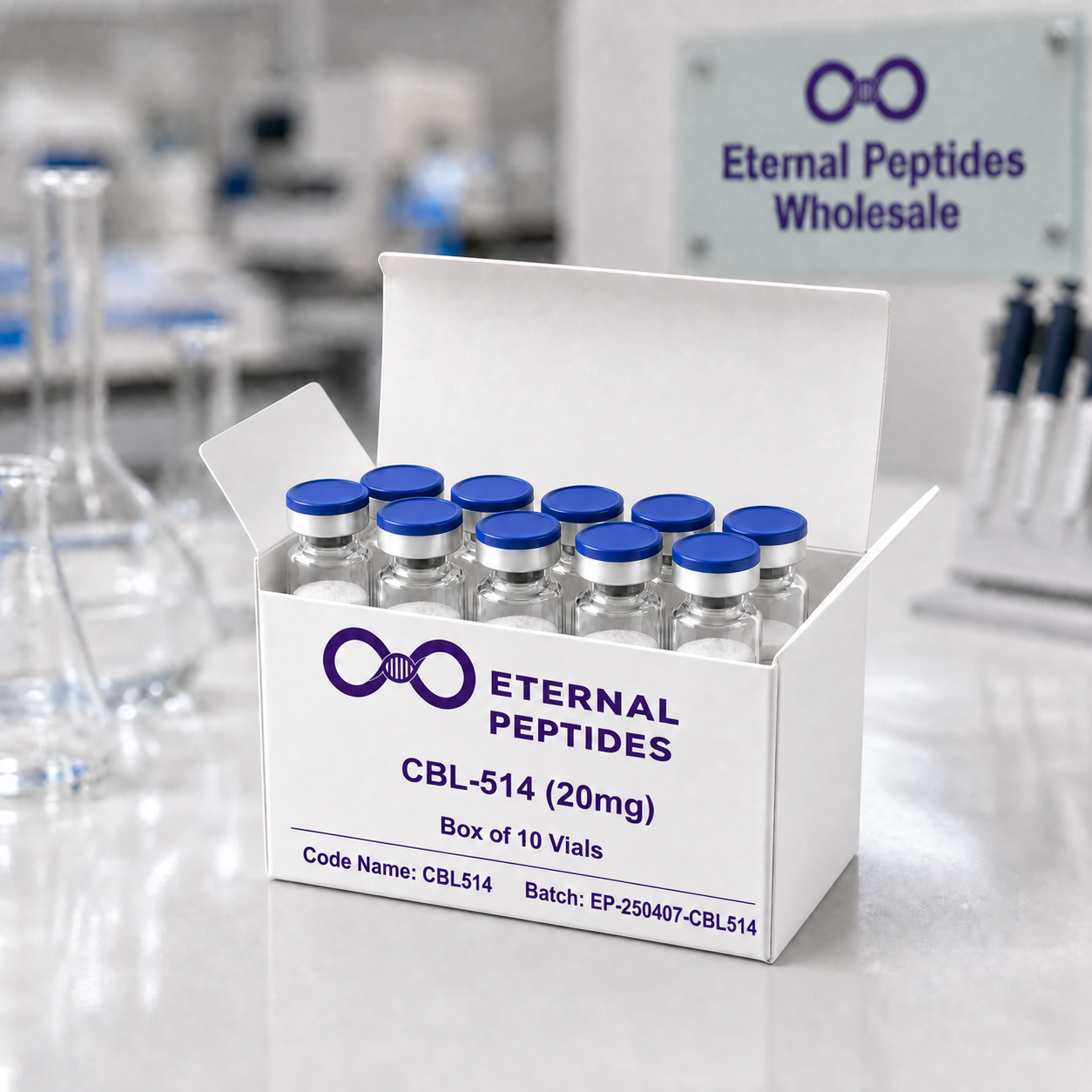
CBL-514 is an investigational small-molecule lipolysis drug candidate, with reported DYRK1B-inhibitory activity. Each box contains 10 vials, with 20 mg per vial. For qualified laboratory research only.
Testing coming soon from Janoshik.
No batch-specific certificate of analysis (COA) is currently available. View testing status.
Free shipping on all products.
For use by qualified professionals in controlled laboratory research. Not for human consumption, therapeutic use or veterinary use.
Testing documentation for batch EP-250407-CBL514 is not available yet. A Janoshik COA will be published here when it has been received and reviewed.
CBL-514 is an investigational small-molecule lipolysis drug candidate. Its reported mechanism involves DYRK1B inhibition and adipocyte apoptosis, the programmed death of fat cells. [1]
The 2022 Phase 2a paper describes inhibition of the cell-survival kinase DYRK1B, increased caspase-3 expression and a higher Bax/Bcl-2 ratio in the sponsor's nonclinical studies. These findings describe the proposed mechanism; they are not direct evidence of target engagement in humans. [1]
Clinical programmes may use different formulations. The study sponsor distinguishes CBL-514D, a formulation with the same active ingredients under development for Dercum's disease. Study results describe the specific formulation and conditions investigated. [5]
Product documentation: Published clinical findings do not establish the identity, quality, safety or effectiveness of this separately supplied product. Clinical equivalence is not claimed; see the batch-specific testing information above.
Historical Google reviews
Customer reviews from our previous Google Business Profile, preserved here as historical feedback. This is an archive, not a live Google rating.
The whole process from placing the order to receiving the package was quite straightforward, and I appreciated how the items were handled carefully, giving a sense of professionalism and attention to detail throughout.
I had a very smooth experience with my order as everything arrived well packed, on time, and exactly as described, which made me feel confident about the reliability and consistency of the service overall.
Smooth and professional wholesale service with a strong focus on product quality and consistency. Communication is clear, and the ordering process feels well organized. Everything is handled efficiently from inquiry to delivery.
Super fast delivery. Products are incredible.
Excellent service & fast shipping
Another purchase !! Thankyou
Will buy again is great
The best shop to get your peptides! Easy to order with fast shipping.
Amazing service purchased multiple times always reliable arrives quick!
Reliable supplier with good attention to detail and timely responses. The team is helpful in providing information and ensures orders are processed correctly. Overall experience feels straightforward and dependable.
Great deal was so happy with my peptide's