

A 99 percent purity certificate is functionally worthless if it only applies to a single vial in a thousand-unit order. For Australian research institutions, the integrity of a longitudinal study depends entirely on batch-to-batch consistency that retail-grade suppliers often fail to provide. You likely recognise that even minor variances in peptide synthesis can compromise months of laboratory data; this leads to significant setbacks in your research timelines and wasted budget.
This guide establishes the technical standards necessary when sourcing bulk tb-500 for laboratories to ensure every vial maintains a minimum purity threshold of 99 percent. We offer a comprehensive framework for securing a reliable B2B supply chain while navigating the specific regulatory shifts of 2026, such as the recent PCAC reviews. You’ll learn how to verify chemical integrity across large-scale inventories and optimise procurement costs without ever sacrificing the clinical reliability your programme demands. We examine the logistical hurdles of Australian distribution and provide the data points needed to maintain a steadfast, professional partnership with your wholesale suppliers.
Key Takeaways
- Understand the precise chemical profile and molecular weight of the synthetic 17-amino acid fragment required for reproducible actin polymerisation research.
- Identify how to transition from fragmented retail sourcing to a strategic procurement model for acquiring bulk tb-500 for laboratories to eliminate batch variability.
- Master the analytical requirements for large-scale trials, including the use of HPLC and Mass Spectrometry to verify peptide identity and sequence integrity.
- Evaluate the impact of high-purity TB-500 on cellular architecture and angiogenesis models to ensure the validity of your institutional data.
- Secure a steadfast Australian logistical partner to maintain a consistent supply chain and adhere to professional B2B procurement standards.
Technical Foundations: TB-500 as a Thymosin Beta-4 Fragment
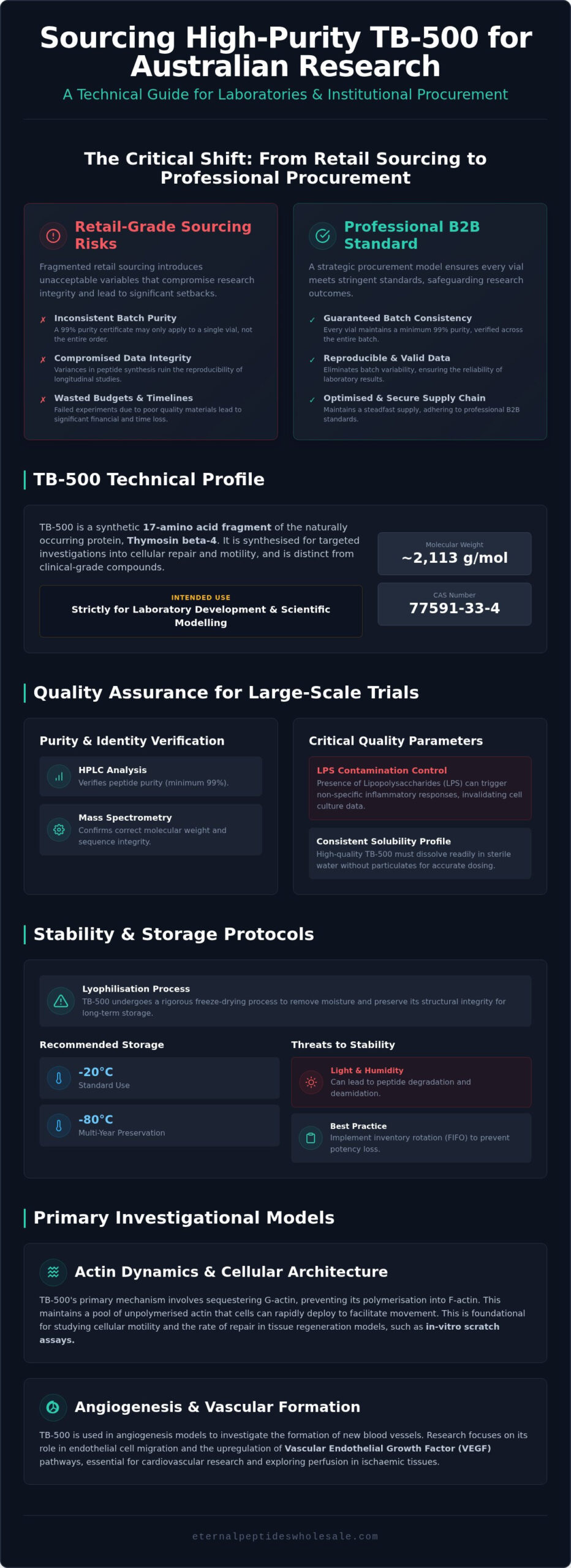
TB-500 is defined as a synthetic 17-amino acid fragment of the naturally occurring protein Thymosin beta-4. Unlike the full-length endogenous protein, this specific peptide sequence is synthesised for targeted investigations into cellular repair and migration. It carries a molecular weight of approximately 2,113 g/mol and is identified by the CAS number 77591-33-4. When procuring bulk tb-500 for laboratories, researchers must distinguish between these synthesised fragments and clinical-grade compounds. Research-grade TB-500 is strictly intended for laboratory development and scientific modelling; it doesn’t contain the specific excipients or regulatory approvals required for human therapeutic applications.
The Molecular Structure of Thymosin Beta-4 Fragments
The efficacy of TB-500 in research environments relies on its specific amino acid sequence, which is the primary region responsible for actin-binding. This interaction is central to studies involving cellular architecture and motility. Maintaining high-purity synthesis is essential to prevent the presence of Lipopolysaccharides (LPS). LPS contamination can trigger non-specific inflammatory responses in cell cultures, effectively ruining longitudinal data. Additionally, the solubility profile of the peptide must be consistent across batches. High-quality TB-500 should dissolve readily in sterile water or bacteriostatic saline without forming particulates, ensuring accurate dosing across large-scale experimental cohorts.
Stability and Storage Protocols for Wholesale Inventory
To maintain biochemical stability, TB-500 undergoes a rigorous lyophilisation process. This freeze-drying technique removes moisture while preserving the peptide’s structural integrity for long-term storage. When managing bulk tb-500 for laboratories, it’s vital to maintain a consistent cold chain. Lyophilised vials should be stored at -20°C for standard use or -80°C for multi-year preservation.
Exposure to light and humidity can lead to peptide degradation and deamidation, which alters the chemical properties of the compound. Professional laboratories should implement inventory rotation protocols to ensure that older batches are utilised first. This prevents the risk of potency loss in wholesale stocks. Handling large-scale inventories requires a methodical approach to temperature monitoring and desiccated storage to ensure that every vial meets the required 99 percent purity threshold upon reconstitution.
Investigational Models: Angiogenesis and Cellular Migration Research
Research applications for bulk tb-500 for laboratories primarily centre on the peptide’s ability to regulate cellular architecture. By sequestering G-actin, TB-500 facilitates the internal scaffolding changes required for cell motility. This mechanism is foundational for investigators studying how cells move toward injury sites in tissue regeneration models. It provides a reliable framework for observing how synthetic fragments influence the rate of repair in various biological systems and complex cellular environments.
Actin Dynamics and Cellular Architecture
TB-500 interacts specifically with globular actin (G-actin), preventing its polymerisation into filamentous actin (F-actin). This sequestration maintains a pool of unpolymerised actin that the cell can deploy rapidly to facilitate movement. In wound healing research, this structural organisation is critical. It allows researchers to observe the rate of cellular influx into a denuded area in specialised *in vitro* scratch assays. Understanding these actin dynamics provides insights into the basic biological processes of tissue regeneration and the structural integrity of newly formed cellular matrices. The consistency of the peptide batch is paramount here; minor sequence variations can lead to unpredictable actin-binding results that compromise the validity of the entire study.
Angiogenesis and Vascular Formation Studies
Angiogenesis models utilise TB-500 to investigate the formation of new blood vessels from pre-existing vasculature. Research interest focuses on endothelial cell migration, which is a prerequisite for capillary sprout formation. In microvascular research, TB-500 is often studied for its role in upregulating vascular endothelial growth factor (VEGF) pathways. These models are essential for cardiovascular research, particularly in exploring how ischaemic tissues might regain perfusion through stimulated vessel growth. Investigators also examine how the peptide modulates inflammatory signalling within these vascular environments to prevent stalled-healing scenarios. This research often requires large-scale test groups to achieve statistical significance, making the procurement of bulk tb-500 for laboratories a logistical necessity.
Beyond vascular studies, TB-500 is a staple in musculoskeletal research. Studies involving muscle, tendon, and ligament kinetics often focus on the peptide’s role in collagen deposition and fibroblast migration. In stalled-healing models, where chronic inflammation prevents the transition from the inflammatory phase to the proliferative phase, TB-500 is investigated for its ability to downregulate pro-inflammatory cytokines. This modulation is key for laboratories developing protocols for accelerated connective tissue repair. Precise control over the concentration of TB-500 allows for more accurate modelling of the proliferative phase. For institutions conducting these complex trials, securing research-grade TB-500 (5mg) in wholesale quantities ensures that experimental variables remain controlled across all test groups.
Procurement Logistics: The Transition to Bulk TB-500 Sourcing
Transitioning from retail single-vial sourcing to wholesale procurement represents a strategic shift for Australian research institutions. While retail channels serve for pilot testing, they’re insufficient for large-scale investigations. The primary advantage of sourcing bulk tb-500 for laboratories lies in the reduction of experimental variability. When a laboratory secures a single, large lot of peptides, they ensure that every experimental subject is exposed to the exact same chemical profile. This consistency is vital for longitudinal research where even minor deviations in peptide purity can skew statistical outcomes. Relying on fragmented retail supplies introduces unnecessary variables that can compromise the reproducibility of your data.
B2B Supply Chain Integrity for Australian Labs
Securing a transparent supply chain is essential for laboratories operating within Australian biotech hubs. Fragmented procurement often leads to significant delays, especially when relying on international retail vendors with unpredictable customs clearance times. By establishing a professional B2B partnership, institutions can reduce procurement lag and ensure a steady inventory. Large-scale order fulfilment requires specialised handling and Australian-based logistics to maintain the cold chain. Professional suppliers act as a steadfast logistical backbone; this allows researchers to focus on data collection rather than supply chain troubleshooting. For a detailed look at navigating these requirements, consult our guide on Sourcing Research Peptides Wholesale in Australia.
Economic Efficiencies in Large-Scale Procurement
Economic planning in an institutional setting requires a balance between cost-per-vial and chemical integrity. Sourcing bulk tb-500 for laboratories allows procurement officers to optimise budgets without compromising on the 99 percent purity standard. Effective inventory management involves forecasting the needs of multi-year studies to avoid mid-programme supply shocks. Institutional labs often benefit from centralised storage that protects lyophilised stocks from environmental degradation. Wholesale partnerships essentially act as a hedge against market volatility and supply chain disruptions. You can explore more about managing these logistical demands in our Wholesale Tissue Repair: Australian Procurement Guide. This approach provides the predictability required for long-term scientific development and ensures that chemical integrity remains uncompromised throughout the study duration.
Quality Assurance: Purity Verification for Large-Scale Trials
Maintaining chemical integrity across 100 or 500 vials requires more than a cursory check of a single sample. In professional settings, procuring bulk tb-500 for laboratories necessitates a rigorous verification protocol that covers the entire production run. Each batch must be accompanied by a specific Certificate of Analysis (CoA) that reflects the exact lot delivered to the institution. Without this documentation, researchers risk introducing unquantified impurities into their models, which can lead to false positives or irreproducible data sets. Standardising these protocols ensures that every vial in a large order performs identically under experimental conditions.
Analytical Techniques: HPLC and MS Analysis
High-Performance Liquid Chromatography (HPLC) is the primary tool for determining the purity percentage by separating the peptide from any residual solvents or synthesis by-products. A clean chromatogram with a single, sharp peak indicates high purity, typically targeted at 99 percent or higher for institutional work. However, HPLC alone doesn’t confirm the sequence. Mass Spectrometry (MS) is utilised to verify the molecular weight and ensure the 17-amino acid sequence is complete. This prevents the use of truncated sequences that might still appear “pure” on HPLC but lack the biological activity required for actin-binding studies. For a deeper dive into these standards, read our guide on Quality Assurance in Research Peptides.
Standardising Batch-to-Batch Consistency
Scaling peptide synthesis from small batches to high-volume wholesale quantities introduces technical challenges. If the synthesis environment isn’t strictly controlled, subtle variations in temperature or reagent concentration can cause batch-to-batch drift. For longitudinal studies, this drift is a silent research killer. Verification protocols for high-volume orders should involve random sampling across the entire shipment, not just the first few vials. Ensuring 99%+ purity is a non-negotiable standard because it provides the buffer needed to ensure that minor degradations over time don’t drop the peptide below a functional threshold. When you order wholesale TB-500 5mg vials, you’re investing in the stability of your data as much as the chemical itself. This level of oversight ensures that your large-scale trials remain grounded in clinical reliability and professional accuracy. Institutions seeking a comprehensive technical reference for navigating the 2026 regulatory landscape can consult our detailed guide on wholesale TB-500 Australia procurement standards to further strengthen their quality assurance frameworks.
Strategic Sourcing: Partnering with Eternal Peptides Wholesale
Eternal Peptides Wholesale serves as a primary logistical partner for the Australian scientific community. By operating as a dedicated B2B entity, we provide the stability and clinical reliability required for high-level institutional investigations. Our focus remains strictly on the wholesale distribution of research-grade compounds, ensuring that every procurement cycle meets the ethical and legal standards expected by modern laboratories. We maintain a rigorous “research only” policy; this means our products are never intended for human consumption or medical use. This no-nonsense approach allows us to focus entirely on the success of your laboratory’s larger-scale operations without the distractions of the retail market.
The Eternal Peptides Wholesale Advantage
Managing the complexities of the wholesale landscape requires a supplier that understands the necessity of chemical consistency. We prioritise the supply of bulk tb-500 for laboratories to ensure that researchers have a predictable inventory for multi-year studies. Our Australian-based logistics eliminate the common delays and customs uncertainties found with international retail vendors, keeping your research timelines on track. Every batch of TB-500 5mg wholesale vials is synthesised to meet a 99 percent purity threshold, providing the chemical integrity needed for the reproducible data discussed in earlier sections. This commitment to scale and quality ensures that institutional researchers don’t have to compromise on purity to meet their volume requirements.
Professional Procurement and Support
Institutional research often involves complex budget cycles and specific logistical requirements that retail shops simply can’t accommodate. Eternal Peptides Wholesale offers direct communication channels for laboratory procurement officers to ensure that every order aligns with institutional goals and project deadlines. We provide customised solutions for large-scale projects, allowing for a more methodical approach to inventory management and long-term planning. This professional partnership ensures that your laboratory is supported by a mentor in the field who values operational excellence as much as you do.
By establishing a professional relationship with an Australian distributor, procurement teams can secure a steadfast logistical backbone for their biotech hubs. This level of service includes the provision of all necessary analytical documentation to support your quality assurance protocols. You can secure your wholesale TB-500 supply from Eternal Peptides Wholesale to ensure your next study is grounded in reliability and professional accuracy. We’re dedicated to being the reliable partner that allows your researchers to focus on results rather than supply chain troubleshooting.
Advancing Australian Research Through Standardised Procurement
Securing bulk tb-500 for laboratories is a strategic move that goes beyond simple vial counts to prioritise the long-term integrity of your institutional data. By transitioning to a professional wholesale model, research teams effectively eliminate the batch-to-batch variability that often plagues fragmented retail-grade supplies. This guide has established that the combination of HPLC verification, precise molecular weight confirmation, and dedicated Australian logistics is the only way to ensure the reproducibility of angiogenesis and tissue repair models. These standards are essential for any scientific programme where chemical consistency is the absolute foundation of the results.
Eternal Peptides Wholesale remains committed to providing the steadfast logistical backbone your institution requires. Our strict professional research-grade standardisation ensures that every shipment meets the technical demands of high-level investigations. When you’re ready to stabilise your supply chain and optimise your procurement protocols, we’re here to facilitate a dependable B2B partnership. You can request a wholesale account for laboratory procurement to begin securing high-purity compounds for your next project. We look forward to supporting your team’s success in the Australian research landscape.
Frequently Asked Questions
Is TB-500 legal for laboratory research in Australia?
TB-500 is legal for legitimate laboratory research and scientific development within Australia. It’s classified as a research-grade compound intended strictly for *in vitro* or animal-based investigational models. It isn’t permitted for human consumption or clinical use. Institutions must ensure their procurement of bulk tb-500 for laboratories aligns with institutional biosafety and ethics committee guidelines. We operate as a strict B2B entity to support these professional research standards.
What is the standard purity level for wholesale TB-500 vials?
The professional standard for research-grade TB-500 is a purity level of 99 percent or higher. This threshold is verified through High-Performance Liquid Chromatography (HPLC) to ensure the absence of synthesis by-products and residual solvents. Maintaining this level of purity across every vial in a wholesale order is critical for experimental repeatability. High-purity vials ensure that observed biological effects are attributable to the peptide fragment itself rather than contaminating agents.
How should bulk TB-500 be stored in a laboratory environment?
Lyophilised TB-500 should be stored in a temperature-controlled environment to prevent chemical degradation. For short-term use, vials are typically kept at -20°C; however, long-term preservation of wholesale inventory requires storage at -80°C. It’s essential to protect the vials from light and humidity. Once reconstituted, the peptide should be used immediately or stored briefly at 2°C to 8°C, though stability decreases significantly after the seal is broken.
Can TB-500 be combined with BPC-157 in research models?
TB-500 and BPC-157 are frequently utilised together in multi-factor tissue repair research models. Investigators often study their synergistic effects on angiogenesis and cellular migration, as they operate through different biological pathways. TB-500 focuses on actin sequestration and motility, while BPC-157 is often researched for its systemic cytoprotective properties. Laboratories procuring these compounds in bulk can standardise their experimental protocols to observe how these fragments interact within complex cellular environments. Institutions seeking to establish a reliable bpc-157 bulk research supply alongside their TB-500 inventory will find that a consolidated B2B procurement strategy significantly reduces logistical complexity and ensures purity standards are met across both compounds.
What is the typical molecular weight of research-grade TB-500?
Research-grade TB-500 has a molecular weight of approximately 2,113 g/mol. This value corresponds to the 17-amino acid sequence that constitutes the synthetic fragment of the endogenous protein. Verification of this molecular weight is conducted using Mass Spectrometry (MS) to ensure sequence accuracy. For procurement officers, confirming the molecular weight via batch-specific analytical reports is a non-negotiable step in verifying the identity of the peptide before commencing large-scale laboratory investigations. Australian institutions looking to align their verification processes with current regulatory expectations can reference the 2026 technical procurement reference for wholesale TB-500 in Australia to ensure their analytical documentation meets the latest compliance standards.
Does Eternal Peptides Wholesale provide Certificates of Analysis for bulk orders?
Yes, Eternal Peptides Wholesale provides batch-specific Certificates of Analysis (CoA) for all wholesale orders. These reports include HPLC and Mass Spectrometry data to verify the purity and identity of the compound. Providing transparent analytical verification is a core component of our commitment to clinical reliability. This documentation allows laboratory managers to confirm that their bulk tb-500 for laboratories meets the required 99 percent purity standards before integrating the vials into their research programmes.
Why is wholesale procurement preferred over retail for longitudinal studies?
Wholesale procurement is preferred because it ensures batch-to-batch consistency across the entire duration of a study. Retail sourcing often involves fragmented lots, which can introduce subtle chemical variations that skew long-term data. By securing a single large lot from a dedicated B2B partner, institutions eliminate these variables. This approach also allows for more efficient inventory management and significant cost optimisation, ensuring that the research budget is utilised for data collection rather than logistical overheads.
Are these peptides suitable for human or veterinary use?
No, these peptides are strictly for laboratory research purposes only. They aren’t suitable for human consumption, medical use, or veterinary applications. We maintain a rigorous non-human consumption policy to ensure compliance with Australian regulatory standards. All compounds are synthesised for *in vitro* testing and scientific modelling in controlled environments. Our professional B2B model is designed to support institutional researchers and laboratory procurement officers who adhere to these ethical and legal constraints.