Delta sleep-inducing peptide, usually shortened to DSIP, has been investigated in sleep research. Its name is not proof that it reliably improves insomnia. The relevant question is what controlled studies measured, how convincing the differences were and whether people experienced a meaningful benefit.
Why start with the study rather than the name?
A compound’s name can reflect the context in which it was investigated. It is not an approved indication or a promise of what will happen to a person. In this case, readers should separate the phrase “sleep-inducing” from evidence about sleep duration, sleep quality and next-day functioning.
Those outcomes are related but not identical. Falling asleep sooner does not automatically establish better overall sleep, and a change in a laboratory measure does not always mean someone feels more rested.
What did the controlled insomnia study find?
A 1992 double-blind study examined 16 people with chronic insomnia across five laboratory nights. Some objective sleep measures favoured DSIP, but the authors described the effects as weak and potentially influenced by changes in the placebo group. Subjective sleep quality did not improve, and the authors did not consider the short-term findings likely to provide major therapeutic benefit. (Bes et al., 1992)
This is more nuanced than either “DSIP works” or “nothing happened”. There were signals in some measurements, alongside important limits on their interpretation.
What about earlier positive reports?
An early clinical report from 1981 used a positive title about sleep in people with insomnia. (Schneider-Helmert et al., 1981) A title alone cannot supply a balanced assessment of effect size, reliability or harms. When publications appear to differ, compare their methods and outcomes rather than selecting the most appealing headline.
Questions to ask of a sleep study
Outcome
What it asks
Sleep latency
How long did falling asleep take?
Sleep efficiency
How much of the recorded time was spent asleep?
Subjective sleep quality
How did participants judge their sleep?
Daytime function
Did people feel or function better while awake?
Adverse events
What unwanted effects were actively assessed?
Why are small, short studies limited?
With few participants, chance variation can have a large influence on a result. Short follow-up also leaves questions about whether effects persist and what happens with longer exposure. A statistically significant finding on one measure should be considered alongside the other results and the design of the experiment.
For a persuasive insomnia claim, readers would want a clear comparator, predefined outcomes, adequate follow-up and reporting of harms. They would also want to know whether the population resembles the people to whom the claim is being applied.
Does this establish that a DSIP product treats insomnia?
No. The selected studies do not establish a reliable benefit for an unspecified commercial product. Identity, formulation and study conditions remain relevant, and an evidence discussion should not become a self-treatment protocol.
What is a useful next step for a reader with persistent sleep problems?
Discuss the symptoms with a qualified health professional. The practical question is why sleep is disrupted and which assessment or treatment is appropriate, rather than whether a compound has a reassuring name.
For research reading, keep the distinction between measured sleep and perceived sleep visible. A trustworthy DSIP summary should report mixed or weak findings as clearly as it reports favourable ones.
References
Linked author–year citations identify the source for the nearby statement. Publication years refer to the journal issue where available; earlier online dates are noted below. “n.d.” means no publication date is displayed; letter suffixes distinguish sources by the same organisation. Tables labelled as editorial interpretation are our reading of the cited evidence.
IGF-1 LR3 is discussed as a modified form of insulin-like growth factor I. Much of the familiar language around its potency comes from laboratory research. Stronger activity in a particular cell assay is not a measured muscle-gain result in people.
What does LR3 refer to?
The original analogue work described Long Arg3 IGF-I, including an extended amino terminus and replacement of an amino acid in the IGF-I sequence. These modifications were investigated in relation to receptor activity and interactions with IGF-binding proteins. (Francis et al., 1992)
The important point for readers is that an analogue is a specifically modified molecule. A paper about ordinary IGF-I, a different analogue or a formulated medicine should not be silently relabelled as evidence for IGF-1 LR3.
What did the original laboratory comparison find?
In the 1992 study, relative activity differed across cell systems. Long Arg3 IGF-I showed greater activity than IGF-I in some systems secreting binding proteins, but was less potent than IGF-I in a fibroblast system without detectable secreted IGF-binding proteins. That contrast is a useful warning against treating “more potent” as a universal property. (Francis et al., 1992)
Why do binding proteins matter?
IGF-binding proteins influence how IGFs are present and available in an experimental system. Primary work in human fibroblasts investigated how IGFs and their analogues interact with those proteins, illustrating that the receptor is only part of the story. (Conover, 1991)
For a non-specialist reader, the key idea is context. A result can depend on the cells, the substances they produce and the conditions under which a response is measured. Changing that setting can change the comparison.
Three meanings often hidden inside “potent”
Meaning
Evidence needed
A response at a lower concentration in one assay.
A controlled concentration-response comparison in that assay.
A larger biological effect in an organism.
Relevant measurements in that organism and setting.
A useful treatment benefit in people.
Appropriate human studies measuring benefits and harms.
Does protein synthesis in cells equal muscle growth in a person?
No. A cell-culture measurement concerns the response of cells under defined conditions. A clinical muscle-growth claim concerns a whole person over time and needs meaningful outcomes such as function, body composition and harms. Those questions cannot be answered by attaching a laboratory percentage to a human before-and-after story.
The same caution applies to a claim that a substance is “several times stronger”. Ask: stronger on which measure, in which system and compared with what? Without those details, the phrase offers little usable information.
Can findings about IGF-I medicines be transferred to LR3?
They cannot be transferred automatically. First establish whether the active molecule, formulation, indication and patient population match. A shared name fragment does not establish chemical or clinical equivalence.
How to evaluate an IGF-1 LR3 article
Look for a clear identity statement and a description of the experimental model. The article should say whether the endpoint was a laboratory response or a human outcome. It should also avoid presenting a mechanistic hypothesis as a treatment recommendation.
This selected-paper appraisal explains why the original experiments are scientifically interesting while leaving the human-use question separate. It is not a clinical review, an approval determination or a guide to self-administration.
References
Linked author–year citations identify the source for the nearby statement. Publication years refer to the journal issue where available; earlier online dates are noted below. “n.d.” means no publication date is displayed; letter suffixes distinguish sources by the same organisation. Tables labelled as editorial interpretation are our reading of the cited evidence.
Background. BPC157 (also written BPC 157 or BPC-157) is a synthetic 15-amino-acid peptide whose online reputation has grown far faster than its clinical record. Australian regulators added it to Schedule 4 of the Poisons Standard, with additional possession controls, from 1 June 2024, and in 2026 the TGA, the Chief Medical Officer and NSW Health issued repeated warnings about unapproved peptides [1, 2, 3, 4, 5]. Existing reviews either summarise the animal findings narratively or, in the two systematic reviews, cover only orthopaedic use or human studies [6, 7, 8]. No published work has mapped the whole BPC157 literature, measured how it is distributed across models, research groups and years, or audited how it is reported.
Objective. To build a reproducible evidence map of every PubMed-indexed BPC157 record; to classify each primary study by outcome domain, model and research group; to audit reporting quality in the open-access animal studies; to reconcile the human evidence across journals, meeting abstracts, trial registries and regulator reviews; and to set out a verified regulatory timeline for Australia, anti-doping and the United States.
Methods. A systematic evidence map with reporting informed by PRISMA 2020 [9]. PubMed was searched through NCBI E-utilities on 30 October 2026 (Australia/Brisbane) with a title/abstract block covering eight synonyms. Europe PMC and ClinicalTrials.gov were searched as cross-checks [10, 11, 12]. All 236 PubMed records were screened and classified by hand. Open-access full texts of in vivo animal studies published from 2013 were audited against core items from ARRIVE 2.0 and the SYRCLE risk-of-bias tool [13, 14]. Regulatory facts were read at the primary source.
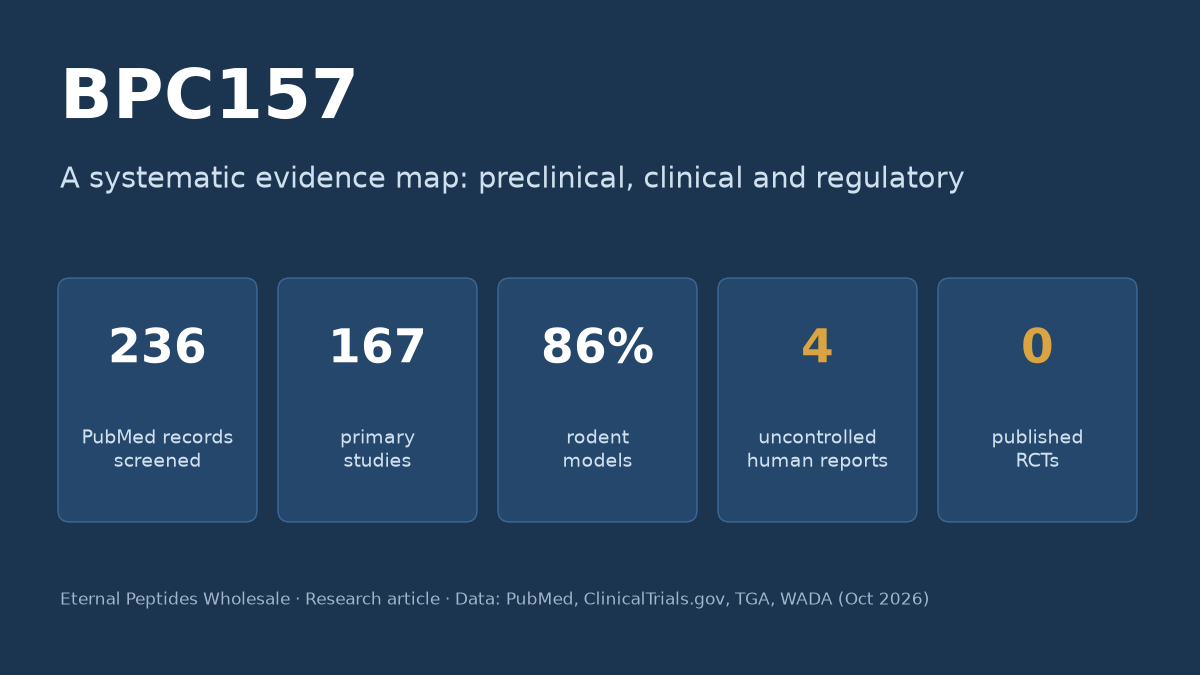
Results. Of 236 records, 3 were excluded, 167 were primary studies and 66 were reviews, editorials or comments. Rodent models accounted for 144 of the 167 primary studies (86.2%), and only 4 (2.4%) reported data from people. Authors from the Zagreb group (any author named Sikirić, or any Zagreb affiliation) wrote 140 of 167 primary studies (83.8%) and 139 of 148 in vivo animal studies (93.9%). In 47 audited full texts, 42 (89.4%) said animals were randomised but only 3 (6.4%) described how. Three (6.4%) reported a sample-size calculation, 5 (10.6%) cited ARRIVE and 42 (89.4%) used male animals only. Human evidence comprised four uncontrolled published reports (33 people) and, outside PubMed, three meeting abstracts from 2002–2005 identified by the US FDA. One was a randomised, placebo-controlled trial in 53 people with ulcerative colitis whose between-group confidence interval included zero [15]. None of four ClinicalTrials.gov registrations has posted results, and three of the four were registered after the study had started. In 2025–26, secondary publications outnumbered primary studies by 33 to 16.
Conclusions. The BPC157 evidence base is large in count but narrow in origin and design: mostly short rodent studies from one research network, with low reporting of the safeguards that protect against bias and no peer-reviewed controlled human trial. Claims about effects in people are therefore not supported by the record. In Australia BPC-157 is a Schedule 4 substance listed in Appendix D, it is prohibited at all times in sport, and the TGA states that a “research use only” label does not change a product’s regulatory status [16, 17, 18].
What is new here. This is, to our knowledge, the first whole-corpus BPC157 evidence map: every PubMed record classified by domain, model and research group, with counts that can be reproduced from the published search strings. It adds a full-text reporting audit, a registry audit, a reconciliation of journal, meeting-abstract and regulator sources on human data, and a regulatory timeline checked against the legislation, TGA decisions and the 2027 WADA List. Top-ranking pages describe BPC157 in general terms. None of them quantifies how concentrated, how rodent-based or how incompletely reported the evidence is.
Key findings
A systematic PubMed search found 236 BPC157 records. After screening, 167 were primary studies: 144 in rodents, 4 in other animals, 6 in vitro or ex vivo, 2 nonclinical pharmacokinetic or safety studies, 7 chemistry or analytical studies and 4 human reports [10].
One research network produced 84% of all primary studies and 94% of in vivo animal studies. Only 9 in vivo animal efficacy studies came from other groups.
Full texts rarely reported the safeguards that reduce bias. 89% said animals were randomised, 6% said how, 6% reported a sample-size calculation and 89% used only male animals [14, 19].
No randomised trial of BPC-157 has been published in a peer-reviewed journal. The only randomised human data are a 2005 meeting abstract that the US FDA judged inadequate to show efficacy or safety [15].
Since 1 June 2024 BPC-157 has been a Schedule 4 substance listed in Appendix D of the Poisons Standard, so possession without authority is illegal. “Research use only” disclaimers do not change that position [2, 18, 3].
BPC-157 is named in the S0 section of the WADA Prohibited List and is prohibited at all times. The 2027 List, in force from 1 January 2027, keeps it there [17, 20].
Few research peptides have drawn as much public attention as BPC157. Search interest, social media and online commentary often present it as well established. The scientific record is different. Most of the literature consists of short experiments in rats, most of those experiments come from one research network, and the human record is sparse enough that a systematic review published in 2026 found only three eligible human studies involving 30 people. That review rated the certainty of evidence as very low [6]. A 2025 systematic review limited to orthopaedic sports medicine reached a similar conclusion about the shortage of human data [7]. A narrative review of musculoskeletal healing set out the gap between preclinical promise and clinical uncertainty [8].
These reviews answer the question “what does the human evidence show?” They do not answer a prior question that matters just as much for anyone trying to interpret BPC157 research: what kind of evidence base is this? How many studies are there, in which models, from which groups, and how well were they reported? The answers determine how much weight any single finding can bear. A literature of 150 rat studies from many independent laboratories with transparent randomisation and adequate sample sizes would carry far more weight than the same number of studies from one network with sparse reporting of bias safeguards. Meta-research across preclinical science shows that unreported randomisation and blinding are associated with larger apparent effects [19], that small samples inflate effect sizes and reduce reproducibility [21], and that only a minority of highly cited animal findings translate into human benefit [22].
A second reason for an evidence map is regulatory. On 1 June 2024 Australia created a Schedule 4 entry for BPC-157 and listed it in Appendix D, clause 5, of the Poisons Standard. That listing places additional controls on possession, and the Explanatory Statement records that possession without authority is illegal [1, 2]. The TGA delegate’s reasons cited “a limited evidence base” made up of “a small number of peer-reviewed studies that largely originate from a single laboratory”, and “only a single registered phase 1 clinical trial conducted in 2015” [23]. Those are empirical statements about the literature. This review tests them with a full count.
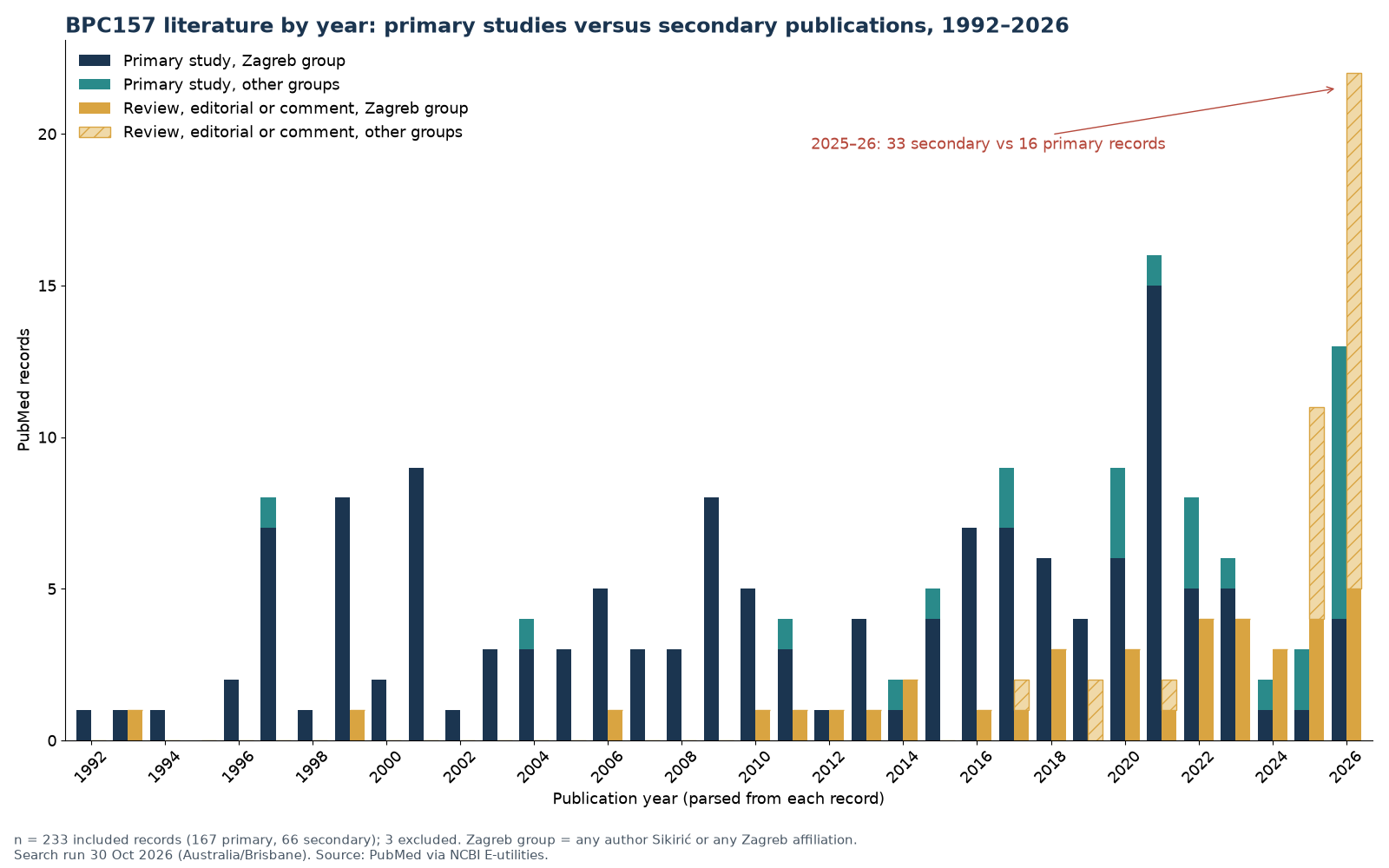
A third reason is the quality of secondary literature. Between 2025 and October 2026, reviews, editorials and comments about BPC-157 outnumbered new primary studies two to one (33 versus 16 PubMed records; see Figure 1). As secondary publications multiply, errors can propagate. One 2025 literature and patent review stated that BPC-157 was not listed as banned by WADA [24]. Yet both the 2025 Prohibited List, in force when the review appeared, and the 2026 List name BPC-157 under S0 [25, 26]. A whole-corpus map gives readers a check against such drift.
This article therefore sets out to do five things: (1) report a reproducible search with real counts; (2) classify every primary BPC157 study by outcome domain, model, species and research group; (3) audit how the recent open-access animal studies report the safeguards that limit bias; (4) reconcile the human evidence across journals, meeting abstracts, trial registries and a regulator’s review; and (5) assemble a verified regulatory timeline for Australia, anti-doping and the United States. It does not assess whether BPC-157 works in people, and it makes no recommendation about use. The aim is to describe the evidence accurately, so that researchers, reviewers and regulators can see where its limits lie.
What BPC157 is: identity, names and origin
BPC-157 is a linear pentadecapeptide. PubChem lists it as compound CID 9941957 with molecular formula C62H98N16O22 and a molecular weight of about 1,419.5 g/mol [27]. Its sequence, Gly-Glu-Pro-Pro-Pro-Gly-Lys-Pro-Ala-Asp-Asp-Ala-Gly-Leu-Val (GEPPPGKPADDAGLV), was confirmed by mass spectrometry in vials confiscated during an anti-doping investigation [28]. The name comes from “body protection compound”. The originating group described BPC as a new gastric juice peptide in a 1993 overview of its stomach-stress-organoprotection hypothesis [29], and later papers from the same group call BPC 157 a “stable gastric pentadecapeptide” [30]. The word “stable” refers to a reported resistance to hydrolysis in gastric juice. The FDA’s 2026 briefing document notes that, despite this, the reported half-life after injection in animals is short [15, 31].
The peptide appears under several names and development codes. The literature and regulators use BPC 157, BPC-157 and BPC157 interchangeably, as well as PL 14736 (also written PL14736), PL-10, PLD-116 and Bepecin [32, 20]. That spread of names matters for searching. A query for one spelling misses records that use another, so the search strategy in this review combined all of them (Table 1). Sport Integrity Australia lists the same aliases on its BPC-157 substance page [20].
BPC-157 is not an approved medicine in Australia. Sport Integrity Australia notes that it is not included on the Australian Register of Therapeutic Goods (ARTG) [20]. In the United States, the FDA’s 2026 briefing document records that it has no pharmacopeial monograph and is not a component of any FDA-approved drug [15]. For broader context on how signalling peptides relate to approved peptide medicines, see the EPW review What do peptides do? Signalling, receptors and approved medicines.
Methods: search, classification and audits
Design and reporting standards for the BPC157 evidence map
This is a systematic evidence map, a form of evidence synthesis that describes the extent and character of a literature rather than pooling effect sizes. Searching, screening and reporting followed the relevant items of PRISMA 2020 [9]. The audit of animal studies used core items from the ARRIVE 2.0 guidelines and the SYRCLE risk-of-bias tool for animal intervention studies [13, 14], together with the reporting items proposed by Landis and colleagues for preclinical research [33]. The review was not prospectively registered. That is a limitation, but because every search string and count is published here and every classification rule is stated, the work can be repeated. All searches were run on 30 October 2026 between about 04:00 and 04:20 Australia/Brisbane time (AEST).
Information sources and search strings
The primary source was PubMed, queried through the NCBI Entrez Programming Utilities (E-utilities) so that counts were captured exactly [10]. The core search combined eight title/abstract synonyms: “BPC 157”, “BPC-157”, “BPC157”, “body protection compound”, “pentadecapeptide BPC”, “PL 14736”, “PL14736” and “bepecin”. It was limited to publication dates up to 30 October 2026. The core search returned 236 records, and a re-run about 15 minutes later returned the same count. Standard PubMed filters were then applied as descriptive subsets (Table 1). Europe PMC was queried through its REST interface as a cross-check, returning 247 records for a title/abstract search and 325 for an all-fields search [11]. ClinicalTrials.gov was searched through its version 2 API for each synonym [12]. The Australian New Zealand Clinical Trials Registry could not be queried programmatically because it blocked automated requests (HTTP 403). This is recorded as a limitation.
Table 1. Reproducible search strings and record counts for BPC157, run 30 October 2026 (Australia/Brisbane).
Source and search
Query (abbreviated where noted)
Records
PubMed, core search
(“BPC 157″[tiab] OR “BPC-157″[tiab] OR “BPC157″[tiab] OR “body protection compound”[tiab] OR “pentadecapeptide BPC”[tiab] OR “PL 14736″[tiab] OR “PL14736″[tiab] OR bepecin[tiab]) AND 1900/01/01:2026/10/30[dp]
236
PubMed, core AND humans[mh]
Core search AND humans[mh]
59
PubMed, animals only
Core search AND animals[mh] NOT humans[mh]
109
PubMed, reviews
Core search AND review[pt]
54
PubMed, systematic reviews or meta-analyses
Core search AND (systematic review[pt] OR meta-analysis[pt])
1
PubMed, clinical trials
Core search AND clinical trial[pt]
0
PubMed, randomised controlled trials
Core search AND randomized controlled trial[pt]
0
PubMed, case reports
Core search AND case reports[pt]
1
PubMed, rats / mice
Core search AND rats[mh]; core search AND mice[mh]
114 / 20
PubMed, published 2020 onward
Core search AND 2020/01/01:2026/10/30[dp]
109
Europe PMC, title/abstract
TITLE_ABS: same eight synonyms
247
Europe PMC, all fields
Same eight synonyms, all fields
325
ClinicalTrials.gov (API v2)
Each synonym searched separately; results de-duplicated
4 unique studies
The PubMed filter counts in Table 1 show why automated subsets cannot replace screening. The humans[mh] filter returned 59 records, yet only 4 primary studies reported data from people. The tag mostly attaches to reviews and to in vitro work on human cells or tissue. Conversely, the clinical trial and randomised controlled trial publication-type filters each returned zero records. That is the correct count for peer-reviewed trials, but it says nothing about trials reported only as conference abstracts, which PubMed does not index (see BPC-157 human studies).
Eligibility, screening and classification
Every one of the 236 records was screened on title, abstract and publication type. Records were classified as primary studies (reporting new data), secondary publications (reviews, editorials, comments, letters and replies) or excluded. Each primary study was assigned to one main outcome domain and one model category. The eight domains were gastrointestinal; vascular and cardiac; nervous system; musculoskeletal (muscle, tendon, ligament and bone); skin wounds and eye; liver, kidney and other organs; toxicity-antagonism models (studies in which BPC-157 was tested against injury caused by another drug or toxin); and chemistry, pharmacokinetics and safety. The six model categories were rodent in vivo, other animal in vivo, in vitro or ex vivo, nonclinical pharmacokinetic or safety study, chemistry or analytical study, and human report. Species were extracted from the title, abstract and MeSH terms. A study that spanned domains was counted once, in the domain of its primary outcome, so every count in this review refers to unique records.
Author-group attribution
A research group was treated as the Zagreb group when any author was named Sikirić (any spelling) or any author affiliation included Zagreb. Both were read from the PubMed XML record. The rule is deliberately broad, because the question is whether the evidence is independent of the originating network, not who led each paper. It may count a small number of unrelated Zagreb studies as part of the network. That would slightly overstate concentration, so the non-Zagreb records were also checked by hand.
Full-text reporting audit
Every primary in vivo animal study with a full text available as PubMed Central (PMC) XML was retrieved, with the reference lists removed: 47 studies published between 2013 and 2026, of which 42 were by the Zagreb group. Each was screened with predefined text patterns, and matching passages were then read to confirm eight reporting items: a statement that animals were randomised; a description of the randomisation method; a statement of blinding; a sample-size calculation; citation of ARRIVE; the sex of the animals; a conflict-of-interest statement; and a data-availability statement. These items map onto the core ARRIVE 2.0 set [13] and onto SYRCLE domains for selection, performance and detection bias [14]. Each item was scored present or absent from the text as published. Absence means “not reported”, which is not the same as “not done” [34].
Trial-registry audit
Each ClinicalTrials.gov record was retrieved as structured JSON. For each one, the review extracted phase, design, masking, planned or actual enrolment, country, overall status, start date, first-submitted date, primary completion date and whether results had been posted. A registration was classed as retrospective when its first-submitted date fell after its start date. Prospective registration has been a condition of publication in member journals of the International Committee of Medical Journal Editors since 2005, because it guards against selective reporting [35].
Verification of regulatory facts
Every regulatory statement in this review was read at the primary source on 30 October 2026. The sources were the TGA’s interim and final scheduling decisions [23, 1], the Explanatory Statement and text of the June 2024 Poisons Standard instrument [2, 36], the Poisons Standard in force from 1 October 2026 [16], TGA guidance and media releases [18, 3, 37, 4, 38, 39], the WADA Prohibited Lists for 2025, 2026 and 2027 [25, 26, 17, 40], Sport Integrity Australia [20], the US FDA [41, 15] and NSW Health [5]. Secondary commentary was not used as a source for any legal or regulatory fact. Where a TGA web page could not be rendered, the decision PDF was cited instead.
Results: search yield and publication trends
Screening flow from 236 records to 167 BPC157 primary studies
The core PubMed search returned 236 records. Three were excluded: a 2021 corrigendum, a 2025 article whose PubMed record is titled “Withdrawn”, and a 2025 paper on another class of compounded medicines in which BPC-157 was mentioned but not studied. Of the remaining 233 records, 167 were primary studies (71.7%; 167 ÷ 233) and 66 were secondary publications (28.3%). The earliest primary study in the set dates from 1992 [42]. Europe PMC returned slightly more records (247 by title and abstract) because it also indexes preprints and records outside MEDLINE [11]. Those extra records were not screened, which is a limitation discussed below.
Publication trend: the rise of secondary BPC-157 literature
The balance between new data and commentary has changed over time (Figure 1). In the 1990s the PubMed record held 22 primary studies and 2 secondary publications. In the 2000s it held 41 and 1, and in the 2010s 47 and 14. From 2020 to October 2026 there were 57 primary studies and 49 secondary publications. The sharpest shift came at the end of the period. In 2025 and 2026 combined, PubMed indexed 16 primary studies and 33 secondary publications, about 2.1 secondary records for every primary one (33 ÷ 16 = 2.06). Of those 33 secondary records, 24 came from authors outside the Zagreb group. The new commentary is coming largely from orthopaedics, sports medicine, pharmacy and public health [43, 44, 45, 46, 47, 48]. The record suggests that BPC-157 is now being written about much faster than it is being studied.
Figure 1. BPC157 records in PubMed by publication year, 1992–2026, split into primary studies and secondary publications (reviews, editorials and comments) and by research group. In 2025–26, secondary records outnumbered primary studies 33 to 16. Sources: PubMed search run 30 October 2026 via NCBI E-utilities [10]; classification by the author. Data figure.
Results: the BPC157 evidence map by domain and model
Models and species: an overwhelmingly rodent BPC-157 literature
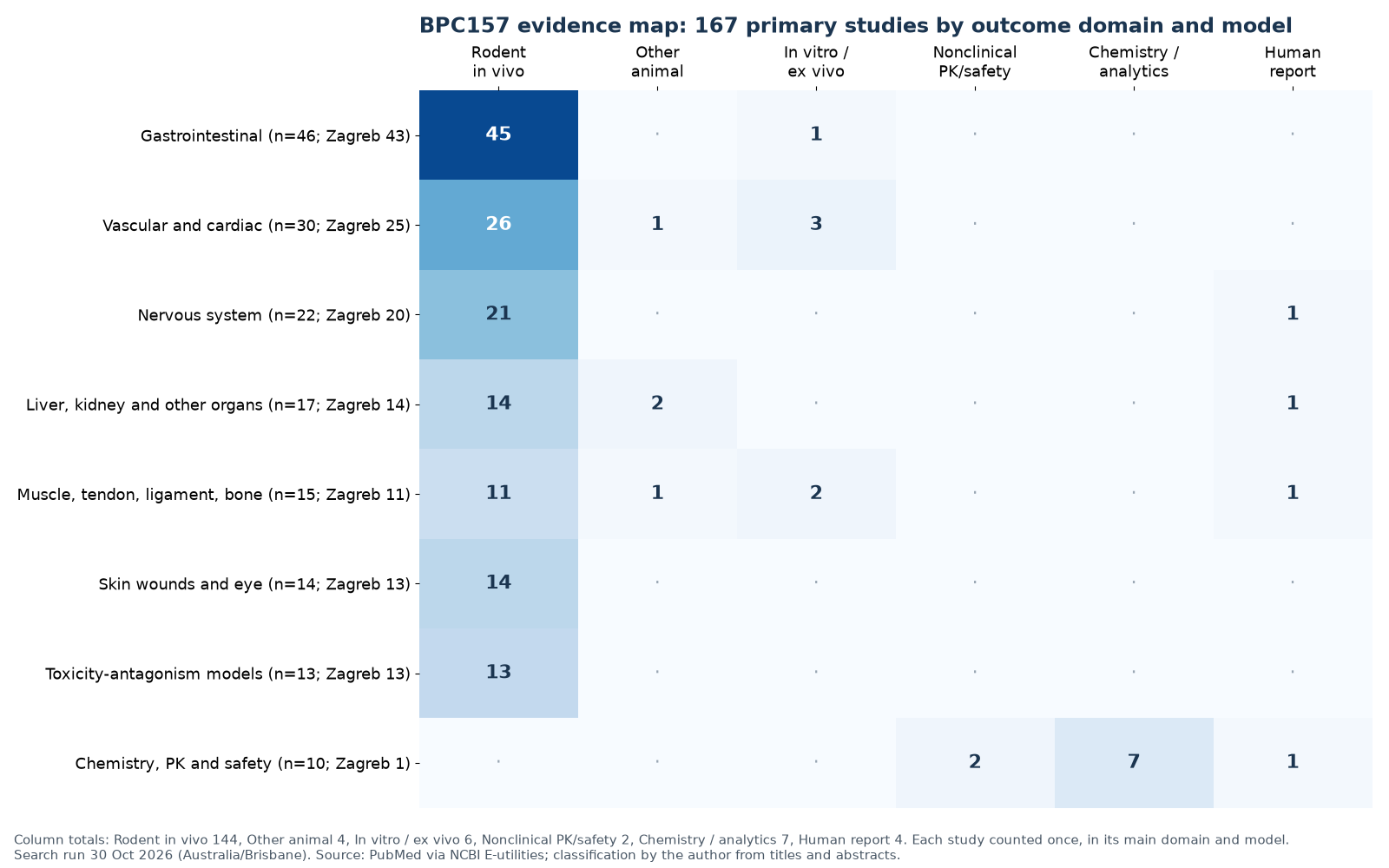
Of the 167 primary studies, 144 (86.2%; 144 ÷ 167) were in vivo rodent experiments (Table 2; Figure 2). Within those 144, rats alone were used in 122 studies (84.7%), mice alone in 10, both species in 9, and the species was not clear from the record in 3. Only four primary studies used another animal species. Two were in honeybees, investigating an apiculture parasite [49]. One was a 1999 rabbit bone-defect study [50], and one was a 1997 study in broiler chicks [51]. No efficacy study in a large mammal was identified. Six studies were in vitro or ex vivo, including tendon-fibroblast experiments [52, 53], isolated rat aorta and endothelial-cell work [54, 55] and an ex vivo study of human internal mammary artery segments obtained during surgery [56]. Two were nonclinical pharmacokinetic or safety studies [57, 31], seven were chemistry, analytical or formulation studies [28, 58, 59, 60, 61], and four reported data from people.
Table 2. BPC157 evidence map: 167 primary studies by main outcome domain and model (number of studies; Zagreb-group studies in brackets).
Outcome domain
Rodent in vivo
Other animal
In vitro / ex vivo
Nonclinical PK/safety
Chemistry / analytics
Human report
Total (Zagreb)
Gastrointestinal
45
0
1
0
0
0
46 (43)
Vascular and cardiac
26
1
3
0
0
0
30 (25)
Nervous system
21
0
0
0
0
1
22 (20)
Liver, kidney and other organs
14
2
0
0
0
1
17 (14)
Muscle, tendon, ligament and bone
11
1
2
0
0
1
15 (11)
Skin wounds and eye
14
0
0
0
0
0
14 (13)
Toxicity-antagonism models
13
0
0
0
0
0
13 (13)
Chemistry, pharmacokinetics and safety
0
0
0
2
7
1
10 (1)
Total (Zagreb)
144 (135)
4 (4)
6 (0)
2 (0)
7 (1)
4 (0)
167 (140)
Source: author classification of the PubMed core search (Table 1). Each study is counted once. Row and column totals were checked by summation: 46 + 30 + 22 + 17 + 15 + 14 + 13 + 10 = 167, and 144 + 4 + 6 + 2 + 7 + 4 = 167.
Outcome domains: from gastric lesions to nearly every organ
The gastrointestinal domain was the largest (46 studies). It is also the oldest: work on gastric and duodenal lesion models began in 1992 and continued through fistula, oesophageal-sphincter and periodontitis models [42, 62, 63, 64]. The most recent gastrointestinal primary study in the PubMed set was published in 2024. The vascular and cardiac domain (30 studies) is now the second largest. Since 2018 it has been dominated by a series of rat “occlusion” models, in which major vessels are ligated and outcomes across several organs are recorded [65, 66, 67]. Earlier work examined bleeding after amputation in anticoagulated rats [68]. Nervous system studies (22) range from behavioural models involving dopamine-active drugs to traumatic brain and spinal cord injury in rodents [69, 70, 71]. Thirteen studies tested BPC-157 against injury caused by an overdose of another drug or a toxic exposure, such as paracetamol or electrolyte disturbance. All 13 came from the Zagreb group [72, 73, 74, 75].
The musculoskeletal domain is the one most often cited online, yet it is comparatively small. It contains 15 primary studies: 11 rodent experiments on transected or crushed muscle, tendon, ligament and bone [76, 77, 78, 79, 80, 81], one rabbit bone study [50], two tendon-fibroblast studies [52, 53] and one human chart review [82]. Only one musculoskeletal animal study came from an independent group. That 2026 rat study of Achilles tendon healing included a TB-500 arm and a combined arm, and it reported that BPC-157 alone produced numerically lower injury scores that were not statistically significant on total scores [83]. It is the only independent in vivo test of a tendon outcome in the PubMed record, and it did not reproduce a clear effect for BPC-157 alone. One study does not refute a literature. It does show why independent replication matters.
Figure 2. Heat map of the BPC157 evidence base: 167 primary studies by outcome domain (rows) and model (columns), with the number of Zagreb-group studies in each domain. Rodent in vivo studies account for 144 of 167 (86.2%). Sources: PubMed search run 30 October 2026 [10]; classification by the author (Table 2). Data figure.
Results: concentration of BPC-157 research in one network
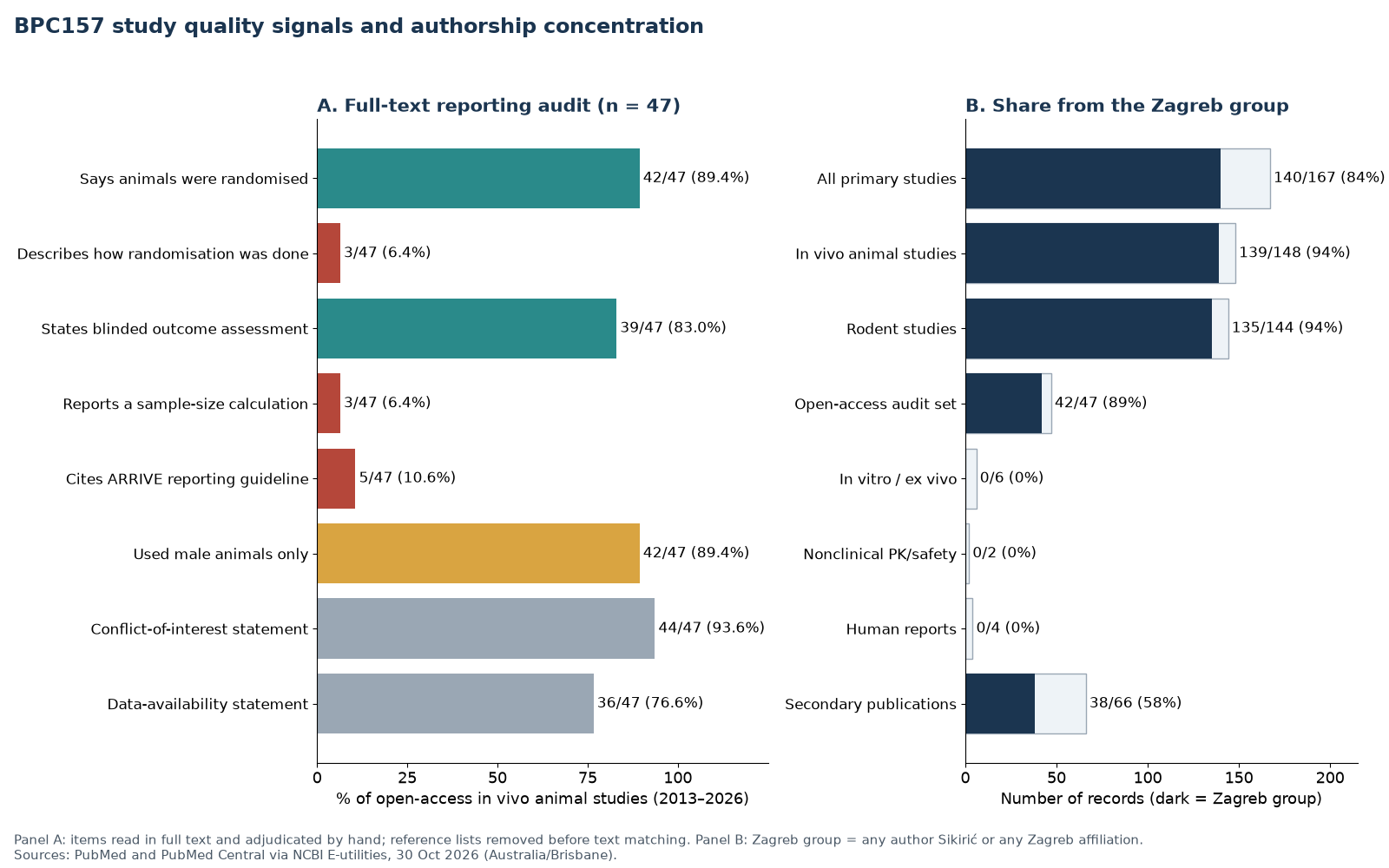
By the attribution rule set out in the Methods, the Zagreb group authored 140 of 167 primary studies (83.8%). Concentration was highest in exactly the categories that make up the efficacy literature. The group wrote 135 of 144 rodent studies (93.8%), all 4 other-animal studies, and 139 of 148 in vivo animal studies overall (93.9%; 139 ÷ 148). It wrote none of the 6 in vitro or ex vivo studies, none of the 2 nonclinical pharmacokinetic or safety studies, 1 of the 7 chemistry studies and none of the 4 human reports. The group also wrote 38 of the 66 secondary publications (57.6%), including several large narrative reviews of its own findings [30, 84, 85, 86].
Only nine in vivo animal efficacy studies in the PubMed record came from outside the Zagreb network, and all nine were in rodents. They covered a gastric ulcer model (2004) [87], an alkali-burn skin wound model (2015) [88], an angiogenesis and hind-limb ischaemia model (2017) [89], clopidogrel-induced gastric injury (2020) [90], incisional pain (2022) [91], radiation-induced liver injury (2022) [92], distant organ injury after limb ischaemia-reperfusion (2025) [93], lower-limb ischaemia (2026) [94] and Achilles tendon healing (2026) [83]. Each tested a different outcome, so none replicates another, and none was designed or reported as a direct replication of a specific Zagreb experiment. This review treats a finding as independently replicated when a second, unrelated group reproduces the same outcome in the same model and says so. By that standard, the review found no independently replicated BPC-157 finding in the PubMed record.
Concentration in one group is not evidence of error. Specialist laboratories often build large bodies of work on a single compound. But the TGA delegate’s 2024 observation that the studies “largely originate from a single laboratory” [23] is confirmed and quantified here. The lack of independent replication is directly relevant to the reproducibility concerns that meta-research has documented across preclinical science [21, 33]. A critical review of the rodent ischaemia-reperfusion literature published in 2026 reached a compatible conclusion. It found heterogeneous models and outcomes that precluded meta-analysis [95].
Results: reporting quality of BPC157 animal studies
The full-text audit covered 47 in vivo animal studies published between 2013 and 2026 (42 Zagreb, 5 other groups). Results are shown in Figure 3. Forty-two studies (89.4%; 42 ÷ 47) stated that animals were randomised, but only 3 (6.4%) described how the allocation sequence was generated. Thirty-nine (83.0%) stated that some assessment was blinded. Three (6.4%) reported a sample-size calculation, and 5 (10.6%) cited the ARRIVE guidelines. Forty-two (89.4%) used only male animals. Of the other five, four included female animals and one did not report sex. Conflict-of-interest statements were present in 44 (93.6%) and data-availability statements in 36 (76.6%). The three studies that described a randomisation method were also the three that reported a sample-size calculation, and all three were published in 2026 [96, 97, 98]. This suggests that reporting has recently begun to improve.
Figure 3. Reporting audit of 47 open-access BPC157 in vivo animal studies (2013–2026) against core ARRIVE 2.0 and SYRCLE items. Panel B shows the share of records in each category written by the Zagreb group. Sources: full texts from PubMed Central; items adapted from ARRIVE 2.0 [13] and SYRCLE [14]. Data figure.
These figures matter because unreported randomisation and blinding are associated with inflated effect estimates in animal research [19, 34]. Small, underpowered studies also produce exaggerated and less reproducible effects [21]. A statement that animals were “randomly assigned”, with no method, does not let a reader judge whether allocation was truly random. SYRCLE rates such studies as “unclear” risk for sequence generation [14]. On the items that can be assessed from text, the recent BPC-157 animal literature would therefore be rated mostly unclear risk of selection bias. The near-universal use of male animals means that findings in female animals are largely untested.
Results: BPC-157 human studies, abstracts and registrations
Peer-reviewed human reports: four uncontrolled studies
Four primary records in the PubMed set reported data from people (Table 3). Two others involved human material but not people: the ex vivo artery study [56] and in vitro work on human cells. The first peer-reviewed human report was a 2021 retrospective chart review from a single clinic in Florida. Seventeen patients with knee pain were identified who had received intra-articular injections of BPC-157, alone or combined with thymosin beta-4. Sixteen were contacted, and 12 had received BPC-157 alone. Outcomes were gathered by telephone without a validated instrument, and there was no comparison group [82]. The second was a 2024 single-arm pilot study of 12 women with interstitial cystitis who were treated during a single procedure at a private clinic. It reported symptom change on the Global Response Assessment questionnaire and no adverse events, again with no control group [99]. The third, published in 2025, described intravenous infusion in two adults at a private clinic, both of whom had received intravenous BPC-157 before. Its title describes it as a study of safety, and its abstract concludes that the results “showed the safety of BPC-157 in humans” [100]. Two participants cannot characterise the safety of anything, and prior exposure selects for people who had already tolerated the substance. The fourth, published in 2026, was a case report with narrative review. It described three people with inferior alveolar nerve injury, a complication of oral and maxillofacial surgery, who were managed with peptide agents together with dexamethasone and local anaesthetic. Because several interventions were given at once, the authors’ framing as “hypothesis-generating” is the appropriate reading [101].
Together, these four reports describe 33 people (16 + 12 + 2 + 3). The 2026 systematic review by Poolton and colleagues, which searched to 1 June 2026 and so predated the case report, included the first three (30 people). It rated all three as poor quality and the certainty of evidence as very low on GRADE [6]. The 2025 systematic review by Vasireddi and colleagues, which searched to June 2024, also found very limited human data in orthopaedic sports medicine [7]. None of the four peer-reviewed reports randomised participants, used a control or comparison group, or blinded outcome assessment.
Meeting abstracts outside PubMed: the 2002–2005 enema studies
A whole-corpus search of PubMed misses one set of human data. In its July 2026 briefing document for the Pharmacy Compounding Advisory Committee, the US FDA searched PubMed and Embase and identified three conference abstracts from 2002, 2003 and 2005 [15]. The 2002 and 2003 abstracts described a placebo-controlled phase 1 tolerability and pharmacokinetic study of BPC-157 given by rectal enema to healthy male volunteers. Thirty-two people were randomised, 24 of whom received BPC-157. The most frequently reported adverse events were headache and flatulence, with no obvious difference from placebo, and BPC-157 was reported as not detected, or mostly below the limit of quantification, in plasma [15]. The 2005 abstract described a multicentre, randomised, double-blind, placebo-controlled trial in 53 people with mild to moderate ulcerative colitis, of whom 46 completed. The FDA reported that the confidence interval for the between-group difference in the primary disease-activity score included zero. It judged that, because the study existed only as a meeting abstract lacking key details, the data were “inadequate to support the efficacy and safety” of BPC-157 for that use [15].
These abstracts are the only randomised, placebo-controlled human data on BPC-157 that this review could find. None was followed by a peer-reviewed full paper indexed in PubMed. That matters in two ways. First, phrases such as “in trials for inflammatory bowel disease” in older review titles [32], or statements in primary papers that BPC-157 had been “successful” in clinical use for ulcerative colitis [64], have no peer-reviewed trial report behind them. Second, the one randomised result that is visible, through the FDA’s description, did not show a clear difference from placebo. Including the abstracts, the FDA counted 81 people exposed to BPC-157 across five human studies, with the longest treatment lasting two weeks [102]. Those five studies are the two studies described in the abstracts and the three peer-reviewed reports published from 2021 to 2025; the published analysis does not break the total down by study, and no serious adverse events were reported in them [102]. The FDA also found three reports in its adverse event reporting system (FAERS), and it stressed that such reports cannot establish causation or safety in either direction [15].
Trial registrations: none with results
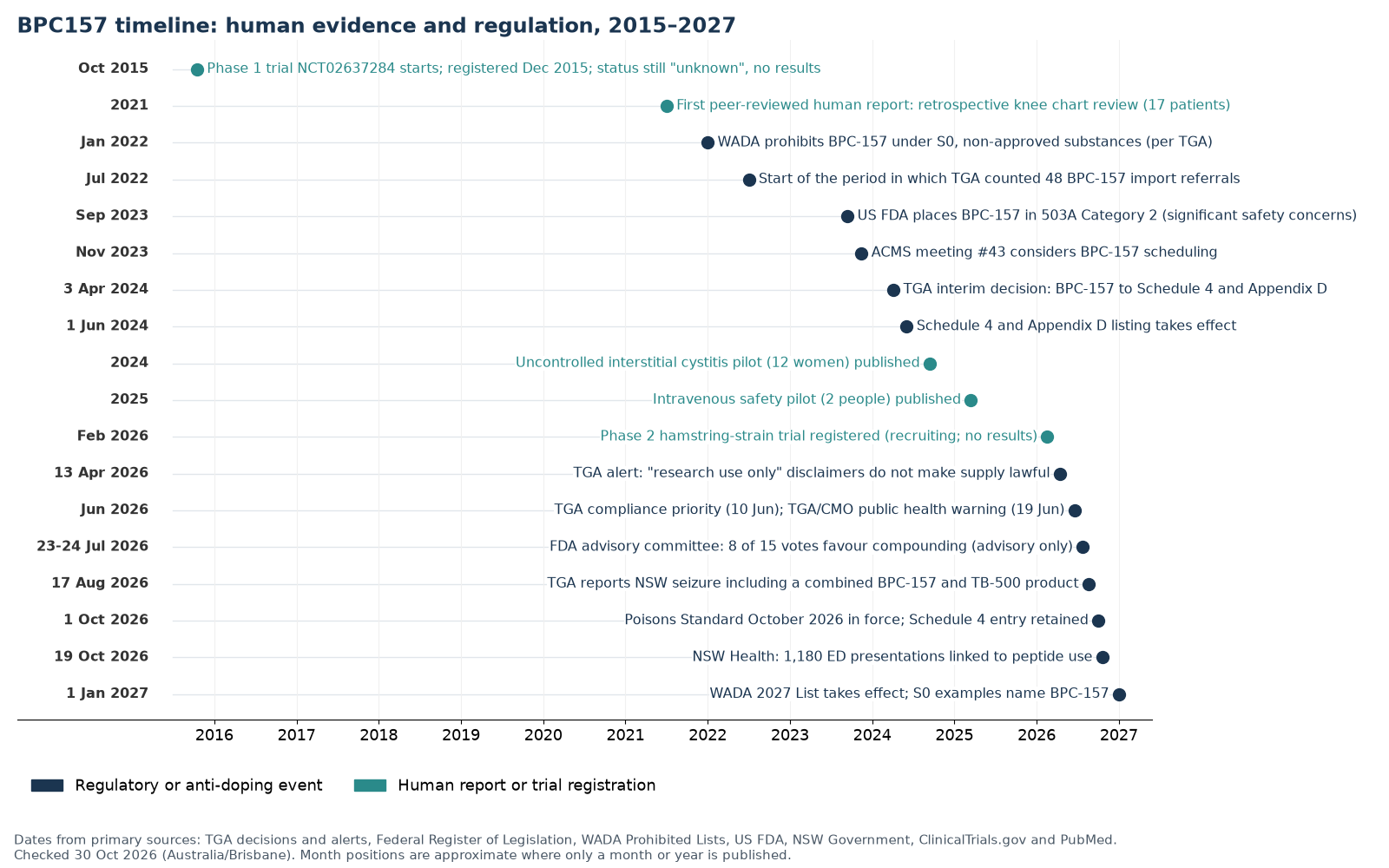
ClinicalTrials.gov held four unique BPC-157 registrations on 30 October 2026 [12]. The oldest, NCT02637284, is a randomised, quadruple-masked phase 1 study in healthy volunteers in Mexico with an estimated enrolment of 42. It started in October 2015 and was first submitted in December 2015, about two months after it started. Its estimated completion was March 2016, its record was last updated in December 2015, and its status is “unknown”. No results have been posted in the roughly 10 years and 7 months since its estimated completion, and the FDA could not find an associated publication [103, 15]. This is the “single registered phase 1 clinical trial conducted in 2015” cited by the TGA delegate in 2024 [23].
Three more registrations appeared in 2026. NCT07437547 is a randomised, quadruple-masked phase 2 study of hamstring strain in China with an estimated enrolment of 120. It started on 2 February 2026, was first submitted on 22 February 2026 (20 days after it started), and was recruiting at the time of the search [104]. NCT07803250 is a randomised, quadruple-masked phase 1 study in people undergoing rotator cuff repair in the United States, with an estimated enrolment of 30. It was registered before its planned start in January 2027 [105]. NCT07752381 is an open-label, single-group study of 40 people in the United States testing an oral product that contains BPC-157. It was recorded as completed on 1 November 2025 but first submitted on 3 August 2026, about nine months after completion, and no results have been posted [106]. In summary, none of the four registrations has posted results, three of the four were registered after the study began, and only one was registered prospectively. Retrospective registration weakens the protection that registries offer against selective outcome reporting [35].
Table 3. BPC-157 human studies, meeting abstracts and trial registrations identified on 30 October 2026 (doses deliberately omitted).
Completed November 2025; registered about 9 months after completion; no results
Results: BPC-157 regulatory status in Australia, sport and the United States
Is BPC-157 legal in Australia? The Schedule 4 and Appendix D listing
BPC-157 entered the Poisons Standard through a scheduling process that ran from November 2023 to June 2024. The proposal was considered at the November 2023 meeting of the Advisory Committee on Medicines Scheduling. It cited 48 referrals for importation of BPC-157 received by the TGA since 1 July 2022 [23]. The delegate’s interim decision, published in April 2024, was to create a Schedule 4 entry and to list BPC-157 in Appendix D, clause 5. The decision document stated that the putative human benefits were “largely unsubstantiated”, that the toxicity profile was “largely uncharacterised”, and that marketing the substance as “not for therapeutic use” or “for research only” was “insufficient to deter consumer misuse” [23]. The final decision confirmed the listing with an implementation date of 1 June 2024 [1]. The legislative instrument’s Explanatory Statement records that the entry added BPC-157 to Schedule 4 for the first time, and that the Appendix D listing means possession without authority is illegal [2, 36].
The Poisons Standard that commenced on 1 October 2026 retains the Schedule 4 entry and the Appendix D, clause 5 listing [16]. Schedule 4 covers prescription-only medicines. Under the Therapeutic Goods Act 1989, medicines supplied in Australia must generally be included in the ARTG unless an exemption, approval or authority applies [107], and BPC-157 is not on the ARTG [20]. On the question “is BPC-157 legal in Australia?”, the primary sources therefore support a precise answer. BPC-157 is not an approved medicine in Australia. It is a Schedule 4 substance with additional possession controls, and the TGA states that labels such as “research use only” or “not for human use” do not change whether a product is regulated as a therapeutic good [18, 3]. This review does not offer legal advice. Anyone with a specific question should consult the TGA, the relevant state or territory health department, or a lawyer.
TGA and state action in 2026
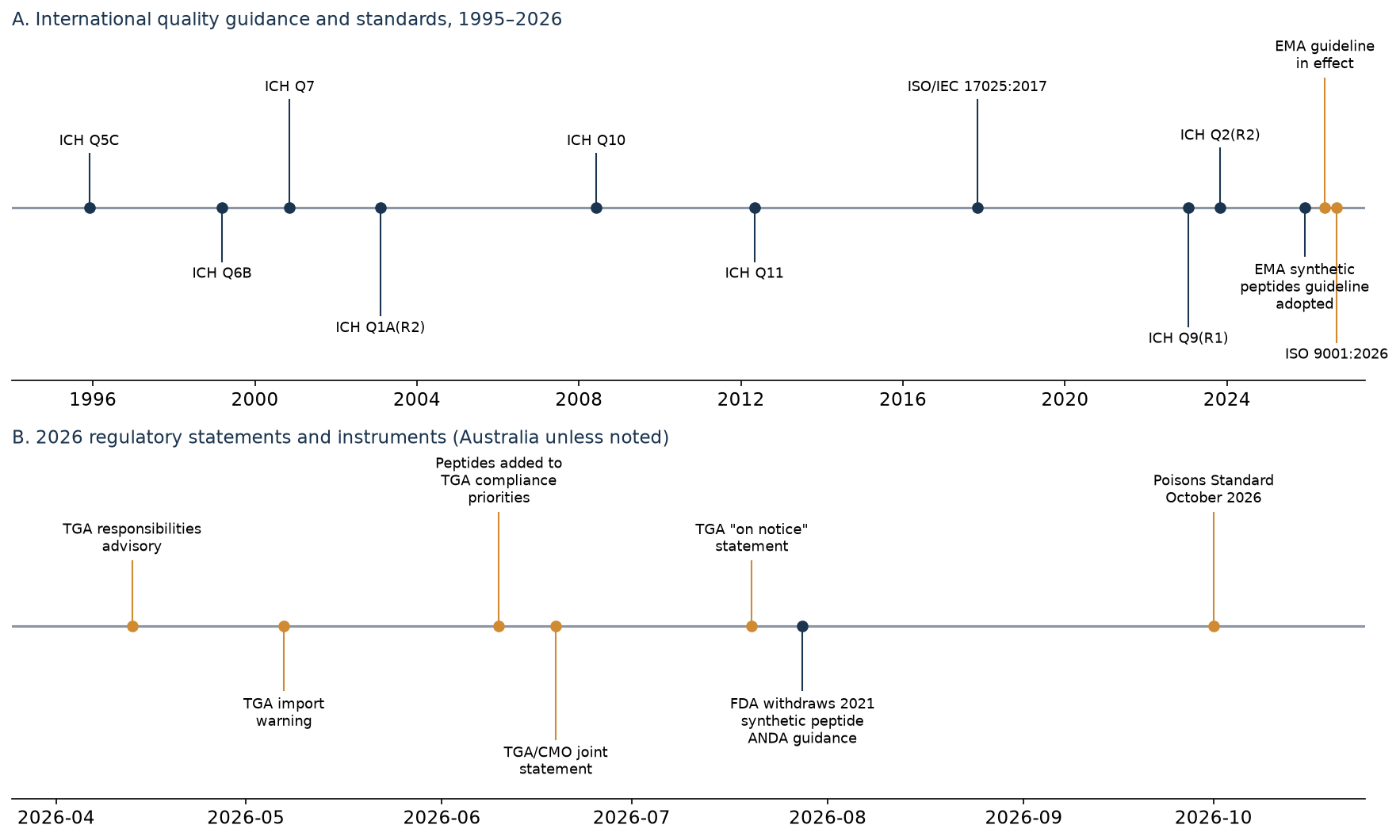
Regulatory attention increased sharply in 2026 (Figure 4). On 13 April 2026 the TGA published guidance on responsibilities when importing, compounding, supplying and advertising peptides. It named BPC-157 among unapproved peptides and stated that research-use disclaimers do not make supply lawful [3]. On 10 June the TGA added unapproved peptide products to its compliance priorities [37]. On 19 June the TGA and Australia’s Chief Medical Officer issued a joint statement on public health risks. It named BPC-157 and noted that the TGA has no oversight of the composition of unapproved products [4]. On 20 July the TGA put promoters and suppliers of unapproved peptides on notice [38]. On 17 August it reported that more than $120,000 of goods had been seized in New South Wales after warrants were executed on 4 August 2026, including a combined BPC-157 and TB-500 product [39]. On 19 October NSW Health reported 1,180 emergency department presentations associated with peptide use between 1 July 2025 and 30 September 2026, rising from 5 in July 2025 to more than 217 in September 2026 [5]. Over those 15 months that is an average of about 79 presentations a month (1,180 ÷ 15 = 78.7). The release attributes presentations to peptide use generally, not to BPC-157 specifically, and should not be read as a BPC-157 harm estimate.
BPC-157 and WADA: prohibited at all times in sport
BPC-157 falls under section S0 (Non-Approved Substances) of the WADA Prohibited List. S0 covers pharmacological substances not approved by any government health authority for human therapeutic use, and they are prohibited at all times, in and out of competition. According to the TGA delegate, the listing applied from January 2022 [23]. BPC-157 is named as an example in the S0 text of the 2025 and 2026 Lists [25, 26]. The 2027 List, approved by WADA’s Executive Committee on 10 September 2026 and in force from 1 January 2027, retains it [17, 40]. Sport Integrity Australia states that BPC-157 is prohibited and that a Therapeutic Use Exemption would not be granted for it [20]. The United States Anti-Doping Agency describes it as an experimental peptide that creates risk for athletes [108, 109]. A validated urine detection method for BPC-157 was reported after the peptide was identified in confiscated vials [28]. A harmonised anti-doping workflow covering peptidic agents was published in 2026 [59], and in vitro metabolite profiling has also been reported [58].
United States: FDA safety concerns and the 2026 advisory committee
The US FDA lists BPC-157 on its page of bulk drug substances that may present significant safety risks in compounding. It states that the substance may pose a risk for immunogenicity and for peptide-related impurities, and that the agency lacks sufficient information to know whether it would cause harm when administered to humans [41]. In July 2026 the FDA’s Pharmacy Compounding Advisory Committee considered whether BPC-157 should be added to the list of bulk substances eligible for compounding. FDA scientists proposed that it should not. They cited inadequate physicochemical characterisation, insufficient safety and immunogenicity information, insufficient evidence of effectiveness, and the fact that its molecular targets had not been identified [15]. According to a published analysis of the meeting, 15 members voted on BPC-157: 8 supported adding it, 6 voted against and 1 abstained. That recommendation is advisory and does not itself change BPC-157’s status [102]. The FDA had not announced a final decision in the sources reviewed on 30 October 2026.
Table 4. BPC-157 regulatory and anti-doping status, verified at primary sources on 30 October 2026.
Jurisdiction or body
Instrument or source
Status of BPC-157
Effective or published
Australia: Poisons Standard
F2024L00589; current instrument F2026L01327 [2, 16]
8 of 15 votes in favour of compounding eligibility; advisory only
July 2026; no final FDA decision found
Figure 4. Timeline of BPC-157 human evidence, trial registrations and regulatory events, 2015–2027. Every event was checked against a primary source. Sources: [103, 82, 23, 1, 2, 99, 100, 104, 3, 102, 37, 4, 15, 39, 16, 5, 17]. Data figure.
Discussion: what the BPC157 evidence map shows
A large animal literature with almost no human translation
The central finding of this review is the gap between the volume and the type of BPC157 evidence. The corpus is large, with 167 primary records over 34 years, and it covers almost every organ system. It is also almost entirely preclinical: 86% of primary records are rodent studies, and only four peer-reviewed reports describe data from people. Those four reports are uncontrolled and together describe 33 people. The only randomised, placebo-controlled human data are three meeting abstracts from 2002 to 2005, which were never published as full papers and are visible today only through the FDA’s description of them [15]. The one randomised efficacy comparison reported in those abstracts did not show a clear difference from placebo. On the question “what do BPC-157 human studies show?”, this is the most accurate one-sentence answer the record supports: very little, and nothing from a peer-reviewed controlled trial.
This gap is not unusual in itself. Most compounds that look promising in rodents never show a benefit in people. Systematic reviews of animal research have repeatedly found that poor reporting of randomisation, blinding and sample size is associated with larger estimated effects [34, 21]. What is unusual about BPC-157 is the combination of three features: the length of time the animal record has grown without a clinical programme reaching publication, the concentration of that record in one group, and the extent to which the substance is promoted online as though human efficacy had been established. The TGA delegate made the same observation in 2024, describing a small number of peer-reviewed studies “that largely originate from a single laboratory” and “only a single registered phase 1 clinical trial conducted in 2015” [23]. Two years later, the number of registrations has risen to four, but none has posted results.
Why concentration in one group matters
The single-group pattern is the most distinctive feature of this literature. Of the 167 primary studies, 140 (83.8%) came from the Zagreb group, and the proportion was higher still among in vivo animal studies (139 of 148, 93.9%). The group has been prolific and consistent, and its papers describe a coherent mechanistic programme centred on nitric oxide, angiogenesis and a proposed “cytoprotective” action [30, 86, 85]. Concentration is not evidence of error. It does mean, however, that the credibility of almost every BPC-157 finding depends on the methods of one laboratory. It also means that the field has had little of the independent testing that normally separates robust effects from chance or method-specific results.
The few independent studies identified here are informative precisely because they are independent. A 2026 rat study of Achilles tendon healing from an independent group reported that BPC-157 alone produced numerically lower injury scores that were not statistically significant on total scores [83]. Work from a Taiwanese group on tendon fibroblasts and vessel tone added mechanistic detail but did not test the Zagreb in vivo models [52, 53, 54]. A pharmacokinetic and toxicology programme in China reported data from mice, rats, rabbits and dogs, and it remains the most systematic published safety work [57, 31]. None of these studies was designed as a replication. The field therefore still lacks the most basic test of robustness: an independent laboratory, using a pre-registered protocol and blinded assessment, repeating a key Zagreb experiment.
Reporting quality and what it implies
The reporting audit in this review (Figure 3) found that randomisation was stated in 42 of 47 full texts, but its method was described in only 3. Blinding was mentioned in 39, a sample size calculation was reported in only 3, and only 5 referred to the ARRIVE guidelines. These are not trivial omissions. ARRIVE 2.0 places randomisation, blinding and sample size among its “essential 10” items because inadequate reporting of them is associated with biased estimates [13, 34]. The audit also found that 42 of the 47 studies used male animals only. That limits generalisability, and it means that any sex differences in response have not been examined. The improvements seen in 2026, when three Zagreb papers described their randomisation method or sample size, are welcome. They are also recent, few and not yet the norm.
How errors propagate in secondary literature
Secondary literature now outnumbers new primary research: in 2025 and 2026, this review counted 33 secondary records against 16 primary studies. That shift matters because errors in reviews tend to be copied. Three examples emerged from this review. First, older review titles describe BPC-157 as being “in trials for inflammatory bowel disease” [32, 110], and a 2008 primary paper describes it as “in clinical trials” [111]. Some primary papers go further and describe clinical use in ulcerative colitis as successful [64]. The only trial-level data visible today are meeting abstracts, and the FDA judged them inadequate [15]. Second, a 2025 literature and patent review states that BPC-157 is “not currently listed as banned by the WADA” [24]. The 2025 Prohibited List names BPC-157 in S0 [25], as do the 2026 and 2027 Lists [26, 17]. Third, online commentary often treats the 2015 registration NCT02637284 as evidence of human testing. Its record shows no results, an unknown status and no update since 2015 [103]. Each of these points can be checked in minutes against a primary source. Each is also repeated widely, which is why this review verified every regulatory and registry statement at source.
The secondary literature is also contested. In 2025, the Zagreb group published a commentary on the Józwiak review, followed by the authors’ reply [112, 113], and a separate commentary responded to a lengthy 2024 Zagreb review [114]. Several reviews written for clinicians in 2026 emphasise limited clinical validation, product quality concerns, regulatory status and anti-doping implications [48, 46, 47, 43, 45]. One, searching to June 2026, found that human musculoskeletal evidence was limited to one small retrospective uncontrolled case series [47]. A 2026 review from a drug-development perspective noted that BPC-157 has no approved formulation and no completed phase II clinical trial, and that its pharmaceutical development remains rudimentary [115].
How this review differs from earlier BPC-157 reviews
Four recent reviews are the closest to this one. The systematic review by Vasireddi and colleagues searched to 3 June 2024 and included 36 studies relevant to orthopaedic sports medicine, of which 35 were preclinical and one was clinical [7]. The systematic review by Poolton and colleagues searched to 1 June 2026, included only human studies, and found three (30 people) of poor quality, with very low certainty of evidence [6]. The narrative review by McGuire and colleagues considered musculoskeletal healing and framed the question as regeneration or risk [8]. The critical review by Demirtaş, published in September 2026, examined rodent ischaemia–reperfusion models and concluded that the evidence was heterogeneous, often relied on short observation periods and single-dose designs, and supported BPC-157 only as a “hypothesis-generating” preclinical candidate [95].
This review adds four things those reviews do not provide. It counts the whole PubMed corpus with a reproducible search and classifies every record. It quantifies the single-group concentration rather than describing it. It audits reporting quality across all open-access full texts. And it reconciles the peer-reviewed human reports with the meeting abstracts, the trial registrations and the FDA’s 2026 count of exposed participants, all checked against primary sources. Its conclusions are consistent with the earlier reviews. They also show that the pattern those reviews describe in specific fields, mostly animal data from one group with very little human evidence, holds across the whole literature.
BPC-157 side effects and safety: what the evidence can and cannot say
Questions about BPC-157 side effects and safety are common, and the honest answer is that its safety in people has not been characterised. The preclinical safety work by Xu and colleagues reported that the peptide was well tolerated in mice, rats, rabbits and dogs, with no genetic or embryo-fetal toxicity observed [57]. Pharmacokinetic work in rats and dogs reported an elimination half-life of under 30 minutes and rapid metabolism [31]. These data are useful, but they cannot be extrapolated to people, to repeated or long-term exposure, or to products of unknown composition. The human reports are too small and too poorly controlled to detect anything but the most common adverse effects. A study of two people cannot establish safety, even when its title says otherwise [100], and the Poolton review rated the overall certainty as very low [6].
Regulators have reached the same conclusion. The TGA delegate described the toxicity profile as “largely uncharacterised” [23]. The FDA states that it lacks sufficient information to know whether BPC-157 would cause harm when administered to humans, and it has raised concerns about immunogenicity and peptide-related impurities [41]. A published analysis of the 2026 advisory committee materials noted that certificates of analysis for these products lacked peptide-specific testing [102]. The TGA has warned that it has no oversight of the composition of unapproved peptide products [4], and NSW Health has reported a rise in emergency department presentations associated with peptide use in general [5]. None of these sources establishes a specific harm from BPC-157. Together they show that the absence of reported harm in small studies is not evidence of safety.
What “research use only” does and does not mean
Products containing BPC-157 are often labelled “for research use only” or “not for human consumption”. The regulatory position on this point is clear. The TGA delegate noted in 2024 that such disclaimers were used “to circumvent existing controls on therapeutic goods” [23]. In 2026 the TGA stated that wording such as “research use only” does not change whether a product is a therapeutic good or whether its supply is lawful [18, 3]. A label describes intended use. It does not change a substance’s scheduling, approval status or anti-doping status. For an Australian reader, the relevant facts are that BPC-157 is a Schedule 4 substance listed in Appendix D, that it is not on the ARTG, and that it is prohibited at all times in sport [16, 20, 17].
Human-evidence gap analysis: research questions for BPC-157
The evidence map points to specific, answerable questions. Table 5 sets out seven of them, the gap each addresses, and the type of study that could answer it. The table deliberately specifies designs and outcomes, not doses or protocols. Any human study would need ethics approval and, in Australia, would need to operate within the clinical trial and scheduling frameworks that apply to an unapproved Schedule 4 substance [107, 16].
Table 5. Priority research questions arising from the BPC-157 evidence map (designs only; no doses or protocols).
#
Research question
Evidence gap identified in this review
Study design that could answer it
1
Do key Zagreb findings replicate independently?
83.8% of attributable primary studies from one group; no reported direct replication
Pre-registered, multi-laboratory replication of a high-priority rodent model, with blinded outcome assessment and ARRIVE 2.0 reporting [13]
2
Are effects present in female animals?
42 of 47 audited full texts used male animals only
Replication studies powered to test sex as a biological variable
3
What happened in the 2002–2005 randomised studies?
Only meeting abstracts; full results never published
Full publication or data release of the original studies, with the original protocol and outcomes
4
What was found in NCT02637284?
Status unknown since 2015; no results
Results posting or a documented reason for non-completion
5
Does BPC-157 differ from placebo in a defined musculoskeletal condition?
No peer-reviewed controlled human trial
Completion and full reporting of the registered randomised, masked trials, with pre-specified outcomes [104, 105]
6
What is the safety and immunogenicity profile in people?
81 exposed participants in total; longest treatment two weeks; no immunogenicity data
Phase 1 studies with characterised material, anti-drug antibody testing and systematic adverse event collection [15]
7
What is actually in unregulated products?
Regulators report no oversight of composition; certificates lack peptide-specific tests
Independent analytical surveys of seized or purchased samples for identity, content and impurities [28, 4]
Questions 1, 3 and 4 could be answered without exposing anyone to BPC-157. Publishing the 2002–2005 data and the outcome of NCT02637284 would provide the first peer-reviewed randomised human evidence on BPC-157, of which there is currently none. Independent preclinical replication would show whether the large Zagreb literature is reproducible. Question 6 reflects the FDA’s view that immunogenicity has not been addressed [41], and question 7 reflects the TGA’s warning about the composition of unapproved products [4].
Limitations of this review
This review has several limitations. The main corpus came from PubMed, so studies indexed only in Embase, Scopus or regional databases may have been missed. The Europe PMC count was used as a cross-check [11], and the FDA’s PubMed and Embase search identified the meeting abstracts that PubMed alone misses [15]. Records were screened and classified by one reviewer using a pre-specified scheme, without independent duplicate screening. Classification of study models and domains involved judgement, and a second reviewer might classify some records differently. Affiliation-based attribution relied on author and affiliation data and may misattribute some collaborative studies. The reporting audit was limited to 47 open-access full texts, which may not represent studies without open full text, and it recorded whether items were reported, not whether they were done well. The Australian New Zealand Clinical Trials Registry blocked automated access, so registrations there could not be checked systematically. Regulatory sources change. Every regulatory statement here was checked on 30 October 2026, and later changes are not reflected. Finally, this review did not assess risk of bias in individual studies or pool effect sizes, because the heterogeneity of models and outcomes would make a pooled estimate misleading.
Conclusion: the state of BPC157 evidence in 2026
BPC157 has one of the largest single-group literatures of any investigational peptide. That literature is overwhelmingly preclinical, concentrated in one laboratory, poorly reported on the items most linked to bias, and largely untested in female animals. In people, the peer-reviewed record consists of four uncontrolled reports describing 33 people. The only randomised data are meeting abstracts from 20 years ago, and four trial registrations have produced no results. In Australia, BPC-157 is a Schedule 4 substance listed in Appendix D and is not on the ARTG. In sport, it is prohibited at all times under the WADA S0 category, including in the 2027 List. In the United States, it is unapproved and the FDA has raised safety and quality concerns. Labels such as “research use only” change none of this. Until independent replications and controlled human trials are completed and fully reported, statements that BPC-157 has been shown to have specific effects in people are not supported by the evidence.
Relevance to Eternal Peptides Wholesale
Eternal Peptides Wholesale distributes research peptides in wholesale boxes of 10 vials, for laboratory research use only and not for human consumption (company background). It publishes this review because BPC157 is one of the most searched peptide names, and an accurate summary of its evidence and regulatory position is more useful to researchers than marketing claims. As this review shows, a “research use only” label is not legal clearance, and BPC-157 is a Schedule 4 and Appendix D substance in Australia.
What the site documents is analytical, not biological. Its certificate of analysis library transcribes batch-specific reports from Janoshik Analytical, an independent laboratory, and the testing standards page explains how identity, purity and content results are read. Those reports bear on the analytical gap identified in question 7 of Table 5. They say nothing about effects in people and do not establish regulatory approval, clinical suitability or safety for human use. Related evidence reviews from Eternal Peptides Wholesale are on the blog, including an analysis of peptides for muscle gain and a guide to reading peptide research claims.
Glossary
Appendix D (clause 5): part of the Poisons Standard listing poisons for which possession without authority is illegal; BPC-157 is item 5.
ARRIVE 2.0: reporting guidelines for animal research, including an “essential 10” set of items such as randomisation, blinding and sample size.
ARTG: Australian Register of Therapeutic Goods, the TGA’s register of goods that can be lawfully supplied in Australia.
BPC157 (BPC-157, BPC 157): a synthetic 15-amino-acid peptide (GEPPPGKPADDAGLV), also coded PL 14736, studied mainly in rat injury models.
Evidence map: a systematic description of what research exists on a topic, by design, model and domain, without pooling results.
FAERS: the FDA Adverse Event Reporting System, a database of voluntary reports that cannot establish causation.
GRADE: a framework for rating the certainty of a body of evidence as high, moderate, low or very low.
Meeting abstract: a short summary presented at a conference, usually not peer reviewed in full and often lacking methods and results detail.
PCAC: the FDA’s Pharmacy Compounding Advisory Committee, whose recommendations are advisory.
Prospective registration: registering a trial before its first participant is enrolled, so that planned outcomes are on record.
S0 (Non-Approved Substances): the WADA Prohibited List section for substances with no current approval for human therapeutic use; prohibited at all times.
Schedule 4: the Poisons Standard schedule for prescription-only medicines.
Zagreb group: the University of Zagreb research network that has produced most BPC-157 studies, defined for this review by the attribution rule in the Methods.
BPC157 frequently asked questions
What is BPC157?
BPC157, also written BPC-157 or BPC 157, is a synthetic peptide of 15 amino acids. It was first described in the early 1990s by researchers in Zagreb in connection with a peptide found in gastric juice. Almost all research on it consists of rodent studies, and 83.8% of primary studies come from one research group in Zagreb. It is not an approved medicine in Australia or the United States.
Is BPC-157 legal in Australia?
BPC-157 is not an approved medicine in Australia and is not on the ARTG. Since 1 June 2024 it has been a Schedule 4 (prescription-only) substance, and it is listed in Appendix D, clause 5, which makes possession without authority illegal. The current Poisons Standard, in force from 1 October 2026, retains both entries. This summary is not legal advice.
Why is BPC-157 Schedule 4?
The TGA delegate’s 2024 reasons cited putative human benefits that were “largely unsubstantiated”, a toxicity profile that was “largely uncharacterised”, a limited evidence base largely from a single laboratory, and the risk of misuse, particularly among athletes. The proposal followed 48 import referrals for BPC-157 received by the TGA since 1 July 2022.
Is BPC-157 banned by WADA?
Yes. BPC-157 is prohibited at all times, in and out of competition, under section S0 (Non-Approved Substances) of the WADA Prohibited List. It is named in the 2025, 2026 and 2027 Lists. Sport Integrity Australia states that a Therapeutic Use Exemption would not be granted for it.
Are there BPC-157 human studies?
Very few. Four peer-reviewed reports describe 33 people, and none had a control group. Randomised, placebo-controlled data exist only as meeting abstracts from 2002 to 2005, which the FDA judged inadequate. Four trials are registered on ClinicalTrials.gov, and none has posted results.
What is known about BPC-157 side effects and safety?
Its safety in people has not been established. Animal toxicology reported it was well tolerated, but the human reports are too small to characterise side effects. The TGA described its toxicity profile as largely uncharacterised, and the FDA has raised concerns about immunogenicity and impurities. The absence of reported harm in small studies is not evidence of safety.
Is BPC-157 approved by the FDA?
No. The FDA lists BPC-157 among bulk drug substances that may present significant safety risks in compounding. In July 2026 FDA scientists proposed that it should not be made eligible for compounding. An advisory committee vote of 8 in favour, 6 against and 1 abstention is advisory only, and no final FDA decision had been announced by 30 October 2026.
Does a “research use only” label change the legal status of BPC 157?
No. The TGA states that wording such as “research use only” or “not for human use” does not change whether a product is regulated as a therapeutic good or make its supply lawful. BPC 157 remains a Schedule 4 and Appendix D substance whatever the label says.
Poolton JT, Minett J, Kazmi A. Human evidence for BPC-157 in orthopaedic and regenerative medicine: a systematic review of efficacy and safety. Acta Orthop Belg. 2026;92(3). doi:10.52628/92.3.15837 PMID: 42885452. Available at: https://doi.org/10.52628/92.3.15837. Accessed 30 October 2026.
Vasireddi N, Hahamyan H, Salata MJ, et al. Emerging Use of BPC-157 in Orthopaedic Sports Medicine: A Systematic Review. HSS J. 2025;21(4):485-495. doi:10.1177/15563316251355551 PMID: 40756949. Available at: https://doi.org/10.1177/15563316251355551. Accessed 30 October 2026.
McGuire FP, Martinez R, Lenz A, et al. Regeneration or Risk? A Narrative Review of BPC-157 for Musculoskeletal Healing. Curr Rev Musculoskelet Med. 2025;18(12):611-619. doi:10.1007/s12178-025-09990-7 PMID: 40789979. Available at: https://doi.org/10.1007/s12178-025-09990-7. Accessed 30 October 2026.
Page MJ, McKenzie JE, Bossuyt PM, et al. The PRISMA 2020 statement: an updated guideline for reporting systematic reviews. BMJ. 2021;372:n71. doi:10.1136/bmj.n71 PMID: 33782057. Available at: https://doi.org/10.1136/bmj.n71. Accessed 30 October 2026.
National Center for Biotechnology Information. Entrez Programming Utilities (E-utilities) Help. Bethesda (MD): National Library of Medicine. Available at: https://www.ncbi.nlm.nih.gov/books/NBK25501/. Accessed 30 October 2026.
ClinicalTrials.gov. ClinicalTrials.gov API (version 2). U.S. National Library of Medicine. Available at: https://clinicaltrials.gov/data-api/api. Accessed 30 October 2026.
Percie du Sert N, Hurst V, Ahluwalia A, et al. The ARRIVE guidelines 2.0: Updated guidelines for reporting animal research. PLoS Biol. 2020;18(7):e3000410. doi:10.1371/journal.pbio.3000410 PMID: 32663219. Available at: https://doi.org/10.1371/journal.pbio.3000410. Accessed 30 October 2026.
Hooijmans CR, Rovers MM, de Vries RB, et al. SYRCLE's risk of bias tool for animal studies. BMC Med Res Methodol. 2014;14:43. doi:10.1186/1471-2288-14-43 PMID: 24667063. Available at: https://doi.org/10.1186/1471-2288-14-43. Accessed 30 October 2026.
U.S. Food and Drug Administration. FDA Briefing Document: Pharmacy Compounding Advisory Committee (PCAC) meeting, July 23–24, 2026. BPC-157 (free base) and BPC-157 acetate. Silver Spring (MD): FDA; 2026. Available at: https://www.fda.gov/media/193343/download. Accessed 30 October 2026.
Macleod MR, Lawson McLean A, Kyriakopoulou A, et al. Risk of Bias in Reports of In Vivo Research: A Focus for Improvement. PLoS Biol. 2015;13(10):e1002273. doi:10.1371/journal.pbio.1002273 PMID: 26460723. Available at: https://doi.org/10.1371/journal.pbio.1002273. Accessed 30 October 2026.
Button KS, Ioannidis JP, Mokrysz C, et al. Power failure: why small sample size undermines the reliability of neuroscience. Nat Rev Neurosci. 2013;14(5):365-76. doi:10.1038/nrn3475 PMID: 23571845. Available at: https://doi.org/10.1038/nrn3475. Accessed 30 October 2026.
Hackam DG, Redelmeier DA. Translation of research evidence from animals to humans. JAMA. 2006;296(14):1731-2. doi:10.1001/jama.296.14.1731 PMID: 17032985. Available at: https://doi.org/10.1001/jama.296.14.1731. Accessed 30 October 2026.
Józwiak M, Bauer M, Kamysz W, et al. Multifunctionality and Possible Medical Application of the BPC 157 Peptide-Literature and Patent Review. Pharmaceuticals (Basel). 2025;18(2). doi:10.3390/ph18020185 PMID: 40005999. Available at: https://doi.org/10.3390/ph18020185. Accessed 30 October 2026.
Cox HD, Miller GD, Eichner D. Detection and in vitro metabolism of the confiscated peptides BPC 157 and MGF R23H. Drug Test Anal. 2017;9(10):1490-1498. doi:10.1002/dta.2152 PMID: 28035768. Available at: https://doi.org/10.1002/dta.2152. Accessed 30 October 2026.
Sikirić P, Petek M, Rucman R, et al. A new gastric juice peptide, BPC. An overview of the stomach-stress-organoprotection hypothesis and beneficial effects of BPC. J Physiol Paris. 1993;87(5):313-27. doi:10.1016/0928-4257(93)90038-u PMID: 8298609. Available at: https://doi.org/10.1016/0928-4257(93)90038-u. Accessed 30 October 2026.
Sikiric P, Boban Blagaic A, Strbe S, et al. The Stable Gastric Pentadecapeptide BPC 157 Pleiotropic Beneficial Activity and Its Possible Relations with Neurotransmitter Activity. Pharmaceuticals (Basel). 2024;17(4). doi:10.3390/ph17040461 PMID: 38675421. Available at: https://doi.org/10.3390/ph17040461. Accessed 30 October 2026.
He L, Feng D, Guo H, et al. Pharmacokinetics, distribution, metabolism, and excretion of body-protective compound 157, a potential drug for treating various wounds, in rats and dogs. Front Pharmacol. 2022;13:1026182. doi:10.3389/fphar.2022.1026182 PMID: 36588717. Available at: https://doi.org/10.3389/fphar.2022.1026182. Accessed 30 October 2026.
Sikiric P, Seiwerth S, Brcic L, et al. Stable gastric pentadecapeptide BPC 157 in trials for inflammatory bowel disease (PL-10, PLD-116, PL 14736, Pliva, Croatia). Full and distended stomach, and vascular response. Inflammopharmacology. 2006;14(5-6):214-21. doi:10.1007/s10787-006-1531-7 PMID: 17186181. Available at: https://doi.org/10.1007/s10787-006-1531-7. Accessed 30 October 2026.
Landis SC, Amara SG, Asadullah K, et al. A call for transparent reporting to optimize the predictive value of preclinical research. Nature. 2012;490(7419):187-91. doi:10.1038/nature11556 PMID: 23060188. Available at: https://doi.org/10.1038/nature11556. Accessed 30 October 2026.
Kilkenny C, Parsons N, Kadyszewski E, et al. Survey of the quality of experimental design, statistical analysis and reporting of research using animals. PLoS One. 2009;4(11):e7824. doi:10.1371/journal.pone.0007824 PMID: 19956596. Available at: https://doi.org/10.1371/journal.pone.0007824. Accessed 30 October 2026.
De Angelis C, Drazen JM, Frizelle FA, et al. Clinical trial registration: a statement from the International Committee of Medical Journal Editors. N Engl J Med. 2004;351(12):1250-1. doi:10.1056/NEJMe048225 PMID: 15356289. Available at: https://doi.org/10.1056/NEJMe048225. Accessed 30 October 2026.
Sikiric P, Petek M, Rucman R, et al. The significance of the gastroprotective effect of body protection compound (BPC): modulation by different procedures. Acta Physiol Hung. 1992;80(1-4):89-98. PMID: 1345210. Available at: https://pubmed.ncbi.nlm.nih.gov/1345210/. Accessed 30 October 2026.
Mendias CL, Awan TM. Safety and Efficacy of Approved and Unapproved Peptide Therapies for Musculoskeletal Injuries and Athletic Performance. Sports Med. 2026;56(8):1921-1935. doi:10.1007/s40279-026-02437-0 PMID: 41966639. Available at: https://doi.org/10.1007/s40279-026-02437-0. Accessed 30 October 2026.
Willis J, Vu N. Synthetic Peptides in Pharmacy Compounding: Analysis of PCAC Recommendations and Industry Safety Standards. Int J Pharm Compd. 2026;30(4):329-336. PMID: 42752426. Available at: https://pubmed.ncbi.nlm.nih.gov/42752426/. Accessed 30 October 2026.
Moiz A, O’Keefe EL, O’Keefe JH. Dangers of Injectable Peptides and Other Unregulated "Biohacking" Drugs. Mo Med. 2026;123(4):337-343. PMID: 42757290. Available at: https://pubmed.ncbi.nlm.nih.gov/42757290/. Accessed 30 October 2026.
Villegas Meza AD, Nocek M, Mitchell BC, et al. Injectable Peptides in Sports Medicine: A Structured Narrative Review of Evidence, Safety, and Antidoping Implications. JBJS Rev. 2026;14(5). doi:10.2106/JBJS.RVW.26.00027 PMID: 42160466. Available at: https://doi.org/10.2106/JBJS.RVW.26.00027. Accessed 30 October 2026.
Tham A, Hodgkins CW, Kennedy JG. Investigational Peptides in Orthopaedic Practice: Evidence, Safety, and Patient Counseling for BPC-157, Thymosin Beta-4, and TB-500. J Am Acad Orthop Surg. 2026. doi:10.5435/JAAOS-D-26-00049 PMID: 42937313. Available at: https://doi.org/10.5435/JAAOS-D-26-00049. Accessed 30 October 2026.
Mayfield CK, Bolia IK, Feingold CL, et al. Injectable Peptide Therapy: A Primer for Orthopaedic and Sports Medicine Physicians. Am J Sports Med. 2026;54(1):223-229. doi:10.1177/03635465251357593 PMID: 41476424. Available at: https://doi.org/10.1177/03635465251357593. Accessed 30 October 2026.
Tlak Gajger I, Ribarić J, Smodiš Škerl M, et al. Stable gastric pentadecapeptide BPC 157 in honeybee (Apis mellifera) therapy, to control Nosema ceranae invasions in apiary conditions. J Vet Pharmacol Ther. 2018;41(4):614-621. doi:10.1111/jvp.12509 PMID: 29682749. Available at: https://doi.org/10.1111/jvp.12509. Accessed 30 October 2026.
Sebecić B, Nikolić V, Sikirić P, et al. Osteogenic effect of a gastric pentadecapeptide, BPC-157, on the healing of segmental bone defect in rabbits: a comparison with bone marrow and autologous cortical bone implantation. Bone. 1999;24(3):195-202. doi:10.1016/s8756-3282(98)00180-x PMID: 10071911. Available at: https://doi.org/10.1016/s8756-3282(98)00180-x. Accessed 30 October 2026.
Grabarevic Z, Tisljar M, Artukovic B, et al. The influence of BPC 157 on nitric oxide agonist and antagonist induced lesions in broiler chicks. J Physiol Paris. 1997;91(3-5):139-49. doi:10.1016/s0928-4257(97)89478-8 PMID: 9403788. Available at: https://doi.org/10.1016/s0928-4257(97)89478-8. Accessed 30 October 2026.
Chang CH, Tsai WC, Lin MS, et al. The promoting effect of pentadecapeptide BPC 157 on tendon healing involves tendon outgrowth, cell survival, and cell migration. J Appl Physiol (1985). 2011;110(3):774-80. doi:10.1152/japplphysiol.00945.2010 PMID: 21030672. Available at: https://doi.org/10.1152/japplphysiol.00945.2010. Accessed 30 October 2026.
Chang CH, Tsai WC, Hsu YH, et al. Pentadecapeptide BPC 157 enhances the growth hormone receptor expression in tendon fibroblasts. Molecules. 2014;19(11):19066-77. doi:10.3390/molecules191119066 PMID: 25415472. Available at: https://doi.org/10.3390/molecules191119066. Accessed 30 October 2026.
Hsieh MJ, Lee CH, Chueh HY, et al. Modulatory effects of BPC 157 on vasomotor tone and the activation of Src-Caveolin-1-endothelial nitric oxide synthase pathway. Sci Rep. 2020;10(1):17078. doi:10.1038/s41598-020-74022-y PMID: 33051481. Available at: https://doi.org/10.1038/s41598-020-74022-y. Accessed 30 October 2026.
Zhang J, Liu M, Ou H, et al. BPC157 drives angiogenesis through FBXO22-dependent stabilization of BACH1. Cell Commun Signal. 2026;24(1). doi:10.1186/s12964-026-02694-6 PMID: 41606641. Available at: https://doi.org/10.1186/s12964-026-02694-6. Accessed 30 October 2026.
Yildirim AK, Dastan AO, Demeli Ertus M, et al. Endothelium-Dependent Nitric Oxide-Mediated Vasorelaxant Effects of BPC 157 in Human Internal Mammary Artery. J Clin Med. 2026;15(9). doi:10.3390/jcm15093488 PMID: 42123221. Available at: https://doi.org/10.3390/jcm15093488. Accessed 30 October 2026.
Xu C, Sun L, Ren F, et al. Preclinical safety evaluation of body protective compound-157, a potential drug for treating various wounds. Regul Toxicol Pharmacol. 2020;114:104665. doi:10.1016/j.yrtph.2020.104665 PMID: 32334036. Available at: https://doi.org/10.1016/j.yrtph.2020.104665. Accessed 30 October 2026.
Tian T, Jing J, Li Y, et al. Stable Isotope Labeling-Based Nontargeted Strategy for Characterization of the In Vitro Metabolic Profile of a Novel Doping BPC-157 in Doping Control by UHPLC-HRMS. Molecules. 2023;28(21). doi:10.3390/molecules28217345 PMID: 37959764. Available at: https://doi.org/10.3390/molecules28217345. Accessed 30 October 2026.
Mazzarino M, Colpaert T, Deventer K, et al. Rapid and harmonized analytical workflow for the determination of peptidic and non-peptidic doping agents in dried and liquid blood matrices. Analyst. 2026;151(15):4398-4413. doi:10.1039/d6an00455e PMID: 42328738. Available at: https://doi.org/10.1039/d6an00455e. Accessed 30 October 2026.
Škrlec K, Ručman R, Jarc E, et al. Engineering recombinant Lactococcus lactis as a delivery vehicle for BPC-157 peptide with antioxidant activities. Appl Microbiol Biotechnol. 2018;102(23):10103-10117. doi:10.1007/s00253-018-9333-6 PMID: 30191288. Available at: https://doi.org/10.1007/s00253-018-9333-6. Accessed 30 October 2026.
Jelińska J, Józwiak M, Szeleszczuk Ł, et al. BPC-157 and Its Novel Hybrid Analogs as Inhibitors of Acetylcholinesterase. Int J Mol Sci. 2026;27(11). doi:10.3390/ijms27114984 PMID: 42278509. Available at: https://doi.org/10.3390/ijms27114984. Accessed 30 October 2026.
Sikiric P, Seiwerth S, Grabarevic Z, et al. The beneficial effect of BPC 157, a 15 amino acid peptide BPC fragment, on gastric and duodenal lesions induced by restraint stress, cysteamine and 96% ethanol in rats. A comparative study with H2 receptor antagonists, dopamine promotors and gut peptides. Life Sci. 1994;54(5):PL63-8. doi:10.1016/0024-3205(94)00796-9 PMID: 7904712. Available at: https://doi.org/10.1016/0024-3205(94)00796-9. Accessed 30 October 2026.
Sikirić P, Seiwerth S, Grabarević Z, et al. Beneficial effect of a novel pentadecapeptide BPC 157 on gastric lesions induced by restraint stress, ethanol, indomethacin, and capsaicin neurotoxicity. Dig Dis Sci. 1996;41(8):1604-14. doi:10.1007/BF02087908 PMID: 8769287. Available at: https://doi.org/10.1007/BF02087908. Accessed 30 October 2026.
Grgic T, Grgic D, Drmic D, et al. Stable gastric pentadecapeptide BPC 157 heals rat colovesical fistula. Eur J Pharmacol. 2016;780:1-7. doi:10.1016/j.ejphar.2016.02.038 PMID: 26875638. Available at: https://doi.org/10.1016/j.ejphar.2016.02.038. Accessed 30 October 2026.
Amic F, Drmic D, Bilic Z, et al. Bypassing major venous occlusion and duodenal lesions in rats, and therapy with the stable gastric pentadecapeptide BPC 157, L-NAME and L-arginine. World J Gastroenterol. 2018;24(47):5366-5378. doi:10.3748/wjg.v24.i47.5366 PMID: 30598581. Available at: https://doi.org/10.3748/wjg.v24.i47.5366. Accessed 30 October 2026.
Gojkovic S, Krezic I, Vrdoljak B, et al. Pentadecapeptide BPC 157 resolves suprahepatic occlusion of the inferior caval vein, Budd-Chiari syndrome model in rats. World J Gastrointest Pathophysiol. 2020;11(1):1-19. doi:10.4291/wjgp.v11.i1.1 PMID: 32226643. Available at: https://doi.org/10.4291/wjgp.v11.i1.1. Accessed 30 October 2026.
Knezevic M, Gojkovic S, Krezic I, et al. Occluded Superior Mesenteric Artery and Vein. Therapy with the Stable Gastric Pentadecapeptide BPC 157. Biomedicines. 2021;9(7). doi:10.3390/biomedicines9070792 PMID: 34356860. Available at: https://doi.org/10.3390/biomedicines9070792. Accessed 30 October 2026.
Stupnisek M, Franjic S, Drmic D, et al. Pentadecapeptide BPC 157 reduces bleeding time and thrombocytopenia after amputation in rats treated with heparin, warfarin or aspirin. Thromb Res. 2012;129(5):652-9. doi:10.1016/j.thromres.2011.07.035 PMID: 21840572. Available at: https://doi.org/10.1016/j.thromres.2011.07.035. Accessed 30 October 2026.
Jelovac N, Sikirić P, Rucman R, et al. A novel pentadecapeptide, BPC 157, blocks the stereotypy produced acutely by amphetamine and the development of haloperidol-induced supersensitivity to amphetamine. Biol Psychiatry. 1998;43(7):511-9. doi:10.1016/s0006-3223(97)00277-1 PMID: 9547930. Available at: https://doi.org/10.1016/s0006-3223(97)00277-1. Accessed 30 October 2026.
Tudor M, Jandric I, Marovic A, et al. Traumatic brain injury in mice and pentadecapeptide BPC 157 effect. Regul Pept. 2010;160(1-3):26-32. doi:10.1016/j.regpep.2009.11.012 PMID: 19931318. Available at: https://doi.org/10.1016/j.regpep.2009.11.012. Accessed 30 October 2026.
Perovic D, Kolenc D, Bilic V, et al. Stable gastric pentadecapeptide BPC 157 can improve the healing course of spinal cord injury and lead to functional recovery in rats. J Orthop Surg Res. 2019;14(1):199. doi:10.1186/s13018-019-1242-6 PMID: 31266512. Available at: https://doi.org/10.1186/s13018-019-1242-6. Accessed 30 October 2026.
Ilic S, Drmic D, Zarkovic K, et al. High hepatotoxic dose of paracetamol produces generalized convulsions and brain damage in rats. A counteraction with the stable gastric pentadecapeptide BPC 157 (PL 14736). J Physiol Pharmacol. 2010;61(2):241-50. PMID: 20436226. Available at: https://pubmed.ncbi.nlm.nih.gov/20436226/. Accessed 30 October 2026.
Barisic I, Balenovic D, Klicek R, et al. Mortal hyperkalemia disturbances in rats are NO-system related. The life saving effect of pentadecapeptide BPC 157. Regul Pept. 2013;181:50-66. doi:10.1016/j.regpep.2012.12.007 PMID: 23327997. Available at: https://doi.org/10.1016/j.regpep.2012.12.007. Accessed 30 October 2026.
Strbe S, Gojkovic S, Krezic I, et al. Over-Dose Lithium Toxicity as an Occlusive-like Syndrome in Rats and Gastric Pentadecapeptide BPC 157. Biomedicines. 2021;9(11). doi:10.3390/biomedicines9111506 PMID: 34829735. Available at: https://doi.org/10.3390/biomedicines9111506. Accessed 30 October 2026.
Vukoja I, Vlainic J, Francina M, et al. Stable pentadecapeptide therapy counteracts gentamicin-induced nephrotoxicity via nitric oxide-system modulation: evidence from a triple nitric oxide-agent approach in rats. J Physiol Pharmacol. 2026;77(3):377-395. doi:10.26402/jpp.2026.3.08 PMID: 42533460. Available at: https://doi.org/10.26402/jpp.2026.3.08. Accessed 30 October 2026.
Staresinic M, Sebecic B, Patrlj L, et al. Gastric pentadecapeptide BPC 157 accelerates healing of transected rat Achilles tendon and in vitro stimulates tendocytes growth. J Orthop Res. 2003;21(6):976-83. doi:10.1016/S0736-0266(03)00110-4 PMID: 14554208. Available at: https://doi.org/10.1016/S0736-0266(03)00110-4. Accessed 30 October 2026.
Staresinic M, Petrovic I, Novinscak T, et al. Effective therapy of transected quadriceps muscle in rat: Gastric pentadecapeptide BPC 157. J Orthop Res. 2006;24(5):1109-17. doi:10.1002/jor.20089 PMID: 16609979. Available at: https://doi.org/10.1002/jor.20089. Accessed 30 October 2026.
Novinscak T, Brcic L, Staresinic M, et al. Gastric pentadecapeptide BPC 157 as an effective therapy for muscle crush injury in the rat. Surg Today. 2008;38(8):716-25. doi:10.1007/s00595-007-3706-2 PMID: 18668315. Available at: https://doi.org/10.1007/s00595-007-3706-2. Accessed 30 October 2026.
Pevec D, Novinscak T, Brcic L, et al. Impact of pentadecapeptide BPC 157 on muscle healing impaired by systemic corticosteroid application. Med Sci Monit. 2010;16(3):BR81-88. PMID: 20190676. Available at: https://pubmed.ncbi.nlm.nih.gov/20190676/. Accessed 30 October 2026.
Japjec M, Horvat Pavlov K, Petrovic A, et al. Stable Gastric Pentadecapeptide BPC 157 as a Therapy for the Disable Myotendinous Junctions in Rats. Biomedicines. 2021;9(11). doi:10.3390/biomedicines9111547 PMID: 34829776. Available at: https://doi.org/10.3390/biomedicines9111547. Accessed 30 October 2026.
Matek D, Matek I, Staresinic E, et al. Stable Gastric Pentadecapeptide BPC 157 as Therapy After Surgical Detachment of the Quadriceps Muscle from Its Attachments for Muscle-to-Bone Reattachment in Rats. Pharmaceutics. 2025;17(1). doi:10.3390/pharmaceutics17010119 PMID: 39861766. Available at: https://doi.org/10.3390/pharmaceutics17010119. Accessed 30 October 2026.
Lee E, Padgett B. Intra-Articular Injection of BPC 157 for Multiple Types of Knee Pain. Altern Ther Health Med. 2021;27(4):8-13. PMID: 34324435. Available at: https://pubmed.ncbi.nlm.nih.gov/34324435/. Accessed 30 October 2026.
Biçer O, Adanir O, Güleryüz Y, et al. Effects of BPC-157 and TB-500 on Achilles tendon healing in rats: A histopathological and biomechanical study. Jt Dis Relat Surg. 2026;37(3):822-837. doi:10.52312/jdrs.2026.2951 PMID: 42542926. Available at: https://doi.org/10.52312/jdrs.2026.2951. Accessed 30 October 2026.
Matek D, Matek I, Japjec M, et al. Tendon, Ligament, and Muscle Injury, Osteotendinous, Myotendinous, and Muscle-to-Bone Junction Therapy Perspectives with Growth Factors and Stable Gastric Pentadecapeptide BPC 157-A Review. Pharmaceuticals (Basel). 2026;19(2). doi:10.3390/ph19020309 PMID: 41754849. Available at: https://doi.org/10.3390/ph19020309. Accessed 30 October 2026.
Vukojevic J, Milavić M, Perović D, et al. Pentadecapeptide BPC 157 and the central nervous system. Neural Regen Res. 2022;17(3):482-487. doi:10.4103/1673-5374.320969 PMID: 34380875. Available at: https://doi.org/10.4103/1673-5374.320969. Accessed 30 October 2026.
Seiwerth S, Milavic M, Vukojevic J, et al. Stable Gastric Pentadecapeptide BPC 157 and Wound Healing. Front Pharmacol. 2021;12:627533. doi:10.3389/fphar.2021.627533 PMID: 34267654. Available at: https://doi.org/10.3389/fphar.2021.627533. Accessed 30 October 2026.
Xue XC, Wu YJ, Gao MT, et al. Protective effects of pentadecapeptide BPC 157 on gastric ulcer in rats. World J Gastroenterol. 2004;10(7):1032-6. doi:10.3748/wjg.v10.i7.1032 PMID: 15052688. Available at: https://doi.org/10.3748/wjg.v10.i7.1032. Accessed 30 October 2026.
Huang T, Zhang K, Sun L, et al. Body protective compound-157 enhances alkali-burn wound healing in vivo and promotes proliferation, migration, and angiogenesis in vitro. Drug Des Devel Ther. 2015;9:2485-99. doi:10.2147/DDDT.S82030 PMID: 25995620. Available at: https://doi.org/10.2147/DDDT.S82030. Accessed 30 October 2026.
Hsieh MJ, Liu HT, Wang CN, et al. Therapeutic potential of pro-angiogenic BPC157 is associated with VEGFR2 activation and up-regulation. J Mol Med (Berl). 2017;95(3):323-333. doi:10.1007/s00109-016-1488-y PMID: 27847966. Available at: https://doi.org/10.1007/s00109-016-1488-y. Accessed 30 October 2026.
Wu H, Wei M, Li N, et al. Clopidogrel-Induced Gastric Injury in Rats is Attenuated by Stable Gastric Pentadecapeptide BPC 157. Drug Des Devel Ther. 2020;14:5599-5610. doi:10.2147/DDDT.S284163 PMID: 33376304. Available at: https://doi.org/10.2147/DDDT.S284163. Accessed 30 October 2026.
Jung YH, Kim H, Kim H, et al. The anti-nociceptive effect of BPC-157 on the incisional pain model in rats. J Dent Anesth Pain Med. 2022;22(2):97-105. doi:10.17245/jdapm.2022.22.2.97 PMID: 35449779. Available at: https://doi.org/10.17245/jdapm.2022.22.2.97. Accessed 30 October 2026.
Huang BS, Huang SC, Chen FH, et al. Pentadecapeptide BPC 157 efficiently reduces radiation-induced liver injury and lipid accumulation through Kruppel-like factor 4 upregulation both in vivo and in vitro. Life Sci. 2022;310:121072. doi:10.1016/j.lfs.2022.121072 PMID: 36228773. Available at: https://doi.org/10.1016/j.lfs.2022.121072. Accessed 30 October 2026.
Demirtaş H, Özer A, Yıldırım AK, et al. Protective Effects of BPC 157 on Liver, Kidney, and Lung Distant Organ Damage in Rats with Experimental Lower-Extremity Ischemia-Reperfusion Injury. Medicina (Kaunas). 2025;61(2). doi:10.3390/medicina61020291 PMID: 40005408. Available at: https://doi.org/10.3390/medicina61020291. Accessed 30 October 2026.
Yıldırım AK, Demirtaş H, Özer A, et al. Protective effects of BPC 157 in rats with experimentally induced lower extremity ischemia-reperfusion injury. Sci Rep. 2026;16(1). doi:10.1038/s41598-026-55449-1 PMID: 42204242. Available at: https://doi.org/10.1038/s41598-026-55449-1. Accessed 30 October 2026.
Demirtaş H. BPC 157 in Rodent Ischemia-Reperfusion Injury: A Critical Review of Preclinical Evidence. Int J Mol Sci. 2026;27(18). doi:10.3390/ijms27188344 PMID: 42794771. Available at: https://doi.org/10.3390/ijms27188344. Accessed 30 October 2026.
Smoday IM, Vukovic V, Oroz K, et al. Unilateral Adrenalectomy, and the Stable Pentadecapeptide BPC 157 as Therapy in Rats-A Cytoprotection Approach. Pharmaceuticals (Basel). 2026;19(6). doi:10.3390/ph19060873 PMID: 42356491. Available at: https://doi.org/10.3390/ph19060873. Accessed 30 October 2026.
Smoday IM, Vukovic V, Oroz K, et al. Fourier Transform Infrared Spectroscopic Characterization of Aortic Wall Remodeling by Stable Gastric Pentadecapeptide BPC 157 After Unilateral Adrenalectomy in Rats. Pharmaceuticals (Basel). 2026;19(1). doi:10.3390/ph19010191 PMID: 41599787. Available at: https://doi.org/10.3390/ph19010191. Accessed 30 October 2026.
Madzarac G, Becejac T, Penovic T, et al. Tracheocutaneous Fistula Resolved by Pentadecapeptide BPC 157 Therapy Through the NO-System-Triple NO-Agent Approach in Rats. Pharmaceuticals (Basel). 2026;19(1). doi:10.3390/ph19010145 PMID: 41599743. Available at: https://doi.org/10.3390/ph19010145. Accessed 30 October 2026.
Lee E, Walker C, Ayadi B. Effect of BPC-157 on Symptoms in Patients with Interstitial Cystitis: A Pilot Study. Altern Ther Health Med. 2024;30(10):12-17. PMID: 39325560. Available at: https://pubmed.ncbi.nlm.nih.gov/39325560/. Accessed 30 October 2026.
Lee E, Burgess K. Safety of Intravenous Infusion of BPC157 in Humans: A Pilot Study. Altern Ther Health Med. 2025;31(5):20-24. PMID: 40131143. Available at: https://pubmed.ncbi.nlm.nih.gov/40131143/. Accessed 30 October 2026.
Froum S, Estrin N, Pico G, et al. Case Report: Regenerative peptides for Inferior alveolar nerve injury: a narrative review with hypothesis-generating three clinical cases. Front Oral Health. 2026;7:1907109. doi:10.3389/froh.2026.1907109 PMID: 42876687. Available at: https://doi.org/10.3389/froh.2026.1907109. Accessed 30 October 2026.
ClinicalTrials.gov. NCT02637284: study record (BPC-157 pharmacokinetics and safety, phase 1). Record status: unknown. Available at: https://clinicaltrials.gov/study/NCT02637284. Accessed 30 October 2026.
Vuksic T, Zoricic I, Brcic L, et al. Stable gastric pentadecapeptide BPC 157 in trials for inflammatory bowel disease (PL-10, PLD-116, PL14736, Pliva, Croatia) heals ileoileal anastomosis in the rat. Surg Today. 2007;37(9):768-77. doi:10.1007/s00595-006-3498-9 PMID: 17713731. Available at: https://doi.org/10.1007/s00595-006-3498-9. Accessed 30 October 2026.
Klicek R, Sever M, Radic B, et al. Pentadecapeptide BPC 157, in clinical trials as a therapy for inflammatory bowel disease (PL14736), is effective in the healing of colocutaneous fistulas in rats: role of the nitric oxide-system. J Pharmacol Sci. 2008;108(1):7-17. doi:10.1254/jphs.fp0072161 PMID: 18818478. Available at: https://doi.org/10.1254/jphs.fp0072161. Accessed 30 October 2026.
Sikiric P, Seiwerth S, Skrtic A, et al. BPC 157 Therapy: Targeting Angiogenesis and Nitric Oxide's Cytotoxic and Damaging Actions, but Maintaining, Promoting, or Recovering Their Essential Protective Functions. Comment on Józwiak et al. Multifunctionality and Possible Medical Application of the BPC 157 Peptide-Literature and Patent Review. Pharmaceuticals 2025, 18, 185. Pharmaceuticals (Basel). 2025;18(10). doi:10.3390/ph18101450 PMID: 41155565. Available at: https://doi.org/10.3390/ph18101450. Accessed 30 October 2026.
Józwiak M, Bauer M, Kamysz W, et al. Reply to Sikiric et al. BPC 157 Therapy: Targeting Angiogenesis and Nitric Oxide's Cytotoxic and Damaging Actions, but Maintaining, Promoting, or Recovering Their Essential Protective Functions. Comment on "Józwiak et al. Multifunctionality and Possible Medical Application of the BPC 157 Peptide-Literature and Patent Review. Pharmaceuticals 2025, 18, 185". Pharmaceuticals (Basel). 2025;18(10). doi:10.3390/ph18101451 PMID: 41155566. Available at: https://doi.org/10.3390/ph18101451. Accessed 30 October 2026.
Whitehouse M. Concerning BPC-157, a natural pentadecapeptide, that acts as a cytoprotectant and is believed to protect the gastro-intestinal tract (GIT). Inflammopharmacology. 2025;33(8):4879-4881. doi:10.1007/s10787-025-01882-z PMID: 40759852. Available at: https://doi.org/10.1007/s10787-025-01882-z. Accessed 30 October 2026.
Mateescu DM, Gavrilescu DM, Constantinescu FE, et al. BPC-157 as an Investigational Peptide Therapeutic: Biopharmaceutical Challenges, Formulation Strategies, and Translational Development Barriers. Pharmaceutics. 2026;18(5). doi:10.3390/pharmaceutics18050625 PMID: 42198317. Available at: https://doi.org/10.3390/pharmaceutics18050625. Accessed 30 October 2026.
This article is an educational evidence review of published research and of Australian and international regulatory documents. It is not medical or regulatory advice, and it does not describe or recommend any use of BPC-157 or other peptides in people or animals. Database searches were run, and every reference and link was checked against its source, on 30 October 2026 (Australia/Brisbane). Sources that block automated access were verified through DOI and NCBI records or indexed page text, as noted in the reference list.
Background. CBL-514 is an investigational small-molecule injectable being developed for localised subcutaneous fat reduction. It enters a field that already contains an approved injectable (deoxycholic acid, approved for submental fat only) and several classes of cleared energy-based devices (cryolipolysis, focused ultrasound, radiofrequency and laser). Each of these modalities has built its evidence on different endpoints, designs and follow-up periods, so published effect sizes cannot simply be set side by side [1, 2, 3, 4, 5].
Objective. To build an original comparative evidence map that places the published CBL-514 fat reduction evidence within the wider literature on non-surgical fat reduction. The map compares measurement methods, trial designs, sample sizes, follow-up, effect sizes as published, safety reporting and regulatory status, and shows where the CBL-514 record is thinner or different.
Methods. Structured PubMed searches across nine themes were run on 29 October 2026 (Australia/Brisbane) through NCBI E-utilities, with parallel Europe PMC counts and a ClinicalTrials.gov registry query for CBL-514 [6, 7, 8]. Records were screened against stated criteria, and regulatory status was confirmed from primary FDA, openFDA and TGA documents. Endpoints were mapped onto an original seven-tier harmonised hierarchy, from MRI volume down to photograph identification. Certainty was appraised with a GRADE-style rubric, which is the author’s adaptation of GRADE and is stated in full so that it can be reproduced [9, 10, 11].
Results. The nine PubMed searches returned 1,055 records, of which 7 concerned CBL-514. Screening the top-ranked records from each theme (310 retrieved, 257 after de-duplication) contributed 61 included studies, and targeted searching added 24, for 85 included journal records. The published CBL-514 fat reduction evidence comprises three abdominal trials (one uncontrolled, two single-blind placebo-controlled; 43, 76 and 108 participants) and one 12-participant open-label lipoma study, all funded by one sponsor. Follow-up after the final treatment is 12 weeks or less. Of 11 completed CBL-514 registry records, 4 have a journal publication. A completed 173-participant phase 2b trial has sponsor-reported results only. By contrast, deoxycholic acid for submental fat rests on double-blind phase 3 trials with more than 1,000 randomised participants and three-year follow-up. Under the stated rubric, certainty was rated High only for deoxycholic acid in the submental region. It was rated Low for low-level laser circumference outcomes and Very low for every other body of evidence, including CBL-514.
Conclusions. The published CBL-514 trials report large responder differences against placebo on ultrasound, MRI and rating-scale endpoints. However, the evidence is younger, smaller, shorter, single-sponsor and less completely published than the evidence for the approved injectable comparator, and its endpoints only partly overlap with those used elsewhere. Phase 3 trials registered for 2026–2027 are where the main gaps could be closed.
What is new here. As far as the searches found, this is the first evidence map to (1) put CBL-514 alongside deoxycholic acid, phosphatidylcholine mixtures, cryolipolysis, focused ultrasound, radiofrequency and laser on one harmonised endpoint hierarchy; (2) audit every CBL-514 registry record against its publication status; (3) recompute risk differences and ratios from published responder counts, with the arithmetic shown; and (4) apply a single, explicitly stated GRADE-style rubric across all seven modalities.
Introduction
The CBL-514 fat reduction programme has moved quickly from a first-in-human study to registered phase 3 trials. Peer-reviewed reports now describe a phase IIa dose-ranging study, a placebo-controlled phase 2 trial, a phase 2b trial with MRI and clinician- and patient-rated endpoints, and an open-label study in painful lipomas of Dercum disease [1, 2, 3, 12]. A reader meeting these papers alone sees large percentages: responder proportions near 70% to 77% in the active arms, and MRI volume reductions of about a fifth of the treated fat compartment [2, 3]. Whether those numbers are large, typical or modest depends on what they are compared with, and on whether the comparison is made on like-for-like endpoints.
That question is the subject of this article. Non-surgical fat reduction is crowded. Deoxycholic acid, an injectable bile acid that disrupts adipocyte membranes, was approved by the US Food and Drug Administration in April 2015 and by the Therapeutic Goods Administration (TGA) in July 2016, in both cases for submental fat only [4, 13, 14]. Before that approval, mixtures of phosphatidylcholine and deoxycholate were injected widely without a regulatory approval, a practice that prompted concern about safety and standardisation [15, 16, 17]. Energy-based devices — cryolipolysis, high-intensity focused ultrasound (HIFU), radiofrequency (RF) and laser — reached the US market through De Novo classification and 510(k) clearance, which are device pathways with evidentiary expectations that differ from those for drugs [18, 19, 20, 21]. Narrative reviews of the field have described effects that are “mild to moderate” and have warned that methodological differences make cross-modality comparison difficult [22, 23, 24].
The difficulty is concrete. Some studies measure fat with MRI, some with ultrasound, some with skin calipers, some with a tape measure, and some only by asking blinded raters to pick the post-treatment photograph [5]. Some trials randomise against placebo or sham. Many enrol a single arm and compare each participant with their own baseline. Follow-up ranges from two weeks to three years [25, 26]. Reporting a CBL-514 percentage next to a cryolipolysis percentage, without accounting for these differences, would mislead.
This review therefore does three things that, as far as the searches found, have not been done for CBL-514. First, it sets out a harmonised endpoint hierarchy and places every major study of each modality on it, so that effect sizes are compared only within the same measurement tier. Second, it audits all CBL-514 registry records against the published literature, because the completeness of publication is itself evidence about a development programme. Third, it applies one explicitly stated GRADE-style rubric to each body of evidence. The rubric is labelled throughout as the author’s adaptation and is not an official GRADE assessment.
Some boundaries apply throughout. CBL-514 is investigational and has no marketing approval from the TGA, the FDA or any other regulator cited here [8, 27]. The FDA’s Fast Track designation, which a recent review reports for CBL-514 in Dercum disease, is a process for expediting development and review and is not an approval [28, 29]. This article reports what studies measured; it does not recommend any treatment and makes no claim that any modality is safe or effective for any individual. It also gives no doses, energy settings or treatment protocols; where studies compared several dose levels or energy levels, they are described as dose-ranging or energy-level comparisons. Finally, labelling a product “research use only” does not create legal clearance in Australia. The TGA has stated that such labels do not change the regulatory status of a product that is a therapeutic good, and supply of therapeutic goods is governed by the Therapeutic Goods Act 1989 [30, 31]. Readers who want background on peptides and on how research materials are qualified can consult the site’s introduction to peptides and its evidence review of supplier qualification and Australian regulation. CBL-514 is a small molecule, not a peptide, and is discussed here only as an investigational drug.
Methods
Search strategy
Nine thematic PubMed searches were constructed and run on 29 October 2026 (Australia/Brisbane) through the NCBI E-utilities esearch endpoint, restricted to title and abstract fields [6]. The themes were CBL-514; deoxycholic acid; phosphatidylcholine and other injection lipolysis; cryolipolysis; focused ultrasound; radiofrequency; laser lipolysis; endpoint measurement methods; and systematic reviews of non-surgical fat reduction. Each search was rerun with a publication-date filter from 2015 onward, the year deoxycholic acid was approved, and an equivalent query was submitted to the Europe PMC REST service to give a broader count that includes full-text matches and preprints [7]. The exact query strings and counts are reproduced in Table 1 so that the searches can be rerun.
For the registry component, the ClinicalTrials.gov API v2 was queried for the intervention term “CBL-514”, and every returned record was downloaded and read [8]. A Canadian clinical trial portal listing and two sponsor news releases were read for phase 3 design information. Sponsor-reported results that have not been peer reviewed are labelled as such wherever they appear [27, 32, 33]. Regulatory status was checked against primary sources: the Drugs@FDA record and prescribing information for deoxycholic acid, the TGA Australian Public Assessment Report, openFDA device classification records for each energy-based product code, and the openFDA premarket records of the first De Novo or 510(k) decisions under those codes [4, 13, 14, 34, 35, 36, 37, 38].
Eligibility and screening
Studies were eligible if they reported a clinical, imaging or anthropometric outcome of localised subcutaneous fat reduction after an injectable or non-invasive energy-based intervention, or if they evaluated how such outcomes are measured. Systematic reviews and meta-analyses were eligible. Animal and cadaver studies were eligible only where they addressed a safety or mechanism question raised by the clinical literature. Studies of liposuction, of invasive laser-assisted lipolysis, and of weight-loss medicines acting systemically were excluded.
For screening, the 40 most relevant records from each PubMed theme (all records where a theme returned fewer than 40) were retrieved with titles, publication types and abstracts. They were then de-duplicated and screened against the criteria above. Records not reached by this screen but identified through reference lists, the CBL-514 publications themselves, or targeted searches for named pivotal trials were added and counted separately. This follows the PRISMA 2020 principle that the flow of records should be reported transparently, although this is an evidence map and not a full systematic review [39]. Every included journal record was then re-retrieved through E-utilities, its abstract (or open-access full text, where available) was read, and its DOI was resolved, before any number was extracted.
Data extraction and arithmetic conventions
For each study, the following were extracted as published: design, sample size, anatomical region, primary endpoint, measurement method, longest follow-up after final treatment, headline effect estimate and safety reporting. No data were imputed. Where a study reported responder proportions for active and control arms, two quantities were computed for comparison. The first was the risk difference in percentage points (active minus control). The second was the ratio of proportions (active divided by control), which is not computed when the control proportion is zero. Each computed value is shown with its arithmetic in the text, and computed values are labelled as the author’s calculations. Published relative risks and confidence intervals are quoted directly and not recalculated. Percentage changes are computed only from paired published means, again with the arithmetic shown.
Harmonised endpoint framework
To compare modalities without mixing incompatible measurements, every efficacy endpoint was assigned to one of seven tiers, ordered by how directly the endpoint quantifies the volume of subcutaneous fat in the treated region (Table 2). Tier 1 is three-dimensional volume by MRI. Tier 2 is ultrasound-derived volume, in which thickness is multiplied by a fixed treatment area. Tier 3 is ultrasound thickness. Tier 4 is caliper skinfold thickness. Tier 5 is circumference by tape. Tier 6 is responder status on a clinician- or patient-rated scale. Tier 7 is the identification of baseline versus post-treatment photographs by blinded raters. Three-dimensional surface photography, which estimates contour volume change, was placed with Tier 2 because it also yields a volume estimate, but with a lower direct link to fat. The ordering reflects published measurement research. A systematic review of 36 measurement studies found that circumference and calipers are confounded by weight and posture, that ultrasound is operator dependent, that photographs are subjective, and that MRI is accurate but costly [5]. Direct comparisons of calipers and ultrasound have shown high reproducibility for each method alone but poor agreement between them [40, 41]. The framework does not claim that a higher tier is always more relevant to a person’s experience. Rating-scale endpoints in Tier 6 are what regulators accepted for the approved injectable, precisely because they capture visible change [4]. The tiers order measurement directness, not importance. The rule used in this review is that numerical effect sizes are compared only within a tier.
GRADE-style appraisal: the author’s adaptation
GRADE rates the certainty of a body of evidence for a defined outcome. Randomised trials start at High and non-randomised studies at Low, and certainty is then lowered for risk of bias, inconsistency, indirectness, imprecision and publication bias [9, 10, 11]. Formal GRADE requires judgement informed by study-level tools such as RoB 2 for randomised trials and ROBINS-I for non-randomised studies [42, 43]. Because this map draws largely on abstracts and on a limited set of full texts, a simplified, rule-based adaptation was used so that another reader could reproduce each rating. The outcome appraised was the same for every modality: short-term (up to about six months) reduction in localised subcutaneous fat, in the anatomical region studied, compared with a control or with baseline. The rules were as follows.
Starting level. High if the body of evidence includes at least one published randomised trial with a concurrent placebo, sham or no-treatment control on this outcome; otherwise Low.
Risk of bias (0, −1 or −2). One point is deducted for each flag present, up to two: (a) the principal controlled trials were not double-blind, or, for a Low-start body, outcome assessment was not blinded; (b) more than 20% of randomised or enrolled participants were missing from the primary analysis of the principal trials; (c) for a High-start body only, most primary studies in the body lacked a concurrent control.
Inconsistency (0 or −1). Deduct one if a pooled analysis reported I² above 75%, or if at least one controlled trial reported a null result while others reported benefit.
Indirectness (0 or −1). Deduct one if the principal studies’ primary endpoint sat in Tier 5 or below with no supporting Tier 1–3 measurement, or if the principal population or region differed from the question.
Imprecision (0, −1 or −2). Count the participants contributing to pooled estimates or, where none exist, to the primary studies cited. Deduct one if fewer than 400 and two if fewer than 100. The 400 threshold follows the common GRADE heuristic for an optimal information size for dichotomous outcomes [11].
Replication and reporting (0 or −1). This stands in for GRADE’s publication-bias domain. Deduct one if all published studies share one commercial sponsor and have no independent replication, or if a completed trial larger than the largest published trial has no results available.
Final certainty. Subtract the total deductions from the starting level (High, Moderate, Low, Very low), with Very low as the floor. No upgrading was applied. Duration of follow-up was recorded separately as a durability field, not as a deduction, because the appraised outcome was short-term.
The ratings that result are the author’s judgements under this rubric. They are not official GRADE assessments, and a different rubric could reasonably produce different ratings.
Table 1. Search strategy and yield, run 29 October 2026 (Australia/Brisbane). PubMed counts are title/abstract searches; Europe PMC counts use the equivalent query across its full index.
Theme
Core PubMed concept terms (abridged; full strings in the build record)
PubMed, all years
PubMed, 2015 onward
Europe PMC
CBL-514
“CBL-514” OR “CBL514” OR “CBL 514”
7
7
7
Deoxycholic acid
deoxycholic acid / ATX-101 / sodium deoxycholate AND submental, fat reduction, subcutaneous fat or lipolysis
167
147
3,083
Phosphatidylcholine and injection lipolysis
phosphatidylcholine, injection lipolysis, lipodissolve AND localised fat, fat reduction, body contouring or lipoma
108
44
1,295
Cryolipolysis
cryolipolysis OR cold-induced lipolysis
299
265
599
Focused ultrasound
focused ultrasound OR HIFU AND fat reduction, subcutaneous fat, body contouring, adipose tissue or waist circumference
129
94
1,439
Radiofrequency
radiofrequency AND fat reduction terms AND non-invasive
107
84
2,181
Laser lipolysis
1060 nm, hyperthermic laser, low-level laser or laser lipolysis AND fat reduction terms
68
43
335
Endpoint measurement
subcutaneous fat / fat thickness AND ultrasound, MRI, caliper or 3D AND fat reduction or body contouring
147
126
861
Systematic reviews
non-invasive / non-surgical AND fat reduction or body contouring AND systematic review or meta-analysis
23
23
619
Total (not de-duplicated)
1,055
833
10,419
Sources for Table 1: NCBI E-utilities esearch and Europe PMC REST search, both run on 29 October 2026 [6, 7]. Totals are the author’s sums: 7 + 167 + 108 + 299 + 129 + 107 + 68 + 147 + 23 = 1,055; 7 + 147 + 44 + 265 + 94 + 84 + 43 + 126 + 23 = 833; 7 + 3,083 + 1,295 + 599 + 1,439 + 2,181 + 335 + 861 + 619 = 10,419.
Results: CBL-514 on the non-surgical fat reduction evidence map
Search yield and screening
The nine PubMed searches returned 1,055 records in total, before de-duplication. Of these, 833 (79.0%; 833 ÷ 1,055) were published from 2015 onward (Table 1; Figure 1). Cryolipolysis produced the largest yield (299 records). CBL-514 produced the smallest (7 records, all from 2015 onward). On the author’s arithmetic, CBL-514 accounts for 0.66% of the PubMed yield (7 ÷ 1,055 = 0.0066). The broader Europe PMC queries returned 10,419 records across the same themes, which shows how much larger the full-text and preprint literature is than the indexed abstract literature [7]. Europe PMC also returned 7 records for CBL-514, so for this compound the indexed abstract literature and the broader index converge.
Structured screening retrieved the top-ranked 40 records from each theme (all 7 for CBL-514 and all 23 for systematic reviews). That gave 310 records, of which 53 were duplicates across themes, leaving 257 unique records. Sixty-one of these met the eligibility criteria and 196 were excluded, mostly because they concerned liposuction or invasive laser-assisted lipolysis, cellulite-only outcomes, skin tightening, systemic weight loss, or unrelated uses of the same technologies. Another 24 journal records were identified through reference lists and targeted searches for named pivotal trials and safety analyses, giving 85 included journal records. Two further methods papers on trial reporting and on interpreting zero event counts were cited during drafting [44, 45]. Together with 38 primary regulatory, registry, sponsor, legislative and methods documents, the resulting 87 journal records form the 125 numbered references (85 + 2 + 38 = 125). Per-theme inclusions sum to 84 (7 + 11 + 3 + 6 + 10 + 9 + 11 + 12 + 15), more than the 61 unique inclusions, because 23 included records were retrieved by more than one theme.
Figure 1. PubMed records returned by each thematic search, all years compared with 2015 onward, from searches run on 29 October 2026 (Australia/Brisbane). CBL-514 has the smallest literature of any modality mapped. Drawn by the author from the counts in Table 1 [6].
The screen also shows how the systematic-review base differs between modalities. Reviews of cryolipolysis are numerous and include meta-analyses of effectiveness and of a specific adverse event [46, 47, 48, 49, 50, 51, 52, 53]. Focused ultrasound has three systematic or evidence-based reviews [54, 55, 56], and low-level laser has one recent systematic review of randomised trials [57]. Deoxycholic acid in the submental region has a systematic review of placebo-controlled studies [58]. CBL-514 appears in one systematic review of injectable lipolytic agents for non-submental regions, which pooled 25 studies and 3,178 patients across all injectable agents, and in one narrative review of Dercum disease therapies [28, 59]. No systematic review was found that evaluates CBL-514 as its primary subject.
The inclusion fractions reported by earlier reviews show how much of the literature fails basic quality filters. Ingargiola and colleagues included 19 of 319 retrieved articles in their cryolipolysis review, which is 6.0% (19 ÷ 319) [46]. Do and colleagues included 8 of 951 screened articles in a submental cryolipolysis meta-analysis, which is 0.84% (8 ÷ 951), and all eight were pre–post studies [49]. Kumar and colleagues included 11 of 4,584 citations in a review of HIFU, which is 0.24% (11 ÷ 4,584) [55]. Auh and colleagues included 36 of 1,057 articles in their review of measurement methods, which is 3.4% (36 ÷ 1,057), and Ho and Jagdeo included 10 of 314 records on paradoxical adipose hyperplasia, which is 3.2% (10 ÷ 314) [5, 53]. All five percentages are the author’s calculations from counts the reviews published.
The harmonised endpoint framework
Table 2 sets out the seven-tier hierarchy and shows which modalities have used each tier as a primary or key secondary endpoint. Two patterns stand out. First, only two programmes in this map have used MRI volume (Tier 1) in a randomised, placebo-controlled trial: CBL-514 in its phase 2b abdominal trial and deoxycholic acid in its submental phase 3 trials [3, 60, 61]. Among the energy-based devices, MRI volume appears only in a small uncontrolled 1060-nm laser study that also used split-flank comparisons [62]. Second, the device literature relies heavily on circumference (Tier 5) and on photograph identification (Tier 7). Both are the endpoints that measurement research identifies as most confounded or most subjective [5]. The pivotal randomised trial of HIFU used waist circumference as its primary endpoint [63]. The pivotal study for submental cryolipolysis used correct identification of baseline photographs by blinded physicians [64]. The randomised trial of low-level laser used combined circumference across several sites [25].
Table 2. Harmonised endpoint framework: seven tiers ordered by how directly they quantify subcutaneous fat volume in the treated region, with published reliability evidence and the modalities whose principal studies used each tier
Tier
Endpoint and method
What it captures
Published reliability or validity evidence
Principal studies using this tier
E1
MRI volume of the treated fat compartment
Three-dimensional fat volume, independent of operator compression
Blinded identification of baseline vs post-treatment photographs
Whether a visible change is detectable
Subjective; vulnerable to lighting and posture [5, 52]
Submental cryolipolysis pivotal study [64]; 1060-nm laser [74, 87]; deoxycholic acid thigh pilot [80]
Sources for Table 2: tier ordering is the author’s synthesis from the measurement review by Auh and colleagues and the reliability studies cited in the table; study allocations are from the abstracts or full texts of the cited studies [5, 40, 41, 68].
The reliability data explain why the tiers cannot be pooled across. In 84 volunteers, Pérez-Chirinos Buxadé and colleagues found inter-rater intraclass correlations of 0.999 for skinfold calipers and 0.755 for portable A-mode ultrasound. Yet Lin’s concordance between the two methods ranged from −0.009 to 0.646, so each method was reproducible on its own terms while the two did not measure the same quantity [40]. In 146 older adults, Fernandes and colleagues reported concordance between calipers and ultrasound of 0.02 to 0.33 across four sites, with caliper-to-ultrasound ratios from 1.20 to 2.90 [41]. Among the energy-device studies, the gap appears within single trials. In Garibyan’s split-flank cryolipolysis study, the treated flank’s caliper measurement fell from 45.6 mm to 38.6 mm. That is 7.0 mm, or 15.4% of baseline (7.0 ÷ 45.6), while the control flank fell from 45.3 mm to 44.6 mm (0.7 mm), for a control-adjusted difference of 6.3 mm (7.0 − 0.7). The 3D photography arm of the same study gave volume losses of 56.2 cc treated against 16.6 cc control, a difference of 39.6 cc [65]. The two results agree in direction. However, the control flank’s 16.6 cc volume loss, set against its 0.7 mm caliper change, shows that the two measurements respond differently to non-treatment variation. All arithmetic in this paragraph is the author’s.
CBL-514 fat reduction evidence: what the trials measured
The four peer-reviewed CBL-514 reports differ in design and endpoint tier, so they are described here one at a time before being compared with other modalities. Each study and its registry record are appraised in CBL-514 clinical trials: a systematic evidence map.
Phase IIa (open-label, dose-ranging). Goodman and colleagues allocated participants at random across three dose levels in an open-label study. Ultrasound follow-up took place at 4 and 8 weeks after the final treatment [1]. The registry record shows 43 participants enrolled [89]. The full text reports that 28 enrolled participants completed all study visits, 65.1% on the author’s arithmetic (28 ÷ 43). Fifteen withdrew; 8 of the 15 withdrawals were attributed to adverse events, including injection-site pain, pruritus, swelling, urticaria, rash and fever. Volume was estimated by ultrasound (Tier 2), and the abstract reports a 24.96% mean reduction in abdominal fat volume at the highest dose level, measured against baseline, with no concurrent control [1]. The paper assigned itself an evidence level of 4.
Phase 2 (single-blind, placebo-controlled). Gold and colleagues randomised 76 participants 2:1 to CBL-514 or placebo, with ultrasound-derived volume as the primary measure [2]. The primary endpoint was the proportion losing at least 150 mL of abdominal subcutaneous fat. In the intention-to-treat analyses reported at each visit, 63.9% of the CBL-514 group and 17.4% of the placebo group met that threshold at 4 weeks after the final treatment. At 8 weeks, 69.6% (16 of 23 evaluable) and 0% (0 of 16) did so. On the author’s arithmetic, the 4-week risk difference is 46.5 percentage points (63.9 − 17.4) and the ratio is 3.67 (63.9 ÷ 17.4). The 8-week difference is 69.6 points, and no ratio can be calculated because the placebo proportion is zero. On the ≥200 mL threshold, 58.3% (21/36) against 8.7% (2/23) responded at 4 weeks, and 60.9% (14/23) against 0% (0/16) at 8 weeks. The between-group difference in mean volume change was −206.62 mL at 4 weeks and −216.28 mL at 8 weeks [2]. The full text reports a non-completion rate of 49.3%, attributed mainly to loss to follow-up, withdrawal and weight instability. The evaluable denominators confirm the attrition: 23 CBL-514 participants contributed at 8 weeks out of the 50 the abstract describes, or 46.0% (23 ÷ 50). The per-protocol population was 30 participants, 39.5% of those randomised (30 ÷ 76). Treatment-emergent adverse events were mostly injection-site reactions of mild to moderate severity. One participant had a moderate adverse event of hyperlipidaemia that the investigators judged probably related to treatment [2].
Phase 2b (single-blind, placebo-controlled, MRI and rating scales). Lorenc and colleagues randomised 108 adults with moderate or severe abdominal fat 1:1 to CBL-514 or placebo [3]. The primary endpoint was at least one grade of improvement on a clinician-reported abdominal fat rating scale at the 12-week follow-up (Tier 6), with a patient-reported scale and MRI volume as secondary endpoints. In the full analysis set, 76.7% (23/30) of CBL-514 participants and 18.9% (7/37) of placebo participants met the clinician-scale endpoint. On the patient scale, the figures were 76.7% (23/30) and 19.4% (7/36). MRI showed a least-squares mean volume change of −152.9 mL, or −20.3% from baseline, which the authors report as significantly greater than placebo [3]. On the author’s arithmetic, the clinician-scale risk difference is 57.8 points (76.7 − 18.9) with a ratio of 4.06 (76.7 ÷ 18.9). The patient-scale difference is 57.3 points (76.7 − 19.4) with a ratio of 3.95 (76.7 ÷ 19.4). Those two primary-endpoint denominators are worth noting. If the 108 randomised participants were split evenly, 54 per arm, then 30 contributing active participants are 55.6% of the arm (30 ÷ 54) and 37 placebo participants are 68.5% (37 ÷ 54). Across both arms, 67 of 108 contributed, or 62.0%. The registry entry lists 107 participants and records the masking as double [90], whereas the publication describes the trial as single-blind; the difference is reported here without interpretation.
Phase 2a in Dercum disease lipomas (open-label). Herbst and colleagues reported 12 participants with painful lipomas, randomised 1:1 between two dose levels and followed for 8 weeks after treatment [12]. Lipoma volume, measured by ultrasound, fell by a median of 45.0% and 50.7% in the two dose groups at 8 weeks. Every participant had at least one treatment-related adverse event, mostly injection-site reactions. Severe adverse events occurred in 4 participants, 2 participants discontinued, and no serious adverse events were reported [12]. A narrative review reports that CBL-514 has FDA Fast Track designation for Dercum disease [28]. Fast Track is a process for expediting development and review, not a marketing authorisation [29]. A placebo-controlled phase 2 Dercum trial with 19 participants is recorded as completed in March 2026, with no results posted [91].
Sponsor-reported phase 2b results (not peer reviewed). The sponsor has reported results from a second phase 2b abdominal trial, which matches the completed 173-participant registry record [33, 92]. According to the sponsor, 21.2% of CBL-514 participants and 0% of placebo participants achieved at least a two-grade improvement on both the clinician and patient scales, and 63.6% against 10.8% achieved at least one grade. On the author’s arithmetic, those are risk differences of 21.2 points and 52.8 points (63.6 − 10.8), and the one-grade ratio is 5.89 (63.6 ÷ 10.8). The same release states that, after discussion with the FDA, the phase 3 primary endpoint was refined to at least a two-grade improvement on both scales, with MRI as a key secondary endpoint [33]. A later release reports that the first participant was dosed in the phase 3 SUPREME-01 trial, described as randomised, double-blind and placebo-controlled with about 320 participants [27, 93]. These sponsor figures are shown in this review only where they are labelled as not peer reviewed, and they do not contribute to the certainty rating.
Figure 2. Responder proportions as published, active compared with placebo. The CBL-514 rows mix an ultrasound volume threshold (≥150 mL, Tier 2) with rating-scale endpoints (Tier 6). The deoxycholic acid rows are composite clinician-and-patient rating-scale responders (Tier 6). Hatched bars are sponsor-reported and not peer reviewed. Rows below the dashed line use a two-grade threshold. Drawn by the author from published values [2, 3, 33, 60, 61].
Figure 2 shows why it matters which tier a figure comes from. On the one-grade rating-scale endpoint, the closest like-for-like comparison, the published CBL-514 risk differences (57.8 and 57.3 points) are numerically larger than those of the REFINE-1 and REFINE-2 deoxycholic acid trials. REFINE-1 reported 70.0% against 18.6%, a difference of 51.4 points and a ratio of 3.76 (70.0 ÷ 18.6). REFINE-2 reported 66.5% against 22.2%, a difference of 44.3 points and a ratio of 3.00 (66.5 ÷ 22.2), against a published Mantel–Haenszel risk ratio of 2.98 [60, 61]. Four features stop this from being a like-for-like comparison:
The CBL-514 figure rests on 67 contributing participants, against 506 and 516 participants in REFINE-1 and REFINE-2 [60, 61].
The CBL-514 scales are abdominal instruments, whereas the submental scales are a different instrument for a different region.
The deoxycholic acid figure is a composite requiring improvement on both the clinician and patient scales, while the published CBL-514 figure reports each scale separately.
The CBL-514 trial was single-blind.
On the stricter two-grade composite, which is now the phase 3 primary endpoint for CBL-514, the REFINE trials reported 13.4% against 0% and 18.6% against 3.0%. Those are risk differences of 13.4 and 15.6 points (18.6 − 3.0), against the sponsor-reported, unreviewed 21.2 points for CBL-514 [33, 60, 61].
Registry–publication audit
The ClinicalTrials.gov query returned 16 CBL-514 records, all with one commercial lead sponsor [8]. Eleven are completed, one is recruiting and four are not yet recruiting. Table 3 lists each record with its publication status. Four of the 11 completed records have a matching journal publication, or 36.4% (4 ÷ 11). Completed records list 539 participants in total (40 + 43 + 25 + 75 + 10 + 12 + 12 + 23 + 107 + 173 + 19 = 539). The published trials account for 237 of them (43 + 75 + 12 + 107), or 44.0% (237 ÷ 539). Four completed but unpublished records have posted registry results: two cellulite studies, one dose-escalation study and one pharmacokinetic study. Three completed records have neither a journal publication nor posted results: the phase 1 study, the 173-participant phase 2b study and the 19-participant placebo-controlled Dercum study.
Two figures put the audit in context. First, the largest unpublished completed trial (173 participants) is 1.62 times the size of the largest published one (107 participants on the registry; 173 ÷ 107 = 1.62). Second, removing the Dercum placebo-controlled trial, which completed in March 2026, leaves 520 participants in 10 completed trials (539 − 19 = 520). The sponsor’s own release refers to 10 completed trials with finalised statistical reports and to more than 544 participants across all CBL-514 trials [33]. Those figures are of the same order as the registry counts, but public records do not show where the difference comes from. The five registered trials that are recruiting or not yet recruiting plan 1,440 participants (250 + 250 + 320 + 320 + 300 = 1,440), which is 2.67 times the completed enrolment (1,440 ÷ 539) [93, 94, 95, 96, 97]. A Canadian trial listing describes one of the phase 3 abdominal trials as randomised, double-blind and placebo-controlled [32].
Table 3. Registry–publication audit of all 16 CBL-514 records on ClinicalTrials.gov (retrieved 29 October 2026). Enrolment is actual for completed records and estimated otherwise. Masking is as recorded in the registry.
Sources for Table 3: ClinicalTrials.gov API v2 records retrieved and parsed on 29 October 2026 [8]; publication matching by registry number cited in each paper, or by design, population and dates where the abstract did not give the number. Totals and percentages are the author’s arithmetic shown in the text. Two records (NCT04575467 and NCT05234736) list phase 2 status but the registry titles indicate dose-escalation and pharmacokinetic aims respectively.
The audit does not imply that anything has been withheld improperly. Phase 1, pharmacokinetic and small exploratory studies are often never published in journals. The sponsor has also announced results from the largest trial, and the Dercum placebo-controlled study completed only seven months before this search. What the audit does show is that the peer-reviewed CBL-514 abdominal evidence covers fewer than half of the participants already studied, and that it does not yet include the largest trial in the programme. For a reader trying to judge the evidence, that is a property of the evidence itself, and the GRADE-style rubric records it under replication and reporting.
Comparator modalities on the same map
Deoxycholic acid. Deoxycholic acid is the only injectable in this map with a marketing authorisation for localised fat reduction. The FDA approved it in April 2015 for moderate to severe convexity or fullness associated with submental fat in adults. Australia’s TGA approved it as a new chemical entity in July 2016, and it was entered on the ARTG that month [13, 14]. Its US label states that safe and effective use outside the submental region has not been established and is not recommended. The label carries warnings about marginal mandibular nerve injury and dysphagia. It also reports pooled phase 3 data from 513 treated and 506 placebo participants, in which 43% against 5% achieved an MRI-measured submental volume reduction of at least 10% [4]. The evidence behind that label is the deepest of any body in this map. REFINE-1 and REFINE-2 together randomised 1,022 participants (506 + 516) in double-blind, placebo-controlled designs with composite rating-scale and MRI co-primary endpoints [60, 61]. Two earlier European phase 3 trials randomised 363 and 360 participants and reported significant caliper and rating-scale effects [81, 88]. A systematic review of placebo-controlled studies pooled 6 studies with 3,488 patients [58].
Durability is better characterised for deoxycholic acid than for any other modality here. In 224 REFINE participants enrolled in long-term follow-up, the proportion maintaining a one-grade clinician response was 86.4% against 56.8% at year 1, 90.6% against 73.8% at year 2 and 82.4% against 65.0% at year 3 [26]. In an open-label study of 165 adults, 86.8% of participants were clinician-rated responders 12 weeks after treatment. At 12 months, 90.4% of clinician-rated and 80.7% of subject-rated responders had maintained their response [105]. A post hoc pooled REFINE analysis reported that 19.1% of active and 3.9% of placebo participants received fewer than the maximum number of sessions. The analysis found that efficacy emerged progressively over the course of treatment [106].
Safety reporting for deoxycholic acid covers trial adverse-event tables, anatomical risk and post-marketing harms. In REFINE-1, marginal mandibular nerve paresis occurred in 4.3% of subjects, or 1.0% of treatment sessions [60]. In REFINE-2, 85.7% of active-arm and 76.9% of placebo-arm adverse events were at the injection site [61]. A cadaver study of 12 hemifaces mapped the course of the marginal mandibular nerve relative to the treatment zone [107]. A systematic review of serious adverse events in real-world use describes arterial injury and other events, most of them procedure related [108]. Case-level reports outside the approved region include subcutaneous calcification after treatment of the knees and an assessment of 3D imaging after treatment, both available here only at title level [66, 109].
Use outside the submental region is studied mainly in small open-label series: 15 participants for the inner thigh, 14 for the hypogastrium and 30 for the flanks [67, 78, 80]. The thigh study reported a mean circumference change of −2.2 cm and a skinfold change of −8.8 mm, and blinded physicians identified the post-treatment photograph for 83% of patients [80]. The hypogastric study reported oedema after 94.4% of treatment sessions, bruising after 90.7% and erythema after 79.6% [67]. The flank study reported aesthetic improvement in 86.7% of participants on the Global Aesthetic Improvement Scale [78]. A systematic review of injectable lipolytic agents for non-submental regions pooled 25 studies with 3,178 patients. Reductions were reported in 93.75% of the studies, but only 37.5% reported statistically significant results [59]. CBL-514 is being developed for exactly this kind of non-submental, larger-area indication, and that is where the deoxycholic acid evidence is thinnest.
Phosphatidylcholine and deoxycholate mixtures. Before deoxycholic acid was approved, injection lipolysis used phosphatidylcholine formulations that contained deoxycholate as a solubiliser. A laboratory study then identified deoxycholate as the major active lytic component [15]. In a small series, 6 patients with 12 lipomas showed a mean reduction in lipoma area of 75% [110]. In a double-blind, randomised, split-body study of 37 women, the mixture and deoxycholate alone performed almost identically. The circumference reductions were 6.46% and 6.77%, and the ultrasound reductions 36.87% and 36.06% respectively, with an overall reduction in 91.9% of patients. No laboratory safety tests were reported [77]. A retrospective review of 1,269 patients over 14 years describes practice in one centre [111]. A practice standard from 2008 and a 2022 commentary on risk set out the case for and against the approach [16, 17]; the commentary is available here only at title level. An animal study has compared a cholic acid formulation with deoxycholic acid [112]. The relevance to CBL-514 is mechanistic. Deoxycholate-containing agents act as detergents that lyse cells. CBL-514 is described as a small molecule that induces adipocyte apoptosis, and the published CBL-514 reports state that no necrosis or nerve injury was observed [1, 3]. Whether that difference in mechanism leads to a difference in clinical outcomes has not been tested head to head.
Cryolipolysis. Controlled cooling of fat was characterised in pig models [113, 114]. Early clinical work included a 40-participant study that found no meaningful change in serum lipids or liver tests over 12 weeks [115]. The first device received De Novo classification in August 2010 under product code OOK, which the FDA defines as a cooling device for disrupting adipocytes for body contouring or circumference reduction [18, 34]. Cryolipolysis has the largest literature in this map, but much of it is uncontrolled. The pivotal submental study treated 60 participants in a single arm. Its primary endpoint was blinded identification of baseline photographs (Tier 7), which was achieved for 91% of participants, with a mean ultrasound fat reduction of 2.0 mm [64]. Other studies used split-body designs [65, 70], single-arm caliper or ultrasound designs [71, 79] and one randomised trial against no treatment [69]. In that randomised trial of 34 women (17 per arm), with concealed allocation and a blinded assessor, no between-group difference was found at any time point. At 90 days, the ultrasound difference was 0.04 cm [69]. In the split-body study, active heating after cooling reduced side effects but also reduced the ultrasound fat reduction, from 14.1% to 9.6% [70].
The meta-analytic evidence for cryolipolysis is large but heterogeneous. One meta-analysis pooled 30 studies with 3,158 participants. It reported a mean difference in circumference of −3.56 cm and in suprailiac skinfold of −5.22 mm, with numbness in 49.5% [51]. Another reported a circumference mean difference of −3.45 with I² of 92% and a fat-thickness mean difference of −3.56 with I² of 95% [50]. A meta-analysis of submental treatment pooled 8 pre–post studies with 206 patients, reporting −2.78 mm in thickness and −19.57 cm³ in volume [49]. Earlier systematic reviews reported caliper reductions of 14.67% to 28.5% and ultrasound reductions of 10.3% to 25.5% [46], as well as a broader 53-article synthesis [47]. A critical review raised concerns about the rigour of the underlying studies [52].
Paradoxical adipose hyperplasia is the most characteristic harm of cryolipolysis, and its estimated frequency has risen as evidence has accumulated. The first report estimated an incidence of 0.0051%, after more than 650,000 treatment cycles worldwide [116]. That is about 1 in 19,608 on the author’s arithmetic (100 ÷ 0.0051). A systematic review of 10 studies identified 16 cases [53]. A 2025 meta-analysis of 28 studies with 13,078 patients estimated a pooled incidence of 0.22% (95% CI 0.10–0.47), based on 29 cases (29 ÷ 13,078 = 0.22%), or about 1 in 455 (100 ÷ 0.22). It also noted that only 4 of the included studies followed patients for 16 weeks or longer [48]. The 2025 estimate is about 43 times the 2014 figure (0.22 ÷ 0.0051 = 43.1). The change illustrates how a rare, late-onset harm can be under-counted when follow-up is short. That lesson applies to every modality here, CBL-514 included, because its longest published follow-up is 12 weeks.
High-intensity focused ultrasound. The first HIFU body-contouring system received 510(k) clearance in August 2011 under product code OHV, which the FDA defines as focused ultrasound for heating or mechanical disruption of tissue in non-invasive aesthetic use [19, 36]. The randomised, sham-controlled trial behind it had a circumference primary endpoint (Tier 5). In the intention-to-treat population, the higher energy level reduced waist circumference by 2.44 cm against sham (p = 0.01), while the lower level reduced it by 2.06 cm (p = 0.13). Both reached significance in the per-protocol population, at −2.52 and −2.10 cm [63]. Twenty-four-week safety follow-up of the same programme reported an adverse-event profile similar to sham [117]. The rest of the literature comprises a retrospective chart review of 85 patients reporting −4.6 cm, with adverse events in 10 of 85 (11.8%) [83]; a 152-patient histology and safety study in which healing was 95% complete at 8 to 14 weeks [118]; earlier mechanistic and clinical reports [119]; a trial reporting a circumference reduction of 3.43 cm [82]; and a 10-participant ultrasound study reporting −4.33 mm in the abdomen [72]. A long-term follow-up letter is available here only at title level [120]. Three reviews describe the evidence as limited. One included 11 of 4,584 citations, one critically appraised the evidence base, and one covered 45 studies reporting circumference reductions of 2.5 to 4.5 cm [54, 55, 56].
Radiofrequency. Studies of non-contact selective-field radiofrequency are small and mostly single-arm, with circumference endpoints. In 40 participants, 35 completed, and the mean circumference reduction was −4.93 cm [84]. In 12 participants, 10 of 12 had a reduction, and a CT volume reduction was shown in one participant [85]. In a 21-participant study, circumference fell from 113.4 cm to 110.7 cm and ultrasound thickness from 40.5 mm to 38.5 mm, a 2.7 cm and 2.0 mm change on the author’s arithmetic, with biopsies taken at subsequent abdominoplasty [73]. A retrospective analysis of 20 people with metabolic syndrome examined circumference and autonomic measures [86]. A newer multi-channel device has been studied in animal tissue [121]. Regulation of these devices is less specific than for the other energy-based modalities. The FDA product code examined, PBX, is defined around minor aches and pains and the temporary reduction of cellulite appearance, not adipocyte disruption [38].
Laser lipolysis (non-invasive). The first 1060-nm laser was cleared in May 2015 under product code PKT, defined as a laser for disrupting adipocytes for body contouring or circumference reduction [20, 35]. A pilot programme combined temperature studies, biopsies, ultrasound and MRI. It reported thickness reductions of 14% to 18% and an MRI volume reduction of 24% at 3 months and 21% at 6 months in a small number of flanks [62]. Later single-arm studies reported blinded photograph identification of 95% with a −2.65 mm ultrasound reduction at 12 weeks in 35 participants [74], and good aesthetic ratings in 60 participants [87]. A combined-wavelength device study in 42 participants reported reductions of 18.62% in the abdomen and 26.4% in the submental area [75]. A 20-participant submental study found a significant reduction at 3 months that was not significant at 6 months [76]. Low-level laser at 635 nm, under product code OLI, has a De Novo record from 2010 [21, 37]. Its pivotal double-blind, sham-controlled trial enrolled 67 participants, 8 of whom had no 2-week measurement. It reported a combined circumference reduction of 3.51 inches against 0.684 inches with sham at the end of a 2-week treatment phase [25]. A systematic review of 3 randomised trials with 160 participants reported 2.48 cm against 0.635 cm [57].
Narrative and cross-modality reviews. Broader reviews place these technologies side by side but do not harmonise endpoints. One reviewed 31 studies of four device classes, including 2,937 patients [23]. Two others, one on mechanisms and one an updated narrative review drawing on 193 references, covered a wider range [22, 24]. A 2023 review surveyed injection lipolysis alongside cryolipolysis, ultrasonic, radiofrequency and laser methods [122], and a 2018 systematic review assessed how changes in subcutaneous fat are quantified [5]. These reviews informed the framework in Table 2. None of them graded certainty with an explicit, reproducible rubric across both drug and device modalities, which is the gap this article addresses.
Safety reporting and post-market surveillance
Safety reporting differs in kind across the map, not only in amount. For CBL-514, all published safety information comes from trial adverse-event tables in four reports with 239 participants between them, taking Gold’s 76 and Lorenc’s 108 randomised (43 + 76 + 108 + 12 = 239). The longest follow-up after the last treatment is 12 weeks [1, 2, 3, 12]. Each report describes mostly mild to moderate injection-site reactions. In the phase 2 trial, nearly all participants (99% overall) reported at least one treatment-related adverse event, and 9 CBL-514 participants reported severe events, all involving injection-site pain [2]. One report records a moderate hyperlipidaemia event judged probably related [2], and one records 8 withdrawals attributed to adverse events among 43 participants [1]. No post-marketing data exist, because the compound is not marketed.
For devices, the US FDA’s MAUDE database records manufacturer and user reports. A cross-sectional analysis of 2014–2020 identified 165 reports for non-invasive fat and cellulite devices. Cryolipolysis accounted for 68 (41.2%), 1060-nm laser for 34 (20.6%) and HIFU for 19 (11.5%) [123]. A 2026 analysis of liposuction and non-invasive fat reduction devices recorded 642 complaints against an estimated 1.8 million procedures, or 0.04% (642 ÷ 1,800,000 = 0.036%). Cryolipolysis accounted for 467 complaints (72.7%), and the authors report that 99% of those concerned paradoxical adipose hyperplasia [124]. Passive reporting under-counts events, so these figures are not incidence rates. They are, however, a category of post-market evidence that does not yet exist for CBL-514.
Metabolic safety has been examined more formally. A dose-response meta-analysis of 22 studies with 676 participants found that changes in serum lipids after non-surgical fat removal were transient [125]. Lipids and liver tests were unchanged after flank cryolipolysis [115], and the HIFU 24-week safety study reported no clinically meaningful lipid changes [117]. Against that background, the single hyperlipidaemia event in the CBL-514 phase 2 trial [2] cannot be interpreted either way from one report. A placebo-controlled lipid analysis in a larger population would be needed.
Regulatory status
The modalities in this map sit in different regulatory categories, and the categories determine what evidence regulators required. Deoxycholic acid holds a drug approval in the US and Australia for one region [4, 13, 14]. Cryolipolysis, HIFU, 1060-nm laser and low-level laser hold device classifications or clearances under specific US product codes, through De Novo or 510(k) substantial-equivalence pathways [18, 19, 20, 21, 34, 35, 36, 37]. A 510(k) clearance rests on substantial equivalence to a predicate device rather than on a new demonstration of efficacy, so it differs in kind from a drug approval. CBL-514 has no marketing authorisation in any jurisdiction located by this search. Its regulatory milestones are trial authorisations and a Fast Track designation for Dercum disease, which expedites development and review but is not approval [28, 29]. In Australia, a product that meets the definition of a therapeutic good is regulated under the Therapeutic Goods Act, whatever its labelling. Marking such a product “research use only” does not change that status [30, 31]. The Australian and international position is analysed in CBL-514 Australia: a comparative regulatory analysis.
Table 4. Comparative design and effect map. Effects are as published, in the authors’ units, for the principal studies of each body of evidence; they are not comparable across tiers.
Sources for Table 4: the abstracts and full texts cited in each row, openFDA classification and clearance records, and product labelling. Effects are quoted as published; dose and energy parameters are deliberately omitted.
Figure 3. Size and design of the primary studies mapped, by modality. Filled markers are randomised studies with a concurrent placebo, sham or no-treatment control; open markers are other designs. The sham-controlled HIFU trial and a second HIFU trial are not plotted because their abstracts do not state the number of participants [63, 82]. Drawn by the author from published sample sizes [1, 2, 3, 12, 25, 60, 61, 69].
Certainty of evidence under the author’s GRADE-style rubric
Table 5 applies the rubric from the Methods to each body of evidence. Figure 4 shows the downgrades by domain. Only submental deoxycholic acid reaches High certainty. Low-level laser reaches Low, because it has a double-blind randomised trial and a review of randomised trials, but its endpoints are circumference only and its information size is small. Every other body of evidence, including both CBL-514 bodies, is rated Very low. The ratings reach that level for different reasons, so the domain profile is more informative than the final grade. CBL-514 abdominal evidence starts High because it includes placebo-controlled randomised trials with MRI endpoints. It then loses two levels for risk of bias (single-blind trials and more than 20% of participants missing from the primary analyses), one for imprecision (184 randomised) and one for replication and reporting (a single sponsor, and an unpublished trial larger than any published one). Cryolipolysis also starts High, but it loses levels for a mostly uncontrolled literature, an unblinded randomised trial, a null randomised result and pooled heterogeneity of I² = 95%. It does not lose a level for imprecision. Energy-based devices tend to lose a level for indirectness, because their primary endpoint is circumference. CBL-514 does not, because it has MRI.
Table 5. GRADE-style certainty appraisal (the author’s adaptation; see Methods for the rubric). Deductions are shown as levels removed in each domain; the participant basis for imprecision is shown with its arithmetic.
Body of evidence
Start
Risk of bias
Inconsistency
Indirectness
Imprecision (basis)
Replication and reporting
Final certainty
Durability field
CBL-514, abdominal fat
High
−2 (single-blind; 49.3% non-completion and 62.0% contributing)
−2 (RCT not double-blind; most studies uncontrolled)
−1 (I² 95%; null RCT)
0
0 (3,158 pooled)
0
Very low
90 days (RCT)
Focused ultrasound
High
−2 (blinding not reported; most studies uncontrolled)
0
−1 (circumference, no Tier 1–3 support)
−1 (85 + 10 + 152 = 247)
0
Very low
24 weeks (safety)
Radiofrequency
Low
−1 (assessment not blinded)
0
−1 (circumference)
−2 (40 + 12 + 21 + 20 = 93)
0
Very low
3 months
1060-nm laser
Low
0 (blinded photograph assessment)
0
0
−1 (35 + 60 + 42 + 20 = 157)
0
Very low
6 months
Low-level laser
High
0 (double-blind; 8 of 67 = 11.9% missing)
0
−1 (circumference)
−1 (160 pooled)
0
Low
End of 2-week treatment
Sources for Table 5: rubric from the Methods [9, 10, 11]; inputs from the studies in Table 4 and the meta-analyses [50, 51, 57]. Final certainty is the starting level minus the summed deductions, with Very low as the floor (High − 5 = Very low for CBL-514 abdominal fat).
Figure 4. Downgrades by domain under the author’s GRADE-style rubric. Darker cells mark two-level deductions. CBL-514’s abdominal evidence loses levels for risk of bias, imprecision and replication and reporting, not for indirectness. Drawn by the author from Table 5.
Two sensitivity checks show how robust the ratings are. First, if the sponsor-reported 173-participant phase 2b trial were published with the reported results, the replication domain could remain at −1, because no independent replication would yet exist. However, the imprecision basis would rise to 357 (184 + 173), which is still under 400, so the CBL-514 abdominal rating would not change. Second, if Lorenc’s trial were treated as double-blind, as its registry entry records, risk of bias would move from −2 to −1. The rating would still be Very low (High − 4). The CBL-514 abdominal rating is therefore insensitive to the most plausible alternative inputs. It could rise only through a large, double-blind, completely reported trial, which is what the registered phase 3 programme describes [27, 93, 96].
Discussion: where the CBL-514 evidence is thinner or different
Principal findings
This evidence map set out to place the published CBL-514 fat reduction evidence within the wider literature on non-surgical fat reduction, using one endpoint hierarchy and one explicitly stated appraisal rubric for every modality. Three findings stand out.
First, the CBL-514 record differs from the device literature more in design than in size. Two of the three abdominal trials had a concurrent placebo arm and random allocation [2, 3], and one used MRI as a secondary endpoint [3]. Concurrent control is uncommon in the device literature mapped here. The only randomised, no-treatment-controlled cryolipolysis trial found was small and reported a null result [69]. The largest cryolipolysis meta-analyses pool mostly pre–post studies with very high heterogeneity [50, 51]. The pivotal studies for focused ultrasound and low-level laser were sham-controlled, but their primary endpoints were circumference measures in Tier 5 [25, 63]. On the narrow question of whether a concurrent comparison exists, the CBL-514 programme compares well with most of the energy-based evidence.
Second, the CBL-514 record is thinner than that of the only approved injectable comparator on almost every other dimension. The deoxycholic acid programme was double-blind and randomised over 1,000 participants in two submental trials alone (506 + 516 = 1,022), and it reported follow-up out to three years [26, 60, 61]. Its MRI responder data appear in the US label [4]. The published CBL-514 trials were single-blind, contributed 67 participants to the primary endpoint of the largest trial, and followed participants for 12 weeks or less after the final treatment [2, 3]. Under the author’s rubric, these differences account for the gap between a High rating for submental deoxycholic acid and a Very low rating for abdominal CBL-514 (Table 5).
Third, publication is incomplete. Of the 11 completed CBL-514 registry records, 4 have a journal publication, accounting for 44.0% of completed enrolment [8]. The largest completed trial, with 173 participants, is known only through a sponsor release [33, 92]. Completeness of this kind cannot be compared directly across the map, because few of the device studies were registered prospectively, but the gap matters for any reader trying to weigh the CBL-514 record as a whole.
What the CBL-514 record does well
Three features of the published CBL-514 programme strengthen it relative to much of the comparator literature, and they should be acknowledged before the weaknesses are discussed.
The first is the use of volumetric imaging. Tier 1 and Tier 2 endpoints (MRI and ultrasound volume) are rare in the device literature, where circumference and caliper measures dominate [5, 23, 46]. Circumference is affected by posture, respiration, water balance and the exact tape position, and the agreement studies summarised in Table 2 show how weak agreement between measurement methods can be [40, 41]. The phase 2b trial’s MRI least-squares mean change of −152.9 mL (−20.3%) is the kind of figure that can, in principle, be set against MRI data from deoxycholic acid [3, 4]. The deoxycholic acid MRI figures, however, describe the submental region rather than the abdomen and are expressed as responder thresholds rather than mean volume.
The second is the concurrent placebo arm. Placebo-arm responder rates in the CBL-514 trials were not zero: 17.4% met the 150 mL threshold at 4 weeks in the phase 2 trial, and 18.9% achieved a one-grade clinician-scale improvement in the phase 2b trial [2, 3]. The REFINE placebo arms behaved in a similar way (18.6% and 22.2% one-grade composite responders) [60, 61]. These figures show how much apparent improvement a trial can record without active treatment, and they are the strongest argument against relying on single-arm studies in this field. A single-arm study with an 18% background response and no comparator cannot separate treatment effect from measurement noise, regression to the mean, weight change or rater expectation.
The third is the pre-specification of responder thresholds. A threshold such as at least 150 mL of fat loss, or at least one grade on a scale, makes the result easier to interpret than a mean change alone. It also allows the risk difference and ratio to be recomputed from the published proportions, as this article has done.
Where the CBL-514 record is thinner
Blinding. The published phase 2 and phase 2b trials are described as single-blind [2, 3]. When the primary endpoint is a rating scale (Tier 6), the rater’s knowledge of allocation can bias the result. The phase 2b registry record lists double masking [90], which differs from the publication, and this review does not attempt to reconcile the two. The registered phase 3 trial is described as double-blind [27, 32], which would address this point if reported as registered.
Attrition. The phase 2 trial reported a non-completion rate of 49.3%, and only 23 of the 50 active-arm participants described in the abstract contributed to the 8-week analysis [2]. In the phase 2b trial, 67 of 108 randomised participants contributed to the primary responder analysis, or 62.0% [3]. The phase IIa study had 15 withdrawals among 43 participants, 8 of them attributed to adverse events [1]. Attrition at this level makes the published responder proportions sensitive to how missing data were handled. Those proportions would be more informative alongside a sensitivity analysis that treats non-completers as non-responders.
Sample size and imprecision. The three published abdominal trials together randomised 227 participants (43 + 76 + 108 = 227), and the two controlled trials 184 (76 + 108). Including the unpublished 173-participant trial would bring the controlled total to 357 (184 + 173), which is still below the 400-participant threshold the rubric uses for imprecision (Table 5). Rare harms cannot be detected at this scale. Using the “rule of three”, which estimates the upper bound of a 95% confidence interval for an event not observed in n participants as 3 ÷ n, no harm event in 239 published participants would still be compatible with a true risk of up to about 1.26% (3 ÷ 239 = 0.0126) [45].
Durability. Follow-up after the final treatment was 8 weeks in the phase 2 and Dercum trials and 12 weeks in the phase 2b trial [2, 3, 12]. Deoxycholic acid has three-year maintenance data [26], and an open-label deoxycholic acid study reported maintenance at 12 months [105]. Whether a CBL-514 response persists, and in what proportion of responders, is unknown from the published record.
Sponsor concentration. Every CBL-514 registry record lists the same commercial lead sponsor, and all four publications were funded by that sponsor [1, 2, 3, 8, 12]. Sponsorship does not by itself make results unreliable, but independent replication is one of the features that raise confidence in a body of evidence [9]. For deoxycholic acid, the first indication that deoxycholate was the active lytic component came from an independent laboratory study [15], and independent off-label series have since accumulated [67, 78, 80]. No independent CBL-514 study was located.
Post-market evidence. The cryolipolysis record shows why this matters. The estimated incidence of paradoxical adipose hyperplasia rose from 0.0051% in the first report to a pooled 0.22% in a 2025 meta-analysis, about 43 times higher [48, 116], and passive surveillance continues to record it as the dominant complaint for the modality [123, 124]. A harm with a delayed onset was under-counted while follow-up was short and exposure was limited. CBL-514 has no post-market record, because it is not marketed, so no such signal could yet have emerged. The point is not that CBL-514 carries a similar risk; there is no evidence either way. It is that 12-week trial data cannot exclude late or rare events in any modality.
Endpoint fit across the map. The CBL-514 rating scales are abdominal instruments, the Clinician-Reported Abdominal Fat Rating Scale and a patient-reported counterpart [3]. They are not the submental scales used for deoxycholic acid [60, 61], and the device literature mostly uses circumference, caliper or photograph identification [63, 64, 74]. Table 2 makes the consequence explicit: only a minority of the mapped bodies of evidence report any outcome in the same tier as CBL-514, and fewer still in the same anatomical region. Comparisons that cross tiers or regions should be read as descriptions of different things, not as competing estimates of one quantity.
Where the CBL-514 record is different rather than weaker
Some differences are neither strengths nor weaknesses. CBL-514 was studied first in the abdomen, a large region where deoxycholic acid is not approved [4]. Its development has also extended to lipomas and to Dercum disease, a rare condition with painful lipomas [12, 28]. The Fast Track designation reported for that indication relates to an unmet medical need rather than to aesthetics [29], so the relevant comparators would differ from those in this map. The cellulite studies on the registry have posted results but no publication [99, 103, 104], and they sit outside the fat reduction endpoints analysed here. The proposed mechanism behind these differences is reviewed in CBL-514 mechanism of action: an evidence synthesis.
The mechanism proposed for CBL-514 also differs from that of deoxycholic acid. Deoxycholic acid is a detergent that lyses cell membranes non-selectively, which is why its label is explicit about anatomical risk [4, 15, 107]. The CBL-514 publications describe induction of adipocyte apoptosis [1]. Whether that difference produces a different safety profile in practice cannot be judged from the published trial tables. Comparative mechanistic or head-to-head data would be needed.
What future CBL-514 trials would need to report
The registered phase 3 programme plans 1,440 participants across five trials [93, 94, 95, 96, 97], which on its own would move the imprecision assessment. Within the framework used here, publications would also need to report the following before the certainty rating could rise:
Double-blind conduct, as registered, with the blinding of outcome assessors stated explicitly.
The two-grade composite primary endpoint and the MRI key secondary endpoint, both on the full randomised population, with the method of handling missing data stated and a non-responder imputation reported as a sensitivity analysis [33].
Participant flow showing randomised, treated, evaluable and analysed numbers per arm, following CONSORT [44].
Follow-up of at least six months after the final treatment, with a durability analysis among responders.
Adverse events by arm, including laboratory lipid and liver measures, with denominators.
Prompt posting of results for every completed record, including the phase 1 study, the 173-participant phase 2b study and the placebo-controlled Dercum study [91, 92, 98].
At least one trial in which outcome assessment is independent of the sponsor.
These points are framed as reporting requirements because the appraisal in this article depends on what is reported, not on the underlying pharmacology. They are not proposals for how CBL-514 should be used.
Implications for comparing non-surgical fat reduction evidence
The harmonised endpoint framework has implications beyond CBL-514. The agreement studies show that a centimetre of circumference, a millimetre of ultrasound thickness and a millilitre of MRI volume are not interchangeable [40, 41], and the measurement review reaches the same conclusion [5]. Readers comparing published figures across modalities should first ask which tier each figure comes from. Second, they should ask whether a concurrent control exists. Third, they should ask how long participants were followed. Effects that look similar in size can carry very different meanings once those three questions are answered.
The same logic applies to certainty. Under the rubric used here, only one body of evidence in the map, submental deoxycholic acid, reached High certainty. Low-level laser circumference outcomes reached Low, and every other body, including every energy-based device class, was rated Very low (Table 5). The sensitivity checks reported with Table 5 show that these ratings are robust to the main judgement calls. The verdict is less a statement about CBL-514 than a description of the field: across non-surgical fat reduction as a whole, evidence that is concurrently controlled, blinded, adequately powered, volumetric and durable remains the exception [23, 24, 52].
Limitations
This evidence map has several limitations, and each affects how the findings should be read.
Abstract-level extraction. For most included studies, data were extracted from PubMed abstracts and NCBI metadata. Full texts were used for the three CBL-514 trials where they were openly available [1, 2, 12], and for key regulatory documents. Abstract reporting is selective. Some abstracts omit sample sizes, which is why two HIFU studies could not be plotted in Figure 3, and some report only the most favourable endpoint. Where an abstract and its full text disagree, the full text would normally prevail, but this was possible to check only for the full texts retrieved.
Single reviewer. Screening, extraction and appraisal were carried out by one reviewer. Standard practice for systematic reviews uses two independent reviewers with a reconciliation step [39]. The risk of extraction error was reduced by showing every computed figure with its arithmetic, so that readers can verify each one, but it was not eliminated.
Relevance-ranked screening. For each theme, the top 40 records by PubMed relevance ranking were screened in detail, rather than every record retrieved. Table 1 reports the total yield for each theme, so the fraction screened is transparent. Relevance ranking favours records whose titles and abstracts match the query, and a relevant study with an unusual title could have been missed. Targeted searching was used to add pivotal studies known to be relevant, but this introduces the possibility of selection driven by prior knowledge.
Simplified rubric. The GRADE-style rubric is the author’s adaptation and is deliberately simpler than full GRADE [9, 10, 11]. It assigns fixed deductions and does not use the judgement-based upgrading that GRADE allows for large effects or dose-response gradients. A full GRADE assessment with outcome-specific evidence profiles might rate some bodies of evidence differently. The rubric is stated in full so that others can apply it, alter it and compare the results.
Title-only and grey-literature records. Some records were included only at title level, mostly case reports, and they contribute to the narrative but not to any figure or rating. Sponsor releases were used only where clearly labelled as not peer reviewed, and they do not contribute to the certainty rating.
Time-bound searching. All searches were run on one day, 29 October 2026. Records indexed after that date, including any phase 3 CBL-514 publications, are not included, and the regulatory statuses reported are those found on that date.
No pooling. No meta-analysis was attempted, because the endpoints, regions and designs are too heterogeneous for pooled estimates to be meaningful. The risk differences and ratios shown are descriptive recalculations from published proportions, not pooled effects, and they carry no confidence intervals.
Conclusion
CBL-514 is an investigational injectable whose published fat reduction evidence consists of three abdominal trials and one lipoma study, all from a single sponsor. Placed on one map with deoxycholic acid, phosphatidylcholine mixtures, cryolipolysis, focused ultrasound, radiofrequency and laser, its record has distinctive features. It includes concurrent placebo arms and volumetric imaging, which much of the device literature lacks, and published responder differences against placebo that are numerically large. It is also smaller, single-blind, burdened by high attrition, short in follow-up, incompletely published and without independent replication or post-market data. Under the stated rubric, its certainty is Very low, as is that of most of the energy-based device evidence. Only submental deoxycholic acid reached High.
The harmonised endpoint framework shows that much of the apparent disagreement in this field reflects measurement rather than effect. Ultrasound, MRI, caliper, circumference, rating-scale and photograph endpoints measure different things and agree poorly with each other. The registered phase 3 CBL-514 trials could close several of the gaps identified here if they are reported in full, with blinded assessment, longer follow-up and complete participant flow. Until then, the CBL-514 evidence should be read as promising in design but immature, and nothing in this article should be taken to mean that CBL-514 has been shown to be safe or effective, or that it is approved anywhere.
Relevance to Eternal Peptides Wholesale
Eternal Peptides Wholesale publishes this map as part of a series of evidence reviews on investigational compounds discussed alongside research peptides. It does not describe or assess any product. The CBL-514 fat reduction evidence summarised here comes from small trials of an unapproved, investigational injectable, all funded by one sponsor, and none of it establishes that CBL-514 is safe or effective.
The documentation the site publishes is analytical. Its certificate of analysis library transcribes batch-specific Janoshik Analytical reports, and the testing standards page explains why purity, sterility screening, endotoxin and heavy-metal results are separate measurements, much as this map treats MRI volume, ultrasound thickness and responder rates as different endpoints. A laboratory report records tests on a submitted sample; it does not establish regulatory approval, clinical suitability or safety for human use. More about Eternal Peptides Wholesale is on the About page, and related evidence maps are on the blog.
Glossary
510(k) clearance: A US FDA device pathway in which a new device is cleared on the basis of substantial equivalence to a legally marketed predicate device.
Attrition: Loss of randomised participants from follow-up or analysis, which can bias results when it differs between arms or is related to outcome.
CBL-514: An investigational small-molecule injectable studied for localised subcutaneous fat reduction and for lipomas; not approved in any jurisdiction located by this review.
Cryolipolysis: Controlled cooling of subcutaneous fat intended to injure adipocytes while sparing overlying skin.
De Novo classification: A US FDA pathway for novel low- to moderate-risk devices with no predicate, establishing a new product code.
Deoxycholic acid: A bile acid that disrupts cell membranes; approved as an injectable for submental fat in the US and Australia.
Dercum disease: A rare condition characterised by multiple painful lipomas.
Fast Track designation: A US FDA process intended to facilitate development and expedite review of drugs for serious conditions with unmet need; it is not a marketing approval.
GRADE: Grading of Recommendations Assessment, Development and Evaluation, a framework for rating certainty of evidence; this article uses a simplified adaptation.
Harmonised endpoint tier: In this article, one of seven levels (E1 to E7) ranking fat reduction endpoints from MRI volume to photograph identification.
HIFU: High-intensity focused ultrasound, which heats or mechanically disrupts tissue at a focal depth.
Paradoxical adipose hyperplasia: Delayed enlargement of fat in a treated area, reported mainly after cryolipolysis.
Risk difference: The responder proportion in the active arm minus that in the control arm, expressed in percentage points.
Risk ratio: The responder proportion in the active arm divided by that in the control arm.
Single-blind: A trial in which one party, usually the participant, does not know the allocation, while investigators or assessors may.
Tier 6 endpoint: A rating-scale responder endpoint, such as at least one grade of improvement on a clinician- or patient-reported scale.
Frequently asked questions about CBL-514
What is CBL-514?
CBL-514 is an investigational small-molecule injectable being studied for the reduction of localised subcutaneous fat and for lipomas, including in Dercum disease. The published reports describe it as inducing adipocyte apoptosis. It has not been approved for any use in any jurisdiction located by this review.
Is CBL-514 approved by the FDA or the TGA?
No approval was found. As of 29 October 2026, CBL-514 is in clinical development, with phase 3 abdominal trials registered. A Fast Track designation reported for Dercum disease expedites development and review but is not a marketing approval.
What did the published CBL-514 fat reduction trials measure?
The phase IIa and phase 2 trials measured abdominal fat volume by ultrasound. The phase 2b trial used clinician- and patient-reported abdominal fat rating scales as primary endpoints, with MRI volume as a secondary endpoint. The lipoma study measured lipoma volume by ultrasound. Follow-up after the final treatment was 12 weeks or less.
How does the CBL-514 evidence compare with deoxycholic acid?
Both have placebo-controlled trials, but the deoxycholic acid programme was double-blind, enrolled over 1,000 participants in two pivotal trials and reported three-year maintenance data in the submental region. The published CBL-514 trials were single-blind, smaller and shorter, and studied the abdomen. Their endpoints only partly overlap, so the effect sizes are not directly comparable.
Why can’t effect sizes be compared across non-surgical fat reduction methods?
Studies measure different things. MRI and ultrasound volume, ultrasound thickness, caliper skinfold, tape circumference, rating scales and photograph identification each capture a different aspect of change, and agreement between methods is often poor. Designs, regions and follow-up periods also differ, so a centimetre of circumference cannot be equated with a millilitre of MRI volume.
How certain is the evidence for CBL-514?
Under the GRADE-style rubric adapted for this article, the certainty of the abdominal CBL-514 evidence is Very low. Deductions were made for single-blind design and attrition, for imprecision with fewer than 400 participants in controlled trials, and for the absence of independent replication. This rating describes the evidence base, not the compound itself.
What adverse events have been reported in CBL-514 trials?
The published trials describe mostly mild to moderate injection-site reactions. In the phase 2 trial, nearly all participants reported at least one treatment-related adverse event, and 9 CBL-514 participants had severe injection-site pain. One phase 2 participant had a moderate hyperlipidaemia event judged probably related to treatment, and 8 of 43 phase IIa participants withdrew because of adverse events. In the lipoma study, every participant had at least one treatment-related event and 4 had severe events. No post-market safety data exist.
Does “research use only” labelling make an unapproved product legal in Australia?
No. The TGA has stated that labelling a product “research use only” or “not for human use” does not change its regulatory status where it is a therapeutic good, and the supply of therapeutic goods in Australia is governed by the Therapeutic Goods Act 1989. Such labelling is therefore not a form of legal clearance, and it says nothing about whether a product has been evaluated for quality, safety or efficacy.
References
Goodman GJ, Ho WWS, Chang KJ, Ling YF, Sheu AY. Efficacy of a Novel Injection Lipolysis to Induce Targeted Adipocyte Apoptosis: A Randomized, Phase IIa Study of CBL-514 Injection on Abdominal Subcutaneous Fat Reduction. Aesthet Surg J. 2022;42(11):NP662-NP674. doi:10.1093/asj/sjac162. PMID: 35709509. Available at: https://doi.org/10.1093/asj/sjac162. Accessed 29 October 2026.
Gold M, Schlessinger J, Goodman GJ, Dayan S, DuBois J, Ling YF, et al. Efficacy and Safety of CBL-514 Injection in Reducing Abdominal Subcutaneous Fat: A Randomized, Single-Blind, Placebo-Controlled Phase II Study. Aesthet Surg J. 2025;45(6):611-620. doi:10.1093/asj/sjaf032. PMID: 40037659. Available at: https://doi.org/10.1093/asj/sjaf032. Accessed 29 October 2026.
Lorenc ZP, Gold M, Schlessinger J, Lain ET, Smith S, Downie J, et al. Randomized Phase 2b Trial of CBL-514 Injection for Abdominal Subcutaneous Fat Reduction With Clinician- and Patient-reported Outcomes and MRI Assessment. Aesthet Surg J. 2026. Published online ahead of print. doi:10.1093/asj/sjag092. PMID: 42159040. Available at: https://doi.org/10.1093/asj/sjag092. Accessed 29 October 2026.
Auh SL, Iyengar S, Weil A, Bolotin D, Cartee TV, Dover JS, et al. Quantification of noninvasive fat reduction: A systematic review. Lasers Surg Med. 2018;50(2):96-110. doi:10.1002/lsm.22761. PMID: 29210446. Available at: https://doi.org/10.1002/lsm.22761. Accessed 29 October 2026.
Sayers E. Entrez Programming Utilities Help. National Center for Biotechnology Information. Available at: https://www.ncbi.nlm.nih.gov/books/NBK25501/. Accessed 29 October 2026.
Guyatt GH, Oxman AD, Vist GE, Kunz R, Falck-Ytter Y, Alonso-Coello P, et al. GRADE: an emerging consensus on rating quality of evidence and strength of recommendations. BMJ. 2008;336(7650):924-6. doi:10.1136/bmj.39489.470347.AD. PMID: 18436948. Available at: https://doi.org/10.1136/bmj.39489.470347.AD. Accessed 29 October 2026.
Balshem H, Helfand M, Schünemann HJ, Oxman AD, Kunz R, Brozek J, et al. GRADE guidelines: 3. Rating the quality of evidence. J Clin Epidemiol. 2011;64(4):401-6. doi:10.1016/j.jclinepi.2010.07.015. PMID: 21208779. Available at: https://doi.org/10.1016/j.jclinepi.2010.07.015. Accessed 29 October 2026.
Rotunda AM, Suzuki H, Moy RL, Kolodney MS. Detergent effects of sodium deoxycholate are a major feature of an injectable phosphatidylcholine formulation used for localized fat dissolution. Dermatol Surg. 2004;30(7):1001-8. doi:10.1111/j.1524-4725.2004.30305.x. PMID: 15209790. Available at: https://doi.org/10.1111/j.1524-4725.2004.30305.x. Accessed 29 October 2026.
Duncan DI, Palmer M. Fat reduction using phosphatidylcholine/sodium deoxycholate injections: standard of practice. Aesthetic Plast Surg. 2008;32(6):858-72. doi:10.1007/s00266-008-9188-9. PMID: 18612680. Available at: https://doi.org/10.1007/s00266-008-9188-9. Accessed 29 October 2026.
Frątczak A, Polak K, Szczepanek M, Waliczek M, Bergler-Czop B. Injection lipolysis with phosphatidylcholine and sodium deoxycholate-Is it really worth the risk?. Dermatol Ther. 2022;35(12):e15805. doi:10.1111/dth.15805. PMID: 36068992. Available at: https://doi.org/10.1111/dth.15805. Accessed 29 October 2026.
Alizadeh Z, Halabchi F, Mazaheri R, Abolhasani M, Tabesh M. Review of the Mechanisms and Effects of Noninvasive Body Contouring Devices on Cellulite and Subcutaneous Fat. Int J Endocrinol Metab. 2016;14(4):e36727. doi:10.5812/ijem.36727. PMID: 28123436. Available at: https://doi.org/10.5812/ijem.36727. Accessed 29 October 2026.
Kennedy J, Verne S, Griffith R, Falto-Aizpurua L, Nouri K. Non-invasive subcutaneous fat reduction: a review. J Eur Acad Dermatol Venereol. 2015;29(9):1679-88. doi:10.1111/jdv.12994. PMID: 25664493. Available at: https://doi.org/10.1111/jdv.12994. Accessed 29 October 2026.
Alizadeh Z, Halabchi F, Bodaghabadi Z, Zarandi MM, Abolhasani M, Seifi V, et al. Non-invasive Body Contouring Technologies: An Updated Narrative Review. Aesthetic Plast Surg. 2024;48(4):659-679. doi:10.1007/s00266-023-03647-x. PMID: 37749418. Available at: https://doi.org/10.1007/s00266-023-03647-x. Accessed 29 October 2026.
Jackson RF, Dedo DD, Roche GC, Turok DI, Maloney RJ. Low-level laser therapy as a non-invasive approach for body contouring: a randomized, controlled study. Lasers Surg Med. 2009;41(10):799-809. doi:10.1002/lsm.20855. PMID: 20014253. Available at: https://doi.org/10.1002/lsm.20855. Accessed 29 October 2026.
Humphrey S, Cohen JL, Bhatia AC, Green LJ, Green JB, Bowen B. Improvements in Submental Contour up to 3 Years After ATX-101: Efficacy and Safety Follow-Up of the Phase 3 REFINE Trials. Aesthet Surg J. 2021;41(11):NP1532-NP1539. doi:10.1093/asj/sjab100. PMID: 33617632. Available at: https://doi.org/10.1093/asj/sjab100. Accessed 29 October 2026.
Idris YA, Janis JE. Dercum’s Disease: A Practical Review of Existing and Novel Therapies. Plast Reconstr Surg Glob Open. 2026;14(7):e7907. doi:10.1097/GOX.0000000000007907. PMID: 42488923. Available at: https://doi.org/10.1097/GOX.0000000000007907. Accessed 29 October 2026.
Page MJ, McKenzie JE, Bossuyt PM, Boutron I, Hoffmann TC, Mulrow CD, et al. The PRISMA 2020 statement: an updated guideline for reporting systematic reviews. BMJ. 2021;372:n71. doi:10.1136/bmj.n71. PMID: 33782057. Available at: https://doi.org/10.1136/bmj.n71. Accessed 29 October 2026.
Pérez-Chirinos Buxadé C, Solà-Perez T, Castizo-Olier J, Carrasco-Marginet M, Roy A, Marfell-Jones M, et al. Assessing subcutaneous adipose tissue by simple and portable field instruments: Skinfolds versus A-mode ultrasound measurements. PLoS One. 2018;13(11):e0205226. doi:10.1371/journal.pone.0205226. PMID: 30496211. Available at: https://doi.org/10.1371/journal.pone.0205226. Accessed 29 October 2026.
Fernandes LV, de Oliveira GB, Valdiviesso R, Amaral TF, Corona LP. Discrepancies between caliper and portable A-mode ultrasound estimates of subcutaneous fat in older adults. Eur J Clin Nutr. 2026;80(8):851-854. doi:10.1038/s41430-026-01756-9. PMID: 42056196. Available at: https://doi.org/10.1038/s41430-026-01756-9. Accessed 29 October 2026.
Sterne JAC, Savović J, Page MJ, Elbers RG, Blencowe NS, Boutron I, et al. RoB 2: a revised tool for assessing risk of bias in randomised trials. BMJ. 2019;366:l4898. doi:10.1136/bmj.l4898. PMID: 31462531. Available at: https://doi.org/10.1136/bmj.l4898. Accessed 29 October 2026.
Sterne JA, Hernán MA, Reeves BC, Savović J, Berkman ND, Viswanathan M, et al. ROBINS-I: a tool for assessing risk of bias in non-randomised studies of interventions. BMJ. 2016;355:i4919. doi:10.1136/bmj.i4919. PMID: 27733354. Available at: https://doi.org/10.1136/bmj.i4919. Accessed 29 October 2026.
Schulz KF, Altman DG, Moher D, CONSORT Group. CONSORT 2010 statement: updated guidelines for reporting parallel group randomised trials. BMJ. 2010;340:c332. doi:10.1136/bmj.c332. PMID: 20332509. Available at: https://doi.org/10.1136/bmj.c332. Accessed 29 October 2026.
Hanley JA, Lippman-Hand A. If nothing goes wrong, is everything all right? Interpreting zero numerators. JAMA. 1983;249(13):1743-5. PMID: 6827763. Available at: https://pubmed.ncbi.nlm.nih.gov/6827763/. Accessed 29 October 2026.
Ingargiola MJ, Motakef S, Chung MT, Vasconez HC, Sasaki GH. Cryolipolysis for fat reduction and body contouring: safety and efficacy of current treatment paradigms. Plast Reconstr Surg. 2015;135(6):1581-1590. doi:10.1097/PRS.0000000000001236. PMID: 26017594. Available at: https://doi.org/10.1097/PRS.0000000000001236. Accessed 29 October 2026.
Hedayati B, Juhász M, Chu S, Mesinkovska NA. Adverse Events Associated With Cryolipolysis: A Systematic Review of the Literature. Dermatol Surg. 2020;46 Suppl 1:S8-S13. doi:10.1097/DSS.0000000000002524. PMID: 32976167. Available at: https://doi.org/10.1097/DSS.0000000000002524. Accessed 29 October 2026.
Mah AE, Razeghi P, Li C, Datta S, Tao BK, Ahmad J, et al. Incidence of Paradoxical Adipose Hyperplasia After Cryolipolysis: A Systematic Review and Meta-Analysis. Aesthet Surg J Open Forum. 2025;7:ojaf142. doi:10.1093/asjof/ojaf142. PMID: 41322038. Available at: https://doi.org/10.1093/asjof/ojaf142. Accessed 29 October 2026.
Do K, Ghani N, Lloyd N, Sagalow ES, Young K, Tam B, et al. Cryolipolysis for Submental Fat Reduction: A Systematic Review and Meta-Analysis. Facial Plast Surg. 2025;41(5):650-663. doi:10.1055/a-2628-3831. PMID: 40473257. Available at: https://doi.org/10.1055/a-2628-3831. Accessed 29 October 2026.
Hakami A, Hakami A, Alghamdi R, Alzahrani H, Alghamdi A, Qureshey A, et al. Effectiveness of Cryolipolysis in Body Contouring and Fat Reduction: A Systematic Review and Meta-analysis. World J Plast Surg. 2025;14(3):16-26. doi:10.61882/wjps.14.3.16. PMID: 41607567. Available at: https://doi.org/10.61882/wjps.14.3.16. Accessed 29 October 2026.
Ravindran R, Pizzol D, Rahmati M, Caminada S, Yon DK, Shin JI, et al. Cryolipolysis and associated health outcomes, adverse events, and satisfaction: A systematic review and meta-analysis. Obes Rev. 2025;26(8):e13925. doi:10.1111/obr.13925. PMID: 40211915. Available at: https://doi.org/10.1111/obr.13925. Accessed 29 October 2026.
Atiyeh BS, Fadul R, Chahine F. Cryolipolysis (CLL) for Reduction of Localized Subcutaneous Fat: Review of the Literature and an Evidence-Based Analysis. Aesthetic Plast Surg. 2020;44(6):2163-2172. doi:10.1007/s00266-020-01869-x. PMID: 32696167. Available at: https://doi.org/10.1007/s00266-020-01869-x. Accessed 29 October 2026.
Ho D, Jagdeo J. A Systematic Review of Paradoxical Adipose Hyperplasia (PAH) Post-Cryolipolysis. J Drugs Dermatol. 2017;16(1):62-67. PMID: 28095535. Available at: https://pubmed.ncbi.nlm.nih.gov/28095535/. Accessed 29 October 2026.
Atiyeh BS, Chahine F. Evidence-Based Efficacy of High-Intensity Focused Ultrasound (HIFU) in Aesthetic Body Contouring. Aesthetic Plast Surg. 2021;45(2):570-578. doi:10.1007/s00266-020-01863-3. PMID: 32705441. Available at: https://doi.org/10.1007/s00266-020-01863-3. Accessed 29 October 2026.
Kumar V, Jain A, Vadera S, Shome D, Kapoor R. Effectiveness of HIFU Therapy for Nonsurgical Facial and Body Contouring: A Systematic Review of Prospective and Experimental Studies. Plast Reconstr Surg. 2023;151(3):533-544. doi:10.1097/PRS.0000000000009912. PMID: 36730550. Available at: https://doi.org/10.1097/PRS.0000000000009912. Accessed 29 October 2026.
Haykal D, Sattler S, Verner I, Madhumita M, Cartier H. A Systematic Review of High-Intensity Focused Ultrasound in Skin Tightening and Body Contouring. Aesthet Surg J. 2025;45(7):690-698. doi:10.1093/asj/sjaf053. PMID: 40184185. Available at: https://doi.org/10.1093/asj/sjaf053. Accessed 29 October 2026.
Mustafa GA, Alawi YF, Kasem MS, Mohamed HE, Heuotiy R, Ghanem SG, et al. Low-level laser therapy for reducing body circumferences: a systematic review. Lasers Med Sci. 2025;40(1):534. doi:10.1007/s10103-025-04755-7. PMID: 41423522. Available at: https://doi.org/10.1007/s10103-025-04755-7. Accessed 29 October 2026.
Vertuan M, Honório HM, Queiroz TP, Santos PL. Is deoxycholic acid able to reduce submental fat and increase patient satisfaction when compared to placebo groups? A systematic review. J Plast Reconstr Aesthet Surg. 2022;75(11):4281-4289. doi:10.1016/j.bjps.2022.08.012. PMID: 36123256. Available at: https://doi.org/10.1016/j.bjps.2022.08.012. Accessed 29 October 2026.
Carrion K, Salingaros S, Bernal C, Barger BT, Lipman KJ, How-Volkman C, et al. A Systematic Review of Injectable Lipolytic Agents for Nonsubmental Fat Reduction. Plast Reconstr Surg. 2026;158(3):414-423. doi:10.1097/PRS.0000000000012648. PMID: 41296813. Available at: https://doi.org/10.1097/PRS.0000000000012648. Accessed 29 October 2026.
Jones DH, Carruthers J, Joseph JH, Callender VD, Walker P, Lee DR, et al. REFINE-1, a Multicenter, Randomized, Double-Blind, Placebo-Controlled, Phase 3 Trial With ATX-101, an Injectable Drug for Submental Fat Reduction. Dermatol Surg. 2016;42(1):38-49. doi:10.1097/DSS.0000000000000578. PMID: 26673433. Available at: https://doi.org/10.1097/DSS.0000000000000578. Accessed 29 October 2026.
Humphrey S, Sykes J, Kantor J, Bertucci V, Walker P, Lee DR, et al. ATX-101 for reduction of submental fat: A phase III randomized controlled trial. J Am Acad Dermatol. 2016;75(4):788-797.e7. doi:10.1016/j.jaad.2016.04.028. PMID: 27430612. Available at: https://doi.org/10.1016/j.jaad.2016.04.028. Accessed 29 October 2026.
Decorato JW, Chen B, Sierra R. Subcutaneous adipose tissue response to a non-invasive hyperthermic treatment using a 1,060 nm laser. Lasers Surg Med. 2017;49(5):480-489. doi:10.1002/lsm.22625. PMID: 28103642. Available at: https://doi.org/10.1002/lsm.22625. Accessed 29 October 2026.
Jewell ML, Baxter RA, Cox SE, Donofrio LM, Dover JS, Glogau RG, et al. Randomized sham-controlled trial to evaluate the safety and effectiveness of a high-intensity focused ultrasound device for noninvasive body sculpting. Plast Reconstr Surg. 2011;128(1):253-262. doi:10.1097/PRS.0b013e3182174278. PMID: 21701341. Available at: https://doi.org/10.1097/PRS.0b013e3182174278. Accessed 29 October 2026.
Kilmer SL, Burns AJ, Zelickson BD. Safety and efficacy of cryolipolysis for non-invasive reduction of submental fat. Lasers Surg Med. 2016;48(1):3-13. doi:10.1002/lsm.22440. PMID: 26607045. Available at: https://doi.org/10.1002/lsm.22440. Accessed 29 October 2026.
Garibyan L, Sipprell WH, Jalian HR, Sakamoto FH, Avram M, Anderson RR. Three-dimensional volumetric quantification of fat loss following cryolipolysis. Lasers Surg Med. 2014;46(2):75-80. doi:10.1002/lsm.22207. PMID: 24535759. Available at: https://doi.org/10.1002/lsm.22207. Accessed 29 October 2026.
Li MK, Mazur C, McDaniel DH, DaSilva D, Canfield D. Use of 3-Dimensional Imaging in Submental Fat Reduction After Deoxycholic Acid Injection. Dermatol Surg. 2018;44(4):599-602. doi:10.1097/DSS.0000000000001342. PMID: 29059140. Available at: https://doi.org/10.1097/DSS.0000000000001342. Accessed 29 October 2026.
Salvador L, Benito-Ruiz J. Safety and Efficacy of Deoxycholic Acid Injection for Hypogastric Fat Reduction: A Pilot Study. Dermatol Surg. 2021;47(4):e132-e137. doi:10.1097/DSS.0000000000002823. PMID: 33795572. Available at: https://doi.org/10.1097/DSS.0000000000002823. Accessed 29 October 2026.
Anvery N, Wan HT, Dirr MA, Christensen RE, Weil A, Raja S, et al. Utility of high-resolution ultrasound in measuring subcutaneous fat thickness. Lasers Surg Med. 2022;54(9):1189-1197. doi:10.1002/lsm.23604. PMID: 36183386. Available at: https://doi.org/10.1002/lsm.23604. Accessed 29 October 2026.
Falster M, Schardong J, Santos DPD, Machado BC, Peres A, Rosa PVD, et al. Effects of cryolipolysis on lower abdomen fat thickness of healthy women and patient satisfaction: a randomized controlled trial. Braz J Phys Ther. 2020;24(5):441-448. doi:10.1016/j.bjpt.2019.07.005. PMID: 31375459. Available at: https://doi.org/10.1016/j.bjpt.2019.07.005. Accessed 29 October 2026.
Dahmann S, Sanders A, Saarbeck C, Batsilas I, Meyer-Marcotty M. Active Heating following Cryolipolysis Reduces Efficacy and Side Effects: A Randomized Split-Body Trial. Plast Reconstr Surg. 2023;152(5):965-975. doi:10.1097/PRS.0000000000010366. PMID: 36877615. Available at: https://doi.org/10.1097/PRS.0000000000010366. Accessed 29 October 2026.
Choi SY, Park JW, Koh YG, Jung YJ, Huh YJ, Ko EJ, et al. Cryolipolysis for abdominal subcutaneous fat reduction: A prospective, multicenter, single arm, clinical study. Dermatol Ther. 2022;35(9):e15717. doi:10.1111/dth.15717. PMID: 35837791. Available at: https://doi.org/10.1111/dth.15717. Accessed 29 October 2026.
Lee HJ, Lee JH, Bang CH, Jung JY, Park YM. High-intensity focused ultrasound treatment for excessive subcutaneous fat in abdomen, upper arms, and thigh: A pilot study. J Cosmet Dermatol. 2022;21(5):2009-2014. doi:10.1111/jocd.14801. PMID: 35080337. Available at: https://doi.org/10.1111/jocd.14801. Accessed 29 October 2026.
Boisnic S, Divaris M, Nelson AA, Gharavi NM, Lask GP. A clinical and biological evaluation of a novel, noninvasive radiofrequency device for the long-term reduction of adipose tissue. Lasers Surg Med. 2014;46(2):94-103. doi:10.1002/lsm.22223. PMID: 24535760. Available at: https://doi.org/10.1002/lsm.22223. Accessed 29 October 2026.
Bass LS, Doherty ST. Safety and Efficacy of a Non-Invasive 1060 nm Diode Laser for Fat Reduction of the Abdomen. J Drugs Dermatol. 2018;17(1):106-112. PMID: 29320595. Available at: https://pubmed.ncbi.nlm.nih.gov/29320595/. Accessed 29 October 2026.
Moon IJ, Choi JW, Jung CJ, Kim S, Park E, Won CH. Efficacy and safety of a novel combined 1060-nm and 635-nm laser device for non-invasive reduction of abdominal and submental fat. Lasers Med Sci. 2022;37(1):505-512. doi:10.1007/s10103-021-03288-z. PMID: 33797649. Available at: https://doi.org/10.1007/s10103-021-03288-z. Accessed 29 October 2026.
Wanitphakdeedecha R, Evangelista KER, Yan C, Apinuntham C, Techapichetvanich T, Eimpunth S, et al. The Efficacy of Noninvasive 1060-Nm Diode Lasers for Submental Lipolysis: A Pilot Study. Clin Cosmet Investig Dermatol. 2022;15:2775-2783. doi:10.2147/CCID.S382582. PMID: 36569419. Available at: https://doi.org/10.2147/CCID.S382582. Accessed 29 October 2026.
Salti G, Ghersetich I, Tantussi F, Bovani B, Lotti T. Phosphatidylcholine and sodium deoxycholate in the treatment of localized fat: a double-blind, randomized study. Dermatol Surg. 2008;34(1):60-6; discussion 66. doi:10.1111/j.1524-4725.2007.34009.x. PMID: 18053049. Available at: https://doi.org/10.1111/j.1524-4725.2007.34009.x. Accessed 29 October 2026.
Namakizadeh Esfahani N, Khorasanizadeh F, Ehsani A, Nasimi M, Mahmoudi H, Kafi H, et al. Evaluating the Efficacy and Safety of Deoxycholic Acid Injection in Reduction of Flank Fat. J Cosmet Dermatol. 2025;24(9):e70436. doi:10.1111/jocd.70436. PMID: 40888414. Available at: https://doi.org/10.1111/jocd.70436. Accessed 29 October 2026.
Shek SY, Chan NP, Chan HH. Non-invasive cryolipolysis for body contouring in Chinese–a first commercial experience. Lasers Surg Med. 2012;44(2):125-30. doi:10.1002/lsm.21145. PMID: 22334296. Available at: https://doi.org/10.1002/lsm.21145. Accessed 29 October 2026.
Yuan J, Shafiq F, Ortiz A. Safety and Efficacy of Deoxycholic Acid for Reduction of Upper Inner Thigh Fat. J Drugs Dermatol. 2022;21(1):66-70. doi:10.36849/JDD.5919. PMID: 35005860. Available at: https://doi.org/10.36849/JDD.5919. Accessed 29 October 2026.
Rzany B, Griffiths T, Walker P, Lippert S, McDiarmid J, Havlickova B. Reduction of unwanted submental fat with ATX-101 (deoxycholic acid), an adipocytolytic injectable treatment: results from a phase III, randomized, placebo-controlled study. Br J Dermatol. 2014;170(2):445-53. doi:10.1111/bjd.12695. PMID: 24147933. Available at: https://doi.org/10.1111/bjd.12695. Accessed 29 October 2026.
Hong JY, Ko EJ, Choi SY, Kwon TR, Kim JH, Kim SY, et al. Efficacy and Safety of High-Intensity Focused Ultrasound for Noninvasive Abdominal Subcutaneous Fat Reduction. Dermatol Surg. 2020;46(2):213-219. doi:10.1097/DSS.0000000000002016. PMID: 31490305. Available at: https://doi.org/10.1097/DSS.0000000000002016. Accessed 29 October 2026.
Fatemi A, Kane MA. High-intensity focused ultrasound effectively reduces waist circumference by ablating adipose tissue from the abdomen and flanks: a retrospective case series. Aesthetic Plast Surg. 2010;34(5):577-82. doi:10.1007/s00266-010-9503-0. PMID: 20383499. Available at: https://doi.org/10.1007/s00266-010-9503-0. Accessed 29 October 2026.
Fajkošová K, Machovcová A, Onder M, Fritz K. Selective radiofrequency therapy as a non-invasive approach for contactless body contouring and circumferential reduction. J Drugs Dermatol. 2014;13(3):291-6. PMID: 24595574. Available at: https://pubmed.ncbi.nlm.nih.gov/24595574/. Accessed 29 October 2026.
Suh DH, Kim CM, Lee SJ, Kim H, Yeom SK, Ryu HJ. Safety and efficacy of a non-contact radiofrequency device for body contouring in Asians. J Cosmet Laser Ther. 2017;19(2):89-92. doi:10.1080/14764172.2016.1256486. PMID: 27834494. Available at: https://doi.org/10.1080/14764172.2016.1256486. Accessed 29 October 2026.
Pumprla J, Howorka K, Kolackova Z, Sovova E. Non-contact radiofrequency-induced reduction of subcutaneous abdominal fat correlates with initial cardiovascular autonomic balance and fat tissue hormones: safety analysis. F1000Res. 2015;4:49. doi:10.12688/f1000research.5708.1. PMID: 26069728. Available at: https://doi.org/10.12688/f1000research.5708.1. Accessed 29 October 2026.
Bonan P, Fusco I, Madeddu F, Zingoni T, Ibrahim SMA. Clinical Evaluation of a 1060-Nm Laser for Non-Invasive Fat Reduction of the Abdomen and Coulotte/Thighs in Men and Women. J Cosmet Dermatol. 2025;24(12):e70558. doi:10.1111/jocd.70558. PMID: 41319004. Available at: https://doi.org/10.1111/jocd.70558. Accessed 29 October 2026.
Ascher B, Hoffmann K, Walker P, Lippert S, Wollina U, Havlickova B. Efficacy, patient-reported outcomes and safety profile of ATX-101 (deoxycholic acid), an injectable drug for the reduction of unwanted submental fat: results from a phase III, randomized, placebo-controlled study. J Eur Acad Dermatol Venereol. 2014;28(12):1707-15. doi:10.1111/jdv.12377. PMID: 24605812. Available at: https://doi.org/10.1111/jdv.12377. Accessed 29 October 2026.
ClinicalTrials.gov. NCT04698642: Phase 2a study of CBL-514 for abdominal subcutaneous fat. U.S. National Library of Medicine. Available at: https://clinicaltrials.gov/study/NCT04698642. Accessed 29 October 2026.
ClinicalTrials.gov. NCT05736107: Phase 2b study of CBL-514 for abdominal subcutaneous fat. U.S. National Library of Medicine. Available at: https://clinicaltrials.gov/study/NCT05736107. Accessed 29 October 2026.
ClinicalTrials.gov. NCT06303570: Placebo-controlled phase 2 study of CBL-514 in Dercum disease. U.S. National Library of Medicine. Available at: https://clinicaltrials.gov/study/NCT06303570. Accessed 29 October 2026.
ClinicalTrials.gov. NCT06005441: Phase 2b study of CBL-514 for abdominal subcutaneous fat. U.S. National Library of Medicine. Available at: https://clinicaltrials.gov/study/NCT06005441. Accessed 29 October 2026.
ClinicalTrials.gov. NCT07140939: A Study to Evaluate the Efficacy and Safety of CBL-514 Injection for Reducing Subcutaneous Fat (SUPREME-01). U.S. National Library of Medicine. Available at: https://clinicaltrials.gov/study/NCT07140939. Accessed 29 October 2026.
ClinicalTrials.gov. NCT07608770: Phase 2 study of CBL-514. U.S. National Library of Medicine. Available at: https://clinicaltrials.gov/study/NCT07608770. Accessed 29 October 2026.
ClinicalTrials.gov. NCT07608757: Phase 2 study of CBL-514. U.S. National Library of Medicine. Available at: https://clinicaltrials.gov/study/NCT07608757. Accessed 29 October 2026.
ClinicalTrials.gov. NCT07526974: Phase 3 study of CBL-514 (SUPREME-02). U.S. National Library of Medicine. Available at: https://clinicaltrials.gov/study/NCT07526974. Accessed 29 October 2026.
ClinicalTrials.gov. NCT07733947: Long-term follow-up study of CBL-514. U.S. National Library of Medicine. Available at: https://clinicaltrials.gov/study/NCT07733947. Accessed 29 October 2026.
ClinicalTrials.gov. NCT04699669: Phase 1 study of CBL-514. U.S. National Library of Medicine. Available at: https://clinicaltrials.gov/study/NCT04699669. Accessed 29 October 2026.
ClinicalTrials.gov. NCT04575467: Phase 2 study (stage 1) of CBL-514. U.S. National Library of Medicine. Available at: https://clinicaltrials.gov/study/NCT04575467. Accessed 29 October 2026.
ClinicalTrials.gov. NCT04897412: Phase 2 study (stage 2) of CBL-514. U.S. National Library of Medicine. Available at: https://clinicaltrials.gov/study/NCT04897412. Accessed 29 October 2026.
ClinicalTrials.gov. NCT05234736: Pharmacokinetic study of CBL-514. U.S. National Library of Medicine. Available at: https://clinicaltrials.gov/study/NCT05234736. Accessed 29 October 2026.
ClinicalTrials.gov. NCT05387733: Phase 2a study of CBL-514 in Dercum disease. U.S. National Library of Medicine. Available at: https://clinicaltrials.gov/study/NCT05387733. Accessed 29 October 2026.
ClinicalTrials.gov. NCT05632926: Phase 2 study of CBL-514 for cellulite. U.S. National Library of Medicine. Available at: https://clinicaltrials.gov/study/NCT05632926. Accessed 29 October 2026.
ClinicalTrials.gov. NCT05836779: Phase 2 study of CBL-514 for cellulite. U.S. National Library of Medicine. Available at: https://clinicaltrials.gov/study/NCT05836779. Accessed 29 October 2026.
Beer K, Weinkle SH, Cox SE, Rubin MG, Shamban A, Somogyif C. ATX-101 (Deoxycholic Acid Injection) for Reduction of Submental Fat: Results From a 12-Month Open-Label Study. J Drugs Dermatol. 2019;18(9):870-877. PMID: 31524342. Available at: https://pubmed.ncbi.nlm.nih.gov/31524342/. Accessed 29 October 2026.
Dayan SH, Schlessinger J, Beer K, Donofrio LM, Jones DH, Humphrey S, et al. Efficacy and Safety of ATX-101 by Treatment Session: Pooled Analysis of Data From the Phase 3 REFINE Trials. Aesthet Surg J. 2018;38(9):998-1010. doi:10.1093/asj/sjy008. PMID: 29401213. Available at: https://doi.org/10.1093/asj/sjy008. Accessed 29 October 2026.
Blandford AD, Ansari W, Young JM, Maley B, Plesec TP, Hwang CJ, et al. Deoxycholic Acid and the Marginal Mandibular Nerve: A Cadaver Study. Aesthetic Plast Surg. 2018;42(5):1394-1398. doi:10.1007/s00266-018-1164-4. PMID: 29869228. Available at: https://doi.org/10.1007/s00266-018-1164-4. Accessed 29 October 2026.
Shridharani SM, Kennedy ML. Management of Serious Adverse Events Following Deoxycholic Acid Injection for Submental and Jowl Fat Reduction: A Systematic Review and Management Recommendations. Aesthet Surg J Open Forum. 2024;6:ojae061. doi:10.1093/asjof/ojae061. PMID: 39247122. Available at: https://doi.org/10.1093/asjof/ojae061. Accessed 29 October 2026.
Tan NMG, Darji K, Zarbafian M, Goldman MP. Subcutaneous Calcifications After Use of Synthetic Deoxycholic Acid Injections for Fat Reduction in the Knees. Dermatol Surg. 2026;52(5):508-509. doi:10.1097/DSS.0000000000004879. PMID: 40991922. Available at: https://doi.org/10.1097/DSS.0000000000004879. Accessed 29 October 2026.
Rotunda AM, Ablon G, Kolodney MS. Lipomas treated with subcutaneous deoxycholate injections. J Am Acad Dermatol. 2005;53(6):973-8. doi:10.1016/j.jaad.2005.07.068. PMID: 16310057. Available at: https://doi.org/10.1016/j.jaad.2005.07.068. Accessed 29 October 2026.
Thomas MK, D’Silva JA, Borole AJ. Injection Lipolysis: A Systematic Review of Literature and Our Experience with a Combination of Phosphatidylcholine and Deoxycholate over a Period of 14 Years in 1269 Patients of Indian and South East Asian Origin. J Cutan Aesthet Surg. 2018;11(4):222-228. doi:10.4103/JCAS.JCAS_117_18. PMID: 30886477. Available at: https://doi.org/10.4103/JCAS.JCAS_117_18. Accessed 29 October 2026.
Cho S, Cruz DJM, Shin M, Byun J, Lee J, Kwak S. Comparison of Cholic Acid (MT921) and Deoxycholic Acid (DCA) in Fat Reduction Efficacy and Skin Adverse Reactions in Mini Pigs and Rodent Models. Pharmaceuticals (Basel). 2025;18(11). doi:10.3390/ph18111643. PMID: 41304889. Available at: https://doi.org/10.3390/ph18111643. Accessed 29 October 2026.
Manstein D, Laubach H, Watanabe K, Farinelli W, Zurakowski D, Anderson RR. Selective cryolysis: a novel method of non-invasive fat removal. Lasers Surg Med. 2008;40(9):595-604. doi:10.1002/lsm.20719. PMID: 18951424. Available at: https://doi.org/10.1002/lsm.20719. Accessed 29 October 2026.
Zelickson B, Egbert BM, Preciado J, Allison J, Springer K, Rhoades RW, et al. Cryolipolysis for noninvasive fat cell destruction: initial results from a pig model. Dermatol Surg. 2009;35(10):1462-70. doi:10.1111/j.1524-4725.2009.01259.x. PMID: 19614940. Available at: https://doi.org/10.1111/j.1524-4725.2009.01259.x. Accessed 29 October 2026.
Klein KB, Zelickson B, Riopelle JG, Okamoto E, Bachelor EP, Harry RS, et al. Non-invasive cryolipolysis for subcutaneous fat reduction does not affect serum lipid levels or liver function tests. Lasers Surg Med. 2009;41(10):785-90. doi:10.1002/lsm.20850. PMID: 20014252. Available at: https://doi.org/10.1002/lsm.20850. Accessed 29 October 2026.
Jalian HR, Avram MM, Garibyan L, Mihm MC, Anderson RR. Paradoxical adipose hyperplasia after cryolipolysis. JAMA Dermatol. 2014;150(3):317-9. doi:10.1001/jamadermatol.2013.8071. PMID: 24382640. Available at: https://doi.org/10.1001/jamadermatol.2013.8071. Accessed 29 October 2026.
Jewell ML, Weiss RA, Baxter RA, Cox SE, Dover JS, Donofrio LM, et al. Safety and tolerability of high-intensity focused ultrasonography for noninvasive body sculpting: 24-week data from a randomized, sham-controlled study. Aesthet Surg J. 2012;32(7):868-76. doi:10.1177/1090820X12455190. PMID: 22942114. Available at: https://doi.org/10.1177/1090820X12455190. Accessed 29 October 2026.
Gadsden E, Aguilar MT, Smoller BR, Jewell ML. Evaluation of a novel high-intensity focused ultrasound device for ablating subcutaneous adipose tissue for noninvasive body contouring: safety studies in human volunteers. Aesthet Surg J. 2011;31(4):401-10. doi:10.1177/1090820X11405027. PMID: 21551431. Available at: https://doi.org/10.1177/1090820X11405027. Accessed 29 October 2026.
Fatemi A. High-intensity focused ultrasound effectively reduces adipose tissue. Semin Cutan Med Surg. 2009;28(4):257-62. doi:10.1016/j.sder.2009.11.005. PMID: 20123425. Available at: https://doi.org/10.1016/j.sder.2009.11.005. Accessed 29 October 2026.
Lim Y, Park JH, Kang SH, Lee JH. Highly-focused ultrasound in non-invasive body contouring: Long-term follow-up in Korean patients. Dermatol Ther. 2018;31(5):e12664. doi:10.1111/dth.12664. PMID: 30019364. Available at: https://doi.org/10.1111/dth.12664. Accessed 29 October 2026.
Koo J, Chae Y, Kim SE, Shin S, Shim KM, Jang K, et al. Evaluation of Non-invasive Fat Reduction Using a Resistive Electric Transfer-based Radiofrequency Device With Multi-channel Handpieces. In Vivo. 2024;38(4):1750-1757. doi:10.21873/invivo.13625. PMID: 38936950. Available at: https://doi.org/10.21873/invivo.13625. Accessed 29 October 2026.
Piłat P, Szpila G, Stojko M, Nocoń J, Smolarczyk J, Żmudka K, et al. Modern and Non-Invasive Methods of Fat Removal. Medicina (Kaunas). 2023;59(8). doi:10.3390/medicina59081378. PMID: 37629668. Available at: https://doi.org/10.3390/medicina59081378. Accessed 29 October 2026.
Wulkan AJ, Vazirnia A, Avram MM. Complications With Noninvasive Fat and Cellulite Reduction Devices: A Cross-sectional Analysis of the US Food and Drug Administration Manufacturer and User Facility Device Experience Database. Dermatol Surg. 2022;48(7):758-763. doi:10.1097/DSS.0000000000003501. PMID: 35778250. Available at: https://doi.org/10.1097/DSS.0000000000003501. Accessed 29 October 2026.
Lin A, Dorotan J, Patel S. Complications and Effectiveness of FDA-Approved Liposuction and Noninvasive Fat Reduction Devices: An Analysis of MAUDE Reports. Ann Plast Surg. 2026;96(Suppl 5):S271-S274. doi:10.1097/SAP.0000000000004571. PMID: 42132831. Available at: https://doi.org/10.1097/SAP.0000000000004571. Accessed 29 October 2026.
Badran S, Doi SA, Iskeirjeh S, Aljassem G, Jafarian N, Clark J, et al. Metabolic changes after nonsurgical fat removal: A dose response meta-analysis. J Plast Reconstr Aesthet Surg. 2023;77:68-77. doi:10.1016/j.bjps.2022.10.054. PMID: 36549125. Available at: https://doi.org/10.1016/j.bjps.2022.10.054. Accessed 29 October 2026.
This article is an educational evidence review of published clinical research, trial registry records and regulatory documents on localised non-surgical fat reduction. It is not medical, legal or regulatory advice and it does not recommend any treatment. CBL-514 is an investigational drug: it is not approved by the TGA, the FDA or any other regulator cited here, and nothing in this article states or implies that it is safe or effective. Database and registry searches were run, and every reference and link was checked against its source, on 29 October 2026 (Australia/Brisbane). Sources that block automated access were verified through DOI and NCBI records, as noted in the references ledger.
Background. CBL-514 is an injectable small-molecule candidate in clinical development for localised subcutaneous fat reduction and for Dercum disease [1, 2]. Nearly all public information about it comes from the developer’s own disclosures and trial reports, and readers who search for CBL-514 Australia status information mostly find corporate news. No one has yet published an independent analysis of where the compound sits under Australian therapeutic goods law, or how that compares with the frameworks in the United States, the European Union and Taiwan.
Objective. To find out, from primary sources only, how an investigational and unapproved therapeutic good such as CBL-514 is treated by the Therapeutic Goods Administration (TGA), the US Food and Drug Administration (FDA), the European Medicines Agency (EMA) and EU legislation, and Taiwan’s Pharmaceutical Affairs Act. A second aim is to build an evidence-based risk framework for institutions that encounter material described as CBL-514 outside a sponsored clinical trial.
Methods. This is a documentary regulatory analysis with structured registry and literature searches. Ten registries, databases and legislative instruments were queried on 29 October 2026 (Australia/Brisbane), each with a positive control where possible. Seven reproducible PubMed search strings were run through NCBI E-utilities, with parallel counts in Europe PMC [3, 4]. Every source was checked by retrieval. Pages that returned bot challenges to scripted requests were read in a real (headed) browser. Pages that could not be retrieved by either method are listed as unverified.
Results. PubMed held 7 records on CBL-514, and all were reviewed. ClinicalTrials.gov listed 16 studies with a single lead sponsor; 7 of them list Australian sites [5]. ANZCTR returned 10 records: 3 native Australian registrations, which name an Australian-registered subsidiary as primary sponsor, and 7 records imported from ClinicalTrials.gov [6]. Two Australian studies were first submitted to ClinicalTrials.gov after they had started, and one of them after it had finished [7, 8]. Searches for CBL-514 returned no results in the ARTG, the FDA orphan designation database, openFDA, the EU Clinical Trials Information System (CTIS), or the EMA medicines and orphan datasets. Each of these sources did return positive-control results [9, 10, 11, 12, 13, 14]. The October 2026 Poisons Standard and the Customs (Prohibited Imports) Regulations contain no entry naming CBL-514 [15, 16]. That absence does not establish that the compound is unscheduled, and its scheduling status could not be verified. Under the Therapeutic Goods Act 1989, the lawful Australian routes for an unapproved good in humans are approval or exemption pathways: the Clinical Trial Notification (CTN) exemption, the Clinical Trial Approval (CTA), the Special Access Scheme (SAS) and Authorised Prescribers. Goods supplied by these routes cannot lawfully be advertised to the public [17, 18, 19, 20].
What is new here. As far as the searches could establish, this is the first independent, source-verified map of an individual investigational aesthetic and metabolic candidate across four regulatory systems. It contributes four things:
a registry-concordance analysis that documents retrospective registration and status disagreement between ANZCTR and ClinicalTrials.gov;
a distinction, often blurred in public communications, between notifying the TGA of a trial and the TGA approving it;
a provision-level map of the Australian legal mechanism;
a sourcing-risk framework grounded in seizure and outbreak studies rather than in assertion.
Conclusions. In Australia, CBL-514 is an investigational product with no ARTG entry. Its only verifiable lawful presence is inside registered clinical trials run under an Australian sponsor. Labels such as “research use only” do not change regulatory status [21, 22]. Several points remain open: the compound’s Poisons Standard classification, the status of its Taiwanese approvals, and its current EU legal position under the consolidated Directive. Each requires confirmation from the relevant regulator.
Not legal advice. This article is an educational analysis of published legislation, regulator guidance, registries and peer-reviewed literature. It is not legal, regulatory or medical advice. It does not describe or endorse any way to obtain, use or administer CBL-514, and no part of it should be read as a statement that any person or organisation is acting lawfully. Anyone whose activities may involve an unapproved therapeutic good should obtain independent legal advice and consult the TGA directly.
1. Introduction
Investigational medicines usually attract scholarly attention only after approval, when clinical evidence, reimbursement decisions and post-market data begin to accumulate. Before approval, a candidate exists mainly in trial registries, regulatory correspondence and corporate disclosures. That pre-approval period is exactly when public confusion about legal status is greatest. A compound that has been tested in humans, given an expedited-development designation in one country and discussed in the trade press can easily be misread as a product that is “available”, “approved” or “legal”. None of those labels can be assumed. Each depends on the jurisdiction, the pathway and the purpose of supply. The evidence on how CBL-514 is proposed to act is reviewed in CBL-514 mechanism of action: an evidence synthesis.
CBL-514 illustrates this well. It is described in the peer-reviewed literature as a first-in-class small-molecule injectable studied for reducing localised subcutaneous fat. In a separate programme it is being studied for the painful lipomas of Dercum disease, a condition with no accepted disease-specific treatment [1, 23, 24]. A 2026 systematic review of injectable fat-reduction agents found that deoxycholic acid remains the only agent approved by the FDA for injectable fat reduction, and only for submental fat; CBL-514 was listed among emerging formulations [2]. Much of the CBL-514 clinical programme has been carried out at Australian sites, beginning with a phase 1 study in 2018 [6, 7]. The question this article addresses, which can be shortened to “CBL-514 Australia”, is therefore not hypothetical. Australia is one of the main places where the compound has actually been given to people. What does Australian law say about that, and about any presence the compound might have outside a trial?
The question matters for three groups. The first is institutional researchers, ethics committees and research governance offices, who need to understand what kind of oversight a CTN-scheme trial receives. The second is clinicians, who may be asked about an investigational compound by patients who have read about it online. The third is laboratory and procurement staff at universities and research institutes, who may come across material described as an investigational compound and need a principled way to assess the legal and quality risks. A recurring theme in 2026 TGA statements is that products sold with “research use only” or “not for human use” disclaimers are still regulated according to what they are and how they are presented, not according to their labels [21, 22, 25]. CBL-514 is a small molecule, not a peptide. The TGA’s 2026 statements were written about peptide products, but the legal principles they restate are general to therapeutic goods, and this article applies them only by analogy and with that caveat.
The article makes no claims about whether CBL-514 is effective or safe. Those are matters for the trial data and for the regulators that will eventually evaluate them. It reports no doses, regimens or clinical outcomes. Its subject is legal status, regulatory process and the quality and provenance risks that surround unapproved goods in general.
This review addresses four questions:
What is the verifiable regulatory footprint of CBL-514 across Australian, US, EU and Taiwanese registries and instruments, and how consistent are those records with each other?
Through which provisions of the Therapeutic Goods Act 1989 and its Regulations can an unapproved good such as CBL-514 lawfully be imported, supplied or advertised in Australia, and what does each pathway require?
How do the US, EU and Taiwanese frameworks treat the same kind of investigational product, especially on pre-approval supply and promotion?
What does peer-reviewed evidence on falsified, research-labelled and illicitly administered injectables imply for an institution assessing material that appears outside a sponsored trial?
The study is a documentary regulatory analysis, a form of qualitative policy research that treats legislation, regulator guidance and registry records as primary data. It is combined with structured literature searches. It is not a systematic review of clinical efficacy, and no clinical outcome data were extracted. Following the model of comparative pharmaceutical-law studies [26, 27, 28], the analysis was organised around a fixed set of regulatory functions applied to each jurisdiction:
what counts as a regulated medicinal product;
the gate for pre-market supply;
clinical trial authorisation;
access outside trials;
advertising and promotion;
import and border controls;
penalties.
2.2 Registries, databases and legislative instruments
Ten registries, databases and instruments were searched on 29 October 2026. For each, the query string, result and verification mode were recorded in a machine-readable file. Wherever the source allowed it, a positive control was run alongside the target query. A positive control is a query expected to return results, and it shows that a zero result reflects a true absence rather than a broken search. Deoxycholic acid, the approved injectable comparator, was used as the control for the ARTG, the Poisons Standard, openFDA and the FDA orphan designation database. A widely trialled oncology medicine was used for CTIS. The sources were:
ClinicalTrials.gov (API version 2, intervention field “CBL-514”) [5];
the Australian New Zealand Clinical Trials Registry (ANZCTR), searched for “CBL-514” [6];
the ARTG, searched by the keywords CBL-514, CBL514 and the developer’s name [9];
the EMA medicines and orphan designation datasets [13, 14];
full-text searches of the Poisons Standard (October 2026) and the Customs (Prohibited Imports) Regulations 1956 [15, 16].
An eleventh source family was attempted but could not be retrieved by the bot by any method: the Taiwan Food and Drug Administration (TFDA) licence database and the Taiwanese trial registry. It is reported as unverified.
2.3 Literature searches
Seven PubMed search strings were run through NCBI E-utilities at 18:39 AEST on 29 October 2026, with matching queries in Europe PMC [3, 4]. They covered seven themes:
CBL-514 itself;
injectable lipolytics;
complications of mesotherapy and injection lipolysis;
falsified and online medicines;
counterfeit or illegal aesthetic injectables;
research-labelled and black-market compounds;
regulation of investigational-product access and trials.
The CBL-514 string retrieved the complete corpus of 7 records, and all of them were included. For the other themes, titles and abstracts were screened for relevance to legal status, provenance, sterility, labelling accuracy or access regulation. Studies were included if they reported primary data on product content, contamination, outbreak investigation or the operation of a regulatory pathway, or if they were systematic reviews of those topics. Opinion pieces without data were excluded. Targeted searches and citation chasing added comparator and regulatory studies. Table 1 reports the yields. The very large Europe PMC counts for some themes reflect full-text matching of common words, and they are reported for transparency rather than as a measure of the relevant literature.
Table 1. Literature search strings and yields (NCBI E-utilities and Europe PMC REST API, run 29 October 2026, 18:39 AEST)
Theme
PubMed query (abridged)
PubMed, all years
PubMed, 2015 onward
Europe PMC
CBL-514
“CBL-514” OR “CBL514” OR “CBL 514” [tiab]
7
7
7
Injectable lipolytics
injection lipolysis / injectable lipolytic / injection adipolysis / deoxycholic AND (submental OR subcutaneous fat)
177
147
615
Mesotherapy and lipolysis complications
(mesotherapy OR lipodissolve OR injection lipolysis) AND (complication OR infection OR mycobacter OR outbreak OR adverse)
212
141
903
Falsified and online medicines
(falsified OR counterfeit OR substandard) AND (medicine OR drug) AND (online OR internet)
245
182
10,521
Counterfeit or illegal aesthetic injectables
(counterfeit OR illegal OR unlicensed OR falsified) AND (filler OR botulinum toxin OR aesthetic OR cosmetic) AND inject
90
63
1,393
Research-labelled and black-market compounds
(research chemical OR black market OR not for human consumption OR research use only) AND (drug OR peptide OR substance)
433
275
32,350
Investigational access and trial regulation
expanded access OR compassionate use OR special access scheme OR clinical trial notification OR unapproved therapeutic good OR investigational new drug
5,458
3,775
36,481
Sources for Table 1: search counts retrieved by script through NCBI E-utilities and the Europe PMC REST API [3, 4]. Full query strings are reproduced in the editor’s topic-research file.
2.4 Verification protocol
Every reference was retrieved during this analysis. PubMed metadata and abstracts were obtained through E-utilities, and each DOI link was checked. Web pages and PDFs were downloaded and their text read. Statutory provisions were quoted or paraphrased only from the authorised compilations on the Federal Register of Legislation [17, 18], from the electronic Code of Federal Regulations [29], from the European Commission’s published consolidation of Directive 2001/83/EC [30], and from Taiwan’s official legal database [31].
Several TGA pages, the ANZCTR and the FDA orphan database returned bot-challenge pages or HTTP 403 errors to scripted requests. These were opened in a headed instance of the Chrome browser driven by Playwright, and their text was read in that session. The references ledger records which verification mode was used for each source. Two limitations apply. First, the current consolidated version of Directive 2001/83/EC on EUR-Lex could not be retrieved by the bot, so EU provisions were taken from the Commission’s 2012 consolidation and have not been checked against later amendments. Second, the TFDA and Taiwanese registry databases could not be retrieved. Claims that depend on either are labelled as unverified.
2.5 Analytic framework
Each jurisdiction was coded on the seven regulatory functions listed in section 2.1. For Australia, the analysis went down to the level of individual provisions. It traced the chain from the statutory definition of therapeutic goods, through the general offences, to the specific exemptions, conditions and advertising prohibitions that apply to an unapproved good. Registry concordance was assessed by pairing each native ANZCTR record with its likely ClinicalTrials.gov counterpart and then comparing registration dates, start dates and recruitment status. Pairing was based on title and design, because the registries do not share a common identifier. The sourcing-risk framework (section 3.6) was built inductively. Each risk domain had to be supported by at least one cited primary study or regulator statement, and no domain was included on the strength of opinion alone.
3. Results: CBL-514 Australia regulatory status and registry footprint
3.1 The verifiable registry footprint
The ClinicalTrials.gov API returned 16 interventional studies of CBL-514, all with the same lead sponsor [5]. By start date and phase they fall into three groups:
an early Australian group from 2018 to 2021: one phase 1 study and three phase 2 studies, all run wholly or partly in Australia;
a US-centred phase 2 group from 2022 to 2026, covering localised fat, cellulite and Dercum disease;
a 2025 to 2028 group of phase 3 and further phase 2 studies, some of which return to Australian sites.
In ClinicalTrials.gov, the “FDA-regulated drug” field was true for 12 of the 16 studies and false for 4. All 4 studies marked false run only in Australia, including the two most recent Australian phase 2 records; one further Australia-only study is marked true [35, 36]. In plain terms, the developer has treated part of its Australian programme as falling outside US investigational new drug jurisdiction. That is consistent with the US rules, which apply to clinical investigations subject to US law and not automatically to trials run entirely abroad [29]. It also means that for these studies the Australian framework, rather than an FDA investigational new drug application, governs supply of the investigational product.
ANZCTR returned 10 records for “CBL-514” [6]. Seven were records imported from ClinicalTrials.gov, and they matched the 7 studies with Australian sites exactly. The other three were native ANZCTR registrations. All three name an Australian-registered subsidiary of the developer as primary sponsor. This fits the TGA requirement that every clinical trial in Australia has an Australian-entity sponsor; an overseas company cannot itself be the sponsor [37]. Details of the three native records are given in Table 2.
Table 2. Australian-linked registry records for CBL-514: native ANZCTR registrations and their likely ClinicalTrials.gov counterparts (records read 29 October 2026)
ANZCTR record
Phase
ANZCTR registration date
ANZCTR status displayed
Ethics status displayed
Likely ClinicalTrials.gov counterpart
ClinicalTrials.gov first submitted
ClinicalTrials.gov start / completion
ACTRN12618000868280
1
22 May 2018
Completed
Approved
NCT04699669 (title and design correspond)
29 Dec 2020
27 Nov 2018 / 20 Aug 2019
ACTRN12619001580167
2a
18 Nov 2019
Recruiting
Approved
NCT04698642 (title and design correspond)
29 Dec 2020
3 Feb 2020 / 12 Nov 2020
ACTRN12620001153909p
2
3 Nov 2020
Not yet recruiting
Submitted, not yet approved
None identified
Not applicable
Not applicable
Sources for Table 2: ANZCTR trial search and record pages read in a headed browser [6]; ClinicalTrials.gov API version 2 and study records [5, 7, 8]. Pairings are inferred from title and design; the registries share no common identifier.
Two concordance findings stand out. The first is a timing pattern. The phase 1 study was prospectively registered on ANZCTR in May 2018, about six months before its first enrolment, which is consistent with prospective registration in the primary WHO-network registry for Australia. However, its ClinicalTrials.gov record was first submitted on 29 December 2020, more than 16 months after the study had finished [7]. The first phase 2a study shows the same pattern: its ClinicalTrials.gov record was submitted on the same day in December 2020, about six weeks after completion [8]. The published report of that phase 2a study, conducted at a single Australian site, cites the ClinicalTrials.gov identifier [38]. Nothing in these records suggests that any registration requirement was breached. Prospective registration on ANZCTR satisfies the usual expectation for Australian trials, and US registration duties attach to trials subject to US law. Still, a reader who relies only on ClinicalTrials.gov would date the start of the programme’s public record more than two years later than ANZCTR does.
The second finding is a status disagreement. ACTRN12619001580167 still displays “Recruiting” on ANZCTR. Its likely ClinicalTrials.gov counterpart has been recorded as completed since November 2020 [6, 8]. The third native record, ACTRN12620001153909p, still displays “Not yet recruiting” with ethics approval “Submitted, not yet approved”. The “p” suffix marks a prospectively registered trial, and no counterpart could be identified. Stale registry entries are a well-known weakness of trial transparency in general. They matter here because registries are often the first, and sometimes the only, independent public evidence that an unapproved product’s presence in a country is limited to a defined study.
Figure 1. Timeline of the 16 CBL-514 studies on ClinicalTrials.gov. Each bar runs from the recorded start date to the recorded or anticipated completion date. Teal bars are studies listing an Australian site; grey bars are not. Orange diamonds mark the date each record was first submitted. For the two earliest Australian studies, first submission came after study start [5, 7, 8]. Dates for studies not yet completed are the sponsor’s anticipated dates as of 29 October 2026.
3.2 Status across four jurisdictions
Table 3 records, for each jurisdiction, what could and could not be verified about the regulatory status of CBL-514. One principle guides the table: a zero result is reported as a zero result, and is never treated as proof that a classification does or does not exist.
Table 3. Verified regulatory footprint of CBL-514 by jurisdiction and source (searched 29 October 2026)
Jurisdiction
Source searched
Result for CBL-514
Positive control
What the result does and does not show
Australia
ARTG (keywords CBL-514, CBL514, developer name)
No entry for CBL-514; developer-name keyword returned 5 entries, none a CBL-514 product
Deoxycholic acid injection returned 1 entry (ARTG 233201)
No registered or listed CBL-514 good; any non-trial supply would involve an unapproved good
Australia
Poisons Standard, October 2026 (full text)
No entry naming CBL-514 or the developer
DEOXYCHOLIC ACID appears 6 times
Absence of a named entry does not settle scheduling; class or generic entries could still apply. Scheduling not verified
Two further status claims appear in public sources. A 2026 review in the peer-reviewed literature reports that CBL-514 has received FDA Fast Track designation [1]. The FDA describes Fast Track as a process that facilitates development and speeds review of drugs for serious conditions that fill an unmet need. It is not an approval and does not authorise supply outside investigations [39]. The FDA does not publish a searchable register of Fast Track designations, so this claim was checked only against the literature and was not confirmed in an FDA database. The second claim concerns Taiwan: developer disclosures refer to Taiwanese approvals of investigational studies, but neither the TFDA database nor the Taiwanese registry could be retrieved. That claim is therefore reported as unverified.
Figure 2. Regulatory status matrix for CBL-514 across four jurisdictions. Dark cells mark a verified absence (a search with a working control returned nothing). Teal cells mark a verified presence, such as trial records. Orange cells mark claims reported in the literature or by the developer but not confirmed in a regulator database. Grey cells mark items that could not be verified by the bot. Built from Table 3 [1, 5, 6, 9, 10, 11, 12, 13, 15].
3.3 The Australian legal mechanism, provision by provision
Is CBL-514 a “therapeutic good”?
The Therapeutic Goods Act 1989 defines therapeutic goods broadly. It covers goods that are, or are represented in any way to be, or are likely to be taken to be, for therapeutic use, whether because of the way they are presented or for any other reason [17]. The definition looks both at what a product is and at how it is presented. An injectable compound developed and trialled to reduce subcutaneous fat and treat the lipomas of Dercum disease is the kind of good the definition was drafted to capture. The TGA’s 2026 guidance on unapproved products makes the related point that labelling a product “research use only” or “not for human use” does not change whether it is regulated as a therapeutic good. Nor does such labelling remove obligations relating to advertising, manufacture, import, export or supply [21, 22]. Whether a particular consignment is a therapeutic good is a legal question that turns on the facts, but the TGA’s position on labelling is unambiguous.
The general offences
Section 19B creates offences for importing, exporting, manufacturing or supplying therapeutic goods for use in humans unless the goods are entered in the ARTG, are exempt, or are the subject of an approval or authority [17]. The TGA describes an “unapproved” good as one not included in the ARTG, or one used outside the terms of its ARTG entry. It adds that an ARTG entry is specific to its sponsor [40, 41]. CBL-514 has no ARTG entry (Table 3), so every lawful Australian supply of it for human use must rely on an exemption or an approval.
The clinical trial routes
The Act and Regulations provide two clinical trial routes for unapproved goods.
The Clinical Trial Notification (CTN) scheme. This is an exemption, set out in item 3 of Schedule 5A to the Therapeutic Goods Regulations 1990 [18]. The Australian sponsor notifies the TGA and pays a fee. The TGA states plainly that it does not evaluate any data about the clinical trial at the time of notification [42]. The scientific and ethical review happens elsewhere. A Human Research Ethics Committee (HREC) must approve the protocol, and the institution or “approving authority” at each site must also approve the trial before the goods are supplied [42]. The conditions in regulation 12AD require the goods to be used in accordance with:
the Guideline for Good Clinical Practice;
the HREC-approved protocol;
the National Statement on Ethical Conduct in Human Research.
Use must stop if the ethics committee withdraws its approval [18, 43].
The Clinical Trial Approval (CTA) scheme. This is an approval under section 19(1)(b), which covers goods “for use solely for experimental purposes in humans”. Here the TGA itself evaluates quality, preclinical and early clinical safety data before the trial begins [17, 44]. Regulation 12AB attaches conditions to such approvals [18].
The TGA explains that, apart from certain higher-risk biologicals for which the CTA is mandatory, the choice between the two schemes rests first with the sponsor and then with the HREC, which considers whether it has the expertise to assess the trial [40, 44]. Researchers have observed that, under the CTN model, oversight of Australian trial safety rests largely with HRECs [45].
This distinction is important for reading public statements about CBL-514 in Australia. A trial run under the CTN scheme has been notified to the TGA. It has not been approved by the TGA in any evaluative sense, because no TGA assessment of trial data takes place [42]. Public communications that describe a CTN-scheme trial as “approved by the TGA” merge HREC approval with TGA notification. The registry records reviewed here do not show which scheme was used for each CBL-514 trial, so this analysis does not say which applied. It notes only that the CTN scheme does not involve TGA evaluation of data.
Access outside trials
Outside trials, the Act allows access to unapproved goods through practitioner-initiated pathways:
The Special Access Scheme. Category A applies to seriously ill patients and requires notification after supply. Category B requires an application and TGA approval before supply. Category C covers goods with an established history of use [46].
Authorised Prescribers. These are practitioners authorised to supply a specified unapproved good to a class of patients [47].
Section 19(1AA) limits approvals for treatment use to health practitioners [17]. The TGA’s SAS guidance states that the scheme should not be used to conduct a clinical trial, and that a Category B application must include sufficient clinical justification [48]. None of these pathways allows unapproved goods to be offered to the public.
The Personal Importation Scheme is sometimes mentioned in online discussion. It allows individuals to import certain goods for their own or an immediate family member’s use, under conditions:
the goods must not be sold or passed on;
a prescription-only medicine requires an Australian prescription;
quantity limits apply;
goods must be in their original packaging;
counterfeit goods are prohibited in all circumstances [49].
The TGA’s May 2026 warning records that non-compliant vials are not released under that scheme and that the Australian Border Force can be asked to seize and destroy them [50].
Advertising
Section 42DL makes it an offence to advertise therapeutic goods in several circumstances. Subsection (12) covers advertisements that refer to goods not entered in the ARTG that are prescribed by the regulations, other than references authorised or required by an Australian government authority [17]. Regulation 7 prescribes, among others, goods that are the subject of an approval or authority under section 19, and goods covered by a Schedule 5A exemption. This includes trial goods supplied under the CTN item [18]. Each day of a continuing contravention counts as a separate offence, and section 42DLB provides parallel civil penalties [17]. The TGA’s guidance confirms that unapproved goods, including those accessed through the SAS and other unapproved pathways and those supplied unlawfully, cannot be advertised to the general public. It also confirms that advertising goods not in the ARTG to the public is prohibited under sections 42DL(12) and 42DLB(9), subject to limited exceptions [19, 20, 51]. Australia has a long-standing ban on direct-to-consumer advertising of prescription medicines [52], and the post-2018 advertising offence and penalty regime has been described as substantially strengthened [53].
Figure 3. The Australian legal mechanism for an unapproved therapeutic good such as CBL-514, from definition to offences to exemption and approval pathways, with the advertising prohibition that attaches to each pathway. Built from [17, 18, 19, 42, 44, 46, 49]. This is a simplified diagram and not a complete statement of the law.
Table 4. Provision map: Australian legislation applicable to an unapproved investigational good such as CBL-514
Instrument and provision
Function
Effect for an unapproved investigational good
Verified source
TG Act s 3 (definition of therapeutic goods)
Scope
Goods that are, or are represented or likely to be taken to be, for therapeutic use are captured; labels such as “research use only” do not decide the question
Sources for Table 4: Federal Register of Legislation compilations and TGA guidance as cited in each row.
3.4 The United States, the European Union and Taiwan compared
United States. Part 312 of Title 21 of the Code of Federal Regulations applies to clinical investigations of drugs subject to the new drug provisions of the Federal Food, Drug, and Cosmetic Act [29]. A “clinical investigation” is any experiment in which a drug is administered or dispensed to, or used involving, one or more human subjects [55]. A sponsor may not begin a clinical investigation until an investigational new drug application is in effect [56]. Section 312.7 prohibits sponsors and investigators from representing in a promotional context that an investigational new drug is safe or effective for the purposes under investigation. It also prohibits commercial distribution and test marketing, while expressly allowing the full exchange of scientific information [57]. Expanded access under Subpart I is available for serious or immediately life-threatening diseases where no comparable or satisfactory alternative therapy exists [58]. Across 92 FDA expanded access programmes, the median period of availability before approval was 10 months [59]. FDA warning letters to sponsors, investigators and review boards show that compliance problems in investigations are common enough to be documented systematically [60]. A Fast Track designation, which the literature reports for CBL-514, changes the process of development and review but not the product’s investigational status [1, 39].
European Union. Directive 2001/83/EC requires a marketing authorisation before any medicinal product can be placed on the market (Article 6(1)). Products intended for research and development trials are excluded from the Directive’s scope (Article 3(3)). Under Article 87(1), Member States must prohibit any advertising of a medicinal product for which no marketing authorisation has been granted, and under Article 88(1)(a) advertising of prescription-only medicines to the general public is also prohibited [30]. Clinical trials are now authorised under Regulation (EU) No 536/2014 through CTIS [61, 62]. No EU CBL-514 trial appears in CTIS, and there is no EMA authorisation or orphan designation (Table 3). The EU provisions cited here come from the Commission’s 2012 consolidation of the Directive. Readers should check them against the current consolidation before relying on them.
Taiwan. The Pharmaceutical Affairs Act, amended in March 2026, defines investigational medicaments as medicaments whose efficacy and safety have not yet been confirmed and which are used only for animal toxicity testing or clinical trials (Article 5). It requires registration and market approval before a drug is manufactured or imported (Article 39) [31]. Drugs manufactured without approval fall within the Act’s definition of counterfeit drugs (Article 20). Drugs imported without approval are “prohibited drugs” (Article 22), subject to a limited personal-carry exception. Advertising of medicaments is restricted to licensed pharmaceutical firms, requires prior approval, and for prescription medicines is limited to academic medical publications (Articles 65 to 67). Manufacturing or importing counterfeit or prohibited drugs is punishable by up to 10 years’ imprisonment and a fine of up to NT$100 million, and knowingly selling them by up to 7 years and a fine of up to NT$50 million (Articles 82 and 83) [31].
Read together, the four systems agree on the fundamentals. Investigational status confines lawful human use to authorised investigations or narrowly defined compassionate pathways, and promotion of unapproved products is prohibited or tightly restricted. They differ in the gatekeeper for trials: in Australia it may be a notification-plus-HREC model; in the US it is an IND in effect; in the EU it is an authorisation coordinated through CTIS; and Taiwan uses its own approval and registration model. Comparative studies of compassionate-use and trial-application frameworks reach the same conclusion: the legal architecture converges, while the procedures and timing differ by jurisdiction [26, 27, 28, 63].
3.5 Sourcing-risk evidence: what the literature shows about unapproved injectables
There is no peer-reviewed study of CBL-514 material outside clinical trials, and this analysis found no regulator statement that names it. Section 3.5 therefore does not claim that such material exists. It asks a different question. If an institution encountered material described as an investigational injectable, what does the evidence on comparable unapproved and falsified products say about the risks? Four bodies of evidence are relevant.
The approved comparator and its limits. The only approved injectable fat-reduction agent in the comparison set is deoxycholic acid. It was approved on the basis of phase III programmes in North America and Europe [64, 65, 66, 67]. Its regulatory dossier, its ARTG entry and its US application exist precisely because those trials were evaluated by regulators (Table 3). Even this approved product carries a documented burden of procedure-related adverse events in real-world reporting [68]. A meta-analysis of its randomised trials judged that all of them showed potential industry bias [69]. These findings are not cited as statements about CBL-514. They show what regulatory evaluation consists of: an evidence base examined by an independent authority, with known weaknesses. Material obtained outside an authorised pathway has none of this.
The published CBL-514 literature currently consists of trial reports and reviews [1, 2, 24, 38, 70, 71, 72]. Several trial reports disclose that some authors are employed by the developer or hold shares in it [24, 70]. That is normal at this stage of development, and it underlines that independent evaluation has not yet happened. This article reports none of their outcome data.
Outbreaks linked to injection lipolysis and mesotherapy. Injection lipolysis and mesotherapy performed outside regulated settings have a well-documented record of infectious outbreaks. A systematic review of mesotherapy-associated infections identified 30 articles describing 423 patients [73]. A separate systematic review of mycobacterial infections after cosmetic procedures found that mesotherapy accounted for 34% of 92 patients, with non-sterile water and poor technique implicated [74]. Individual outbreak investigations describe:
clusters in Argentina and Peru, including isolation of the causative organism from a vial of local anaesthetic [75, 76];
a Spanish outbreak in which 39 of 138 clients of a single salon were affected [77];
sixteen patients of a single practitioner in France [78];
a 2026 Montreal cluster linked to one practitioner, with genetically near-identical isolates [79].
Other reports document infections and necrosis after “lipolytic” or “lipodissolve” injections of uncertain composition, including products sold under the name of an approved brand and given by untrained people [80, 81, 82, 83]. French national surveillance recorded 43 infection cases across 7 episodes linked to aesthetic care over a decade [84]. The common factor in this literature is not a particular molecule. It is the combination of uncontrolled product provenance, non-sterile preparation and administration outside a regulated setting.
Falsified, substandard and research-labelled products. Studies of seized and online products show a recurring gap between what labels claim and what vials contain:
Of 1,190 products seized at the Swiss border, fewer than 20% contained the claimed substance in the claimed amount [85].
In New South Wales, only 8.7% of 809 seizures of falsified alprazolam tablets contained alprazolam [86].
A meta-analysis of illicit anabolic steroid testing found that 36% of samples were counterfeit and a further 37% were substandard [87].
Six of seven “legal high” products sold as research chemicals did not contain the advertised ingredient [88].
In an analysis of research-grade peptides, only 44.0% met the purity specification they were sold under, and certificate-of-analysis claims were contradicted [89].
Other studies show wrong active ingredients, absent actives and elemental contaminants in falsified biotechnology products [90, 91]. Mass spectrometry has distinguished counterfeit from genuine protein products by their degradation profiles [92]. Official control laboratory screening and seizure studies have detected substances still in pre-clinical or clinical development in illegal preparations [93, 94]. Further seizure and market studies document unapproved compounds, novel analogues and products freely offered online without completed clinical trials [95, 96, 97, 98, 99, 100, 101]. Investigational status, in other words, does not keep a compound out of illicit markets. One counterexample deserves mention. In one analysis, two synthetic cannabinoid samples bought online were of comparable purity [102]. Accurate labelling does not make an unregulated product lawful, and the studies taken together show that label accuracy cannot be assumed. Even legitimately custom-synthesised material can contain undeclared constituents that standard methods miss [103]. Reviews describe how hard it is to detect and characterise falsified medicines analytically [104]. A 2026 review links unregulated compound use to digital promotion and grey-market access [105].
Aesthetic injectables and practice exposure. In a US survey, 41.1% of aesthetic practitioners reported having encountered counterfeit injectables [106]. In one case series, illegal fillers given by unlicensed practitioners were implicated in 70% of complication cases [107]. A 2025 cluster of iatrogenic botulism in England involved a seized product that contained substantially more than its labelled content [108]. A review of 161 cosmetic iatrogenic botulism cases reported between 2014 and 2024 associated them with products of unknown origin and with administration by unlicensed practitioners [109].
Figure 4. Published proportions from studies of falsified, research-labelled and illicit products. Panel A shows the share of tested products that did not match their label or specification. Panel B shows indicators of clinical and practice exposure. These figures come from different study designs and denominators and are shown side by side for orientation only; they must not be pooled or compared directly. None of them concerns CBL-514. Sources: [74, 77, 85, 86, 87, 88, 89, 106, 107].
The public health and policy context. The World Health Organization estimates that about 1 in 10 medical products in low- and middle-income countries is substandard or falsified [110]. Wider economic estimates of the burden run much higher [111]. Systematic reviews have examined interventions against counterfeiting and the international, national and local policies intended to protect against falsified medicines [112, 113]. Comparative work proposes frameworks for assessing market risk across countries [114]. About half of online pharmacies studied were not properly regulated [115]. Direct-to-consumer promotion through social media is recognised as a regulatory challenge in its own right [116]. Targeted regulatory action against markets for unproven interventions has been shown to work in Australia and Canada [117].
Table 5. Evidence-based risk framework for institutions encountering material described as an investigational injectable such as CBL-514 outside a sponsored trial
Risk domain
Evidence base
Institutional governance question (not a procedure)
Key sources
Legal status
Unapproved goods may be lawfully imported or supplied for human use only through exemption or approval pathways; disclaimers do not change status
Is there any documented legal basis (trial, SAS, Authorised Prescriber) for the material’s presence, confirmed by legal advice?
The sponsor-controlled trial supply chain is the only verifiable source of genuine investigational product; investigational compounds appear in illicit markets
Can provenance be traced to an authorised sponsor and trial, or is the chain of custody unknown?
Sources for Table 5: as cited in each row. The framework sets out questions for governance and legal review. It is not a procedure for obtaining, handling or using any product.
3.6 TGA compliance statements in 2026
The TGA’s 2026 statements concern peptide products, not small molecules such as CBL-514. They are relevant here because they restate general principles of the Therapeutic Goods Act in unusually direct language, and because they set out the regulator’s current enforcement posture. In chronological order:
13 April 2026, safety advisory. Disclaimers such as “research use only” do not change a product’s regulatory status, do not permit importation and do not remove advertising or supply obligations. The advisory also noted the contamination and infection risks of injected products [22].
7 May 2026, warning. Border referrals of such products were frequently poorly labelled. Non-compliant vials would not be released under the Personal Importation Scheme, and the Australian Border Force could be asked to seize and destroy them. The TGA listed unmarked or code-only labelling as a warning sign [50].
10 June 2026. The TGA added unapproved peptide products to its compliance priority focus areas [121]. On the same date it updated its Compliance Principles 2026 and 2027, which set out five core compliance principles and quarterly-reviewed priority areas for 1 January 2026 to 31 December 2027 [122].
19 June 2026, joint statement with the Australian Government Chief Medical Officer. Unknowns about sterility, aseptic manufacture and quality standards were set out as public health concerns [118].
20 July 2026, public notice. The TGA listed its enforcement tools: warning letters, infringement notices, seizure, civil penalty proceedings and prosecution. It said that promoters and affiliates, not only sellers, may be held accountable [25].
17 August 2026, enforcement report. With NSW Police assistance, more than $120,000 of illicit products were seized from two residential premises, allegedly linked to a social media influencer who had imported and relabelled the products. The release states: “It is unlawful to import, advertise, manufacture and supply unapproved peptide products in Australia” [120].
Clinical trials hub. The hub records a consultation on information sharing under the clinical trial schemes, open for comment until 20 November 2026, and lists the TGA’s good clinical practice inspection programme [40, 123].
The TGA’s general guidance on regulating these products adds that unapproved goods have not been assessed by the TGA for quality, safety or effectiveness [21]. The overview of access pathways makes clear that lawful routes exist for unapproved goods, and that they run through practitioners and sponsors, not through open sale [124]. Applied by analogy to an investigational small molecule, the message is consistent. The legal question is decided by what the goods are and how they are presented and supplied, not by their label.
4. Discussion
4.1 Principal findings
This analysis set out to establish, from primary sources, the regulatory status of CBL-514 in Australia and three comparator jurisdictions. It has four principal findings.
First, the verifiable Australian footprint of CBL-514 consists entirely of registered clinical trials with an Australian-entity sponsor. There is no ARTG entry, no Poisons Standard entry naming the compound, and no compound-specific import control. Every lawful supply of the compound for human use in Australia therefore depends on a trial exemption or approval, or on a practitioner-initiated access pathway, and the registry evidence shows only the first. The compound’s scheduling status could not be verified. The absence of a named entry in the Poisons Standard does not answer the question, because scheduling can operate through class or generic entries and through the general rules that apply to new chemical entities. Only the TGA or a scheduling delegate can give a definitive answer.
Second, the registries do not tell a single consistent story. The two earliest Australian studies appear on ClinicalTrials.gov only from late 2020, after they had started or finished. One native ANZCTR record still displays a recruiting status long after its likely counterpart was recorded as completed. Neither observation implies non-compliance. Together, though, they mean that anyone trying to reconstruct the compound’s history from a single registry will get it wrong. They also mean that registry status fields cannot be relied on as evidence of current trial activity without checking the record’s update history.
Third, the language of approval is used loosely in public communications. Under the CTN scheme the TGA receives a notification and does not evaluate trial data [42]. Ethical and scientific review is carried out by an HREC, and site governance by the approving authority [40, 42, 45]. Only the CTA scheme involves TGA evaluation before supply [44]. A statement that an Australian trial was “approved by the TGA” should therefore be read with care. In most cases the accurate description will be that an HREC approved the trial and the sponsor notified the TGA. This distinction is the single most common misunderstanding in public discussion of CBL-514 in Australia, and the one this article most aims to correct.
Fourth, the four jurisdictions share the same core architecture despite their procedural differences. Investigational products may be used in humans only within authorised investigations or narrow compassionate pathways, and promotion of unapproved products is prohibited [17, 30, 31, 57]. The jurisdictions differ in who decides that a trial may begin and in how much regulator review takes place before it does. This matches earlier comparative analyses of compassionate use and trial authorisation [26, 27, 63].
4.2 Implications for institutions
For research institutions, the most practical implication concerns governance. Material described as an investigational compound that does not come from a sponsor-controlled trial supply chain has no verifiable provenance. The evidence summarised in section 3.5 shows that, for comparable product classes, such material frequently fails to match its label, and that injectable products of uncontrolled origin have caused outbreaks. The framework in Table 5 is deliberately framed as a set of questions for legal, ethics and biosafety review rather than as a procedure. Its central point is that a sound institutional answer will usually depend on documented legal advice and on regulator contact, not on documents that accompany the material.
Whether non-clinical laboratory work with material of this kind falls within the Therapeutic Goods Act, within other chemical-control legislation, or within neither, is a fact-specific legal question beyond the scope of this article. The TGA’s statements show that labels and disclaimers will not answer it [21, 22].
For ethics committees and governance offices, the findings support routine checks that registry records are kept current and are consistent across registries, particularly where a study is registered both on ANZCTR and on ClinicalTrials.gov. For communicators, including journalists, educators and authors of patient information, the findings support precise language: “investigational”, “not approved”, “notified under the CTN scheme” and “HREC-approved” each have specific meanings, and “available” or “approved” should not be used without stating by whom and for what.
4.3 Relation to the wider literature
The literature on falsified medicines has concentrated on approved medicines diverted or counterfeited after approval [110, 111, 113]. The literature on research-labelled compounds has concentrated on recreational and performance-enhancing substances [85, 87, 88]. Investigational candidates sit between these two bodies of work. They are not yet approved, so there is no genuine commercial product to counterfeit. Yet they may have enough public visibility to attract demand. Studies documenting the presence of compounds still in clinical development in seizures [93, 94] show that this middle ground is real. As far as the searches could establish, this article is the first to set out that middle ground for a specific named candidate, using registry and legislative evidence rather than seizure data alone.
4.4 Implications for regulators and registries
The findings also point to three modest opportunities for regulators and registry operators. None of them requires new legislation, and each follows directly from the gaps that this analysis encountered.
The first concerns the public visibility of the CTN scheme. A CTN is lodged with the TGA, but the scheme does not generate a public, compound-level register that a member of the public could search to confirm that a named investigational product is the subject of a current notification [40, 42]. ANZCTR fills part of this gap. The TGA’s clinical trial handbook expects trials to be registered in a publicly accessible database before the first participant is recruited, and notes the journal-editor policy requiring registration before publication [37]. Registry content, however, is the responsibility of sponsors and investigators [6], and section 3.1 showed that status fields can fall out of date. The EU’s Clinical Trials Information System takes a different approach: authorisation and public transparency are handled within a single system, and the public record is generated by the regulatory process itself [12, 61, 62]. The TGA’s published review of the CTA scheme [44] provides an opportunity to consider whether some public, compound-level confirmation of CTN and CTA status would reduce the scope for loose “approved” language in public communications.
The second concerns cross-registry consistency. The same study can be recorded on ANZCTR and on ClinicalTrials.gov with different start dates, statuses and sponsor descriptions. Neither registry is responsible for the accuracy of the other. Simple automated reconciliation, for example a periodic comparison of status fields for records that cite each other’s identifiers, would make discrepancies visible to the sponsor, to the reviewing HREC and to readers. The public application programming interface of ClinicalTrials.gov already makes this technically straightforward on the US side [5].
The third concerns enforcement communication. The TGA’s 2026 statements were clear that importing, advertising, manufacturing and supplying unapproved peptide products is unlawful, and that “research use only” labels do not change the legal position [22, 25, 120]. Those statements addressed product classes rather than individual investigational candidates, which is appropriate: a regulator cannot issue a statement for every compound in development. The compliance priorities published for 2026–27 [122] and the advertising framework [19, 51] already supply the general rule. What the CBL-514 case illustrates is that public attention to a named investigational candidate can arrive years before any marketing application is lodged. It can also arrive in a jurisdiction where the only lawful use is within a trial. General statements about unapproved goods therefore carry particular weight for compounds of this kind, and their reach depends on the public understanding that “investigational” means “not approved for any use outside an authorised trial or access pathway”.
These observations are offered as policy questions, not as criticism of any regulator, registry, sponsor or investigator. Each of the regulatory systems examined here is functioning as designed. The gaps arise at the points where systems meet: between a notification and a public record, between two registries, and between a regulator’s general statements and public discussion of a specific compound.
5. Limitations
This analysis has important limitations.
Unretrievable Taiwanese sources. The TFDA licence database and the Taiwanese trial registry could not be retrieved by the bot. Claims about Taiwanese approvals are therefore unverified.
Outdated EU consolidation. The current consolidated text of Directive 2001/83/EC on EUR-Lex could not be retrieved. EU provisions were taken from the Commission’s 2012 consolidation, and later amendments may have changed article numbering or content.
CTIS search method. The CTIS public search service refused plain scripted GET requests. Results were obtained by POST queries to the public search service, and they reflect what that service returned.
Fast Track not confirmed. No public FDA register of Fast Track designations for unapproved products was identified, so the reported designation was confirmed only in the literature.
Scheduling not determined. Full-text searching of the Poisons Standard can only establish that a name does not appear. It cannot rule out scheduling by class.
Inferred registry pairings. Pairings between ANZCTR and ClinicalTrials.gov records were inferred from titles and designs, not from shared identifiers.
Bot-challenge pages. Several TGA pages, ANZCTR and the FDA orphan database were verified in a real browser session because scripted requests were blocked. Their content was read as displayed on 29 October 2026 and may since have changed.
Snapshot in time. Registry statuses, regulator pages and legislation compilations change, and every finding should be treated as accurate only as of 29 October 2026.
Literature searches. The searches were structured but not exhaustive systematic reviews, and Europe PMC full-text counts overstate the relevant literature.
Analogy from peptides. TGA statements written about peptide products have been applied to a small molecule only by analogy.
6. Conclusion
On the evidence available on 29 October 2026, CBL-514 in Australia is an investigational, unapproved therapeutic good. It has no ARTG entry, and its verifiable presence is limited to registered clinical trials with an Australian sponsor. The Therapeutic Goods Act permits human use of such a good only through defined exemptions and approvals:
the CTN exemption, under which the TGA is notified but does not evaluate data;
the CTA, under which the TGA does evaluate data;
practitioner-initiated access through the SAS and Authorised Prescribers.
Goods supplied through any of these pathways cannot be advertised to the public. Disclaimers such as “research use only” change none of this. The United States, the European Union and Taiwan reach the same position by different procedures. Three questions remain open: the compound’s Poisons Standard classification, its Taiwanese regulatory status, and the current EU consolidated text. Each should be confirmed with the relevant regulator before anyone relies on it. For institutions, the published evidence on falsified, research-labelled and illicitly administered injectables supports one conclusion: material described as an investigational compound that has not come from an authorised trial supply chain should be treated as of unknown identity, purity and sterility, and as a matter for legal advice.
Relevance to Eternal Peptides Wholesale
Eternal Peptides Wholesale publishes this regulatory analysis because the status of investigational compounds is often misread in discussions of research peptides, and searches for CBL-514 Australia information mainly return corporate news. The analysis does not describe or assess any product and is not legal advice. Its central finding applies regardless of source: CBL-514 is an unapproved, investigational therapeutic good, and a “research use only” label does not change how it is regulated.
Eternal Peptides Wholesale distributes research materials for laboratory research use only, not for human consumption (see About), and publishes batch-specific Janoshik Analytical reports in its certificate of analysis library. As that page states, laboratory reports record the stated tests on a submitted sample and do not establish regulatory approval, clinical suitability or safety for human use; the testing standards page explains what each test area covers. Analytical documentation and regulatory status are separate questions, as the risk framework in this paper sets out. Related reviews are on the blog.
Glossary
ARTG (Australian Register of Therapeutic Goods): the public register of therapeutic goods that can lawfully be supplied in Australia. An entry is specific to its sponsor [40, 41].
Authorised Prescriber: a health practitioner authorised by the TGA to supply a specified unapproved good to a class of patients [47].
CTA (Clinical Trial Approval) scheme: an approval under section 19(1)(b) of the Therapeutic Goods Act, under which the TGA evaluates quality, preclinical and early clinical data before a trial begins [44].
CTIS (Clinical Trials Information System): the EU portal and database for clinical trial applications under Regulation (EU) No 536/2014 [61].
CTN (Clinical Trial Notification) scheme: an exemption under Schedule 5A of the Therapeutic Goods Regulations, under which the Australian sponsor notifies the TGA of a trial. The TGA does not evaluate trial data at notification [42].
Fast Track: an FDA process to facilitate development and speed review of drugs for serious conditions. It is not an approval [39].
HREC (Human Research Ethics Committee): a committee that reviews research in accordance with the National Statement on Ethical Conduct in Human Research [43].
IND (investigational new drug application): the US application that must be in effect before a clinical investigation begins [56].
Investigational medicament: under Taiwan’s Pharmaceutical Affairs Act, a medicament whose efficacy and safety are not yet confirmed and which is used only for toxicity testing or clinical trials [31].
Positive control (search): a query expected to return results, run alongside the target query to show that a zero result reflects a real absence.
Poisons Standard: the legislative instrument that classifies medicines and poisons into schedules in Australia [15].
SAS (Special Access Scheme): the pathways (Categories A, B and C) through which health practitioners can access unapproved goods for individual patients [46].
Unapproved therapeutic good: a good not included in the ARTG, or used outside the terms of its ARTG entry [40].
Frequently asked questions
What is the regulatory status of CBL-514 in Australia?
On searches run on 29 October 2026, CBL-514 has no entry in the Australian Register of Therapeutic Goods, so it is an unapproved, investigational therapeutic good. Its verifiable presence in Australia is limited to registered clinical trials with an Australian-entity sponsor [6, 9, 37].
Is CBL-514 approved by the TGA?
No TGA approval of CBL-514 as a product was found. Clinical trials in Australia can run under the CTN scheme, in which the TGA is notified but does not evaluate trial data, or under the CTA scheme, in which it does. The registry records reviewed do not show which scheme each CBL-514 trial used [42, 44].
Is CBL-514 listed in the Poisons Standard?
No entry naming CBL-514 was found in the October 2026 Poisons Standard. That does not establish that it is unscheduled, because scheduling can operate through class or general entries. Its scheduling status could not be verified and should be confirmed with the TGA [15].
Does a “research use only” label change the legal status of a product like CBL-514?
No. The TGA states that “research use only” or “not for human use” disclaimers do not change whether a product is regulated as a therapeutic good, and do not remove obligations on import, supply or advertising [21, 22].
What does CBL-514 Australia trial registration show?
ANZCTR returned 10 CBL-514 records: 3 native Australian registrations and 7 records imported from ClinicalTrials.gov. Two early Australian studies were first submitted to ClinicalTrials.gov after they started, and one ANZCTR record still displays a recruiting status [6, 7, 8].
Can an unapproved investigational product be advertised in Australia?
Advertising to the public of goods not in the ARTG that are prescribed by the regulations, which include goods under section 19 approvals and Schedule 5A exemptions, is an offence under section 42DL(12), with parallel civil penalties. TGA guidance confirms that unapproved goods cannot be advertised to the public [17, 18, 19].
How do the FDA, EMA and TFDA treat CBL-514?
No FDA approval or orphan designation, no EMA authorisation and no EU CTIS trial were found. A Fast Track designation is reported in the literature but was not confirmed in an FDA database, and Taiwanese records could not be verified. All three frameworks restrict use of investigational products to authorised studies and restrict their promotion [1, 10, 11, 12, 13, 31].
Is this article legal advice?
No. This article is an educational analysis of public legislation, regulator guidance, registries and literature as at 29 October 2026. It is not legal, regulatory or medical advice. Anyone whose activities may involve an unapproved therapeutic good should obtain independent legal advice and consult the TGA [124].
References
Idris YA, Janis JE. Dercum’s Disease: A Practical Review of Existing and Novel Therapies. Plast Reconstr Surg Glob Open. 2026;14(7):e7907. doi:10.1097/GOX.0000000000007907. PMID: 42488923. Available at: https://doi.org/10.1097/GOX.0000000000007907. Accessed 29 October 2026.
Carrion K, Salingaros S, Bernal C, Barger BT, Lipman KJ, How-Volkman C, et al. A Systematic Review of Injectable Lipolytic Agents for Nonsubmental Fat Reduction. Plast Reconstr Surg. 2026;158(3):414-423. doi:10.1097/PRS.0000000000012648. PMID: 41296813. Available at: https://doi.org/10.1097/PRS.0000000000012648. Accessed 29 October 2026.
ClinicalTrials.gov. NCT04699669: A Phase 1 Study to Evaluate the Safety and Tolerability of CBL-514 Injection on Convexity or Fullness of Abdominal Subcutaneous Fat in Healthy Volunteers [registry record]. Available at: https://clinicaltrials.gov/study/NCT04699669. Accessed 29 October 2026.
ClinicalTrials.gov. NCT04698642: A Study to Evaluate the Safety, Tolerability, and Preliminary Efficacy of CBL-514 Injection for Reducing Convexity or Fullness of Abdominal Subcutaneous Fat [registry record]. Available at: https://clinicaltrials.gov/study/NCT04698642. Accessed 29 October 2026.
Therapeutic Goods Administration. Australian Register of Therapeutic Goods (ARTG) search [database]. Available at: https://www.tga.gov.au/resources/artg. Accessed 29 October 2026.
Therapeutic Goods Act 1989 (Cth), Compilation No. 89 (compilation date 5 September 2025; C2025C00525). Federal Register of Legislation. Available at: https://www.legislation.gov.au/C2004A03952/latest/text. Accessed 29 October 2026.
Therapeutic Goods Regulations 1990 (Cth), Compilation No. 131 (compilation date 5 October 2026). Federal Register of Legislation F1996B00406. Available at: https://www.legislation.gov.au/F1996B00406/latest/text. Accessed 29 October 2026.
Kucharz EJ, Kopeć-Mędrek M, Kramza J, Chrzanowska M, Kotyla P. Dercum’s disease (adiposis dolorosa): a review of clinical presentation and management. Reumatologia. 2019;57(5):281-287. doi:10.5114/reum.2019.89521. PMID: 31844341. Available at: https://doi.org/10.5114/reum.2019.89521. Accessed 29 October 2026.
Herbst KL, Ling YF, Sheu AY, Schlessinger DI, Wu SY. Efficacy and safety of CBL-514 for Dercum disease lipomas: A randomized phase 2a study. JAAD Int. 2026;25:1-4. doi:10.1016/j.jdin.2025.11.022. PMID: 41623934. Available at: https://doi.org/10.1016/j.jdin.2025.11.022. Accessed 29 October 2026.
Borysowski J, Górski A. Compassionate use of unauthorized drugs: Legal regulations and ethical challenges. Eur J Intern Med. 2019;65:12-16. doi:10.1016/j.ejim.2019.04.008. PMID: 31036436. Available at: https://doi.org/10.1016/j.ejim.2019.04.008. Accessed 29 October 2026.
Stewart B, Lepola P, Egger GF, Ali F, Allen AJ, Croker AK, et al. Requirements and special considerations for drug trials with children across six jurisdictions: 1. Clinical trial application review in the regulatory approval process. Front Med (Lausanne). 2025;12:1542408. doi:10.3389/fmed.2025.1542408. PMID: 40303377. Available at: https://doi.org/10.3389/fmed.2025.1542408. Accessed 29 October 2026.
Michaeli DT, Mills M, Michaeli T, Miracolo A, Kanavos P. Initial and supplementary indication approval of new targeted cancer drugs by the FDA, EMA, Health Canada, and TGA. Invest New Drugs. 2022;40(4):798-809. doi:10.1007/s10637-022-01227-5. PMID: 35389145. Available at: https://doi.org/10.1007/s10637-022-01227-5. Accessed 29 October 2026.
ClinicalTrials.gov. NCT04575467: A Study to Evaluate the Efficacy, Safety and Tolerability of CBL-514 Injection for Reducing Subcutaneous Fat (Stage 1) [registry record]. Available at: https://clinicaltrials.gov/study/NCT04575467. Accessed 29 October 2026.
ClinicalTrials.gov. NCT04897412: A Study to Evaluate the Efficacy, Safety, and Tolerability of CBL-514 Injection for Reducing Subcutaneous Fat (Stage 2) [registry record]. Available at: https://clinicaltrials.gov/study/NCT04897412. Accessed 29 October 2026.
ClinicalTrials.gov. NCT07526974: A Study to Evaluate the Efficacy and Safety of CBL-514 Injection for Reducing Subcutaneous Fat ( SUPREME-02 ) [registry record]. Available at: https://clinicaltrials.gov/study/NCT07526974. Accessed 29 October 2026.
ClinicalTrials.gov. NCT07608757: A Study to Evaluate the Efficacy, Safety, and Tolerability of CBL-514 Injection for Reducing Abdominal Subcutaneous Fat [registry record]. Available at: https://clinicaltrials.gov/study/NCT07608757. Accessed 29 October 2026.
ClinicalTrials.gov. NCT07608770: A Study to Evaluate the Efficacy, Safety, and Tolerability of CBL-514 Injection for Reducing Abdominal Subcutaneous Fat [registry record]. Available at: https://clinicaltrials.gov/study/NCT07608770. Accessed 29 October 2026.
Goodman GJ, Ho WWS, Chang KJ, Ling YF, Sheu AY. Efficacy of a Novel Injection Lipolysis to Induce Targeted Adipocyte Apoptosis: A Randomized, Phase IIa Study of CBL-514 Injection on Abdominal Subcutaneous Fat Reduction. Aesthet Surg J. 2022;42(11):NP662-NP674. doi:10.1093/asj/sjac162. PMID: 35709509. Available at: https://doi.org/10.1093/asj/sjac162. Accessed 29 October 2026.
Nicol D, Eckstein L. Gene Editing Clinical Trials Could Slip through Australian Regulatory Cracks. J Law Med. 2019;27(2):274-283. PMID: 32129035. Available at: https://pubmed.ncbi.nlm.nih.gov/32129035/. Accessed 29 October 2026.
Brown S. Striving for quality use of medicines: how effective is Australia’s ban on direct-to-consumer prescription medicine advertising?. J Law Med. 2009;16(4):666-83. PMID: 19297873. Available at: https://pubmed.ncbi.nlm.nih.gov/19297873/. Accessed 29 October 2026.
Rudge C, Ghinea N, Munsie M, Stewart C. Regulating autologous stem cell interventions in Australia: updated review of the direct-to-consumer advertising restrictions. Aust Health Rev. 2021;45(4):507-515. doi:10.1071/AH20217. PMID: 33952390. Available at: https://doi.org/10.1071/AH20217. Accessed 29 October 2026.
Puthumana J, Miller JE, Kim J, Ross JS. Availability of Investigational Medicines Through the US Food and Drug Administration’s Expanded Access and Compassionate Use Programs. JAMA Netw Open. 2018;1(2):e180283. doi:10.1001/jamanetworkopen.2018.0283. PMID: 30646072. Available at: https://doi.org/10.1001/jamanetworkopen.2018.0283. Accessed 29 October 2026.
Saxena U, Bose D, Saha S, Gogtay NJ, Thatte UM. An audit of US FDA warning letters issued to sponsors, institutional review boards and investigators over a six-year period. Indian J Med Ethics. 2022;VII(2):108-113. doi:10.20529/IJME.2021.094. PMID: 35765256. Available at: https://doi.org/10.20529/IJME.2021.094. Accessed 29 October 2026.
Watson T. A Global Perspective on Compassionate Use and Expanded Access. Ther Innov Regul Sci. 2017;51(2):143-145. doi:10.1177/2168479017694848. PMID: 30231725. Available at: https://doi.org/10.1177/2168479017694848. Accessed 29 October 2026.
Jones DH, Carruthers J, Joseph JH, Callender VD, Walker P, Lee DR, et al. REFINE-1, a Multicenter, Randomized, Double-Blind, Placebo-Controlled, Phase 3 Trial With ATX-101, an Injectable Drug for Submental Fat Reduction. Dermatol Surg. 2016;42(1):38-49. doi:10.1097/DSS.0000000000000578. PMID: 26673433. Available at: https://doi.org/10.1097/DSS.0000000000000578. Accessed 29 October 2026.
Humphrey S, Sykes J, Kantor J, Bertucci V, Walker P, Lee DR, et al. ATX-101 for reduction of submental fat: A phase III randomized controlled trial. J Am Acad Dermatol. 2016;75(4):788-797.e7. doi:10.1016/j.jaad.2016.04.028. PMID: 27430612. Available at: https://doi.org/10.1016/j.jaad.2016.04.028. Accessed 29 October 2026.
Rzany B, Griffiths T, Walker P, Lippert S, McDiarmid J, Havlickova B. Reduction of unwanted submental fat with ATX-101 (deoxycholic acid), an adipocytolytic injectable treatment: results from a phase III, randomized, placebo-controlled study. Br J Dermatol. 2014;170(2):445-53. doi:10.1111/bjd.12695. PMID: 24147933. Available at: https://doi.org/10.1111/bjd.12695. Accessed 29 October 2026.
Deeks ED. Deoxycholic Acid: A Review in Submental Fat Contouring. Am J Clin Dermatol. 2016;17(6):701-707. doi:10.1007/s40257-016-0231-3. PMID: 27785706. Available at: https://doi.org/10.1007/s40257-016-0231-3. Accessed 29 October 2026.
Shridharani SM, Kennedy ML. Management of Serious Adverse Events Following Deoxycholic Acid Injection for Submental and Jowl Fat Reduction: A Systematic Review and Management Recommendations. Aesthet Surg J Open Forum. 2024;6:ojae061. doi:10.1093/asjof/ojae061. PMID: 39247122. Available at: https://doi.org/10.1093/asjof/ojae061. Accessed 29 October 2026.
Inocêncio GSG, Meneses-Santos D, Costa MDMA, Vieira WA, de Almeida VL, Rodrigues RPCB, et al. Efficacy, safety, and potential industry bias in using deoxycholic acid for submental fat reduction ‒ A systematic review and meta-analysis of randomized clinical trials. Clinics (Sao Paulo). 2023;78:100220. doi:10.1016/j.clinsp.2023.100220. PMID: 37806137. Available at: https://doi.org/10.1016/j.clinsp.2023.100220. Accessed 29 October 2026.
Lorenc ZP, Gold M, Schlessinger J, Lain ET, Smith S, Downie J, et al. Randomized Phase 2b Trial of CBL-514 Injection for Abdominal Subcutaneous Fat Reduction With Clinician- and Patient-reported Outcomes and MRI Assessment. Aesthet Surg J. 2026;. doi:10.1093/asj/sjag092. PMID: 42159040. Available at: https://doi.org/10.1093/asj/sjag092. Accessed 29 October 2026.
Gold M, Schlessinger J, Goodman GJ, Dayan S, DuBois J, Ling YF, et al. Efficacy and Safety of CBL-514 Injection in Reducing Abdominal Subcutaneous Fat: A Randomized, Single-Blind, Placebo-Controlled Phase II Study. Aesthet Surg J. 2025;45(6):611-620. doi:10.1093/asj/sjaf032. PMID: 40037659. Available at: https://doi.org/10.1093/asj/sjaf032. Accessed 29 October 2026.
Piłat P, Szpila G, Stojko M, Nocoń J, Smolarczyk J, Żmudka K, et al. Modern and Non-Invasive Methods of Fat Removal. Medicina (Kaunas). 2023;59(8). doi:10.3390/medicina59081378. PMID: 37629668. Available at: https://doi.org/10.3390/medicina59081378. Accessed 29 October 2026.
Singsing ME, Duncan SG, Vachon MJ, Goff HW. Clinical features of mesotherapy-associated non-tuberculous mycobacterial infections: A systematic review. Int J Womens Dermatol. 2022;8(4):e059. doi:10.1097/JW9.0000000000000059. PMID: 39916988. Available at: https://doi.org/10.1097/JW9.0000000000000059. Accessed 29 October 2026.
Jabbour SF, Malek AE, Kechichian EG, Tomb RR, Nasr MW. Nontuberculous Mycobacterial Infections After Cosmetic Procedures: A Systematic Review and Management Algorithm. Dermatol Surg. 2020;46(1):116-121. doi:10.1097/DSS.0000000000001929. PMID: 30964788. Available at: https://doi.org/10.1097/DSS.0000000000001929. Accessed 29 October 2026.
Del-Castillo M, Palmero D, Lopez B, Paul R, Ritacco V, Bonvehi P, et al. Mesotherapy-associated outbreak caused by Mycobacterium immunogenum. Emerg Infect Dis. 2009;15(2):357-9. doi:10.3201/eid1502.081125. PMID: 19193300. Available at: https://doi.org/10.3201/eid1502.081125. Accessed 29 October 2026.
Munayco CV, Grijalva CG, Culqui DR, Bolarte JL, Suárez-Ognio LA, Quispe N, et al. Outbreak of persistent cutaneous abscesses due to Mycobacterium chelonae after mesotherapy sessions, Lima, Peru. Rev Saude Publica. 2008;42(1):146-9. doi:10.1590/s0034-89102008000100020. PMID: 18200353. Available at: https://doi.org/10.1590/s0034-89102008000100020. Accessed 29 October 2026.
Quiñones C, Ramalle-Gómara E, Perucha M, Lezaun ME, Fernández-Vilariño E, García-Morrás P, et al. An outbreak of Mycobacterium fortuitum cutaneous infection associated with mesotherapy. J Eur Acad Dermatol Venereol. 2010;24(5):604-6. doi:10.1111/j.1468-3083.2009.03461.x. PMID: 19840199. Available at: https://doi.org/10.1111/j.1468-3083.2009.03461.x. Accessed 29 October 2026.
Regnier S, Cambau E, Meningaud JP, Guihot A, Deforges L, Carbonne A, et al. Clinical management of rapidly growing mycobacterial cutaneous infections in patients after mesotherapy. Clin Infect Dis. 2009;49(9):1358-64. doi:10.1086/606050. PMID: 19814609. Available at: https://doi.org/10.1086/606050. Accessed 29 October 2026.
Quan-Nguyen X, Waglechner N, Veillette M, Vasil PA, Point F, Tannir B, et al. Mycobacterium abscessus soft tissue infections associated with subcutaneous injection of lipolytic agents: An outbreak report and novel molecular epidemiology analysis approach. Can Commun Dis Rep. 2026;52(6):256-263. doi:10.14745/ccdr.v52i06a05. PMID: 42603027. Available at: https://doi.org/10.14745/ccdr.v52i06a05. Accessed 29 October 2026.
Mello RB, Moreira DN, Pereira ACG, Lustosa NR. Cutaneous infection by Mycobacterium lentiflavum after subcutaneous injection of lipolytic formula. An Bras Dermatol. 2020;95(4):511-513. doi:10.1016/j.abd.2019.11.013. PMID: 32522448. Available at: https://doi.org/10.1016/j.abd.2019.11.013. Accessed 29 October 2026.
Kaur H, Reyes-Barron C, Sipprell WH, Cameron A, Louie T, Tsai PR, et al. Painful Purulent Nodules Caused by Mycobacterium at Site of Lipodissolve Injections. Am J Dermatopathol. 2022;44(4):257-259. doi:10.1097/DAD.0000000000002118. PMID: 34999596. Available at: https://doi.org/10.1097/DAD.0000000000002118. Accessed 29 October 2026.
Shahid S, Al-Hassani F. Chronic Infection and Nodule Formation following Deoxycholate Injection. Arch Plast Surg. 2022;49(3):315-318. doi:10.1055/s-0042-1748644. PMID: 35832164. Available at: https://doi.org/10.1055/s-0042-1748644. Accessed 29 October 2026.
Campos LM, Miot LDB, Marques MEA, Miot HA. Case for diagnosis. Noninfectious suppurative panniculitis induced by mesotherapy with deoxycholate. An Bras Dermatol. 2019;94(6):754-756. doi:10.1016/j.abd.2019.02.003. PMID: 31789264. Available at: https://doi.org/10.1016/j.abd.2019.02.003. Accessed 29 October 2026.
Couderc C, Carbonne A, Thiolet JM, Brossier F, Savey A, Bernet C, et al. [Non-tuberculous mycobacterial infections related to esthetic care in France, 2001-2010]. Med Mal Infect. 2011;41(7):379-83. doi:10.1016/j.medmal.2011.02.007. PMID: 21440389. Available at: https://doi.org/10.1016/j.medmal.2011.02.007. Accessed 29 October 2026.
Weber C, Krug O, Kamber M, Thevis M. Qualitative and Semiquantitative Analysis of Doping Products Seized at the Swiss Border. Subst Use Misuse. 2017;52(6):742-753. doi:10.1080/10826084.2016.1263665. PMID: 28156209. Available at: https://doi.org/10.1080/10826084.2016.1263665. Accessed 29 October 2026.
Smith JL, Jiranantakan T, Cullinan U, Ewers C, Roberts DM, Brown JA. Contents and Time-Course of Falsified Alprazolam Detections in New South Wales, Australia. Drug Alcohol Rev. 2025;44(5):1449-1458. doi:10.1111/dar.14068. PMID: 40408267. Available at: https://doi.org/10.1111/dar.14068. Accessed 29 October 2026.
Magnolini R, Falcato L, Cremonesi A, Schori D, Bruggmann P. Fake anabolic androgenic steroids on the black market – a systematic review and meta-analysis on qualitative and quantitative analytical results found within the literature. BMC Public Health. 2022;22(1):1371. doi:10.1186/s12889-022-13734-4. PMID: 35842594. Available at: https://doi.org/10.1186/s12889-022-13734-4. Accessed 29 October 2026.
Baron M, Elie M, Elie L. An analysis of legal highs: do they contain what it says on the tin?. Drug Test Anal. 2011;3(9):576-81. doi:10.1002/dta.274. PMID: 21595051. Available at: https://doi.org/10.1002/dta.274. Accessed 29 October 2026.
Verbeke F, Wynendaele E, Braet S, D’Hondt M, De Spiegeleer B. Quality evaluation of synthetic quorum sensing peptides used in R&D. J Pharm Anal. 2015;5(3):169-181. doi:10.1016/j.jpha.2014.12.002. PMID: 29403929. Available at: https://doi.org/10.1016/j.jpha.2014.12.002. Accessed 29 October 2026.
Janvier S, Cheyns K, Canfyn M, Goscinny S, De Spiegeleer B, Vanhee C, et al. Impurity profiling of the most frequently encountered falsified polypeptide drugs on the Belgian market. Talanta. 2018;188:795-807. doi:10.1016/j.talanta.2018.06.023. PMID: 30029448. Available at: https://doi.org/10.1016/j.talanta.2018.06.023. Accessed 29 October 2026.
Janvier S, De Spiegeleer B, Vanhee C, Deconinck E. Falsification of biotechnology drugs: current dangers and/or future disasters?. J Pharm Biomed Anal. 2018;161:175-191. doi:10.1016/j.jpba.2018.08.037. PMID: 30165334. Available at: https://doi.org/10.1016/j.jpba.2018.08.037. Accessed 29 October 2026.
Jiang H, Wu SL, Karger BL, Hancock WS. Mass spectrometric analysis of innovator, counterfeit, and follow-on recombinant human growth hormone. Biotechnol Prog. 2009;25(1):207-18. doi:10.1002/btpr.72. PMID: 19224592. Available at: https://doi.org/10.1002/btpr.72. Accessed 29 October 2026.
Vanhee C, Janvier S, Desmedt B, Moens G, Deconinck E, De Beer JO, et al. Analysis of illegal peptide biopharmaceuticals frequently encountered by controlling agencies. Talanta. 2015;142:1-10. doi:10.1016/j.talanta.2015.04.022. PMID: 26003685. Available at: https://doi.org/10.1016/j.talanta.2015.04.022. Accessed 29 October 2026.
Kohler M, Thomas A, Geyer H, Petrou M, Schänzer W, Thevis M. Confiscated black market products and nutritional supplements with non-approved ingredients analyzed in the Cologne Doping Control Laboratory 2009. Drug Test Anal. 2010;2(11-12):533-7. doi:10.1002/dta.186. PMID: 21204286. Available at: https://doi.org/10.1002/dta.186. Accessed 29 October 2026.
Krug O, Thomas A, Walpurgis K, Piper T, Sigmund G, Schänzer W, et al. Identification of black market products and potential doping agents in Germany 2010-2013. Eur J Clin Pharmacol. 2014;70(11):1303-11. doi:10.1007/s00228-014-1743-5. PMID: 25168622. Available at: https://doi.org/10.1007/s00228-014-1743-5. Accessed 29 October 2026.
Hullstein IR, Malerod-Fjeld H, Dehnes Y, Hemmersbach P. Black market products confiscated in Norway 2011-2014 compared to analytical findings in urine samples. Drug Test Anal. 2015;7(11-12):1025-9. doi:10.1002/dta.1900. PMID: 26607218. Available at: https://doi.org/10.1002/dta.1900. Accessed 29 October 2026.
Reichel C, Gmeiner G, Thevis M. Detection of black market follistatin 344. Drug Test Anal. 2019;11(11-12):1675-1697. doi:10.1002/dta.2741. PMID: 31758732. Available at: https://doi.org/10.1002/dta.2741. Accessed 29 October 2026.
Popławska M, Błażewicz A. Identification of a novel growth hormone releasing peptide (a glycine analogue of GHRP-2) in a seized injection vial. Drug Test Anal. 2019;11(1):162-167. doi:10.1002/dta.2467. PMID: 30051972. Available at: https://doi.org/10.1002/dta.2467. Accessed 29 October 2026.
Cox HD, Miller GD, Eichner D. Detection and in vitro metabolism of the confiscated peptides BPC 157 and MGF R23H. Drug Test Anal. 2017;9(10):1490-1498. doi:10.1002/dta.2152. PMID: 28035768. Available at: https://doi.org/10.1002/dta.2152. Accessed 29 October 2026.
Mestria S, Odoardi S, Frison G, Strano Rossi S. LC-HRMS characterization of the skin pigmentation and sexual enhancers melanotan II and bremelanotide sold on the black market of performance and image enhancing drugs. Drug Test Anal. 2021;13(4):876-882. doi:10.1002/dta.2986. PMID: 33245851. Available at: https://doi.org/10.1002/dta.2986. Accessed 29 October 2026.
Vanhee C, Francotte A, Janvier S, Deconinck E. The occurrence of putative cognitive enhancing research peptides in seized pharmaceutical preparations: An incentive for controlling agencies to prepare for future encounters of the kind. Drug Test Anal. 2020;12(3):371-381. doi:10.1002/dta.2717. PMID: 31667971. Available at: https://doi.org/10.1002/dta.2717. Accessed 29 October 2026.
Ginsburg BC, McMahon LR, Sanchez JJ, Javors MA. Purity of synthetic cannabinoids sold online for recreational use. J Anal Toxicol. 2012;36(1):66-8. doi:10.1093/jat/bkr018. PMID: 22290755. Available at: https://doi.org/10.1093/jat/bkr018. Accessed 29 October 2026.
Choules MP, Bisson J, Simmler C, McAlpine JB, Giancaspro G, Bzhelyansky A, et al. NMR reveals an undeclared constituent in custom synthetic peptides. J Pharm Biomed Anal. 2020;178:112915. doi:10.1016/j.jpba.2019.112915. PMID: 31671336. Available at: https://doi.org/10.1016/j.jpba.2019.112915. Accessed 29 October 2026.
Bakker-‘t Hart IME, Ohana D, Venhuis BJ. Current challenges in the detection and analysis of falsified medicines. J Pharm Biomed Anal. 2021;197:113948. doi:10.1016/j.jpba.2021.113948. PMID: 33582458. Available at: https://doi.org/10.1016/j.jpba.2021.113948. Accessed 29 October 2026.
Hailu KT, Abriha FN, Duguma YM, Haddad RR, Liyew T, Kasagga A. Unregulated Peptide Use in the Age of Biohacking: Digital Promotion, Gray-Market Access, and Emerging Public Health Risks. Cureus. 2026;18(6):e110657. doi:10.7759/cureus.110657. PMID: 42437212. Available at: https://doi.org/10.7759/cureus.110657. Accessed 29 October 2026.
Wang JV, Hattier G, Rohrer T, Zachary CB, Saedi N. Experiences With Counterfeit Aesthetic Medical Devices and Injectables: A National Survey. Dermatol Surg. 2020;46(10):1323-1326. doi:10.1097/DSS.0000000000002307. PMID: 31895259. Available at: https://doi.org/10.1097/DSS.0000000000002307. Accessed 29 October 2026.
Chayangsu O, Wanitphakdeedecha R, Pattanaprichakul P, Hidajat IJ, Evangelista KER, Manuskiatti W. Legal vs. illegal injectable fillers: The adverse effects comparison study. J Cosmet Dermatol. 2020;19(7):1580-1586. doi:10.1111/jocd.13492. PMID: 32418301. Available at: https://doi.org/10.1111/jocd.13492. Accessed 29 October 2026.
Jasperse J, Wilson K, Akbar S, Hayden I, Naseem Q, Worthington A, et al. A local outbreak of iatrogenic botulism associated with cosmetic injections of botulinum neurotoxin-containing products, England, 2025. Euro Surveill. 2025;30(39). doi:10.2807/1560-7917.ES.2025.30.39.2500746. PMID: 41040069. Available at: https://doi.org/10.2807/1560-7917.ES.2025.30.39.2500746. Accessed 29 October 2026.
Qiu H, Shen J, Tang Y, Ji Q, Lin X, Wu D. A Retrospective Case Series Study of Illegal Cosmetic Iatrogenic Botulism: Outbreak Analysis and Response Lessons. Aesthet Surg J. 2025;45(9):936-946. doi:10.1093/asj/sjaf088. PMID: 40391523. Available at: https://doi.org/10.1093/asj/sjaf088. Accessed 29 October 2026.
Nayyar GML, Breman JG, Mackey TK, Clark JP, Hajjou M, Littrell M, et al. Falsified and Substandard Drugs: Stopping the Pandemic. Am J Trop Med Hyg. 2019;100(5):1058-1065. doi:10.4269/ajtmh.18-0981. PMID: 30860016. Available at: https://doi.org/10.4269/ajtmh.18-0981. Accessed 29 October 2026.
El-Jardali F, Akl EA, Fadlallah R, Oliver S, Saleh N, El-Bawab L, et al. Interventions to combat or prevent drug counterfeiting: a systematic review. BMJ Open. 2015;5(3):e006290. doi:10.1136/bmjopen-2014-006290. PMID: 25787989. Available at: https://doi.org/10.1136/bmjopen-2014-006290. Accessed 29 October 2026.
Hamilton WL, Doyle C, Halliwell-Ewen M, Lambert G. Public health interventions to protect against falsified medicines: a systematic review of international, national and local policies. Health Policy Plan. 2016;31(10):1448-1466. doi:10.1093/heapol/czw062. PMID: 27311827. Available at: https://doi.org/10.1093/heapol/czw062. Accessed 29 October 2026.
Pisani E, Nistor AL, Hasnida A, Parmaksiz K, Xu J, Kok MO. Identifying market risk for substandard and falsified medicines: an analytic framework based on qualitative research in China, Indonesia, Turkey and Romania. Wellcome Open Res. 2019;4:70. doi:10.12688/wellcomeopenres.15236.1. PMID: 31131333. Available at: https://doi.org/10.12688/wellcomeopenres.15236.1. Accessed 29 October 2026.
Long CS, Kumaran H, Goh KW, Bakrin FS, Ming LC, Rehman IU, et al. Online Pharmacies Selling Prescription Drugs: Systematic Review. Pharmacy (Basel). 2022;10(2). doi:10.3390/pharmacy10020042. PMID: 35448701. Available at: https://doi.org/10.3390/pharmacy10020042. Accessed 29 October 2026.
Ahmed J, Modica de Mohac L, Mackey TK, Raimi-Abraham BT. A critical review on the availability of substandard and falsified medicines online: Incidence, challenges and perspectives. J Med Access. 2022;6:23992026221074548. doi:10.1177/23992026221074548. PMID: 36204527. Available at: https://doi.org/10.1177/23992026221074548. Accessed 29 October 2026.
Ikonomou L, Munsie M, Power C, Sipp D, Turner L, Rasko JEJ. Effective regulatory responses to predatory stem cell markets in Australia and Canada. Cell Stem Cell. 2024;31(10):1393-1397. doi:10.1016/j.stem.2024.09.007. PMID: 39366360. Available at: https://doi.org/10.1016/j.stem.2024.09.007. Accessed 29 October 2026.
This article is an educational comparative regulatory analysis of published legislation, regulator guidance, trial registries and peer-reviewed literature. It is not legal, regulatory or medical advice. It does not describe or recommend any use of CBL-514 or any other substance, and nothing in it is a statement that any person, organisation or product is compliant with the law. Registry and database searches were run, and every reference and link was checked against its source, on 29 October 2026 (Australia/Brisbane). Sources that block automated access were read in a real browser session, as noted in the references ledger; sources that could not be retrieved are identified in the text as unverified.
Background. CBL-514 is an investigational injectable small molecule. Its developer describes it as inducing apoptosis of adipocytes at the injection site [1, 2]. It has been studied for localised subcutaneous fat, cellulite and the lipomas of Dercum disease, and two placebo-controlled Phase 3 trials are now registered [3, 4]. No marketing approval for it was identified in this search. The question for anyone reading about CBL-514 clinical trials is therefore not “does it work?” but “what has actually been studied, what has been reported, and how far can the reports be trusted?”.
Objective. To build a systematic evidence map of every registered and published human study of CBL-514; to reconcile registry records against publications; to appraise risk of bias in the published randomised and non-randomised studies; and to measure how much of the completed research is publicly reported.
Methods. We followed the PRISMA 2020 and PRISMA-ScR reporting frameworks [5, 6]. On 29 October 2026 (Australia/Brisbane) we searched:
PubMed through NCBI E-utilities and Europe PMC through its REST API [7, 8];
ClinicalTrials.gov through its version 2 API [10];
ANZCTR, the WHO ICTRP, the EU Clinical Trials Register, CTIS, ChiCTR and the Taiwan TPIDB [11, 12, 13, 14, 15, 16];
the sponsor’s news releases and conference libraries, labelled as sponsor-sourced throughout.
The four published randomised studies were appraised with RoB 2 [17]. Non-randomised and single-arm studies with registry results were appraised with ROBINS-I-informed judgements [18]. We recalculated published responder proportions under alternative denominators, and we measured results-reporting intervals against 42 CFR Part 11 [19].
Results. ClinicalTrials.gov holds 16 CBL-514 records. Eleven are completed, with 539 participants enrolled in total. Five are recruiting or not yet recruiting, with 1,440 estimated places.
Publication: four completed studies (237 participants, 44.0%) have peer-reviewed reports [1, 20, 21, 22]. Four (70 participants, 13.0%) have registry results only. Three (232 participants, 43.0%) have neither.
No study has both a journal article and posted registry results.
Registry results timing: for the four studies with posted results, the median interval from primary completion to first results submission was 33.1 months (range 27.2 to 46.4).
Retrospective registration: two early Australian studies were registered on ClinicalTrials.gov after their primary completion dates. Their earlier ANZCTR records conflict with the later records on design and primary outcome [11, 23, 24, 25].
Reconciliation: we found at least 19 discrepancies between registry records, papers, a conference abstract and sponsor releases describing the same studies, including two different estimates of the main result of the 2026 trial [21, 26].
Effect of denominators: in the two published placebo-controlled trials, responder proportions were reported on available-case denominators that left out as much as 54% of the participants randomised to an arm. Under an extreme-case bound, the 8-week comparison in the 2025 trial and the 12-week comparison in the 2026 trial no longer exclude a null or reversed difference.
Harms reporting: injection-site events were very common in both arms. In the 2025 trial they included discolouration (71.4% vs 11.5%) and induration (61.2% vs 7.7%) [1].
Conclusions. The CBL-514 evidence base is mostly sponsor-generated and only partly peer reviewed. It relies on subjective or operator-dependent outcomes, and in the published trials the people delivering treatment were not masked. Missing outcome data are substantial. The two Phase 3 trials and timely registry results will matter more than any further press release.
What is new here. To our knowledge this is the first systematic map of CBL-514 clinical trials. It is also the first to reconcile every registry record with each paper, sponsor release and conference abstract. It provides the first denominator-sensitivity reanalysis of the published responder results, and the first quantified reporting-gap audit at the participant level. We also set out ten specific research questions that the Phase 3 programme and future registry postings could answer.
Introduction
Injectable fat reduction has one approved pharmacological precedent. Deoxycholic acid (ATX-101) is approved in the United States for submental fat [27]. It was tested in replicated, double-blind Phase 3 trials (REFINE-1 and REFINE-2) and in a European programme [28, 29, 30, 31], and later meta-analyses examined both its efficacy and the influence of industry funding [32, 33]. A 2026 systematic review of injectable lipolytic agents for areas other than the chin found 25 studies with 3,178 patients. It confirmed that deoxycholic acid remains the only approved agent, and only for the submental area [34]. Any new agent for larger body areas is therefore being judged against a sparse and heterogeneous background. The proposed mechanism is appraised separately in CBL-514 mechanism of action: an evidence synthesis.
CBL-514 is the most advanced candidate in that space, and CBL-514 clinical trials now span Phase 1 to Phase 3. Its sponsor describes it as a first-in-class small-molecule injection that induces adipocyte apoptosis without necrosis [2]. The first Phase IIa report described the mechanism in terms of DYRK1b inhibition and changes in caspase 3 and the Bax/Bcl-2 ratio. It cited unpublished confidential company reports as the source [20]. Preclinical literature on how compounds alter adipocyte biology in 3T3-L1 cells and in mice shows why cell and animal findings, however suggestive, cannot stand in for human evidence [35]. CBL-514 is not a peptide. It is included in this series because readers of the peptide literature regularly come across it alongside metabolic and body-composition research, and because its trial record is a useful case study in how evidence on a new injectable builds up.
Review articles already mention CBL-514. A 2023 narrative review of fat-removal methods lists it among emerging approaches [36]. A 2026 practical review of Dercum disease notes its Phase 2 status and Fast Track designation [37]. A 2026 systematic review of Dercum interventions sets it against a field with no standard treatment [38]. None of these reviews lists the registry records, compares them with the publications, or asks how much of the completed research has been reported. That is the gap this article addresses.
The gap matters because reporting bias is a well-documented and serious threat to the evidence on new medicines. Studies with favourable results are more likely to be published, and outcomes are often reported selectively [39, 40]. Registered and published primary outcomes frequently disagree [41, 42], and outcome switching persists even in high-impact journals [43]. Industry-sponsored studies more often reach conclusions favourable to the sponsor [44, 45]. Selective publication can distort the apparent efficacy of a whole drug class [46]. Prospective registration, results databases and editorial policies were introduced to counter these problems [47, 48, 49, 50]. The Declaration of Helsinki requires registration before recruitment and public dissemination of all results, including negative and inconclusive ones [51]. A product whose evidence comes almost entirely from one sponsor is exactly where these safeguards should be tested.
A note on status is essential. CBL-514 is an investigational medicine. A query of the openFDA Drugs@FDA interface on the search date found no application for the sponsor or the compound, while a control query for deoxycholic acid’s US brand returned its approved application [52]. In Australia, clinical trials of unapproved therapeutic goods run under the Clinical Trial Notification or Clinical Trial Approval schemes [53]. The Therapeutic Goods Administration has stated that labels such as “research use only” do not change a product’s regulatory status or remove legal obligations [54, 55]. Nothing in this article is a statement that CBL-514 is safe or effective, and nothing in it describes how the product is or could be used. It is an analysis of research reporting.
Research questions
The map was organised around five questions, each answered with counts from the search log:
RQ1 (inventory): What human studies of CBL-514 have been registered, in which registries, with what phases, indications, designs, sample sizes and primary outcomes?
RQ2 (reconciliation): Where a study appears in more than one place (registry, journal, conference, press release), do the design, sample size, masking, primary outcome and results agree?
RQ3 (appraisal): What is the risk of bias in the published reports, and how sensitive are the headline responder proportions to the handling of missing outcome data?
RQ4 (transparency): What proportion of completed studies and of enrolled participants have public results, and how long did results take to appear?
RQ5 (forward agenda): What specific, answerable questions should the Phase 3 programme and future registry postings resolve?
Methods
Design and reporting framework
This is a systematic evidence map, or scoping review, of an investigational medicine’s clinical development. We report it against PRISMA-ScR [6] and adapt the PRISMA 2020 flow diagram [5]. No protocol was registered in advance, and we treat this as a limitation. The unit of analysis is the registry record. Several sponsor protocols were split into staged records, so a “study” here means one ClinicalTrials.gov record or, where there is no such record, one uniquely identified registry entry. Trial design concepts were classified using the SPIRIT 2013 and SPIRIT 2025 protocol items [56, 57]. Intervention descriptions were checked against TIDieR [58], and reporting was compared with CONSORT 2025 and the CONSORT Harms extensions [59, 60, 61].
Information sources and searches
All searches were run on 29 October 2026 (Australia/Brisbane) and saved as raw JSON or HTML. The search strings were chosen to capture known spellings of the code name (“CBL-514”, “CBL514”, “CBL 514”) and the sponsor’s name.
PubMed [7]: each of the three spellings returned the same 7 records. A combined Boolean query also returned 7. A sponsor-affiliation query (Caliway[ad]) returned 3, all already among the 7.
Europe PMC [8]: “CBL-514” and “CBL 514” each returned the same 7 records, and “CBL514” returned 0. The sponsor name as free text returned 23 records: the 7 already found plus records that mention the sponsor only in author disclosures or are unrelated.
Crossref [9]: the works API returned 2 relevant items. One was a research letter already found; the other was a 2026 preclinical conference abstract, excluded as non-clinical.
ClinicalTrials.gov [10]: queries for “CBL-514” and for the sponsor name each returned the same 16 records. Each record was then retrieved in full through the API’s study endpoint, including submission-tracking fields.
ANZCTR [11, 23]: the search interface refused automated requests (HTTP 403). Two records (ACTRN12618000868280 and ACTRN12619001580167) were found through web search and read directly.
WHO ICTRP [12]: queries for the code name and the sponsor returned one record each, both NCT05234736. This shows how far ICTRP’s coverage of this programme lags.
EU Clinical Trials Register and CTIS [13, 14]: both returned 0 records for the code name and the sponsor. A positive-control query in CTIS returned 487 records, confirming the interface was working.
ChiCTR and the China CDE trial platform [15]: neither could be searched programmatically (a JavaScript challenge and an HTTP 500 respectively). Web searches found no CBL-514 record in either.
Taiwan TPIDB [16]: one record, protocol CBL-0206, linked to a ClinicalTrials.gov identifier.
Sponsor and conference sources: 13 sponsor news releases on clinical milestones were opened and read. Conference libraries were searched, and one clinical abstract (IMCAS World Congress 2025) was found and read [26].
Eligibility
We included any interventional study in humans that administered CBL-514 alone or in combination, in any registry or publication and in any language. Reviews were included as context only, not as evidence of effect. Excluded were preclinical studies, records that mentioned the sponsor only in conflict-of-interest statements, financial reports, and promotional notices that contained no study-level data. Sponsor-sourced study data were included but labelled as sponsor-sourced and not peer reviewed, in line with Good Publication Practice expectations for company-sponsored research [62].
Data extraction
For each ClinicalTrials.gov record we extracted the following fields from the structured API output:
identifiers, phase, allocation and masking (including who was masked);
conditions, arms, actual or estimated enrolment and its type, and countries of sites;
primary and secondary outcomes with time frames;
study start, primary completion, first-submitted and results-first-submitted dates;
whether results were posted, the FDA-regulated-drug flag, and the last update date.
For publications we extracted design, masking, the randomised and analysed numbers in each arm, the primary endpoint, how missing data were handled, the effect estimates as published, adverse event tables, funding, author affiliations and registry identifiers. Doses are deliberately not reported: this map concerns evidence quality, not use. Extraction was performed by one reviewer and every number was re-read against the saved source. Single-reviewer extraction is a limitation.
Appraisal
Risk of bias in the randomised comparisons was judged with the five RoB 2 domains: the randomisation process, deviations from intended interventions, missing outcome data, measurement of the outcome, and selection of the reported result [17]. The two randomised dose-comparison studies were assessed with RoB 2 for the dose comparison only. Single-group and non-randomised studies were assessed with ROBINS-I-style signalling questions on confounding, selection, classification of interventions, deviations, missing data, measurement and reporting [18]. Judgements drew on meta-epidemiological evidence that inadequate allocation concealment and absent blinding inflate effect estimates. That inflation is largest for subjective outcomes [63, 64, 65], and unblinded outcome assessors exaggerate effects on subjective binary outcomes [66]. Certainty of evidence was framed with GRADE concepts [67], although we did not pool estimates.
Denominator-sensitivity analysis
Trials often use “intention to treat” loosely [68]. Excluding participants after randomisation can bias comparisons [69], and plausible assumptions about people lost to follow-up can change the conclusions of a trial [70]. Recommended practice is to analyse all randomised participants and to test how robust the result is to departures from the missing-data assumption [71]. ICH E9 defines the full analysis set as being as close as possible to all randomised participants [72], and the E9(R1) estimand addendum requires intercurrent events to be handled explicitly [73]. For each published responder outcome we therefore calculated three versions:
As published: responders divided by the number assessed.
Randomised denominator: responders divided by the number randomised, which treats missing participants as non-responders.
Extreme-case bound: missing CBL-514 participants counted as non-responders and missing placebo participants as responders.
The third version is deliberately unfavourable to the active arm. It is a stress test, not an estimate of the true effect.
Reporting-timeliness analysis
For each completed record we calculated:
registration timing: days from the start date to first submission, where a negative value means prospective registration;
the results interval: months from primary completion to the first results submission;
for studies without posted results, months from primary completion to 29 October 2026.
Months were calculated as days divided by 30.44. Under 42 CFR 11.44, results for an applicable clinical trial are generally due no later than one year after primary completion. A sponsor may delay submission by certifying that the product is unapproved and still being studied [19, 74, 75]. Phase 1 trials are outside the definition of an applicable clinical trial, and studies with no US site and no FDA-regulated status may fall outside it. We therefore report the intervals descriptively and do not judge legal compliance. Australian expectations for registration and dissemination come from the National Statement [76], and ICH E6(R3) frames transparency as part of good clinical practice [77].
Results: the CBL-514 clinical trials identified
Search and selection
Figure 3 summarises the flow. The literature databases yielded 27 unique records after de-duplication. These were the 7 CBL-514 records, 18 further records retrieved only by the sponsor-name query in Europe PMC, 1 record from a mechanism query and 1 Crossref preclinical abstract. Twenty were excluded: 18 did not concern CBL-514 in humans, 1 concerned mechanism only and 1 was preclinical. That left 7 included publications (27 − 20 = 7). Four are primary clinical reports, three full papers and one research letter [1, 20, 21, 22], and three are reviews used for context [34, 36, 37].
The registries gave 19 records:
16 on ClinicalTrials.gov;
2 on ANZCTR;
1 on TPIDB.
The ICTRP hit was a duplicate. After the two ANZCTR records and the TPIDB record were matched to their ClinicalTrials.gov counterparts, 16 unique studies remained (19 − 3 = 16). Of the 13 sponsor releases screened, 4 were excluded; those excluded duplicated information in other releases or contained no study-level data, leaving 9 cited [2, 78, 79, 80, 81, 82, 83, 84, 85] plus one conference abstract [26].
The sponsor’s releases also describe three studies that had no registry record we could find on the search date:
CBL-0201WR: a Phase 2 combination study with an approved weight-management medicine, for which an IND has been cleared [85].
CBL-0102 and CBL-0304: a Phase 1 study and a planned Phase 3 study for China, for which an IND was submitted to the national regulator [83].
Because the Chinese registries could not be searched by machine, their absence there is unconfirmed.
Figure 3. Flow of records through the evidence map. Counts come from the search log of 29 October 2026 (Australia/Brisbane). Records can appear in more than one source; registry records were de-duplicated to unique studies before analysis. Sources: database outputs saved during this review [7, 8, 9, 10, 11, 12, 13, 14, 15, 16, 23].
Inventory of studies
Table 1 lists all 16 ClinicalTrials.gov records, broadly in order of study start. By the registry’s phase field, 1 record is Phase 1 (NCT04699669), 12 are Phase 2 and 3 are Phase 3 (1 + 12 + 3 = 16). The Phase 2 group includes studies the sponsor calls Phase 2a or 2b, and the Phase 3 group includes the Phase 3b follow-up study (NCT07733947). The 12 Phase 2 records are the 10 completed Phase 2 studies plus the two stages of CBL-0206 (10 + 2 = 12). The completed Phase 1 study brings the number of completed studies to 11.
By indication:
abdominal or localised subcutaneous fat, including one pharmacokinetic study in healthy volunteers: 12 records;
The 11 completed studies enrolled 40 + 43 + 25 + 10 + 75 + 12 + 12 + 23 + 107 + 173 + 19 = 539 participants [24, 25, 86, 87, 88, 89, 90, 91, 92, 93, 94]. That figure is close to, but different from, the sponsor’s statement that “more than 544 subjects” have taken part in CBL-514 trials [2, 83]. The difference of at least six participants may reflect studies registered elsewhere, expanded-access use mentioned in a sponsor release [78], or different counting rules. The public record does not allow it to be resolved.
Table 1. Inventory of registered CBL-514 clinical trials (ClinicalTrials.gov, cross-matched to ANZCTR and TPIDB), status at 29 October 2026
#
Protocol
Registry IDs
Phase and design (as registered)
Population and sites
N (type)
Registered primary outcome
Status
Public results
1
CBL-16001 (Phase 1)
NCT04699669; ACTRN12618000868280
Phase 1; randomised, participant and investigator masked
Adults with abdominal fat; Australia (Taiwanese sites listed on TPIDB)
250 (estimated)
Percentage change in abdominal fat versus placebo
Recruiting
Not applicable
15
CBL-0206 Stage 2
NCT07608757; TPIDB protocol CBL-0206
Phase 2b; open-label re-treatment stage
Adults with abdominal fat; Australia (Taiwan per TPIDB)
250 (estimated)
Percentage change in abdominal fat
Not yet recruiting
Not applicable
16
CBL-0303 Stage 1
NCT07733947
Phase 3b; double-blind long-term follow-up (participant, investigator and outcomes assessor masked) then open-label extension
Participants from parent Phase 3 studies; United States
300 (estimated)
Percentage with at least one treatment-emergent adverse event at 6, 9 and 12 months
Not yet recruiting
Not applicable
Sources for Table 1: registry records [3, 4, 11, 16, 23, 24, 25, 86, 87, 88, 89, 90, 91, 92, 93, 94, 95, 96, 97]; publications as cited in the final column. Abbreviations: CR-AFRS and PR-AFRS, clinician-reported and patient-reported abdominal fat rating scales. Doses and dose groups are not reported, by design.
The five ongoing records list 320 + 320 + 250 + 250 + 300 = 1,440 estimated places [3, 4, 95, 96, 97]. These places are not all different people. According to its record and a sponsor release, CBL-0303 follows participants from the two Phase 3 parent studies [80, 97], and the CBL-0206 Stage 2 record describes re-treatment within the same protocol [95, 96]. If both overlaps are complete, the number of new participants could be as low as 320 + 320 + 250 = 890. That is 61.8% of the headline estimate (890 ÷ 1,440).
Figure 1. Registration, conduct and results timing for all 16 ClinicalTrials.gov records. Bars run from study start to primary completion (dark for actual dates, light for estimated); diamonds mark first submission to the registry, circles the first results submission, and crosses completed studies with no posted results on 29 October 2026 (Australia/Brisbane). The two top rows show registration after primary completion. Source: ClinicalTrials.gov API v2 records [10].
Registration timing
Fourteen of the 16 ClinicalTrials.gov records (87.5%) were submitted before the study started. The two exceptions are the two stages of the first-in-human protocol. The Phase 1 record was submitted 763 days after its start date and about 16 months after primary completion. The Phase 2a record was submitted 330 days after its start and after its primary completion date of 12 November 2020 [24, 25]. Both studies had been registered earlier on ANZCTR, so they were registered prospectively somewhere [11, 23]. This matches the ICMJE requirement, which accepts any primary registry in the WHO network [48, 50]. Research on registration timing shows that retrospective entries are common [98], and that a later record in a second registry is where discrepancies are most likely to appear. That is the case here.
Reconciliation of registry records, publications and sponsor statements
Table 2 lists every discrepancy we found between the sources that describe the same study. Most are small one at a time. Together they show a pattern: the record that a reader is most likely to find first, ClinicalTrials.gov or a press release, is often not the one that matches the published paper.
Table 2. Registry, publication, conference and sponsor-release reconciliation for CBL-514 studies
Study
Item
Source A
Source B
Discrepancy and why it matters
CBL-16001 Phase 1
Allocation and masking
ANZCTR: non-randomised allocation, described as double blind and placebo controlled
ClinicalTrials.gov: randomised, participant and investigator masked
Design cannot be confirmed from public sources; no results are posted on either registry
CBL-16001 Phase 1
Start date
ANZCTR: first enrolment 11 Dec 2018
ClinicalTrials.gov: start 27 Nov 2018
14-day difference in recorded start
CBL-16001 Phase 2a
Sample size and status
ANZCTR: target 66, accrual 23, status Recruiting (last updated 2020)
ClinicalTrials.gov: 43 actual, completed; paper: 43 enrolled of 47 planned
ANZCTR record stale for about six years; three different planned sizes (66, 47 and an unstated target)
CBL-16001 Phase 2a
Primary outcome
ANZCTR: change in waist circumference by tape measure
ClinicalTrials.gov and paper: change in subcutaneous fat volume by ultrasound
Primary outcome differs between registries; the paper reports the later one
CBL-16001 Phase 2a
Adverse-event withdrawals
Paper text: 8
Paper flow: 7
Internal inconsistency; 28 of 43 completed (65.1%)
CBL-16001 (both)
Cross-links
ANZCTR records
ClinicalTrials.gov records
Neither ANZCTR record cites an NCT number or a publication
CBL-0202 Stage 2
Randomised number
Paper: 81 enrolled, 76 randomised, 75 treated
ClinicalTrials.gov: 75 actual
One participant randomised but never treated appears only in the paper
CBL-0202 Stage 2
Non-completion
Paper: 37 of 75 did not complete
Listed reasons: 6 + 7 + 7 + 6 + 4 = 30
Reasons for 7 non-completers (18.9% of 37) are not given
CBL-0202 Stage 2
Responder counts
Paper: 28 of 50 in the CBL-514 arm lost at least 150 mL at some point
Paper: 16 of 23 assessed at week 8
Two responder counts with different denominators; the “ITT” label is applied to available cases
CBL-0204
Randomised number
Paper: 108 randomised 1:1
ClinicalTrials.gov and IMCAS abstract: 107
One-participant difference not explained
CBL-0204
Masking
Paper title and abstract: single blind
ClinicalTrials.gov: participant and outcomes assessor masked
Whether the clinician rating the primary outcome was masked is contested between sources
CBL-0204
Primary result
IMCAS 2025: 81.8% vs 16.7% and 18.5%
Paper: 76.7% (23/30) vs 18.9% (7/37) CR-AFRS; 76.7% vs 19.4% (7/36) PR-AFRS
Different estimates for the same trial in two sponsor-authored outputs
CBL-0204
Analysis set
Paper: full analysis set of 30 vs 37
Randomisation 1:1 (108)
Arm imbalance in the analysed set; 41 of 108 (38.0%) not analysed
CBL-0204 or unidentified
Volume effect
IMCAS: “Phase 2b” difference of −28.1% and −276.8 mL
Paper: MRI least-squares mean −152.9 mL (−20.3%)
Metric and study source of the conference figures are unclear
Phase 2b (unidentified)
2-grade responders
Sponsor release: 24–32% (PR-AFRS) and 23–30% (CR-AFRS) vs 0–2.5%
No registry results for CBL-0204 or CBL-0205
The figure used to justify the Phase 3 endpoint cannot be traced to a public dataset
CBL-0201DD
Pain effect
Fast Track release: improvement of 4.7 points
Research letter: median change −4.0
Mean and median from different analyses; the letter uses the lipoma as the unit of analysis and last observation carried forward
These findings repeat patterns documented across the trial literature. Discrepancies between registered and published primary outcomes affect a median of about 31% of trials in systematic reviews [42], and they occur even in adequately registered trials [41]. In one cohort, 62% of trials had at least one primary outcome changed, introduced or omitted between protocol and publication [40]. The CBL-514 Phase 2a waist-circumference to fat-volume change is one example. In contrast, the Phase 3 endpoint amendment was recorded openly in the registry, which is the behaviour registration is meant to encourage [75].
Endpoints and measurement methods
The sixteen studies use nine kinds of endpoint, summarised in Table 3. The programme has moved its main outcome measure three times:
Ultrasound-derived fat volume, as a continuous change or a 150 mL responder threshold, in the early Phase 2 studies [1, 20].
A one-grade improvement on a clinician-rated photonumeric scale in CBL-0204 [21, 92].
A two-grade improvement on both the patient-rated and the clinician-rated scales, with MRI volume as a key secondary endpoint, in the Phase 3 studies [3, 4, 84].
Each step makes the outcome more relevant to patients and more comparable with the approach regulators took for injectable deoxycholic acid, where co-primary clinician- and patient-reported scales were used [27, 28, 29]. Each step also means that earlier results cannot be pooled with later ones.
Table 3. Endpoints and measurement methods used across CBL-514 clinical trials
Endpoint family
Studies using it (role)
How it is measured
Methodological issues relevant to appraisal
Ultrasound fat thickness and derived volume
CBL-16001 Phase 2a (primary); CBL-0202 Stage 2 (primary, at least 150 mL loss)
Thickness at 4 scan points, triplicate scans, converted to volume with a cuboid formula; 2 designated sonographers per centre
Operator dependent; volume is calculated, not imaged; standardised placement and reader masking are needed for reliability; masking of sonographers is not stated while site staff were unmasked
MRI subcutaneous fat volume
CBL-0204 (secondary); CBL-0301 and CBL-0302 (key secondary)
Least-squares mean change in millilitres and per cent
More objective; region-of-interest definition and reader masking not described in public sources
Ultrasound measurement of subcutaneous fat can be reliable, but only when probe placement, compression and reader training are standardised [99]. The CBL-0202 Stage 2 paper reports some of these measures (designated sonographers and triplicate scans). It also reports that investigators and site staff were unmasked [1]. Whether the people taking the measurements knew the allocation therefore matters a great deal, and the paper does not say.
The Dercum disease studies have a different problem. Dercum disease is defined by painful lipomas, often many in one person, and its diagnostic criteria and classification are still debated [101]. When several lipomas from the same participant are analysed as independent observations, the effective sample size is inflated and confidence intervals become too narrow [102]. The research letter reports results with the lipoma as the unit and uses last observation carried forward [22]. To its credit, it also deposits the underlying data in a public repository.
The cellulite studies use a version of a validated photonumeric scale [100]. They count thighs rather than people for the secondary responder outcome [90, 91], which raises the same clustering issue.
Outcomes as published
This section reports what each study measured and what its authors or registry entry said, with no attempt to pool. Pooling is not justified given the different endpoints, designs and populations (Table 3). None of the figures below shows that CBL-514 is effective. Each is a reported estimate whose reliability is appraised in the next sections.
CBL-16001 Phase 2a (43 participants). Participants were randomly allocated to one of three dose groups with no placebo arm. The study was open label [20, 25]. The paper reports a mean ultrasound-derived volume reduction of 24.96% in the highest-dose group. With no untreated comparator, this change cannot be separated from measurement drift, regression to the mean or changes in behaviour, even though participants who gained or lost 5% or more of their body weight were withdrawn. Twenty-eight of 43 participants completed (65.1%). The paper says that part of the proposed mechanism rests on unpublished confidential reports [20].
CBL-0202 Stage 2 (75 treated). This was a placebo-controlled study with participants masked by visual barriers. The investigators, site staff and the sponsor’s medical monitor were unmasked [1]. The registered primary outcome was the proportion losing at least 150 mL of subcutaneous fat [88]. The paper’s “intention-to-treat” analysis reports 69.6% for CBL-514 against 0% for placebo at 8 weeks, and 63.9% against 17.4% at 4 weeks [1].
Non-completion was 49.3% (37 of 75). The authors attribute it to strict protocol rules, including withdrawal for any weight change of 3 kg or more [1]. That rule matters. A participant whose weight changed was removed from the analysis, and weight change is directly linked to the outcome (fat volume). The missing data are therefore unlikely to be missing at random [70, 71].
CBL-0204 (108 randomised in the paper; 107 on the registry). The published abstract reports at least a one-grade improvement on the clinician-rated scale in 76.7% (23/30) of the CBL-514 arm against 18.9% (7/37) of the placebo arm. On the patient-rated scale it reports 76.7% (23/30) against 19.4% (7/36). It also reports an MRI least-squares mean change of −152.9 mL (−20.3%) [21]. Analysed groups of 30 and 37 out of 108 randomised 1:1 mean that 41 participants (38.0%) are not in the full analysis set, and that losses were uneven between arms. The IMCAS 2025 abstract gives 81.8% against 16.7% and 18.5% for the same trial [26]. Our appraisal of this trial relies on the abstract and registry because the full text was not open access when we searched.
CBL-0201DD (12 participants with Dercum disease). This open-label randomised study compared two doses with no placebo [22, 89]. The research letter reports a median change in lipoma pain of −4.0 and relative lipoma volume reductions, analysed per lipoma with last observation carried forward. It reports no serious adverse events, severe adverse events in 4 participants and 2 discontinuations [22]. The Fast Track announcement for this indication quoted a pain improvement of 4.7 points [78]. That figure is not the published median and may be a mean from a different analysis. Fast Track designation speeds up development and review. It is not a finding of effectiveness and not an approval [103].
Studies reported only on the registry.
CBL-0202 Stage 1 (non-randomised, four dose groups, 25 participants) posted its safety results. The registry lists 103, 57, 69 and 61 treatment-emergent events in the four groups (290 events in total), and every participant had at least one non-serious event (6 + 7 + 6 + 6 = 25 of 25). There was one serious event, a closed head injury with post-concussive symptoms. One participant had a clinically significant laboratory abnormality [86].
CBL-0203 (10 healthy volunteers) posted pharmacokinetic results. Peak plasma concentrations and times to peak are listed under two analyte labels, “curcumin of CBL-514” and “resveratrol of CBL-514”. All 10 participants had non-serious adverse events and none had a serious event [87]. No public source we found explains these labels or the chemical relationship between CBL-514 and the two named compounds. Curcumin itself has been studied in preclinical work for effects on fat cells [35]. The published trial reports describe CBL-514 only as a small-molecule injection [1].
CBL-0201EFP Stage 1 (three groups of 4 participants) reported mean Cellulite Severity Scale changes at week 4 of −2.0, −1.5 and −2.6 points from baseline means of 6.8, 6.1 and 7.8 [90].
CBL-0201EFP Stage 2 (single arm, 23 enrolled, 22 analysed) reported a mean change of −1.2 points (standard deviation 1.3). One participant had serious adverse events recorded as hypersensitivity and obstructive airways disorder. Eighteen of 23 (78.3%) had non-serious events [91].
None of the four registry-only result sets has a placebo arm, so none supports any comparative inference.
Studies with no public results. These are the Phase 1 study (40 participants), CBL-0205 (173) and CBL-0202DD (19). For CBL-0202DD, a sponsor release says the primary endpoint was met. It gives week-20 pain reductions of 3.1 against 1.9 points in the full analysis set (p = 0.005) [79], but there are no registry results or peer-reviewed report. No public results of any kind were found for CBL-0205, the largest completed study, a four-arm factorial trial that included two comparator formulations [93].
Safety as reported
The largest published randomised safety table comes from CBL-0202 Stage 2. It lists injection-site adverse events by preferred term for 49 CBL-514 and 26 placebo participants [1].
Figure 4. Proportion of participants with each injection-site adverse event in CBL-0202 Stage 2, as published (CBL-514 n = 49; placebo n = 26). Percentages are calculated by us from published counts. Events are not mutually exclusive and are not adjusted for exposure. Source: [1].
Some injection-site events were common in both arms: erythema (46/49, 93.9%, against 18/26, 69.2%), pain (93.9% against 65.4%) and bruising (77.6% against 84.6%). The placebo injections were themselves an invasive procedure. Three events were far more common with CBL-514:
discolouration: 35/49 (71.4%) against 3/26 (11.5%);
induration: 30/49 (61.2%) against 2/26 (7.7%);
warmth: 41/49 (83.7%) against 8/26 (30.8%).
These calculations use the published counts [1]. Severe treatment-related events, all injection-site pain, were reported in 9 CBL-514 participants (18.4%) and no placebo participants. Pain resolved within one week in 57 of 63 affected participants (90.5%). Two participants stopped treatment because of a treatment-related event, and one serious event (peritoneal metastasis) was judged unrelated [1].
Two consequences follow for appraisal. First, a difference of about 60 percentage points in visible discolouration and induration (71.4 − 11.5 = 59.9; 61.2 − 7.7 = 53.5) means participants could probably tell which arm they were in. That weakens the participant-only masking on which the CBL-0202 and CBL-0204 designs depend, and it bears directly on the patient-rated scale chosen as a co-primary endpoint in Phase 3 [63, 64, 65, 66]. Second, harms were reported mainly as preferred-term frequencies. The paper gives little information on timing, duration, severity by arm and dose, or how events were collected. CONSORT Harms asks for exactly these details [60, 61].
For context, injectable deoxycholic acid, the closest approved comparator, carries label warnings for marginal mandibular nerve injury and injection-site reactions in the submental area [27, 28]. The CBL-514 trials have not yet reported comparable nerve-specific surveillance across abdominal sites. Its absence from public reports is a gap, not evidence that such events do not occur.
Denominator sensitivity results
The published responder estimates are highly sensitive to how missing participants are counted. We re-expressed the reported counts on three denominators:
As published: participants assessed at that visit.
Randomised denominator: all randomised participants, with missing participants counted as non-responders. This is a conservative but common convention [68, 69].
Extreme-case bound: missing participants counted as non-responders in the CBL-514 arm and as responders in the placebo arm [70].
The third denominator is not a plausible estimate. It is a stress test that shows how much of the published contrast depends on the missing data.
Figure 2. Responder proportions for CBL-514 and placebo under three denominator rules. CBL-0202 Stage 2 at 4 and 8 weeks (randomised 50 and 26) and CBL-0204 (108 randomised; equal arms of 54 assumed from the stated 1:1 ratio). Arithmetic is shown in the text. Sources: [1, 21].
The arithmetic for CBL-0202 Stage 2 at 4 weeks:
As published: 23/36 = 63.9% against 4/23 = 17.4%.
Randomised denominator: 23/50 = 46.0% against 4/26 = 15.4%.
Randomised denominator: 16/50 = 32.0% against 0/26 = 0%.
Extreme case: 32.0% against 10/26 = 38.5%. The ten placebo participants not assessed are counted as responders, and the direction of the contrast reverses.
For CBL-0204, assuming 54 participants per arm:
As published: 23/30 = 76.7% against 7/37 = 18.9%.
Randomised denominator: 23/54 = 42.6% against 7/54 = 13.0%.
Extreme case: 42.6% against (7 + 17)/54 = 44.4%.
These are our calculations from published counts [1, 21]. On the randomised denominator, the CBL-514 arms still have higher response rates in all three comparisons. The size of the difference, however, shrinks by 16 to 38 percentage points:
4 weeks: 46.5 points published against 30.6 on the randomised denominator;
8 weeks: 69.6 against 32.0;
CBL-0204: 57.8 against 29.6.
Under the extreme case the contrast disappears or reverses. This does not show that CBL-514 lacks an effect. It shows that the published data, as analysed on available cases, cannot settle the question. Missing data of this size need a pre-specified estimand and multiple imputation or tipping-point analyses, as ICH E9(R1) recommends [71, 72, 73]. Labelling an available-case analysis “intention to treat” does not meet that standard [68].
Risk-of-bias appraisal
Table 4 gives our domain-level judgements. We used RoB 2 for the randomised placebo-controlled comparisons, and RoB 2 for the dose comparisons in the two randomised studies without placebo [17]. For non-randomised and single-arm studies we used a ROBINS-I-informed judgement [18], but these studies have no comparator, so confounding cannot be addressed and they offer no comparative evidence.
Table 4. Risk-of-bias appraisal of CBL-514 clinical trials with public results
Some concerns: registry tables only, no protocol or statistical analysis plan posted
Critical for any comparative inference; descriptive safety only
Sources for Table 4: appraisal by the authors of this map using [1, 17, 18, 20, 21, 22, 23, 26, 78, 86, 87, 90, 91]. Percentages: 37/75 = 49.3%; 41/108 = 38.0%; 15/43 = 34.9%.
All four randomised reports have an overall high risk of bias for their primary efficacy outcome. Had we applied GRADE, the certainty of evidence would start at high for randomised evidence. It would then be rated down at least two levels, for risk of bias and for imprecision (small samples and wide intervals), and possibly further for indirectness given the changing endpoints. That leaves low to very low certainty for every efficacy outcome [67]. Sponsor funding and sponsor-employed authors are disclosed in the published reports [1, 22]. Industry sponsorship is associated with more favourable conclusions, independent of the measurable risk-of-bias domains [44].
Reporting timeliness results
Table 5. Results reporting status of the 11 completed CBL-514 clinical trials at 29 October 2026
Sources for Table 5: ClinicalTrials.gov API v2 records [10, 24, 25, 86, 87, 88, 89, 90, 91, 92, 93, 94]; legal framework [19, 74, 75]. “Probably” means the record lists US sites and an FDA-regulated drug; whether a study is an applicable clinical trial depends on facts not all visible in the public record. Months are calculated as days ÷ 30.44.
Of the 11 completed studies:
Posted registry results: 4. The median lag from primary completion to first results submission was 33.1 months (lags of 27.2, 29.6, 36.5 and 46.4 months; the median is the mean of the middle two, (29.6 + 36.5) ÷ 2 = 33.05).
Peer-reviewed report: 4.
Both: none.
Neither: 3 (the Phase 1 study, CBL-0205 and CBL-0202DD).
By participants: the peer-reviewed studies enrolled 43 + 75 + 107 + 12 = 237 of 539 (44.0%), the registry-only studies 25 + 10 + 12 + 23 = 70 (13.0%), and the studies with neither 40 + 173 + 19 = 232 (43.0%).
US regulations require results for applicable clinical trials within one year of primary completion. A sponsor may delay submission by certifying that the product is unapproved and that approval is being sought [19, 74]. Phase 1 trials are not applicable clinical trials [19]. Four studies are more than a year past primary completion with no posted results:
CBL-0202 Stage 2: 32.2 months past the one-year point (44.2 − 12);
CBL-0201DD: 30.9 months (42.9 − 12);
CBL-0204: 17.3 months (29.3 − 12);
CBL-0205: 12.3 months (24.3 − 12).
Together they enrolled 75 + 12 + 107 + 173 = 367 participants, which is 68.1% of all completed-trial participants (367 ÷ 539). The records we retrieved show no delayed-certification submission date. A certification is the most likely lawful explanation for an investigational product, and certifications are not always visible to readers [75]. We therefore call these studies “results not yet public”, not non-compliant.
Sponsor statements compared with the registry
Sponsor releases are a major source of information on CBL-514, and in several cases the only source. They state that the programme has “more than 544 subjects” and “10 completed clinical trials with finalized statistical reports”, with primary and key secondary endpoints met [2, 79, 83]. The registry shows 11 completed studies with 539 participants. Three of them have no public results of any kind, and only 4 have a peer-reviewed report. Whether “endpoints met” applies to CBL-0205 cannot be checked, because no data from that trial are public.
Releases also report Phase 2b two-grade responder rates of 24–32% (patient-rated) and 23–30% (clinician-rated) against 0–2.5% for placebo. These figures are used to justify the Phase 3 endpoint [84], but they cannot be linked to a named trial or a public dataset. A Phase 2 MRI analysis of visceral fat presented at a diabetes congress is mentioned without a trial identifier [2]. Good Publication Practice asks companies to publish results of all sponsored trials in a complete, timely and balanced way [62]. Full publication of results first presented as conference abstracts is far from guaranteed: in a Cochrane review, only about 37% were followed by a full paper [104].
Discussion
Principal findings
This map answers its five research questions with one consistent picture. CBL-514 has an active, mostly prospectively registered development programme: 16 ClinicalTrials.gov records, 11 completed studies with 539 participants, and two placebo-controlled Phase 3 trials either recruiting or about to start (RQ1).
The public evidence from that programme is thin, however. Four primary reports have been published: three full papers and one research letter. All four carry a high risk of bias for their efficacy outcomes (RQ3). The records describing the same study disagree on design, sample size, masking, primary outcome or headline result in at least 19 places (Table 2; RQ2). For 43.0% of completed-trial participants there are no public results at all, and no study has both a peer-reviewed report and posted registry results (RQ4).
The responder proportions most often quoted from the published trials rest on available-case denominators. On the randomised denominator the between-arm differences shrink by between a third and just over a half (from 46.5 to 30.6, 69.6 to 32.0 and 57.8 to 29.6 percentage points). Under an extreme but logically possible assumption about the missing participants, the between-arm contrast disappears (Figure 2).
None of this shows that CBL-514 does or does not reduce subcutaneous fat. A difference favouring CBL-514 persists on the randomised denominator in every comparison we could recalculate, and the Phase 3 programme has been designed to answer the question properly. The finding is about the evidence, not the drug. The public record is not yet good enough for an independent reader to estimate the size of any benefit or harm with confidence. That position is common for an investigational medicine in mid-development, and it is the reason CBL-514 should be described only as investigational.
How the CBL-514 record compares with the wider trial literature
The reporting pattern found here is not unusual. Across ClinicalTrials.gov, the share of applicable trials reporting results within one year has been low:
13.4% for trials completing between 2008 and 2012 [105];
40.9% in a later cohort after the Final Rule [107].
Industry-funded trials registered on ClinicalTrials.gov have historically been published less often than others [108]. Selective non-publication distorts the evidence available to clinicians and patients [39, 46, 109]. How these endpoints compare with other non-surgical modalities is set out in CBL-514 fat reduction: a comparative evidence map.
The CBL-514 programme compares reasonably well on registration and poorly on results. Fourteen of 16 records (87.5%) were submitted before the study started, and the first two were prospectively registered on ANZCTR. By contrast, none of the 11 completed studies posted results within one year, and the median lag among the four that did post was 33.1 months. A delayed-certification route probably explains some of this for an unapproved product [19, 75]. Even so, a reader trying to judge the programme is left with press releases for the largest completed trial (CBL-0205, 173 participants) and none at all for the Phase 1 safety study.
Three features of the published reports deserve emphasis because they recur in the literature on spin and selective reporting.
The “intention-to-treat” label. It is applied to analyses that exclude a large share of randomised participants [1, 21]. This is a well-documented misuse of the term [68].
Unexplained discrepancies between outputs. The headline results differ between the conference abstract and the paper for the same trial [21, 26], between a press release and a research letter [22, 78], and between a registry and a paper [20, 23]. Reviews of spin show how abstracts and promotional summaries can emphasise favourable framings that the full data do not support [110].
Primary endpoints that change across phases. This is legitimate when regulators advise it, as with the Phase 3 amendment [84]. It also means the evidence base for the current primary endpoint, a two-grade improvement on both scales, consists only of sponsor-reported subgroup figures that cannot be traced to a trial.
The CBL-0302 endpoint shows how quickly these definitions change. When its IND clearance was announced, the release named MRI volume and the patient-rated scale as primary endpoints [81]. The current registry record lists a two-grade improvement on the patient-rated scale combined with a clinical criterion [4].
Multiplicity and the Phase 3 design
The Phase 3 trials use co-primary endpoints, the patient-rated and clinician-rated two-grade improvements, with MRI volume as a key secondary [2, 3]. With co-primary endpoints both must succeed, so no type I error adjustment is needed for them. Power is lower, however, and any secondary claims need a pre-specified hierarchy or another method that controls the overall error rate [111, 112]. Public registry records list multiple secondary outcomes but do not describe a testing hierarchy. The statistical analysis plans, once posted, should be checked against the claims in sponsor releases.
The Phase 2 experience points to three design features that would make Phase 3 results easier to interpret:
An estimand that states how withdrawals for weight change are handled. Weight change is plausibly related to the outcome, so treating such withdrawals as ignorable is hard to justify [73].
Masked outcome assessors for the clinician-rated scale, with a documented way of preventing assessors from seeing injection-site reactions [64, 66].
A check on whether participants have guessed their allocation, given the large between-arm differences in visible injection-site discolouration and induration (Figure 4) [63, 65].
Recruitment should also reflect the population likely to receive the treatment if approved, including sex, age, body mass index and skin tone. Skin tone matters for the visibility and grading of discolouration [113].
The wider programme
Sponsor releases describe four more strands of work:
CBL-0206: a Phase 2b study with a re-treatment stage, recruiting in Australia with Taiwanese sites listed on TPIDB [16, 80, 82, 95].
CBL-0201WR: a combination study with an approved weight-management medicine [85].
China: a planned Phase 1 study and a later Phase 3 study [83].
Of these, only CBL-0303 is designed to collect safety data beyond a few months, and it will follow only participants from the two parent Phase 3 trials [97]. No public source describes how the combination study will separate the effect of CBL-514 from that of the weight-management medicine. No public source says whether the Dercum disease programme will continue with the CBL-514D formulation mentioned in a sponsor release [2]. The regulatory position of the compound is analysed in CBL-514 Australia: a comparative regulatory analysis.
Clinical study reports, which ICH E3 describes as the complete record of a trial [114], are not public for any CBL-514 study. Until they are, registry results are the most detailed public source that can be checked.
Reading future CBL-514 clinical trial results
The findings of this map suggest five checks a reader can apply to any new CBL-514 clinical trial report, whether a paper, a registry posting or a press release. Each check comes from a problem documented above.
Denominators. Is the headline proportion calculated on all randomised participants, and if not, how many were excluded from each arm and why? In the published trials, moving to the randomised denominator removed between 16 and 38 percentage points from the between-arm difference.
Masking. Who was masked: participants only, or also the investigators and the people rating outcomes? Is there any evidence on whether participants guessed their allocation? Visible injection-site reactions make this question unavoidable for both rating scales.
Registry match. Does the reported primary outcome, time point and sample size match the registry record that was current before the results were known? The Phase 2a change from waist circumference to fat volume shows why this matters [23, 25].
Harms by arm. Are adverse events given by arm, with severity, duration and timing, as CONSORT Harms recommends [60]? Are serious events described individually?
Traceability. Can every number in a press release or conference abstract be traced to a registered trial and a public dataset? For several figures quoted in this programme, it cannot [26, 84].
None of these checks requires access to confidential documents. Together they separate a report that can be relied on from one that needs independent confirmation. They apply equally to positive and negative results.
A research agenda
Answering RQ5, we propose ten specific questions that future registry postings, publications or regulatory documents should be able to answer:
What were the results of CBL-0205 (173 participants), including both comparator formulations, and how do they compare with the published CBL-0204 estimates?
What were the safety results of the Phase 1 study (40 participants)? Are its allocation and masking those described on ANZCTR or those on ClinicalTrials.gov?
Which trial and analysis set produced the Phase 2b two-grade responder rates (24–32% and 23–30% against 0–2.5%) used to justify the Phase 3 endpoint?
How were the four registry-reported differences in CBL-0204 resolved: 107 versus 108 randomised, single versus double masking, 76.7% versus 81.8%, and −152.9 mL versus −276.8 mL?
What are the responder estimates on the full randomised population with multiple imputation or tipping-point analysis, for CBL-0202 Stage 2 and CBL-0204?
What were the reasons for the 7 of 37 non-completions in CBL-0202 Stage 2 that the published list does not account for?
Were sonographers and MRI readers masked to allocation, and what are the inter-reader reliability figures for the abdominal fat rating scales?
In the Dercum disease studies, what are the results on a per-participant basis, and what was the primary pain analysis in CBL-0202DD?
In the cellulite studies, what was the relatedness of the serious hypersensitivity and airway events reported in one participant, and are there any further hypersensitivity reports across the programme?
Over the Phase 3 and long-term follow-up studies, what is the incidence of persistent discolouration, induration and nerve-related events at abdominal sites, and how does it vary by skin tone?
Each question can be answered with data the sponsor already holds or will collect. The legal frameworks in the United States [19, 74], the ethical principles of the Declaration of Helsinki [51] and industry guidance [62] all point towards making those answers public.
Limitations
This map has several limitations.
Searches. They were run on a single day, 29 October 2026 (Australia/Brisbane), by one reviewer without independent duplicate screening or extraction. Inclusion was simple because CBL-514 is a unique identifier, but the risk-of-bias judgements would be more robust with two independent appraisers [17].
Registry access. Several registries could not be searched by machine. ANZCTR returned HTTP 403, ChiCTR presented a JavaScript challenge and the China CDE registry returned HTTP 500. We found the two ANZCTR records by web search and fetched them directly, but further records in Chinese registries cannot be excluded.
Lorenc 2026. The full text was not open access, so our appraisal relied on its abstract and registry record.
Recalculations. The denominator sensitivity analysis assumes equal arms for CBL-0204 (from the stated 1:1 ratio) and uses only published counts. Results based on individual participant data could differ.
US reporting rules. We cannot see delayed-certification filings, so the reporting-timeliness analysis describes results that are “not yet public”, not non-compliance.
Sponsor releases. These are company statements, not peer-reviewed data. We cite them because they are often the only public source, and we label them as such.
No protocol. The map’s own protocol was not registered in advance.
Conclusion
CBL-514 clinical trials form a substantial, mostly prospectively registered programme in localised subcutaneous fat, Dercum disease and cellulite. The peer-reviewed evidence from that programme is limited to four reports, all at high risk of bias, with responder estimates that depend heavily on how missing participants are handled.
For 43.0% of completed-trial participants there are no public results, and the largest completed trial has none. Registries, papers, conference abstracts and press releases describing the same studies disagree in many places.
CBL-514 is an investigational medicine. This search identified no marketing approval in the United States, and in Australia it is used only within clinical trial schemes [52, 53]. “Research use only” labelling of any product does not confer legal clearance for human use [54, 55]. The two Phase 3 trials, if fully and promptly reported with the design features outlined above, are the programme’s opportunity to settle questions that the current public record cannot.
Relevance to Eternal Peptides Wholesale
Eternal Peptides Wholesale publishes evidence reviews on compounds that appear in discussions of research peptides, including investigational agents such as CBL-514. This map is educational. It does not describe or assess any product, and registered or published CBL-514 clinical trials do not make the compound approved for any use.
Where the site publishes evidence of its own, it is analytical. The certificate of analysis library lists batch-specific Janoshik Analytical reports with task numbers and verification keys, and the guide to reading a Janoshik report explains how to match a report to its batch and check it with the laboratory. That approach parallels the method of this map, which reconciles registry entries with publications rather than taking summaries at face value. A laboratory report, however, records tests on a submitted sample and does not establish regulatory approval, clinical suitability or safety for human use. Background on Eternal Peptides Wholesale is on the About page, and the testing approach is set out under testing standards.
Glossary
Applicable clinical trial (ACT): Under US law, a controlled clinical investigation of an FDA-regulated product, other than Phase 1, that must be registered and must report results on ClinicalTrials.gov.
Available-case analysis: An analysis that includes only participants with outcome data at a given visit, excluding those missing.
Co-primary endpoints: Two or more primary endpoints that must all show an effect for a trial to be considered successful.
CR-AFRS and PR-AFRS: Clinician-reported and patient-reported abdominal fat rating scales, photonumeric grading scales used as primary outcomes in recent CBL-514 trials.
Delayed certification: A US provision allowing results submission to be postponed when a product is unapproved and approval is being sought.
Dercum disease: A rare disorder characterised by multiple painful subcutaneous lipomas, often with obesity and other symptoms.
Estimand: A precise definition of the treatment effect a trial aims to estimate, including how events such as withdrawal are handled (ICH E9(R1)).
Extreme-case bound: A sensitivity analysis that assigns missing participants the least favourable outcome in the treatment arm and the most favourable in the control arm.
Full analysis set (FAS): The set of participants as close as possible to all randomised participants, defined in ICH E9.
Intention to treat (ITT): Analysing all randomised participants in their allocated groups regardless of what happened after randomisation.
Last observation carried forward (LOCF): An imputation method that replaces missing values with the last observed value; generally discouraged.
Masking (blinding): Concealing treatment allocation from participants, investigators, outcome assessors or analysts.
Risk of bias: The likelihood that features of a study’s design or conduct lead to systematic error in its results.
Unit of analysis error: Treating multiple correlated observations from one person (for example, several lipomas or two thighs) as independent.
Frequently asked questions about CBL-514 clinical trials
What is CBL-514?
CBL-514 is an investigational small-molecule injection under clinical development for reducing localised subcutaneous fat, and it has also been studied in Dercum disease and cellulite. It is not a peptide. This search identified no marketing approval for it. Its human use is limited to registered clinical trials, such as those run under the TGA clinical trial schemes in Australia.
How many CBL-514 clinical trials are registered?
On 29 October 2026 (Australia/Brisbane), ClinicalTrials.gov listed 16 CBL-514 clinical trials. Eleven were completed with 539 participants and five were recruiting or not yet recruiting. Two of these studies also appear on ANZCTR and one on Taiwan’s TPIDB registry. We found no records on the EU registers.
What phase are CBL-514 clinical trials in?
According to the registry phase field, there is 1 Phase 1 record, 12 Phase 2 records and 3 Phase 3 records. The Phase 3 group includes two placebo-controlled pivotal studies, SUPREME-01 (recruiting in the United States and Canada) and SUPREME-02 (not yet recruiting), and a Phase 3b long-term follow-up study.
What have published CBL-514 clinical trials reported?
Four primary reports have been published. Two placebo-controlled trials reported higher responder proportions with CBL-514 than placebo, but only among participants assessed at follow-up. On the full randomised denominator the differences shrank by between a third and just over a half. All four reports have a high risk of bias, mainly because of missing outcome data and incomplete masking.
What side effects were reported in CBL-514 clinical trials?
The largest published safety table reports injection-site events in most participants in both arms. Discolouration (71.4% against 11.5%) and induration (61.2% against 7.7%) were much more frequent with CBL-514. Registry results also list individual serious events. Long-term safety data are not yet available.
Are CBL-514 clinical trial results publicly available?
Only partly. Of 11 completed studies, 4 have a peer-reviewed report and 4 have posted registry results, and none has both. Three studies, including the largest (173 participants), have no public results. Together they account for 43.0% of completed-trial participants.
Is CBL-514 approved by the FDA or the TGA?
No marketing approval was identified in this search. An openFDA Drugs@FDA query for CBL-514 returned no matches. FDA Fast Track designation for Dercum disease is a development and review process, not an approval. In Australia, unapproved medicines can lawfully be used in humans only through pathways such as the clinical trial schemes.
Why do CBL-514 clinical trial numbers differ between sources?
Registries, papers, conference abstracts and press releases sometimes report different sample sizes, masking, endpoints or results for the same study. This map found at least 19 such discrepancies, including two estimates of the main CBL-0204 result. Readers should rely on peer-reviewed reports and registry results, and treat company statements as unverified.
References
Gold M, Schlessinger J, Goodman GJ, Dayan S, DuBois J, Ling YF, et al.. Efficacy and Safety of CBL-514 Injection in Reducing Abdominal Subcutaneous Fat: A Randomized, Single-Blind, Placebo-Controlled Phase II Study. Aesthet Surg J. 2025;45(6):611-620. doi:10.1093/asj/sjaf032. PMID: 40037659. Available at: https://doi.org/10.1093/asj/sjaf032. Accessed 29 October 2026.
ClinicalTrials.gov. NCT07140939: CBL-0301 (SUPREME-01) [registry record]. Bethesda (MD): US National Library of Medicine. Available at: https://clinicaltrials.gov/study/NCT07140939. Accessed 29 October 2026.
ClinicalTrials.gov. NCT07526974: CBL-0302 [registry record]. Bethesda (MD): US National Library of Medicine. Available at: https://clinicaltrials.gov/study/NCT07526974. Accessed 29 October 2026.
Page MJ, McKenzie JE, Bossuyt PM, Boutron I, Hoffmann TC, Mulrow CD, et al.. The PRISMA 2020 statement: an updated guideline for reporting systematic reviews. BMJ. 2021;372:n71. doi:10.1136/bmj.n71. PMID: 33782057. Available at: https://doi.org/10.1136/bmj.n71. Accessed 29 October 2026.
Tricco AC, Lillie E, Zarin W, O’Brien KK, Colquhoun H, Levac D, et al.. PRISMA Extension for Scoping Reviews (PRISMA-ScR): Checklist and Explanation. Ann Intern Med. 2018;169(7):467-473. doi:10.7326/M18-0850. PMID: 30178033. Available at: https://doi.org/10.7326/M18-0850. Accessed 29 October 2026.
Sayers E. A General Introduction to the E-utilities. In: Entrez Programming Utilities Help. Bethesda (MD): NCBI; 2010-. Available at: https://www.ncbi.nlm.nih.gov/books/NBK25497/. Accessed 29 October 2026.
US National Library of Medicine. ClinicalTrials.gov data API (v2) documentation [web page]. Available at: https://clinicaltrials.gov/data-api/api. Accessed 29 October 2026.
World Health Organization. International Clinical Trials Registry Platform search portal: query “CBL-514” [database]. Available at: https://trialsearch.who.int/?SearchAll=CBL-514. Accessed 29 October 2026.
Chinese Clinical Trial Registry (ChiCTR) [database]. Available at: https://www.chictr.org.cn/. Accessed 29 October 2026.
Taiwan Clinical Trial Principal Investigator Database (TPIDB). Protocol CBL-0206 [registry record]. Taipei: Taiwan Clinical Trial Consortium. Available at: https://tpidb.taiwanclinicaltrials.tw/en/case/detail/116729. Accessed 29 October 2026.
Sterne JAC, Savović J, Page MJ, Elbers RG, Blencowe NS, Boutron I, et al.. RoB 2: a revised tool for assessing risk of bias in randomised trials. BMJ. 2019;366:l4898. doi:10.1136/bmj.l4898. PMID: 31462531. Available at: https://doi.org/10.1136/bmj.l4898. Accessed 29 October 2026.
Sterne JA, Hernán MA, Reeves BC, Savović J, Berkman ND, Viswanathan M, et al.. ROBINS-I: a tool for assessing risk of bias in non-randomised studies of interventions. BMJ. 2016;355:i4919. doi:10.1136/bmj.i4919. PMID: 27733354. Available at: https://doi.org/10.1136/bmj.i4919. Accessed 29 October 2026.
Goodman GJ, Ho WWS, Chang KJ, Ling YF, Sheu AY. Efficacy of a Novel Injection Lipolysis to Induce Targeted Adipocyte Apoptosis: A Randomized, Phase IIa Study of CBL-514 Injection on Abdominal Subcutaneous Fat Reduction. Aesthet Surg J. 2022;42(11):NP662-NP674. doi:10.1093/asj/sjac162. PMID: 35709509. Available at: https://doi.org/10.1093/asj/sjac162. Accessed 29 October 2026.
Lorenc ZP, Gold M, Schlessinger J, Lain ET, Smith S, Downie J, et al.. Randomized Phase 2b Trial of CBL-514 Injection for Abdominal Subcutaneous Fat Reduction With Clinician- and Patient-reported Outcomes and MRI Assessment. Aesthet Surg J. 2026. Online ahead of print. doi:10.1093/asj/sjag092. PMID: 42159040. Available at: https://doi.org/10.1093/asj/sjag092. Accessed 29 October 2026.
Herbst KL, Ling YF, Sheu AY, Schlessinger DI, Wu SY. Efficacy and safety of CBL-514 for Dercum disease lipomas: A randomized phase 2a study. JAAD Int. 2026;25:1-4. doi:10.1016/j.jdin.2025.11.022. PMID: 41623934. Available at: https://doi.org/10.1016/j.jdin.2025.11.022. Accessed 29 October 2026.
Australian New Zealand Clinical Trials Registry. ACTRN12619001580167: Phase 2a study of CBL-514 for abdominal subcutaneous fat [registry record]. Sydney: NHMRC Clinical Trials Centre. Available at: https://www.anzctr.org.au/Trial/Registration/TrialReview.aspx?id=378399. Accessed 29 October 2026.
ClinicalTrials.gov. NCT04699669: CBL-16001 Phase 1 [registry record]. Bethesda (MD): US National Library of Medicine. Available at: https://clinicaltrials.gov/study/NCT04699669. Accessed 29 October 2026.
ClinicalTrials.gov. NCT04698642: CBL-16001 Phase 2a [registry record]. Bethesda (MD): US National Library of Medicine. Available at: https://clinicaltrials.gov/study/NCT04698642. Accessed 29 October 2026.
Gold M, et al. CBL-0204 Phase 2 study presentation [conference abstract]. IMCAS World Congress 2025, Paris. IMCAS Academy library, published 1 April 2025. Available at: https://www.imcas.com/en/academy/library/videos/video/17800. Accessed 29 October 2026.
Jones DH, Carruthers J, Joseph JH, Callender VD, Walker P, Lee DR, et al.. REFINE-1, a Multicenter, Randomized, Double-Blind, Placebo-Controlled, Phase 3 Trial With ATX-101, an Injectable Drug for Submental Fat Reduction. Dermatol Surg. 2016;42(1):38-49. doi:10.1097/DSS.0000000000000578. PMID: 26673433. Available at: https://doi.org/10.1097/DSS.0000000000000578. Accessed 29 October 2026.
Humphrey S, Sykes J, Kantor J, Bertucci V, Walker P, Lee DR, et al.. ATX-101 for reduction of submental fat: A phase III randomized controlled trial. J Am Acad Dermatol. 2016;75(4):788-797.e7. doi:10.1016/j.jaad.2016.04.028. PMID: 27430612. Available at: https://doi.org/10.1016/j.jaad.2016.04.028. Accessed 29 October 2026.
Rzany B, Griffiths T, Walker P, Lippert S, McDiarmid J, Havlickova B. Reduction of unwanted submental fat with ATX-101 (deoxycholic acid), an adipocytolytic injectable treatment: results from a phase III, randomized, placebo-controlled study. Br J Dermatol. 2014;170(2):445-53. doi:10.1111/bjd.12695. PMID: 24147933. Available at: https://doi.org/10.1111/bjd.12695. Accessed 29 October 2026.
Dayan SH, Humphrey S, Jones DH, Lizzul PF, Gross TM, Stauffer K, et al.. Overview of ATX-101 (Deoxycholic Acid Injection): A Nonsurgical Approach for Reduction of Submental Fat. Dermatol Surg. 2016;42 Suppl 1:S263-S270. doi:10.1097/DSS.0000000000000870. PMID: 27787266. Available at: https://doi.org/10.1097/DSS.0000000000000870. Accessed 29 October 2026.
Inocêncio GSG, Meneses-Santos D, Costa MDMA, Vieira WA, de Almeida VL, Rodrigues RPCB, et al.. Efficacy, safety, and potential industry bias in using deoxycholic acid for submental fat reduction ‒ A systematic review and meta-analysis of randomized clinical trials. Clinics (Sao Paulo). 2023;78:100220. doi:10.1016/j.clinsp.2023.100220. PMID: 37806137. Available at: https://doi.org/10.1016/j.clinsp.2023.100220. Accessed 29 October 2026.
Cunha KS, Lima F, Cardoso RM. Efficacy and safety of injectable deoxycholic acid for submental fat reduction: a systematic review and meta-analysis of randomized controlled trials. Expert Rev Clin Pharmacol. 2021;14(3):383-397. doi:10.1080/17512433.2021.1884070. PMID: 33523775. Available at: https://doi.org/10.1080/17512433.2021.1884070. Accessed 29 October 2026.
Carrion K, Salingaros S, Bernal C, Barger BT, Lipman KJ, How-Volkman C, et al.. A Systematic Review of Injectable Lipolytic Agents for Nonsubmental Fat Reduction. Plast Reconstr Surg. 2026;158(3):414-423. doi:10.1097/PRS.0000000000012648. PMID: 41296813. Available at: https://doi.org/10.1097/PRS.0000000000012648. Accessed 29 October 2026.
Ejaz A, Wu D, Kwan P, Meydani M. Curcumin inhibits adipogenesis in 3T3-L1 adipocytes and angiogenesis and obesity in C57/BL mice. J Nutr. 2009;139(5):919-25. doi:10.3945/jn.108.100966. PMID: 19297423. Available at: https://doi.org/10.3945/jn.108.100966. Accessed 29 October 2026.
Piłat P, Szpila G, Stojko M, Nocoń J, Smolarczyk J, Żmudka K, et al.. Modern and Non-Invasive Methods of Fat Removal. Medicina (Kaunas). 2023;59(8). doi:10.3390/medicina59081378. PMID: 37629668. Available at: https://doi.org/10.3390/medicina59081378. Accessed 29 October 2026.
Idris YA, Janis JE. Dercum’s Disease: A Practical Review of Existing and Novel Therapies. Plast Reconstr Surg Glob Open. 2026;14(7):e7907. doi:10.1097/GOX.0000000000007907. PMID: 42488923. Available at: https://doi.org/10.1097/GOX.0000000000007907. Accessed 29 October 2026.
How-Volkman C, Bernal C, Kruayatidee A, Gulia K, Kabutogi S, Mohammed H, et al.. Painful Adipose Tissue Disorder: A Systematic Review of Interventions for Dercum’s Disease. Ann Plast Surg. 2026;96(4S Suppl 4):S147-S154. doi:10.1097/SAP.0000000000004665. PMID: 41604515. Available at: https://doi.org/10.1097/SAP.0000000000004665. Accessed 29 October 2026.
Dwan K, Altman DG, Arnaiz JA, Bloom J, Chan AW, Cronin E, et al.. Systematic review of the empirical evidence of study publication bias and outcome reporting bias. PLoS One. 2008;3(8):e3081. doi:10.1371/journal.pone.0003081. PMID: 18769481. Available at: https://doi.org/10.1371/journal.pone.0003081. Accessed 29 October 2026.
Chan AW, Hróbjartsson A, Haahr MT, Gøtzsche PC, Altman DG. Empirical evidence for selective reporting of outcomes in randomized trials: comparison of protocols to published articles. JAMA. 2004;291(20):2457-65. doi:10.1001/jama.291.20.2457. PMID: 15161896. Available at: https://doi.org/10.1001/jama.291.20.2457. Accessed 29 October 2026.
Mathieu S, Boutron I, Moher D, Altman DG, Ravaud P. Comparison of registered and published primary outcomes in randomized controlled trials. JAMA. 2009;302(9):977-84. doi:10.1001/jama.2009.1242. PMID: 19724045. Available at: https://doi.org/10.1001/jama.2009.1242. Accessed 29 October 2026.
Jones CW, Keil LG, Holland WC, Caughey MC, Platts-Mills TF. Comparison of registered and published outcomes in randomized controlled trials: a systematic review. BMC Med. 2015;13:282. doi:10.1186/s12916-015-0520-3. PMID: 26581191. Available at: https://doi.org/10.1186/s12916-015-0520-3. Accessed 29 October 2026.
Goldacre B, Drysdale H, Dale A, Milosevic I, Slade E, Hartley P, et al.. COMPare: a prospective cohort study correcting and monitoring 58 misreported trials in real time. Trials. 2019;20(1):118. doi:10.1186/s13063-019-3173-2. PMID: 30760329. Available at: https://doi.org/10.1186/s13063-019-3173-2. Accessed 29 October 2026.
Lundh A, Lexchin J, Mintzes B, Schroll JB, Bero L. Industry sponsorship and research outcome. Cochrane Database Syst Rev. 2017;2(2):MR000033. doi:10.1002/14651858.MR000033.pub3. PMID: 28207928. Available at: https://doi.org/10.1002/14651858.MR000033.pub3. Accessed 29 October 2026.
Lexchin J, Bero LA, Djulbegovic B, Clark O. Pharmaceutical industry sponsorship and research outcome and quality: systematic review. BMJ. 2003;326(7400):1167-70. doi:10.1136/bmj.326.7400.1167. PMID: 12775614. Available at: https://doi.org/10.1136/bmj.326.7400.1167. Accessed 29 October 2026.
Turner EH, Matthews AM, Linardatos E, Tell RA, Rosenthal R. Selective publication of antidepressant trials and its influence on apparent efficacy. N Engl J Med. 2008;358(3):252-60. doi:10.1056/NEJMsa065779. PMID: 18199864. Available at: https://doi.org/10.1056/NEJMsa065779. Accessed 29 October 2026.
De Angelis C, Drazen JM, Frizelle FA, Haug C, Hoey J, Horton R, et al.. Clinical trial registration: a statement from the International Committee of Medical Journal Editors. N Engl J Med. 2004;351(12):1250-1. doi:10.1056/NEJMe048225. PMID: 15356289. Available at: https://doi.org/10.1056/NEJMe048225. Accessed 29 October 2026.
Zarin DA, Tse T, Williams RJ, Califf RM, Ide NC. The ClinicalTrials.gov results database–update and key issues. N Engl J Med. 2011;364(9):852-60. doi:10.1056/NEJMsa1012065. PMID: 21366476. Available at: https://doi.org/10.1056/NEJMsa1012065. Accessed 29 October 2026.
US Food and Drug Administration. openFDA Drugs@FDA API documentation [web page]. Available at: https://open.fda.gov/apis/drug/drugsfda/. Accessed 29 October 2026.
Chan AW, Tetzlaff JM, Altman DG, Laupacis A, Gøtzsche PC, Krleža-Jerić K, et al.. SPIRIT 2013 statement: defining standard protocol items for clinical trials. Ann Intern Med. 2013;158(3):200-7. doi:10.7326/0003-4819-158-3-201302050-00583. PMID: 23295957. Available at: https://doi.org/10.7326/0003-4819-158-3-201302050-00583. Accessed 29 October 2026.
Chan AW, Boutron I, Hopewell S, Moher D, Schulz KF, Collins GS, et al.. SPIRIT 2025 statement: updated guideline for protocols of randomised trials. Lancet. 2025;405(10491):e19-e27. doi:10.1016/S0140-6736(25)00770-6. PMID: 42290521. Available at: https://doi.org/10.1016/S0140-6736(25)00770-6. Accessed 29 October 2026.
Hoffmann TC, Glasziou PP, Boutron I, Milne R, Perera R, Moher D, et al.. Better reporting of interventions: template for intervention description and replication (TIDieR) checklist and guide. BMJ. 2014;348:g1687. doi:10.1136/bmj.g1687. PMID: 24609605. Available at: https://doi.org/10.1136/bmj.g1687. Accessed 29 October 2026.
Hopewell S, Chan AW, Collins GS, Hróbjartsson A, Moher D, Schulz KF, et al.. CONSORT 2025 statement: updated guideline for reporting randomised trials. BMJ. 2025;389:e081123. doi:10.1136/bmj-2024-081123. PMID: 40228833. Available at: https://doi.org/10.1136/bmj-2024-081123. Accessed 29 October 2026.
Junqueira DR, Zorzela L, Golder S, Loke Y, Gagnier JJ, Julious SA, et al.. CONSORT Harms 2022 statement, explanation, and elaboration: updated guideline for the reporting of harms in randomised trials. BMJ. 2023;381:e073725. doi:10.1136/bmj-2022-073725. PMID: 37094878. Available at: https://doi.org/10.1136/bmj-2022-073725. Accessed 29 October 2026.
Ioannidis JP, Evans SJ, Gøtzsche PC, O’Neill RT, Altman DG, Schulz K, et al.. Better reporting of harms in randomized trials: an extension of the CONSORT statement. Ann Intern Med. 2004;141(10):781-8. doi:10.7326/0003-4819-141-10-200411160-00009. PMID: 15545678. Available at: https://doi.org/10.7326/0003-4819-141-10-200411160-00009. Accessed 29 October 2026.
DeTora LM, Lane T, Sykes A, DiBiasi F, Toroser D, Citrome L. Good Publication Practice (GPP) Guidelines for Company-Sponsored Biomedical Research: 2022 Update. Ann Intern Med. 2023;176(3):eL220490. doi:10.7326/L22-0490. PMID: 36940457. Available at: https://doi.org/10.7326/L22-0490. Accessed 29 October 2026.
Schulz KF, Chalmers I, Hayes RJ, Altman DG. Empirical evidence of bias. Dimensions of methodological quality associated with estimates of treatment effects in controlled trials. JAMA. 1995;273(5):408-12. doi:10.1001/jama.273.5.408. PMID: 7823387. Available at: https://doi.org/10.1001/jama.273.5.408. Accessed 29 October 2026.
Wood L, Egger M, Gluud LL, Schulz KF, Jüni P, Altman DG, et al.. Empirical evidence of bias in treatment effect estimates in controlled trials with different interventions and outcomes: meta-epidemiological study. BMJ. 2008;336(7644):601-5. doi:10.1136/bmj.39465.451748.AD. PMID: 18316340. Available at: https://doi.org/10.1136/bmj.39465.451748.AD. Accessed 29 October 2026.
Moustgaard H, Clayton GL, Jones HE, Boutron I, Jørgensen L, Laursen DRT, et al.. Impact of blinding on estimated treatment effects in randomised clinical trials: meta-epidemiological study. BMJ. 2020;368:l6802. doi:10.1136/bmj.l6802. PMID: 31964641. Available at: https://doi.org/10.1136/bmj.l6802. Accessed 29 October 2026.
Hróbjartsson A, Thomsen AS, Emanuelsson F, Tendal B, Hilden J, Boutron I, et al.. Observer bias in randomised clinical trials with binary outcomes: systematic review of trials with both blinded and non-blinded outcome assessors. BMJ. 2012;344:e1119. doi:10.1136/bmj.e1119. PMID: 22371859. Available at: https://doi.org/10.1136/bmj.e1119. Accessed 29 October 2026.
Guyatt GH, Oxman AD, Vist GE, Kunz R, Falck-Ytter Y, Alonso-Coello P, et al.. GRADE: an emerging consensus on rating quality of evidence and strength of recommendations. BMJ. 2008;336(7650):924-6. doi:10.1136/bmj.39489.470347.AD. PMID: 18436948. Available at: https://doi.org/10.1136/bmj.39489.470347.AD. Accessed 29 October 2026.
Hollis S, Campbell F. What is meant by intention to treat analysis? Survey of published randomised controlled trials. BMJ. 1999;319(7211):670-4. doi:10.1136/bmj.319.7211.670. PMID: 10480822. Available at: https://doi.org/10.1136/bmj.319.7211.670. Accessed 29 October 2026.
Fergusson D, Aaron SD, Guyatt G, Hébert P. Post-randomisation exclusions: the intention to treat principle and excluding patients from analysis. BMJ. 2002;325(7365):652-4. doi:10.1136/bmj.325.7365.652. PMID: 12242181. Available at: https://doi.org/10.1136/bmj.325.7365.652. Accessed 29 October 2026.
Akl EA, Briel M, You JJ, Sun X, Johnston BC, Busse JW, et al.. Potential impact on estimated treatment effects of information lost to follow-up in randomised controlled trials (LOST-IT): systematic review. BMJ. 2012;344:e2809. doi:10.1136/bmj.e2809. PMID: 22611167. Available at: https://doi.org/10.1136/bmj.e2809. Accessed 29 October 2026.
White IR, Horton NJ, Carpenter J, Pocock SJ. Strategy for intention to treat analysis in randomised trials with missing outcome data. BMJ. 2011;342:d40. doi:10.1136/bmj.d40. PMID: 21300711. Available at: https://doi.org/10.1136/bmj.d40. Accessed 29 October 2026.
Zarin DA, Tse T, Williams RJ, Carr S. Trial Reporting in ClinicalTrials.gov – The Final Rule. N Engl J Med. 2016;375(20):1998-2004. doi:10.1056/NEJMsr1611785. PMID: 27635471. Available at: https://doi.org/10.1056/NEJMsr1611785. Accessed 29 October 2026.
ClinicalTrials.gov. NCT04575467: CBL-0202 Stage 1 [registry record]. Bethesda (MD): US National Library of Medicine. Available at: https://clinicaltrials.gov/study/NCT04575467. Accessed 29 October 2026.
ClinicalTrials.gov. NCT05234736: CBL-0203 pharmacokinetics [registry record]. Bethesda (MD): US National Library of Medicine. Available at: https://clinicaltrials.gov/study/NCT05234736. Accessed 29 October 2026.
ClinicalTrials.gov. NCT04897412: CBL-0202 Stage 2 [registry record]. Bethesda (MD): US National Library of Medicine. Available at: https://clinicaltrials.gov/study/NCT04897412. Accessed 29 October 2026.
ClinicalTrials.gov. NCT05387733: CBL-0201DD Dercum disease [registry record]. Bethesda (MD): US National Library of Medicine. Available at: https://clinicaltrials.gov/study/NCT05387733. Accessed 29 October 2026.
ClinicalTrials.gov. NCT05632926: CBL-0201EFP Stage 1 cellulite [registry record]. Bethesda (MD): US National Library of Medicine. Available at: https://clinicaltrials.gov/study/NCT05632926. Accessed 29 October 2026.
ClinicalTrials.gov. NCT05836779: CBL-0201EFP Stage 2 cellulite [registry record]. Bethesda (MD): US National Library of Medicine. Available at: https://clinicaltrials.gov/study/NCT05836779. Accessed 29 October 2026.
ClinicalTrials.gov. NCT05736107: CBL-0204 [registry record]. Bethesda (MD): US National Library of Medicine. Available at: https://clinicaltrials.gov/study/NCT05736107. Accessed 29 October 2026.
ClinicalTrials.gov. NCT06005441: CBL-0205 [registry record]. Bethesda (MD): US National Library of Medicine. Available at: https://clinicaltrials.gov/study/NCT06005441. Accessed 29 October 2026.
ClinicalTrials.gov. NCT06303570: CBL-0202DD Dercum disease [registry record]. Bethesda (MD): US National Library of Medicine. Available at: https://clinicaltrials.gov/study/NCT06303570. Accessed 29 October 2026.
ClinicalTrials.gov. NCT07608770: CBL-0206 Stage 1 [registry record]. Bethesda (MD): US National Library of Medicine. Available at: https://clinicaltrials.gov/study/NCT07608770. Accessed 29 October 2026.
ClinicalTrials.gov. NCT07608757: CBL-0206 Stage 2 [registry record]. Bethesda (MD): US National Library of Medicine. Available at: https://clinicaltrials.gov/study/NCT07608757. Accessed 29 October 2026.
ClinicalTrials.gov. NCT07733947: CBL-0303 Stage 1 [registry record]. Bethesda (MD): US National Library of Medicine. Available at: https://clinicaltrials.gov/study/NCT07733947. Accessed 29 October 2026.
Harriman SL, Patel J. When are clinical trials registered? An analysis of prospective versus retrospective registration. Trials. 2016;17:187. doi:10.1186/s13063-016-1310-8. PMID: 27079379. Available at: https://doi.org/10.1186/s13063-016-1310-8. Accessed 29 October 2026.
Störchle P, Müller W, Sengeis M, Ahammer H, Fürhapter-Rieger A, Bachl N, et al.. Standardized Ultrasound Measurement of Subcutaneous Fat Patterning: High Reliability and Accuracy in Groups Ranging from Lean to Obese. Ultrasound Med Biol. 2017;43(2):427-438. doi:10.1016/j.ultrasmedbio.2016.09.014. PMID: 27866704. Available at: https://doi.org/10.1016/j.ultrasmedbio.2016.09.014. Accessed 29 October 2026.
Hexsel DM, Dal’forno T, Hexsel CL. A validated photonumeric cellulite severity scale. J Eur Acad Dermatol Venereol. 2009;23(5):523-8. doi:10.1111/j.1468-3083.2009.03101.x. PMID: 19220646. Available at: https://doi.org/10.1111/j.1468-3083.2009.03101.x. Accessed 29 October 2026.
Hansson E, Svensson H, Brorson H. Review of Dercum’s disease and proposal of diagnostic criteria, diagnostic methods, classification and management. Orphanet J Rare Dis. 2012;7:23. doi:10.1186/1750-1172-7-23. PMID: 22546240. Available at: https://doi.org/10.1186/1750-1172-7-23. Accessed 29 October 2026.
Altman DG, Bland JM. Statistics notes. Units of analysis. BMJ. 1997;314(7098):1874. doi:10.1136/bmj.314.7098.1874. PMID: 9224131. Available at: https://doi.org/10.1136/bmj.314.7098.1874. Accessed 29 October 2026.
Scherer RW, Meerpohl JJ, Pfeifer N, Schmucker C, Schwarzer G, von Elm E. Full publication of results initially presented in abstracts. Cochrane Database Syst Rev. 2018;11(11):MR000005. doi:10.1002/14651858.MR000005.pub4. PMID: 30480762. Available at: https://doi.org/10.1002/14651858.MR000005.pub4. Accessed 29 October 2026.
Anderson ML, Chiswell K, Peterson ED, Tasneem A, Topping J, Califf RM. Compliance with results reporting at ClinicalTrials.gov. N Engl J Med. 2015;372(11):1031-9. doi:10.1056/NEJMsa1409364. PMID: 25760355. Available at: https://doi.org/10.1056/NEJMsa1409364. Accessed 29 October 2026.
Prayle AP, Hurley MN, Smyth AR. Compliance with mandatory reporting of clinical trial results on ClinicalTrials.gov: cross sectional study. BMJ. 2012;344:d7373. doi:10.1136/bmj.d7373. PMID: 22214756. Available at: https://doi.org/10.1136/bmj.d7373. Accessed 29 October 2026.
DeVito NJ, Bacon S, Goldacre B. Compliance with legal requirement to report clinical trial results on ClinicalTrials.gov: a cohort study. Lancet. 2020;395(10221):361-369. doi:10.1016/S0140-6736(19)33220-9. PMID: 31958402. Available at: https://doi.org/10.1016/S0140-6736(19)33220-9. Accessed 29 October 2026.
Ross JS, Mulvey GK, Hines EM, Nissen SE, Krumholz HM. Trial publication after registration in ClinicalTrials.Gov: a cross-sectional analysis. PLoS Med. 2009;6(9):e1000144. doi:10.1371/journal.pmed.1000144. PMID: 19901971. Available at: https://doi.org/10.1371/journal.pmed.1000144. Accessed 29 October 2026.
Chan AW, Song F, Vickers A, Jefferson T, Dickersin K, Gøtzsche PC, et al.. Increasing value and reducing waste: addressing inaccessible research. Lancet. 2014;383(9913):257-66. doi:10.1016/S0140-6736(13)62296-5. PMID: 24411650. Available at: https://doi.org/10.1016/S0140-6736(13)62296-5. Accessed 29 October 2026.
Boutron I, Dutton S, Ravaud P, Altman DG. Reporting and interpretation of randomized controlled trials with statistically nonsignificant results for primary outcomes. JAMA. 2010;303(20):2058-64. doi:10.1001/jama.2010.651. PMID: 20501928. Available at: https://doi.org/10.1001/jama.2010.651. Accessed 29 October 2026.
Bender R, Lange S. Adjusting for multiple testing–when and how?. J Clin Epidemiol. 2001;54(4):343-9. doi:10.1016/s0895-4356(00)00314-0. PMID: 11297884. Available at: https://doi.org/10.1016/s0895-4356(00)00314-0. Accessed 29 October 2026.
This article is an educational systematic evidence map of published research, trial registry records and company statements about CBL-514. It is not medical, legal or regulatory advice and does not describe or recommend any use of CBL-514. CBL-514 is an investigational medicine; no marketing approval was identified in this search. Database and registry searches were run, and every reference and link was checked against its source, on 29 October 2026 (Australia/Brisbane). Company statements are labelled as sponsor-sourced and are not peer-reviewed data.
Background. CBL-514 is an investigational injectable product developed by Caliway Biopharmaceuticals for localised subcutaneous fat reduction and for the painful lipomas of Dercum disease. Its sponsor describes the CBL-514 mechanism of action as that of a first-in-class small molecule that induces adipocyte apoptosis rather than the detergent-type cell lysis produced by deoxycholic acid [1, 2]. Several Phase 2 trials have been published and Phase 3 trials are registered [3, 4]. CBL-514 is not approved for any indication, and the evidence for its proposed mechanism has not previously been appraised as a whole.
Objective. To map, source by source, what is actually documented about the CBL-514 mechanism of action, composition, pharmacology and pharmacokinetics, and to separate peer-reviewed findings from sponsor statements, registry entries, patents, conference abstracts and press material.
Methods. On 29 October 2026 we searched PubMed and Europe PMC (including preprints), ClinicalTrials.gov and the Australian New Zealand Clinical Trials Registry (ANZCTR). We also read US patents and the FDA orphan designation database, and ran contextual searches on injection lipolysis, deoxycholic acid, adipocyte apoptosis, DYRK1B and the reported active ingredients. Each mechanistic or clinical claim was assigned an evidence tier and appraised. All arithmetic in the figures was recomputed from published or posted numbers.
Results. Seven PubMed records name CBL-514; four are sponsor-funded clinical reports, and none reports primary nonclinical data. No preprints were found. Sixteen ClinicalTrials.gov records and three ANZCTR records exist. Of the 539 participants in the 11 completed registered trials, 237 (44.0%) are reported in full peer-reviewed papers. A US FDA designation record and posted pharmacokinetic results identify two active ingredients, curcumin and resveratrol. The DYRK1B-inhibition, caspase-3 and Bax/Bcl-2 evidence rests on unpublished company reports. We found no CBL-514-specific source for calcium-signalling or macrophage-clearance mechanisms. We also identify a registry–publication primary-outcome discrepancy, a masking discrepancy and observed-case denominators. Recalculated on all randomised participants, the published Phase 2 primary endpoint falls from 69.6% to 32.0% in the active arm at 8 weeks, while remaining 0% with placebo. Visceral-fat figures differ between a conference abstract and its press release.
Conclusions. CBL-514 has a coherent sponsor-proposed mechanism. However, the mechanism itself is not yet independently published, and composition, vehicle and kinase-selectivity questions remain open. Clinical signals come from small, sponsor-funded trials with measurement and reporting limitations. Independent replication and full publication of the completed trials are the main evidence gaps.
What is new here. This is, to our knowledge, the first structured evidence map of CBL-514. It brings together:
an evidence-tier appraisal of each mechanistic claim;
a reconciliation of the “small molecule” description with the two-ingredient registry and FDA records;
an internal-consistency check of the posted pharmacokinetic data;
a demonstration that the ultrasound “volume” endpoints are linear rescalings of mean thickness;
a denominator re-analysis of the primary endpoint;
a registry-to-publication audit across all 19 registry records.
Introduction
CBL-514 is being developed for non-surgical reduction of localised subcutaneous fat. That is a large area of clinical research, and a crowded one. Approaches include energy-based devices such as cryolipolysis [5, 6, 7]. They also include injectable agents, of which deoxycholic acid is the only one approved in the United States, and there only for submental fat [8, 9]. Before deoxycholic acid was developed as a registered medicine, “injection lipolysis” referred mainly to unregulated phosphatidylcholine and deoxycholate mixtures [10, 11]. Later work showed that the deoxycholate detergent in those mixtures was the main active component [12]. Terminology in this field has therefore often been loose: “lipolysis” is used for procedures that destroy adipocytes, as well as for the enzymatic hydrolysis of stored triglyceride that the word originally described [13].
CBL-514 entered this landscape with a distinct claim. Its sponsor and the published trial reports describe it as inducing adipocyte apoptosis, a regulated form of cell death, rather than lysis. The papers state or imply that this produces fat reduction without the necrosis, ulceration and nerve injury associated with deoxycholic acid [14, 15, 16]. CBL-514 has been studied in abdominal subcutaneous fat, cellulite and Dercum disease lipomas [17]. Reviews of non-surgical fat reduction and of Dercum disease now list it among emerging options [9, 18, 19]. In September 2026 the sponsor announced dosing of the first participant in a Phase 3 trial [2, 3].
Interest in CBL-514 has grown faster than the primary literature. A search for “CBL-514 mechanism of action” mostly returns sponsor news, registry entries and a few open-access trial reports (see the editor notes accompanying this article). None of these sets out where each mechanistic statement comes from. For readers interested in the mechanism, that distinction matters. A clinical trial can show that an injection reduces a measured fat thickness. It cannot by itself show why, and every published CBL-514 paper attributes the mechanism to unpublished company reports [14, 15, 17].
This article is a structured synthesis of that evidence. It sets out:
what is documented about the identity, formulation and proposed CBL-514 mechanism of action;
what the posted pharmacokinetic data show;
how CBL-514 differs in principle from deoxycholic acid and cryolipolysis;
how far the clinical reports support the mechanistic narrative;
which questions an independent research programme would need to answer.
It is not a guide to use, and it does not suggest that CBL-514 is safe or effective for any purpose. CBL-514 is an investigational product. In Australia, clinical trials of unapproved therapeutic goods are conducted under the Clinical Trial Notification or Clinical Trial Approval schemes [20]. Supply of therapeutic goods outside those pathways is governed by the Therapeutic Goods Act 1989 [21]. The Therapeutic Goods Administration (TGA) has stated that labels such as “research use only” or “not for human use” do not by themselves change whether a product is regulated as a therapeutic good or remove legal obligations [22]. For background on peptide and small-molecule terminology used in related reviews on this site, see What are peptides?. Our companion review, Synthetic peptides: manufacture, impurities and analytical verification, discusses identity and composition testing, which is relevant to the composition questions raised below.
Methods
Design and reporting
This is a structured evidence synthesis, not a systematic review of efficacy. Its unit of analysis is the claim (for example, “CBL-514 inhibits DYRK1B”) rather than the trial. We adapted elements of PRISMA 2020 for search reporting [23]. We used the RoB 2 domains to structure, not score, our appraisal of the randomised trials [24]. GRADE informed our language about certainty [25]. We drew on CONSORT 2010 and its 2025 update, SPIRIT 2013 and ARRIVE 2.0 as benchmarks for what trial, protocol and animal-study reports would be expected to contain [26, 27, 28, 29]. Mechanistic claims about cell death were judged against the 2018 recommendations of the Nomenclature Committee on Cell Death, which hold that cell-death subroutines should be defined by molecular mechanism and not by single markers [30]. Causal reasoning about the clinical findings drew on the Bradford Hill considerations [31]. Funding and authorship were recorded because industry sponsorship is associated with more favourable results and conclusions [32]. Good Publication Practice 2022 sets out the expectations for company-sponsored publications [33].
Information sources and searches
All searches were run on 29 October 2026 (Australia/Brisbane). We searched three groups of sources.
Bibliographic databases. PubMed was searched through NCBI E-utilities [34] and Europe PMC through its REST API [35]. The primary query was “CBL-514” OR CBL514 OR “CBL 514”. It returned 7 PubMed records (all from 2015 onward) and 7 Europe PMC records, which were the same 7 PubMed identifiers. The same query restricted to Europe PMC preprints (SRC:PPR) returned 0 records. A sponsor-name query (Caliway AND adipocyte, lipolysis or fat terms) returned 5 PubMed and 7 Europe PMC records. This added no new CBL-514 studies: one PubMed record and two Europe PMC records were unrelated to CBL-514 and were excluded at screening.
We ran five contextual queries to frame comparators and the plausibility of the mechanism. Counts are given as PubMed all years / PubMed 2015 onward / Europe PMC:
injection lipolysis: 65 / 38 / 161;
deoxycholic acid or ATX-101 with submental: 131 / 127 / 284;
curcumin and resveratrol with adipocyte, adipose or adipogenesis terms: 46 / 37 / 4,744;
adipocyte apoptosis: 185 / 108 / 1,574;
DYRK1B with adipose terms: 21 / 19 / 329.
Europe PMC searches full text by default, which explains its much higher counts. Contextual records were not screened exhaustively. They were sampled to identify primary sources for specific mechanistic statements.
Trial registries. The ClinicalTrials.gov data API (version 2) [36] was queried by intervention term and by sponsor name. Both queries returned the same 16 records, and all 16 full records were downloaded. ANZCTR blocks automated retrieval. We identified three ANZCTR records by web search and read each record page directly [37, 38, 39].
Regulatory, patent and company sources. We also read:
the FDA orphan drug designation database;
two US patents assigned to the sponsor;
the FDA Fast Track and fixed-combination rules;
the Australian and US product information for deoxycholic acid;
sponsor web pages and press releases;
a 2026 conference abstract, its press release and an independent expert-reaction page.
These are cited individually in the results.
Eligibility, extraction and evidence tiers
Any source making a factual statement about CBL-514 was eligible. From each source we extracted every statement about identity, mechanism, pharmacology, pharmacokinetics, efficacy outcome or safety, together with its stated origin. Each claim was then assigned to one of six tiers:
A: independent peer-reviewed primary data;
B: sponsor-funded peer-reviewed primary data;
C: regulatory or registry record;
D: patent;
E: sponsor statement citing unpublished data, a conference abstract or a press release;
F: no CBL-514-specific source, inferred from literature on components or analogous agents.
The tier describes where a claim comes from. It is not a judgement that the claim is true or false.
Original analyses
We recomputed four quantities from published or posted numbers only. First, we re-expressed the ultrasound “volume” endpoints as mean-thickness changes, using the cuboid formula stated in each paper. Second, we recalculated responder proportions using all randomised participants as the denominator. Third, we checked the internal consistency of the posted pharmacokinetic parameters using the relationship between apparent volume, clearance and half-life. Fourth, we measured the interval between each trial’s primary completion date and the publication of its paper. Every input number is cited where it is used, and the arithmetic is shown in the text or figure captions. We did not contact the sponsor or investigators, and we had no access to unpublished reports.
Results: the CBL-514 evidence base
What the searches found
The primary literature on CBL-514 is small, and almost all of it is clinical. The seven records naming CBL-514 in PubMed are:
four sponsor-funded trial reports: a Phase 2a dose-allocation study in abdominal fat [14], a placebo-controlled Phase 2 study [15], a Phase 2b study [16] and a Phase 2a study in Dercum disease lipomas [17];
three reviews that mention CBL-514 in passing [9, 18, 19].
None of the seven reports primary nonclinical data: no cell-culture, animal pharmacology, toxicology or receptor-binding study of CBL-514 has been published in an indexed journal. None of the four trial reports was written by an investigator group independent of the sponsor. Each declares sponsor funding, and the later papers include sponsor-employed authors [15, 16, 17]. The absence of preprints means there is no shadow literature waiting to be indexed.
The registries show how much has not yet been published. The 16 ClinicalTrials.gov records and 3 ANZCTR records describe at least 11 completed trials. Two of the ANZCTR records correspond to ClinicalTrials.gov records that were registered later [37, 38, 40, 41]. The third appears to match the Stage 1 dose-escalation trial [39, 42]. Five further trials are planned or recruiting, including two Phase 3 efficacy trials and a long-term maintenance study [3, 4, 43, 44, 45]. Table 1 lists every record.
Table 1. Every registered CBL-514 trial identified on 29 October 2026, with the sponsor study code, design as registered, enrolment and reporting status. “Paper” means a full peer-reviewed report.
Figure 1 summarises the yield of the searches and the reporting status of the completed trials. Of 539 participants in the 11 completed trials:
237 (44.0%) are in the four trials with full papers (43 + 75 + 12 + 107);
70 (13.0%) are in four trials with registry results only (25 + 10 + 12 + 23);
232 (43.0%) are in three trials with neither (40 + 173 + 19).
A further 1,440 participants are planned in the five trials not yet completed (250 + 250 + 320 + 320 + 300). The sponsor describes “more than 544” trial participants to date [2], a figure close to our registry-derived total.
Figure 1. Yield of the CBL-514 searches (A) and reporting status of participants in the 11 completed registered trials (B). Arithmetic: 237/539 = 44.0%; 70/539 = 13.0%; 232/539 = 43.0%. Planned enrolment in five trials not yet completed: 250 + 250 + 320 + 320 + 300 = 1,440. Sources: search counts from this study; enrolments from the registry records in Table 1.
What is CBL-514? Identity and composition
Accounts of what CBL-514 actually is differ, and this matters for any discussion of its mechanism. The sponsor describes it as a “first-in-class small-molecule” injection developed under the 505(b)(1) pathway, the US route for new molecular entities [2]. A clinical review repeats that description, calling it a “first-in-class small-molecule inhibitor” [19]. The published trial reports give no chemical structure, formulation or composition [14, 15, 16, 17].
Two primary records point the other way. The FDA orphan drug designation for Dercum disease gives the generic name of the designated product as the systematic (IUPAC) chemical names of resveratrol and curcumin [54]. The posted results of the US pharmacokinetic trial state that CBL-514 contains two active pharmaceutical ingredients, curcumin and resveratrol, and report pharmacokinetic parameters for each separately [46].
The sponsor’s patents fit those records. One describes curcumin in non-ionic surfactant micelles made from polyoxyethylene castor oil derivatives, optionally combined with a second micellised drug such as resveratrol, for localised fat reduction [55]. The other claims curcuminoid and resveratrol in micelles of the same surfactant class for subcutaneous injection [56]. The patents do not say that their examples are the clinical formulation. Read together with the FDA record and the pharmacokinetic posting, though, the most parsimonious reading is that CBL-514 is a micellar co-formulation of two well-known plant-derived polyphenols.
The question of identity has three consequences.
First, “small molecule” and “two active ingredients” can both be literally true: curcumin and resveratrol are each small molecules. “First-in-class” and “new molecular entity” are harder to reconcile with two compounds that have been studied for decades, and we found no document that explains the 505(b)(1) characterisation.
Second, US rules on fixed-combination drugs require each component to contribute to the claimed effects [57]. FDA guidance on co-developing investigational drugs recommends factorial designs to show that contribution [58]. The CBL-0205 trial randomised participants to CBL-514, two comparators labelled CBL-A1 and CBL-A2, and placebo [52]. This structure is consistent with a factorial test of each component, but the registry does not identify CBL-A1 and CBL-A2, and the trial is unpublished.
Third, the long literature on curcumin and resveratrol becomes directly relevant. That literature includes well-documented problems with bioavailability, assay interference and replication, discussed below [59, 60].
The proposed CBL-514 mechanism of action, claim by claim
The sponsor summarises the CBL-514 mechanism of action as “adipocyte apoptosis and lipolysis” without necrosis [1]. Goodman and colleagues give the most detailed account in the peer-reviewed literature. They state that “nonclinical studies showed that CBL-514 inhibits the cell survival kinase DYRK1b; upregulates the apoptosis mediators caspase 3 and Bax/Bcl-2; and induces dose-dependent adipocyte apoptosis in vivo and in vitro”, and they cite “unpublished confidential reports” [14]. Gold and colleagues and Herbst and colleagues cite coded company reports for the same mechanism [15, 17]. We examined each component of the claim.
Apoptosis rather than lysis. Apoptosis is a regulated form of cell death. Its classical features are cell shrinkage, chromatin condensation, membrane blebbing and the formation of apoptotic bodies, executed largely by caspases [61]. The Nomenclature Committee on Cell Death recommends defining cell death by molecular mechanism. It cautions that single markers, such as caspase activation or phosphatidylserine exposure, are not enough [30]. That caution is especially relevant here, because caspases also have non-apoptotic functions [62]. Goodman and colleagues report caspase-3 and Bax/Bcl-2 increases and Annexin V/propidium iodide (PI) staining in 3T3-L1 cells [14]. Conventional Annexin V/PI protocols can give up to 40% false-positive results, and the problem is worst in large cells with a low nuclear-to-cytoplasmic ratio [63]. Mature adipocytes are an extreme example of such cells. Modified protocols that correct for this have been described [64]. Whether the CBL-514 studies used them is unknown. The method reference cited for the caspase-3 assay is itself a study of capsaicin in 3T3-L1 cells, not of CBL-514 [65]. 3T3-L1 cells are a mouse line, and their behaviour differs from that of mature human adipocytes in situ [66].
Mitochondrial (intrinsic) pathway. A rising Bax/Bcl-2 ratio points to the BCL-2 family-regulated intrinsic pathway [67]. Independent work fits this. Curcumin, one of the two reported ingredients, induced apoptosis in SW872 human liposarcoma-derived adipocytes, with a higher Bax/Bcl-2 ratio, cytochrome c release and caspase-3 activation [68]. In 3T3-L1 preadipocytes, curcumin activated caspases 8, 9 and 3 [69]. Resveratrol increased apoptosis in mature 3T3-L1 adipocytes, particularly in combination with quercetin [70], and potentiated pro-apoptotic effects of genistein [71, 72]. Reviews describe several phytochemicals that act at different stages of the adipocyte life cycle [73], and curcumin also inhibited adipogenesis in cells and mice [74]. This literature makes the sponsor’s narrative plausible. It does not show that the clinical formulation acts this way in human subcutaneous fat. Most of these studies used concentrations in the micromolar range in culture medium, a condition with no established relationship to tissue concentrations after injection.
DYRK1B inhibition. DYRK1B is a dual-specificity kinase. Gain-of-function mutations in it cause a form of metabolic syndrome, and the wild-type kinase enhances adipogenesis [75]. In cancer cells, DYRK1B maintains quiescence and survival, and inhibiting it increases apoptosis in quiescent cells that express high levels of the kinase [76]. A link between DYRK1B inhibition and adipocyte death is therefore biologically conceivable. The evidence that CBL-514 inhibits DYRK1B, however, rests entirely on unpublished reports [14]. Selectivity is an open question. Curcumin binds the ATP pocket of the related kinase DYRK2 and inhibited it selectively over 139 other kinases in a published panel [77]. Kinome-wide profiling shows that apparently selective inhibitors often hit closely related family members [78, 79]. Without published selectivity data, “inhibits DYRK1b” cannot be distinguished from broader inhibition of the DYRK family.
“Lipolysis”. In biochemistry, lipolysis is the stepwise hydrolysis of stored triglyceride by adipose triglyceride lipase, hormone-sensitive lipase and monoacylglycerol lipase [80, 81]. Goodman and colleagues describe “apoptosis, leading to lipolysis” [14]. This places lipolysis after cell death, as the handling of lipid released from dying cells, rather than as a stimulated hydrolysis in living adipocytes. Rotunda’s earlier warning applies: loose use of “lipolysis” in the injectable-fat literature obscures whether a product shrinks cells or kills them [13]. No CBL-514 source reports glycerol or free fatty acid release, lipase activation or plasma lipid changes after injection. The equivalent questions were studied for deoxycholic acid in a dedicated Phase 1 trial [82].
Calcium signalling. Calcium-dependent signalling is often suggested as a route to adipocyte death. We looked specifically for a CBL-514 source linking the product to calcium signalling and found none. The nearest primary evidence concerns curcumin: it inhibits all isoforms of the SERCA calcium pump in vitro [83], and it affects endoplasmic reticulum stress pathways [84]. Calcium overload or disturbed calcium compartmentalisation can trigger either apoptotic or necrotic death [85]. A calcium-mediated mechanism is therefore a reasonable hypothesis to test, but it is not a reported finding for CBL-514.
Macrophage clearance and “no necrosis”. The idea that apoptotic adipocytes are cleared quietly by macrophages comes from general cell biology: phagocytic clearance of apoptotic cells generally promotes an anti-inflammatory response [86]. Adipose tissue complicates the picture. In obese white adipose tissue, more than 90% of macrophages cluster around dead adipocytes in “crown-like structures”, and that adipocyte death has necrotic-like rather than apoptotic features [87]. Adipocytes are very large cells, and whether they can be cleared in the same way as small apoptotic cells has not been established for any injectable product. For deoxycholic acid, the Australian product information describes macrophages arriving to eliminate cell debris and lipid, followed by fibroblasts and thickened fibrous septa [88]. Cryolipolysis produces a comparable inflammatory sequence over months in pigs [89]. Goodman and colleagues report that repeat-dose toxicology in dogs and rodents showed no CBL-514-related necrosis [14]. No histology from human CBL-514-treated fat has been published, so whether its clearance differs from these comparators is unknown.
The vehicle. The patented formulations use polyoxyethylene castor oil-derived surfactants [55, 56]. This class of vehicle is not inert. It is associated with hypersensitivity reactions and hyperlipidaemia, and it alters drug disposition through micellar encapsulation [90]. The patent’s own rat experiment shows why this matters. Inguinal fat weight was 99.8%, 93.6% and 62.8% of the saline control after curcumin in saline, polyethylene glycol and the castor oil-derived surfactant respectively (n = 5 per group) [55]. The experiment had no surfactant-only control, so the contribution of the vehicle itself cannot be separated from that of better-solubilised curcumin. The history of injectable fat products gives a precedent: the deoxycholate solubiliser in phosphatidylcholine injections turned out to be the main active agent [12]. Deoxycholate lyses every cell type tested in vitro, and its apparent fat selectivity in vivo is attributed to inactivation by protein-rich tissue [91]. Where the placebo or control is described, it was saline [15, 37], which controls for neither the vehicle nor injection volume effects.
Biological context: why adipocyte number matters
Interest in an apoptosis mechanism rests on a basic feature of human adipose biology. Adipocyte number is largely fixed in adulthood. Roughly 10% of fat cells are renewed each year, and the number stays stable even after substantial weight loss [92, 93]. Over the average adipocyte lifespan of about ten years, its stored triglyceride is replaced about six times [94]. Reducing a depot by killing cells is therefore a different proposition from shrinking cells by lipolysis, and in principle more durable, provided neighbouring cells do not compensate. Adipose depots differ in their biology [95]. Apoptosis also occurs naturally in adipose tissue, through both intrinsic and extrinsic pathways [96, 97]. Adipocyte apoptosis is not automatically benign. In mice it has been linked to insulin resistance and hepatic steatosis [98]. Independent experts raised the same issue when visceral-fat data for CBL-514 were presented in 2026 [99].
Evidence-tier appraisal
Table 2 brings the claims together. The pattern is consistent. The clinical observation that CBL-514 injection is followed by reduced fat thickness or lipoma volume has tier B support from sponsor-funded randomised and non-randomised trials. Every element of the mechanism is tier E (unpublished company reports) or tier F (inferred from the literature on the components).
Table 2. Evidence-tier appraisal of claims about CBL-514. Tiers: A, independent peer-reviewed primary data; B, sponsor-funded peer-reviewed primary data; C, regulatory or registry record; D, patent; E, sponsor statement citing unpublished data, conference abstract or press release; F, no CBL-514-specific source.
Claim
Best available source
Tier
Main limitation
Appraisal
Contains curcumin and resveratrol
FDA designation record; PK results posting
C
Exact formulation and ratio not disclosed
Well supported as a description of composition
Formulated in castor oil-derived surfactant micelles
Sponsor patents
D
Patents need not describe the clinical product
Plausible; unconfirmed for the trial formulation
“First-in-class small molecule”, new molecular entity
Sponsor news; one review
E
No structure or explanation published
Unresolved; conflicts with the two-ingredient records
Inhibits DYRK1B
Unpublished reports cited in a trial paper
E
No assay, potency or selectivity data
Not verifiable
Raises caspase-3 and Bax/Bcl-2 in adipocytes
Unpublished reports; component literature
E/F
Single markers; 3T3-L1 model
Plausible; not independently shown for CBL-514
Induces adipocyte apoptosis in vivo
Unpublished reports
E
No published histology
Not verifiable
Does not cause necrosis
Unpublished toxicology summarised in a trial paper
Only one source reports pharmacokinetic data for CBL-514: the results posting of the open-label US trial in 10 participants [46]. That posting does three things. It confirms that curcumin and resveratrol were measured as separate analytes. It reports standard non-compartmental parameters for each, with plasma sampling up to 24 hours. And it records a restrictive agreement limiting investigators’ rights to publish [46]. The earlier Australian Phase 1 trial planned plasma pharmacokinetic sampling at nine time points over 24 hours [37, 40], but no results have been posted or published.
The posted means were as follows:
Curcumin: peak concentration 137.6 ± 42.6 ng/mL at 7.4 ± 1.6 hours; area under the curve (AUC) 881.4 ± 220.1 h·ng/mL; half-life 3.3 ± 0.9 hours; apparent clearance (CL/F) 767.2 ± 253.8 L/h; apparent volume of distribution (Vz/F) 3,752.7 ± 1,922.7 L.
Treatment-emergent adverse events were recorded in all 10 participants. No participant had a clinically significant laboratory abnormality [46].
We checked these parameters for internal consistency (Figure 3). For a one-compartment model, apparent volume should equal CL/F multiplied by half-life divided by ln 2.
For curcumin: 767.2 × 3.3 / 0.693 = 3,652.6 L, within 2.7% of the posted 3,752.7 L.
For resveratrol: 136.1 × 7.2 / 0.693 = 1,413.7 L, 12.6% above the posted 1,255.2 L.
Some mismatch is expected, because posted values are means of individual estimates rather than estimates derived from the means. The data are broadly coherent.
Two further inferences follow, and both are tentative. First, the administered amount equals CL/F multiplied by AUC. The ratio of curcumin to resveratrol amounts implied by the posted means is (767.2 × 881.4) / (136.1 × 1,005.0) = 4.94. The formulation therefore appears to contain roughly five times as much curcumin as resveratrol by mass. This is an inference from means, not a disclosed specification. Second, for both compounds the time to peak (7.4 hours) is long. For curcumin it exceeds the terminal half-life (3.3 hours). That pattern is consistent with absorption-limited (“flip-flop”) kinetics, in which slow release from the subcutaneous depot, rather than elimination, governs the declining phase. If so, the true elimination half-life of systemically available curcumin may be much shorter than 3.3 hours. That would fit independent evidence that intravenous liposomal curcumin falls below quantification limits within 6 to 60 minutes after infusion [102]. We present this as a hypothesis that the posted data allow but cannot confirm.
These findings matter for interpreting the mechanism in three ways.
Depot persistence. The kinetics suggest that much of the injected material remains at the injection site for hours, which is compatible with a local mechanism.
Systemic exposure is real. Measurable plasma concentrations persist for at least a day, so any systemic effects of the two polyphenols, or of the vehicle, cannot be assumed away.
Metabolism. Both compounds are extensively metabolised. Curcumin has notoriously poor oral bioavailability and undergoes rapid conjugation [103, 104]. After oral resveratrol, at least 70% is absorbed, but only trace amounts circulate unchanged [105]. Exposure to conjugated metabolites is up to 23 times that of the parent compound [106]. We could not determine from the posting whether parent compounds, conjugates or total deconjugated compounds were measured, and the distinction would change the interpretation.
By comparison, plasma deoxycholic acid after injection rose quickly and returned to the highly variable endogenous range within 24 hours [107].
Figure 3. Internal-consistency check of the posted CBL-514 pharmacokinetic means (NCT05234736, n = 10). Predicted Vz = CL/F × t½ / ln 2: curcumin 767.2 × 3.3 / 0.693 = 3,652.6 L vs posted 3,752.7 L (−2.7%); resveratrol 136.1 × 7.2 / 0.693 = 1,413.7 L vs posted 1,255.2 L (+12.6%). CL/F ratio 767.2 / 136.1 = 5.64; AUC ratio 1,005.0 / 881.4 = 1.14; implied ratio of administered amounts = 5.64 / 1.14 = 4.94. Curcumin Tmax (7.4 h) exceeds its t½ (3.3 h), consistent with possible absorption-limited kinetics. Source: [46].
Clinical observations and how they were measured
The clinical trials were not designed to test the mechanism, but they are the only published human data. Their design determines how much they can support any mechanistic narrative. All registered and published studies are mapped in CBL-514 clinical trials: a systematic evidence map.
Phase 2a (Goodman 2022). Participants were randomly allocated, without masking, to three dose arms at a single Australian site between February and November 2020. Enrolment in the lowest-dose arm stopped at 7 participants because of the COVID-19 pandemic; 36 more were enrolled in the two higher arms, for 43 in total [14, 41]. There was no placebo group, and the lowest dose served as a “hypothetical control”. Fat volume was calculated as a 150 cm² treatment area multiplied by the mean of five ultrasound thickness readings. In the highest unit-dose arm, the per-protocol least-squares mean change was −119.82 mL (−24.96%) at the first follow-up visit and −104.82 mL (−23.54%) at the second [14]. The journal graded the study as Level of Evidence 4. The ANZCTR record, registered prospectively, listed waist circumference by tape as the primary outcome, with ultrasound thickness and calculated volume as secondary outcomes [38]. The paper presents ultrasound volume as primary and does not report waist circumference [14]. The ClinicalTrials.gov record, submitted after the trial ended, lists fat volume as primary [41].
Placebo-controlled Phase 2 (Gold 2025). In this trial, 81 people were enrolled, 76 were randomised 2:1 (50 to CBL-514, 26 to saline) and 75 were treated. Thirty-eight completed the study. Of the 37 who did not, 6 were lost to follow-up, 7 withdrew, 7 had unstable weight, 6 were non-compliant and 4 had adverse events [15]. The primary endpoint was the proportion of participants losing at least 150 mL of ultrasound-derived volume, calculated as a 300 cm² area multiplied by mean thickness at four points. The reported proportions were 63.9% (23/36) vs 17.4% (4/23) at 4 weeks and 69.6% (16/23) vs 0% (0/16) at 8 weeks [15]. The least-squares mean volume change in the CBL-514 group was −199.80 mL at 4 weeks and −209.46 mL at 8 weeks, and the difference from placebo was −206.62 mL and −216.28 mL respectively [15]. Mean body weight changed by +0.45 kg and +0.02 kg with CBL-514 and by −0.76 kg and −0.26 kg with placebo, which argues against weight loss explaining the result [15]. The paper defines the intention-to-treat population as all randomised participants, but the denominators it reports are those with observations at each visit [15, 47].
Two original analyses help interpret these numbers. First, because volume is a fixed area multiplied by mean thickness, every “volume” result is a rescaled thickness result. A 150 mL threshold over 300 cm² corresponds to a mean thickness change of 0.50 cm (150/300). The between-group difference of −206.62 mL corresponds to 0.689 cm (206.62/300). In Goodman’s study the same 150 mL threshold over 150 cm² would correspond to 1.0 cm. These are measurable changes. The 0.50 cm threshold is about 2.3 times the ±2.2 mm range that contained 95% of repeat measurements by the same observer in a standardised protocol [108]. Calling them volumes, however, implies a three-dimensional measurement that was not made. Only Lorenc and colleagues measured volume directly, by MRI [16].
Second, we recalculated the primary endpoint on all randomised participants, counting those without observations as non-responders (Figure 2). This is a conservative assumption, not a correction. On that basis the 8-week result in the active arm falls from 69.6% to 32.0% (16/50) and in the placebo arm stays at 0% (0/26). At 4 weeks the figures fall from 63.9% to 46.0% (23/50) and from 17.4% to 15.4% (4/26). The direction of the between-group difference holds under the conservative assumption. Its size depends heavily on the large amount of missing data, and post-randomisation exclusions can bias trial results in either direction [109]. Surveys show that “intention to treat” is often claimed but not applied [110].
Figure 2. CBL-514 Phase 2 primary endpoint (≥150 mL ultrasound-derived loss) as reported and on randomised denominators. As reported: 4 weeks 23/36 = 63.9% vs 4/23 = 17.4%; 8 weeks 16/23 = 69.6% vs 0/16 = 0%. Randomised denominators (50 active, 26 placebo; missing counted as non-response): 4 weeks 23/50 = 46.0% vs 4/26 = 15.4%; 8 weeks 16/50 = 32.0% vs 0/26 = 0%. Source: [15].
Phase 2b (Lorenc 2026). In this trial 108 participants were randomised 1:1, while the registry records 107 actually enrolled [16, 51]. The paper describes the trial as single-blind, but the registry records double masking of participants and outcome assessors [51]. The full analysis set included 30 participants given CBL-514 and 37 given placebo, 67 in total, or 62.0% of those randomised. A ≥1-grade improvement on the clinician-reported abdominal fat rating scale was seen in 76.7% (23/30) vs 18.9% (7/37) of participants. On the participant-reported scale the figures were 76.7% vs 19.4% (7/36). The least-squares mean change in MRI volume was −152.9 mL (−20.3%) [16]. Several authors were employed by the sponsor [16]. The MRI result is the strongest published evidence that something three-dimensional changes. As in the previous trial, more than a third of randomised participants are absent from the analysis.
Dercum disease (Herbst 2026). Dercum disease (adiposis dolorosa) is a rare disorder of painful subcutaneous adipose tissue and lipomas. Its diagnostic criteria and classification are still debated, and it must be distinguished from lipoedema [111, 112]. In an open-label, single-site study, 12 participants (83.3% female, mean age 52.5 years) were randomised 1:1 to lower and higher per-injection dose groups, treating 40 and 37 lipomas respectively [17]. The median relative change in lipoma volume was −46.0% and −59.1% at 4 weeks and −45.0% and −50.7% at 8 weeks. Complete clearance was reported for 22.5% (4 weeks) and 17.5% (8 weeks) of lipomas in the lower-dose group, and for 27.0% and 35.1% in the higher-dose group. The median Comparative Pain Scale score fell by 4.0 points from baseline at both follow-up visits. All participants had a treatment-related adverse event, four had a severe event and two discontinued; there were no serious adverse events [17].
The authors acknowledge the small sample, the lack of a comparator and the short follow-up [17]. We add three methodological points:
Statistical tests were run at the level of the lipoma, treating 77 lipomas from 12 people as independent, which overstates precision.
Missing values were imputed by last observation carried forward.
Multiple time points and outcomes were tested without adjustment [113].
Without a control group, regression towards the mean is also possible, because participants are often enrolled when symptoms are at their worst [114].
The sponsor’s press materials report 64.5% of lipomas with more than 50% reduction, 38.7% complete clearance and a 4.7-point pain reduction [115, 116]. We could not reproduce these figures from the published paper.
The FDA granted orphan designation for Dercum disease on 27 February 2024 [54], and the sponsor reports Fast Track designation [117]. Neither status is an approval. Fast Track is a procedural designation for drugs that target serious conditions with unmet need [118]. A placebo-controlled Dercum trial was completed in March 2026, but no results have been posted [53]. The sponsor reports that its pain endpoint was met and refers to a separate formulation for this indication [2].
Cellulite and posted safety data. Two cellulite trials, of 12 and 23 participants, have posted results on ClinicalTrials.gov but have not been published. The second records one participant with serious adverse events of hypersensitivity and obstructive airways disorder, as well as a restrictive investigator publication agreement [49, 50]. Hypersensitivity is a recognised effect of polyoxyethylated castor oil vehicles [90], but a single event cannot be attributed to any component. The Stage 1 dose-escalation trial in abdominal fat posted safety results that include one serious adverse event, a closed head injury [42]. Its ANZCTR record states that ethics approval was “submitted, not yet approved” at registration [39].
Visceral fat. In September 2026, a post hoc analysis of participants from CBL-0204 and CBL-0205 was presented at the EASD Annual Meeting. It reported changes in visceral adipose tissue at the L2–L3 level by MRI in participants with a body mass index of 22–30 kg/m² whose weight changed by less than 3 kg [100]. The abstract reports subgroups of 26 and 20, baseline volumes of 642.5 and 677.4 mL, and changes of −10.9% vs +4.6% at week 4 and −7.3% vs +18.4% at weeks 8–12. It gives trial registration as “N/A” [100]. The official press release describes subgroups of 23 and 17, different baseline volumes and different percentages [101]. Sponsor materials present the analysis as evidence of a visceral-fat effect [119]. Independent experts noted several problems: the subgroup was small and post hoc, there was no full paper, and weight gain in the placebo group would accentuate any difference. They also called for measures of ectopic fat, lipids and glucose control, given what is known from lipodystrophy [99]. Because subcutaneous injections would have to act on a distant depot, a visceral effect would also challenge the purely local mechanism the sponsor proposes. That makes independent confirmation especially important.
Table 3. Discrepancies between registered, published and press-reported information on CBL-514 identified in this synthesis.
Item
Source A
Source B
Nature of discrepancy
Why it matters
Phase 2a primary outcome
ANZCTR: waist circumference
Paper: ultrasound-derived volume
Primary outcome changed; registered primary not reported
Outcome switching inflates false-positive risk
Phase 2b masking
Paper: single-blind
Registry: double (participant, outcome assessor)
Masking described differently
Affects risk-of-bias judgement for subjective scales
Phase 2 analysis population
Paper: ITT = all randomised
Reported denominators 36/23 and 23/16
Observed-case proportions labelled ITT
Effect size sensitive to missing data (Figure 2)
Phase 2b enrolment
Paper: 108 randomised
Registry: 107 enrolled
Off by one
Minor, but unexplained
Dercum lipoma outcomes
Paper: median −45.0% to −59.1%; complete clearance 17.5–35.1%; pain −4.0
Figure 4 places each completed trial on a timeline. The intervals from primary completion to publication of the four papers were 23.0 months (Phase 2a), 26.7 months (Phase 2), 32.3 months (Dercum) and 24.0 months (Phase 2b). Two trials were first submitted to ClinicalTrials.gov after they had finished, although both were registered prospectively on ANZCTR [37, 38, 40, 41]. Seven completed trials have no full paper.
This pattern is common in industry-sponsored research. In a random sample of completed trials registered on ClinicalTrials.gov, 46% (311/677) had been published, and industry-sponsored trials were published less often, at 40% [120]. Selective publication can distort the apparent evidence base substantially [121]. Results posted in registries often differ from the corresponding papers [122]. The ClinicalTrials.gov results database was created partly to counter this problem [123]. Journals in the ICMJE now require data-sharing statements [124], and SPIRIT sets out what a protocol should prespecify [28]. Several CBL-514 records state that individual participant data will not be shared, and several results postings record restrictive agreements on investigator publication [37, 38, 46, 50].
Figure 4. CBL-514 registry-to-publication timeline. Bars run from study start to primary completion; markers show first ClinicalTrials.gov submission, results posting and journal publication. Completion-to-publication intervals: Goodman 23.0 months (to 13 Oct 2022), Gold 26.7 months (to 15 May 2025), Herbst 32.3 months (to e-publication 10 Dec 2025) and Lorenc 24.0 months (to 20 May 2026). Sources: registry records in Table 1 and [14, 15, 16, 17].
Discussion: what the evidence does and does not show about CBL-514
Principal findings
This synthesis has four main findings.
First, the CBL-514 mechanism of action as usually described has not been published as primary data. Its parts are DYRK1B inhibition, caspase-3 and Bax/Bcl-2 activation, adipocyte apoptosis, subsequent lipolysis and the absence of necrosis. All of them rest on unpublished company reports [14, 15, 17]. The calcium-signalling and macrophage-clearance elements sometimes added to the story have no CBL-514-specific source at all.
Second, primary regulatory and registry documents identify the product as a combination of curcumin and resveratrol [46, 54], and the sponsor’s patents describe micellar formulations of these compounds [55, 56]. Sponsor descriptions of a first-in-class small molecule [2] have not been reconciled with those records.
Third, the clinical trials consistently report reductions in subcutaneous fat measures relative to saline or baseline. However, they are small, short and sponsor-funded, they use derived “volume” endpoints, and a large share of participants is missing from analyses [15, 16].
Fourth, more than half of the participants in completed CBL-514 trials are in studies without a full peer-reviewed report, and the published record contains discrepancies with registrations and press materials.
How CBL-514 differs from deoxycholic acid and other non-surgical approaches
The clearest point of difference is the claimed type of cell death. Deoxycholic acid is a detergent. Its US label describes it as a cytolytic drug that physically destroys cell membranes [8]. The Australian product information describes membrane disruption followed by macrophage clearance, fibroblast recruitment and thickened fibrous septa [88]. Deoxycholate’s selectivity for fat in vivo is relative rather than absolute: it lyses many cell types, and protein-rich tissue attenuates the effect [91]. Its submental efficacy was established in four Phase 3 trials:
REFINE-1: a composite response of 70.0% vs 18.6% with placebo, MRI responders 46.3% vs 5.3%, and marginal mandibular nerve paresis in 4.3% of participants [125];
the two European trials: 58.3% and 62.3% in the active arms vs 34.5% with placebo on a clinician-rated scale [127, 128].
Responses persisted to three years in 82.4% of ATX-101 responders vs 65.0% of placebo responders [129]. Reviews describe the pharmacology and development programme in detail [130, 131]. Deoxycholic acid is approved in Australia for submental fat [132]. In September 2026 the FDA announced new warnings about serious adverse events, including neuromuscular events, nodules and masses, after use outside the submental region [133]. A systematic review of injectable agents used beyond the submental area found 25 studies with 3,178 patients, mostly at high or unclear risk of bias [9]. Endpoints and effect sizes across modalities are compared in CBL-514 fat reduction: a comparative evidence map.
Cryolipolysis works by a different route. Cold injures lipid-rich adipocytes, as shown in pigs [5], followed by an inflammatory response and gradual reduction of the fat layer over months [89]. It is supported by a larger clinical literature [6, 7], and it has its own rare paradoxical effect, adipose hyperplasia, with an estimated incidence of 0.0051% [134].
Against these comparators, CBL-514’s distinctive claim is cell death that is regulated rather than lytic, and therefore less inflammatory, and so better tolerated over larger areas. If confirmed, that would be a meaningful pharmacological difference. At present it is a hypothesis, supported by the trial reports’ description of tolerability [14, 15] but not by any head-to-head comparison, human histology or published nonclinical study. Table 4 sets out the comparison with the source tier for each row.
Table 4. CBL-514 compared with deoxycholic acid injection and cryolipolysis on mechanism and evidence. The comparison concerns the evidence base, not clinical recommendations.
Feature
CBL-514 (investigational)
Deoxycholic acid injection
Cryolipolysis
Regulatory status
Investigational; in Phase 3 trials; US orphan designation (Dercum)
Approved for submental fat (US, Australia)
Cleared devices for specified body areas
Composition
Curcumin and resveratrol (FDA record, registry); micellar vehicle (patents)
Synthetic deoxycholic acid
Not a drug (controlled cooling)
Proposed cell-death mode
Apoptosis (sponsor; unpublished data)
Lysis by membrane disruption (label)
Cold-induced adipocyte injury
Mechanistic evidence tier
E/F
Regulatory label and published pharmacology
Published animal histology
Inflammatory sequence
Not described in humans
Macrophages, fibroblasts, septal thickening
Inflammatory infiltrate over months (pig)
Published randomised placebo-controlled trials
2 (Phase 2 and 2b), sponsor-funded
4 Phase 3 trials, plus long-term follow-up
Device literature; sham control is uncommon
Head-to-head comparison
None
None with CBL-514
None with CBL-514
Notable safety signals in sources
Treatment-emergent adverse events common; isolated serious events in registry postings
Is the proposed mechanism plausible? A Bradford Hill reading
Applying the Bradford Hill considerations to the mechanistic claim, rather than to the clinical effect, helps separate what is plausible from what is shown [31].
Plausibility and coherence. These are reasonably strong. The component compounds induce apoptosis in adipocyte models [68, 69, 70]. DYRK1B has a credible role in adipocyte survival and differentiation [75, 76]. Adipocyte number is a durable target [92].
Experimental evidence. This is the weakest consideration, because none of it is published for CBL-514.
Specificity. This is doubtful. Curcumin interferes with many assays and is classed as a pan-assay interference and invalid metabolic panacea candidate. No double-blind, placebo-controlled trial of curcumin itself had succeeded at the time of that review [59, 60]. Curcumin also inhibits SERCA pumps [83] and other kinases [77], so DYRK1B is unlikely to be its only target.
Biological gradient. The evidence is directionally consistent but thin. In the Dercum study, the higher-dose group showed larger median volume reductions and higher complete-clearance proportions at both visits. However, only two dose levels were tested, in 12 people [17]. In the Phase 2a study the lowest-dose arm was truncated at 7 participants [14].
Analogy. This cuts both ways. The last major injectable fat product, phosphatidylcholine–deoxycholate, turned out to work through its solubiliser rather than its nominal active ingredient [12]. CBL-514’s castor oil-derived surfactant has not been tested alone in any published experiment.
The wider meta-research literature recommends caution. Small studies, flexible analyses and financial interests reduce the probability that positive findings are true [135]. Many landmark preclinical findings could not be reproduced [136], and irreproducibility in preclinical research is common and costly [137]. Sponsor funding is associated with more favourable results and conclusions [32]. Single-blind designs leave room for bias in subjective outcomes [138]. Rating-scale endpoints such as the abdominal fat rating scales used in the Phase 2b trial are particularly sensitive to it. None of this suggests the CBL-514 findings are wrong. It does mean they need independent confirmation before the mechanism can be regarded as established.
Predictions that would distinguish the proposed mechanism
A mechanism is most useful when it makes predictions that could prove it wrong. The apoptosis account of CBL-514 makes at least five, and none has yet been tested in published work.
Histology. If adipocytes die mainly by apoptosis, human biopsies taken days after injection should show shrunken adipocytes with fragmented nuclei, caspase-3 cleavage and TUNEL positivity. They should not show the membrane rupture, free lipid lakes and dense neutrophil infiltrate expected after a detergent [30, 61, 88]. Because adipocytes are so large, crown-like macrophage aggregates might still form whatever the mode of death [87]. Their presence alone would therefore not refute the claim, but their timing and intensity relative to deoxycholic acid would be informative.
Selectivity. If the effect is driven by the active ingredients acting on adipocyte survival pathways, non-adipose cells exposed to the same formulation should be relatively spared. If the surfactant drives it, non-specific membrane injury should be seen across cell types, as with deoxycholate [90, 91]. A simple in vitro comparison of formulation, vehicle alone and individual ingredients across adipocytes, fibroblasts and keratinocytes would test this.
Target engagement. If DYRK1B inhibition is causal, reducing DYRK1B genetically should reproduce the effect, and a drug-resistant DYRK1B variant should prevent it. Kinome-wide profiling would show whether related kinases such as DYRK2, which curcumin inhibits [77], are engaged at relevant concentrations [78].
Metabolic signature. Apoptosis followed by gradual clearance should produce a slower and smaller rise in local glycerol and free fatty acids than lysis. That difference could be measured by microdialysis or plasma sampling, as was done for deoxycholic acid [80, 82].
Durability. Because adipocyte number is stable in adults [92], removing cells by apoptosis should produce a durable reduction unless remaining cells enlarge. Long-term MRI in the planned maintenance study [43] could test this, provided body weight is tracked and analyses are prespecified.
These predictions are independent of the sponsor’s commercial interests and could be tested by academic groups. Several require only the formulation and standard laboratory methods.
Unanswered research questions
Table 5 lists the questions that, in our assessment, would most change the certainty of the evidence, together with study designs that could answer them. Several could be answered from data the sponsor already holds, in particular the unpublished nonclinical reports and the completed CBL-0205 factorial trial [52].
Table 5. Priority research questions for CBL-514, with the evidence gap each addresses and a design that could answer it.
#
Research question
Current evidence
Informative design
1
What exactly is the clinical formulation (ingredients, ratio, vehicle, particle size)?
FDA record, PK posting and patents; no specification
Published chemistry, manufacturing and controls summary; independent analytical characterisation
2
Does each ingredient contribute to the effect?
Factorial Phase 2b completed, unpublished
Full publication of CBL-0205 with component arms identified
3
Does the vehicle alone reduce fat?
Patent rat study without a vehicle-only arm
Vehicle-controlled animal and human studies
4
Is DYRK1B the relevant target, and how selective is the inhibition?
Unpublished reports
Kinome-wide profiling; genetic knock-down or rescue in human adipocytes
5
Is the cell death apoptotic in human fat?
3T3-L1 single markers (unpublished)
Serial human biopsies with NCCD-concordant markers and TUNEL; mature human adipocyte models
6
Is clearance less inflammatory than with deoxycholic acid?
None
Comparative histology and inflammatory markers, ideally head-to-head
7
What are the systemic exposures to parent compounds and conjugates?
One 10-person PK posting
Validated assays reporting parent and conjugates; repeat-dose PK
8
Do volume changes persist, and does adipose tissue regrow?
the searches were reproducible and run on a single date across bibliographic and registry sources;
each claim was traced to its stated origin;
all quantitative re-analyses use only published or posted numbers, with the arithmetic shown.
It also has limitations:
Searches were limited to PubMed, Europe PMC and two registries. Regional registries, conference proceedings other than the one identified, and non-English sources may hold further data.
We did not have access to the sponsor’s unpublished nonclinical reports and did not contact the sponsor, so our tier E judgements may be more conservative than the underlying data warrant.
The contextual literature on curcumin, resveratrol and adipocyte apoptosis was sampled rather than systematically reviewed.
Our denominator re-analysis assumes that participants without observations did not respond. This is a bounding assumption, not an estimate.
The pharmacokinetic inferences are drawn from posted means.
Evidence tiers describe provenance, not truth. A tier E claim may be entirely correct.
The author has no relationship with the sponsor, but this article was produced for an organisation that publishes peptide research content. Readers should weigh that context.
Implications for researchers and readers
For researchers, the most useful contributions would be independent ones:
characterisation of the formulation;
vehicle-controlled preclinical studies;
human histology using contemporary cell-death criteria;
full publication of the completed trials, including CBL-0205 and the placebo-controlled Dercum study [52, 53].
The Phase 3 programme is registered with triple masking and dual clinician- and participant-reported endpoints [3, 4]. If reported in full, it will address several of the design limitations described here, though not the mechanistic questions. For general readers, the main point is that CBL-514 is an investigational product whose mechanism is proposed rather than demonstrated. Its clinical signals are encouraging but preliminary. The regulatory position of CBL-514 is analysed in CBL-514 Australia: a comparative regulatory analysis.
On regulation, investigational products in Australia are studied under the Clinical Trial Notification or Clinical Trial Approval schemes [20]. The TGA has made clear that a “research use only” label is not legal clearance and does not change whether a product is regulated as a therapeutic good [21, 22]. Readers interested in how quality and regulatory frameworks apply to research compounds more generally may find our evidence review Peptides wholesale: quality standards and regulation useful background. Its regulatory analysis is general and is not specific to CBL-514.
Conclusion
CBL-514 is an investigational injection reported to reduce localised subcutaneous fat and Dercum disease lipomas. Its sponsor attributes this to adipocyte apoptosis rather than lysis. Regulatory and registry records describe it as a co-formulation of curcumin and resveratrol. Patents describe a micellar castor oil-derived vehicle. The proposed CBL-514 mechanism of action, as described by the sponsor (DYRK1B inhibition, intrinsic apoptosis and subsequent lipolysis, without necrosis), is biologically plausible but rests on unpublished data. Calcium-signalling and macrophage-clearance explanations are hypotheses drawn from component and comparator literature. The clinical evidence comes from small, short, sponsor-funded trials. Those trials have derived endpoints, substantial missing data and several discrepancies between registry and publication. Fewer than half of the participants in completed trials are in fully published studies. CBL-514 is not approved for any use, and nothing in this evidence establishes that it is safe or effective. Independent mechanistic research and complete publication of the completed trials are the clearest next steps.
Relevance to Eternal Peptides Wholesale
Eternal Peptides Wholesale publishes evidence reviews on compounds that readers meet in discussions of research peptides, and investigational agents such as CBL-514 are among them. This synthesis is educational. It does not describe or assess any product, and, as the conclusion states, CBL-514 is not approved for any use and nothing here establishes that it is safe or effective.
The documentation the site publishes itself is analytical. Its certificate of analysis library transcribes batch-specific reports issued by Janoshik Analytical, an independent laboratory, and the testing standards page explains how purity, sterility screening, endotoxin and heavy-metal results are reported separately. As that library notes, a laboratory report records the stated tests on a submitted sample; it does not establish regulatory approval, clinical suitability or safety for human use. That mirrors the distinction drawn in this paper between characterising a material and establishing the CBL-514 mechanism of action in people. More about Eternal Peptides Wholesale is on the About page, and related reviews are on the blog.
Glossary
Adipocyte: a fat cell, which stores energy as triglyceride.
Apoptosis: regulated, caspase-dependent cell death with characteristic shrinkage and fragmentation, classically with limited inflammation.
Lysis (adipocytolysis): rupture of the cell membrane, as caused by detergents such as deoxycholic acid.
Lipolysis: enzymatic hydrolysis of stored triglyceride into glycerol and fatty acids. The term is often used loosely for fat-destroying procedures.
DYRK1B: dual-specificity tyrosine phosphorylation-regulated kinase 1B, which is involved in cell survival, quiescence and adipogenesis.
Caspase-3: an executioner protease of apoptosis, which also has non-apoptotic roles.
Bax/Bcl-2 ratio: the balance of pro- and anti-apoptotic BCL-2 family proteins regulating the mitochondrial pathway.
3T3-L1: a mouse fibroblast-derived cell line that can be differentiated into adipocyte-like cells.
Micelle: a nanoscale aggregate of surfactant molecules that can solubilise poorly water-soluble compounds.
CL/F and Vz/F: apparent clearance and apparent volume of distribution, uncorrected for the unknown fraction absorbed.
Flip-flop kinetics: the situation in which slow absorption, rather than elimination, determines the declining phase of the plasma concentration curve.
Intention-to-treat (ITT): analysis of all participants in the groups to which they were randomised.
Evidence tier: in this article, a label for where a claim comes from (A–F), not whether it is true.
Orphan designation: an FDA status for products intended for rare diseases. It is not a marketing approval.
Frequently asked questions about CBL-514
What is CBL-514?
CBL-514 is an investigational injectable product developed by Caliway Biopharmaceuticals. It has been studied for reducing localised abdominal subcutaneous fat, for cellulite and for the painful lipomas of Dercum disease. The FDA orphan designation record and a posted pharmacokinetic study identify two active ingredients, curcumin and resveratrol [46, 54], while the sponsor describes a first-in-class small-molecule injection [2]. It is not approved for any use.
What is the CBL-514 mechanism of action?
The sponsor and trial reports describe adipocyte apoptosis, a regulated form of cell death, followed by lipolysis, and say this occurs without necrosis. The detailed account involves DYRK1B kinase inhibition and increased caspase-3 and Bax/Bcl-2. This CBL-514 mechanism of action is attributed to unpublished company reports [14, 15], so it cannot yet be independently verified.
How is CBL-514 different from deoxycholic acid?
Deoxycholic acid is a detergent that destroys cell membranes (lysis) and is approved only for submental fat [8, 132]. CBL-514 is claimed to cause apoptosis instead. No head-to-head study, published human histology or published nonclinical comparison has confirmed that difference, so it remains a hypothesis.
Does CBL-514 involve calcium signalling or macrophages?
No CBL-514-specific source reports either. Curcumin inhibits SERCA calcium pumps in vitro [83], and macrophages clear dead adipocytes in other settings [87, 88], so both are reasonable hypotheses to test. They are not reported findings for CBL-514.
What do the published CBL-514 clinical trials show?
Four sponsor-funded trials report reductions in ultrasound- or MRI-measured abdominal fat, or in lipoma volume, compared with saline or baseline [14, 15, 16, 17]. They are small and short, and they have substantial missing data. The certainty of the evidence is low, and the trials do not establish that CBL-514 is safe or effective.
What is known about CBL-514 pharmacokinetics?
One posted study in 10 participants reports curcumin and resveratrol separately. Peak concentrations occurred at about 7.4 hours, with half-lives of 3.3 and 7.2 hours respectively [46]. Our consistency check suggests the data are coherent and may reflect slow release from the injection site, but this has not been confirmed.
Is CBL-514 approved by the TGA or FDA?
No. CBL-514 is investigational. It has US orphan designation for Dercum disease and sponsor-reported Fast Track status, but neither is an approval [54, 118]. In Australia, unapproved products are studied under the clinical trial schemes, and a “research use only” label does not provide legal clearance [20, 22].
What research on CBL-514 is still needed?
The main needs are: publication of the nonclinical mechanism studies; independent characterisation of the formulation and vehicle; human histology; full publication of completed trials, including the factorial CBL-0205 trial; and long-term follow-up. The registered Phase 3 trials and maintenance study may address some of the clinical questions [3, 43, 52].
Caliway Biopharmaceuticals Co., Ltd. A study to evaluate the efficacy and safety of CBL-514 injection for reducing subcutaneous fat (CBL-0301). ClinicalTrials.gov identifier NCT07140939. Bethesda (MD): US National Library of Medicine. Available at: https://clinicaltrials.gov/study/NCT07140939. Accessed 29 October 2026.
Caliway Biopharmaceuticals Co., Ltd. A study to evaluate the efficacy and safety of CBL-514 injection for reducing subcutaneous fat (SUPREME-02) (CBL-0302). ClinicalTrials.gov identifier NCT07526974. Bethesda (MD): US National Library of Medicine. Available at: https://clinicaltrials.gov/study/NCT07526974. Accessed 29 October 2026.
Manstein D, Laubach H, Watanabe K, Farinelli W, Zurakowski D, Anderson RR. Selective cryolysis: a novel method of non-invasive fat removal. Lasers Surg Med. 2008;40(9):595-604. doi:10.1002/lsm.20719. PMID: 18951424. Available at: https://doi.org/10.1002/lsm.20719. Accessed 29 October 2026.
Krueger N, Mai SV, Luebberding S, Sadick NS. Cryolipolysis for noninvasive body contouring: clinical efficacy and patient satisfaction. Clin Cosmet Investig Dermatol. 2014;7:201-5. doi:10.2147/CCID.S44371. PMID: 25061326. Available at: https://doi.org/10.2147/CCID.S44371. Accessed 29 October 2026.
Ingargiola MJ, Motakef S, Chung MT, Vasconez HC, Sasaki GH. Cryolipolysis for fat reduction and body contouring: safety and efficacy of current treatment paradigms. Plast Reconstr Surg. 2015;135(6):1581-1590. doi:10.1097/PRS.0000000000001236. PMID: 26017594. Available at: https://doi.org/10.1097/PRS.0000000000001236. Accessed 29 October 2026.
Carrion K, Salingaros S, Bernal C, Barger BT, Lipman KJ, How-Volkman C, et al.. A Systematic Review of Injectable Lipolytic Agents for Nonsubmental Fat Reduction. Plast Reconstr Surg. 2026;158(3):414-423. doi:10.1097/PRS.0000000000012648. PMID: 41296813. Available at: https://doi.org/10.1097/PRS.0000000000012648. Accessed 29 October 2026.
Rotunda AM, Kolodney MS. Mesotherapy and phosphatidylcholine injections: historical clarification and review. Dermatol Surg. 2006;32(4):465-80. doi:10.1111/j.1524-4725.2006.32100.x. PMID: 16681654. Available at: https://doi.org/10.1111/j.1524-4725.2006.32100.x. Accessed 29 October 2026.
Duncan D, Rotunda AM. Injectable therapies for localized fat loss: state of the art. Clin Plast Surg. 2011;38(3):489-501, vii. doi:10.1016/j.cps.2011.02.005. PMID: 21824545. Available at: https://doi.org/10.1016/j.cps.2011.02.005. Accessed 29 October 2026.
Rotunda AM, Suzuki H, Moy RL, Kolodney MS. Detergent effects of sodium deoxycholate are a major feature of an injectable phosphatidylcholine formulation used for localized fat dissolution. Dermatol Surg. 2004;30(7):1001-8. doi:10.1111/j.1524-4725.2004.30305.x. PMID: 15209790. Available at: https://doi.org/10.1111/j.1524-4725.2004.30305.x. Accessed 29 October 2026.
Rotunda AM. Injectable treatments for adipose tissue: terminology, mechanism, and tissue interaction. Lasers Surg Med. 2009;41(10):714-20. doi:10.1002/lsm.20807. PMID: 20014257. Available at: https://doi.org/10.1002/lsm.20807. Accessed 29 October 2026.
Goodman GJ, Ho WWS, Chang KJ, Ling YF, Sheu AY. Efficacy of a Novel Injection Lipolysis to Induce Targeted Adipocyte Apoptosis: A Randomized, Phase IIa Study of CBL-514 Injection on Abdominal Subcutaneous Fat Reduction. Aesthet Surg J. 2022;42(11):NP662-NP674. doi:10.1093/asj/sjac162. PMID: 35709509. Available at: https://doi.org/10.1093/asj/sjac162. Accessed 29 October 2026.
Gold M, Schlessinger J, Goodman GJ, Dayan S, DuBois J, Ling YF, et al.. Efficacy and Safety of CBL-514 Injection in Reducing Abdominal Subcutaneous Fat: A Randomized, Single-Blind, Placebo-Controlled Phase II Study. Aesthet Surg J. 2025;45(6):611-620. doi:10.1093/asj/sjaf032. PMID: 40037659. Available at: https://doi.org/10.1093/asj/sjaf032. Accessed 29 October 2026.
Lorenc ZP, Gold M, Schlessinger J, Lain ET, Smith S, Downie J, et al.. Randomized Phase 2b Trial of CBL-514 Injection for Abdominal Subcutaneous Fat Reduction With Clinician- and Patient-reported Outcomes and MRI Assessment. Aesthet Surg J. 2026;. doi:10.1093/asj/sjag092. PMID: 42159040. Available at: https://doi.org/10.1093/asj/sjag092. Accessed 29 October 2026.
Herbst KL, Ling YF, Sheu AY, Schlessinger DI, Wu SY. Efficacy and safety of CBL-514 for Dercum disease lipomas: A randomized phase 2a study. JAAD Int. 2026;25:1-4. doi:10.1016/j.jdin.2025.11.022. PMID: 41623934. Available at: https://doi.org/10.1016/j.jdin.2025.11.022. Accessed 29 October 2026.
Piłat P, Szpila G, Stojko M, Nocoń J, Smolarczyk J, Żmudka K, et al.. Modern and Non-Invasive Methods of Fat Removal. Medicina (Kaunas). 2023;59(8). doi:10.3390/medicina59081378. PMID: 37629668. Available at: https://doi.org/10.3390/medicina59081378. Accessed 29 October 2026.
Idris YA, Janis JE. Dercum’s Disease: A Practical Review of Existing and Novel Therapies. Plast Reconstr Surg Glob Open. 2026;14(7):e7907. doi:10.1097/GOX.0000000000007907. PMID: 42488923. Available at: https://doi.org/10.1097/GOX.0000000000007907. Accessed 29 October 2026.
Page MJ, McKenzie JE, Bossuyt PM, Boutron I, Hoffmann TC, Mulrow CD, et al.. The PRISMA 2020 statement: an updated guideline for reporting systematic reviews. BMJ. 2021;372:n71. doi:10.1136/bmj.n71. PMID: 33782057. Available at: https://doi.org/10.1136/bmj.n71. Accessed 29 October 2026.
Sterne JAC, Savović J, Page MJ, Elbers RG, Blencowe NS, Boutron I, et al.. RoB 2: a revised tool for assessing risk of bias in randomised trials. BMJ. 2019;366:l4898. doi:10.1136/bmj.l4898. PMID: 31462531. Available at: https://doi.org/10.1136/bmj.l4898. Accessed 29 October 2026.
Guyatt GH, Oxman AD, Vist GE, Kunz R, Falck-Ytter Y, Alonso-Coello P, et al.. GRADE: an emerging consensus on rating quality of evidence and strength of recommendations. BMJ. 2008;336(7650):924-6. doi:10.1136/bmj.39489.470347.AD. PMID: 18436948. Available at: https://doi.org/10.1136/bmj.39489.470347.AD. Accessed 29 October 2026.
Schulz KF, Altman DG, Moher D. CONSORT 2010 statement: updated guidelines for reporting parallel group randomised trials. BMJ. 2010;340:c332. doi:10.1136/bmj.c332. PMID: 20332509. Available at: https://doi.org/10.1136/bmj.c332. Accessed 29 October 2026.
Hopewell S, Chan AW, Collins GS, Hróbjartsson A, Moher D, Schulz KF, et al.. CONSORT 2025 statement: updated guideline for reporting randomised trials. BMJ. 2025;389:e081123. doi:10.1136/bmj-2024-081123. PMID: 40228833. Available at: https://doi.org/10.1136/bmj-2024-081123. Accessed 29 October 2026.
Chan AW, Tetzlaff JM, Altman DG, Laupacis A, Gøtzsche PC, Krleža-Jerić K, et al.. SPIRIT 2013 statement: defining standard protocol items for clinical trials. Ann Intern Med. 2013;158(3):200-7. doi:10.7326/0003-4819-158-3-201302050-00583. PMID: 23295957. Available at: https://doi.org/10.7326/0003-4819-158-3-201302050-00583. Accessed 29 October 2026.
Percie du Sert N, Hurst V, Ahluwalia A, Alam S, Avey MT, Baker M, et al.. The ARRIVE guidelines 2.0: Updated guidelines for reporting animal research. PLoS Biol. 2020;18(7):e3000410. doi:10.1371/journal.pbio.3000410. PMID: 32663219. Available at: https://doi.org/10.1371/journal.pbio.3000410. Accessed 29 October 2026.
Galluzzi L, Vitale I, Aaronson SA, Abrams JM, Adam D, Agostinis P, et al.. Molecular mechanisms of cell death: recommendations of the Nomenclature Committee on Cell Death 2018. Cell Death Differ. 2018;25(3):486-541. doi:10.1038/s41418-017-0012-4. PMID: 29362479. Available at: https://doi.org/10.1038/s41418-017-0012-4. Accessed 29 October 2026.
HILL AB. THE ENVIRONMENT AND DISEASE: ASSOCIATION OR CAUSATION?. Proc R Soc Med. 1965;58(5):295-300. doi:10.1177/003591576505800503. PMID: 14283879. Available at: https://doi.org/10.1177/003591576505800503. Accessed 29 October 2026.
Lundh A, Lexchin J, Mintzes B, Schroll JB, Bero L. Industry sponsorship and research outcome. Cochrane Database Syst Rev. 2017;2(2):MR000033. doi:10.1002/14651858.MR000033.pub3. PMID: 28207928. Available at: https://doi.org/10.1002/14651858.MR000033.pub3. Accessed 29 October 2026.
DeTora LM, Toroser D, Sykes A, Vanderlinden C, Plunkett FJ, Lane T, et al.. Good Publication Practice (GPP) Guidelines for Company-Sponsored Biomedical Research: 2022 Update. Ann Intern Med. 2022;175(9):1298-1304. doi:10.7326/M22-1460. PMID: 36037471. Available at: https://doi.org/10.7326/M22-1460. Accessed 29 October 2026.
National Center for Biotechnology Information. Entrez Programming Utilities Help [Internet]. Bethesda (MD): NCBI. Available at: https://www.ncbi.nlm.nih.gov/books/NBK25501/. Accessed 29 October 2026.
Caliway Biopharmaceuticals Australia Pty Ltd. Phase 1 study of CBL-514 injection on abdominal subcutaneous fat in healthy volunteers. ANZCTR registration ACTRN12618000868280. Sydney: Australian New Zealand Clinical Trials Registry. Available at: https://www.anzctr.org.au/ACTRN12618000868280.aspx. Accessed 29 October 2026.
Caliway Biopharmaceuticals Australia Pty Ltd. A Phase 2a study to evaluate the preliminary efficacy and safety of CBL-514 injection on convexity or fullness of abdominal subcutaneous fat in healthy volunteers. ANZCTR registration ACTRN12619001580167. Available at: https://www.anzctr.org.au/ACTRN12619001580167.aspx. Accessed 29 October 2026.
Caliway Biopharmaceuticals Australia Pty Ltd. Phase 2 study of CBL-514 on thigh subcutaneous fat. ANZCTR registration ACTRN12620001153909p. Available at: https://www.anzctr.org.au/ACTRN12620001153909p.aspx. Accessed 29 October 2026.
Caliway Biopharmaceuticals Co., Ltd. A Phase 1 study to evaluate the safety and tolerability of CBL-514 injection on convexity or fullness of abdominal subcutaneous fat in healthy volunteers (CBL-16001 Phase 1). ClinicalTrials.gov identifier NCT04699669. Bethesda (MD): US National Library of Medicine. Available at: https://clinicaltrials.gov/study/NCT04699669. Accessed 29 October 2026.
Caliway Biopharmaceuticals Co., Ltd. A study to evaluate the safety, tolerability, and preliminary efficacy of CBL-514 injection for reducing convexity or fullness of abdominal subcutaneous fat (CBL-16001 Phase 2a). ClinicalTrials.gov identifier NCT04698642. Bethesda (MD): US National Library of Medicine. Available at: https://clinicaltrials.gov/study/NCT04698642. Accessed 29 October 2026.
Caliway Biopharmaceuticals Co., Ltd. A study to evaluate the efficacy, safety and tolerability of CBL-514 injection for reducing subcutaneous fat (Stage 1) (CBL-0202). ClinicalTrials.gov identifier NCT04575467. Bethesda (MD): US National Library of Medicine. Available at: https://clinicaltrials.gov/study/NCT04575467. Accessed 29 October 2026.
Caliway Biopharmaceuticals Co., Ltd. A study to evaluate the maintenance of efficacy and long-term safety of CBL-514 injection for reducing subcutaneous fat (Stage 1) (CBL-0303). ClinicalTrials.gov identifier NCT07733947. Bethesda (MD): US National Library of Medicine. Available at: https://clinicaltrials.gov/study/NCT07733947. Accessed 29 October 2026.
Caliway Biopharmaceuticals Co., Ltd. A study to evaluate the efficacy, safety, and tolerability of CBL-514 injection for reducing abdominal subcutaneous fat (CBL-0206 Stage 1). ClinicalTrials.gov identifier NCT07608770. Bethesda (MD): US National Library of Medicine. Available at: https://clinicaltrials.gov/study/NCT07608770. Accessed 29 October 2026.
Caliway Biopharmaceuticals Co., Ltd. A study to evaluate the efficacy, safety, and tolerability of CBL-514 injection for reducing abdominal subcutaneous fat (CBL-0206 Stage 2). ClinicalTrials.gov identifier NCT07608757. Bethesda (MD): US National Library of Medicine. Available at: https://clinicaltrials.gov/study/NCT07608757. Accessed 29 October 2026.
Caliway Biopharmaceuticals Co., Ltd. A study to evaluate the pharmacokinetic profile of CBL-514 injection in healthy volunteers (CBL-0203). ClinicalTrials.gov identifier NCT05234736. Bethesda (MD): US National Library of Medicine. Available at: https://clinicaltrials.gov/study/NCT05234736. Accessed 29 October 2026.
Caliway Biopharmaceuticals Co., Ltd. A study to evaluate the efficacy, safety, and tolerability of CBL-514 injection for reducing subcutaneous fat (Stage 2) (CBL-0202). ClinicalTrials.gov identifier NCT04897412. Bethesda (MD): US National Library of Medicine. Available at: https://clinicaltrials.gov/study/NCT04897412. Accessed 29 October 2026.
Caliway Biopharmaceuticals Co., Ltd. A study to evaluate the efficacy and safety of CBL-514 in participants with Dercum’s disease lipomas (CBL-0201DD). ClinicalTrials.gov identifier NCT05387733. Bethesda (MD): US National Library of Medicine. Available at: https://clinicaltrials.gov/study/NCT05387733. Accessed 29 October 2026.
Caliway Biopharmaceuticals Co., Ltd. A study to evaluate the efficacy and safety of CBL-514 in participants with EFP; cellulite (Stage 1) (CBL-0201EFP). ClinicalTrials.gov identifier NCT05632926. Bethesda (MD): US National Library of Medicine. Available at: https://clinicaltrials.gov/study/NCT05632926. Accessed 29 October 2026.
Caliway Biopharmaceuticals Co., Ltd. A study to evaluate the efficacy and safety of CBL-514 in participants with EFP; cellulite (Stage 2) (CBL-0201EFP). ClinicalTrials.gov identifier NCT05836779. Bethesda (MD): US National Library of Medicine. Available at: https://clinicaltrials.gov/study/NCT05836779. Accessed 29 October 2026.
Caliway Biopharmaceuticals Co., Ltd. A study to evaluate the efficacy, safety and tolerability of CBL-514 injection for reducing abdominal subcutaneous fat (CBL-0204). ClinicalTrials.gov identifier NCT05736107. Bethesda (MD): US National Library of Medicine. Available at: https://clinicaltrials.gov/study/NCT05736107. Accessed 29 October 2026.
Caliway Biopharmaceuticals Co., Ltd. A Phase 2b study to evaluate the efficacy and safety of CBL-514 injection for reducing subcutaneous fat (CBL-0205). ClinicalTrials.gov identifier NCT06005441. Bethesda (MD): US National Library of Medicine. Available at: https://clinicaltrials.gov/study/NCT06005441. Accessed 29 October 2026.
Caliway Biopharmaceuticals Co., Ltd. A study to evaluate the efficacy and safety of CBL-514 compared to placebo in participants with Dercum’s disease lipomas (CBL-0202DD). ClinicalTrials.gov identifier NCT06303570. Bethesda (MD): US National Library of Medicine. Available at: https://clinicaltrials.gov/study/NCT06303570. Accessed 29 October 2026.
Caliway Biopharmaceuticals. US Patent 10,610,496 B2: Pharmaceutical composition for reducing localized fat and uses thereof. Granted 7 April 2020. Google Patents. Available at: https://patents.google.com/patent/US10610496B2/en. Accessed 29 October 2026.
Caliway Biopharmaceuticals. US Patent 10,716,824 B2: Pharmaceutical composition for reducing body weight. Granted 21 July 2020. Google Patents. Available at: https://patents.google.com/patent/US10716824B2/en. Accessed 29 October 2026.
Nelson KM, Dahlin JL, Bisson J, Graham J, Pauli GF, Walters MA. The Essential Medicinal Chemistry of Curcumin. J Med Chem. 2017;60(5):1620-1637. doi:10.1021/acs.jmedchem.6b00975. PMID: 28074653. Available at: https://doi.org/10.1021/acs.jmedchem.6b00975. Accessed 29 October 2026.
Baell J, Walters MA. Chemistry: Chemical con artists foil drug discovery. Nature. 2014;513(7519):481-3. doi:10.1038/513481a. PMID: 25254460. Available at: https://doi.org/10.1038/513481a. Accessed 29 October 2026.
Elmore S. Apoptosis: a review of programmed cell death. Toxicol Pathol. 2007;35(4):495-516. doi:10.1080/01926230701320337. PMID: 17562483. Available at: https://doi.org/10.1080/01926230701320337. Accessed 29 October 2026.
Shalini S, Dorstyn L, Dawar S, Kumar S. Old, new and emerging functions of caspases. Cell Death Differ. 2015;22(4):526-39. doi:10.1038/cdd.2014.216. PMID: 25526085. Available at: https://doi.org/10.1038/cdd.2014.216. Accessed 29 October 2026.
Rieger AM, Hall BE, Luong le T, Schang LM, Barreda DR. Conventional apoptosis assays using propidium iodide generate a significant number of false positives that prevent accurate assessment of cell death. J Immunol Methods. 2010;358(1-2):81-92. doi:10.1016/j.jim.2010.03.019. PMID: 20381494. Available at: https://doi.org/10.1016/j.jim.2010.03.019. Accessed 29 October 2026.
Rieger AM, Nelson KL, Konowalchuk JD, Barreda DR. Modified annexin V/propidium iodide apoptosis assay for accurate assessment of cell death. J Vis Exp. 2011;(50). doi:10.3791/2597. PMID: 21540825. Available at: https://doi.org/10.3791/2597. Accessed 29 October 2026.
Hsu CL, Yen GC. Effects of capsaicin on induction of apoptosis and inhibition of adipogenesis in 3T3-L1 cells. J Agric Food Chem. 2007;55(5):1730-6. doi:10.1021/jf062912b. PMID: 17295509. Available at: https://doi.org/10.1021/jf062912b. Accessed 29 October 2026.
Ruiz-Ojeda FJ, Rupérez AI, Gomez-Llorente C, Gil A, Aguilera CM. Cell Models and Their Application for Studying Adipogenic Differentiation in Relation to Obesity: A Review. Int J Mol Sci. 2016;17(7). doi:10.3390/ijms17071040. PMID: 27376273. Available at: https://doi.org/10.3390/ijms17071040. Accessed 29 October 2026.
Youle RJ, Strasser A. The BCL-2 protein family: opposing activities that mediate cell death. Nat Rev Mol Cell Biol. 2008;9(1):47-59. doi:10.1038/nrm2308. PMID: 18097445. Available at: https://doi.org/10.1038/nrm2308. Accessed 29 October 2026.
Zhu L, Han MB, Gao Y, Wang H, Dai L, Wen Y, et al.. Curcumin triggers apoptosis via upregulation of Bax/Bcl-2 ratio and caspase activation in SW872 human adipocytes. Mol Med Rep. 2015;12(1):1151-6. doi:10.3892/mmr.2015.3450. PMID: 25760477. Available at: https://doi.org/10.3892/mmr.2015.3450. Accessed 29 October 2026.
Wu LY, Chen CW, Chen LK, Chou HY, Chang CL, Juan CC. Curcumin Attenuates Adipogenesis by Inducing Preadipocyte Apoptosis and Inhibiting Adipocyte Differentiation. Nutrients. 2019;11(10). doi:10.3390/nu11102307. PMID: 31569380. Available at: https://doi.org/10.3390/nu11102307. Accessed 29 October 2026.
Yang JY, Della-Fera MA, Rayalam S, Ambati S, Hartzell DL, Park HJ, et al.. Enhanced inhibition of adipogenesis and induction of apoptosis in 3T3-L1 adipocytes with combinations of resveratrol and quercetin. Life Sci. 2008;82(19-20):1032-9. doi:10.1016/j.lfs.2008.03.003. PMID: 18433793. Available at: https://doi.org/10.1016/j.lfs.2008.03.003. Accessed 29 October 2026.
Rayalam S, Della-Fera MA, Yang JY, Park HJ, Ambati S, Baile CA. Resveratrol potentiates genistein’s antiadipogenic and proapoptotic effects in 3T3-L1 adipocytes. J Nutr. 2007;137(12):2668-73. doi:10.1093/jn/137.12.2668. PMID: 18029481. Available at: https://doi.org/10.1093/jn/137.12.2668. Accessed 29 October 2026.
Park HJ, Yang JY, Ambati S, Della-Fera MA, Hausman DB, Rayalam S, et al.. Combined effects of genistein, quercetin, and resveratrol in human and 3T3-L1 adipocytes. J Med Food. 2008;11(4):773-83. doi:10.1089/jmf.2008.0077. PMID: 19053873. Available at: https://doi.org/10.1089/jmf.2008.0077. Accessed 29 October 2026.
Rayalam S, Della-Fera MA, Baile CA. Phytochemicals and regulation of the adipocyte life cycle. J Nutr Biochem. 2008;19(11):717-26. doi:10.1016/j.jnutbio.2007.12.007. PMID: 18495457. Available at: https://doi.org/10.1016/j.jnutbio.2007.12.007. Accessed 29 October 2026.
Ejaz A, Wu D, Kwan P, Meydani M. Curcumin inhibits adipogenesis in 3T3-L1 adipocytes and angiogenesis and obesity in C57/BL mice. J Nutr. 2009;139(5):919-25. doi:10.3945/jn.108.100966. PMID: 19297423. Available at: https://doi.org/10.3945/jn.108.100966. Accessed 29 October 2026.
Keramati AR, Fathzadeh M, Go GW, Singh R, Choi M, Faramarzi S, et al.. A form of the metabolic syndrome associated with mutations in DYRK1B. N Engl J Med. 2014;370(20):1909-1919. doi:10.1056/NEJMoa1301824. PMID: 24827035. Available at: https://doi.org/10.1056/NEJMoa1301824. Accessed 29 October 2026.
Becker W. A wake-up call to quiescent cancer cells – potential use of DYRK1B inhibitors in cancer therapy. FEBS J. 2018;285(7):1203-1211. doi:10.1111/febs.14347. PMID: 29193696. Available at: https://doi.org/10.1111/febs.14347. Accessed 29 October 2026.
Banerjee S, Ji C, Mayfield JE, Goel A, Xiao J, Dixon JE, et al.. Ancient drug curcumin impedes 26S proteasome activity by direct inhibition of dual-specificity tyrosine-regulated kinase 2. Proc Natl Acad Sci U S A. 2018;115(32):8155-8160. doi:10.1073/pnas.1806797115. PMID: 29987021. Available at: https://doi.org/10.1073/pnas.1806797115. Accessed 29 October 2026.
Davis MI, Hunt JP, Herrgard S, Ciceri P, Wodicka LM, Pallares G, et al.. Comprehensive analysis of kinase inhibitor selectivity. Nat Biotechnol. 2011;29(11):1046-51. doi:10.1038/nbt.1990. PMID: 22037378. Available at: https://doi.org/10.1038/nbt.1990. Accessed 29 October 2026.
Karaman MW, Herrgard S, Treiber DK, Gallant P, Atteridge CE, Campbell BT, et al.. A quantitative analysis of kinase inhibitor selectivity. Nat Biotechnol. 2008;26(1):127-32. doi:10.1038/nbt1358. PMID: 18183025. Available at: https://doi.org/10.1038/nbt1358. Accessed 29 October 2026.
Zechner R, Zimmermann R, Eichmann TO, Kohlwein SD, Haemmerle G, Lass A, et al.. FAT SIGNALS–lipases and lipolysis in lipid metabolism and signaling. Cell Metab. 2012;15(3):279-91. doi:10.1016/j.cmet.2011.12.018. PMID: 22405066. Available at: https://doi.org/10.1016/j.cmet.2011.12.018. Accessed 29 October 2026.
Duncan RE, Ahmadian M, Jaworski K, Sarkadi-Nagy E, Sul HS. Regulation of lipolysis in adipocytes. Annu Rev Nutr. 2007;27:79-101. doi:10.1146/annurev.nutr.27.061406.093734. PMID: 17313320. Available at: https://doi.org/10.1146/annurev.nutr.27.061406.093734. Accessed 29 October 2026.
Walker P, Lee D. A phase 1 pharmacokinetic study of ATX-101: serum lipids and adipokines following synthetic deoxycholic acid injections. J Cosmet Dermatol. 2015;14(1):33-9. doi:10.1111/jocd.12122. PMID: 25684122. Available at: https://doi.org/10.1111/jocd.12122. Accessed 29 October 2026.
Bilmen JG, Khan SZ, Javed MH, Michelangeli F. Inhibition of the SERCA Ca2+ pumps by curcumin. Curcumin putatively stabilizes the interaction between the nucleotide-binding and phosphorylation domains in the absence of ATP. Eur J Biochem. 2001;268(23):6318-27. doi:10.1046/j.0014-2956.2001.02589.x. PMID: 11733029. Available at: https://doi.org/10.1046/j.0014-2956.2001.02589.x. Accessed 29 October 2026.
Shakeri A, Zirak MR, Wallace Hayes A, Reiter R, Karimi G. Curcumin and its analogues protect from endoplasmic reticulum stress: Mechanisms and pathways. Pharmacol Res. 2019;146:104335. doi:10.1016/j.phrs.2019.104335. PMID: 31265891. Available at: https://doi.org/10.1016/j.phrs.2019.104335. Accessed 29 October 2026.
Orrenius S, Zhivotovsky B, Nicotera P. Regulation of cell death: the calcium-apoptosis link. Nat Rev Mol Cell Biol. 2003;4(7):552-65. doi:10.1038/nrm1150. PMID: 12838338. Available at: https://doi.org/10.1038/nrm1150. Accessed 29 October 2026.
Poon IK, Lucas CD, Rossi AG, Ravichandran KS. Apoptotic cell clearance: basic biology and therapeutic potential. Nat Rev Immunol. 2014;14(3):166-80. doi:10.1038/nri3607. PMID: 24481336. Available at: https://doi.org/10.1038/nri3607. Accessed 29 October 2026.
Cinti S, Mitchell G, Barbatelli G, Murano I, Ceresi E, Faloia E, et al.. Adipocyte death defines macrophage localization and function in adipose tissue of obese mice and humans. J Lipid Res. 2005;46(11):2347-55. doi:10.1194/jlr.M500294-JLR200. PMID: 16150820. Available at: https://doi.org/10.1194/jlr.M500294-JLR200. Accessed 29 October 2026.
Zelickson B, Egbert BM, Preciado J, Allison J, Springer K, Rhoades RW, et al.. Cryolipolysis for noninvasive fat cell destruction: initial results from a pig model. Dermatol Surg. 2009;35(10):1462-70. doi:10.1111/j.1524-4725.2009.01259.x. PMID: 19614940. Available at: https://doi.org/10.1111/j.1524-4725.2009.01259.x. Accessed 29 October 2026.
Gelderblom H, Verweij J, Nooter K, Sparreboom A. Cremophor EL: the drawbacks and advantages of vehicle selection for drug formulation. Eur J Cancer. 2001;37(13):1590-8. doi:10.1016/s0959-8049(01)00171-x. PMID: 11527683. Available at: https://doi.org/10.1016/s0959-8049(01)00171-x. Accessed 29 October 2026.
Thuangtong R, Bentow JJ, Knopp K, Mahmood NA, David NE, Kolodney MS. Tissue-selective effects of injected deoxycholate. Dermatol Surg. 2010;36(6):899-908. doi:10.1111/j.1524-4725.2010.01566.x. PMID: 20482723. Available at: https://doi.org/10.1111/j.1524-4725.2010.01566.x. Accessed 29 October 2026.
Spalding KL, Arner E, Westermark PO, Bernard S, Buchholz BA, Bergmann O, et al.. Dynamics of fat cell turnover in humans. Nature. 2008;453(7196):783-7. doi:10.1038/nature06902. PMID: 18454136. Available at: https://doi.org/10.1038/nature06902. Accessed 29 October 2026.
Arner P, Spalding KL. Fat cell turnover in humans. Biochem Biophys Res Commun. 2010;396(1):101-4. doi:10.1016/j.bbrc.2010.02.165. PMID: 20494119. Available at: https://doi.org/10.1016/j.bbrc.2010.02.165. Accessed 29 October 2026.
Arner P, Bernard S, Salehpour M, Possnert G, Liebl J, Steier P, et al.. Dynamics of human adipose lipid turnover in health and metabolic disease. Nature. 2011;478(7367):110-3. doi:10.1038/nature10426. PMID: 21947005. Available at: https://doi.org/10.1038/nature10426. Accessed 29 October 2026.
Rosen ED, Spiegelman BM. What we talk about when we talk about fat. Cell. 2014;156(1-2):20-44. doi:10.1016/j.cell.2013.12.012. PMID: 24439368. Available at: https://doi.org/10.1016/j.cell.2013.12.012. Accessed 29 October 2026.
Herold C, Rennekampff HO, Engeli S. Apoptotic pathways in adipose tissue. Apoptosis. 2013;18(8):911-6. doi:10.1007/s10495-013-0848-0. PMID: 23584726. Available at: https://doi.org/10.1007/s10495-013-0848-0. Accessed 29 October 2026.
Sorisky A, Magun R, Gagnon AM. Adipose cell apoptosis: death in the energy depot. Int J Obes Relat Metab Disord. 2000;24 Suppl 4:S3-7. doi:10.1038/sj.ijo.0801491. PMID: 11126237. Available at: https://doi.org/10.1038/sj.ijo.0801491. Accessed 29 October 2026.
Alkhouri N, Gornicka A, Berk MP, Thapaliya S, Dixon LJ, Kashyap S, et al.. Adipocyte apoptosis, a link between obesity, insulin resistance, and hepatic steatosis. J Biol Chem. 2010;285(5):3428-38. doi:10.1074/jbc.M109.074252. PMID: 19940134. Available at: https://doi.org/10.1074/jbc.M109.074252. Accessed 29 October 2026.
Ling Y-F, Liang M-Z, Liu Y-W, Garvey T, Sharma A, Xu J-R. CBL-514, a first-in-class adipocyte apoptosis-inducing injection, reduces MRI-measured L2-L3 visceral adipose tissue: translational evidence from preclinical models to a Phase 2 clinical trial [late-breaking abstract LBA 57]. European Association for the Study of Diabetes Annual Meeting; Milan; 2026. Available at: https://easddistribute.m-anage.com/from.storage?image=DRQMKAdip9FzW2MCANbX46pDTPF0FRS1sIC5x6az9H40EiS3YcOblx0nZtdj_ne80. Accessed 29 October 2026.
European Association for the Study of Diabetes. New weight-loss injection targets fat cells [press release]. EurekAlert!; 2026. Available at: https://www.eurekalert.org/news-releases/1146063. Accessed 29 October 2026.
Storka A, Vcelar B, Klickovic U, Gouya G, Weisshaar S, Aschauer S, et al.. Safety, tolerability and pharmacokinetics of liposomal curcumin in healthy humans. Int J Clin Pharmacol Ther. 2015;53(1):54-65. doi:10.5414/CP202076. PMID: 25500488. Available at: https://doi.org/10.5414/CP202076. Accessed 29 October 2026.
Anand P, Kunnumakkara AB, Newman RA, Aggarwal BB. Bioavailability of curcumin: problems and promises. Mol Pharm. 2007;4(6):807-18. doi:10.1021/mp700113r. PMID: 17999464. Available at: https://doi.org/10.1021/mp700113r. Accessed 29 October 2026.
Metzler M, Pfeiffer E, Schulz SI, Dempe JS. Curcumin uptake and metabolism. Biofactors. 2013;39(1):14-20. doi:10.1002/biof.1042. PMID: 22996406. Available at: https://doi.org/10.1002/biof.1042. Accessed 29 October 2026.
Walle T, Hsieh F, DeLegge MH, Oatis JE Jr, Walle UK. High absorption but very low bioavailability of oral resveratrol in humans. Drug Metab Dispos. 2004;32(12):1377-82. doi:10.1124/dmd.104.000885. PMID: 15333514. Available at: https://doi.org/10.1124/dmd.104.000885. Accessed 29 October 2026.
Boocock DJ, Faust GE, Patel KR, Schinas AM, Brown VA, Ducharme MP, et al.. Phase I dose escalation pharmacokinetic study in healthy volunteers of resveratrol, a potential cancer chemopreventive agent. Cancer Epidemiol Biomarkers Prev. 2007;16(6):1246-52. doi:10.1158/1055-9965.EPI-07-0022. PMID: 17548692. Available at: https://doi.org/10.1158/1055-9965.EPI-07-0022. Accessed 29 October 2026.
Walker P, Fellmann J, Lizzul PF. A phase I safety and pharmacokinetic study of ATX-101: injectable, synthetic deoxycholic acid for submental contouring. J Drugs Dermatol. 2015;14(3):279-87. PMID: 25738850. Available at: https://pubmed.ncbi.nlm.nih.gov/25738850/. Accessed 29 October 2026.
Störchle P, Müller W, Sengeis M, Ahammer H, Fürhapter-Rieger A, Bachl N, et al.. Standardized Ultrasound Measurement of Subcutaneous Fat Patterning: High Reliability and Accuracy in Groups Ranging from Lean to Obese. Ultrasound Med Biol. 2017;43(2):427-438. doi:10.1016/j.ultrasmedbio.2016.09.014. PMID: 27866704. Available at: https://doi.org/10.1016/j.ultrasmedbio.2016.09.014. Accessed 29 October 2026.
Fergusson D, Aaron SD, Guyatt G, Hébert P. Post-randomisation exclusions: the intention to treat principle and excluding patients from analysis. BMJ. 2002;325(7365):652-4. doi:10.1136/bmj.325.7365.652. PMID: 12242181. Available at: https://doi.org/10.1136/bmj.325.7365.652. Accessed 29 October 2026.
Hollis S, Campbell F. What is meant by intention to treat analysis? Survey of published randomised controlled trials. BMJ. 1999;319(7211):670-4. doi:10.1136/bmj.319.7211.670. PMID: 10480822. Available at: https://doi.org/10.1136/bmj.319.7211.670. Accessed 29 October 2026.
Hansson E, Svensson H, Brorson H. Review of Dercum’s disease and proposal of diagnostic criteria, diagnostic methods, classification and management. Orphanet J Rare Dis. 2012;7:23. doi:10.1186/1750-1172-7-23. PMID: 22546240. Available at: https://doi.org/10.1186/1750-1172-7-23. Accessed 29 October 2026.
Beltran K, Herbst KL. Differentiating lipedema and Dercum’s disease. Int J Obes (Lond). 2017;41(2):240-245. doi:10.1038/ijo.2016.205. PMID: 27857136. Available at: https://doi.org/10.1038/ijo.2016.205. Accessed 29 October 2026.
Bender R, Lange S. Adjusting for multiple testing–when and how?. J Clin Epidemiol. 2001;54(4):343-9. doi:10.1016/s0895-4356(00)00314-0. PMID: 11297884. Available at: https://doi.org/10.1016/s0895-4356(00)00314-0. Accessed 29 October 2026.
Bland JM, Altman DG. Regression towards the mean. BMJ. 1994;308(6942):1499. doi:10.1136/bmj.308.6942.1499. PMID: 8019287. Available at: https://doi.org/10.1136/bmj.308.6942.1499. Accessed 29 October 2026.
Ross JS, Mulvey GK, Hines EM, Nissen SE, Krumholz HM. Trial publication after registration in ClinicalTrials.Gov: a cross-sectional analysis. PLoS Med. 2009;6(9):e1000144. doi:10.1371/journal.pmed.1000144. PMID: 19901971. Available at: https://doi.org/10.1371/journal.pmed.1000144. Accessed 29 October 2026.
Turner EH, Matthews AM, Linardatos E, Tell RA, Rosenthal R. Selective publication of antidepressant trials and its influence on apparent efficacy. N Engl J Med. 2008;358(3):252-60. doi:10.1056/NEJMsa065779. PMID: 18199864. Available at: https://doi.org/10.1056/NEJMsa065779. Accessed 29 October 2026.
Hartung DM, Zarin DA, Guise JM, McDonagh M, Paynter R, Helfand M. Reporting discrepancies between the ClinicalTrials.gov results database and peer-reviewed publications. Ann Intern Med. 2014;160(7):477-83. doi:10.7326/M13-0480. PMID: 24687070. Available at: https://doi.org/10.7326/M13-0480. Accessed 29 October 2026.
Zarin DA, Tse T, Williams RJ, Califf RM, Ide NC. The ClinicalTrials.gov results database–update and key issues. N Engl J Med. 2011;364(9):852-60. doi:10.1056/NEJMsa1012065. PMID: 21366476. Available at: https://doi.org/10.1056/NEJMsa1012065. Accessed 29 October 2026.
Taichman DB, Sahni P, Pinborg A, Peiperl L, Laine C, James A, et al.. Data Sharing Statements for Clinical Trials: A Requirement of the International Committee of Medical Journal Editors. PLoS Med. 2017;14(6):e1002315. doi:10.1371/journal.pmed.1002315. PMID: 28582414. Available at: https://doi.org/10.1371/journal.pmed.1002315. Accessed 29 October 2026.
Jones DH, Carruthers J, Joseph JH, Callender VD, Walker P, Lee DR, et al.. REFINE-1, a Multicenter, Randomized, Double-Blind, Placebo-Controlled, Phase 3 Trial With ATX-101, an Injectable Drug for Submental Fat Reduction. Dermatol Surg. 2016;42(1):38-49. doi:10.1097/DSS.0000000000000578. PMID: 26673433. Available at: https://doi.org/10.1097/DSS.0000000000000578. Accessed 29 October 2026.
Humphrey S, Sykes J, Kantor J, Bertucci V, Walker P, Lee DR, et al.. ATX-101 for reduction of submental fat: A phase III randomized controlled trial. J Am Acad Dermatol. 2016;75(4):788-797.e7. doi:10.1016/j.jaad.2016.04.028. PMID: 27430612. Available at: https://doi.org/10.1016/j.jaad.2016.04.028. Accessed 29 October 2026.
Rzany B, Griffiths T, Walker P, Lippert S, McDiarmid J, Havlickova B. Reduction of unwanted submental fat with ATX-101 (deoxycholic acid), an adipocytolytic injectable treatment: results from a phase III, randomized, placebo-controlled study. Br J Dermatol. 2014;170(2):445-53. doi:10.1111/bjd.12695. PMID: 24147933. Available at: https://doi.org/10.1111/bjd.12695. Accessed 29 October 2026.
Ascher B, Hoffmann K, Walker P, Lippert S, Wollina U, Havlickova B. Efficacy, patient-reported outcomes and safety profile of ATX-101 (deoxycholic acid), an injectable drug for the reduction of unwanted submental fat: results from a phase III, randomized, placebo-controlled study. J Eur Acad Dermatol Venereol. 2014;28(12):1707-15. doi:10.1111/jdv.12377. PMID: 24605812. Available at: https://doi.org/10.1111/jdv.12377. Accessed 29 October 2026.
Humphrey S, Cohen JL, Bhatia AC, Green LJ, Green JB, Bowen B. Improvements in Submental Contour up to 3 Years After ATX-101: Efficacy and Safety Follow-Up of the Phase 3 REFINE Trials. Aesthet Surg J. 2021;41(11):NP1532-NP1539. doi:10.1093/asj/sjab100. PMID: 33617632. Available at: https://doi.org/10.1093/asj/sjab100. Accessed 29 October 2026.
Dayan SH, Humphrey S, Jones DH, Lizzul PF, Gross TM, Stauffer K, et al.. Overview of ATX-101 (Deoxycholic Acid Injection): A Nonsurgical Approach for Reduction of Submental Fat. Dermatol Surg. 2016;42 Suppl 1:S263-S270. doi:10.1097/DSS.0000000000000870. PMID: 27787266. Available at: https://doi.org/10.1097/DSS.0000000000000870. Accessed 29 October 2026.
Ascher B, Fellmann J, Monheit G. ATX-101 (deoxycholic acid injection) for reduction of submental fat. Expert Rev Clin Pharmacol. 2016;9(9):1131-43. doi:10.1080/17512433.2016.1215911. PMID: 27457304. Available at: https://doi.org/10.1080/17512433.2016.1215911. Accessed 29 October 2026.
Jalian HR, Avram MM, Garibyan L, Mihm MC, Anderson RR. Paradoxical adipose hyperplasia after cryolipolysis. JAMA Dermatol. 2014;150(3):317-9. doi:10.1001/jamadermatol.2013.8071. PMID: 24382640. Available at: https://doi.org/10.1001/jamadermatol.2013.8071. Accessed 29 October 2026.
Ioannidis JP. Why most published research findings are false. PLoS Med. 2005;2(8):e124. doi:10.1371/journal.pmed.0020124. PMID: 16060722. Available at: https://doi.org/10.1371/journal.pmed.0020124. Accessed 29 October 2026.
Begley CG, Ellis LM. Drug development: Raise standards for preclinical cancer research. Nature. 2012;483(7391):531-3. doi:10.1038/483531a. PMID: 22460880. Available at: https://doi.org/10.1038/483531a. Accessed 29 October 2026.
Freedman LP, Cockburn IM, Simcoe TS. The Economics of Reproducibility in Preclinical Research. PLoS Biol. 2015;13(6):e1002165. doi:10.1371/journal.pbio.1002165. PMID: 26057340. Available at: https://doi.org/10.1371/journal.pbio.1002165. Accessed 29 October 2026.
Schulz KF, Grimes DA. Blinding in randomised trials: hiding who got what. Lancet. 2002;359(9307):696-700. doi:10.1016/S0140-6736(02)07816-9. PMID: 11879884. Available at: https://doi.org/10.1016/S0140-6736(02)07816-9. Accessed 29 October 2026.
This article is an educational evidence synthesis of published research, trial registry records, patents and regulatory documents. CBL-514 is an investigational product: it is not approved for any use, and nothing here is medical, legal or regulatory advice or a statement that it is safe or effective. The article does not describe dosing or use in people or animals. Database searches were run, and every reference and link was checked against its source, on 29 October 2026 (Australia/Brisbane). Sources that block automated access were verified through DOI and NCBI records or retrieved page text, as noted in the references ledger.
Background. The phrase “peptides wholesale” is widely used to describe the bulk, business-to-business supply of synthetic peptides to laboratories, analytical facilities and manufacturers. Behind the commercial label lies a technical question that matters to every purchaser: how can a buyer establish that a peptide received in quantity has the identity, purity, content and stability that its documentation claims? Synthetic peptides sit between small molecules and proteins, are excluded from several of the impurity guidelines that govern conventional active substances, and are now the subject of sustained regulatory attention in Australia [1, 2, 3].
Objective. To synthesise the peer-reviewed and regulatory evidence relevant to quality assurance in peptides wholesale, with particular reference to supplier qualification, certificate-of-analysis (COA) evidence, counterfeit and substandard material, storage and stability, the cost of quality, and the Australian legal framework.
Methods. A structured evidence review informed by PRISMA 2020 reporting principles [4]. Seven reproducible PubMed search strings were executed through NCBI E-utilities on 29 October 2026, with parallel counts in Europe PMC [5, 6]. The 60 most relevant records per string (420 records; 417 after de-duplication) were screened, supplemented by targeted searches and citation chasing. Regulatory and standards documents were identified directly from ICH, EMA, EDQM, FDA, ISO, NATA, the Therapeutic Goods Administration (TGA), the Office of Drug Control (ODC), AICIS and the Federal Register of Legislation, and every source was fetch-verified.
Results. Sixty-seven peer-reviewed records and 36 regulatory, standards and infrastructure documents were included (103 sources). Database screening contributed 22 of the 67 peer-reviewed records; 45 came from targeted searching. The supplier-qualification search string returned 61 PubMed records in total but contributed no included study, indicating that peptide-specific supplier qualification is rarely studied directly. Independent testing of research-grade synthetic peptides repeatedly found discrepancies with supplier documentation: in one study only 44.0% of peptides ordered at ≥95% purity met that specification [7]; undeclared mannitol at roughly 20% and 43% w/w was found in two custom peptides [8]; and trace cross-contamination at about 1% w/w produced false-positive immunological results [9]. Mass-balance studies show that the peptide itself may account for well under 100% of a lyophilised powder, with counter-ion (often trifluoroacetate) contributing up to about a quarter of the mass [10, 11]. Seizure studies show that a large share of black-market peptide products do not contain the declared substance or amount [12, 13, 14]. In Australia, the TGA states that “research use only” disclaimers do not change whether a product is a therapeutic good [2].
Conclusions. In peptides wholesale, supplier documentation is necessary but insufficient. A defensible qualification process combines a documented quality system, traceability to the original manufacturer, orthogonal analytical evidence that distinguishes purity from net peptide content, periodic independent verification, controlled storage, and legal advice on the regulatory status of the intended use. The evidence base is strongest on analytical failure modes and weakest on direct comparative studies of supplier qualification.
The word “wholesale” implies scale: larger quantities, repeat orders, longer supply relationships and, frequently, a chain of intermediaries between the facility that synthesises a molecule and the laboratory that eventually weighs it. In the context of synthetic peptides, scale changes the nature of the quality problem. A single milligram vial that fails in an exploratory assay is an irritation; a multi-gram lot that is incorrectly characterised can contaminate months of work, a reference-standard programme or a downstream manufacturing step. This review therefore treats peptides wholesale not as a marketing category but as a supply-chain and quality-assurance problem that can be examined with the tools of analytical chemistry, pharmaceutical quality systems and regulatory science.
Peptides are short chains of amino acids, and their basic chemistry, biological roles and research uses have been reviewed in earlier articles in this series (see What are peptides? and What are peptides used for in research?). Synthetic peptides are, in most cases, assembled by solid-phase peptide synthesis (SPPS) and purified by preparative reversed-phase chromatography [15, 16]. That process is well established, but it is also a prolific source of closely related impurities: deletion and insertion sequences, diastereomers formed by racemisation, incompletely deprotected adducts, oxidised species, aggregates and residual counter-ions [15, 17, 18]. A companion article in this series examined these manufacturing impurities in depth (synthetic peptides: manufacture, impurities and analytical verification). The present article asks what those impurity mechanisms mean for a buyer who sources synthetic peptides in bulk.
Three developments make the question timely. First, the regulatory science of synthetic peptides has matured. The European Medicines Agency (EMA) adopted a dedicated Guideline on the Development and Manufacture of Synthetic Peptides in December 2025, which came into effect on 1 June 2026 and explicitly records that synthetic peptides are fully or partially excluded from ICH Q3A/B, Q6A/B and M7 [1, 19]. Second, the United States Food and Drug Administration withdrew its 2021 guidance on abbreviated applications for certain synthetic peptides in July 2026, stating that it no longer reflected current thinking [20, 21]. Third, Australian regulators have made unapproved peptide products an explicit compliance priority, issuing a sequence of statements in 2026 that address importation, labelling, quality and enforcement [3, 22, 23, 24, 25].
Against that background, buyers of wholesale peptides often encounter a gap between the language of supply and the language of evidence. Product documentation may state a purity figure without stating the method, the basis on which it was calculated or the laboratory that measured it. A purity of “98%” by HPLC peak area says nothing about how much of the powder is peptide rather than water, salt or excipient [10, 26]. Terms such as “research grade” and “GMP-like” have no defined regulatory meaning, whereas good manufacturing practice (GMP) is a defined, inspectable standard [27, 28, 29]. And a disclaimer that a product is “for research use only” is not a regulatory classification at all [2].
This review addresses four questions:
Which international quality standards and guidelines are relevant to the bulk supply of synthetic peptides, and what do they actually require of manufacturers, distributors and testing laboratories?
What analytical evidence is needed to establish the identity, purity, content and stability of a wholesale peptide lot, and what does the peer-reviewed literature show about the reliability of supplier documentation?
What is known about counterfeit, falsified and substandard peptide material, and how is that evidence relevant to legitimate procurement?
How does the Australian regulatory framework bear on peptides wholesale, and what does it imply for supplier qualification?
The review deliberately avoids clinical, therapeutic or consumer framing. It is written for scientists, quality professionals, procurement officers and compliance staff who need to understand what evidence a peptide supply chain can and cannot provide. Nothing in it should be read as legal advice or as a statement about the regulatory status of any particular product or business.
2. Background: the structure of the peptides wholesale supply chain
2.1 Manufacturing at scale
Peptide therapeutics are now an established pharmaceutical class. Reviews published between 2019 and 2023 variously count more than 50, more than 60 and about 80 approved peptide drugs, with roughly 170 candidates in clinical trials at the time of the 2019 estimate [16, 30, 31, 32]. Industrial experience with large-scale chemical synthesis is therefore substantial. The development of a 36-residue peptide by chemical synthesis at commercial scale, described in 2003, showed that route selection, fragment strategy and purification capacity dominate the feasibility and cost of large campaigns [33]. More recent work by an industry consortium assessed process mass intensity across 40 synthetic peptide processes from 14 companies and confirmed that SPPS consumes very large quantities of solvents and reagents per kilogram of product [34]. These facts matter for wholesale procurement because they explain why peptide quality is closely coupled to process design: the same sequence made by different routes, at different scales or with different purification capacity can carry a different impurity profile [17, 35].
2.2 The actors in the chain
A wholesale peptide supply chain may involve the original manufacturer, one or more contract laboratories, agents or brokers, distributors, repackers or relabellers, and finally the end user. ICH Q7, the international GMP guide for active pharmaceutical ingredients, devotes a whole section to “agents, brokers, traders, distributors, repackers, and relabellers” and applies it to “any party other than the original manufacturer who may trade and/or take possession, repack, relabel, manipulate, distribute or store” an active ingredient or intermediate [27]. Q7 expects those parties to comply with GMP, to maintain a quality system, to retain traceability documents (including the identity and address of the original manufacturer, the manufacturer’s batch number, transport records and all authentic certificates of analysis) and to pass on the name of the original manufacturer and the batch numbers supplied [27]. Where an intermediary repackages material into a different container type, Q7 expects stability data to justify the assigned expiry or retest date [27].
Q7 is written for active pharmaceutical ingredients destined for medicines, and many peptides traded at wholesale are not sold for that purpose. Nevertheless, its intermediary provisions are the most complete published description of what traceability in a peptide supply chain should look like, and they provide a useful benchmark for any bulk peptide buyer regardless of end use. The provisions also highlight a structural risk: every additional intermediary between the synthesis reactor and the user is a point at which documentation can be reissued, relabelled or detached from the batch it describes. Q7 addresses this directly by requiring that any reissued certificate identify the laboratory that performed the analysis, reference the original manufacturer and attach a copy of the original batch certificate [27].
2.3 Why the research supply chain is a quality problem
Concerns about the reproducibility of preclinical research have drawn attention to the quality of research reagents. An analysis published in 2015 estimated that the cumulative prevalence of irreproducible preclinical research exceeds 50%, at a cost of roughly US$28 billion per year in the United States alone [36]. A 2016 Nature survey of some 1,500 scientists examined how widely researchers experience failures to reproduce published work [37]. In the antibody field, the response has been a call for standardised, sequence-defined reagents [38]. Synthetic peptides are, in principle, easier to define than antibodies because their intended structure is fully specified by sequence and modifications. In practice, the literature reviewed below shows that the defined structure on the order form and the material in the vial can diverge in ways that standard documentation does not reveal [7, 8, 39].
3. Methods
3.1 Design
This is a structured narrative evidence review. It borrows the transparency elements of PRISMA 2020 (explicit search strings, dates, counts and selection criteria) without claiming to be a systematic review with meta-analysis, because the evidence is methodologically heterogeneous and largely descriptive [4]. The unit of analysis is the published claim: each factual statement in the article is linked to a numbered source, and each source is recorded in a references ledger with its verification method, the exact claim it supports and the access date.
3.2 Information sources and search strategy
PubMed was searched programmatically through the NCBI E-utilities interface (esearch, esummary and efetch) [5]. Europe PMC was searched in parallel through its REST interface to provide a broader count [6]. All searches were run on 29 October 2026 at 12:01 AEST (Australian Eastern Standard Time, UTC+10). Seven themes were defined in advance from the review questions: (1) synthetic peptide impurities and quality control; (2) counter-ions and trifluoroacetate; (3) peptide content and purity assignment; (4) peptide stability and degradation; (5) counterfeit, falsified or black-market peptides; (6) supplier qualification and quality systems; and (7) reagent quality and reproducibility. Each theme was translated into a PubMed query using title/abstract field tags and an equivalent Europe PMC query. The exact strings are reproduced in the editor notes accompanying this article and are summarised in Table 1.
Because Europe PMC matches terms in full text as well as titles and abstracts, its counts are an order of magnitude higher than PubMed’s for the same concepts and should be read as an indication of the breadth of discussion rather than as a count of relevant studies. The PubMed counts are the primary measure.
3.3 Screening and eligibility
For each of the seven PubMed strings, the 60 most relevant records (PubMed relevance sort) were retrieved, giving 420 records. Three duplicates were removed, leaving 417 unique records for title and abstract screening. Records were eligible if they (a) reported primary analytical, regulatory or quality data on synthetic or recombinant peptides, peptide reference materials or peptide-containing seized products, or (b) were reviews or guidance documents that directly addressed peptide quality attributes, impurity control, content assignment, stability or supply-chain integrity. Records were excluded if they were primarily clinical, therapeutic or dosing studies, concerned unrelated meanings of the search terms (for example, peptides designed to neutralise endotoxin rather than endotoxin contamination of peptides), or could not be verified through PubMed metadata.
Twenty-two records were included from the structured screen. A further 45 peer-reviewed records were identified through targeted searches on specific attributes (for example, enantiomeric purity, isotope-dilution content assignment, moisture-induced aggregation and seizure analyses) and by citation chasing from included reviews. Two records retrieved during targeted searching were excluded after abstract review as primarily therapeutic in scope, and two seizure reports were excluded because PubMed held no abstract against which claims could be checked. In total, 67 peer-reviewed records were included.
3.4 Regulatory and standards sources
Regulatory and standards documents were identified directly from issuing bodies rather than from secondary summaries: ICH (Q1A(R2), Q2(R2), Q5C, Q6B, Q7, Q9(R1), Q10 and Q11) [27, 40, 41, 42, 43, 44, 45, 46]; the EMA synthetic peptides guideline and its history page [1, 19]; the EDQM guidance on Ph. Eur. general monograph 2034 [47]; FDA guidance listings and statements [20, 21, 48]; EudraLex Volume 4 [29]; ISO and NATA pages for ISO 9001, ISO/IEC 17025 and ISO 17034 [49, 50, 51, 52]; TGA GMP and peptide pages [2, 3, 22, 23, 24, 25, 28]; ODC import-permit pages [53, 54]; AICIS guidance [55]; and the Federal Register of Legislation for the Therapeutic Goods Act 1989, the October 2026 Poisons Standard, the Customs (Prohibited Imports) Regulations 1956, the Industrial Chemicals Act 2019 and the Competition and Consumer Act 2010 [56, 57, 58, 59, 60].
3.5 Data extraction and verification
For each included peer-reviewed record, bibliographic metadata were retrieved from PubMed esummary and the abstract from efetch; quantitative claims used in this review were taken from the abstract or, for regulatory documents, from the text of the document itself. Every digital object identifier was resolved through the doi.org handle service, and all 66 registered identifiers resolved. Every regulatory URL was fetched with an HTTP client on 29 October 2026; pages that block automated clients (the ISO standard pages) were verified with an alternative fetch method and are flagged in the ledger. Where a guidance document had been revised or withdrawn, the current status was recorded and the document is described historically.
3.6 Appraisal and synthesis
Formal risk-of-bias tools designed for clinical trials do not fit analytical case reports, method comparisons, seizure surveys or regulatory texts. Studies were instead appraised against four questions: was the analytical method orthogonal to the supplier’s method; was the sample size stated; were the discrepancies quantified; and was the claim reproduced elsewhere? The synthesis is narrative and organised by the four review questions. Quantitative findings are reported as published and are not pooled.
4. Results
4.1 Search yield and the shape of the evidence base
The seven PubMed strings returned between 61 and 2,958 records each, of which between 42 and 1,650 were published from 2015 onward (Table 1, Figure 1). The largest yields came from the content-and-purity-assignment string and the reproducibility string, both of which capture large method-development literatures that extend well beyond peptide supply. The smallest yield came from the supplier-qualification string (61 records in total, 42 since 2015), and none of the 60 most relevant records from that string met the eligibility criteria: they concerned supplier audits for excipients, small-molecule active ingredients or general laboratory reagents rather than peptides. This is itself a finding. Peptide-specific supplier qualification is discussed extensively in regulatory guidance but is rarely studied empirically; what the literature offers instead is a large body of indirect evidence, from analytical method comparisons and case reports, about the ways in which peptide documentation can fail.
Table 1. Search yield by theme. PubMed counts from NCBI E-utilities and Europe PMC counts from the REST API, run 29 October 2026, 12:01 AEST. The final column gives the number of records from that theme’s 60 most relevant PubMed results that were included in this review. Column totals sum to 23 because one included record was retrieved by two strings.
Theme
PubMed (all years)
PubMed (2015 onward)
Europe PMC
Included from top 60
Synthetic peptide impurities and quality control
195
116
6,688
12
Counter-ions and trifluoroacetate
446
174
9,107
4
Peptide content and purity assignment
2,958
548
23,747
1
Peptide stability and degradation
183
123
711
2
Counterfeit, falsified or black-market peptides
204
124
8,278
3
Supplier qualification and quality systems
61
42
3,308
0
Reagent quality and reproducibility (peptides)
2,825
1,650
127,872
1
Screening totals
420 retrieved
417 unique
n/a
22 included; 45 added by targeted search
Figure 1. PubMed records returned by each of the seven search strings (all years and 2015 onward), run 29 October 2026. The supplier-qualification theme returned the fewest records and contributed no included study, whereas analytical themes dominate the evidence base. Source: build/search_counts.json.
The included peer-reviewed literature falls into five clusters: impurity characterisation and analytical method studies (about a third of records); content assignment and reference-material studies; documented quality failures in research-grade material; seizure and counterfeit analyses; and stability and degradation reviews. Publication dates span 1992 to 2026. Most quantitative claims come from analytical laboratories, official medicines control laboratories, metrology institutes and anti-doping laboratories rather than from suppliers.
4.2 Quality standards relevant to peptides wholesale
Buyers of bulk peptides encounter a vocabulary of standards that are often cited loosely. Table 2 maps the principal instruments to what they govern and what they do not. The central distinction is between standards that govern how a product is made and released (GMP), standards that govern how a measurement is made (laboratory competence and analytical validation), standards that govern how an organisation is managed (quality management systems), and standards that define what the product must contain (pharmacopoeial monographs and specifications).
Table 2. Map of quality standards and guidelines relevant to peptides wholesale, what each governs, and common misreadings.
Instrument
What it governs
Relevance to synthetic peptides
Common misreading
ICH Q7 (2000)
GMP for active pharmaceutical ingredients, including §17 on agents, brokers, distributors and repackers
Supplier approval, COA content, traceability to original manufacturer
That a supplier “following Q7 principles” has been inspected
ICH Q11 (2012)
Development and manufacture of drug substances; control strategy
Process understanding and starting-material controls
GMP and its imitations. ICH Q7 sets out what GMP means for active ingredients: an independent quality unit, documented procedures, validated processes, change control, batch records, and release testing against specifications [27]. Within that framework, supplier approval is explicit. Q7 expects at least one identity test on every batch of incoming material and permits a supplier’s certificate to substitute for other tests only if the manufacturer “has a system in place to evaluate suppliers” [27]. Supplier approval “should include an evaluation that provides adequate evidence (e.g., past quality history) that the manufacturer can consistently provide material meeting specifications”, and “full analyses should be conducted on at least three batches before reducing in-house testing”, with periodic full analysis thereafter and regular checks of the reliability of certificates [27]. In Australia, the TGA applies the PIC/S Guide to GMP to medicine manufacturers [28], and in Europe the equivalent requirements are collected in EudraLex Volume 4 [29]. GMP compliance is demonstrated through licensing and inspection, not through self-description. Terms such as “research grade”, “high purity” and “GMP-like” appear frequently in peptide supply, but none corresponds to an inspectable standard, and none should be interpreted as equivalent to licensed GMP manufacture.
The peptide-specific gap in impurity guidance. For conventional small-molecule active substances, ICH Q3A sets reporting, identification and qualification thresholds. The EMA guideline confirms that synthetic peptides are excluded from ICH Q3A and that “consequently the limits laid down in this guideline are not applicable” [1]. Instead, Ph. Eur. general monograph 2034 (Substances for Pharmaceutical Use) specifies that peptide-related impurities should be reported above 0.1%, identified above 0.5% and qualified above 1.0% [1, 47]. The EDQM confirms that these thresholds are binding for substances within the scope of the monograph [47]. The EMA guideline also lists the attributes it expects in a synthetic peptide active-substance specification: appearance, identity, related impurities, high-molecular-weight impurities specified by type, assay or content (by liquid chromatography, elemental analysis, amino acid analysis, Kjeldahl nitrogen or quantitative NMR), counter-ion identity and content, residual trifluoroacetate, water, residual solvents, elemental impurities, bacterial endotoxins and microbiological purity [1]. It requires that assay limits be “expressed in terms of the counter-ion free, anhydrous substance, unless otherwise justified” [1]. Synthetic peptides do fall within ICH Q3D on elemental impurities [1].
These provisions apply to medicinal products. They are nonetheless the best available statement of what a complete characterisation of a synthetic peptide looks like, and they expose how much less is typically conveyed by a single purity figure. The pharmacopoeias themselves are not fully aligned: a 2009 review found that Ph. Eur. and USP peptide monographs were “barely harmonized”, with large differences in identification, purity and assay requirements, and inconsistencies even within a single pharmacopoeia [62].
Analytical validation and laboratory competence. ICH Q2(R2) describes the evidence needed to show that an analytical procedure is fit for its intended purpose, including specificity, accuracy, precision and range [41]. ISO/IEC 17025 specifies requirements for the competence, impartiality and consistent operation of testing laboratories, and it is the standard against which accreditation bodies assess them [50]. In Australia, NATA accredits laboratories to ISO/IEC 17025 and reference material producers to ISO 17034 [51, 52]. Accreditation applies to a defined scope of tests; a laboratory accredited for one method is not thereby accredited for every assay it reports. A buyer reading a certificate should therefore ask not only whether the issuing laboratory is accredited but whether the specific tests on the certificate fall within its accredited scope.
Quality management systems. ISO 9001 specifies generic requirements for a quality management system. Its sixth edition, ISO 9001:2026, was published in September 2026 and replaced the 2015 edition, which was withdrawn on 16 September 2026 [49]. ISO 9001 certification shows that an organisation operates documented processes for things like document control, corrective action and supplier management; it does not attest to the identity or purity of any product. In peptides wholesale, ISO 9001 is a useful indicator of organisational discipline but cannot substitute for product-level analytical evidence.
Reference standards. The USP describes a two-step approach to peptide reference standards in which a quantitative value is first assigned to bulk material by mass balance and the bulk material is then used to assign a value to vialed material, with identity testing, outlier handling and stability monitoring [61]. The EMA guideline similarly expects the origin of reference standards to be stated, a two-tier primary and working standard system to be explained, and measures to “prevent drift in peptide content” to be presented [1]. Certified reference materials produced under ISO 17034 provide metrological traceability but are scarce and expensive for peptides [51, 63].
Quality agreements. Regulators expect contractual arrangements to define quality responsibilities. FDA guidance on contract manufacturing describes written quality agreements that allocate responsibilities for testing, release, change control, deviations and record keeping between the owner and the contract facility [48]. Q10 likewise places responsibility for the quality of purchased materials and outsourced activities on the pharmaceutical company [45]. For bulk peptide buyers outside the medicinal sphere, the same logic applies: specify in writing what is to be tested, by whom, against which acceptance criteria and with what notification of change.
4.3 What a certificate of analysis should evidence
A certificate of analysis is the primary document through which a supplier communicates quality, and Q7 sets out its minimum content: the name and grade of the material, the batch number and release date, each test performed with its acceptance limit and numerical result, dating and signature by the quality unit, and the name, address and telephone number of the original manufacturer [27]. Where certificates are reissued by agents or brokers, the testing laboratory, the original manufacturer and the original batch certificate must be identified [27]. Table 3 sets out the attributes a complete COA for a synthetic peptide lot would address, drawing on the EMA specification list and the analytical literature.
Table 3. Certificate-of-analysis attributes for a synthetic peptide lot, suitable methods, and what each attribute does and does not establish.
Attribute
Typical method(s)
What it establishes
Limitation
Identity (mass)
LC-MS or MALDI-MS
Molecular mass consistent with sequence
Cannot distinguish isobaric or epimeric impurities
Identity (sequence/structure)
MS/MS sequencing; amino acid analysis; NMR
Sequence and composition
AAA hydrolysis can epimerise residues
Chromatographic purity
RP-HPLC/UHPLC with UV (and MS)
Relative area of main peak versus related impurities
Blind to non-UV-absorbing components such as salts, water and sugars
Related impurities
LC-MS; orthogonal chromatography
Identity and level of deletion, insertion, oxidised and truncated species
Co-eluting species may be unresolved
Enantiomeric purity
Chiral chromatography after hydrolysis
D-isomer content
Few validated methods; hydrolysis artefacts
Net peptide content
Elemental analysis (CHN), AAA, Kjeldahl nitrogen, qNMR, mass balance
Mass fraction of peptide in the powder
Method-dependent; requires correction for related impurities
Counter-ion content
Ion chromatography; 19F-NMR; CE
Acetate, trifluoroacetate or chloride level
Often omitted; can be a quarter of the mass
Water content
Karl Fischer titration
Moisture contribution
Hygroscopic powders change after opening
Residual solvents and elemental impurities
GC; ICP-MS
Process residues
Not routinely reported for research supply
Bacterial endotoxins and bioburden
Compendial endotoxin and microbial tests
Contamination relevant to biological assays
Not meaningful unless sample handling is controlled
Identity. Mass spectrometry is the default identity test, and the integration of a single-quadrupole MS detector into routine chromatographic QC allows identification of the main peptide and its major impurities in the same run [67, 68]. Mass alone is not sufficient, however. Diastereomers produced by racemisation have the same mass as the intended peptide, and the analysis of enantiomeric purity remains technically demanding, with few validated methods reported [17, 18]. The EMA guideline notes that hydrolysis for amino acid analysis can itself induce epimerisation, complicating stereochemical assignment [1]. Contaminants can also evade mass spectrometry altogether: one study traced spurious T-cell responses to a peptide contaminant that was undetectable by direct MS [69].
Purity versus content. The single most consequential distinction in peptide documentation is between chromatographic purity and net peptide content. Chromatographic purity, usually reported as the percentage area of the main peak in a UV chromatogram, describes the relative abundance of the intended peptide among UV-absorbing peptide species. Net peptide content describes the mass fraction of the powder that is peptide. Lyophilised synthetic peptides contain water and counter-ions and may contain excipients or residual salts, none of which contribute to a UV chromatogram. A peptide can therefore be “98% pure” by HPLC while containing substantially less than 98% peptide by mass.
Mass-balance studies on peptide reference materials quantify the gap (Figure 2). In the certification of an angiotensin II candidate reference material, the trifluoroacetate counter-ion accounted for “nearly 25% by mass”, and the final purity value was 691 ± 9 mg/g [10]. For the antimicrobial peptide sublancin, mass balance gave a purity of 78.60% with trifluoroacetate at 15.48% and water at 5.46%, and the certified purity was 78.1% ± 1.5% [11]. For synthetic glucagon, combining Karl Fischer water determination, ion chromatography for trifluoroacetate and liquid chromatography for related impurities yielded a mass fraction of 896.36 ± 0.68 mg/g [70]. For oxytocin, 21 related impurities were quantified at 0.05 to 15.65 mg/g [71], and accurate purity assignment by mass balance, amino acid analysis or qNMR each required correction for structurally related impurities [72]. In synthetic C-peptide, more than 65 structurally related impurities were identified [73].
Figure 2. Published mass-balance composition of three peptide reference materials. Bars show the reported peptide mass fraction, with trifluoroacetate counter-ion and water plotted where the source reports them as percentages; the hatched remainder comprises components not plotted separately (for glucagon, water, trifluoroacetate and related impurities were measured but are not shown individually). Data from Melanson et al. 2018 (angiotensin II), Chen et al. 2026 (sublancin) and Wang et al. 2020 (glucagon).
Content methods disagree with one another. A comparison of four methods for the peptide content of a lyophilised peptide found that amino acid analysis was highly variable in one laboratory but precise in another, that HPLC precision depended on the laboratory (with more precise values obtained under cGMP), and that CHN elemental analysis gave coefficients of variation below 2% [26]. A USP multi-laboratory study compared HPLC, qNMR and amino acid analysis for peptide quantification and their reproducibility [74]. Isotope-dilution approaches can improve traceability, but they depend on certified peptides that are scarce and expensive [63, 75], and peptide calibrators standardised by amino acid analysis may not be commutable across assays [76]. For a wholesale buyer, the implication is that a content figure is only interpretable when the method, the laboratory and the basis of calculation are stated.
Counter-ions. Peptides purified by reversed-phase chromatography with trifluoroacetic acid are commonly isolated as trifluoroacetate salts, and peptide drugs occur with a range of counter-ions that affect structure, physicochemical properties and formulation [1, 30]. The EMA guideline notes that acetate is usual for synthetic peptide medicines and requires the counter-ion type to be defined and its amount controlled with a justified upper limit [1]. Analytical methods for acetate and trifluoroacetate have existed for decades [64]. The counter-ion is not merely an accounting issue: trifluoroacetate at concentrations as low as 10⁻⁸ to 10⁻⁷ M reduced the proliferation of osteoblasts and chondrocytes in vitro, prompting the recommendation that peptides used in such assays be converted to hydrochloride salts [77]. For buyers of bulk peptides intended for cell-based work, the counter-ion form and content are therefore fit-for-purpose questions, not just stoichiometric details.
Endotoxin and microbiological quality. The EMA guideline includes bacterial endotoxins and microbiological purity in its list of specification attributes for synthetic peptide active substances [1]. For research supply, these tests are frequently absent from certificates. In one study of beta-amyloid lots, low levels of endotoxin (about 1 EU/mL) were detected in several preparations but did not correlate with the lot-to-lot differences in neurotoxicity that were observed [78], illustrating both that endotoxin can be present in commercial peptide lots and that its presence or absence does not by itself explain variable biological behaviour.
Stability information. Few research-grade certificates carry stability-supported retest dates. One group that traced rapid degradation of a vendor’s glucagon to a thermostable high-molecular-weight contaminant proposed that manufacturers conduct real or accelerated stability tests and include “accelerated stability criteria” on certificates [66]. Stability is discussed further in section 4.6.
4.4 Documented discrepancies between supplier documentation and independent testing
The most directly relevant evidence for peptides wholesale comes from studies in which independent laboratories tested peptides obtained from commercial suppliers and compared the results with what was ordered or certified. Table 4 summarises the principal studies; Figure 3 plots the quantitative findings.
Table 4. Peer-reviewed reports of discrepancies between ordered or certified properties of commercially supplied peptides and independent analysis.
Study
Material
Independent finding
Consequence reported
Verbeke et al. 2015
Synthetic quorum-sensing peptides ordered at ≥95% purity
Only 44.0% met the requested purity; one peptide had a different structure; large discrepancies with supplier COAs
Authors recommend in-house QC of research peptides
Choules et al. 2020
Two custom synthetic peptides
qNMR found undeclared mannitol at about 20% and 43% w/w, invisible to LC-UV
Weighed mass overstated peptide amount
Currier et al. 2008
Custom peptide library for immunology
About 1% w/w contamination with an unrelated viral peptide
False-positive T-cell responses
Brezar et al. 2011
Synthetic peptides for T-cell assays
Contaminant undetectable by direct mass spectrometry
Spurious T-cell recognition
de Beukelaar et al. 2007
Synthetic peptides for T-cell assays
Amino acid omissions and other modifications in specific batches
Responses not reproduced with resynthesised peptide
Verbeken et al. 2012
Crude peptide (~50–80% purity) from several suppliers
Contractile response absent with ≥95% purified peptide
False-positive functional result
Zheng et al. 2019
Glucagon from a specific vendor
Rapid cleavage caused by a thermostable high-molecular-weight contaminant
Material lost to degradation
May et al. 1992
Three lots of beta-amyloid from one supplier plus three other sources
One lot neurotoxic at 10 µM, others not
Lot-to-lot variability explaining conflicting literature
Suvorina et al. 2015
Aβ42 from five commercial suppliers
Significant variability, including lot-to-lot, with distinct fibril types
Divergent structural results
Adams et al. 2017
Synthetic Aβ42
A minor deletion impurity inhibited fibrillation and toxicity
Biological readouts depend on purity and provenance
Figure 3. Proportion of material meeting stated specification or declared content in four published independent analyses: research peptides meeting ordered purity (Verbeke 2015), black-market follistatin products containing the declared protein (Reichel 2019), and seized doping products containing the claimed substance in the claimed amount (Weber 2017, upper bound). The Choules 2020 bars show the mass fraction that was undeclared mannitol in two custom peptides.
Several patterns emerge. First, the failures are not confined to obscure suppliers or unusual sequences; they include routine custom synthesis for immunology and neuroscience. Second, many of the failures were invisible to the analytical method typically used on certificates. Choules and colleagues described LC-UV as effectively “blind” to the mannitol they detected by qNMR and concluded that “experimental verification supersedes trust” [8]. The contaminant reported by Brezar and colleagues could not be seen by direct mass spectrometry [69], and the high-molecular-weight contaminant that degraded glucagon in Zheng’s study was identified only by investigating an unexpected degradation pattern [66]. Third, low-level impurities can dominate biological readouts. A cross-contaminating peptide at about 1% w/w was sufficient to produce false-positive responses in sensitive cellular assays [9], and a minor deletion impurity altered the aggregation behaviour of a widely studied amyloid peptide [81]. Fourth, crude or partially purified material can generate false functional conclusions that disappear with purified peptide [39].
These studies also show the limits of chromatographic purity as a single acceptance criterion. Verbeke and colleagues’ observation that fewer than half of peptides ordered at ≥95% purity met that criterion is striking, but even a peptide that meets a purity specification may contain undeclared non-peptide mass or a biologically potent minor impurity [7, 8, 9]. Impurity reviews explain the mechanisms: SPPS generates deletion and insertion sequences, racemised residues, protection-group adducts and oxidised species, and contamination with unrelated peptides has been observed “pointing out the lack of appropriate GMP” [15]. Impurities in peptide medicines are also scrutinised for their potential to introduce new T-cell epitopes [32], which helps explain why the immunology literature has been so prominent in documenting supply problems.
4.5 Counterfeit, falsified and black-market peptide material
Counterfeit and falsified material is a distinct problem from substandard legitimate supply, but the two overlap in a wholesale context because illicit products can enter the same distribution channels, use the same packaging formats and carry similar documentation. The evidence comes mainly from official medicines control laboratories, customs and anti-doping laboratories.
A comprehensive analysis of 1,190 doping products seized at the Swiss border found that 146 (12%) were labelled as containing peptide hormones or growth factors, and that for the majority of products the pharmaceutical quality was unsatisfactory: non-approved substances were detected and fewer than 20% contained the claimed substance in the claimed amount [12]. A German series of 337 confiscated products analysed between 2010 and 2013 found that 12.8% were peptide hormones and growth factors and identified “fake/non-approved” substances, including a fusion protein of unknown activity [83, 84]. Only 9 of 17 black-market products sold as follistatin 344 contained it; others contained different peptides [13]. Products labelled as growth hormone have been found to contain no active content [85], and newer black-market growth-promoting products have contained modified analogues [86]. Mass spectrometric comparison of innovator, counterfeit and follow-on recombinant growth hormone revealed differences including oxidation and deamidation [87].
The Belgian official medicines control laboratory has developed screening methods for illegal peptide preparations, including an LC-MS/MS method for 25 peptides validated against ISO/IEC 17025 requirements and a HILIC-DAD-MS method for lyophilised peptides below 5 kDa [88, 89]. Its impurity profiling of the ten most frequently encountered falsified polypeptide products, bought from three suspected illegal internet pharmacies, found high variation in the amount of drug per unit, purities ranging from 5% to 75% for cysteine-containing peptides, and arsenic and lead at concentrations up to ten times the ICH toxicity limit [14]. Research peptides sold online have also appeared in seized preparations, including putative cognitive-enhancing sequences [90] and peptides detected in confiscated vials by anti-doping laboratories [91]. Reviews of falsified biotechnology drugs summarise the recurring failure modes as wrong active ingredient, wrong dose, absent active ingredient, toxic contaminants and process-related impurities [92, 93]. A 2026 narrative review of digitally promoted grey-market peptides emphasised uncertain identity, purity, potency and sterility [94], and compounding policy for synthetic peptides has received regulatory scrutiny in the United States [95].
The Australian regulator has drawn the same conclusions. In a joint statement on 19 June 2026, the TGA and the Australian Government Chief Medical Officer stated that the TGA “does not have oversight of the composition of ingredients, manufacturing standards, or the safety and efficacy of unapproved peptide products”, that counterfeit products “are often deliberately designed to mimic genuine medicines”, and that many products are supplied in “poorly labelled or unmarked vials, making it difficult or impossible to verify their ingredients” [24]. TGA advisories in April and May 2026 raised concerns about inaccurate or misleading labelling and about products marked only with codes or abbreviations [22, 23].
For legitimate peptides wholesale, the counterfeit literature has two practical lessons. First, the analytical tools that official laboratories use (high-resolution mass spectrometry, orthogonal chromatography, elemental analysis) are the same tools that a careful buyer can commission from an accredited laboratory. Second, the documentation that accompanies illicit products is not reliably different in appearance from that accompanying legitimate products; authenticity has to be established through traceability and testing rather than through presentation.
4.6 Stability, storage and the cold chain
Bulk peptide lots are often stored for longer and subdivided more often than single-use vials, which makes stability evidence more important at wholesale scale. Peptides degrade chemically through oxidation, deamidation, hydrolysis, racemisation, beta-elimination and related reactions, and validated analytical methods are needed to monitor these changes reliably [96]. In the solid state, deamidation, peptide-bond cleavage, oxidation, the Maillard reaction, beta-elimination and aggregation all occur, with rates governed by temperature, moisture content, excipients and the physical state of the formulation [97]. Sequence features such as asparagine, aspartate, methionine, tryptophan and cysteine residues create predictable liabilities [98].
Physical stability is a separate concern. Peptide aggregation depends on sequence, concentration, pH, net charge, surfaces, impurities, temperature, agitation and lyophilisation [65]. Moisture is particularly important: lyophilised insulin underwent both covalent and noncovalent aggregation in response to elevated temperature and moisture, and the extent of aggregation correlated directly with water uptake by the powder [99]. The solid state is not automatically protective. In a model peptide stored at 50 °C, the rate of pyroglutamate formation in lyophilised solids exceeded that in solution in the pH range commonly used for formulation [100]. The EMA guideline notes that peptides “are often very hygroscopic powders” and advises precautions against moisture uptake during storage and analysis, with moisture content confirmed before use where appropriate [1].
ICH Q1A(R2) and Q5C describe how stability studies under long-term, accelerated and stress conditions are used to justify storage conditions and retest periods for drug substances and biotechnological products [40, 42]. For distributors, ICH Q7 requires stability data when material is repackaged into a different container type [27]. In regulated medicines supply, cold-chain management from manufacture to point of delivery is treated as a basic expectation for temperature-sensitive peptide products [101]. For peptides wholesale, these principles translate into four questions a buyer can ask: what storage temperature and humidity are supported by data; what happens to the material between dispatch and receipt; whether bulk material is subdivided, and if so under what environmental controls; and whether the retest date on the certificate is supported by stability data or simply assigned.
4.7 Bulk economics and the cost of quality
Published evidence on the economics of peptide procurement is sparse, and this review does not report or compare prices. What the literature does show is where the costs of quality lie. Peptide manufacture is resource-intensive: SPPS uses large excesses of reagents and solvents, and process mass intensity across 40 industrial processes was high relative to small-molecule manufacture [16, 34]. Scale-up requires careful route selection and purification capacity [33]. Analytical characterisation adds further cost, particularly for orthogonal content assignment: certified peptide standards for isotope-dilution methods are described as expensive, and mass-balance value assignment requires several independent techniques [61, 63, 70].
The cost of not establishing quality is better documented. Irreproducible preclinical research was estimated to cost about US$28 billion per year in the United States, with more than half of preclinical research estimated to be irreproducible [36], and a large survey of scientists has examined the extent of reproducibility problems across research fields [37]. The case studies in Table 4 show how a single uncharacterised impurity can invalidate an immunological screen, a functional assay or a structural study [9, 39, 81]. One group noted that additional stability testing and its inclusion on certificates “would be very helpful for avoiding losses for both vendors and users” [66]. For bulk buyers, the economic logic is straightforward: the larger the lot, the more work depends on its characterisation, and the more an upfront investment in independent verification is amortised across downstream use.
Bulk purchasing also concentrates risk. A single wholesale lot may supply many experiments or many downstream customers, so an error in identity or content propagates widely. This is the rationale behind Q7’s insistence on full analysis of several batches before reduced testing, and on periodic verification thereafter [27]. It also argues for retaining reserve samples from each lot so that later questions about identity or content can be answered by retesting the same material.
4.8 The Australian regulatory framework for peptides wholesale
Australian law does not contain a single category called “wholesale peptides”. Instead, the regulatory status of a peptide product depends on what the product is, how it is presented and what it is used for. Table 5 summarises the principal instruments; it is a map of where obligations may arise, not a determination of how any instrument applies to a particular product. A worked example for one investigational compound is given in CBL-514 Australia: a comparative regulatory analysis.
Table 5. Australian legal and regulatory instruments relevant to peptides wholesale (as at 29 October 2026). This table is descriptive and is not legal advice.
Instrument or body
What it covers
Relevance to peptide supply
Therapeutic Goods Act 1989
Regulation of therapeutic goods, including ARTG inclusion, manufacturing, advertising, import and supply
TGA states that peptide products are regulated as therapeutic goods where they meet the definition; “research use only” disclaimers do not change that status
TGA 2026 statements (13 April, 7 May, 10 June, 19 June, 20 July)
Responsibilities, import warnings, compliance priority, public health concerns, enforcement
Peptides added to compliance priority areas; regulatory responses listed include infringement notices, seizures, civil penalties and criminal prosecution
Poisons Standard (October 2026), F2026L01327
Scheduling of substances by access control, including Schedule 4 and Appendix D
Scheduled peptides are subject to state and territory controls on supply and possession
Customs (Prohibited Imports) Regulations 1956 and Office of Drug Control
Import permits for listed substances (reg 5H, Schedule 8)
Growth hormones, somatomedins, IGFs, GHRH and synthetic analogues require an import permit
Industrial Chemicals Act 2019 and AICIS
Introduction of industrial chemicals, including research and development categorisation
Possible pathway for genuinely non-therapeutic chemical introductions; boundary with therapeutic goods depends on use
Competition and Consumer Act 2010, Schedule 2 (Australian Consumer Law)
Misleading or deceptive conduct and false representations in trade
Claims about purity, grade or compliance must be accurate
NATA
Accreditation to ISO/IEC 17025 and ISO 17034
Australian route to accredited independent testing and reference materials
TGA GMP (PIC/S Guide)
Licensing and inspection of medicine manufacturers
Distinguishes licensed GMP manufacture from self-described quality claims
Therapeutic goods. The TGA’s page on how it regulates therapeutic peptide products states that products meeting the definition of a therapeutic good must generally be included in the Australian Register of Therapeutic Goods (ARTG) before they are imported, manufactured, supplied, exported or advertised [2, 56]. The same page states that “disclaimers that a product is for ‘research use only’ or ‘not for human use’ do not change whether a product is regulated as a therapeutic good”, and that “these claims do not remove advertising, manufacture, import, export or supply obligations” [2]. This is the most important single point for anyone involved in peptides wholesale in Australia: the label a seller applies does not determine the regulatory category. Whether a given peptide product is a therapeutic good depends on its characteristics, presentation and use, and is a question for legal advice.
The 2026 compliance focus. On 13 April 2026, the TGA issued an advisory on responsibilities when importing, compounding and supplying unapproved peptide products, noting that such products have not been evaluated by the TGA for safety, quality or effectiveness and that their labelling may be inaccurate or misleading [22]. On 7 May 2026, it warned about the risks of importing unapproved peptide products, noting that products referred by the Australian Border Force are often poorly labelled, that some are marked only with codes or abbreviations, and that products failing importation requirements because of poor or unclear labelling will be seized and destroyed [23]. On 10 June 2026, it added unapproved peptide products to its compliance priority areas and reported a joint operation with the Australian Border Force and Victoria Police that seized peptide products, performance and image enhancing drugs and illicit steroids with an estimated street value in excess of $2 million [3]. On 20 July 2026, it put promoters and suppliers “on notice”, listing warning letters, infringement notices, product seizures and forfeiture, civil penalties and, in serious cases, criminal prosecution, and stating that it was working directly with social media and e-commerce platforms [25].
Scheduling and import permits. The Poisons Standard is a legislative instrument made under the Therapeutic Goods Act; the current instrument is the Therapeutic Goods (Poisons Standard—October 2026) Instrument 2026 [57]. It classifies substances into schedules that determine access controls, including Schedule 4 (prescription-only) and Appendix D (additional controls on possession or supply for certain Schedule 4 and 8 substances) [57]. Separately, the Customs (Prohibited Imports) Regulations 1956 require permits to import listed substances [58]. The Office of Drug Control states that somatropin, somatrem, somatomedins, insulin-like growth factors, growth hormone releasing hormone and their synthetic analogues require an import permit [53, 54]. These are factual descriptions of the regulatory architecture; they are not statements about the status of any product discussed elsewhere in this review.
Industrial chemicals. The Industrial Chemicals Act 2019 establishes AICIS, which regulates the introduction of industrial chemicals [59]. AICIS guidance on chemicals introduced for research and development describes categorisation criteria, including that the chemical is not available to the public and annual volume limits for exempted and reported introductions [55]. Whether a peptide falls within the industrial chemicals scheme or the therapeutic goods scheme depends on its intended use and presentation, and the boundary is not one that a supplier’s label can settle [2, 55].
Consumer law. The Australian Consumer Law, in Schedule 2 of the Competition and Consumer Act 2010, prohibits misleading or deceptive conduct and false or misleading representations in trade or commerce [60]. For business-to-business supply, this means that claims about purity, grade, testing or compliance must be accurate and capable of substantiation.
Testing infrastructure. NATA accreditation provides an Australian route to ISO/IEC 17025-accredited testing and ISO 17034-accredited reference materials [52]. An accredited laboratory can provide independent identity, purity and content data, but accreditation of a laboratory does not change the regulatory status of the material it tests.
Figure 4. Timeline of quality and regulatory instruments relevant to peptides wholesale, from ICH Q5C (1995) to the October 2026 Poisons Standard. Upper track: international quality guidance and standards. Lower track: Australian regulatory statements and instruments in 2026.
5. Discussion
5.1 Principal findings
This review set out to answer four questions about peptides wholesale: what quality standards are relevant, what a certificate of analysis should evidence, how often supplier documentation diverges from independent testing, and how Australian regulation bears on the supply chain. Four findings stand out.
First, the most complete statements of what synthetic peptide quality means are found in medicinal-product guidance, especially the EMA synthetic peptides guideline, Ph. Eur. general monograph 2034 and ICH Q7 [1, 27, 47]. These documents converge on a characterisation that goes well beyond a single purity figure: identity, related impurities with defined thresholds, stereochemical purity, net content on a counter-ion-free and anhydrous basis, counter-ion and water content, residual solvents, elemental impurities, endotoxin and microbiological quality, and stability-supported storage. Research-grade supply is not bound by these requirements, but they provide the most defensible benchmark for what a buyer of bulk peptides should ask to see.
Second, chromatographic purity is an incomplete and frequently misunderstood measure. Mass-balance studies show that counter-ions and water can account for a fifth to a quarter or more of the mass of a lyophilised peptide [10, 11], and that undeclared excipients can be invisible to the analytical method most commonly reported [8]. Content assignment is method-dependent and laboratory-dependent [26, 74], and certified reference materials that would anchor it are scarce [63]. A certificate that reports only HPLC purity therefore says little about how much peptide a given mass of powder contains.
Third, discrepancies between what is ordered and what is supplied are well documented for research peptides, including routine custom syntheses [7, 8, 9, 39, 69, 79]. The evidence is heterogeneous and cannot support a pooled prevalence estimate, but its direction is consistent. Several of the reported failures were detected only because experimental results were anomalous; it is reasonable to infer that others go undetected. The counterfeit literature shows a more extreme version of the same problem, with purities from 5% to 75% and toxic elemental contamination in falsified products [14], and fewer than 20% of seized doping products containing the claimed substance in the claimed amount [12].
Fourth, the Australian regulatory position, as stated by the TGA in 2026, is that peptide products meeting the definition of therapeutic goods are regulated as such regardless of “research use only” or “not for human use” disclaimers [2]. Unapproved peptide products are an explicit compliance priority, with seizure, infringement notices, civil penalties and criminal prosecution among the available responses [3, 25]. The TGA has also stated plainly that it has no oversight of the composition or manufacturing standards of unapproved peptide products [24]. In practical terms, this means that no regulator verifies the quality of such products before they reach a buyer; any verification must come from the buyer’s own supplier qualification and testing.
5.2 Interpreting supplier documentation
The literature supports a structured way of reading supplier documentation in peptides wholesale. A certificate of analysis is best treated as a claim to be evaluated rather than as evidence in itself. Q7 frames the issue precisely: a supplier’s certificate can substitute for in-house testing only where a system exists to evaluate the supplier, where full analyses have been conducted on several batches, and where the reliability of certificates is checked at intervals [27]. These conditions are rarely met in informal procurement.
Four features of a certificate deserve scrutiny. The first is traceability: whether the certificate identifies the original manufacturer and the batch, and whether a reissued certificate names the testing laboratory and attaches the original, as Q7 requires of agents, brokers and distributors [27]. A certificate without a traceable origin cannot be evaluated. The second is method transparency: whether each result is accompanied by its method, its acceptance limit and a numerical value rather than a statement such as “conforms” [27, 41]. The third is completeness: whether the certificate addresses content, counter-ion and water in addition to chromatographic purity and mass [1]. The fourth is independence: whether any result comes from a laboratory independent of the supplier and accredited for the specific test [50, 52].
Chromatograms and spectra attached to certificates also need careful reading. Chromatographic results depend on the column, mobile-phase modifier and temperature chosen [68], so a clean chromatogram under one set of conditions does not exclude co-eluting impurities that another system would resolve. Structured overviews of synthetic peptide quality emphasise the need for orthogonal characterisation, in-process controls and attention to aggregates as well as related impurities [35, 102]. Mass-balance studies of reference peptides illustrate the level of characterisation that underpins a reliable content value [71, 73, 103].
5.3 An evidence-based supplier qualification framework
The findings can be synthesised into a supplier qualification framework for peptides wholesale. It is derived from the regulatory and empirical sources reviewed above and is intended as a research-quality tool rather than a statement of legal requirements. It does not address whether any particular product may lawfully be imported, supplied or used, which depends on the factors described in section 4.8 and requires specific legal advice.
Define the intended use and the regulatory category first. Determine whether the material is, or could be, a therapeutic good, a scheduled substance, a substance requiring an import permit or an industrial chemical, and obtain advice where the answer is uncertain. A “research use only” label does not settle the question [2, 53, 55, 57].
Write a specification before sourcing. Specify identity, purity and related impurities with thresholds, content basis, counter-ion form, water, and, where relevant to the use, endotoxin, elemental impurities and enantiomeric purity, using the EMA attribute list and Ph. Eur. thresholds as reference points [1, 47].
Require traceable documentation. Certificates should name the original manufacturer and batch, list each test with method, limit and numerical result, and be dated and signed by a quality function. Reissued certificates should name the testing laboratory and attach the original [27].
Distinguish purity from content. Require net peptide content with a stated method and basis, alongside chromatographic purity, and treat any certificate that reports only HPLC purity as incomplete [8, 10, 26].
Verify identity independently on every lot. At minimum, confirm molecular mass by an independent laboratory; where biological results depend on the absence of specific impurities, add orthogonal chromatography or sequence confirmation [9, 27, 67, 69].
Conduct full analysis on initial lots. Before relying on supplier certificates, perform complete independent testing on several lots, consistent with Q7’s expectation of at least three batches, and repeat periodically [27].
Use accredited laboratories within scope. Confirm that the independent laboratory is accredited to ISO/IEC 17025 for the specific tests reported, and use certified reference materials from ISO 17034 producers where available [50, 51, 52].
Assess the quality system, not just the certificate. A peptide supplier audit, whether conducted by questionnaire or on site, should ask whether the supplier operates a documented quality system with change control, deviation management and supplier oversight; recognise that ISO 9001 certification attests to organisational processes, not product quality, and that “GMP-like” claims are not licensed GMP [28, 45, 49].
Agree quality responsibilities in writing. Use a quality agreement that allocates testing, release, notification of change, handling of out-of-specification results and record retention [45, 48].
Control storage, transport and subdivision. Request stability data supporting storage conditions and retest dates; protect hygroscopic powders from moisture; record temperature in transit; and control the environment when bulk lots are subdivided [1, 27, 40, 99].
Retain samples and records. Keep reserve samples and the full documentation for each lot so that questions about identity or content can be resolved by retesting [27].
Treat anomalies as quality signals. Investigate unexpected biological, chromatographic or stability behaviour as a possible quality failure before attributing it to experimental biology [66, 78, 81].
This framework is deliberately conservative. Its purpose is to replace trust with verification at the points where the evidence shows failures occur, consistent with the conclusion that “experimental verification supersedes trust” [8].
5.4 Implications for research reproducibility
The relevance of supplier qualification extends beyond any single purchase. Irreproducibility in preclinical research carries a large estimated cost [36] and is widely recognised by scientists [37]. Reagent quality is one plausible contributor that can be controlled, and the antibody field offers a precedent: calls for sequence-defined, standardised antibodies arose from evidence that poorly characterised commercial reagents were undermining published findings [38]. Synthetic peptides are in some respects easier to define than antibodies, because their intended sequence is known precisely, yet the evidence reviewed here shows that peptides supplied at scale can still differ from their specification in identity, purity and content. Reporting the source, lot, certificate data and independent verification results for peptides used in published work would allow readers to judge whether reagent quality could explain discrepant findings, and would strengthen the evidence base for peptides more generally [7, 82].
5.5 Implications for the Australian context
The Australian evidence has a particular character. The regulator has stated that disclaimers do not determine regulatory status, that unapproved peptide products are a compliance priority and that it does not oversee their composition or manufacture [2, 3, 24]. At the same time, Australia has the infrastructure needed for rigorous independent testing through NATA-accredited laboratories [52]. These features point in the same direction: anyone involved in peptides wholesale in Australia should obtain legal advice about regulatory status and should not rely on supplier documentation alone for quality assurance. Consumer law adds a further consideration, because representations about purity, grade, testing or compliance made in trade must not be misleading [60].
6. Limitations
This review has several limitations. It is a structured narrative review rather than a systematic review with meta-analysis; although the searches, counts and screening decisions are reported transparently, screening and extraction were performed by a single reviewer and no formal risk-of-bias tool was applied. The heterogeneity of the included evidence, which spans analytical method studies, case reports, seizure analyses and regulatory documents, precluded quantitative synthesis.
The search covered PubMed and Europe PMC and was supplemented by targeted searches and citation chasing. Relevant studies indexed only in chemistry, engineering or trade databases may have been missed. Only the 60 most relevant records from each PubMed string were screened, so lower-ranked relevant records may not have been captured. The supplier-qualification string contributed no included records from its top 60, which reflects the scarcity of peptide-specific empirical work on supplier qualification but also means that this review’s framework is built from indirect evidence.
The documented discrepancies in Table 4 are subject to publication bias: failures are more likely to be reported when they produce anomalous results, and successful supply relationships are rarely published. The studies therefore cannot be used to estimate the prevalence of quality failure in peptides wholesale. Many of the reports are more than a decade old, and synthesis and analytical practices have improved since then, although recent studies continue to report similar problems [8, 66].
Regulatory sources were current at 29 October 2026. Regulatory positions, particularly in Australia, are evolving rapidly, and the instruments described in Table 5 may be amended. For the Poisons Standard, only the title and structure of the current instrument were relied on; this review does not describe the scheduling status of any individual peptide. Nothing in this review is legal advice, and the regulatory descriptions should not be read as a determination of the status of any product, supplier or activity.
Finally, this review does not address the clinical use, safety or efficacy of any peptide. Its scope is limited to the quality and regulatory infrastructure of supply.
7. Conclusion
Peptides wholesale sits at the intersection of analytical chemistry, quality management and regulation. The evidence reviewed here shows that synthetic peptide quality is multidimensional, that the single purity figure commonly reported in supply documentation captures only part of it, and that discrepancies between supplier documentation and independent analysis are well documented for research peptides. Regulatory guidance for medicinal synthetic peptides, especially the EMA guideline, Ph. Eur. monograph 2034 and ICH Q7, provides a coherent benchmark for what complete characterisation and supplier oversight involve. In Australia, the TGA’s 2026 statements make clear that “research use only” labelling does not determine regulatory status, that unapproved peptide products are a compliance priority, and that the regulator does not oversee their composition. The practical conclusion is that quality in peptides wholesale cannot be assumed from labels, grades or certificates. It has to be established through written specifications, traceable documentation, independent and accredited testing, controlled storage and periodic re-verification, within a regulatory position confirmed by appropriate advice.
Peptides wholesale in practice: relevance to Eternal Peptides Wholesale
Eternal Peptides Wholesale is itself part of the peptides wholesale supply chain described in this review. As its about page sets out, it distributes research peptides in wholesale boxes of 10 vials, for laboratory research use only and not for human consumption. The documentation criteria in the supplier qualification framework can therefore be applied to what the site publishes.
Its certificate of analysis library transcribes and links 78 Janoshik Analytical report images for 24 products, with batch, task number, tests requested and results, and each report carries a verification key that can be checked with the laboratory. The testing standards page states that Janoshik Analytical operates independently of Eternal Peptides Wholesale, and the Janoshik report guide states that mass-spectrometry testing is not part of the programme it describes. The shipping policy notes that dispatch origin can vary and may include offshore fulfilment, which bears on the traceability questions above. These are disclosures that readers can test against the framework. Consistent with About this article, they are not a statement about regulatory status. The full catalogue is organised into nine categories.
Glossary
Amino acid analysis (AAA): Hydrolysis of a peptide into its constituent amino acids followed by their quantification, used for composition and content assignment.
Certificate of analysis (COA): A document reporting the tests performed on a batch, with acceptance limits and results, issued by the manufacturer or a testing laboratory.
Certified reference material (CRM): A reference material with property values certified by a metrologically valid procedure, typically produced under ISO 17034.
Chromatographic purity: The relative peak area of the intended peptide among UV-absorbing species in a chromatogram; not the same as content.
Counter-ion: The ion (commonly acetate, trifluoroacetate or chloride) that balances charges on a peptide salt and contributes to its mass.
Good manufacturing practice (GMP): A licensed and inspected system of manufacturing and quality controls, such as ICH Q7 for active ingredients or the PIC/S Guide applied by the TGA.
Mass balance: Assignment of peptide content by subtracting measured water, counter-ions, related impurities and other components from 100%.
Net peptide content: The mass fraction of a powder that is the intended peptide, expressed on a stated basis.
Qualification threshold: The impurity level above which biological safety must be established; 1.0% for peptides under Ph. Eur. monograph 2034.
Quality agreement: A written agreement allocating quality responsibilities between a buyer and a supplier or contract facility.
Quantitative NMR (qNMR): Nuclear magnetic resonance spectroscopy used to quantify a substance against an internal standard, able to detect non-UV-absorbing components.
Solid-phase peptide synthesis (SPPS): Stepwise assembly of a peptide on a solid support, the dominant route for synthetic peptides.
Supplier qualification: The documented process of evaluating and approving a supplier, including testing of initial lots and periodic re-verification.
Trifluoroacetate (TFA): A counter-ion introduced by trifluoroacetic acid during cleavage and purification, which can affect mass balance and some biological assays.
Frequently asked questions
What does peptides wholesale mean in a research and regulatory context?
Peptides wholesale refers to the supply of synthetic peptides in bulk quantities between businesses, institutions or laboratories, rather than single-vial retail supply. In a quality context, it raises questions about lot characterisation, documentation and traceability across larger quantities. In Australia, the regulatory status of wholesale peptides depends on what the product is and how it is presented, not on the quantity or the label applied to it.
Does “research use only” labelling make wholesale peptides legal in Australia?
No. The TGA states that disclaimers such as “research use only” or “not for human use” do not change whether a product is regulated as a therapeutic good and do not remove advertising, manufacture, import, export or supply obligations. Whether a particular product is a therapeutic good, a scheduled substance or an import-permit substance depends on its characteristics and presentation, and requires specific legal advice.
What is the difference between peptide purity and peptide content?
Chromatographic purity is the proportion of the intended peptide among UV-absorbing peptide species in an HPLC chromatogram. Net peptide content is the proportion of the powder’s mass that is the intended peptide. Because lyophilised peptides contain water and counter-ions that do not appear in the chromatogram, a peptide can show high HPLC purity while containing substantially less peptide by mass; published reference materials show counter-ions accounting for about 15% to 25% of mass.
What should a certificate of analysis for bulk peptides include?
Following ICH Q7, a certificate should identify the material, grade, batch and release date, list each test with its method, acceptance limit and numerical result, be dated and signed by a quality function, and name the original manufacturer. For synthetic peptides, a complete certificate would also address related impurities, net content, counter-ion content, water and, where relevant, endotoxin and elemental impurities.
How often do supplier certificates disagree with independent testing?
No reliable prevalence estimate exists. Individual studies have reported that only 44% of research peptides ordered at 95% purity or higher met that specification, that custom peptides contained undeclared mannitol at about 20% and 43% by weight, and that low-level contaminants produced false-positive immunological results. These studies show that discrepancies occur and can be consequential, but publication bias means they cannot be generalised into a failure rate.
What is peptide supplier qualification?
Peptide supplier qualification is the documented process of evaluating a supplier before relying on its material and documentation. Drawing on ICH Q7, it typically includes a written specification, review of the supplier’s quality system, full independent analysis of initial lots, identity testing of every lot, periodic re-verification of certificate reliability and a written quality agreement.
Are synthetic peptides covered by standard impurity guidelines?
Not fully. The EMA’s synthetic peptides guideline confirms that synthetic peptides are excluded from ICH Q3A/B, Q6A/B and M7. Instead, Ph. Eur. general monograph 2034 sets peptide-specific thresholds: impurities above 0.1% are reported, above 0.5% identified and above 1.0% qualified. ICH Q3D on elemental impurities does apply.
Does the TGA test the quality of unapproved peptide products?
The TGA has stated that it does not have oversight of the composition of ingredients, manufacturing standards, or the safety and efficacy of unapproved peptide products. Products that are not included in the Australian Register of Therapeutic Goods have not been evaluated by the TGA for safety, quality or effectiveness.
Page MJ, McKenzie JE, Bossuyt PM, Boutron I, Hoffmann TC, Mulrow CD, et al.. The PRISMA 2020 statement: an updated guideline for reporting systematic reviews. BMJ. 2021;372:n71. doi:10.1136/bmj.n71. PMID: 33782057. Available at: https://doi.org/10.1136/bmj.n71. Accessed 29 October 2026.
National Center for Biotechnology Information. Entrez Programming Utilities Help [Internet]. Bethesda (MD): NCBI. Available at: https://www.ncbi.nlm.nih.gov/books/NBK25501/. Accessed 29 October 2026.
Verbeke F, Wynendaele E, Braet S, D’Hondt M, De Spiegeleer B. Quality evaluation of synthetic quorum sensing peptides used in R&D. J Pharm Anal. 2015;5(3):169-181. doi:10.1016/j.jpha.2014.12.002. PMID: 29403929. Available at: https://doi.org/10.1016/j.jpha.2014.12.002. Accessed 29 October 2026.
Choules MP, Bisson J, Simmler C, McAlpine JB, Giancaspro G, Bzhelyansky A, et al.. NMR reveals an undeclared constituent in custom synthetic peptides. J Pharm Biomed Anal. 2020;178:112915. doi:10.1016/j.jpba.2019.112915. PMID: 31671336. Available at: https://doi.org/10.1016/j.jpba.2019.112915. Accessed 29 October 2026.
Currier JR, Galley LM, Wenschuh H, Morafo V, Ratto-Kim S, Gray CM, et al.. Peptide impurities in commercial synthetic peptides and their implications for vaccine trial assessment. Clin Vaccine Immunol. 2008;15(2):267-76. doi:10.1128/CVI.00284-07. PMID: 18077621. Available at: https://doi.org/10.1128/CVI.00284-07. Accessed 29 October 2026.
Melanson JE, Thibeault MP, Stocks BB, Leek DM, McRae G, Meija J. Purity assignment for peptide certified reference materials by combining qNMR and LC-MS/MS amino acid analysis results: application to angiotensin II. Anal Bioanal Chem. 2018;410(26):6719-6731. doi:10.1007/s00216-018-1272-7. PMID: 30143839. Available at: https://doi.org/10.1007/s00216-018-1272-7. Accessed 29 October 2026.
Chen W, Yan J, Yang M, Wang M, Zhou J, Li F, et al.. SI-traceable purity assignment for peptide sublancin using mass balance approach and isotope dilution mass spectrometry based on amino acid analysis. J Chromatogr B Analyt Technol Biomed Life Sci. 2026;1277:125038. doi:10.1016/j.jchromb.2026.125038. PMID: 41916078. Available at: https://doi.org/10.1016/j.jchromb.2026.125038. Accessed 29 October 2026.
Weber C, Krug O, Kamber M, Thevis M. Qualitative and Semiquantitative Analysis of Doping Products Seized at the Swiss Border. Subst Use Misuse. 2017;52(6):742-753. doi:10.1080/10826084.2016.1263665. PMID: 28156209. Available at: https://doi.org/10.1080/10826084.2016.1263665. Accessed 29 October 2026.
Reichel C, Gmeiner G, Thevis M. Detection of black market follistatin 344. Drug Test Anal. 2019;11(11-12):1675-1697. doi:10.1002/dta.2741. PMID: 31758732. Available at: https://doi.org/10.1002/dta.2741. Accessed 29 October 2026.
Janvier S, Cheyns K, Canfyn M, Goscinny S, De Spiegeleer B, Vanhee C, et al.. Impurity profiling of the most frequently encountered falsified polypeptide drugs on the Belgian market. Talanta. 2018;188:795-807. doi:10.1016/j.talanta.2018.06.023. PMID: 30029448. Available at: https://doi.org/10.1016/j.talanta.2018.06.023. Accessed 29 October 2026.
D’Hondt M, Bracke N, Taevernier L, Gevaert B, Verbeke F, Wynendaele E, et al.. Related impurities in peptide medicines. J Pharm Biomed Anal. 2014;101:2-30. doi:10.1016/j.jpba.2014.06.012. PMID: 25044089. Available at: https://doi.org/10.1016/j.jpba.2014.06.012. Accessed 29 October 2026.
Isidro-Llobet A, Kenworthy MN, Mukherjee S, Kopach ME, Wegner K, Gallou F, et al.. Sustainability Challenges in Peptide Synthesis and Purification: From R&D to Production. J Org Chem. 2019;84(8):4615-4628. doi:10.1021/acs.joc.8b03001. PMID: 30900880. Available at: https://doi.org/10.1021/acs.joc.8b03001. Accessed 29 October 2026.
Lian Z, Wang N, Tian Y, Huang L. Characterization of Synthetic Peptide Therapeutics Using Liquid Chromatography-Mass Spectrometry: Challenges, Solutions, Pitfalls, and Future Perspectives. J Am Soc Mass Spectrom. 2021;32(8):1852-1860. doi:10.1021/jasms.0c00479. PMID: 34110145. Available at: https://doi.org/10.1021/jasms.0c00479. Accessed 29 October 2026.
Badgujar D, Paritala ST, Matre S, Sharma N. Enantiomeric purity of synthetic therapeutic peptides: A review. Chirality. 2024;36(3). doi:10.1002/chir.23652. PMID: 38448043. Available at: https://doi.org/10.1002/chir.23652. Accessed 29 October 2026.
Vemuri S. Comparison of assays for determination of peptide content for lyophilized thymalfasin. J Pept Res. 2005;65(4):433-9. doi:10.1111/j.1399-3011.2005.00225.x. PMID: 15813890. Available at: https://doi.org/10.1111/j.1399-3011.2005.00225.x. Accessed 29 October 2026.
International Council for Harmonisation (ICH). Q7: Good Manufacturing Practice Guide for Active Pharmaceutical Ingredients. Current Step 4 version dated 10 November 2000. Geneva: ICH; 2000. Available at: https://database.ich.org/sites/default/files/Q7%20Guideline.pdf. Accessed 29 October 2026.
Sikora K, Jaśkiewicz M, Neubauer D, Migoń D, Kamysz W. The Role of Counter-Ions in Peptides-An Overview. Pharmaceuticals (Basel). 2020;13(12). doi:10.3390/ph13120442. PMID: 33287352. Available at: https://doi.org/10.3390/ph13120442. Accessed 29 October 2026.
Muttenthaler M, King GF, Adams DJ, Alewood PF. Trends in peptide drug discovery. Nat Rev Drug Discov. 2021;20(4):309-325. doi:10.1038/s41573-020-00135-8. PMID: 33536635. Available at: https://doi.org/10.1038/s41573-020-00135-8. Accessed 29 October 2026.
De Groot AS, Roberts BJ, Mattei A, Lelias S, Boyle C, Martin WD. Immunogenicity risk assessment of synthetic peptide drugs and their impurities. Drug Discov Today. 2023;28(10):103714. doi:10.1016/j.drudis.2023.103714. PMID: 37467878. Available at: https://doi.org/10.1016/j.drudis.2023.103714. Accessed 29 October 2026.
Bray BL. Large-scale manufacture of peptide therapeutics by chemical synthesis. Nat Rev Drug Discov. 2003;2(7):587-93. doi:10.1038/nrd1133. PMID: 12815383. Available at: https://doi.org/10.1038/nrd1133. Accessed 29 October 2026.
Kekessie I, Wegner K, Martinez I, Kopach ME, White TD, Tom JK, et al.. Process Mass Intensity (PMI): A Holistic Analysis of Current Peptide Manufacturing Processes Informs Sustainability in Peptide Synthesis. J Org Chem. 2024;89(7):4261-4282. doi:10.1021/acs.joc.3c01494. PMID: 38508870. Available at: https://doi.org/10.1021/acs.joc.3c01494. Accessed 29 October 2026.
Sharma N, Kukreja D, Giri T, Kumar S, Shah RP. Synthetic pharmaceutical peptides characterization by chromatography principles and method development. J Sep Sci. 2022;45(13):2200-2216. doi:10.1002/jssc.202101034. PMID: 35460196. Available at: https://doi.org/10.1002/jssc.202101034. Accessed 29 October 2026.
Freedman LP, Cockburn IM, Simcoe TS. The Economics of Reproducibility in Preclinical Research. PLoS Biol. 2015;13(6):e1002165. doi:10.1371/journal.pbio.1002165. PMID: 26057340. Available at: https://doi.org/10.1371/journal.pbio.1002165. Accessed 29 October 2026.
Baker M. 1,500 scientists lift the lid on reproducibility. Nature. 2016;533(7604):452-4. doi:10.1038/533452a. PMID: 27225100. Available at: https://doi.org/10.1038/533452a. Accessed 29 October 2026.
Bradbury A, Plückthun A. Reproducibility: Standardize antibodies used in research. Nature. 2015;518(7537):27-9. doi:10.1038/518027a. PMID: 25652980. Available at: https://doi.org/10.1038/518027a. Accessed 29 October 2026.
Verbeken M, Wynendaele E, Lefebvre RA, Goossens E, Spiegeleer BD. The influence of peptide impurity profiles on functional tissue-organ bath response: the 11-mer peptide INSL6[151-161] case. Anal Biochem. 2012;421(2):547-55. doi:10.1016/j.ab.2011.09.031. PMID: 22033292. Available at: https://doi.org/10.1016/j.ab.2011.09.031. Accessed 29 October 2026.
ICH. Q5C: Quality of Biotechnological Products: Stability Testing of Biotechnological/Biological Products. Current Step 4 version dated 30 November 1995. Available at: https://database.ich.org/sites/default/files/Q5C%20Guideline.pdf. Accessed 29 October 2026.
ICH. Q6B: Specifications: Test Procedures and Acceptance Criteria for Biotechnological/Biological Products. Current Step 4 version dated 10 March 1999. Available at: https://database.ich.org/sites/default/files/Q6B%20Guideline.pdf. Accessed 29 October 2026.
ICH. Q11: Development and Manufacture of Drug Substances (Chemical Entities and Biotechnological/Biological Entities). Current Step 4 version dated 1 May 2012. Available at: https://database.ich.org/sites/default/files/Q11%20Guideline.pdf. Accessed 29 October 2026.
European Directorate for the Quality of Medicines & HealthCare (EDQM). FAQ: Substances for pharmaceutical use (2034) – thresholds for peptides [web page]. Strasbourg: EDQM. Available at: https://faq.edqm.eu/pages/viewpage.action?pageId=1376897. Accessed 29 October 2026.
International Organization for Standardization. ISO 9001:2026 Quality management systems – Requirements. 6th ed. Geneva: ISO; 2026. Available at: https://www.iso.org/standard/9001. Accessed 29 October 2026.
International Organization for Standardization. ISO/IEC 17025:2017 General requirements for the competence of testing and calibration laboratories. Geneva: ISO; 2017. Available at: https://www.iso.org/standard/66912.html. Accessed 29 October 2026.
International Organization for Standardization. ISO 17034:2016 General requirements for the competence of reference material producers. Geneva: ISO; 2016. Available at: https://www.iso.org/standard/29357.html. Accessed 29 October 2026.
National Association of Testing Authorities, Australia (NATA). Accreditation [web page]. Sydney: NATA. Available at: https://www.nata.com.au/accreditation/. Accessed 29 October 2026.
Competition and Consumer Act 2010 (Cth), Schedule 2 (Australian Consumer Law). Federal Register of Legislation C2004A00109. Available at: https://www.legislation.gov.au/C2004A00109/latest/text. Accessed 29 October 2026.
McCarthy D, Han Y, Carrick K, Schmidt D, Workman W, Matejtschuk P, et al.. Reference Standards to Support Quality of Synthetic Peptide Therapeutics. Pharm Res. 2023;40(6):1317-1328. doi:10.1007/s11095-023-03493-1. PMID: 36949371. Available at: https://doi.org/10.1007/s11095-023-03493-1. Accessed 29 October 2026.
Vergote V, Burvenich C, Van de Wiele C, De Spiegeleer B. Quality specifications for peptide drugs: a regulatory-pharmaceutical approach. J Pept Sci. 2009;15(11):697-710. doi:10.1002/psc.1167. PMID: 19750489. Available at: https://doi.org/10.1002/psc.1167. Accessed 29 October 2026.
Nicolás Carcelén J, Potes Rodríguez H, González-Gago A, Marchante-Gayón JM, Ballesteros A, González JM, et al.. Evaluation of different isotope dilution mass spectrometry strategies for the characterization of naturally abundant and isotopically labelled peptide standards. Anal Bioanal Chem. 2024;416(7):1717-1731. doi:10.1007/s00216-024-05176-1. PMID: 38363304. Available at: https://doi.org/10.1007/s00216-024-05176-1. Accessed 29 October 2026.
Hettiarachchi K, Ridge S. Capillary electrophoretic determination of acetic acid and trifluoroacetic acid in synthetic peptide samples. J Chromatogr A. 1998;817(1-2):153-61. doi:10.1016/s0021-9673(98)00328-8. PMID: 9764489. Available at: https://doi.org/10.1016/s0021-9673(98)00328-8. Accessed 29 October 2026.
Zapadka KL, Becher FJ, Gomes Dos Santos AL, Jackson SE. Factors affecting the physical stability (aggregation) of peptide therapeutics. Interface Focus. 2017;7(6):20170030. doi:10.1098/rsfs.2017.0030. PMID: 29147559. Available at: https://doi.org/10.1098/rsfs.2017.0030. Accessed 29 October 2026.
Zheng HJ, Shen BB, Wang J, Wang H, Huo GL, Huang LR, et al.. Uncommon Peptide Bond Cleavage of Glucagon from a Specific Vendor under near Neutral to Basic Conditions. Pharm Res. 2019;36(8):118. doi:10.1007/s11095-019-2647-y. PMID: 31161359. Available at: https://doi.org/10.1007/s11095-019-2647-y. Accessed 29 October 2026.
D’Hondt M, Gevaert B, Wynendaele E, De Spiegeleer B. Implementation of a single quad MS detector in routine QC analysis of peptide drugs. J Pharm Anal. 2016;6(1):24-31. doi:10.1016/j.jpha.2015.09.002. PMID: 29403959. Available at: https://doi.org/10.1016/j.jpha.2015.09.002. Accessed 29 October 2026.
Stalmans S, Gevaert B, Verbeke F, D’Hondt M, Bracke N, Wynendaele E, et al.. Quality control of cationic cell-penetrating peptides. J Pharm Biomed Anal. 2016;117:289-97. doi:10.1016/j.jpba.2015.09.011. PMID: 26397208. Available at: https://doi.org/10.1016/j.jpba.2015.09.011. Accessed 29 October 2026.
Brezar V, Culina S, Østerbye T, Guillonneau F, Chiappetta G, Verdier Y, et al.. T cells recognizing a peptide contaminant undetectable by mass spectrometry. PLoS One. 2011;6(12):e28866. doi:10.1371/journal.pone.0028866. PMID: 22194932. Available at: https://doi.org/10.1371/journal.pone.0028866. Accessed 29 October 2026.
Wang X, Zhang F, Li H, Xiao P, Su F, Xu B, et al.. Purity determination of synthetic glucagon using a mass balance approach. Sci Rep. 2020;10(1):4423. doi:10.1038/s41598-020-61109-9. PMID: 32157163. Available at: https://doi.org/10.1038/s41598-020-61109-9. Accessed 29 October 2026.
Wang S, Wu P, Li M, Huang T, Shi N, Feng L, et al.. Mass balance method for SI-traceable purity assignment of synthetic oxytocin. J Pharm Biomed Anal. 2022;207:114401. doi:10.1016/j.jpba.2021.114401. PMID: 34656934. Available at: https://doi.org/10.1016/j.jpba.2021.114401. Accessed 29 October 2026.
Li M, Josephs RD, Daireaux A, Choteau T, Westwood S, Martos G, et al.. Structurally related peptide impurity identification and accurate quantification for synthetic oxytocin by liquid chromatography-high-resolution mass spectrometry. Anal Bioanal Chem. 2021;413(7):1861-1870. doi:10.1007/s00216-021-03154-5. PMID: 33479819. Available at: https://doi.org/10.1007/s00216-021-03154-5. Accessed 29 October 2026.
Li M, Josephs RD, Daireaux A, Choteau T, Westwood S, Wielgosz RI, et al.. Identification and accurate quantification of structurally related peptide impurities in synthetic human C-peptide by liquid chromatography-high resolution mass spectrometry. Anal Bioanal Chem. 2018;410(20):5059-5070. doi:10.1007/s00216-018-1155-y. PMID: 29862433. Available at: https://doi.org/10.1007/s00216-018-1155-y. Accessed 29 October 2026.
Li C, Bhavaraju S, Thibeault MP, Melanson J, Blomgren A, Rundlöf T, et al.. Survey of peptide quantification methods and comparison of their reproducibility: A case study using oxytocin. J Pharm Biomed Anal. 2019;166:105-112. doi:10.1016/j.jpba.2018.12.028. PMID: 30640042. Available at: https://doi.org/10.1016/j.jpba.2018.12.028. Accessed 29 October 2026.
Cueto Díaz S, Ruiz Encinar J, García Alonso JI. Evaluation of online carbon isotope dilution mass spectrometry for the purity assessment of synthetic peptide standards. Anal Chim Acta. 2014;844:48-53. doi:10.1016/j.aca.2014.07.041. PMID: 25172815. Available at: https://doi.org/10.1016/j.aca.2014.07.041. Accessed 29 October 2026.
Shuford CM, Walters JJ, Holland PM, Sreenivasan U, Askari N, Ray K, et al.. Absolute Protein Quantification by Mass Spectrometry: Not as Simple as Advertised. Anal Chem. 2017;89(14):7406-7415. doi:10.1021/acs.analchem.7b00858. PMID: 28605192. Available at: https://doi.org/10.1021/acs.analchem.7b00858. Accessed 29 October 2026.
Cornish J, Callon KE, Lin CQ, Xiao CL, Mulvey TB, Cooper GJ, et al.. Trifluoroacetate, a contaminant in purified proteins, inhibits proliferation of osteoblasts and chondrocytes. Am J Physiol. 1999;277(5):E779-83. doi:10.1152/ajpendo.1999.277.5.E779. PMID: 10567002. Available at: https://doi.org/10.1152/ajpendo.1999.277.5.E779. Accessed 29 October 2026.
May PC, Gitter BD, Waters DC, Simmons LK, Becker GW, Small JS, et al.. beta-Amyloid peptide in vitro toxicity: lot-to-lot variability. Neurobiol Aging. 1992;13(5):605-7. doi:10.1016/0197-4580(92)90064-5. PMID: 1281290. Available at: https://doi.org/10.1016/0197-4580(92)90064-5. Accessed 29 October 2026.
de Beukelaar JW, Gratama JW, Smitt PA, Verjans GM, Kraan J, Luider TM, et al.. The impact of impurities in synthetic peptides on the outcome of T-cell stimulation assays. Rapid Commun Mass Spectrom. 2007;21(7):1282-8. doi:10.1002/rcm.2958. PMID: 17340558. Available at: https://doi.org/10.1002/rcm.2958. Accessed 29 October 2026.
Suvorina MY, Selivanova OM, Grigorashvili EI, Nikulin AD, Marchenkov VV, Surin AK, et al.. Studies of Polymorphism of Amyloid-β42 Peptide from Different Suppliers. J Alzheimers Dis. 2015;47(3):583-93. doi:10.3233/JAD-150147. PMID: 26401694. Available at: https://doi.org/10.3233/JAD-150147. Accessed 29 October 2026.
Adams DJ, Nemkov TG, Mayer JP, Old WM, Stowell MHB. Identification of the primary peptide contaminant that inhibits fibrillation and toxicity in synthetic amyloid-β42. PLoS One. 2017;12(8):e0182804. doi:10.1371/journal.pone.0182804. PMID: 28792968. Available at: https://doi.org/10.1371/journal.pone.0182804. Accessed 29 October 2026.
Achyuthan KE, Wheeler DR. Easy parallel screening of reagent stability, quality control, and metrology in solid phase peptide synthesis (SPPS) and peptide couplings for microarrays. J Pept Sci. 2015;21(10):751-7. doi:10.1002/psc.2806. PMID: 26310933. Available at: https://doi.org/10.1002/psc.2806. Accessed 29 October 2026.
Krug O, Thomas A, Walpurgis K, Piper T, Sigmund G, Schänzer W, et al.. Identification of black market products and potential doping agents in Germany 2010-2013. Eur J Clin Pharmacol. 2014;70(11):1303-11. doi:10.1007/s00228-014-1743-5. PMID: 25168622. Available at: https://doi.org/10.1007/s00228-014-1743-5. Accessed 29 October 2026.
Walpurgis K, Krug O, Thomas A, Laussmann T, Schänzer W, Thevis M. Detection of an unknown fusion protein in confiscated black market products. Drug Test Anal. 2014;6(11-12):1117-24. doi:10.1002/dta.1713. PMID: 25219942. Available at: https://doi.org/10.1002/dta.1713. Accessed 29 October 2026.
Kohler M, Thomas A, Geyer H, Petrou M, Schänzer W, Thevis M. Confiscated black market products and nutritional supplements with non-approved ingredients analyzed in the Cologne Doping Control Laboratory 2009. Drug Test Anal. 2010;2(11-12):533-7. doi:10.1002/dta.186. PMID: 21204286. Available at: https://doi.org/10.1002/dta.186. Accessed 29 October 2026.
Krug O, Thomas A, Malerød-Fjeld H, Dehnes Y, Laussmann T, Feldmann I, et al.. Analysis of new growth promoting black market products. Growth Horm IGF Res. 2018;41:1-6. doi:10.1016/j.ghir.2018.05.001. PMID: 29864719. Available at: https://doi.org/10.1016/j.ghir.2018.05.001. Accessed 29 October 2026.
Jiang H, Wu SL, Karger BL, Hancock WS. Mass spectrometric analysis of innovator, counterfeit, and follow-on recombinant human growth hormone. Biotechnol Prog. 2009;25(1):207-18. doi:10.1002/btpr.72. PMID: 19224592. Available at: https://doi.org/10.1002/btpr.72. Accessed 29 October 2026.
Vanhee C, Janvier S, Desmedt B, Moens G, Deconinck E, De Beer JO, et al.. Analysis of illegal peptide biopharmaceuticals frequently encountered by controlling agencies. Talanta. 2015;142:1-10. doi:10.1016/j.talanta.2015.04.022. PMID: 26003685. Available at: https://doi.org/10.1016/j.talanta.2015.04.022. Accessed 29 October 2026.
Janvier S, De Sutter E, Wynendaele E, De Spiegeleer B, Vanhee C, Deconinck E. Analysis of illegal peptide drugs via HILIC-DAD-MS. Talanta. 2017;174:562-571. doi:10.1016/j.talanta.2017.06.034. PMID: 28738623. Available at: https://doi.org/10.1016/j.talanta.2017.06.034. Accessed 29 October 2026.
Vanhee C, Francotte A, Janvier S, Deconinck E. The occurrence of putative cognitive enhancing research peptides in seized pharmaceutical preparations: An incentive for controlling agencies to prepare for future encounters of the kind. Drug Test Anal. 2020;12(3):371-381. doi:10.1002/dta.2717. PMID: 31667971. Available at: https://doi.org/10.1002/dta.2717. Accessed 29 October 2026.
Cox HD, Miller GD, Eichner D. Detection and in vitro metabolism of the confiscated peptides BPC 157 and MGF R23H. Drug Test Anal. 2017;9(10):1490-1498. doi:10.1002/dta.2152. PMID: 28035768. Available at: https://doi.org/10.1002/dta.2152. Accessed 29 October 2026.
Janvier S, De Spiegeleer B, Vanhee C, Deconinck E. Falsification of biotechnology drugs: current dangers and/or future disasters?. J Pharm Biomed Anal. 2018;161:175-191. doi:10.1016/j.jpba.2018.08.037. PMID: 30165334. Available at: https://doi.org/10.1016/j.jpba.2018.08.037. Accessed 29 October 2026.
Thevis M, Schänzer W. Analytical approaches for the detection of emerging therapeutics and non-approved drugs in human doping controls. J Pharm Biomed Anal. 2014;101:66-83. doi:10.1016/j.jpba.2014.05.020. PMID: 24906629. Available at: https://doi.org/10.1016/j.jpba.2014.05.020. Accessed 29 October 2026.
Hailu KT, Abriha FN, Duguma YM, Haddad RR, Liyew T, Kasagga A. Unregulated Peptide Use in the Age of Biohacking: Digital Promotion, Gray-Market Access, and Emerging Public Health Risks. Cureus. 2026;18(6):e110657. doi:10.7759/cureus.110657. PMID: 42437212. Available at: https://doi.org/10.7759/cureus.110657. Accessed 29 October 2026.
Willis J, Vu N. Synthetic Peptides in Pharmacy Compounding: Analysis of PCAC Recommendations and Industry Safety Standards. Int J Pharm Compd. 2026;30(4):329-336. PMID: 42752426. Available at: https://pubmed.ncbi.nlm.nih.gov/42752426/. Accessed 29 October 2026.
Reubsaet JL, Beijnen JH, Bult A, van Maanen RJ, Marchal JA, Underberg WJ. Analytical techniques used to study the degradation of proteins and peptides: chemical instability. J Pharm Biomed Anal. 1998;17(6-7):955-78. doi:10.1016/s0731-7085(98)00063-6. PMID: 9884187. Available at: https://doi.org/10.1016/s0731-7085(98)00063-6. Accessed 29 October 2026.
Lai MC, Topp EM. Solid-state chemical stability of proteins and peptides. J Pharm Sci. 1999;88(5):489-500. doi:10.1021/js980374e. PMID: 10229638. Available at: https://doi.org/10.1021/js980374e. Accessed 29 October 2026.
Furman JL, Chiu M, Hunter MJ. Early engineering approaches to improve peptide developability and manufacturability. AAPS J. 2015;17(1):111-20. doi:10.1208/s12248-014-9681-9. PMID: 25338742. Available at: https://doi.org/10.1208/s12248-014-9681-9. Accessed 29 October 2026.
Costantino HR, Langer R, Klibanov AM. Moisture-induced aggregation of lyophilized insulin. Pharm Res. 1994;11(1):21-9. doi:10.1023/a:1018981208076. PMID: 8140052. Available at: https://doi.org/10.1023/a:1018981208076. Accessed 29 October 2026.
Bersin LM, Patel SM, Topp EM. Effect of ‘pH’ on the Rate of Pyroglutamate Formation in Solution and Lyophilized Solids. Mol Pharm. 2021;18(8):3116-3124. doi:10.1021/acs.molpharmaceut.1c00338. PMID: 34232660. Available at: https://doi.org/10.1021/acs.molpharmaceut.1c00338. Accessed 29 October 2026.
Richter B, Bongaerts B, Metzendorf MI. Thermal stability and storage of human insulin. Cochrane Database Syst Rev. 2023;11(11):CD015385. doi:10.1002/14651858.CD015385.pub2. PMID: 37930742. Available at: https://doi.org/10.1002/14651858.CD015385.pub2. Accessed 29 October 2026.
Wu LC, Chen F, Lee SL, Raw A, Yu LX. Building parity between brand and generic peptide products: Regulatory and scientific considerations for quality of synthetic peptides. Int J Pharm. 2017;518(1-2):320-334. doi:10.1016/j.ijpharm.2016.12.051. PMID: 28027918. Available at: https://doi.org/10.1016/j.ijpharm.2016.12.051. Accessed 29 October 2026.
Stoppacher N, Josephs RD, Daireaux A, Choteau T, Westwood SW, Wielgosz RI. Impurity identification and determination for the peptide hormone angiotensin I by liquid chromatography-high-resolution tandem mass spectrometry and the metrological impact on value assignments by amino acid analysis. Anal Bioanal Chem. 2013;405(25):8039-51. doi:10.1007/s00216-013-6953-7. PMID: 23708692. Available at: https://doi.org/10.1007/s00216-013-6953-7. Accessed 29 October 2026.
This article is an educational evidence review of published research and of Australian and international regulatory and standards documents. It is not legal, regulatory or medical advice, it does not describe or recommend any use of peptides in people or animals, and nothing in it is a statement about the regulatory status of any product or supplier. Database searches were run, and every reference and link was checked against its source, on 29 October 2026 (Australia/Brisbane). Sources that block automated access were verified through DOI and NCBI records or retrieved page text, as noted in the references ledger.
Background. Online interest in peptides for muscle gain has grown quickly, and products sold under names such as BPC-157, TB-500, CJC-1295, sermorelin and IGF-1 LR3 are often described as if their effects in people were settled. Australian regulators have recently warned that many such products are unapproved, have not been evaluated for quality or effectiveness, and have been linked to serious adverse events [17, 19, 20]. Yet the scientific literature on peptides and skeletal muscle is large, uneven and spread across very different classes of molecule, from endogenous hormones to experimental fragments studied almost entirely in rats.
Objective. To map and appraise the published evidence on whether peptides and peptide-pathway agents increase skeletal muscle mass or function in humans, to separate human trials from animal and cell research, and to set the findings against the 2026 anti-doping and Australian regulatory position.
Methods. A structured evidence review informed by PRISMA 2020 reporting items [21]. PubMed (via NCBI E-utilities), Europe PMC and the ClinicalTrials.gov registry were searched on 27 October 2026 (Australia/Brisbane) for six evidence classes combined with a block of muscle-outcome terms [1, 22, 23]. Pivotal randomised controlled trials (RCTs), systematic reviews and all primary muscle studies of BPC-157 and thymosin beta-4 that could be identified were read in full or in abstract and appraised with RoB 2 for trials [24], SYRCLE for animal studies [25] and GRADE for certainty [26]. Regulatory status was read from the October 2026 Poisons Standard and the 2026 Prohibited List [14, 16].
Findings. Agents that block the myostatin and activin pathway, which are mostly antibodies and receptor decoys rather than short peptides, raised lean mass by roughly 2–8% in phase 1 and 2 trials, but improvements in physical function were inconsistent and several primary functional end points were not met [2, 3, 4, 27]. Growth hormone (GH) and GH secretagogues reliably increased lean mass without corresponding gains in strength in healthy, young or older adults [6, 7, 8]. The long-acting growth hormone-releasing hormone (GHRH) analogue CJC-1295 has only pharmacokinetic and hormonal data in humans [10]. No human trial of IGF-1 LR3 was found [11]. Evidence for BPC-157 and thymosin beta-4 (TB-500) on muscle comes almost entirely from rodents; no completed human muscle trial was found, and the first phase 2 trial in hamstring strain is still recruiting [12, 28].
Conclusions. There is no adequate human evidence that BPC-157, TB-500, CJC-1295, ipamorelin or IGF-1 LR3 increase muscle mass, strength or function. For the better-studied pathways, gains in measured lean mass have rarely translated into better function. All of these substances are prohibited in sport, and most are listed in Appendix D of the Poisons Standard, which makes possession without authority an offence [14, 16].
Key points
Interest in peptides for muscle gain far outstrips the human evidence: the compounds most promoted online have the smallest clinical literatures, with no randomised trial publications indexed in PubMed for BPC-157 or IGF-1 LR3 [1].
Blocking the myostatin and activin pathway, mostly with antibodies rather than short peptides, raised lean mass by about 2–8% in trials, but physical function generally did not improve [2, 3, 4, 5].
Growth hormone and GH secretagogues increase measured lean mass without matching gains in strength in healthy young or older adults [6, 7, 8, 9].
CJC-1295 has hormonal data only, IGF-1 LR3 has no human trial, and BPC-157 and TB-500 evidence on muscle is almost entirely from rodents [10, 11, 12, 13].
All of these substances are prohibited in sport under WADA sections S0, S2 or S4.3 [14, 15].
In Australia most are Schedule 4 substances listed in Appendix D of the Poisons Standard, the TGA warned in 2026 of serious adverse events, and a “research use only” label does not change regulatory status [16, 17, 18].
Introduction: why peptides for muscle gain need a careful evidence review
Skeletal muscle makes up about two-fifths of body mass in healthy adults and is central to mobility, metabolism and independence in later life. Its loss with age, disease or disuse, known as sarcopenia when it is accompanied by low strength or poor physical performance, is now recognised as a disease in its own right [29, 30]. It is therefore no surprise that researchers have spent decades looking for molecules that can preserve or rebuild muscle. Many of the candidates are peptides, or act on peptide hormone systems, because the body’s own regulators of muscle growth include peptide hormones such as GH-releasing hormone, ghrelin and insulin-like growth factor 1 (IGF-1), and growth factors of the transforming growth factor beta (TGF-β) family such as myostatin [31, 32].
The phrase “peptides for muscle gain” is used online to bundle together compounds that have little in common. Some are approved medicines with narrow indications, such as the GHRH analogue tesamorelin or recombinant IGF-1 (mecasermin) [33, 34]. Some are investigational antibodies or fusion proteins that went through formal clinical development and largely stalled, such as bimagrumab and ACE-031 [3, 35]. Others, such as BPC-157 and TB-500, have never completed a phase 2 trial for any muscle outcome, yet are widely promoted [36, 37]. Treating these as a single category hides the most important fact a reader needs: how strong the human evidence is for each one.
This review answers a narrow, testable question. For each major class of synthetic peptides and peptide-pathway agents discussed in relation to muscle, what does controlled human research show about lean mass, muscle size, strength and physical function, and where is the evidence only from animals or cells? Because the answer matters for public health and sport as much as for science, the review also sets out how each substance is treated by the World Anti-Doping Agency (WADA), Sport Integrity Australia and the Therapeutic Goods Administration (TGA).
Muscle mass reflects the balance between muscle protein synthesis and breakdown, together with the activity of muscle stem cells (satellite cells) that fuse with existing fibres during growth and repair. Mechanical loading, amino acid supply and hormones all shift this balance. At the centre of the growth signal is the phosphoinositide 3-kinase (PI3K)–Akt–mammalian target of rapamycin (mTOR) pathway, which increases protein synthesis and suppresses the ubiquitin ligases that drive atrophy [31]. Studies in genetically modified mice and cultured muscle cells showed that this pathway is necessary for hypertrophy and that activating it can prevent disuse atrophy [38, 39].
The GH and IGF-1 axis
GH is released from the pituitary in pulses under the opposing control of hypothalamic GHRH, which stimulates release, and somatostatin, which inhibits it. A third input comes from ghrelin, a 28-residue acylated peptide made mainly in the stomach, which acts on the GH secretagogue receptor [40, 41]. GH acts partly directly and partly by raising IGF-1, which is produced in the liver and locally in muscle. IGF-1 activates the PI3K–Akt–mTOR pathway in muscle cells [39]. Its activity in blood is buffered by IGF-binding proteins, which is why analogues that bind these proteins weakly, such as Long R3 IGF-I, are more potent in cell culture [42].
In rodents, raising IGF-1 locally in a muscle produces hypertrophy. Local infusion into a rat muscle increased its mass by about 9% [43], and muscle-restricted IGF-1 transgenes or viral gene transfer preserved muscle function in ageing mice [44, 45]. These models deliver IGF-1 to the tissue continuously and at levels that systemic administration cannot reproduce. Reviews of the field have repeatedly noted the gap between these local effects and the weak evidence for systemic GH or IGF-1 in healthy people [32, 46].
The myostatin and activin brake
Myostatin, also called growth and differentiation factor 8 (GDF-8), is a TGF-β family member that limits muscle growth. Mice lacking it have muscles two to three times heavier than normal, from both more and larger fibres [47], and a child with a loss-of-function mutation in the human gene was described with marked muscle hypertrophy [48]. Myostatin signals through activin type II receptors (mainly ActRIIB) and the Smad2/3 transcription factors, and it damps down Akt–mTOR signalling [49, 50, 51]. Other ligands, including activins and GDF11, use the same receptors, so blocking the receptor has larger effects in mice than blocking myostatin alone [52, 53]. Follistatin, a natural binding protein, and the myostatin propeptide both neutralise myostatin [49].
This biology suggested an obvious therapeutic idea, and it generated most of the controlled human trials discussed below. However, larger muscles in myostatin-deficient animals do not always generate proportionally more force; specific force can be lower [54].
What “muscle gain” means in a trial
Three outcome levels should be kept apart. The first is lean mass, usually measured by dual-energy X-ray absorptiometry (DXA) or bioelectrical impedance. Lean mass includes water, organs and connective tissue as well as muscle, and it can change with fluid retention. The second is muscle size, measured more directly by magnetic resonance imaging (MRI) or computed tomography of the thigh, or by muscle fibre cross-sectional area in biopsies. The third is what matters to patients: strength, power and physical function, measured by tests such as handgrip, leg extension, gait speed, stair climb, the 6-minute walk and the Short Physical Performance Battery (SPPB). The European definition of sarcopenia (EWGSOP2) makes low strength, not low mass, its key characteristic [29], and Australian and New Zealand guidance supports that definition and gives resistance training the strongest consensus as management [30]. A substance that increases lean mass but not strength or function has not shown a clinically meaningful benefit.
This is a structured evidence review rather than a registered systematic review with meta-analysis. Its reporting follows relevant PRISMA 2020 items, including full search strings, dates, eligibility criteria and a flow diagram [21]. The aim was to map the volume and type of evidence for each class and to appraise the pivotal human trials and the complete set of identifiable primary muscle studies for the least-studied compounds. No review plan was registered in advance and no pooled effect sizes were calculated, because populations, comparators and outcomes differ too much across classes for pooling to be meaningful.
Information sources and searches
Three sources were searched on 27 October 2026 (Australia/Brisbane), using their public programming interfaces so that the exact counts can be reproduced:
PubMed, through the NCBI E-utilities esearch service [1]. Each class string was restricted to title and abstract fields ([tiab]), combined with a muscle-outcome block, and limited to publication dates from 1 January 1900 to 27 October 2026. Counts were also obtained for records tagged with the MeSH heading Humans, for records tagged Animals but not Humans, and for the publication types randomized controlled trial and systematic review or meta-analysis.
Europe PMC, through its REST search service, using equivalent strings with a first-publication date limit [22]. Europe PMC also indexes preprints and full text, so its counts are larger and less specific.
ClinicalTrials.gov, through API version 2, searching the intervention field for each named compound [23]. Individual registrations were then read to record status, phase, start date and planned enrolment.
The muscle-outcome block was: “skeletal muscle”, “muscle mass”, “lean mass”, “lean body mass”, “fat-free mass”, “muscle hypertrophy”, “muscle strength”, sarcopenia, “muscle wasting”, “muscle injury” or “muscle regeneration”. The class strings and counts are shown in Table 1, and compound-level counts in Table 2.
Table 1. Database searches by evidence class, run 27 October 2026 (Australia/Brisbane). PubMed counts are title/abstract matches combined with the muscle-outcome block, dated 1900/01/01 to 2026/10/27. “Humans” and “Animals only” use MeSH tags, so untagged recent records are not counted in either. RCT = randomised controlled trial publication type; SR/MA = systematic review or meta-analysis.
Evidence class
PubMed search terms (title/abstract), each AND muscle block
PubMed class total (no muscle block)
PubMed with muscle block
Humans
Animals only
RCT
SR/MA
Europe PMC
Myostatin/activin pathway
myostatin, GDF-8, activin type II receptor, ACVR2B, follistatin, bimagrumab
Studies were eligible for appraisal if they reported a muscle-related outcome (lean or fat-free mass, muscle volume or cross-sectional area, fibre size, strength, power, physical function, or histological or functional healing of injured muscle) after exposure to a peptide, peptide analogue or agent acting on a peptide hormone or growth factor pathway relevant to muscle. For humans, priority was given to randomised, placebo-controlled trials and to systematic reviews; uncontrolled studies were included only where nothing stronger existed. For BPC-157 and thymosin beta-4, every primary animal or cell study of skeletal muscle that could be identified was eligible, because these are the compounds for which the evidence base is smallest and most often overstated.
Excluded were case reports of misuse (except where they established a key biological fact), studies without a muscle outcome, conference abstracts without full reports, non-English reports, and sources whose titles named substances outside the scope of this review. Agents acting mainly on appetite or body fat were excluded unless a muscle outcome was a pre-specified end point. Gene therapy was described only where it tested a peptide pathway and is labelled as such.
Selection, data items and appraisal
One reviewer screened records by title and abstract, prioritising the trials and reviews most often cited for each compound, and supplemented the database searches with citation chasing, because the muscle-outcome block missed several primary BPC-157 rat studies whose abstracts use terms such as “transected quadriceps” or “crush injury” [55, 56]. For each study the following were extracted: design, species, sample size, population, comparator, duration, outcome measures and the direction and size of effects on lean mass and on function, as reported in the abstract or full text. Bibliographic details and abstracts were retrieved from PubMed records; DOIs were checked against the DOI resolver.
Risk of bias in randomised trials was judged with the RoB 2 tool across its five domains (randomisation, deviations from intended interventions, missing outcome data, outcome measurement and selection of the reported result) [24]. Animal studies were assessed with SYRCLE’s tool, which adapts these domains to experimental animal research, including random housing, blinding of caregivers and outcome assessors, and baseline comparability [25]. Where the methods sections did not report an item, it was judged “unclear”. Certainty of evidence for each class and outcome was rated with GRADE as high, moderate, low or very low, starting from high for RCTs and from low for observational evidence and downgrading for risk of bias, inconsistency, indirectness, imprecision and publication bias [26]. Animal and cell findings were treated as indirect evidence for human outcomes.
Regulatory and anti-doping sources
The current scheduling of each substance was read from the authorised text of the Therapeutic Goods (Poisons Standard—October 2026) Instrument 2026 on the Federal Register of Legislation [16]. Sport status was read from the WADA 2026 Prohibited List [14, 57] and from Sport Integrity Australia’s education pages [15, 58, 59]. TGA statements were read in full on the TGA website [17, 18, 19, 20, 60]. United States prescribing information for tesamorelin and mecasermin was read through the openFDA label service [33, 34].
Figure 2. Flow of records through the review. Database counts are from searches run on 27 October 2026 (Australia/Brisbane); appraised reports are grouped by evidence class. This is a structured evidence review, so records were mapped and prioritised rather than exhaustively screened. Sources: NCBI E-utilities [1]; Page et al. 2021 [21]; Europe PMC REST API [22]; ClinicalTrials.gov API [23]. Data figure.
The flow of records is summarised in Figure 2. Database searches identified 7,638 PubMed records across the six classes once the muscle block was applied (classes overlap only slightly), 55,391 Europe PMC records and 111 ClinicalTrials.gov registrations for the ten named compounds in Table 2. From these, 98 published reports were appraised: 23 on the myostatin and activin pathway, 25 on GH, GHRH analogues and secretagogues, 13 on IGF-1 and its analogues, 11 on BPC-157, 10 on thymosin beta-4 and TB-500, 6 on collagen peptides and dietary protein, 4 on analytical detection of peptides in sport, 2 sarcopenia consensus papers and 4 methods papers. Nine trial registrations were read individually (four for BPC-157, three for ipamorelin and one each for CJC-1295 and tesamorelin), and fourteen regulatory, prescribing-information or anti-doping documents were included.
Table 2. Compound-level search counts, 27 October 2026 (Australia/Brisbane). PubMed and Europe PMC counts are for the compound name alone, without the muscle block, so they include all topics. ClinicalTrials.gov counts are intervention-field matches and include completed, terminated, withdrawn and recruiting studies for any condition.
Compound or group
PubMed records (any topic)
PubMed, Humans tag
PubMed, RCT type
Europe PMC
ClinicalTrials.gov registrations
BPC-157
222
53
0
306
4
TB-500 / thymosin beta-4
1,154
631
7
2,330
20
CJC-1295
35
22
1
62
1
Ipamorelin
51
25
2
119
3
Sermorelin
25
18
0
485
27
IGF-1 LR3
100
29
0
414
0
GHRP-6
639
234
19
1,106
0
Tesamorelin
95
76
21
374
24
Bimagrumab
80
57
15
591
17
Follistatin (any context)
2,980
1,564
65
11,612
15
Two features of these counts are worth stating plainly. First, the compounds most promoted online for muscle, BPC-157, CJC-1295 and IGF-1 LR3, have the smallest human literatures, with no PubMed record of the RCT publication type for BPC-157 or IGF-1 LR3. Second, the Humans tag is not a marker of human trials. For BPC-157, the 53 human-tagged records are mostly reviews, commentaries and analytical papers; for thymosin beta-4, they are dominated by studies of its biology in human tissues, eye-drop and wound trials, and cardiac research [61].
Figure 3. Publications and registered trials by compound, 27 October 2026 (Australia/Brisbane), on a logarithmic scale. PubMed and registry counts cover all topics, not only muscle. Zero counts are shown as labelled gaps. Sources: NCBI E-utilities [1]; ClinicalTrials.gov API [23]. Data figure.
Findings: myostatin and activin pathway inhibitors
From mice to clinical trials
The preclinical case for blocking myostatin is among the strongest in muscle biology. Beyond the knockout mouse [47], transgenic mice expressing the myostatin propeptide, follistatin or a dominant-negative receptor in muscle had large increases in muscle mass [49]. A soluble ActRIIB decoy receptor raised muscle mass in normal mice by up to 60% within two weeks, and still had an effect in myostatin-null mice, showing that other ligands also restrain muscle [52]. Bimagrumab, an antibody against the ActRII receptors, caused more hypertrophy in mice than myostatin blockade alone and protected against glucocorticoid-induced atrophy [53]. At the level of signalling, Smad2 and Smad3 drive an atrophy programme that interacts with mTOR, and myostatin lowers Akt–mTOR activity in myoblasts [50, 51].
Among short synthetic peptides, the most relevant work concerns fragments of the myostatin prodomain. Minimal 23- to 24-residue peptides bound myostatin with nanomolar affinity, and one increased muscle mass in a mouse model of Duchenne muscular dystrophy [62]. A 29-residue prodomain peptide suppressed myostatin and GDF11 signalling in cells and reduced atrophy in a limb-girdle dystrophy model [63]. These are early-stage research peptides with no human data.
Human trials
Most clinical candidates in this class are large proteins: monoclonal antibodies (MYO-029, LY2495655, domagrozumab, bimagrumab), an Fc fusion “peptibody” (AMG 745) and a soluble receptor fusion protein (ACE-031). They are relevant here because they test the same pathway that peptide approaches target and because they are the only route by which the myostatin hypothesis has been tested in randomised human trials.
The pattern across these trials is consistent. Lean mass or muscle volume increased, but function rarely followed. A single administration of ACE-031 to 48 healthy postmenopausal women increased total lean mass by 3.3% and thigh muscle volume by 5.1% at day 29 in the highest-exposure group [2]. AMG 745 increased lean body mass by 2.2% relative to placebo in men receiving androgen deprivation [64]. In 201 older adults with recent falls, LY2495655 increased appendicular lean mass by 0.43 kg at 24 weeks; stair climbing, chair rise with arms and fast gait speed differed from placebo only at a relaxed, pre-specified significance threshold of 0.1, and other tests did not [27]. After total hip replacement, the same antibody missed its primary lean-mass objective at week 12 and did not change exploratory functional end points meaningfully [65].
Bimagrumab provides the largest and most rigorous data. In 40 older adults with sarcopenia and mobility limitation, it increased thigh muscle volume at every time point, but gait speed and 6-minute walk distance improved only in the slower-walking subgroup [66]. After two weeks of leg immobilisation in young men, one administration sped up recovery of thigh muscle volume, but knee-extension strength recovered no faster than with placebo [67]. In the phase 2b trial of 180 adults aged 70 or more with sarcopenia, all of whom received dietary support and home exercise, bimagrumab increased lean mass by about 6% more than placebo but did not improve the SPPB, 6-minute walk or gait speed relative to placebo [3]. Both groups improved function, which suggests that the exercise and nutrition programme, not the extra lean mass, drove the functional gains.
In muscular dystrophies, the picture is no better. MYO-029 did not improve strength or function in 116 adults (the trial was not powered for efficacy), and higher exposures caused skin hypersensitivity [68]. Domagrozumab did not differ from placebo on the 4-stair climb or any secondary functional measure in 120 boys with Duchenne muscular dystrophy [4]. ACE-031 in Duchenne boys was stopped early because of nosebleeds and dilated skin blood vessels (telangiectasias), adverse effects that reviewers have linked to the binding of other ligands besides myostatin [5], with only non-significant trends in lean mass and walking distance [35]. One proposed explanation for these disappointing findings is that the myostatin pathway is already down-regulated in many wasting diseases, leaving less to block [69]. An uncontrolled gene-transfer study of follistatin in six men with Becker muscular dystrophy reported improved 6-minute walk distance in four [70], but without a control group this cannot be separated from natural variation and expectation effects.
A review of the field concluded that many myostatin and activin candidates failed, sometimes because of adverse or off-target effects, but more often because muscle mass was preserved or increased without improved function [5]. That conclusion is the single most important lesson for anyone reading claims about peptides for muscle gain: a rise in measured lean mass is a surrogate, and in this class it has repeatedly failed to predict functional benefit.
Certainty (GRADE). Moderate certainty that myostatin and activin pathway inhibition increases lean mass by a small amount over weeks to months; low certainty, downgraded for inconsistency and imprecision, of no clinically important improvement in physical function. There is no human evidence for any short synthetic myostatin-inhibiting peptide.
Findings: GHRH analogues, GH secretagogues and the GH/IGF-1 axis
Growth hormone as the reference point
Because GHRH analogues and GH secretagogues work by raising GH, trials of GH itself set an upper bound on what these agents could achieve through that route. In HIV-associated wasting, a 12-week RCT found that recombinant GH increased lean body mass by 3.0 kg, compared with no change with placebo, and increased treadmill work output [71]. In healthy older men with low IGF-1, an early six-month study reported an 8.8% rise in lean body mass and a 14.4% fall in fat mass [72]. Later RCTs were less encouraging. In healthy older women and men, 26 weeks of GH increased lean mass and reduced fat mass but did not significantly increase strength, except marginally when combined with testosterone in men; diabetes or glucose intolerance occurred more often with GH [73]. In trained older men doing resistance exercise, GH raised IGF-1 and lean mass but added nothing to strength gains [74].
The same dissociation appears in young people. In young men undertaking resistance training, GH increased fat-free mass more than placebo, but muscle protein synthesis, limb circumference and strength did not increase further; the authors concluded that the extra fat-free mass was probably non-muscle lean tissue, including fluid [75]. A systematic review of 27 study samples in young, fit adults found that GH increased lean body mass by 2.1 kg but did not appear to improve strength or exercise capacity [6]. A systematic review in healthy older adults found small increases in lean mass with higher rates of oedema, joint pain, carpal tunnel syndrome and breast enlargement in men, and concluded that GH could not be recommended as an anti-ageing therapy [7]. A later review of GH in sport noted a selective effect on anaerobic sprint capacity in recreational athletes but no significant effect on strength, power or maximal oxygen uptake [76].
GHRH analogues: tesamorelin, sermorelin and CJC-1295
GHRH analogues are genuine synthetic peptides, designed to stimulate the patient’s own pulsatile GH release. Tesamorelin, a stabilised 44-residue analogue, is the best studied. In a phase 3 RCT in people with HIV and abdominal fat accumulation, it reduced visceral fat by 15.2% compared with a 5.0% increase with placebo and raised IGF-1 by 81%; overall adverse event rates did not differ significantly, but more participants withdrew because of an adverse event in the tesamorelin group [77]. A pooled analysis of two phase 3 trials confirmed about a 15% relative reduction in visceral fat at 26 weeks [78], and a smaller RCT showed reductions in visceral and liver fat, with fasting glucose rising at two weeks but not significantly at six months [79]. Its approved use in the United States is limited to reducing excess abdominal fat in adults with HIV-associated lipodystrophy [33]. Muscle function was not the target of these trials, and a phase 2 trial testing whether tesamorelin adds to exercise for physical function in HIV is still recruiting [80].
Sermorelin is the 1–29 fragment of human GHRH, the shortest fully active sequence, and was historically used in children with idiopathic GH deficiency [81]. Its proposed use for adult GH insufficiency has been discussed in commentary [82], but controlled muscle evidence is sparse. In a single-blind, placebo-controlled study of a GHRH(1–29) analogue in 19 adults aged 55 to 71, lean body mass increased in men but not in women [83]. Continuous infusion of full-length GHRH(1–44) for 14 days increased 24-hour GH and IGF-1 in healthy older men [84], demonstrating that the ageing pituitary can still respond, but without muscle outcomes.
CJC-1295 was designed to bind serum albumin after administration, extending its half-life to about a week. In placebo-controlled studies of healthy adults aged 21 to 61, it produced sustained increases in GH (2- to 10-fold for six days or more) and IGF-1 (1.5- to 3-fold), with a half-life of 5.8 to 8.1 days [10]. A further study showed that it raised trough and mean GH while preserving pulsatile secretion [85]. Neither study measured body composition, strength or function. The only CJC-1295 trial registered on ClinicalTrials.gov, a phase 2 study in people with HIV and abdominal obesity, was terminated with no outcome data posted [86]. Its development was not continued. The evidence that CJC-1295 builds muscle in people therefore consists of hormonal surrogate measures from short studies, plus the indirect and largely negative evidence from GH itself.
Ghrelin-receptor agonists: GHRPs, ipamorelin and the oral secretagogues
The growth hormone-releasing peptides (GHRPs) began with a synthetic hexapeptide that released GH in several species without releasing other pituitary hormones [87]. Its receptor was cloned more than a decade later [41], and its natural ligand, ghrelin, was identified in 1999 [40]. Ipamorelin, a pentapeptide, was reported in rats and pigs to release GH with greater selectivity than earlier GHRPs, without the rises in adrenocorticotropic hormone and cortisol seen with some of them [88]. Two of its three ClinicalTrials.gov registrations concerned recovery of bowel function after surgery, not muscle (Table 2). This review found no published human trial of ipamorelin with a muscle mass or function outcome.
The strongest human data in this group come from orally active secretagogues that are not peptides at all: ibutamoren (MK-677), capromorelin and anamorelin are small molecules that act on the same receptor. In 65 healthy older adults, 12 months of ibutamoren increased fat-free mass by 1.1 kg compared with a 0.5 kg fall with placebo; strength and function did not change, although the study was underpowered for these outcomes, and fasting glucose rose while insulin sensitivity fell [8]. In a trial that randomised 395 older adults with mild functional limitation and was stopped early, capromorelin increased lean body mass (1.4 kg versus 0.3 kg), with improvements in tandem walk and later stair climb and small adverse changes in glucose and insulin resistance [89]. In the two ROMANA phase 3 trials in 979 people with cancer cachexia, anamorelin increased lean body mass relative to placebo but did not improve handgrip strength [9]. A review of GH secretagogues concluded that few long-term, rigorously controlled studies exist, that these agents may increase lean mass in wasting states, and that rising blood glucose and unknown long-term risks, including cancer, remain concerns [90].
Certainty (GRADE). For GH, moderate to high certainty of increased lean mass and moderate certainty of no meaningful strength benefit in healthy adults. For oral secretagogues, moderate certainty of increased lean mass in older or ill populations and low certainty for function. For tesamorelin, high certainty of reduced visceral fat in HIV-associated lipodystrophy but no direct evidence on muscle function. For sermorelin and GHRH(1–29) analogues, very low certainty from small, older studies. For CJC-1295 and ipamorelin, no human evidence on muscle outcomes.
Findings: IGF-1 and IGF-1 LR3
Systemic IGF-1 in humans
IGF-1 is the obvious next step down the GH axis. Its role in muscle hypertrophy is well established in cells and rodents, where it drives myotube growth through PI3K–Akt–mTOR and blocks atrophy signalling [31, 38, 39]. Local IGF-1 in rat and mouse muscle produced hypertrophy and preserved function in ageing animals [43, 44, 45]. In dexamethasone-treated rats, IGF-1 partly reversed muscle catabolism [91].
The human evidence is thin and mostly negative. In a one-year RCT in 16 healthy women over 60, IGF-1 raised blood levels to the young-adult range but produced no change in lean mass, fat mass, bone density, strength, mood or memory, and the study was stopped early [92]. Reviewers have noted that there is very little evidence for an anabolic effect of raised systemic GH or IGF-1 on muscle in healthy people, in contrast to the animal data on muscle-specific IGF-1 [32], and that no approved therapy reverses muscle catabolism through this route [46]. The approved medicine, mecasermin, is indicated in the United States only for growth failure in children with severe primary IGF-1 deficiency [34]. In a long-term study of children treated with it, height velocity increased, but hypoglycaemia occurred in 49% [93], a reminder that IGF-1 has insulin-like metabolic actions.
IGF-1 LR3: a laboratory reagent
Long R3 IGF-I (IGF-1 LR3) is a recombinant analogue with a 13-residue N-terminal extension and an arginine substituted at position 3. It was designed for cell culture, where its weak binding to IGF-binding proteins makes it more potent than native IGF-1 in rat L6 myoblasts [42]. In dexamethasone-treated rats, it and another variant were about 2.5 times more potent than IGF-1 at reversing catabolism [91]. These properties made it a useful research reagent. They also mean that, in an intact animal, more of the analogue circulates free, which is the reason its metabolic effects, including on blood glucose, cannot be assumed to resemble those of the native hormone.
No human trial of IGF-1 LR3 was found in PubMed or registered on ClinicalTrials.gov (Table 2). Its appearance in human literature is almost entirely through doping control: analysts identified unpurified long-R3-IGF-1 among confiscated black-market products [94], and a separate black-market product proved by mass spectrometry to be a histidine-tagged version of the analogue, whose effects in humans have not been described [11]. A histidine tag is a purification handle used in recombinant protein production, and its presence in a product suggests material not prepared for human use.
Certainty (GRADE). Low certainty, from a single small RCT, that systemic IGF-1 does not improve lean mass or strength in healthy older women. No human evidence of any kind for IGF-1 LR3 on muscle.
Findings: BPC-157 and thymosin beta-4 (TB-500)
What BPC-157 is
BPC-157 is a synthetic 15-residue peptide (sequence GEPPPGKPADDAGLV) described by its originators as a partial sequence of a “body protection compound” isolated from human gastric juice [55, 95]. It does not correspond to a characterised human hormone with a known receptor, and its mechanism remains uncertain. Cell studies report that it increases outgrowth, migration and survival of rat tendon fibroblasts, with activation of focal adhesion kinase and paxillin [95]. Most of the wider literature describes protective effects across many organ systems in rats, much of it from a single research group [36, 96].
Animal studies of skeletal muscle
The primary muscle studies are all in rats. In a model of complete transection of the quadriceps, daily intraperitoneal BPC-157 improved biomechanical, functional and histological measures of healing over 72 days compared with controls [55]. In a gastrocnemius crush-injury model, BPC-157 given into the abdominal cavity or applied locally as a cream improved macroscopic, microscopic, functional and enzyme measures of healing over 14 days [56], and in the same model it counteracted the impaired healing caused by a corticosteroid [97]. In a rat defect of the junction between quadriceps muscle and tendon, both intraperitoneal and drinking-water administration improved healing and counteracted muscle atrophy [98]. Related work extends to rat models of limb ischaemia–reperfusion injury and other organ damage, which were among the records retrieved by the muscle-block search (Table 1).
These are consistently favourable findings, but they share important weaknesses. Sample sizes, randomisation and blinding are often not reported in the abstracts, the same laboratory conducted most of the experiments, and independent replication is scarce [36]. Several studies report effects across a very wide range of exposure levels, which is unusual pharmacology and makes the findings harder to interpret. None measured muscle mass gain in healthy animals; the outcomes are healing of surgically or mechanically injured tissue. A systematic review in orthopaedic sports medicine, covering literature to June 2024, included 36 studies, of which 35 were preclinical and one was a retrospective clinical series of knee pain; it found no clinical tolerability data and warned of possible adverse effects from unregulated manufacturing or contamination [12]. A 2025 narrative review similarly described robust preclinical signals but extremely limited human data from three small pilot studies, and advised that BPC-157 be regarded as investigational [37]. A 2026 systematic review, written by authors including members of the group responsible for most of the rat studies, concluded that BPC-157 was consistently effective in rats and that clinical studies are still needed [96].
Human data for BPC-157
No completed randomised trial of BPC-157 with a muscle outcome was found. The published human data consist of very small uncontrolled reports, including a pilot study of intravenous BPC-157 in two healthy adults conducted at a private clinic, which reported no measurable changes in biomarkers [99]. On ClinicalTrials.gov, four registrations matched the intervention search. A phase 1 study of tolerability and pharmacokinetics registered in 2015 has an unknown status and no posted outcome data [100]. A phase 2 trial in acute hamstring strain, with a planned enrolment of 120, began recruiting in February 2026 [28], and a phase 1 study after rotator cuff repair is not yet recruiting [101]. The fourth is a completed single-group study of an oral consumer formulation, without a control group or blinding, whose registered outcomes are blood inflammatory markers and self-reported symptoms; by design it cannot show an effect on muscle mass or strength. Until trials like the hamstring study report, the human evidence on BPC-157 for muscle is effectively absent.
BPC-157 also appears in the analytical literature because it has been found in confiscated vials alongside other unapproved peptides, and anti-doping laboratories have validated urine tests for it [102].
Thymosin beta-4 and TB-500
Thymosin beta-4 (Tβ4) is a natural 43-residue peptide found in almost all cells, where its main known role is to bind and sequester monomeric actin. It is released from injured tissue and, in preclinical models, promotes cell migration, new blood vessel formation and reduced scarring [61]. In a rat wound model it increased re-epithelialisation, contraction, collagen deposition and angiogenesis [103]. In mice, it activated integrin-linked kinase and Akt in heart muscle cells and improved cardiac function after coronary artery ligation [104], and it mobilised epicardial progenitor cells [105]. Its clinical development has concentrated on skin wounds, the eye, the heart and the brain, not skeletal muscle [61].
“TB-500” is not Tβ4 itself. Analytical studies identified it as a preparation containing the synthetic N-acetylated fragment LKKTETQ, residues 17 to 23 of Tβ4, which forms part of the actin-binding region and originated as a veterinary product [106, 107]. Evidence about full-length Tβ4 therefore cannot be transferred automatically to this fragment.
The skeletal muscle evidence is limited and mixed. Tβ4 expression rises in regenerating mouse muscle, and Tβ4 attracts myoblasts in culture [108]. In exercised dystrophin-deficient (mdx) mice, six months of Tβ4 increased the number of regenerating muscle fibres but did not improve grip strength, cardiac function or fibrosis [13]. A proteomics study found Tβ4 to be the most up-regulated protein secreted by contracting muscle cells and showed that its blood level rises acutely during exercise in humans; however, treating mice with Tβ4 neither enhanced muscle regeneration nor improved the metabolic effects of a high-fat diet [109]. In humans, a phase 1 trial of intravenous synthetic Tβ4 in 40 healthy volunteers, part of a cardiac programme, reported good tolerability but measured no muscle outcomes [110]. No human trial of TB-500 or of Tβ4 with a skeletal-muscle end point was found.
Table 3. Preclinical skeletal-muscle studies of BPC-157 and thymosin beta-4, with SYRCLE risk-of-bias judgements. Judgements are based on the published abstracts or full text available to this review; “unclear” means the item was not reported. None of these studies tested muscle gain in healthy animals.
Certainty (GRADE). For BPC-157, very low certainty for any human muscle outcome, because all evidence is indirect (rodent injury models), at unclear risk of bias and largely from one research group. For Tβ4 and TB-500, there is no human evidence on skeletal muscle, and the mouse evidence on muscle repair is mixed.
Findings: collagen peptides and dietary protein as comparators
Food-derived peptides offer a useful contrast, because they have been tested in randomised trials with clear training programmes. In 53 older men with sarcopenia completing 12 weeks of resistance training, collagen peptides increased fat-free mass (4.2 versus 2.9 kg) and quadriceps strength more than placebo [111]. Similar trials in 25 young men [112] and 77 premenopausal women [113] reported larger increases in fat-free mass with collagen peptides than with placebo. In 57 young men, however, type II muscle fibre size increased similarly in both groups despite a larger fat-free mass gain with collagen, which led the authors to propose adaptation of connective tissue rather than muscle fibres [114]. Collagen is rich in glycine and proline and is thought to support connective-tissue rather than myofibrillar protein synthesis [115]. These trials are small, several were funded by industry, and they measured fat-free mass by bioimpedance or DXA, so the true effect on muscle tissue is uncertain.
For context, a meta-analysis of 49 RCTs with 1,863 participants found that protein supplementation during prolonged resistance training increased fat-free mass by 0.30 kg and one-repetition-maximum strength by 2.49 kg, with the benefit levelling off at higher habitual protein intakes [116]. The effect is modest, but it rests on far more evidence than any of the research peptides discussed above, and it comes from food. Resistance training remains the intervention with the strongest consensus support for sarcopenia [30].
Certainty (GRADE). Low certainty that collagen peptides with resistance training produce a small additional increase in fat-free mass, downgraded for risk of bias and imprecision; moderate certainty for a modest effect of protein supplementation with training.
Approved peptide medicines: regulatory facts only
Several peptides or peptide-pathway agents discussed here are, or have been, approved medicines for specific conditions. They are listed for regulatory context only; nothing here suggests that they should be used to gain muscle, and none is approved for that purpose. In the United States, tesamorelin is approved to reduce excess abdominal fat in adults with HIV-associated lipodystrophy, and its labelling notes that long-term cardiovascular risk has not been established [33]. Mecasermin, recombinant human IGF-1, is approved for growth failure in children with severe primary IGF-1 deficiency and is not a substitute for GH [34]. Sermorelin was formerly used in the diagnosis and treatment of children with idiopathic GH deficiency [81]. In Australia, mecasermin and sermorelin are Schedule 4 entries in the Poisons Standard [16]. Prescription status does not create evidence for uses outside the approved indication. The broader landscape of approved peptide medicines is described in our article on what peptides do.
Table 4. Key human randomised trials and systematic reviews relevant to muscle, with RoB 2 judgements. Effects are as reported versus placebo or control. RoB 2 judgements are based on published reports; “some concerns” usually reflects small samples, early stopping, multiple outcomes or relaxed significance thresholds.
No randomised human trial with a muscle outcome was identified for BPC-157, TB-500, Tβ4, IGF-1 LR3, ipamorelin, sermorelin in healthy adults, or CJC-1295.
Anti-doping status: WADA S0, S2 and S4.3 and Sport Integrity Australia
Every substance discussed in this review, apart from dietary protein and collagen, is prohibited in sport. The WADA Prohibited List is published each year as an International Standard under the World Anti-Doping Code [57], and the 2026 List took effect on 1 January 2026 [14]. Three of its sections are relevant:
S0, non-approved substances. Any pharmacological substance not addressed by another section and with no current approval by any government health regulatory authority for human therapeutic use is prohibited at all times. The 2026 List names BPC-157 as an example [14]. Sport Integrity Australia explains that such substances have no approval by any regulator for human therapeutic use and that their risks in humans are unknown, giving experimental peptides such as BPC-157 sold as supplements as an example [59].
S2, peptide hormones, growth factors, related substances and mimetics. This section, prohibited at all times, covers GHRH and its analogues (including CJC-1293, CJC-1295, sermorelin and tesamorelin), GH secretagogues (including anamorelin, capromorelin, ibutamoren and ipamorelin), GH-releasing peptides (including GHRP-2, GHRP-6 and hexarelin), IGF-1 (including mecasermin) and its analogues, and thymosin-β4 and its derivatives such as TB-500 [14].
S4.3, agents preventing activin receptor IIB activation. This class, also prohibited at all times, includes ACE-031, bimagrumab, follistatin and myostatin-neutralising antibodies [14].
Sport Integrity Australia’s page on BPC-157 describes it as an S0 substance that is prohibited at all times and is a Specified Substance; it notes that BPC-157 is not on the Australian Register of Therapeutic Goods (ARTG), is not approved by any regulator worldwide, and that the studies of it were not conducted in humans [58]. Its broader guidance warns that many unapproved peptides, including BPC-157, ipamorelin, ibutamoren, CJC-1295 and thymosin beta-4 (TB-500), are prohibited, that possession or use of such products by athletes can lead to an anti-doping rule violation, and that a therapeutic use exemption is unlikely for an unregistered medicine [15].
These rules are enforced through laboratory testing. Analysts have characterised urinary metabolites of GHRP-1, GHRP-2, GHRP-6, hexarelin and ipamorelin [117], validated urine detection of BPC-157 [102], developed methods for the TB-500 fragment [106, 107] and identified CJC-1295 in seized material [118]. Annual reviews of sports drug testing track continuing methodological advances for peptide hormones [119]. The same analytical studies repeatedly found that black-market products were mislabelled, contained no active ingredient or contained unexpected substances [11, 94].
Australian regulation: the Poisons Standard and the 2026 TGA statements
Scheduling and Appendix D
In Australia, therapeutic goods are regulated under the Therapeutic Goods Act 1989 [120], and the national scheduling of medicines and poisons is set out in the Poisons Standard, a legislative instrument made under that Act. The current consolidated text is the Therapeutic Goods (Poisons Standard—October 2026) Instrument 2026, registered on the Federal Register of Legislation as F2026L01327 [16].
The authorised text lists BPC-157, CJC-1295, TB-500, thymosin beta-4, follistatin, insulin-like growth factor I and the insulin-like growth factors class entry in Schedule 4 (prescription-only medicines) and marks each with “#”, meaning that it is also listed in Appendix D [16]. Appendix D clause 5 lists poisons “for which possession without authority is illegal” and includes these substances along with growth hormone-releasing hormones, growth hormone-releasing peptides and growth hormone secretagogues as classes [16]. Ipamorelin, ibutamoren, capromorelin, hexarelin and GHRP-6 are also individually listed in Schedule 4 with the “#” mark. Mecasermin and sermorelin are Schedule 4 entries without the “#” mark. IGF-1 LR3, tesamorelin, anamorelin and bimagrumab are not named individually; whether a class entry applies to a specific analogue is a question for qualified regulatory advice, not for this review. State and territory laws determine how the scheduling is applied and may impose further controls [18].
What the TGA said in 2026
The TGA issued several statements about unapproved peptides in 2026. On 13 April it stated that a “research use only” disclaimer does not make supply lawful or permit importation, and that state and territory laws may add further controls [18]. Its general guidance makes the same point: labels such as “research use only” or “not for human use” do not change whether a product is regulated as a therapeutic good [60]. A “research use only” label is therefore never regulatory clearance for anything.
On 10 June the TGA added unapproved peptide products to its priority compliance areas, noting that they are often marketed for performance enhancement or anti-ageing, that many are not on the ARTG and that they have not been assessed for quality, risk or effectiveness. It reported a joint operation with Australian Border Force and Victoria Police that seized peptides and other performance and image enhancing drugs with an estimated street value of more than $2 million, and listed possible responses including infringement notices, seizures, import interventions and civil or criminal penalties [19].
On 19 June the TGA and Australia’s Chief Medical Officer warned that TGA reports and state and territory hospitalisation data had identified serious adverse effects, including liver damage, severe allergic reactions requiring hospital care, and inflammation. The statement named unapproved products containing BPC-157, GHK-Cu, TB-500 and CJC-1295 among others, said they had not been evaluated for quality, risk or effectiveness, and said that how they act in the human body and the nature, frequency and severity of their side effects remain unknown; the Chief Medical Officer noted that some had not undergone sufficient human clinical trials [17]. (GHK-Cu, a copper peptide studied mainly in skin biology, is reviewed separately in our article on copper peptides.)
On 20 July the TGA noted that peptide products continued to be promoted online for muscle growth and performance enhancement, among other things, that advertising unapproved therapeutic goods to Australian consumers is generally unlawful, and that consequences range from warning letters to criminal prosecution. It added that unlabelled vials were increasingly intercepted at the border and that products may contain the wrong ingredients, be contaminated or fail sterility standards [20]. Anyone studying the regulation of peptides Australia-wide should read these statements together with the Poisons Standard itself.
Table 5. Evidence summary and regulatory status by compound. GRADE ratings refer to the certainty of evidence for improved muscle strength or function in humans, the outcome that matters clinically. Poisons Standard status is from the October 2026 instrument; WADA status is from the 2026 Prohibited List. This table is descriptive and is not regulatory advice.
Compound
What it is
Best human evidence on muscle
GRADE (function)
WADA 2026
Poisons Standard, Oct 2026
Bimagrumab, ACE-031, anti-myostatin antibodies
Antibodies and fusion proteins, not short peptides
Phase 2 RCTs: lean mass up 2–8%; function mostly unchanged [3, 4]
Low (no clinically important benefit)
S4.3
ACE-031 and bimagrumab not named; follistatin Schedule 4 #
The most consistent finding of this review is a dissociation between lean mass and function. It appears across classes with entirely different mechanisms: antibodies and decoys that block the myostatin and activin pathway [3, 4, 65], recombinant GH in young and older adults [6, 73, 74], and oral GH secretagogues [8, 9]. Several explanations are plausible. Part of the DXA-measured lean mass gain with GH-axis agents is fluid and non-muscle tissue [75]. Myostatin deficiency can produce larger fibres with lower specific force [54]. In older adults and people with chronic disease, function is limited by neural, cardiovascular and joint factors as well as muscle size. And trials of these agents often gave all participants exercise and nutrition support, which itself improves function and leaves little room for the drug to add more [3]. Regulators and sarcopenia guidelines now emphasise strength and physical performance for exactly these reasons [29, 30].
The implication for interpreting claims about peptides for muscle gain is direct. Even where a pathway has been tested in large, well-run RCTs, a change on the scale or the scanner has not reliably meant a stronger or more capable person. For compounds that have never reached such trials, a claimed “gain” cannot be judged at all.
Translation from animals to people
The second theme is the gap between animal and human evidence. Mouse muscle responds dramatically to myostatin loss and local IGF-1 [45, 47, 52], but the human trials of the corresponding pathways produced modest effects [5, 92]. Local, continuous expression of a growth factor in a mouse leg is pharmacologically unlike intermittent systemic exposure in a person. Species differences in GH pulsatility, IGF-binding proteins and muscle fibre composition add further uncertainty. For BPC-157 and Tβ4, this translation problem is compounded by the nature of the models. Healing of a surgically transected rat quadriceps [55] is a different biological question from growth of healthy human muscle, and the one mouse study that tested Tβ4 on regeneration directly found no benefit [109], while long-term Tβ4 in dystrophic mice increased regenerating fibres without improving strength [13].
Concentration of evidence in a few research groups
Most primary BPC-157 studies come from a single research group, and the authors of a recent positive systematic review include members of that group [36, 96]. That does not make the findings wrong, but it raises the risk that shared methods, assumptions and publication choices shape the whole evidence base. Independent replication, pre-registered animal studies with blinded outcome assessment, and reporting of negative findings would substantially strengthen the field. The SYRCLE judgements in Table 3 are mostly “unclear” because key items are rarely reported in abstracts, which is common in preclinical research but limits confidence [25].
Product identity and quality
A third theme comes from analytical chemistry rather than pharmacology. Doping-control laboratories examining seized and black-market products have found GH-labelled vials with no active content, unpurified long-R3-IGF-1, a histidine-tagged recombinant analogue, and peptides that did not match their labels [11, 94]. TB-500 turned out to be a short fragment rather than full-length Tβ4 [106, 107]. The TGA’s 2026 statements warn that products may contain the wrong ingredients, be contaminated or fail sterility standards [20], and the systematic review of BPC-157 flagged unregulated manufacturing as a potential source of harm [12]. For synthetic peptides, identity, purity, related-substance impurities and endotoxin all require proper analytical verification, as described in our article on how synthetic peptides are made and tested. Even where a peptide has published animal data, those data apply only to the characterised material that was studied. What supply documentation can and cannot show about product quality is reviewed in peptides wholesale: supplier qualification, quality standards and regulation.
Adverse effects
Harms are better characterised for the well-studied pathways than for the research peptides. GH in older adults increased oedema, joint pain, carpal tunnel syndrome and breast enlargement in men [7], and raised the incidence of diabetes or glucose intolerance [73]. Oral secretagogues raised fasting glucose and reduced insulin sensitivity [8, 89]. Mecasermin caused hypoglycaemia in about half of treated children [93]. ACE-031 caused nosebleeds and telangiectasias [35], and MYO-029 caused skin hypersensitivity [68]. For BPC-157, TB-500, CJC-1295, ipamorelin and IGF-1 LR3, the absence of adequate trials means that the absence of reported harms is not evidence of their absence. The TGA’s 2026 reports of liver damage, severe allergic reactions and inflammation linked to unapproved peptide products underline this point [17].
Where adequate human evidence is absent
Bringing these strands together, the review can state clearly where there is no adequate human evidence on muscle mass, strength or function:
BPC-157: no completed controlled human trial; the evidence is rodent injury-healing studies, largely from one group [12, 37].
TB-500 and thymosin beta-4: no human skeletal-muscle trial; mixed mouse evidence [13, 109].
CJC-1295: hormonal data only; its one registered trial was terminated [10, 86].
Ipamorelin: no human muscle trial; animal GH-release data only [88].
IGF-1 LR3: no human trial of any kind; a laboratory reagent identified in black-market products [11, 42].
Synthetic myostatin-inhibiting peptides: mouse data only [62, 63].
Sermorelin in healthy adults: only small, older studies with inconsistent body-composition effects [83].
Limitations of this review
This review has several limitations. It is a structured evidence review, not a registered systematic review, and one reviewer selected and appraised studies, which increases the risk of selection and judgement errors. Database counts were used to map the volume of evidence rather than to screen every record, so some relevant trials, especially small or non-English ones, may have been missed. The muscle-outcome block demonstrably missed some primary BPC-157 studies that were found by citation chasing, and it may have missed others. Risk-of-bias judgements were made from published abstracts and available reports, not from full trial plans or individual participant data, so many items were rated “unclear”. No meta-analysis was attempted, and GRADE ratings are therefore qualitative. Industry funding was common among the human trials of both investigational drugs and collagen peptides and was not formally assessed. Regulatory information reflects documents available on 27 October 2026 (Australia/Brisbane); scheduling and anti-doping lists change, and some Sport Integrity Australia pages could not be retrieved directly and were read from indexed text, one of which still cited the 2025 List. Finally, absence of evidence in this review means that no adequate study was identified, not that a substance has been shown to have no effect.
Conclusion
The question behind searches for peptides for muscle gain has a clear answer at the level of evidence, even if the biology remains interesting. Where muscle-related peptide pathways have been tested properly in humans, they have produced small increases in lean mass and, with few exceptions, no clinically meaningful improvement in strength or physical function. This applies to myostatin and activin pathway inhibitors, to GH and to GH secretagogues. Systemic IGF-1 did not increase lean mass or strength in the one small trial in healthy older women.
For the compounds most often promoted online, the evidence is weaker still. There is no adequate human evidence that BPC-157, TB-500, CJC-1295, ipamorelin, sermorelin in healthy adults or IGF-1 LR3 increase muscle mass, strength or function. BPC-157 and Tβ4 have animal data on healing of injured muscle, of uncertain quality and with limited independent replication; the first phase 2 human trial of BPC-157 in muscle injury is only now recruiting. These substances are prohibited in sport under WADA sections S0, S2 or S4.3, most are Schedule 4 substances listed in Appendix D of the Poisons Standard, and the TGA has warned in 2026 of serious adverse events and unknown product quality. A “research use only” label changes none of this. The scientific priorities are independent, pre-registered animal studies, well-designed human trials with functional primary end points, and reliable product characterisation.
Relevance to Eternal Peptides Wholesale
Eternal Peptides Wholesale distributes research peptides in wholesale boxes of 10 vials, for laboratory research use only and not for human consumption (company background). It publishes this review because questions about peptides for muscle gain are common, and the evidence gives the answer set out in the conclusion. There is no adequate human evidence that the peptides most often promoted online increase muscle mass, strength or function. Several are prohibited in sport, and a “research use only” label does not change their regulatory position in Australia.
What the site documents is analytical, not biological. Its certificate of analysis library transcribes batch-specific reports from Janoshik Analytical, an independent laboratory, and the testing standards page explains how purity and vial content, sterility screening, endotoxin and heavy-metal results are read. Those reports bear on the product-quality question raised in the discussion. They say nothing about effects in people and do not establish regulatory approval, clinical suitability or safety for human use. Related evidence reviews from Eternal Peptides Wholesale are on the blog.
Glossary
ActRIIB (activin type IIB receptor): a cell-surface receptor through which myostatin, activins and related ligands restrain muscle growth.
Appendix D: part of the Poisons Standard listing Schedule 4 and 8 substances with additional controls on possession or supply.
ARTG: Australian Register of Therapeutic Goods, the TGA’s register of goods that can be lawfully supplied in Australia.
BPC-157: a synthetic 15-residue peptide studied mainly in rat injury models.
DXA: dual-energy X-ray absorptiometry, a scan that estimates lean, fat and bone mass; lean mass includes water and organs as well as muscle.
GHRH: growth hormone-releasing hormone, the hypothalamic peptide that stimulates GH release; sermorelin, tesamorelin and CJC-1295 are analogues.
GH secretagogue: a substance that stimulates GH release through the ghrelin receptor; may be a peptide (for example ipamorelin) or a small molecule (for example ibutamoren).
GRADE: a system for rating the certainty of a body of evidence as high, moderate, low or very low.
IGF-1 LR3: Long R3 IGF-I, a recombinant IGF-1 analogue designed for cell culture.
Lean mass / fat-free mass: body mass that is not fat; a surrogate for, but not the same as, muscle mass.
Myostatin (GDF-8): a growth factor that limits skeletal muscle growth.
RCT: randomised controlled trial.
RoB 2: the Cochrane tool for judging risk of bias in randomised trials.
Sarcopenia: loss of muscle strength together with low muscle quantity or quality, often with poor physical performance.
SPPB: Short Physical Performance Battery, a test of balance, gait speed and chair rise.
SYRCLE: a risk-of-bias tool for animal intervention studies.
TB-500: a preparation containing a synthetic acetylated 7-residue fragment (LKKTETQ) of thymosin beta-4.
Thymosin beta-4 (Tβ4): a natural 43-residue actin-binding peptide involved in cell migration and tissue repair.
Frequently asked questions
Do peptides for muscle gain work?
For the compounds most often promoted, there is no adequate human evidence. BPC-157, TB-500, CJC-1295, ipamorelin and IGF-1 LR3 have not been shown in controlled human trials to increase muscle mass, strength or function. Better-studied pathways, such as myostatin blockade and growth hormone, raised lean mass in trials but rarely improved strength or physical function.
What do peptides do in muscle?
The body uses peptide and protein signals to regulate muscle. Growth hormone-releasing hormone and ghrelin control growth hormone release, IGF-1 activates growth signalling inside muscle cells, and myostatin acts as a brake on muscle growth. Synthetic peptides can be designed to mimic or block these signals, but an effect in cells or mice does not show a benefit in people.
Is there human evidence for BPC-157 and muscle?
No completed controlled human trial with a muscle outcome was found. The evidence comes from rat studies of injured muscle and tendon, mostly from one research group, plus tiny uncontrolled human reports. A phase 2 trial in hamstring strain began recruiting in 2026 and has not reported.
What is TB-500, and is it the same as thymosin beta-4?
No. Thymosin beta-4 is a natural 43-amino-acid peptide. Analyses of TB-500 found a synthetic seven-residue fragment of it, originally a veterinary preparation. Evidence about the full peptide cannot be assumed to apply to the fragment, and no human skeletal-muscle trial of either was found.
What is the difference between sermorelin, CJC-1295 and IGF-1 LR3?
Sermorelin is the active 1–29 fragment of growth hormone-releasing hormone. CJC-1295 is a modified, long-acting version of that hormone designed to bind albumin in blood. IGF-1 LR3 is a lengthened recombinant form of IGF-1 made for cell culture. Human muscle evidence is sparse for sermorelin, limited to hormone levels for CJC-1295, and absent for IGF-1 LR3.
Are synthetic peptides for muscle gain allowed in sport?
No. The 2026 WADA Prohibited List bans BPC-157 under S0, GHRH analogues, GH secretagogues, IGF-1 and its analogues and thymosin beta-4 derivatives such as TB-500 under S2, and myostatin and activin receptor blockers under S4.3, at all times. Sport Integrity Australia warns that possession or use can lead to an anti-doping rule violation.
How are these peptides regulated in Australia?
Most are Schedule 4 substances in the Poisons Standard, and many are also listed in Appendix D, which makes possession without authority an offence. In 2026 the TGA made unapproved peptides a compliance priority, warned of serious adverse events, and stated that a research-use-only label does not make supply lawful. This summary is not regulatory advice.
Why does lean mass not always mean stronger muscles?
Lean mass measured by DXA or bioimpedance includes water, organs and connective tissue as well as muscle, and growth hormone in particular can increase fluid. Larger muscles can also have lower force per unit size. That is why clinical guidelines define sarcopenia by strength and physical performance, and why trials need functional end points.
References
National Center for Biotechnology Information. Entrez Programming Utilities (E-utilities) Help. Available at: https://www.ncbi.nlm.nih.gov/books/NBK25501/. Accessed 27 October 2026.
Attie KM, Borgstein NG, Yang Y, et al. A single ascending-dose study of muscle regulator ACE-031 in healthy volunteers. Muscle Nerve. 2013;47(3):416-23. doi:10.1002/mus.23539 PMID: 23169607. Available at: https://doi.org/10.1002/mus.23539. Accessed 27 October 2026.
Rooks D, Swan T, Goswami B, et al. Bimagrumab vs Optimized Standard of Care for Treatment of Sarcopenia in Community-Dwelling Older Adults: A Randomized Clinical Trial. JAMA Netw Open. 2020;3(10):e2020836. doi:10.1001/jamanetworkopen.2020.20836 PMID: 33074327. Available at: https://doi.org/10.1001/jamanetworkopen.2020.20836. Accessed 27 October 2026.
Wagner KR, Abdel-Hamid HZ, Mah JK, et al. Randomized phase 2 trial and open-label extension of domagrozumab in Duchenne muscular dystrophy. Neuromuscul Disord. 2020;30(6):492-502. doi:10.1016/j.nmd.2020.05.002 PMID: 32522498. Available at: https://doi.org/10.1016/j.nmd.2020.05.002. Accessed 27 October 2026.
Rodgers BD, Ward CW. Myostatin/Activin Receptor Ligands in Muscle and the Development Status of Attenuating Drugs. Endocr Rev. 2022;43(2):329-365. doi:10.1210/endrev/bnab030 PMID: 34520530. Available at: https://doi.org/10.1210/endrev/bnab030. Accessed 27 October 2026.
Liu H, Bravata DM, Olkin I, et al. Systematic review: the effects of growth hormone on athletic performance. Ann Intern Med. 2008;148(10):747-58. doi:10.7326/0003-4819-148-10-200805200-00215 PMID: 18347346. Available at: https://doi.org/10.7326/0003-4819-148-10-200805200-00215. Accessed 27 October 2026.
Liu H, Bravata DM, Olkin I, et al. Systematic review: the safety and efficacy of growth hormone in the healthy elderly. Ann Intern Med. 2007;146(2):104-15. doi:10.7326/0003-4819-146-2-200701160-00005 PMID: 17227934. Available at: https://doi.org/10.7326/0003-4819-146-2-200701160-00005. Accessed 27 October 2026.
Nass R, Pezzoli SS, Oliveri MC, et al. Effects of an oral ghrelin mimetic on body composition and clinical outcomes in healthy older adults: a randomized trial. Ann Intern Med. 2008;149(9):601-11. doi:10.7326/0003-4819-149-9-200811040-00003 PMID: 18981485. Available at: https://doi.org/10.7326/0003-4819-149-9-200811040-00003. Accessed 27 October 2026.
Temel JS, Abernethy AP, Currow DC, et al. Anamorelin in patients with non-small-cell lung cancer and cachexia (ROMANA 1 and ROMANA 2): results from two randomised, double-blind, phase 3 trials. Lancet Oncol. 2016;17(4):519-531. doi:10.1016/S1470-2045(15)00558-6 PMID: 26906526. Available at: https://doi.org/10.1016/S1470-2045(15)00558-6. Accessed 27 October 2026.
Teichman SL, Neale A, Lawrence B, Gagnon C, Castaigne JP, Frohman LA. Prolonged stimulation of growth hormone (GH) and insulin-like growth factor I secretion by CJC-1295, a long-acting analog of GH-releasing hormone, in healthy adults. J Clin Endocrinol Metab. 2006;91(3):799-805. doi:10.1210/jc.2005-1536 PMID: 16352683. Available at: https://doi.org/10.1210/jc.2005-1536. Accessed 27 October 2026.
Kohler M, Thomas A, Walpurgis K, Terlouw K, Schänzer W, Thevis M. Detection of His-tagged Long-R³-IGF-I in a black market product. Growth Horm IGF Res. 2010;20(5):386-90. doi:10.1016/j.ghir.2010.07.001 PMID: 20675162. Available at: https://doi.org/10.1016/j.ghir.2010.07.001. Accessed 27 October 2026.
Vasireddi N, Hahamyan H, Salata MJ, et al. Emerging Use of BPC-157 in Orthopaedic Sports Medicine: A Systematic Review. HSS J. 2025;21(4):485-495. doi:10.1177/15563316251355551 PMID: 40756949. Available at: https://doi.org/10.1177/15563316251355551. Accessed 27 October 2026.
Spurney CF, Cha HJ, Sali A, et al. Evaluation of skeletal and cardiac muscle function after chronic administration of thymosin beta-4 in the dystrophin deficient mouse. PLoS One. 2010;5(1):e8976. doi:10.1371/journal.pone.0008976 PMID: 20126456. Available at: https://doi.org/10.1371/journal.pone.0008976. Accessed 27 October 2026.
Therapeutic Goods (Poisons Standard—October 2026) Instrument 2026 (Cth), F2026L01327. Made 28 September 2026; registered 30 September 2026. Federal Register of Legislation. Available at: https://www.legislation.gov.au/F2026L01327/asmade/text. Accessed 27 October 2026.
Page MJ, McKenzie JE, Bossuyt PM, et al. The PRISMA 2020 statement: an updated guideline for reporting systematic reviews. BMJ. 2021;372:n71. doi:10.1136/bmj.n71 PMID: 33782057. Available at: https://doi.org/10.1136/bmj.n71. Accessed 27 October 2026.
Sterne JAC, Savović J, Page MJ, et al. RoB 2: a revised tool for assessing risk of bias in randomised trials. BMJ. 2019;366:l4898. doi:10.1136/bmj.l4898 PMID: 31462531. Available at: https://doi.org/10.1136/bmj.l4898. Accessed 27 October 2026.
Hooijmans CR, Rovers MM, de Vries RB, Leenaars M, Ritskes-Hoitinga M, Langendam MW. SYRCLE’s risk of bias tool for animal studies. BMC Med Res Methodol. 2014;14:43. doi:10.1186/1471-2288-14-43 PMID: 24667063. Available at: https://doi.org/10.1186/1471-2288-14-43. Accessed 27 October 2026.
Guyatt GH, Oxman AD, Vist GE, et al. GRADE: an emerging consensus on rating quality of evidence and strength of recommendations. BMJ. 2008;336(7650):924-6. doi:10.1136/bmj.39489.470347.AD PMID: 18436948. Available at: https://doi.org/10.1136/bmj.39489.470347.AD. Accessed 27 October 2026.
Becker C, Lord SR, Studenski SA, et al. Myostatin antibody (LY2495655) in older weak fallers: a proof-of-concept, randomised, phase 2 trial. Lancet Diabetes Endocrinol. 2015;3(12):948-57. doi:10.1016/S2213-8587(15)00298-3 PMID: 26516121. Available at: https://doi.org/10.1016/S2213-8587(15)00298-3. Accessed 27 October 2026.
ClinicalTrials.gov. NCT07437547: BPC 157 for Acute Hamstring Muscle Strain Repair. Phase 2; recruiting; actual start 2 February 2026; estimated enrolment 120. Available at: https://clinicaltrials.gov/study/NCT07437547. Accessed 27 October 2026.
Cruz-Jentoft AJ, Bahat G, Bauer J, et al. Sarcopenia: revised European consensus on definition and diagnosis. Age Ageing. 2019;48(1):16-31. doi:10.1093/ageing/afy169 PMID: 30312372. Available at: https://doi.org/10.1093/ageing/afy169. Accessed 27 October 2026.
Zanker J, Sim M, Anderson K, et al. Consensus guidelines for sarcopenia prevention, diagnosis and management in Australia and New Zealand. J Cachexia Sarcopenia Muscle. 2023;14(1):142-156. doi:10.1002/jcsm.13115 PMID: 36349684. Available at: https://doi.org/10.1002/jcsm.13115. Accessed 27 October 2026.
Glass DJ. Skeletal muscle hypertrophy and atrophy signaling pathways. Int J Biochem Cell Biol. 2005;37(10):1974-84. doi:10.1016/j.biocel.2005.04.018 PMID: 16087388. Available at: https://doi.org/10.1016/j.biocel.2005.04.018. Accessed 27 October 2026.
Velloso CP. Regulation of muscle mass by growth hormone and IGF-I. Br J Pharmacol. 2008;154(3):557-68. doi:10.1038/bjp.2008.153 PMID: 18500379. Available at: https://doi.org/10.1038/bjp.2008.153. Accessed 27 October 2026.
Campbell C, McMillan HJ, Mah JK, et al. Myostatin inhibitor ACE-031 treatment of ambulatory boys with Duchenne muscular dystrophy: Results of a randomized, placebo-controlled clinical trial. Muscle Nerve. 2017;55(4):458-464. doi:10.1002/mus.25268 PMID: 27462804. Available at: https://doi.org/10.1002/mus.25268. Accessed 27 October 2026.
Gwyer D, Wragg NM, Wilson SL. Gastric pentadecapeptide body protection compound BPC 157 and its role in accelerating musculoskeletal soft tissue healing. Cell Tissue Res. 2019;377(2):153-159. doi:10.1007/s00441-019-03016-8 PMID: 30915550. Available at: https://doi.org/10.1007/s00441-019-03016-8. Accessed 27 October 2026.
McGuire FP, Martinez R, Lenz A, Skinner L, Cushman DM. Regeneration or Risk? A Narrative Review of BPC-157 for Musculoskeletal Healing. Curr Rev Musculoskelet Med. 2025;18(12):611-619. doi:10.1007/s12178-025-09990-7 PMID: 40789979. Available at: https://doi.org/10.1007/s12178-025-09990-7. Accessed 27 October 2026.
Bodine SC, Stitt TN, Gonzalez M, et al. Akt/mTOR pathway is a crucial regulator of skeletal muscle hypertrophy and can prevent muscle atrophy in vivo. Nat Cell Biol. 2001;3(11):1014-9. doi:10.1038/ncb1101-1014 PMID: 11715023. Available at: https://doi.org/10.1038/ncb1101-1014. Accessed 27 October 2026.
Rommel C, Bodine SC, Clarke BA, et al. Mediation of IGF-1-induced skeletal myotube hypertrophy by PI(3)K/Akt/mTOR and PI(3)K/Akt/GSK3 pathways. Nat Cell Biol. 2001;3(11):1009-13. doi:10.1038/ncb1101-1009 PMID: 11715022. Available at: https://doi.org/10.1038/ncb1101-1009. Accessed 27 October 2026.
Kojima M, Hosoda H, Date Y, Nakazato M, Matsuo H, Kangawa K. Ghrelin is a growth-hormone-releasing acylated peptide from stomach. Nature. 1999;402(6762):656-60. doi:10.1038/45230 PMID: 10604470. Available at: https://doi.org/10.1038/45230. Accessed 27 October 2026.
Howard AD, Feighner SD, Cully DF, et al. A receptor in pituitary and hypothalamus that functions in growth hormone release. Science. 1996;273(5277):974-7. doi:10.1126/science.273.5277.974 PMID: 8688086. Available at: https://doi.org/10.1126/science.273.5277.974. Accessed 27 October 2026.
Francis GL, Ross M, Ballard FJ, et al. Novel recombinant fusion protein analogues of insulin-like growth factor (IGF)-I indicate the relative importance of IGF-binding protein and receptor binding for enhanced biological potency. J Mol Endocrinol. 1992;8(3):213-23. doi:10.1677/jme.0.0080213 PMID: 1378742. Available at: https://doi.org/10.1677/jme.0.0080213. Accessed 27 October 2026.
Adams GR, McCue SA. Localized infusion of IGF-I results in skeletal muscle hypertrophy in rats. J Appl Physiol (1985). 1998;84(5):1716-22. doi:10.1152/jappl.1998.84.5.1716 PMID: 9572822. Available at: https://doi.org/10.1152/jappl.1998.84.5.1716. Accessed 27 October 2026.
Barton-Davis ER, Shoturma DI, Musaro A, Rosenthal N, Sweeney HL. Viral mediated expression of insulin-like growth factor I blocks the aging-related loss of skeletal muscle function. Proc Natl Acad Sci U S A. 1998;95(26):15603-7. doi:10.1073/pnas.95.26.15603 PMID: 9861016. Available at: https://doi.org/10.1073/pnas.95.26.15603. Accessed 27 October 2026.
Musarò A, McCullagh K, Paul A, et al. Localized Igf-1 transgene expression sustains hypertrophy and regeneration in senescent skeletal muscle. Nat Genet. 2001;27(2):195-200. doi:10.1038/84839 PMID: 11175789. Available at: https://doi.org/10.1038/84839. Accessed 27 October 2026.
Clemmons DR. Role of IGF-I in skeletal muscle mass maintenance. Trends Endocrinol Metab. 2009;20(7):349-56. doi:10.1016/j.tem.2009.04.002 PMID: 19729319. Available at: https://doi.org/10.1016/j.tem.2009.04.002. Accessed 27 October 2026.
McPherron AC, Lawler AM, Lee SJ. Regulation of skeletal muscle mass in mice by a new TGF-beta superfamily member. Nature. 1997;387(6628):83-90. doi:10.1038/387083a0 PMID: 9139826. Available at: https://doi.org/10.1038/387083a0. Accessed 27 October 2026.
Schuelke M, Wagner KR, Stolz LE, et al. Myostatin mutation associated with gross muscle hypertrophy in a child. N Engl J Med. 2004;350(26):2682-8. doi:10.1056/NEJMoa040933 PMID: 15215484. Available at: https://doi.org/10.1056/NEJMoa040933. Accessed 27 October 2026.
Lee SJ, McPherron AC. Regulation of myostatin activity and muscle growth. Proc Natl Acad Sci U S A. 2001;98(16):9306-11. doi:10.1073/pnas.151270098 PMID: 11459935. Available at: https://doi.org/10.1073/pnas.151270098. Accessed 27 October 2026.
Sartori R, Milan G, Patron M, et al. Smad2 and 3 transcription factors control muscle mass in adulthood. Am J Physiol Cell Physiol. 2009;296(6):C1248-57. doi:10.1152/ajpcell.00104.2009 PMID: 19357234. Available at: https://doi.org/10.1152/ajpcell.00104.2009. Accessed 27 October 2026.
Trendelenburg AU, Meyer A, Rohner D, Boyle J, Hatakeyama S, Glass DJ. Myostatin reduces Akt/TORC1/p70S6K signaling, inhibiting myoblast differentiation and myotube size. Am J Physiol Cell Physiol. 2009;296(6):C1258-70. doi:10.1152/ajpcell.00105.2009 PMID: 19357233. Available at: https://doi.org/10.1152/ajpcell.00105.2009. Accessed 27 October 2026.
Lee SJ, Reed LA, Davies MV, et al. Regulation of muscle growth by multiple ligands signaling through activin type II receptors. Proc Natl Acad Sci U S A. 2005;102(50):18117-22. doi:10.1073/pnas.0505996102 PMID: 16330774. Available at: https://doi.org/10.1073/pnas.0505996102. Accessed 27 October 2026.
Lach-Trifilieff E, Minetti GC, Sheppard K, et al. An antibody blocking activin type II receptors induces strong skeletal muscle hypertrophy and protects from atrophy. Mol Cell Biol. 2014;34(4):606-18. doi:10.1128/MCB.01307-13 PMID: 24298022. Available at: https://doi.org/10.1128/MCB.01307-13. Accessed 27 October 2026.
Smith RC, Lin BK. Myostatin inhibitors as therapies for muscle wasting associated with cancer and other disorders. Curr Opin Support Palliat Care. 2013;7(4):352-60. doi:10.1097/SPC.0000000000000013 PMID: 24157714. Available at: https://doi.org/10.1097/SPC.0000000000000013. Accessed 27 October 2026.
Staresinic M, Petrovic I, Novinscak T, et al. Effective therapy of transected quadriceps muscle in rat: Gastric pentadecapeptide BPC 157. J Orthop Res. 2006;24(5):1109-17. doi:10.1002/jor.20089 PMID: 16609979. Available at: https://doi.org/10.1002/jor.20089. Accessed 27 October 2026.
Novinscak T, Brcic L, Staresinic M, et al. Gastric pentadecapeptide BPC 157 as an effective therapy for muscle crush injury in the rat. Surg Today. 2008;38(8):716-25. doi:10.1007/s00595-007-3706-2 PMID: 18668315. Available at: https://doi.org/10.1007/s00595-007-3706-2. Accessed 27 October 2026.
Goldstein AL, Hannappel E, Sosne G, Kleinman HK. Thymosin β4: a multi-functional regenerative peptide. Basic properties and clinical applications. Expert Opin Biol Ther. 2012;12(1):37-51. doi:10.1517/14712598.2012.634793 PMID: 22074294. Available at: https://doi.org/10.1517/14712598.2012.634793. Accessed 27 October 2026.
Takayama K, Noguchi Y, Aoki S, et al. Identification of the minimum peptide from mouse myostatin prodomain for human myostatin inhibition. J Med Chem. 2015;58(3):1544-9. doi:10.1021/jm501170d PMID: 25569186. Available at: https://doi.org/10.1021/jm501170d. Accessed 27 October 2026.
Ohsawa Y, Takayama K, Nishimatsu S, et al. The Inhibitory Core of the Myostatin Prodomain: Its Interaction with Both Type I and II Membrane Receptors, and Potential to Treat Muscle Atrophy. PLoS One. 2015;10(7):e0133713. doi:10.1371/journal.pone.0133713 PMID: 26226340. Available at: https://doi.org/10.1371/journal.pone.0133713. Accessed 27 October 2026.
Padhi D, Higano CS, Shore ND, Sieber P, Rasmussen E, Smith MR. Pharmacological inhibition of myostatin and changes in lean body mass and lower extremity muscle size in patients receiving androgen deprivation therapy for prostate cancer. J Clin Endocrinol Metab. 2014;99(10):E1967-75. doi:10.1210/jc.2014-1271 PMID: 24971661. Available at: https://doi.org/10.1210/jc.2014-1271. Accessed 27 October 2026.
Woodhouse L, Gandhi R, Warden SJ, et al. A Phase 2 Randomized Study Investigating the Efficacy and Safety of Myostatin Antibody LY2495655 versus Placebo in Patients Undergoing Elective Total Hip Arthroplasty. J Frailty Aging. 2016;5(1):62-70. doi:10.14283/jfa.2016.81 PMID: 26980371. Available at: https://doi.org/10.14283/jfa.2016.81. Accessed 27 October 2026.
Rooks D, Praestgaard J, Hariry S, et al. Treatment of Sarcopenia with Bimagrumab: Results from a Phase II, Randomized, Controlled, Proof-of-Concept Study. J Am Geriatr Soc. 2017;65(9):1988-1995. doi:10.1111/jgs.14927 PMID: 28653345. Available at: https://doi.org/10.1111/jgs.14927. Accessed 27 October 2026.
Rooks DS, Laurent D, Praestgaard J, Rasmussen S, Bartlett M, Tankó LB. Effect of bimagrumab on thigh muscle volume and composition in men with casting-induced atrophy. J Cachexia Sarcopenia Muscle. 2017;8(5):727-734. doi:10.1002/jcsm.12205 PMID: 28905498. Available at: https://doi.org/10.1002/jcsm.12205. Accessed 27 October 2026.
Wagner KR, Fleckenstein JL, Amato AA, et al. A phase I/IItrial of MYO-029 in adult subjects with muscular dystrophy. Ann Neurol. 2008;63(5):561-71. doi:10.1002/ana.21338 PMID: 18335515. Available at: https://doi.org/10.1002/ana.21338. Accessed 27 October 2026.
Mariot V, Joubert R, Hourdé C, et al. Downregulation of myostatin pathway in neuromuscular diseases may explain challenges of anti-myostatin therapeutic approaches. Nat Commun. 2017;8(1):1859. doi:10.1038/s41467-017-01486-4 PMID: 29192144. Available at: https://doi.org/10.1038/s41467-017-01486-4. Accessed 27 October 2026.
Mendell JR, Sahenk Z, Malik V, et al. A phase 1/2a follistatin gene therapy trial for becker muscular dystrophy. Mol Ther. 2015;23(1):192-201. doi:10.1038/mt.2014.200 PMID: 25322757. Available at: https://doi.org/10.1038/mt.2014.200. Accessed 27 October 2026.
Schambelan M, Mulligan K, Grunfeld C, et al. Recombinant human growth hormone in patients with HIV-associated wasting. A randomized, placebo-controlled trial. Serostim Study Group. Ann Intern Med. 1996;125(11):873-82. doi:10.7326/0003-4819-125-11-199612010-00002 PMID: 8967667. Available at: https://doi.org/10.7326/0003-4819-125-11-199612010-00002. Accessed 27 October 2026.
Rudman D, Feller AG, Nagraj HS, et al. Effects of human growth hormone in men over 60 years old. N Engl J Med. 1990;323(1):1-6. doi:10.1056/NEJM199007053230101 PMID: 2355952. Available at: https://doi.org/10.1056/NEJM199007053230101. Accessed 27 October 2026.
Blackman MR, Sorkin JD, Münzer T, et al. Growth hormone and sex steroid administration in healthy aged women and men: a randomized controlled trial. JAMA. 2002;288(18):2282-92. doi:10.1001/jama.288.18.2282 PMID: 12425705. Available at: https://doi.org/10.1001/jama.288.18.2282. Accessed 27 October 2026.
Taaffe DR, Pruitt L, Reim J, et al. Effect of recombinant human growth hormone on the muscle strength response to resistance exercise in elderly men. J Clin Endocrinol Metab. 1994;79(5):1361-6. doi:10.1210/jcem.79.5.7525633 PMID: 7525633. Available at: https://doi.org/10.1210/jcem.79.5.7525633. Accessed 27 October 2026.
Yarasheski KE, Campbell JA, Smith K, Rennie MJ, Holloszy JO, Bier DM. Effect of growth hormone and resistance exercise on muscle growth in young men. Am J Physiol. 1992;262(3 Pt 1):E261-7. doi:10.1152/ajpendo.1992.262.3.E261 PMID: 1550219. Available at: https://doi.org/10.1152/ajpendo.1992.262.3.E261. Accessed 27 October 2026.
Holt RIG, Ho KKY. The Use and Abuse of Growth Hormone in Sports. Endocr Rev. 2019;40(4):1163-1185. doi:10.1210/er.2018-00265 PMID: 31180479. Available at: https://doi.org/10.1210/er.2018-00265. Accessed 27 October 2026.
Falutz J, Allas S, Blot K, et al. Metabolic effects of a growth hormone-releasing factor in patients with HIV. N Engl J Med. 2007;357(23):2359-70. doi:10.1056/NEJMoa072375 PMID: 18057338. Available at: https://doi.org/10.1056/NEJMoa072375. Accessed 27 October 2026.
Falutz J, Mamputu JC, Potvin D, et al. Effects of tesamorelin (TH9507), a growth hormone-releasing factor analog, in human immunodeficiency virus-infected patients with excess abdominal fat: a pooled analysis of two multicenter, double-blind placebo-controlled phase 3 trials with safety extension data. J Clin Endocrinol Metab. 2010;95(9):4291-304. doi:10.1210/jc.2010-0490 PMID: 20554713. Available at: https://doi.org/10.1210/jc.2010-0490. Accessed 27 October 2026.
Stanley TL, Feldpausch MN, Oh J, et al. Effect of tesamorelin on visceral fat and liver fat in HIV-infected patients with abdominal fat accumulation: a randomized clinical trial. JAMA. 2014;312(4):380-9. doi:10.1001/jama.2014.8334 PMID: 25038357. Available at: https://doi.org/10.1001/jama.2014.8334. Accessed 27 October 2026.
ClinicalTrials.gov. NCT06554717: Tesamorelin as an Adjunct to Exercise for Improving Physical Function in HIV. Phase 2; recruiting; actual start 10 July 2025; estimated enrolment 100. Available at: https://clinicaltrials.gov/study/NCT06554717. Accessed 27 October 2026.
Prakash A, Goa KL. Sermorelin: a review of its use in the diagnosis and treatment of children with idiopathic growth hormone deficiency. BioDrugs. 1999;12(2):139-57. doi:10.2165/00063030-199912020-00007 PMID: 18031173. Available at: https://doi.org/10.2165/00063030-199912020-00007. Accessed 27 October 2026.
Walker RF. Sermorelin: a better approach to management of adult-onset growth hormone insufficiency? Clin Interv Aging. 2006;1(4):307-8. doi:10.2147/ciia.2006.1.4.307 PMID: 18046908. Available at: https://doi.org/10.2147/ciia.2006.1.4.307. Accessed 27 October 2026.
Khorram O, Laughlin GA, Yen SS. Endocrine and metabolic effects of long-term administration of [Nle27]growth hormone-releasing hormone-(1-29)-NH2 in age-advanced men and women. J Clin Endocrinol Metab. 1997;82(5):1472-9. doi:10.1210/jcem.82.5.3943 PMID: 9141536. Available at: https://doi.org/10.1210/jcem.82.5.3943. Accessed 27 October 2026.
Corpas E, Harman SM, Piñeyro MA, Roberson R, Blackman MR. Continuous subcutaneous infusions of growth hormone (GH) releasing hormone 1-44 for 14 days increase GH and insulin-like growth factor-I levels in old men. J Clin Endocrinol Metab. 1993;76(1):134-8. doi:10.1210/jcem.76.1.8421077 PMID: 8421077. Available at: https://doi.org/10.1210/jcem.76.1.8421077. Accessed 27 October 2026.
Ionescu M, Frohman LA. Pulsatile secretion of growth hormone (GH) persists during continuous stimulation by CJC-1295, a long-acting GH-releasing hormone analog. J Clin Endocrinol Metab. 2006;91(12):4792-7. doi:10.1210/jc.2006-1702 PMID: 17018654. Available at: https://doi.org/10.1210/jc.2006-1702. Accessed 27 October 2026.
ClinicalTrials.gov. NCT00267527: A Study to Evaluate CJC 1295 in HIV Patients With Visceral Obesity. Phase 2; terminated; start December 2005; enrolment 120. Available at: https://clinicaltrials.gov/study/NCT00267527. Accessed 27 October 2026.
Bowers CY, Momany FA, Reynolds GA, Hong A. On the in vitro and in vivo activity of a new synthetic hexapeptide that acts on the pituitary to specifically release growth hormone. Endocrinology. 1984;114(5):1537-45. doi:10.1210/endo-114-5-1537 PMID: 6714155. Available at: https://doi.org/10.1210/endo-114-5-1537. Accessed 27 October 2026.
Raun K, Hansen BS, Johansen NL, et al. Ipamorelin, the first selective growth hormone secretagogue. Eur J Endocrinol. 1998;139(5):552-61. doi:10.1530/eje.0.1390552 PMID: 9849822. Available at: https://doi.org/10.1530/eje.0.1390552. Accessed 27 October 2026.
White HK, Petrie CD, Landschulz W, et al. Effects of an oral growth hormone secretagogue in older adults. J Clin Endocrinol Metab. 2009;94(4):1198-206. doi:10.1210/jc.2008-0632 PMID: 19174493. Available at: https://doi.org/10.1210/jc.2008-0632. Accessed 27 October 2026.
Sigalos JT, Pastuszak AW. The Safety and Efficacy of Growth Hormone Secretagogues. Sex Med Rev. 2018;6(1):45-53. doi:10.1016/j.sxmr.2017.02.004 PMID: 28400207. Available at: https://doi.org/10.1016/j.sxmr.2017.02.004. Accessed 27 October 2026.
Tomas FM, Knowles SE, Owens PC, et al. Insulin-like growth factor-I (IGF-I) and especially IGF-I variants are anabolic in dexamethasone-treated rats. Biochem J. 1992;282 ( Pt 1)(Pt 1):91-7. doi:10.1042/bj2820091 PMID: 1371669. Available at: https://doi.org/10.1042/bj2820091. Accessed 27 October 2026.
Friedlander AL, Butterfield GE, Moynihan S, et al. One year of insulin-like growth factor I treatment does not affect bone density, body composition, or psychological measures in postmenopausal women. J Clin Endocrinol Metab. 2001;86(4):1496-503. doi:10.1210/jcem.86.4.7377 PMID: 11297574. Available at: https://doi.org/10.1210/jcem.86.4.7377. Accessed 27 October 2026.
Chernausek SD, Backeljauw PF, Frane J, Kuntze J, Underwood LE. Long-term treatment with recombinant insulin-like growth factor (IGF)-I in children with severe IGF-I deficiency due to growth hormone insensitivity. J Clin Endocrinol Metab. 2007;92(3):902-10. doi:10.1210/jc.2006-1610 PMID: 17192294. Available at: https://doi.org/10.1210/jc.2006-1610. Accessed 27 October 2026.
Kohler M, Thomas A, Geyer H, Petrou M, Schänzer W, Thevis M. Confiscated black market products and nutritional supplements with non-approved ingredients analyzed in the Cologne Doping Control Laboratory 2009. Drug Test Anal. 2010;2(11-12):533-7. doi:10.1002/dta.186 PMID: 21204286. Available at: https://doi.org/10.1002/dta.186. Accessed 27 October 2026.
Chang CH, Tsai WC, Lin MS, Hsu YH, Pang JH. The promoting effect of pentadecapeptide BPC 157 on tendon healing involves tendon outgrowth, cell survival, and cell migration. J Appl Physiol (1985). 2011;110(3):774-80. doi:10.1152/japplphysiol.00945.2010 PMID: 21030672. Available at: https://doi.org/10.1152/japplphysiol.00945.2010. Accessed 27 October 2026.
Matek D, Matek I, Japjec M, et al. Tendon, Ligament, and Muscle Injury, Osteotendinous, Myotendinous, and Muscle-to-Bone Junction Therapy Perspectives with Growth Factors and Stable Gastric Pentadecapeptide BPC 157-A Review. Pharmaceuticals (Basel). 2026;19(2). doi:10.3390/ph19020309 PMID: 41754849. Available at: https://doi.org/10.3390/ph19020309. Accessed 27 October 2026.
Pevec D, Novinscak T, Brcic L, et al. Impact of pentadecapeptide BPC 157 on muscle healing impaired by systemic corticosteroid application. Med Sci Monit. 2010;16(3):BR81-88. PMID: 20190676. Available at: https://pubmed.ncbi.nlm.nih.gov/20190676/. Accessed 27 October 2026.
Japjec M, Horvat Pavlov K, Petrovic A, et al. Stable Gastric Pentadecapeptide BPC 157 as a Therapy for the Disable Myotendinous Junctions in Rats. Biomedicines. 2021;9(11). doi:10.3390/biomedicines9111547 PMID: 34829776. Available at: https://doi.org/10.3390/biomedicines9111547. Accessed 27 October 2026.
Lee E, Burgess K. Safety of Intravenous Infusion of BPC157 in Humans: A Pilot Study. Altern Ther Health Med. 2025;31(5):20-24. PMID: 40131143. Available at: https://pubmed.ncbi.nlm.nih.gov/40131143/. Accessed 27 October 2026.
ClinicalTrials.gov. NCT02637284: PCO-02 – Safety and Pharmacokinetics Trial. Phase 1; status unknown; start October 2015; estimated enrolment 42. Available at: https://clinicaltrials.gov/study/NCT02637284. Accessed 27 October 2026.
ClinicalTrials.gov. NCT07803250: Impact of BPC-157 on Recovery Following Rotator Cuff Repair Surgery. Phase 1; not yet recruiting; estimated start 1 January 2027; estimated enrolment 30. Available at: https://clinicaltrials.gov/study/NCT07803250. Accessed 27 October 2026.
Cox HD, Miller GD, Eichner D. Detection and in vitro metabolism of the confiscated peptides BPC 157 and MGF R23H. Drug Test Anal. 2017;9(10):1490-1498. doi:10.1002/dta.2152 PMID: 28035768. Available at: https://doi.org/10.1002/dta.2152. Accessed 27 October 2026.
Malinda KM, Sidhu GS, Mani H, et al. Thymosin beta4 accelerates wound healing. J Invest Dermatol. 1999;113(3):364-8. doi:10.1046/j.1523-1747.1999.00708.x PMID: 10469335. Available at: https://doi.org/10.1046/j.1523-1747.1999.00708.x. Accessed 27 October 2026.
Bock-Marquette I, Saxena A, White MD, Dimaio JM, Srivastava D. Thymosin beta4 activates integrin-linked kinase and promotes cardiac cell migration, survival and cardiac repair. Nature. 2004;432(7016):466-72. doi:10.1038/nature03000 PMID: 15565145. Available at: https://doi.org/10.1038/nature03000. Accessed 27 October 2026.
Smart N, Risebro CA, Melville AA, et al. Thymosin beta4 induces adult epicardial progenitor mobilization and neovascularization. Nature. 2007;445(7124):177-82. doi:10.1038/nature05383 PMID: 17108969. Available at: https://doi.org/10.1038/nature05383. Accessed 27 October 2026.
Ho EN, Kwok WH, Lau MY, et al. Doping control analysis of TB-500, a synthetic version of an active region of thymosin β₄, in equine urine and plasma by liquid chromatography-mass spectrometry. J Chromatogr A. 2012;1265:57-69. doi:10.1016/j.chroma.2012.09.043 PMID: 23084823. Available at: https://doi.org/10.1016/j.chroma.2012.09.043. Accessed 27 October 2026.
Esposito S, Deventer K, Goeman J, Van der Eycken J, Van Eenoo P. Synthesis and characterization of the N-terminal acetylated 17-23 fragment of thymosin beta 4 identified in TB-500, a product suspected to possess doping potential. Drug Test Anal. 2012;4(9):733-8. doi:10.1002/dta.1402 PMID: 22962027. Available at: https://doi.org/10.1002/dta.1402. Accessed 27 October 2026.
Tokura Y, Nakayama Y, Fukada S, et al. Muscle injury-induced thymosin β4 acts as a chemoattractant for myoblasts. J Biochem. 2011;149(1):43-8. doi:10.1093/jb/mvq115 PMID: 20880960. Available at: https://doi.org/10.1093/jb/mvq115. Accessed 27 October 2026.
Gonzalez-Franquesa A, Stocks B, Borg ML, et al. Discovery of thymosin β4 as a human exerkine and growth factor. Am J Physiol Cell Physiol. 2021;321(5):C770-C778. doi:10.1152/ajpcell.00263.2021 PMID: 34495765. Available at: https://doi.org/10.1152/ajpcell.00263.2021. Accessed 27 October 2026.
Ruff D, Crockford D, Girardi G, Zhang Y. A randomized, placebo-controlled, single and multiple dose study of intravenous thymosin beta4 in healthy volunteers. Ann N Y Acad Sci. 2010;1194:223-9. doi:10.1111/j.1749-6632.2010.05474.x PMID: 20536472. Available at: https://doi.org/10.1111/j.1749-6632.2010.05474.x. Accessed 27 October 2026.
Zdzieblik D, Oesser S, Baumstark MW, Gollhofer A, König D. Collagen peptide supplementation in combination with resistance training improves body composition and increases muscle strength in elderly sarcopenic men: a randomised controlled trial. Br J Nutr. 2015;114(8):1237-45. doi:10.1017/S0007114515002810 PMID: 26353786. Available at: https://doi.org/10.1017/S0007114515002810. Accessed 27 October 2026.
Oertzen-Hagemann V, Kirmse M, Eggers B, et al. Effects of 12 Weeks of Hypertrophy Resistance Exercise Training Combined with Collagen Peptide Supplementation on the Skeletal Muscle Proteome in Recreationally Active Men. Nutrients. 2019;11(5). doi:10.3390/nu11051072 PMID: 31091754. Available at: https://doi.org/10.3390/nu11051072. Accessed 27 October 2026.
Jendricke P, Centner C, Zdzieblik D, Gollhofer A, König D. Specific Collagen Peptides in Combination with Resistance Training Improve Body Composition and Regional Muscle Strength in Premenopausal Women: A Randomized Controlled Trial. Nutrients. 2019;11(4). doi:10.3390/nu11040892 PMID: 31010031. Available at: https://doi.org/10.3390/nu11040892. Accessed 27 October 2026.
Kirmse M, Oertzen-Hagemann V, de Marées M, Bloch W, Platen P. Prolonged Collagen Peptide Supplementation and Resistance Exercise Training Affects Body Composition in Recreationally Active Men. Nutrients. 2019;11(5). doi:10.3390/nu11051154 PMID: 31126103. Available at: https://doi.org/10.3390/nu11051154. Accessed 27 October 2026.
Holwerda AM, van Loon LJC. The impact of collagen protein ingestion on musculoskeletal connective tissue remodeling: a narrative review. Nutr Rev. 2022;80(6):1497-1514. doi:10.1093/nutrit/nuab083 PMID: 34605901. Available at: https://doi.org/10.1093/nutrit/nuab083. Accessed 27 October 2026.
Morton RW, Murphy KT, McKellar SR, et al. A systematic review, meta-analysis and meta-regression of the effect of protein supplementation on resistance training-induced gains in muscle mass and strength in healthy adults. Br J Sports Med. 2018;52(6):376-384. doi:10.1136/bjsports-2017-097608 PMID: 28698222. Available at: https://doi.org/10.1136/bjsports-2017-097608. Accessed 27 October 2026.
Semenistaya E, Zvereva I, Thomas A, Thevis M, Krotov G, Rodchenkov G. Determination of growth hormone releasing peptides metabolites in human urine after nasal administration of GHRP-1, GHRP-2, GHRP-6, Hexarelin, and Ipamorelin. Drug Test Anal. 2015;7(10):919-25. doi:10.1002/dta.1787 PMID: 25869809. Available at: https://doi.org/10.1002/dta.1787. Accessed 27 October 2026.
Henninge J, Pepaj M, Hullstein I, Hemmersbach P. Identification of CJC-1295, a growth-hormone-releasing peptide, in an unknown pharmaceutical preparation. Drug Test Anal. 2010;2(11-12):647-50. doi:10.1002/dta.233 PMID: 21204297. Available at: https://doi.org/10.1002/dta.233. Accessed 27 October 2026.
Thevis M, Kuuranne T, Geyer H. Annual Banned-Substance Review 17th Edition-Analytical Approaches in Human Sports Drug Testing 2023/2024. Drug Test Anal. 2025;17(8):1417-1442. doi:10.1002/dta.3835 PMID: 39731401. Available at: https://doi.org/10.1002/dta.3835. Accessed 27 October 2026.
This article is an educational evidence review of published research and of Australian and international regulatory documents. It is not medical or regulatory advice, and it does not describe or recommend any use of peptides in people or animals. Database searches were run, and every reference and link was checked against its source, on 27 October 2026 (Australia/Brisbane). Sources that block automated access were verified through DOI and NCBI records or indexed page text, as noted in the reference list.
What are peptides used for? Most public answers jump straight to medicines, supplements or skin care, but the largest and oldest use of synthetic peptides is quieter: they are everyday tools in research laboratories. A peptide is a short chain of amino acids, and because chemists can make almost any sequence on demand, peptides let researchers copy, label, block or measure a small, well-defined piece of a protein (Groß et al. 2015; Behrendt et al. 2016). This review explains the main research uses of synthetic peptides, from raising and mapping antibodies to tagging proteins, measuring enzymes, calibrating mass spectrometry, screening libraries, studying folding and building nanomaterials. It also covers the few places peptides appear in everyday products, such as food additives, and summarises how peptides are regulated in Australia. It does not describe or recommend any use in people or animals.
Key points
In the laboratory, synthetic peptides are used mainly as tools: to raise and map antibodies, tag and purify proteins, measure enzyme activity, quantify proteins by mass spectrometry, screen libraries for binders, study folding and build materials (Sutcliffe et al. 1983; Groß et al. 2015; Gerber et al. 2003).
Anti-peptide antibodies work because short synthetic peptides copied from a protein’s sequence can raise antibodies that recognise the whole native protein (Lerner 1982; Sutcliffe et al. 1983).
In proteomics, isotope-labelled synthetic peptides act as internal standards for absolute quantification, and their purity and quantity must be specified for the assay (Gerber et al. 2003; Hoofnagle et al. 2016).
Outside the laboratory, peptides appear in food as the preservative nisin (code 234) and the sweetener aspartame (code 951), and some are medicines; those uses are governed by separate rules (FSANZ Schedule 8; Lau & Dunn 2018).
In Australia, whether a peptide product is a therapeutic good depends on how it is presented and what it claims, and a “research use only” label does not change its regulatory status (TGA 2024; TGA n.d.; TGA 2026).
What are peptides used for, and why are they so useful in the laboratory?
Peptides are chains of amino acids joined by amide (peptide) bonds. There is no sharp cut-off between a peptide and a protein, but in practice “peptide” usually means a chain of roughly 2 to 50 residues, short enough to make by chemical synthesis. Our earlier explainers cover what peptides are and what peptides do in the body; this article focuses on what synthetic peptides are used for as research tools.
Three properties make synthetic peptides useful. The first is that they can be made to order. Since solid-phase peptide synthesis was introduced in 1963, a peptide of a chosen sequence has been something a chemist can assemble residue by residue on a resin support (Merrifield 1963). Fmoc-based solid-phase synthesis is now the standard method, and protected building blocks, including many modified amino acids, are widely available at low cost (Behrendt et al. 2016; Fields & Noble 1990). Longer chains and small proteins can be joined from synthetic segments by native chemical ligation (Dawson et al. 1994; Kent 2009). Our article on how synthetic peptides are manufactured and verified covers the chemistry in detail.
The second property is that a peptide can stand in for part of a protein. Many proteins interact with antibodies, receptors, enzymes and other proteins through short, continuous stretches of sequence. A synthetic copy of that stretch can often reproduce, block or report on the interaction, while being far easier to make, purify and modify than the whole protein (Groß et al. 2015).
The third is that peptides are easy to change. A chemist can swap one residue at a time, add non-natural amino acids, attach fluorescent dyes, biotin or heavy isotopes, or tie the chain into a ring. Such changes can raise resistance to proteases or lock a chain into a particular shape (Groß et al. 2015; Walensky et al. 2004). Much of the research described below depends on that ability to make many closely related variants and compare them.
In this sense, the honest answer to “what are synthetic peptides used for?” is “mostly for asking precise questions about proteins”. The uses sort into a handful of families, summarised in Table 1 and Figure 1.
Table 1. What synthetic peptides are used for in research: main fields, what the peptide does and typical examples.
Field
What the peptide does
Typical example
Key sources
Immunology and antibodies
Acts as an immunogen or as a binding target to locate epitopes
Anti-peptide antibodies; overlapping peptide sets for epitope mapping
What are peptides used for in immunology? Antibody production and epitope mapping
Anti-peptide antibodies
One of the earliest and still most common uses of synthetic peptides is to make antibodies against a protein without first purifying the protein. In the early 1980s, researchers showed that chemically synthesised peptides copied from almost any surface region of a protein could raise antibodies that recognised the intact, native protein, giving antibodies of “predetermined specificity” (Lerner 1982). A follow-up review argued that such immunogens would become valuable reagents, because a researcher who knew only a gene sequence could make an antibody to its product (Sutcliffe et al. 1983).
Peptide antibody production follows a broadly standard design. Short peptides are usually too small to provoke a strong immune response by themselves, so they are coupled to a large carrier protein such as keyhole limpet hemocyanin or bovine serum albumin. A common chemistry adds a cysteine to one end of the peptide and links it to the carrier with a heterobifunctional cross-linker; one widely cited method uses dimethylformamide to dissolve hydrophobic peptides before coupling (Lateef et al. 2007). An alternative avoids a carrier altogether: the multiple antigen peptide system builds eight copies of a peptide onto a branched lysine core in a single solid-phase synthesis. In the original description, five of six such constructs raised antibodies that reacted with the native proteins (Tam 1988).
Anti-peptide antibodies are workhorses for detecting proteins on blots, in cells and in tissue sections. They also underpin several protein tags, discussed below, because an antibody raised against a peptide will recognise that peptide wherever it is fused (Field et al. 1988; Evan et al. 1985). A recent journal special issue on peptide antibodies shows that design, production and characterisation remain active topics (Trier & Houen 2023).
Epitope mapping
The reverse question, which part of a protein an antibody binds, is answered with sets of synthetic peptides. In 1984, researchers described synthesising hundreds of peptides at once on solid supports and testing each against antibodies by ELISA without removing it from the support. Using peptides from a foot-and-mouth disease virus coat protein, they located an epitope within residues 146–152. They then made a complete replacement set, substituting all 20 amino acids at every position, and found that leucines at positions 148 and 151 were essential for binding (Geysen et al. 1984). The same group later set out general strategies for epitope analysis with large peptide sets (Geysen et al. 1987).
Other parallel methods followed. A “tea-bag” approach made 248 different 13-residue analogues of an influenza haemagglutinin segment, 10–20 mg each, in under four weeks, and showed that a single aspartic acid was critical for antibody binding (Houghten 1985). SPOT synthesis builds peptides at addressable positions on a cellulose membrane (Frank 1992); a later description reported a cost per peptide below 1% of conventional resin synthesis, with applications in binding and enzyme assays (Hilpert et al. 2007). Peptide arrays on membranes, glass and other surfaces are now a field in their own right (Szymczak et al. 2018).
Epitope maps are collected in public resources. The Immune Epitope Database curates published antibody and T-cell epitope data and makes them freely searchable (Vita et al. 2019), and databases of MHC ligands and binding motifs support epitope prediction (Rammensee et al. 1999).
T-cell research: peptide pools and peptide–MHC multimers
T cells recognise short peptides presented by MHC molecules rather than intact proteins, so synthetic peptides are natural tools for studying them. Pools of overlapping peptides spanning a protein can be added to blood cells to see which T cells respond. One influential study found that 15-residue peptides overlapping by 11 residues stimulated both CD4+ and CD8+ T-cell responses, regardless of the donor’s HLA type (Maecker et al. 2001).
Peptides also make T cells visible. In 1996, researchers multimerised peptide–MHC complexes into soluble tetramers that bound T cells specific for that peptide, replacing tedious, indirect methods with direct identification of the responding cells (Altman et al. 1996). Peptide–MHC multimers remain a standard reagent, although, as Figure 3 shows, they account for a small share of the literature compared with broader topics.
Peptide tags and functional motifs
Epitope and affinity tags
Most proteins studied in modern laboratories are produced recombinantly. To detect or purify a protein that has no good antibody, researchers fuse a short peptide tag to it by genetic engineering and then use a well-characterised reagent against the tag (Terpe 2003; Kimple et al. 2013). The idea was demonstrated in 1988 when a short epitope was added to a yeast enzyme complex so that it could be purified with an antibody raised against the peptide (Field et al. 1988). The same year saw descriptions of the FLAG marker sequence (Hopp et al. 1988) and of adjacent histidine residues that bind a nickel chelate resin (Hochuli et al. 1988).
Table 2 lists widely used tags and motifs. Small tags such as FLAG, HA and c-myc have short linear recognition sequences that rarely change the properties of the fused protein (Kimple et al. 2013), and the hexahistidine tag is the most frequently used affinity tag of all (Zhao et al. 2013). Tags are not neutral in every case, so researchers often test whether a tag affects folding, activity or location.
Table 2. Common peptide tags and functional motifs used in research.
Tag or motif
Sequence or size
Origin
Main research use
Sources
FLAG
DYKDDDDK (8 residues); includes an enterokinase cleavage site
The Strep-tag system illustrates how a selected peptide can become a standard reagent: the eight-residue Strep-tag II binds an engineered streptavidin tightly enough for one-step purification and detection (Schmidt & Skerra 2007). Polyhistidine tags work through a different chemistry: histidine side chains coordinate immobilised nickel or cobalt ions and are released by imidazole or low pH (Kimple et al. 2013).
Localisation signals
Some of the most useful peptide sequences are natural signals that tell a cell where to send a protein. The classic example is the seven-residue sequence Pro-Lys-Lys-Lys-Arg-Lys-Val from SV40 large T antigen, which acts as a nuclear localisation signal when transferred to other proteins (Kalderon et al. 1984). Researchers use such signals to direct reporter proteins to particular compartments, or mutate them to test whether a protein’s location matters for its function.
Cell-penetrating peptides
In 1988, two groups reported that the HIV-1 Tat protein could enter cultured cells from the surrounding medium (Frankel & Pabo 1988; Green & Loewenstein 1988). Later work narrowed the activity to a short basic segment that crossed the plasma membrane and gathered in the nucleus (Vivès et al. 1997). Independently, a 16-residue peptide from the third helix of the Antennapedia homeodomain was found to cross membranes, including at 4 °C, which argued against simple endocytosis (Derossi et al. 1994).
These and similar sequences became known as cell-penetrating peptides. They are rich in arginine and lysine and are used in research to carry attached cargoes, such as other peptides, nucleic acids or labels, into cells (Guidotti et al. 2017). How they get in is still debated: endocytosis and direct penetration have both been proposed, and the route may depend on the peptide, cargo, concentration and cell type (Madani et al. 2011). That uncertainty is a reason for caution when reading claims about delivery.
Adhesion motifs: RGD
In 1984, researchers showed that the cell-attachment activity of fibronectin, a large extracellular protein, could be reproduced by the tetrapeptide Arg-Gly-Asp-Ser (Pierschbacher & Ruoslahti 1984). RGD turned out to be the attachment site of many adhesion proteins and is recognised by a large family of integrin receptors. Short RGD peptides promote cell adhesion when attached to a surface and inhibit it when free in solution, and cyclising the peptide can shift which integrins it prefers (Ruoslahti 1996). RGD peptides are therefore used both to coat culture surfaces and materials and as competitive probes in adhesion experiments.
What are peptides used for in proteomics? Synthetic peptides in mass spectrometry
Mass spectrometry has become the main way to identify and measure proteins in complex samples (Aebersold & Mann 2003). Most workflows do not analyse intact proteins. Instead they digest proteins with trypsin, which cuts after arginine and lysine, and analyse the resulting peptides (Olsen et al. 2004). Peptides are therefore the currency of proteomics, and synthetic peptides play several roles in it.
Internal standards for absolute quantification
To measure how much of a protein is present, rather than comparing relative amounts, researchers add a known quantity of a synthetic peptide that matches a tryptic peptide from the target protein but carries heavy stable isotopes. The natural and heavy versions behave almost identically during separation but differ in mass, so the ratio of their signals gives the absolute amount. This approach, called AQUA, was described in 2003; it also allowed synthetic peptides carrying modifications such as phosphorylation to measure modified forms of a protein (Gerber et al. 2003). In AQUA the synthetic internal standard is added at a known concentration during digestion (Kirkpatrick et al. 2005). Spiked synthetic standards sit alongside metabolic, chemical and enzymatic labelling and label-free methods as one of the main quantitative strategies (Bantscheff et al. 2007).
These measurements usually use targeted methods such as selected reaction monitoring, in which the instrument is set to watch for chosen precursor and fragment ions; the selected transitions plus the retention time form an assay (Lange et al. 2008; Picotti & Aebersold 2012). Because such assays can support important conclusions, a community guideline sets out tiers of validation that should match the intended use (Carr et al. 2014).
Specifying synthetic peptide standards
The quality of the standard sets a ceiling on the quality of the measurement. Consensus recommendations from a proteomics consortium cover how labelled synthetic peptides should be procured, characterised, stored and handled; they call for chemical purity above 95%, isotopic purity above 99% and amino acid analysis to establish how much peptide is actually present (Hoofnagle et al. 2016). That last point matters because HPLC purity describes only the share of peptide-related material that is the target sequence. It does not tell you how much of the powder’s weight is peptide rather than water, salts and counter-ions. Our guides to reading a certificate of analysis, interpreting an HPLC chromatogram and calculating peptide concentrations explain the difference.
Reference peptides and peptide libraries for identification
Synthetic peptides also calibrate instruments and software. Indexed retention time (iRT) uses a set of reference peptides to convert retention times into a dimensionless, peptide-specific value that can be transferred between laboratories and chromatography systems (Escher et al. 2012). At a far larger scale, the ProteomeTools project synthesised and analysed more than 330,000 tryptic peptides covering essentially all canonical human gene products, creating reference spectra for identifying peptides and training prediction tools (Zolg et al. 2017).
What are peptides used for in enzymology? Substrates and inhibitors
Enzymes that act on proteins, such as proteases and kinases, usually recognise a short stretch of sequence around the bond they cut or the residue they modify. Synthetic peptides are therefore natural substrates for measuring their activity and mapping what they prefer. Early studies used peptide substrates of increasing length to probe the size of the active site of the protease papain (Schechter & Berger 1967), and showed that several basic residues determine which substrates a cAMP-dependent protein kinase will phosphorylate (Kemp et al. 1977).
Fluorogenic and reporter substrates
A widely used design attaches a fluorescent group to one side of a cleavage site and a quencher to the other. While the peptide is intact, the quencher absorbs the fluorophore’s energy; when a protease cuts between them, fluorescence rises and can be followed continuously. A 1990 assay for HIV-1 protease used this internally quenched design (Matayoshi et al. 1990). Similar quenched, chromogenic and fluorogenic peptides are used to measure many proteases in purified systems and cell extracts.
Mapping specificity with libraries
Researchers use peptide libraries to find out which sequences an enzyme prefers. A positional scanning library defined the specificities of the caspase family and granzyme B; caspases 2, 3 and 7, for example, preferred the motif DEXD (Thornberry et al. 1997). For protein kinases, an oriented library of more than 2.5 billion peptide substrates was used to determine optimal phosphorylation sequences (Songyang et al. 1994), and a later combinatorial method sped up motif discovery for serine and threonine kinases (Hutti et al. 2004). Proteome-derived peptide libraries take the idea further by digesting a whole proteome into peptides, exposing them to a protease and identifying the cut sites by mass spectrometry; for the protease GluC, more than 95% of 558 identified sites showed its canonical selectivity (Schilling & Overall 2008).
The same knowledge of preferred sequences is used to design peptide-based inhibitors and activity probes for research. Those designs, as with substrates, are tools for studying enzymes in defined experimental systems.
Peptide libraries, display technologies and constrained peptides
Synthetic combinatorial libraries
If a researcher does not know which peptide will bind a target, they can make a very large number at once and select the ones that do. In 1991, two complementary approaches were published. One made libraries of free peptides, more than 34 million hexapeptides, and narrowed them down by iterative selection to find an antibody epitope and other ligands (Houghten et al. 1991). The other, the one-bead-one-compound method, used split-and-mix synthesis so that each resin bead carried many copies of a single sequence; beads that bound a labelled target were picked and sequenced (Lam et al. 1991; Lam et al. 1997).
Biological display
Biological display links each peptide to the gene that encodes it, so that winning sequences can be read from DNA. In 1985, foreign sequences inserted into a gene of filamentous phage were shown to appear on the surface of the virus particle, and fusion phage could be enriched more than 1000-fold by binding to an antibody (Smith 1985). A 1990 “epitope library” displayed tens of millions of different short peptides on phage and surveyed them for binding to antibodies and other proteins (Scott & Smith 1990). mRNA display, introduced in 1997, joins each peptide covalently to its own mRNA through puromycin, allowing selection entirely in vitro (Roberts & Szostak 1997). Ribosomal translation combined with an engineered genetic code can now screen macrocyclic peptide libraries of more than 10^13 members in hours to days (Passioura et al. 2014).
Constrained and designed peptides
Short linear peptides are flexible and easily cut by proteases, which limits their use as probes. Several approaches lock them into defined shapes. Hydrocarbon “stapling” links two side chains to hold a peptide in a helix; stapled peptides derived from the BH3 domain were helical, resistant to proteases and able to enter cells, and bound their target proteins with higher affinity, making them useful tools for studying protein–protein interactions (Walensky et al. 2004). Phage-displayed peptides with three cysteines can be cyclised onto a small chemical core to give bicyclic peptides; one selected from such a library inhibited the protease plasma kallikrein with a Ki of 1.5 nM (Heinis et al. 2009). Computational design can now produce hyperstable disulfide-crosslinked and backbone-cyclised peptides of 18–47 residues (Bhardwaj et al. 2016), and mixed-chirality macrocycles whose NMR structures matched the designs in most cases tested (Hosseinzadeh et al. 2017).
Nature supplies constrained scaffolds too. Cyclotides are plant peptides of about 30 residues with a head-to-tail cyclic backbone and a knotted arrangement of three disulfide bonds; a 1999 study described 16 new members and an NMR structure (Craik et al. 1999). Animal venoms are another source: venom peptides act on a wide range of pharmacological targets and are valuable research ligands for studying them (Lewis & Garcia 2003). One example is a double-knot spider-venom peptide that inhibits the acid-sensing ion channel ASIC1a, whose two-domain structure was solved by NMR (Chassagnon et al. 2017).
Folding and biophysics: peptides as model systems
Proteins are too large and complex to explain every structural rule directly, so researchers use peptides to isolate one element at a time. In 1987, short alanine-based peptides were designed to test how glutamate–lysine spacing affects helix formation; pairs spaced to form salt bridges one turn apart stabilised the helix, measured by circular dichroism (Marqusee & Baldwin 1987). Such host–guest peptides, combined with protein studies, produced scales of helix propensity: alanine is the most favourable residue and, excluding proline, glycine is the least, about 1 kcal/mol less favourable (Pace & Scholtz 1998).
Miniproteins push the approach further. The 20-residue Trp-cage is more than 95% folded in water and became a test system for both experiments and computer simulations of folding (Neidigh et al. 2002). Collagen-like peptides revealed the triple helix in atomic detail; a 1.9 Å crystal structure confirmed the structure and showed a network of water molecules involving hydroxyproline (Bella et al. 1994), and synthetic collagen-mimetic peptides have since clarified what stabilises the triple helix (Shoulders & Raines 2009).
Peptides are also central to the study of misfolding. Synthetic amyloid-β peptides showed that amyloid formation is nucleation-dependent and that two extra residues at the C-terminus, 1–42 versus 1–40, change how quickly the peptides aggregate (Jarrett et al. 1993). Research since has shown that the amyloid state is more general than once thought, and that many peptides and proteins can adopt it under suitable conditions (Knowles et al. 2014).
Materials: self-assembling peptides and hydrogels
Because sequence controls how peptides pack together, peptides can be designed as building blocks for materials. In 1993, a 16-residue peptide with alternating charged and uncharged residues, (AEAEAKAK)2, was found to assemble on adding salt into a stable membrane made of filaments 10–20 nm across (Zhang et al. 1993). Related ionic self-complementary peptides form hydrogels that, in culture, supported neuronal attachment, neurite outgrowth and synapse formation (Holmes et al. 2000).
Other designs use different forces. Peptide amphiphiles, which combine a peptide with a fatty tail, assembled into nanofibres that directed the mineralisation of hydroxyapatite along the fibre axes (Hartgerink et al. 2001). The dipeptide diphenylalanine forms discrete, stiff nanotubes, which have been used as templates for silver nanowires (Reches & Gazit 2003). Fmoc-protected dipeptides form hydrogels used for three-dimensional cell culture (Jayawarna et al. 2006). Reviews describe short peptides forming nanotubes, nanospheres, nanofibrils, nanotapes and hydrogels, and stress that they are easy to synthesise at scale (Gazit 2007; Hauser & Zhang 2010). In these applications, the peptide is a structural component, not a biologically active agent.
Table 3. Common modifications to synthetic peptides and what they are used for in research.
Modification
Purpose
Example research use
Sources
Terminal cysteine plus cross-linker
Site-specific attachment to a carrier or surface
Coupling to keyhole limpet hemocyanin or albumin for antibody production
Many organisms make short, positively charged peptides that kill or inhibit microbes. In 1987, two such peptides, the magainins, were isolated from the skin of the African clawed frog (Zasloff 1987). Broad-spectrum antimicrobial peptides were later found in animals and plants as part of host defence (Zasloff 2002). Most are cationic and amphiphilic, and they occur in virtually every form of life (Hancock & Sahl 2006). The Antimicrobial Peptide Database held 2,619 natural antimicrobial peptides in its 2016 update, including 261 bacteriocins from bacteria and 1,972 host-defence peptides from animals (Wang et al. 2016).
Antimicrobial peptides are a major research topic, and Figure 2 shows they generate more PubMed records than any other use counted here. Translation has been much slower than the volume of research might suggest. A 2006 review noted that clinical trials had shown efficacy only for topical use and that toxicity and protease degradation were obstacles (Hancock & Sahl 2006), and a 2020 review described structural and functional limitations and a stricter regulatory environment (Magana et al. 2020). Antimicrobial peptides are therefore best described as a research field, not an established class of products.
Peptides in food and cosmetics
A few peptides have become everyday ingredients, which is one answer to the question “are peptides used outside the lab?”. Nisin is a bacteriocin, an antimicrobial peptide made by bacteria (Cotter et al. 2013). A 1996 review reported that nisin had been introduced commercially as a food preservative in the United Kingdom about 30 years earlier, first in processed cheese, and was by then recognised as a food preservative in about 50 countries (Delves-Broughton et al. 1996). In Australia and New Zealand, Schedule 8 of the Food Standards Code lists nisin with the code number 234 (FSANZ Schedule 8).
The sweetener aspartame is a dipeptide derivative: L-aspartyl-L-phenylalanine methyl ester (PubChem n.d.). Schedule 8 lists it with the code number 951 (FSANZ Schedule 8). Whether a substance may be added to a particular food, and in what amount, is set by other parts of the Code; Schedule 8 only gives the names and code numbers used on ingredient lists.
Peptides also appear in cosmetics. In Australia, cosmetic ingredients are regulated as industrial chemicals by the Australian Industrial Chemicals Introduction Scheme (AICIS), and the TGA does not assess cosmetics unless they make therapeutic claims (TGA 2021). The scheme is established under the Industrial Chemicals Act 2019 (Industrial Chemicals Act 2019). Our review of copper peptides and GHK-Cu looks at one cosmetic peptide in detail, including where the evidence is limited.
Peptide medicines: a separate question
Some peptides are approved medicines. A 2018 review counted more than 60 peptide drugs approved in the United States and other major markets, with more than 150 in active clinical development (Lau & Dunn 2018), and a 2021 review put the number on the market at more than 80 (Muttenthaler et al. 2021). Approved medicines are a different subject from research tools: they are specific products evaluated by regulators, and their use is a matter for prescribers and patients. This article does not discuss individual peptide medicines; our article on what peptides do, including approved peptide medicines in Australia gives an overview. The point for this review is that the same synthesis and analytical chemistry that supports medicines also supports research peptides (Wang et al. 2022; Vlieghe et al. 2010; Henninot et al. 2018), and that there is pressure to make that chemistry greener, because peptide synthesis still relies heavily on large volumes of hazardous solvents and reagents (Isidro-Llobet et al. 2019). The gap between laboratory findings and claims about effects in people is examined for one popular area in peptides for muscle gain: a structured evidence review.
How research uses of peptides have grown: a PubMed snapshot
To give a rough sense of scale, we counted PubMed records whose title or abstract mentions nine research uses of peptides, by decade from 1980 to 2025, using the National Library of Medicine’s public E-utilities search service (NCBI E-utilities). The search strings are listed in the editor notes so the analysis can be repeated. Figure 2 shows the counts.
Figure 2. PubMed records per decade (title or abstract) for nine peptide research-use terms, 1980–2025. Original analysis of NCBI esearch counts retrieved 27 October 2026; the final bin covers six years, and recent years are still being indexed. Counts show publication activity, not quality or importance. Sources: NCBI E-utilities [105]. Data figure; exact search strings are listed in the editor notes.
Three patterns stand out. First, antimicrobial peptides dominate, with about 27,000 records across the period, including more than 11,000 in each of the last two bins. Second, several tool-based fields grew fast and then levelled off: phage display rose from 2 records in the 1980s to about 3,650 in 2010–2019, and peptide libraries peaked in 2000–2009 at about 1,550. Third, newer materials work, such as self-assembling peptides and peptide hydrogels, is still growing, from 3 records in the 1990s to about 1,320 in the six years from 2020 to 2025.
The smaller series tell their own stories. Cell-penetrating peptides barely appear before 2000, with one record in the 1990s under these terms, and then rise to about 3,000 records in 2010–2019, following the uptake findings described earlier (Derossi et al. 1994; Madani et al. 2011). Epitope mapping is the most stable series: it was already well established in the 1990s, with almost 1,000 records, and has stayed at roughly that level per decade since. Peptide–MHC tetramer and multimer terms, and isotope-labelled peptide standards, are small in absolute numbers, partly because both tools are now routine and are often used without being named in an abstract. A low count can therefore mean a niche technique or a technique so standard that authors no longer mention it.
Counts like these have clear limits. They depend on wording: a paper that uses a peptide standard without naming it in the abstract will not be found, and some terms have synonyms we did not include. A record count measures how often a topic is written about, not how important or reliable the work is. Because the last bin is six years and indexing of recent papers continues, it is not directly comparable with full decades. The figure is best read as a map of where research attention has gone, not a ranking of value. For a guide to weighing the evidence behind any peptide claim, see our article on how to judge the evidence behind a claim.
A short history of synthetic peptides as research tools
The tools described above arrived over about half a century, each built on improvements in synthesis and analysis. Figure 3 places selected milestones on a timeline.
Solid-phase synthesis in 1963 made peptides practical to make (Merrifield 1963). The early 1980s brought anti-peptide antibodies (Lerner 1982), and 1984 brought parallel synthesis for epitope mapping (Geysen et al. 1984). Phage display followed in 1985 (Smith 1985), and the first widely adopted protein tags in 1988 (Hopp et al. 1988; Hochuli et al. 1988). The 1990s added self-assembling peptide materials (Zhang et al. 1993), native chemical ligation for building small proteins (Dawson et al. 1994) and peptide–MHC tetramers (Altman et al. 1996). In the 2000s came isotope-labelled peptide standards for absolute quantification (Gerber et al. 2003) and hydrocarbon-stapled helices (Walensky et al. 2004), and in 2017 a single project synthesised more than 330,000 peptides as references for proteomics (Zolg et al. 2017).
Two broader trends run through the timeline. One is the spread of standard Fmoc chemistry and low-cost building blocks, which made custom peptides routine laboratory reagents (Behrendt et al. 2016). The other is the growing link between peptides and analytical instruments, especially mass spectrometry, which moved synthetic peptides from being the object of study to being the reference against which other measurements are made (Gerber et al. 2003; Zolg et al. 2017). Both trends continue, alongside efforts to make synthesis less wasteful (Isidro-Llobet et al. 2019).
Peptide research in Australia
Australian researchers have contributed to several of these fields, which is relevant to readers interested in peptides research in Australia. The authors of the 1987 strategies paper on epitope analysis by multiple peptide synthesis were based at a serum laboratory in Parkville, Victoria, building on the 1984 parallel-synthesis method (Geysen et al. 1987; Geysen et al. 1984). Brisbane-based researchers described the cyclotide family of plant peptides and their cyclic cystine-knot structure (Craik et al. 1999), have long studied venom peptides as research ligands (Lewis & Garcia 2003; Muttenthaler et al. 2021), and solved the structure of the double-knot spider-venom peptide that inhibits ASIC1a (Chassagnon et al. 2017). Brisbane-based researchers were also among the authors of the computational macrocycle-design work cited above (Hosseinzadeh et al. 2017).
We mention these contributions to show that peptide science is an active research area in Australia. None of the work described involves any commercial product, and none of the cited groups is connected with this website.
Purity, quality and handling: matching the peptide to its use
Academic peptide facilities commonly offer several grades and match them to applications. One such facility lists four levels: above 95% for quantitative bioassays, quantitative enzyme studies, chromatography standards, NMR and crystallisation; above 80% for antigens, affinity ligands, epitope mapping and ELISA; desalted material, usually 50–70% pure; and crude material for high-throughput screening. It also notes that purity is not the same as peptide content (UNC Peptide Core n.d.). For isotope-labelled mass-spectrometry standards, consensus recommendations go further, asking for chemical purity above 95%, isotopic purity above 99% and amino acid analysis to establish quantity (Hoofnagle et al. 2016). Table 4 summarises the pattern.
Table 4. Typical purity requirements by research application.
Figure 4 follows a research peptide from design through synthesis, purification and quality control, and shows where the intended use sets the specification.
Handling matters too. Many peptides are supplied freeze-dried and absorb moisture, oxidise or degrade in solution, so practical steps such as dividing material into single-use portions and recording storage conditions protect experiments. The consensus recommendations for mass-spectrometry standards cover storage and handling as well as purity (Hoofnagle et al. 2016). Our laboratory guides cover handling lyophilised peptides and aliquoting.
Practical considerations when using synthetic peptides in experiments
The research uses above share a handful of practical questions that decide whether an experiment with a synthetic peptide can be interpreted. None of them is specific to one field, and most are about making sure that the molecule in the tube is the one the experiment assumes.
Is it the right molecule?
Identity comes first. Mass spectrometry confirms that the measured mass matches the expected sequence and modifications, and tandem mass spectrometry can confirm the order of residues; reversed-phase HPLC shows how much of the material is the main product. Our guides on reading a certificate of analysis and interpreting an HPLC chromatogram explain what those documents can and cannot show. For modified peptides, such as phosphorylated or isotope-labelled standards, the position and completeness of the modification matter as much as the overall purity (Gerber et al. 2003; Hoofnagle et al. 2016).
How much is really there?
The weight of a freeze-dried peptide powder is not the weight of peptide. Salts, counter-ions left from purification and absorbed water all add mass, which is why purity and peptide content are separate measurements (UNC Peptide Core n.d.). Where the exact amount matters, as with internal standards for quantitative mass spectrometry, consensus recommendations call for amino acid analysis to establish quantity (Hoofnagle et al. 2016). Our guide to calculating peptide concentrations works through the arithmetic.
Does it behave like the protein it represents?
A peptide copies a fragment, not the whole protein. A linear peptide may be flexible where the same sequence is rigid in the folded protein, and it may lack the neighbouring residues that shape a binding site. Anti-peptide antibodies frequently react with the native protein (Lerner 1982), but because the peptide’s shape can differ from the folded sequence, that reactivity has to be confirmed for each antibody; constrained designs exist partly to narrow this gap (Walensky et al. 2004; Heinis et al. 2009). Interpreting a peptide experiment therefore usually involves checking the finding against the full-length protein or another independent method.
Are the controls appropriate?
Because peptides are easy to make in many variants, good controls are usually available: a peptide with the same composition in a scrambled order, a version with a key residue replaced, or an unrelated peptide of similar length and charge. Replacement sets of this kind were central to early epitope mapping, where swapping each residue in turn showed which ones mattered for antibody binding (Geysen et al. 1984; Geysen et al. 1987). The same logic applies to substrates, tags and binding peptides: if a closely related variant gives the same signal, the sequence may not be the cause.
Is the material stable under the experimental conditions?
Peptides can be degraded by proteases in cell extracts or culture media, and some residues oxidise or rearrange during storage or in solution. Modifications such as cyclisation, D-amino acids or non-proteinogenic residues are often introduced specifically to improve stability for research use (Groß et al. 2015; Hosseinzadeh et al. 2017). Recording how material was stored and handled, and dividing it into single-use portions, makes it easier to rule out degradation as an explanation for an unexpected finding.
Peptides in Australia: how the rules apply
Readers searching for “peptides Australia” are often trying to work out which rules apply to a peptide. The short answer is that the rules depend on what a product is and how it is presented, not on the fact that it contains a peptide. The summary below is factual and general; it is not legal advice.
Therapeutic goods. The Therapeutic Goods Act 1989 defines therapeutic goods in section 3 (Therapeutic Goods Act 1989). The TGA explains that whether a product is a medicine, food or cosmetic depends on how it is presented and what is claimed for it (TGA 2024). The TGA has also stated that labels such as “research use only” or “not for human use” do not change whether a product is regulated as a therapeutic good, and do not remove advertising, manufacture, import, export or supply obligations (TGA n.d.). A 2026 safety advisory adds that such disclaimers do not make supply lawful, do not permit importation and that state and territory laws may impose further controls (TGA 2026).
Scheduling. The Poisons Standard lists substances and classes of substances by name and assigns them to schedules. Some peptide classes are listed; for example, growth hormone releasing peptides appear in Schedule 4, with additional controls under Appendix D (Poisons Standard 2026). Scheduling is entry-specific, so the status of any particular peptide has to be checked against the current instrument.
Food. Food additives are governed by the Australia New Zealand Food Standards Code; Schedule 8 lists additive names and code numbers, such as nisin (234) and aspartame (951) (FSANZ Schedule 8).
Cosmetics and industrial chemicals. Cosmetic ingredients are regulated as industrial chemicals by AICIS, and the TGA does not assess cosmetics unless they make therapeutic claims (TGA 2021). The Industrial Chemicals Act 2019 defines “industrial chemical” in section 10 and establishes the scheme in section 140 (Industrial Chemicals Act 2019).
Table 5. Australian regulatory frameworks that can apply to peptides (summary, not legal advice).
How to read claims about what peptides are used for
Because peptides have so many genuine uses, the word is easy to borrow. A few questions help separate research facts from marketing.
Which use is meant? A claim that “peptides are used for” something may refer to a laboratory tool, a food additive, a cosmetic ingredient or an approved medicine. Evidence for one does not transfer to another.
What kind of evidence is cited? Cell-culture, animal and biophysical studies answer different questions from controlled human trials. Many research uses described here are valuable precisely because they work in defined experimental systems.
Is the peptide identified? A sequence, modifications, salt form and analytical data identify a peptide. A trade name does not.
What does the label claim legally? A “research use only” label is not legal clearance, and presentation and claims decide how a product is regulated (TGA n.d.; TGA 2024).
Is a mechanism being stretched? Findings that cell-penetrating peptides enter cells in culture, for example, do not settle how they behave elsewhere, and the uptake mechanism itself is still debated (Madani et al. 2011).
Limitations of this review
This is a narrative review, not a systematic one. It aims to explain the main research uses of synthetic peptides with representative primary sources and reviews, not to catalogue every application. Sources were found through PubMed, Crossref and official regulatory websites; most were read at the level of the abstract, with full text consulted for a few open-access papers, and a few older papers were confirmed only by title and bibliographic data. Where that is the case, the article cites them only for the facts their titles support. Many of the foundational papers are decades old; they are cited because they introduced methods that are still in use, but later refinements are not covered in detail. The PubMed counts in Figure 2 depend on the search terms chosen and on indexing, and measure publication volume, not quality. Purity grades in Table 4 are typical guidance from one academic facility and one consensus document; individual experiments may need different specifications. The regulatory summary reflects documents read on 26–27 October 2026; regulations change, and the summary is not legal advice. Some TGA pages could not be re-checked automatically on the day of the final check and were verified from a full read the previous day.
Relevance to Eternal Peptides Wholesale
Eternal Peptides Wholesale distributes research peptides in wholesale boxes of 10 vials, for laboratory research use only and not for human consumption (company background). The research uses described in this review are the setting for such materials: a peptide used as an antigen, an enzyme substrate or a quantitative standard needs documentation that matches that purpose, as the section on purity and quality explains.
The site’s certificate of analysis library transcribes batch-specific Janoshik Analytical reports for purity and vial content, sterility screening, endotoxin and heavy metals, and each report applies only to the batch printed on it. Its guide to reading a Janoshik report states that mass-spectrometry testing is not part of the programme it describes. A laboratory that needs mass-spectrometric identity confirmation or amino acid analysis, as described for proteomics standards above, would therefore need to arrange it separately. The catalogue is grouped by research category, and further reviews from Eternal Peptides Wholesale are on the blog.
Glossary
Affinity tag
A short peptide or protein fused to a recombinant protein so it can be purified with a matching ligand, such as a metal chelate for polyhistidine (Kimple et al. 2013).
Amyloid
An ordered, fibrillar aggregated state that many peptides and proteins can adopt (Knowles et al. 2014).
AQUA
Absolute quantification of proteins using a stable-isotope-labelled synthetic peptide as an internal standard (Gerber et al. 2003).
Cell-penetrating peptide
A short, usually arginine- and lysine-rich peptide taken up by cells in experimental systems, by mechanisms that are still debated (Madani et al. 2011).
Epitope
The part of an antigen recognised by an antibody or T-cell receptor.
Epitope mapping
Locating the residues of an antigen that an antibody or T cell recognises, often with sets of overlapping or substituted synthetic peptides (Geysen et al. 1984).
Fmoc
9-Fluorenylmethoxycarbonyl, the protecting group that gives its name to Fmoc solid-phase synthesis, the method of choice for making peptides (Behrendt et al. 2016).
Native chemical ligation
A reaction that joins two unprotected peptide segments with a native peptide bond, used to build small proteins (Dawson et al. 1994).
Peptide content
The proportion of a peptide sample’s weight that is peptide, as distinct from water, salts and counter-ions; it is not the same as HPLC purity (UNC Peptide Core n.d.).
Phage display
Displaying peptides on the surface of bacteriophages so that binders can be selected and identified from their DNA (Smith 1985).
Selected reaction monitoring (SRM)
A targeted mass-spectrometry method that monitors chosen precursor and fragment ion pairs (Lange et al. 2008).
Solid-phase peptide synthesis (SPPS)
Building a peptide one residue at a time while it is anchored to an insoluble resin (Merrifield 1963).
Frequently asked questions
What are peptides used for?
Peptides are used in many ways. In the laboratory, synthetic peptides serve as antigens for antibodies, epitope maps, protein tags, enzyme substrates, mass-spectrometry standards, library members, folding models and building blocks for materials. Outside the laboratory, some peptides are food additives, such as nisin and aspartame, and some are approved medicines, which are regulated separately.
What are synthetic peptides used for in research?
Synthetic peptides are chemically made chains of amino acids with a chosen sequence. Researchers use them where a defined, modifiable piece of a protein is needed: to raise antibodies, map where antibodies or T cells bind, measure protease and kinase activity, calibrate mass-spectrometry assays, screen for binders, and test how sequence controls structure and self-assembly.
How are peptides used in antibody production?
A short peptide copied from a protein’s sequence is usually coupled to a large carrier protein, such as keyhole limpet hemocyanin, or built on a branched lysine core, and used as the immunogen. The resulting anti-peptide antibodies often recognise the native protein. Overlapping peptide sets are then used to map exactly which residues an antibody binds.
What is a peptide tag?
A peptide tag is a short sequence, often 6 to 11 amino acids, fused to a protein by genetic engineering so that the protein can be detected or purified with a well-characterised reagent. Common examples include FLAG (DYKDDDDK), HA (YPYDVPDYA), c-myc (EQKLISEEQKL), six histidines for metal-chelate purification and Strep-tag II (WSHPQFEK).
How are peptides used in mass spectrometry?
Most proteomics digests proteins with trypsin and measures the resulting peptides. Synthetic copies of chosen peptides, labelled with heavy stable isotopes, are added at a known amount as internal standards so the natural peptide can be quantified. Reference peptides are also used to calibrate retention times, and large synthetic peptide sets train identification software.
Are peptides used in food and cosmetics?
Yes. In Australia and New Zealand, the Food Standards Code lists nisin, an antimicrobial peptide made by bacteria, as food additive 234, and aspartame, a dipeptide ester sweetener, as 951. Peptides also appear as cosmetic ingredients, which are regulated as industrial chemicals unless therapeutic claims are made.
What purity does a research peptide need?
It depends on the use. Peptide facilities commonly suggest crude or desalted material for high-throughput screening, around 80% purity for antigens and epitope mapping, and over 95% for quantitative assays, structural work and standards. Isotope-labelled mass-spectrometry standards also need high isotopic purity and an accurate measure of peptide quantity, not just HPLC purity.
How are peptides regulated in Australia?
No single rule covers all peptides. Medicines fall under the Therapeutic Goods Act 1989 and the Poisons Standard, food additives under the Food Standards Code, and cosmetic and other industrial uses under the Industrial Chemicals Act 2019. A product’s presentation and claims decide which applies, and a research-use-only label does not change that. This is not legal advice.
References
Sutcliffe JG, Shinnick TM, Green N, Lerner RA. Antibodies that react with predetermined sites on proteins. Science. 1983;219(4585):660-6. doi:10.1126/science.6186024 PMID: 6186024. Available at: https://doi.org/10.1126/science.6186024. Accessed 27 October 2026.
Groß A, Hashimoto C, Sticht H, Eichler J. Synthetic Peptides as Protein Mimics. Front Bioeng Biotechnol. 2015;3:211. doi:10.3389/fbioe.2015.00211 PMID: 26835447. Available at: https://doi.org/10.3389/fbioe.2015.00211. Accessed 27 October 2026.
Gerber SA, Rush J, Stemman O, Kirschner MW, Gygi SP. Absolute quantification of proteins and phosphoproteins from cell lysates by tandem MS. Proc Natl Acad Sci U S A. 2003;100(12):6940-5. doi:10.1073/pnas.0832254100 PMID: 12771378. Available at: https://doi.org/10.1073/pnas.0832254100. Accessed 27 October 2026.
Lerner RA. Tapping the immunological repertoire to produce antibodies of predetermined specificity. Nature. 1982;299(5884):593-6. doi:10.1038/299592a0 PMID: 6181415. Available at: https://doi.org/10.1038/299592a0. Accessed 27 October 2026.
Hopp TP, Prickett KS, Price VL, et al. A Short Polypeptide Marker Sequence Useful for Recombinant Protein Identification and Purification. Bio/Technology. 1988;6(10):1204-1210. doi:10.1038/nbt1088-1204 Available at: https://doi.org/10.1038/nbt1088-1204. Accessed 27 October 2026.
Field J, Nikawa J, Broek D, et al. Purification of a RAS-responsive adenylyl cyclase complex from Saccharomyces cerevisiae by use of an epitope addition method. Mol Cell Biol. 1988;8(5):2159-65. doi:10.1128/mcb.8.5.2159-2165.1988 PMID: 2455217. Available at: https://doi.org/10.1128/mcb.8.5.2159-2165.1988. Accessed 27 October 2026.
Hochuli E, Bannwarth W, Döbeli H, Gentz R, Stüber D. Genetic Approach to Facilitate Purification of Recombinant Proteins with a Novel Metal Chelate Adsorbent. Nature Biotechnology. 1988;6(11):1321-1325. doi:10.1038/nbt1188-1321 Available at: https://doi.org/10.1038/nbt1188-1321. Accessed 27 October 2026.
Schmidt TG, Skerra A. The Strep-tag system for one-step purification and high-affinity detection or capturing of proteins. Nat Protoc. 2007;2(6):1528-35. doi:10.1038/nprot.2007.209 PMID: 17571060. Available at: https://doi.org/10.1038/nprot.2007.209. Accessed 27 October 2026.
Hoofnagle AN, Whiteaker JR, Carr SA, et al. Recommendations for the Generation, Quantification, Storage, and Handling of Peptides Used for Mass Spectrometry-Based Assays. Clin Chem. 2016;62(1):48-69. doi:10.1373/clinchem.2015.250563 PMID: 26719571. Available at: https://doi.org/10.1373/clinchem.2015.250563. Accessed 27 October 2026.
Australia New Zealand Food Standards Code – Schedule 8 – Food additive names and code numbers (for statement of ingredients). F2015L00478, compilation registered 9 October 2025 (F2025C00967). Available at: https://www.legislation.gov.au/F2015L00478/latest/text. Accessed 27 October 2026.
Lau JL, Dunn MK. Therapeutic peptides: Historical perspectives, current development trends, and future directions. Bioorg Med Chem. 2018;26(10):2700-2707. doi:10.1016/j.bmc.2017.06.052 PMID: 28720325. Available at: https://doi.org/10.1016/j.bmc.2017.06.052. Accessed 27 October 2026.
Behrendt R, White P, Offer J. Advances in Fmoc solid-phase peptide synthesis. J Pept Sci. 2016;22(1):4-27. doi:10.1002/psc.2836 PMID: 26785684. Available at: https://doi.org/10.1002/psc.2836. Accessed 27 October 2026.
Merrifield RB. Solid Phase Peptide Synthesis. I. The Synthesis of a Tetrapeptide. Journal of the American Chemical Society. 1963;85(14):2149-2154. doi:10.1021/ja00897a025 Available at: https://doi.org/10.1021/ja00897a025. Accessed 27 October 2026.
Fields GB, Noble RL. Solid phase peptide synthesis utilizing 9-fluorenylmethoxycarbonyl amino acids. Int J Pept Protein Res. 1990;35(3):161-214. doi:10.1111/j.1399-3011.1990.tb00939.x PMID: 2191922. Available at: https://doi.org/10.1111/j.1399-3011.1990.tb00939.x. Accessed 27 October 2026.
Dawson PE, Muir TW, Clark-Lewis I, Kent SB. Synthesis of proteins by native chemical ligation. Science. 1994;266(5186):776-9. doi:10.1126/science.7973629 PMID: 7973629. Available at: https://doi.org/10.1126/science.7973629. Accessed 27 October 2026.
Kent SB. Total chemical synthesis of proteins. Chem Soc Rev. 2009;38(2):338-51. doi:10.1039/b700141j PMID: 19169452. Available at: https://doi.org/10.1039/b700141j. Accessed 27 October 2026.
Walensky LD, Kung AL, Escher I, et al. Activation of apoptosis in vivo by a hydrocarbon-stapled BH3 helix. Science. 2004;305(5689):1466-70. doi:10.1126/science.1099191 PMID: 15353804. Available at: https://doi.org/10.1126/science.1099191. Accessed 27 October 2026.
Geysen HM, Meloen RH, Barteling SJ. Use of peptide synthesis to probe viral antigens for epitopes to a resolution of a single amino acid. Proc Natl Acad Sci U S A. 1984;81(13):3998-4002. doi:10.1073/pnas.81.13.3998 PMID: 6204335. Available at: https://doi.org/10.1073/pnas.81.13.3998. Accessed 27 October 2026.
Maecker HT, Dunn HS, Suni MA, et al. Use of overlapping peptide mixtures as antigens for cytokine flow cytometry. J Immunol Methods. 2001;255(1-2):27-40. doi:10.1016/s0022-1759(01)00416-1 PMID: 11470284. Available at: https://doi.org/10.1016/s0022-1759(01)00416-1. Accessed 27 October 2026.
Kalderon D, Roberts BL, Richardson WD, Smith AE. A short amino acid sequence able to specify nuclear location. Cell. 1984;39(3 Pt 2):499-509. doi:10.1016/0092-8674(84)90457-4 PMID: 6096007. Available at: https://doi.org/10.1016/0092-8674(84)90457-4. Accessed 27 October 2026.
Escher C, Reiter L, MacLean B, et al. Using iRT, a normalized retention time for more targeted measurement of peptides. Proteomics. 2012;12(8):1111-21. doi:10.1002/pmic.201100463 PMID: 22577012. Available at: https://doi.org/10.1002/pmic.201100463. Accessed 27 October 2026.
Matayoshi ED, Wang GT, Krafft GA, Erickson J. Novel fluorogenic substrates for assaying retroviral proteases by resonance energy transfer. Science. 1990;247(4945):954-8. doi:10.1126/science.2106161 PMID: 2106161. Available at: https://doi.org/10.1126/science.2106161. Accessed 27 October 2026.
Thornberry NA, Rano TA, Peterson EP, et al. A combinatorial approach defines specificities of members of the caspase family and granzyme B. Functional relationships established for key mediators of apoptosis. J Biol Chem. 1997;272(29):17907-11. doi:10.1074/jbc.272.29.17907 PMID: 9218414. Available at: https://doi.org/10.1074/jbc.272.29.17907. Accessed 27 October 2026.
Songyang Z, Blechner S, Hoagland N, Hoekstra MF, Piwnica-Worms H, Cantley LC. Use of an oriented peptide library to determine the optimal substrates of protein kinases. Curr Biol. 1994;4(11):973-82. doi:10.1016/s0960-9822(00)00221-9 PMID: 7874496. Available at: https://doi.org/10.1016/s0960-9822(00)00221-9. Accessed 27 October 2026.
Smith GP. Filamentous fusion phage: novel expression vectors that display cloned antigens on the virion surface. Science. 1985;228(4705):1315-7. doi:10.1126/science.4001944 PMID: 4001944. Available at: https://doi.org/10.1126/science.4001944. Accessed 27 October 2026.
Lam KS, Salmon SE, Hersh EM, Hruby VJ, Kazmierski WM, Knapp RJ. A new type of synthetic peptide library for identifying ligand-binding activity. Nature. 1991;354(6348):82-4. doi:10.1038/354082a0 PMID: 1944576. Available at: https://doi.org/10.1038/354082a0. Accessed 27 October 2026.
Roberts RW, Szostak JW. RNA-peptide fusions for the in vitro selection of peptides and proteins. Proc Natl Acad Sci U S A. 1997;94(23):12297-302. doi:10.1073/pnas.94.23.12297 PMID: 9356443. Available at: https://doi.org/10.1073/pnas.94.23.12297. Accessed 27 October 2026.
Marqusee S, Baldwin RL. Helix stabilization by Glu-…Lys+ salt bridges in short peptides of de novo design. Proc Natl Acad Sci U S A. 1987;84(24):8898-902. doi:10.1073/pnas.84.24.8898 PMID: 3122208. Available at: https://doi.org/10.1073/pnas.84.24.8898. Accessed 27 October 2026.
Neidigh JW, Fesinmeyer RM, Andersen NH. Designing a 20-residue protein. Nat Struct Biol. 2002;9(6):425-30. doi:10.1038/nsb798 PMID: 11979279. Available at: https://doi.org/10.1038/nsb798. Accessed 27 October 2026.
Jarrett JT, Berger EP, Lansbury PT Jr. The carboxy terminus of the beta amyloid protein is critical for the seeding of amyloid formation: implications for the pathogenesis of Alzheimer’s disease. Biochemistry. 1993;32(18):4693-7. doi:10.1021/bi00069a001 PMID: 8490014. Available at: https://doi.org/10.1021/bi00069a001. Accessed 27 October 2026.
Zhang S, Holmes T, Lockshin C, Rich A. Spontaneous assembly of a self-complementary oligopeptide to form a stable macroscopic membrane. Proc Natl Acad Sci U S A. 1993;90(8):3334-8. doi:10.1073/pnas.90.8.3334 PMID: 7682699. Available at: https://doi.org/10.1073/pnas.90.8.3334. Accessed 27 October 2026.
Reches M, Gazit E. Casting metal nanowires within discrete self-assembled peptide nanotubes. Science. 2003;300(5619):625-7. doi:10.1126/science.1082387 PMID: 12714741. Available at: https://doi.org/10.1126/science.1082387. Accessed 27 October 2026.
Zasloff M. Magainins, a class of antimicrobial peptides from Xenopus skin: isolation, characterization of two active forms, and partial cDNA sequence of a precursor. Proc Natl Acad Sci U S A. 1987;84(15):5449-53. doi:10.1073/pnas.84.15.5449 PMID: 3299384. Available at: https://doi.org/10.1073/pnas.84.15.5449. Accessed 27 October 2026.
Wang G, Li X, Wang Z. APD3: the antimicrobial peptide database as a tool for research and education. Nucleic Acids Res. 2016;44(D1):D1087-93. doi:10.1093/nar/gkv1278 PMID: 26602694. Available at: https://doi.org/10.1093/nar/gkv1278. Accessed 27 October 2026.
Lateef SS, Gupta S, Jayathilaka LP, Krishnanchettiar S, Huang JS, Lee BS. An improved protocol for coupling synthetic peptides to carrier proteins for antibody production using DMF to solubilize peptides. J Biomol Tech. 2007;18(3):173-6. PMID: 17595313. Available at: https://pubmed.ncbi.nlm.nih.gov/17595313/. Accessed 27 October 2026.
Tam JP. Synthetic peptide vaccine design: synthesis and properties of a high-density multiple antigenic peptide system. Proc Natl Acad Sci U S A. 1988;85(15):5409-13. doi:10.1073/pnas.85.15.5409 PMID: 3399498. Available at: https://doi.org/10.1073/pnas.85.15.5409. Accessed 27 October 2026.
Evan GI, Lewis GK, Ramsay G, Bishop JM. Isolation of monoclonal antibodies specific for human c-myc proto-oncogene product. Mol Cell Biol. 1985;5(12):3610-6. doi:10.1128/mcb.5.12.3610-3616.1985 PMID: 3915782. Available at: https://doi.org/10.1128/mcb.5.12.3610-3616.1985. Accessed 27 October 2026.
Trier NH, Houen G. Design, Production, Characterization, and Use of Peptide Antibodies. Antibodies (Basel). 2023;12(1). doi:10.3390/antib12010006 PMID: 36648890. Available at: https://doi.org/10.3390/antib12010006. Accessed 27 October 2026.
Geysen HM, Rodda SJ, Mason TJ, Tribbick G, Schoofs PG. Strategies for epitope analysis using peptide synthesis. J Immunol Methods. 1987;102(2):259-74. doi:10.1016/0022-1759(87)90085-8 PMID: 2443575. Available at: https://doi.org/10.1016/0022-1759(87)90085-8. Accessed 27 October 2026.
Houghten RA. General method for the rapid solid-phase synthesis of large numbers of peptides: specificity of antigen-antibody interaction at the level of individual amino acids. Proc Natl Acad Sci U S A. 1985;82(15):5131-5. doi:10.1073/pnas.82.15.5131 PMID: 2410914. Available at: https://doi.org/10.1073/pnas.82.15.5131. Accessed 27 October 2026.
Frank R. Spot-synthesis: an easy technique for the positionally addressable, parallel chemical synthesis on a membrane support. Tetrahedron. 1992;48(42):9217-9232. doi:10.1016/s0040-4020(01)85612-x Available at: https://doi.org/10.1016/s0040-4020(01)85612-x. Accessed 27 October 2026.
Hilpert K, Winkler DF, Hancock RE. Peptide arrays on cellulose support: SPOT synthesis, a time and cost efficient method for synthesis of large numbers of peptides in a parallel and addressable fashion. Nat Protoc. 2007;2(6):1333-49. doi:10.1038/nprot.2007.160 PMID: 17545971. Available at: https://doi.org/10.1038/nprot.2007.160. Accessed 27 October 2026.
Szymczak LC, Kuo HY, Mrksich M. Peptide Arrays: Development and Application. Anal Chem. 2018;90(1):266-282. doi:10.1021/acs.analchem.7b04380 PMID: 29135227. Available at: https://doi.org/10.1021/acs.analchem.7b04380. Accessed 27 October 2026.
Vita R, Mahajan S, Overton JA, et al. The Immune Epitope Database (IEDB): 2018 update. Nucleic Acids Res. 2019;47(D1):D339-D343. doi:10.1093/nar/gky1006 PMID: 30357391. Available at: https://doi.org/10.1093/nar/gky1006. Accessed 27 October 2026.
Rammensee H, Bachmann J, Emmerich NP, Bachor OA, Stevanović S. SYFPEITHI: database for MHC ligands and peptide motifs. Immunogenetics. 1999;50(3-4):213-9. doi:10.1007/s002510050595 PMID: 10602881. Available at: https://doi.org/10.1007/s002510050595. Accessed 27 October 2026.
Altman JD, Moss PA, Goulder PJ, et al. Phenotypic analysis of antigen-specific T lymphocytes. Science. 1996;274(5284):94-6. doi:10.1126/science.274.5284.94 PMID: 8810254. Available at: https://doi.org/10.1126/science.274.5284.94. Accessed 27 October 2026.
Terpe K. Overview of tag protein fusions: from molecular and biochemical fundamentals to commercial systems. Appl Microbiol Biotechnol. 2003;60(5):523-33. doi:10.1007/s00253-002-1158-6 PMID: 12536251. Available at: https://doi.org/10.1007/s00253-002-1158-6. Accessed 27 October 2026.
Kimple ME, Brill AL, Pasker RL. Overview of affinity tags for protein purification. Curr Protoc Protein Sci. 2013;73:9.9.1-9.9.23. doi:10.1002/0471140864.ps0909s73 PMID: 24510596. Available at: https://doi.org/10.1002/0471140864.ps0909s73. Accessed 27 October 2026.
Zhao X, Li G, Liang S. Several affinity tags commonly used in chromatographic purification. J Anal Methods Chem. 2013;2013:581093. doi:10.1155/2013/581093 PMID: 24490106. Available at: https://doi.org/10.1155/2013/581093. Accessed 27 October 2026.
Vivès E, Brodin P, Lebleu B. A truncated HIV-1 Tat protein basic domain rapidly translocates through the plasma membrane and accumulates in the cell nucleus. J Biol Chem. 1997;272(25):16010-7. doi:10.1074/jbc.272.25.16010 PMID: 9188504. Available at: https://doi.org/10.1074/jbc.272.25.16010. Accessed 27 October 2026.
Madani F, Lindberg S, Langel U, Futaki S, Gräslund A. Mechanisms of cellular uptake of cell-penetrating peptides. J Biophys. 2011;2011:414729. doi:10.1155/2011/414729 PMID: 21687343. Available at: https://doi.org/10.1155/2011/414729. Accessed 27 October 2026.
Derossi D, Joliot AH, Chassaing G, Prochiantz A. The third helix of the Antennapedia homeodomain translocates through biological membranes. J Biol Chem. 1994;269(14):10444-50. PMID: 8144628. Available at: https://pubmed.ncbi.nlm.nih.gov/8144628/. Accessed 27 October 2026.
Pierschbacher MD, Ruoslahti E. Cell attachment activity of fibronectin can be duplicated by small synthetic fragments of the molecule. Nature. 1984;309(5963):30-3. doi:10.1038/309030a0 PMID: 6325925. Available at: https://doi.org/10.1038/309030a0. Accessed 27 October 2026.
Ruoslahti E. RGD and other recognition sequences for integrins. Annu Rev Cell Dev Biol. 1996;12:697-715. doi:10.1146/annurev.cellbio.12.1.697 PMID: 8970741. Available at: https://doi.org/10.1146/annurev.cellbio.12.1.697. Accessed 27 October 2026.
Frankel AD, Pabo CO. Cellular uptake of the tat protein from human immunodeficiency virus. Cell. 1988;55(6):1189-93. doi:10.1016/0092-8674(88)90263-2 PMID: 2849510. Available at: https://doi.org/10.1016/0092-8674(88)90263-2. Accessed 27 October 2026.
Green M, Loewenstein PM. Autonomous functional domains of chemically synthesized human immunodeficiency virus tat trans-activator protein. Cell. 1988;55(6):1179-88. doi:10.1016/0092-8674(88)90262-0 PMID: 2849509. Available at: https://doi.org/10.1016/0092-8674(88)90262-0. Accessed 27 October 2026.
Guidotti G, Brambilla L, Rossi D. Cell-Penetrating Peptides: From Basic Research to Clinics. Trends Pharmacol Sci. 2017;38(4):406-424. doi:10.1016/j.tips.2017.01.003 PMID: 28209404. Available at: https://doi.org/10.1016/j.tips.2017.01.003. Accessed 27 October 2026.
Aebersold R, Mann M. Mass spectrometry-based proteomics. Nature. 2003;422(6928):198-207. doi:10.1038/nature01511 PMID: 12634793. Available at: https://doi.org/10.1038/nature01511. Accessed 27 October 2026.
Olsen JV, Ong SE, Mann M. Trypsin cleaves exclusively C-terminal to arginine and lysine residues. Mol Cell Proteomics. 2004;3(6):608-14. doi:10.1074/mcp.T400003-MCP200 PMID: 15034119. Available at: https://doi.org/10.1074/mcp.T400003-MCP200. Accessed 27 October 2026.
Kirkpatrick DS, Gerber SA, Gygi SP. The absolute quantification strategy: a general procedure for the quantification of proteins and post-translational modifications. Methods. 2005;35(3):265-73. doi:10.1016/j.ymeth.2004.08.018 PMID: 15722223. Available at: https://doi.org/10.1016/j.ymeth.2004.08.018. Accessed 27 October 2026.
Bantscheff M, Schirle M, Sweetman G, Rick J, Kuster B. Quantitative mass spectrometry in proteomics: a critical review. Anal Bioanal Chem. 2007;389(4):1017-31. doi:10.1007/s00216-007-1486-6 PMID: 17668192. Available at: https://doi.org/10.1007/s00216-007-1486-6. Accessed 27 October 2026.
Lange V, Picotti P, Domon B, Aebersold R. Selected reaction monitoring for quantitative proteomics: a tutorial. Mol Syst Biol. 2008;4:222. doi:10.1038/msb.2008.61 PMID: 18854821. Available at: https://doi.org/10.1038/msb.2008.61. Accessed 27 October 2026.
Picotti P, Aebersold R. Selected reaction monitoring-based proteomics: workflows, potential, pitfalls and future directions. Nat Methods. 2012;9(6):555-66. doi:10.1038/nmeth.2015 PMID: 22669653. Available at: https://doi.org/10.1038/nmeth.2015. Accessed 27 October 2026.
Carr SA, Abbatiello SE, Ackermann BL, et al. Targeted peptide measurements in biology and medicine: best practices for mass spectrometry-based assay development using a fit-for-purpose approach. Mol Cell Proteomics. 2014;13(3):907-17. doi:10.1074/mcp.M113.036095 PMID: 24443746. Available at: https://doi.org/10.1074/mcp.M113.036095. Accessed 27 October 2026.
Zolg DP, Wilhelm M, Schnatbaum K, et al. Building ProteomeTools based on a complete synthetic human proteome. Nat Methods. 2017;14(3):259-262. doi:10.1038/nmeth.4153 PMID: 28135259. Available at: https://doi.org/10.1038/nmeth.4153. Accessed 27 October 2026.
Schechter I, Berger A. On the size of the active site in proteases. I. Papain. Biochem Biophys Res Commun. 1967;27(2):157-62. doi:10.1016/s0006-291x(67)80055-x PMID: 6035483. Available at: https://doi.org/10.1016/s0006-291x(67)80055-x. Accessed 27 October 2026.
Kemp BE, Graves DJ, Benjamini E, Krebs EG. Role of multiple basic residues in determining the substrate specificity of cyclic AMP-dependent protein kinase. J Biol Chem. 1977;252(14):4888-94. PMID: 194899. Available at: https://pubmed.ncbi.nlm.nih.gov/194899/. Accessed 27 October 2026.
Hutti JE, Jarrell ET, Chang JD, et al. A rapid method for determining protein kinase phosphorylation specificity. Nat Methods. 2004;1(1):27-9. doi:10.1038/nmeth708 PMID: 15782149. Available at: https://doi.org/10.1038/nmeth708. Accessed 27 October 2026.
Schilling O, Overall CM. Proteome-derived, database-searchable peptide libraries for identifying protease cleavage sites. Nat Biotechnol. 2008;26(6):685-94. doi:10.1038/nbt1408 PMID: 18500335. Available at: https://doi.org/10.1038/nbt1408. Accessed 27 October 2026.
Houghten RA, Pinilla C, Blondelle SE, Appel JR, Dooley CT, Cuervo JH. Generation and use of synthetic peptide combinatorial libraries for basic research and drug discovery. Nature. 1991;354(6348):84-6. doi:10.1038/354084a0 PMID: 1719428. Available at: https://doi.org/10.1038/354084a0. Accessed 27 October 2026.
Lam KS, Lebl M, Krchnák V. The “One-Bead-One-Compound” Combinatorial Library Method. Chem Rev. 1997;97(2):411-448. doi:10.1021/cr9600114 PMID: 11848877. Available at: https://doi.org/10.1021/cr9600114. Accessed 27 October 2026.
Scott JK, Smith GP. Searching for peptide ligands with an epitope library. Science. 1990;249(4967):386-90. doi:10.1126/science.1696028 PMID: 1696028. Available at: https://doi.org/10.1126/science.1696028. Accessed 27 October 2026.
Passioura T, Katoh T, Goto Y, Suga H. Selection-based discovery of druglike macrocyclic peptides. Annu Rev Biochem. 2014;83:727-52. doi:10.1146/annurev-biochem-060713-035456 PMID: 24580641. Available at: https://doi.org/10.1146/annurev-biochem-060713-035456. Accessed 27 October 2026.
Heinis C, Rutherford T, Freund S, Winter G. Phage-encoded combinatorial chemical libraries based on bicyclic peptides. Nat Chem Biol. 2009;5(7):502-7. doi:10.1038/nchembio.184 PMID: 19483697. Available at: https://doi.org/10.1038/nchembio.184. Accessed 27 October 2026.
Bhardwaj G, Mulligan VK, Bahl CD, et al. Accurate de novo design of hyperstable constrained peptides. Nature. 2016;538(7625):329-335. doi:10.1038/nature19791 PMID: 27626386. Available at: https://doi.org/10.1038/nature19791. Accessed 27 October 2026.
Hosseinzadeh P, Bhardwaj G, Mulligan VK, et al. Comprehensive computational design of ordered peptide macrocycles. Science. 2017;358(6369):1461-1466. doi:10.1126/science.aap7577 PMID: 29242347. Available at: https://doi.org/10.1126/science.aap7577. Accessed 27 October 2026.
Craik DJ, Daly NL, Bond T, Waine C. Plant cyclotides: A unique family of cyclic and knotted proteins that defines the cyclic cystine knot structural motif. J Mol Biol. 1999;294(5):1327-36. doi:10.1006/jmbi.1999.3383 PMID: 10600388. Available at: https://doi.org/10.1006/jmbi.1999.3383. Accessed 27 October 2026.
Lewis RJ, Garcia ML. Therapeutic potential of venom peptides. Nat Rev Drug Discov. 2003;2(10):790-802. doi:10.1038/nrd1197 PMID: 14526382. Available at: https://doi.org/10.1038/nrd1197. Accessed 27 October 2026.
Chassagnon IR, McCarthy CA, Chin YK, et al. Potent neuroprotection after stroke afforded by a double-knot spider-venom peptide that inhibits acid-sensing ion channel 1a. Proc Natl Acad Sci U S A. 2017;114(14):3750-3755. doi:10.1073/pnas.1614728114 PMID: 28320941. Available at: https://doi.org/10.1073/pnas.1614728114. Accessed 27 October 2026.
Pace CN, Scholtz JM. A helix propensity scale based on experimental studies of peptides and proteins. Biophys J. 1998;75(1):422-7. doi:10.1016/s0006-3495(98)77529-0 PMID: 9649402. Available at: https://doi.org/10.1016/s0006-3495(98)77529-0. Accessed 27 October 2026.
Bella J, Eaton M, Brodsky B, Berman HM. Crystal and molecular structure of a collagen-like peptide at 1.9 A resolution. Science. 1994;266(5182):75-81. doi:10.1126/science.7695699 PMID: 7695699. Available at: https://doi.org/10.1126/science.7695699. Accessed 27 October 2026.
Shoulders MD, Raines RT. Collagen structure and stability. Annu Rev Biochem. 2009;78:929-58. doi:10.1146/annurev.biochem.77.032207.120833 PMID: 19344236. Available at: https://doi.org/10.1146/annurev.biochem.77.032207.120833. Accessed 27 October 2026.
Knowles TP, Vendruscolo M, Dobson CM. The amyloid state and its association with protein misfolding diseases. Nat Rev Mol Cell Biol. 2014;15(6):384-96. doi:10.1038/nrm3810 PMID: 24854788. Available at: https://doi.org/10.1038/nrm3810. Accessed 27 October 2026.
Holmes TC, de Lacalle S, Su X, Liu G, Rich A, Zhang S. Extensive neurite outgrowth and active synapse formation on self-assembling peptide scaffolds. Proc Natl Acad Sci U S A. 2000;97(12):6728-33. doi:10.1073/pnas.97.12.6728 PMID: 10841570. Available at: https://doi.org/10.1073/pnas.97.12.6728. Accessed 27 October 2026.
Hartgerink JD, Beniash E, Stupp SI. Self-assembly and mineralization of peptide-amphiphile nanofibers. Science. 2001;294(5547):1684-8. doi:10.1126/science.1063187 PMID: 11721046. Available at: https://doi.org/10.1126/science.1063187. Accessed 27 October 2026.
Jayawarna V, Ali M, Jowitt TA, et al. Nanostructured Hydrogels for Three‐Dimensional Cell Culture Through Self‐Assembly of Fluorenylmethoxycarbonyl–Dipeptides. Advanced Materials. 2006;18(5):611-614. doi:10.1002/adma.200501522 Available at: https://doi.org/10.1002/adma.200501522. Accessed 27 October 2026.
Gazit E. Self-assembled peptide nanostructures: the design of molecular building blocks and their technological utilization. Chem Soc Rev. 2007;36(8):1263-9. doi:10.1039/b605536m PMID: 17619686. Available at: https://doi.org/10.1039/b605536m. Accessed 27 October 2026.
Hauser CA, Zhang S. Designer self-assembling peptide nanofiber biological materials. Chem Soc Rev. 2010;39(8):2780-90. doi:10.1039/b921448h PMID: 20520907. Available at: https://doi.org/10.1039/b921448h. Accessed 27 October 2026.
Zasloff M. Antimicrobial peptides of multicellular organisms. Nature. 2002;415(6870):389-95. doi:10.1038/415389a PMID: 11807545. Available at: https://doi.org/10.1038/415389a. Accessed 27 October 2026.
Hancock RE, Sahl HG. Antimicrobial and host-defense peptides as new anti-infective therapeutic strategies. Nat Biotechnol. 2006;24(12):1551-7. doi:10.1038/nbt1267 PMID: 17160061. Available at: https://doi.org/10.1038/nbt1267. Accessed 27 October 2026.
Magana M, Pushpanathan M, Santos AL, et al. The value of antimicrobial peptides in the age of resistance. Lancet Infect Dis. 2020;20(9):e216-e230. doi:10.1016/S1473-3099(20)30327-3 PMID: 32653070. Available at: https://doi.org/10.1016/S1473-3099(20)30327-3. Accessed 27 October 2026.
Cotter PD, Ross RP, Hill C. Bacteriocins – a viable alternative to antibiotics? Nat Rev Microbiol. 2013;11(2):95-105. doi:10.1038/nrmicro2937 PMID: 23268227. Available at: https://doi.org/10.1038/nrmicro2937. Accessed 27 October 2026.
Delves-Broughton J, Blackburn P, Evans RJ, Hugenholtz J. Applications of the bacteriocin, nisin. Antonie Van Leeuwenhoek. 1996;69(2):193-202. doi:10.1007/BF00399424 PMID: 8775979. Available at: https://doi.org/10.1007/BF00399424. Accessed 27 October 2026.
Muttenthaler M, King GF, Adams DJ, Alewood PF. Trends in peptide drug discovery. Nat Rev Drug Discov. 2021;20(4):309-325. doi:10.1038/s41573-020-00135-8 PMID: 33536635. Available at: https://doi.org/10.1038/s41573-020-00135-8. Accessed 27 October 2026.
Wang L, Wang N, Zhang W, et al. Therapeutic peptides: current applications and future directions. Signal Transduct Target Ther. 2022;7(1):48. doi:10.1038/s41392-022-00904-4 PMID: 35165272. Available at: https://doi.org/10.1038/s41392-022-00904-4. Accessed 27 October 2026.
Vlieghe P, Lisowski V, Martinez J, Khrestchatisky M. Synthetic therapeutic peptides: science and market. Drug Discov Today. 2010;15(1-2):40-56. doi:10.1016/j.drudis.2009.10.009 PMID: 19879957. Available at: https://doi.org/10.1016/j.drudis.2009.10.009. Accessed 27 October 2026.
Henninot A, Collins JC, Nuss JM. The Current State of Peptide Drug Discovery: Back to the Future? J Med Chem. 2018;61(4):1382-1414. doi:10.1021/acs.jmedchem.7b00318 PMID: 28737935. Available at: https://doi.org/10.1021/acs.jmedchem.7b00318. Accessed 27 October 2026.
Isidro-Llobet A, Kenworthy MN, Mukherjee S, et al. Sustainability Challenges in Peptide Synthesis and Purification: From R&D to Production. J Org Chem. 2019;84(8):4615-4628. doi:10.1021/acs.joc.8b03001 PMID: 30900880. Available at: https://doi.org/10.1021/acs.joc.8b03001. Accessed 27 October 2026.
National Center for Biotechnology Information. Entrez Programming Utilities (E-utilities) Help. Available at: https://www.ncbi.nlm.nih.gov/books/NBK25501/. Accessed 27 October 2026.
High-Throughput Peptide Synthesis and Array Facility, UNC School of Medicine. General description of services. Available at: https://www.med.unc.edu/csb/unc-peptides/services. Accessed 27 October 2026.
This article is an educational review of published research and Australian regulatory documents about the research uses of synthetic peptides. It is not medical, legal or regulatory advice, and it does not describe or recommend any use of peptides in people or animals. Every reference was checked against its source on 26–27 October 2026 (Australia/Brisbane).