
Posted on

Avoiding Counterfeit Peptides: Verify COAs and Peptide Content

Avoiding Counterfeit Peptides: Verify COAs and Peptide Content

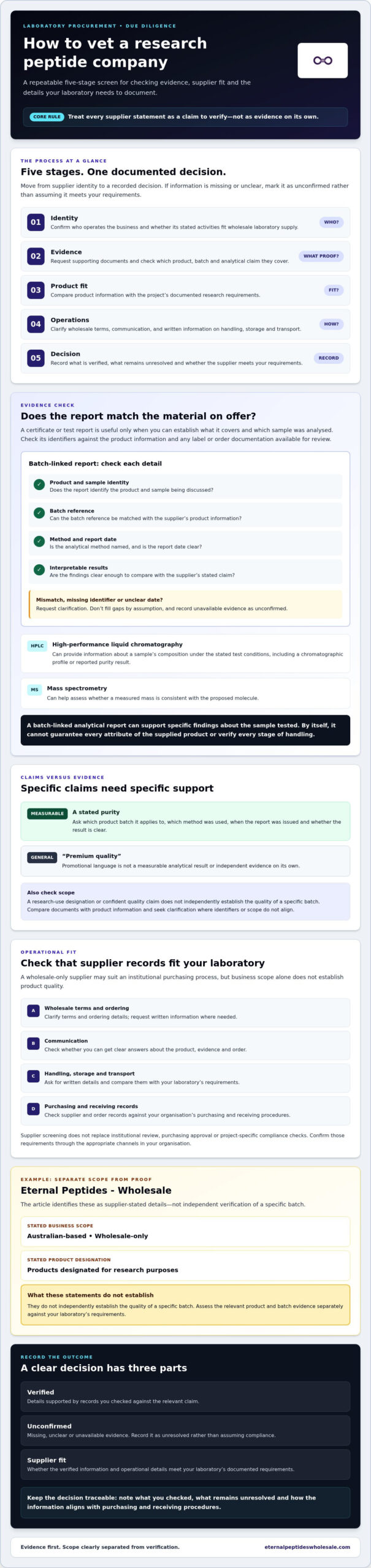
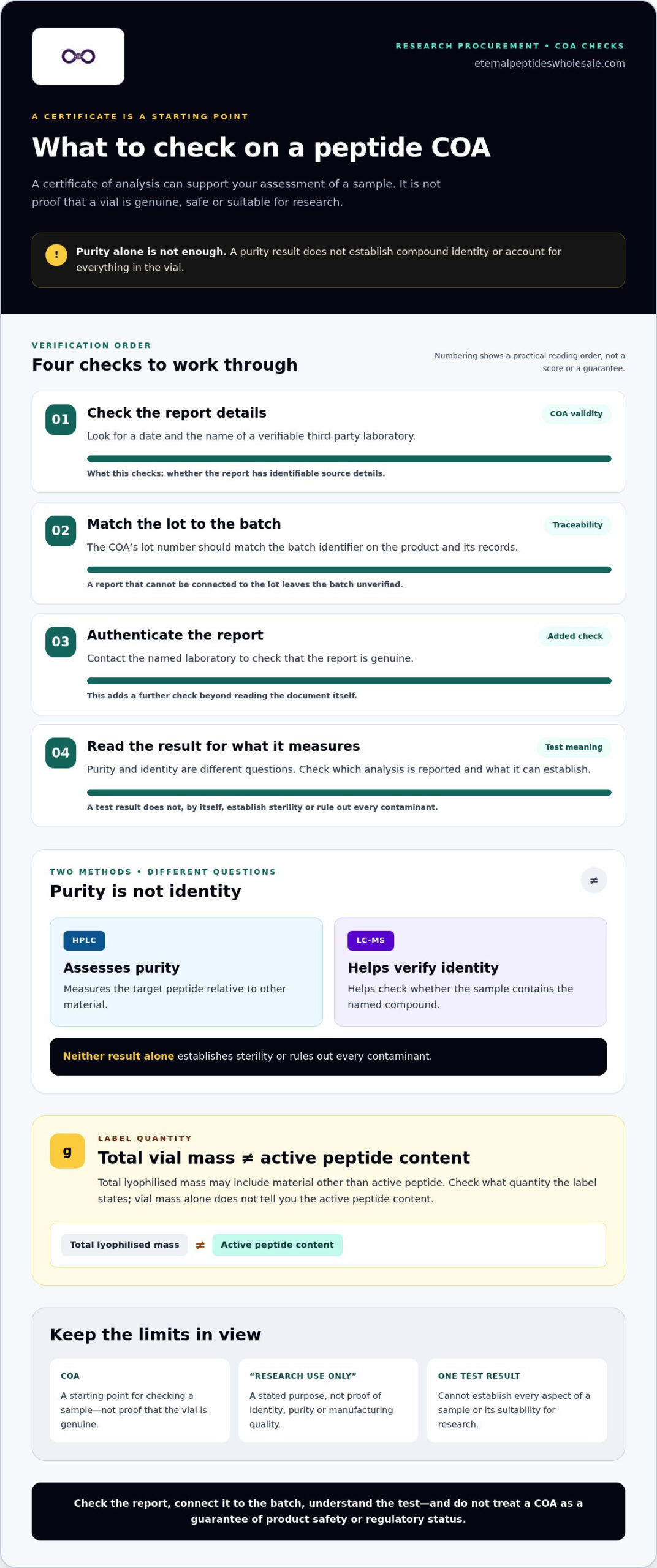
A certificate of analysis is a starting point, not proof that a peptide vial is genuine. A sound approach to avoiding counterfeit peptides in research is to check that the COA is dated, names a verifiable third-party laboratory and carries a lot number matching the batch. Contacting the named laboratory to authenticate the report adds another useful check.

A COA should clarify what a sample contains, but a purity result alone doesn’t establish the compound’s identity or account for everything in the vial. HPLC can assess purity, while LC-MS can help verify identity. Scrutinise the quantity on the label too: total lyophilised mass may not equal active peptide content.

This article explains how to assess those details, spot vendor warning signs and understand why underfilling matters. It also covers risks associated with unapproved products, including Australian reports of acute liver toxicity linked to counterfeit retatrutide. The aim is to support informed research procurement, not to treat a COA as a guarantee of product safety or regulatory status.

Key Takeaways

  • Assess a COA by looking beyond the purity result: its date, laboratory details and batch identifier all matter.
  • Understand why purity testing and identity testing answer different questions about a peptide sample.
  • Compare labelled quantity with active peptide content, as total vial mass can include filler.
  • Recognise that underfilled or incorrectly labelled products can undermine research reliability and create additional risks.
  • Consider the reported liver toxicity associated with counterfeit retatrutide when weighing the risks of unapproved products.

Research-use-only and gray-market peptide products

“Research-use-only” describes a stated purpose, not proof of identity, purity or manufacturing quality. In Australia, the Therapeutic Goods Administration (TGA) says it does not oversee the composition, manufacturing standards, safety or efficacy of unapproved peptide products.

Counterfeit, mislabelled and adulterated products

A counterfeit product imitates a genuine one, a mislabelled product gives inaccurate information, and an adulterated product contains an unintended ingredient or contaminant. Each can make a vial’s contents differ from its label, even when its packaging appears convincing. A study of falsified polypeptide drugs on the Belgian market found samples containing the advertised peptide ranged from 5% to 75% pure peptide. That variation can disrupt experimental comparisons and make results difficult to interpret.

“Research use only” or “not for human consumption” wording does not establish that a product is suitable for laboratory work. In Australia, the Therapeutic Goods Administration advises against purchasing or using unapproved peptide products, particularly those obtained online or from overseas, and advises using only products supplied through Australian pharmacies. It also reported that more than 94,500 unapproved peptide products had been destroyed in Australia in 2026.

For Australian imports, the Therapeutic Goods Act 1989 is relevant: the TGA monitors potential non-compliance involving therapeutic goods under that Act. The TGA published information for suppliers about responsibilities when importing, compounding and supplying unapproved peptide products on 13 April 2026. A research-use label alone does not settle whether an import complies with applicable requirements.

Identity, purity and sterility risks

Identity testing asks whether a vial contains the named compound; purity testing measures the target peptide relative to other material. Neither result alone establishes sterility or rules out every contaminant. A study testing products from five peptide manufacturers found that two-thirds fell below the threshold considered necessary for reliable research results. Unmarked vials and poorly traceable supply chains make it harder to connect a sample to its source and batch.

Injection adds risks associated with contamination, inaccurate concentration and poor handling. Follow the supplied handling conditions for research materials, and record the lot, arrival time, packaging condition and storage handover when a shipment arrives. If a shipment appears counterfeit or fails testing, quarantine it, retain its packaging and batch records, and document the discrepancy for investigation. Don’t use it in experiments in the meantime.

Comparing prices without compromising quality

Compare prices against the amount of active peptide, batch-specific evidence and traceability, not vial price alone. Ask what mass the label states and whether manufacturing tolerances are disclosed. A low price doesn’t establish authenticity, and a higher price can’t replace evidence about the batch.

To compare research suppliers consistently, align the compound, active peptide quantity, analytical evidence and delivery conditions. A COA that cannot be matched to a lot, or a price that obscures whether the stated mass includes filler, makes a like-for-like comparison difficult. For researchers avoiding counterfeit peptides in research, documented content and identity are essential purchasing criteria.

Warning signs of illegitimate peptide vendors

Vendor claims and sales channels can reveal gaps in accountability. Missing batch records, vague product descriptions and pressure to pay through unusual channels are reasons to pause before buying.

Buying research peptides through online marketplaces or social media can expose researchers to mislabelled products, incorrect ingredients or doses, degradation, contamination and non-sterile contents. A polished listing or positive comment doesn’t establish a compound’s identity or quality.

Payment and documentation red flags

Payment and documentation red flags may indicate that a seller is difficult to trace or hold accountable. Be cautious if payment relies on an anonymous link or the seller provides no invoice, batch identifier or consistent product description. Keep order records and compare the label, invoice and accompanying documents. Mismatched compound names or lot details make problems harder to investigate.

Marketplace and social media risks

Marketplace and social media risks arise when sales listings and peer recommendations stand in for traceable quality controls. Online peptide communities may share vendor recommendations, shipping advice, product impressions and protocol changes, but peer trust cannot replace pharmaceutical quality assurance or clinical monitoring. Positive reviews don’t establish what a vial contains.

Look for specific warning signs in the sales process rather than relying on presentation alone. For example, a listing that calls a compound “therapeutic” while offering it as a research chemical blurs its intended use. Claims about purity without batch-specific evidence also leave questions about identity, contamination and manufacturing unanswered. Note each discrepancy before proceeding.

  • Product details: Check whether the compound name and stated amount remain consistent across the listing, invoice and label.
  • Batch traceability: Look for a lot identifier that connects the product to its accompanying records.
  • Sales claims: Treat claims of therapeutic effects or guaranteed outcomes as a warning, not evidence of research quality.
  • Payment trail: Avoid anonymous payment links that leave no clear record of the transaction.

If a shipment arrives with damaged packaging, altered labels or records that don’t match the order, quarantine it and document the discrepancy. Retain the packaging, invoice and communications; these details help connect the concern to the specific shipment and batch. For procurement teams assessing wholesale research peptide supply, research peptide options can be considered alongside the same documentation and traceability criteria.

How can I verify a peptide Certificate of Analysis (COA)?

A COA is useful only when its details connect to the specific vial and test report. Check the date, laboratory identity and batch number, then assess what the reported methods can establish.

Contamination in counterfeit batches

Contamination means a sample contains unwanted material, which may not be identified by a peptide purity result alone. A report detecting retatrutide, for example, doesn’t establish whether the vial also contains contaminants, other drugs or medications. That distinction matters because a single test result can answer only the question its method was designed to examine. Review the reported analysis and its limits before relying on it.

Fake and non-batch-specific certificates

A fake certificate is not an authentic report; a non-batch-specific certificate doesn’t show that the tested sample came from the vial being assessed. Either can create false confidence in a product’s identity or purity. Look for a report date, the named third-party laboratory and a lot number tied to the batch. Contact the laboratory named on the COA to verify that it issued the report.

Warning signs include a missing date, an unverifiable laboratory name, no lot number or details that don’t match the product listing. A COA also doesn’t provide regulatory assurance about a peptide product. Treat its findings as evidence about the tested sample, not a guarantee about every vial or its regulatory status.

Batch numbers and vial matching

Batch matching means comparing the lot identifier on the vial with the one on the COA. Check every character, including letters, numbers and suffixes, then compare the compound name and stated quantity. If a shipment contains vials from different lots, each vial needs records for its own batch. A mismatch breaks the link between the report and the sample.

Keep the vial label, COA and purchase record together. If the COA lists one lot and the vial shows another, don’t treat the report as evidence for that batch. Record the discrepancy and preserve the original documents for follow-up or testing.

Independent laboratory testing

Independent testing can assess identity and purity using methods that answer different questions. LC-MS can help verify peptide identity; HPLC can assess purity, but purity testing alone doesn’t establish identity. Neither result by itself rules out every contaminant. Ask what was tested, which method was used and whether the report identifies the sample’s batch.

For suspected contamination, the laboratory analysis needs to address the specific concern; a purity result alone cannot detect every possible contaminant. Compare the reported methods with the claims made about the product, and retain the test report with the batch records. This helps distinguish a verified finding from a broad claim that a sample is simply “tested”.
Avoiding Counterfeit Peptides: Verify COAs and Peptide Content

Counterfeit retatrutide linked to acute liver toxicity

Australian reports link the use of counterfeit retatrutide with acute liver toxicity, making product identity a serious safety concern. The Therapeutic Goods Administration (TGA) says retatrutide remains in clinical trials and isn’t approved for human use. The TGA also advises Australians not to purchase or use unapproved peptide products. A vial labelled retatrutide shouldn’t be treated as equivalent to a legitimate trial product.

In Victoria, seven patients were hospitalised with acute liver toxicity after using counterfeit retatrutide. One developed severe liver injury after a second dose of unregulated retatrutide. Reported injuries occurred within a few weeks of use. These cases show why a label, seller’s claims or apparent product effects can’t establish which chemical a vial contains.

Canberra Health Services confirmed it had detected liver damage associated with products sold as retatrutide. It didn’t disclose the number of cases because the numbers were low. These reports indicate a safety signal, but don’t establish that every product labelled retatrutide has the same composition or causes the same outcome. They do make unverified products a serious concern.

Testing also illustrates the difference between a product name and its contents. Leeder Analytical tested 18 counterfeit retatrutide samples in 2026, and only one matched its label claim. About 30 per cent had higher concentrations than their labels stated, while about 30 per cent had lower concentrations. One sample contained none of the peptide. A matching label alone could not identify these failures.

For researchers, the practical response is to keep suspect material out of use and preserve evidence. Record the product name, batch details, supplier information and any test results. Keep the vial and packaging with the relevant records. If a sample fails identity or concentration testing, quarantine the affected batch and document the failure before considering further analysis. Don’t assume another vial from the same shipment is legitimate.

Anyone who has used a product sold as retatrutide and feels unwell should seek medical assessment promptly, and provide the product packaging and timing of exposure. The reported Victorian cases included severe liver injury after a second dose, so symptoms following exposure warrant attention. Researchers should also follow institutional procedures to document and report an adverse event or product-quality concern.

Counterfeit retatrutide is not the same product as retatrutide currently in clinical trials. A purity result detecting the named peptide can’t establish that a sample is free of other drugs, medications or contaminants. This limitation matters even when a certificate or vendor description seems credible. Independent testing, batch records and careful incident documentation help distinguish evidence about a sample from claims about a product.

Underfilling and net peptide content

A vial’s labelled mass doesn’t necessarily equal its active peptide content. This distinction matters in research: a sample with less active compound than expected can affect concentration calculations, comparisons between batches and reproducibility. In counterfeit retatrutide tested by Leeder Analytical, labelled quantities didn’t reliably describe vial contents. Underfilling is one possible mismatch, but an apparently full vial doesn’t establish its peptide content.

Leeder Analytical tested 18 counterfeit retatrutide samples in 2026. About 30 per cent had lower concentrations than their labels stated, while one sample contained none of the peptide. About 30 per cent also had higher concentrations than stated, showing that a label discrepancy can mean more or less active peptide, not only underfilling. The result can undermine a study’s intended concentration and make batch comparisons unreliable.

Leeder Analytical reported that peptide usually made up about 10 per cent of the contents in vials it tested. Chemist Grace Hamann said about 90 per cent of those contents was unaccounted for. This illustrates why total vial mass and active peptide mass are different measurements. The remaining material’s identity cannot be inferred from a label stating the vial’s total weight.

Consider a vial labelled as containing 5 mg of peptide. If it contains 1 mg of active peptide and 4 mg of filler, its total mass may still appear consistent with that label. A 10 mg label presents the same interpretive issue if it refers to total lyophilised mass rather than active peptide weight. Without clear labelling, researchers can miscalculate the amount of compound in a sample.

For meaningful comparisons, seek documentation that states active peptide weight and discloses manufacturing tolerances. These details help distinguish the target compound from fillers and make the labelled quantity more useful for experimental planning. A certificate reporting purity alone doesn’t necessarily show the total active peptide in the vial; purity and net content describe different aspects of a sample.

According to the Therapeutic Goods Administration, retatrutide remains in clinical trials and isn’t approved for human use. “Research use only” wording doesn’t resolve underfilling or establish suitability for human consumption. For research procurement, record the labelled quantity, batch details and test findings together. If results conflict, quarantine the sample and document the discrepancy rather than adjusting experimental quantities based on the label alone.

When assessing research-grade retatrutide for laboratory procurement, compare the stated strength with evidence about active peptide content and batch identity. Review wholesale retatrutide options as part of that documented assessment.

Eternal Peptides Wholesale: Retatrutide 10mg (wholesale)

Eternal Peptides Wholesale offers Retatrutide 10mg (wholesale) for laboratory research use. Researchers procuring retatrutide can consider this offering when sourcing wholesale quantities, while applying the same checks discussed above: review batch-specific documentation, confirm the vial and certificate details align, and assess active peptide content rather than relying on the label alone.

According to the Therapeutic Goods Administration, retatrutide remains in clinical trials and isn’t approved for human use. This offering is for research purposes only, not human consumption or medical use. Product selection doesn’t replace an independent assessment of identity, purity or suitability for a particular research protocol.

For wholesale retatrutide enquiries, contact Eternal Peptides Wholesale or visit eternalpeptideswholesale.com.

Make your next procurement decision evidence-led

Turn your findings into a documented procurement process. Set acceptance criteria before ordering, assign responsibility for receiving checks, and keep batch records alongside research results. Consistent records make it easier to identify discrepancies and assess whether material belongs in a study. They also help teams apply the same standard to future orders instead of relying on supplier claims or informal impressions.

A disciplined approach to avoiding counterfeit peptides in research is built into decisions made before a shipment arrives. Eternal Peptides Wholesale offers Retatrutide 10mg (wholesale), Retatrutide 20mg (wholesale) and cjc-1295(without DAC) + Ipamorelin (5/5mg) (Wholesale) for research purposes, not human consumption or medical use.

For wholesale research sourcing, contact Eternal Peptides Wholesale and carry your evidence-led procurement standards into the next stage of your work.

Frequently Asked Questions

How do I know if a peptide COA is real?

Authenticate a COA by confirming its details directly with the named laboratory, using contact information you find independently. Check that the report identifies the tested sample and its batch, and that the compound description matches your vial. A professional-looking document can still be misused or altered. Even a genuine report supports findings only about its tested sample; it doesn’t establish regulatory status or guarantee that every vial matches.

What should I look for in a trustworthy peptide vendor?

Look for traceable business details, consistent product descriptions and records that connect an order to a specific batch. A supplier should distinguish research-use products from therapeutic medicines and avoid claims of treatment effects. Check that invoices, labels and technical documents use the same compound name and identifiers. Online endorsements alone are weak evidence: peer recommendations can’t replace documented quality controls or establish the contents of a particular shipment.

How can researchers verify the identity and purity of research peptides?

Use complementary analytical methods: LC-MS can help assess identity, while HPLC can assess purity. Arrange testing on a sample from the received batch and retain its chain-of-custody details, including who collected and transferred it. Interpret each result within the method’s scope. A purity result doesn’t prove identity, and detecting the expected peptide doesn’t rule out other compounds or contaminants.

What certificates of analysis and batch documents should peptide suppliers provide?

For each batch, keep the COA with the invoice, product label and shipment record. The COA should identify the laboratory, report date, tested sample, analytical methods and batch identifier; the other records should connect that report to the material received. Record discrepancies when the shipment arrives rather than correcting them informally. This creates an auditable trail for later testing, study review or procurement investigations.

How can researchers check whether a peptide supplier is reputable in Australia?

Assess traceability and documentation, but don’t treat an Australian location as proof of product quality or regulatory status. The TGA says it doesn’t oversee the composition, manufacturing standards, safety or efficacy of unapproved peptide products. Eternal Peptides Wholesale supplies bulk products labelled “Research Use Only” and “Not for human consumption”; its batch reports come from Janoshik independent laboratory testing. These details inform procurement, not medical or regulatory approval.

Posted on

Certificate of Analysis: 2026 Research Peptides Guide

Certificate of Analysis: 2026 Research Peptides Guide

What if a peptide COA’s most prominent number tells you less than you think? A purity result can look conclusive, but it doesn’t identify the batch by itself or explain everything the test measured. For research procurement, a certificate of analysis for research peptides is useful only when its results are read in context and tied to the exact batch under consideration.

Technical terms and abbreviations can make a report difficult to assess, particularly when it’s unclear whether the document matches the product lot. A COA can provide valuable evidence about a tested sample, but its findings have limits. Understanding those limits helps researchers make consistent, informed procurement decisions for laboratory work.

This guide explains the key fields to review, including batch details, laboratory information, HPLC purity results and mass spectrometry identity findings. It also clarifies what a purity percentage can and can’t establish, why peptide content and test scope matter, and how to use a repeatable document-review process. The aim is practical: assess the report, check that it applies to the batch, and interpret each result within its stated scope.

Key Takeaways

  • Use a certificate of analysis for research peptides as one part of procurement review, not as a blanket guarantee of quality or fitness for purpose.
  • Follow each result from sample identifier to test method, reported value and any stated acceptance criteria.
  • Interpret identity and purity findings within the scope of the methods and sample described in the report.
  • Use a consistent checklist to review batch identifiers, test dates, methods, results and limitations.
  • Retain COAs with procurement and experimental records to support traceability and research planning.

What a Certificate of Analysis for Research Peptides Actually Shows

A Certificate of Analysis (COA) records specified analytical results for an identified sample or batch. In a certificate of analysis for research peptides, the document can help researchers connect reported findings to material under review and keep procurement decisions traceable. Its value depends on what was tested, how the results were reported and whether the identifiers match the relevant material.

A COA is a record of specified test results for an identified sample or batch; it is not, by itself, a guarantee of quality, safety or suitability for a research purpose.

Researchers use these records to document the information available when material was procured and to support consistent record-keeping alongside study plans and experimental results. A COA’s findings are evidence about the sample and analyses described in that document. They don’t establish attributes that weren’t tested or show that a material is suitable for every research method. For general background on the document’s role across industries, see What is a Certificate of Analysis (COA)?

Which details identify the sample and batch?

Start with the product name, batch or lot identifier, and report date. These details help distinguish one material or production lot from another and link the report to procurement records. The product name should describe the material being considered, while the batch or lot number should match the identifier on the relevant packaging or accompanying documentation. A report date provides context for when the document was issued; it isn’t necessarily the date every test was performed.

Compare identifiers character by character. A missing lot number, a product name that could refer to multiple materials, or a mismatch between the report and the material weakens the connection. The results may still describe the sample named in the document, but their relevance to the material under review is limited. Record any discrepancy rather than treating similar-looking identifiers as interchangeable.

What is the difference between a COA and a product specification?

A specification states acceptance criteria, such as the required range or limit for a defined attribute. A COA reports analytical results for a particular sample. Some documents present both, but layouts and reporting conventions vary, so identify which values are criteria and which are measured findings.

A specification alone doesn’t show what an analysed sample actually measured. For example, a document might state a required purity threshold without reporting a sample’s result. Conversely, a reported result without a stated acceptance criterion tells you what was measured, but not whether it meets a particular specification. Read the headings, units and notes together before drawing a conclusion.

Keep the distinction clear during procurement: the specification describes the intended standard, while the COA provides reported evidence about a tested sample. Neither should be read beyond its stated scope. For research-use-only procurement, retain both documents with the relevant batch and purchasing records to support a clearer audit trail.

How to Read Identity, Purity, and Test Results on a Peptide COA

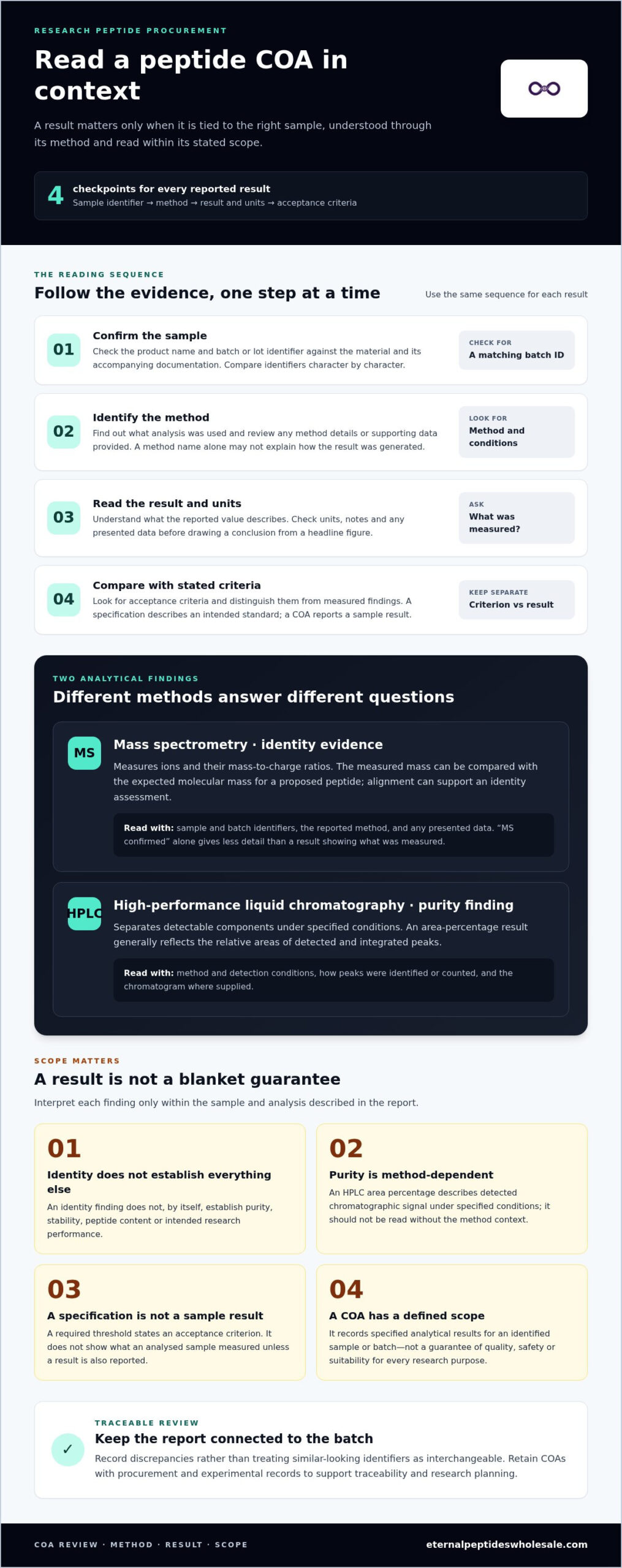
Read each result as a sequence: confirm the sample identifier, identify the analytical method, find the reported result and units, then check any stated acceptance criteria. This helps prevent a method name or headline figure from being mistaken for a complete assessment. Interpret a certificate of analysis for research peptides according to the data it actually reports, not the conclusions a reader hopes it will support.

Look for enough information to understand how each result was generated. A method may be named without conditions or supporting data, while a numerical result can be difficult to interpret without units or a stated criterion. The FDA’s Guidance on GMP for Pharmaceutical Ingredients provides broader context for quality control and documentation in pharmaceutical ingredient manufacturing. It is not a peptide-specific interpretation guide, but it illustrates why methods and records matter.

What can mass spectrometry indicate about peptide identity?

Mass spectrometry (MS) measures ions and their mass-to-charge ratios. These measurements can be used to derive a measured mass and compare it with the expected molecular mass for a proposed peptide. A result that aligns with the expected value can support an identity assessment. Review the reported method and presented data alongside the sample and batch identifiers. A label saying “MS confirmed” alone gives less detail than a result showing what was measured.

Identity evidence has a defined scope. It doesn’t, by itself, establish purity, stability, peptide content or intended research performance. Treat it as one analytical finding, not a stand-alone conclusion about every attribute of the material.

How should researchers interpret an HPLC purity result?

High-performance liquid chromatography (HPLC) separates detectable components under specified conditions. A purity figure reported as area percentage generally reflects the relative areas of peaks detected and integrated by that method. The result depends on the method, detection conditions and how peaks are identified or counted. Where supplied, examine the chromatogram and method details rather than relying only on the summary percentage.

An HPLC area-percentage purity result describes the detected chromatographic signal; it is not automatically a measurement of the total mass of peptide in the sample. Total peptide content is a separate question that requires an appropriate content or assay measurement. A high area percentage cannot establish how much peptide is present in the material as a whole, and the two values shouldn’t be used interchangeably.

For meaningful comparisons, check that reports use comparable methods, sample preparation, units and reporting conventions. Different figures may reflect different analytical conditions rather than a straightforward difference in material. Don’t apply a universal purity threshold without considering the research method’s requirements and the evidence reported.

Keep this distinction in view when planning laboratory procurement: identity, chromatographic purity and content answer different questions. Research teams sourcing material wholesale for laboratory research and development can review the wholesale research peptide range from Eternal Peptides Wholesale as part of their procurement planning.

What a Peptide COA Cannot Prove: Limits, Gaps, and Misreadings

A Certificate of Analysis is not a blanket guarantee of quality or fitness for purpose. It reports findings for specified analyses on a sample. What those findings support depends on the tests performed, the methods used and how the sample relates to the batch being considered. Even a clear result can leave important questions unanswered.

Every COA supports only the conclusions justified by its reported tests, methods and identified sample. A purity result, for example, doesn’t establish sterility, endotoxin status, stability or regulatory compliance. Those attributes require relevant evidence; they can’t be inferred from a strong result in another test. A general statement such as “quality tested” also doesn’t specify what was assessed.

Traceability matters. A report tied to an identified sample is not automatically evidence about every unit associated with a batch. The document should make its sample and batch connection clear. If that link is missing or ambiguous, readers can’t confidently apply the reported findings to the material under review. Treat uncertain traceability as a limitation in the evidence, not as proof that a test failed.

Does a COA establish safety or suitability for human use?

No. Analytical documentation does not make research products suitable for human use. A COA describes specified analytical findings; it doesn’t establish suitability for diagnosis, treatment, dosing or any other human use. Products discussed in this context are for laboratory research and development only. A COA also doesn’t replace the institutional, ethical or regulatory review relevant to a research project.

Which absent results should researchers avoid assuming?

Don’t infer an unreported test from a purity percentage or broad quality statement. Depending on the material and research requirements, relevant questions might include whether endotoxin, water content, residual solvents or stability were assessed. These are examples, not a universal checklist: the need for each analysis depends on the research context and applicable protocols.

There’s an important difference between a missing result and a failed result. If a COA doesn’t include an endotoxin test, that means the document doesn’t report the finding. It doesn’t show that the sample passed or failed. Likewise, the absence of stability data establishes neither stability nor instability. Record the gap accurately and avoid filling it with assumptions.

When evaluating a certificate of analysis for research peptides, separate reported findings from untested attributes and consider whether the sample identification supports applying those findings to the material being procured. A COA can inform a research procurement decision, but it can’t answer questions outside its stated scope or replace the research team’s review of requirements.

Certificate of Analysis: 2026 Research Peptides Guide

A Practical Checklist for Reviewing a Research Peptide COA

A repeatable review makes a Certificate of Analysis more useful in procurement and research records. Work through the document in order, separating what it reports from what you infer. This five-step process keeps batch traceability and evidence gaps visible without treating a single result as a complete quality assessment.

  1. Match the identifiers. Compare the product name and batch or lot identifier on the report with the accompanying product documentation. Note any mismatch, missing field or unclear sample description as a traceability limitation.
  2. Inspect the dates. Record the report date and any test dates shown. Check that the timing and sample description make sense for the material under review, and don’t assume a report applies to a different lot.
  3. Read the methods. Identify which analytical method supports each result. Note whether the report provides enough method detail to interpret the finding, rather than relying only on a general statement that testing was performed.
  4. Interpret each result. Record the reported value, units and any stated acceptance criteria. Keep different analyses separate; an identity result, for instance, answers a different question from a purity result.
  5. Record limitations. List relevant attributes the COA doesn’t report, and distinguish these gaps from failed results. Don’t infer a finding for a test that isn’t shown.

How to match a report to the material under review

Use the product and batch identifiers as the link between the report and the material’s accompanying documentation. Record the identifiers exactly as written, including letters, numbers and any suffixes. If the report describes a sample but doesn’t clearly connect it to the batch being considered, note that uncertainty in the procurement record rather than assuming a match.

Dates also need context. A report date may differ from the date testing took place, so capture both when available. Preserve the original document and note where it came from and which procurement record it relates to. This lets a later reviewer see what was assessed and which material the assessment was intended to cover.

How to record findings without overinterpreting them

Keep reported data distinct from interpretation. For each analysis, record the method, result, units and any stated criterion. Then add a separate note explaining what the result supports and what remains unanswered. A missing stability result, for example, is an unreported attribute, not evidence of either stability or instability. Review the method and reported findings together to understand what the HPLC or MS result supports.

Retain the COA with procurement documentation and relevant experimental records. If the batch identifier is unclear or a test is absent, state that plainly and follow the research team’s documented review process before deciding how the material fits the project. This approach supports traceable, research-use-only procurement without overstating what the paperwork establishes.

For laboratory research and development procurement, explore the wholesale research peptide range from Eternal Peptides Wholesale.

Using COA Literacy in Wholesale Research Peptide Procurement

COA review is most useful when it forms part of a consistent procurement record, rather than sitting as an isolated file. For laboratory research and development, linking the document to the relevant purchase, batch and project helps teams understand which evidence informed a decision and which questions remain open. This supports continuity when records are revisited during project planning or review.

How can laboratories make COA review repeatable?

Use the same record fields each time: product identity, batch identifier, report and test dates, method, result and units, stated acceptance criteria, reviewer and review date. Add a brief note on the scope and any unresolved gaps. Consistent fields make documents easier to compare, but they don’t make different analytical methods interchangeable. Link each review record to the relevant procurement file and project documentation.

A shared template can also clarify responsibility. The reviewer records what the document states; a separate interpretation field captures how the finding relates to the project’s requirements. Keep the original COA with the record, so another team member can trace a summary back to its source instead of relying on a second-hand description.

  1. Log the procurement link. Record the purchase reference and the material’s product and batch identifiers.
  2. Capture the evidence. Enter each method and result with its units, dates and any stated criteria.
  3. Separate findings from assessment. Note what the result supports without extending it to untested attributes.
  4. Flag open questions. Describe missing or unclear information as an evidence gap, not as a pass or failure.
  5. Connect the record. File the review with the project documentation and retain the source report for traceability.

This structure can help teams identify why two documents aren’t directly comparable. Differences in method, units or sample description should remain visible in the record, rather than being reduced to a single headline figure. Broader procurement considerations, such as sourcing research peptides wholesale in Australia, also sit alongside document review. A COA alone doesn’t answer them.

Where does COA review fit in Australian research procurement?

In Australia, treat COA interpretation as one component of procurement due diligence, not a substitute for an organisation’s applicable obligations, research governance or project-specific review. A document can inform planning, but it doesn’t decide whether a material is appropriate for a particular protocol. Keep the research purpose clear and assess the paperwork against the requirements established for the work.

Eternal Peptides Wholesale is an Australian wholesale supplier of research-grade peptides for laboratory research and development. Its products are for research purposes only, not for human consumption or medical use. If you’re planning laboratory research procurement, explore Eternal Peptides Wholesale’s wholesale research peptide offerings as one part of that process.

Make COA Review Part of Your Procurement Routine

Make your next step a practical one: build COA review into the way your team plans and documents laboratory procurement. A consistent process gives researchers a clearer basis for assessing whether available documentation aligns with a project’s requirements, while keeping unanswered questions visible for review. The aim isn’t to make a document prove more than it can, but to use its evidence carefully as part of sound research planning.

Apply the same disciplined approach when considering a certificate of analysis for research peptides: keep the document connected to the relevant procurement and project records, and interpret its findings within their stated scope. This supports more traceable decisions as research work progresses.

Eternal Peptides Wholesale is an Australian-based wholesale supplier of research-grade peptides for laboratory research and development. Its products are for research purposes only, not for human consumption or medical use. For laboratory procurement, explore Eternal Peptides Wholesale’s research peptide range. A clear, consistent review process helps your team make better use of its documentation.

Frequently Asked Questions

What is a Certificate of Analysis for research peptides?

A Certificate of Analysis (COA) is a report of analytical findings for an identified sample or batch. A certificate of analysis for research peptides can help a laboratory document what information accompanied a procurement decision. For example, a record can note whether the report identifies a sample, names the analysis and gives a result with units. Researchers should read those details in relation to their project requirements, rather than treating the document as a general quality endorsement.

How do I check whether a peptide COA matches the batch I am reviewing?

Compare the report’s product and batch identifiers with the accompanying material documentation, then note any differences in your procurement record. Check whether the sample description is specific enough to identify what was analysed. For digital filing, use a consistent file name that includes the product, batch identifier and report date. Keep the original report with the purchase record so another team member can retrace the match without relying on a summary.

Does an HPLC purity percentage show the total amount of peptide in a sample?

No. An HPLC purity percentage shouldn’t automatically be read as the total peptide amount. It commonly describes relative chromatographic signal under the stated method, while a content assay addresses how much peptide is present in a sample. For instance, a report may state an area-percentage result but provide no content measurement. Record the result under the analysis actually reported, and don’t relabel it as concentration or potency.

What does mass spectrometry tell you about a research peptide?

Mass spectrometry can provide evidence relevant to whether a measured mass is consistent with the expected molecular mass. When reviewing a report, check that the result relates to the identified sample and note the method and data presented. A mass match is one piece of evidence, not a full characterisation of the material. It doesn’t independently answer questions about purity, storage stability or how the material will perform in a specific experiment.

Is a third-party COA enough to prove a peptide is safe or suitable for human use?

No. A third-party report doesn’t make a research peptide suitable for human consumption or medical use. It remains documentation of defined analytical results, and its meaning depends on the analyses and sample described. Research-grade peptides supplied by Eternal Peptides Wholesale are for laboratory research and development only. Keep assessment within that research context, and don’t use a COA as a basis for personal or clinical use.

What should I do if a peptide COA does not list a test I need?

Record the missing analysis as an information gap, then compare the available documentation with the requirements set for the planned research. For example, if a project’s documented review calls for a particular test but the COA doesn’t report it, note that the report provides no result for that attribute. Don’t mark it as passed or failed. Retain the note with the procurement file so the decision is clear to later reviewers.

Related from Eternal Peptides Wholesale

Eternal Peptides Wholesale publishes batch-specific Janoshik Analytical reports in its certificate of analysis library, so the documentation for a listed batch can be read alongside the evidence discussed in this article.

Posted on

Wholesale BPC-157 Australia: Research Lab Sourcing Guide

Wholesale BPC-157 Australia: Research Lab Sourcing Guide

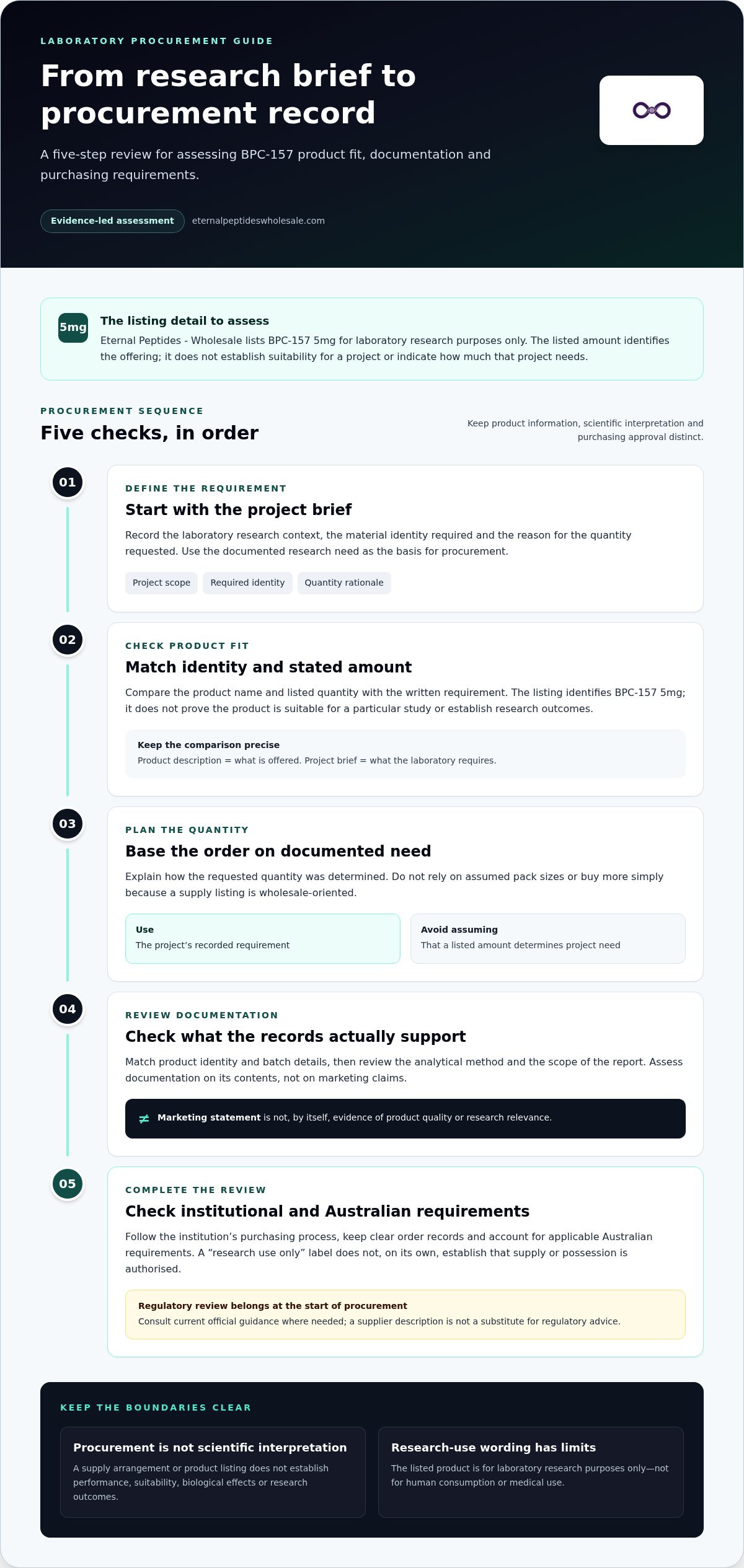
A wholesale listing is only the starting point for laboratory procurement. If you’re assessing wholesale bpc 157 australia options, first define the research requirement, then consider whether the product details and purchasing arrangement fit your institution’s processes and applicable Australian requirements. A “research use only” label does not, by itself, establish that supply or possession is authorised.

Eternal Peptides Wholesale lists BPC-157 5mg for laboratory research purposes only, not for human consumption or medical use. This guide explains how to assess product identity, compare wholesale supply with retail-oriented listings, and interpret batch documentation without treating marketing claims as evidence. It also covers how to plan quantities around a documented research requirement and why regulatory considerations belong at the start of procurement. The aim is to help laboratory buyers make an evidence-led assessment without assuming product quality or documentation beyond what has been substantiated.

Key Takeaways

  • Define the research scope and check institutional purchasing requirements before comparing wholesale bpc 157 australia options.
  • Eternal Peptides Wholesale lists BPC-157 5mg for laboratory research only, not for human consumption or medical use.
  • Assess documentation by matching product identity and batch details, then reviewing the analytical method and report scope.
  • Separate the listed compound and quantity from claims about biological effects or research outcomes.
  • Build procurement around internal approval and clear order records, and account for applicable Australian regulatory requirements.

Wholesale BPC-157 Australia: What Laboratory Buyers Need to Know

Wholesale BPC-157 supply is a laboratory research procurement arrangement, not a consumer or therapeutic product category. For Australian laboratories, comparing wholesale bpc 157 australia options means starting with the research purpose, product identity and institutional purchasing requirements. A bulk listing alone does not demonstrate suitability or permission to purchase.

Eternal Peptides Wholesale lists BPC-157 5mg for laboratory research purposes only. It is not for human consumption or medical use. The listed quantity identifies the product offering, but does not establish research outcomes, product performance or suitability for a particular project.

What does wholesale BPC-157 supply mean for a laboratory?

Wholesale procurement is organised around a laboratory’s documented requirements and purchasing processes. A single-vial retail listing is generally framed for an individual transaction, while a wholesale offering is intended for business or institutional purchasing. This describes the purchasing context, not a particular pack size, discount, testing standard or scientific benefit.

Before comparing listings, record the project scope, required material identity and reason for the quantity requested. Base the plan on the documented need, not assumed pack sizes or a desire to buy more. A supply arrangement concerns procurement; it does not establish conclusions about the compound or replace a research protocol.

  • Define the research requirement and the basis for the quantity.
  • Record the exact product identity and listed amount under review.
  • Keep procurement documentation separate from scientific interpretation.

Who is this Australian sourcing guide for?

This guide is for laboratory researchers, procurement staff and research institutions operating across Australia. It provides a framework for assessing product fit, documentation and internal processes. It is not a research protocol and does not provide directions for handling, administration or use in people.

Product decisions remain subject to institutional procedures and applicable Australian requirements. A research-use-only description does not, on its own, determine whether a particular acquisition is authorised or appropriate. Include regulatory and institutional review in procurement planning, and consult current official guidance where needed. The BPC-157 Wikipedia article offers a general overview of the compound, but is not a substitute for regulatory advice or product-specific evidence.

The distinction between wholesale and retail matters because the purchasing record should reflect the laboratory’s actual requirement, not an individual consumer transaction. A disciplined assessment also prevents a listed quantity or supplier description from being mistaken for evidence about quality or research relevance. The following sections cover product fit, documentation and procurement planning in more detail.

BPC-157 Product Fit: Define the Research Requirement Before Sourcing

Product fit starts with the research requirement, not a supplier’s description. Before comparing wholesale bpc 157 australia listings, document the laboratory context, the required material identity and the reason for the requested quantity. This gives researchers and procurement staff a consistent basis for assessing a listing while keeping product selection within institutional procedures.

Make the brief specific. For example, it can name BPC-157 as the compound under consideration, describe the laboratory research context and explain how the required quantity was determined. Don’t add assumptions about formulation, storage conditions or other specifications that aren’t stated in the product information.

Match product identity and stated quantity to the project

Eternal Peptides Wholesale lists BPC-157 5mg as a wholesale offering for laboratory research. Treat the compound name and stated quantity as product-identification details, then compare them with the written requirement. The listing does not establish suitability for a particular study, and the quantity does not indicate how much a project needs.

A clear internal brief can record:

  • The compound identity required for the project.
  • The stated quantity being assessed.
  • The intended laboratory research context.
  • The institutional process that governs purchasing decisions.

This record helps separate procurement fit from scientific interpretation. A product description can identify what is being offered; it cannot establish the material’s relevance to a hypothesis or predict a study result. Keep those judgements within the research team’s established review process.

Keep research-use language precise

Descriptions of research interest provide context, not proof. References to a topic or model do not demonstrate efficacy, confirm suitability for a specific study or support claims about health outcomes. Use neutral terms such as “research interest” and “laboratory study”, and assess scientific claims separately through appropriate evidence and institutional review.

BPC-157 products supplied by Eternal Peptides Wholesale are strictly for laboratory research. They are not for human consumption or medical use. Avoid language that blurs this boundary, such as turning a research-area description into a treatment benefit or an expected result.

Before progressing a purchase review, check that the proposed product identity and quantity align with the project brief and that the decision follows institutional requirements. For a procurement starting point, review Eternal Peptides Wholesale’s wholesale BPC-157 5mg offering against the documented research need.

Assess Wholesale BPC-157 Documentation and Quality Claims

Documentation is useful when it supports a specific procurement decision. When assessing wholesale bpc 157 australia options for research, distinguish a general quality statement from evidence tied to the exact product and batch under review. A marketing description may explain how a supplier presents an offering, but it cannot replace a document that identifies what was assessed and reports results within a defined scope.

Marketing claims and batch-specific evidence are not interchangeable. Keep that distinction clear in the procurement record. A certificate or analytical report should be interpreted according to its stated contents, not treated as a blanket assurance of research suitability, biological performance or compliance with institutional requirements. The steps below help make the limits of the paperwork clear.

What should a laboratory review in product documentation?

Use a four-step review: confirm product identity, match the record to the relevant batch, identify the analytical method and read the report scope. If an element is absent or ambiguous, record that limitation rather than filling the gap with an assumption. This creates a traceable basis for internal review without overstating what the paperwork establishes.

  1. Product identity: Check that the document names the compound being assessed and corresponds to the product under consideration.
  2. Batch link: Look for a batch identifier connecting the report to the material under review, rather than relying on a general supplier statement.
  3. Analytical method: Note the method named in the report and what it is used to assess.
  4. Report scope: Record the reported results, stated limits and any information the document does not cover.

A certificate is relevant only to the extent that its identity and batch details match the product and batch being assessed. A document for a different batch, or one that names no batch, may not support the same procurement conclusion. Include the document date and any stated limitations in the institution’s records so reviewers can see exactly what evidence informed the decision.

How to interpret purity and testing language

HPLC, or high-performance liquid chromatography, is an analytical technique used to separate components in a sample. Mass spectrometry measures the mass-to-charge ratios of ions and can contribute to characterising material. These terms describe methods. They do not guarantee that a particular supplier used them or that a report answers every question relevant to a laboratory’s requirements.

Read a stated purity percentage within the test’s scope and reporting basis. On its own, it does not prove suitability for a specific study, biological activity or performance. Don’t infer additional tests from the mention of one method. When reviewing an analytical claim, use current product documentation that directly supports it.

For a more structured procurement review, the research peptide quality assurance guide provides related context. Documentation review is one part of a broader institutional assessment; it does not replace applicable approval or regulatory review.

Wholesale BPC-157 Australia: Research Lab Sourcing Guide

Plan Wholesale BPC-157 Procurement for an Australian Laboratory

A sound procurement process connects the research requirement, institutional review and purchasing record. For wholesale bpc 157 australia enquiries, treat regulatory and institutional approval as prerequisites, not paperwork to complete after selecting a product. A research-use-only description does not, by itself, establish that a proposed supply or acquisition is authorised. The institution should assess applicable Australian requirements before a purchasing decision proceeds.

A procurement sequence from requirements to records

Use a documented sequence so each decision has a clear basis. The exact review pathway depends on institutional procedures and the requirements that apply to the proposed research.

  1. Define the requirement. Record the compound identity, stated quantity and authorised research context. Explain how the quantity relates to the project rather than relying on an assumed pack size.
  2. Complete institutional review. Route the proposed procurement through the relevant purchasing, research governance and compliance processes. Resolve authorisation questions before proceeding.
  3. Assess product information. Review available product details and any batch documentation. Record what the documents establish, their scope and any limitations. Don’t infer tests or specifications that aren’t stated.
  4. Document the decision. Retain the review outcome, approval records, relevant product information and order records according to institutional procedures.

This sequence creates a traceable record from need through approval. It also distinguishes a decision to assess an offering from a conclusion that it is authorised or appropriate for a particular project. Align research-use procedures with purchasing controls, and refer unresolved regulatory questions to the institution’s designated compliance personnel.

Wholesale versus retail: choose the right purchasing context

Compare the project’s documented requirements with the supplier’s stated wholesale offer. Eternal Peptides Wholesale operates as a wholesale supplier, and its listed BPC-157 offering is BPC-157 5mg for laboratory research purposes only. The business does not sell retail single vials. Wholesale purchasing is therefore distinct from a retail-oriented single-vial listing, but that distinction does not establish the permissions, documentation or suitability required for a particular institutional purchase.

Keep the assessment focused on verifiable details. Don’t infer minimum quantities, pricing, payment terms, shipping arrangements or delivery timeframes unless those details are explicitly documented for the transaction. A general fulfilment statement is not a commitment to a specific order. For a broader framework on Australian purchasing workflows, the Australian wholesale research peptide procurement guide can help structure internal review.

Once institutional approval and relevant requirements are clear, review the BPC-157 5mg wholesale listing as part of the documented assessment. Products are for laboratory research only, not for human consumption or medical use.

Source Wholesale BPC-157 from Eternal Peptides Wholesale for Research Use

Eternal Peptides Wholesale is an Australian-based wholesale supplier of research-grade peptides. Its listed BPC-157 offering is BPC-157 5mg, supplied strictly for laboratory research. It is not intended for human consumption or medical use. These details define the offer; they do not establish suitability for a particular study or make claims about effects.

The wholesale model is distinct from retail single-vial purchasing. Eternal Peptides Wholesale does not sell retail single vials, and its BPC-157 listing is presented as a wholesale research offering. This purchasing context is relevant to laboratory procurement, but it is not evidence of product quality, research performance or legal authority to acquire or supply the compound.

What Eternal Peptides Wholesale’s wholesale offer is designed for

The offering is for laboratory research within an appropriate institutional and regulatory framework. Before proceeding, define the research requirement, establish that the proposed procurement aligns with organisational procedures and assess product information against that requirement. A research-use label does not, by itself, establish that acquisition is authorised under applicable Australian controls.

Keep these points distinct in procurement records:

  • Product identity: BPC-157.
  • Listed quantity: 5mg.
  • Purchasing context: wholesale supply for laboratory research.
  • Use restriction: not for human consumption or medical use.

This summary is a starting point, not a substitute for the product-fit and documentation review described above. A laboratory still needs to assess whether the stated identity and quantity match its documented requirement, consider what product or batch records establish, and follow its own approval and purchasing processes. Avoid drawing conclusions beyond the stated scope of product descriptions.

Take the next step with a research-led purchasing decision

Before considering a transaction, address applicable Australian requirements and institutional approvals. BPC-157’s regulatory status means a research-only description should not be treated as an exemption or proof that a proposed supply arrangement is authorised. If regulatory obligations are uncertain, consult current authoritative Australian guidance and the institution’s compliance processes before proceeding.

For laboratory buyers whose procurement has passed the relevant review, compare the documented project need with the wholesale listing and retain the basis for the decision. Review the BPC-157 5mg wholesale research listing as part of that assessment. Base the decision on product identity, quantity fit, documentation scope and applicable approvals, not unverified claims about performance, fulfilment or quality.

Make the Next Procurement Decision Evidence-Led

Turn your review into a clear internal decision record. Document why the proposed material fits the project, what the available evidence does and does not establish, and which institutional approvals apply. This gives researchers and procurement staff a shared basis for deciding whether to proceed, pause or seek further review.

For teams evaluating wholesale bpc 157 australia options, a research-use label alone does not establish authority to acquire or supply the product. Resolve applicable Australian regulatory requirements and institutional approvals before procurement. Keep that assessment distinct from product identity and batch documentation so each part of the decision is supported by appropriate evidence.

Eternal Peptides Wholesale is an Australian-based wholesale supplier, with BPC-157 5mg listed for laboratory research only, not for human consumption or medical use. If the offering aligns with your documented requirements and relevant approvals, review Eternal Peptides Wholesale’s wholesale research peptide range as part of your purchasing assessment. A careful, well-recorded decision is a sound foundation for responsible research procurement.

Frequently Asked Questions

Can laboratories source wholesale BPC-157 in Australia?

Not as an unrestricted purchase based solely on a supplier’s listing. BPC-157 is classified as a Schedule 4 prescription-only medicine in Australia, so a “research use only” description does not itself establish that supply or acquisition is authorised. Eternal Peptides Wholesale lists BPC-157 5mg as a wholesale research offering, but laboratories must assess applicable regulatory requirements and institutional approvals before considering procurement. A listing is not proof of legal authority.

What does research-use-only mean for BPC-157?

Research-use-only describes the stated purpose of a product. It does not make it a medicine, support human use or establish that a purchase is lawful. Laboratories should consider the Australian regulatory framework separately from the supplier’s label and follow their organisation’s governance and handling procedures. Eternal Peptides Wholesale’s products are for laboratory research only, not human consumption or medical use. The business does not provide medical consultations.

What should a laboratory check before purchasing wholesale BPC-157?

Begin with the institution’s authority to acquire the material, then assess whether the product information matches the approved research requirement. A procurement record can note the compound name, stated quantity, relevant batch identifier and documents reviewed, alongside the approval reference. Keep promotional descriptions separate from evidence. If a proposed acquisition raises regulatory or governance questions, pause the purchasing process and refer them through the institution’s established compliance pathway.

Is a certificate of analysis enough to assess a BPC-157 product?

No. A certificate of analysis may inform a review, but its usefulness depends on whether it identifies the specific material and batch and clearly describes its methods and results. A generic document, or one that cannot be linked to the product under consideration, offers a limited basis for assessment. Record the document’s scope and omissions, and don’t treat reported results as proof of suitability for a particular project or of biological outcomes.

How much BPC-157 should a laboratory order wholesale?

There’s no universal quantity for every laboratory. The amount should follow an approved project requirement and institutional purchasing process. Avoid basing the decision on consumer advice, an assumed pack size or a supplier’s general description. Eternal Peptides Wholesale lists BPC-157 5mg as a wholesale offering. Assess that stated quantity against the authorised need rather than interpreting it as a recommendation about study design or use.

Does wholesale BPC-157 have a human medical use?

Eternal Peptides Wholesale’s BPC-157 offering is for laboratory research only, not human consumption or medical use. The business does not provide medical consultations, and a wholesale listing is not medical advice, a treatment recommendation or an instruction for human use. Don’t infer a medical purpose from research-related descriptions. Questions about a person’s health or treatment belong with an appropriately qualified health professional, not a research product listing.

How can Australian laboratories compare wholesale and retail BPC-157 listings?

Compare the purchasing format with the institution’s procurement needs, but don’t assume that format determines legality or product quality. Wholesale and single-vial retail listings may describe different purchasing contexts; details such as quantity, testing, price and delivery terms are supplier-specific. For a wholesale bpc 157 australia assessment, record each listing’s stated product identity and supporting documents separately, then assess the proposed acquisition under institutional procedures and applicable Australian requirements.

Related from Eternal Peptides Wholesale

Eternal Peptides Wholesale publishes batch-specific Janoshik Analytical reports in its certificate of analysis library, so the documentation for a listed batch can be read alongside the evidence discussed in this article.

Posted on

Bulk TB-500 for Laboratories: Technical Specifications and Procurement Standards

Bulk TB-500 for Laboratories: Technical Specifications and Procurement Standards

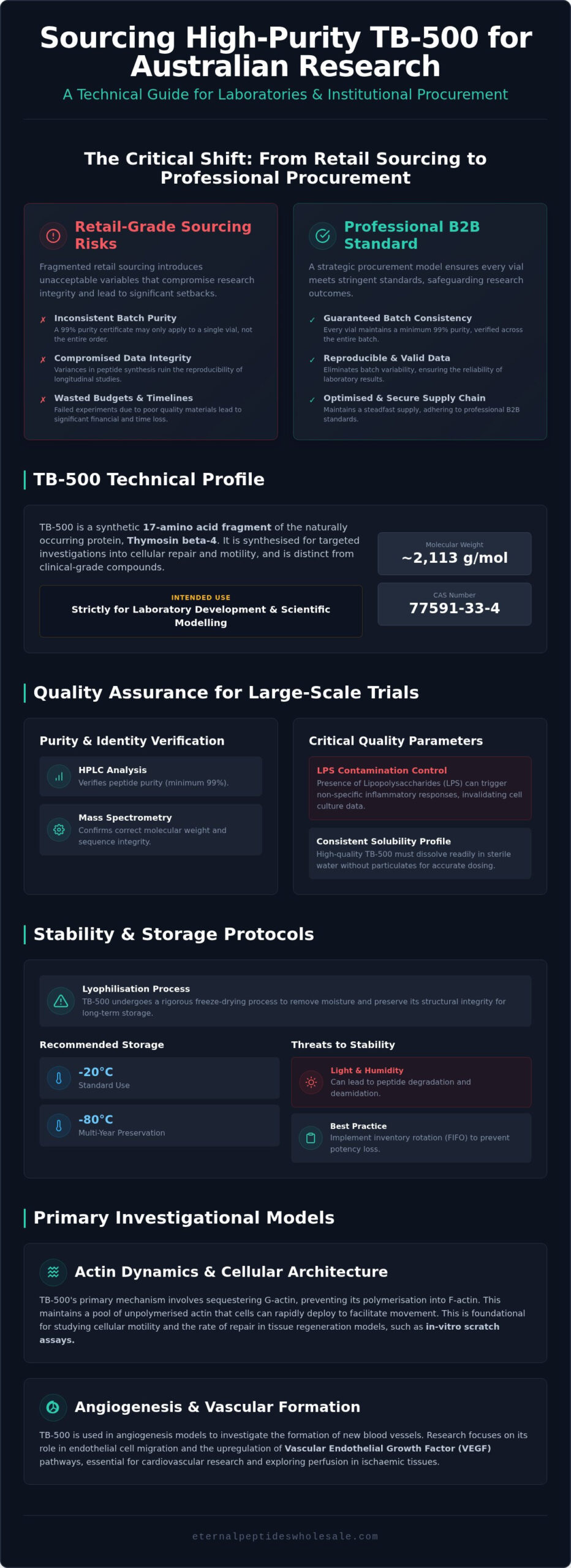
A 99 percent purity certificate is functionally worthless if it only applies to a single vial in a thousand-unit order. For Australian research institutions, the integrity of a longitudinal study depends entirely on batch-to-batch consistency that retail-grade suppliers often fail to provide. You likely recognise that even minor variances in peptide synthesis can compromise months of laboratory data; this leads to significant setbacks in your research timelines and wasted budget.

This guide establishes the technical standards necessary when sourcing bulk tb-500 for laboratories to ensure every vial maintains a minimum purity threshold of 99 percent. We offer a comprehensive framework for securing a reliable B2B supply chain while navigating the specific regulatory shifts of 2026, such as the recent PCAC reviews. You’ll learn how to verify chemical integrity across large-scale inventories and optimise procurement costs without ever sacrificing the clinical reliability your programme demands. We examine the logistical hurdles of Australian distribution and provide the data points needed to maintain a steadfast, professional partnership with your wholesale suppliers.

Key Takeaways

  • Understand the precise chemical profile and molecular weight of the synthetic 17-amino acid fragment required for reproducible actin polymerisation research.
  • Identify how to transition from fragmented retail sourcing to a strategic procurement model for acquiring bulk tb-500 for laboratories to eliminate batch variability.
  • Master the analytical requirements for large-scale trials, including the use of HPLC and Mass Spectrometry to verify peptide identity and sequence integrity.
  • Evaluate the impact of high-purity TB-500 on cellular architecture and angiogenesis models to ensure the validity of your institutional data.
  • Secure a steadfast Australian logistical partner to maintain a consistent supply chain and adhere to professional B2B procurement standards.

Technical Foundations: TB-500 as a Thymosin Beta-4 Fragment

TB-500 is defined as a synthetic 17-amino acid fragment of the naturally occurring protein Thymosin beta-4. Unlike the full-length endogenous protein, this specific peptide sequence is synthesised for targeted investigations into cellular repair and migration. It carries a molecular weight of approximately 2,113 g/mol and is identified by the CAS number 77591-33-4. When procuring bulk tb-500 for laboratories, researchers must distinguish between these synthesised fragments and clinical-grade compounds. Research-grade TB-500 is strictly intended for laboratory development and scientific modelling; it doesn’t contain the specific excipients or regulatory approvals required for human therapeutic applications.

The Molecular Structure of Thymosin Beta-4 Fragments

The efficacy of TB-500 in research environments relies on its specific amino acid sequence, which is the primary region responsible for actin-binding. This interaction is central to studies involving cellular architecture and motility. Maintaining high-purity synthesis is essential to prevent the presence of Lipopolysaccharides (LPS). LPS contamination can trigger non-specific inflammatory responses in cell cultures, effectively ruining longitudinal data. Additionally, the solubility profile of the peptide must be consistent across batches. High-quality TB-500 should dissolve readily in sterile water or bacteriostatic saline without forming particulates, ensuring accurate dosing across large-scale experimental cohorts.

Stability and Storage Protocols for Wholesale Inventory

To maintain biochemical stability, TB-500 undergoes a rigorous lyophilisation process. This freeze-drying technique removes moisture while preserving the peptide’s structural integrity for long-term storage. When managing bulk tb-500 for laboratories, it’s vital to maintain a consistent cold chain. Lyophilised vials should be stored at -20°C for standard use or -80°C for multi-year preservation.

Exposure to light and humidity can lead to peptide degradation and deamidation, which alters the chemical properties of the compound. Professional laboratories should implement inventory rotation protocols to ensure that older batches are utilised first. This prevents the risk of potency loss in wholesale stocks. Handling large-scale inventories requires a methodical approach to temperature monitoring and desiccated storage to ensure that every vial meets the required 99 percent purity threshold upon reconstitution.

Investigational Models: Angiogenesis and Cellular Migration Research

Research applications for bulk tb-500 for laboratories primarily centre on the peptide’s ability to regulate cellular architecture. By sequestering G-actin, TB-500 facilitates the internal scaffolding changes required for cell motility. This mechanism is foundational for investigators studying how cells move toward injury sites in tissue regeneration models. It provides a reliable framework for observing how synthetic fragments influence the rate of repair in various biological systems and complex cellular environments.

Actin Dynamics and Cellular Architecture

TB-500 interacts specifically with globular actin (G-actin), preventing its polymerisation into filamentous actin (F-actin). This sequestration maintains a pool of unpolymerised actin that the cell can deploy rapidly to facilitate movement. In wound healing research, this structural organisation is critical. It allows researchers to observe the rate of cellular influx into a denuded area in specialised *in vitro* scratch assays. Understanding these actin dynamics provides insights into the basic biological processes of tissue regeneration and the structural integrity of newly formed cellular matrices. The consistency of the peptide batch is paramount here; minor sequence variations can lead to unpredictable actin-binding results that compromise the validity of the entire study.

Angiogenesis and Vascular Formation Studies

Angiogenesis models utilise TB-500 to investigate the formation of new blood vessels from pre-existing vasculature. Research interest focuses on endothelial cell migration, which is a prerequisite for capillary sprout formation. In microvascular research, TB-500 is often studied for its role in upregulating vascular endothelial growth factor (VEGF) pathways. These models are essential for cardiovascular research, particularly in exploring how ischaemic tissues might regain perfusion through stimulated vessel growth. Investigators also examine how the peptide modulates inflammatory signalling within these vascular environments to prevent stalled-healing scenarios. This research often requires large-scale test groups to achieve statistical significance, making the procurement of bulk tb-500 for laboratories a logistical necessity.

Beyond vascular studies, TB-500 is a staple in musculoskeletal research. Studies involving muscle, tendon, and ligament kinetics often focus on the peptide’s role in collagen deposition and fibroblast migration. In stalled-healing models, where chronic inflammation prevents the transition from the inflammatory phase to the proliferative phase, TB-500 is investigated for its ability to downregulate pro-inflammatory cytokines. This modulation is key for laboratories developing protocols for accelerated connective tissue repair. Precise control over the concentration of TB-500 allows for more accurate modelling of the proliferative phase. For institutions conducting these complex trials, securing research-grade TB-500 (5mg) in wholesale quantities ensures that experimental variables remain controlled across all test groups.

Procurement Logistics: The Transition to Bulk TB-500 Sourcing

Transitioning from retail single-vial sourcing to wholesale procurement represents a strategic shift for Australian research institutions. While retail channels serve for pilot testing, they’re insufficient for large-scale investigations. The primary advantage of sourcing bulk tb-500 for laboratories lies in the reduction of experimental variability. When a laboratory secures a single, large lot of peptides, they ensure that every experimental subject is exposed to the exact same chemical profile. This consistency is vital for longitudinal research where even minor deviations in peptide purity can skew statistical outcomes. Relying on fragmented retail supplies introduces unnecessary variables that can compromise the reproducibility of your data.

B2B Supply Chain Integrity for Australian Labs

Securing a transparent supply chain is essential for laboratories operating within Australian biotech hubs. Fragmented procurement often leads to significant delays, especially when relying on international retail vendors with unpredictable customs clearance times. By establishing a professional B2B partnership, institutions can reduce procurement lag and ensure a steady inventory. Large-scale order fulfilment requires specialised handling and Australian-based logistics to maintain the cold chain. Professional suppliers act as a steadfast logistical backbone; this allows researchers to focus on data collection rather than supply chain troubleshooting. For a detailed look at navigating these requirements, consult our guide on Sourcing Research Peptides Wholesale in Australia.

Economic Efficiencies in Large-Scale Procurement

Economic planning in an institutional setting requires a balance between cost-per-vial and chemical integrity. Sourcing bulk tb-500 for laboratories allows procurement officers to optimise budgets without compromising on the 99 percent purity standard. Effective inventory management involves forecasting the needs of multi-year studies to avoid mid-programme supply shocks. Institutional labs often benefit from centralised storage that protects lyophilised stocks from environmental degradation. Wholesale partnerships essentially act as a hedge against market volatility and supply chain disruptions. You can explore more about managing these logistical demands in our Wholesale Tissue Repair: Australian Procurement Guide. This approach provides the predictability required for long-term scientific development and ensures that chemical integrity remains uncompromised throughout the study duration.

Bulk TB-500 for Laboratories: Technical Specifications and Procurement Standards

Quality Assurance: Purity Verification for Large-Scale Trials

Maintaining chemical integrity across 100 or 500 vials requires more than a cursory check of a single sample. In professional settings, procuring bulk tb-500 for laboratories necessitates a rigorous verification protocol that covers the entire production run. Each batch must be accompanied by a specific Certificate of Analysis (CoA) that reflects the exact lot delivered to the institution. Without this documentation, researchers risk introducing unquantified impurities into their models, which can lead to false positives or irreproducible data sets. Standardising these protocols ensures that every vial in a large order performs identically under experimental conditions.

Analytical Techniques: HPLC and MS Analysis

High-Performance Liquid Chromatography (HPLC) is the primary tool for determining the purity percentage by separating the peptide from any residual solvents or synthesis by-products. A clean chromatogram with a single, sharp peak indicates high purity, typically targeted at 99 percent or higher for institutional work. However, HPLC alone doesn’t confirm the sequence. Mass Spectrometry (MS) is utilised to verify the molecular weight and ensure the 17-amino acid sequence is complete. This prevents the use of truncated sequences that might still appear “pure” on HPLC but lack the biological activity required for actin-binding studies. For a deeper dive into these standards, read our guide on Quality Assurance in Research Peptides.

Standardising Batch-to-Batch Consistency

Scaling peptide synthesis from small batches to high-volume wholesale quantities introduces technical challenges. If the synthesis environment isn’t strictly controlled, subtle variations in temperature or reagent concentration can cause batch-to-batch drift. For longitudinal studies, this drift is a silent research killer. Verification protocols for high-volume orders should involve random sampling across the entire shipment, not just the first few vials. Ensuring 99%+ purity is a non-negotiable standard because it provides the buffer needed to ensure that minor degradations over time don’t drop the peptide below a functional threshold. When you order wholesale TB-500 5mg vials, you’re investing in the stability of your data as much as the chemical itself. This level of oversight ensures that your large-scale trials remain grounded in clinical reliability and professional accuracy. Institutions seeking a comprehensive technical reference for navigating the 2026 regulatory landscape can consult our detailed guide on wholesale TB-500 Australia procurement standards to further strengthen their quality assurance frameworks.

Strategic Sourcing: Partnering with Eternal Peptides Wholesale

Eternal Peptides Wholesale serves as a primary logistical partner for the Australian scientific community. By operating as a dedicated B2B entity, we provide the stability and clinical reliability required for high-level institutional investigations. Our focus remains strictly on the wholesale distribution of research-grade compounds, ensuring that every procurement cycle meets the ethical and legal standards expected by modern laboratories. We maintain a rigorous “research only” policy; this means our products are never intended for human consumption or medical use. This no-nonsense approach allows us to focus entirely on the success of your laboratory’s larger-scale operations without the distractions of the retail market.

The Eternal Peptides Wholesale Advantage

Managing the complexities of the wholesale landscape requires a supplier that understands the necessity of chemical consistency. We prioritise the supply of bulk tb-500 for laboratories to ensure that researchers have a predictable inventory for multi-year studies. Our Australian-based logistics eliminate the common delays and customs uncertainties found with international retail vendors, keeping your research timelines on track. Every batch of TB-500 5mg wholesale vials is synthesised to meet a 99 percent purity threshold, providing the chemical integrity needed for the reproducible data discussed in earlier sections. This commitment to scale and quality ensures that institutional researchers don’t have to compromise on purity to meet their volume requirements.

Professional Procurement and Support

Institutional research often involves complex budget cycles and specific logistical requirements that retail shops simply can’t accommodate. Eternal Peptides Wholesale offers direct communication channels for laboratory procurement officers to ensure that every order aligns with institutional goals and project deadlines. We provide customised solutions for large-scale projects, allowing for a more methodical approach to inventory management and long-term planning. This professional partnership ensures that your laboratory is supported by a mentor in the field who values operational excellence as much as you do.

By establishing a professional relationship with an Australian distributor, procurement teams can secure a steadfast logistical backbone for their biotech hubs. This level of service includes the provision of all necessary analytical documentation to support your quality assurance protocols. You can secure your wholesale TB-500 supply from Eternal Peptides Wholesale to ensure your next study is grounded in reliability and professional accuracy. We’re dedicated to being the reliable partner that allows your researchers to focus on results rather than supply chain troubleshooting.

Advancing Australian Research Through Standardised Procurement

Securing bulk tb-500 for laboratories is a strategic move that goes beyond simple vial counts to prioritise the long-term integrity of your institutional data. By transitioning to a professional wholesale model, research teams effectively eliminate the batch-to-batch variability that often plagues fragmented retail-grade supplies. This guide has established that the combination of HPLC verification, precise molecular weight confirmation, and dedicated Australian logistics is the only way to ensure the reproducibility of angiogenesis and tissue repair models. These standards are essential for any scientific programme where chemical consistency is the absolute foundation of the results.

Eternal Peptides Wholesale remains committed to providing the steadfast logistical backbone your institution requires. Our strict professional research-grade standardisation ensures that every shipment meets the technical demands of high-level investigations. When you’re ready to stabilise your supply chain and optimise your procurement protocols, we’re here to facilitate a dependable B2B partnership. You can request a wholesale account for laboratory procurement to begin securing high-purity compounds for your next project. We look forward to supporting your team’s success in the Australian research landscape.

Frequently Asked Questions

Is TB-500 legal for laboratory research in Australia?

TB-500 is legal for legitimate laboratory research and scientific development within Australia. It’s classified as a research-grade compound intended strictly for *in vitro* or animal-based investigational models. It isn’t permitted for human consumption or clinical use. Institutions must ensure their procurement of bulk tb-500 for laboratories aligns with institutional biosafety and ethics committee guidelines. We operate as a strict B2B entity to support these professional research standards.

What is the standard purity level for wholesale TB-500 vials?

The professional standard for research-grade TB-500 is a purity level of 99 percent or higher. This threshold is verified through High-Performance Liquid Chromatography (HPLC) to ensure the absence of synthesis by-products and residual solvents. Maintaining this level of purity across every vial in a wholesale order is critical for experimental repeatability. High-purity vials ensure that observed biological effects are attributable to the peptide fragment itself rather than contaminating agents.

How should bulk TB-500 be stored in a laboratory environment?

Lyophilised TB-500 should be stored in a temperature-controlled environment to prevent chemical degradation. For short-term use, vials are typically kept at -20°C; however, long-term preservation of wholesale inventory requires storage at -80°C. It’s essential to protect the vials from light and humidity. Once reconstituted, the peptide should be used immediately or stored briefly at 2°C to 8°C, though stability decreases significantly after the seal is broken.

Can TB-500 be combined with BPC-157 in research models?

TB-500 and BPC-157 are frequently utilised together in multi-factor tissue repair research models. Investigators often study their synergistic effects on angiogenesis and cellular migration, as they operate through different biological pathways. TB-500 focuses on actin sequestration and motility, while BPC-157 is often researched for its systemic cytoprotective properties. Laboratories procuring these compounds in bulk can standardise their experimental protocols to observe how these fragments interact within complex cellular environments. Institutions seeking to establish a reliable bpc-157 bulk research supply alongside their TB-500 inventory will find that a consolidated B2B procurement strategy significantly reduces logistical complexity and ensures purity standards are met across both compounds.

What is the typical molecular weight of research-grade TB-500?

Research-grade TB-500 has a molecular weight of approximately 2,113 g/mol. This value corresponds to the 17-amino acid sequence that constitutes the synthetic fragment of the endogenous protein. Verification of this molecular weight is conducted using Mass Spectrometry (MS) to ensure sequence accuracy. For procurement officers, confirming the molecular weight via batch-specific analytical reports is a non-negotiable step in verifying the identity of the peptide before commencing large-scale laboratory investigations. Australian institutions looking to align their verification processes with current regulatory expectations can reference the 2026 technical procurement reference for wholesale TB-500 in Australia to ensure their analytical documentation meets the latest compliance standards.

Does Eternal Peptides Wholesale provide Certificates of Analysis for bulk orders?

Yes, Eternal Peptides Wholesale provides batch-specific Certificates of Analysis (CoA) for all wholesale orders. These reports include HPLC and Mass Spectrometry data to verify the purity and identity of the compound. Providing transparent analytical verification is a core component of our commitment to clinical reliability. This documentation allows laboratory managers to confirm that their bulk tb-500 for laboratories meets the required 99 percent purity standards before integrating the vials into their research programmes.

Why is wholesale procurement preferred over retail for longitudinal studies?

Wholesale procurement is preferred because it ensures batch-to-batch consistency across the entire duration of a study. Retail sourcing often involves fragmented lots, which can introduce subtle chemical variations that skew long-term data. By securing a single large lot from a dedicated B2B partner, institutions eliminate these variables. This approach also allows for more efficient inventory management and significant cost optimisation, ensuring that the research budget is utilised for data collection rather than logistical overheads.

Are these peptides suitable for human or veterinary use?

No, these peptides are strictly for laboratory research purposes only. They aren’t suitable for human consumption, medical use, or veterinary applications. We maintain a rigorous non-human consumption policy to ensure compliance with Australian regulatory standards. All compounds are synthesised for *in vitro* testing and scientific modelling in controlled environments. Our professional B2B model is designed to support institutional researchers and laboratory procurement officers who adhere to these ethical and legal constraints.

Posted on

How to Vet a Research Peptide Company: An Australian Lab Checklist

How to Vet a Research Peptide Company: An Australian Lab Checklist

A supplier’s most persuasive claim may tell you less than a document linked to the batch on offer. Knowing how to vet a research peptide company means looking beyond product descriptions to assess whether its evidence is verifiable and its operations suit your laboratory’s procurement requirements.

It’s reasonable to expect documentation that matches the product and batch under consideration, along with clear answers about wholesale terms, ordering and communication. A research-use designation or confident quality claim isn’t independent evidence on its own. Check and record each detail before you commit.

This guide sets out a repeatable due diligence process: what to request, how to review batch-specific analytical documents, and which business and operational details to clarify. For example, Eternal Peptides Wholesale identifies itself as an Australian-based, wholesale-only supplier, with products designated for research purposes. Those statements describe its business scope, but they don’t independently establish the quality of a specific batch. Use the checklist to distinguish stated facts from evidence, assess supplier fit and document a decision against your laboratory’s requirements.

Key Takeaways

  • Use a five-stage process to assess company identity, evidence, product fit, operations and your procurement decision.
  • When learning how to vet a research peptide company, check whether documents identify the specific product and batch being offered.
  • Compare suppliers using verifiable criteria. Record unavailable evidence as unconfirmed rather than assuming it meets your requirements.
  • Check that supplier and order records align with your laboratory’s purchasing and receiving procedures. Request written details where needed.
  • Separate stated business scope from independently verified quality evidence when assessing whether a wholesale supplier fits your laboratory.

How to vet a research peptide company before your laboratory buys

A defensible supplier decision relies on records you can check against your laboratory’s requirements, not confidence created by polished marketing. To understand how to vet a research peptide company, treat each statement as a claim to verify. Check it against documents, references where relevant, and your organisation’s purchasing and receiving criteria.

Use a consistent five-stage screen:

  • Identity: Confirm who operates the business and whether its stated activities fit wholesale laboratory supply.
  • Evidence: Request supporting documents and check which product, batch and analytical claim they cover.
  • Product fit: Compare the product information with the project’s documented research requirements.
  • Operations: Clarify wholesale terms, communication, and written information about handling, storage and transport.
  • Decision: Record what is verified, what remains unresolved and whether the supplier meets your requirements.

What should supplier vetting establish?

Start by confirming the supplier’s identity and stated business scope. A wholesale-only supplier may suit an institutional purchasing process, but that alone doesn’t establish product quality. Ask what evidence supports the specific product and any claims about quality or handling. Check that documents relate to the product under consideration, rather than relying on a generic example. Log missing or unclear information as unconfirmed and assign follow-up. Don’t treat silence as evidence of compliance.

Questions about product manufacture are another reason to be precise, not to make assumptions. A basic explanation of chemical peptide synthesis can provide context for why manufacturing or analytical statements need clear supporting records. The explanation itself doesn’t verify a supplier’s process or establish the quality of a particular batch.

Which claims deserve closer scrutiny?

Separate measurable statements from broad promotional language. A stated purity is a specific analytical claim; “premium quality” is not. For each measurable claim, ask which product batch it applies to, which method was used, when the report was issued and whether the result is clear. Compare those details with the product information and the supplier’s explanation. If identifiers or scope don’t align, seek clarification before relying on the claim.

Keep the review within laboratory procurement. Language that implies human use, treatment or performance outcomes isn’t evidence of suitability for a research project and falls outside this research-use guide. Supplier screening also doesn’t replace institutional review, purchasing approval or project-specific compliance checks. Confirm those requirements through the appropriate channels at your organisation before proceeding.

Check company identity and research peptide quality evidence

A certificate or test report is useful only if you can establish what it covers and which sample was analysed. A polished document without a clear product identifier, batch reference or testing scope may be impossible to connect to the material being offered. When working out how to vet a research peptide company, ask not just whether a report exists, but whether its details can be checked against the supplier’s claims.

A batch-linked analytical report can support specific findings about the sample tested. It cannot, by itself, guarantee every attribute of the supplied product or verify every stage of its handling. Treat the report as one piece of evidence and assess its scope against your laboratory’s requirements.

How to assess HPLC and mass spectrometry reports

Check that the report identifies the sample and relevant batch, names the analytical method, and provides a date and interpretable results. Compare its product name and batch reference with the supplier’s product information and any label or order documentation available for review. Differences, missing identifiers or unclear dates are reasons to request clarification, not details to fill in by assumption.

Methods answer different questions. High-performance liquid chromatography (HPLC) can provide information about a sample’s composition under the stated test conditions, including a chromatographic profile or reported purity result. Mass spectrometry (MS) can help assess whether a measured mass is consistent with the proposed molecular identity. Neither result proves every quality attribute. A chromatogram or mass spectrum is not, on its own, a complete quality guarantee or evidence about handling and storage.

Ask what the report’s conclusions actually support. If a supplier makes a claim about identity, purity or another attribute, request the relevant result and method rather than treating one test as evidence for everything.

How to confirm business and document consistency

Compare the company name on the report with the supplier’s stated business identity. If a separate laboratory performed the analysis, ask which laboratory it was and whether the supplier can clarify the relationship between that laboratory, the report and the sample. A third-party name alone doesn’t establish that the document relates to the batch under consideration.

Record the answers and any gaps. For more context on evaluating quality systems in procurement, consult this research peptide quality assurance guide. Eternal Peptides Wholesale identifies itself as an Australian-based, wholesale-only supplier of research-use products. Those stated business details are separate from batch-specific analytical evidence, which buyers should confirm for the product being considered.

Reviewing a supplier’s stated scope can help you assess wholesale fit alongside technical evidence. You can review Eternal Peptides Wholesale’s supplier information as part of that assessment, while requesting any product-specific documentation your procurement process requires.

Compare suppliers using evidence, transparency and procurement fit

A structured comparison makes supplier differences easier to assess and reduces the influence of persuasive but unsupported claims. To understand how to vet a research peptide company, compare like with like: the same product, comparable batch context and the same documentation requests. Laboratories apply these same verification principles to batch testing and purity documentation when evaluating any supplier, including overseas suppliers. Keep technical evidence separate from business reliability. A report may support a specific analytical claim, while communication, terms and wholesale fit determine whether the supplier suits your procurement process.

Use a comparison table and score only criteria you can verify. Mark missing or unclear information as unconfirmed, not as a low-risk assumption.

Criterion What to check Record
Evidence Does the documentation identify the product and explain its relationship to the sample or batch? Verified, unconfirmed or follow-up required
Communication Are answers accurate, complete and consistent with the documents? Examples and unresolved questions
Product fit Does the available product information align with the laboratory’s documented project requirements? Fit confirmed or not established
Terms Are wholesale conditions and purchasing details clear in writing? Terms reviewed or clarification needed
Open questions What information is still missing or needs institutional review? Owner and next step

What to ask before accepting a supplier’s claims

Request the documentation relevant to the product under consideration, then ask how it relates to the sample or batch being offered. Check whether product identifiers connect across the quotation, packaging information and supporting records. If names, references or descriptions differ, ask the supplier to explain the discrepancy in writing.

Record the quality of the response, not just whether a reply arrived. Does it address the question directly? Are limitations acknowledged? Can the supplier clarify what a document does and doesn’t establish? Score only observable answers and records. Don’t award points for claims you can’t independently assess.

How to compare wholesale suitability

Technical quality evidence and procurement suitability are separate assessments. Confirm whether the supplier’s wholesale model, written terms, product information and support channels align with your laboratory’s order and approval process. When assessing direct-supply arrangements, compare the terms and documentation each supplier provides. A supplier may be a potential operational fit while specific quality evidence remains unconfirmed, or the reverse. Keep both findings visible in your comparison rather than blending them into one overall impression.

For broader sourcing considerations, consult this Australian wholesale research peptide procurement guide. You can also review Eternal Peptides Wholesale’s stated supplier scope as one input to a comparison, while assessing product-specific evidence and procurement fit separately.

How to Vet a Research Peptide Company: An Australian Lab Checklist

Verify Australian operating, documentation and institutional requirements

An Australian operating presence can be relevant to procurement, but it doesn’t establish that a product is lawful for a particular purpose, that an import is permitted or that the product is suitable for your research. Check the supplier, product and proposed activity against the requirements that apply to your organisation. Keep those checks separate from technical quality assessment.

What Australian buyers should confirm

Requirements can depend on the compound, intended research activity and institutional setting. Don’t rely on a supplier’s location or a research-use-only statement as a substitute for checking. Consult current information from the relevant Australian regulator, such as the Therapeutic Goods Administration where applicable, and seek advice from your institution’s compliance staff or a qualified adviser if the position is unclear. Don’t apply a general statement to a specific compound or project without confirmation.

Before progressing an order, check the proposed purchase against your institution’s procedures. Confirm who can approve it, which records must be retained and what receiving checks are required. Make sure the order and product identifiers can be reconciled with the paperwork your team needs to file. These internal controls help turn supplier information into a reviewable procurement record.

How to assess fulfilment and communication

Ask the supplier for written details on handling, storage and transport, and confirm that the instructions are clear enough for your receiving process. Verify supplier-specific statements rather than assuming standard practices apply. You can also ask what order, dispatch and delivery information will be provided, and how the supplier would respond if a document or identifier didn’t match the order.

  • Can the supplier explain which records accompany the order?
  • Are product identifiers consistent across the order information and supporting documents?
  • Who should your procurement team contact about a discrepancy, and how will the issue be documented?

Record unanswered questions as unresolved. If instructions are vague, request clarification before approval rather than filling gaps with assumptions. This is a practical part of how to vet a research peptide company: assess what can be verified, then refer remaining questions to the relevant institutional or regulatory contact.

Eternal Peptides Wholesale describes itself as an Australian-based, wholesale-only supplier of research-use products. Those details can inform an initial business-fit review, but they don’t establish regulatory status, product suitability or specific handling and delivery arrangements. Confirm those points independently before relying on them.

For a supplier-scope review alongside your institutional checks, review Eternal Peptides Wholesale’s stated business information and verify any product or operational details your procurement process requires.

Make a documented supplier decision and assess Eternal Peptides Wholesale

Turn your checks into a decision record before seeking procurement approval. This gives reviewers a clear account of what the supplier has demonstrated, what remains uncertain and why the supplier is or isn’t suitable for the laboratory’s requirements. It also makes reassessment easier if product information, terms or institutional requirements change.

A practical supplier approval checklist

Record each finding under one of four statuses: verified, unverified, unsuitable or follow-up required. Check the supplier’s stated business scope, product identity, available product-specific documentation and written wholesale terms. Resolve discrepancies between claims, records and your laboratory’s specifications before approval.

  • Verified: A claim supported by records you’ve reviewed.
  • Unverified: Information that is missing or hasn’t been independently checked.
  • Unsuitable: A requirement the supplier or product doesn’t meet.
  • Follow-up required: A question awaiting clarification or institutional review.

Include who completed the review, which documents were considered, outstanding questions and the date or trigger for reassessment. Don’t treat an unanswered request as confirmation. If a key requirement remains unresolved, state that clearly in the record and follow your organisation’s approval process.

When to contact a wholesale supplier

Prepare a concise enquiry before contacting a supplier. Identify the product under consideration, the order volume your laboratory requires, and the documentation or written operational details needed for review. Ask whether product-specific evidence is available and how its identifiers relate to the product offered. Keep the discussion within research procurement. Supplier enquiries aren’t a substitute for medical advice or guidance on human use.

Assess Eternal Peptides Wholesale against confirmed scope only: it identifies itself as Australian-based and wholesale-only, and its products are designated for research purposes. Those facts may help establish whether its stated business model aligns with your purchasing needs. They don’t confirm that a particular product meets your specifications or that batch-specific reports, certifications, handling processes or other supporting records are available. Request and review the relevant information directly rather than assuming it exists.

A careful approach to how to vet a research peptide company ends with a measured decision, not automatic approval. Confirm business fit, documentation and outstanding requirements with the supplier, then complete your institution’s review before procurement approval. To check the stated wholesale range and raise product-specific questions, review Eternal Peptides Wholesale’s wholesale research range.

Make your next supplier decision evidence-led

A repeatable vetting process turns supplier claims into a decision your laboratory can explain and review. Match documents to the product and batch, assess wholesale and operational fit separately from technical evidence, and record what is verified, unresolved or unsuitable. Knowing how to vet a research peptide company also means checking project and institutional requirements rather than assuming a supplier’s stated location or scope settles them.

Eternal Peptides Wholesale describes itself as an Australian-based, wholesale-only supplier, with products designated for research purposes. Its listed wholesale offerings include Retatrutide 10mg. These are stated business details, not a substitute for requesting product-specific documentation or completing your laboratory’s own review.

For a practical next step, review Eternal Peptides Wholesale’s wholesale research range and confirm the product information and documentation relevant to your procurement requirements directly. A careful, recorded assessment gives your team a clearer basis for deciding whether to proceed.

Frequently Asked Questions

How do I vet a research peptide company?

Use a documented process to check the supplier’s identity, product-specific evidence, wholesale fit and operational information against your laboratory’s requirements. Compare product and batch identifiers across available records, clarify what analytical reports establish, and record gaps as unverified. Confirm institutional approvals and any applicable Australian requirements separately. A supplier’s location or research-use-only designation isn’t, by itself, proof of product quality, compliance or suitability for a particular project.

What documents should a research peptide supplier provide?

Ask what product-specific records are available for the item under consideration. Depending on your procurement requirements, these may include an analytical report with clear product and sample identifiers, order or quotation details, and written information about handling, storage and transport. Check whether the documents relate to the product or batch being offered, and ask who prepared any test report. Don’t assume a particular document, certification or quality system is available without confirmation.

Can I rely on a certificate of analysis for research peptides?

A certificate of analysis can support specific findings about the sample it identifies, but it shouldn’t be treated as a complete quality guarantee. Check the named product, sample or batch reference, date, analytical methods and reported results. Consider whether the report addresses the attribute being claimed, such as identity or purity. It won’t necessarily establish other product attributes, handling history or suitability for your laboratory’s research requirements.

How can I check whether a peptide test report matches the product batch?

Compare the report’s product name and batch or sample reference with the supplier’s product information and the records associated with the proposed order. Check that dates, identifiers and descriptions are consistent, and ask the supplier to explain any difference in writing. If the report doesn’t identify a relevant batch or sample, its connection to the product being offered remains unconfirmed. Record that gap and seek clarification before relying on the result.

Are research peptides from an Australian supplier automatically compliant for my laboratory?

No. An Australian-based supplier’s location doesn’t establish that a product or proposed research activity meets applicable requirements. The relevant considerations can depend on the compound, project and institution. Check current information with the appropriate Australian regulator or a qualified compliance adviser, and confirm your organisation’s purchasing, approval and receiving procedures. Treat supplier statements as information to verify, not as a substitute for institutional review or project-specific checks.

What should I do if a peptide supplier cannot answer technical questions?

Pause the assessment and record which questions remain unanswered. Request clarification on the specific product, report scope, sample or batch identifiers, and any stated analytical results. If the response remains incomplete or doesn’t match the available records, mark the point as unverified and follow your laboratory’s escalation or approval process. Don’t interpret a confident sales response, or the absence of an answer, as technical evidence.

Can research peptides be purchased for personal use?

This supplier’s products are designated for research purposes only, not for human consumption or medical use. A research-use label doesn’t establish that a product is appropriate or authorised for personal use. Rules may depend on the substance and circumstances, so don’t rely on supplier marketing to determine personal-use status. Check current Australian guidance with the relevant regulator and consult a qualified health professional for personal health questions. The supplier doesn’t provide medical consultations.

Trusted Australian peptide suppliers: separate three kinds of evidence

Company identity, analytical findings and suitability for your experiment require different evidence. Contact information helps establish who is making the offer. A laboratory report describes a tested sample. Your acceptance criteria determine whether those findings are sufficient for the intended work. None of these checks can stand in for the other two. [1][2]

When a supplier describes its peptides as independently tested, request the report identifier and confirm the exact product and lot relationship. Janoshik provides a report-verification facility, but verification of a report alone is not proof that an untested consignment is identical to its submitted sample. [3]

For the next step, review the Australian research peptide buying guide and the batch-verification checklist. Contact Eternal Peptides Wholesale with the exact product and any unanswered documentation questions.

Related from Eternal Peptides Wholesale

Eternal Peptides Wholesale publishes batch-specific Janoshik Analytical reports in its certificate of analysis library, so the documentation for a listed batch can be read alongside the evidence discussed in this article.

Related reading: How to Write a Peptide Procurement Proposal: A Practical Guide; TGA Research Peptide Guidelines: 2026 Compliance Guide

References and bibliography

  1. Eternal Peptides Wholesale. Contact and Australian store locations. Accessed 27 September 2026.
  2. McCarthy D, Han Y, Carrick K, Schmidt D, Workman W, Matejtschuk P, Duru C, Atouf F. 2023. Reference Standards to Support Quality of Synthetic Peptide Therapeutics. Pharmaceutical research. 40(6):1317-1328. doi:10.1007/s11095-023-03493-1.
  3. Janoshik Analytical. Report verification. Accessed 27 September 2026.