

What if one molecule could activate three metabolic hormone receptors, while the reasons for its clinical effects remained only partly understood? That distinction matters when reading retatrutide mechanism of action studies: receptor activity describes how the molecule is designed to act, while trial outcomes show what happened to participants under specific study conditions.
Retatrutide targets GLP-1, GIP and glucagon receptors, and clinical trials have reported changes in body weight and blood sugar. Those results do not, by themselves, prove every proposed pathway or show how much each receptor contributes.
This article explains the three targets and their proposed roles, then considers what laboratory research and clinical trials can establish. It separates evidence about receptor binding and physiological effects from observed outcomes, and highlights unresolved questions, including long-term safety and the contribution of each pathway. Retatrutide remains investigational, so its findings should be assessed as evidence, not treated as a complete account of its mechanism.
Key Takeaways
- Identify the three receptors retatrutide is designed to activate, and distinguish receptor agonism from proof of a clinical effect.
- See how GLP-1, GIP and glucagon pathways may contribute differently to appetite, glucose regulation and energy balance.
- Compare what receptor assays, animal models and human trials can, and cannot, establish.
- Assess mechanistic claims by checking what a study measured: receptor binding, downstream signalling or whole-body outcomes.
- Separate established findings from proposed explanations and unresolved questions. Research materials are for laboratory research only, not human consumption or medical use.
Retatrutide mechanism of action: what triple agonism means
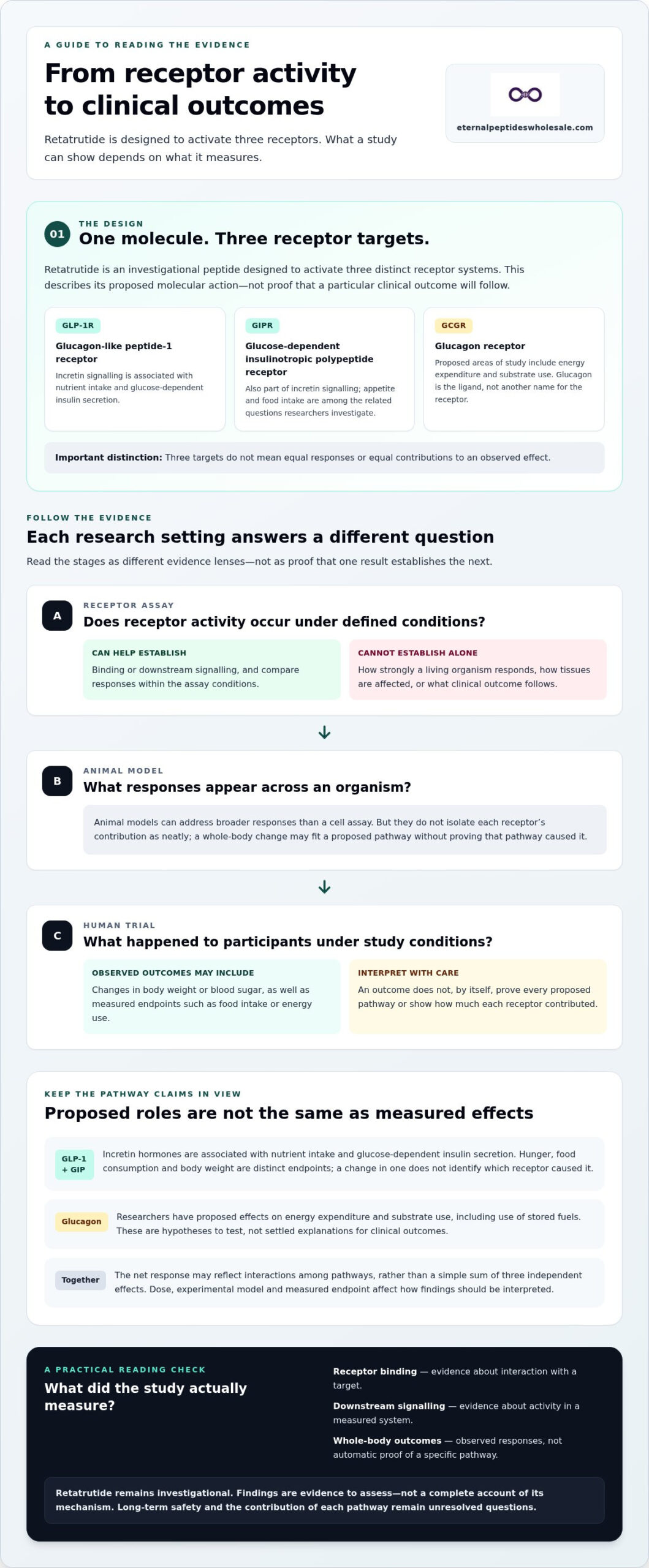
Retatrutide is an investigational peptide designed to activate three receptor targets: the GLP-1 receptor, the GIP receptor and the glucagon receptor. A receptor is a molecular structure through which a cell responds to specific signals. An agonist binds to a receptor and activates it, prompting activity in the cell. This describes a proposed molecular action, not proof that a particular health or clinical outcome will follow.
Receptor activation is only one step in a complex chain. A laboratory assay may show that a molecule activates a receptor under defined conditions. By itself, that result does not establish how strongly the receptor will respond in a living organism, how different tissues will be affected, or what clinical outcome will follow. The Retatrutide Wikipedia page offers a general overview of the molecule and its triple-agonist design. Interpret mechanistic claims in light of the methods and findings of the underlying studies.
A triple agonist is a single molecule designed to activate three distinct receptor systems. A single agonist targets one receptor, while a dual agonist targets two.
Which three receptors does retatrutide target?
The target names refer to receptors, not simply to the hormones associated with them:
- GLP-1R is the glucagon-like peptide-1 receptor.
- GIPR is the glucose-dependent insulinotropic polypeptide receptor.
- GCGR is the glucagon receptor. Glucagon is its ligand, not another name for the receptor.
These abbreviations help researchers specify which receptor they examine. They do not indicate that each target produces an equal response or contributes equally to an observed effect.
What does triple agonism mean in study terms?
In study terms, retatrutide’s design means researchers can assess its activity at three separate receptor systems. They can test each target individually, then investigate how receptor activation relates to signalling in cells or responses in a whole organism. The experimental setup determines what a result can support.
A receptor assay can measure binding or downstream signalling in a controlled system. It can help establish whether receptor activity occurs and compare responses under the assay’s conditions. It cannot recreate the full physiological environment, including interactions among tissues and feedback between biological systems. Results also depend on factors such as the cells and measurement methods used.
Animal models and human trials address broader questions by measuring responses across an organism, but they do not isolate each receptor’s contribution as neatly. A change observed in a whole-body study may be consistent with a proposed pathway without proving that the pathway caused the outcome. When reading retatrutide mechanism of action studies, remember that target activity, downstream signalling and clinical outcomes are related forms of evidence, but they are not interchangeable.
The three-receptor design gives researchers a framework for testing retatrutide’s actions, not a complete explanation in itself. The next step is to examine the proposed physiological pathways and the evidence for each one. Retatrutide research materials are for laboratory research only, not human consumption or medical use.
How retatrutide’s receptor activity may influence metabolic pathways
Activating three receptors may affect several connected processes, but a proposed pathway is not automatically the explanation for every outcome in a study. Researchers need to distinguish direct measurements, such as receptor signalling, from broader observations, such as changes in food intake or energy use. The receptors may also interact, making it difficult to assign a whole-body effect to one target alone.
GLP-1 and GIP receptor pathways
GLP-1 and GIP are incretin hormones, signals associated with nutrient intake that help regulate insulin secretion. Their insulin-related effects are glucose-dependent: they are linked to insulin release when blood glucose is elevated, rather than acting as a constant switch. Studies can examine this signalling directly or assess related outcomes such as glucose levels. Neither receptor activation nor a study result guarantees the same response in every individual.
Appetite and food intake are related but distinct research questions. Investigators may measure reported hunger, food consumption or changes in body weight. These endpoints do not all reveal the same mechanism. A change in intake could be consistent with appetite-related signalling, for example, but it does not identify which receptor caused it. This distinction helps separate proposed GLP-1 and GIP contributions from measured outcomes.
The glucagon receptor pathway
Retatrutide’s glucagon receptor activity is included to investigate metabolic effects beyond incretin signalling. Researchers have proposed that this pathway may influence energy expenditure and substrate use, including how the body uses stored fuels. These remain hypotheses to test, not settled explanations for clinical outcomes. Findings depend on the dose, the experimental model and the endpoint measured, such as energy use or a change in body composition.
Glucagon signalling also has a role in glucose regulation, so it cannot be treated as a standalone weight-loss mechanism. In a molecule that activates multiple receptors, the net response may reflect interactions among pathways, rather than a simple sum of three independent effects. A useful overview of the proposed metabolic rationale is Radiology Key on retatrutide’s triple-agonist mechanism. Check mechanistic interpretations against the study design and measurements.
Shared outcomes do not establish equal contributions from all three receptors. For example, if a study records a change in food intake alongside altered glucose measures, those observations alone cannot show how much each receptor contributed. Stronger attribution requires experiments designed to isolate pathways, with clear reporting of the model, dose and measured outcome. Read retatrutide mechanism of action studies as a body of evidence, not as proof that each proposed pathway has the same effect.
For research teams reviewing these questions, Eternal Peptides Wholesale lists retatrutide for laboratory research. Research materials are for laboratory use only, not human consumption or medical use.
What retatrutide mechanism-of-action studies actually show
Different study types answer different questions. A receptor assay can test whether retatrutide activates a target in a controlled system. An animal model can explore broader physiological responses, while a human trial can measure outcomes in participants. None of these designs, on its own, establishes the full chain from receptor activity to a clinical result.
| Study type | What it can show | Key limitation |
|---|---|---|
| Receptor assay | Whether target activity or downstream signalling occurs under defined laboratory conditions. | Does not reproduce the interactions, feedback or complexity of a whole organism. |
| Animal model | How physiological responses may develop across systems in a living model. | Species differences mean findings do not establish human responses. |
| Human clinical study | Measured pharmacodynamic or clinical outcomes in a defined participant group. | Outcomes do not necessarily identify which receptor caused them. |
What preclinical studies can establish
Receptor assays provide evidence of target activity only within the conditions tested, including the chosen cells, measurements and controls. Animal studies can explore broader responses, but their relevance to humans must be assessed rather than assumed. Researchers also consider species differences, suitable comparison groups and whether independent studies reproduce a result. Together, these methods can strengthen a mechanistic explanation, but they do not prove a human clinical effect.
What human trials can, and cannot, establish
A landmark example is the 2023 phase 2 trial by Jastreboff and colleagues, published in the New England Journal of Medicine as “Triple-Hormone-Receptor Agonist Retatrutide for Obesity.” It enrolled 338 adults with obesity, or overweight with a weight-related condition, who did not have diabetes. At 48 weeks, the highest-dose group had a mean body-weight change of −24.2%, compared with −2.1% for placebo. These are clinical outcome data, not a direct measurement of each receptor’s contribution.
Separate pharmacodynamic observations, such as measured changes in biological activity, from clinical endpoints, such as body weight or glycaemic measures. A trial may assess both, but observing them together does not prove that one precisely caused the other. Study design, population, comparator and follow-up period all shape how findings should be interpreted.
An observed clinical outcome supports an efficacy assessment, but it does not prove the precise mechanism that produced it. Trials can show what happened to their participants, while targeted experiments are needed to test causal explanations. For wider context on related compounds and research categories, see the wholesale GLP-1 research chemicals guide.
How to assess claims in retatrutide mechanism studies
A mechanistic claim is only as strong as the evidence behind it. Before accepting that a particular receptor explains an outcome, trace the claim back to what researchers measured. Use this checklist to separate direct evidence from interpretation in retatrutide mechanism of action studies.
- Identify the experimental system. Was the work conducted in a receptor assay, an animal model or a human trial? Each answers different questions, so evidence from one type should not be treated as interchangeable with another.
- Check the measurement. Did researchers measure receptor binding, downstream signalling or a whole-body outcome such as food intake or body weight? A change in an outcome does not necessarily identify the pathway that produced it.
- Review the comparison. Look for the comparator or control group, the number of observations or participants, and whether the comparison suits the research question. These details help show how confidently a result can be attributed to the tested conditions.
- Match the conclusion to the endpoint. Check what was measured and for how long. A short-term signalling result supports a different conclusion from a clinical endpoint tracked over a longer period.
- Look for corroboration. Ask whether other studies using suitable methods support the same interpretation, and whether the authors distinguish measured results from proposed explanations.
Check the model, methods and endpoint
Start with the methods, not the headline. Note the experimental system, comparator, sample size and prespecified endpoint, if reported. A receptor-selectivity assay tests a narrower question than animal physiology or human clinical measurement. If key methods are missing or reporting is incomplete, be cautious about broad claims. The model sets the boundaries of what the findings can reasonably support.
Endpoints matter, too. A study measuring downstream cellular signalling can support a statement about that signal under the test conditions. It cannot establish a whole-body effect unless that effect was measured. Likewise, an animal outcome may suggest a physiological pathway for further investigation, but it does not establish that the same response occurs in humans.
Separate association, mechanism and clinical relevance
Ask whether the experiment directly tests the proposed pathway or simply records an outcome that could be consistent with it. Direct pathway tests may strengthen causal interpretation; an observed association alone leaves other explanations open. Look for replication and converging evidence from different methods before treating a mechanism as established. Keep conclusions within the study’s model, comparator, endpoint and duration.
Analytical quality and biological interpretation are related but separate considerations. The research peptide quality assurance guide provides context for assessing material quality; it does not validate a biological result or prove a proposed mechanism. For laboratory research procurement, explore retatrutide research materials from Eternal Peptides Wholesale. These materials are for laboratory research only, not human consumption or medical use. Research findings should not be translated into dosing, treatment or personal medical advice.
Retatrutide research context: interpreting findings and sourcing responsibly
Read the evidence in three layers. It is established that retatrutide is designed to activate GLP-1, GIP and glucagon receptors, and that studies have measured biological and clinical responses. It is plausible that activity across these pathways contributes to observed metabolic effects. What remains unresolved is how much each receptor contributes, how the pathways interact, and how fully current findings explain outcomes across different research settings.
This distinction is central to interpreting retatrutide mechanism of action studies. A measured response can support a proposed explanation without proving it. Keep the study design, population, endpoints and follow-up period in view, and avoid treating a mechanistic hypothesis as a settled account of every observed effect.
What remains uncertain in the mechanism evidence?
Because the molecule activates multiple receptor systems, isolating the relative contribution of each one can be difficult. Long-term safety and responses across different populations also require continued evaluation. Findings from a defined trial group do not automatically answer questions about groups or time periods it did not study. For Australian readers, check current official sources before relying on claims about retatrutide’s Australian regulatory status.
Useful questions for future research include whether effects are consistent across study designs, which endpoints most directly reflect each proposed pathway, and whether longer follow-up changes the interpretation of earlier findings. Until those questions are addressed, distinguish what has been measured from what researchers propose may explain it.
Keep laboratory research distinct from medical use
Retatrutide research materials are for laboratory research only, not human consumption or medical use. Research findings are not instructions for treatment, dosing or individual health decisions. Laboratory materials are intended for research, not clinical care.
Eternal Peptides Wholesale is an Australian wholesale supplier of research-grade peptides. Its Retatrutide 10mg and Retatrutide 20mg are wholesale research offerings for laboratory purposes. For institutional procurement considerations, the strategic retatrutide sourcing guide provides relevant context. Sourcing information supports procurement planning, not conclusions about biological activity or clinical outcomes.
For research teams reviewing the evidence, pair careful study appraisal with clear procurement processes. Explore wholesale retatrutide research materials from Eternal Peptides Wholesale for laboratory research only. Receptor activity defines the research question, while study methods determine what the evidence can support.
Track the next evidence, not just the headline
As new research emerges, focus on whether studies are designed to test the mechanism directly or simply report an outcome that may fit a proposed explanation. Clear methods, appropriate comparators and repeatable findings can help refine what researchers understand about retatrutide’s receptor activity. The useful question is not only whether a result sounds promising, but what the study was actually able to establish.
Use that approach when reviewing future retatrutide mechanism of action studies, and keep laboratory research separate from clinical use. For Australian research teams planning procurement, Eternal Peptides Wholesale supplies research-grade peptides nationally, including Retatrutide 10mg and 20mg as wholesale research offerings. These materials are for laboratory research only, not human consumption or medical use.
Explore Retatrutide wholesale research supply and continue your work with a clear, evidence-led perspective.
Frequently Asked Questions
What receptors does retatrutide activate?
Retatrutide is designed to activate the GLP-1, GIP and glucagon receptors, commonly abbreviated as GLP-1R, GIPR and GCGR. In a paper, check whether researchers tested all three targets directly or inferred activity from other results. For example, an assay of GLP-1R signalling alone cannot establish the molecule’s activity at GIPR or GCGR, or show how those targets behave together in a more complex biological system.
Is retatrutide a triple agonist?
Yes. Retatrutide is described as a triple agonist because its design targets three receptor types: GLP-1R, GIPR and GCGR. The label describes target activity, not the size or importance of each pathway’s contribution. To assess a claim about a particular effect, look for experiments that tested the relevant pathway and consider whether the finding has been replicated using suitable methods.
How does retatrutide differ from a dual agonist?
A dual agonist is designed to activate two receptor targets; retatrutide is designed to activate three, including the glucagon receptor. This difference describes molecular design, not a direct measure of comparative performance. For a meaningful comparison, check whether studies used similar participant groups, comparators, follow-up periods and outcome measures. Results from separate trials cannot necessarily be compared as if the compounds were tested head-to-head.
Can clinical trial results prove how retatrutide works?
No. Clinical trials measure outcomes in a defined population and under specified conditions, but a change in an outcome does not by itself identify the receptor or pathway responsible. For example, a trial may record a change in a clinical measure without testing which receptor caused it. Retatrutide mechanism of action studies offer stronger mechanistic support when clinical observations align with targeted receptor experiments and relevant preclinical evidence.
What is the difference between receptor activity and a downstream effect?
Receptor activity is a measured interaction or signal at a target; a downstream effect is a later response in a cell, tissue or whole organism. For instance, an assay may detect receptor signalling, while a separate experiment measures a physiological change. The second result can be consistent with the first, but the link needs testing. Check the methods and controls to see whether a study examined that connection directly.
Are retatrutide mechanism studies conducted in humans or animals?
They can include laboratory assays, animal studies and human clinical trials. Each type addresses a different scale of question: an assay examines target activity, an animal model explores responses in a living system, and a clinical trial measures specified outcomes in participants. When reading a paper, check its model and population before applying its conclusions elsewhere. A result from one research setting does not automatically establish what happens in another.
Is retatrutide approved for medical use in Australia?
Check the Therapeutic Goods Administration’s current records before relying on any claim about Australian approval, as regulatory status can change. Do not treat a research listing or study result as evidence of approval for medical use. Eternal Peptides Wholesale supplies research-grade peptides for laboratory research only; its materials are not for human consumption or medical use. This information is not medical advice and does not provide guidance on treatment or dosing.
Related from Eternal Peptides Wholesale
Eternal Peptides Wholesale publishes batch-specific Janoshik Analytical reports in its certificate of analysis library, so the documentation for a listed batch can be read alongside the evidence discussed in this article.
- Peptide COA library: batch-specific Janoshik Analytical reports with their verification details
- Our peptide testing standards: how independent Janoshik testing is used and reported
- Janoshik reports explained: what each test measures and its limits
- Evidence review: What do peptides do? Peptide signalling and classes
- Evidence review: What are peptides used for? Synthetic peptides as research tools