
Abstract
What are peptides used for? Most public answers jump straight to medicines, supplements or skin care, but the largest and oldest use of synthetic peptides is quieter: they are everyday tools in research laboratories. A peptide is a short chain of amino acids, and because chemists can make almost any sequence on demand, peptides let researchers copy, label, block or measure a small, well-defined piece of a protein (Groß et al. 2015; Behrendt et al. 2016). This review explains the main research uses of synthetic peptides, from raising and mapping antibodies to tagging proteins, measuring enzymes, calibrating mass spectrometry, screening libraries, studying folding and building nanomaterials. It also covers the few places peptides appear in everyday products, such as food additives, and summarises how peptides are regulated in Australia. It does not describe or recommend any use in people or animals.
Key points
- In the laboratory, synthetic peptides are used mainly as tools: to raise and map antibodies, tag and purify proteins, measure enzyme activity, quantify proteins by mass spectrometry, screen libraries for binders, study folding and build materials (Sutcliffe et al. 1983; Groß et al. 2015; Gerber et al. 2003).
- Anti-peptide antibodies work because short synthetic peptides copied from a protein’s sequence can raise antibodies that recognise the whole native protein (Lerner 1982; Sutcliffe et al. 1983).
- Short peptide tags such as FLAG, HA, c-myc, polyhistidine and Strep-tag II let researchers detect and purify proteins that have no antibody of their own (Hopp et al. 1988; Field et al. 1988; Hochuli et al. 1988; Schmidt & Skerra 2007).
- In proteomics, isotope-labelled synthetic peptides act as internal standards for absolute quantification, and their purity and quantity must be specified for the assay (Gerber et al. 2003; Hoofnagle et al. 2016).
- Outside the laboratory, peptides appear in food as the preservative nisin (code 234) and the sweetener aspartame (code 951), and some are medicines; those uses are governed by separate rules (FSANZ Schedule 8; Lau & Dunn 2018).
- In Australia, whether a peptide product is a therapeutic good depends on how it is presented and what it claims, and a “research use only” label does not change its regulatory status (TGA 2024; TGA n.d.; TGA 2026).
Contents
- What are peptides used for, and why are they so useful in the laboratory?
- What are peptides used for in immunology? Antibody production and epitope mapping
- Peptide tags and functional motifs
- What are peptides used for in proteomics? Synthetic peptides in mass spectrometry
- What are peptides used for in enzymology? Substrates and inhibitors
- Peptide libraries, display technologies and constrained peptides
- Folding and biophysics: peptides as model systems
- Materials: self-assembling peptides and hydrogels
- Antimicrobial peptides: a major research field
- Peptides in food and cosmetics
- Peptide medicines: a separate question
- How research uses of peptides have grown: a PubMed snapshot
- A short history of synthetic peptides as research tools
- Peptide research in Australia
- Purity, quality and handling: matching the peptide to its use
- Practical considerations when using synthetic peptides in experiments
- Peptides in Australia: how the rules apply
- How to read claims about what peptides are used for
- Limitations of this review
- Relevance to Eternal Peptides Wholesale
- Glossary
- Frequently asked questions
- References
- Related research
- About this article
- About the author
What are peptides used for, and why are they so useful in the laboratory?
Peptides are chains of amino acids joined by amide (peptide) bonds. There is no sharp cut-off between a peptide and a protein, but in practice “peptide” usually means a chain of roughly 2 to 50 residues, short enough to make by chemical synthesis. Our earlier explainers cover what peptides are and what peptides do in the body; this article focuses on what synthetic peptides are used for as research tools.
Three properties make synthetic peptides useful. The first is that they can be made to order. Since solid-phase peptide synthesis was introduced in 1963, a peptide of a chosen sequence has been something a chemist can assemble residue by residue on a resin support (Merrifield 1963). Fmoc-based solid-phase synthesis is now the standard method, and protected building blocks, including many modified amino acids, are widely available at low cost (Behrendt et al. 2016; Fields & Noble 1990). Longer chains and small proteins can be joined from synthetic segments by native chemical ligation (Dawson et al. 1994; Kent 2009). Our article on how synthetic peptides are manufactured and verified covers the chemistry in detail.
The second property is that a peptide can stand in for part of a protein. Many proteins interact with antibodies, receptors, enzymes and other proteins through short, continuous stretches of sequence. A synthetic copy of that stretch can often reproduce, block or report on the interaction, while being far easier to make, purify and modify than the whole protein (Groß et al. 2015).
The third is that peptides are easy to change. A chemist can swap one residue at a time, add non-natural amino acids, attach fluorescent dyes, biotin or heavy isotopes, or tie the chain into a ring. Such changes can raise resistance to proteases or lock a chain into a particular shape (Groß et al. 2015; Walensky et al. 2004). Much of the research described below depends on that ability to make many closely related variants and compare them.
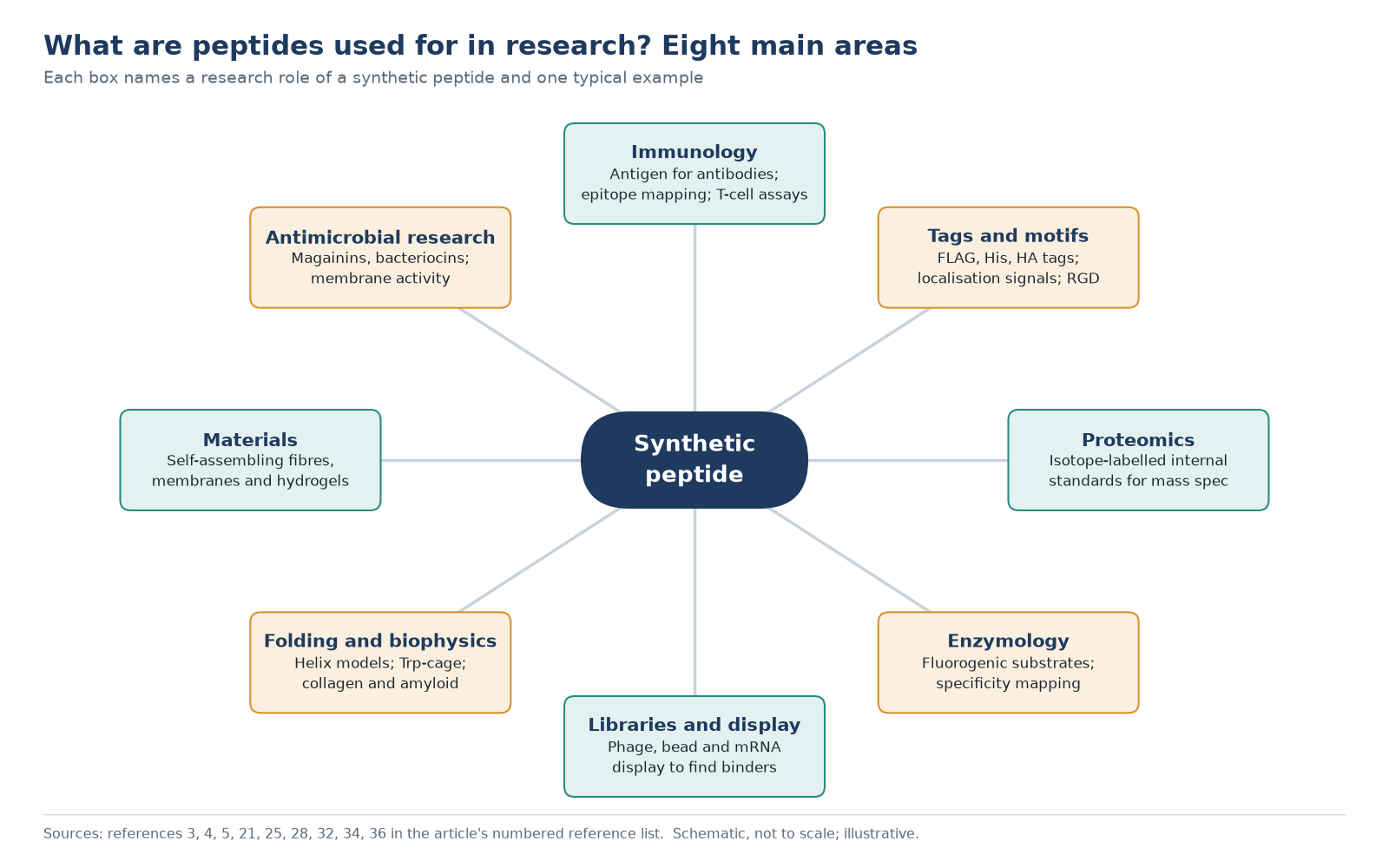
In this sense, the honest answer to “what are synthetic peptides used for?” is “mostly for asking precise questions about proteins”. The uses sort into a handful of families, summarised in Table 1 and Figure 1.
Table 1. What synthetic peptides are used for in research: main fields, what the peptide does and typical examples.
| Field | What the peptide does | Typical example | Key sources |
|---|---|---|---|
| Immunology and antibodies | Acts as an immunogen or as a binding target to locate epitopes | Anti-peptide antibodies; overlapping peptide sets for epitope mapping | (Lerner 1982; Geysen et al. 1984; Maecker et al. 2001) |
| Protein tags and motifs | Short sequence fused to a protein for detection, purification or localisation | FLAG, HA, c-myc, polyhistidine, Strep-tag II; nuclear localisation signal | (Hopp et al. 1988; Hochuli et al. 1988; Kalderon et al. 1984) |
| Proteomics and mass spectrometry | Labelled synthetic copy acts as an internal standard or reference | Isotope-labelled peptides for absolute quantification; retention-time standards | (Gerber et al. 2003; Escher et al. 2012) |
| Enzymology | Substrate or inhibitor that reports enzyme activity or specificity | Quenched fluorogenic protease substrates; kinase substrate libraries | (Matayoshi et al. 1990; Thornberry et al. 1997; Songyang et al. 1994) |
| Libraries and display | Large collections screened for binders | Phage display, one-bead-one-compound and mRNA display libraries | (Smith 1985; Lam et al. 1991; Roberts & Szostak 1997) |
| Folding and biophysics | Minimal model of a structural element | Designed helices, the Trp-cage miniprotein, amyloid peptides | (Marqusee & Baldwin 1987; Neidigh et al. 2002; Jarrett et al. 1993) |
| Materials and cell culture | Building block that self-assembles into fibres, membranes or gels | Ionic self-complementary peptides; diphenylalanine nanotubes | (Zhang et al. 1993; Reches & Gazit 2003) |
| Antimicrobial research | Natural or designed peptides studied for membrane activity | Magainins, bacteriocins, database-driven design | (Zasloff 1987; Wang et al. 2016) |
What are peptides used for in immunology? Antibody production and epitope mapping
Anti-peptide antibodies
One of the earliest and still most common uses of synthetic peptides is to make antibodies against a protein without first purifying the protein. In the early 1980s, researchers showed that chemically synthesised peptides copied from almost any surface region of a protein could raise antibodies that recognised the intact, native protein, giving antibodies of “predetermined specificity” (Lerner 1982). A follow-up review argued that such immunogens would become valuable reagents, because a researcher who knew only a gene sequence could make an antibody to its product (Sutcliffe et al. 1983).
Peptide antibody production follows a broadly standard design. Short peptides are usually too small to provoke a strong immune response by themselves, so they are coupled to a large carrier protein such as keyhole limpet hemocyanin or bovine serum albumin. A common chemistry adds a cysteine to one end of the peptide and links it to the carrier with a heterobifunctional cross-linker; one widely cited method uses dimethylformamide to dissolve hydrophobic peptides before coupling (Lateef et al. 2007). An alternative avoids a carrier altogether: the multiple antigen peptide system builds eight copies of a peptide onto a branched lysine core in a single solid-phase synthesis. In the original description, five of six such constructs raised antibodies that reacted with the native proteins (Tam 1988).
Anti-peptide antibodies are workhorses for detecting proteins on blots, in cells and in tissue sections. They also underpin several protein tags, discussed below, because an antibody raised against a peptide will recognise that peptide wherever it is fused (Field et al. 1988; Evan et al. 1985). A recent journal special issue on peptide antibodies shows that design, production and characterisation remain active topics (Trier & Houen 2023).
Epitope mapping
The reverse question, which part of a protein an antibody binds, is answered with sets of synthetic peptides. In 1984, researchers described synthesising hundreds of peptides at once on solid supports and testing each against antibodies by ELISA without removing it from the support. Using peptides from a foot-and-mouth disease virus coat protein, they located an epitope within residues 146–152. They then made a complete replacement set, substituting all 20 amino acids at every position, and found that leucines at positions 148 and 151 were essential for binding (Geysen et al. 1984). The same group later set out general strategies for epitope analysis with large peptide sets (Geysen et al. 1987).
Other parallel methods followed. A “tea-bag” approach made 248 different 13-residue analogues of an influenza haemagglutinin segment, 10–20 mg each, in under four weeks, and showed that a single aspartic acid was critical for antibody binding (Houghten 1985). SPOT synthesis builds peptides at addressable positions on a cellulose membrane (Frank 1992); a later description reported a cost per peptide below 1% of conventional resin synthesis, with applications in binding and enzyme assays (Hilpert et al. 2007). Peptide arrays on membranes, glass and other surfaces are now a field in their own right (Szymczak et al. 2018).
Epitope maps are collected in public resources. The Immune Epitope Database curates published antibody and T-cell epitope data and makes them freely searchable (Vita et al. 2019), and databases of MHC ligands and binding motifs support epitope prediction (Rammensee et al. 1999).
T-cell research: peptide pools and peptide–MHC multimers
T cells recognise short peptides presented by MHC molecules rather than intact proteins, so synthetic peptides are natural tools for studying them. Pools of overlapping peptides spanning a protein can be added to blood cells to see which T cells respond. One influential study found that 15-residue peptides overlapping by 11 residues stimulated both CD4+ and CD8+ T-cell responses, regardless of the donor’s HLA type (Maecker et al. 2001).
Peptides also make T cells visible. In 1996, researchers multimerised peptide–MHC complexes into soluble tetramers that bound T cells specific for that peptide, replacing tedious, indirect methods with direct identification of the responding cells (Altman et al. 1996). Peptide–MHC multimers remain a standard reagent, although, as Figure 3 shows, they account for a small share of the literature compared with broader topics.
Peptide tags and functional motifs
Epitope and affinity tags
Most proteins studied in modern laboratories are produced recombinantly. To detect or purify a protein that has no good antibody, researchers fuse a short peptide tag to it by genetic engineering and then use a well-characterised reagent against the tag (Terpe 2003; Kimple et al. 2013). The idea was demonstrated in 1988 when a short epitope was added to a yeast enzyme complex so that it could be purified with an antibody raised against the peptide (Field et al. 1988). The same year saw descriptions of the FLAG marker sequence (Hopp et al. 1988) and of adjacent histidine residues that bind a nickel chelate resin (Hochuli et al. 1988).
Table 2 lists widely used tags and motifs. Small tags such as FLAG, HA and c-myc have short linear recognition sequences that rarely change the properties of the fused protein (Kimple et al. 2013), and the hexahistidine tag is the most frequently used affinity tag of all (Zhao et al. 2013). Tags are not neutral in every case, so researchers often test whether a tag affects folding, activity or location.
Table 2. Common peptide tags and functional motifs used in research.
| Tag or motif | Sequence or size | Origin | Main research use | Sources |
|---|---|---|---|---|
| FLAG | DYKDDDDK (8 residues); includes an enterokinase cleavage site | Designed marker | Detection and antibody-based purification | (Hopp et al. 1988; Zhao et al. 2013) |
| HA | Haemagglutinin residues 98–106 (9 residues) | Influenza haemagglutinin | Detection, immunoprecipitation, purification | (Kimple et al. 2013; Zhao et al. 2013) |
| c-myc | Short sequence from the human c-myc product, recognised by antibody 9E10 | Human c-myc protein | Detection and immunoprecipitation | (Evan et al. 1985; Zhao et al. 2013) |
| Polyhistidine (His-tag) | 2–10 histidines, usually six | Designed | Metal-chelate purification (Ni²⁺ or Co²⁺), elution with imidazole | (Hochuli et al. 1988; Kimple et al. 2013) |
| Strep-tag II | WSHPQFEK (8 residues) | Selected peptide | Binds engineered streptavidin (Strep-Tactin); one-step purification | (Schmidt & Skerra 2007; Kimple et al. 2013) |
| SV40 nuclear localisation signal | PKKKRKV (7 residues) | SV40 large T antigen | Directs fused proteins to the nucleus | (Kalderon et al. 1984) |
| HIV-1 Tat basic domain | Short arginine-rich peptide | HIV-1 Tat protein | Cell-penetrating carrier in uptake studies | (Vivès et al. 1997; Madani et al. 2011) |
| Antennapedia third helix | 16 residues | Drosophila homeodomain | Cell-penetrating carrier in uptake studies | (Derossi et al. 1994) |
| RGD | Arg-Gly-Asp (3 residues; RGDS tetrapeptide in early work) | Fibronectin and other adhesion proteins | Cell-adhesion studies; integrin binding | (Pierschbacher & Ruoslahti 1984; Ruoslahti 1996) |
The Strep-tag system illustrates how a selected peptide can become a standard reagent: the eight-residue Strep-tag II binds an engineered streptavidin tightly enough for one-step purification and detection (Schmidt & Skerra 2007). Polyhistidine tags work through a different chemistry: histidine side chains coordinate immobilised nickel or cobalt ions and are released by imidazole or low pH (Kimple et al. 2013).
Localisation signals
Some of the most useful peptide sequences are natural signals that tell a cell where to send a protein. The classic example is the seven-residue sequence Pro-Lys-Lys-Lys-Arg-Lys-Val from SV40 large T antigen, which acts as a nuclear localisation signal when transferred to other proteins (Kalderon et al. 1984). Researchers use such signals to direct reporter proteins to particular compartments, or mutate them to test whether a protein’s location matters for its function.
Cell-penetrating peptides
In 1988, two groups reported that the HIV-1 Tat protein could enter cultured cells from the surrounding medium (Frankel & Pabo 1988; Green & Loewenstein 1988). Later work narrowed the activity to a short basic segment that crossed the plasma membrane and gathered in the nucleus (Vivès et al. 1997). Independently, a 16-residue peptide from the third helix of the Antennapedia homeodomain was found to cross membranes, including at 4 °C, which argued against simple endocytosis (Derossi et al. 1994).
These and similar sequences became known as cell-penetrating peptides. They are rich in arginine and lysine and are used in research to carry attached cargoes, such as other peptides, nucleic acids or labels, into cells (Guidotti et al. 2017). How they get in is still debated: endocytosis and direct penetration have both been proposed, and the route may depend on the peptide, cargo, concentration and cell type (Madani et al. 2011). That uncertainty is a reason for caution when reading claims about delivery.
Adhesion motifs: RGD
In 1984, researchers showed that the cell-attachment activity of fibronectin, a large extracellular protein, could be reproduced by the tetrapeptide Arg-Gly-Asp-Ser (Pierschbacher & Ruoslahti 1984). RGD turned out to be the attachment site of many adhesion proteins and is recognised by a large family of integrin receptors. Short RGD peptides promote cell adhesion when attached to a surface and inhibit it when free in solution, and cyclising the peptide can shift which integrins it prefers (Ruoslahti 1996). RGD peptides are therefore used both to coat culture surfaces and materials and as competitive probes in adhesion experiments.
What are peptides used for in proteomics? Synthetic peptides in mass spectrometry
Mass spectrometry has become the main way to identify and measure proteins in complex samples (Aebersold & Mann 2003). Most workflows do not analyse intact proteins. Instead they digest proteins with trypsin, which cuts after arginine and lysine, and analyse the resulting peptides (Olsen et al. 2004). Peptides are therefore the currency of proteomics, and synthetic peptides play several roles in it.
Internal standards for absolute quantification
To measure how much of a protein is present, rather than comparing relative amounts, researchers add a known quantity of a synthetic peptide that matches a tryptic peptide from the target protein but carries heavy stable isotopes. The natural and heavy versions behave almost identically during separation but differ in mass, so the ratio of their signals gives the absolute amount. This approach, called AQUA, was described in 2003; it also allowed synthetic peptides carrying modifications such as phosphorylation to measure modified forms of a protein (Gerber et al. 2003). In AQUA the synthetic internal standard is added at a known concentration during digestion (Kirkpatrick et al. 2005). Spiked synthetic standards sit alongside metabolic, chemical and enzymatic labelling and label-free methods as one of the main quantitative strategies (Bantscheff et al. 2007).
These measurements usually use targeted methods such as selected reaction monitoring, in which the instrument is set to watch for chosen precursor and fragment ions; the selected transitions plus the retention time form an assay (Lange et al. 2008; Picotti & Aebersold 2012). Because such assays can support important conclusions, a community guideline sets out tiers of validation that should match the intended use (Carr et al. 2014).
Specifying synthetic peptide standards
The quality of the standard sets a ceiling on the quality of the measurement. Consensus recommendations from a proteomics consortium cover how labelled synthetic peptides should be procured, characterised, stored and handled; they call for chemical purity above 95%, isotopic purity above 99% and amino acid analysis to establish how much peptide is actually present (Hoofnagle et al. 2016). That last point matters because HPLC purity describes only the share of peptide-related material that is the target sequence. It does not tell you how much of the powder’s weight is peptide rather than water, salts and counter-ions. Our guides to reading a certificate of analysis, interpreting an HPLC chromatogram and calculating peptide concentrations explain the difference.
Reference peptides and peptide libraries for identification
Synthetic peptides also calibrate instruments and software. Indexed retention time (iRT) uses a set of reference peptides to convert retention times into a dimensionless, peptide-specific value that can be transferred between laboratories and chromatography systems (Escher et al. 2012). At a far larger scale, the ProteomeTools project synthesised and analysed more than 330,000 tryptic peptides covering essentially all canonical human gene products, creating reference spectra for identifying peptides and training prediction tools (Zolg et al. 2017).
What are peptides used for in enzymology? Substrates and inhibitors
Enzymes that act on proteins, such as proteases and kinases, usually recognise a short stretch of sequence around the bond they cut or the residue they modify. Synthetic peptides are therefore natural substrates for measuring their activity and mapping what they prefer. Early studies used peptide substrates of increasing length to probe the size of the active site of the protease papain (Schechter & Berger 1967), and showed that several basic residues determine which substrates a cAMP-dependent protein kinase will phosphorylate (Kemp et al. 1977).
Fluorogenic and reporter substrates
A widely used design attaches a fluorescent group to one side of a cleavage site and a quencher to the other. While the peptide is intact, the quencher absorbs the fluorophore’s energy; when a protease cuts between them, fluorescence rises and can be followed continuously. A 1990 assay for HIV-1 protease used this internally quenched design (Matayoshi et al. 1990). Similar quenched, chromogenic and fluorogenic peptides are used to measure many proteases in purified systems and cell extracts.
Mapping specificity with libraries
Researchers use peptide libraries to find out which sequences an enzyme prefers. A positional scanning library defined the specificities of the caspase family and granzyme B; caspases 2, 3 and 7, for example, preferred the motif DEXD (Thornberry et al. 1997). For protein kinases, an oriented library of more than 2.5 billion peptide substrates was used to determine optimal phosphorylation sequences (Songyang et al. 1994), and a later combinatorial method sped up motif discovery for serine and threonine kinases (Hutti et al. 2004). Proteome-derived peptide libraries take the idea further by digesting a whole proteome into peptides, exposing them to a protease and identifying the cut sites by mass spectrometry; for the protease GluC, more than 95% of 558 identified sites showed its canonical selectivity (Schilling & Overall 2008).
The same knowledge of preferred sequences is used to design peptide-based inhibitors and activity probes for research. Those designs, as with substrates, are tools for studying enzymes in defined experimental systems.
Peptide libraries, display technologies and constrained peptides
Synthetic combinatorial libraries
If a researcher does not know which peptide will bind a target, they can make a very large number at once and select the ones that do. In 1991, two complementary approaches were published. One made libraries of free peptides, more than 34 million hexapeptides, and narrowed them down by iterative selection to find an antibody epitope and other ligands (Houghten et al. 1991). The other, the one-bead-one-compound method, used split-and-mix synthesis so that each resin bead carried many copies of a single sequence; beads that bound a labelled target were picked and sequenced (Lam et al. 1991; Lam et al. 1997).
Biological display
Biological display links each peptide to the gene that encodes it, so that winning sequences can be read from DNA. In 1985, foreign sequences inserted into a gene of filamentous phage were shown to appear on the surface of the virus particle, and fusion phage could be enriched more than 1000-fold by binding to an antibody (Smith 1985). A 1990 “epitope library” displayed tens of millions of different short peptides on phage and surveyed them for binding to antibodies and other proteins (Scott & Smith 1990). mRNA display, introduced in 1997, joins each peptide covalently to its own mRNA through puromycin, allowing selection entirely in vitro (Roberts & Szostak 1997). Ribosomal translation combined with an engineered genetic code can now screen macrocyclic peptide libraries of more than 10^13 members in hours to days (Passioura et al. 2014).
Constrained and designed peptides
Short linear peptides are flexible and easily cut by proteases, which limits their use as probes. Several approaches lock them into defined shapes. Hydrocarbon “stapling” links two side chains to hold a peptide in a helix; stapled peptides derived from the BH3 domain were helical, resistant to proteases and able to enter cells, and bound their target proteins with higher affinity, making them useful tools for studying protein–protein interactions (Walensky et al. 2004). Phage-displayed peptides with three cysteines can be cyclised onto a small chemical core to give bicyclic peptides; one selected from such a library inhibited the protease plasma kallikrein with a Ki of 1.5 nM (Heinis et al. 2009). Computational design can now produce hyperstable disulfide-crosslinked and backbone-cyclised peptides of 18–47 residues (Bhardwaj et al. 2016), and mixed-chirality macrocycles whose NMR structures matched the designs in most cases tested (Hosseinzadeh et al. 2017).
Nature supplies constrained scaffolds too. Cyclotides are plant peptides of about 30 residues with a head-to-tail cyclic backbone and a knotted arrangement of three disulfide bonds; a 1999 study described 16 new members and an NMR structure (Craik et al. 1999). Animal venoms are another source: venom peptides act on a wide range of pharmacological targets and are valuable research ligands for studying them (Lewis & Garcia 2003). One example is a double-knot spider-venom peptide that inhibits the acid-sensing ion channel ASIC1a, whose two-domain structure was solved by NMR (Chassagnon et al. 2017).
Folding and biophysics: peptides as model systems
Proteins are too large and complex to explain every structural rule directly, so researchers use peptides to isolate one element at a time. In 1987, short alanine-based peptides were designed to test how glutamate–lysine spacing affects helix formation; pairs spaced to form salt bridges one turn apart stabilised the helix, measured by circular dichroism (Marqusee & Baldwin 1987). Such host–guest peptides, combined with protein studies, produced scales of helix propensity: alanine is the most favourable residue and, excluding proline, glycine is the least, about 1 kcal/mol less favourable (Pace & Scholtz 1998).
Miniproteins push the approach further. The 20-residue Trp-cage is more than 95% folded in water and became a test system for both experiments and computer simulations of folding (Neidigh et al. 2002). Collagen-like peptides revealed the triple helix in atomic detail; a 1.9 Å crystal structure confirmed the structure and showed a network of water molecules involving hydroxyproline (Bella et al. 1994), and synthetic collagen-mimetic peptides have since clarified what stabilises the triple helix (Shoulders & Raines 2009).
Peptides are also central to the study of misfolding. Synthetic amyloid-β peptides showed that amyloid formation is nucleation-dependent and that two extra residues at the C-terminus, 1–42 versus 1–40, change how quickly the peptides aggregate (Jarrett et al. 1993). Research since has shown that the amyloid state is more general than once thought, and that many peptides and proteins can adopt it under suitable conditions (Knowles et al. 2014).
Materials: self-assembling peptides and hydrogels
Because sequence controls how peptides pack together, peptides can be designed as building blocks for materials. In 1993, a 16-residue peptide with alternating charged and uncharged residues, (AEAEAKAK)2, was found to assemble on adding salt into a stable membrane made of filaments 10–20 nm across (Zhang et al. 1993). Related ionic self-complementary peptides form hydrogels that, in culture, supported neuronal attachment, neurite outgrowth and synapse formation (Holmes et al. 2000).
Other designs use different forces. Peptide amphiphiles, which combine a peptide with a fatty tail, assembled into nanofibres that directed the mineralisation of hydroxyapatite along the fibre axes (Hartgerink et al. 2001). The dipeptide diphenylalanine forms discrete, stiff nanotubes, which have been used as templates for silver nanowires (Reches & Gazit 2003). Fmoc-protected dipeptides form hydrogels used for three-dimensional cell culture (Jayawarna et al. 2006). Reviews describe short peptides forming nanotubes, nanospheres, nanofibrils, nanotapes and hydrogels, and stress that they are easy to synthesise at scale (Gazit 2007; Hauser & Zhang 2010). In these applications, the peptide is a structural component, not a biologically active agent.
Table 3. Common modifications to synthetic peptides and what they are used for in research.
| Modification | Purpose | Example research use | Sources |
|---|---|---|---|
| Terminal cysteine plus cross-linker | Site-specific attachment to a carrier or surface | Coupling to keyhole limpet hemocyanin or albumin for antibody production | (Lateef et al. 2007) |
| Branched lysine core (MAP) | Many copies of an antigen without a carrier protein | Multiple antigen peptides | (Tam 1988) |
| Stable heavy isotopes (¹³C, ¹⁵N) | Mass shift without changing chemistry | Internal standards for absolute quantification | (Gerber et al. 2003; Hoofnagle et al. 2016) |
| Phosphorylation and other modifications | Mimic a natural modification | Standards for modified proteins; kinase substrates | (Gerber et al. 2003; Songyang et al. 1994) |
| Fluorophore and quencher pair | Signal on cleavage | Continuous protease assays | (Matayoshi et al. 1990) |
| Hydrocarbon staple | Stabilise a helix | Probes of protein–protein interactions | (Walensky et al. 2004) |
| Cyclisation and bicyclic cores | Restrict shape; tune selectivity and stability | Cyclic RGD peptides; bicyclic phage-library binders | (Ruoslahti 1996; Heinis et al. 2009) |
| Non-proteinogenic and D-amino acids | Add new chemistry; resist proteases | Protein mimics; mixed-chirality macrocycles | (Groß et al. 2015; Hosseinzadeh et al. 2017) |
| Aromatic N-terminal group (Fmoc) | Drive self-assembly | Fmoc-dipeptide hydrogels | (Jayawarna et al. 2006) |
| Fatty tail (amphiphile) | Drive fibre formation | Mineralising peptide-amphiphile nanofibres | (Hartgerink et al. 2001) |
Antimicrobial peptides: a major research field
Many organisms make short, positively charged peptides that kill or inhibit microbes. In 1987, two such peptides, the magainins, were isolated from the skin of the African clawed frog (Zasloff 1987). Broad-spectrum antimicrobial peptides were later found in animals and plants as part of host defence (Zasloff 2002). Most are cationic and amphiphilic, and they occur in virtually every form of life (Hancock & Sahl 2006). The Antimicrobial Peptide Database held 2,619 natural antimicrobial peptides in its 2016 update, including 261 bacteriocins from bacteria and 1,972 host-defence peptides from animals (Wang et al. 2016).
Antimicrobial peptides are a major research topic, and Figure 2 shows they generate more PubMed records than any other use counted here. Translation has been much slower than the volume of research might suggest. A 2006 review noted that clinical trials had shown efficacy only for topical use and that toxicity and protease degradation were obstacles (Hancock & Sahl 2006), and a 2020 review described structural and functional limitations and a stricter regulatory environment (Magana et al. 2020). Antimicrobial peptides are therefore best described as a research field, not an established class of products.
Peptides in food and cosmetics
A few peptides have become everyday ingredients, which is one answer to the question “are peptides used outside the lab?”. Nisin is a bacteriocin, an antimicrobial peptide made by bacteria (Cotter et al. 2013). A 1996 review reported that nisin had been introduced commercially as a food preservative in the United Kingdom about 30 years earlier, first in processed cheese, and was by then recognised as a food preservative in about 50 countries (Delves-Broughton et al. 1996). In Australia and New Zealand, Schedule 8 of the Food Standards Code lists nisin with the code number 234 (FSANZ Schedule 8).
The sweetener aspartame is a dipeptide derivative: L-aspartyl-L-phenylalanine methyl ester (PubChem n.d.). Schedule 8 lists it with the code number 951 (FSANZ Schedule 8). Whether a substance may be added to a particular food, and in what amount, is set by other parts of the Code; Schedule 8 only gives the names and code numbers used on ingredient lists.
Peptides also appear in cosmetics. In Australia, cosmetic ingredients are regulated as industrial chemicals by the Australian Industrial Chemicals Introduction Scheme (AICIS), and the TGA does not assess cosmetics unless they make therapeutic claims (TGA 2021). The scheme is established under the Industrial Chemicals Act 2019 (Industrial Chemicals Act 2019). Our review of copper peptides and GHK-Cu looks at one cosmetic peptide in detail, including where the evidence is limited.
Peptide medicines: a separate question
Some peptides are approved medicines. A 2018 review counted more than 60 peptide drugs approved in the United States and other major markets, with more than 150 in active clinical development (Lau & Dunn 2018), and a 2021 review put the number on the market at more than 80 (Muttenthaler et al. 2021). Approved medicines are a different subject from research tools: they are specific products evaluated by regulators, and their use is a matter for prescribers and patients. This article does not discuss individual peptide medicines; our article on what peptides do, including approved peptide medicines in Australia gives an overview. The point for this review is that the same synthesis and analytical chemistry that supports medicines also supports research peptides (Wang et al. 2022; Vlieghe et al. 2010; Henninot et al. 2018), and that there is pressure to make that chemistry greener, because peptide synthesis still relies heavily on large volumes of hazardous solvents and reagents (Isidro-Llobet et al. 2019). The gap between laboratory findings and claims about effects in people is examined for one popular area in peptides for muscle gain: a structured evidence review.
How research uses of peptides have grown: a PubMed snapshot
To give a rough sense of scale, we counted PubMed records whose title or abstract mentions nine research uses of peptides, by decade from 1980 to 2025, using the National Library of Medicine’s public E-utilities search service (NCBI E-utilities). The search strings are listed in the editor notes so the analysis can be repeated. Figure 2 shows the counts.
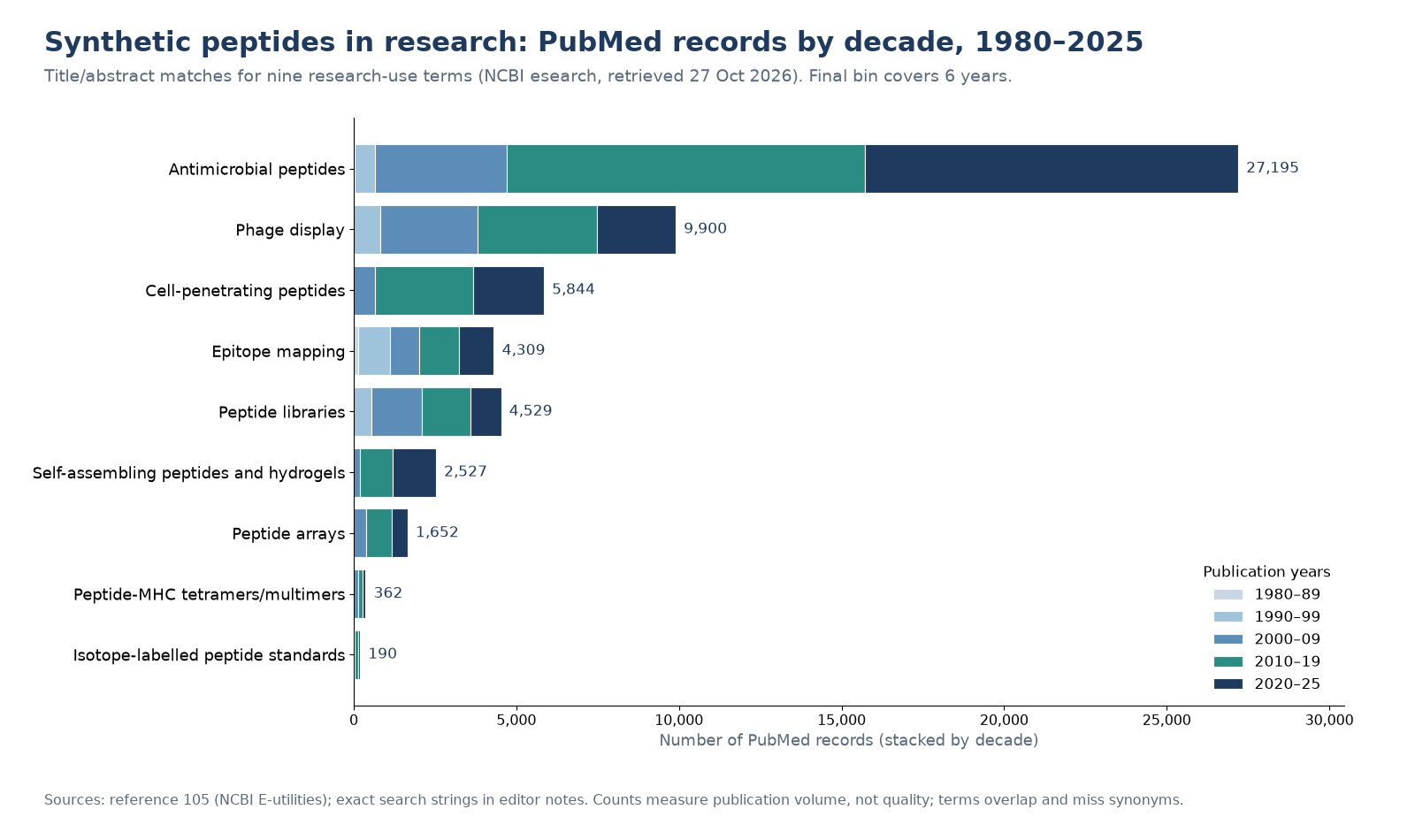
Three patterns stand out. First, antimicrobial peptides dominate, with about 27,000 records across the period, including more than 11,000 in each of the last two bins. Second, several tool-based fields grew fast and then levelled off: phage display rose from 2 records in the 1980s to about 3,650 in 2010–2019, and peptide libraries peaked in 2000–2009 at about 1,550. Third, newer materials work, such as self-assembling peptides and peptide hydrogels, is still growing, from 3 records in the 1990s to about 1,320 in the six years from 2020 to 2025.
The smaller series tell their own stories. Cell-penetrating peptides barely appear before 2000, with one record in the 1990s under these terms, and then rise to about 3,000 records in 2010–2019, following the uptake findings described earlier (Derossi et al. 1994; Madani et al. 2011). Epitope mapping is the most stable series: it was already well established in the 1990s, with almost 1,000 records, and has stayed at roughly that level per decade since. Peptide–MHC tetramer and multimer terms, and isotope-labelled peptide standards, are small in absolute numbers, partly because both tools are now routine and are often used without being named in an abstract. A low count can therefore mean a niche technique or a technique so standard that authors no longer mention it.
Counts like these have clear limits. They depend on wording: a paper that uses a peptide standard without naming it in the abstract will not be found, and some terms have synonyms we did not include. A record count measures how often a topic is written about, not how important or reliable the work is. Because the last bin is six years and indexing of recent papers continues, it is not directly comparable with full decades. The figure is best read as a map of where research attention has gone, not a ranking of value. For a guide to weighing the evidence behind any peptide claim, see our article on how to judge the evidence behind a claim.
A short history of synthetic peptides as research tools
The tools described above arrived over about half a century, each built on improvements in synthesis and analysis. Figure 3 places selected milestones on a timeline.
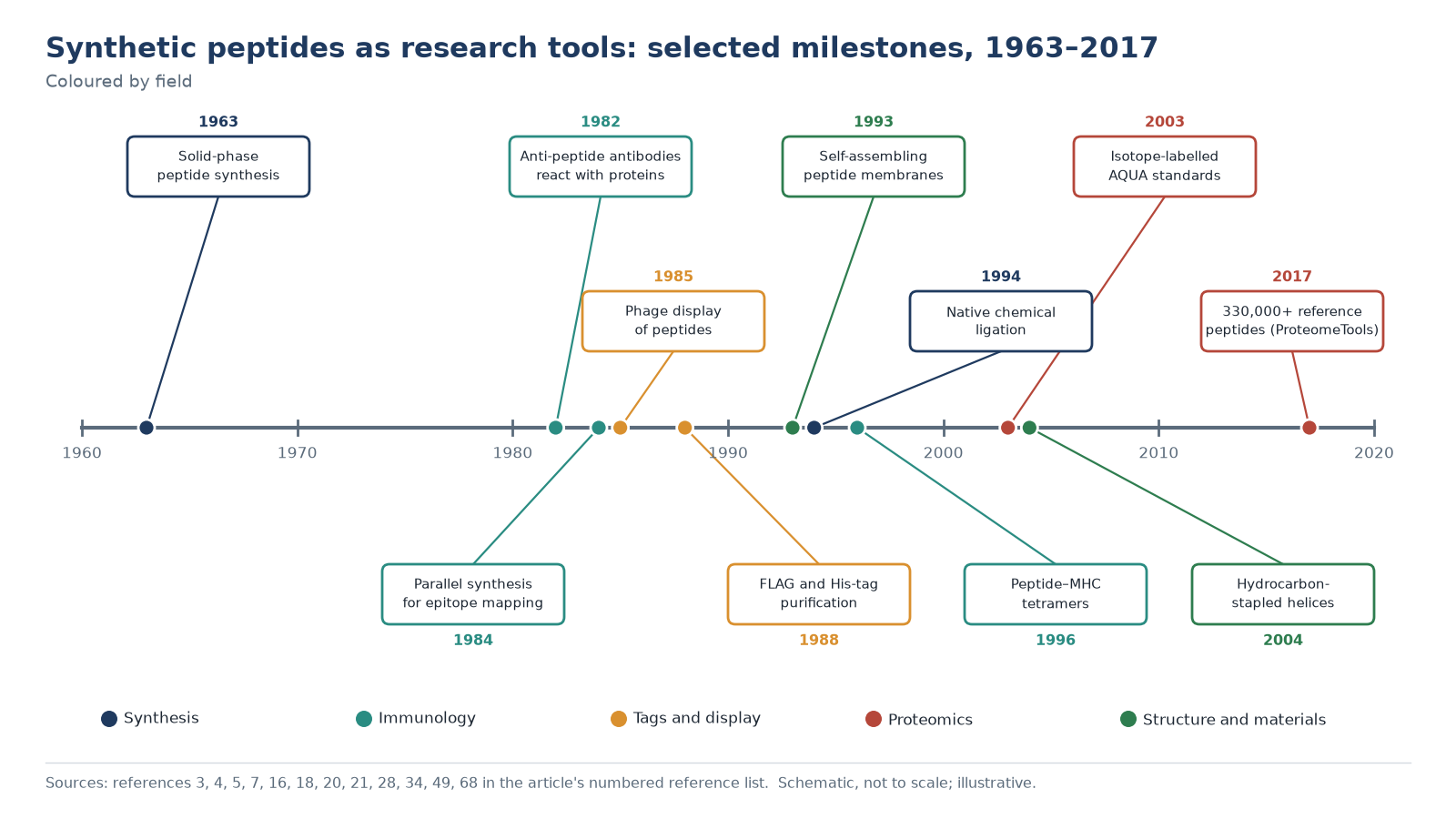
Solid-phase synthesis in 1963 made peptides practical to make (Merrifield 1963). The early 1980s brought anti-peptide antibodies (Lerner 1982), and 1984 brought parallel synthesis for epitope mapping (Geysen et al. 1984). Phage display followed in 1985 (Smith 1985), and the first widely adopted protein tags in 1988 (Hopp et al. 1988; Hochuli et al. 1988). The 1990s added self-assembling peptide materials (Zhang et al. 1993), native chemical ligation for building small proteins (Dawson et al. 1994) and peptide–MHC tetramers (Altman et al. 1996). In the 2000s came isotope-labelled peptide standards for absolute quantification (Gerber et al. 2003) and hydrocarbon-stapled helices (Walensky et al. 2004), and in 2017 a single project synthesised more than 330,000 peptides as references for proteomics (Zolg et al. 2017).
Two broader trends run through the timeline. One is the spread of standard Fmoc chemistry and low-cost building blocks, which made custom peptides routine laboratory reagents (Behrendt et al. 2016). The other is the growing link between peptides and analytical instruments, especially mass spectrometry, which moved synthetic peptides from being the object of study to being the reference against which other measurements are made (Gerber et al. 2003; Zolg et al. 2017). Both trends continue, alongside efforts to make synthesis less wasteful (Isidro-Llobet et al. 2019).
Peptide research in Australia
Australian researchers have contributed to several of these fields, which is relevant to readers interested in peptides research in Australia. The authors of the 1987 strategies paper on epitope analysis by multiple peptide synthesis were based at a serum laboratory in Parkville, Victoria, building on the 1984 parallel-synthesis method (Geysen et al. 1987; Geysen et al. 1984). Brisbane-based researchers described the cyclotide family of plant peptides and their cyclic cystine-knot structure (Craik et al. 1999), have long studied venom peptides as research ligands (Lewis & Garcia 2003; Muttenthaler et al. 2021), and solved the structure of the double-knot spider-venom peptide that inhibits ASIC1a (Chassagnon et al. 2017). Brisbane-based researchers were also among the authors of the computational macrocycle-design work cited above (Hosseinzadeh et al. 2017).
We mention these contributions to show that peptide science is an active research area in Australia. None of the work described involves any commercial product, and none of the cited groups is connected with this website.
Purity, quality and handling: matching the peptide to its use
Because peptides are used for such different jobs, there is no single “right” purity. The impurities left by synthesis, such as deletion sequences, truncated chains, incompletely deprotected residues and counter-ions, matter more in some applications than others. Our article on synthetic peptides: manufacture, impurities and analytical verification describes them in detail. Supplier documentation and its limits are examined in peptides wholesale: supplier qualification, quality standards and regulation.
Academic peptide facilities commonly offer several grades and match them to applications. One such facility lists four levels: above 95% for quantitative bioassays, quantitative enzyme studies, chromatography standards, NMR and crystallisation; above 80% for antigens, affinity ligands, epitope mapping and ELISA; desalted material, usually 50–70% pure; and crude material for high-throughput screening. It also notes that purity is not the same as peptide content (UNC Peptide Core n.d.). For isotope-labelled mass-spectrometry standards, consensus recommendations go further, asking for chemical purity above 95%, isotopic purity above 99% and amino acid analysis to establish quantity (Hoofnagle et al. 2016). Table 4 summarises the pattern.
Table 4. Typical purity requirements by research application.
| Research application | Typical purity grade | Why | Sources |
|---|---|---|---|
| High-throughput screening of many sequences | Crude or desalted (desalted usually 50–70%) | Large numbers; hits are re-made at higher purity | (UNC Peptide Core n.d.) |
| Antigens for antibody production; epitope mapping; ELISA | Above about 80% | Antibodies tolerate minor impurities; carrier coupling adds its own variability | (UNC Peptide Core n.d.; Lateef et al. 2007) |
| Affinity ligands and enzyme substrate studies | Above about 80% | Qualitative or comparative measurements | (UNC Peptide Core n.d.) |
| Quantitative bioassays and enzyme kinetics | Above 95% | Impurities could act on the target or skew concentrations | (UNC Peptide Core n.d.) |
| NMR, crystallisation and other structural studies | Above 95% | Impurities interfere with spectra and crystal growth | (UNC Peptide Core n.d.) |
| Isotope-labelled MS internal standards | Above 95% chemical; above 99% isotopic; quantity by amino acid analysis | The standard sets the accuracy of the measurement | (Hoofnagle et al. 2016) |
Figure 4 follows a research peptide from design through synthesis, purification and quality control, and shows where the intended use sets the specification.
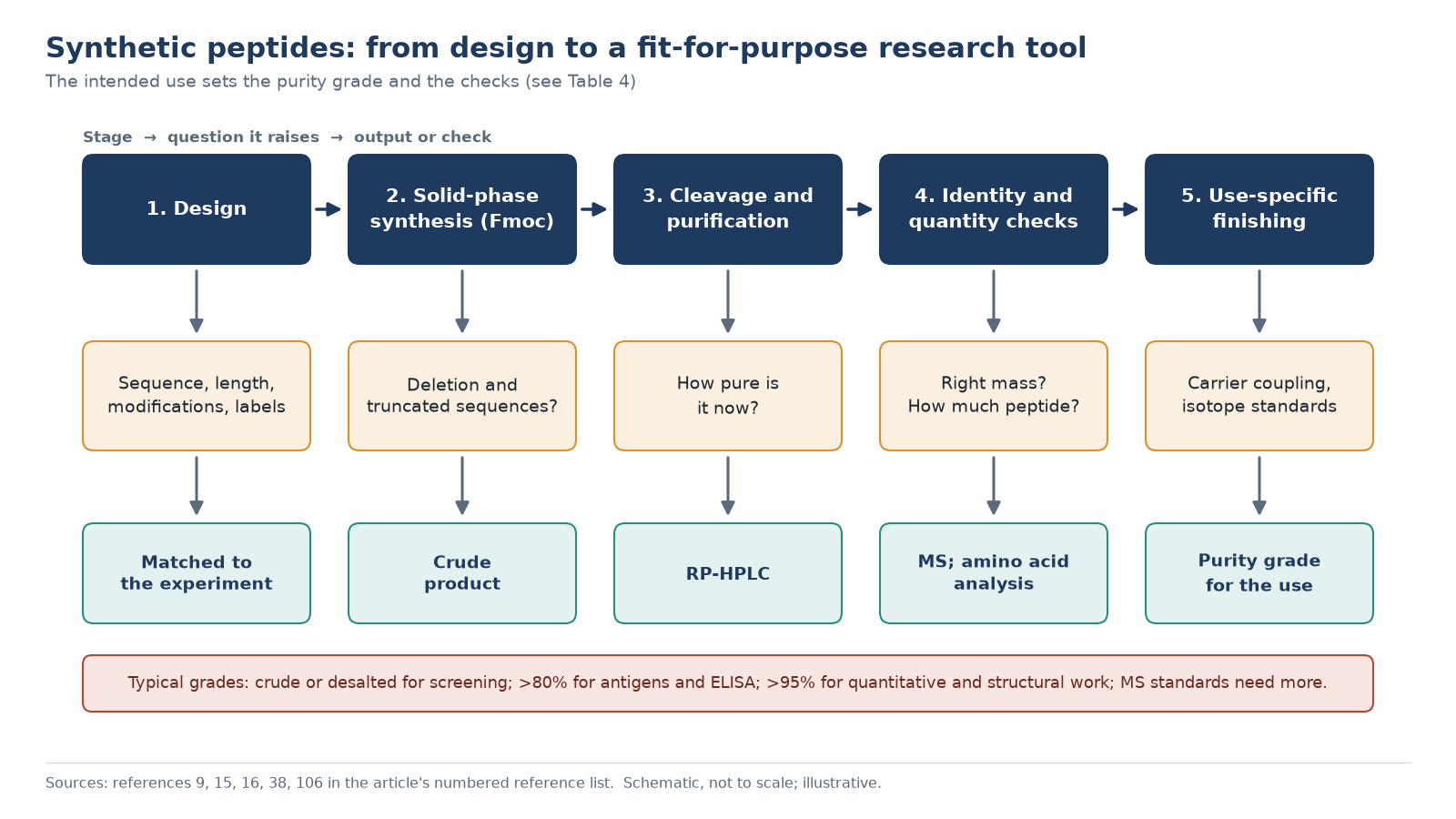
Handling matters too. Many peptides are supplied freeze-dried and absorb moisture, oxidise or degrade in solution, so practical steps such as dividing material into single-use portions and recording storage conditions protect experiments. The consensus recommendations for mass-spectrometry standards cover storage and handling as well as purity (Hoofnagle et al. 2016). Our laboratory guides cover handling lyophilised peptides and aliquoting.
Practical considerations when using synthetic peptides in experiments
The research uses above share a handful of practical questions that decide whether an experiment with a synthetic peptide can be interpreted. None of them is specific to one field, and most are about making sure that the molecule in the tube is the one the experiment assumes.
Is it the right molecule?
Identity comes first. Mass spectrometry confirms that the measured mass matches the expected sequence and modifications, and tandem mass spectrometry can confirm the order of residues; reversed-phase HPLC shows how much of the material is the main product. Our guides on reading a certificate of analysis and interpreting an HPLC chromatogram explain what those documents can and cannot show. For modified peptides, such as phosphorylated or isotope-labelled standards, the position and completeness of the modification matter as much as the overall purity (Gerber et al. 2003; Hoofnagle et al. 2016).
How much is really there?
The weight of a freeze-dried peptide powder is not the weight of peptide. Salts, counter-ions left from purification and absorbed water all add mass, which is why purity and peptide content are separate measurements (UNC Peptide Core n.d.). Where the exact amount matters, as with internal standards for quantitative mass spectrometry, consensus recommendations call for amino acid analysis to establish quantity (Hoofnagle et al. 2016). Our guide to calculating peptide concentrations works through the arithmetic.
Does it behave like the protein it represents?
A peptide copies a fragment, not the whole protein. A linear peptide may be flexible where the same sequence is rigid in the folded protein, and it may lack the neighbouring residues that shape a binding site. Anti-peptide antibodies frequently react with the native protein (Lerner 1982), but because the peptide’s shape can differ from the folded sequence, that reactivity has to be confirmed for each antibody; constrained designs exist partly to narrow this gap (Walensky et al. 2004; Heinis et al. 2009). Interpreting a peptide experiment therefore usually involves checking the finding against the full-length protein or another independent method.
Are the controls appropriate?
Because peptides are easy to make in many variants, good controls are usually available: a peptide with the same composition in a scrambled order, a version with a key residue replaced, or an unrelated peptide of similar length and charge. Replacement sets of this kind were central to early epitope mapping, where swapping each residue in turn showed which ones mattered for antibody binding (Geysen et al. 1984; Geysen et al. 1987). The same logic applies to substrates, tags and binding peptides: if a closely related variant gives the same signal, the sequence may not be the cause.
Is the material stable under the experimental conditions?
Peptides can be degraded by proteases in cell extracts or culture media, and some residues oxidise or rearrange during storage or in solution. Modifications such as cyclisation, D-amino acids or non-proteinogenic residues are often introduced specifically to improve stability for research use (Groß et al. 2015; Hosseinzadeh et al. 2017). Recording how material was stored and handled, and dividing it into single-use portions, makes it easier to rule out degradation as an explanation for an unexpected finding.
Peptides in Australia: how the rules apply
Readers searching for “peptides Australia” are often trying to work out which rules apply to a peptide. The short answer is that the rules depend on what a product is and how it is presented, not on the fact that it contains a peptide. The summary below is factual and general; it is not legal advice.
Therapeutic goods. The Therapeutic Goods Act 1989 defines therapeutic goods in section 3 (Therapeutic Goods Act 1989). The TGA explains that whether a product is a medicine, food or cosmetic depends on how it is presented and what is claimed for it (TGA 2024). The TGA has also stated that labels such as “research use only” or “not for human use” do not change whether a product is regulated as a therapeutic good, and do not remove advertising, manufacture, import, export or supply obligations (TGA n.d.). A 2026 safety advisory adds that such disclaimers do not make supply lawful, do not permit importation and that state and territory laws may impose further controls (TGA 2026).
Scheduling. The Poisons Standard lists substances and classes of substances by name and assigns them to schedules. Some peptide classes are listed; for example, growth hormone releasing peptides appear in Schedule 4, with additional controls under Appendix D (Poisons Standard 2026). Scheduling is entry-specific, so the status of any particular peptide has to be checked against the current instrument.
Food. Food additives are governed by the Australia New Zealand Food Standards Code; Schedule 8 lists additive names and code numbers, such as nisin (234) and aspartame (951) (FSANZ Schedule 8).
Cosmetics and industrial chemicals. Cosmetic ingredients are regulated as industrial chemicals by AICIS, and the TGA does not assess cosmetics unless they make therapeutic claims (TGA 2021). The Industrial Chemicals Act 2019 defines “industrial chemical” in section 10 and establishes the scheme in section 140 (Industrial Chemicals Act 2019).
Table 5. Australian regulatory frameworks that can apply to peptides (summary, not legal advice).
| Framework | Primary instrument | What it covers | Peptide examples in this article | Sources |
|---|---|---|---|---|
| Therapeutic goods | Therapeutic Goods Act 1989, section 3 | Goods presented or claimed for therapeutic use | Approved peptide medicines; unapproved peptide products | (Therapeutic Goods Act 1989; TGA 2024; TGA n.d.) |
| Scheduling | Poisons Standard (current instrument) | Access controls for listed substances and classes | Growth hormone releasing peptides (Schedule 4, Appendix D) | (Poisons Standard 2026) |
| Food additives | Food Standards Code (Schedule 8 names and codes) | Additives permitted in food and how they are labelled | Nisin (234); aspartame (951) | (FSANZ Schedule 8) |
| Cosmetics and industrial chemicals | Industrial Chemicals Act 2019 (AICIS) | Introduction of industrial chemicals, including cosmetic ingredients | Cosmetic peptides such as copper peptides | (Industrial Chemicals Act 2019; TGA 2021) |
| Research-use labelling | No separate exemption | A “research use only” label does not change regulatory status | Any peptide product | (TGA n.d.; TGA 2026) |
How to read claims about what peptides are used for
Because peptides have so many genuine uses, the word is easy to borrow. A few questions help separate research facts from marketing.
- Which use is meant? A claim that “peptides are used for” something may refer to a laboratory tool, a food additive, a cosmetic ingredient or an approved medicine. Evidence for one does not transfer to another.
- What kind of evidence is cited? Cell-culture, animal and biophysical studies answer different questions from controlled human trials. Many research uses described here are valuable precisely because they work in defined experimental systems.
- Is the peptide identified? A sequence, modifications, salt form and analytical data identify a peptide. A trade name does not.
- What does the label claim legally? A “research use only” label is not legal clearance, and presentation and claims decide how a product is regulated (TGA n.d.; TGA 2024).
- Is a mechanism being stretched? Findings that cell-penetrating peptides enter cells in culture, for example, do not settle how they behave elsewhere, and the uptake mechanism itself is still debated (Madani et al. 2011).
Limitations of this review
This is a narrative review, not a systematic one. It aims to explain the main research uses of synthetic peptides with representative primary sources and reviews, not to catalogue every application. Sources were found through PubMed, Crossref and official regulatory websites; most were read at the level of the abstract, with full text consulted for a few open-access papers, and a few older papers were confirmed only by title and bibliographic data. Where that is the case, the article cites them only for the facts their titles support. Many of the foundational papers are decades old; they are cited because they introduced methods that are still in use, but later refinements are not covered in detail. The PubMed counts in Figure 2 depend on the search terms chosen and on indexing, and measure publication volume, not quality. Purity grades in Table 4 are typical guidance from one academic facility and one consensus document; individual experiments may need different specifications. The regulatory summary reflects documents read on 26–27 October 2026; regulations change, and the summary is not legal advice. Some TGA pages could not be re-checked automatically on the day of the final check and were verified from a full read the previous day.
Relevance to Eternal Peptides Wholesale
Eternal Peptides Wholesale distributes research peptides in wholesale boxes of 10 vials, for laboratory research use only and not for human consumption (company background). The research uses described in this review are the setting for such materials: a peptide used as an antigen, an enzyme substrate or a quantitative standard needs documentation that matches that purpose, as the section on purity and quality explains.
The site’s certificate of analysis library transcribes batch-specific Janoshik Analytical reports for purity and vial content, sterility screening, endotoxin and heavy metals, and each report applies only to the batch printed on it. Its guide to reading a Janoshik report states that mass-spectrometry testing is not part of the programme it describes. A laboratory that needs mass-spectrometric identity confirmation or amino acid analysis, as described for proteomics standards above, would therefore need to arrange it separately. The catalogue is grouped by research category, and further reviews from Eternal Peptides Wholesale are on the blog.
Glossary
- Affinity tag
- A short peptide or protein fused to a recombinant protein so it can be purified with a matching ligand, such as a metal chelate for polyhistidine (Kimple et al. 2013).
- Amyloid
- An ordered, fibrillar aggregated state that many peptides and proteins can adopt (Knowles et al. 2014).
- AQUA
- Absolute quantification of proteins using a stable-isotope-labelled synthetic peptide as an internal standard (Gerber et al. 2003).
- Cell-penetrating peptide
- A short, usually arginine- and lysine-rich peptide taken up by cells in experimental systems, by mechanisms that are still debated (Madani et al. 2011).
- Epitope
- The part of an antigen recognised by an antibody or T-cell receptor.
- Epitope mapping
- Locating the residues of an antigen that an antibody or T cell recognises, often with sets of overlapping or substituted synthetic peptides (Geysen et al. 1984).
- Fmoc
- 9-Fluorenylmethoxycarbonyl, the protecting group that gives its name to Fmoc solid-phase synthesis, the method of choice for making peptides (Behrendt et al. 2016).
- Native chemical ligation
- A reaction that joins two unprotected peptide segments with a native peptide bond, used to build small proteins (Dawson et al. 1994).
- Peptide content
- The proportion of a peptide sample’s weight that is peptide, as distinct from water, salts and counter-ions; it is not the same as HPLC purity (UNC Peptide Core n.d.).
- Phage display
- Displaying peptides on the surface of bacteriophages so that binders can be selected and identified from their DNA (Smith 1985).
- Selected reaction monitoring (SRM)
- A targeted mass-spectrometry method that monitors chosen precursor and fragment ion pairs (Lange et al. 2008).
- Solid-phase peptide synthesis (SPPS)
- Building a peptide one residue at a time while it is anchored to an insoluble resin (Merrifield 1963).
Frequently asked questions
What are peptides used for?
Peptides are used in many ways. In the laboratory, synthetic peptides serve as antigens for antibodies, epitope maps, protein tags, enzyme substrates, mass-spectrometry standards, library members, folding models and building blocks for materials. Outside the laboratory, some peptides are food additives, such as nisin and aspartame, and some are approved medicines, which are regulated separately.
What are synthetic peptides used for in research?
Synthetic peptides are chemically made chains of amino acids with a chosen sequence. Researchers use them where a defined, modifiable piece of a protein is needed: to raise antibodies, map where antibodies or T cells bind, measure protease and kinase activity, calibrate mass-spectrometry assays, screen for binders, and test how sequence controls structure and self-assembly.
How are peptides used in antibody production?
A short peptide copied from a protein’s sequence is usually coupled to a large carrier protein, such as keyhole limpet hemocyanin, or built on a branched lysine core, and used as the immunogen. The resulting anti-peptide antibodies often recognise the native protein. Overlapping peptide sets are then used to map exactly which residues an antibody binds.
What is a peptide tag?
A peptide tag is a short sequence, often 6 to 11 amino acids, fused to a protein by genetic engineering so that the protein can be detected or purified with a well-characterised reagent. Common examples include FLAG (DYKDDDDK), HA (YPYDVPDYA), c-myc (EQKLISEEQKL), six histidines for metal-chelate purification and Strep-tag II (WSHPQFEK).
How are peptides used in mass spectrometry?
Most proteomics digests proteins with trypsin and measures the resulting peptides. Synthetic copies of chosen peptides, labelled with heavy stable isotopes, are added at a known amount as internal standards so the natural peptide can be quantified. Reference peptides are also used to calibrate retention times, and large synthetic peptide sets train identification software.
Are peptides used in food and cosmetics?
Yes. In Australia and New Zealand, the Food Standards Code lists nisin, an antimicrobial peptide made by bacteria, as food additive 234, and aspartame, a dipeptide ester sweetener, as 951. Peptides also appear as cosmetic ingredients, which are regulated as industrial chemicals unless therapeutic claims are made.
What purity does a research peptide need?
It depends on the use. Peptide facilities commonly suggest crude or desalted material for high-throughput screening, around 80% purity for antigens and epitope mapping, and over 95% for quantitative assays, structural work and standards. Isotope-labelled mass-spectrometry standards also need high isotopic purity and an accurate measure of peptide quantity, not just HPLC purity.
How are peptides regulated in Australia?
No single rule covers all peptides. Medicines fall under the Therapeutic Goods Act 1989 and the Poisons Standard, food additives under the Food Standards Code, and cosmetic and other industrial uses under the Industrial Chemicals Act 2019. A product’s presentation and claims decide which applies, and a research-use-only label does not change that. This is not legal advice.
References
- Sutcliffe JG, Shinnick TM, Green N, Lerner RA. Antibodies that react with predetermined sites on proteins. Science. 1983;219(4585):660-6. doi:10.1126/science.6186024 PMID: 6186024. Available at: https://doi.org/10.1126/science.6186024. Accessed 27 October 2026.
- Groß A, Hashimoto C, Sticht H, Eichler J. Synthetic Peptides as Protein Mimics. Front Bioeng Biotechnol. 2015;3:211. doi:10.3389/fbioe.2015.00211 PMID: 26835447. Available at: https://doi.org/10.3389/fbioe.2015.00211. Accessed 27 October 2026.
- Gerber SA, Rush J, Stemman O, Kirschner MW, Gygi SP. Absolute quantification of proteins and phosphoproteins from cell lysates by tandem MS. Proc Natl Acad Sci U S A. 2003;100(12):6940-5. doi:10.1073/pnas.0832254100 PMID: 12771378. Available at: https://doi.org/10.1073/pnas.0832254100. Accessed 27 October 2026.
- Lerner RA. Tapping the immunological repertoire to produce antibodies of predetermined specificity. Nature. 1982;299(5884):593-6. doi:10.1038/299592a0 PMID: 6181415. Available at: https://doi.org/10.1038/299592a0. Accessed 27 October 2026.
- Hopp TP, Prickett KS, Price VL, et al. A Short Polypeptide Marker Sequence Useful for Recombinant Protein Identification and Purification. Bio/Technology. 1988;6(10):1204-1210. doi:10.1038/nbt1088-1204 Available at: https://doi.org/10.1038/nbt1088-1204. Accessed 27 October 2026.
- Field J, Nikawa J, Broek D, et al. Purification of a RAS-responsive adenylyl cyclase complex from Saccharomyces cerevisiae by use of an epitope addition method. Mol Cell Biol. 1988;8(5):2159-65. doi:10.1128/mcb.8.5.2159-2165.1988 PMID: 2455217. Available at: https://doi.org/10.1128/mcb.8.5.2159-2165.1988. Accessed 27 October 2026.
- Hochuli E, Bannwarth W, Döbeli H, Gentz R, Stüber D. Genetic Approach to Facilitate Purification of Recombinant Proteins with a Novel Metal Chelate Adsorbent. Nature Biotechnology. 1988;6(11):1321-1325. doi:10.1038/nbt1188-1321 Available at: https://doi.org/10.1038/nbt1188-1321. Accessed 27 October 2026.
- Schmidt TG, Skerra A. The Strep-tag system for one-step purification and high-affinity detection or capturing of proteins. Nat Protoc. 2007;2(6):1528-35. doi:10.1038/nprot.2007.209 PMID: 17571060. Available at: https://doi.org/10.1038/nprot.2007.209. Accessed 27 October 2026.
- Hoofnagle AN, Whiteaker JR, Carr SA, et al. Recommendations for the Generation, Quantification, Storage, and Handling of Peptides Used for Mass Spectrometry-Based Assays. Clin Chem. 2016;62(1):48-69. doi:10.1373/clinchem.2015.250563 PMID: 26719571. Available at: https://doi.org/10.1373/clinchem.2015.250563. Accessed 27 October 2026.
- Australia New Zealand Food Standards Code – Schedule 8 – Food additive names and code numbers (for statement of ingredients). F2015L00478, compilation registered 9 October 2025 (F2025C00967). Available at: https://www.legislation.gov.au/F2015L00478/latest/text. Accessed 27 October 2026.
- Lau JL, Dunn MK. Therapeutic peptides: Historical perspectives, current development trends, and future directions. Bioorg Med Chem. 2018;26(10):2700-2707. doi:10.1016/j.bmc.2017.06.052 PMID: 28720325. Available at: https://doi.org/10.1016/j.bmc.2017.06.052. Accessed 27 October 2026.
- Therapeutic Goods Administration. What are ‘therapeutic goods’? Last updated 6 June 2024. Available at: https://www.tga.gov.au/products/regulations-all-products/regulation-essentials/what-are-therapeutic-goods. Accessed 27 October 2026.
- Therapeutic Goods Administration. How we regulate therapeutic peptide products. (No page date displayed.) Available at: https://www.tga.gov.au/products/medicines/monitoring-and-compliance/how-we-regulate-therapeutic-peptide-products. Accessed 27 October 2026.
- Therapeutic Goods Administration. Understanding your responsibilities when importing, compounding and supplying unapproved peptide products. Safety advisory, 13 April 2026. Available at: https://www.tga.gov.au/safety/safety-monitoring-and-information/safety-alerts/understanding-your-responsibilities-when-importing-compounding-and-supplying-unapproved-peptide-products. Accessed 27 October 2026.
- Behrendt R, White P, Offer J. Advances in Fmoc solid-phase peptide synthesis. J Pept Sci. 2016;22(1):4-27. doi:10.1002/psc.2836 PMID: 26785684. Available at: https://doi.org/10.1002/psc.2836. Accessed 27 October 2026.
- Merrifield RB. Solid Phase Peptide Synthesis. I. The Synthesis of a Tetrapeptide. Journal of the American Chemical Society. 1963;85(14):2149-2154. doi:10.1021/ja00897a025 Available at: https://doi.org/10.1021/ja00897a025. Accessed 27 October 2026.
- Fields GB, Noble RL. Solid phase peptide synthesis utilizing 9-fluorenylmethoxycarbonyl amino acids. Int J Pept Protein Res. 1990;35(3):161-214. doi:10.1111/j.1399-3011.1990.tb00939.x PMID: 2191922. Available at: https://doi.org/10.1111/j.1399-3011.1990.tb00939.x. Accessed 27 October 2026.
- Dawson PE, Muir TW, Clark-Lewis I, Kent SB. Synthesis of proteins by native chemical ligation. Science. 1994;266(5186):776-9. doi:10.1126/science.7973629 PMID: 7973629. Available at: https://doi.org/10.1126/science.7973629. Accessed 27 October 2026.
- Kent SB. Total chemical synthesis of proteins. Chem Soc Rev. 2009;38(2):338-51. doi:10.1039/b700141j PMID: 19169452. Available at: https://doi.org/10.1039/b700141j. Accessed 27 October 2026.
- Walensky LD, Kung AL, Escher I, et al. Activation of apoptosis in vivo by a hydrocarbon-stapled BH3 helix. Science. 2004;305(5689):1466-70. doi:10.1126/science.1099191 PMID: 15353804. Available at: https://doi.org/10.1126/science.1099191. Accessed 27 October 2026.
- Geysen HM, Meloen RH, Barteling SJ. Use of peptide synthesis to probe viral antigens for epitopes to a resolution of a single amino acid. Proc Natl Acad Sci U S A. 1984;81(13):3998-4002. doi:10.1073/pnas.81.13.3998 PMID: 6204335. Available at: https://doi.org/10.1073/pnas.81.13.3998. Accessed 27 October 2026.
- Maecker HT, Dunn HS, Suni MA, et al. Use of overlapping peptide mixtures as antigens for cytokine flow cytometry. J Immunol Methods. 2001;255(1-2):27-40. doi:10.1016/s0022-1759(01)00416-1 PMID: 11470284. Available at: https://doi.org/10.1016/s0022-1759(01)00416-1. Accessed 27 October 2026.
- Kalderon D, Roberts BL, Richardson WD, Smith AE. A short amino acid sequence able to specify nuclear location. Cell. 1984;39(3 Pt 2):499-509. doi:10.1016/0092-8674(84)90457-4 PMID: 6096007. Available at: https://doi.org/10.1016/0092-8674(84)90457-4. Accessed 27 October 2026.
- Escher C, Reiter L, MacLean B, et al. Using iRT, a normalized retention time for more targeted measurement of peptides. Proteomics. 2012;12(8):1111-21. doi:10.1002/pmic.201100463 PMID: 22577012. Available at: https://doi.org/10.1002/pmic.201100463. Accessed 27 October 2026.
- Matayoshi ED, Wang GT, Krafft GA, Erickson J. Novel fluorogenic substrates for assaying retroviral proteases by resonance energy transfer. Science. 1990;247(4945):954-8. doi:10.1126/science.2106161 PMID: 2106161. Available at: https://doi.org/10.1126/science.2106161. Accessed 27 October 2026.
- Thornberry NA, Rano TA, Peterson EP, et al. A combinatorial approach defines specificities of members of the caspase family and granzyme B. Functional relationships established for key mediators of apoptosis. J Biol Chem. 1997;272(29):17907-11. doi:10.1074/jbc.272.29.17907 PMID: 9218414. Available at: https://doi.org/10.1074/jbc.272.29.17907. Accessed 27 October 2026.
- Songyang Z, Blechner S, Hoagland N, Hoekstra MF, Piwnica-Worms H, Cantley LC. Use of an oriented peptide library to determine the optimal substrates of protein kinases. Curr Biol. 1994;4(11):973-82. doi:10.1016/s0960-9822(00)00221-9 PMID: 7874496. Available at: https://doi.org/10.1016/s0960-9822(00)00221-9. Accessed 27 October 2026.
- Smith GP. Filamentous fusion phage: novel expression vectors that display cloned antigens on the virion surface. Science. 1985;228(4705):1315-7. doi:10.1126/science.4001944 PMID: 4001944. Available at: https://doi.org/10.1126/science.4001944. Accessed 27 October 2026.
- Lam KS, Salmon SE, Hersh EM, Hruby VJ, Kazmierski WM, Knapp RJ. A new type of synthetic peptide library for identifying ligand-binding activity. Nature. 1991;354(6348):82-4. doi:10.1038/354082a0 PMID: 1944576. Available at: https://doi.org/10.1038/354082a0. Accessed 27 October 2026.
- Roberts RW, Szostak JW. RNA-peptide fusions for the in vitro selection of peptides and proteins. Proc Natl Acad Sci U S A. 1997;94(23):12297-302. doi:10.1073/pnas.94.23.12297 PMID: 9356443. Available at: https://doi.org/10.1073/pnas.94.23.12297. Accessed 27 October 2026.
- Marqusee S, Baldwin RL. Helix stabilization by Glu-…Lys+ salt bridges in short peptides of de novo design. Proc Natl Acad Sci U S A. 1987;84(24):8898-902. doi:10.1073/pnas.84.24.8898 PMID: 3122208. Available at: https://doi.org/10.1073/pnas.84.24.8898. Accessed 27 October 2026.
- Neidigh JW, Fesinmeyer RM, Andersen NH. Designing a 20-residue protein. Nat Struct Biol. 2002;9(6):425-30. doi:10.1038/nsb798 PMID: 11979279. Available at: https://doi.org/10.1038/nsb798. Accessed 27 October 2026.
- Jarrett JT, Berger EP, Lansbury PT Jr. The carboxy terminus of the beta amyloid protein is critical for the seeding of amyloid formation: implications for the pathogenesis of Alzheimer’s disease. Biochemistry. 1993;32(18):4693-7. doi:10.1021/bi00069a001 PMID: 8490014. Available at: https://doi.org/10.1021/bi00069a001. Accessed 27 October 2026.
- Zhang S, Holmes T, Lockshin C, Rich A. Spontaneous assembly of a self-complementary oligopeptide to form a stable macroscopic membrane. Proc Natl Acad Sci U S A. 1993;90(8):3334-8. doi:10.1073/pnas.90.8.3334 PMID: 7682699. Available at: https://doi.org/10.1073/pnas.90.8.3334. Accessed 27 October 2026.
- Reches M, Gazit E. Casting metal nanowires within discrete self-assembled peptide nanotubes. Science. 2003;300(5619):625-7. doi:10.1126/science.1082387 PMID: 12714741. Available at: https://doi.org/10.1126/science.1082387. Accessed 27 October 2026.
- Zasloff M. Magainins, a class of antimicrobial peptides from Xenopus skin: isolation, characterization of two active forms, and partial cDNA sequence of a precursor. Proc Natl Acad Sci U S A. 1987;84(15):5449-53. doi:10.1073/pnas.84.15.5449 PMID: 3299384. Available at: https://doi.org/10.1073/pnas.84.15.5449. Accessed 27 October 2026.
- Wang G, Li X, Wang Z. APD3: the antimicrobial peptide database as a tool for research and education. Nucleic Acids Res. 2016;44(D1):D1087-93. doi:10.1093/nar/gkv1278 PMID: 26602694. Available at: https://doi.org/10.1093/nar/gkv1278. Accessed 27 October 2026.
- Lateef SS, Gupta S, Jayathilaka LP, Krishnanchettiar S, Huang JS, Lee BS. An improved protocol for coupling synthetic peptides to carrier proteins for antibody production using DMF to solubilize peptides. J Biomol Tech. 2007;18(3):173-6. PMID: 17595313. Available at: https://pubmed.ncbi.nlm.nih.gov/17595313/. Accessed 27 October 2026.
- Tam JP. Synthetic peptide vaccine design: synthesis and properties of a high-density multiple antigenic peptide system. Proc Natl Acad Sci U S A. 1988;85(15):5409-13. doi:10.1073/pnas.85.15.5409 PMID: 3399498. Available at: https://doi.org/10.1073/pnas.85.15.5409. Accessed 27 October 2026.
- Evan GI, Lewis GK, Ramsay G, Bishop JM. Isolation of monoclonal antibodies specific for human c-myc proto-oncogene product. Mol Cell Biol. 1985;5(12):3610-6. doi:10.1128/mcb.5.12.3610-3616.1985 PMID: 3915782. Available at: https://doi.org/10.1128/mcb.5.12.3610-3616.1985. Accessed 27 October 2026.
- Trier NH, Houen G. Design, Production, Characterization, and Use of Peptide Antibodies. Antibodies (Basel). 2023;12(1). doi:10.3390/antib12010006 PMID: 36648890. Available at: https://doi.org/10.3390/antib12010006. Accessed 27 October 2026.
- Geysen HM, Rodda SJ, Mason TJ, Tribbick G, Schoofs PG. Strategies for epitope analysis using peptide synthesis. J Immunol Methods. 1987;102(2):259-74. doi:10.1016/0022-1759(87)90085-8 PMID: 2443575. Available at: https://doi.org/10.1016/0022-1759(87)90085-8. Accessed 27 October 2026.
- Houghten RA. General method for the rapid solid-phase synthesis of large numbers of peptides: specificity of antigen-antibody interaction at the level of individual amino acids. Proc Natl Acad Sci U S A. 1985;82(15):5131-5. doi:10.1073/pnas.82.15.5131 PMID: 2410914. Available at: https://doi.org/10.1073/pnas.82.15.5131. Accessed 27 October 2026.
- Frank R. Spot-synthesis: an easy technique for the positionally addressable, parallel chemical synthesis on a membrane support. Tetrahedron. 1992;48(42):9217-9232. doi:10.1016/s0040-4020(01)85612-x Available at: https://doi.org/10.1016/s0040-4020(01)85612-x. Accessed 27 October 2026.
- Hilpert K, Winkler DF, Hancock RE. Peptide arrays on cellulose support: SPOT synthesis, a time and cost efficient method for synthesis of large numbers of peptides in a parallel and addressable fashion. Nat Protoc. 2007;2(6):1333-49. doi:10.1038/nprot.2007.160 PMID: 17545971. Available at: https://doi.org/10.1038/nprot.2007.160. Accessed 27 October 2026.
- Szymczak LC, Kuo HY, Mrksich M. Peptide Arrays: Development and Application. Anal Chem. 2018;90(1):266-282. doi:10.1021/acs.analchem.7b04380 PMID: 29135227. Available at: https://doi.org/10.1021/acs.analchem.7b04380. Accessed 27 October 2026.
- Vita R, Mahajan S, Overton JA, et al. The Immune Epitope Database (IEDB): 2018 update. Nucleic Acids Res. 2019;47(D1):D339-D343. doi:10.1093/nar/gky1006 PMID: 30357391. Available at: https://doi.org/10.1093/nar/gky1006. Accessed 27 October 2026.
- Rammensee H, Bachmann J, Emmerich NP, Bachor OA, Stevanović S. SYFPEITHI: database for MHC ligands and peptide motifs. Immunogenetics. 1999;50(3-4):213-9. doi:10.1007/s002510050595 PMID: 10602881. Available at: https://doi.org/10.1007/s002510050595. Accessed 27 October 2026.
- Altman JD, Moss PA, Goulder PJ, et al. Phenotypic analysis of antigen-specific T lymphocytes. Science. 1996;274(5284):94-6. doi:10.1126/science.274.5284.94 PMID: 8810254. Available at: https://doi.org/10.1126/science.274.5284.94. Accessed 27 October 2026.
- Terpe K. Overview of tag protein fusions: from molecular and biochemical fundamentals to commercial systems. Appl Microbiol Biotechnol. 2003;60(5):523-33. doi:10.1007/s00253-002-1158-6 PMID: 12536251. Available at: https://doi.org/10.1007/s00253-002-1158-6. Accessed 27 October 2026.
- Kimple ME, Brill AL, Pasker RL. Overview of affinity tags for protein purification. Curr Protoc Protein Sci. 2013;73:9.9.1-9.9.23. doi:10.1002/0471140864.ps0909s73 PMID: 24510596. Available at: https://doi.org/10.1002/0471140864.ps0909s73. Accessed 27 October 2026.
- Zhao X, Li G, Liang S. Several affinity tags commonly used in chromatographic purification. J Anal Methods Chem. 2013;2013:581093. doi:10.1155/2013/581093 PMID: 24490106. Available at: https://doi.org/10.1155/2013/581093. Accessed 27 October 2026.
- Vivès E, Brodin P, Lebleu B. A truncated HIV-1 Tat protein basic domain rapidly translocates through the plasma membrane and accumulates in the cell nucleus. J Biol Chem. 1997;272(25):16010-7. doi:10.1074/jbc.272.25.16010 PMID: 9188504. Available at: https://doi.org/10.1074/jbc.272.25.16010. Accessed 27 October 2026.
- Madani F, Lindberg S, Langel U, Futaki S, Gräslund A. Mechanisms of cellular uptake of cell-penetrating peptides. J Biophys. 2011;2011:414729. doi:10.1155/2011/414729 PMID: 21687343. Available at: https://doi.org/10.1155/2011/414729. Accessed 27 October 2026.
- Derossi D, Joliot AH, Chassaing G, Prochiantz A. The third helix of the Antennapedia homeodomain translocates through biological membranes. J Biol Chem. 1994;269(14):10444-50. PMID: 8144628. Available at: https://pubmed.ncbi.nlm.nih.gov/8144628/. Accessed 27 October 2026.
- Pierschbacher MD, Ruoslahti E. Cell attachment activity of fibronectin can be duplicated by small synthetic fragments of the molecule. Nature. 1984;309(5963):30-3. doi:10.1038/309030a0 PMID: 6325925. Available at: https://doi.org/10.1038/309030a0. Accessed 27 October 2026.
- Ruoslahti E. RGD and other recognition sequences for integrins. Annu Rev Cell Dev Biol. 1996;12:697-715. doi:10.1146/annurev.cellbio.12.1.697 PMID: 8970741. Available at: https://doi.org/10.1146/annurev.cellbio.12.1.697. Accessed 27 October 2026.
- Frankel AD, Pabo CO. Cellular uptake of the tat protein from human immunodeficiency virus. Cell. 1988;55(6):1189-93. doi:10.1016/0092-8674(88)90263-2 PMID: 2849510. Available at: https://doi.org/10.1016/0092-8674(88)90263-2. Accessed 27 October 2026.
- Green M, Loewenstein PM. Autonomous functional domains of chemically synthesized human immunodeficiency virus tat trans-activator protein. Cell. 1988;55(6):1179-88. doi:10.1016/0092-8674(88)90262-0 PMID: 2849509. Available at: https://doi.org/10.1016/0092-8674(88)90262-0. Accessed 27 October 2026.
- Guidotti G, Brambilla L, Rossi D. Cell-Penetrating Peptides: From Basic Research to Clinics. Trends Pharmacol Sci. 2017;38(4):406-424. doi:10.1016/j.tips.2017.01.003 PMID: 28209404. Available at: https://doi.org/10.1016/j.tips.2017.01.003. Accessed 27 October 2026.
- Aebersold R, Mann M. Mass spectrometry-based proteomics. Nature. 2003;422(6928):198-207. doi:10.1038/nature01511 PMID: 12634793. Available at: https://doi.org/10.1038/nature01511. Accessed 27 October 2026.
- Olsen JV, Ong SE, Mann M. Trypsin cleaves exclusively C-terminal to arginine and lysine residues. Mol Cell Proteomics. 2004;3(6):608-14. doi:10.1074/mcp.T400003-MCP200 PMID: 15034119. Available at: https://doi.org/10.1074/mcp.T400003-MCP200. Accessed 27 October 2026.
- Kirkpatrick DS, Gerber SA, Gygi SP. The absolute quantification strategy: a general procedure for the quantification of proteins and post-translational modifications. Methods. 2005;35(3):265-73. doi:10.1016/j.ymeth.2004.08.018 PMID: 15722223. Available at: https://doi.org/10.1016/j.ymeth.2004.08.018. Accessed 27 October 2026.
- Bantscheff M, Schirle M, Sweetman G, Rick J, Kuster B. Quantitative mass spectrometry in proteomics: a critical review. Anal Bioanal Chem. 2007;389(4):1017-31. doi:10.1007/s00216-007-1486-6 PMID: 17668192. Available at: https://doi.org/10.1007/s00216-007-1486-6. Accessed 27 October 2026.
- Lange V, Picotti P, Domon B, Aebersold R. Selected reaction monitoring for quantitative proteomics: a tutorial. Mol Syst Biol. 2008;4:222. doi:10.1038/msb.2008.61 PMID: 18854821. Available at: https://doi.org/10.1038/msb.2008.61. Accessed 27 October 2026.
- Picotti P, Aebersold R. Selected reaction monitoring-based proteomics: workflows, potential, pitfalls and future directions. Nat Methods. 2012;9(6):555-66. doi:10.1038/nmeth.2015 PMID: 22669653. Available at: https://doi.org/10.1038/nmeth.2015. Accessed 27 October 2026.
- Carr SA, Abbatiello SE, Ackermann BL, et al. Targeted peptide measurements in biology and medicine: best practices for mass spectrometry-based assay development using a fit-for-purpose approach. Mol Cell Proteomics. 2014;13(3):907-17. doi:10.1074/mcp.M113.036095 PMID: 24443746. Available at: https://doi.org/10.1074/mcp.M113.036095. Accessed 27 October 2026.
- Zolg DP, Wilhelm M, Schnatbaum K, et al. Building ProteomeTools based on a complete synthetic human proteome. Nat Methods. 2017;14(3):259-262. doi:10.1038/nmeth.4153 PMID: 28135259. Available at: https://doi.org/10.1038/nmeth.4153. Accessed 27 October 2026.
- Schechter I, Berger A. On the size of the active site in proteases. I. Papain. Biochem Biophys Res Commun. 1967;27(2):157-62. doi:10.1016/s0006-291x(67)80055-x PMID: 6035483. Available at: https://doi.org/10.1016/s0006-291x(67)80055-x. Accessed 27 October 2026.
- Kemp BE, Graves DJ, Benjamini E, Krebs EG. Role of multiple basic residues in determining the substrate specificity of cyclic AMP-dependent protein kinase. J Biol Chem. 1977;252(14):4888-94. PMID: 194899. Available at: https://pubmed.ncbi.nlm.nih.gov/194899/. Accessed 27 October 2026.
- Hutti JE, Jarrell ET, Chang JD, et al. A rapid method for determining protein kinase phosphorylation specificity. Nat Methods. 2004;1(1):27-9. doi:10.1038/nmeth708 PMID: 15782149. Available at: https://doi.org/10.1038/nmeth708. Accessed 27 October 2026.
- Schilling O, Overall CM. Proteome-derived, database-searchable peptide libraries for identifying protease cleavage sites. Nat Biotechnol. 2008;26(6):685-94. doi:10.1038/nbt1408 PMID: 18500335. Available at: https://doi.org/10.1038/nbt1408. Accessed 27 October 2026.
- Houghten RA, Pinilla C, Blondelle SE, Appel JR, Dooley CT, Cuervo JH. Generation and use of synthetic peptide combinatorial libraries for basic research and drug discovery. Nature. 1991;354(6348):84-6. doi:10.1038/354084a0 PMID: 1719428. Available at: https://doi.org/10.1038/354084a0. Accessed 27 October 2026.
- Lam KS, Lebl M, Krchnák V. The “One-Bead-One-Compound” Combinatorial Library Method. Chem Rev. 1997;97(2):411-448. doi:10.1021/cr9600114 PMID: 11848877. Available at: https://doi.org/10.1021/cr9600114. Accessed 27 October 2026.
- Scott JK, Smith GP. Searching for peptide ligands with an epitope library. Science. 1990;249(4967):386-90. doi:10.1126/science.1696028 PMID: 1696028. Available at: https://doi.org/10.1126/science.1696028. Accessed 27 October 2026.
- Passioura T, Katoh T, Goto Y, Suga H. Selection-based discovery of druglike macrocyclic peptides. Annu Rev Biochem. 2014;83:727-52. doi:10.1146/annurev-biochem-060713-035456 PMID: 24580641. Available at: https://doi.org/10.1146/annurev-biochem-060713-035456. Accessed 27 October 2026.
- Heinis C, Rutherford T, Freund S, Winter G. Phage-encoded combinatorial chemical libraries based on bicyclic peptides. Nat Chem Biol. 2009;5(7):502-7. doi:10.1038/nchembio.184 PMID: 19483697. Available at: https://doi.org/10.1038/nchembio.184. Accessed 27 October 2026.
- Bhardwaj G, Mulligan VK, Bahl CD, et al. Accurate de novo design of hyperstable constrained peptides. Nature. 2016;538(7625):329-335. doi:10.1038/nature19791 PMID: 27626386. Available at: https://doi.org/10.1038/nature19791. Accessed 27 October 2026.
- Hosseinzadeh P, Bhardwaj G, Mulligan VK, et al. Comprehensive computational design of ordered peptide macrocycles. Science. 2017;358(6369):1461-1466. doi:10.1126/science.aap7577 PMID: 29242347. Available at: https://doi.org/10.1126/science.aap7577. Accessed 27 October 2026.
- Craik DJ, Daly NL, Bond T, Waine C. Plant cyclotides: A unique family of cyclic and knotted proteins that defines the cyclic cystine knot structural motif. J Mol Biol. 1999;294(5):1327-36. doi:10.1006/jmbi.1999.3383 PMID: 10600388. Available at: https://doi.org/10.1006/jmbi.1999.3383. Accessed 27 October 2026.
- Lewis RJ, Garcia ML. Therapeutic potential of venom peptides. Nat Rev Drug Discov. 2003;2(10):790-802. doi:10.1038/nrd1197 PMID: 14526382. Available at: https://doi.org/10.1038/nrd1197. Accessed 27 October 2026.
- Chassagnon IR, McCarthy CA, Chin YK, et al. Potent neuroprotection after stroke afforded by a double-knot spider-venom peptide that inhibits acid-sensing ion channel 1a. Proc Natl Acad Sci U S A. 2017;114(14):3750-3755. doi:10.1073/pnas.1614728114 PMID: 28320941. Available at: https://doi.org/10.1073/pnas.1614728114. Accessed 27 October 2026.
- Pace CN, Scholtz JM. A helix propensity scale based on experimental studies of peptides and proteins. Biophys J. 1998;75(1):422-7. doi:10.1016/s0006-3495(98)77529-0 PMID: 9649402. Available at: https://doi.org/10.1016/s0006-3495(98)77529-0. Accessed 27 October 2026.
- Bella J, Eaton M, Brodsky B, Berman HM. Crystal and molecular structure of a collagen-like peptide at 1.9 A resolution. Science. 1994;266(5182):75-81. doi:10.1126/science.7695699 PMID: 7695699. Available at: https://doi.org/10.1126/science.7695699. Accessed 27 October 2026.
- Shoulders MD, Raines RT. Collagen structure and stability. Annu Rev Biochem. 2009;78:929-58. doi:10.1146/annurev.biochem.77.032207.120833 PMID: 19344236. Available at: https://doi.org/10.1146/annurev.biochem.77.032207.120833. Accessed 27 October 2026.
- Knowles TP, Vendruscolo M, Dobson CM. The amyloid state and its association with protein misfolding diseases. Nat Rev Mol Cell Biol. 2014;15(6):384-96. doi:10.1038/nrm3810 PMID: 24854788. Available at: https://doi.org/10.1038/nrm3810. Accessed 27 October 2026.
- Holmes TC, de Lacalle S, Su X, Liu G, Rich A, Zhang S. Extensive neurite outgrowth and active synapse formation on self-assembling peptide scaffolds. Proc Natl Acad Sci U S A. 2000;97(12):6728-33. doi:10.1073/pnas.97.12.6728 PMID: 10841570. Available at: https://doi.org/10.1073/pnas.97.12.6728. Accessed 27 October 2026.
- Hartgerink JD, Beniash E, Stupp SI. Self-assembly and mineralization of peptide-amphiphile nanofibers. Science. 2001;294(5547):1684-8. doi:10.1126/science.1063187 PMID: 11721046. Available at: https://doi.org/10.1126/science.1063187. Accessed 27 October 2026.
- Jayawarna V, Ali M, Jowitt TA, et al. Nanostructured Hydrogels for Three‐Dimensional Cell Culture Through Self‐Assembly of Fluorenylmethoxycarbonyl–Dipeptides. Advanced Materials. 2006;18(5):611-614. doi:10.1002/adma.200501522 Available at: https://doi.org/10.1002/adma.200501522. Accessed 27 October 2026.
- Gazit E. Self-assembled peptide nanostructures: the design of molecular building blocks and their technological utilization. Chem Soc Rev. 2007;36(8):1263-9. doi:10.1039/b605536m PMID: 17619686. Available at: https://doi.org/10.1039/b605536m. Accessed 27 October 2026.
- Hauser CA, Zhang S. Designer self-assembling peptide nanofiber biological materials. Chem Soc Rev. 2010;39(8):2780-90. doi:10.1039/b921448h PMID: 20520907. Available at: https://doi.org/10.1039/b921448h. Accessed 27 October 2026.
- Zasloff M. Antimicrobial peptides of multicellular organisms. Nature. 2002;415(6870):389-95. doi:10.1038/415389a PMID: 11807545. Available at: https://doi.org/10.1038/415389a. Accessed 27 October 2026.
- Hancock RE, Sahl HG. Antimicrobial and host-defense peptides as new anti-infective therapeutic strategies. Nat Biotechnol. 2006;24(12):1551-7. doi:10.1038/nbt1267 PMID: 17160061. Available at: https://doi.org/10.1038/nbt1267. Accessed 27 October 2026.
- Magana M, Pushpanathan M, Santos AL, et al. The value of antimicrobial peptides in the age of resistance. Lancet Infect Dis. 2020;20(9):e216-e230. doi:10.1016/S1473-3099(20)30327-3 PMID: 32653070. Available at: https://doi.org/10.1016/S1473-3099(20)30327-3. Accessed 27 October 2026.
- Cotter PD, Ross RP, Hill C. Bacteriocins – a viable alternative to antibiotics? Nat Rev Microbiol. 2013;11(2):95-105. doi:10.1038/nrmicro2937 PMID: 23268227. Available at: https://doi.org/10.1038/nrmicro2937. Accessed 27 October 2026.
- Delves-Broughton J, Blackburn P, Evans RJ, Hugenholtz J. Applications of the bacteriocin, nisin. Antonie Van Leeuwenhoek. 1996;69(2):193-202. doi:10.1007/BF00399424 PMID: 8775979. Available at: https://doi.org/10.1007/BF00399424. Accessed 27 October 2026.
- National Center for Biotechnology Information. PubChem Compound Summary for CID 134601, Aspartame. Available at: https://pubchem.ncbi.nlm.nih.gov/compound/134601. Accessed 27 October 2026.
- Therapeutic Goods Administration. Cosmetics (explore topic). Last updated 17 May 2021. Available at: https://www.tga.gov.au/resources/explore-topic/cosmetics. Accessed 27 October 2026.
- Industrial Chemicals Act 2019 (Cth), No. 12, 2019. Federal Register of Legislation, C2019A00012, latest compilation. Available at: https://www.legislation.gov.au/C2019A00012/latest/text. Accessed 27 October 2026.
- Muttenthaler M, King GF, Adams DJ, Alewood PF. Trends in peptide drug discovery. Nat Rev Drug Discov. 2021;20(4):309-325. doi:10.1038/s41573-020-00135-8 PMID: 33536635. Available at: https://doi.org/10.1038/s41573-020-00135-8. Accessed 27 October 2026.
- Wang L, Wang N, Zhang W, et al. Therapeutic peptides: current applications and future directions. Signal Transduct Target Ther. 2022;7(1):48. doi:10.1038/s41392-022-00904-4 PMID: 35165272. Available at: https://doi.org/10.1038/s41392-022-00904-4. Accessed 27 October 2026.
- Vlieghe P, Lisowski V, Martinez J, Khrestchatisky M. Synthetic therapeutic peptides: science and market. Drug Discov Today. 2010;15(1-2):40-56. doi:10.1016/j.drudis.2009.10.009 PMID: 19879957. Available at: https://doi.org/10.1016/j.drudis.2009.10.009. Accessed 27 October 2026.
- Henninot A, Collins JC, Nuss JM. The Current State of Peptide Drug Discovery: Back to the Future? J Med Chem. 2018;61(4):1382-1414. doi:10.1021/acs.jmedchem.7b00318 PMID: 28737935. Available at: https://doi.org/10.1021/acs.jmedchem.7b00318. Accessed 27 October 2026.
- Isidro-Llobet A, Kenworthy MN, Mukherjee S, et al. Sustainability Challenges in Peptide Synthesis and Purification: From R&D to Production. J Org Chem. 2019;84(8):4615-4628. doi:10.1021/acs.joc.8b03001 PMID: 30900880. Available at: https://doi.org/10.1021/acs.joc.8b03001. Accessed 27 October 2026.
- National Center for Biotechnology Information. Entrez Programming Utilities (E-utilities) Help. Available at: https://www.ncbi.nlm.nih.gov/books/NBK25501/. Accessed 27 October 2026.
- High-Throughput Peptide Synthesis and Array Facility, UNC School of Medicine. General description of services. Available at: https://www.med.unc.edu/csb/unc-peptides/services. Accessed 27 October 2026.
- Therapeutic Goods Act 1989 (Cth). Federal Register of Legislation, C2004A03952, latest compilation. Available at: https://www.legislation.gov.au/C2004A03952/latest/text. Accessed 27 October 2026.
- Therapeutic Goods (Poisons Standard—October 2026) Instrument 2026 (Cth), F2026L01327. Federal Register of Legislation. Available at: https://www.legislation.gov.au/F2026L01327/asmade/text. Accessed 27 October 2026.
Related research
- What do peptides do? Signalling, peptide classes and approved medicines: how peptides act as signals through receptors, the main peptide classes and peptide medicines on the ARTG.
- Synthetic peptides: manufacture, impurities and analytical verification: how synthetic peptides are made, where impurities arise and how identity, purity and content are verified.
- Copper peptides: GHK-Cu chemistry, copper binding and the limits of the evidence: the coordination chemistry, laboratory biology, stability and Australian regulatory position of GHK-Cu.
About this article
This article is an educational review of published research and Australian regulatory documents about the research uses of synthetic peptides. It is not medical, legal or regulatory advice, and it does not describe or recommend any use of peptides in people or animals. Every reference was checked against its source on 26–27 October 2026 (Australia/Brisbane).
Related reading
- What are peptides?
- What do peptides do? Signalling and approved medicines
- Synthetic peptides: manufacture, impurities and analytical verification
- Copper peptides: GHK-Cu chemistry, biology and evidence
- How to read a peptide certificate of analysis
- Peptide research explained: how to judge the evidence behind a claim
About the author
Dr. Sarah Chen, PhD Pharmacology. Author and reviewer attribution for this article is as confirmed by Eternal Peptides Wholesale.