

What does an actin-binding result actually tell you about TB-500? In TB-500 actin-binding properties research, TB-500 and full-length thymosin beta-4 (Tβ4) are sometimes treated as interchangeable, even though the molecules tested may differ. Actin interaction is often described as G-actin sequestration, but that mechanism alone doesn’t establish what a specific TB-500 material does in cells, animals or people.
It’s reasonable to look for a clear link between actin binding and proposed tissue effects. The key is to check what the study tested and how: the material, experimental model and assay all shape what researchers can conclude. Evidence from the parent protein shouldn’t automatically be attributed to a synthetic fragment.
This article explains the actin-binding hypothesis and the terminology behind it, then considers how researchers investigate the interaction and where the evidence has limits. You’ll learn how to assess claims in context and why laboratory or animal findings don’t establish outcomes in people.
Key Takeaways
- Actin binding is a testable research question, not proof that TB-500 controls every actin-related cellular process.
- Distinguish the specific material tested from full-length thymosin beta-4 before interpreting a result.
- Assess each finding by its evidence level, experimental model, comparator and measured endpoint.
- Review material identity, assay methods and controls to judge how much a binding claim can support.
- Keep laboratory findings separate from conclusions about human outcomes. Research-grade TB-500 is for laboratory research, not human consumption or medical use.
What does TB-500 actin-binding research investigate?
Actin-binding research asks whether a specified peptide preparation associates with actin in a defined laboratory system, and what changes under the conditions tested. That is a narrower question than whether TB-500 “affects healing” or controls cell behaviour. A binding result describes an experimental interaction; its meaning depends on the material, assay and measured outcome.
Actin is a structural protein involved in the cell’s internal framework. Researchers can test whether a molecule binds actin directly, changes the amount of actin available for assembly, or influences a related process in cells. These are separate questions. Evidence for one doesn’t establish the others, or show that one peptide directs every actin-dependent activity.
How TB-500 and thymosin beta-4 terminology relates
TB-500 is commonly described in research and commercial contexts as related to thymosin beta-4 (Tβ4), a naturally occurring protein. However, the label alone doesn’t identify the exact molecule or preparation used in an experiment. Publications and secondary sources may use terms such as “fragment”, “analogue” or “peptide” differently, so check the study’s own description of what was tested.
That distinction matters when comparing results. A study of full-length Tβ4 is evidence about that tested protein, not automatic evidence about every material called TB-500. The Thymosin beta-4 overview provides background on the parent protein and its reported relationship with actin. To establish the identity of a study’s test material, look to the paper’s methods. Check whether the authors clearly describe the molecule, preparation and experimental source before treating two findings as directly comparable.
Why actin is central to the research question
Globular actin, usually called G-actin, is the individual protein unit that can assemble into filamentous actin, or F-actin. These filaments form part of the cytoskeleton, a dynamic network that helps cells maintain their shape and change it in response to their surroundings. Actin organisation can also contribute to cell movement and other cellular processes.
Actin sequestration is the binding and temporary retention of individual G-actin molecules, which can reduce the pool available for filament assembly under the conditions studied. This definition describes a proposed molecular mechanism, not a conclusion about every TB-500 preparation. In foundational descriptions of Tβ4, actin sequestration helps explain how the protein may regulate actin availability. Whether a particular TB-500-labelled material binds actin, and whether that binding affects cellular behaviour, requires experiments using that material.
For TB-500 actin-binding studies, keep the biological context separate from the peptide-specific claim. Actin’s role in cell structure and movement is established background; a proposed link between a particular preparation and those processes must be assessed using the relevant assay or cell study. This distinction prevents general cell biology from being mistaken for evidence of a demonstrated effect.
How the proposed TB-500-actin interaction is studied
The proposed interaction is a molecular hypothesis researchers can test, not a settled description of every preparation sold or studied under the TB-500 name. A careful experiment first defines the test material, then asks whether it associates with actin under specified conditions. Researchers may use purified components to examine binding, followed by cell-based experiments to explore whether an observed interaction corresponds with changes in actin organisation or cell behaviour.
A direct binding result shows an association under the assay conditions; on its own, it doesn’t prove the proposed mechanism operates inside living cells. An assay with isolated molecules lacks much of the cellular environment. Concentrations, solution conditions and the identity of the peptide preparation can all affect what is observed.
G-actin, F-actin and the meaning of sequestration
G-actin refers to individual globular actin units. These units can assemble into F-actin, the longer filaments that help form and remodel a cell’s cytoskeleton. In this context, sequestration means a binding partner may hold some G-actin in a form less available for filament assembly. It doesn’t mean actin is destroyed or permanently removed.
That proposed change in availability can be measured in a defined system, but a result from isolated molecules cannot establish that the same balance occurs in living tissue. Binding alone also doesn’t show whether filament assembly increases, decreases or changes in a particular cell. Those outcomes require suitable experiments and controls.
From molecular interaction to cellular response
Researchers can investigate the next link in cells, measuring endpoints such as actin organisation, cell shape or movement. If a cell-migration assay shows a difference, that is an observed cellular response. It doesn’t identify actin binding as the cause unless the study tests that explanation and rules out plausible alternatives.
For example, a migration result may be consistent with altered cytoskeletal remodelling, but consistency isn’t proof of mechanism. To support the proposed link, a study would need to connect the defined peptide material, evidence of the molecular interaction and the measured cell response. An effect in one cell model also doesn’t establish the same effect in another model or in an organism.
Angiogenesis and tissue-level changes sit further downstream. They involve additional cell types and biological signals, so they are separate research questions, not conclusions that can be drawn from actin binding alone. In this area, the strength of a mechanism claim depends on how directly each step has been tested.
For laboratory work, keep the research material distinct from the evidence generated with it. Eternal Peptides Wholesale supplies TB-500 research material for laboratory use. Supply does not establish a biological effect or validate a particular mechanism.
What does the evidence establish, and what remains uncertain?
Evidence about TB-500 and actin needs to be read in levels. A biochemical assay can test whether a defined material interacts with actin under controlled conditions. Cell and animal studies can examine related responses in more complex models, but they don’t automatically demonstrate the same mechanism or effect in people. For each result, identify the tested material, model, comparator and measured endpoint before deciding what it supports.
This distinction matters when a paper measures cell migration or changes in cell shape. Such findings may be consistent with cytoskeletal changes, but they don’t prove direct actin binding unless the study measures that interaction separately. Evidence from full-length thymosin beta-4 also can’t be transferred to a TB-500-labelled preparation without support showing the materials are comparable.
Direct binding evidence versus downstream findings
Look for the actual measurement. A biochemical experiment may assess association between the stated test material and actin. A cell study may measure movement, morphology or another cellular endpoint. The latter reports a response in that model; it doesn’t establish the molecular explanation on its own. If a paper infers binding from a downstream result, treat the proposed mechanism as an interpretation, not a direct measurement.
Biochemical assay
Shows: Whether the specified preparation associates with actin under the assay conditions and controls used.
Suggests: A possible molecular interaction relevant to further testing.
Cannot establish: That the same interaction occurs in cells, animals or people.
Cell model
Shows: A measured cellular response, such as migration or a change in morphology, compared with the study’s control or comparator.
Suggests: A cellular effect that may warrant investigation of its mechanism.
Cannot establish: Direct binding unless that is independently measured, or an effect beyond the tested cells and conditions.
Animal model
Shows: An outcome in the specific animal model, using the material, comparator and endpoint reported by the researchers.
Suggests: Questions for additional preclinical or clinical research.
Cannot establish: Human benefit, safety or therapeutic effectiveness.
Human study
Shows: Findings only for the tested material, participants, comparator and outcomes. Published human evidence has not established the safety or efficacy of the synthetic TB-500 fragment for a condition.
Cannot establish: Findings for other preparations or outcomes that the study did not assess.
Study limitations that change interpretation
Assay conditions shape results. Consider how the material was identified, what controls were used, which endpoint was measured and whether the methods support the claimed conclusion. Cell type and animal model also set boundaries; results from one system may not reproduce in another. Check whether independent studies report comparable findings using comparable materials and methods. Where results conflict or key details are missing, retain that uncertainty rather than resolving it by assumption.
This evidence-by-evidence approach is central to TB-500 actin-binding properties research: it separates what an experiment measured from what researchers propose it might mean. No laboratory or animal finding alone establishes human benefit, safety or therapeutic effectiveness.
How should researchers assess an actin-binding claim?
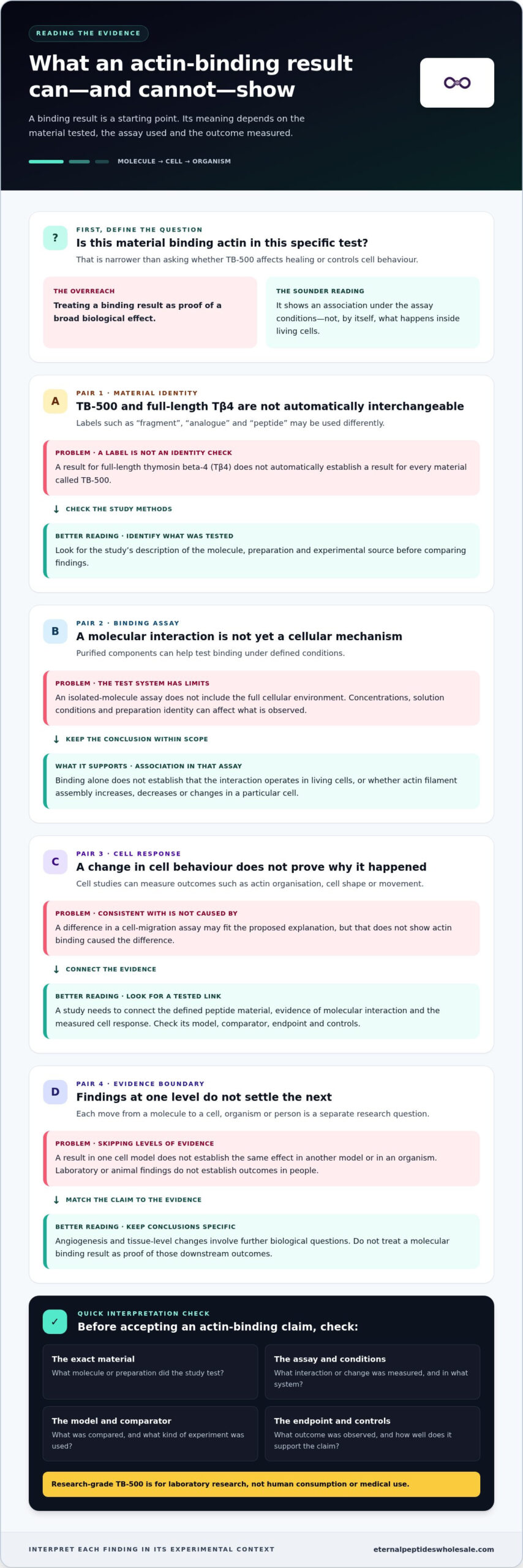
A disciplined review follows the evidence from material identity to conclusion. The aim isn’t to decide whether a mechanism sounds plausible, but to check whether the study’s methods support its claim. For an actin-binding claim, that means separating a measured interaction from a proposed explanation of cell behaviour.
- Identify the material. Record how the study names and describes the tested peptide or preparation. Don’t assume a label establishes that two studies used the same material.
- Inspect the method. Determine whether the experiment directly measures an interaction with actin or records a downstream endpoint, such as a change in cell movement.
- Review the controls. Check whether the controls suit the assay and help distinguish a specific signal from background, measurement interference or other explanations.
- Compare the endpoints. Keep binding, actin organisation and cell behaviour as separate outcomes unless the study tests their relationship.
- Assess the limits. Consider the model, assay conditions, sample limitations and whether independent work supports a comparable conclusion.
Match the claim to the assay and controls
Start with the results, not just the abstract’s mechanism language. A direct interaction assay addresses binding under its specific conditions; a cell-based endpoint addresses what happened in that cellular model. Negative, positive and assay-specific controls can help assess whether the measurement behaves as intended. Assay controls support interpretation, but they don’t prove broader biological effects. Keep the conclusion within the endpoint and controls the authors actually report.
Check material identity and reproducibility
Next, review the reported identity and preparation details, including any analytical characterisation and purity information. These details help readers judge what entered the assay, but a purity statement alone doesn’t establish identity, binding or biological activity. Contamination controls may also matter where they could affect the chosen endpoint. Compare independent results only when the materials, methods and outcomes are meaningfully alike.
Reproducibility depends on enough detail for another laboratory to evaluate the work. Look for a clear description of the test material, assay conditions, comparator, controls, endpoint and analysis. If a key detail is absent, note the limitation rather than filling it in by assumption. If studies reach different conclusions, first check whether they tested comparable preparations and measured the same thing. Different endpoints may explain why results appear inconsistent, but they don’t resolve the question without further evidence.
For Australian laboratories procuring research materials, explore wholesale TB-500 5mg for laboratory research. Product supply and evidence of a biological mechanism are separate considerations; research materials are not for human consumption or medical use.
How TB-500 actin-binding research fits laboratory study
Actin interaction is one defined question within broader peptide and cell-biology research, not a complete account of a peptide’s biological activity. A study might test whether a specified material binds actin, examine cytoskeletal organisation in cells, or measure a downstream endpoint such as cell movement. These questions sit at different levels. Findings from one level shouldn’t be treated as interchangeable with results from another model or method.
Keep the research question narrower than the broad mechanism
State precisely what the experiment examines. A molecular interaction study addresses binding under its assay conditions; a cell study may measure cellular dynamics; an animal study may examine an organism-level endpoint. A result in one model can inform further research, but it doesn’t establish the same result in another. Keep conclusions and summaries aligned with the material, model and endpoint actually studied.
This discipline also helps prevent a proposed mechanism from becoming an assumed outcome. If a cellular response is observed, describe it as the measured response unless the research directly tests the proposed molecular explanation. Broader claims about tissue biology require their own evidence. Laboratory findings don’t establish human benefit, safety or therapeutic effectiveness, and conclusions should make those limits clear.
Connect evidence review with research-material procurement
Material documentation matters when interpreting an experiment because researchers need to know what preparation was used and how it was described. A research peptide quality assurance guide provides adjacent procurement context, while a bulk peptide vials sourcing guide may help when considering laboratory purchasing format. Neither sourcing information nor a product description substitutes for evidence from a study using the specified material.
For researchers working on tissue-repair biology, the wholesale tissue repair procurement guide offers related sourcing context. Eternal Peptides Wholesale lists TB-500 5mg as a wholesale research-material option for laboratory use. This product reference makes no claim about actin binding or experimental performance. Products are for research purposes only, not for human consumption or medical use.
Ultimately, TB-500 actin-binding work is best understood through clearly defined questions, transparent methods and conclusions proportionate to the evidence. The wholesale tissue repair procurement guide also offers adjacent context for laboratory procurement planning.
Set a clear next step for your research
Before extending a laboratory finding, decide what evidence would justify the next stage of investigation. A direct interaction result may support further molecular work; a cellular observation may prompt a carefully designed follow-up in another model. Set the research question and endpoint in advance, and record what would count as support, uncertainty or a reason to revise the hypothesis. This makes the next experiment more informative, even when its result doesn’t match expectations.
Keep the scope explicit in protocols, reports and internal summaries. A finding tied to one material and model should remain attached to those conditions when shared or used to plan subsequent work. That helps colleagues assess the result without turning a preliminary observation into a broader claim about human outcomes. Responsible research in this area depends on maintaining that distinction at each step.
For laboratory research procurement, Eternal Peptides Wholesale is an Australian-based wholesale supplier, with TB-500 5mg listed for research supply. View TB-500 5mg wholesale for laboratory research. Keep the research question precise, and let the evidence guide what comes next.
Frequently Asked Questions
Is TB-500 the same molecule as thymosin beta-4?
No. TB-500 is generally described as a synthetic fragment derived from thymosin beta-4, not the full-length parent protein. However, the TB-500 label can be used inconsistently, so it doesn’t identify a study material precisely on its own. Before comparing findings, check the paper’s methods for how the tested material is named and characterised. Similar labels don’t demonstrate that two preparations are chemically equivalent.
Does an actin-binding result prove that TB-500 changes cell migration?
No. A binding result addresses an interaction measured in a particular assay; cell migration is a separate outcome that needs its own experiment. For example, researchers might measure movement in a cell-based assay and assess cell viability or other relevant factors that could affect the result. Even if both findings appear in one paper, the study needs evidence connecting the interaction to the migration response before that mechanism can be concluded.
What is the difference between G-actin and F-actin?
G-actin refers to individual actin protein units, while F-actin refers to chains or filaments assembled from those units. This distinction matters when interpreting laboratory results: an assay may examine individual actin molecules, filament formation or the organisation of actin inside cells. Those measurements answer different questions. Check the reported endpoint rather than assuming a result about one form of actin also describes the other.
Can thymosin beta-4 findings be used as evidence about TB-500?
They can provide background for developing a hypothesis, but they aren’t direct evidence about every TB-500 preparation. A finding involving full-length thymosin beta-4 applies to the material and model actually studied. To relate it to TB-500, researchers need evidence that the tested materials are sufficiently comparable and that the relevant effect is demonstrated for the TB-500 material itself. Don’t treat a shared name or biological relationship as proof of equivalence.
How can readers tell whether a paper measured direct actin binding?
Look in the methods and results for an experiment designed to measure an interaction between the named test material and actin. The paper should describe the assay’s readout and controls. If the reported outcome is cell migration, cell shape or another cellular response, that alone isn’t a direct binding measurement. Matching the wording of the claim to the actual endpoint is a useful first check.
Do preclinical actin-binding findings establish a human benefit?
No. Findings from biochemical assays, cultured cells or animal models don’t establish that a material benefits people, is safe for human use or effectively treats a condition. As of October 2026, completed, published human clinical trials have not established the safety or efficacy of the synthetic TB-500 fragment for any condition. Keep conclusions within the evidence available, and don’t treat research-grade material as intended for human consumption or medical use.
Related from Eternal Peptides Wholesale
Eternal Peptides Wholesale publishes batch-specific Janoshik Analytical reports in its certificate of analysis library, so the documentation for a listed batch can be read alongside the evidence discussed in this article.
- Peptide COA library: batch-specific Janoshik Analytical reports with their verification details
- Our peptide testing standards: how independent Janoshik testing is used and reported
- BPC-157 and TB-500 research catalogue
- Evidence review: Peptides for muscle gain: a structured evidence review
- Evidence review: Synthetic peptides: manufacture, impurities and analytical verification
Related reading: TB-500 for Cell Migration Assays: Design, Controls and Interpretation