

Shipping and evidence maintenance — 29 September 2026: Shipping, stock-location and transport-service claims in this article have been corrected against the current Shipping Policy. These edits are not a new clinical or regulatory review.
In the Australian biotechnology sector, the distinction between a laboratory reagent and an unapproved therapeutic good is not merely a technicality; it’s a legal firewall that dictates the operational security of your facility. For procurement professionals and lead researchers, the increasing scrutiny from regulatory bodies means that “near enough” is no longer good enough. You likely recognise the frustration of managing a landscape where the definitions of research-only chemicals frequently overlap with restricted medicines, creating a climate of uncertainty during the acquisition process. [Evidence note 4]
Staying ahead of the TGA guidelines for research-only peptides Australia is essential to avoid the disruption of Australian Border Force seizures or the reputational risk of a compliance audit. This 2026 guide promises to clarify the complex regulatory framework, providing your institution with the confidence to manage high-purity peptide procurement legally. We will examine the essential documentation required for compliant sourcing, the technical standards for laboratory-grade vials, and the methods for maintaining a transparent audit trail for every compound in your inventory. [Evidence note 4]
Key Takeaways
- Identify the critical legal distinction between unapproved therapeutic goods and laboratory reagents under the Therapeutic Goods Act 1989. [Evidence note 4]
- Master the TGA guidelines for research-only peptides Australia to ensure your laboratory procurement remains fully compliant with 2026 standards. [Evidence note 4]
- Evaluate the necessity of HPLC and Mass Spectrometry analysis to verify the purity and molecular weight of every peptide batch you acquire.
- Mitigate the operational risks associated with grey-market international sourcing by establishing a transparent, Australian-based supply chain.
- Develop a robust audit trail and documentation process that safeguards your institution against regulatory scrutiny and potential logistics disruptions. [Evidence note 4]
Navigating TGA Regulations for Peptides in Australia (2026)
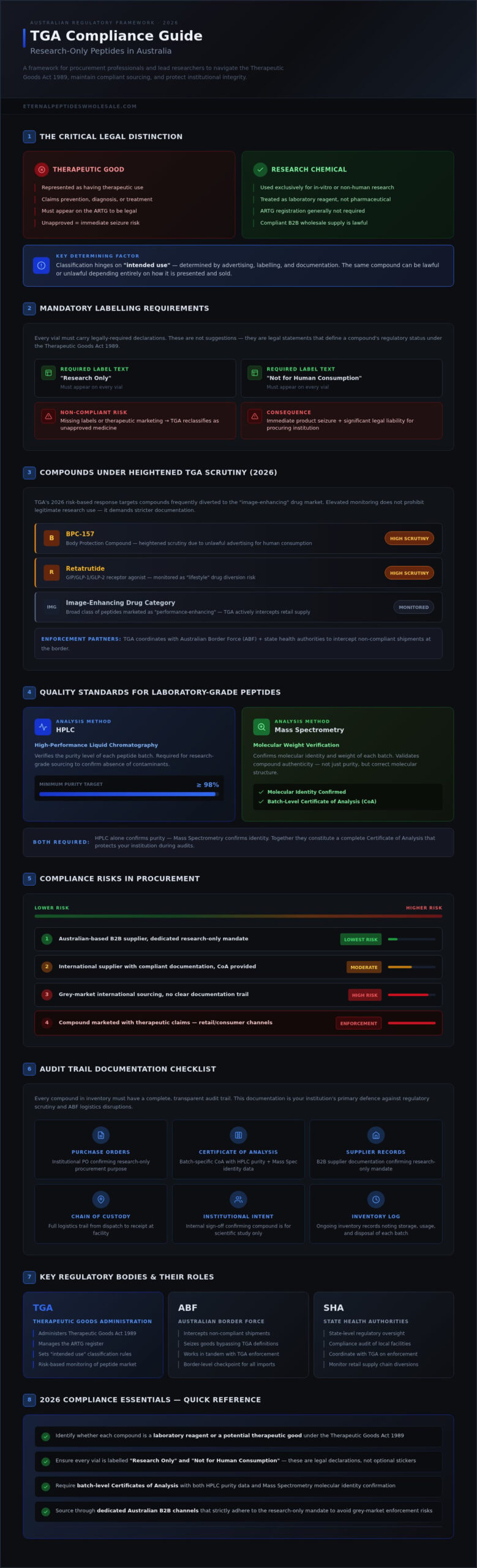
The Therapeutic Goods Administration (TGA) operates under the Therapeutic Goods Act 1989 to oversee any substance that claims to have a therapeutic effect. While the TGA primarily focuses on medicines and medical devices, its reach extends to any compound that could be classified as a therapeutic good. For laboratory professionals, understanding the TGA guidelines for research-only peptides Australia is the first step in ensuring that procurement activities don’t inadvertently cross into the territory of “unapproved therapeutic goods”. These are substances that haven’t been evaluated for safety or efficacy by the TGA and are not listed on the Australian Register of Therapeutic Goods (ARTG). [Evidence note 4]
Specific compounds like BPC-157 and Retatrutide are currently under heightened scrutiny. This isn’t necessarily due to their chemical properties in a lab setting, but rather because of their widespread unlawful advertising and supply for human consumption. The TGA’s regulatory focus in 2026 remains firmly on preventing these research chemicals from entering the retail market as “lifestyle” or “performance-enhancing” drugs. When a compound is diverted from the lab to the consumer, it triggers enforcement actions that can impact the entire supply chain. [Evidence note 4]
The Role of the Australian Register of Therapeutic Goods (ARTG)
Research-grade chemicals are generally excluded from the ARTG because they are not intended for human administration. The regulatory classification of a peptide often hinges on its “intended use”. If a compound is marketed, sold, or packaged in a way that suggests human use, the TGA classifies it as a therapeutic good. To maintain compliance, laboratories must ensure their documentation clearly reflects the non-therapeutic, in-vitro nature of their work. The TGA monitors these boundaries through close collaboration with the Australian Border Force (ABF) and various state health authorities to intercept shipments that appear to bypass these definitions. It’s the responsibility of the procuring institution to prove the chemical is for scientific study rather than clinical application. [Evidence note 4]
TGA Compliance Priorities for 2026
The TGA has adopted a risk-based response to the emerging peptide market. Their 2026 priorities focus on compounds frequently diverted to the “image-enhancing” drug market. For legitimate research institutions, this means procurement processes must be demonstrably distinct from retail channels. Maintaining high standards of logistical integrity is vital. By sourcing through dedicated B2B channels that strictly adhere to the “research-only” mandate, facilities can avoid the complications associated with the grey market. This proactive approach ensures that institutional R&D remains unhindered by the enforcement actions targeting illicit retail supply chains. A clear distinction between chemical procurement and pharmaceutical acquisition is the best defence against regulatory delays. [Evidence note 4]
The Legal Distinction: Therapeutic Goods vs Research Chemicals
In the Australian regulatory context, the distinction between a medicine and a laboratory reagent rests primarily on the intent of the supplier and the end-user. Under the Therapeutic Goods Act 1989, a substance is classified as a therapeutic good if it is represented as having a therapeutic use. This includes claims regarding the prevention, diagnosis, or treatment of a physical or mental condition. For scientific facilities, the TGA guidelines for research-only peptides Australia provide a framework where compounds used exclusively for in-vitro or non-human research are treated as laboratory chemicals rather than pharmaceuticals. This legal boundary is fundamental to the operation of biotech firms and academic institutions. [Evidence note 4]
Maintaining this distinction requires more than just internal policy; it necessitates strict compliance in labelling and documentation. Every vial must be clearly marked as “Research Only” or “Not for Human Consumption”. These labels are not mere suggestions; they are legal declarations that define the compound’s status. If a peptide lacks these markings or is accompanied by marketing material suggesting clinical benefits, the TGA may reclassify it as an unapproved medicine. This reclassification can lead to immediate product seizures and significant legal liability for the procuring institution. The TGA views the wholesale distribution of bulk biochemicals to research institutions as a legitimate commercial activity, provided the clinical-to-chemical firewall remains absolute. [Evidence note 4]
Intended Use and the Therapeutic Goods Act
The TGA determines a product’s status by evaluating its “intended use” through advertising, packaging, and the context of the sale. Vague or suggestive marketing is the most common trigger for regulatory intervention. If a supplier hints at performance-enhancing or anti-ageing properties, they are effectively supplying a therapeutic good. To safeguard your laboratory, it’s essential to establish a comprehensive paper trail. Every procurement order should be linked to a specific, documented research project or protocol. This internal documentation serves as primary evidence that the chemicals are being used for scientific inquiry rather than clinical application, ensuring your facility remains on the right side of the law. [Evidence note 4]
Importing Peptides: Personal vs. Wholesale Frameworks
A domestic supplier is not a customs or regulatory exemption. Confirm where the goods will actually dispatch from and which import and supply obligations apply to the proposed order. Offshore fulfilment may involve border processing, and domestic sourcing does not guarantee that goods cannot be held or seized. Keep an allowance for delays rather than treating a supplier’s Australian address as proof of clearance. Related reading: Eternal Peptides Wholesale.
Compliance Risks in Wholesale Peptide Procurement
The most significant hurdle in laboratory procurement is verifying batch identity. If a facility cannot confirm the exact chemical composition of its inventory, it fails to meet the core tenets of TGA guidelines for research-only peptides Australia. Sourcing from international “grey market” retailers introduces substantial risk. These entities often bypass the rigorous quality controls required for legitimate scientific study, leading to the acquisition of mislabelled or contaminated compounds. For an institution, the discovery of such substances can trigger a formal TGA audit or lead to the permanent suspension of importation privileges. Regulatory bodies view the presence of substandard chemicals as a sign of a compromised supply chain. [Evidence note 4]
Batch-to-batch consistency is equally critical for the integrity of longitudinal research. In long-term studies, even a minor variance in purity or the presence of unexpected isomers can invalidate years of data. Secure procurement relies on a stable supply chain where every vial is accounted for through a transparent logistical framework. When a compound is sourced from a non-specialist retailer, the researcher loses the ability to verify the synthesis history. This lack of transparency is a primary concern for the TGA, as it mirrors the haphazard supply chains of the illicit performance-enhancing drug market. [Evidence note 4]
Avoiding the “Unapproved Medicine” Trap
To ensure your procurement process remains compliant, it must be demonstrably different from retail purchasing. A professional B2B transaction is defined by its documentation. Every shipment should be accompanied by a comprehensive Material Safety Data Sheet (MSDS). This document is essential for compliance because it categorises the substance as a chemical reagent rather than a finished pharmaceutical product. Vetting suppliers involves assessing their B2B infrastructure. A legitimate wholesale partner will require institutional credentials and will provide technical data sheets that align with Australian laboratory safety standards. If a procurement portal resembles a standard e-commerce shopfront, it’s a sign that the supplier may not be prioritising regulatory rigour. [Evidence note 4]
Counterfeit and Substandard Peptides
The TGA maintains a high level of concern regarding non-sterile vials that mimic injectable forms. While these products are intended for in-vitro use, their presentation can lead to regulatory red flags. Unmarked or poorly labelled vials are particularly problematic. They are often intercepted by the ABF because they lack the necessary identifiers for chemical reagents. High-purity standards, verified through independent testing, protect the integrity of your scientific data and serve as a secondary layer of regulatory protection. By insisting on vials that meet strict B2B labelling requirements, your institution demonstrates a commitment to the “research only” mandate. This clarity is the most effective way to avoid the complications of being associated with counterfeit or substandard peptide markets. [Evidence note 4]
Maintaining Rigour: Quality Standards for Laboratory Peptides
Technical verification is the bridge between a generic chemical and a compliant laboratory reagent. While the TGA does not evaluate the composition of unapproved goods, scientific institutions must maintain their own rigorous quality benchmarks to satisfy TGA guidelines for research-only peptides Australia. High-Performance Liquid Chromatography (HPLC) remains the gold standard for this verification. It allows researchers to quantify the purity of a sample by separating individual components based on their chemical properties. Coupled with Mass Spectrometry (MS) to confirm molecular weight and identity, these tests provide the empirical evidence required for an audit-ready inventory. A purity baseline of 99% or higher is the minimum standard for reliable study; anything less introduces variables that can compromise the validity of your results. [Evidence note 1, 4]
Storage and Stability Protocols
Stability is a secondary but equally critical compliance factor. The TGA often expresses concern regarding the degradation of unapproved goods, which can lead to unpredictable chemical profiles. Best practices for Australian laboratories involve storing lyophilised peptides in a temperature-controlled environment, typically between -20°C and -80°C, to prevent hydrolysis and oxidation. Logistical speed is a vital component of this chain. Rapid delivery from an Australian-based centre reduces the time compounds spend in transit, minimising exposure to fluctuating temperatures. Maintaining compound integrity from the point of synthesis to the point of use is essential for consistent data and remains a core part of complying with the TGA guidelines for research-only peptides Australia. If you are ready to secure high-purity compounds for your facility, you can view our wholesale laboratory inventory to find compliant solutions. [Evidence note 2, 3, 4]
Secure Sourcing with Eternal Peptides Wholesale
A domestic supplier is not a customs or regulatory exemption. Confirm where the goods will actually dispatch from and which import and supply obligations apply to the proposed order. Offshore fulfilment may involve border processing, and domestic sourcing does not guarantee that goods cannot be held or seized. Keep an allowance for delays rather than treating a supplier’s Australian address as proof of clearance.
Logistical integrity is at the core of our distribution model. Sourcing from within Australia allows for faster transit times and more reliable environmental controls, which are essential for maintaining the stability of lyophilised compounds. Our B2B focus means we speak the language of procurement professionals and lead researchers. We prioritise the delivery of high-purity vials that meet the exact specifications required for in-vitro study and pre-clinical trials. This disciplined approach supports the long-term success of Australian biotech hubs by providing a stable and predictable inventory of essential biochemicals.
Wholesale-Only: A Disciplined B2B Model
Our business model is intentionally restrictive to ensure absolute alignment with Australian law. We don’t engage in retail single-vial sales, nor do we provide medical consultations or advice regarding human administration. This professional boundary is vital for institutional compliance. By focusing exclusively on bulk wholesale, we provide the scale required for large-scale longitudinal research projects. This includes Retatrutide and various GLP-1 analogues, all sourced through a supply chain that prioritises chemical purity over commercial hype. Our clients benefit from a partner that understands the specific documentation requirements of the Therapeutic Goods Act. [Evidence note 4]
Partnering for Scientific Excellence
Streamlining procurement for Australian universities and private biotech hubs requires more than just high-quality products. It demands a partnership based on clinical-grade reliability and shared professional standards. We provide the necessary audit trails and technical reports to ensure that every acquisition is defensible under TGA guidelines for research-only peptides Australia. Our commitment to purity is reflected in our comprehensive batch testing and transparent reporting. If your facility requires a dependable Australian source for high-purity biochemicals, you can enquire about wholesale research supply for your institution to discuss your specific project requirements and volume needs. [Evidence note 4]
Securing Your Laboratory’s Regulatory Future
Maintaining operational stability in the Australian biotech sector requires a proactive approach to regulatory alignment. The boundary between a laboratory reagent and a restricted medicine is defined by your procurement documentation and the physical labelling of your inventory. By strictly adhering to the TGA guidelines for research-only peptides Australia, your facility ensures it remains insulated from the enforcement actions targeting the retail consumer market. Institutional security is built on this clear distinction between scientific chemicals and therapeutic goods. [Evidence note 4]
The transition to 2026 standards highlights the necessity of technical verification and domestic logistical security. Reliable research outcomes depend on 99%+ purity levels, verified through independent HPLC and Mass Spectrometry analysis. Partnering with a specialist B2B supplier provides the stable logistical backbone needed to avoid the risks of international acquisition. This methodical approach to sourcing protects your institution’s reputation and guarantees the integrity of your longitudinal data. We remain committed to providing the high-purity compounds required for the next generation of scientific discovery. [Evidence note 1]
Secure Compliant Wholesale Peptides for Your Lab and benefit from our 99%+ purity HPLC/MS verified, strictly research-grade B2B supply and Australian-based wholesale logistics. We look forward to supporting your facility with precision and professional reliability. [Evidence note 1, 3]
Frequently Asked Questions
Is it legal to buy peptides for research in Australia?
It’s legal to acquire peptides for legitimate laboratory research and in-vitro study within Australia. These substances are classified as laboratory reagents rather than therapeutic goods when there is no intention for human administration. Compliance depends on maintaining a clear distinction between chemical procurement and pharmaceutical supply. Following the TGA guidelines for research-only peptides Australia ensures that your facility operates within the legal framework established for scientific inquiry. [Evidence note 4]
What does “unapproved” mean in TGA guidelines?
In the TGA context, “unapproved” refers to a therapeutic good that has not been evaluated for safety or efficacy and is not listed on the Australian Register of Therapeutic Goods (ARTG). While research peptides are technically unapproved as medicines, they are permitted for use as laboratory chemicals. The term signifies that the substance cannot be legally marketed or supplied for therapeutic use in humans without specific exemptions. [Evidence note 4]
Can I use research peptides for clinical trials in Australia?
Research-grade peptides are not suitable for clinical trials involving human participants. Clinical trials require compounds manufactured under Good Manufacturing Practice (GMP) standards and must be conducted under the Clinical Trial Notification (CTN) or Clinical Trial Approval (CTA) schemes. Research-only peptides are strictly limited to in-vitro experiments or animal studies. Attempting to use laboratory-grade chemicals in a clinical setting violates the Therapeutic Goods Act and carries significant legal risks. [Evidence note 4]
What are the penalties for non-compliant peptide supply?
Penalties for the unlawful supply or advertising of unapproved therapeutic goods are severe under the Therapeutic Goods Act 1989. Civil and criminal penalties can include substantial fines reaching into millions of dollars for corporations and potential imprisonment for individuals. Additionally, the Australian Border Force may seize non-compliant shipments. Maintaining a robust audit trail and sourcing from professional B2B partners helps mitigate the risk of these regulatory enforcement actions. [Evidence note 4]
How does the TGA regulate GLP-1 analogues for laboratory use?
The TGA regulates GLP-1 analogues based on their classification in the Poisons Standard and their intended application. While many are Schedule 4 prescription-only medicines when sold for therapy, they are treated as research chemicals when supplied in bulk for laboratory use. Adhering to TGA guidelines for research-only peptides Australia is particularly important for GLP-1 analogues because of the high level of regulatory scrutiny regarding their diversion into the retail market. [Evidence note 4]
Do research-only peptides require ARTG registration?
Research-only peptides don’t require registration on the Australian Register of Therapeutic Goods because they are not therapeutic goods. The ARTG is a database of medicines and medical devices approved for human use in Australia. Since laboratory reagents are intended for scientific study rather than clinical application, they fall outside the scope of ARTG registration. However, they must still be clearly labelled and documented to maintain this exclusion from the register. [Evidence note 4]
What documentation is required for bulk peptide procurement in Australia?
Compliant bulk procurement requires several key documents to establish a transparent audit trail. These include a Material Safety Data Sheet (MSDS) that identifies the substance as a chemical reagent and a professional B2B invoice from an Australian supplier. Additionally, internal records should link the purchase to a specific research protocol or institutional project. This documentation proves the compound’s intended use and satisfies regulatory requirements during institutional audits or customs inspections. [Evidence note 4]
How can I verify the purity of wholesale peptides?
Purity verification is achieved through High-Performance Liquid Chromatography (HPLC) and Mass Spectrometry (MS). An HPLC report provides a quantitative analysis of the peptide’s purity level, which should ideally be 99% or higher for research consistency. Mass Spectrometry confirms the molecular weight and identity of the compound. Legitimate wholesale partners provide a Certificate of Analysis (COA) for every batch, allowing researchers to verify the technical specifications before beginning their study. [Evidence note 1]
Current Australian regulatory clarification
The TGA explains that research-only wording does not remove applicable regulatory obligations. Therapeutic peptide products generally require ARTG inclusion unless a valid exemption, approval or authority applies. This is not a blanket determination about every peptide or every laboratory activity. [8]
Separate the questions of product classification, proposed activity, customer eligibility and any specific authority. A purchasing checklist, institutional affiliation or analytical report cannot by itself resolve those questions. Use current official information and the institution’s compliance process for the actual proposed transaction.
For the next step, review the Australian research peptide buying guide and the batch-verification checklist. Contact Eternal Peptides Wholesale with the exact product and any unanswered documentation questions.
Related from Eternal Peptides Wholesale
Eternal Peptides Wholesale publishes batch-specific Janoshik Analytical reports in its certificate of analysis library, so the documentation for a listed batch can be read alongside the evidence discussed in this article.
- Peptide COA library: batch-specific Janoshik Analytical reports with their verification details
- Janoshik reports explained: what each test measures and its limits
- Evidence review: Peptides wholesale: supplier qualification and quality standards
- Evidence review: CBL-514 Australia: a comparative regulatory analysis
References and bibliography
- McCarthy D, Han Y, Carrick K, Schmidt D, Workman W, Matejtschuk P, Duru C, Atouf F. 2023. Reference Standards to Support Quality of Synthetic Peptide Therapeutics. Pharmaceutical research. 40(6):1317-1328. doi:10.1007/s11095-023-03493-1.
- Bachem. 2021. FAQ: Analysis and handling of peptides. Accessed 27 September 2026.
- U.S. Food and Drug Administration / International Council for Harmonisation. Q6A Specifications: Test Procedures and Acceptance Criteria for New Drug Substances and New Drug Products: Chemical Substances. Accessed 27 September 2026.
- Eternal Peptides Wholesale. Peptide testing standards and report directory. Accessed 27 September 2026.
- Eternal Peptides Wholesale. Research product catalogue. Accessed 27 September 2026.
- Eternal Peptides Wholesale. Terms of service. Accessed 27 September 2026.
- Eternal Peptides Wholesale. Contact and Australian store locations. Accessed 27 September 2026.
- Therapeutic Goods Administration. 2026. How we regulate therapeutic peptide products. Accessed 27 September 2026.