
Abstract
Background. The phrase “peptides wholesale” is widely used to describe the bulk, business-to-business supply of synthetic peptides to laboratories, analytical facilities and manufacturers. Behind the commercial label lies a technical question that matters to every purchaser: how can a buyer establish that a peptide received in quantity has the identity, purity, content and stability that its documentation claims? Synthetic peptides sit between small molecules and proteins, are excluded from several of the impurity guidelines that govern conventional active substances, and are now the subject of sustained regulatory attention in Australia [1, 2, 3].
Objective. To synthesise the peer-reviewed and regulatory evidence relevant to quality assurance in peptides wholesale, with particular reference to supplier qualification, certificate-of-analysis (COA) evidence, counterfeit and substandard material, storage and stability, the cost of quality, and the Australian legal framework.
Methods. A structured evidence review informed by PRISMA 2020 reporting principles [4]. Seven reproducible PubMed search strings were executed through NCBI E-utilities on 29 October 2026, with parallel counts in Europe PMC [5, 6]. The 60 most relevant records per string (420 records; 417 after de-duplication) were screened, supplemented by targeted searches and citation chasing. Regulatory and standards documents were identified directly from ICH, EMA, EDQM, FDA, ISO, NATA, the Therapeutic Goods Administration (TGA), the Office of Drug Control (ODC), AICIS and the Federal Register of Legislation, and every source was fetch-verified.
Results. Sixty-seven peer-reviewed records and 36 regulatory, standards and infrastructure documents were included (103 sources). Database screening contributed 22 of the 67 peer-reviewed records; 45 came from targeted searching. The supplier-qualification search string returned 61 PubMed records in total but contributed no included study, indicating that peptide-specific supplier qualification is rarely studied directly. Independent testing of research-grade synthetic peptides repeatedly found discrepancies with supplier documentation: in one study only 44.0% of peptides ordered at ≥95% purity met that specification [7]; undeclared mannitol at roughly 20% and 43% w/w was found in two custom peptides [8]; and trace cross-contamination at about 1% w/w produced false-positive immunological results [9]. Mass-balance studies show that the peptide itself may account for well under 100% of a lyophilised powder, with counter-ion (often trifluoroacetate) contributing up to about a quarter of the mass [10, 11]. Seizure studies show that a large share of black-market peptide products do not contain the declared substance or amount [12, 13, 14]. In Australia, the TGA states that “research use only” disclaimers do not change whether a product is a therapeutic good [2].
Conclusions. In peptides wholesale, supplier documentation is necessary but insufficient. A defensible qualification process combines a documented quality system, traceability to the original manufacturer, orthogonal analytical evidence that distinguishes purity from net peptide content, periodic independent verification, controlled storage, and legal advice on the regulatory status of the intended use. The evidence base is strongest on analytical failure modes and weakest on direct comparative studies of supplier qualification.
Keywords: peptides wholesale; wholesale peptides; bulk peptides; synthetic peptides; peptide supplier qualification; peptide supplier audit; certificate of analysis; peptide content; trifluoroacetate; counterfeit medicines; peptides Australia; wholesale peptides Australia; Therapeutic Goods Administration
1. Introduction
The word “wholesale” implies scale: larger quantities, repeat orders, longer supply relationships and, frequently, a chain of intermediaries between the facility that synthesises a molecule and the laboratory that eventually weighs it. In the context of synthetic peptides, scale changes the nature of the quality problem. A single milligram vial that fails in an exploratory assay is an irritation; a multi-gram lot that is incorrectly characterised can contaminate months of work, a reference-standard programme or a downstream manufacturing step. This review therefore treats peptides wholesale not as a marketing category but as a supply-chain and quality-assurance problem that can be examined with the tools of analytical chemistry, pharmaceutical quality systems and regulatory science.
Peptides are short chains of amino acids, and their basic chemistry, biological roles and research uses have been reviewed in earlier articles in this series (see What are peptides? and What are peptides used for in research?). Synthetic peptides are, in most cases, assembled by solid-phase peptide synthesis (SPPS) and purified by preparative reversed-phase chromatography [15, 16]. That process is well established, but it is also a prolific source of closely related impurities: deletion and insertion sequences, diastereomers formed by racemisation, incompletely deprotected adducts, oxidised species, aggregates and residual counter-ions [15, 17, 18]. A companion article in this series examined these manufacturing impurities in depth (synthetic peptides: manufacture, impurities and analytical verification). The present article asks what those impurity mechanisms mean for a buyer who sources synthetic peptides in bulk.
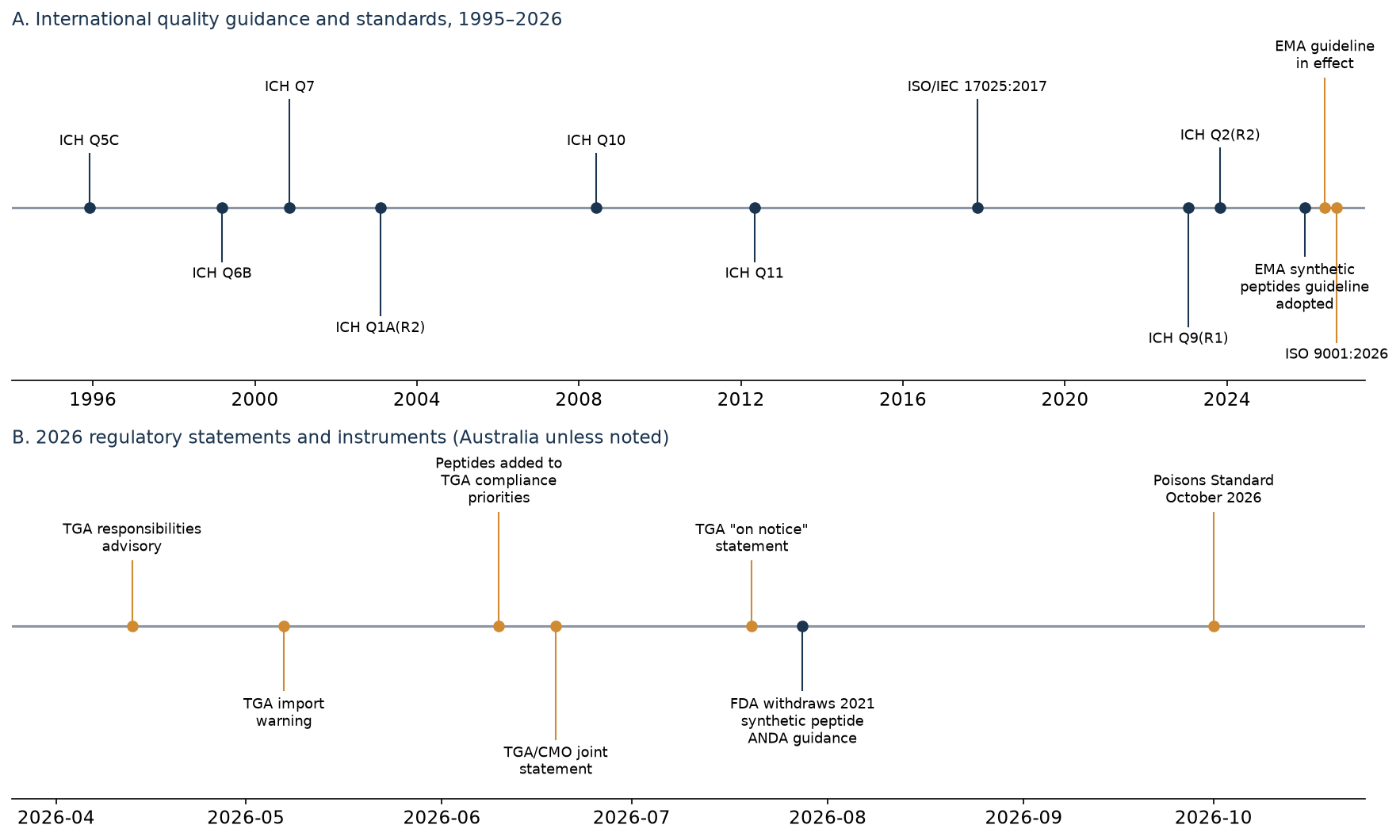
Three developments make the question timely. First, the regulatory science of synthetic peptides has matured. The European Medicines Agency (EMA) adopted a dedicated Guideline on the Development and Manufacture of Synthetic Peptides in December 2025, which came into effect on 1 June 2026 and explicitly records that synthetic peptides are fully or partially excluded from ICH Q3A/B, Q6A/B and M7 [1, 19]. Second, the United States Food and Drug Administration withdrew its 2021 guidance on abbreviated applications for certain synthetic peptides in July 2026, stating that it no longer reflected current thinking [20, 21]. Third, Australian regulators have made unapproved peptide products an explicit compliance priority, issuing a sequence of statements in 2026 that address importation, labelling, quality and enforcement [3, 22, 23, 24, 25].
Against that background, buyers of wholesale peptides often encounter a gap between the language of supply and the language of evidence. Product documentation may state a purity figure without stating the method, the basis on which it was calculated or the laboratory that measured it. A purity of “98%” by HPLC peak area says nothing about how much of the powder is peptide rather than water, salt or excipient [10, 26]. Terms such as “research grade” and “GMP-like” have no defined regulatory meaning, whereas good manufacturing practice (GMP) is a defined, inspectable standard [27, 28, 29]. And a disclaimer that a product is “for research use only” is not a regulatory classification at all [2].
This review addresses four questions:
- Which international quality standards and guidelines are relevant to the bulk supply of synthetic peptides, and what do they actually require of manufacturers, distributors and testing laboratories?
- What analytical evidence is needed to establish the identity, purity, content and stability of a wholesale peptide lot, and what does the peer-reviewed literature show about the reliability of supplier documentation?
- What is known about counterfeit, falsified and substandard peptide material, and how is that evidence relevant to legitimate procurement?
- How does the Australian regulatory framework bear on peptides wholesale, and what does it imply for supplier qualification?
The review deliberately avoids clinical, therapeutic or consumer framing. It is written for scientists, quality professionals, procurement officers and compliance staff who need to understand what evidence a peptide supply chain can and cannot provide. Nothing in it should be read as legal advice or as a statement about the regulatory status of any particular product or business.
2. Background: the structure of the peptides wholesale supply chain
2.1 Manufacturing at scale
Peptide therapeutics are now an established pharmaceutical class. Reviews published between 2019 and 2023 variously count more than 50, more than 60 and about 80 approved peptide drugs, with roughly 170 candidates in clinical trials at the time of the 2019 estimate [16, 30, 31, 32]. Industrial experience with large-scale chemical synthesis is therefore substantial. The development of a 36-residue peptide by chemical synthesis at commercial scale, described in 2003, showed that route selection, fragment strategy and purification capacity dominate the feasibility and cost of large campaigns [33]. More recent work by an industry consortium assessed process mass intensity across 40 synthetic peptide processes from 14 companies and confirmed that SPPS consumes very large quantities of solvents and reagents per kilogram of product [34]. These facts matter for wholesale procurement because they explain why peptide quality is closely coupled to process design: the same sequence made by different routes, at different scales or with different purification capacity can carry a different impurity profile [17, 35].
2.2 The actors in the chain
A wholesale peptide supply chain may involve the original manufacturer, one or more contract laboratories, agents or brokers, distributors, repackers or relabellers, and finally the end user. ICH Q7, the international GMP guide for active pharmaceutical ingredients, devotes a whole section to “agents, brokers, traders, distributors, repackers, and relabellers” and applies it to “any party other than the original manufacturer who may trade and/or take possession, repack, relabel, manipulate, distribute or store” an active ingredient or intermediate [27]. Q7 expects those parties to comply with GMP, to maintain a quality system, to retain traceability documents (including the identity and address of the original manufacturer, the manufacturer’s batch number, transport records and all authentic certificates of analysis) and to pass on the name of the original manufacturer and the batch numbers supplied [27]. Where an intermediary repackages material into a different container type, Q7 expects stability data to justify the assigned expiry or retest date [27].
Q7 is written for active pharmaceutical ingredients destined for medicines, and many peptides traded at wholesale are not sold for that purpose. Nevertheless, its intermediary provisions are the most complete published description of what traceability in a peptide supply chain should look like, and they provide a useful benchmark for any bulk peptide buyer regardless of end use. The provisions also highlight a structural risk: every additional intermediary between the synthesis reactor and the user is a point at which documentation can be reissued, relabelled or detached from the batch it describes. Q7 addresses this directly by requiring that any reissued certificate identify the laboratory that performed the analysis, reference the original manufacturer and attach a copy of the original batch certificate [27].
2.3 Why the research supply chain is a quality problem
Concerns about the reproducibility of preclinical research have drawn attention to the quality of research reagents. An analysis published in 2015 estimated that the cumulative prevalence of irreproducible preclinical research exceeds 50%, at a cost of roughly US$28 billion per year in the United States alone [36]. A 2016 Nature survey of some 1,500 scientists examined how widely researchers experience failures to reproduce published work [37]. In the antibody field, the response has been a call for standardised, sequence-defined reagents [38]. Synthetic peptides are, in principle, easier to define than antibodies because their intended structure is fully specified by sequence and modifications. In practice, the literature reviewed below shows that the defined structure on the order form and the material in the vial can diverge in ways that standard documentation does not reveal [7, 8, 39].
3. Methods
3.1 Design
This is a structured narrative evidence review. It borrows the transparency elements of PRISMA 2020 (explicit search strings, dates, counts and selection criteria) without claiming to be a systematic review with meta-analysis, because the evidence is methodologically heterogeneous and largely descriptive [4]. The unit of analysis is the published claim: each factual statement in the article is linked to a numbered source, and each source is recorded in a references ledger with its verification method, the exact claim it supports and the access date.
3.2 Information sources and search strategy
PubMed was searched programmatically through the NCBI E-utilities interface (esearch, esummary and efetch) [5]. Europe PMC was searched in parallel through its REST interface to provide a broader count [6]. All searches were run on 29 October 2026 at 12:01 AEST (Australian Eastern Standard Time, UTC+10). Seven themes were defined in advance from the review questions: (1) synthetic peptide impurities and quality control; (2) counter-ions and trifluoroacetate; (3) peptide content and purity assignment; (4) peptide stability and degradation; (5) counterfeit, falsified or black-market peptides; (6) supplier qualification and quality systems; and (7) reagent quality and reproducibility. Each theme was translated into a PubMed query using title/abstract field tags and an equivalent Europe PMC query. The exact strings are reproduced in the editor notes accompanying this article and are summarised in Table 1.
Because Europe PMC matches terms in full text as well as titles and abstracts, its counts are an order of magnitude higher than PubMed’s for the same concepts and should be read as an indication of the breadth of discussion rather than as a count of relevant studies. The PubMed counts are the primary measure.
3.3 Screening and eligibility
For each of the seven PubMed strings, the 60 most relevant records (PubMed relevance sort) were retrieved, giving 420 records. Three duplicates were removed, leaving 417 unique records for title and abstract screening. Records were eligible if they (a) reported primary analytical, regulatory or quality data on synthetic or recombinant peptides, peptide reference materials or peptide-containing seized products, or (b) were reviews or guidance documents that directly addressed peptide quality attributes, impurity control, content assignment, stability or supply-chain integrity. Records were excluded if they were primarily clinical, therapeutic or dosing studies, concerned unrelated meanings of the search terms (for example, peptides designed to neutralise endotoxin rather than endotoxin contamination of peptides), or could not be verified through PubMed metadata.
Twenty-two records were included from the structured screen. A further 45 peer-reviewed records were identified through targeted searches on specific attributes (for example, enantiomeric purity, isotope-dilution content assignment, moisture-induced aggregation and seizure analyses) and by citation chasing from included reviews. Two records retrieved during targeted searching were excluded after abstract review as primarily therapeutic in scope, and two seizure reports were excluded because PubMed held no abstract against which claims could be checked. In total, 67 peer-reviewed records were included.
3.4 Regulatory and standards sources
Regulatory and standards documents were identified directly from issuing bodies rather than from secondary summaries: ICH (Q1A(R2), Q2(R2), Q5C, Q6B, Q7, Q9(R1), Q10 and Q11) [27, 40, 41, 42, 43, 44, 45, 46]; the EMA synthetic peptides guideline and its history page [1, 19]; the EDQM guidance on Ph. Eur. general monograph 2034 [47]; FDA guidance listings and statements [20, 21, 48]; EudraLex Volume 4 [29]; ISO and NATA pages for ISO 9001, ISO/IEC 17025 and ISO 17034 [49, 50, 51, 52]; TGA GMP and peptide pages [2, 3, 22, 23, 24, 25, 28]; ODC import-permit pages [53, 54]; AICIS guidance [55]; and the Federal Register of Legislation for the Therapeutic Goods Act 1989, the October 2026 Poisons Standard, the Customs (Prohibited Imports) Regulations 1956, the Industrial Chemicals Act 2019 and the Competition and Consumer Act 2010 [56, 57, 58, 59, 60].
3.5 Data extraction and verification
For each included peer-reviewed record, bibliographic metadata were retrieved from PubMed esummary and the abstract from efetch; quantitative claims used in this review were taken from the abstract or, for regulatory documents, from the text of the document itself. Every digital object identifier was resolved through the doi.org handle service, and all 66 registered identifiers resolved. Every regulatory URL was fetched with an HTTP client on 29 October 2026; pages that block automated clients (the ISO standard pages) were verified with an alternative fetch method and are flagged in the ledger. Where a guidance document had been revised or withdrawn, the current status was recorded and the document is described historically.
3.6 Appraisal and synthesis
Formal risk-of-bias tools designed for clinical trials do not fit analytical case reports, method comparisons, seizure surveys or regulatory texts. Studies were instead appraised against four questions: was the analytical method orthogonal to the supplier’s method; was the sample size stated; were the discrepancies quantified; and was the claim reproduced elsewhere? The synthesis is narrative and organised by the four review questions. Quantitative findings are reported as published and are not pooled.
4. Results
4.1 Search yield and the shape of the evidence base
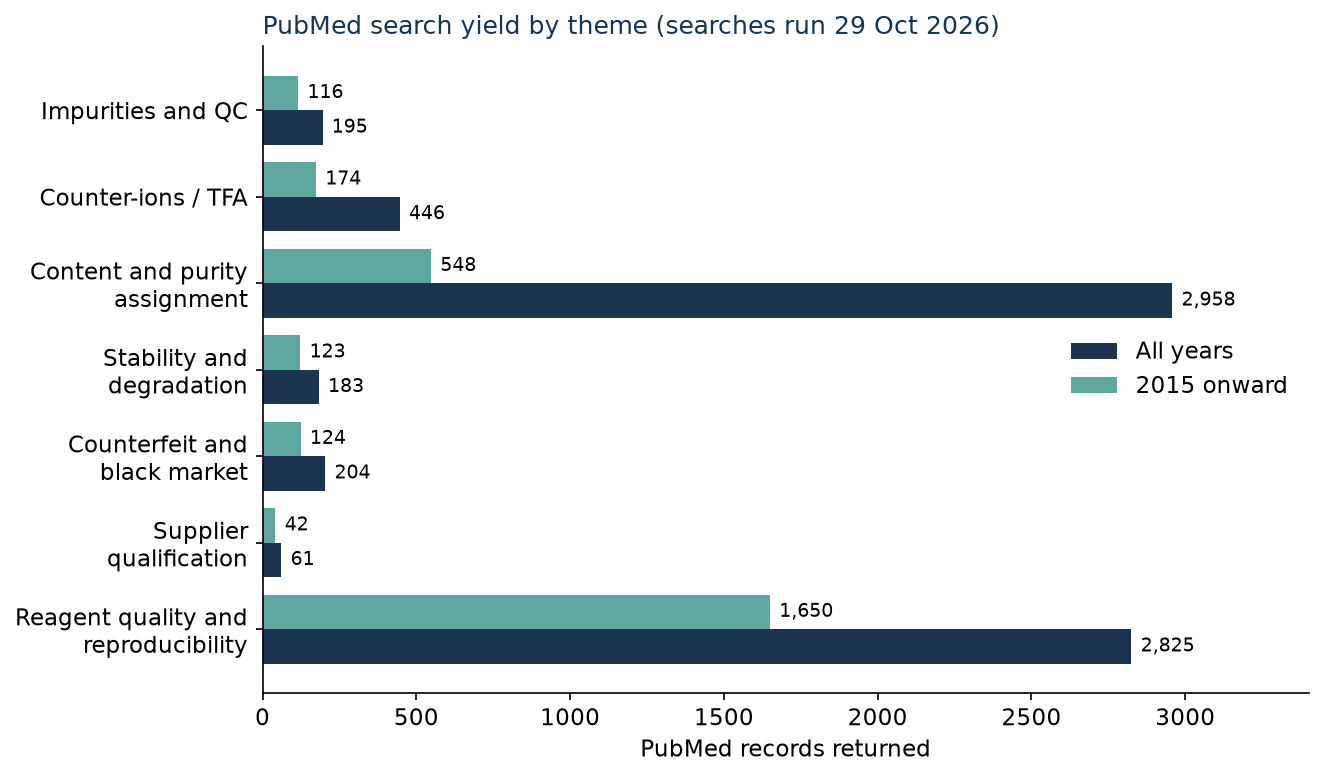
The seven PubMed strings returned between 61 and 2,958 records each, of which between 42 and 1,650 were published from 2015 onward (Table 1, Figure 1). The largest yields came from the content-and-purity-assignment string and the reproducibility string, both of which capture large method-development literatures that extend well beyond peptide supply. The smallest yield came from the supplier-qualification string (61 records in total, 42 since 2015), and none of the 60 most relevant records from that string met the eligibility criteria: they concerned supplier audits for excipients, small-molecule active ingredients or general laboratory reagents rather than peptides. This is itself a finding. Peptide-specific supplier qualification is discussed extensively in regulatory guidance but is rarely studied empirically; what the literature offers instead is a large body of indirect evidence, from analytical method comparisons and case reports, about the ways in which peptide documentation can fail.
Table 1. Search yield by theme. PubMed counts from NCBI E-utilities and Europe PMC counts from the REST API, run 29 October 2026, 12:01 AEST. The final column gives the number of records from that theme’s 60 most relevant PubMed results that were included in this review. Column totals sum to 23 because one included record was retrieved by two strings.
| Theme | PubMed (all years) | PubMed (2015 onward) | Europe PMC | Included from top 60 |
|---|---|---|---|---|
| Synthetic peptide impurities and quality control | 195 | 116 | 6,688 | 12 |
| Counter-ions and trifluoroacetate | 446 | 174 | 9,107 | 4 |
| Peptide content and purity assignment | 2,958 | 548 | 23,747 | 1 |
| Peptide stability and degradation | 183 | 123 | 711 | 2 |
| Counterfeit, falsified or black-market peptides | 204 | 124 | 8,278 | 3 |
| Supplier qualification and quality systems | 61 | 42 | 3,308 | 0 |
| Reagent quality and reproducibility (peptides) | 2,825 | 1,650 | 127,872 | 1 |
| Screening totals | 420 retrieved | 417 unique | n/a | 22 included; 45 added by targeted search |
The included peer-reviewed literature falls into five clusters: impurity characterisation and analytical method studies (about a third of records); content assignment and reference-material studies; documented quality failures in research-grade material; seizure and counterfeit analyses; and stability and degradation reviews. Publication dates span 1992 to 2026. Most quantitative claims come from analytical laboratories, official medicines control laboratories, metrology institutes and anti-doping laboratories rather than from suppliers.
4.2 Quality standards relevant to peptides wholesale
Buyers of bulk peptides encounter a vocabulary of standards that are often cited loosely. Table 2 maps the principal instruments to what they govern and what they do not. The central distinction is between standards that govern how a product is made and released (GMP), standards that govern how a measurement is made (laboratory competence and analytical validation), standards that govern how an organisation is managed (quality management systems), and standards that define what the product must contain (pharmacopoeial monographs and specifications).
Table 2. Map of quality standards and guidelines relevant to peptides wholesale, what each governs, and common misreadings.
| Instrument | What it governs | Relevance to synthetic peptides | Common misreading |
|---|---|---|---|
| ICH Q7 (2000) | GMP for active pharmaceutical ingredients, including §17 on agents, brokers, distributors and repackers | Supplier approval, COA content, traceability to original manufacturer | That a supplier “following Q7 principles” has been inspected |
| ICH Q11 (2012) | Development and manufacture of drug substances; control strategy | Process understanding and starting-material controls | That it sets peptide impurity limits |
| ICH Q6B (1999) | Specifications for biotechnological products | Recombinant peptides; synthetic peptides partly outside scope | That it applies to all peptides |
| ICH Q9(R1) (2023) and Q10 (2008) | Quality risk management; pharmaceutical quality system | Risk-based supplier oversight, management of purchased materials | That a risk assessment substitutes for testing |
| ICH Q2(R2) (2023) | Validation of analytical procedures | Whether a COA method is fit for purpose | That any HPLC trace is a validated assay |
| EMA synthetic peptides guideline (in effect 1 June 2026) | Development, manufacture and control of synthetic peptides in medicines | Specification attributes, counter-ion control, Ph. Eur. thresholds, hygroscopicity | That it applies to non-medicinal research supply |
| Ph. Eur. general monograph 2034 | Thresholds for peptide-related impurities: report >0.1%, identify >0.5%, qualify >1.0% | Binding for pharmaceutical use in Ph. Eur. jurisdictions | That “≥95% purity” is a pharmacopoeial grade |
| USP peptide reference standards | Value-assigned reference materials for compendial testing | Two-step mass-balance value assignment | That any “reference” sample is a certified standard |
| ISO 9001:2026 | Generic quality management system | Organisational process control | That certification attests product quality |
| ISO/IEC 17025:2017 | Competence of testing and calibration laboratories | Accredited third-party testing of identity, purity and content | That accreditation covers every test a laboratory performs |
| ISO 17034:2016 | Competence of reference material producers | Certified reference materials for calibration | That a COA from any producer is a certified value |
| PIC/S GMP (as applied by TGA) and EudraLex Vol. 4 | Inspectable GMP for medicines and active substances | Licensed manufacture for therapeutic supply | That “GMP-like” or “GMP-grade” claims equal licensed GMP |
Sources for Table 2: [1, 27, 28, 29, 41, 43, 44, 45, 46, 47, 49, 50, 51, 61].
GMP and its imitations. ICH Q7 sets out what GMP means for active ingredients: an independent quality unit, documented procedures, validated processes, change control, batch records, and release testing against specifications [27]. Within that framework, supplier approval is explicit. Q7 expects at least one identity test on every batch of incoming material and permits a supplier’s certificate to substitute for other tests only if the manufacturer “has a system in place to evaluate suppliers” [27]. Supplier approval “should include an evaluation that provides adequate evidence (e.g., past quality history) that the manufacturer can consistently provide material meeting specifications”, and “full analyses should be conducted on at least three batches before reducing in-house testing”, with periodic full analysis thereafter and regular checks of the reliability of certificates [27]. In Australia, the TGA applies the PIC/S Guide to GMP to medicine manufacturers [28], and in Europe the equivalent requirements are collected in EudraLex Volume 4 [29]. GMP compliance is demonstrated through licensing and inspection, not through self-description. Terms such as “research grade”, “high purity” and “GMP-like” appear frequently in peptide supply, but none corresponds to an inspectable standard, and none should be interpreted as equivalent to licensed GMP manufacture.
The peptide-specific gap in impurity guidance. For conventional small-molecule active substances, ICH Q3A sets reporting, identification and qualification thresholds. The EMA guideline confirms that synthetic peptides are excluded from ICH Q3A and that “consequently the limits laid down in this guideline are not applicable” [1]. Instead, Ph. Eur. general monograph 2034 (Substances for Pharmaceutical Use) specifies that peptide-related impurities should be reported above 0.1%, identified above 0.5% and qualified above 1.0% [1, 47]. The EDQM confirms that these thresholds are binding for substances within the scope of the monograph [47]. The EMA guideline also lists the attributes it expects in a synthetic peptide active-substance specification: appearance, identity, related impurities, high-molecular-weight impurities specified by type, assay or content (by liquid chromatography, elemental analysis, amino acid analysis, Kjeldahl nitrogen or quantitative NMR), counter-ion identity and content, residual trifluoroacetate, water, residual solvents, elemental impurities, bacterial endotoxins and microbiological purity [1]. It requires that assay limits be “expressed in terms of the counter-ion free, anhydrous substance, unless otherwise justified” [1]. Synthetic peptides do fall within ICH Q3D on elemental impurities [1].
These provisions apply to medicinal products. They are nonetheless the best available statement of what a complete characterisation of a synthetic peptide looks like, and they expose how much less is typically conveyed by a single purity figure. The pharmacopoeias themselves are not fully aligned: a 2009 review found that Ph. Eur. and USP peptide monographs were “barely harmonized”, with large differences in identification, purity and assay requirements, and inconsistencies even within a single pharmacopoeia [62].
Analytical validation and laboratory competence. ICH Q2(R2) describes the evidence needed to show that an analytical procedure is fit for its intended purpose, including specificity, accuracy, precision and range [41]. ISO/IEC 17025 specifies requirements for the competence, impartiality and consistent operation of testing laboratories, and it is the standard against which accreditation bodies assess them [50]. In Australia, NATA accredits laboratories to ISO/IEC 17025 and reference material producers to ISO 17034 [51, 52]. Accreditation applies to a defined scope of tests; a laboratory accredited for one method is not thereby accredited for every assay it reports. A buyer reading a certificate should therefore ask not only whether the issuing laboratory is accredited but whether the specific tests on the certificate fall within its accredited scope.
Quality management systems. ISO 9001 specifies generic requirements for a quality management system. Its sixth edition, ISO 9001:2026, was published in September 2026 and replaced the 2015 edition, which was withdrawn on 16 September 2026 [49]. ISO 9001 certification shows that an organisation operates documented processes for things like document control, corrective action and supplier management; it does not attest to the identity or purity of any product. In peptides wholesale, ISO 9001 is a useful indicator of organisational discipline but cannot substitute for product-level analytical evidence.
Reference standards. The USP describes a two-step approach to peptide reference standards in which a quantitative value is first assigned to bulk material by mass balance and the bulk material is then used to assign a value to vialed material, with identity testing, outlier handling and stability monitoring [61]. The EMA guideline similarly expects the origin of reference standards to be stated, a two-tier primary and working standard system to be explained, and measures to “prevent drift in peptide content” to be presented [1]. Certified reference materials produced under ISO 17034 provide metrological traceability but are scarce and expensive for peptides [51, 63].
Quality agreements. Regulators expect contractual arrangements to define quality responsibilities. FDA guidance on contract manufacturing describes written quality agreements that allocate responsibilities for testing, release, change control, deviations and record keeping between the owner and the contract facility [48]. Q10 likewise places responsibility for the quality of purchased materials and outsourced activities on the pharmaceutical company [45]. For bulk peptide buyers outside the medicinal sphere, the same logic applies: specify in writing what is to be tested, by whom, against which acceptance criteria and with what notification of change.
4.3 What a certificate of analysis should evidence
A certificate of analysis is the primary document through which a supplier communicates quality, and Q7 sets out its minimum content: the name and grade of the material, the batch number and release date, each test performed with its acceptance limit and numerical result, dating and signature by the quality unit, and the name, address and telephone number of the original manufacturer [27]. Where certificates are reissued by agents or brokers, the testing laboratory, the original manufacturer and the original batch certificate must be identified [27]. Table 3 sets out the attributes a complete COA for a synthetic peptide lot would address, drawing on the EMA specification list and the analytical literature.
Table 3. Certificate-of-analysis attributes for a synthetic peptide lot, suitable methods, and what each attribute does and does not establish.
| Attribute | Typical method(s) | What it establishes | Limitation |
|---|---|---|---|
| Identity (mass) | LC-MS or MALDI-MS | Molecular mass consistent with sequence | Cannot distinguish isobaric or epimeric impurities |
| Identity (sequence/structure) | MS/MS sequencing; amino acid analysis; NMR | Sequence and composition | AAA hydrolysis can epimerise residues |
| Chromatographic purity | RP-HPLC/UHPLC with UV (and MS) | Relative area of main peak versus related impurities | Blind to non-UV-absorbing components such as salts, water and sugars |
| Related impurities | LC-MS; orthogonal chromatography | Identity and level of deletion, insertion, oxidised and truncated species | Co-eluting species may be unresolved |
| Enantiomeric purity | Chiral chromatography after hydrolysis | D-isomer content | Few validated methods; hydrolysis artefacts |
| Net peptide content | Elemental analysis (CHN), AAA, Kjeldahl nitrogen, qNMR, mass balance | Mass fraction of peptide in the powder | Method-dependent; requires correction for related impurities |
| Counter-ion content | Ion chromatography; 19F-NMR; CE | Acetate, trifluoroacetate or chloride level | Often omitted; can be a quarter of the mass |
| Water content | Karl Fischer titration | Moisture contribution | Hygroscopic powders change after opening |
| Residual solvents and elemental impurities | GC; ICP-MS | Process residues | Not routinely reported for research supply |
| Bacterial endotoxins and bioburden | Compendial endotoxin and microbial tests | Contamination relevant to biological assays | Not meaningful unless sample handling is controlled |
| Aggregates | SEC-LC | High-molecular-weight species | Requires named species, not a generic limit |
| Stability and retest date | Real-time and accelerated stability studies | Justified storage conditions and shelf life | Rarely supported by data in research supply |
Sources for Table 3: [1, 8, 10, 15, 17, 18, 26, 27, 64, 65, 66].
Identity. Mass spectrometry is the default identity test, and the integration of a single-quadrupole MS detector into routine chromatographic QC allows identification of the main peptide and its major impurities in the same run [67, 68]. Mass alone is not sufficient, however. Diastereomers produced by racemisation have the same mass as the intended peptide, and the analysis of enantiomeric purity remains technically demanding, with few validated methods reported [17, 18]. The EMA guideline notes that hydrolysis for amino acid analysis can itself induce epimerisation, complicating stereochemical assignment [1]. Contaminants can also evade mass spectrometry altogether: one study traced spurious T-cell responses to a peptide contaminant that was undetectable by direct MS [69].
Purity versus content. The single most consequential distinction in peptide documentation is between chromatographic purity and net peptide content. Chromatographic purity, usually reported as the percentage area of the main peak in a UV chromatogram, describes the relative abundance of the intended peptide among UV-absorbing peptide species. Net peptide content describes the mass fraction of the powder that is peptide. Lyophilised synthetic peptides contain water and counter-ions and may contain excipients or residual salts, none of which contribute to a UV chromatogram. A peptide can therefore be “98% pure” by HPLC while containing substantially less than 98% peptide by mass.
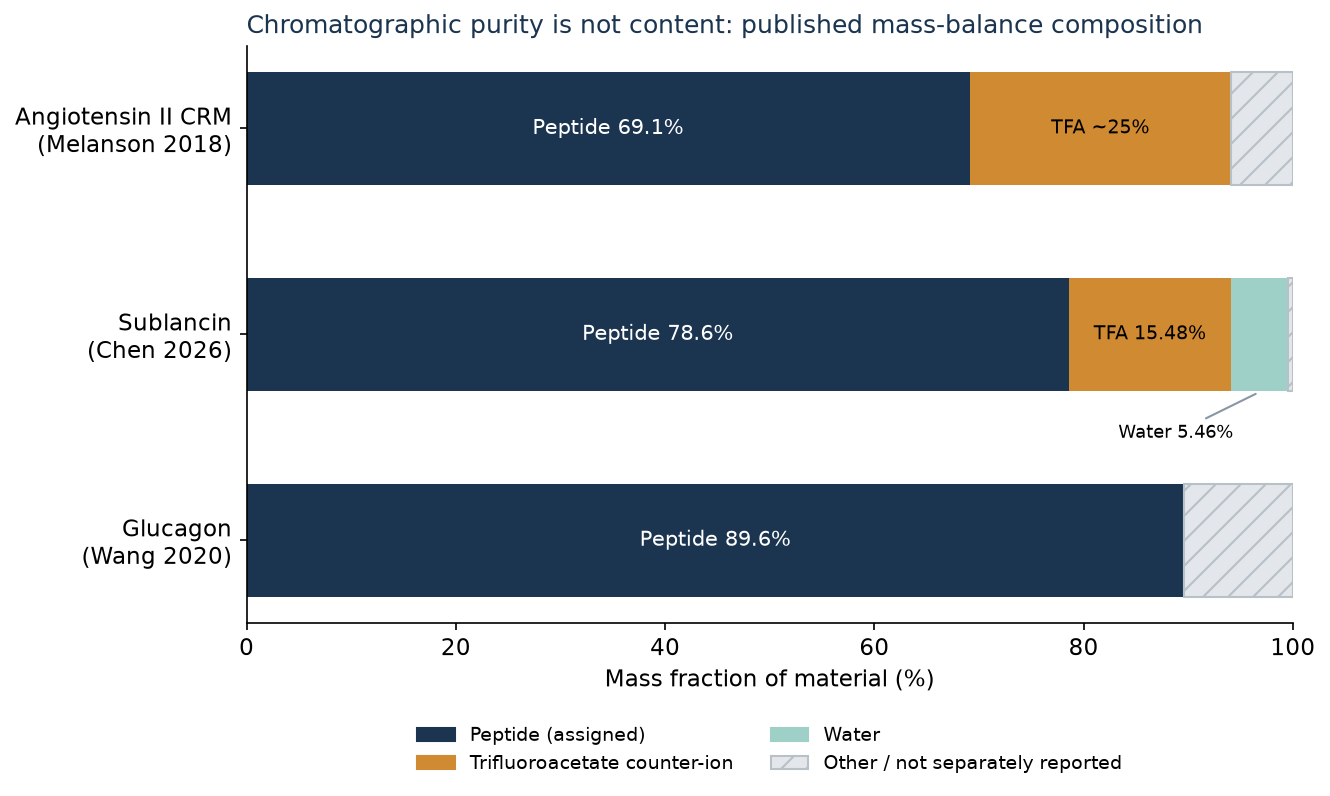
Mass-balance studies on peptide reference materials quantify the gap (Figure 2). In the certification of an angiotensin II candidate reference material, the trifluoroacetate counter-ion accounted for “nearly 25% by mass”, and the final purity value was 691 ± 9 mg/g [10]. For the antimicrobial peptide sublancin, mass balance gave a purity of 78.60% with trifluoroacetate at 15.48% and water at 5.46%, and the certified purity was 78.1% ± 1.5% [11]. For synthetic glucagon, combining Karl Fischer water determination, ion chromatography for trifluoroacetate and liquid chromatography for related impurities yielded a mass fraction of 896.36 ± 0.68 mg/g [70]. For oxytocin, 21 related impurities were quantified at 0.05 to 15.65 mg/g [71], and accurate purity assignment by mass balance, amino acid analysis or qNMR each required correction for structurally related impurities [72]. In synthetic C-peptide, more than 65 structurally related impurities were identified [73].
Content methods disagree with one another. A comparison of four methods for the peptide content of a lyophilised peptide found that amino acid analysis was highly variable in one laboratory but precise in another, that HPLC precision depended on the laboratory (with more precise values obtained under cGMP), and that CHN elemental analysis gave coefficients of variation below 2% [26]. A USP multi-laboratory study compared HPLC, qNMR and amino acid analysis for peptide quantification and their reproducibility [74]. Isotope-dilution approaches can improve traceability, but they depend on certified peptides that are scarce and expensive [63, 75], and peptide calibrators standardised by amino acid analysis may not be commutable across assays [76]. For a wholesale buyer, the implication is that a content figure is only interpretable when the method, the laboratory and the basis of calculation are stated.
Counter-ions. Peptides purified by reversed-phase chromatography with trifluoroacetic acid are commonly isolated as trifluoroacetate salts, and peptide drugs occur with a range of counter-ions that affect structure, physicochemical properties and formulation [1, 30]. The EMA guideline notes that acetate is usual for synthetic peptide medicines and requires the counter-ion type to be defined and its amount controlled with a justified upper limit [1]. Analytical methods for acetate and trifluoroacetate have existed for decades [64]. The counter-ion is not merely an accounting issue: trifluoroacetate at concentrations as low as 10⁻⁸ to 10⁻⁷ M reduced the proliferation of osteoblasts and chondrocytes in vitro, prompting the recommendation that peptides used in such assays be converted to hydrochloride salts [77]. For buyers of bulk peptides intended for cell-based work, the counter-ion form and content are therefore fit-for-purpose questions, not just stoichiometric details.
Endotoxin and microbiological quality. The EMA guideline includes bacterial endotoxins and microbiological purity in its list of specification attributes for synthetic peptide active substances [1]. For research supply, these tests are frequently absent from certificates. In one study of beta-amyloid lots, low levels of endotoxin (about 1 EU/mL) were detected in several preparations but did not correlate with the lot-to-lot differences in neurotoxicity that were observed [78], illustrating both that endotoxin can be present in commercial peptide lots and that its presence or absence does not by itself explain variable biological behaviour.
Stability information. Few research-grade certificates carry stability-supported retest dates. One group that traced rapid degradation of a vendor’s glucagon to a thermostable high-molecular-weight contaminant proposed that manufacturers conduct real or accelerated stability tests and include “accelerated stability criteria” on certificates [66]. Stability is discussed further in section 4.6.
4.4 Documented discrepancies between supplier documentation and independent testing
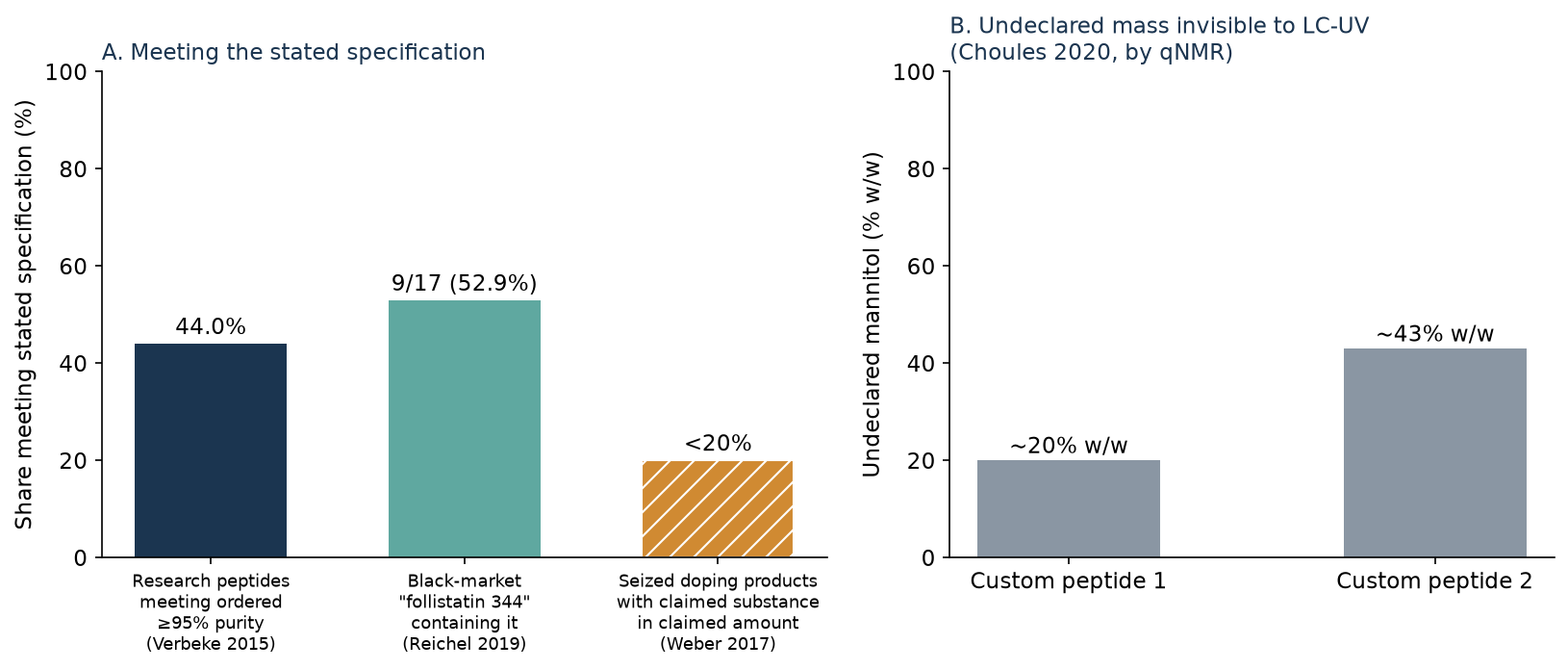
The most directly relevant evidence for peptides wholesale comes from studies in which independent laboratories tested peptides obtained from commercial suppliers and compared the results with what was ordered or certified. Table 4 summarises the principal studies; Figure 3 plots the quantitative findings.
Table 4. Peer-reviewed reports of discrepancies between ordered or certified properties of commercially supplied peptides and independent analysis.
| Study | Material | Independent finding | Consequence reported |
|---|---|---|---|
| Verbeke et al. 2015 | Synthetic quorum-sensing peptides ordered at ≥95% purity | Only 44.0% met the requested purity; one peptide had a different structure; large discrepancies with supplier COAs | Authors recommend in-house QC of research peptides |
| Choules et al. 2020 | Two custom synthetic peptides | qNMR found undeclared mannitol at about 20% and 43% w/w, invisible to LC-UV | Weighed mass overstated peptide amount |
| Currier et al. 2008 | Custom peptide library for immunology | About 1% w/w contamination with an unrelated viral peptide | False-positive T-cell responses |
| Brezar et al. 2011 | Synthetic peptides for T-cell assays | Contaminant undetectable by direct mass spectrometry | Spurious T-cell recognition |
| de Beukelaar et al. 2007 | Synthetic peptides for T-cell assays | Amino acid omissions and other modifications in specific batches | Responses not reproduced with resynthesised peptide |
| Verbeken et al. 2012 | Crude peptide (~50–80% purity) from several suppliers | Contractile response absent with ≥95% purified peptide | False-positive functional result |
| Zheng et al. 2019 | Glucagon from a specific vendor | Rapid cleavage caused by a thermostable high-molecular-weight contaminant | Material lost to degradation |
| May et al. 1992 | Three lots of beta-amyloid from one supplier plus three other sources | One lot neurotoxic at 10 µM, others not | Lot-to-lot variability explaining conflicting literature |
| Suvorina et al. 2015 | Aβ42 from five commercial suppliers | Significant variability, including lot-to-lot, with distinct fibril types | Divergent structural results |
| Adams et al. 2017 | Synthetic Aβ42 | A minor deletion impurity inhibited fibrillation and toxicity | Biological readouts depend on purity and provenance |
| Achyuthan et al. 2015 | One sequence synthesised by different vendors | Immunoreactivity differed between vendors | Independent QC needed |
Sources for Table 4: [7, 8, 9, 39, 66, 69, 78, 79, 80, 81, 82].
Several patterns emerge. First, the failures are not confined to obscure suppliers or unusual sequences; they include routine custom synthesis for immunology and neuroscience. Second, many of the failures were invisible to the analytical method typically used on certificates. Choules and colleagues described LC-UV as effectively “blind” to the mannitol they detected by qNMR and concluded that “experimental verification supersedes trust” [8]. The contaminant reported by Brezar and colleagues could not be seen by direct mass spectrometry [69], and the high-molecular-weight contaminant that degraded glucagon in Zheng’s study was identified only by investigating an unexpected degradation pattern [66]. Third, low-level impurities can dominate biological readouts. A cross-contaminating peptide at about 1% w/w was sufficient to produce false-positive responses in sensitive cellular assays [9], and a minor deletion impurity altered the aggregation behaviour of a widely studied amyloid peptide [81]. Fourth, crude or partially purified material can generate false functional conclusions that disappear with purified peptide [39].
These studies also show the limits of chromatographic purity as a single acceptance criterion. Verbeke and colleagues’ observation that fewer than half of peptides ordered at ≥95% purity met that criterion is striking, but even a peptide that meets a purity specification may contain undeclared non-peptide mass or a biologically potent minor impurity [7, 8, 9]. Impurity reviews explain the mechanisms: SPPS generates deletion and insertion sequences, racemised residues, protection-group adducts and oxidised species, and contamination with unrelated peptides has been observed “pointing out the lack of appropriate GMP” [15]. Impurities in peptide medicines are also scrutinised for their potential to introduce new T-cell epitopes [32], which helps explain why the immunology literature has been so prominent in documenting supply problems.
4.5 Counterfeit, falsified and black-market peptide material
Counterfeit and falsified material is a distinct problem from substandard legitimate supply, but the two overlap in a wholesale context because illicit products can enter the same distribution channels, use the same packaging formats and carry similar documentation. The evidence comes mainly from official medicines control laboratories, customs and anti-doping laboratories.
A comprehensive analysis of 1,190 doping products seized at the Swiss border found that 146 (12%) were labelled as containing peptide hormones or growth factors, and that for the majority of products the pharmaceutical quality was unsatisfactory: non-approved substances were detected and fewer than 20% contained the claimed substance in the claimed amount [12]. A German series of 337 confiscated products analysed between 2010 and 2013 found that 12.8% were peptide hormones and growth factors and identified “fake/non-approved” substances, including a fusion protein of unknown activity [83, 84]. Only 9 of 17 black-market products sold as follistatin 344 contained it; others contained different peptides [13]. Products labelled as growth hormone have been found to contain no active content [85], and newer black-market growth-promoting products have contained modified analogues [86]. Mass spectrometric comparison of innovator, counterfeit and follow-on recombinant growth hormone revealed differences including oxidation and deamidation [87].
The Belgian official medicines control laboratory has developed screening methods for illegal peptide preparations, including an LC-MS/MS method for 25 peptides validated against ISO/IEC 17025 requirements and a HILIC-DAD-MS method for lyophilised peptides below 5 kDa [88, 89]. Its impurity profiling of the ten most frequently encountered falsified polypeptide products, bought from three suspected illegal internet pharmacies, found high variation in the amount of drug per unit, purities ranging from 5% to 75% for cysteine-containing peptides, and arsenic and lead at concentrations up to ten times the ICH toxicity limit [14]. Research peptides sold online have also appeared in seized preparations, including putative cognitive-enhancing sequences [90] and peptides detected in confiscated vials by anti-doping laboratories [91]. Reviews of falsified biotechnology drugs summarise the recurring failure modes as wrong active ingredient, wrong dose, absent active ingredient, toxic contaminants and process-related impurities [92, 93]. A 2026 narrative review of digitally promoted grey-market peptides emphasised uncertain identity, purity, potency and sterility [94], and compounding policy for synthetic peptides has received regulatory scrutiny in the United States [95].
The Australian regulator has drawn the same conclusions. In a joint statement on 19 June 2026, the TGA and the Australian Government Chief Medical Officer stated that the TGA “does not have oversight of the composition of ingredients, manufacturing standards, or the safety and efficacy of unapproved peptide products”, that counterfeit products “are often deliberately designed to mimic genuine medicines”, and that many products are supplied in “poorly labelled or unmarked vials, making it difficult or impossible to verify their ingredients” [24]. TGA advisories in April and May 2026 raised concerns about inaccurate or misleading labelling and about products marked only with codes or abbreviations [22, 23].
For legitimate peptides wholesale, the counterfeit literature has two practical lessons. First, the analytical tools that official laboratories use (high-resolution mass spectrometry, orthogonal chromatography, elemental analysis) are the same tools that a careful buyer can commission from an accredited laboratory. Second, the documentation that accompanies illicit products is not reliably different in appearance from that accompanying legitimate products; authenticity has to be established through traceability and testing rather than through presentation.
4.6 Stability, storage and the cold chain
Bulk peptide lots are often stored for longer and subdivided more often than single-use vials, which makes stability evidence more important at wholesale scale. Peptides degrade chemically through oxidation, deamidation, hydrolysis, racemisation, beta-elimination and related reactions, and validated analytical methods are needed to monitor these changes reliably [96]. In the solid state, deamidation, peptide-bond cleavage, oxidation, the Maillard reaction, beta-elimination and aggregation all occur, with rates governed by temperature, moisture content, excipients and the physical state of the formulation [97]. Sequence features such as asparagine, aspartate, methionine, tryptophan and cysteine residues create predictable liabilities [98].
Physical stability is a separate concern. Peptide aggregation depends on sequence, concentration, pH, net charge, surfaces, impurities, temperature, agitation and lyophilisation [65]. Moisture is particularly important: lyophilised insulin underwent both covalent and noncovalent aggregation in response to elevated temperature and moisture, and the extent of aggregation correlated directly with water uptake by the powder [99]. The solid state is not automatically protective. In a model peptide stored at 50 °C, the rate of pyroglutamate formation in lyophilised solids exceeded that in solution in the pH range commonly used for formulation [100]. The EMA guideline notes that peptides “are often very hygroscopic powders” and advises precautions against moisture uptake during storage and analysis, with moisture content confirmed before use where appropriate [1].
ICH Q1A(R2) and Q5C describe how stability studies under long-term, accelerated and stress conditions are used to justify storage conditions and retest periods for drug substances and biotechnological products [40, 42]. For distributors, ICH Q7 requires stability data when material is repackaged into a different container type [27]. In regulated medicines supply, cold-chain management from manufacture to point of delivery is treated as a basic expectation for temperature-sensitive peptide products [101]. For peptides wholesale, these principles translate into four questions a buyer can ask: what storage temperature and humidity are supported by data; what happens to the material between dispatch and receipt; whether bulk material is subdivided, and if so under what environmental controls; and whether the retest date on the certificate is supported by stability data or simply assigned.
4.7 Bulk economics and the cost of quality
Published evidence on the economics of peptide procurement is sparse, and this review does not report or compare prices. What the literature does show is where the costs of quality lie. Peptide manufacture is resource-intensive: SPPS uses large excesses of reagents and solvents, and process mass intensity across 40 industrial processes was high relative to small-molecule manufacture [16, 34]. Scale-up requires careful route selection and purification capacity [33]. Analytical characterisation adds further cost, particularly for orthogonal content assignment: certified peptide standards for isotope-dilution methods are described as expensive, and mass-balance value assignment requires several independent techniques [61, 63, 70].
The cost of not establishing quality is better documented. Irreproducible preclinical research was estimated to cost about US$28 billion per year in the United States, with more than half of preclinical research estimated to be irreproducible [36], and a large survey of scientists has examined the extent of reproducibility problems across research fields [37]. The case studies in Table 4 show how a single uncharacterised impurity can invalidate an immunological screen, a functional assay or a structural study [9, 39, 81]. One group noted that additional stability testing and its inclusion on certificates “would be very helpful for avoiding losses for both vendors and users” [66]. For bulk buyers, the economic logic is straightforward: the larger the lot, the more work depends on its characterisation, and the more an upfront investment in independent verification is amortised across downstream use.
Bulk purchasing also concentrates risk. A single wholesale lot may supply many experiments or many downstream customers, so an error in identity or content propagates widely. This is the rationale behind Q7’s insistence on full analysis of several batches before reduced testing, and on periodic verification thereafter [27]. It also argues for retaining reserve samples from each lot so that later questions about identity or content can be answered by retesting the same material.
4.8 The Australian regulatory framework for peptides wholesale
Australian law does not contain a single category called “wholesale peptides”. Instead, the regulatory status of a peptide product depends on what the product is, how it is presented and what it is used for. Table 5 summarises the principal instruments; it is a map of where obligations may arise, not a determination of how any instrument applies to a particular product. A worked example for one investigational compound is given in CBL-514 Australia: a comparative regulatory analysis.
Table 5. Australian legal and regulatory instruments relevant to peptides wholesale (as at 29 October 2026). This table is descriptive and is not legal advice.
| Instrument or body | What it covers | Relevance to peptide supply |
|---|---|---|
| Therapeutic Goods Act 1989 | Regulation of therapeutic goods, including ARTG inclusion, manufacturing, advertising, import and supply | TGA states that peptide products are regulated as therapeutic goods where they meet the definition; “research use only” disclaimers do not change that status |
| TGA 2026 statements (13 April, 7 May, 10 June, 19 June, 20 July) | Responsibilities, import warnings, compliance priority, public health concerns, enforcement | Peptides added to compliance priority areas; regulatory responses listed include infringement notices, seizures, civil penalties and criminal prosecution |
| Poisons Standard (October 2026), F2026L01327 | Scheduling of substances by access control, including Schedule 4 and Appendix D | Scheduled peptides are subject to state and territory controls on supply and possession |
| Customs (Prohibited Imports) Regulations 1956 and Office of Drug Control | Import permits for listed substances (reg 5H, Schedule 8) | Growth hormones, somatomedins, IGFs, GHRH and synthetic analogues require an import permit |
| Industrial Chemicals Act 2019 and AICIS | Introduction of industrial chemicals, including research and development categorisation | Possible pathway for genuinely non-therapeutic chemical introductions; boundary with therapeutic goods depends on use |
| Competition and Consumer Act 2010, Schedule 2 (Australian Consumer Law) | Misleading or deceptive conduct and false representations in trade | Claims about purity, grade or compliance must be accurate |
| NATA | Accreditation to ISO/IEC 17025 and ISO 17034 | Australian route to accredited independent testing and reference materials |
| TGA GMP (PIC/S Guide) | Licensing and inspection of medicine manufacturers | Distinguishes licensed GMP manufacture from self-described quality claims |
Sources for Table 5: [2, 3, 22, 23, 24, 25, 28, 52, 53, 54, 55, 56, 57, 58, 59, 60].
Therapeutic goods. The TGA’s page on how it regulates therapeutic peptide products states that products meeting the definition of a therapeutic good must generally be included in the Australian Register of Therapeutic Goods (ARTG) before they are imported, manufactured, supplied, exported or advertised [2, 56]. The same page states that “disclaimers that a product is for ‘research use only’ or ‘not for human use’ do not change whether a product is regulated as a therapeutic good”, and that “these claims do not remove advertising, manufacture, import, export or supply obligations” [2]. This is the most important single point for anyone involved in peptides wholesale in Australia: the label a seller applies does not determine the regulatory category. Whether a given peptide product is a therapeutic good depends on its characteristics, presentation and use, and is a question for legal advice.
The 2026 compliance focus. On 13 April 2026, the TGA issued an advisory on responsibilities when importing, compounding and supplying unapproved peptide products, noting that such products have not been evaluated by the TGA for safety, quality or effectiveness and that their labelling may be inaccurate or misleading [22]. On 7 May 2026, it warned about the risks of importing unapproved peptide products, noting that products referred by the Australian Border Force are often poorly labelled, that some are marked only with codes or abbreviations, and that products failing importation requirements because of poor or unclear labelling will be seized and destroyed [23]. On 10 June 2026, it added unapproved peptide products to its compliance priority areas and reported a joint operation with the Australian Border Force and Victoria Police that seized peptide products, performance and image enhancing drugs and illicit steroids with an estimated street value in excess of $2 million [3]. On 20 July 2026, it put promoters and suppliers “on notice”, listing warning letters, infringement notices, product seizures and forfeiture, civil penalties and, in serious cases, criminal prosecution, and stating that it was working directly with social media and e-commerce platforms [25].
Scheduling and import permits. The Poisons Standard is a legislative instrument made under the Therapeutic Goods Act; the current instrument is the Therapeutic Goods (Poisons Standard—October 2026) Instrument 2026 [57]. It classifies substances into schedules that determine access controls, including Schedule 4 (prescription-only) and Appendix D (additional controls on possession or supply for certain Schedule 4 and 8 substances) [57]. Separately, the Customs (Prohibited Imports) Regulations 1956 require permits to import listed substances [58]. The Office of Drug Control states that somatropin, somatrem, somatomedins, insulin-like growth factors, growth hormone releasing hormone and their synthetic analogues require an import permit [53, 54]. These are factual descriptions of the regulatory architecture; they are not statements about the status of any product discussed elsewhere in this review.
Industrial chemicals. The Industrial Chemicals Act 2019 establishes AICIS, which regulates the introduction of industrial chemicals [59]. AICIS guidance on chemicals introduced for research and development describes categorisation criteria, including that the chemical is not available to the public and annual volume limits for exempted and reported introductions [55]. Whether a peptide falls within the industrial chemicals scheme or the therapeutic goods scheme depends on its intended use and presentation, and the boundary is not one that a supplier’s label can settle [2, 55].
Consumer law. The Australian Consumer Law, in Schedule 2 of the Competition and Consumer Act 2010, prohibits misleading or deceptive conduct and false or misleading representations in trade or commerce [60]. For business-to-business supply, this means that claims about purity, grade, testing or compliance must be accurate and capable of substantiation.
Testing infrastructure. NATA accreditation provides an Australian route to ISO/IEC 17025-accredited testing and ISO 17034-accredited reference materials [52]. An accredited laboratory can provide independent identity, purity and content data, but accreditation of a laboratory does not change the regulatory status of the material it tests.
5. Discussion
5.1 Principal findings
This review set out to answer four questions about peptides wholesale: what quality standards are relevant, what a certificate of analysis should evidence, how often supplier documentation diverges from independent testing, and how Australian regulation bears on the supply chain. Four findings stand out.
First, the most complete statements of what synthetic peptide quality means are found in medicinal-product guidance, especially the EMA synthetic peptides guideline, Ph. Eur. general monograph 2034 and ICH Q7 [1, 27, 47]. These documents converge on a characterisation that goes well beyond a single purity figure: identity, related impurities with defined thresholds, stereochemical purity, net content on a counter-ion-free and anhydrous basis, counter-ion and water content, residual solvents, elemental impurities, endotoxin and microbiological quality, and stability-supported storage. Research-grade supply is not bound by these requirements, but they provide the most defensible benchmark for what a buyer of bulk peptides should ask to see.
Second, chromatographic purity is an incomplete and frequently misunderstood measure. Mass-balance studies show that counter-ions and water can account for a fifth to a quarter or more of the mass of a lyophilised peptide [10, 11], and that undeclared excipients can be invisible to the analytical method most commonly reported [8]. Content assignment is method-dependent and laboratory-dependent [26, 74], and certified reference materials that would anchor it are scarce [63]. A certificate that reports only HPLC purity therefore says little about how much peptide a given mass of powder contains.
Third, discrepancies between what is ordered and what is supplied are well documented for research peptides, including routine custom syntheses [7, 8, 9, 39, 69, 79]. The evidence is heterogeneous and cannot support a pooled prevalence estimate, but its direction is consistent. Several of the reported failures were detected only because experimental results were anomalous; it is reasonable to infer that others go undetected. The counterfeit literature shows a more extreme version of the same problem, with purities from 5% to 75% and toxic elemental contamination in falsified products [14], and fewer than 20% of seized doping products containing the claimed substance in the claimed amount [12].
Fourth, the Australian regulatory position, as stated by the TGA in 2026, is that peptide products meeting the definition of therapeutic goods are regulated as such regardless of “research use only” or “not for human use” disclaimers [2]. Unapproved peptide products are an explicit compliance priority, with seizure, infringement notices, civil penalties and criminal prosecution among the available responses [3, 25]. The TGA has also stated plainly that it has no oversight of the composition or manufacturing standards of unapproved peptide products [24]. In practical terms, this means that no regulator verifies the quality of such products before they reach a buyer; any verification must come from the buyer’s own supplier qualification and testing.
5.2 Interpreting supplier documentation
The literature supports a structured way of reading supplier documentation in peptides wholesale. A certificate of analysis is best treated as a claim to be evaluated rather than as evidence in itself. Q7 frames the issue precisely: a supplier’s certificate can substitute for in-house testing only where a system exists to evaluate the supplier, where full analyses have been conducted on several batches, and where the reliability of certificates is checked at intervals [27]. These conditions are rarely met in informal procurement.
Four features of a certificate deserve scrutiny. The first is traceability: whether the certificate identifies the original manufacturer and the batch, and whether a reissued certificate names the testing laboratory and attaches the original, as Q7 requires of agents, brokers and distributors [27]. A certificate without a traceable origin cannot be evaluated. The second is method transparency: whether each result is accompanied by its method, its acceptance limit and a numerical value rather than a statement such as “conforms” [27, 41]. The third is completeness: whether the certificate addresses content, counter-ion and water in addition to chromatographic purity and mass [1]. The fourth is independence: whether any result comes from a laboratory independent of the supplier and accredited for the specific test [50, 52].
Chromatograms and spectra attached to certificates also need careful reading. Chromatographic results depend on the column, mobile-phase modifier and temperature chosen [68], so a clean chromatogram under one set of conditions does not exclude co-eluting impurities that another system would resolve. Structured overviews of synthetic peptide quality emphasise the need for orthogonal characterisation, in-process controls and attention to aggregates as well as related impurities [35, 102]. Mass-balance studies of reference peptides illustrate the level of characterisation that underpins a reliable content value [71, 73, 103].
5.3 An evidence-based supplier qualification framework
The findings can be synthesised into a supplier qualification framework for peptides wholesale. It is derived from the regulatory and empirical sources reviewed above and is intended as a research-quality tool rather than a statement of legal requirements. It does not address whether any particular product may lawfully be imported, supplied or used, which depends on the factors described in section 4.8 and requires specific legal advice.
- Define the intended use and the regulatory category first. Determine whether the material is, or could be, a therapeutic good, a scheduled substance, a substance requiring an import permit or an industrial chemical, and obtain advice where the answer is uncertain. A “research use only” label does not settle the question [2, 53, 55, 57].
- Write a specification before sourcing. Specify identity, purity and related impurities with thresholds, content basis, counter-ion form, water, and, where relevant to the use, endotoxin, elemental impurities and enantiomeric purity, using the EMA attribute list and Ph. Eur. thresholds as reference points [1, 47].
- Require traceable documentation. Certificates should name the original manufacturer and batch, list each test with method, limit and numerical result, and be dated and signed by a quality function. Reissued certificates should name the testing laboratory and attach the original [27].
- Distinguish purity from content. Require net peptide content with a stated method and basis, alongside chromatographic purity, and treat any certificate that reports only HPLC purity as incomplete [8, 10, 26].
- Verify identity independently on every lot. At minimum, confirm molecular mass by an independent laboratory; where biological results depend on the absence of specific impurities, add orthogonal chromatography or sequence confirmation [9, 27, 67, 69].
- Conduct full analysis on initial lots. Before relying on supplier certificates, perform complete independent testing on several lots, consistent with Q7’s expectation of at least three batches, and repeat periodically [27].
- Use accredited laboratories within scope. Confirm that the independent laboratory is accredited to ISO/IEC 17025 for the specific tests reported, and use certified reference materials from ISO 17034 producers where available [50, 51, 52].
- Assess the quality system, not just the certificate. A peptide supplier audit, whether conducted by questionnaire or on site, should ask whether the supplier operates a documented quality system with change control, deviation management and supplier oversight; recognise that ISO 9001 certification attests to organisational processes, not product quality, and that “GMP-like” claims are not licensed GMP [28, 45, 49].
- Agree quality responsibilities in writing. Use a quality agreement that allocates testing, release, notification of change, handling of out-of-specification results and record retention [45, 48].
- Control storage, transport and subdivision. Request stability data supporting storage conditions and retest dates; protect hygroscopic powders from moisture; record temperature in transit; and control the environment when bulk lots are subdivided [1, 27, 40, 99].
- Retain samples and records. Keep reserve samples and the full documentation for each lot so that questions about identity or content can be resolved by retesting [27].
- Treat anomalies as quality signals. Investigate unexpected biological, chromatographic or stability behaviour as a possible quality failure before attributing it to experimental biology [66, 78, 81].
This framework is deliberately conservative. Its purpose is to replace trust with verification at the points where the evidence shows failures occur, consistent with the conclusion that “experimental verification supersedes trust” [8].
5.4 Implications for research reproducibility
The relevance of supplier qualification extends beyond any single purchase. Irreproducibility in preclinical research carries a large estimated cost [36] and is widely recognised by scientists [37]. Reagent quality is one plausible contributor that can be controlled, and the antibody field offers a precedent: calls for sequence-defined, standardised antibodies arose from evidence that poorly characterised commercial reagents were undermining published findings [38]. Synthetic peptides are in some respects easier to define than antibodies, because their intended sequence is known precisely, yet the evidence reviewed here shows that peptides supplied at scale can still differ from their specification in identity, purity and content. Reporting the source, lot, certificate data and independent verification results for peptides used in published work would allow readers to judge whether reagent quality could explain discrepant findings, and would strengthen the evidence base for peptides more generally [7, 82].
5.5 Implications for the Australian context
The Australian evidence has a particular character. The regulator has stated that disclaimers do not determine regulatory status, that unapproved peptide products are a compliance priority and that it does not oversee their composition or manufacture [2, 3, 24]. At the same time, Australia has the infrastructure needed for rigorous independent testing through NATA-accredited laboratories [52]. These features point in the same direction: anyone involved in peptides wholesale in Australia should obtain legal advice about regulatory status and should not rely on supplier documentation alone for quality assurance. Consumer law adds a further consideration, because representations about purity, grade, testing or compliance made in trade must not be misleading [60].
6. Limitations
This review has several limitations. It is a structured narrative review rather than a systematic review with meta-analysis; although the searches, counts and screening decisions are reported transparently, screening and extraction were performed by a single reviewer and no formal risk-of-bias tool was applied. The heterogeneity of the included evidence, which spans analytical method studies, case reports, seizure analyses and regulatory documents, precluded quantitative synthesis.
The search covered PubMed and Europe PMC and was supplemented by targeted searches and citation chasing. Relevant studies indexed only in chemistry, engineering or trade databases may have been missed. Only the 60 most relevant records from each PubMed string were screened, so lower-ranked relevant records may not have been captured. The supplier-qualification string contributed no included records from its top 60, which reflects the scarcity of peptide-specific empirical work on supplier qualification but also means that this review’s framework is built from indirect evidence.
The documented discrepancies in Table 4 are subject to publication bias: failures are more likely to be reported when they produce anomalous results, and successful supply relationships are rarely published. The studies therefore cannot be used to estimate the prevalence of quality failure in peptides wholesale. Many of the reports are more than a decade old, and synthesis and analytical practices have improved since then, although recent studies continue to report similar problems [8, 66].
Regulatory sources were current at 29 October 2026. Regulatory positions, particularly in Australia, are evolving rapidly, and the instruments described in Table 5 may be amended. For the Poisons Standard, only the title and structure of the current instrument were relied on; this review does not describe the scheduling status of any individual peptide. Nothing in this review is legal advice, and the regulatory descriptions should not be read as a determination of the status of any product, supplier or activity.
Finally, this review does not address the clinical use, safety or efficacy of any peptide. Its scope is limited to the quality and regulatory infrastructure of supply.
7. Conclusion
Peptides wholesale sits at the intersection of analytical chemistry, quality management and regulation. The evidence reviewed here shows that synthetic peptide quality is multidimensional, that the single purity figure commonly reported in supply documentation captures only part of it, and that discrepancies between supplier documentation and independent analysis are well documented for research peptides. Regulatory guidance for medicinal synthetic peptides, especially the EMA guideline, Ph. Eur. monograph 2034 and ICH Q7, provides a coherent benchmark for what complete characterisation and supplier oversight involve. In Australia, the TGA’s 2026 statements make clear that “research use only” labelling does not determine regulatory status, that unapproved peptide products are a compliance priority, and that the regulator does not oversee their composition. The practical conclusion is that quality in peptides wholesale cannot be assumed from labels, grades or certificates. It has to be established through written specifications, traceable documentation, independent and accredited testing, controlled storage and periodic re-verification, within a regulatory position confirmed by appropriate advice.
Peptides wholesale in practice: relevance to Eternal Peptides Wholesale
Eternal Peptides Wholesale is itself part of the peptides wholesale supply chain described in this review. As its about page sets out, it distributes research peptides in wholesale boxes of 10 vials, for laboratory research use only and not for human consumption. The documentation criteria in the supplier qualification framework can therefore be applied to what the site publishes.
Its certificate of analysis library transcribes and links 78 Janoshik Analytical report images for 24 products, with batch, task number, tests requested and results, and each report carries a verification key that can be checked with the laboratory. The testing standards page states that Janoshik Analytical operates independently of Eternal Peptides Wholesale, and the Janoshik report guide states that mass-spectrometry testing is not part of the programme it describes. The shipping policy notes that dispatch origin can vary and may include offshore fulfilment, which bears on the traceability questions above. These are disclosures that readers can test against the framework. Consistent with About this article, they are not a statement about regulatory status. The full catalogue is organised into nine categories.
Glossary
- Amino acid analysis (AAA): Hydrolysis of a peptide into its constituent amino acids followed by their quantification, used for composition and content assignment.
- Certificate of analysis (COA): A document reporting the tests performed on a batch, with acceptance limits and results, issued by the manufacturer or a testing laboratory.
- Certified reference material (CRM): A reference material with property values certified by a metrologically valid procedure, typically produced under ISO 17034.
- Chromatographic purity: The relative peak area of the intended peptide among UV-absorbing species in a chromatogram; not the same as content.
- Counter-ion: The ion (commonly acetate, trifluoroacetate or chloride) that balances charges on a peptide salt and contributes to its mass.
- Good manufacturing practice (GMP): A licensed and inspected system of manufacturing and quality controls, such as ICH Q7 for active ingredients or the PIC/S Guide applied by the TGA.
- Mass balance: Assignment of peptide content by subtracting measured water, counter-ions, related impurities and other components from 100%.
- Net peptide content: The mass fraction of a powder that is the intended peptide, expressed on a stated basis.
- Qualification threshold: The impurity level above which biological safety must be established; 1.0% for peptides under Ph. Eur. monograph 2034.
- Quality agreement: A written agreement allocating quality responsibilities between a buyer and a supplier or contract facility.
- Quantitative NMR (qNMR): Nuclear magnetic resonance spectroscopy used to quantify a substance against an internal standard, able to detect non-UV-absorbing components.
- Solid-phase peptide synthesis (SPPS): Stepwise assembly of a peptide on a solid support, the dominant route for synthetic peptides.
- Supplier qualification: The documented process of evaluating and approving a supplier, including testing of initial lots and periodic re-verification.
- Trifluoroacetate (TFA): A counter-ion introduced by trifluoroacetic acid during cleavage and purification, which can affect mass balance and some biological assays.
Frequently asked questions
What does peptides wholesale mean in a research and regulatory context?
Peptides wholesale refers to the supply of synthetic peptides in bulk quantities between businesses, institutions or laboratories, rather than single-vial retail supply. In a quality context, it raises questions about lot characterisation, documentation and traceability across larger quantities. In Australia, the regulatory status of wholesale peptides depends on what the product is and how it is presented, not on the quantity or the label applied to it.
Does “research use only” labelling make wholesale peptides legal in Australia?
No. The TGA states that disclaimers such as “research use only” or “not for human use” do not change whether a product is regulated as a therapeutic good and do not remove advertising, manufacture, import, export or supply obligations. Whether a particular product is a therapeutic good, a scheduled substance or an import-permit substance depends on its characteristics and presentation, and requires specific legal advice.
What is the difference between peptide purity and peptide content?
Chromatographic purity is the proportion of the intended peptide among UV-absorbing peptide species in an HPLC chromatogram. Net peptide content is the proportion of the powder’s mass that is the intended peptide. Because lyophilised peptides contain water and counter-ions that do not appear in the chromatogram, a peptide can show high HPLC purity while containing substantially less peptide by mass; published reference materials show counter-ions accounting for about 15% to 25% of mass.
What should a certificate of analysis for bulk peptides include?
Following ICH Q7, a certificate should identify the material, grade, batch and release date, list each test with its method, acceptance limit and numerical result, be dated and signed by a quality function, and name the original manufacturer. For synthetic peptides, a complete certificate would also address related impurities, net content, counter-ion content, water and, where relevant, endotoxin and elemental impurities.
How often do supplier certificates disagree with independent testing?
No reliable prevalence estimate exists. Individual studies have reported that only 44% of research peptides ordered at 95% purity or higher met that specification, that custom peptides contained undeclared mannitol at about 20% and 43% by weight, and that low-level contaminants produced false-positive immunological results. These studies show that discrepancies occur and can be consequential, but publication bias means they cannot be generalised into a failure rate.
What is peptide supplier qualification?
Peptide supplier qualification is the documented process of evaluating a supplier before relying on its material and documentation. Drawing on ICH Q7, it typically includes a written specification, review of the supplier’s quality system, full independent analysis of initial lots, identity testing of every lot, periodic re-verification of certificate reliability and a written quality agreement.
Are synthetic peptides covered by standard impurity guidelines?
Not fully. The EMA’s synthetic peptides guideline confirms that synthetic peptides are excluded from ICH Q3A/B, Q6A/B and M7. Instead, Ph. Eur. general monograph 2034 sets peptide-specific thresholds: impurities above 0.1% are reported, above 0.5% identified and above 1.0% qualified. ICH Q3D on elemental impurities does apply.
Does the TGA test the quality of unapproved peptide products?
The TGA has stated that it does not have oversight of the composition of ingredients, manufacturing standards, or the safety and efficacy of unapproved peptide products. Products that are not included in the Australian Register of Therapeutic Goods have not been evaluated by the TGA for safety, quality or effectiveness.
References
- European Medicines Agency. Guideline on the Development and Manufacture of Synthetic Peptides. EMA/CHMP/CVMP/QWP/367182/2025. Adopted by CHMP 1 December 2025; date of coming into effect 1 June 2026. Amsterdam: EMA; 2025. Available at: https://www.ema.europa.eu/en/documents/scientific-guideline/guideline-development-manufacture-synthetic-peptides_en.pdf. Accessed 29 October 2026.
- Therapeutic Goods Administration. How we regulate therapeutic peptide products [web page]. Canberra: TGA; 2026. Available at: https://www.tga.gov.au/products/medicines/monitoring-and-compliance/how-we-regulate-therapeutic-peptide-products. Accessed 29 October 2026.
- Therapeutic Goods Administration. TGA strengthens compliance focus on unapproved peptide products as part of evolving risk response [media release]. Published 10 June 2026. Available at: https://www.tga.gov.au/news/media-releases/tga-strengthens-compliance-focus-unapproved-peptide-products-part-evolving-risk-response. Accessed 29 October 2026.
- Page MJ, McKenzie JE, Bossuyt PM, Boutron I, Hoffmann TC, Mulrow CD, et al.. The PRISMA 2020 statement: an updated guideline for reporting systematic reviews. BMJ. 2021;372:n71. doi:10.1136/bmj.n71. PMID: 33782057. Available at: https://doi.org/10.1136/bmj.n71. Accessed 29 October 2026.
- National Center for Biotechnology Information. Entrez Programming Utilities Help [Internet]. Bethesda (MD): NCBI. Available at: https://www.ncbi.nlm.nih.gov/books/NBK25501/. Accessed 29 October 2026.
- Europe PMC. RESTful web service: search endpoint. Hinxton: EMBL-EBI. Available at: https://www.ebi.ac.uk/europepmc/webservices/rest/search?query=peptide&format=json&pageSize=1. Accessed 29 October 2026.
- Verbeke F, Wynendaele E, Braet S, D’Hondt M, De Spiegeleer B. Quality evaluation of synthetic quorum sensing peptides used in R&D. J Pharm Anal. 2015;5(3):169-181. doi:10.1016/j.jpha.2014.12.002. PMID: 29403929. Available at: https://doi.org/10.1016/j.jpha.2014.12.002. Accessed 29 October 2026.
- Choules MP, Bisson J, Simmler C, McAlpine JB, Giancaspro G, Bzhelyansky A, et al.. NMR reveals an undeclared constituent in custom synthetic peptides. J Pharm Biomed Anal. 2020;178:112915. doi:10.1016/j.jpba.2019.112915. PMID: 31671336. Available at: https://doi.org/10.1016/j.jpba.2019.112915. Accessed 29 October 2026.
- Currier JR, Galley LM, Wenschuh H, Morafo V, Ratto-Kim S, Gray CM, et al.. Peptide impurities in commercial synthetic peptides and their implications for vaccine trial assessment. Clin Vaccine Immunol. 2008;15(2):267-76. doi:10.1128/CVI.00284-07. PMID: 18077621. Available at: https://doi.org/10.1128/CVI.00284-07. Accessed 29 October 2026.
- Melanson JE, Thibeault MP, Stocks BB, Leek DM, McRae G, Meija J. Purity assignment for peptide certified reference materials by combining qNMR and LC-MS/MS amino acid analysis results: application to angiotensin II. Anal Bioanal Chem. 2018;410(26):6719-6731. doi:10.1007/s00216-018-1272-7. PMID: 30143839. Available at: https://doi.org/10.1007/s00216-018-1272-7. Accessed 29 October 2026.
- Chen W, Yan J, Yang M, Wang M, Zhou J, Li F, et al.. SI-traceable purity assignment for peptide sublancin using mass balance approach and isotope dilution mass spectrometry based on amino acid analysis. J Chromatogr B Analyt Technol Biomed Life Sci. 2026;1277:125038. doi:10.1016/j.jchromb.2026.125038. PMID: 41916078. Available at: https://doi.org/10.1016/j.jchromb.2026.125038. Accessed 29 October 2026.
- Weber C, Krug O, Kamber M, Thevis M. Qualitative and Semiquantitative Analysis of Doping Products Seized at the Swiss Border. Subst Use Misuse. 2017;52(6):742-753. doi:10.1080/10826084.2016.1263665. PMID: 28156209. Available at: https://doi.org/10.1080/10826084.2016.1263665. Accessed 29 October 2026.
- Reichel C, Gmeiner G, Thevis M. Detection of black market follistatin 344. Drug Test Anal. 2019;11(11-12):1675-1697. doi:10.1002/dta.2741. PMID: 31758732. Available at: https://doi.org/10.1002/dta.2741. Accessed 29 October 2026.
- Janvier S, Cheyns K, Canfyn M, Goscinny S, De Spiegeleer B, Vanhee C, et al.. Impurity profiling of the most frequently encountered falsified polypeptide drugs on the Belgian market. Talanta. 2018;188:795-807. doi:10.1016/j.talanta.2018.06.023. PMID: 30029448. Available at: https://doi.org/10.1016/j.talanta.2018.06.023. Accessed 29 October 2026.
- D’Hondt M, Bracke N, Taevernier L, Gevaert B, Verbeke F, Wynendaele E, et al.. Related impurities in peptide medicines. J Pharm Biomed Anal. 2014;101:2-30. doi:10.1016/j.jpba.2014.06.012. PMID: 25044089. Available at: https://doi.org/10.1016/j.jpba.2014.06.012. Accessed 29 October 2026.
- Isidro-Llobet A, Kenworthy MN, Mukherjee S, Kopach ME, Wegner K, Gallou F, et al.. Sustainability Challenges in Peptide Synthesis and Purification: From R&D to Production. J Org Chem. 2019;84(8):4615-4628. doi:10.1021/acs.joc.8b03001. PMID: 30900880. Available at: https://doi.org/10.1021/acs.joc.8b03001. Accessed 29 October 2026.
- Lian Z, Wang N, Tian Y, Huang L. Characterization of Synthetic Peptide Therapeutics Using Liquid Chromatography-Mass Spectrometry: Challenges, Solutions, Pitfalls, and Future Perspectives. J Am Soc Mass Spectrom. 2021;32(8):1852-1860. doi:10.1021/jasms.0c00479. PMID: 34110145. Available at: https://doi.org/10.1021/jasms.0c00479. Accessed 29 October 2026.
- Badgujar D, Paritala ST, Matre S, Sharma N. Enantiomeric purity of synthetic therapeutic peptides: A review. Chirality. 2024;36(3). doi:10.1002/chir.23652. PMID: 38448043. Available at: https://doi.org/10.1002/chir.23652. Accessed 29 October 2026.
- European Medicines Agency. Development and manufacture of synthetic peptides – scientific guideline [web page]. Amsterdam: EMA. Available at: https://www.ema.europa.eu/en/development-manufacture-synthetic-peptides-scientific-guideline. Accessed 29 October 2026.
- US Food and Drug Administration. Withdrawn and expired guidances (drugs) [web page]. Silver Spring (MD): FDA. Available at: https://www.fda.gov/drugs/guidances-drugs/withdrawn-and-expired-guidances-drugs. Accessed 29 October 2026.
- US Food and Drug Administration. FDA publishes revised draft product-specific guidances for certain generic peptide products [statement]. Silver Spring (MD): FDA; 2026. Available at: https://www.fda.gov/drugs/drug-alerts-and-statements/fda-publishes-revised-draft-product-specific-guidances-certain-generic-peptide-products. Accessed 29 October 2026.
- Therapeutic Goods Administration. Understanding your responsibilities when importing, compounding and supplying unapproved peptide products [safety advisory]. Published 13 April 2026. Available at: https://www.tga.gov.au/safety/safety-monitoring-and-information/safety-alerts/understanding-your-responsibilities-when-importing-compounding-and-supplying-unapproved-peptide-products. Accessed 29 October 2026.
- Therapeutic Goods Administration. TGA warning on the risks of importing unapproved peptide products [safety advisory]. Published 7 May 2026. Available at: https://www.tga.gov.au/safety/safety-monitoring-and-information/safety-alerts/tga-warning-risks-importing-unapproved-peptide-products. Accessed 29 October 2026.
- Therapeutic Goods Administration; Australian Government Chief Medical Officer. Concerns regarding the public health risks associated with unapproved peptide products [media release]. Published 19 June 2026. Available at: https://www.tga.gov.au/news/media-releases/concerns-regarding-public-health-risks-associated-unapproved-peptide-products. Accessed 29 October 2026.
- Therapeutic Goods Administration. Unapproved peptide product promoters and suppliers are put on notice [media release]. Published 20 July 2026. Available at: https://www.tga.gov.au/news/media-releases/unapproved-peptide-product-promoters-and-suppliers-are-put-notice. Accessed 29 October 2026.
- Vemuri S. Comparison of assays for determination of peptide content for lyophilized thymalfasin. J Pept Res. 2005;65(4):433-9. doi:10.1111/j.1399-3011.2005.00225.x. PMID: 15813890. Available at: https://doi.org/10.1111/j.1399-3011.2005.00225.x. Accessed 29 October 2026.
- International Council for Harmonisation (ICH). Q7: Good Manufacturing Practice Guide for Active Pharmaceutical Ingredients. Current Step 4 version dated 10 November 2000. Geneva: ICH; 2000. Available at: https://database.ich.org/sites/default/files/Q7%20Guideline.pdf. Accessed 29 October 2026.
- Therapeutic Goods Administration. Good manufacturing practice (GMP) [web page]. Canberra: Australian Government Department of Health, Disability and Ageing. Available at: https://www.tga.gov.au/how-we-regulate/manufacturing/manufacture-medicine/good-manufacturing-practice-gmp. Accessed 29 October 2026.
- European Commission. EudraLex Volume 4 – Good Manufacturing Practice (GMP) guidelines [web page]. Brussels: European Commission. Available at: https://health.ec.europa.eu/medicinal-products/eudralex/eudralex-volume-4_en. Accessed 29 October 2026.
- Sikora K, Jaśkiewicz M, Neubauer D, Migoń D, Kamysz W. The Role of Counter-Ions in Peptides-An Overview. Pharmaceuticals (Basel). 2020;13(12). doi:10.3390/ph13120442. PMID: 33287352. Available at: https://doi.org/10.3390/ph13120442. Accessed 29 October 2026.
- Muttenthaler M, King GF, Adams DJ, Alewood PF. Trends in peptide drug discovery. Nat Rev Drug Discov. 2021;20(4):309-325. doi:10.1038/s41573-020-00135-8. PMID: 33536635. Available at: https://doi.org/10.1038/s41573-020-00135-8. Accessed 29 October 2026.
- De Groot AS, Roberts BJ, Mattei A, Lelias S, Boyle C, Martin WD. Immunogenicity risk assessment of synthetic peptide drugs and their impurities. Drug Discov Today. 2023;28(10):103714. doi:10.1016/j.drudis.2023.103714. PMID: 37467878. Available at: https://doi.org/10.1016/j.drudis.2023.103714. Accessed 29 October 2026.
- Bray BL. Large-scale manufacture of peptide therapeutics by chemical synthesis. Nat Rev Drug Discov. 2003;2(7):587-93. doi:10.1038/nrd1133. PMID: 12815383. Available at: https://doi.org/10.1038/nrd1133. Accessed 29 October 2026.
- Kekessie I, Wegner K, Martinez I, Kopach ME, White TD, Tom JK, et al.. Process Mass Intensity (PMI): A Holistic Analysis of Current Peptide Manufacturing Processes Informs Sustainability in Peptide Synthesis. J Org Chem. 2024;89(7):4261-4282. doi:10.1021/acs.joc.3c01494. PMID: 38508870. Available at: https://doi.org/10.1021/acs.joc.3c01494. Accessed 29 October 2026.
- Sharma N, Kukreja D, Giri T, Kumar S, Shah RP. Synthetic pharmaceutical peptides characterization by chromatography principles and method development. J Sep Sci. 2022;45(13):2200-2216. doi:10.1002/jssc.202101034. PMID: 35460196. Available at: https://doi.org/10.1002/jssc.202101034. Accessed 29 October 2026.
- Freedman LP, Cockburn IM, Simcoe TS. The Economics of Reproducibility in Preclinical Research. PLoS Biol. 2015;13(6):e1002165. doi:10.1371/journal.pbio.1002165. PMID: 26057340. Available at: https://doi.org/10.1371/journal.pbio.1002165. Accessed 29 October 2026.
- Baker M. 1,500 scientists lift the lid on reproducibility. Nature. 2016;533(7604):452-4. doi:10.1038/533452a. PMID: 27225100. Available at: https://doi.org/10.1038/533452a. Accessed 29 October 2026.
- Bradbury A, Plückthun A. Reproducibility: Standardize antibodies used in research. Nature. 2015;518(7537):27-9. doi:10.1038/518027a. PMID: 25652980. Available at: https://doi.org/10.1038/518027a. Accessed 29 October 2026.
- Verbeken M, Wynendaele E, Lefebvre RA, Goossens E, Spiegeleer BD. The influence of peptide impurity profiles on functional tissue-organ bath response: the 11-mer peptide INSL6[151-161] case. Anal Biochem. 2012;421(2):547-55. doi:10.1016/j.ab.2011.09.031. PMID: 22033292. Available at: https://doi.org/10.1016/j.ab.2011.09.031. Accessed 29 October 2026.
- ICH. Q1A(R2): Stability Testing of New Drug Substances and Products. Current Step 4 version dated 6 February 2003. Available at: https://database.ich.org/sites/default/files/Q1A%28R2%29%20Guideline.pdf. Accessed 29 October 2026.
- ICH. Q2(R2): Validation of Analytical Procedures. Final version adopted 1 November 2023. Available at: https://database.ich.org/sites/default/files/ICH_Q2%28R2%29_Guideline_2023_1130.pdf. Accessed 29 October 2026.
- ICH. Q5C: Quality of Biotechnological Products: Stability Testing of Biotechnological/Biological Products. Current Step 4 version dated 30 November 1995. Available at: https://database.ich.org/sites/default/files/Q5C%20Guideline.pdf. Accessed 29 October 2026.
- ICH. Q6B: Specifications: Test Procedures and Acceptance Criteria for Biotechnological/Biological Products. Current Step 4 version dated 10 March 1999. Available at: https://database.ich.org/sites/default/files/Q6B%20Guideline.pdf. Accessed 29 October 2026.
- ICH. Q9(R1): Quality Risk Management. Final version adopted 18 January 2023. Available at: https://database.ich.org/sites/default/files/ICH_Q9%28R1%29_Guideline_Step4_2025_0115.pdf. Accessed 29 October 2026.
- ICH. Q10: Pharmaceutical Quality System. Current Step 4 version dated 4 June 2008. Available at: https://database.ich.org/sites/default/files/Q10%20Guideline.pdf. Accessed 29 October 2026.
- ICH. Q11: Development and Manufacture of Drug Substances (Chemical Entities and Biotechnological/Biological Entities). Current Step 4 version dated 1 May 2012. Available at: https://database.ich.org/sites/default/files/Q11%20Guideline.pdf. Accessed 29 October 2026.
- European Directorate for the Quality of Medicines & HealthCare (EDQM). FAQ: Substances for pharmaceutical use (2034) – thresholds for peptides [web page]. Strasbourg: EDQM. Available at: https://faq.edqm.eu/pages/viewpage.action?pageId=1376897. Accessed 29 October 2026.
- US Food and Drug Administration. Contract Manufacturing Arrangements for Drugs: Quality Agreements. Guidance for Industry. Silver Spring (MD): FDA; 2016. Available at: https://www.fda.gov/regulatory-information/search-fda-guidance-documents/contract-manufacturing-arrangements-drugs-quality-agreements-guidance-industry. Accessed 29 October 2026.
- International Organization for Standardization. ISO 9001:2026 Quality management systems – Requirements. 6th ed. Geneva: ISO; 2026. Available at: https://www.iso.org/standard/9001. Accessed 29 October 2026.
- International Organization for Standardization. ISO/IEC 17025:2017 General requirements for the competence of testing and calibration laboratories. Geneva: ISO; 2017. Available at: https://www.iso.org/standard/66912.html. Accessed 29 October 2026.
- International Organization for Standardization. ISO 17034:2016 General requirements for the competence of reference material producers. Geneva: ISO; 2016. Available at: https://www.iso.org/standard/29357.html. Accessed 29 October 2026.
- National Association of Testing Authorities, Australia (NATA). Accreditation [web page]. Sydney: NATA. Available at: https://www.nata.com.au/accreditation/. Accessed 29 October 2026.
- Office of Drug Control. Growth hormones (natural and manufactured) [web page]. Canberra: Australian Government. Available at: https://www.odc.gov.au/controlled-substances/list/growth-hormones-natural-and-manufactured. Accessed 29 October 2026.
- Office of Drug Control. Anabolic and androgenic hormones and other controlled substances [web page]. Canberra: Australian Government. Available at: https://www.odc.gov.au/anabolic-androgenic-hormones-and-other-controlled-substances. Accessed 29 October 2026.
- Australian Industrial Chemicals Introduction Scheme. Categorisation of chemicals introduced for research and development [web page]. Canberra: AICIS. Available at: https://www.industrialchemicals.gov.au/help-and-guides/extra-resources-help-you-categorise-your-introduction/categorisation-chemicals-introduced-research-and-development. Accessed 29 October 2026.
- Therapeutic Goods Act 1989 (Cth). Federal Register of Legislation C2004A03952. Available at: https://www.legislation.gov.au/C2004A03952/latest/text. Accessed 29 October 2026.
- Therapeutic Goods (Poisons Standard—October 2026) Instrument 2026 (Cth). Federal Register of Legislation F2026L01327. Available at: https://www.legislation.gov.au/F2026L01327/asmade/text. Accessed 29 October 2026.
- Customs (Prohibited Imports) Regulations 1956 (Cth). Federal Register of Legislation F1996B03651. Available at: https://www.legislation.gov.au/F1996B03651/latest/text. Accessed 29 October 2026.
- Industrial Chemicals Act 2019 (Cth). Federal Register of Legislation C2019A00012. Available at: https://www.legislation.gov.au/C2019A00012/latest/text. Accessed 29 October 2026.
- Competition and Consumer Act 2010 (Cth), Schedule 2 (Australian Consumer Law). Federal Register of Legislation C2004A00109. Available at: https://www.legislation.gov.au/C2004A00109/latest/text. Accessed 29 October 2026.
- McCarthy D, Han Y, Carrick K, Schmidt D, Workman W, Matejtschuk P, et al.. Reference Standards to Support Quality of Synthetic Peptide Therapeutics. Pharm Res. 2023;40(6):1317-1328. doi:10.1007/s11095-023-03493-1. PMID: 36949371. Available at: https://doi.org/10.1007/s11095-023-03493-1. Accessed 29 October 2026.
- Vergote V, Burvenich C, Van de Wiele C, De Spiegeleer B. Quality specifications for peptide drugs: a regulatory-pharmaceutical approach. J Pept Sci. 2009;15(11):697-710. doi:10.1002/psc.1167. PMID: 19750489. Available at: https://doi.org/10.1002/psc.1167. Accessed 29 October 2026.
- Nicolás Carcelén J, Potes Rodríguez H, González-Gago A, Marchante-Gayón JM, Ballesteros A, González JM, et al.. Evaluation of different isotope dilution mass spectrometry strategies for the characterization of naturally abundant and isotopically labelled peptide standards. Anal Bioanal Chem. 2024;416(7):1717-1731. doi:10.1007/s00216-024-05176-1. PMID: 38363304. Available at: https://doi.org/10.1007/s00216-024-05176-1. Accessed 29 October 2026.
- Hettiarachchi K, Ridge S. Capillary electrophoretic determination of acetic acid and trifluoroacetic acid in synthetic peptide samples. J Chromatogr A. 1998;817(1-2):153-61. doi:10.1016/s0021-9673(98)00328-8. PMID: 9764489. Available at: https://doi.org/10.1016/s0021-9673(98)00328-8. Accessed 29 October 2026.
- Zapadka KL, Becher FJ, Gomes Dos Santos AL, Jackson SE. Factors affecting the physical stability (aggregation) of peptide therapeutics. Interface Focus. 2017;7(6):20170030. doi:10.1098/rsfs.2017.0030. PMID: 29147559. Available at: https://doi.org/10.1098/rsfs.2017.0030. Accessed 29 October 2026.
- Zheng HJ, Shen BB, Wang J, Wang H, Huo GL, Huang LR, et al.. Uncommon Peptide Bond Cleavage of Glucagon from a Specific Vendor under near Neutral to Basic Conditions. Pharm Res. 2019;36(8):118. doi:10.1007/s11095-019-2647-y. PMID: 31161359. Available at: https://doi.org/10.1007/s11095-019-2647-y. Accessed 29 October 2026.
- D’Hondt M, Gevaert B, Wynendaele E, De Spiegeleer B. Implementation of a single quad MS detector in routine QC analysis of peptide drugs. J Pharm Anal. 2016;6(1):24-31. doi:10.1016/j.jpha.2015.09.002. PMID: 29403959. Available at: https://doi.org/10.1016/j.jpha.2015.09.002. Accessed 29 October 2026.
- Stalmans S, Gevaert B, Verbeke F, D’Hondt M, Bracke N, Wynendaele E, et al.. Quality control of cationic cell-penetrating peptides. J Pharm Biomed Anal. 2016;117:289-97. doi:10.1016/j.jpba.2015.09.011. PMID: 26397208. Available at: https://doi.org/10.1016/j.jpba.2015.09.011. Accessed 29 October 2026.
- Brezar V, Culina S, Østerbye T, Guillonneau F, Chiappetta G, Verdier Y, et al.. T cells recognizing a peptide contaminant undetectable by mass spectrometry. PLoS One. 2011;6(12):e28866. doi:10.1371/journal.pone.0028866. PMID: 22194932. Available at: https://doi.org/10.1371/journal.pone.0028866. Accessed 29 October 2026.
- Wang X, Zhang F, Li H, Xiao P, Su F, Xu B, et al.. Purity determination of synthetic glucagon using a mass balance approach. Sci Rep. 2020;10(1):4423. doi:10.1038/s41598-020-61109-9. PMID: 32157163. Available at: https://doi.org/10.1038/s41598-020-61109-9. Accessed 29 October 2026.
- Wang S, Wu P, Li M, Huang T, Shi N, Feng L, et al.. Mass balance method for SI-traceable purity assignment of synthetic oxytocin. J Pharm Biomed Anal. 2022;207:114401. doi:10.1016/j.jpba.2021.114401. PMID: 34656934. Available at: https://doi.org/10.1016/j.jpba.2021.114401. Accessed 29 October 2026.
- Li M, Josephs RD, Daireaux A, Choteau T, Westwood S, Martos G, et al.. Structurally related peptide impurity identification and accurate quantification for synthetic oxytocin by liquid chromatography-high-resolution mass spectrometry. Anal Bioanal Chem. 2021;413(7):1861-1870. doi:10.1007/s00216-021-03154-5. PMID: 33479819. Available at: https://doi.org/10.1007/s00216-021-03154-5. Accessed 29 October 2026.
- Li M, Josephs RD, Daireaux A, Choteau T, Westwood S, Wielgosz RI, et al.. Identification and accurate quantification of structurally related peptide impurities in synthetic human C-peptide by liquid chromatography-high resolution mass spectrometry. Anal Bioanal Chem. 2018;410(20):5059-5070. doi:10.1007/s00216-018-1155-y. PMID: 29862433. Available at: https://doi.org/10.1007/s00216-018-1155-y. Accessed 29 October 2026.
- Li C, Bhavaraju S, Thibeault MP, Melanson J, Blomgren A, Rundlöf T, et al.. Survey of peptide quantification methods and comparison of their reproducibility: A case study using oxytocin. J Pharm Biomed Anal. 2019;166:105-112. doi:10.1016/j.jpba.2018.12.028. PMID: 30640042. Available at: https://doi.org/10.1016/j.jpba.2018.12.028. Accessed 29 October 2026.
- Cueto Díaz S, Ruiz Encinar J, García Alonso JI. Evaluation of online carbon isotope dilution mass spectrometry for the purity assessment of synthetic peptide standards. Anal Chim Acta. 2014;844:48-53. doi:10.1016/j.aca.2014.07.041. PMID: 25172815. Available at: https://doi.org/10.1016/j.aca.2014.07.041. Accessed 29 October 2026.
- Shuford CM, Walters JJ, Holland PM, Sreenivasan U, Askari N, Ray K, et al.. Absolute Protein Quantification by Mass Spectrometry: Not as Simple as Advertised. Anal Chem. 2017;89(14):7406-7415. doi:10.1021/acs.analchem.7b00858. PMID: 28605192. Available at: https://doi.org/10.1021/acs.analchem.7b00858. Accessed 29 October 2026.
- Cornish J, Callon KE, Lin CQ, Xiao CL, Mulvey TB, Cooper GJ, et al.. Trifluoroacetate, a contaminant in purified proteins, inhibits proliferation of osteoblasts and chondrocytes. Am J Physiol. 1999;277(5):E779-83. doi:10.1152/ajpendo.1999.277.5.E779. PMID: 10567002. Available at: https://doi.org/10.1152/ajpendo.1999.277.5.E779. Accessed 29 October 2026.
- May PC, Gitter BD, Waters DC, Simmons LK, Becker GW, Small JS, et al.. beta-Amyloid peptide in vitro toxicity: lot-to-lot variability. Neurobiol Aging. 1992;13(5):605-7. doi:10.1016/0197-4580(92)90064-5. PMID: 1281290. Available at: https://doi.org/10.1016/0197-4580(92)90064-5. Accessed 29 October 2026.
- de Beukelaar JW, Gratama JW, Smitt PA, Verjans GM, Kraan J, Luider TM, et al.. The impact of impurities in synthetic peptides on the outcome of T-cell stimulation assays. Rapid Commun Mass Spectrom. 2007;21(7):1282-8. doi:10.1002/rcm.2958. PMID: 17340558. Available at: https://doi.org/10.1002/rcm.2958. Accessed 29 October 2026.
- Suvorina MY, Selivanova OM, Grigorashvili EI, Nikulin AD, Marchenkov VV, Surin AK, et al.. Studies of Polymorphism of Amyloid-β42 Peptide from Different Suppliers. J Alzheimers Dis. 2015;47(3):583-93. doi:10.3233/JAD-150147. PMID: 26401694. Available at: https://doi.org/10.3233/JAD-150147. Accessed 29 October 2026.
- Adams DJ, Nemkov TG, Mayer JP, Old WM, Stowell MHB. Identification of the primary peptide contaminant that inhibits fibrillation and toxicity in synthetic amyloid-β42. PLoS One. 2017;12(8):e0182804. doi:10.1371/journal.pone.0182804. PMID: 28792968. Available at: https://doi.org/10.1371/journal.pone.0182804. Accessed 29 October 2026.
- Achyuthan KE, Wheeler DR. Easy parallel screening of reagent stability, quality control, and metrology in solid phase peptide synthesis (SPPS) and peptide couplings for microarrays. J Pept Sci. 2015;21(10):751-7. doi:10.1002/psc.2806. PMID: 26310933. Available at: https://doi.org/10.1002/psc.2806. Accessed 29 October 2026.
- Krug O, Thomas A, Walpurgis K, Piper T, Sigmund G, Schänzer W, et al.. Identification of black market products and potential doping agents in Germany 2010-2013. Eur J Clin Pharmacol. 2014;70(11):1303-11. doi:10.1007/s00228-014-1743-5. PMID: 25168622. Available at: https://doi.org/10.1007/s00228-014-1743-5. Accessed 29 October 2026.
- Walpurgis K, Krug O, Thomas A, Laussmann T, Schänzer W, Thevis M. Detection of an unknown fusion protein in confiscated black market products. Drug Test Anal. 2014;6(11-12):1117-24. doi:10.1002/dta.1713. PMID: 25219942. Available at: https://doi.org/10.1002/dta.1713. Accessed 29 October 2026.
- Kohler M, Thomas A, Geyer H, Petrou M, Schänzer W, Thevis M. Confiscated black market products and nutritional supplements with non-approved ingredients analyzed in the Cologne Doping Control Laboratory 2009. Drug Test Anal. 2010;2(11-12):533-7. doi:10.1002/dta.186. PMID: 21204286. Available at: https://doi.org/10.1002/dta.186. Accessed 29 October 2026.
- Krug O, Thomas A, Malerød-Fjeld H, Dehnes Y, Laussmann T, Feldmann I, et al.. Analysis of new growth promoting black market products. Growth Horm IGF Res. 2018;41:1-6. doi:10.1016/j.ghir.2018.05.001. PMID: 29864719. Available at: https://doi.org/10.1016/j.ghir.2018.05.001. Accessed 29 October 2026.
- Jiang H, Wu SL, Karger BL, Hancock WS. Mass spectrometric analysis of innovator, counterfeit, and follow-on recombinant human growth hormone. Biotechnol Prog. 2009;25(1):207-18. doi:10.1002/btpr.72. PMID: 19224592. Available at: https://doi.org/10.1002/btpr.72. Accessed 29 October 2026.
- Vanhee C, Janvier S, Desmedt B, Moens G, Deconinck E, De Beer JO, et al.. Analysis of illegal peptide biopharmaceuticals frequently encountered by controlling agencies. Talanta. 2015;142:1-10. doi:10.1016/j.talanta.2015.04.022. PMID: 26003685. Available at: https://doi.org/10.1016/j.talanta.2015.04.022. Accessed 29 October 2026.
- Janvier S, De Sutter E, Wynendaele E, De Spiegeleer B, Vanhee C, Deconinck E. Analysis of illegal peptide drugs via HILIC-DAD-MS. Talanta. 2017;174:562-571. doi:10.1016/j.talanta.2017.06.034. PMID: 28738623. Available at: https://doi.org/10.1016/j.talanta.2017.06.034. Accessed 29 October 2026.
- Vanhee C, Francotte A, Janvier S, Deconinck E. The occurrence of putative cognitive enhancing research peptides in seized pharmaceutical preparations: An incentive for controlling agencies to prepare for future encounters of the kind. Drug Test Anal. 2020;12(3):371-381. doi:10.1002/dta.2717. PMID: 31667971. Available at: https://doi.org/10.1002/dta.2717. Accessed 29 October 2026.
- Cox HD, Miller GD, Eichner D. Detection and in vitro metabolism of the confiscated peptides BPC 157 and MGF R23H. Drug Test Anal. 2017;9(10):1490-1498. doi:10.1002/dta.2152. PMID: 28035768. Available at: https://doi.org/10.1002/dta.2152. Accessed 29 October 2026.
- Janvier S, De Spiegeleer B, Vanhee C, Deconinck E. Falsification of biotechnology drugs: current dangers and/or future disasters?. J Pharm Biomed Anal. 2018;161:175-191. doi:10.1016/j.jpba.2018.08.037. PMID: 30165334. Available at: https://doi.org/10.1016/j.jpba.2018.08.037. Accessed 29 October 2026.
- Thevis M, Schänzer W. Analytical approaches for the detection of emerging therapeutics and non-approved drugs in human doping controls. J Pharm Biomed Anal. 2014;101:66-83. doi:10.1016/j.jpba.2014.05.020. PMID: 24906629. Available at: https://doi.org/10.1016/j.jpba.2014.05.020. Accessed 29 October 2026.
- Hailu KT, Abriha FN, Duguma YM, Haddad RR, Liyew T, Kasagga A. Unregulated Peptide Use in the Age of Biohacking: Digital Promotion, Gray-Market Access, and Emerging Public Health Risks. Cureus. 2026;18(6):e110657. doi:10.7759/cureus.110657. PMID: 42437212. Available at: https://doi.org/10.7759/cureus.110657. Accessed 29 October 2026.
- Willis J, Vu N. Synthetic Peptides in Pharmacy Compounding: Analysis of PCAC Recommendations and Industry Safety Standards. Int J Pharm Compd. 2026;30(4):329-336. PMID: 42752426. Available at: https://pubmed.ncbi.nlm.nih.gov/42752426/. Accessed 29 October 2026.
- Reubsaet JL, Beijnen JH, Bult A, van Maanen RJ, Marchal JA, Underberg WJ. Analytical techniques used to study the degradation of proteins and peptides: chemical instability. J Pharm Biomed Anal. 1998;17(6-7):955-78. doi:10.1016/s0731-7085(98)00063-6. PMID: 9884187. Available at: https://doi.org/10.1016/s0731-7085(98)00063-6. Accessed 29 October 2026.
- Lai MC, Topp EM. Solid-state chemical stability of proteins and peptides. J Pharm Sci. 1999;88(5):489-500. doi:10.1021/js980374e. PMID: 10229638. Available at: https://doi.org/10.1021/js980374e. Accessed 29 October 2026.
- Furman JL, Chiu M, Hunter MJ. Early engineering approaches to improve peptide developability and manufacturability. AAPS J. 2015;17(1):111-20. doi:10.1208/s12248-014-9681-9. PMID: 25338742. Available at: https://doi.org/10.1208/s12248-014-9681-9. Accessed 29 October 2026.
- Costantino HR, Langer R, Klibanov AM. Moisture-induced aggregation of lyophilized insulin. Pharm Res. 1994;11(1):21-9. doi:10.1023/a:1018981208076. PMID: 8140052. Available at: https://doi.org/10.1023/a:1018981208076. Accessed 29 October 2026.
- Bersin LM, Patel SM, Topp EM. Effect of ‘pH’ on the Rate of Pyroglutamate Formation in Solution and Lyophilized Solids. Mol Pharm. 2021;18(8):3116-3124. doi:10.1021/acs.molpharmaceut.1c00338. PMID: 34232660. Available at: https://doi.org/10.1021/acs.molpharmaceut.1c00338. Accessed 29 October 2026.
- Richter B, Bongaerts B, Metzendorf MI. Thermal stability and storage of human insulin. Cochrane Database Syst Rev. 2023;11(11):CD015385. doi:10.1002/14651858.CD015385.pub2. PMID: 37930742. Available at: https://doi.org/10.1002/14651858.CD015385.pub2. Accessed 29 October 2026.
- Wu LC, Chen F, Lee SL, Raw A, Yu LX. Building parity between brand and generic peptide products: Regulatory and scientific considerations for quality of synthetic peptides. Int J Pharm. 2017;518(1-2):320-334. doi:10.1016/j.ijpharm.2016.12.051. PMID: 28027918. Available at: https://doi.org/10.1016/j.ijpharm.2016.12.051. Accessed 29 October 2026.
- Stoppacher N, Josephs RD, Daireaux A, Choteau T, Westwood SW, Wielgosz RI. Impurity identification and determination for the peptide hormone angiotensin I by liquid chromatography-high-resolution tandem mass spectrometry and the metrological impact on value assignments by amino acid analysis. Anal Bioanal Chem. 2013;405(25):8039-51. doi:10.1007/s00216-013-6953-7. PMID: 23708692. Available at: https://doi.org/10.1007/s00216-013-6953-7. Accessed 29 October 2026.
Related research
- Synthetic peptides: manufacture, impurities and analytical verification: how synthetic peptides are made, where impurities arise and how identity, purity and content are verified.
- What are peptides used for? Synthetic peptides as research tools: antigens, tags, enzyme substrates, mass-spectrometry standards and peptide materials in laboratory research.
- CBL-514 Australia: a comparative regulatory analysis: how an investigational, unapproved therapeutic good is treated by the TGA, FDA, EMA and Taiwanese law.
About this article
This article is an educational evidence review of published research and of Australian and international regulatory and standards documents. It is not legal, regulatory or medical advice, it does not describe or recommend any use of peptides in people or animals, and nothing in it is a statement about the regulatory status of any product or supplier. Database searches were run, and every reference and link was checked against its source, on 29 October 2026 (Australia/Brisbane). Sources that block automated access were verified through DOI and NCBI records or retrieved page text, as noted in the references ledger.
Related reading
- What are peptides?
- What are peptides used for? Research tools
- Synthetic peptides: manufacture, impurities and analytical verification
- What do peptides do? Signalling and approved medicines
- Copper peptides: GHK-Cu chemistry, biology and evidence
About the author
Dr. Sarah Chen, PhD Pharmacology. Author and reviewer attribution for this article is as confirmed by Eternal Peptides Wholesale.