
Abstract
Background. CBL-514 is an injectable small-molecule candidate in clinical development for localised subcutaneous fat reduction and for Dercum disease [1, 2]. Nearly all public information about it comes from the developer’s own disclosures and trial reports, and readers who search for CBL-514 Australia status information mostly find corporate news. No one has yet published an independent analysis of where the compound sits under Australian therapeutic goods law, or how that compares with the frameworks in the United States, the European Union and Taiwan.
Objective. To find out, from primary sources only, how an investigational and unapproved therapeutic good such as CBL-514 is treated by the Therapeutic Goods Administration (TGA), the US Food and Drug Administration (FDA), the European Medicines Agency (EMA) and EU legislation, and Taiwan’s Pharmaceutical Affairs Act. A second aim is to build an evidence-based risk framework for institutions that encounter material described as CBL-514 outside a sponsored clinical trial.
Methods. This is a documentary regulatory analysis with structured registry and literature searches. Ten registries, databases and legislative instruments were queried on 29 October 2026 (Australia/Brisbane), each with a positive control where possible. Seven reproducible PubMed search strings were run through NCBI E-utilities, with parallel counts in Europe PMC [3, 4]. Every source was checked by retrieval. Pages that returned bot challenges to scripted requests were read in a real (headed) browser. Pages that could not be retrieved by either method are listed as unverified.
Results. PubMed held 7 records on CBL-514, and all were reviewed. ClinicalTrials.gov listed 16 studies with a single lead sponsor; 7 of them list Australian sites [5]. ANZCTR returned 10 records: 3 native Australian registrations, which name an Australian-registered subsidiary as primary sponsor, and 7 records imported from ClinicalTrials.gov [6]. Two Australian studies were first submitted to ClinicalTrials.gov after they had started, and one of them after it had finished [7, 8]. Searches for CBL-514 returned no results in the ARTG, the FDA orphan designation database, openFDA, the EU Clinical Trials Information System (CTIS), or the EMA medicines and orphan datasets. Each of these sources did return positive-control results [9, 10, 11, 12, 13, 14]. The October 2026 Poisons Standard and the Customs (Prohibited Imports) Regulations contain no entry naming CBL-514 [15, 16]. That absence does not establish that the compound is unscheduled, and its scheduling status could not be verified. Under the Therapeutic Goods Act 1989, the lawful Australian routes for an unapproved good in humans are approval or exemption pathways: the Clinical Trial Notification (CTN) exemption, the Clinical Trial Approval (CTA), the Special Access Scheme (SAS) and Authorised Prescribers. Goods supplied by these routes cannot lawfully be advertised to the public [17, 18, 19, 20].
What is new here. As far as the searches could establish, this is the first independent, source-verified map of an individual investigational aesthetic and metabolic candidate across four regulatory systems. It contributes four things:
- a registry-concordance analysis that documents retrospective registration and status disagreement between ANZCTR and ClinicalTrials.gov;
- a distinction, often blurred in public communications, between notifying the TGA of a trial and the TGA approving it;
- a provision-level map of the Australian legal mechanism;
- a sourcing-risk framework grounded in seizure and outbreak studies rather than in assertion.
Conclusions. In Australia, CBL-514 is an investigational product with no ARTG entry. Its only verifiable lawful presence is inside registered clinical trials run under an Australian sponsor. Labels such as “research use only” do not change regulatory status [21, 22]. Several points remain open: the compound’s Poisons Standard classification, the status of its Taiwanese approvals, and its current EU legal position under the consolidated Directive. Each requires confirmation from the relevant regulator.
Keywords: CBL-514 Australia; CBL-514 regulatory status; CBL-514; unapproved therapeutic goods; Clinical Trial Notification scheme; Special Access Scheme; investigational new drug; therapeutic goods advertising; falsified medicines; Therapeutic Goods Administration
Not legal advice. This article is an educational analysis of published legislation, regulator guidance, registries and peer-reviewed literature. It is not legal, regulatory or medical advice. It does not describe or endorse any way to obtain, use or administer CBL-514, and no part of it should be read as a statement that any person or organisation is acting lawfully. Anyone whose activities may involve an unapproved therapeutic good should obtain independent legal advice and consult the TGA directly.
1. Introduction
Investigational medicines usually attract scholarly attention only after approval, when clinical evidence, reimbursement decisions and post-market data begin to accumulate. Before approval, a candidate exists mainly in trial registries, regulatory correspondence and corporate disclosures. That pre-approval period is exactly when public confusion about legal status is greatest. A compound that has been tested in humans, given an expedited-development designation in one country and discussed in the trade press can easily be misread as a product that is “available”, “approved” or “legal”. None of those labels can be assumed. Each depends on the jurisdiction, the pathway and the purpose of supply. The evidence on how CBL-514 is proposed to act is reviewed in CBL-514 mechanism of action: an evidence synthesis.
CBL-514 illustrates this well. It is described in the peer-reviewed literature as a first-in-class small-molecule injectable studied for reducing localised subcutaneous fat. In a separate programme it is being studied for the painful lipomas of Dercum disease, a condition with no accepted disease-specific treatment [1, 23, 24]. A 2026 systematic review of injectable fat-reduction agents found that deoxycholic acid remains the only agent approved by the FDA for injectable fat reduction, and only for submental fat; CBL-514 was listed among emerging formulations [2]. Much of the CBL-514 clinical programme has been carried out at Australian sites, beginning with a phase 1 study in 2018 [6, 7]. The question this article addresses, which can be shortened to “CBL-514 Australia”, is therefore not hypothetical. Australia is one of the main places where the compound has actually been given to people. What does Australian law say about that, and about any presence the compound might have outside a trial?
The question matters for three groups. The first is institutional researchers, ethics committees and research governance offices, who need to understand what kind of oversight a CTN-scheme trial receives. The second is clinicians, who may be asked about an investigational compound by patients who have read about it online. The third is laboratory and procurement staff at universities and research institutes, who may come across material described as an investigational compound and need a principled way to assess the legal and quality risks. A recurring theme in 2026 TGA statements is that products sold with “research use only” or “not for human use” disclaimers are still regulated according to what they are and how they are presented, not according to their labels [21, 22, 25]. CBL-514 is a small molecule, not a peptide. The TGA’s 2026 statements were written about peptide products, but the legal principles they restate are general to therapeutic goods, and this article applies them only by analogy and with that caveat.
The article makes no claims about whether CBL-514 is effective or safe. Those are matters for the trial data and for the regulators that will eventually evaluate them. It reports no doses, regimens or clinical outcomes. Its subject is legal status, regulatory process and the quality and provenance risks that surround unapproved goods in general.
This review addresses four questions:
- What is the verifiable regulatory footprint of CBL-514 across Australian, US, EU and Taiwanese registries and instruments, and how consistent are those records with each other?
- Through which provisions of the Therapeutic Goods Act 1989 and its Regulations can an unapproved good such as CBL-514 lawfully be imported, supplied or advertised in Australia, and what does each pathway require?
- How do the US, EU and Taiwanese frameworks treat the same kind of investigational product, especially on pre-approval supply and promotion?
- What does peer-reviewed evidence on falsified, research-labelled and illicitly administered injectables imply for an institution assessing material that appears outside a sponsored trial?
Background chemistry and terminology for related compound classes are covered elsewhere in this series (What are peptides?). Two earlier evidence reviews cover quality systems and analytical verification in more depth: one on qualification, quality and regulation and one on manufacture, impurities and analytical verification.
2. Methods
2.1 Design
The study is a documentary regulatory analysis, a form of qualitative policy research that treats legislation, regulator guidance and registry records as primary data. It is combined with structured literature searches. It is not a systematic review of clinical efficacy, and no clinical outcome data were extracted. Following the model of comparative pharmaceutical-law studies [26, 27, 28], the analysis was organised around a fixed set of regulatory functions applied to each jurisdiction:
- what counts as a regulated medicinal product;
- the gate for pre-market supply;
- clinical trial authorisation;
- access outside trials;
- advertising and promotion;
- import and border controls;
- penalties.
2.2 Registries, databases and legislative instruments
Ten registries, databases and instruments were searched on 29 October 2026. For each, the query string, result and verification mode were recorded in a machine-readable file. Wherever the source allowed it, a positive control was run alongside the target query. A positive control is a query expected to return results, and it shows that a zero result reflects a true absence rather than a broken search. Deoxycholic acid, the approved injectable comparator, was used as the control for the ARTG, the Poisons Standard, openFDA and the FDA orphan designation database. A widely trialled oncology medicine was used for CTIS. The sources were:
- ClinicalTrials.gov (API version 2, intervention field “CBL-514”) [5];
- the Australian New Zealand Clinical Trials Registry (ANZCTR), searched for “CBL-514” [6];
- the ARTG, searched by the keywords CBL-514, CBL514 and the developer’s name [9];
- the FDA orphan drug designation database [10];
- the openFDA drugs endpoint [11];
- the EU CTIS public search [12];
- the EMA medicines and orphan designation datasets [13, 14];
- full-text searches of the Poisons Standard (October 2026) and the Customs (Prohibited Imports) Regulations 1956 [15, 16].
An eleventh source family was attempted but could not be retrieved by the bot by any method: the Taiwan Food and Drug Administration (TFDA) licence database and the Taiwanese trial registry. It is reported as unverified.
2.3 Literature searches
Seven PubMed search strings were run through NCBI E-utilities at 18:39 AEST on 29 October 2026, with matching queries in Europe PMC [3, 4]. They covered seven themes:
- CBL-514 itself;
- injectable lipolytics;
- complications of mesotherapy and injection lipolysis;
- falsified and online medicines;
- counterfeit or illegal aesthetic injectables;
- research-labelled and black-market compounds;
- regulation of investigational-product access and trials.
The CBL-514 string retrieved the complete corpus of 7 records, and all of them were included. For the other themes, titles and abstracts were screened for relevance to legal status, provenance, sterility, labelling accuracy or access regulation. Studies were included if they reported primary data on product content, contamination, outbreak investigation or the operation of a regulatory pathway, or if they were systematic reviews of those topics. Opinion pieces without data were excluded. Targeted searches and citation chasing added comparator and regulatory studies. Table 1 reports the yields. The very large Europe PMC counts for some themes reflect full-text matching of common words, and they are reported for transparency rather than as a measure of the relevant literature.
Table 1. Literature search strings and yields (NCBI E-utilities and Europe PMC REST API, run 29 October 2026, 18:39 AEST)
| Theme | PubMed query (abridged) | PubMed, all years | PubMed, 2015 onward | Europe PMC |
|---|---|---|---|---|
| CBL-514 | “CBL-514” OR “CBL514” OR “CBL 514” [tiab] | 7 | 7 | 7 |
| Injectable lipolytics | injection lipolysis / injectable lipolytic / injection adipolysis / deoxycholic AND (submental OR subcutaneous fat) | 177 | 147 | 615 |
| Mesotherapy and lipolysis complications | (mesotherapy OR lipodissolve OR injection lipolysis) AND (complication OR infection OR mycobacter OR outbreak OR adverse) | 212 | 141 | 903 |
| Falsified and online medicines | (falsified OR counterfeit OR substandard) AND (medicine OR drug) AND (online OR internet) | 245 | 182 | 10,521 |
| Counterfeit or illegal aesthetic injectables | (counterfeit OR illegal OR unlicensed OR falsified) AND (filler OR botulinum toxin OR aesthetic OR cosmetic) AND inject | 90 | 63 | 1,393 |
| Research-labelled and black-market compounds | (research chemical OR black market OR not for human consumption OR research use only) AND (drug OR peptide OR substance) | 433 | 275 | 32,350 |
| Investigational access and trial regulation | expanded access OR compassionate use OR special access scheme OR clinical trial notification OR unapproved therapeutic good OR investigational new drug | 5,458 | 3,775 | 36,481 |
Sources for Table 1: search counts retrieved by script through NCBI E-utilities and the Europe PMC REST API [3, 4]. Full query strings are reproduced in the editor’s topic-research file.
2.4 Verification protocol
Every reference was retrieved during this analysis. PubMed metadata and abstracts were obtained through E-utilities, and each DOI link was checked. Web pages and PDFs were downloaded and their text read. Statutory provisions were quoted or paraphrased only from the authorised compilations on the Federal Register of Legislation [17, 18], from the electronic Code of Federal Regulations [29], from the European Commission’s published consolidation of Directive 2001/83/EC [30], and from Taiwan’s official legal database [31].
Several TGA pages, the ANZCTR and the FDA orphan database returned bot-challenge pages or HTTP 403 errors to scripted requests. These were opened in a headed instance of the Chrome browser driven by Playwright, and their text was read in that session. The references ledger records which verification mode was used for each source. Two limitations apply. First, the current consolidated version of Directive 2001/83/EC on EUR-Lex could not be retrieved by the bot, so EU provisions were taken from the Commission’s 2012 consolidation and have not been checked against later amendments. Second, the TFDA and Taiwanese registry databases could not be retrieved. Claims that depend on either are labelled as unverified.
2.5 Analytic framework
Each jurisdiction was coded on the seven regulatory functions listed in section 2.1. For Australia, the analysis went down to the level of individual provisions. It traced the chain from the statutory definition of therapeutic goods, through the general offences, to the specific exemptions, conditions and advertising prohibitions that apply to an unapproved good. Registry concordance was assessed by pairing each native ANZCTR record with its likely ClinicalTrials.gov counterpart and then comparing registration dates, start dates and recruitment status. Pairing was based on title and design, because the registries do not share a common identifier. The sourcing-risk framework (section 3.6) was built inductively. Each risk domain had to be supported by at least one cited primary study or regulator statement, and no domain was included on the strength of opinion alone.
3. Results: CBL-514 Australia regulatory status and registry footprint
3.1 The verifiable registry footprint
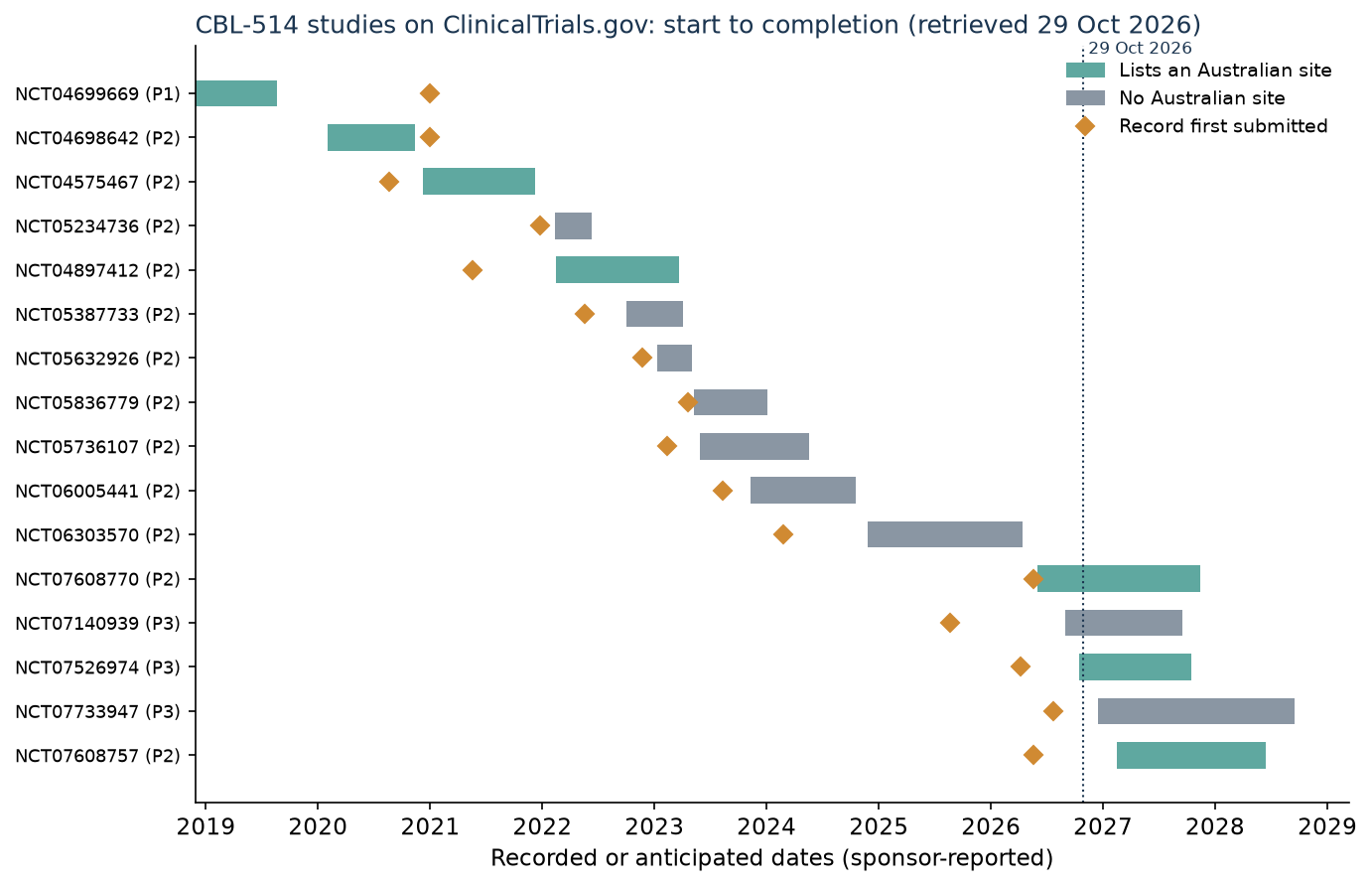
The ClinicalTrials.gov API returned 16 interventional studies of CBL-514, all with the same lead sponsor [5]. By start date and phase they fall into three groups:
- an early Australian group from 2018 to 2021: one phase 1 study and three phase 2 studies, all run wholly or partly in Australia;
- a US-centred phase 2 group from 2022 to 2026, covering localised fat, cellulite and Dercum disease;
- a 2025 to 2028 group of phase 3 and further phase 2 studies, some of which return to Australian sites.
Seven of the 16 studies list at least one Australian site [7, 8, 32, 33, 34, 35, 36]. Two of these seven also list sites outside Australia. The trials themselves are mapped and appraised in CBL-514 clinical trials: a systematic evidence map.
In ClinicalTrials.gov, the “FDA-regulated drug” field was true for 12 of the 16 studies and false for 4. All 4 studies marked false run only in Australia, including the two most recent Australian phase 2 records; one further Australia-only study is marked true [35, 36]. In plain terms, the developer has treated part of its Australian programme as falling outside US investigational new drug jurisdiction. That is consistent with the US rules, which apply to clinical investigations subject to US law and not automatically to trials run entirely abroad [29]. It also means that for these studies the Australian framework, rather than an FDA investigational new drug application, governs supply of the investigational product.
ANZCTR returned 10 records for “CBL-514” [6]. Seven were records imported from ClinicalTrials.gov, and they matched the 7 studies with Australian sites exactly. The other three were native ANZCTR registrations. All three name an Australian-registered subsidiary of the developer as primary sponsor. This fits the TGA requirement that every clinical trial in Australia has an Australian-entity sponsor; an overseas company cannot itself be the sponsor [37]. Details of the three native records are given in Table 2.
Table 2. Australian-linked registry records for CBL-514: native ANZCTR registrations and their likely ClinicalTrials.gov counterparts (records read 29 October 2026)
| ANZCTR record | Phase | ANZCTR registration date | ANZCTR status displayed | Ethics status displayed | Likely ClinicalTrials.gov counterpart | ClinicalTrials.gov first submitted | ClinicalTrials.gov start / completion |
|---|---|---|---|---|---|---|---|
| ACTRN12618000868280 | 1 | 22 May 2018 | Completed | Approved | NCT04699669 (title and design correspond) | 29 Dec 2020 | 27 Nov 2018 / 20 Aug 2019 |
| ACTRN12619001580167 | 2a | 18 Nov 2019 | Recruiting | Approved | NCT04698642 (title and design correspond) | 29 Dec 2020 | 3 Feb 2020 / 12 Nov 2020 |
| ACTRN12620001153909p | 2 | 3 Nov 2020 | Not yet recruiting | Submitted, not yet approved | None identified | Not applicable | Not applicable |
Sources for Table 2: ANZCTR trial search and record pages read in a headed browser [6]; ClinicalTrials.gov API version 2 and study records [5, 7, 8]. Pairings are inferred from title and design; the registries share no common identifier.
Two concordance findings stand out. The first is a timing pattern. The phase 1 study was prospectively registered on ANZCTR in May 2018, about six months before its first enrolment, which is consistent with prospective registration in the primary WHO-network registry for Australia. However, its ClinicalTrials.gov record was first submitted on 29 December 2020, more than 16 months after the study had finished [7]. The first phase 2a study shows the same pattern: its ClinicalTrials.gov record was submitted on the same day in December 2020, about six weeks after completion [8]. The published report of that phase 2a study, conducted at a single Australian site, cites the ClinicalTrials.gov identifier [38]. Nothing in these records suggests that any registration requirement was breached. Prospective registration on ANZCTR satisfies the usual expectation for Australian trials, and US registration duties attach to trials subject to US law. Still, a reader who relies only on ClinicalTrials.gov would date the start of the programme’s public record more than two years later than ANZCTR does.
The second finding is a status disagreement. ACTRN12619001580167 still displays “Recruiting” on ANZCTR. Its likely ClinicalTrials.gov counterpart has been recorded as completed since November 2020 [6, 8]. The third native record, ACTRN12620001153909p, still displays “Not yet recruiting” with ethics approval “Submitted, not yet approved”. The “p” suffix marks a prospectively registered trial, and no counterpart could be identified. Stale registry entries are a well-known weakness of trial transparency in general. They matter here because registries are often the first, and sometimes the only, independent public evidence that an unapproved product’s presence in a country is limited to a defined study.
3.2 Status across four jurisdictions
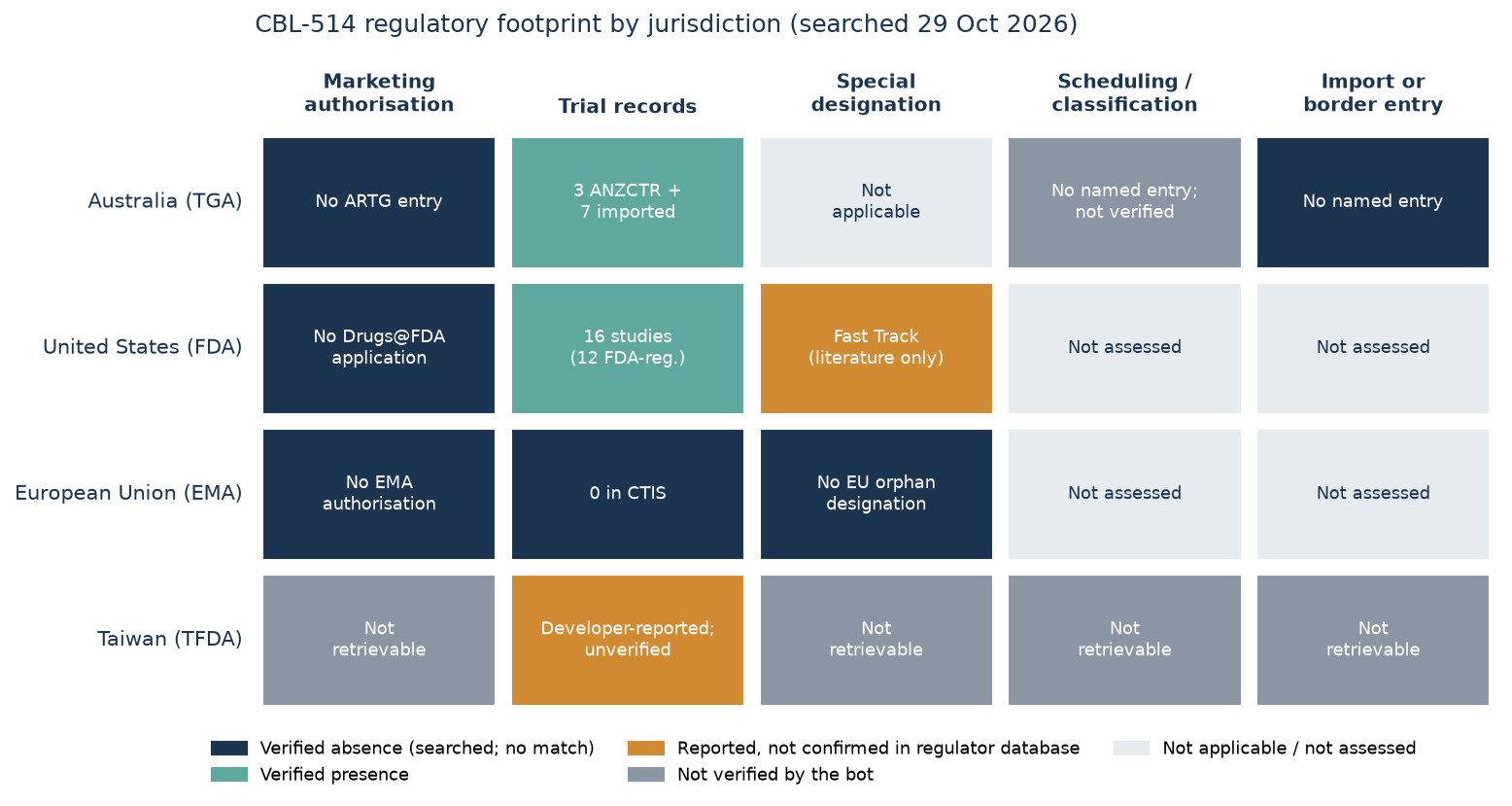
Table 3 records, for each jurisdiction, what could and could not be verified about the regulatory status of CBL-514. One principle guides the table: a zero result is reported as a zero result, and is never treated as proof that a classification does or does not exist.
Table 3. Verified regulatory footprint of CBL-514 by jurisdiction and source (searched 29 October 2026)
| Jurisdiction | Source searched | Result for CBL-514 | Positive control | What the result does and does not show |
|---|---|---|---|---|
| Australia | ARTG (keywords CBL-514, CBL514, developer name) | No entry for CBL-514; developer-name keyword returned 5 entries, none a CBL-514 product | Deoxycholic acid injection returned 1 entry (ARTG 233201) | No registered or listed CBL-514 good; any non-trial supply would involve an unapproved good |
| Australia | Poisons Standard, October 2026 (full text) | No entry naming CBL-514 or the developer | DEOXYCHOLIC ACID appears 6 times | Absence of a named entry does not settle scheduling; class or generic entries could still apply. Scheduling not verified |
| Australia | Customs (Prohibited Imports) Regulations 1956 (full text) | No entry naming CBL-514 or the developer | Not applicable | No compound-specific border control located; general therapeutic goods import offences still apply |
| Australia | ANZCTR | 3 native records and 7 imported records | Not applicable | Human use documented only within registered trials |
| United States | ClinicalTrials.gov | 16 studies; 12 flagged as FDA-regulated | Not applicable | Consistent with US investigational new drug oversight of US studies; individual IND numbers are not public |
| United States | Drugs@FDA via openFDA | No application (HTTP 404, not found) | NDA 206333, deoxycholic acid, approved 29 April 2015 | No approved US application |
| United States | FDA orphan drug designations | No records found | Control query returned 6 designations | No orphan designation recorded, including for Dercum disease |
| European Union | CTIS public search (CBL-514, CBL514, developer) | 0 / 0 / 0 | Oncology control returned 487 | No EU trial applications visible in CTIS |
| European Union | EMA medicines and orphan datasets | 0 of 2,754 and 0 of 3,310 | Not applicable | No central authorisation or EU orphan designation |
| Taiwan | TFDA licence database; Taiwanese trial registry | Not retrievable by the bot | Not run | Unverified. Developer disclosures describe Taiwanese trial approvals that this analysis could not confirm independently |
Sources for Table 3: [5, 6, 9, 10, 11, 12, 13, 14, 15, 16].
Two further status claims appear in public sources. A 2026 review in the peer-reviewed literature reports that CBL-514 has received FDA Fast Track designation [1]. The FDA describes Fast Track as a process that facilitates development and speeds review of drugs for serious conditions that fill an unmet need. It is not an approval and does not authorise supply outside investigations [39]. The FDA does not publish a searchable register of Fast Track designations, so this claim was checked only against the literature and was not confirmed in an FDA database. The second claim concerns Taiwan: developer disclosures refer to Taiwanese approvals of investigational studies, but neither the TFDA database nor the Taiwanese registry could be retrieved. That claim is therefore reported as unverified.
3.3 The Australian legal mechanism, provision by provision
Is CBL-514 a “therapeutic good”?
The Therapeutic Goods Act 1989 defines therapeutic goods broadly. It covers goods that are, or are represented in any way to be, or are likely to be taken to be, for therapeutic use, whether because of the way they are presented or for any other reason [17]. The definition looks both at what a product is and at how it is presented. An injectable compound developed and trialled to reduce subcutaneous fat and treat the lipomas of Dercum disease is the kind of good the definition was drafted to capture. The TGA’s 2026 guidance on unapproved products makes the related point that labelling a product “research use only” or “not for human use” does not change whether it is regulated as a therapeutic good. Nor does such labelling remove obligations relating to advertising, manufacture, import, export or supply [21, 22]. Whether a particular consignment is a therapeutic good is a legal question that turns on the facts, but the TGA’s position on labelling is unambiguous.
The general offences
Section 19B creates offences for importing, exporting, manufacturing or supplying therapeutic goods for use in humans unless the goods are entered in the ARTG, are exempt, or are the subject of an approval or authority [17]. The TGA describes an “unapproved” good as one not included in the ARTG, or one used outside the terms of its ARTG entry. It adds that an ARTG entry is specific to its sponsor [40, 41]. CBL-514 has no ARTG entry (Table 3), so every lawful Australian supply of it for human use must rely on an exemption or an approval.
The clinical trial routes
The Act and Regulations provide two clinical trial routes for unapproved goods.
The Clinical Trial Notification (CTN) scheme. This is an exemption, set out in item 3 of Schedule 5A to the Therapeutic Goods Regulations 1990 [18]. The Australian sponsor notifies the TGA and pays a fee. The TGA states plainly that it does not evaluate any data about the clinical trial at the time of notification [42]. The scientific and ethical review happens elsewhere. A Human Research Ethics Committee (HREC) must approve the protocol, and the institution or “approving authority” at each site must also approve the trial before the goods are supplied [42]. The conditions in regulation 12AD require the goods to be used in accordance with:
- the Guideline for Good Clinical Practice;
- the HREC-approved protocol;
- the National Statement on Ethical Conduct in Human Research.
Use must stop if the ethics committee withdraws its approval [18, 43].
The Clinical Trial Approval (CTA) scheme. This is an approval under section 19(1)(b), which covers goods “for use solely for experimental purposes in humans”. Here the TGA itself evaluates quality, preclinical and early clinical safety data before the trial begins [17, 44]. Regulation 12AB attaches conditions to such approvals [18].
The TGA explains that, apart from certain higher-risk biologicals for which the CTA is mandatory, the choice between the two schemes rests first with the sponsor and then with the HREC, which considers whether it has the expertise to assess the trial [40, 44]. Researchers have observed that, under the CTN model, oversight of Australian trial safety rests largely with HRECs [45].
This distinction is important for reading public statements about CBL-514 in Australia. A trial run under the CTN scheme has been notified to the TGA. It has not been approved by the TGA in any evaluative sense, because no TGA assessment of trial data takes place [42]. Public communications that describe a CTN-scheme trial as “approved by the TGA” merge HREC approval with TGA notification. The registry records reviewed here do not show which scheme was used for each CBL-514 trial, so this analysis does not say which applied. It notes only that the CTN scheme does not involve TGA evaluation of data.
Access outside trials
Outside trials, the Act allows access to unapproved goods through practitioner-initiated pathways:
- The Special Access Scheme. Category A applies to seriously ill patients and requires notification after supply. Category B requires an application and TGA approval before supply. Category C covers goods with an established history of use [46].
- Authorised Prescribers. These are practitioners authorised to supply a specified unapproved good to a class of patients [47].
Section 19(1AA) limits approvals for treatment use to health practitioners [17]. The TGA’s SAS guidance states that the scheme should not be used to conduct a clinical trial, and that a Category B application must include sufficient clinical justification [48]. None of these pathways allows unapproved goods to be offered to the public.
The Personal Importation Scheme is sometimes mentioned in online discussion. It allows individuals to import certain goods for their own or an immediate family member’s use, under conditions:
- the goods must not be sold or passed on;
- a prescription-only medicine requires an Australian prescription;
- quantity limits apply;
- goods must be in their original packaging;
- counterfeit goods are prohibited in all circumstances [49].
The TGA’s May 2026 warning records that non-compliant vials are not released under that scheme and that the Australian Border Force can be asked to seize and destroy them [50].
Advertising
Section 42DL makes it an offence to advertise therapeutic goods in several circumstances. Subsection (12) covers advertisements that refer to goods not entered in the ARTG that are prescribed by the regulations, other than references authorised or required by an Australian government authority [17]. Regulation 7 prescribes, among others, goods that are the subject of an approval or authority under section 19, and goods covered by a Schedule 5A exemption. This includes trial goods supplied under the CTN item [18]. Each day of a continuing contravention counts as a separate offence, and section 42DLB provides parallel civil penalties [17]. The TGA’s guidance confirms that unapproved goods, including those accessed through the SAS and other unapproved pathways and those supplied unlawfully, cannot be advertised to the general public. It also confirms that advertising goods not in the ARTG to the public is prohibited under sections 42DL(12) and 42DLB(9), subject to limited exceptions [19, 20, 51]. Australia has a long-standing ban on direct-to-consumer advertising of prescription medicines [52], and the post-2018 advertising offence and penalty regime has been described as substantially strengthened [53].
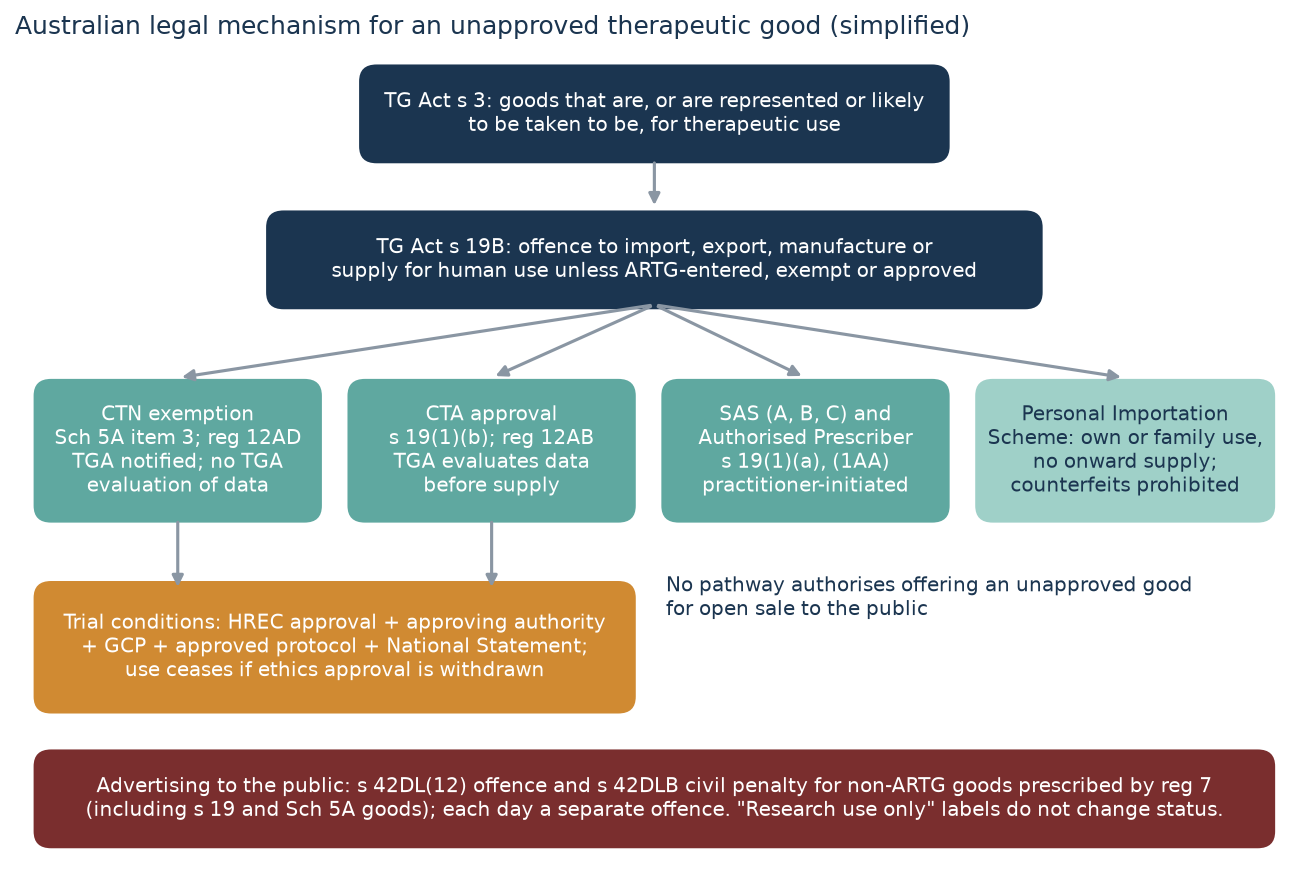
Table 4. Provision map: Australian legislation applicable to an unapproved investigational good such as CBL-514
| Instrument and provision | Function | Effect for an unapproved investigational good | Verified source |
|---|---|---|---|
| TG Act s 3 (definition of therapeutic goods) | Scope | Goods that are, or are represented or likely to be taken to be, for therapeutic use are captured; labels such as “research use only” do not decide the question | [17, 21] |
| TG Act s 19B | General offences | Importing, exporting, manufacturing or supplying for use in humans without ARTG entry, exemption or approval is an offence | [17] |
| TG Act s 18 and TG Regs Sch 5A item 3 | CTN exemption | Trial supply is exempt on conditions, including HREC and approving-authority approval; the TGA does not evaluate data at notification | [17, 18, 42] |
| TG Act s 19(1)(b) and TG Regs reg 12AB | CTA approval | The TGA evaluates quality, preclinical and early clinical data before trial supply | [17, 18, 44] |
| TG Regs reg 12AD | Conditions of trial use | Use must follow GCP, the approved protocol and the National Statement, and must stop if ethics approval is withdrawn | [18, 43, 54] |
| TG Act s 19(1)(a), s 19(1AA) | SAS and Authorised Prescriber | Treatment access is limited to health practitioners, case by case or by authorisation | [17, 46, 47, 48] |
| TG Act s 42DL(12), TG Regs reg 7 | Advertising offence | Advertising non-ARTG goods prescribed by reg 7 (including s 19 and Sch 5A goods) is an offence; each day is a separate offence | [17, 18, 20] |
| TG Act s 42DLB | Civil penalty | Civil penalties run parallel to the advertising offences | [17, 51] |
| Poisons Standard (October 2026) | Scheduling | No entry names CBL-514; scheduling not verified | [15] |
| Customs (Prohibited Imports) Regulations 1956 | Border controls | No compound-specific entry found; the TG Act import offences still apply | [16, 50] |
Sources for Table 4: Federal Register of Legislation compilations and TGA guidance as cited in each row.
3.4 The United States, the European Union and Taiwan compared
United States. Part 312 of Title 21 of the Code of Federal Regulations applies to clinical investigations of drugs subject to the new drug provisions of the Federal Food, Drug, and Cosmetic Act [29]. A “clinical investigation” is any experiment in which a drug is administered or dispensed to, or used involving, one or more human subjects [55]. A sponsor may not begin a clinical investigation until an investigational new drug application is in effect [56]. Section 312.7 prohibits sponsors and investigators from representing in a promotional context that an investigational new drug is safe or effective for the purposes under investigation. It also prohibits commercial distribution and test marketing, while expressly allowing the full exchange of scientific information [57]. Expanded access under Subpart I is available for serious or immediately life-threatening diseases where no comparable or satisfactory alternative therapy exists [58]. Across 92 FDA expanded access programmes, the median period of availability before approval was 10 months [59]. FDA warning letters to sponsors, investigators and review boards show that compliance problems in investigations are common enough to be documented systematically [60]. A Fast Track designation, which the literature reports for CBL-514, changes the process of development and review but not the product’s investigational status [1, 39].
European Union. Directive 2001/83/EC requires a marketing authorisation before any medicinal product can be placed on the market (Article 6(1)). Products intended for research and development trials are excluded from the Directive’s scope (Article 3(3)). Under Article 87(1), Member States must prohibit any advertising of a medicinal product for which no marketing authorisation has been granted, and under Article 88(1)(a) advertising of prescription-only medicines to the general public is also prohibited [30]. Clinical trials are now authorised under Regulation (EU) No 536/2014 through CTIS [61, 62]. No EU CBL-514 trial appears in CTIS, and there is no EMA authorisation or orphan designation (Table 3). The EU provisions cited here come from the Commission’s 2012 consolidation of the Directive. Readers should check them against the current consolidation before relying on them.
Taiwan. The Pharmaceutical Affairs Act, amended in March 2026, defines investigational medicaments as medicaments whose efficacy and safety have not yet been confirmed and which are used only for animal toxicity testing or clinical trials (Article 5). It requires registration and market approval before a drug is manufactured or imported (Article 39) [31]. Drugs manufactured without approval fall within the Act’s definition of counterfeit drugs (Article 20). Drugs imported without approval are “prohibited drugs” (Article 22), subject to a limited personal-carry exception. Advertising of medicaments is restricted to licensed pharmaceutical firms, requires prior approval, and for prescription medicines is limited to academic medical publications (Articles 65 to 67). Manufacturing or importing counterfeit or prohibited drugs is punishable by up to 10 years’ imprisonment and a fine of up to NT$100 million, and knowingly selling them by up to 7 years and a fine of up to NT$50 million (Articles 82 and 83) [31].
Read together, the four systems agree on the fundamentals. Investigational status confines lawful human use to authorised investigations or narrowly defined compassionate pathways, and promotion of unapproved products is prohibited or tightly restricted. They differ in the gatekeeper for trials: in Australia it may be a notification-plus-HREC model; in the US it is an IND in effect; in the EU it is an authorisation coordinated through CTIS; and Taiwan uses its own approval and registration model. Comparative studies of compassionate-use and trial-application frameworks reach the same conclusion: the legal architecture converges, while the procedures and timing differ by jurisdiction [26, 27, 28, 63].
3.5 Sourcing-risk evidence: what the literature shows about unapproved injectables
There is no peer-reviewed study of CBL-514 material outside clinical trials, and this analysis found no regulator statement that names it. Section 3.5 therefore does not claim that such material exists. It asks a different question. If an institution encountered material described as an investigational injectable, what does the evidence on comparable unapproved and falsified products say about the risks? Four bodies of evidence are relevant.
The approved comparator and its limits. The only approved injectable fat-reduction agent in the comparison set is deoxycholic acid. It was approved on the basis of phase III programmes in North America and Europe [64, 65, 66, 67]. Its regulatory dossier, its ARTG entry and its US application exist precisely because those trials were evaluated by regulators (Table 3). Even this approved product carries a documented burden of procedure-related adverse events in real-world reporting [68]. A meta-analysis of its randomised trials judged that all of them showed potential industry bias [69]. These findings are not cited as statements about CBL-514. They show what regulatory evaluation consists of: an evidence base examined by an independent authority, with known weaknesses. Material obtained outside an authorised pathway has none of this.
The published CBL-514 literature currently consists of trial reports and reviews [1, 2, 24, 38, 70, 71, 72]. Several trial reports disclose that some authors are employed by the developer or hold shares in it [24, 70]. That is normal at this stage of development, and it underlines that independent evaluation has not yet happened. This article reports none of their outcome data.
Outbreaks linked to injection lipolysis and mesotherapy. Injection lipolysis and mesotherapy performed outside regulated settings have a well-documented record of infectious outbreaks. A systematic review of mesotherapy-associated infections identified 30 articles describing 423 patients [73]. A separate systematic review of mycobacterial infections after cosmetic procedures found that mesotherapy accounted for 34% of 92 patients, with non-sterile water and poor technique implicated [74]. Individual outbreak investigations describe:
- clusters in Argentina and Peru, including isolation of the causative organism from a vial of local anaesthetic [75, 76];
- a Spanish outbreak in which 39 of 138 clients of a single salon were affected [77];
- sixteen patients of a single practitioner in France [78];
- a 2026 Montreal cluster linked to one practitioner, with genetically near-identical isolates [79].
Other reports document infections and necrosis after “lipolytic” or “lipodissolve” injections of uncertain composition, including products sold under the name of an approved brand and given by untrained people [80, 81, 82, 83]. French national surveillance recorded 43 infection cases across 7 episodes linked to aesthetic care over a decade [84]. The common factor in this literature is not a particular molecule. It is the combination of uncontrolled product provenance, non-sterile preparation and administration outside a regulated setting.
Falsified, substandard and research-labelled products. Studies of seized and online products show a recurring gap between what labels claim and what vials contain:
- Of 1,190 products seized at the Swiss border, fewer than 20% contained the claimed substance in the claimed amount [85].
- In New South Wales, only 8.7% of 809 seizures of falsified alprazolam tablets contained alprazolam [86].
- A meta-analysis of illicit anabolic steroid testing found that 36% of samples were counterfeit and a further 37% were substandard [87].
- Six of seven “legal high” products sold as research chemicals did not contain the advertised ingredient [88].
- In an analysis of research-grade peptides, only 44.0% met the purity specification they were sold under, and certificate-of-analysis claims were contradicted [89].
Other studies show wrong active ingredients, absent actives and elemental contaminants in falsified biotechnology products [90, 91]. Mass spectrometry has distinguished counterfeit from genuine protein products by their degradation profiles [92]. Official control laboratory screening and seizure studies have detected substances still in pre-clinical or clinical development in illegal preparations [93, 94]. Further seizure and market studies document unapproved compounds, novel analogues and products freely offered online without completed clinical trials [95, 96, 97, 98, 99, 100, 101]. Investigational status, in other words, does not keep a compound out of illicit markets. One counterexample deserves mention. In one analysis, two synthetic cannabinoid samples bought online were of comparable purity [102]. Accurate labelling does not make an unregulated product lawful, and the studies taken together show that label accuracy cannot be assumed. Even legitimately custom-synthesised material can contain undeclared constituents that standard methods miss [103]. Reviews describe how hard it is to detect and characterise falsified medicines analytically [104]. A 2026 review links unregulated compound use to digital promotion and grey-market access [105].
Aesthetic injectables and practice exposure. In a US survey, 41.1% of aesthetic practitioners reported having encountered counterfeit injectables [106]. In one case series, illegal fillers given by unlicensed practitioners were implicated in 70% of complication cases [107]. A 2025 cluster of iatrogenic botulism in England involved a seized product that contained substantially more than its labelled content [108]. A review of 161 cosmetic iatrogenic botulism cases reported between 2014 and 2024 associated them with products of unknown origin and with administration by unlicensed practitioners [109].
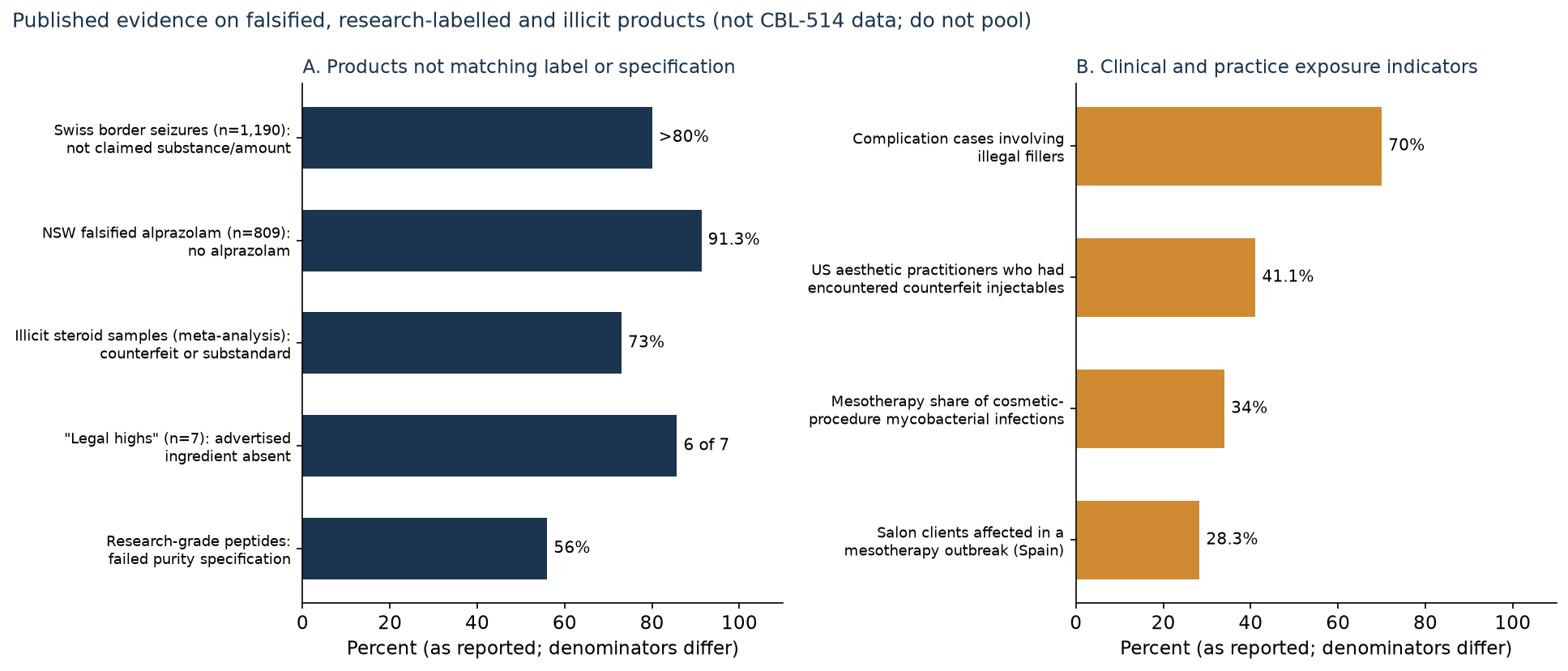
The public health and policy context. The World Health Organization estimates that about 1 in 10 medical products in low- and middle-income countries is substandard or falsified [110]. Wider economic estimates of the burden run much higher [111]. Systematic reviews have examined interventions against counterfeiting and the international, national and local policies intended to protect against falsified medicines [112, 113]. Comparative work proposes frameworks for assessing market risk across countries [114]. About half of online pharmacies studied were not properly regulated [115]. Direct-to-consumer promotion through social media is recognised as a regulatory challenge in its own right [116]. Targeted regulatory action against markets for unproven interventions has been shown to work in Australia and Canada [117].
Table 5. Evidence-based risk framework for institutions encountering material described as an investigational injectable such as CBL-514 outside a sponsored trial
| Risk domain | Evidence base | Institutional governance question (not a procedure) | Key sources |
|---|---|---|---|
| Legal status | Unapproved goods may be lawfully imported or supplied for human use only through exemption or approval pathways; disclaimers do not change status | Is there any documented legal basis (trial, SAS, Authorised Prescriber) for the material’s presence, confirmed by legal advice? | [17, 21, 22, 40] |
| Provenance and diversion | The sponsor-controlled trial supply chain is the only verifiable source of genuine investigational product; investigational compounds appear in illicit markets | Can provenance be traced to an authorised sponsor and trial, or is the chain of custody unknown? | [37, 93, 94] |
| Identity and content | Large shares of seized and online products do not contain the labelled substance or amount | Has identity been established by an independent, accredited method, rather than by the label or by an accompanying document alone? | [85, 87, 88, 91] |
| Purity and impurities | Research-grade products often fail purity claims; undeclared constituents can escape routine methods | Do the analytical methods relied on have the specificity to detect related substances and undeclared components? | [89, 103, 104] |
| Sterility and microbiology | Outbreaks after non-sterile injection lipolysis and mesotherapy; the TGA warns that the sterility of unapproved injectables is unknown | Is there any evidence of manufacture under GMP, which unapproved goods by definition have not shown to the TGA? | [73, 74, 79, 118, 119] |
| Documentation authenticity | Certificates of analysis are contradicted by independent testing; falsified medicines are designed to evade detection | Is documentation independently verifiable at its source? | [89, 104, 112] |
| Promotion and advertising | Advertising non-ARTG and trial goods to the public is an offence; promoters and affiliates may be held accountable | Could institutional communications be construed as advertising an unapproved good? | [19, 20, 25] |
| Border and enforcement | Non-compliant consignments can be seized and destroyed; the TGA has executed warrants and seizures in 2026 | Has the institution sought regulatory advice before any importation question arises? | [16, 50, 120] |
Sources for Table 5: as cited in each row. The framework sets out questions for governance and legal review. It is not a procedure for obtaining, handling or using any product.
3.6 TGA compliance statements in 2026
The TGA’s 2026 statements concern peptide products, not small molecules such as CBL-514. They are relevant here because they restate general principles of the Therapeutic Goods Act in unusually direct language, and because they set out the regulator’s current enforcement posture. In chronological order:
- 13 April 2026, safety advisory. Disclaimers such as “research use only” do not change a product’s regulatory status, do not permit importation and do not remove advertising or supply obligations. The advisory also noted the contamination and infection risks of injected products [22].
- 7 May 2026, warning. Border referrals of such products were frequently poorly labelled. Non-compliant vials would not be released under the Personal Importation Scheme, and the Australian Border Force could be asked to seize and destroy them. The TGA listed unmarked or code-only labelling as a warning sign [50].
- 10 June 2026. The TGA added unapproved peptide products to its compliance priority focus areas [121]. On the same date it updated its Compliance Principles 2026 and 2027, which set out five core compliance principles and quarterly-reviewed priority areas for 1 January 2026 to 31 December 2027 [122].
- 19 June 2026, joint statement with the Australian Government Chief Medical Officer. Unknowns about sterility, aseptic manufacture and quality standards were set out as public health concerns [118].
- 20 July 2026, public notice. The TGA listed its enforcement tools: warning letters, infringement notices, seizure, civil penalty proceedings and prosecution. It said that promoters and affiliates, not only sellers, may be held accountable [25].
- 17 August 2026, enforcement report. With NSW Police assistance, more than $120,000 of illicit products were seized from two residential premises, allegedly linked to a social media influencer who had imported and relabelled the products. The release states: “It is unlawful to import, advertise, manufacture and supply unapproved peptide products in Australia” [120].
- Clinical trials hub. The hub records a consultation on information sharing under the clinical trial schemes, open for comment until 20 November 2026, and lists the TGA’s good clinical practice inspection programme [40, 123].
The TGA’s general guidance on regulating these products adds that unapproved goods have not been assessed by the TGA for quality, safety or effectiveness [21]. The overview of access pathways makes clear that lawful routes exist for unapproved goods, and that they run through practitioners and sponsors, not through open sale [124]. Applied by analogy to an investigational small molecule, the message is consistent. The legal question is decided by what the goods are and how they are presented and supplied, not by their label.
4. Discussion
4.1 Principal findings
This analysis set out to establish, from primary sources, the regulatory status of CBL-514 in Australia and three comparator jurisdictions. It has four principal findings.
First, the verifiable Australian footprint of CBL-514 consists entirely of registered clinical trials with an Australian-entity sponsor. There is no ARTG entry, no Poisons Standard entry naming the compound, and no compound-specific import control. Every lawful supply of the compound for human use in Australia therefore depends on a trial exemption or approval, or on a practitioner-initiated access pathway, and the registry evidence shows only the first. The compound’s scheduling status could not be verified. The absence of a named entry in the Poisons Standard does not answer the question, because scheduling can operate through class or generic entries and through the general rules that apply to new chemical entities. Only the TGA or a scheduling delegate can give a definitive answer.
Second, the registries do not tell a single consistent story. The two earliest Australian studies appear on ClinicalTrials.gov only from late 2020, after they had started or finished. One native ANZCTR record still displays a recruiting status long after its likely counterpart was recorded as completed. Neither observation implies non-compliance. Together, though, they mean that anyone trying to reconstruct the compound’s history from a single registry will get it wrong. They also mean that registry status fields cannot be relied on as evidence of current trial activity without checking the record’s update history.
Third, the language of approval is used loosely in public communications. Under the CTN scheme the TGA receives a notification and does not evaluate trial data [42]. Ethical and scientific review is carried out by an HREC, and site governance by the approving authority [40, 42, 45]. Only the CTA scheme involves TGA evaluation before supply [44]. A statement that an Australian trial was “approved by the TGA” should therefore be read with care. In most cases the accurate description will be that an HREC approved the trial and the sponsor notified the TGA. This distinction is the single most common misunderstanding in public discussion of CBL-514 in Australia, and the one this article most aims to correct.
Fourth, the four jurisdictions share the same core architecture despite their procedural differences. Investigational products may be used in humans only within authorised investigations or narrow compassionate pathways, and promotion of unapproved products is prohibited [17, 30, 31, 57]. The jurisdictions differ in who decides that a trial may begin and in how much regulator review takes place before it does. This matches earlier comparative analyses of compassionate use and trial authorisation [26, 27, 63].
4.2 Implications for institutions
For research institutions, the most practical implication concerns governance. Material described as an investigational compound that does not come from a sponsor-controlled trial supply chain has no verifiable provenance. The evidence summarised in section 3.5 shows that, for comparable product classes, such material frequently fails to match its label, and that injectable products of uncontrolled origin have caused outbreaks. The framework in Table 5 is deliberately framed as a set of questions for legal, ethics and biosafety review rather than as a procedure. Its central point is that a sound institutional answer will usually depend on documented legal advice and on regulator contact, not on documents that accompany the material.
Whether non-clinical laboratory work with material of this kind falls within the Therapeutic Goods Act, within other chemical-control legislation, or within neither, is a fact-specific legal question beyond the scope of this article. The TGA’s statements show that labels and disclaimers will not answer it [21, 22].
For ethics committees and governance offices, the findings support routine checks that registry records are kept current and are consistent across registries, particularly where a study is registered both on ANZCTR and on ClinicalTrials.gov. For communicators, including journalists, educators and authors of patient information, the findings support precise language: “investigational”, “not approved”, “notified under the CTN scheme” and “HREC-approved” each have specific meanings, and “available” or “approved” should not be used without stating by whom and for what.
4.3 Relation to the wider literature
The literature on falsified medicines has concentrated on approved medicines diverted or counterfeited after approval [110, 111, 113]. The literature on research-labelled compounds has concentrated on recreational and performance-enhancing substances [85, 87, 88]. Investigational candidates sit between these two bodies of work. They are not yet approved, so there is no genuine commercial product to counterfeit. Yet they may have enough public visibility to attract demand. Studies documenting the presence of compounds still in clinical development in seizures [93, 94] show that this middle ground is real. As far as the searches could establish, this article is the first to set out that middle ground for a specific named candidate, using registry and legislative evidence rather than seizure data alone.
4.4 Implications for regulators and registries
The findings also point to three modest opportunities for regulators and registry operators. None of them requires new legislation, and each follows directly from the gaps that this analysis encountered.
The first concerns the public visibility of the CTN scheme. A CTN is lodged with the TGA, but the scheme does not generate a public, compound-level register that a member of the public could search to confirm that a named investigational product is the subject of a current notification [40, 42]. ANZCTR fills part of this gap. The TGA’s clinical trial handbook expects trials to be registered in a publicly accessible database before the first participant is recruited, and notes the journal-editor policy requiring registration before publication [37]. Registry content, however, is the responsibility of sponsors and investigators [6], and section 3.1 showed that status fields can fall out of date. The EU’s Clinical Trials Information System takes a different approach: authorisation and public transparency are handled within a single system, and the public record is generated by the regulatory process itself [12, 61, 62]. The TGA’s published review of the CTA scheme [44] provides an opportunity to consider whether some public, compound-level confirmation of CTN and CTA status would reduce the scope for loose “approved” language in public communications.
The second concerns cross-registry consistency. The same study can be recorded on ANZCTR and on ClinicalTrials.gov with different start dates, statuses and sponsor descriptions. Neither registry is responsible for the accuracy of the other. Simple automated reconciliation, for example a periodic comparison of status fields for records that cite each other’s identifiers, would make discrepancies visible to the sponsor, to the reviewing HREC and to readers. The public application programming interface of ClinicalTrials.gov already makes this technically straightforward on the US side [5].
The third concerns enforcement communication. The TGA’s 2026 statements were clear that importing, advertising, manufacturing and supplying unapproved peptide products is unlawful, and that “research use only” labels do not change the legal position [22, 25, 120]. Those statements addressed product classes rather than individual investigational candidates, which is appropriate: a regulator cannot issue a statement for every compound in development. The compliance priorities published for 2026–27 [122] and the advertising framework [19, 51] already supply the general rule. What the CBL-514 case illustrates is that public attention to a named investigational candidate can arrive years before any marketing application is lodged. It can also arrive in a jurisdiction where the only lawful use is within a trial. General statements about unapproved goods therefore carry particular weight for compounds of this kind, and their reach depends on the public understanding that “investigational” means “not approved for any use outside an authorised trial or access pathway”.
These observations are offered as policy questions, not as criticism of any regulator, registry, sponsor or investigator. Each of the regulatory systems examined here is functioning as designed. The gaps arise at the points where systems meet: between a notification and a public record, between two registries, and between a regulator’s general statements and public discussion of a specific compound.
5. Limitations
This analysis has important limitations.
- Unretrievable Taiwanese sources. The TFDA licence database and the Taiwanese trial registry could not be retrieved by the bot. Claims about Taiwanese approvals are therefore unverified.
- Outdated EU consolidation. The current consolidated text of Directive 2001/83/EC on EUR-Lex could not be retrieved. EU provisions were taken from the Commission’s 2012 consolidation, and later amendments may have changed article numbering or content.
- CTIS search method. The CTIS public search service refused plain scripted GET requests. Results were obtained by POST queries to the public search service, and they reflect what that service returned.
- Fast Track not confirmed. No public FDA register of Fast Track designations for unapproved products was identified, so the reported designation was confirmed only in the literature.
- Scheduling not determined. Full-text searching of the Poisons Standard can only establish that a name does not appear. It cannot rule out scheduling by class.
- Inferred registry pairings. Pairings between ANZCTR and ClinicalTrials.gov records were inferred from titles and designs, not from shared identifiers.
- Bot-challenge pages. Several TGA pages, ANZCTR and the FDA orphan database were verified in a real browser session because scripted requests were blocked. Their content was read as displayed on 29 October 2026 and may since have changed.
- Snapshot in time. Registry statuses, regulator pages and legislation compilations change, and every finding should be treated as accurate only as of 29 October 2026.
- Literature searches. The searches were structured but not exhaustive systematic reviews, and Europe PMC full-text counts overstate the relevant literature.
- Analogy from peptides. TGA statements written about peptide products have been applied to a small molecule only by analogy.
6. Conclusion
On the evidence available on 29 October 2026, CBL-514 in Australia is an investigational, unapproved therapeutic good. It has no ARTG entry, and its verifiable presence is limited to registered clinical trials with an Australian sponsor. The Therapeutic Goods Act permits human use of such a good only through defined exemptions and approvals:
- the CTN exemption, under which the TGA is notified but does not evaluate data;
- the CTA, under which the TGA does evaluate data;
- practitioner-initiated access through the SAS and Authorised Prescribers.
Goods supplied through any of these pathways cannot be advertised to the public. Disclaimers such as “research use only” change none of this. The United States, the European Union and Taiwan reach the same position by different procedures. Three questions remain open: the compound’s Poisons Standard classification, its Taiwanese regulatory status, and the current EU consolidated text. Each should be confirmed with the relevant regulator before anyone relies on it. For institutions, the published evidence on falsified, research-labelled and illicitly administered injectables supports one conclusion: material described as an investigational compound that has not come from an authorised trial supply chain should be treated as of unknown identity, purity and sterility, and as a matter for legal advice.
Relevance to Eternal Peptides Wholesale
Eternal Peptides Wholesale publishes this regulatory analysis because the status of investigational compounds is often misread in discussions of research peptides, and searches for CBL-514 Australia information mainly return corporate news. The analysis does not describe or assess any product and is not legal advice. Its central finding applies regardless of source: CBL-514 is an unapproved, investigational therapeutic good, and a “research use only” label does not change how it is regulated.
Eternal Peptides Wholesale distributes research materials for laboratory research use only, not for human consumption (see About), and publishes batch-specific Janoshik Analytical reports in its certificate of analysis library. As that page states, laboratory reports record the stated tests on a submitted sample and do not establish regulatory approval, clinical suitability or safety for human use; the testing standards page explains what each test area covers. Analytical documentation and regulatory status are separate questions, as the risk framework in this paper sets out. Related reviews are on the blog.
Glossary
- ARTG (Australian Register of Therapeutic Goods): the public register of therapeutic goods that can lawfully be supplied in Australia. An entry is specific to its sponsor [40, 41].
- Authorised Prescriber: a health practitioner authorised by the TGA to supply a specified unapproved good to a class of patients [47].
- CTA (Clinical Trial Approval) scheme: an approval under section 19(1)(b) of the Therapeutic Goods Act, under which the TGA evaluates quality, preclinical and early clinical data before a trial begins [44].
- CTIS (Clinical Trials Information System): the EU portal and database for clinical trial applications under Regulation (EU) No 536/2014 [61].
- CTN (Clinical Trial Notification) scheme: an exemption under Schedule 5A of the Therapeutic Goods Regulations, under which the Australian sponsor notifies the TGA of a trial. The TGA does not evaluate trial data at notification [42].
- Fast Track: an FDA process to facilitate development and speed review of drugs for serious conditions. It is not an approval [39].
- HREC (Human Research Ethics Committee): a committee that reviews research in accordance with the National Statement on Ethical Conduct in Human Research [43].
- IND (investigational new drug application): the US application that must be in effect before a clinical investigation begins [56].
- Investigational medicament: under Taiwan’s Pharmaceutical Affairs Act, a medicament whose efficacy and safety are not yet confirmed and which is used only for toxicity testing or clinical trials [31].
- Positive control (search): a query expected to return results, run alongside the target query to show that a zero result reflects a real absence.
- Poisons Standard: the legislative instrument that classifies medicines and poisons into schedules in Australia [15].
- SAS (Special Access Scheme): the pathways (Categories A, B and C) through which health practitioners can access unapproved goods for individual patients [46].
- Unapproved therapeutic good: a good not included in the ARTG, or used outside the terms of its ARTG entry [40].
Frequently asked questions
What is the regulatory status of CBL-514 in Australia?
On searches run on 29 October 2026, CBL-514 has no entry in the Australian Register of Therapeutic Goods, so it is an unapproved, investigational therapeutic good. Its verifiable presence in Australia is limited to registered clinical trials with an Australian-entity sponsor [6, 9, 37].
Is CBL-514 approved by the TGA?
No TGA approval of CBL-514 as a product was found. Clinical trials in Australia can run under the CTN scheme, in which the TGA is notified but does not evaluate trial data, or under the CTA scheme, in which it does. The registry records reviewed do not show which scheme each CBL-514 trial used [42, 44].
Is CBL-514 listed in the Poisons Standard?
No entry naming CBL-514 was found in the October 2026 Poisons Standard. That does not establish that it is unscheduled, because scheduling can operate through class or general entries. Its scheduling status could not be verified and should be confirmed with the TGA [15].
Does a “research use only” label change the legal status of a product like CBL-514?
No. The TGA states that “research use only” or “not for human use” disclaimers do not change whether a product is regulated as a therapeutic good, and do not remove obligations on import, supply or advertising [21, 22].
What does CBL-514 Australia trial registration show?
ANZCTR returned 10 CBL-514 records: 3 native Australian registrations and 7 records imported from ClinicalTrials.gov. Two early Australian studies were first submitted to ClinicalTrials.gov after they started, and one ANZCTR record still displays a recruiting status [6, 7, 8].
Can an unapproved investigational product be advertised in Australia?
Advertising to the public of goods not in the ARTG that are prescribed by the regulations, which include goods under section 19 approvals and Schedule 5A exemptions, is an offence under section 42DL(12), with parallel civil penalties. TGA guidance confirms that unapproved goods cannot be advertised to the public [17, 18, 19].
How do the FDA, EMA and TFDA treat CBL-514?
No FDA approval or orphan designation, no EMA authorisation and no EU CTIS trial were found. A Fast Track designation is reported in the literature but was not confirmed in an FDA database, and Taiwanese records could not be verified. All three frameworks restrict use of investigational products to authorised studies and restrict their promotion [1, 10, 11, 12, 13, 31].
Is this article legal advice?
No. This article is an educational analysis of public legislation, regulator guidance, registries and literature as at 29 October 2026. It is not legal, regulatory or medical advice. Anyone whose activities may involve an unapproved therapeutic good should obtain independent legal advice and consult the TGA [124].
References
- Idris YA, Janis JE. Dercum’s Disease: A Practical Review of Existing and Novel Therapies. Plast Reconstr Surg Glob Open. 2026;14(7):e7907. doi:10.1097/GOX.0000000000007907. PMID: 42488923. Available at: https://doi.org/10.1097/GOX.0000000000007907. Accessed 29 October 2026.
- Carrion K, Salingaros S, Bernal C, Barger BT, Lipman KJ, How-Volkman C, et al. A Systematic Review of Injectable Lipolytic Agents for Nonsubmental Fat Reduction. Plast Reconstr Surg. 2026;158(3):414-423. doi:10.1097/PRS.0000000000012648. PMID: 41296813. Available at: https://doi.org/10.1097/PRS.0000000000012648. Accessed 29 October 2026.
- National Center for Biotechnology Information. Entrez Programming Utilities Help. Available at: https://www.ncbi.nlm.nih.gov/books/NBK25501/. Accessed 29 October 2026.
- Europe PMC. RESTful web service: search endpoint. Available at: https://www.ebi.ac.uk/europepmc/webservices/rest/search?query=peptide&format=json&pageSize=1. Accessed 29 October 2026.
- ClinicalTrials.gov. API v2 studies endpoint, query.intr=CBL-514. Available at: https://clinicaltrials.gov/api/v2/studies?query.intr=CBL-514&pageSize=50. Accessed 29 October 2026.
- Australian New Zealand Clinical Trials Registry (ANZCTR). Trial search: “CBL-514”. Available at: https://www.anzctr.org.au/TrialSearch.aspx. Accessed 29 October 2026.
- ClinicalTrials.gov. NCT04699669: A Phase 1 Study to Evaluate the Safety and Tolerability of CBL-514 Injection on Convexity or Fullness of Abdominal Subcutaneous Fat in Healthy Volunteers [registry record]. Available at: https://clinicaltrials.gov/study/NCT04699669. Accessed 29 October 2026.
- ClinicalTrials.gov. NCT04698642: A Study to Evaluate the Safety, Tolerability, and Preliminary Efficacy of CBL-514 Injection for Reducing Convexity or Fullness of Abdominal Subcutaneous Fat [registry record]. Available at: https://clinicaltrials.gov/study/NCT04698642. Accessed 29 October 2026.
- Therapeutic Goods Administration. Australian Register of Therapeutic Goods (ARTG) search [database]. Available at: https://www.tga.gov.au/resources/artg. Accessed 29 October 2026.
- US Food and Drug Administration. Search Orphan Drug Designations and Approvals [database]. Available at: https://www.accessdata.fda.gov/scripts/opdlisting/oopd/. Accessed 29 October 2026.
- US Food and Drug Administration. openFDA drugsfda endpoint: application NDA206333. Available at: https://api.fda.gov/drug/drugsfda.json?search=application_number:NDA206333. Accessed 29 October 2026.
- European Medicines Agency. Clinical Trials Information System (CTIS) public search. Available at: https://euclinicaltrials.eu/search-for-clinical-trials/. Accessed 29 October 2026.
- European Medicines Agency. Medicines data: centrally authorised medicines (JSON report). Available at: https://www.ema.europa.eu/en/documents/report/medicines-output-medicines_json-report_en.json. Accessed 29 October 2026.
- European Medicines Agency. Medicines data: orphan designations (JSON report). Available at: https://www.ema.europa.eu/en/documents/report/medicines-output-orphan_designations-json-report_en.json. Accessed 29 October 2026.
- Therapeutic Goods (Poisons Standard—October 2026) Instrument 2026 (Cth). Federal Register of Legislation F2026L01327. Available at: https://www.legislation.gov.au/F2026L01327/asmade/text. Accessed 29 October 2026.
- Customs (Prohibited Imports) Regulations 1956 (Cth). Federal Register of Legislation F1996B03651. Available at: https://www.legislation.gov.au/F1996B03651/latest/text. Accessed 29 October 2026.
- Therapeutic Goods Act 1989 (Cth), Compilation No. 89 (compilation date 5 September 2025; C2025C00525). Federal Register of Legislation. Available at: https://www.legislation.gov.au/C2004A03952/latest/text. Accessed 29 October 2026.
- Therapeutic Goods Regulations 1990 (Cth), Compilation No. 131 (compilation date 5 October 2026). Federal Register of Legislation F1996B00406. Available at: https://www.legislation.gov.au/F1996B00406/latest/text. Accessed 29 October 2026.
- Therapeutic Goods Administration. What can and cannot be advertised to the general public [web page]. Last updated 18 June 2026. Available at: https://www.tga.gov.au/products/regulations-all-products/advertising/advertising-basics/what-can-and-cannot-be-advertised-general-public. Accessed 29 October 2026.
- Therapeutic Goods Administration. Complying with the restrictions on advertising prescription medicines to the public [guidance]. Last updated 23 June 2026. Available at: https://www.tga.gov.au/resources/guidance/complying-restrictions-advertising-prescription-medicines-public. Accessed 29 October 2026.
- Therapeutic Goods Administration. How we regulate therapeutic peptide products [web page]. 2026. Available at: https://www.tga.gov.au/products/medicines/monitoring-and-compliance/how-we-regulate-therapeutic-peptide-products. Accessed 29 October 2026.
- Therapeutic Goods Administration. Understanding your responsibilities when importing, compounding and supplying unapproved peptide products [safety advisory]. Published 13 April 2026. Available at: https://www.tga.gov.au/safety/safety-monitoring-and-information/safety-alerts/understanding-your-responsibilities-when-importing-compounding-and-supplying-unapproved-peptide-products. Accessed 29 October 2026.
- Kucharz EJ, Kopeć-Mędrek M, Kramza J, Chrzanowska M, Kotyla P. Dercum’s disease (adiposis dolorosa): a review of clinical presentation and management. Reumatologia. 2019;57(5):281-287. doi:10.5114/reum.2019.89521. PMID: 31844341. Available at: https://doi.org/10.5114/reum.2019.89521. Accessed 29 October 2026.
- Herbst KL, Ling YF, Sheu AY, Schlessinger DI, Wu SY. Efficacy and safety of CBL-514 for Dercum disease lipomas: A randomized phase 2a study. JAAD Int. 2026;25:1-4. doi:10.1016/j.jdin.2025.11.022. PMID: 41623934. Available at: https://doi.org/10.1016/j.jdin.2025.11.022. Accessed 29 October 2026.
- Therapeutic Goods Administration. Unapproved peptide product promoters and suppliers are put on notice [media release]. Published 20 July 2026. Available at: https://www.tga.gov.au/news/media-releases/unapproved-peptide-product-promoters-and-suppliers-are-put-notice. Accessed 29 October 2026.
- Borysowski J, Górski A. Compassionate use of unauthorized drugs: Legal regulations and ethical challenges. Eur J Intern Med. 2019;65:12-16. doi:10.1016/j.ejim.2019.04.008. PMID: 31036436. Available at: https://doi.org/10.1016/j.ejim.2019.04.008. Accessed 29 October 2026.
- Stewart B, Lepola P, Egger GF, Ali F, Allen AJ, Croker AK, et al. Requirements and special considerations for drug trials with children across six jurisdictions: 1. Clinical trial application review in the regulatory approval process. Front Med (Lausanne). 2025;12:1542408. doi:10.3389/fmed.2025.1542408. PMID: 40303377. Available at: https://doi.org/10.3389/fmed.2025.1542408. Accessed 29 October 2026.
- Michaeli DT, Mills M, Michaeli T, Miracolo A, Kanavos P. Initial and supplementary indication approval of new targeted cancer drugs by the FDA, EMA, Health Canada, and TGA. Invest New Drugs. 2022;40(4):798-809. doi:10.1007/s10637-022-01227-5. PMID: 35389145. Available at: https://doi.org/10.1007/s10637-022-01227-5. Accessed 29 October 2026.
- Code of Federal Regulations. 21 CFR 312.2 Applicability. eCFR. Available at: https://www.ecfr.gov/current/title-21/chapter-I/subchapter-D/part-312/subpart-A/section-312.2. Accessed 29 October 2026.
- European Parliament and Council. Directive 2001/83/EC on the Community code relating to medicinal products for human use, consolidated text 16 November 2012. European Commission. Available at: https://health.ec.europa.eu/document/download/6a59e03f-fb86-4cbc-9fca-f8e4a7e938b1_en?filename=dir_2001_83_cons_2012_en.pdf. Accessed 29 October 2026.
- Pharmaceutical Affairs Act (Taiwan), amended 4 March 2026. Laws & Regulations Database of the Republic of China (Taiwan). Available at: https://law.moj.gov.tw/ENG/LawClass/LawAll.aspx?pcode=L0030001. Accessed 29 October 2026.
- ClinicalTrials.gov. NCT04575467: A Study to Evaluate the Efficacy, Safety and Tolerability of CBL-514 Injection for Reducing Subcutaneous Fat (Stage 1) [registry record]. Available at: https://clinicaltrials.gov/study/NCT04575467. Accessed 29 October 2026.
- ClinicalTrials.gov. NCT04897412: A Study to Evaluate the Efficacy, Safety, and Tolerability of CBL-514 Injection for Reducing Subcutaneous Fat (Stage 2) [registry record]. Available at: https://clinicaltrials.gov/study/NCT04897412. Accessed 29 October 2026.
- ClinicalTrials.gov. NCT07526974: A Study to Evaluate the Efficacy and Safety of CBL-514 Injection for Reducing Subcutaneous Fat ( SUPREME-02 ) [registry record]. Available at: https://clinicaltrials.gov/study/NCT07526974. Accessed 29 October 2026.
- ClinicalTrials.gov. NCT07608757: A Study to Evaluate the Efficacy, Safety, and Tolerability of CBL-514 Injection for Reducing Abdominal Subcutaneous Fat [registry record]. Available at: https://clinicaltrials.gov/study/NCT07608757. Accessed 29 October 2026.
- ClinicalTrials.gov. NCT07608770: A Study to Evaluate the Efficacy, Safety, and Tolerability of CBL-514 Injection for Reducing Abdominal Subcutaneous Fat [registry record]. Available at: https://clinicaltrials.gov/study/NCT07608770. Accessed 29 October 2026.
- Therapeutic Goods Administration. Australian clinical trial handbook [guidance]. Last updated 3 October 2024. Available at: https://www.tga.gov.au/resources/guidance/australian-clinical-trial-handbook. Accessed 29 October 2026.
- Goodman GJ, Ho WWS, Chang KJ, Ling YF, Sheu AY. Efficacy of a Novel Injection Lipolysis to Induce Targeted Adipocyte Apoptosis: A Randomized, Phase IIa Study of CBL-514 Injection on Abdominal Subcutaneous Fat Reduction. Aesthet Surg J. 2022;42(11):NP662-NP674. doi:10.1093/asj/sjac162. PMID: 35709509. Available at: https://doi.org/10.1093/asj/sjac162. Accessed 29 October 2026.
- US Food and Drug Administration. Fast Track [web page]. Available at: https://www.fda.gov/patients/fast-track-breakthrough-therapy-accelerated-approval-priority-review/fast-track. Accessed 29 October 2026.
- Therapeutic Goods Administration. How we regulate Australian clinical trials that use unapproved therapeutic goods [web page]. Last updated 26 May 2025. Available at: https://www.tga.gov.au/products/unapproved-therapeutic-goods/access-pathways/clinical-trials/how-we-regulate-australian-clinical-trials-use-unapproved-therapeutic-goods. Accessed 29 October 2026.
- Therapeutic Goods Administration. About the Australian Register of Therapeutic Goods (ARTG) [web page]. Available at: https://www.tga.gov.au/products/regulations-all-products/about-australian-register-therapeutic-goods-artg. Accessed 29 October 2026.
- Therapeutic Goods Administration. Clinical Trial Notification (CTN) scheme [web page]. Last updated 9 April 2025. Available at: https://www.tga.gov.au/products/unapproved-therapeutic-goods/access-pathways/clinical-trials/clinical-trial-notification-ctn-scheme. Accessed 29 October 2026.
- National Health and Medical Research Council. National Statement on Ethical Conduct in Human Research 2025. Canberra: NHMRC; effective 23 June 2026. Available at: https://www.nhmrc.gov.au/about-us/publications/national-statement-ethical-conduct-human-research-2025. Accessed 29 October 2026.
- Therapeutic Goods Administration. Review of the Clinical Trial Approval (CTA) scheme [web page]. Last updated 1 September 2024. Available at: https://www.tga.gov.au/products/unapproved-therapeutic-goods/access-pathways/clinical-trials/review-clinical-trial-approval-cta-scheme. Accessed 29 October 2026.
- Nicol D, Eckstein L. Gene Editing Clinical Trials Could Slip through Australian Regulatory Cracks. J Law Med. 2019;27(2):274-283. PMID: 32129035. Available at: https://pubmed.ncbi.nlm.nih.gov/32129035/. Accessed 29 October 2026.
- Therapeutic Goods Administration. Access to unapproved therapeutic goods for individual patients (Special Access Scheme) [web page]. Last updated 3 December 2025. Available at: https://www.tga.gov.au/business-services/special-access-scheme-and-authorised-prescriber-online-system/access-unapproved-therapeutic-goods-individual-patients-special-access-scheme. Accessed 29 October 2026.
- Therapeutic Goods Administration. Access to unapproved therapeutic goods for multiple patients (Authorised Prescriber) [web page]. Available at: https://www.tga.gov.au/business-services/special-access-scheme-and-authorised-prescriber-online-system/access-unapproved-therapeutic-goods-multiple-patients-authorised-prescriber. Accessed 29 October 2026.
- Therapeutic Goods Administration. Special Access Scheme (SAS): guidance for health practitioners accessing unapproved therapeutic goods. Last updated 1 October 2024. Available at: https://www.tga.gov.au/resources/guidance/special-access-scheme-sas-guidance-health-practitioners-accessing-unapproved-therapeutic-goods. Accessed 29 October 2026.
- Therapeutic Goods Administration. Personal Importation Scheme [web page]. Last updated 8 September 2026. Available at: https://www.tga.gov.au/products/unapproved-therapeutic-goods/access-pathways/personal-importation-scheme. Accessed 29 October 2026.
- Therapeutic Goods Administration. TGA warning on the risks of importing unapproved peptide products [safety advisory]. Published 7 May 2026. Available at: https://www.tga.gov.au/safety/safety-monitoring-and-information/safety-alerts/tga-warning-risks-importing-unapproved-peptide-products. Accessed 29 October 2026.
- Therapeutic Goods Administration. Advertising legal framework [web page]. Last updated 11 March 2025. Available at: https://www.tga.gov.au/products/regulations-all-products/advertising/advertising-legal-framework. Accessed 29 October 2026.
- Brown S. Striving for quality use of medicines: how effective is Australia’s ban on direct-to-consumer prescription medicine advertising?. J Law Med. 2009;16(4):666-83. PMID: 19297873. Available at: https://pubmed.ncbi.nlm.nih.gov/19297873/. Accessed 29 October 2026.
- Rudge C, Ghinea N, Munsie M, Stewart C. Regulating autologous stem cell interventions in Australia: updated review of the direct-to-consumer advertising restrictions. Aust Health Rev. 2021;45(4):507-515. doi:10.1071/AH20217. PMID: 33952390. Available at: https://doi.org/10.1071/AH20217. Accessed 29 October 2026.
- International Council for Harmonisation. E6(R3) Guideline for Good Clinical Practice, Step 4, 6 January 2025. Available at: https://database.ich.org/sites/default/files/ICH_E6%28R3%29_Step4_FinalGuideline_2025_0106.pdf. Accessed 29 October 2026.
- Code of Federal Regulations. 21 CFR 312.3 Definitions and interpretations. eCFR. Available at: https://www.ecfr.gov/current/title-21/chapter-I/subchapter-D/part-312/subpart-A/section-312.3. Accessed 29 October 2026.
- Code of Federal Regulations. 21 CFR 312.20 Requirement for an IND. eCFR. Available at: https://www.ecfr.gov/current/title-21/chapter-I/subchapter-D/part-312/subpart-B/section-312.20. Accessed 29 October 2026.
- Code of Federal Regulations. 21 CFR 312.7 Promotion of investigational drugs. eCFR. Available at: https://www.ecfr.gov/current/title-21/chapter-I/subchapter-D/part-312/subpart-A/section-312.7. Accessed 29 October 2026.
- Code of Federal Regulations. 21 CFR 312.300 Expanded access: general. eCFR. Available at: https://www.ecfr.gov/current/title-21/chapter-I/subchapter-D/part-312/subpart-I/section-312.300. Accessed 29 October 2026.
- Puthumana J, Miller JE, Kim J, Ross JS. Availability of Investigational Medicines Through the US Food and Drug Administration’s Expanded Access and Compassionate Use Programs. JAMA Netw Open. 2018;1(2):e180283. doi:10.1001/jamanetworkopen.2018.0283. PMID: 30646072. Available at: https://doi.org/10.1001/jamanetworkopen.2018.0283. Accessed 29 October 2026.
- Saxena U, Bose D, Saha S, Gogtay NJ, Thatte UM. An audit of US FDA warning letters issued to sponsors, institutional review boards and investigators over a six-year period. Indian J Med Ethics. 2022;VII(2):108-113. doi:10.20529/IJME.2021.094. PMID: 35765256. Available at: https://doi.org/10.20529/IJME.2021.094. Accessed 29 October 2026.
- European Commission. Clinical trials: Regulation (EU) No 536/2014 [web page]. Available at: https://health.ec.europa.eu/medicinal-products/clinical-trials/clinical-trials-regulation-eu-no-5362014_en. Accessed 29 October 2026.
- European Medicines Agency. Clinical trials in human medicines [web page]. Available at: https://www.ema.europa.eu/en/human-regulatory-overview/research-development/clinical-trials-human-medicines. Accessed 29 October 2026.
- Watson T. A Global Perspective on Compassionate Use and Expanded Access. Ther Innov Regul Sci. 2017;51(2):143-145. doi:10.1177/2168479017694848. PMID: 30231725. Available at: https://doi.org/10.1177/2168479017694848. Accessed 29 October 2026.
- Jones DH, Carruthers J, Joseph JH, Callender VD, Walker P, Lee DR, et al. REFINE-1, a Multicenter, Randomized, Double-Blind, Placebo-Controlled, Phase 3 Trial With ATX-101, an Injectable Drug for Submental Fat Reduction. Dermatol Surg. 2016;42(1):38-49. doi:10.1097/DSS.0000000000000578. PMID: 26673433. Available at: https://doi.org/10.1097/DSS.0000000000000578. Accessed 29 October 2026.
- Humphrey S, Sykes J, Kantor J, Bertucci V, Walker P, Lee DR, et al. ATX-101 for reduction of submental fat: A phase III randomized controlled trial. J Am Acad Dermatol. 2016;75(4):788-797.e7. doi:10.1016/j.jaad.2016.04.028. PMID: 27430612. Available at: https://doi.org/10.1016/j.jaad.2016.04.028. Accessed 29 October 2026.
- Rzany B, Griffiths T, Walker P, Lippert S, McDiarmid J, Havlickova B. Reduction of unwanted submental fat with ATX-101 (deoxycholic acid), an adipocytolytic injectable treatment: results from a phase III, randomized, placebo-controlled study. Br J Dermatol. 2014;170(2):445-53. doi:10.1111/bjd.12695. PMID: 24147933. Available at: https://doi.org/10.1111/bjd.12695. Accessed 29 October 2026.
- Deeks ED. Deoxycholic Acid: A Review in Submental Fat Contouring. Am J Clin Dermatol. 2016;17(6):701-707. doi:10.1007/s40257-016-0231-3. PMID: 27785706. Available at: https://doi.org/10.1007/s40257-016-0231-3. Accessed 29 October 2026.
- Shridharani SM, Kennedy ML. Management of Serious Adverse Events Following Deoxycholic Acid Injection for Submental and Jowl Fat Reduction: A Systematic Review and Management Recommendations. Aesthet Surg J Open Forum. 2024;6:ojae061. doi:10.1093/asjof/ojae061. PMID: 39247122. Available at: https://doi.org/10.1093/asjof/ojae061. Accessed 29 October 2026.
- Inocêncio GSG, Meneses-Santos D, Costa MDMA, Vieira WA, de Almeida VL, Rodrigues RPCB, et al. Efficacy, safety, and potential industry bias in using deoxycholic acid for submental fat reduction ‒ A systematic review and meta-analysis of randomized clinical trials. Clinics (Sao Paulo). 2023;78:100220. doi:10.1016/j.clinsp.2023.100220. PMID: 37806137. Available at: https://doi.org/10.1016/j.clinsp.2023.100220. Accessed 29 October 2026.
- Lorenc ZP, Gold M, Schlessinger J, Lain ET, Smith S, Downie J, et al. Randomized Phase 2b Trial of CBL-514 Injection for Abdominal Subcutaneous Fat Reduction With Clinician- and Patient-reported Outcomes and MRI Assessment. Aesthet Surg J. 2026;. doi:10.1093/asj/sjag092. PMID: 42159040. Available at: https://doi.org/10.1093/asj/sjag092. Accessed 29 October 2026.
- Gold M, Schlessinger J, Goodman GJ, Dayan S, DuBois J, Ling YF, et al. Efficacy and Safety of CBL-514 Injection in Reducing Abdominal Subcutaneous Fat: A Randomized, Single-Blind, Placebo-Controlled Phase II Study. Aesthet Surg J. 2025;45(6):611-620. doi:10.1093/asj/sjaf032. PMID: 40037659. Available at: https://doi.org/10.1093/asj/sjaf032. Accessed 29 October 2026.
- Piłat P, Szpila G, Stojko M, Nocoń J, Smolarczyk J, Żmudka K, et al. Modern and Non-Invasive Methods of Fat Removal. Medicina (Kaunas). 2023;59(8). doi:10.3390/medicina59081378. PMID: 37629668. Available at: https://doi.org/10.3390/medicina59081378. Accessed 29 October 2026.
- Singsing ME, Duncan SG, Vachon MJ, Goff HW. Clinical features of mesotherapy-associated non-tuberculous mycobacterial infections: A systematic review. Int J Womens Dermatol. 2022;8(4):e059. doi:10.1097/JW9.0000000000000059. PMID: 39916988. Available at: https://doi.org/10.1097/JW9.0000000000000059. Accessed 29 October 2026.
- Jabbour SF, Malek AE, Kechichian EG, Tomb RR, Nasr MW. Nontuberculous Mycobacterial Infections After Cosmetic Procedures: A Systematic Review and Management Algorithm. Dermatol Surg. 2020;46(1):116-121. doi:10.1097/DSS.0000000000001929. PMID: 30964788. Available at: https://doi.org/10.1097/DSS.0000000000001929. Accessed 29 October 2026.
- Del-Castillo M, Palmero D, Lopez B, Paul R, Ritacco V, Bonvehi P, et al. Mesotherapy-associated outbreak caused by Mycobacterium immunogenum. Emerg Infect Dis. 2009;15(2):357-9. doi:10.3201/eid1502.081125. PMID: 19193300. Available at: https://doi.org/10.3201/eid1502.081125. Accessed 29 October 2026.
- Munayco CV, Grijalva CG, Culqui DR, Bolarte JL, Suárez-Ognio LA, Quispe N, et al. Outbreak of persistent cutaneous abscesses due to Mycobacterium chelonae after mesotherapy sessions, Lima, Peru. Rev Saude Publica. 2008;42(1):146-9. doi:10.1590/s0034-89102008000100020. PMID: 18200353. Available at: https://doi.org/10.1590/s0034-89102008000100020. Accessed 29 October 2026.
- Quiñones C, Ramalle-Gómara E, Perucha M, Lezaun ME, Fernández-Vilariño E, García-Morrás P, et al. An outbreak of Mycobacterium fortuitum cutaneous infection associated with mesotherapy. J Eur Acad Dermatol Venereol. 2010;24(5):604-6. doi:10.1111/j.1468-3083.2009.03461.x. PMID: 19840199. Available at: https://doi.org/10.1111/j.1468-3083.2009.03461.x. Accessed 29 October 2026.
- Regnier S, Cambau E, Meningaud JP, Guihot A, Deforges L, Carbonne A, et al. Clinical management of rapidly growing mycobacterial cutaneous infections in patients after mesotherapy. Clin Infect Dis. 2009;49(9):1358-64. doi:10.1086/606050. PMID: 19814609. Available at: https://doi.org/10.1086/606050. Accessed 29 October 2026.
- Quan-Nguyen X, Waglechner N, Veillette M, Vasil PA, Point F, Tannir B, et al. Mycobacterium abscessus soft tissue infections associated with subcutaneous injection of lipolytic agents: An outbreak report and novel molecular epidemiology analysis approach. Can Commun Dis Rep. 2026;52(6):256-263. doi:10.14745/ccdr.v52i06a05. PMID: 42603027. Available at: https://doi.org/10.14745/ccdr.v52i06a05. Accessed 29 October 2026.
- Mello RB, Moreira DN, Pereira ACG, Lustosa NR. Cutaneous infection by Mycobacterium lentiflavum after subcutaneous injection of lipolytic formula. An Bras Dermatol. 2020;95(4):511-513. doi:10.1016/j.abd.2019.11.013. PMID: 32522448. Available at: https://doi.org/10.1016/j.abd.2019.11.013. Accessed 29 October 2026.
- Kaur H, Reyes-Barron C, Sipprell WH, Cameron A, Louie T, Tsai PR, et al. Painful Purulent Nodules Caused by Mycobacterium at Site of Lipodissolve Injections. Am J Dermatopathol. 2022;44(4):257-259. doi:10.1097/DAD.0000000000002118. PMID: 34999596. Available at: https://doi.org/10.1097/DAD.0000000000002118. Accessed 29 October 2026.
- Shahid S, Al-Hassani F. Chronic Infection and Nodule Formation following Deoxycholate Injection. Arch Plast Surg. 2022;49(3):315-318. doi:10.1055/s-0042-1748644. PMID: 35832164. Available at: https://doi.org/10.1055/s-0042-1748644. Accessed 29 October 2026.
- Campos LM, Miot LDB, Marques MEA, Miot HA. Case for diagnosis. Noninfectious suppurative panniculitis induced by mesotherapy with deoxycholate. An Bras Dermatol. 2019;94(6):754-756. doi:10.1016/j.abd.2019.02.003. PMID: 31789264. Available at: https://doi.org/10.1016/j.abd.2019.02.003. Accessed 29 October 2026.
- Couderc C, Carbonne A, Thiolet JM, Brossier F, Savey A, Bernet C, et al. [Non-tuberculous mycobacterial infections related to esthetic care in France, 2001-2010]. Med Mal Infect. 2011;41(7):379-83. doi:10.1016/j.medmal.2011.02.007. PMID: 21440389. Available at: https://doi.org/10.1016/j.medmal.2011.02.007. Accessed 29 October 2026.
- Weber C, Krug O, Kamber M, Thevis M. Qualitative and Semiquantitative Analysis of Doping Products Seized at the Swiss Border. Subst Use Misuse. 2017;52(6):742-753. doi:10.1080/10826084.2016.1263665. PMID: 28156209. Available at: https://doi.org/10.1080/10826084.2016.1263665. Accessed 29 October 2026.
- Smith JL, Jiranantakan T, Cullinan U, Ewers C, Roberts DM, Brown JA. Contents and Time-Course of Falsified Alprazolam Detections in New South Wales, Australia. Drug Alcohol Rev. 2025;44(5):1449-1458. doi:10.1111/dar.14068. PMID: 40408267. Available at: https://doi.org/10.1111/dar.14068. Accessed 29 October 2026.
- Magnolini R, Falcato L, Cremonesi A, Schori D, Bruggmann P. Fake anabolic androgenic steroids on the black market – a systematic review and meta-analysis on qualitative and quantitative analytical results found within the literature. BMC Public Health. 2022;22(1):1371. doi:10.1186/s12889-022-13734-4. PMID: 35842594. Available at: https://doi.org/10.1186/s12889-022-13734-4. Accessed 29 October 2026.
- Baron M, Elie M, Elie L. An analysis of legal highs: do they contain what it says on the tin?. Drug Test Anal. 2011;3(9):576-81. doi:10.1002/dta.274. PMID: 21595051. Available at: https://doi.org/10.1002/dta.274. Accessed 29 October 2026.
- Verbeke F, Wynendaele E, Braet S, D’Hondt M, De Spiegeleer B. Quality evaluation of synthetic quorum sensing peptides used in R&D. J Pharm Anal. 2015;5(3):169-181. doi:10.1016/j.jpha.2014.12.002. PMID: 29403929. Available at: https://doi.org/10.1016/j.jpha.2014.12.002. Accessed 29 October 2026.
- Janvier S, Cheyns K, Canfyn M, Goscinny S, De Spiegeleer B, Vanhee C, et al. Impurity profiling of the most frequently encountered falsified polypeptide drugs on the Belgian market. Talanta. 2018;188:795-807. doi:10.1016/j.talanta.2018.06.023. PMID: 30029448. Available at: https://doi.org/10.1016/j.talanta.2018.06.023. Accessed 29 October 2026.
- Janvier S, De Spiegeleer B, Vanhee C, Deconinck E. Falsification of biotechnology drugs: current dangers and/or future disasters?. J Pharm Biomed Anal. 2018;161:175-191. doi:10.1016/j.jpba.2018.08.037. PMID: 30165334. Available at: https://doi.org/10.1016/j.jpba.2018.08.037. Accessed 29 October 2026.
- Jiang H, Wu SL, Karger BL, Hancock WS. Mass spectrometric analysis of innovator, counterfeit, and follow-on recombinant human growth hormone. Biotechnol Prog. 2009;25(1):207-18. doi:10.1002/btpr.72. PMID: 19224592. Available at: https://doi.org/10.1002/btpr.72. Accessed 29 October 2026.
- Vanhee C, Janvier S, Desmedt B, Moens G, Deconinck E, De Beer JO, et al. Analysis of illegal peptide biopharmaceuticals frequently encountered by controlling agencies. Talanta. 2015;142:1-10. doi:10.1016/j.talanta.2015.04.022. PMID: 26003685. Available at: https://doi.org/10.1016/j.talanta.2015.04.022. Accessed 29 October 2026.
- Kohler M, Thomas A, Geyer H, Petrou M, Schänzer W, Thevis M. Confiscated black market products and nutritional supplements with non-approved ingredients analyzed in the Cologne Doping Control Laboratory 2009. Drug Test Anal. 2010;2(11-12):533-7. doi:10.1002/dta.186. PMID: 21204286. Available at: https://doi.org/10.1002/dta.186. Accessed 29 October 2026.
- Krug O, Thomas A, Walpurgis K, Piper T, Sigmund G, Schänzer W, et al. Identification of black market products and potential doping agents in Germany 2010-2013. Eur J Clin Pharmacol. 2014;70(11):1303-11. doi:10.1007/s00228-014-1743-5. PMID: 25168622. Available at: https://doi.org/10.1007/s00228-014-1743-5. Accessed 29 October 2026.
- Hullstein IR, Malerod-Fjeld H, Dehnes Y, Hemmersbach P. Black market products confiscated in Norway 2011-2014 compared to analytical findings in urine samples. Drug Test Anal. 2015;7(11-12):1025-9. doi:10.1002/dta.1900. PMID: 26607218. Available at: https://doi.org/10.1002/dta.1900. Accessed 29 October 2026.
- Reichel C, Gmeiner G, Thevis M. Detection of black market follistatin 344. Drug Test Anal. 2019;11(11-12):1675-1697. doi:10.1002/dta.2741. PMID: 31758732. Available at: https://doi.org/10.1002/dta.2741. Accessed 29 October 2026.
- Popławska M, Błażewicz A. Identification of a novel growth hormone releasing peptide (a glycine analogue of GHRP-2) in a seized injection vial. Drug Test Anal. 2019;11(1):162-167. doi:10.1002/dta.2467. PMID: 30051972. Available at: https://doi.org/10.1002/dta.2467. Accessed 29 October 2026.
- Cox HD, Miller GD, Eichner D. Detection and in vitro metabolism of the confiscated peptides BPC 157 and MGF R23H. Drug Test Anal. 2017;9(10):1490-1498. doi:10.1002/dta.2152. PMID: 28035768. Available at: https://doi.org/10.1002/dta.2152. Accessed 29 October 2026.
- Mestria S, Odoardi S, Frison G, Strano Rossi S. LC-HRMS characterization of the skin pigmentation and sexual enhancers melanotan II and bremelanotide sold on the black market of performance and image enhancing drugs. Drug Test Anal. 2021;13(4):876-882. doi:10.1002/dta.2986. PMID: 33245851. Available at: https://doi.org/10.1002/dta.2986. Accessed 29 October 2026.
- Vanhee C, Francotte A, Janvier S, Deconinck E. The occurrence of putative cognitive enhancing research peptides in seized pharmaceutical preparations: An incentive for controlling agencies to prepare for future encounters of the kind. Drug Test Anal. 2020;12(3):371-381. doi:10.1002/dta.2717. PMID: 31667971. Available at: https://doi.org/10.1002/dta.2717. Accessed 29 October 2026.
- Ginsburg BC, McMahon LR, Sanchez JJ, Javors MA. Purity of synthetic cannabinoids sold online for recreational use. J Anal Toxicol. 2012;36(1):66-8. doi:10.1093/jat/bkr018. PMID: 22290755. Available at: https://doi.org/10.1093/jat/bkr018. Accessed 29 October 2026.
- Choules MP, Bisson J, Simmler C, McAlpine JB, Giancaspro G, Bzhelyansky A, et al. NMR reveals an undeclared constituent in custom synthetic peptides. J Pharm Biomed Anal. 2020;178:112915. doi:10.1016/j.jpba.2019.112915. PMID: 31671336. Available at: https://doi.org/10.1016/j.jpba.2019.112915. Accessed 29 October 2026.
- Bakker-‘t Hart IME, Ohana D, Venhuis BJ. Current challenges in the detection and analysis of falsified medicines. J Pharm Biomed Anal. 2021;197:113948. doi:10.1016/j.jpba.2021.113948. PMID: 33582458. Available at: https://doi.org/10.1016/j.jpba.2021.113948. Accessed 29 October 2026.
- Hailu KT, Abriha FN, Duguma YM, Haddad RR, Liyew T, Kasagga A. Unregulated Peptide Use in the Age of Biohacking: Digital Promotion, Gray-Market Access, and Emerging Public Health Risks. Cureus. 2026;18(6):e110657. doi:10.7759/cureus.110657. PMID: 42437212. Available at: https://doi.org/10.7759/cureus.110657. Accessed 29 October 2026.
- Wang JV, Hattier G, Rohrer T, Zachary CB, Saedi N. Experiences With Counterfeit Aesthetic Medical Devices and Injectables: A National Survey. Dermatol Surg. 2020;46(10):1323-1326. doi:10.1097/DSS.0000000000002307. PMID: 31895259. Available at: https://doi.org/10.1097/DSS.0000000000002307. Accessed 29 October 2026.
- Chayangsu O, Wanitphakdeedecha R, Pattanaprichakul P, Hidajat IJ, Evangelista KER, Manuskiatti W. Legal vs. illegal injectable fillers: The adverse effects comparison study. J Cosmet Dermatol. 2020;19(7):1580-1586. doi:10.1111/jocd.13492. PMID: 32418301. Available at: https://doi.org/10.1111/jocd.13492. Accessed 29 October 2026.
- Jasperse J, Wilson K, Akbar S, Hayden I, Naseem Q, Worthington A, et al. A local outbreak of iatrogenic botulism associated with cosmetic injections of botulinum neurotoxin-containing products, England, 2025. Euro Surveill. 2025;30(39). doi:10.2807/1560-7917.ES.2025.30.39.2500746. PMID: 41040069. Available at: https://doi.org/10.2807/1560-7917.ES.2025.30.39.2500746. Accessed 29 October 2026.
- Qiu H, Shen J, Tang Y, Ji Q, Lin X, Wu D. A Retrospective Case Series Study of Illegal Cosmetic Iatrogenic Botulism: Outbreak Analysis and Response Lessons. Aesthet Surg J. 2025;45(9):936-946. doi:10.1093/asj/sjaf088. PMID: 40391523. Available at: https://doi.org/10.1093/asj/sjaf088. Accessed 29 October 2026.
- World Health Organization. Substandard and falsified medical products [fact sheet]. Available at: https://www.who.int/news-room/fact-sheets/detail/substandard-and-falsified-medical-products. Accessed 29 October 2026.
- Nayyar GML, Breman JG, Mackey TK, Clark JP, Hajjou M, Littrell M, et al. Falsified and Substandard Drugs: Stopping the Pandemic. Am J Trop Med Hyg. 2019;100(5):1058-1065. doi:10.4269/ajtmh.18-0981. PMID: 30860016. Available at: https://doi.org/10.4269/ajtmh.18-0981. Accessed 29 October 2026.
- El-Jardali F, Akl EA, Fadlallah R, Oliver S, Saleh N, El-Bawab L, et al. Interventions to combat or prevent drug counterfeiting: a systematic review. BMJ Open. 2015;5(3):e006290. doi:10.1136/bmjopen-2014-006290. PMID: 25787989. Available at: https://doi.org/10.1136/bmjopen-2014-006290. Accessed 29 October 2026.
- Hamilton WL, Doyle C, Halliwell-Ewen M, Lambert G. Public health interventions to protect against falsified medicines: a systematic review of international, national and local policies. Health Policy Plan. 2016;31(10):1448-1466. doi:10.1093/heapol/czw062. PMID: 27311827. Available at: https://doi.org/10.1093/heapol/czw062. Accessed 29 October 2026.
- Pisani E, Nistor AL, Hasnida A, Parmaksiz K, Xu J, Kok MO. Identifying market risk for substandard and falsified medicines: an analytic framework based on qualitative research in China, Indonesia, Turkey and Romania. Wellcome Open Res. 2019;4:70. doi:10.12688/wellcomeopenres.15236.1. PMID: 31131333. Available at: https://doi.org/10.12688/wellcomeopenres.15236.1. Accessed 29 October 2026.
- Long CS, Kumaran H, Goh KW, Bakrin FS, Ming LC, Rehman IU, et al. Online Pharmacies Selling Prescription Drugs: Systematic Review. Pharmacy (Basel). 2022;10(2). doi:10.3390/pharmacy10020042. PMID: 35448701. Available at: https://doi.org/10.3390/pharmacy10020042. Accessed 29 October 2026.
- Ahmed J, Modica de Mohac L, Mackey TK, Raimi-Abraham BT. A critical review on the availability of substandard and falsified medicines online: Incidence, challenges and perspectives. J Med Access. 2022;6:23992026221074548. doi:10.1177/23992026221074548. PMID: 36204527. Available at: https://doi.org/10.1177/23992026221074548. Accessed 29 October 2026.
- Ikonomou L, Munsie M, Power C, Sipp D, Turner L, Rasko JEJ. Effective regulatory responses to predatory stem cell markets in Australia and Canada. Cell Stem Cell. 2024;31(10):1393-1397. doi:10.1016/j.stem.2024.09.007. PMID: 39366360. Available at: https://doi.org/10.1016/j.stem.2024.09.007. Accessed 29 October 2026.
- Therapeutic Goods Administration; Australian Government Chief Medical Officer. Concerns regarding the public health risks associated with unapproved peptide products [joint statement]. Published 19 June 2026. Available at: https://www.tga.gov.au/news/media-releases/concerns-regarding-public-health-risks-associated-unapproved-peptide-products. Accessed 29 October 2026.
- Therapeutic Goods Administration. Good manufacturing practice (GMP) [web page]. Available at: https://www.tga.gov.au/how-we-regulate/manufacturing/manufacture-medicine/good-manufacturing-practice-gmp. Accessed 29 October 2026.
- Therapeutic Goods Administration. TGA flexes its muscle against illegal peptides and steroids [media release]. Published 17 August 2026. Available at: https://www.tga.gov.au/news/media-releases/tga-flexes-its-muscle-against-illegal-peptides-and-steroids. Accessed 29 October 2026.
- Therapeutic Goods Administration. TGA strengthens compliance focus on unapproved peptide products as part of evolving risk response [media release]. Published 10 June 2026. Available at: https://www.tga.gov.au/news/media-releases/tga-strengthens-compliance-focus-unapproved-peptide-products-part-evolving-risk-response. Accessed 29 October 2026.
- Therapeutic Goods Administration. Compliance Principles 2026 and 2027 [web page]. Last updated 10 June 2026. Available at: https://www.tga.gov.au/safety/compliance-and-enforcement/compliance-management-enforcement/compliance-principles-2026-and-2027. Accessed 29 October 2026.
- Therapeutic Goods Administration. Clinical trials [web page]. Available at: https://www.tga.gov.au/products/unapproved-therapeutic-goods/access-pathways/clinical-trials. Accessed 29 October 2026.
- Therapeutic Goods Administration. Access pathways for unapproved therapeutic goods [web page]. Available at: https://www.tga.gov.au/products/unapproved-therapeutic-goods/access-pathways. Accessed 29 October 2026.
Related research
- CBL-514 clinical trials: a systematic evidence map: registered and published studies, registry discrepancies, risk of bias and reporting gaps.
- CBL-514 mechanism of action: an evidence synthesis: what is and is not documented about how the investigational injection is proposed to act on adipocytes.
- Peptides wholesale: supplier qualification, quality standards and Australian regulation: what supplier documentation can show, impurity thresholds, counterfeits and the 2026 TGA position.
About this article
This article is an educational comparative regulatory analysis of published legislation, regulator guidance, trial registries and peer-reviewed literature. It is not legal, regulatory or medical advice. It does not describe or recommend any use of CBL-514 or any other substance, and nothing in it is a statement that any person, organisation or product is compliant with the law. Registry and database searches were run, and every reference and link was checked against its source, on 29 October 2026 (Australia/Brisbane). Sources that block automated access were read in a real browser session, as noted in the references ledger; sources that could not be retrieved are identified in the text as unverified.
Related reading
- What are peptides?
- Quality systems, analytical evidence and Australian regulation: a structured evidence review
- Synthetic peptides: manufacture, impurities and analytical verification
About the author
Dr. Sarah Chen, PhD Pharmacology. Author and reviewer attribution for this article is as confirmed by Eternal Peptides Wholesale.