
Structured abstract
Background. CBL-514 is an investigational injectable small molecule. Its developer describes it as inducing apoptosis of adipocytes at the injection site [1, 2]. It has been studied for localised subcutaneous fat, cellulite and the lipomas of Dercum disease, and two placebo-controlled Phase 3 trials are now registered [3, 4]. No marketing approval for it was identified in this search. The question for anyone reading about CBL-514 clinical trials is therefore not “does it work?” but “what has actually been studied, what has been reported, and how far can the reports be trusted?”.
Objective. To build a systematic evidence map of every registered and published human study of CBL-514; to reconcile registry records against publications; to appraise risk of bias in the published randomised and non-randomised studies; and to measure how much of the completed research is publicly reported.
Methods. We followed the PRISMA 2020 and PRISMA-ScR reporting frameworks [5, 6]. On 29 October 2026 (Australia/Brisbane) we searched:
- PubMed through NCBI E-utilities and Europe PMC through its REST API [7, 8];
- Crossref [9];
- ClinicalTrials.gov through its version 2 API [10];
- ANZCTR, the WHO ICTRP, the EU Clinical Trials Register, CTIS, ChiCTR and the Taiwan TPIDB [11, 12, 13, 14, 15, 16];
- the sponsor’s news releases and conference libraries, labelled as sponsor-sourced throughout.
The four published randomised studies were appraised with RoB 2 [17]. Non-randomised and single-arm studies with registry results were appraised with ROBINS-I-informed judgements [18]. We recalculated published responder proportions under alternative denominators, and we measured results-reporting intervals against 42 CFR Part 11 [19].
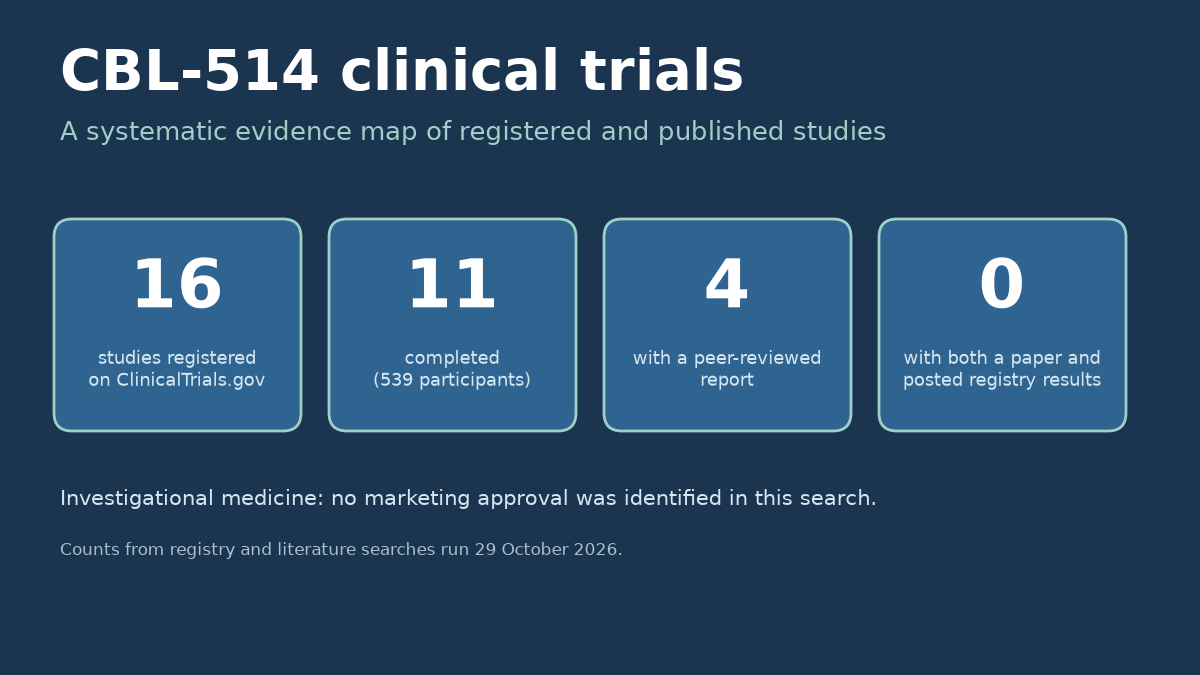
Results. ClinicalTrials.gov holds 16 CBL-514 records. Eleven are completed, with 539 participants enrolled in total. Five are recruiting or not yet recruiting, with 1,440 estimated places.
- Publication: four completed studies (237 participants, 44.0%) have peer-reviewed reports [1, 20, 21, 22]. Four (70 participants, 13.0%) have registry results only. Three (232 participants, 43.0%) have neither.
- No study has both a journal article and posted registry results.
- Registry results timing: for the four studies with posted results, the median interval from primary completion to first results submission was 33.1 months (range 27.2 to 46.4).
- Retrospective registration: two early Australian studies were registered on ClinicalTrials.gov after their primary completion dates. Their earlier ANZCTR records conflict with the later records on design and primary outcome [11, 23, 24, 25].
- Reconciliation: we found at least 19 discrepancies between registry records, papers, a conference abstract and sponsor releases describing the same studies, including two different estimates of the main result of the 2026 trial [21, 26].
- Effect of denominators: in the two published placebo-controlled trials, responder proportions were reported on available-case denominators that left out as much as 54% of the participants randomised to an arm. Under an extreme-case bound, the 8-week comparison in the 2025 trial and the 12-week comparison in the 2026 trial no longer exclude a null or reversed difference.
- Harms reporting: injection-site events were very common in both arms. In the 2025 trial they included discolouration (71.4% vs 11.5%) and induration (61.2% vs 7.7%) [1].
Conclusions. The CBL-514 evidence base is mostly sponsor-generated and only partly peer reviewed. It relies on subjective or operator-dependent outcomes, and in the published trials the people delivering treatment were not masked. Missing outcome data are substantial. The two Phase 3 trials and timely registry results will matter more than any further press release.
What is new here. To our knowledge this is the first systematic map of CBL-514 clinical trials. It is also the first to reconcile every registry record with each paper, sponsor release and conference abstract. It provides the first denominator-sensitivity reanalysis of the published responder results, and the first quantified reporting-gap audit at the participant level. We also set out ten specific research questions that the Phase 3 programme and future registry postings could answer.
Introduction
Injectable fat reduction has one approved pharmacological precedent. Deoxycholic acid (ATX-101) is approved in the United States for submental fat [27]. It was tested in replicated, double-blind Phase 3 trials (REFINE-1 and REFINE-2) and in a European programme [28, 29, 30, 31], and later meta-analyses examined both its efficacy and the influence of industry funding [32, 33]. A 2026 systematic review of injectable lipolytic agents for areas other than the chin found 25 studies with 3,178 patients. It confirmed that deoxycholic acid remains the only approved agent, and only for the submental area [34]. Any new agent for larger body areas is therefore being judged against a sparse and heterogeneous background. The proposed mechanism is appraised separately in CBL-514 mechanism of action: an evidence synthesis.
CBL-514 is the most advanced candidate in that space, and CBL-514 clinical trials now span Phase 1 to Phase 3. Its sponsor describes it as a first-in-class small-molecule injection that induces adipocyte apoptosis without necrosis [2]. The first Phase IIa report described the mechanism in terms of DYRK1b inhibition and changes in caspase 3 and the Bax/Bcl-2 ratio. It cited unpublished confidential company reports as the source [20]. Preclinical literature on how compounds alter adipocyte biology in 3T3-L1 cells and in mice shows why cell and animal findings, however suggestive, cannot stand in for human evidence [35]. CBL-514 is not a peptide. It is included in this series because readers of the peptide literature regularly come across it alongside metabolic and body-composition research, and because its trial record is a useful case study in how evidence on a new injectable builds up.
Review articles already mention CBL-514. A 2023 narrative review of fat-removal methods lists it among emerging approaches [36]. A 2026 practical review of Dercum disease notes its Phase 2 status and Fast Track designation [37]. A 2026 systematic review of Dercum interventions sets it against a field with no standard treatment [38]. None of these reviews lists the registry records, compares them with the publications, or asks how much of the completed research has been reported. That is the gap this article addresses.
The gap matters because reporting bias is a well-documented and serious threat to the evidence on new medicines. Studies with favourable results are more likely to be published, and outcomes are often reported selectively [39, 40]. Registered and published primary outcomes frequently disagree [41, 42], and outcome switching persists even in high-impact journals [43]. Industry-sponsored studies more often reach conclusions favourable to the sponsor [44, 45]. Selective publication can distort the apparent efficacy of a whole drug class [46]. Prospective registration, results databases and editorial policies were introduced to counter these problems [47, 48, 49, 50]. The Declaration of Helsinki requires registration before recruitment and public dissemination of all results, including negative and inconclusive ones [51]. A product whose evidence comes almost entirely from one sponsor is exactly where these safeguards should be tested.
A note on status is essential. CBL-514 is an investigational medicine. A query of the openFDA Drugs@FDA interface on the search date found no application for the sponsor or the compound, while a control query for deoxycholic acid’s US brand returned its approved application [52]. In Australia, clinical trials of unapproved therapeutic goods run under the Clinical Trial Notification or Clinical Trial Approval schemes [53]. The Therapeutic Goods Administration has stated that labels such as “research use only” do not change a product’s regulatory status or remove legal obligations [54, 55]. Nothing in this article is a statement that CBL-514 is safe or effective, and nothing in it describes how the product is or could be used. It is an analysis of research reporting.
Research questions
The map was organised around five questions, each answered with counts from the search log:
- RQ1 (inventory): What human studies of CBL-514 have been registered, in which registries, with what phases, indications, designs, sample sizes and primary outcomes?
- RQ2 (reconciliation): Where a study appears in more than one place (registry, journal, conference, press release), do the design, sample size, masking, primary outcome and results agree?
- RQ3 (appraisal): What is the risk of bias in the published reports, and how sensitive are the headline responder proportions to the handling of missing outcome data?
- RQ4 (transparency): What proportion of completed studies and of enrolled participants have public results, and how long did results take to appear?
- RQ5 (forward agenda): What specific, answerable questions should the Phase 3 programme and future registry postings resolve?
Methods
Design and reporting framework
This is a systematic evidence map, or scoping review, of an investigational medicine’s clinical development. We report it against PRISMA-ScR [6] and adapt the PRISMA 2020 flow diagram [5]. No protocol was registered in advance, and we treat this as a limitation. The unit of analysis is the registry record. Several sponsor protocols were split into staged records, so a “study” here means one ClinicalTrials.gov record or, where there is no such record, one uniquely identified registry entry. Trial design concepts were classified using the SPIRIT 2013 and SPIRIT 2025 protocol items [56, 57]. Intervention descriptions were checked against TIDieR [58], and reporting was compared with CONSORT 2025 and the CONSORT Harms extensions [59, 60, 61].
Information sources and searches
All searches were run on 29 October 2026 (Australia/Brisbane) and saved as raw JSON or HTML. The search strings were chosen to capture known spellings of the code name (“CBL-514”, “CBL514”, “CBL 514”) and the sponsor’s name.
- PubMed [7]: each of the three spellings returned the same 7 records. A combined Boolean query also returned 7. A sponsor-affiliation query (Caliway[ad]) returned 3, all already among the 7.
- Europe PMC [8]: “CBL-514” and “CBL 514” each returned the same 7 records, and “CBL514” returned 0. The sponsor name as free text returned 23 records: the 7 already found plus records that mention the sponsor only in author disclosures or are unrelated.
- Crossref [9]: the works API returned 2 relevant items. One was a research letter already found; the other was a 2026 preclinical conference abstract, excluded as non-clinical.
- ClinicalTrials.gov [10]: queries for “CBL-514” and for the sponsor name each returned the same 16 records. Each record was then retrieved in full through the API’s study endpoint, including submission-tracking fields.
- ANZCTR [11, 23]: the search interface refused automated requests (HTTP 403). Two records (ACTRN12618000868280 and ACTRN12619001580167) were found through web search and read directly.
- WHO ICTRP [12]: queries for the code name and the sponsor returned one record each, both NCT05234736. This shows how far ICTRP’s coverage of this programme lags.
- EU Clinical Trials Register and CTIS [13, 14]: both returned 0 records for the code name and the sponsor. A positive-control query in CTIS returned 487 records, confirming the interface was working.
- ChiCTR and the China CDE trial platform [15]: neither could be searched programmatically (a JavaScript challenge and an HTTP 500 respectively). Web searches found no CBL-514 record in either.
- Taiwan TPIDB [16]: one record, protocol CBL-0206, linked to a ClinicalTrials.gov identifier.
- Sponsor and conference sources: 13 sponsor news releases on clinical milestones were opened and read. Conference libraries were searched, and one clinical abstract (IMCAS World Congress 2025) was found and read [26].
Eligibility
We included any interventional study in humans that administered CBL-514 alone or in combination, in any registry or publication and in any language. Reviews were included as context only, not as evidence of effect. Excluded were preclinical studies, records that mentioned the sponsor only in conflict-of-interest statements, financial reports, and promotional notices that contained no study-level data. Sponsor-sourced study data were included but labelled as sponsor-sourced and not peer reviewed, in line with Good Publication Practice expectations for company-sponsored research [62].
Data extraction
For each ClinicalTrials.gov record we extracted the following fields from the structured API output:
- identifiers, phase, allocation and masking (including who was masked);
- conditions, arms, actual or estimated enrolment and its type, and countries of sites;
- primary and secondary outcomes with time frames;
- study start, primary completion, first-submitted and results-first-submitted dates;
- whether results were posted, the FDA-regulated-drug flag, and the last update date.
For publications we extracted design, masking, the randomised and analysed numbers in each arm, the primary endpoint, how missing data were handled, the effect estimates as published, adverse event tables, funding, author affiliations and registry identifiers. Doses are deliberately not reported: this map concerns evidence quality, not use. Extraction was performed by one reviewer and every number was re-read against the saved source. Single-reviewer extraction is a limitation.
Appraisal
Risk of bias in the randomised comparisons was judged with the five RoB 2 domains: the randomisation process, deviations from intended interventions, missing outcome data, measurement of the outcome, and selection of the reported result [17]. The two randomised dose-comparison studies were assessed with RoB 2 for the dose comparison only. Single-group and non-randomised studies were assessed with ROBINS-I-style signalling questions on confounding, selection, classification of interventions, deviations, missing data, measurement and reporting [18]. Judgements drew on meta-epidemiological evidence that inadequate allocation concealment and absent blinding inflate effect estimates. That inflation is largest for subjective outcomes [63, 64, 65], and unblinded outcome assessors exaggerate effects on subjective binary outcomes [66]. Certainty of evidence was framed with GRADE concepts [67], although we did not pool estimates.
Denominator-sensitivity analysis
Trials often use “intention to treat” loosely [68]. Excluding participants after randomisation can bias comparisons [69], and plausible assumptions about people lost to follow-up can change the conclusions of a trial [70]. Recommended practice is to analyse all randomised participants and to test how robust the result is to departures from the missing-data assumption [71]. ICH E9 defines the full analysis set as being as close as possible to all randomised participants [72], and the E9(R1) estimand addendum requires intercurrent events to be handled explicitly [73]. For each published responder outcome we therefore calculated three versions:
- As published: responders divided by the number assessed.
- Randomised denominator: responders divided by the number randomised, which treats missing participants as non-responders.
- Extreme-case bound: missing CBL-514 participants counted as non-responders and missing placebo participants as responders.
The third version is deliberately unfavourable to the active arm. It is a stress test, not an estimate of the true effect.
Reporting-timeliness analysis
For each completed record we calculated:
- registration timing: days from the start date to first submission, where a negative value means prospective registration;
- the results interval: months from primary completion to the first results submission;
- for studies without posted results, months from primary completion to 29 October 2026.
Months were calculated as days divided by 30.44. Under 42 CFR 11.44, results for an applicable clinical trial are generally due no later than one year after primary completion. A sponsor may delay submission by certifying that the product is unapproved and still being studied [19, 74, 75]. Phase 1 trials are outside the definition of an applicable clinical trial, and studies with no US site and no FDA-regulated status may fall outside it. We therefore report the intervals descriptively and do not judge legal compliance. Australian expectations for registration and dissemination come from the National Statement [76], and ICH E6(R3) frames transparency as part of good clinical practice [77].
Results: the CBL-514 clinical trials identified
Search and selection
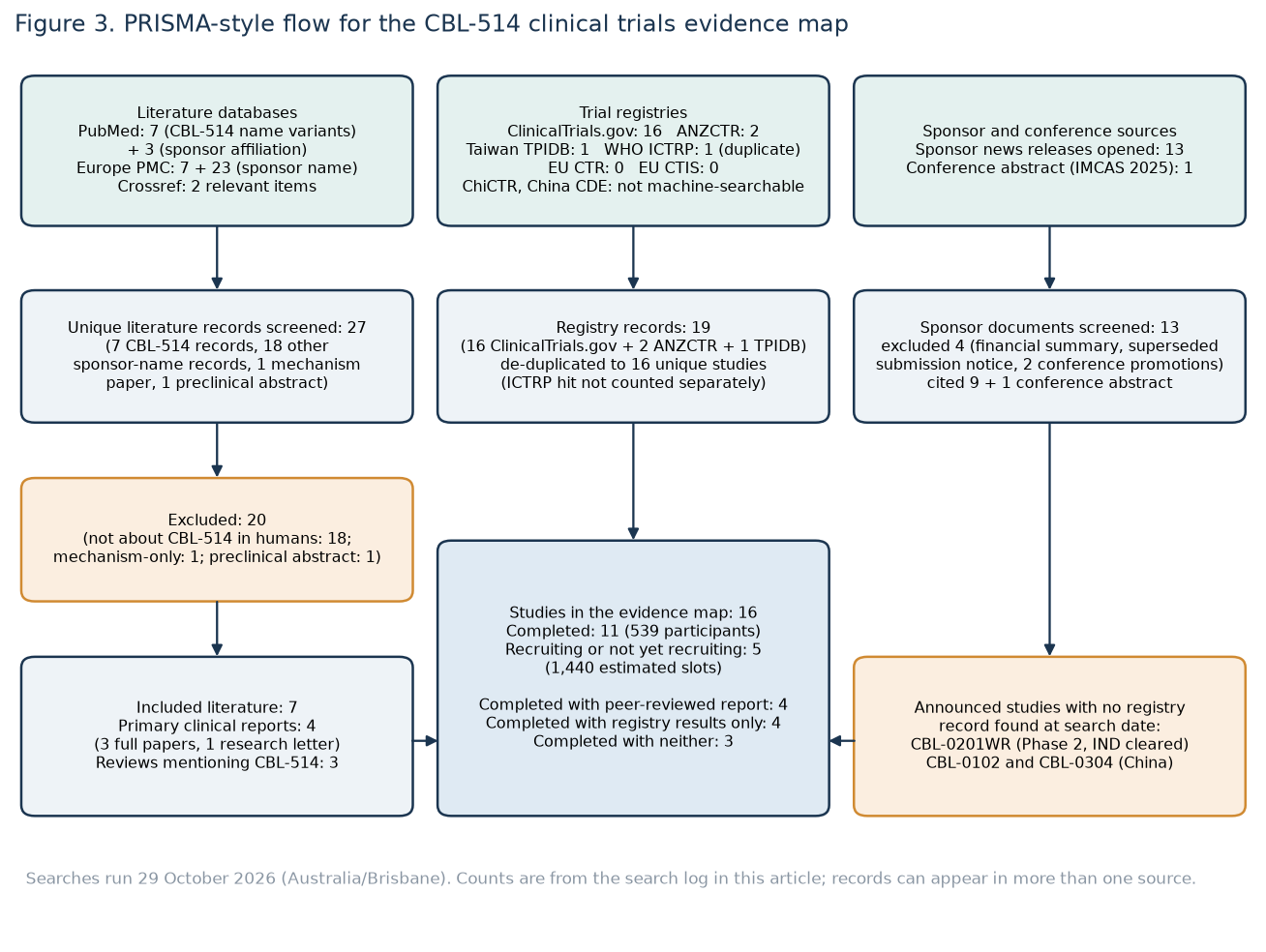
Figure 3 summarises the flow. The literature databases yielded 27 unique records after de-duplication. These were the 7 CBL-514 records, 18 further records retrieved only by the sponsor-name query in Europe PMC, 1 record from a mechanism query and 1 Crossref preclinical abstract. Twenty were excluded: 18 did not concern CBL-514 in humans, 1 concerned mechanism only and 1 was preclinical. That left 7 included publications (27 − 20 = 7). Four are primary clinical reports, three full papers and one research letter [1, 20, 21, 22], and three are reviews used for context [34, 36, 37].
The registries gave 19 records:
- 16 on ClinicalTrials.gov;
- 2 on ANZCTR;
- 1 on TPIDB.
The ICTRP hit was a duplicate. After the two ANZCTR records and the TPIDB record were matched to their ClinicalTrials.gov counterparts, 16 unique studies remained (19 − 3 = 16). Of the 13 sponsor releases screened, 4 were excluded; those excluded duplicated information in other releases or contained no study-level data, leaving 9 cited [2, 78, 79, 80, 81, 82, 83, 84, 85] plus one conference abstract [26].
The sponsor’s releases also describe three studies that had no registry record we could find on the search date:
- CBL-0201WR: a Phase 2 combination study with an approved weight-management medicine, for which an IND has been cleared [85].
- CBL-0102 and CBL-0304: a Phase 1 study and a planned Phase 3 study for China, for which an IND was submitted to the national regulator [83].
Because the Chinese registries could not be searched by machine, their absence there is unconfirmed.
Inventory of studies
Table 1 lists all 16 ClinicalTrials.gov records, broadly in order of study start. By the registry’s phase field, 1 record is Phase 1 (NCT04699669), 12 are Phase 2 and 3 are Phase 3 (1 + 12 + 3 = 16). The Phase 2 group includes studies the sponsor calls Phase 2a or 2b, and the Phase 3 group includes the Phase 3b follow-up study (NCT07733947). The 12 Phase 2 records are the 10 completed Phase 2 studies plus the two stages of CBL-0206 (10 + 2 = 12). The completed Phase 1 study brings the number of completed studies to 11.
By indication:
- abdominal or localised subcutaneous fat, including one pharmacokinetic study in healthy volunteers: 12 records;
- Dercum disease: 2;
- cellulite (oedematous fibrosclerotic panniculopathy): 2.
The 11 completed studies enrolled 40 + 43 + 25 + 10 + 75 + 12 + 12 + 23 + 107 + 173 + 19 = 539 participants [24, 25, 86, 87, 88, 89, 90, 91, 92, 93, 94]. That figure is close to, but different from, the sponsor’s statement that “more than 544 subjects” have taken part in CBL-514 trials [2, 83]. The difference of at least six participants may reflect studies registered elsewhere, expanded-access use mentioned in a sponsor release [78], or different counting rules. The public record does not allow it to be resolved.
Table 1. Inventory of registered CBL-514 clinical trials (ClinicalTrials.gov, cross-matched to ANZCTR and TPIDB), status at 29 October 2026
| # | Protocol | Registry IDs | Phase and design (as registered) | Population and sites | N (type) | Registered primary outcome | Status | Public results |
|---|---|---|---|---|---|---|---|---|
| 1 | CBL-16001 (Phase 1) | NCT04699669; ACTRN12618000868280 | Phase 1; randomised, participant and investigator masked | Adults with abdominal fat; Australia | 40 (actual) | Treatment-emergent adverse events, laboratory, vital signs, ECG, examination, injection-site reactions | Completed (primary completion 20 Aug 2019) | None |
| 2 | CBL-16001 (Phase 2a) | NCT04698642; ACTRN12619001580167 | Phase 2a; random allocation to three dose groups, open label | Adults with abdominal fat; Australia | 43 (actual) | Change in abdominal subcutaneous fat volume | Completed (12 Nov 2020) | Journal article [20] |
| 3 | CBL-0202 Stage 1 | NCT04575467 | Phase 2; non-randomised, open label, four dose groups | Adults with abdominal fat; Australia | 25 (actual) | Safety and injection-site reactions to 4 weeks | Completed (15 Nov 2021) | Registry results |
| 4 | CBL-0203 | NCT05234736 | Phase 2; single group, pharmacokinetic | Healthy volunteers; United States | 10 (actual) | Plasma pharmacokinetic parameters | Completed (9 Jun 2022) | Registry results |
| 5 | CBL-0202 Stage 2 | NCT04897412 | Phase 2; randomised, participant masked, saline placebo | Adults with abdominal fat; Australia, United States | 75 (actual) | Proportion losing at least 150 mL of subcutaneous fat by 8 weeks | Completed (22 Feb 2023) | Journal article [1] |
| 6 | CBL-0201DD | NCT05387733 | Phase 2a; randomised, open label, two groups | Adults with Dercum disease; United States | 12 (actual) | Lipoma or nodule response, days 0 to 84 | Completed (3 Apr 2023) | Research letter [22] |
| 7 | CBL-0201EFP Stage 1 | NCT05632926 | Phase 2a; non-randomised, open label, three dose groups | Adults with cellulite; United States | 12 (actual) | Cellulite Severity Scale change to week 4 | Completed (3 May 2023) | Registry results |
| 8 | CBL-0201EFP Stage 2 | NCT05836779 | Phase 2a; single group, open label | Adults with cellulite; United States | 23 (actual) | Cellulite Severity Scale change to 4 weeks after final treatment | Completed (29 Nov 2023) | Registry results |
| 9 | CBL-0204 | NCT05736107 | Phase 2b; randomised, participant and outcomes assessor masked, saline placebo | Adults with abdominal fat; United States | 107 (actual) | At least 1-grade improvement on CR-AFRS at 12 weeks | Completed (20 May 2024) | Journal article [21] |
| 10 | CBL-0205 | NCT06005441 | Phase 2b; randomised factorial, participant and outcomes assessor masked, four arms including two comparator formulations and saline | Adults with abdominal fat; United States | 173 (actual) | Percentage with at least 20% subcutaneous fat change | Completed (18 Oct 2024) | None |
| 11 | CBL-0202DD | NCT06303570 | Phase 2; randomised, participant masked, saline placebo | Adults with Dercum disease; United States | 19 (actual) | Pain at week 20 | Completed (23 Mar 2026) | None (sponsor release only) |
| 12 | CBL-0301 (SUPREME-01) | NCT07140939 | Phase 3; randomised, triple masked, saline placebo | Adults with abdominal fat; United States, Canada | 320 (estimated) | At least 2-grade improvement on PR-AFRS and CR-AFRS | Recruiting | Not applicable |
| 13 | CBL-0302 (SUPREME-02) | NCT07526974 | Phase 3; randomised, triple masked, saline placebo | Adults with abdominal fat; Australia, Canada, United States | 320 (estimated) | At least 2-grade improvement on PR-AFRS (composite with fat reduction) | Not yet recruiting | Not applicable |
| 14 | CBL-0206 Stage 1 | NCT07608770 | Phase 2b; randomised, participant masked, saline placebo | Adults with abdominal fat; Australia (Taiwanese sites listed on TPIDB) | 250 (estimated) | Percentage change in abdominal fat versus placebo | Recruiting | Not applicable |
| 15 | CBL-0206 Stage 2 | NCT07608757; TPIDB protocol CBL-0206 | Phase 2b; open-label re-treatment stage | Adults with abdominal fat; Australia (Taiwan per TPIDB) | 250 (estimated) | Percentage change in abdominal fat | Not yet recruiting | Not applicable |
| 16 | CBL-0303 Stage 1 | NCT07733947 | Phase 3b; double-blind long-term follow-up (participant, investigator and outcomes assessor masked) then open-label extension | Participants from parent Phase 3 studies; United States | 300 (estimated) | Percentage with at least one treatment-emergent adverse event at 6, 9 and 12 months | Not yet recruiting | Not applicable |
Sources for Table 1: registry records [3, 4, 11, 16, 23, 24, 25, 86, 87, 88, 89, 90, 91, 92, 93, 94, 95, 96, 97]; publications as cited in the final column. Abbreviations: CR-AFRS and PR-AFRS, clinician-reported and patient-reported abdominal fat rating scales. Doses and dose groups are not reported, by design.
The five ongoing records list 320 + 320 + 250 + 250 + 300 = 1,440 estimated places [3, 4, 95, 96, 97]. These places are not all different people. According to its record and a sponsor release, CBL-0303 follows participants from the two Phase 3 parent studies [80, 97], and the CBL-0206 Stage 2 record describes re-treatment within the same protocol [95, 96]. If both overlaps are complete, the number of new participants could be as low as 320 + 320 + 250 = 890. That is 61.8% of the headline estimate (890 ÷ 1,440).
Registration timing
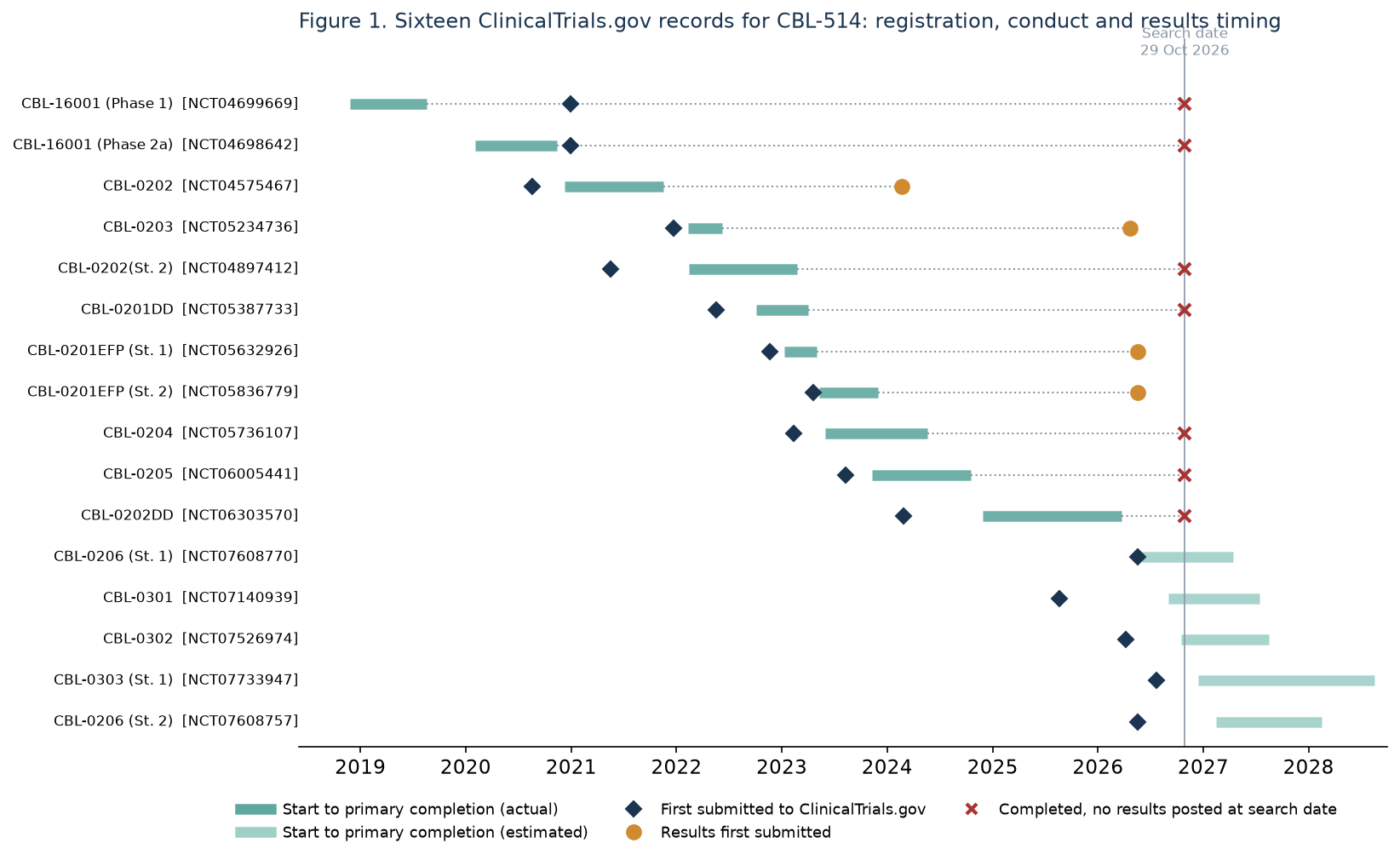
Fourteen of the 16 ClinicalTrials.gov records (87.5%) were submitted before the study started. The two exceptions are the two stages of the first-in-human protocol. The Phase 1 record was submitted 763 days after its start date and about 16 months after primary completion. The Phase 2a record was submitted 330 days after its start and after its primary completion date of 12 November 2020 [24, 25]. Both studies had been registered earlier on ANZCTR, so they were registered prospectively somewhere [11, 23]. This matches the ICMJE requirement, which accepts any primary registry in the WHO network [48, 50]. Research on registration timing shows that retrospective entries are common [98], and that a later record in a second registry is where discrepancies are most likely to appear. That is the case here.
Reconciliation of registry records, publications and sponsor statements
Table 2 lists every discrepancy we found between the sources that describe the same study. Most are small one at a time. Together they show a pattern: the record that a reader is most likely to find first, ClinicalTrials.gov or a press release, is often not the one that matches the published paper.
Table 2. Registry, publication, conference and sponsor-release reconciliation for CBL-514 studies
| Study | Item | Source A | Source B | Discrepancy and why it matters |
|---|---|---|---|---|
| CBL-16001 Phase 1 | Allocation and masking | ANZCTR: non-randomised allocation, described as double blind and placebo controlled | ClinicalTrials.gov: randomised, participant and investigator masked | Design cannot be confirmed from public sources; no results are posted on either registry |
| CBL-16001 Phase 1 | Start date | ANZCTR: first enrolment 11 Dec 2018 | ClinicalTrials.gov: start 27 Nov 2018 | 14-day difference in recorded start |
| CBL-16001 Phase 2a | Sample size and status | ANZCTR: target 66, accrual 23, status Recruiting (last updated 2020) | ClinicalTrials.gov: 43 actual, completed; paper: 43 enrolled of 47 planned | ANZCTR record stale for about six years; three different planned sizes (66, 47 and an unstated target) |
| CBL-16001 Phase 2a | Primary outcome | ANZCTR: change in waist circumference by tape measure | ClinicalTrials.gov and paper: change in subcutaneous fat volume by ultrasound | Primary outcome differs between registries; the paper reports the later one |
| CBL-16001 Phase 2a | Adverse-event withdrawals | Paper text: 8 | Paper flow: 7 | Internal inconsistency; 28 of 43 completed (65.1%) |
| CBL-16001 (both) | Cross-links | ANZCTR records | ClinicalTrials.gov records | Neither ANZCTR record cites an NCT number or a publication |
| CBL-0202 Stage 2 | Randomised number | Paper: 81 enrolled, 76 randomised, 75 treated | ClinicalTrials.gov: 75 actual | One participant randomised but never treated appears only in the paper |
| CBL-0202 Stage 2 | Non-completion | Paper: 37 of 75 did not complete | Listed reasons: 6 + 7 + 7 + 6 + 4 = 30 | Reasons for 7 non-completers (18.9% of 37) are not given |
| CBL-0202 Stage 2 | Responder counts | Paper: 28 of 50 in the CBL-514 arm lost at least 150 mL at some point | Paper: 16 of 23 assessed at week 8 | Two responder counts with different denominators; the “ITT” label is applied to available cases |
| CBL-0204 | Randomised number | Paper: 108 randomised 1:1 | ClinicalTrials.gov and IMCAS abstract: 107 | One-participant difference not explained |
| CBL-0204 | Masking | Paper title and abstract: single blind | ClinicalTrials.gov: participant and outcomes assessor masked | Whether the clinician rating the primary outcome was masked is contested between sources |
| CBL-0204 | Primary result | IMCAS 2025: 81.8% vs 16.7% and 18.5% | Paper: 76.7% (23/30) vs 18.9% (7/37) CR-AFRS; 76.7% vs 19.4% (7/36) PR-AFRS | Different estimates for the same trial in two sponsor-authored outputs |
| CBL-0204 | Analysis set | Paper: full analysis set of 30 vs 37 | Randomisation 1:1 (108) | Arm imbalance in the analysed set; 41 of 108 (38.0%) not analysed |
| CBL-0204 or unidentified | Volume effect | IMCAS: “Phase 2b” difference of −28.1% and −276.8 mL | Paper: MRI least-squares mean −152.9 mL (−20.3%) | Metric and study source of the conference figures are unclear |
| Phase 2b (unidentified) | 2-grade responders | Sponsor release: 24–32% (PR-AFRS) and 23–30% (CR-AFRS) vs 0–2.5% | No registry results for CBL-0204 or CBL-0205 | The figure used to justify the Phase 3 endpoint cannot be traced to a public dataset |
| CBL-0201DD | Pain effect | Fast Track release: improvement of 4.7 points | Research letter: median change −4.0 | Mean and median from different analyses; the letter uses the lipoma as the unit of analysis and last observation carried forward |
| CBL-0202DD | Primary result | Sponsor release: week-20 pain reduction 3.1 vs 1.9 (p = 0.005) | ClinicalTrials.gov: no results; no paper | Primary result available only from the sponsor |
| Programme | Completed trials | Sponsor: 10 completed trials with finalised statistical reports; more than 544 participants | ClinicalTrials.gov: 11 completed; 539 enrolled | Counting rules unstated |
| CBL-0301 | Primary endpoint | Sponsor release: endpoint amended on FDA advice to a 2-grade improvement on both scales; MRI moved to secondary | ClinicalTrials.gov: 2-grade improvement primary | Registry updated consistently with the amendment, so the change is transparent |
| CBL-0206 | Sites | ClinicalTrials.gov: Australian sites only | TPIDB: 8 Taiwanese sites, Taiwan 200 of 250 participants, linked to the Stage 2 NCT number | Country mix and stage linkage differ between registries |
Sources for Table 2: [1, 3, 11, 16, 20, 21, 22, 23, 24, 25, 26, 78, 79, 83, 84, 88, 89, 92, 93, 94, 95, 96].
These findings repeat patterns documented across the trial literature. Discrepancies between registered and published primary outcomes affect a median of about 31% of trials in systematic reviews [42], and they occur even in adequately registered trials [41]. In one cohort, 62% of trials had at least one primary outcome changed, introduced or omitted between protocol and publication [40]. The CBL-514 Phase 2a waist-circumference to fat-volume change is one example. In contrast, the Phase 3 endpoint amendment was recorded openly in the registry, which is the behaviour registration is meant to encourage [75].
Endpoints and measurement methods
The sixteen studies use nine kinds of endpoint, summarised in Table 3. The programme has moved its main outcome measure three times:
- Ultrasound-derived fat volume, as a continuous change or a 150 mL responder threshold, in the early Phase 2 studies [1, 20].
- A one-grade improvement on a clinician-rated photonumeric scale in CBL-0204 [21, 92].
- A two-grade improvement on both the patient-rated and the clinician-rated scales, with MRI volume as a key secondary endpoint, in the Phase 3 studies [3, 4, 84].
Each step makes the outcome more relevant to patients and more comparable with the approach regulators took for injectable deoxycholic acid, where co-primary clinician- and patient-reported scales were used [27, 28, 29]. Each step also means that earlier results cannot be pooled with later ones.
Table 3. Endpoints and measurement methods used across CBL-514 clinical trials
| Endpoint family | Studies using it (role) | How it is measured | Methodological issues relevant to appraisal |
|---|---|---|---|
| Ultrasound fat thickness and derived volume | CBL-16001 Phase 2a (primary); CBL-0202 Stage 2 (primary, at least 150 mL loss) | Thickness at 4 scan points, triplicate scans, converted to volume with a cuboid formula; 2 designated sonographers per centre | Operator dependent; volume is calculated, not imaged; standardised placement and reader masking are needed for reliability; masking of sonographers is not stated while site staff were unmasked |
| MRI subcutaneous fat volume | CBL-0204 (secondary); CBL-0301 and CBL-0302 (key secondary) | Least-squares mean change in millilitres and per cent | More objective; region-of-interest definition and reader masking not described in public sources |
| Clinician-reported Abdominal Fat Rating Scale (CR-AFRS) | CBL-0204 (primary, at least 1 grade); Phase 3 (co-primary, at least 2 grades) | Photonumeric grading by an investigator | No published validation study identified in the retrieved records; masking of the rater differs between sources (Table 2) |
| Patient-reported Abdominal Fat Rating Scale (PR-AFRS) | CBL-0204 (secondary); Phase 3 (co-primary) | Participant self-rating | Visible injection-site reactions could reveal allocation to participants and so bias self-ratings |
| Percentage fat change responder | CBL-0205 (primary, at least 20%); CBL-0206 (primary, continuous) | Imaging-derived percentage change | Threshold not linked in public sources to a minimal important difference |
| Cellulite Severity Scale | CBL-0201EFP Stages 1 and 2 (primary) | Modified Hexsel photonumeric scale, total score | Thighs (two per participant) used as units in secondary outcomes; groups of 4 participants |
| Lipoma volume and lipoma pain | CBL-0201DD (primary); CBL-0202DD (pain at week 20, primary) | Lipoma measurement; pain rating scale | Lipoma used as the unit of analysis (clustering); last observation carried forward; pain self-rated in open-label or participant-masked designs |
| Plasma pharmacokinetics | CBL-0203 (primary) | Peak concentration, time to peak, exposure, half-life, clearance and volume after a single course | Results tabulated under two analyte labels; 10 healthy volunteers; single course only |
| Safety and tolerability | All studies; CBL-16001 Phase 1, CBL-0202 Stage 1 and CBL-0303 (primary) | Treatment-emergent adverse events, laboratory values, vital signs, ECG, injection-site reactions | Mostly short follow-up; long-term data planned only in CBL-0303 |
Sources for Table 3: [1, 3, 4, 20, 21, 22, 24, 25, 84, 86, 87, 88, 89, 90, 91, 92, 93, 94, 95, 97, 99, 100, 101, 102].
Ultrasound measurement of subcutaneous fat can be reliable, but only when probe placement, compression and reader training are standardised [99]. The CBL-0202 Stage 2 paper reports some of these measures (designated sonographers and triplicate scans). It also reports that investigators and site staff were unmasked [1]. Whether the people taking the measurements knew the allocation therefore matters a great deal, and the paper does not say.
The Dercum disease studies have a different problem. Dercum disease is defined by painful lipomas, often many in one person, and its diagnostic criteria and classification are still debated [101]. When several lipomas from the same participant are analysed as independent observations, the effective sample size is inflated and confidence intervals become too narrow [102]. The research letter reports results with the lipoma as the unit and uses last observation carried forward [22]. To its credit, it also deposits the underlying data in a public repository.
The cellulite studies use a version of a validated photonumeric scale [100]. They count thighs rather than people for the secondary responder outcome [90, 91], which raises the same clustering issue.
Outcomes as published
This section reports what each study measured and what its authors or registry entry said, with no attempt to pool. Pooling is not justified given the different endpoints, designs and populations (Table 3). None of the figures below shows that CBL-514 is effective. Each is a reported estimate whose reliability is appraised in the next sections.
CBL-16001 Phase 2a (43 participants). Participants were randomly allocated to one of three dose groups with no placebo arm. The study was open label [20, 25]. The paper reports a mean ultrasound-derived volume reduction of 24.96% in the highest-dose group. With no untreated comparator, this change cannot be separated from measurement drift, regression to the mean or changes in behaviour, even though participants who gained or lost 5% or more of their body weight were withdrawn. Twenty-eight of 43 participants completed (65.1%). The paper says that part of the proposed mechanism rests on unpublished confidential reports [20].
CBL-0202 Stage 2 (75 treated). This was a placebo-controlled study with participants masked by visual barriers. The investigators, site staff and the sponsor’s medical monitor were unmasked [1]. The registered primary outcome was the proportion losing at least 150 mL of subcutaneous fat [88]. The paper’s “intention-to-treat” analysis reports 69.6% for CBL-514 against 0% for placebo at 8 weeks, and 63.9% against 17.4% at 4 weeks [1].
Non-completion was 49.3% (37 of 75). The authors attribute it to strict protocol rules, including withdrawal for any weight change of 3 kg or more [1]. That rule matters. A participant whose weight changed was removed from the analysis, and weight change is directly linked to the outcome (fat volume). The missing data are therefore unlikely to be missing at random [70, 71].
CBL-0204 (108 randomised in the paper; 107 on the registry). The published abstract reports at least a one-grade improvement on the clinician-rated scale in 76.7% (23/30) of the CBL-514 arm against 18.9% (7/37) of the placebo arm. On the patient-rated scale it reports 76.7% (23/30) against 19.4% (7/36). It also reports an MRI least-squares mean change of −152.9 mL (−20.3%) [21]. Analysed groups of 30 and 37 out of 108 randomised 1:1 mean that 41 participants (38.0%) are not in the full analysis set, and that losses were uneven between arms. The IMCAS 2025 abstract gives 81.8% against 16.7% and 18.5% for the same trial [26]. Our appraisal of this trial relies on the abstract and registry because the full text was not open access when we searched.
CBL-0201DD (12 participants with Dercum disease). This open-label randomised study compared two doses with no placebo [22, 89]. The research letter reports a median change in lipoma pain of −4.0 and relative lipoma volume reductions, analysed per lipoma with last observation carried forward. It reports no serious adverse events, severe adverse events in 4 participants and 2 discontinuations [22]. The Fast Track announcement for this indication quoted a pain improvement of 4.7 points [78]. That figure is not the published median and may be a mean from a different analysis. Fast Track designation speeds up development and review. It is not a finding of effectiveness and not an approval [103].
Studies reported only on the registry.
- CBL-0202 Stage 1 (non-randomised, four dose groups, 25 participants) posted its safety results. The registry lists 103, 57, 69 and 61 treatment-emergent events in the four groups (290 events in total), and every participant had at least one non-serious event (6 + 7 + 6 + 6 = 25 of 25). There was one serious event, a closed head injury with post-concussive symptoms. One participant had a clinically significant laboratory abnormality [86].
- CBL-0203 (10 healthy volunteers) posted pharmacokinetic results. Peak plasma concentrations and times to peak are listed under two analyte labels, “curcumin of CBL-514” and “resveratrol of CBL-514”. All 10 participants had non-serious adverse events and none had a serious event [87]. No public source we found explains these labels or the chemical relationship between CBL-514 and the two named compounds. Curcumin itself has been studied in preclinical work for effects on fat cells [35]. The published trial reports describe CBL-514 only as a small-molecule injection [1].
- CBL-0201EFP Stage 1 (three groups of 4 participants) reported mean Cellulite Severity Scale changes at week 4 of −2.0, −1.5 and −2.6 points from baseline means of 6.8, 6.1 and 7.8 [90].
- CBL-0201EFP Stage 2 (single arm, 23 enrolled, 22 analysed) reported a mean change of −1.2 points (standard deviation 1.3). One participant had serious adverse events recorded as hypersensitivity and obstructive airways disorder. Eighteen of 23 (78.3%) had non-serious events [91].
None of the four registry-only result sets has a placebo arm, so none supports any comparative inference.
Studies with no public results. These are the Phase 1 study (40 participants), CBL-0205 (173) and CBL-0202DD (19). For CBL-0202DD, a sponsor release says the primary endpoint was met. It gives week-20 pain reductions of 3.1 against 1.9 points in the full analysis set (p = 0.005) [79], but there are no registry results or peer-reviewed report. No public results of any kind were found for CBL-0205, the largest completed study, a four-arm factorial trial that included two comparator formulations [93].
Safety as reported
The largest published randomised safety table comes from CBL-0202 Stage 2. It lists injection-site adverse events by preferred term for 49 CBL-514 and 26 placebo participants [1].
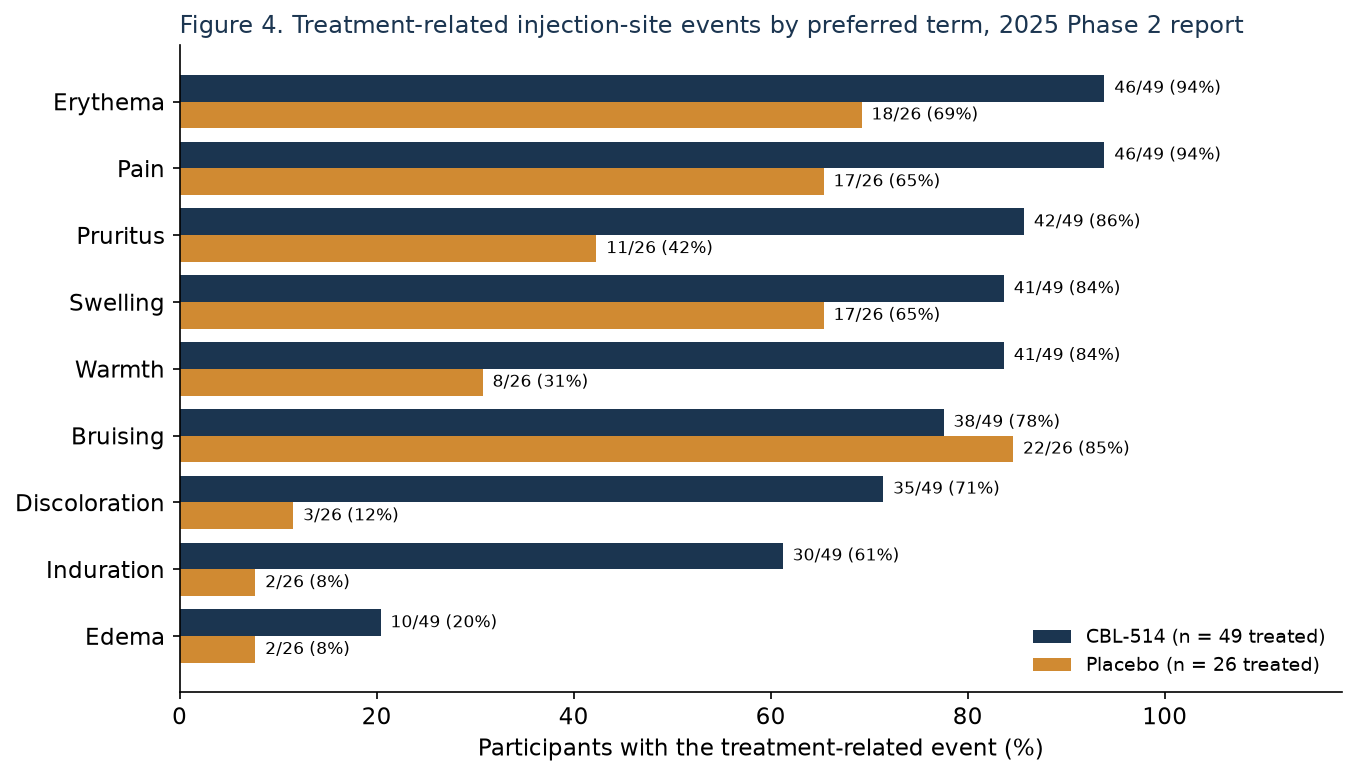
Some injection-site events were common in both arms: erythema (46/49, 93.9%, against 18/26, 69.2%), pain (93.9% against 65.4%) and bruising (77.6% against 84.6%). The placebo injections were themselves an invasive procedure. Three events were far more common with CBL-514:
- discolouration: 35/49 (71.4%) against 3/26 (11.5%);
- induration: 30/49 (61.2%) against 2/26 (7.7%);
- warmth: 41/49 (83.7%) against 8/26 (30.8%).
These calculations use the published counts [1]. Severe treatment-related events, all injection-site pain, were reported in 9 CBL-514 participants (18.4%) and no placebo participants. Pain resolved within one week in 57 of 63 affected participants (90.5%). Two participants stopped treatment because of a treatment-related event, and one serious event (peritoneal metastasis) was judged unrelated [1].
Two consequences follow for appraisal. First, a difference of about 60 percentage points in visible discolouration and induration (71.4 − 11.5 = 59.9; 61.2 − 7.7 = 53.5) means participants could probably tell which arm they were in. That weakens the participant-only masking on which the CBL-0202 and CBL-0204 designs depend, and it bears directly on the patient-rated scale chosen as a co-primary endpoint in Phase 3 [63, 64, 65, 66]. Second, harms were reported mainly as preferred-term frequencies. The paper gives little information on timing, duration, severity by arm and dose, or how events were collected. CONSORT Harms asks for exactly these details [60, 61].
For context, injectable deoxycholic acid, the closest approved comparator, carries label warnings for marginal mandibular nerve injury and injection-site reactions in the submental area [27, 28]. The CBL-514 trials have not yet reported comparable nerve-specific surveillance across abdominal sites. Its absence from public reports is a gap, not evidence that such events do not occur.
Denominator sensitivity results
The published responder estimates are highly sensitive to how missing participants are counted. We re-expressed the reported counts on three denominators:
- As published: participants assessed at that visit.
- Randomised denominator: all randomised participants, with missing participants counted as non-responders. This is a conservative but common convention [68, 69].
- Extreme-case bound: missing participants counted as non-responders in the CBL-514 arm and as responders in the placebo arm [70].
The third denominator is not a plausible estimate. It is a stress test that shows how much of the published contrast depends on the missing data.
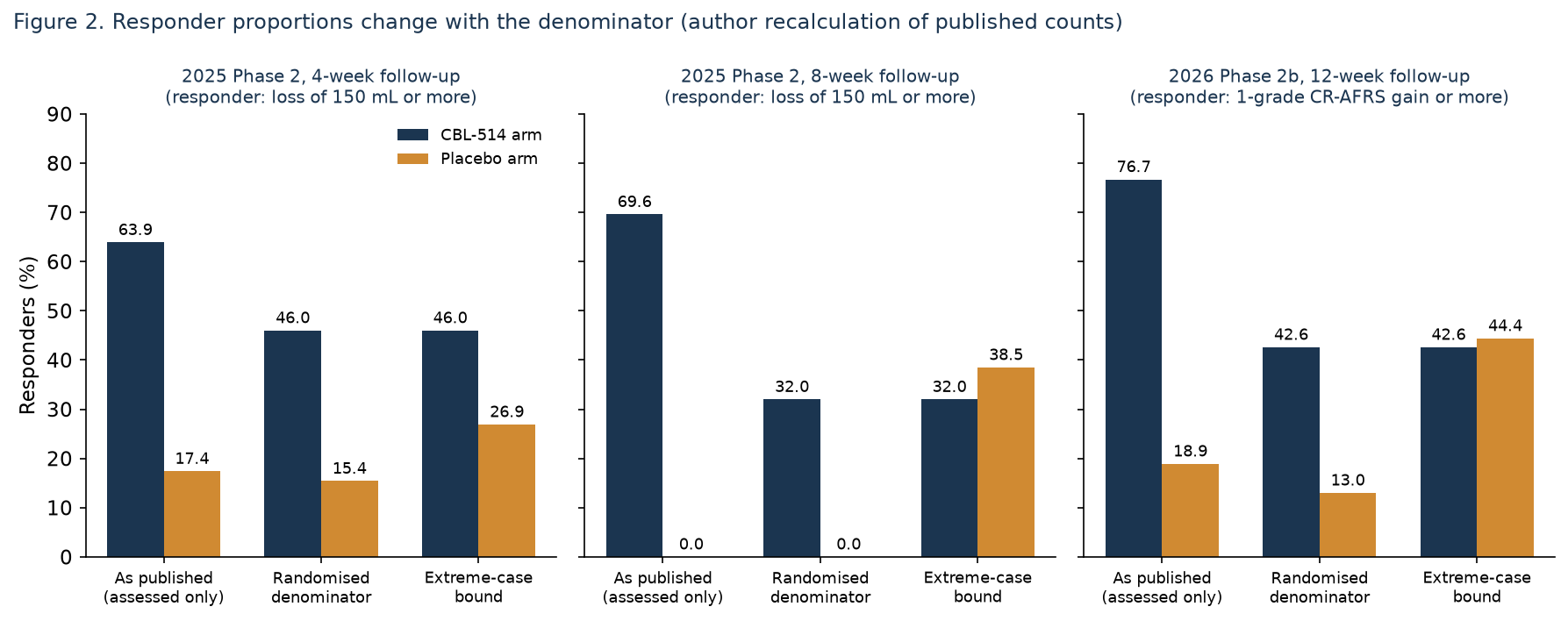
The arithmetic for CBL-0202 Stage 2 at 4 weeks:
- As published: 23/36 = 63.9% against 4/23 = 17.4%.
- Randomised denominator: 23/50 = 46.0% against 4/26 = 15.4%.
- Extreme case: 23/50 = 46.0% against (4 + 3)/26 = 26.9%.
At 8 weeks:
- As published: 16/23 = 69.6% against 0/16 = 0%.
- Randomised denominator: 16/50 = 32.0% against 0/26 = 0%.
- Extreme case: 32.0% against 10/26 = 38.5%. The ten placebo participants not assessed are counted as responders, and the direction of the contrast reverses.
For CBL-0204, assuming 54 participants per arm:
- As published: 23/30 = 76.7% against 7/37 = 18.9%.
- Randomised denominator: 23/54 = 42.6% against 7/54 = 13.0%.
- Extreme case: 42.6% against (7 + 17)/54 = 44.4%.
These are our calculations from published counts [1, 21]. On the randomised denominator, the CBL-514 arms still have higher response rates in all three comparisons. The size of the difference, however, shrinks by 16 to 38 percentage points:
- 4 weeks: 46.5 points published against 30.6 on the randomised denominator;
- 8 weeks: 69.6 against 32.0;
- CBL-0204: 57.8 against 29.6.
Under the extreme case the contrast disappears or reverses. This does not show that CBL-514 lacks an effect. It shows that the published data, as analysed on available cases, cannot settle the question. Missing data of this size need a pre-specified estimand and multiple imputation or tipping-point analyses, as ICH E9(R1) recommends [71, 72, 73]. Labelling an available-case analysis “intention to treat” does not meet that standard [68].
Risk-of-bias appraisal
Table 4 gives our domain-level judgements. We used RoB 2 for the randomised placebo-controlled comparisons, and RoB 2 for the dose comparisons in the two randomised studies without placebo [17]. For non-randomised and single-arm studies we used a ROBINS-I-informed judgement [18], but these studies have no comparator, so confounding cannot be addressed and they offer no comparative evidence.
Table 4. Risk-of-bias appraisal of CBL-514 clinical trials with public results
| Study (report) | Randomisation | Deviations from intended intervention | Missing outcome data | Outcome measurement | Selection of reported result | Overall |
|---|---|---|---|---|---|---|
| CBL-0202 Stage 2 [1] | Some concerns: method and concealment not verifiable in full | Some concerns: participant-only masking; investigators and site staff unmasked | High: 49.3% non-completion; withdrawal rule linked to outcome; available-case “ITT” | High: assessor masking not stated; visible injection-site reactions | Some concerns: two responder counts with different denominators | High |
| CBL-0204 [21] | Some concerns: arm imbalance in analysed set (30 vs 37) | Some concerns: described as single blind | High: 38.0% of randomised not in analysis set | Some concerns: rater masking contested between sources | Some concerns: estimates differ between paper and conference abstract | High |
| CBL-16001 Phase 2a [20] | Low to some concerns (dose comparison only) | High: open label | High: 34.9% did not complete | High: open-label outcome assessment | High: registered primary outcome differs between registries | High |
| CBL-0201DD [22] | Some concerns: 12 participants, dose comparison only | High: open label | Some concerns: LOCF imputation | High: self-rated pain in open-label design | Some concerns: lipoma as unit; mean and median pain figures differ between sources | High |
| CBL-0202 Stage 1; CBL-0203; CBL-0201EFP Stages 1 and 2 (registry results) | Not randomised or single arm | Open label | Low to some concerns (small losses) | Not applicable to comparative claims | Some concerns: registry tables only, no protocol or statistical analysis plan posted | Critical for any comparative inference; descriptive safety only |
Sources for Table 4: appraisal by the authors of this map using [1, 17, 18, 20, 21, 22, 23, 26, 78, 86, 87, 90, 91]. Percentages: 37/75 = 49.3%; 41/108 = 38.0%; 15/43 = 34.9%.
All four randomised reports have an overall high risk of bias for their primary efficacy outcome. Had we applied GRADE, the certainty of evidence would start at high for randomised evidence. It would then be rated down at least two levels, for risk of bias and for imprecision (small samples and wide intervals), and possibly further for indirectness given the changing endpoints. That leaves low to very low certainty for every efficacy outcome [67]. Sponsor funding and sponsor-employed authors are disclosed in the published reports [1, 22]. Industry sponsorship is associated with more favourable conclusions, independent of the measurable risk-of-bias domains [44].
Reporting timeliness results
Table 5. Results reporting status of the 11 completed CBL-514 clinical trials at 29 October 2026
| Study | Registry ID | Participants | Primary completion | Registry results first submitted | Months to results, or months with no results | Peer-reviewed report | US results rule applies? |
|---|---|---|---|---|---|---|---|
| CBL-16001 Phase 1 | NCT04699669 | 40 | 20 Aug 2019 | None | 86.3 with none | None | No (Phase 1, Australian sites) |
| CBL-16001 Phase 2a | NCT04698642 | 43 | 12 Nov 2020 | None | 71.5 with none | 2022 [20] | No (Australian sites, not FDA-regulated in record) |
| CBL-0202 Stage 1 | NCT04575467 | 25 | 15 Nov 2021 | 22 Feb 2024 | 27.2 | None | Probably |
| CBL-0203 | NCT05234736 | 10 | 9 Jun 2022 | 22 Apr 2026 | 46.4 | None | Uncertain (pharmacokinetic study) |
| CBL-0202 Stage 2 | NCT04897412 | 75 | 22 Feb 2023 | None | 44.2 with none | 2025 [1] | Probably |
| CBL-0201DD | NCT05387733 | 12 | 3 Apr 2023 | None | 42.9 with none | 2026 [22] | Probably |
| CBL-0201EFP Stage 1 | NCT05632926 | 12 | 3 May 2023 | 18 May 2026 | 36.5 | None | Probably |
| CBL-0201EFP Stage 2 | NCT05836779 | 23 | 29 Nov 2023 | 18 May 2026 | 29.6 | None | Probably |
| CBL-0204 | NCT05736107 | 107 | 20 May 2024 | None | 29.3 with none | 2026 [21] | Probably |
| CBL-0205 | NCT06005441 | 173 | 18 Oct 2024 | None | 24.3 with none | None | Probably |
| CBL-0202DD | NCT06303570 | 19 | 23 Mar 2026 | None | 7.2 with none (deadline 23 Mar 2027) | None (sponsor release) | Probably |
Sources for Table 5: ClinicalTrials.gov API v2 records [10, 24, 25, 86, 87, 88, 89, 90, 91, 92, 93, 94]; legal framework [19, 74, 75]. “Probably” means the record lists US sites and an FDA-regulated drug; whether a study is an applicable clinical trial depends on facts not all visible in the public record. Months are calculated as days ÷ 30.44.
Of the 11 completed studies:
- Posted registry results: 4. The median lag from primary completion to first results submission was 33.1 months (lags of 27.2, 29.6, 36.5 and 46.4 months; the median is the mean of the middle two, (29.6 + 36.5) ÷ 2 = 33.05).
- Peer-reviewed report: 4.
- Both: none.
- Neither: 3 (the Phase 1 study, CBL-0205 and CBL-0202DD).
By participants: the peer-reviewed studies enrolled 43 + 75 + 107 + 12 = 237 of 539 (44.0%), the registry-only studies 25 + 10 + 12 + 23 = 70 (13.0%), and the studies with neither 40 + 173 + 19 = 232 (43.0%).
US regulations require results for applicable clinical trials within one year of primary completion. A sponsor may delay submission by certifying that the product is unapproved and that approval is being sought [19, 74]. Phase 1 trials are not applicable clinical trials [19]. Four studies are more than a year past primary completion with no posted results:
- CBL-0202 Stage 2: 32.2 months past the one-year point (44.2 − 12);
- CBL-0201DD: 30.9 months (42.9 − 12);
- CBL-0204: 17.3 months (29.3 − 12);
- CBL-0205: 12.3 months (24.3 − 12).
Together they enrolled 75 + 12 + 107 + 173 = 367 participants, which is 68.1% of all completed-trial participants (367 ÷ 539). The records we retrieved show no delayed-certification submission date. A certification is the most likely lawful explanation for an investigational product, and certifications are not always visible to readers [75]. We therefore call these studies “results not yet public”, not non-compliant.
Sponsor statements compared with the registry
Sponsor releases are a major source of information on CBL-514, and in several cases the only source. They state that the programme has “more than 544 subjects” and “10 completed clinical trials with finalized statistical reports”, with primary and key secondary endpoints met [2, 79, 83]. The registry shows 11 completed studies with 539 participants. Three of them have no public results of any kind, and only 4 have a peer-reviewed report. Whether “endpoints met” applies to CBL-0205 cannot be checked, because no data from that trial are public.
Releases also report Phase 2b two-grade responder rates of 24–32% (patient-rated) and 23–30% (clinician-rated) against 0–2.5% for placebo. These figures are used to justify the Phase 3 endpoint [84], but they cannot be linked to a named trial or a public dataset. A Phase 2 MRI analysis of visceral fat presented at a diabetes congress is mentioned without a trial identifier [2]. Good Publication Practice asks companies to publish results of all sponsored trials in a complete, timely and balanced way [62]. Full publication of results first presented as conference abstracts is far from guaranteed: in a Cochrane review, only about 37% were followed by a full paper [104].
Discussion
Principal findings
This map answers its five research questions with one consistent picture. CBL-514 has an active, mostly prospectively registered development programme: 16 ClinicalTrials.gov records, 11 completed studies with 539 participants, and two placebo-controlled Phase 3 trials either recruiting or about to start (RQ1).
The public evidence from that programme is thin, however. Four primary reports have been published: three full papers and one research letter. All four carry a high risk of bias for their efficacy outcomes (RQ3). The records describing the same study disagree on design, sample size, masking, primary outcome or headline result in at least 19 places (Table 2; RQ2). For 43.0% of completed-trial participants there are no public results at all, and no study has both a peer-reviewed report and posted registry results (RQ4).
The responder proportions most often quoted from the published trials rest on available-case denominators. On the randomised denominator the between-arm differences shrink by between a third and just over a half (from 46.5 to 30.6, 69.6 to 32.0 and 57.8 to 29.6 percentage points). Under an extreme but logically possible assumption about the missing participants, the between-arm contrast disappears (Figure 2).
None of this shows that CBL-514 does or does not reduce subcutaneous fat. A difference favouring CBL-514 persists on the randomised denominator in every comparison we could recalculate, and the Phase 3 programme has been designed to answer the question properly. The finding is about the evidence, not the drug. The public record is not yet good enough for an independent reader to estimate the size of any benefit or harm with confidence. That position is common for an investigational medicine in mid-development, and it is the reason CBL-514 should be described only as investigational.
How the CBL-514 record compares with the wider trial literature
The reporting pattern found here is not unusual. Across ClinicalTrials.gov, the share of applicable trials reporting results within one year has been low:
- 13.4% for trials completing between 2008 and 2012 [105];
- 22% in an earlier cohort [106];
- 40.9% in a later cohort after the Final Rule [107].
Industry-funded trials registered on ClinicalTrials.gov have historically been published less often than others [108]. Selective non-publication distorts the evidence available to clinicians and patients [39, 46, 109]. How these endpoints compare with other non-surgical modalities is set out in CBL-514 fat reduction: a comparative evidence map.
The CBL-514 programme compares reasonably well on registration and poorly on results. Fourteen of 16 records (87.5%) were submitted before the study started, and the first two were prospectively registered on ANZCTR. By contrast, none of the 11 completed studies posted results within one year, and the median lag among the four that did post was 33.1 months. A delayed-certification route probably explains some of this for an unapproved product [19, 75]. Even so, a reader trying to judge the programme is left with press releases for the largest completed trial (CBL-0205, 173 participants) and none at all for the Phase 1 safety study.
Three features of the published reports deserve emphasis because they recur in the literature on spin and selective reporting.
- The “intention-to-treat” label. It is applied to analyses that exclude a large share of randomised participants [1, 21]. This is a well-documented misuse of the term [68].
- Unexplained discrepancies between outputs. The headline results differ between the conference abstract and the paper for the same trial [21, 26], between a press release and a research letter [22, 78], and between a registry and a paper [20, 23]. Reviews of spin show how abstracts and promotional summaries can emphasise favourable framings that the full data do not support [110].
- Primary endpoints that change across phases. This is legitimate when regulators advise it, as with the Phase 3 amendment [84]. It also means the evidence base for the current primary endpoint, a two-grade improvement on both scales, consists only of sponsor-reported subgroup figures that cannot be traced to a trial.
The CBL-0302 endpoint shows how quickly these definitions change. When its IND clearance was announced, the release named MRI volume and the patient-rated scale as primary endpoints [81]. The current registry record lists a two-grade improvement on the patient-rated scale combined with a clinical criterion [4].
Multiplicity and the Phase 3 design
The Phase 3 trials use co-primary endpoints, the patient-rated and clinician-rated two-grade improvements, with MRI volume as a key secondary [2, 3]. With co-primary endpoints both must succeed, so no type I error adjustment is needed for them. Power is lower, however, and any secondary claims need a pre-specified hierarchy or another method that controls the overall error rate [111, 112]. Public registry records list multiple secondary outcomes but do not describe a testing hierarchy. The statistical analysis plans, once posted, should be checked against the claims in sponsor releases.
The Phase 2 experience points to three design features that would make Phase 3 results easier to interpret:
- An estimand that states how withdrawals for weight change are handled. Weight change is plausibly related to the outcome, so treating such withdrawals as ignorable is hard to justify [73].
- Masked outcome assessors for the clinician-rated scale, with a documented way of preventing assessors from seeing injection-site reactions [64, 66].
- A check on whether participants have guessed their allocation, given the large between-arm differences in visible injection-site discolouration and induration (Figure 4) [63, 65].
Recruitment should also reflect the population likely to receive the treatment if approved, including sex, age, body mass index and skin tone. Skin tone matters for the visibility and grading of discolouration [113].
The wider programme
Sponsor releases describe four more strands of work:
- CBL-0206: a Phase 2b study with a re-treatment stage, recruiting in Australia with Taiwanese sites listed on TPIDB [16, 80, 82, 95].
- CBL-0303: a long-term follow-up study [80, 97].
- CBL-0201WR: a combination study with an approved weight-management medicine [85].
- China: a planned Phase 1 study and a later Phase 3 study [83].
Of these, only CBL-0303 is designed to collect safety data beyond a few months, and it will follow only participants from the two parent Phase 3 trials [97]. No public source describes how the combination study will separate the effect of CBL-514 from that of the weight-management medicine. No public source says whether the Dercum disease programme will continue with the CBL-514D formulation mentioned in a sponsor release [2]. The regulatory position of the compound is analysed in CBL-514 Australia: a comparative regulatory analysis.
Clinical study reports, which ICH E3 describes as the complete record of a trial [114], are not public for any CBL-514 study. Until they are, registry results are the most detailed public source that can be checked.
Reading future CBL-514 clinical trial results
The findings of this map suggest five checks a reader can apply to any new CBL-514 clinical trial report, whether a paper, a registry posting or a press release. Each check comes from a problem documented above.
- Denominators. Is the headline proportion calculated on all randomised participants, and if not, how many were excluded from each arm and why? In the published trials, moving to the randomised denominator removed between 16 and 38 percentage points from the between-arm difference.
- Masking. Who was masked: participants only, or also the investigators and the people rating outcomes? Is there any evidence on whether participants guessed their allocation? Visible injection-site reactions make this question unavoidable for both rating scales.
- Registry match. Does the reported primary outcome, time point and sample size match the registry record that was current before the results were known? The Phase 2a change from waist circumference to fat volume shows why this matters [23, 25].
- Harms by arm. Are adverse events given by arm, with severity, duration and timing, as CONSORT Harms recommends [60]? Are serious events described individually?
- Traceability. Can every number in a press release or conference abstract be traced to a registered trial and a public dataset? For several figures quoted in this programme, it cannot [26, 84].
None of these checks requires access to confidential documents. Together they separate a report that can be relied on from one that needs independent confirmation. They apply equally to positive and negative results.
A research agenda
Answering RQ5, we propose ten specific questions that future registry postings, publications or regulatory documents should be able to answer:
- What were the results of CBL-0205 (173 participants), including both comparator formulations, and how do they compare with the published CBL-0204 estimates?
- What were the safety results of the Phase 1 study (40 participants)? Are its allocation and masking those described on ANZCTR or those on ClinicalTrials.gov?
- Which trial and analysis set produced the Phase 2b two-grade responder rates (24–32% and 23–30% against 0–2.5%) used to justify the Phase 3 endpoint?
- How were the four registry-reported differences in CBL-0204 resolved: 107 versus 108 randomised, single versus double masking, 76.7% versus 81.8%, and −152.9 mL versus −276.8 mL?
- What are the responder estimates on the full randomised population with multiple imputation or tipping-point analysis, for CBL-0202 Stage 2 and CBL-0204?
- What were the reasons for the 7 of 37 non-completions in CBL-0202 Stage 2 that the published list does not account for?
- Were sonographers and MRI readers masked to allocation, and what are the inter-reader reliability figures for the abdominal fat rating scales?
- In the Dercum disease studies, what are the results on a per-participant basis, and what was the primary pain analysis in CBL-0202DD?
- In the cellulite studies, what was the relatedness of the serious hypersensitivity and airway events reported in one participant, and are there any further hypersensitivity reports across the programme?
- Over the Phase 3 and long-term follow-up studies, what is the incidence of persistent discolouration, induration and nerve-related events at abdominal sites, and how does it vary by skin tone?
Each question can be answered with data the sponsor already holds or will collect. The legal frameworks in the United States [19, 74], the ethical principles of the Declaration of Helsinki [51] and industry guidance [62] all point towards making those answers public.
Limitations
This map has several limitations.
- Searches. They were run on a single day, 29 October 2026 (Australia/Brisbane), by one reviewer without independent duplicate screening or extraction. Inclusion was simple because CBL-514 is a unique identifier, but the risk-of-bias judgements would be more robust with two independent appraisers [17].
- Registry access. Several registries could not be searched by machine. ANZCTR returned HTTP 403, ChiCTR presented a JavaScript challenge and the China CDE registry returned HTTP 500. We found the two ANZCTR records by web search and fetched them directly, but further records in Chinese registries cannot be excluded.
- Lorenc 2026. The full text was not open access, so our appraisal relied on its abstract and registry record.
- Recalculations. The denominator sensitivity analysis assumes equal arms for CBL-0204 (from the stated 1:1 ratio) and uses only published counts. Results based on individual participant data could differ.
- US reporting rules. We cannot see delayed-certification filings, so the reporting-timeliness analysis describes results that are “not yet public”, not non-compliance.
- Sponsor releases. These are company statements, not peer-reviewed data. We cite them because they are often the only public source, and we label them as such.
- No protocol. The map’s own protocol was not registered in advance.
Conclusion
CBL-514 clinical trials form a substantial, mostly prospectively registered programme in localised subcutaneous fat, Dercum disease and cellulite. The peer-reviewed evidence from that programme is limited to four reports, all at high risk of bias, with responder estimates that depend heavily on how missing participants are handled.
For 43.0% of completed-trial participants there are no public results, and the largest completed trial has none. Registries, papers, conference abstracts and press releases describing the same studies disagree in many places.
CBL-514 is an investigational medicine. This search identified no marketing approval in the United States, and in Australia it is used only within clinical trial schemes [52, 53]. “Research use only” labelling of any product does not confer legal clearance for human use [54, 55]. The two Phase 3 trials, if fully and promptly reported with the design features outlined above, are the programme’s opportunity to settle questions that the current public record cannot.
Relevance to Eternal Peptides Wholesale
Eternal Peptides Wholesale publishes evidence reviews on compounds that appear in discussions of research peptides, including investigational agents such as CBL-514. This map is educational. It does not describe or assess any product, and registered or published CBL-514 clinical trials do not make the compound approved for any use.
Where the site publishes evidence of its own, it is analytical. The certificate of analysis library lists batch-specific Janoshik Analytical reports with task numbers and verification keys, and the guide to reading a Janoshik report explains how to match a report to its batch and check it with the laboratory. That approach parallels the method of this map, which reconciles registry entries with publications rather than taking summaries at face value. A laboratory report, however, records tests on a submitted sample and does not establish regulatory approval, clinical suitability or safety for human use. Background on Eternal Peptides Wholesale is on the About page, and the testing approach is set out under testing standards.
Glossary
- Applicable clinical trial (ACT): Under US law, a controlled clinical investigation of an FDA-regulated product, other than Phase 1, that must be registered and must report results on ClinicalTrials.gov.
- Available-case analysis: An analysis that includes only participants with outcome data at a given visit, excluding those missing.
- Co-primary endpoints: Two or more primary endpoints that must all show an effect for a trial to be considered successful.
- CR-AFRS and PR-AFRS: Clinician-reported and patient-reported abdominal fat rating scales, photonumeric grading scales used as primary outcomes in recent CBL-514 trials.
- Delayed certification: A US provision allowing results submission to be postponed when a product is unapproved and approval is being sought.
- Dercum disease: A rare disorder characterised by multiple painful subcutaneous lipomas, often with obesity and other symptoms.
- Estimand: A precise definition of the treatment effect a trial aims to estimate, including how events such as withdrawal are handled (ICH E9(R1)).
- Extreme-case bound: A sensitivity analysis that assigns missing participants the least favourable outcome in the treatment arm and the most favourable in the control arm.
- Full analysis set (FAS): The set of participants as close as possible to all randomised participants, defined in ICH E9.
- Intention to treat (ITT): Analysing all randomised participants in their allocated groups regardless of what happened after randomisation.
- Last observation carried forward (LOCF): An imputation method that replaces missing values with the last observed value; generally discouraged.
- Masking (blinding): Concealing treatment allocation from participants, investigators, outcome assessors or analysts.
- Risk of bias: The likelihood that features of a study’s design or conduct lead to systematic error in its results.
- Unit of analysis error: Treating multiple correlated observations from one person (for example, several lipomas or two thighs) as independent.
Frequently asked questions about CBL-514 clinical trials
What is CBL-514?
CBL-514 is an investigational small-molecule injection under clinical development for reducing localised subcutaneous fat, and it has also been studied in Dercum disease and cellulite. It is not a peptide. This search identified no marketing approval for it. Its human use is limited to registered clinical trials, such as those run under the TGA clinical trial schemes in Australia.
How many CBL-514 clinical trials are registered?
On 29 October 2026 (Australia/Brisbane), ClinicalTrials.gov listed 16 CBL-514 clinical trials. Eleven were completed with 539 participants and five were recruiting or not yet recruiting. Two of these studies also appear on ANZCTR and one on Taiwan’s TPIDB registry. We found no records on the EU registers.
What phase are CBL-514 clinical trials in?
According to the registry phase field, there is 1 Phase 1 record, 12 Phase 2 records and 3 Phase 3 records. The Phase 3 group includes two placebo-controlled pivotal studies, SUPREME-01 (recruiting in the United States and Canada) and SUPREME-02 (not yet recruiting), and a Phase 3b long-term follow-up study.
What have published CBL-514 clinical trials reported?
Four primary reports have been published. Two placebo-controlled trials reported higher responder proportions with CBL-514 than placebo, but only among participants assessed at follow-up. On the full randomised denominator the differences shrank by between a third and just over a half. All four reports have a high risk of bias, mainly because of missing outcome data and incomplete masking.
What side effects were reported in CBL-514 clinical trials?
The largest published safety table reports injection-site events in most participants in both arms. Discolouration (71.4% against 11.5%) and induration (61.2% against 7.7%) were much more frequent with CBL-514. Registry results also list individual serious events. Long-term safety data are not yet available.
Are CBL-514 clinical trial results publicly available?
Only partly. Of 11 completed studies, 4 have a peer-reviewed report and 4 have posted registry results, and none has both. Three studies, including the largest (173 participants), have no public results. Together they account for 43.0% of completed-trial participants.
Is CBL-514 approved by the FDA or the TGA?
No marketing approval was identified in this search. An openFDA Drugs@FDA query for CBL-514 returned no matches. FDA Fast Track designation for Dercum disease is a development and review process, not an approval. In Australia, unapproved medicines can lawfully be used in humans only through pathways such as the clinical trial schemes.
Why do CBL-514 clinical trial numbers differ between sources?
Registries, papers, conference abstracts and press releases sometimes report different sample sizes, masking, endpoints or results for the same study. This map found at least 19 such discrepancies, including two estimates of the main CBL-0204 result. Readers should rely on peer-reviewed reports and registry results, and treat company statements as unverified.
References
- Gold M, Schlessinger J, Goodman GJ, Dayan S, DuBois J, Ling YF, et al.. Efficacy and Safety of CBL-514 Injection in Reducing Abdominal Subcutaneous Fat: A Randomized, Single-Blind, Placebo-Controlled Phase II Study. Aesthet Surg J. 2025;45(6):611-620. doi:10.1093/asj/sjaf032. PMID: 40037659. Available at: https://doi.org/10.1093/asj/sjaf032. Accessed 29 October 2026.
- Caliway Biopharmaceuticals. First patient dosed in global Phase 3 SUPREME-01 trial of CBL-514; new preclinical data accepted for ObesityWeek 2026 [press release]. 23 September 2026. Available at: https://www.caliwaybiopharma.com/en/news-detail/-CBL-514-SUPREME-01-FPI-ObesityWeek-2026-ENG/. Accessed 29 October 2026.
- ClinicalTrials.gov. NCT07140939: CBL-0301 (SUPREME-01) [registry record]. Bethesda (MD): US National Library of Medicine. Available at: https://clinicaltrials.gov/study/NCT07140939. Accessed 29 October 2026.
- ClinicalTrials.gov. NCT07526974: CBL-0302 [registry record]. Bethesda (MD): US National Library of Medicine. Available at: https://clinicaltrials.gov/study/NCT07526974. Accessed 29 October 2026.
- Page MJ, McKenzie JE, Bossuyt PM, Boutron I, Hoffmann TC, Mulrow CD, et al.. The PRISMA 2020 statement: an updated guideline for reporting systematic reviews. BMJ. 2021;372:n71. doi:10.1136/bmj.n71. PMID: 33782057. Available at: https://doi.org/10.1136/bmj.n71. Accessed 29 October 2026.
- Tricco AC, Lillie E, Zarin W, O’Brien KK, Colquhoun H, Levac D, et al.. PRISMA Extension for Scoping Reviews (PRISMA-ScR): Checklist and Explanation. Ann Intern Med. 2018;169(7):467-473. doi:10.7326/M18-0850. PMID: 30178033. Available at: https://doi.org/10.7326/M18-0850. Accessed 29 October 2026.
- Sayers E. A General Introduction to the E-utilities. In: Entrez Programming Utilities Help. Bethesda (MD): NCBI; 2010-. Available at: https://www.ncbi.nlm.nih.gov/books/NBK25497/. Accessed 29 October 2026.
- Europe PMC. RESTful web service, search endpoint (query “CBL-514”) [web API]. Available at: https://www.ebi.ac.uk/europepmc/webservices/rest/search?query=%22CBL-514%22&format=json. Accessed 29 October 2026.
- Crossref. REST API documentation [web page]. Available at: https://www.crossref.org/documentation/retrieve-metadata/rest-api/. Accessed 29 October 2026.
- US National Library of Medicine. ClinicalTrials.gov data API (v2) documentation [web page]. Available at: https://clinicaltrials.gov/data-api/api. Accessed 29 October 2026.
- Australian New Zealand Clinical Trials Registry. ACTRN12618000868280: Phase 1 study of CBL-514 [registry record]. Sydney: NHMRC Clinical Trials Centre. Available at: https://www.anzctr.org.au/Trial/Registration/TrialReview.aspx?id=373885. Accessed 29 October 2026.
- World Health Organization. International Clinical Trials Registry Platform search portal: query “CBL-514” [database]. Available at: https://trialsearch.who.int/?SearchAll=CBL-514. Accessed 29 October 2026.
- European Medicines Agency. EU Clinical Trials Register: search “CBL-514” [database]. Available at: https://www.clinicaltrialsregister.eu/ctr-search/search?query=CBL-514. Accessed 29 October 2026.
- European Medicines Agency. Clinical Trials Information System (CTIS) public portal [database]. Available at: https://euclinicaltrials.eu/ctis-public/search. Accessed 29 October 2026.
- Chinese Clinical Trial Registry (ChiCTR) [database]. Available at: https://www.chictr.org.cn/. Accessed 29 October 2026.
- Taiwan Clinical Trial Principal Investigator Database (TPIDB). Protocol CBL-0206 [registry record]. Taipei: Taiwan Clinical Trial Consortium. Available at: https://tpidb.taiwanclinicaltrials.tw/en/case/detail/116729. Accessed 29 October 2026.
- Sterne JAC, Savović J, Page MJ, Elbers RG, Blencowe NS, Boutron I, et al.. RoB 2: a revised tool for assessing risk of bias in randomised trials. BMJ. 2019;366:l4898. doi:10.1136/bmj.l4898. PMID: 31462531. Available at: https://doi.org/10.1136/bmj.l4898. Accessed 29 October 2026.
- Sterne JA, Hernán MA, Reeves BC, Savović J, Berkman ND, Viswanathan M, et al.. ROBINS-I: a tool for assessing risk of bias in non-randomised studies of interventions. BMJ. 2016;355:i4919. doi:10.1136/bmj.i4919. PMID: 27733354. Available at: https://doi.org/10.1136/bmj.i4919. Accessed 29 October 2026.
- Code of Federal Regulations. 42 CFR Part 11: Clinical Trials Registration and Results Information Submission. Available at: https://www.ecfr.gov/current/title-42/chapter-I/subchapter-A/part-11. Accessed 29 October 2026.
- Goodman GJ, Ho WWS, Chang KJ, Ling YF, Sheu AY. Efficacy of a Novel Injection Lipolysis to Induce Targeted Adipocyte Apoptosis: A Randomized, Phase IIa Study of CBL-514 Injection on Abdominal Subcutaneous Fat Reduction. Aesthet Surg J. 2022;42(11):NP662-NP674. doi:10.1093/asj/sjac162. PMID: 35709509. Available at: https://doi.org/10.1093/asj/sjac162. Accessed 29 October 2026.
- Lorenc ZP, Gold M, Schlessinger J, Lain ET, Smith S, Downie J, et al.. Randomized Phase 2b Trial of CBL-514 Injection for Abdominal Subcutaneous Fat Reduction With Clinician- and Patient-reported Outcomes and MRI Assessment. Aesthet Surg J. 2026. Online ahead of print. doi:10.1093/asj/sjag092. PMID: 42159040. Available at: https://doi.org/10.1093/asj/sjag092. Accessed 29 October 2026.
- Herbst KL, Ling YF, Sheu AY, Schlessinger DI, Wu SY. Efficacy and safety of CBL-514 for Dercum disease lipomas: A randomized phase 2a study. JAAD Int. 2026;25:1-4. doi:10.1016/j.jdin.2025.11.022. PMID: 41623934. Available at: https://doi.org/10.1016/j.jdin.2025.11.022. Accessed 29 October 2026.
- Australian New Zealand Clinical Trials Registry. ACTRN12619001580167: Phase 2a study of CBL-514 for abdominal subcutaneous fat [registry record]. Sydney: NHMRC Clinical Trials Centre. Available at: https://www.anzctr.org.au/Trial/Registration/TrialReview.aspx?id=378399. Accessed 29 October 2026.
- ClinicalTrials.gov. NCT04699669: CBL-16001 Phase 1 [registry record]. Bethesda (MD): US National Library of Medicine. Available at: https://clinicaltrials.gov/study/NCT04699669. Accessed 29 October 2026.
- ClinicalTrials.gov. NCT04698642: CBL-16001 Phase 2a [registry record]. Bethesda (MD): US National Library of Medicine. Available at: https://clinicaltrials.gov/study/NCT04698642. Accessed 29 October 2026.
- Gold M, et al. CBL-0204 Phase 2 study presentation [conference abstract]. IMCAS World Congress 2025, Paris. IMCAS Academy library, published 1 April 2025. Available at: https://www.imcas.com/en/academy/library/videos/video/17800. Accessed 29 October 2026.
- US Food and Drug Administration. KYBELLA (deoxycholic acid) injection: prescribing information, 2015. Available at: https://www.accessdata.fda.gov/drugsatfda_docs/label/2015/206333Orig1s000lbl.pdf. Accessed 29 October 2026.
- Jones DH, Carruthers J, Joseph JH, Callender VD, Walker P, Lee DR, et al.. REFINE-1, a Multicenter, Randomized, Double-Blind, Placebo-Controlled, Phase 3 Trial With ATX-101, an Injectable Drug for Submental Fat Reduction. Dermatol Surg. 2016;42(1):38-49. doi:10.1097/DSS.0000000000000578. PMID: 26673433. Available at: https://doi.org/10.1097/DSS.0000000000000578. Accessed 29 October 2026.
- Humphrey S, Sykes J, Kantor J, Bertucci V, Walker P, Lee DR, et al.. ATX-101 for reduction of submental fat: A phase III randomized controlled trial. J Am Acad Dermatol. 2016;75(4):788-797.e7. doi:10.1016/j.jaad.2016.04.028. PMID: 27430612. Available at: https://doi.org/10.1016/j.jaad.2016.04.028. Accessed 29 October 2026.
- Rzany B, Griffiths T, Walker P, Lippert S, McDiarmid J, Havlickova B. Reduction of unwanted submental fat with ATX-101 (deoxycholic acid), an adipocytolytic injectable treatment: results from a phase III, randomized, placebo-controlled study. Br J Dermatol. 2014;170(2):445-53. doi:10.1111/bjd.12695. PMID: 24147933. Available at: https://doi.org/10.1111/bjd.12695. Accessed 29 October 2026.
- Dayan SH, Humphrey S, Jones DH, Lizzul PF, Gross TM, Stauffer K, et al.. Overview of ATX-101 (Deoxycholic Acid Injection): A Nonsurgical Approach for Reduction of Submental Fat. Dermatol Surg. 2016;42 Suppl 1:S263-S270. doi:10.1097/DSS.0000000000000870. PMID: 27787266. Available at: https://doi.org/10.1097/DSS.0000000000000870. Accessed 29 October 2026.
- Inocêncio GSG, Meneses-Santos D, Costa MDMA, Vieira WA, de Almeida VL, Rodrigues RPCB, et al.. Efficacy, safety, and potential industry bias in using deoxycholic acid for submental fat reduction ‒ A systematic review and meta-analysis of randomized clinical trials. Clinics (Sao Paulo). 2023;78:100220. doi:10.1016/j.clinsp.2023.100220. PMID: 37806137. Available at: https://doi.org/10.1016/j.clinsp.2023.100220. Accessed 29 October 2026.
- Cunha KS, Lima F, Cardoso RM. Efficacy and safety of injectable deoxycholic acid for submental fat reduction: a systematic review and meta-analysis of randomized controlled trials. Expert Rev Clin Pharmacol. 2021;14(3):383-397. doi:10.1080/17512433.2021.1884070. PMID: 33523775. Available at: https://doi.org/10.1080/17512433.2021.1884070. Accessed 29 October 2026.
- Carrion K, Salingaros S, Bernal C, Barger BT, Lipman KJ, How-Volkman C, et al.. A Systematic Review of Injectable Lipolytic Agents for Nonsubmental Fat Reduction. Plast Reconstr Surg. 2026;158(3):414-423. doi:10.1097/PRS.0000000000012648. PMID: 41296813. Available at: https://doi.org/10.1097/PRS.0000000000012648. Accessed 29 October 2026.
- Ejaz A, Wu D, Kwan P, Meydani M. Curcumin inhibits adipogenesis in 3T3-L1 adipocytes and angiogenesis and obesity in C57/BL mice. J Nutr. 2009;139(5):919-25. doi:10.3945/jn.108.100966. PMID: 19297423. Available at: https://doi.org/10.3945/jn.108.100966. Accessed 29 October 2026.
- Piłat P, Szpila G, Stojko M, Nocoń J, Smolarczyk J, Żmudka K, et al.. Modern and Non-Invasive Methods of Fat Removal. Medicina (Kaunas). 2023;59(8). doi:10.3390/medicina59081378. PMID: 37629668. Available at: https://doi.org/10.3390/medicina59081378. Accessed 29 October 2026.
- Idris YA, Janis JE. Dercum’s Disease: A Practical Review of Existing and Novel Therapies. Plast Reconstr Surg Glob Open. 2026;14(7):e7907. doi:10.1097/GOX.0000000000007907. PMID: 42488923. Available at: https://doi.org/10.1097/GOX.0000000000007907. Accessed 29 October 2026.
- How-Volkman C, Bernal C, Kruayatidee A, Gulia K, Kabutogi S, Mohammed H, et al.. Painful Adipose Tissue Disorder: A Systematic Review of Interventions for Dercum’s Disease. Ann Plast Surg. 2026;96(4S Suppl 4):S147-S154. doi:10.1097/SAP.0000000000004665. PMID: 41604515. Available at: https://doi.org/10.1097/SAP.0000000000004665. Accessed 29 October 2026.
- Dwan K, Altman DG, Arnaiz JA, Bloom J, Chan AW, Cronin E, et al.. Systematic review of the empirical evidence of study publication bias and outcome reporting bias. PLoS One. 2008;3(8):e3081. doi:10.1371/journal.pone.0003081. PMID: 18769481. Available at: https://doi.org/10.1371/journal.pone.0003081. Accessed 29 October 2026.
- Chan AW, Hróbjartsson A, Haahr MT, Gøtzsche PC, Altman DG. Empirical evidence for selective reporting of outcomes in randomized trials: comparison of protocols to published articles. JAMA. 2004;291(20):2457-65. doi:10.1001/jama.291.20.2457. PMID: 15161896. Available at: https://doi.org/10.1001/jama.291.20.2457. Accessed 29 October 2026.
- Mathieu S, Boutron I, Moher D, Altman DG, Ravaud P. Comparison of registered and published primary outcomes in randomized controlled trials. JAMA. 2009;302(9):977-84. doi:10.1001/jama.2009.1242. PMID: 19724045. Available at: https://doi.org/10.1001/jama.2009.1242. Accessed 29 October 2026.
- Jones CW, Keil LG, Holland WC, Caughey MC, Platts-Mills TF. Comparison of registered and published outcomes in randomized controlled trials: a systematic review. BMC Med. 2015;13:282. doi:10.1186/s12916-015-0520-3. PMID: 26581191. Available at: https://doi.org/10.1186/s12916-015-0520-3. Accessed 29 October 2026.
- Goldacre B, Drysdale H, Dale A, Milosevic I, Slade E, Hartley P, et al.. COMPare: a prospective cohort study correcting and monitoring 58 misreported trials in real time. Trials. 2019;20(1):118. doi:10.1186/s13063-019-3173-2. PMID: 30760329. Available at: https://doi.org/10.1186/s13063-019-3173-2. Accessed 29 October 2026.
- Lundh A, Lexchin J, Mintzes B, Schroll JB, Bero L. Industry sponsorship and research outcome. Cochrane Database Syst Rev. 2017;2(2):MR000033. doi:10.1002/14651858.MR000033.pub3. PMID: 28207928. Available at: https://doi.org/10.1002/14651858.MR000033.pub3. Accessed 29 October 2026.
- Lexchin J, Bero LA, Djulbegovic B, Clark O. Pharmaceutical industry sponsorship and research outcome and quality: systematic review. BMJ. 2003;326(7400):1167-70. doi:10.1136/bmj.326.7400.1167. PMID: 12775614. Available at: https://doi.org/10.1136/bmj.326.7400.1167. Accessed 29 October 2026.
- Turner EH, Matthews AM, Linardatos E, Tell RA, Rosenthal R. Selective publication of antidepressant trials and its influence on apparent efficacy. N Engl J Med. 2008;358(3):252-60. doi:10.1056/NEJMsa065779. PMID: 18199864. Available at: https://doi.org/10.1056/NEJMsa065779. Accessed 29 October 2026.
- De Angelis C, Drazen JM, Frizelle FA, Haug C, Hoey J, Horton R, et al.. Clinical trial registration: a statement from the International Committee of Medical Journal Editors. N Engl J Med. 2004;351(12):1250-1. doi:10.1056/NEJMe048225. PMID: 15356289. Available at: https://doi.org/10.1056/NEJMe048225. Accessed 29 October 2026.
- International Committee of Medical Journal Editors. Clinical trials: registration [recommendations]. Available at: https://www.icmje.org/recommendations/browse/publishing-and-editorial-issues/clinical-trial-registration.html. Accessed 29 October 2026.
- Zarin DA, Tse T, Williams RJ, Califf RM, Ide NC. The ClinicalTrials.gov results database–update and key issues. N Engl J Med. 2011;364(9):852-60. doi:10.1056/NEJMsa1012065. PMID: 21366476. Available at: https://doi.org/10.1056/NEJMsa1012065. Accessed 29 October 2026.
- World Health Organization. International Clinical Trials Registry Platform (ICTRP) [web page]. Available at: https://www.who.int/tools/clinical-trials-registry-platform. Accessed 29 October 2026.
- World Medical Association. Declaration of Helsinki: ethical principles for medical research involving human participants [policy]. Available at: https://www.wma.net/policies-post/wma-declaration-of-helsinki/. Accessed 29 October 2026.
- US Food and Drug Administration. openFDA Drugs@FDA API documentation [web page]. Available at: https://open.fda.gov/apis/drug/drugsfda/. Accessed 29 October 2026.
- Therapeutic Goods Administration. Clinical trials [web page]. Canberra: TGA; updated 26 October 2026. Available at: https://www.tga.gov.au/products/unapproved-therapeutic-goods/clinical-trials. Accessed 29 October 2026.
- Therapeutic Goods Administration. How we regulate therapeutic peptide products [web page]. Canberra: TGA; 2026. Available at: https://www.tga.gov.au/products/medicines/monitoring-and-compliance/how-we-regulate-therapeutic-peptide-products. Accessed 29 October 2026.
- Therapeutic Goods Administration. Understanding your responsibilities when importing, compounding and supplying unapproved peptide products [safety advisory]. Published 13 April 2026. Available at: https://www.tga.gov.au/safety/safety-monitoring-and-information/safety-alerts/understanding-your-responsibilities-when-importing-compounding-and-supplying-unapproved-peptide-products. Accessed 29 October 2026.
- Chan AW, Tetzlaff JM, Altman DG, Laupacis A, Gøtzsche PC, Krleža-Jerić K, et al.. SPIRIT 2013 statement: defining standard protocol items for clinical trials. Ann Intern Med. 2013;158(3):200-7. doi:10.7326/0003-4819-158-3-201302050-00583. PMID: 23295957. Available at: https://doi.org/10.7326/0003-4819-158-3-201302050-00583. Accessed 29 October 2026.
- Chan AW, Boutron I, Hopewell S, Moher D, Schulz KF, Collins GS, et al.. SPIRIT 2025 statement: updated guideline for protocols of randomised trials. Lancet. 2025;405(10491):e19-e27. doi:10.1016/S0140-6736(25)00770-6. PMID: 42290521. Available at: https://doi.org/10.1016/S0140-6736(25)00770-6. Accessed 29 October 2026.
- Hoffmann TC, Glasziou PP, Boutron I, Milne R, Perera R, Moher D, et al.. Better reporting of interventions: template for intervention description and replication (TIDieR) checklist and guide. BMJ. 2014;348:g1687. doi:10.1136/bmj.g1687. PMID: 24609605. Available at: https://doi.org/10.1136/bmj.g1687. Accessed 29 October 2026.
- Hopewell S, Chan AW, Collins GS, Hróbjartsson A, Moher D, Schulz KF, et al.. CONSORT 2025 statement: updated guideline for reporting randomised trials. BMJ. 2025;389:e081123. doi:10.1136/bmj-2024-081123. PMID: 40228833. Available at: https://doi.org/10.1136/bmj-2024-081123. Accessed 29 October 2026.
- Junqueira DR, Zorzela L, Golder S, Loke Y, Gagnier JJ, Julious SA, et al.. CONSORT Harms 2022 statement, explanation, and elaboration: updated guideline for the reporting of harms in randomised trials. BMJ. 2023;381:e073725. doi:10.1136/bmj-2022-073725. PMID: 37094878. Available at: https://doi.org/10.1136/bmj-2022-073725. Accessed 29 October 2026.
- Ioannidis JP, Evans SJ, Gøtzsche PC, O’Neill RT, Altman DG, Schulz K, et al.. Better reporting of harms in randomized trials: an extension of the CONSORT statement. Ann Intern Med. 2004;141(10):781-8. doi:10.7326/0003-4819-141-10-200411160-00009. PMID: 15545678. Available at: https://doi.org/10.7326/0003-4819-141-10-200411160-00009. Accessed 29 October 2026.
- DeTora LM, Lane T, Sykes A, DiBiasi F, Toroser D, Citrome L. Good Publication Practice (GPP) Guidelines for Company-Sponsored Biomedical Research: 2022 Update. Ann Intern Med. 2023;176(3):eL220490. doi:10.7326/L22-0490. PMID: 36940457. Available at: https://doi.org/10.7326/L22-0490. Accessed 29 October 2026.
- Schulz KF, Chalmers I, Hayes RJ, Altman DG. Empirical evidence of bias. Dimensions of methodological quality associated with estimates of treatment effects in controlled trials. JAMA. 1995;273(5):408-12. doi:10.1001/jama.273.5.408. PMID: 7823387. Available at: https://doi.org/10.1001/jama.273.5.408. Accessed 29 October 2026.
- Wood L, Egger M, Gluud LL, Schulz KF, Jüni P, Altman DG, et al.. Empirical evidence of bias in treatment effect estimates in controlled trials with different interventions and outcomes: meta-epidemiological study. BMJ. 2008;336(7644):601-5. doi:10.1136/bmj.39465.451748.AD. PMID: 18316340. Available at: https://doi.org/10.1136/bmj.39465.451748.AD. Accessed 29 October 2026.
- Moustgaard H, Clayton GL, Jones HE, Boutron I, Jørgensen L, Laursen DRT, et al.. Impact of blinding on estimated treatment effects in randomised clinical trials: meta-epidemiological study. BMJ. 2020;368:l6802. doi:10.1136/bmj.l6802. PMID: 31964641. Available at: https://doi.org/10.1136/bmj.l6802. Accessed 29 October 2026.
- Hróbjartsson A, Thomsen AS, Emanuelsson F, Tendal B, Hilden J, Boutron I, et al.. Observer bias in randomised clinical trials with binary outcomes: systematic review of trials with both blinded and non-blinded outcome assessors. BMJ. 2012;344:e1119. doi:10.1136/bmj.e1119. PMID: 22371859. Available at: https://doi.org/10.1136/bmj.e1119. Accessed 29 October 2026.
- Guyatt GH, Oxman AD, Vist GE, Kunz R, Falck-Ytter Y, Alonso-Coello P, et al.. GRADE: an emerging consensus on rating quality of evidence and strength of recommendations. BMJ. 2008;336(7650):924-6. doi:10.1136/bmj.39489.470347.AD. PMID: 18436948. Available at: https://doi.org/10.1136/bmj.39489.470347.AD. Accessed 29 October 2026.
- Hollis S, Campbell F. What is meant by intention to treat analysis? Survey of published randomised controlled trials. BMJ. 1999;319(7211):670-4. doi:10.1136/bmj.319.7211.670. PMID: 10480822. Available at: https://doi.org/10.1136/bmj.319.7211.670. Accessed 29 October 2026.
- Fergusson D, Aaron SD, Guyatt G, Hébert P. Post-randomisation exclusions: the intention to treat principle and excluding patients from analysis. BMJ. 2002;325(7365):652-4. doi:10.1136/bmj.325.7365.652. PMID: 12242181. Available at: https://doi.org/10.1136/bmj.325.7365.652. Accessed 29 October 2026.
- Akl EA, Briel M, You JJ, Sun X, Johnston BC, Busse JW, et al.. Potential impact on estimated treatment effects of information lost to follow-up in randomised controlled trials (LOST-IT): systematic review. BMJ. 2012;344:e2809. doi:10.1136/bmj.e2809. PMID: 22611167. Available at: https://doi.org/10.1136/bmj.e2809. Accessed 29 October 2026.
- White IR, Horton NJ, Carpenter J, Pocock SJ. Strategy for intention to treat analysis in randomised trials with missing outcome data. BMJ. 2011;342:d40. doi:10.1136/bmj.d40. PMID: 21300711. Available at: https://doi.org/10.1136/bmj.d40. Accessed 29 October 2026.
- International Council for Harmonisation. E9 Statistical Principles for Clinical Trials. 1998. Available at: https://database.ich.org/sites/default/files/E9_Guideline.pdf. Accessed 29 October 2026.
- International Council for Harmonisation. E9(R1) Addendum on Estimands and Sensitivity Analysis in Clinical Trials. 2019. Available at: https://database.ich.org/sites/default/files/E9-R1_Step4_Guideline_2019_1203.pdf. Accessed 29 October 2026.
- ClinicalTrials.gov. FDAAA 801 and the Final Rule [web page]. Available at: https://clinicaltrials.gov/policy/fdaaa-801-final-rule. Accessed 29 October 2026.
- Zarin DA, Tse T, Williams RJ, Carr S. Trial Reporting in ClinicalTrials.gov – The Final Rule. N Engl J Med. 2016;375(20):1998-2004. doi:10.1056/NEJMsr1611785. PMID: 27635471. Available at: https://doi.org/10.1056/NEJMsr1611785. Accessed 29 October 2026.
- National Health and Medical Research Council. National Statement on Ethical Conduct in Human Research 2023 [guideline]. Canberra: NHMRC. Available at: https://www.nhmrc.gov.au/about-us/publications/national-statement-ethical-conduct-human-research-2023. Accessed 29 October 2026.
- International Council for Harmonisation. E6(R3) Guideline for Good Clinical Practice. Step 4, 6 January 2025. Available at: https://database.ich.org/sites/default/files/ICH_E6%28R3%29_Step4_FinalGuideline_2025_0106.pdf. Accessed 29 October 2026.
- Caliway Biopharmaceuticals. CBL-514 receives US FDA Fast Track designation for Dercum disease [press release]. 15 February 2024. Available at: https://www.caliwaybiopharma.com/en/news-detail/cbl-514-fast-track-designation/. Accessed 29 October 2026.
- Caliway Biopharmaceuticals. Caliway announces positive Phase 2 results of CBL-514 in Dercum’s disease (CBL-0202DD) [press release]. 21 September 2026. Available at: https://www.caliwaybiopharma.com/en/news-detail/CBL-514-CBL-0202DD-Phase2-met-primary-endpoint-ENG/. Accessed 29 October 2026.
- Caliway Biopharmaceuticals. US FDA IND for CBL-0303 completed; CBL-0206 enrolment begins [press release]. 3 July 2026. Available at: https://www.caliwaybiopharma.com/en/news-detail/CBL-514-CBL-0303-FDA-IND-Compled/. Accessed 29 October 2026.
- Caliway Biopharmaceuticals. US FDA IND clearance for CBL-0302 global pivotal Phase 3 [press release]. 22 May 2026. Available at: https://www.caliwaybiopharma.com/en/news-detail/U-S-FDA-IND-Clearance-CBL-0302-Global-Pivotal-Phase-3-CBL-514/. Accessed 29 October 2026.
- Caliway Biopharmaceuticals. CBL-0206 submitted for HREC review [press release]. 23 February 2026. Available at: https://www.caliwaybiopharma.com/en/news-detail/CBL-0206-en/. Accessed 29 October 2026.
- Caliway Biopharmaceuticals. Caliway initiates CBL-514 clinical development in China [press release]. 3 August 2026. Available at: https://www.caliwaybiopharma.com/en/news-detail/Caliway-CBL-514-CBL-0102-China-IND-ENG/. Accessed 29 October 2026.
- Caliway Biopharmaceuticals. Caliway targets first-in-class FDA “2-grade improvement” claim with upgraded CBL-514 Phase 3 trial [press release]. 28 July 2026. Available at: https://www.caliwaybiopharma.com/en/news-detail/Caliway-CBL-514-Phase-3-Supreme-01-And-CBL-0206-TW-ENG/. Accessed 29 October 2026.
- Caliway Biopharmaceuticals. CBL-514 combination therapy cleared by US FDA for Phase 2 trial; SUPREME-01 initiates enrolment [press release]. 25 August 2026. Available at: https://www.caliwaybiopharma.com/en/news-detail/CBL-514-CBL-0201WR-IND-APPROVAL-CBL-0301-IRB-APPROVAL-ENG/. Accessed 29 October 2026.
- ClinicalTrials.gov. NCT04575467: CBL-0202 Stage 1 [registry record]. Bethesda (MD): US National Library of Medicine. Available at: https://clinicaltrials.gov/study/NCT04575467. Accessed 29 October 2026.
- ClinicalTrials.gov. NCT05234736: CBL-0203 pharmacokinetics [registry record]. Bethesda (MD): US National Library of Medicine. Available at: https://clinicaltrials.gov/study/NCT05234736. Accessed 29 October 2026.
- ClinicalTrials.gov. NCT04897412: CBL-0202 Stage 2 [registry record]. Bethesda (MD): US National Library of Medicine. Available at: https://clinicaltrials.gov/study/NCT04897412. Accessed 29 October 2026.
- ClinicalTrials.gov. NCT05387733: CBL-0201DD Dercum disease [registry record]. Bethesda (MD): US National Library of Medicine. Available at: https://clinicaltrials.gov/study/NCT05387733. Accessed 29 October 2026.
- ClinicalTrials.gov. NCT05632926: CBL-0201EFP Stage 1 cellulite [registry record]. Bethesda (MD): US National Library of Medicine. Available at: https://clinicaltrials.gov/study/NCT05632926. Accessed 29 October 2026.
- ClinicalTrials.gov. NCT05836779: CBL-0201EFP Stage 2 cellulite [registry record]. Bethesda (MD): US National Library of Medicine. Available at: https://clinicaltrials.gov/study/NCT05836779. Accessed 29 October 2026.
- ClinicalTrials.gov. NCT05736107: CBL-0204 [registry record]. Bethesda (MD): US National Library of Medicine. Available at: https://clinicaltrials.gov/study/NCT05736107. Accessed 29 October 2026.
- ClinicalTrials.gov. NCT06005441: CBL-0205 [registry record]. Bethesda (MD): US National Library of Medicine. Available at: https://clinicaltrials.gov/study/NCT06005441. Accessed 29 October 2026.
- ClinicalTrials.gov. NCT06303570: CBL-0202DD Dercum disease [registry record]. Bethesda (MD): US National Library of Medicine. Available at: https://clinicaltrials.gov/study/NCT06303570. Accessed 29 October 2026.
- ClinicalTrials.gov. NCT07608770: CBL-0206 Stage 1 [registry record]. Bethesda (MD): US National Library of Medicine. Available at: https://clinicaltrials.gov/study/NCT07608770. Accessed 29 October 2026.
- ClinicalTrials.gov. NCT07608757: CBL-0206 Stage 2 [registry record]. Bethesda (MD): US National Library of Medicine. Available at: https://clinicaltrials.gov/study/NCT07608757. Accessed 29 October 2026.
- ClinicalTrials.gov. NCT07733947: CBL-0303 Stage 1 [registry record]. Bethesda (MD): US National Library of Medicine. Available at: https://clinicaltrials.gov/study/NCT07733947. Accessed 29 October 2026.
- Harriman SL, Patel J. When are clinical trials registered? An analysis of prospective versus retrospective registration. Trials. 2016;17:187. doi:10.1186/s13063-016-1310-8. PMID: 27079379. Available at: https://doi.org/10.1186/s13063-016-1310-8. Accessed 29 October 2026.
- Störchle P, Müller W, Sengeis M, Ahammer H, Fürhapter-Rieger A, Bachl N, et al.. Standardized Ultrasound Measurement of Subcutaneous Fat Patterning: High Reliability and Accuracy in Groups Ranging from Lean to Obese. Ultrasound Med Biol. 2017;43(2):427-438. doi:10.1016/j.ultrasmedbio.2016.09.014. PMID: 27866704. Available at: https://doi.org/10.1016/j.ultrasmedbio.2016.09.014. Accessed 29 October 2026.
- Hexsel DM, Dal’forno T, Hexsel CL. A validated photonumeric cellulite severity scale. J Eur Acad Dermatol Venereol. 2009;23(5):523-8. doi:10.1111/j.1468-3083.2009.03101.x. PMID: 19220646. Available at: https://doi.org/10.1111/j.1468-3083.2009.03101.x. Accessed 29 October 2026.
- Hansson E, Svensson H, Brorson H. Review of Dercum’s disease and proposal of diagnostic criteria, diagnostic methods, classification and management. Orphanet J Rare Dis. 2012;7:23. doi:10.1186/1750-1172-7-23. PMID: 22546240. Available at: https://doi.org/10.1186/1750-1172-7-23. Accessed 29 October 2026.
- Altman DG, Bland JM. Statistics notes. Units of analysis. BMJ. 1997;314(7098):1874. doi:10.1136/bmj.314.7098.1874. PMID: 9224131. Available at: https://doi.org/10.1136/bmj.314.7098.1874. Accessed 29 October 2026.
- US Food and Drug Administration. Fast Track [web page]. Available at: https://www.fda.gov/patients/fast-track-breakthrough-therapy-accelerated-approval-priority-review/fast-track. Accessed 29 October 2026.
- Scherer RW, Meerpohl JJ, Pfeifer N, Schmucker C, Schwarzer G, von Elm E. Full publication of results initially presented in abstracts. Cochrane Database Syst Rev. 2018;11(11):MR000005. doi:10.1002/14651858.MR000005.pub4. PMID: 30480762. Available at: https://doi.org/10.1002/14651858.MR000005.pub4. Accessed 29 October 2026.
- Anderson ML, Chiswell K, Peterson ED, Tasneem A, Topping J, Califf RM. Compliance with results reporting at ClinicalTrials.gov. N Engl J Med. 2015;372(11):1031-9. doi:10.1056/NEJMsa1409364. PMID: 25760355. Available at: https://doi.org/10.1056/NEJMsa1409364. Accessed 29 October 2026.
- Prayle AP, Hurley MN, Smyth AR. Compliance with mandatory reporting of clinical trial results on ClinicalTrials.gov: cross sectional study. BMJ. 2012;344:d7373. doi:10.1136/bmj.d7373. PMID: 22214756. Available at: https://doi.org/10.1136/bmj.d7373. Accessed 29 October 2026.
- DeVito NJ, Bacon S, Goldacre B. Compliance with legal requirement to report clinical trial results on ClinicalTrials.gov: a cohort study. Lancet. 2020;395(10221):361-369. doi:10.1016/S0140-6736(19)33220-9. PMID: 31958402. Available at: https://doi.org/10.1016/S0140-6736(19)33220-9. Accessed 29 October 2026.
- Ross JS, Mulvey GK, Hines EM, Nissen SE, Krumholz HM. Trial publication after registration in ClinicalTrials.Gov: a cross-sectional analysis. PLoS Med. 2009;6(9):e1000144. doi:10.1371/journal.pmed.1000144. PMID: 19901971. Available at: https://doi.org/10.1371/journal.pmed.1000144. Accessed 29 October 2026.
- Chan AW, Song F, Vickers A, Jefferson T, Dickersin K, Gøtzsche PC, et al.. Increasing value and reducing waste: addressing inaccessible research. Lancet. 2014;383(9913):257-66. doi:10.1016/S0140-6736(13)62296-5. PMID: 24411650. Available at: https://doi.org/10.1016/S0140-6736(13)62296-5. Accessed 29 October 2026.
- Boutron I, Dutton S, Ravaud P, Altman DG. Reporting and interpretation of randomized controlled trials with statistically nonsignificant results for primary outcomes. JAMA. 2010;303(20):2058-64. doi:10.1001/jama.2010.651. PMID: 20501928. Available at: https://doi.org/10.1001/jama.2010.651. Accessed 29 October 2026.
- US Food and Drug Administration. Multiple Endpoints in Clinical Trials: Guidance for Industry. 2022. Available at: https://www.fda.gov/regulatory-information/search-fda-guidance-documents/multiple-endpoints-clinical-trials. Accessed 29 October 2026.
- Bender R, Lange S. Adjusting for multiple testing–when and how?. J Clin Epidemiol. 2001;54(4):343-9. doi:10.1016/s0895-4356(00)00314-0. PMID: 11297884. Available at: https://doi.org/10.1016/s0895-4356(00)00314-0. Accessed 29 October 2026.
- US Food and Drug Administration. Enhancing the Diversity of Clinical Trial Populations: Eligibility Criteria, Enrollment Practices, and Trial Designs. Guidance for Industry. 2020. Available at: https://www.fda.gov/regulatory-information/search-fda-guidance-documents/enhancing-diversity-clinical-trial-populations-eligibility-criteria-enrollment-practices-and-trial. Accessed 29 October 2026.
- International Council for Harmonisation. E3 Structure and Content of Clinical Study Reports. 1995. Available at: https://database.ich.org/sites/default/files/E3_Guideline.pdf. Accessed 29 October 2026.
Related research
- CBL-514 mechanism of action: an evidence synthesis: what is and is not documented about how the investigational injection is proposed to act on adipocytes.
- CBL-514 fat reduction: a comparative evidence map: CBL-514 endpoints, trial designs and certainty set against deoxycholic acid and energy-based devices.
- CBL-514 Australia: a comparative regulatory analysis: how an investigational, unapproved therapeutic good is treated by the TGA, FDA, EMA and Taiwanese law.
About this article
This article is an educational systematic evidence map of published research, trial registry records and company statements about CBL-514. It is not medical, legal or regulatory advice and does not describe or recommend any use of CBL-514. CBL-514 is an investigational medicine; no marketing approval was identified in this search. Database and registry searches were run, and every reference and link was checked against its source, on 29 October 2026 (Australia/Brisbane). Company statements are labelled as sponsor-sourced and are not peer-reviewed data.
Related reading
- Peptide research evidence: how to read claims
- Peptides for weight loss: what the research evidence shows
- What do peptides do? Signalling and approved medicines
- What are peptides?
- MOTS-c, exercise and the human evidence
About the author
Dr. Sarah Chen, PhD Pharmacology. Author and reviewer attribution for this article is as confirmed by Eternal Peptides Wholesale.