
Structured abstract
Background. CBL-514 is an investigational injectable product developed by Caliway Biopharmaceuticals for localised subcutaneous fat reduction and for the painful lipomas of Dercum disease. Its sponsor describes the CBL-514 mechanism of action as that of a first-in-class small molecule that induces adipocyte apoptosis rather than the detergent-type cell lysis produced by deoxycholic acid [1, 2]. Several Phase 2 trials have been published and Phase 3 trials are registered [3, 4]. CBL-514 is not approved for any indication, and the evidence for its proposed mechanism has not previously been appraised as a whole.
Objective. To map, source by source, what is actually documented about the CBL-514 mechanism of action, composition, pharmacology and pharmacokinetics, and to separate peer-reviewed findings from sponsor statements, registry entries, patents, conference abstracts and press material.
Methods. On 29 October 2026 we searched PubMed and Europe PMC (including preprints), ClinicalTrials.gov and the Australian New Zealand Clinical Trials Registry (ANZCTR). We also read US patents and the FDA orphan designation database, and ran contextual searches on injection lipolysis, deoxycholic acid, adipocyte apoptosis, DYRK1B and the reported active ingredients. Each mechanistic or clinical claim was assigned an evidence tier and appraised. All arithmetic in the figures was recomputed from published or posted numbers.
Results. Seven PubMed records name CBL-514; four are sponsor-funded clinical reports, and none reports primary nonclinical data. No preprints were found. Sixteen ClinicalTrials.gov records and three ANZCTR records exist. Of the 539 participants in the 11 completed registered trials, 237 (44.0%) are reported in full peer-reviewed papers. A US FDA designation record and posted pharmacokinetic results identify two active ingredients, curcumin and resveratrol. The DYRK1B-inhibition, caspase-3 and Bax/Bcl-2 evidence rests on unpublished company reports. We found no CBL-514-specific source for calcium-signalling or macrophage-clearance mechanisms. We also identify a registry–publication primary-outcome discrepancy, a masking discrepancy and observed-case denominators. Recalculated on all randomised participants, the published Phase 2 primary endpoint falls from 69.6% to 32.0% in the active arm at 8 weeks, while remaining 0% with placebo. Visceral-fat figures differ between a conference abstract and its press release.
Conclusions. CBL-514 has a coherent sponsor-proposed mechanism. However, the mechanism itself is not yet independently published, and composition, vehicle and kinase-selectivity questions remain open. Clinical signals come from small, sponsor-funded trials with measurement and reporting limitations. Independent replication and full publication of the completed trials are the main evidence gaps.
What is new here. This is, to our knowledge, the first structured evidence map of CBL-514. It brings together:
- an evidence-tier appraisal of each mechanistic claim;
- a reconciliation of the “small molecule” description with the two-ingredient registry and FDA records;
- an internal-consistency check of the posted pharmacokinetic data;
- a demonstration that the ultrasound “volume” endpoints are linear rescalings of mean thickness;
- a denominator re-analysis of the primary endpoint;
- a registry-to-publication audit across all 19 registry records.
Introduction
CBL-514 is being developed for non-surgical reduction of localised subcutaneous fat. That is a large area of clinical research, and a crowded one. Approaches include energy-based devices such as cryolipolysis [5, 6, 7]. They also include injectable agents, of which deoxycholic acid is the only one approved in the United States, and there only for submental fat [8, 9]. Before deoxycholic acid was developed as a registered medicine, “injection lipolysis” referred mainly to unregulated phosphatidylcholine and deoxycholate mixtures [10, 11]. Later work showed that the deoxycholate detergent in those mixtures was the main active component [12]. Terminology in this field has therefore often been loose: “lipolysis” is used for procedures that destroy adipocytes, as well as for the enzymatic hydrolysis of stored triglyceride that the word originally described [13].
CBL-514 entered this landscape with a distinct claim. Its sponsor and the published trial reports describe it as inducing adipocyte apoptosis, a regulated form of cell death, rather than lysis. The papers state or imply that this produces fat reduction without the necrosis, ulceration and nerve injury associated with deoxycholic acid [14, 15, 16]. CBL-514 has been studied in abdominal subcutaneous fat, cellulite and Dercum disease lipomas [17]. Reviews of non-surgical fat reduction and of Dercum disease now list it among emerging options [9, 18, 19]. In September 2026 the sponsor announced dosing of the first participant in a Phase 3 trial [2, 3].
Interest in CBL-514 has grown faster than the primary literature. A search for “CBL-514 mechanism of action” mostly returns sponsor news, registry entries and a few open-access trial reports (see the editor notes accompanying this article). None of these sets out where each mechanistic statement comes from. For readers interested in the mechanism, that distinction matters. A clinical trial can show that an injection reduces a measured fat thickness. It cannot by itself show why, and every published CBL-514 paper attributes the mechanism to unpublished company reports [14, 15, 17].
This article is a structured synthesis of that evidence. It sets out:
- what is documented about the identity, formulation and proposed CBL-514 mechanism of action;
- what the posted pharmacokinetic data show;
- how CBL-514 differs in principle from deoxycholic acid and cryolipolysis;
- how far the clinical reports support the mechanistic narrative;
- which questions an independent research programme would need to answer.
It is not a guide to use, and it does not suggest that CBL-514 is safe or effective for any purpose. CBL-514 is an investigational product. In Australia, clinical trials of unapproved therapeutic goods are conducted under the Clinical Trial Notification or Clinical Trial Approval schemes [20]. Supply of therapeutic goods outside those pathways is governed by the Therapeutic Goods Act 1989 [21]. The Therapeutic Goods Administration (TGA) has stated that labels such as “research use only” or “not for human use” do not by themselves change whether a product is regulated as a therapeutic good or remove legal obligations [22]. For background on peptide and small-molecule terminology used in related reviews on this site, see What are peptides?. Our companion review, Synthetic peptides: manufacture, impurities and analytical verification, discusses identity and composition testing, which is relevant to the composition questions raised below.
Methods
Design and reporting
This is a structured evidence synthesis, not a systematic review of efficacy. Its unit of analysis is the claim (for example, “CBL-514 inhibits DYRK1B”) rather than the trial. We adapted elements of PRISMA 2020 for search reporting [23]. We used the RoB 2 domains to structure, not score, our appraisal of the randomised trials [24]. GRADE informed our language about certainty [25]. We drew on CONSORT 2010 and its 2025 update, SPIRIT 2013 and ARRIVE 2.0 as benchmarks for what trial, protocol and animal-study reports would be expected to contain [26, 27, 28, 29]. Mechanistic claims about cell death were judged against the 2018 recommendations of the Nomenclature Committee on Cell Death, which hold that cell-death subroutines should be defined by molecular mechanism and not by single markers [30]. Causal reasoning about the clinical findings drew on the Bradford Hill considerations [31]. Funding and authorship were recorded because industry sponsorship is associated with more favourable results and conclusions [32]. Good Publication Practice 2022 sets out the expectations for company-sponsored publications [33].
Information sources and searches
All searches were run on 29 October 2026 (Australia/Brisbane). We searched three groups of sources.
Bibliographic databases. PubMed was searched through NCBI E-utilities [34] and Europe PMC through its REST API [35]. The primary query was “CBL-514” OR CBL514 OR “CBL 514”. It returned 7 PubMed records (all from 2015 onward) and 7 Europe PMC records, which were the same 7 PubMed identifiers. The same query restricted to Europe PMC preprints (SRC:PPR) returned 0 records. A sponsor-name query (Caliway AND adipocyte, lipolysis or fat terms) returned 5 PubMed and 7 Europe PMC records. This added no new CBL-514 studies: one PubMed record and two Europe PMC records were unrelated to CBL-514 and were excluded at screening.
We ran five contextual queries to frame comparators and the plausibility of the mechanism. Counts are given as PubMed all years / PubMed 2015 onward / Europe PMC:
- injection lipolysis: 65 / 38 / 161;
- deoxycholic acid or ATX-101 with submental: 131 / 127 / 284;
- curcumin and resveratrol with adipocyte, adipose or adipogenesis terms: 46 / 37 / 4,744;
- adipocyte apoptosis: 185 / 108 / 1,574;
- DYRK1B with adipose terms: 21 / 19 / 329.
Europe PMC searches full text by default, which explains its much higher counts. Contextual records were not screened exhaustively. They were sampled to identify primary sources for specific mechanistic statements.
Trial registries. The ClinicalTrials.gov data API (version 2) [36] was queried by intervention term and by sponsor name. Both queries returned the same 16 records, and all 16 full records were downloaded. ANZCTR blocks automated retrieval. We identified three ANZCTR records by web search and read each record page directly [37, 38, 39].
Regulatory, patent and company sources. We also read:
- the FDA orphan drug designation database;
- two US patents assigned to the sponsor;
- the FDA Fast Track and fixed-combination rules;
- the Australian and US product information for deoxycholic acid;
- sponsor web pages and press releases;
- a 2026 conference abstract, its press release and an independent expert-reaction page.
These are cited individually in the results.
Eligibility, extraction and evidence tiers
Any source making a factual statement about CBL-514 was eligible. From each source we extracted every statement about identity, mechanism, pharmacology, pharmacokinetics, efficacy outcome or safety, together with its stated origin. Each claim was then assigned to one of six tiers:
- A: independent peer-reviewed primary data;
- B: sponsor-funded peer-reviewed primary data;
- C: regulatory or registry record;
- D: patent;
- E: sponsor statement citing unpublished data, a conference abstract or a press release;
- F: no CBL-514-specific source, inferred from literature on components or analogous agents.
The tier describes where a claim comes from. It is not a judgement that the claim is true or false.
Original analyses
We recomputed four quantities from published or posted numbers only. First, we re-expressed the ultrasound “volume” endpoints as mean-thickness changes, using the cuboid formula stated in each paper. Second, we recalculated responder proportions using all randomised participants as the denominator. Third, we checked the internal consistency of the posted pharmacokinetic parameters using the relationship between apparent volume, clearance and half-life. Fourth, we measured the interval between each trial’s primary completion date and the publication of its paper. Every input number is cited where it is used, and the arithmetic is shown in the text or figure captions. We did not contact the sponsor or investigators, and we had no access to unpublished reports.
Results: the CBL-514 evidence base
What the searches found
The primary literature on CBL-514 is small, and almost all of it is clinical. The seven records naming CBL-514 in PubMed are:
- four sponsor-funded trial reports: a Phase 2a dose-allocation study in abdominal fat [14], a placebo-controlled Phase 2 study [15], a Phase 2b study [16] and a Phase 2a study in Dercum disease lipomas [17];
- three reviews that mention CBL-514 in passing [9, 18, 19].
None of the seven reports primary nonclinical data: no cell-culture, animal pharmacology, toxicology or receptor-binding study of CBL-514 has been published in an indexed journal. None of the four trial reports was written by an investigator group independent of the sponsor. Each declares sponsor funding, and the later papers include sponsor-employed authors [15, 16, 17]. The absence of preprints means there is no shadow literature waiting to be indexed.
The registries show how much has not yet been published. The 16 ClinicalTrials.gov records and 3 ANZCTR records describe at least 11 completed trials. Two of the ANZCTR records correspond to ClinicalTrials.gov records that were registered later [37, 38, 40, 41]. The third appears to match the Stage 1 dose-escalation trial [39, 42]. Five further trials are planned or recruiting, including two Phase 3 efficacy trials and a long-term maintenance study [3, 4, 43, 44, 45]. Table 1 lists every record.
Table 1. Every registered CBL-514 trial identified on 29 October 2026, with the sponsor study code, design as registered, enrolment and reporting status. “Paper” means a full peer-reviewed report.
| Registry record | Sponsor code | Population | Design as registered | Enrolment (actual or estimated) | Status | Results posted / paper |
|---|---|---|---|---|---|---|
| NCT04699669 (also ACTRN12618000868280) | CBL-16001 Phase 1 | Abdominal subcutaneous fat | Randomised, double-masked, dose escalation | 40 | Completed Aug 2019 | No / No |
| NCT04698642 (also ACTRN12619001580167) | CBL-16001 Phase 2a | Abdominal subcutaneous fat | Randomised, no masking | 43 | Completed Nov 2020 | No / Yes (Goodman 2022) |
| NCT04575467 (likely ANZCTR CBL-0202 record) | CBL-0202 Stage 1 | Abdominal subcutaneous fat | Non-randomised, four dose groups | 25 | Completed Nov 2021 | Yes (safety) / No |
| NCT05234736 | CBL-0203 | Pharmacokinetics | Single group, open-label | 10 | Completed Jun 2022 | Yes (PK, safety) / No |
| NCT04897412 | CBL-0202 Stage 2 | Abdominal subcutaneous fat | Randomised, single-masked, placebo | 75 | Completed Feb 2023 | No / Yes (Gold 2025) |
| NCT05387733 | CBL-0201DD | Dercum disease lipomas | Randomised to two dose groups, no masking | 12 | Completed Apr 2023 | No / Yes (Herbst 2026) |
| NCT05632926 | CBL-0201EFP Stage 1 | Cellulite | Non-randomised, three dose groups | 12 | Completed May 2023 | Yes / No |
| NCT05836779 | CBL-0201EFP Stage 2 | Cellulite | Single group, open-label | 23 | Completed Nov 2023 | Yes / No |
| NCT05736107 | CBL-0204 | Abdominal subcutaneous fat | Randomised, double-masked, placebo | 107 | Completed May 2024 | No / Yes (Lorenc 2026) |
| NCT06005441 | CBL-0205 | Abdominal subcutaneous fat | Randomised, double-masked, factorial (CBL-514, CBL-A1, CBL-A2, placebo) | 173 | Completed Oct 2024 | No / No (abstract only) |
| NCT06303570 | CBL-0202DD | Dercum disease lipomas | Randomised, single-masked, placebo | 19 | Completed Mar 2026 | No / No |
| NCT07608770 | CBL-0206 Stage 1 | Abdominal subcutaneous fat | Randomised, single-masked | 250 (est.) | Recruiting | n/a |
| NCT07608757 | CBL-0206 Stage 2 | Abdominal subcutaneous fat | Single group | 250 (est.) | Not yet recruiting | n/a |
| NCT07140939 | CBL-0301 | Abdominal subcutaneous fat | Randomised, triple-masked, Phase 3 | 320 (est.) | Recruiting | n/a |
| NCT07526974 | CBL-0302 | Abdominal subcutaneous fat | Randomised, triple-masked, Phase 3 | 320 (est.) | Not yet recruiting | n/a |
| NCT07733947 | CBL-0303 Stage 1 | Abdominal subcutaneous fat | Non-randomised, maintenance and long-term safety | 300 (est.) | Not yet recruiting | n/a |
Sources for Table 1: [3, 4, 37, 38, 39, 40, 41, 42, 43, 44, 45, 46, 47, 48, 49, 50, 51, 52, 53].
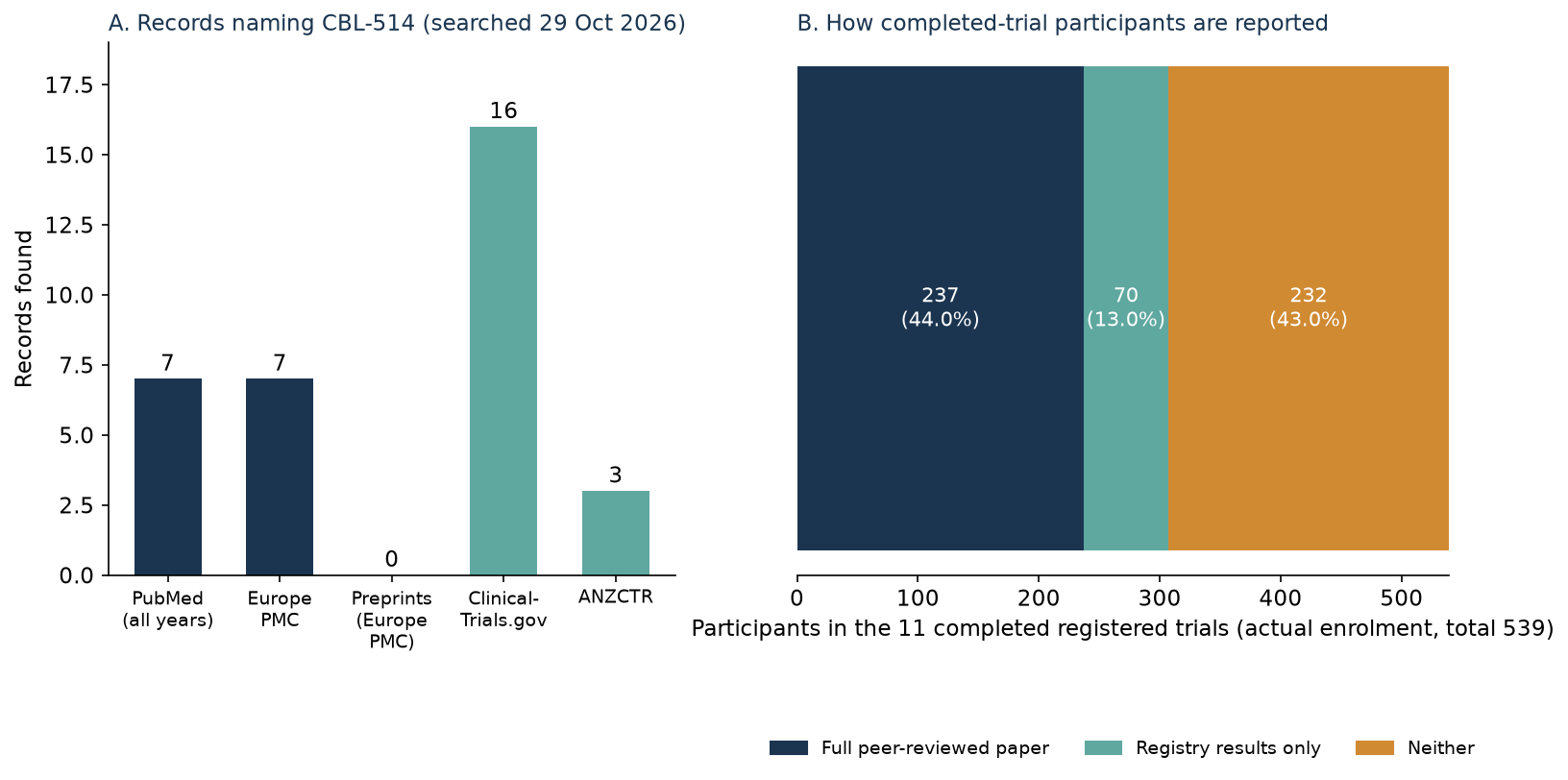
Figure 1 summarises the yield of the searches and the reporting status of the completed trials. Of 539 participants in the 11 completed trials:
- 237 (44.0%) are in the four trials with full papers (43 + 75 + 12 + 107);
- 70 (13.0%) are in four trials with registry results only (25 + 10 + 12 + 23);
- 232 (43.0%) are in three trials with neither (40 + 173 + 19).
A further 1,440 participants are planned in the five trials not yet completed (250 + 250 + 320 + 320 + 300). The sponsor describes “more than 544” trial participants to date [2], a figure close to our registry-derived total.
What is CBL-514? Identity and composition
Accounts of what CBL-514 actually is differ, and this matters for any discussion of its mechanism. The sponsor describes it as a “first-in-class small-molecule” injection developed under the 505(b)(1) pathway, the US route for new molecular entities [2]. A clinical review repeats that description, calling it a “first-in-class small-molecule inhibitor” [19]. The published trial reports give no chemical structure, formulation or composition [14, 15, 16, 17].
Two primary records point the other way. The FDA orphan drug designation for Dercum disease gives the generic name of the designated product as the systematic (IUPAC) chemical names of resveratrol and curcumin [54]. The posted results of the US pharmacokinetic trial state that CBL-514 contains two active pharmaceutical ingredients, curcumin and resveratrol, and report pharmacokinetic parameters for each separately [46].
The sponsor’s patents fit those records. One describes curcumin in non-ionic surfactant micelles made from polyoxyethylene castor oil derivatives, optionally combined with a second micellised drug such as resveratrol, for localised fat reduction [55]. The other claims curcuminoid and resveratrol in micelles of the same surfactant class for subcutaneous injection [56]. The patents do not say that their examples are the clinical formulation. Read together with the FDA record and the pharmacokinetic posting, though, the most parsimonious reading is that CBL-514 is a micellar co-formulation of two well-known plant-derived polyphenols.
The question of identity has three consequences.
First, “small molecule” and “two active ingredients” can both be literally true: curcumin and resveratrol are each small molecules. “First-in-class” and “new molecular entity” are harder to reconcile with two compounds that have been studied for decades, and we found no document that explains the 505(b)(1) characterisation.
Second, US rules on fixed-combination drugs require each component to contribute to the claimed effects [57]. FDA guidance on co-developing investigational drugs recommends factorial designs to show that contribution [58]. The CBL-0205 trial randomised participants to CBL-514, two comparators labelled CBL-A1 and CBL-A2, and placebo [52]. This structure is consistent with a factorial test of each component, but the registry does not identify CBL-A1 and CBL-A2, and the trial is unpublished.
Third, the long literature on curcumin and resveratrol becomes directly relevant. That literature includes well-documented problems with bioavailability, assay interference and replication, discussed below [59, 60].
The proposed CBL-514 mechanism of action, claim by claim
The sponsor summarises the CBL-514 mechanism of action as “adipocyte apoptosis and lipolysis” without necrosis [1]. Goodman and colleagues give the most detailed account in the peer-reviewed literature. They state that “nonclinical studies showed that CBL-514 inhibits the cell survival kinase DYRK1b; upregulates the apoptosis mediators caspase 3 and Bax/Bcl-2; and induces dose-dependent adipocyte apoptosis in vivo and in vitro”, and they cite “unpublished confidential reports” [14]. Gold and colleagues and Herbst and colleagues cite coded company reports for the same mechanism [15, 17]. We examined each component of the claim.
Apoptosis rather than lysis. Apoptosis is a regulated form of cell death. Its classical features are cell shrinkage, chromatin condensation, membrane blebbing and the formation of apoptotic bodies, executed largely by caspases [61]. The Nomenclature Committee on Cell Death recommends defining cell death by molecular mechanism. It cautions that single markers, such as caspase activation or phosphatidylserine exposure, are not enough [30]. That caution is especially relevant here, because caspases also have non-apoptotic functions [62]. Goodman and colleagues report caspase-3 and Bax/Bcl-2 increases and Annexin V/propidium iodide (PI) staining in 3T3-L1 cells [14]. Conventional Annexin V/PI protocols can give up to 40% false-positive results, and the problem is worst in large cells with a low nuclear-to-cytoplasmic ratio [63]. Mature adipocytes are an extreme example of such cells. Modified protocols that correct for this have been described [64]. Whether the CBL-514 studies used them is unknown. The method reference cited for the caspase-3 assay is itself a study of capsaicin in 3T3-L1 cells, not of CBL-514 [65]. 3T3-L1 cells are a mouse line, and their behaviour differs from that of mature human adipocytes in situ [66].
Mitochondrial (intrinsic) pathway. A rising Bax/Bcl-2 ratio points to the BCL-2 family-regulated intrinsic pathway [67]. Independent work fits this. Curcumin, one of the two reported ingredients, induced apoptosis in SW872 human liposarcoma-derived adipocytes, with a higher Bax/Bcl-2 ratio, cytochrome c release and caspase-3 activation [68]. In 3T3-L1 preadipocytes, curcumin activated caspases 8, 9 and 3 [69]. Resveratrol increased apoptosis in mature 3T3-L1 adipocytes, particularly in combination with quercetin [70], and potentiated pro-apoptotic effects of genistein [71, 72]. Reviews describe several phytochemicals that act at different stages of the adipocyte life cycle [73], and curcumin also inhibited adipogenesis in cells and mice [74]. This literature makes the sponsor’s narrative plausible. It does not show that the clinical formulation acts this way in human subcutaneous fat. Most of these studies used concentrations in the micromolar range in culture medium, a condition with no established relationship to tissue concentrations after injection.
DYRK1B inhibition. DYRK1B is a dual-specificity kinase. Gain-of-function mutations in it cause a form of metabolic syndrome, and the wild-type kinase enhances adipogenesis [75]. In cancer cells, DYRK1B maintains quiescence and survival, and inhibiting it increases apoptosis in quiescent cells that express high levels of the kinase [76]. A link between DYRK1B inhibition and adipocyte death is therefore biologically conceivable. The evidence that CBL-514 inhibits DYRK1B, however, rests entirely on unpublished reports [14]. Selectivity is an open question. Curcumin binds the ATP pocket of the related kinase DYRK2 and inhibited it selectively over 139 other kinases in a published panel [77]. Kinome-wide profiling shows that apparently selective inhibitors often hit closely related family members [78, 79]. Without published selectivity data, “inhibits DYRK1b” cannot be distinguished from broader inhibition of the DYRK family.
“Lipolysis”. In biochemistry, lipolysis is the stepwise hydrolysis of stored triglyceride by adipose triglyceride lipase, hormone-sensitive lipase and monoacylglycerol lipase [80, 81]. Goodman and colleagues describe “apoptosis, leading to lipolysis” [14]. This places lipolysis after cell death, as the handling of lipid released from dying cells, rather than as a stimulated hydrolysis in living adipocytes. Rotunda’s earlier warning applies: loose use of “lipolysis” in the injectable-fat literature obscures whether a product shrinks cells or kills them [13]. No CBL-514 source reports glycerol or free fatty acid release, lipase activation or plasma lipid changes after injection. The equivalent questions were studied for deoxycholic acid in a dedicated Phase 1 trial [82].
Calcium signalling. Calcium-dependent signalling is often suggested as a route to adipocyte death. We looked specifically for a CBL-514 source linking the product to calcium signalling and found none. The nearest primary evidence concerns curcumin: it inhibits all isoforms of the SERCA calcium pump in vitro [83], and it affects endoplasmic reticulum stress pathways [84]. Calcium overload or disturbed calcium compartmentalisation can trigger either apoptotic or necrotic death [85]. A calcium-mediated mechanism is therefore a reasonable hypothesis to test, but it is not a reported finding for CBL-514.
Macrophage clearance and “no necrosis”. The idea that apoptotic adipocytes are cleared quietly by macrophages comes from general cell biology: phagocytic clearance of apoptotic cells generally promotes an anti-inflammatory response [86]. Adipose tissue complicates the picture. In obese white adipose tissue, more than 90% of macrophages cluster around dead adipocytes in “crown-like structures”, and that adipocyte death has necrotic-like rather than apoptotic features [87]. Adipocytes are very large cells, and whether they can be cleared in the same way as small apoptotic cells has not been established for any injectable product. For deoxycholic acid, the Australian product information describes macrophages arriving to eliminate cell debris and lipid, followed by fibroblasts and thickened fibrous septa [88]. Cryolipolysis produces a comparable inflammatory sequence over months in pigs [89]. Goodman and colleagues report that repeat-dose toxicology in dogs and rodents showed no CBL-514-related necrosis [14]. No histology from human CBL-514-treated fat has been published, so whether its clearance differs from these comparators is unknown.
The vehicle. The patented formulations use polyoxyethylene castor oil-derived surfactants [55, 56]. This class of vehicle is not inert. It is associated with hypersensitivity reactions and hyperlipidaemia, and it alters drug disposition through micellar encapsulation [90]. The patent’s own rat experiment shows why this matters. Inguinal fat weight was 99.8%, 93.6% and 62.8% of the saline control after curcumin in saline, polyethylene glycol and the castor oil-derived surfactant respectively (n = 5 per group) [55]. The experiment had no surfactant-only control, so the contribution of the vehicle itself cannot be separated from that of better-solubilised curcumin. The history of injectable fat products gives a precedent: the deoxycholate solubiliser in phosphatidylcholine injections turned out to be the main active agent [12]. Deoxycholate lyses every cell type tested in vitro, and its apparent fat selectivity in vivo is attributed to inactivation by protein-rich tissue [91]. Where the placebo or control is described, it was saline [15, 37], which controls for neither the vehicle nor injection volume effects.
Biological context: why adipocyte number matters
Interest in an apoptosis mechanism rests on a basic feature of human adipose biology. Adipocyte number is largely fixed in adulthood. Roughly 10% of fat cells are renewed each year, and the number stays stable even after substantial weight loss [92, 93]. Over the average adipocyte lifespan of about ten years, its stored triglyceride is replaced about six times [94]. Reducing a depot by killing cells is therefore a different proposition from shrinking cells by lipolysis, and in principle more durable, provided neighbouring cells do not compensate. Adipose depots differ in their biology [95]. Apoptosis also occurs naturally in adipose tissue, through both intrinsic and extrinsic pathways [96, 97]. Adipocyte apoptosis is not automatically benign. In mice it has been linked to insulin resistance and hepatic steatosis [98]. Independent experts raised the same issue when visceral-fat data for CBL-514 were presented in 2026 [99].
Evidence-tier appraisal
Table 2 brings the claims together. The pattern is consistent. The clinical observation that CBL-514 injection is followed by reduced fat thickness or lipoma volume has tier B support from sponsor-funded randomised and non-randomised trials. Every element of the mechanism is tier E (unpublished company reports) or tier F (inferred from the literature on the components).
Table 2. Evidence-tier appraisal of claims about CBL-514. Tiers: A, independent peer-reviewed primary data; B, sponsor-funded peer-reviewed primary data; C, regulatory or registry record; D, patent; E, sponsor statement citing unpublished data, conference abstract or press release; F, no CBL-514-specific source.
| Claim | Best available source | Tier | Main limitation | Appraisal |
|---|---|---|---|---|
| Contains curcumin and resveratrol | FDA designation record; PK results posting | C | Exact formulation and ratio not disclosed | Well supported as a description of composition |
| Formulated in castor oil-derived surfactant micelles | Sponsor patents | D | Patents need not describe the clinical product | Plausible; unconfirmed for the trial formulation |
| “First-in-class small molecule”, new molecular entity | Sponsor news; one review | E | No structure or explanation published | Unresolved; conflicts with the two-ingredient records |
| Inhibits DYRK1B | Unpublished reports cited in a trial paper | E | No assay, potency or selectivity data | Not verifiable |
| Raises caspase-3 and Bax/Bcl-2 in adipocytes | Unpublished reports; component literature | E/F | Single markers; 3T3-L1 model | Plausible; not independently shown for CBL-514 |
| Induces adipocyte apoptosis in vivo | Unpublished reports | E | No published histology | Not verifiable |
| Does not cause necrosis | Unpublished toxicology summarised in a trial paper | E | No human histology | Not verifiable |
| Calcium-signalling mechanism | None for CBL-514 | F | Inferred from curcumin–SERCA data | Hypothesis only |
| Macrophage-mediated quiet clearance | None for CBL-514 | F | Adipocyte size and crown-like structure biology | Hypothesis only |
| Reduces abdominal fat thickness vs saline | Placebo-controlled Phase 2 and 2b | B | Small, short, sponsor-funded; observed-case analyses | Signal present; certainty low |
| Reduces Dercum lipoma volume | Uncontrolled Phase 2a | B | No comparator; lipoma-level statistics | Signal present; certainty very low |
| Reduces visceral fat | Conference abstract; press release | E | Post hoc subgroup; inconsistent figures | Not established |
Sources for Table 2: [2, 14, 15, 16, 17, 19, 46, 54, 55, 56, 68, 83, 87, 100, 101].
CBL-514 pharmacology and pharmacokinetics
Only one source reports pharmacokinetic data for CBL-514: the results posting of the open-label US trial in 10 participants [46]. That posting does three things. It confirms that curcumin and resveratrol were measured as separate analytes. It reports standard non-compartmental parameters for each, with plasma sampling up to 24 hours. And it records a restrictive agreement limiting investigators’ rights to publish [46]. The earlier Australian Phase 1 trial planned plasma pharmacokinetic sampling at nine time points over 24 hours [37, 40], but no results have been posted or published.
The posted means were as follows:
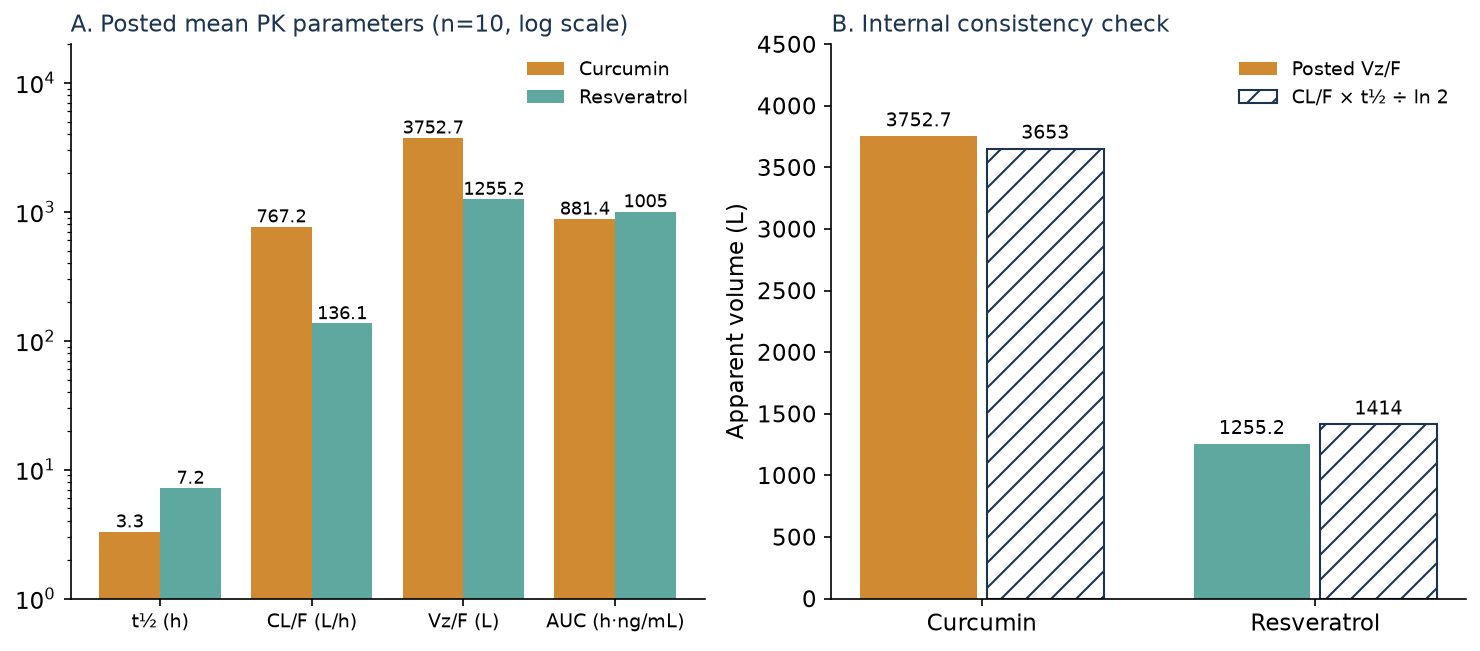
- Curcumin: peak concentration 137.6 ± 42.6 ng/mL at 7.4 ± 1.6 hours; area under the curve (AUC) 881.4 ± 220.1 h·ng/mL; half-life 3.3 ± 0.9 hours; apparent clearance (CL/F) 767.2 ± 253.8 L/h; apparent volume of distribution (Vz/F) 3,752.7 ± 1,922.7 L.
- Resveratrol: peak 79.5 ± 18.0 ng/mL at 7.4 ± 1.8 hours; AUC 1,005.0 ± 178.8 h·ng/mL; half-life 7.2 ± 2.0 hours; CL/F 136.1 ± 20.1 L/h; Vz/F 1,255.2 ± 290.5 L.
Treatment-emergent adverse events were recorded in all 10 participants. No participant had a clinically significant laboratory abnormality [46].
We checked these parameters for internal consistency (Figure 3). For a one-compartment model, apparent volume should equal CL/F multiplied by half-life divided by ln 2.
- For curcumin: 767.2 × 3.3 / 0.693 = 3,652.6 L, within 2.7% of the posted 3,752.7 L.
- For resveratrol: 136.1 × 7.2 / 0.693 = 1,413.7 L, 12.6% above the posted 1,255.2 L.
Some mismatch is expected, because posted values are means of individual estimates rather than estimates derived from the means. The data are broadly coherent.
Two further inferences follow, and both are tentative. First, the administered amount equals CL/F multiplied by AUC. The ratio of curcumin to resveratrol amounts implied by the posted means is (767.2 × 881.4) / (136.1 × 1,005.0) = 4.94. The formulation therefore appears to contain roughly five times as much curcumin as resveratrol by mass. This is an inference from means, not a disclosed specification. Second, for both compounds the time to peak (7.4 hours) is long. For curcumin it exceeds the terminal half-life (3.3 hours). That pattern is consistent with absorption-limited (“flip-flop”) kinetics, in which slow release from the subcutaneous depot, rather than elimination, governs the declining phase. If so, the true elimination half-life of systemically available curcumin may be much shorter than 3.3 hours. That would fit independent evidence that intravenous liposomal curcumin falls below quantification limits within 6 to 60 minutes after infusion [102]. We present this as a hypothesis that the posted data allow but cannot confirm.
These findings matter for interpreting the mechanism in three ways.
- Depot persistence. The kinetics suggest that much of the injected material remains at the injection site for hours, which is compatible with a local mechanism.
- Systemic exposure is real. Measurable plasma concentrations persist for at least a day, so any systemic effects of the two polyphenols, or of the vehicle, cannot be assumed away.
- Metabolism. Both compounds are extensively metabolised. Curcumin has notoriously poor oral bioavailability and undergoes rapid conjugation [103, 104]. After oral resveratrol, at least 70% is absorbed, but only trace amounts circulate unchanged [105]. Exposure to conjugated metabolites is up to 23 times that of the parent compound [106]. We could not determine from the posting whether parent compounds, conjugates or total deconjugated compounds were measured, and the distinction would change the interpretation.
By comparison, plasma deoxycholic acid after injection rose quickly and returned to the highly variable endogenous range within 24 hours [107].
Clinical observations and how they were measured
The clinical trials were not designed to test the mechanism, but they are the only published human data. Their design determines how much they can support any mechanistic narrative. All registered and published studies are mapped in CBL-514 clinical trials: a systematic evidence map.
Phase 2a (Goodman 2022). Participants were randomly allocated, without masking, to three dose arms at a single Australian site between February and November 2020. Enrolment in the lowest-dose arm stopped at 7 participants because of the COVID-19 pandemic; 36 more were enrolled in the two higher arms, for 43 in total [14, 41]. There was no placebo group, and the lowest dose served as a “hypothetical control”. Fat volume was calculated as a 150 cm² treatment area multiplied by the mean of five ultrasound thickness readings. In the highest unit-dose arm, the per-protocol least-squares mean change was −119.82 mL (−24.96%) at the first follow-up visit and −104.82 mL (−23.54%) at the second [14]. The journal graded the study as Level of Evidence 4. The ANZCTR record, registered prospectively, listed waist circumference by tape as the primary outcome, with ultrasound thickness and calculated volume as secondary outcomes [38]. The paper presents ultrasound volume as primary and does not report waist circumference [14]. The ClinicalTrials.gov record, submitted after the trial ended, lists fat volume as primary [41].
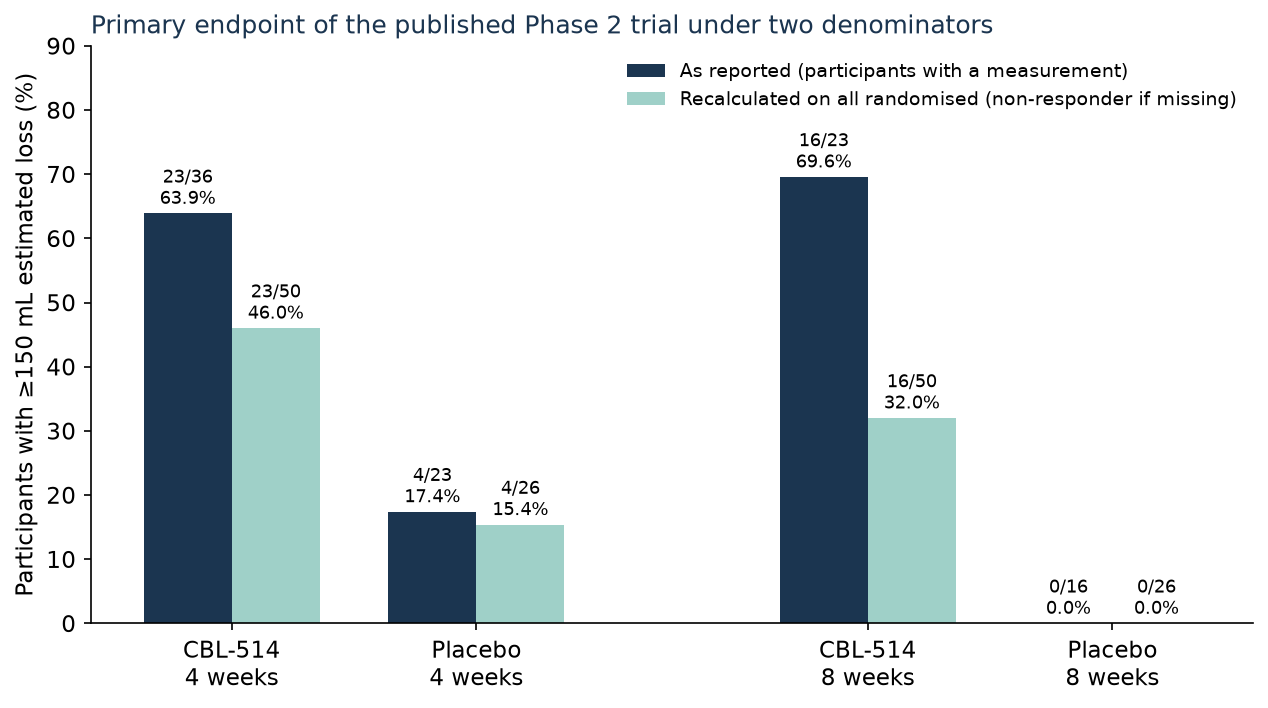
Placebo-controlled Phase 2 (Gold 2025). In this trial, 81 people were enrolled, 76 were randomised 2:1 (50 to CBL-514, 26 to saline) and 75 were treated. Thirty-eight completed the study. Of the 37 who did not, 6 were lost to follow-up, 7 withdrew, 7 had unstable weight, 6 were non-compliant and 4 had adverse events [15]. The primary endpoint was the proportion of participants losing at least 150 mL of ultrasound-derived volume, calculated as a 300 cm² area multiplied by mean thickness at four points. The reported proportions were 63.9% (23/36) vs 17.4% (4/23) at 4 weeks and 69.6% (16/23) vs 0% (0/16) at 8 weeks [15]. The least-squares mean volume change in the CBL-514 group was −199.80 mL at 4 weeks and −209.46 mL at 8 weeks, and the difference from placebo was −206.62 mL and −216.28 mL respectively [15]. Mean body weight changed by +0.45 kg and +0.02 kg with CBL-514 and by −0.76 kg and −0.26 kg with placebo, which argues against weight loss explaining the result [15]. The paper defines the intention-to-treat population as all randomised participants, but the denominators it reports are those with observations at each visit [15, 47].
Two original analyses help interpret these numbers. First, because volume is a fixed area multiplied by mean thickness, every “volume” result is a rescaled thickness result. A 150 mL threshold over 300 cm² corresponds to a mean thickness change of 0.50 cm (150/300). The between-group difference of −206.62 mL corresponds to 0.689 cm (206.62/300). In Goodman’s study the same 150 mL threshold over 150 cm² would correspond to 1.0 cm. These are measurable changes. The 0.50 cm threshold is about 2.3 times the ±2.2 mm range that contained 95% of repeat measurements by the same observer in a standardised protocol [108]. Calling them volumes, however, implies a three-dimensional measurement that was not made. Only Lorenc and colleagues measured volume directly, by MRI [16].
Second, we recalculated the primary endpoint on all randomised participants, counting those without observations as non-responders (Figure 2). This is a conservative assumption, not a correction. On that basis the 8-week result in the active arm falls from 69.6% to 32.0% (16/50) and in the placebo arm stays at 0% (0/26). At 4 weeks the figures fall from 63.9% to 46.0% (23/50) and from 17.4% to 15.4% (4/26). The direction of the between-group difference holds under the conservative assumption. Its size depends heavily on the large amount of missing data, and post-randomisation exclusions can bias trial results in either direction [109]. Surveys show that “intention to treat” is often claimed but not applied [110].
Phase 2b (Lorenc 2026). In this trial 108 participants were randomised 1:1, while the registry records 107 actually enrolled [16, 51]. The paper describes the trial as single-blind, but the registry records double masking of participants and outcome assessors [51]. The full analysis set included 30 participants given CBL-514 and 37 given placebo, 67 in total, or 62.0% of those randomised. A ≥1-grade improvement on the clinician-reported abdominal fat rating scale was seen in 76.7% (23/30) vs 18.9% (7/37) of participants. On the participant-reported scale the figures were 76.7% vs 19.4% (7/36). The least-squares mean change in MRI volume was −152.9 mL (−20.3%) [16]. Several authors were employed by the sponsor [16]. The MRI result is the strongest published evidence that something three-dimensional changes. As in the previous trial, more than a third of randomised participants are absent from the analysis.
Dercum disease (Herbst 2026). Dercum disease (adiposis dolorosa) is a rare disorder of painful subcutaneous adipose tissue and lipomas. Its diagnostic criteria and classification are still debated, and it must be distinguished from lipoedema [111, 112]. In an open-label, single-site study, 12 participants (83.3% female, mean age 52.5 years) were randomised 1:1 to lower and higher per-injection dose groups, treating 40 and 37 lipomas respectively [17]. The median relative change in lipoma volume was −46.0% and −59.1% at 4 weeks and −45.0% and −50.7% at 8 weeks. Complete clearance was reported for 22.5% (4 weeks) and 17.5% (8 weeks) of lipomas in the lower-dose group, and for 27.0% and 35.1% in the higher-dose group. The median Comparative Pain Scale score fell by 4.0 points from baseline at both follow-up visits. All participants had a treatment-related adverse event, four had a severe event and two discontinued; there were no serious adverse events [17].
The authors acknowledge the small sample, the lack of a comparator and the short follow-up [17]. We add three methodological points:
- Statistical tests were run at the level of the lipoma, treating 77 lipomas from 12 people as independent, which overstates precision.
- Missing values were imputed by last observation carried forward.
- Multiple time points and outcomes were tested without adjustment [113].
Without a control group, regression towards the mean is also possible, because participants are often enrolled when symptoms are at their worst [114].
The sponsor’s press materials report 64.5% of lipomas with more than 50% reduction, 38.7% complete clearance and a 4.7-point pain reduction [115, 116]. We could not reproduce these figures from the published paper.
The FDA granted orphan designation for Dercum disease on 27 February 2024 [54], and the sponsor reports Fast Track designation [117]. Neither status is an approval. Fast Track is a procedural designation for drugs that target serious conditions with unmet need [118]. A placebo-controlled Dercum trial was completed in March 2026, but no results have been posted [53]. The sponsor reports that its pain endpoint was met and refers to a separate formulation for this indication [2].
Cellulite and posted safety data. Two cellulite trials, of 12 and 23 participants, have posted results on ClinicalTrials.gov but have not been published. The second records one participant with serious adverse events of hypersensitivity and obstructive airways disorder, as well as a restrictive investigator publication agreement [49, 50]. Hypersensitivity is a recognised effect of polyoxyethylated castor oil vehicles [90], but a single event cannot be attributed to any component. The Stage 1 dose-escalation trial in abdominal fat posted safety results that include one serious adverse event, a closed head injury [42]. Its ANZCTR record states that ethics approval was “submitted, not yet approved” at registration [39].
Visceral fat. In September 2026, a post hoc analysis of participants from CBL-0204 and CBL-0205 was presented at the EASD Annual Meeting. It reported changes in visceral adipose tissue at the L2–L3 level by MRI in participants with a body mass index of 22–30 kg/m² whose weight changed by less than 3 kg [100]. The abstract reports subgroups of 26 and 20, baseline volumes of 642.5 and 677.4 mL, and changes of −10.9% vs +4.6% at week 4 and −7.3% vs +18.4% at weeks 8–12. It gives trial registration as “N/A” [100]. The official press release describes subgroups of 23 and 17, different baseline volumes and different percentages [101]. Sponsor materials present the analysis as evidence of a visceral-fat effect [119]. Independent experts noted several problems: the subgroup was small and post hoc, there was no full paper, and weight gain in the placebo group would accentuate any difference. They also called for measures of ectopic fat, lipids and glucose control, given what is known from lipodystrophy [99]. Because subcutaneous injections would have to act on a distant depot, a visceral effect would also challenge the purely local mechanism the sponsor proposes. That makes independent confirmation especially important.
Table 3. Discrepancies between registered, published and press-reported information on CBL-514 identified in this synthesis.
| Item | Source A | Source B | Nature of discrepancy | Why it matters |
|---|---|---|---|---|
| Phase 2a primary outcome | ANZCTR: waist circumference | Paper: ultrasound-derived volume | Primary outcome changed; registered primary not reported | Outcome switching inflates false-positive risk |
| Phase 2b masking | Paper: single-blind | Registry: double (participant, outcome assessor) | Masking described differently | Affects risk-of-bias judgement for subjective scales |
| Phase 2 analysis population | Paper: ITT = all randomised | Reported denominators 36/23 and 23/16 | Observed-case proportions labelled ITT | Effect size sensitive to missing data (Figure 2) |
| Phase 2b enrolment | Paper: 108 randomised | Registry: 107 enrolled | Off by one | Minor, but unexplained |
| Dercum lipoma outcomes | Paper: median −45.0% to −59.1%; complete clearance 17.5–35.1%; pain −4.0 | Press: 64.5% >50% reduction; 38.7% clearance; 4.7-point pain | Figures not reproducible from paper | Press metrics not peer reviewed |
| Visceral fat subgroup | Abstract: n = 26/20; −10.9% vs +4.6% | Press release: n = 23/17; −12.01% vs +5.68% | Different n, baselines and percentages | Cannot tell which analysis is definitive |
| Identity | FDA and registry: two ingredients | Sponsor: first-in-class small molecule, 505(b)(1) | Characterisation differs | Mechanism and regulatory pathway depend on identity |
| Timing of registration | ClinicalTrials.gov first submission after completion (two trials) | ANZCTR prospective registration | Late on one registry, prospective on the other | Prospective record should be the reference |
Sources for Table 3: [2, 14, 15, 16, 17, 37, 38, 40, 41, 46, 51, 54, 100, 101, 115].
From registration to publication
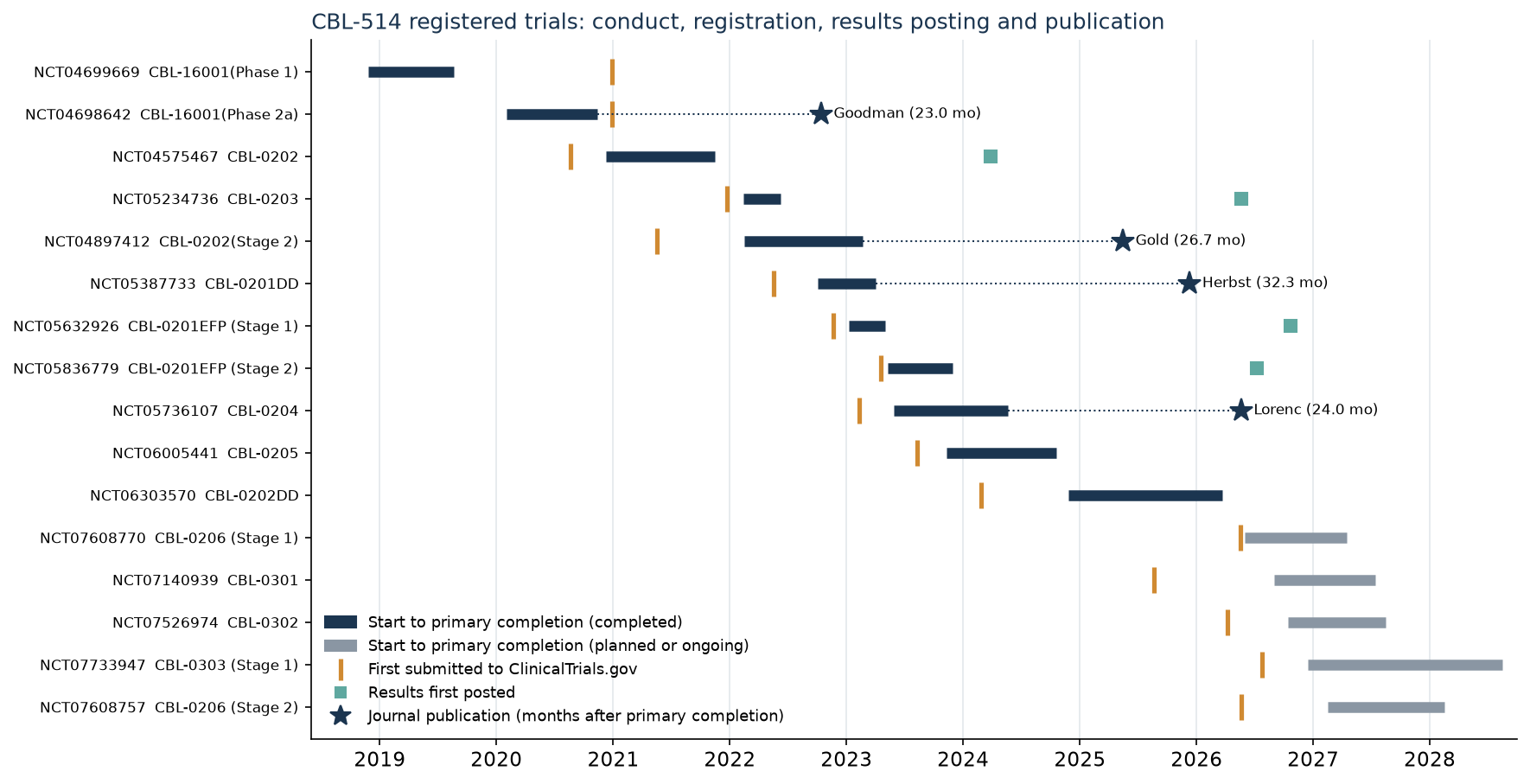
Figure 4 places each completed trial on a timeline. The intervals from primary completion to publication of the four papers were 23.0 months (Phase 2a), 26.7 months (Phase 2), 32.3 months (Dercum) and 24.0 months (Phase 2b). Two trials were first submitted to ClinicalTrials.gov after they had finished, although both were registered prospectively on ANZCTR [37, 38, 40, 41]. Seven completed trials have no full paper.
This pattern is common in industry-sponsored research. In a random sample of completed trials registered on ClinicalTrials.gov, 46% (311/677) had been published, and industry-sponsored trials were published less often, at 40% [120]. Selective publication can distort the apparent evidence base substantially [121]. Results posted in registries often differ from the corresponding papers [122]. The ClinicalTrials.gov results database was created partly to counter this problem [123]. Journals in the ICMJE now require data-sharing statements [124], and SPIRIT sets out what a protocol should prespecify [28]. Several CBL-514 records state that individual participant data will not be shared, and several results postings record restrictive agreements on investigator publication [37, 38, 46, 50].
Discussion: what the evidence does and does not show about CBL-514
Principal findings
This synthesis has four main findings.
First, the CBL-514 mechanism of action as usually described has not been published as primary data. Its parts are DYRK1B inhibition, caspase-3 and Bax/Bcl-2 activation, adipocyte apoptosis, subsequent lipolysis and the absence of necrosis. All of them rest on unpublished company reports [14, 15, 17]. The calcium-signalling and macrophage-clearance elements sometimes added to the story have no CBL-514-specific source at all.
Second, primary regulatory and registry documents identify the product as a combination of curcumin and resveratrol [46, 54], and the sponsor’s patents describe micellar formulations of these compounds [55, 56]. Sponsor descriptions of a first-in-class small molecule [2] have not been reconciled with those records.
Third, the clinical trials consistently report reductions in subcutaneous fat measures relative to saline or baseline. However, they are small, short and sponsor-funded, they use derived “volume” endpoints, and a large share of participants is missing from analyses [15, 16].
Fourth, more than half of the participants in completed CBL-514 trials are in studies without a full peer-reviewed report, and the published record contains discrepancies with registrations and press materials.
How CBL-514 differs from deoxycholic acid and other non-surgical approaches
The clearest point of difference is the claimed type of cell death. Deoxycholic acid is a detergent. Its US label describes it as a cytolytic drug that physically destroys cell membranes [8]. The Australian product information describes membrane disruption followed by macrophage clearance, fibroblast recruitment and thickened fibrous septa [88]. Deoxycholate’s selectivity for fat in vivo is relative rather than absolute: it lyses many cell types, and protein-rich tissue attenuates the effect [91]. Its submental efficacy was established in four Phase 3 trials:
- REFINE-1: a composite response of 70.0% vs 18.6% with placebo, MRI responders 46.3% vs 5.3%, and marginal mandibular nerve paresis in 4.3% of participants [125];
- REFINE-2: 66.5% vs 22.2% [126];
- the two European trials: 58.3% and 62.3% in the active arms vs 34.5% with placebo on a clinician-rated scale [127, 128].
Responses persisted to three years in 82.4% of ATX-101 responders vs 65.0% of placebo responders [129]. Reviews describe the pharmacology and development programme in detail [130, 131]. Deoxycholic acid is approved in Australia for submental fat [132]. In September 2026 the FDA announced new warnings about serious adverse events, including neuromuscular events, nodules and masses, after use outside the submental region [133]. A systematic review of injectable agents used beyond the submental area found 25 studies with 3,178 patients, mostly at high or unclear risk of bias [9]. Endpoints and effect sizes across modalities are compared in CBL-514 fat reduction: a comparative evidence map.
Cryolipolysis works by a different route. Cold injures lipid-rich adipocytes, as shown in pigs [5], followed by an inflammatory response and gradual reduction of the fat layer over months [89]. It is supported by a larger clinical literature [6, 7], and it has its own rare paradoxical effect, adipose hyperplasia, with an estimated incidence of 0.0051% [134].
Against these comparators, CBL-514’s distinctive claim is cell death that is regulated rather than lytic, and therefore less inflammatory, and so better tolerated over larger areas. If confirmed, that would be a meaningful pharmacological difference. At present it is a hypothesis, supported by the trial reports’ description of tolerability [14, 15] but not by any head-to-head comparison, human histology or published nonclinical study. Table 4 sets out the comparison with the source tier for each row.
Table 4. CBL-514 compared with deoxycholic acid injection and cryolipolysis on mechanism and evidence. The comparison concerns the evidence base, not clinical recommendations.
| Feature | CBL-514 (investigational) | Deoxycholic acid injection | Cryolipolysis |
|---|---|---|---|
| Regulatory status | Investigational; in Phase 3 trials; US orphan designation (Dercum) | Approved for submental fat (US, Australia) | Cleared devices for specified body areas |
| Composition | Curcumin and resveratrol (FDA record, registry); micellar vehicle (patents) | Synthetic deoxycholic acid | Not a drug (controlled cooling) |
| Proposed cell-death mode | Apoptosis (sponsor; unpublished data) | Lysis by membrane disruption (label) | Cold-induced adipocyte injury |
| Mechanistic evidence tier | E/F | Regulatory label and published pharmacology | Published animal histology |
| Inflammatory sequence | Not described in humans | Macrophages, fibroblasts, septal thickening | Inflammatory infiltrate over months (pig) |
| Published randomised placebo-controlled trials | 2 (Phase 2 and 2b), sponsor-funded | 4 Phase 3 trials, plus long-term follow-up | Device literature; sham control is uncommon |
| Head-to-head comparison | None | None with CBL-514 | None with CBL-514 |
| Notable safety signals in sources | Treatment-emergent adverse events common; isolated serious events in registry postings | Nerve paresis, ulceration, necrosis; off-label serious events | Paradoxical adipose hyperplasia (rare) |
Sources for Table 4: [5, 8, 14, 15, 16, 46, 50, 54, 55, 88, 89, 125, 126, 129, 132, 133, 134].
Is the proposed mechanism plausible? A Bradford Hill reading
Applying the Bradford Hill considerations to the mechanistic claim, rather than to the clinical effect, helps separate what is plausible from what is shown [31].
- Plausibility and coherence. These are reasonably strong. The component compounds induce apoptosis in adipocyte models [68, 69, 70]. DYRK1B has a credible role in adipocyte survival and differentiation [75, 76]. Adipocyte number is a durable target [92].
- Experimental evidence. This is the weakest consideration, because none of it is published for CBL-514.
- Specificity. This is doubtful. Curcumin interferes with many assays and is classed as a pan-assay interference and invalid metabolic panacea candidate. No double-blind, placebo-controlled trial of curcumin itself had succeeded at the time of that review [59, 60]. Curcumin also inhibits SERCA pumps [83] and other kinases [77], so DYRK1B is unlikely to be its only target.
- Biological gradient. The evidence is directionally consistent but thin. In the Dercum study, the higher-dose group showed larger median volume reductions and higher complete-clearance proportions at both visits. However, only two dose levels were tested, in 12 people [17]. In the Phase 2a study the lowest-dose arm was truncated at 7 participants [14].
- Analogy. This cuts both ways. The last major injectable fat product, phosphatidylcholine–deoxycholate, turned out to work through its solubiliser rather than its nominal active ingredient [12]. CBL-514’s castor oil-derived surfactant has not been tested alone in any published experiment.
The wider meta-research literature recommends caution. Small studies, flexible analyses and financial interests reduce the probability that positive findings are true [135]. Many landmark preclinical findings could not be reproduced [136], and irreproducibility in preclinical research is common and costly [137]. Sponsor funding is associated with more favourable results and conclusions [32]. Single-blind designs leave room for bias in subjective outcomes [138]. Rating-scale endpoints such as the abdominal fat rating scales used in the Phase 2b trial are particularly sensitive to it. None of this suggests the CBL-514 findings are wrong. It does mean they need independent confirmation before the mechanism can be regarded as established.
Predictions that would distinguish the proposed mechanism
A mechanism is most useful when it makes predictions that could prove it wrong. The apoptosis account of CBL-514 makes at least five, and none has yet been tested in published work.
- Histology. If adipocytes die mainly by apoptosis, human biopsies taken days after injection should show shrunken adipocytes with fragmented nuclei, caspase-3 cleavage and TUNEL positivity. They should not show the membrane rupture, free lipid lakes and dense neutrophil infiltrate expected after a detergent [30, 61, 88]. Because adipocytes are so large, crown-like macrophage aggregates might still form whatever the mode of death [87]. Their presence alone would therefore not refute the claim, but their timing and intensity relative to deoxycholic acid would be informative.
- Selectivity. If the effect is driven by the active ingredients acting on adipocyte survival pathways, non-adipose cells exposed to the same formulation should be relatively spared. If the surfactant drives it, non-specific membrane injury should be seen across cell types, as with deoxycholate [90, 91]. A simple in vitro comparison of formulation, vehicle alone and individual ingredients across adipocytes, fibroblasts and keratinocytes would test this.
- Target engagement. If DYRK1B inhibition is causal, reducing DYRK1B genetically should reproduce the effect, and a drug-resistant DYRK1B variant should prevent it. Kinome-wide profiling would show whether related kinases such as DYRK2, which curcumin inhibits [77], are engaged at relevant concentrations [78].
- Metabolic signature. Apoptosis followed by gradual clearance should produce a slower and smaller rise in local glycerol and free fatty acids than lysis. That difference could be measured by microdialysis or plasma sampling, as was done for deoxycholic acid [80, 82].
- Durability. Because adipocyte number is stable in adults [92], removing cells by apoptosis should produce a durable reduction unless remaining cells enlarge. Long-term MRI in the planned maintenance study [43] could test this, provided body weight is tracked and analyses are prespecified.
These predictions are independent of the sponsor’s commercial interests and could be tested by academic groups. Several require only the formulation and standard laboratory methods.
Unanswered research questions
Table 5 lists the questions that, in our assessment, would most change the certainty of the evidence, together with study designs that could answer them. Several could be answered from data the sponsor already holds, in particular the unpublished nonclinical reports and the completed CBL-0205 factorial trial [52].
Table 5. Priority research questions for CBL-514, with the evidence gap each addresses and a design that could answer it.
| # | Research question | Current evidence | Informative design |
|---|---|---|---|
| 1 | What exactly is the clinical formulation (ingredients, ratio, vehicle, particle size)? | FDA record, PK posting and patents; no specification | Published chemistry, manufacturing and controls summary; independent analytical characterisation |
| 2 | Does each ingredient contribute to the effect? | Factorial Phase 2b completed, unpublished | Full publication of CBL-0205 with component arms identified |
| 3 | Does the vehicle alone reduce fat? | Patent rat study without a vehicle-only arm | Vehicle-controlled animal and human studies |
| 4 | Is DYRK1B the relevant target, and how selective is the inhibition? | Unpublished reports | Kinome-wide profiling; genetic knock-down or rescue in human adipocytes |
| 5 | Is the cell death apoptotic in human fat? | 3T3-L1 single markers (unpublished) | Serial human biopsies with NCCD-concordant markers and TUNEL; mature human adipocyte models |
| 6 | Is clearance less inflammatory than with deoxycholic acid? | None | Comparative histology and inflammatory markers, ideally head-to-head |
| 7 | What are the systemic exposures to parent compounds and conjugates? | One 10-person PK posting | Validated assays reporting parent and conjugates; repeat-dose PK |
| 8 | Do volume changes persist, and does adipose tissue regrow? | Follow-up of 8–12 weeks | Long-term MRI follow-up (planned maintenance study) |
| 9 | Is there a visceral or metabolic effect? | Post hoc subgroup abstract; inconsistent press figures | Prespecified MRI and metabolic endpoints in a randomised trial |
| 10 | Are effects robust to missing data and to masking? | Observed-case analyses; masking discrepancy | Preregistered ITT analyses with multiple imputation; triple masking (as in Phase 3) |
Sources for Table 5: [3, 14, 15, 30, 43, 46, 52, 55, 64, 100].
Strengths and limitations of this synthesis
This synthesis has several strengths:
- the searches were reproducible and run on a single date across bibliographic and registry sources;
- each claim was traced to its stated origin;
- all quantitative re-analyses use only published or posted numbers, with the arithmetic shown.
It also has limitations:
- Searches were limited to PubMed, Europe PMC and two registries. Regional registries, conference proceedings other than the one identified, and non-English sources may hold further data.
- We did not have access to the sponsor’s unpublished nonclinical reports and did not contact the sponsor, so our tier E judgements may be more conservative than the underlying data warrant.
- The contextual literature on curcumin, resveratrol and adipocyte apoptosis was sampled rather than systematically reviewed.
- Our denominator re-analysis assumes that participants without observations did not respond. This is a bounding assumption, not an estimate.
- The pharmacokinetic inferences are drawn from posted means.
- Evidence tiers describe provenance, not truth. A tier E claim may be entirely correct.
- The author has no relationship with the sponsor, but this article was produced for an organisation that publishes peptide research content. Readers should weigh that context.
Implications for researchers and readers
For researchers, the most useful contributions would be independent ones:
- characterisation of the formulation;
- vehicle-controlled preclinical studies;
- human histology using contemporary cell-death criteria;
- full publication of the completed trials, including CBL-0205 and the placebo-controlled Dercum study [52, 53].
The Phase 3 programme is registered with triple masking and dual clinician- and participant-reported endpoints [3, 4]. If reported in full, it will address several of the design limitations described here, though not the mechanistic questions. For general readers, the main point is that CBL-514 is an investigational product whose mechanism is proposed rather than demonstrated. Its clinical signals are encouraging but preliminary. The regulatory position of CBL-514 is analysed in CBL-514 Australia: a comparative regulatory analysis.
On regulation, investigational products in Australia are studied under the Clinical Trial Notification or Clinical Trial Approval schemes [20]. The TGA has made clear that a “research use only” label is not legal clearance and does not change whether a product is regulated as a therapeutic good [21, 22]. Readers interested in how quality and regulatory frameworks apply to research compounds more generally may find our evidence review Peptides wholesale: quality standards and regulation useful background. Its regulatory analysis is general and is not specific to CBL-514.
Conclusion
CBL-514 is an investigational injection reported to reduce localised subcutaneous fat and Dercum disease lipomas. Its sponsor attributes this to adipocyte apoptosis rather than lysis. Regulatory and registry records describe it as a co-formulation of curcumin and resveratrol. Patents describe a micellar castor oil-derived vehicle. The proposed CBL-514 mechanism of action, as described by the sponsor (DYRK1B inhibition, intrinsic apoptosis and subsequent lipolysis, without necrosis), is biologically plausible but rests on unpublished data. Calcium-signalling and macrophage-clearance explanations are hypotheses drawn from component and comparator literature. The clinical evidence comes from small, short, sponsor-funded trials. Those trials have derived endpoints, substantial missing data and several discrepancies between registry and publication. Fewer than half of the participants in completed trials are in fully published studies. CBL-514 is not approved for any use, and nothing in this evidence establishes that it is safe or effective. Independent mechanistic research and complete publication of the completed trials are the clearest next steps.
Relevance to Eternal Peptides Wholesale
Eternal Peptides Wholesale publishes evidence reviews on compounds that readers meet in discussions of research peptides, and investigational agents such as CBL-514 are among them. This synthesis is educational. It does not describe or assess any product, and, as the conclusion states, CBL-514 is not approved for any use and nothing here establishes that it is safe or effective.
The documentation the site publishes itself is analytical. Its certificate of analysis library transcribes batch-specific reports issued by Janoshik Analytical, an independent laboratory, and the testing standards page explains how purity, sterility screening, endotoxin and heavy-metal results are reported separately. As that library notes, a laboratory report records the stated tests on a submitted sample; it does not establish regulatory approval, clinical suitability or safety for human use. That mirrors the distinction drawn in this paper between characterising a material and establishing the CBL-514 mechanism of action in people. More about Eternal Peptides Wholesale is on the About page, and related reviews are on the blog.
Glossary
- Adipocyte: a fat cell, which stores energy as triglyceride.
- Apoptosis: regulated, caspase-dependent cell death with characteristic shrinkage and fragmentation, classically with limited inflammation.
- Lysis (adipocytolysis): rupture of the cell membrane, as caused by detergents such as deoxycholic acid.
- Lipolysis: enzymatic hydrolysis of stored triglyceride into glycerol and fatty acids. The term is often used loosely for fat-destroying procedures.
- DYRK1B: dual-specificity tyrosine phosphorylation-regulated kinase 1B, which is involved in cell survival, quiescence and adipogenesis.
- Caspase-3: an executioner protease of apoptosis, which also has non-apoptotic roles.
- Bax/Bcl-2 ratio: the balance of pro- and anti-apoptotic BCL-2 family proteins regulating the mitochondrial pathway.
- 3T3-L1: a mouse fibroblast-derived cell line that can be differentiated into adipocyte-like cells.
- Micelle: a nanoscale aggregate of surfactant molecules that can solubilise poorly water-soluble compounds.
- CL/F and Vz/F: apparent clearance and apparent volume of distribution, uncorrected for the unknown fraction absorbed.
- Flip-flop kinetics: the situation in which slow absorption, rather than elimination, determines the declining phase of the plasma concentration curve.
- Intention-to-treat (ITT): analysis of all participants in the groups to which they were randomised.
- Evidence tier: in this article, a label for where a claim comes from (A–F), not whether it is true.
- Orphan designation: an FDA status for products intended for rare diseases. It is not a marketing approval.
Frequently asked questions about CBL-514
What is CBL-514?
CBL-514 is an investigational injectable product developed by Caliway Biopharmaceuticals. It has been studied for reducing localised abdominal subcutaneous fat, for cellulite and for the painful lipomas of Dercum disease. The FDA orphan designation record and a posted pharmacokinetic study identify two active ingredients, curcumin and resveratrol [46, 54], while the sponsor describes a first-in-class small-molecule injection [2]. It is not approved for any use.
What is the CBL-514 mechanism of action?
The sponsor and trial reports describe adipocyte apoptosis, a regulated form of cell death, followed by lipolysis, and say this occurs without necrosis. The detailed account involves DYRK1B kinase inhibition and increased caspase-3 and Bax/Bcl-2. This CBL-514 mechanism of action is attributed to unpublished company reports [14, 15], so it cannot yet be independently verified.
How is CBL-514 different from deoxycholic acid?
Deoxycholic acid is a detergent that destroys cell membranes (lysis) and is approved only for submental fat [8, 132]. CBL-514 is claimed to cause apoptosis instead. No head-to-head study, published human histology or published nonclinical comparison has confirmed that difference, so it remains a hypothesis.
Does CBL-514 involve calcium signalling or macrophages?
No CBL-514-specific source reports either. Curcumin inhibits SERCA calcium pumps in vitro [83], and macrophages clear dead adipocytes in other settings [87, 88], so both are reasonable hypotheses to test. They are not reported findings for CBL-514.
What do the published CBL-514 clinical trials show?
Four sponsor-funded trials report reductions in ultrasound- or MRI-measured abdominal fat, or in lipoma volume, compared with saline or baseline [14, 15, 16, 17]. They are small and short, and they have substantial missing data. The certainty of the evidence is low, and the trials do not establish that CBL-514 is safe or effective.
What is known about CBL-514 pharmacokinetics?
One posted study in 10 participants reports curcumin and resveratrol separately. Peak concentrations occurred at about 7.4 hours, with half-lives of 3.3 and 7.2 hours respectively [46]. Our consistency check suggests the data are coherent and may reflect slow release from the injection site, but this has not been confirmed.
Is CBL-514 approved by the TGA or FDA?
No. CBL-514 is investigational. It has US orphan designation for Dercum disease and sponsor-reported Fast Track status, but neither is an approval [54, 118]. In Australia, unapproved products are studied under the clinical trial schemes, and a “research use only” label does not provide legal clearance [20, 22].
What research on CBL-514 is still needed?
The main needs are: publication of the nonclinical mechanism studies; independent characterisation of the formulation and vehicle; human histology; full publication of completed trials, including the factorial CBL-0205 trial; and long-term follow-up. The registered Phase 3 trials and maintenance study may address some of the clinical questions [3, 43, 52].
References
- Caliway Biopharmaceuticals. CBL-514 [R&D pipeline page]. Available at: https://www.caliwaybiopharma.com/en/research/15/. Accessed 29 October 2026.
- Caliway Biopharmaceuticals. Caliway announces first patient dosed in global Phase 3 SUPREME-01 trial of CBL-514 [news]. 23 September 2026. Available at: https://www.caliwaybiopharma.com/en/news-detail/-CBL-514-SUPREME-01-FPI-ObesityWeek-2026-ENG/. Accessed 29 October 2026.
- Caliway Biopharmaceuticals Co., Ltd. A study to evaluate the efficacy and safety of CBL-514 injection for reducing subcutaneous fat (CBL-0301). ClinicalTrials.gov identifier NCT07140939. Bethesda (MD): US National Library of Medicine. Available at: https://clinicaltrials.gov/study/NCT07140939. Accessed 29 October 2026.
- Caliway Biopharmaceuticals Co., Ltd. A study to evaluate the efficacy and safety of CBL-514 injection for reducing subcutaneous fat (SUPREME-02) (CBL-0302). ClinicalTrials.gov identifier NCT07526974. Bethesda (MD): US National Library of Medicine. Available at: https://clinicaltrials.gov/study/NCT07526974. Accessed 29 October 2026.
- Manstein D, Laubach H, Watanabe K, Farinelli W, Zurakowski D, Anderson RR. Selective cryolysis: a novel method of non-invasive fat removal. Lasers Surg Med. 2008;40(9):595-604. doi:10.1002/lsm.20719. PMID: 18951424. Available at: https://doi.org/10.1002/lsm.20719. Accessed 29 October 2026.
- Krueger N, Mai SV, Luebberding S, Sadick NS. Cryolipolysis for noninvasive body contouring: clinical efficacy and patient satisfaction. Clin Cosmet Investig Dermatol. 2014;7:201-5. doi:10.2147/CCID.S44371. PMID: 25061326. Available at: https://doi.org/10.2147/CCID.S44371. Accessed 29 October 2026.
- Ingargiola MJ, Motakef S, Chung MT, Vasconez HC, Sasaki GH. Cryolipolysis for fat reduction and body contouring: safety and efficacy of current treatment paradigms. Plast Reconstr Surg. 2015;135(6):1581-1590. doi:10.1097/PRS.0000000000001236. PMID: 26017594. Available at: https://doi.org/10.1097/PRS.0000000000001236. Accessed 29 October 2026.
- US Food and Drug Administration. KYBELLA (deoxycholic acid) injection: prescribing information. Revised 09/2026. Available at: https://www.accessdata.fda.gov/drugsatfda_docs/label/2026/206333s007lbl.pdf. Accessed 29 October 2026.
- Carrion K, Salingaros S, Bernal C, Barger BT, Lipman KJ, How-Volkman C, et al.. A Systematic Review of Injectable Lipolytic Agents for Nonsubmental Fat Reduction. Plast Reconstr Surg. 2026;158(3):414-423. doi:10.1097/PRS.0000000000012648. PMID: 41296813. Available at: https://doi.org/10.1097/PRS.0000000000012648. Accessed 29 October 2026.
- Rotunda AM, Kolodney MS. Mesotherapy and phosphatidylcholine injections: historical clarification and review. Dermatol Surg. 2006;32(4):465-80. doi:10.1111/j.1524-4725.2006.32100.x. PMID: 16681654. Available at: https://doi.org/10.1111/j.1524-4725.2006.32100.x. Accessed 29 October 2026.
- Duncan D, Rotunda AM. Injectable therapies for localized fat loss: state of the art. Clin Plast Surg. 2011;38(3):489-501, vii. doi:10.1016/j.cps.2011.02.005. PMID: 21824545. Available at: https://doi.org/10.1016/j.cps.2011.02.005. Accessed 29 October 2026.
- Rotunda AM, Suzuki H, Moy RL, Kolodney MS. Detergent effects of sodium deoxycholate are a major feature of an injectable phosphatidylcholine formulation used for localized fat dissolution. Dermatol Surg. 2004;30(7):1001-8. doi:10.1111/j.1524-4725.2004.30305.x. PMID: 15209790. Available at: https://doi.org/10.1111/j.1524-4725.2004.30305.x. Accessed 29 October 2026.
- Rotunda AM. Injectable treatments for adipose tissue: terminology, mechanism, and tissue interaction. Lasers Surg Med. 2009;41(10):714-20. doi:10.1002/lsm.20807. PMID: 20014257. Available at: https://doi.org/10.1002/lsm.20807. Accessed 29 October 2026.
- Goodman GJ, Ho WWS, Chang KJ, Ling YF, Sheu AY. Efficacy of a Novel Injection Lipolysis to Induce Targeted Adipocyte Apoptosis: A Randomized, Phase IIa Study of CBL-514 Injection on Abdominal Subcutaneous Fat Reduction. Aesthet Surg J. 2022;42(11):NP662-NP674. doi:10.1093/asj/sjac162. PMID: 35709509. Available at: https://doi.org/10.1093/asj/sjac162. Accessed 29 October 2026.
- Gold M, Schlessinger J, Goodman GJ, Dayan S, DuBois J, Ling YF, et al.. Efficacy and Safety of CBL-514 Injection in Reducing Abdominal Subcutaneous Fat: A Randomized, Single-Blind, Placebo-Controlled Phase II Study. Aesthet Surg J. 2025;45(6):611-620. doi:10.1093/asj/sjaf032. PMID: 40037659. Available at: https://doi.org/10.1093/asj/sjaf032. Accessed 29 October 2026.
- Lorenc ZP, Gold M, Schlessinger J, Lain ET, Smith S, Downie J, et al.. Randomized Phase 2b Trial of CBL-514 Injection for Abdominal Subcutaneous Fat Reduction With Clinician- and Patient-reported Outcomes and MRI Assessment. Aesthet Surg J. 2026;. doi:10.1093/asj/sjag092. PMID: 42159040. Available at: https://doi.org/10.1093/asj/sjag092. Accessed 29 October 2026.
- Herbst KL, Ling YF, Sheu AY, Schlessinger DI, Wu SY. Efficacy and safety of CBL-514 for Dercum disease lipomas: A randomized phase 2a study. JAAD Int. 2026;25:1-4. doi:10.1016/j.jdin.2025.11.022. PMID: 41623934. Available at: https://doi.org/10.1016/j.jdin.2025.11.022. Accessed 29 October 2026.
- Piłat P, Szpila G, Stojko M, Nocoń J, Smolarczyk J, Żmudka K, et al.. Modern and Non-Invasive Methods of Fat Removal. Medicina (Kaunas). 2023;59(8). doi:10.3390/medicina59081378. PMID: 37629668. Available at: https://doi.org/10.3390/medicina59081378. Accessed 29 October 2026.
- Idris YA, Janis JE. Dercum’s Disease: A Practical Review of Existing and Novel Therapies. Plast Reconstr Surg Glob Open. 2026;14(7):e7907. doi:10.1097/GOX.0000000000007907. PMID: 42488923. Available at: https://doi.org/10.1097/GOX.0000000000007907. Accessed 29 October 2026.
- Therapeutic Goods Administration. Clinical trials [web page]. Last updated 26 October 2026. Available at: https://www.tga.gov.au/products/unapproved-therapeutic-goods/clinical-trials. Accessed 29 October 2026.
- Therapeutic Goods Act 1989 (Cth). Federal Register of Legislation C2004A03952. Available at: https://www.legislation.gov.au/C2004A03952/latest/text. Accessed 29 October 2026.
- Therapeutic Goods Administration. How we regulate therapeutic peptide products [web page]. Canberra: TGA; 2026. Available at: https://www.tga.gov.au/products/medicines/monitoring-and-compliance/how-we-regulate-therapeutic-peptide-products. Accessed 29 October 2026.
- Page MJ, McKenzie JE, Bossuyt PM, Boutron I, Hoffmann TC, Mulrow CD, et al.. The PRISMA 2020 statement: an updated guideline for reporting systematic reviews. BMJ. 2021;372:n71. doi:10.1136/bmj.n71. PMID: 33782057. Available at: https://doi.org/10.1136/bmj.n71. Accessed 29 October 2026.
- Sterne JAC, Savović J, Page MJ, Elbers RG, Blencowe NS, Boutron I, et al.. RoB 2: a revised tool for assessing risk of bias in randomised trials. BMJ. 2019;366:l4898. doi:10.1136/bmj.l4898. PMID: 31462531. Available at: https://doi.org/10.1136/bmj.l4898. Accessed 29 October 2026.
- Guyatt GH, Oxman AD, Vist GE, Kunz R, Falck-Ytter Y, Alonso-Coello P, et al.. GRADE: an emerging consensus on rating quality of evidence and strength of recommendations. BMJ. 2008;336(7650):924-6. doi:10.1136/bmj.39489.470347.AD. PMID: 18436948. Available at: https://doi.org/10.1136/bmj.39489.470347.AD. Accessed 29 October 2026.
- Schulz KF, Altman DG, Moher D. CONSORT 2010 statement: updated guidelines for reporting parallel group randomised trials. BMJ. 2010;340:c332. doi:10.1136/bmj.c332. PMID: 20332509. Available at: https://doi.org/10.1136/bmj.c332. Accessed 29 October 2026.
- Hopewell S, Chan AW, Collins GS, Hróbjartsson A, Moher D, Schulz KF, et al.. CONSORT 2025 statement: updated guideline for reporting randomised trials. BMJ. 2025;389:e081123. doi:10.1136/bmj-2024-081123. PMID: 40228833. Available at: https://doi.org/10.1136/bmj-2024-081123. Accessed 29 October 2026.
- Chan AW, Tetzlaff JM, Altman DG, Laupacis A, Gøtzsche PC, Krleža-Jerić K, et al.. SPIRIT 2013 statement: defining standard protocol items for clinical trials. Ann Intern Med. 2013;158(3):200-7. doi:10.7326/0003-4819-158-3-201302050-00583. PMID: 23295957. Available at: https://doi.org/10.7326/0003-4819-158-3-201302050-00583. Accessed 29 October 2026.
- Percie du Sert N, Hurst V, Ahluwalia A, Alam S, Avey MT, Baker M, et al.. The ARRIVE guidelines 2.0: Updated guidelines for reporting animal research. PLoS Biol. 2020;18(7):e3000410. doi:10.1371/journal.pbio.3000410. PMID: 32663219. Available at: https://doi.org/10.1371/journal.pbio.3000410. Accessed 29 October 2026.
- Galluzzi L, Vitale I, Aaronson SA, Abrams JM, Adam D, Agostinis P, et al.. Molecular mechanisms of cell death: recommendations of the Nomenclature Committee on Cell Death 2018. Cell Death Differ. 2018;25(3):486-541. doi:10.1038/s41418-017-0012-4. PMID: 29362479. Available at: https://doi.org/10.1038/s41418-017-0012-4. Accessed 29 October 2026.
- HILL AB. THE ENVIRONMENT AND DISEASE: ASSOCIATION OR CAUSATION?. Proc R Soc Med. 1965;58(5):295-300. doi:10.1177/003591576505800503. PMID: 14283879. Available at: https://doi.org/10.1177/003591576505800503. Accessed 29 October 2026.
- Lundh A, Lexchin J, Mintzes B, Schroll JB, Bero L. Industry sponsorship and research outcome. Cochrane Database Syst Rev. 2017;2(2):MR000033. doi:10.1002/14651858.MR000033.pub3. PMID: 28207928. Available at: https://doi.org/10.1002/14651858.MR000033.pub3. Accessed 29 October 2026.
- DeTora LM, Toroser D, Sykes A, Vanderlinden C, Plunkett FJ, Lane T, et al.. Good Publication Practice (GPP) Guidelines for Company-Sponsored Biomedical Research: 2022 Update. Ann Intern Med. 2022;175(9):1298-1304. doi:10.7326/M22-1460. PMID: 36037471. Available at: https://doi.org/10.7326/M22-1460. Accessed 29 October 2026.
- National Center for Biotechnology Information. Entrez Programming Utilities Help [Internet]. Bethesda (MD): NCBI. Available at: https://www.ncbi.nlm.nih.gov/books/NBK25501/. Accessed 29 October 2026.
- Europe PMC. RESTful web service: search endpoint. Hinxton: EMBL-EBI. Available at: https://www.ebi.ac.uk/europepmc/webservices/rest/search?query=CBL-514&format=json&pageSize=1. Accessed 29 October 2026.
- US National Library of Medicine. ClinicalTrials.gov data API (v2). Available at: https://clinicaltrials.gov/data-api/api. Accessed 29 October 2026.
- Caliway Biopharmaceuticals Australia Pty Ltd. Phase 1 study of CBL-514 injection on abdominal subcutaneous fat in healthy volunteers. ANZCTR registration ACTRN12618000868280. Sydney: Australian New Zealand Clinical Trials Registry. Available at: https://www.anzctr.org.au/ACTRN12618000868280.aspx. Accessed 29 October 2026.
- Caliway Biopharmaceuticals Australia Pty Ltd. A Phase 2a study to evaluate the preliminary efficacy and safety of CBL-514 injection on convexity or fullness of abdominal subcutaneous fat in healthy volunteers. ANZCTR registration ACTRN12619001580167. Available at: https://www.anzctr.org.au/ACTRN12619001580167.aspx. Accessed 29 October 2026.
- Caliway Biopharmaceuticals Australia Pty Ltd. Phase 2 study of CBL-514 on thigh subcutaneous fat. ANZCTR registration ACTRN12620001153909p. Available at: https://www.anzctr.org.au/ACTRN12620001153909p.aspx. Accessed 29 October 2026.
- Caliway Biopharmaceuticals Co., Ltd. A Phase 1 study to evaluate the safety and tolerability of CBL-514 injection on convexity or fullness of abdominal subcutaneous fat in healthy volunteers (CBL-16001 Phase 1). ClinicalTrials.gov identifier NCT04699669. Bethesda (MD): US National Library of Medicine. Available at: https://clinicaltrials.gov/study/NCT04699669. Accessed 29 October 2026.
- Caliway Biopharmaceuticals Co., Ltd. A study to evaluate the safety, tolerability, and preliminary efficacy of CBL-514 injection for reducing convexity or fullness of abdominal subcutaneous fat (CBL-16001 Phase 2a). ClinicalTrials.gov identifier NCT04698642. Bethesda (MD): US National Library of Medicine. Available at: https://clinicaltrials.gov/study/NCT04698642. Accessed 29 October 2026.
- Caliway Biopharmaceuticals Co., Ltd. A study to evaluate the efficacy, safety and tolerability of CBL-514 injection for reducing subcutaneous fat (Stage 1) (CBL-0202). ClinicalTrials.gov identifier NCT04575467. Bethesda (MD): US National Library of Medicine. Available at: https://clinicaltrials.gov/study/NCT04575467. Accessed 29 October 2026.
- Caliway Biopharmaceuticals Co., Ltd. A study to evaluate the maintenance of efficacy and long-term safety of CBL-514 injection for reducing subcutaneous fat (Stage 1) (CBL-0303). ClinicalTrials.gov identifier NCT07733947. Bethesda (MD): US National Library of Medicine. Available at: https://clinicaltrials.gov/study/NCT07733947. Accessed 29 October 2026.
- Caliway Biopharmaceuticals Co., Ltd. A study to evaluate the efficacy, safety, and tolerability of CBL-514 injection for reducing abdominal subcutaneous fat (CBL-0206 Stage 1). ClinicalTrials.gov identifier NCT07608770. Bethesda (MD): US National Library of Medicine. Available at: https://clinicaltrials.gov/study/NCT07608770. Accessed 29 October 2026.
- Caliway Biopharmaceuticals Co., Ltd. A study to evaluate the efficacy, safety, and tolerability of CBL-514 injection for reducing abdominal subcutaneous fat (CBL-0206 Stage 2). ClinicalTrials.gov identifier NCT07608757. Bethesda (MD): US National Library of Medicine. Available at: https://clinicaltrials.gov/study/NCT07608757. Accessed 29 October 2026.
- Caliway Biopharmaceuticals Co., Ltd. A study to evaluate the pharmacokinetic profile of CBL-514 injection in healthy volunteers (CBL-0203). ClinicalTrials.gov identifier NCT05234736. Bethesda (MD): US National Library of Medicine. Available at: https://clinicaltrials.gov/study/NCT05234736. Accessed 29 October 2026.
- Caliway Biopharmaceuticals Co., Ltd. A study to evaluate the efficacy, safety, and tolerability of CBL-514 injection for reducing subcutaneous fat (Stage 2) (CBL-0202). ClinicalTrials.gov identifier NCT04897412. Bethesda (MD): US National Library of Medicine. Available at: https://clinicaltrials.gov/study/NCT04897412. Accessed 29 October 2026.
- Caliway Biopharmaceuticals Co., Ltd. A study to evaluate the efficacy and safety of CBL-514 in participants with Dercum’s disease lipomas (CBL-0201DD). ClinicalTrials.gov identifier NCT05387733. Bethesda (MD): US National Library of Medicine. Available at: https://clinicaltrials.gov/study/NCT05387733. Accessed 29 October 2026.
- Caliway Biopharmaceuticals Co., Ltd. A study to evaluate the efficacy and safety of CBL-514 in participants with EFP; cellulite (Stage 1) (CBL-0201EFP). ClinicalTrials.gov identifier NCT05632926. Bethesda (MD): US National Library of Medicine. Available at: https://clinicaltrials.gov/study/NCT05632926. Accessed 29 October 2026.
- Caliway Biopharmaceuticals Co., Ltd. A study to evaluate the efficacy and safety of CBL-514 in participants with EFP; cellulite (Stage 2) (CBL-0201EFP). ClinicalTrials.gov identifier NCT05836779. Bethesda (MD): US National Library of Medicine. Available at: https://clinicaltrials.gov/study/NCT05836779. Accessed 29 October 2026.
- Caliway Biopharmaceuticals Co., Ltd. A study to evaluate the efficacy, safety and tolerability of CBL-514 injection for reducing abdominal subcutaneous fat (CBL-0204). ClinicalTrials.gov identifier NCT05736107. Bethesda (MD): US National Library of Medicine. Available at: https://clinicaltrials.gov/study/NCT05736107. Accessed 29 October 2026.
- Caliway Biopharmaceuticals Co., Ltd. A Phase 2b study to evaluate the efficacy and safety of CBL-514 injection for reducing subcutaneous fat (CBL-0205). ClinicalTrials.gov identifier NCT06005441. Bethesda (MD): US National Library of Medicine. Available at: https://clinicaltrials.gov/study/NCT06005441. Accessed 29 October 2026.
- Caliway Biopharmaceuticals Co., Ltd. A study to evaluate the efficacy and safety of CBL-514 compared to placebo in participants with Dercum’s disease lipomas (CBL-0202DD). ClinicalTrials.gov identifier NCT06303570. Bethesda (MD): US National Library of Medicine. Available at: https://clinicaltrials.gov/study/NCT06303570. Accessed 29 October 2026.
- US Food and Drug Administration. Search Orphan Drug Designations and Approvals: designation detail for resveratrol and curcumin (sponsor Caliway Biopharmaceuticals), treatment of Dercum’s disease. Available at: https://www.accessdata.fda.gov/scripts/opdlisting/oopd/detailedIndex.cfm?cfgridkey=825321. Accessed 29 October 2026.
- Caliway Biopharmaceuticals. US Patent 10,610,496 B2: Pharmaceutical composition for reducing localized fat and uses thereof. Granted 7 April 2020. Google Patents. Available at: https://patents.google.com/patent/US10610496B2/en. Accessed 29 October 2026.
- Caliway Biopharmaceuticals. US Patent 10,716,824 B2: Pharmaceutical composition for reducing body weight. Granted 21 July 2020. Google Patents. Available at: https://patents.google.com/patent/US10716824B2/en. Accessed 29 October 2026.
- US Code of Federal Regulations. 21 CFR 300.50: Fixed-combination prescription drugs for humans. eCFR. Available at: https://www.ecfr.gov/current/title-21/chapter-I/subchapter-D/part-300/subpart-B/section-300.50. Accessed 29 October 2026.
- US Food and Drug Administration. Codevelopment of two or more new investigational drugs for use in combination: guidance for industry. Docket FDA-2010-D-0616. Available at: https://www.fda.gov/regulatory-information/search-fda-guidance-documents/codevelopment-two-or-more-new-investigational-drugs-use-combination. Accessed 29 October 2026.
- Nelson KM, Dahlin JL, Bisson J, Graham J, Pauli GF, Walters MA. The Essential Medicinal Chemistry of Curcumin. J Med Chem. 2017;60(5):1620-1637. doi:10.1021/acs.jmedchem.6b00975. PMID: 28074653. Available at: https://doi.org/10.1021/acs.jmedchem.6b00975. Accessed 29 October 2026.
- Baell J, Walters MA. Chemistry: Chemical con artists foil drug discovery. Nature. 2014;513(7519):481-3. doi:10.1038/513481a. PMID: 25254460. Available at: https://doi.org/10.1038/513481a. Accessed 29 October 2026.
- Elmore S. Apoptosis: a review of programmed cell death. Toxicol Pathol. 2007;35(4):495-516. doi:10.1080/01926230701320337. PMID: 17562483. Available at: https://doi.org/10.1080/01926230701320337. Accessed 29 October 2026.
- Shalini S, Dorstyn L, Dawar S, Kumar S. Old, new and emerging functions of caspases. Cell Death Differ. 2015;22(4):526-39. doi:10.1038/cdd.2014.216. PMID: 25526085. Available at: https://doi.org/10.1038/cdd.2014.216. Accessed 29 October 2026.
- Rieger AM, Hall BE, Luong le T, Schang LM, Barreda DR. Conventional apoptosis assays using propidium iodide generate a significant number of false positives that prevent accurate assessment of cell death. J Immunol Methods. 2010;358(1-2):81-92. doi:10.1016/j.jim.2010.03.019. PMID: 20381494. Available at: https://doi.org/10.1016/j.jim.2010.03.019. Accessed 29 October 2026.
- Rieger AM, Nelson KL, Konowalchuk JD, Barreda DR. Modified annexin V/propidium iodide apoptosis assay for accurate assessment of cell death. J Vis Exp. 2011;(50). doi:10.3791/2597. PMID: 21540825. Available at: https://doi.org/10.3791/2597. Accessed 29 October 2026.
- Hsu CL, Yen GC. Effects of capsaicin on induction of apoptosis and inhibition of adipogenesis in 3T3-L1 cells. J Agric Food Chem. 2007;55(5):1730-6. doi:10.1021/jf062912b. PMID: 17295509. Available at: https://doi.org/10.1021/jf062912b. Accessed 29 October 2026.
- Ruiz-Ojeda FJ, Rupérez AI, Gomez-Llorente C, Gil A, Aguilera CM. Cell Models and Their Application for Studying Adipogenic Differentiation in Relation to Obesity: A Review. Int J Mol Sci. 2016;17(7). doi:10.3390/ijms17071040. PMID: 27376273. Available at: https://doi.org/10.3390/ijms17071040. Accessed 29 October 2026.
- Youle RJ, Strasser A. The BCL-2 protein family: opposing activities that mediate cell death. Nat Rev Mol Cell Biol. 2008;9(1):47-59. doi:10.1038/nrm2308. PMID: 18097445. Available at: https://doi.org/10.1038/nrm2308. Accessed 29 October 2026.
- Zhu L, Han MB, Gao Y, Wang H, Dai L, Wen Y, et al.. Curcumin triggers apoptosis via upregulation of Bax/Bcl-2 ratio and caspase activation in SW872 human adipocytes. Mol Med Rep. 2015;12(1):1151-6. doi:10.3892/mmr.2015.3450. PMID: 25760477. Available at: https://doi.org/10.3892/mmr.2015.3450. Accessed 29 October 2026.
- Wu LY, Chen CW, Chen LK, Chou HY, Chang CL, Juan CC. Curcumin Attenuates Adipogenesis by Inducing Preadipocyte Apoptosis and Inhibiting Adipocyte Differentiation. Nutrients. 2019;11(10). doi:10.3390/nu11102307. PMID: 31569380. Available at: https://doi.org/10.3390/nu11102307. Accessed 29 October 2026.
- Yang JY, Della-Fera MA, Rayalam S, Ambati S, Hartzell DL, Park HJ, et al.. Enhanced inhibition of adipogenesis and induction of apoptosis in 3T3-L1 adipocytes with combinations of resveratrol and quercetin. Life Sci. 2008;82(19-20):1032-9. doi:10.1016/j.lfs.2008.03.003. PMID: 18433793. Available at: https://doi.org/10.1016/j.lfs.2008.03.003. Accessed 29 October 2026.
- Rayalam S, Della-Fera MA, Yang JY, Park HJ, Ambati S, Baile CA. Resveratrol potentiates genistein’s antiadipogenic and proapoptotic effects in 3T3-L1 adipocytes. J Nutr. 2007;137(12):2668-73. doi:10.1093/jn/137.12.2668. PMID: 18029481. Available at: https://doi.org/10.1093/jn/137.12.2668. Accessed 29 October 2026.
- Park HJ, Yang JY, Ambati S, Della-Fera MA, Hausman DB, Rayalam S, et al.. Combined effects of genistein, quercetin, and resveratrol in human and 3T3-L1 adipocytes. J Med Food. 2008;11(4):773-83. doi:10.1089/jmf.2008.0077. PMID: 19053873. Available at: https://doi.org/10.1089/jmf.2008.0077. Accessed 29 October 2026.
- Rayalam S, Della-Fera MA, Baile CA. Phytochemicals and regulation of the adipocyte life cycle. J Nutr Biochem. 2008;19(11):717-26. doi:10.1016/j.jnutbio.2007.12.007. PMID: 18495457. Available at: https://doi.org/10.1016/j.jnutbio.2007.12.007. Accessed 29 October 2026.
- Ejaz A, Wu D, Kwan P, Meydani M. Curcumin inhibits adipogenesis in 3T3-L1 adipocytes and angiogenesis and obesity in C57/BL mice. J Nutr. 2009;139(5):919-25. doi:10.3945/jn.108.100966. PMID: 19297423. Available at: https://doi.org/10.3945/jn.108.100966. Accessed 29 October 2026.
- Keramati AR, Fathzadeh M, Go GW, Singh R, Choi M, Faramarzi S, et al.. A form of the metabolic syndrome associated with mutations in DYRK1B. N Engl J Med. 2014;370(20):1909-1919. doi:10.1056/NEJMoa1301824. PMID: 24827035. Available at: https://doi.org/10.1056/NEJMoa1301824. Accessed 29 October 2026.
- Becker W. A wake-up call to quiescent cancer cells – potential use of DYRK1B inhibitors in cancer therapy. FEBS J. 2018;285(7):1203-1211. doi:10.1111/febs.14347. PMID: 29193696. Available at: https://doi.org/10.1111/febs.14347. Accessed 29 October 2026.
- Banerjee S, Ji C, Mayfield JE, Goel A, Xiao J, Dixon JE, et al.. Ancient drug curcumin impedes 26S proteasome activity by direct inhibition of dual-specificity tyrosine-regulated kinase 2. Proc Natl Acad Sci U S A. 2018;115(32):8155-8160. doi:10.1073/pnas.1806797115. PMID: 29987021. Available at: https://doi.org/10.1073/pnas.1806797115. Accessed 29 October 2026.
- Davis MI, Hunt JP, Herrgard S, Ciceri P, Wodicka LM, Pallares G, et al.. Comprehensive analysis of kinase inhibitor selectivity. Nat Biotechnol. 2011;29(11):1046-51. doi:10.1038/nbt.1990. PMID: 22037378. Available at: https://doi.org/10.1038/nbt.1990. Accessed 29 October 2026.
- Karaman MW, Herrgard S, Treiber DK, Gallant P, Atteridge CE, Campbell BT, et al.. A quantitative analysis of kinase inhibitor selectivity. Nat Biotechnol. 2008;26(1):127-32. doi:10.1038/nbt1358. PMID: 18183025. Available at: https://doi.org/10.1038/nbt1358. Accessed 29 October 2026.
- Zechner R, Zimmermann R, Eichmann TO, Kohlwein SD, Haemmerle G, Lass A, et al.. FAT SIGNALS–lipases and lipolysis in lipid metabolism and signaling. Cell Metab. 2012;15(3):279-91. doi:10.1016/j.cmet.2011.12.018. PMID: 22405066. Available at: https://doi.org/10.1016/j.cmet.2011.12.018. Accessed 29 October 2026.
- Duncan RE, Ahmadian M, Jaworski K, Sarkadi-Nagy E, Sul HS. Regulation of lipolysis in adipocytes. Annu Rev Nutr. 2007;27:79-101. doi:10.1146/annurev.nutr.27.061406.093734. PMID: 17313320. Available at: https://doi.org/10.1146/annurev.nutr.27.061406.093734. Accessed 29 October 2026.
- Walker P, Lee D. A phase 1 pharmacokinetic study of ATX-101: serum lipids and adipokines following synthetic deoxycholic acid injections. J Cosmet Dermatol. 2015;14(1):33-9. doi:10.1111/jocd.12122. PMID: 25684122. Available at: https://doi.org/10.1111/jocd.12122. Accessed 29 October 2026.
- Bilmen JG, Khan SZ, Javed MH, Michelangeli F. Inhibition of the SERCA Ca2+ pumps by curcumin. Curcumin putatively stabilizes the interaction between the nucleotide-binding and phosphorylation domains in the absence of ATP. Eur J Biochem. 2001;268(23):6318-27. doi:10.1046/j.0014-2956.2001.02589.x. PMID: 11733029. Available at: https://doi.org/10.1046/j.0014-2956.2001.02589.x. Accessed 29 October 2026.
- Shakeri A, Zirak MR, Wallace Hayes A, Reiter R, Karimi G. Curcumin and its analogues protect from endoplasmic reticulum stress: Mechanisms and pathways. Pharmacol Res. 2019;146:104335. doi:10.1016/j.phrs.2019.104335. PMID: 31265891. Available at: https://doi.org/10.1016/j.phrs.2019.104335. Accessed 29 October 2026.
- Orrenius S, Zhivotovsky B, Nicotera P. Regulation of cell death: the calcium-apoptosis link. Nat Rev Mol Cell Biol. 2003;4(7):552-65. doi:10.1038/nrm1150. PMID: 12838338. Available at: https://doi.org/10.1038/nrm1150. Accessed 29 October 2026.
- Poon IK, Lucas CD, Rossi AG, Ravichandran KS. Apoptotic cell clearance: basic biology and therapeutic potential. Nat Rev Immunol. 2014;14(3):166-80. doi:10.1038/nri3607. PMID: 24481336. Available at: https://doi.org/10.1038/nri3607. Accessed 29 October 2026.
- Cinti S, Mitchell G, Barbatelli G, Murano I, Ceresi E, Faloia E, et al.. Adipocyte death defines macrophage localization and function in adipose tissue of obese mice and humans. J Lipid Res. 2005;46(11):2347-55. doi:10.1194/jlr.M500294-JLR200. PMID: 16150820. Available at: https://doi.org/10.1194/jlr.M500294-JLR200. Accessed 29 October 2026.
- Therapeutic Goods Administration. AusPAR attachment: product information for deoxycholic acid (Belkyra). April 2017. Available at: https://www.tga.gov.au/sites/default/files/auspar-deoxycholic-acid-170406-pi.pdf. Accessed 29 October 2026.
- Zelickson B, Egbert BM, Preciado J, Allison J, Springer K, Rhoades RW, et al.. Cryolipolysis for noninvasive fat cell destruction: initial results from a pig model. Dermatol Surg. 2009;35(10):1462-70. doi:10.1111/j.1524-4725.2009.01259.x. PMID: 19614940. Available at: https://doi.org/10.1111/j.1524-4725.2009.01259.x. Accessed 29 October 2026.
- Gelderblom H, Verweij J, Nooter K, Sparreboom A. Cremophor EL: the drawbacks and advantages of vehicle selection for drug formulation. Eur J Cancer. 2001;37(13):1590-8. doi:10.1016/s0959-8049(01)00171-x. PMID: 11527683. Available at: https://doi.org/10.1016/s0959-8049(01)00171-x. Accessed 29 October 2026.
- Thuangtong R, Bentow JJ, Knopp K, Mahmood NA, David NE, Kolodney MS. Tissue-selective effects of injected deoxycholate. Dermatol Surg. 2010;36(6):899-908. doi:10.1111/j.1524-4725.2010.01566.x. PMID: 20482723. Available at: https://doi.org/10.1111/j.1524-4725.2010.01566.x. Accessed 29 October 2026.
- Spalding KL, Arner E, Westermark PO, Bernard S, Buchholz BA, Bergmann O, et al.. Dynamics of fat cell turnover in humans. Nature. 2008;453(7196):783-7. doi:10.1038/nature06902. PMID: 18454136. Available at: https://doi.org/10.1038/nature06902. Accessed 29 October 2026.
- Arner P, Spalding KL. Fat cell turnover in humans. Biochem Biophys Res Commun. 2010;396(1):101-4. doi:10.1016/j.bbrc.2010.02.165. PMID: 20494119. Available at: https://doi.org/10.1016/j.bbrc.2010.02.165. Accessed 29 October 2026.
- Arner P, Bernard S, Salehpour M, Possnert G, Liebl J, Steier P, et al.. Dynamics of human adipose lipid turnover in health and metabolic disease. Nature. 2011;478(7367):110-3. doi:10.1038/nature10426. PMID: 21947005. Available at: https://doi.org/10.1038/nature10426. Accessed 29 October 2026.
- Rosen ED, Spiegelman BM. What we talk about when we talk about fat. Cell. 2014;156(1-2):20-44. doi:10.1016/j.cell.2013.12.012. PMID: 24439368. Available at: https://doi.org/10.1016/j.cell.2013.12.012. Accessed 29 October 2026.
- Herold C, Rennekampff HO, Engeli S. Apoptotic pathways in adipose tissue. Apoptosis. 2013;18(8):911-6. doi:10.1007/s10495-013-0848-0. PMID: 23584726. Available at: https://doi.org/10.1007/s10495-013-0848-0. Accessed 29 October 2026.
- Sorisky A, Magun R, Gagnon AM. Adipose cell apoptosis: death in the energy depot. Int J Obes Relat Metab Disord. 2000;24 Suppl 4:S3-7. doi:10.1038/sj.ijo.0801491. PMID: 11126237. Available at: https://doi.org/10.1038/sj.ijo.0801491. Accessed 29 October 2026.
- Alkhouri N, Gornicka A, Berk MP, Thapaliya S, Dixon LJ, Kashyap S, et al.. Adipocyte apoptosis, a link between obesity, insulin resistance, and hepatic steatosis. J Biol Chem. 2010;285(5):3428-38. doi:10.1074/jbc.M109.074252. PMID: 19940134. Available at: https://doi.org/10.1074/jbc.M109.074252. Accessed 29 October 2026.
- Science Media Centre. Expert reaction to conference abstract about a phase 2 trial of a new weight loss injection, CBL-514, and levels of subcutaneous and visceral fat, presented at EASD. 1 October 2026. Available at: https://www.sciencemediacentre.org/expert-reaction-to-conference-abstract-about-a-phase-2-trial-of-a-new-weight-loss-injection-cbl-514-and-levels-of-subcutaneous-and-visceral-fat-presented-at-the-european-association-for-the-study-o/. Accessed 29 October 2026.
- Ling Y-F, Liang M-Z, Liu Y-W, Garvey T, Sharma A, Xu J-R. CBL-514, a first-in-class adipocyte apoptosis-inducing injection, reduces MRI-measured L2-L3 visceral adipose tissue: translational evidence from preclinical models to a Phase 2 clinical trial [late-breaking abstract LBA 57]. European Association for the Study of Diabetes Annual Meeting; Milan; 2026. Available at: https://easddistribute.m-anage.com/from.storage?image=DRQMKAdip9FzW2MCANbX46pDTPF0FRS1sIC5x6az9H40EiS3YcOblx0nZtdj_ne80. Accessed 29 October 2026.
- European Association for the Study of Diabetes. New weight-loss injection targets fat cells [press release]. EurekAlert!; 2026. Available at: https://www.eurekalert.org/news-releases/1146063. Accessed 29 October 2026.
- Storka A, Vcelar B, Klickovic U, Gouya G, Weisshaar S, Aschauer S, et al.. Safety, tolerability and pharmacokinetics of liposomal curcumin in healthy humans. Int J Clin Pharmacol Ther. 2015;53(1):54-65. doi:10.5414/CP202076. PMID: 25500488. Available at: https://doi.org/10.5414/CP202076. Accessed 29 October 2026.
- Anand P, Kunnumakkara AB, Newman RA, Aggarwal BB. Bioavailability of curcumin: problems and promises. Mol Pharm. 2007;4(6):807-18. doi:10.1021/mp700113r. PMID: 17999464. Available at: https://doi.org/10.1021/mp700113r. Accessed 29 October 2026.
- Metzler M, Pfeiffer E, Schulz SI, Dempe JS. Curcumin uptake and metabolism. Biofactors. 2013;39(1):14-20. doi:10.1002/biof.1042. PMID: 22996406. Available at: https://doi.org/10.1002/biof.1042. Accessed 29 October 2026.
- Walle T, Hsieh F, DeLegge MH, Oatis JE Jr, Walle UK. High absorption but very low bioavailability of oral resveratrol in humans. Drug Metab Dispos. 2004;32(12):1377-82. doi:10.1124/dmd.104.000885. PMID: 15333514. Available at: https://doi.org/10.1124/dmd.104.000885. Accessed 29 October 2026.
- Boocock DJ, Faust GE, Patel KR, Schinas AM, Brown VA, Ducharme MP, et al.. Phase I dose escalation pharmacokinetic study in healthy volunteers of resveratrol, a potential cancer chemopreventive agent. Cancer Epidemiol Biomarkers Prev. 2007;16(6):1246-52. doi:10.1158/1055-9965.EPI-07-0022. PMID: 17548692. Available at: https://doi.org/10.1158/1055-9965.EPI-07-0022. Accessed 29 October 2026.
- Walker P, Fellmann J, Lizzul PF. A phase I safety and pharmacokinetic study of ATX-101: injectable, synthetic deoxycholic acid for submental contouring. J Drugs Dermatol. 2015;14(3):279-87. PMID: 25738850. Available at: https://pubmed.ncbi.nlm.nih.gov/25738850/. Accessed 29 October 2026.
- Störchle P, Müller W, Sengeis M, Ahammer H, Fürhapter-Rieger A, Bachl N, et al.. Standardized Ultrasound Measurement of Subcutaneous Fat Patterning: High Reliability and Accuracy in Groups Ranging from Lean to Obese. Ultrasound Med Biol. 2017;43(2):427-438. doi:10.1016/j.ultrasmedbio.2016.09.014. PMID: 27866704. Available at: https://doi.org/10.1016/j.ultrasmedbio.2016.09.014. Accessed 29 October 2026.
- Fergusson D, Aaron SD, Guyatt G, Hébert P. Post-randomisation exclusions: the intention to treat principle and excluding patients from analysis. BMJ. 2002;325(7365):652-4. doi:10.1136/bmj.325.7365.652. PMID: 12242181. Available at: https://doi.org/10.1136/bmj.325.7365.652. Accessed 29 October 2026.
- Hollis S, Campbell F. What is meant by intention to treat analysis? Survey of published randomised controlled trials. BMJ. 1999;319(7211):670-4. doi:10.1136/bmj.319.7211.670. PMID: 10480822. Available at: https://doi.org/10.1136/bmj.319.7211.670. Accessed 29 October 2026.
- Hansson E, Svensson H, Brorson H. Review of Dercum’s disease and proposal of diagnostic criteria, diagnostic methods, classification and management. Orphanet J Rare Dis. 2012;7:23. doi:10.1186/1750-1172-7-23. PMID: 22546240. Available at: https://doi.org/10.1186/1750-1172-7-23. Accessed 29 October 2026.
- Beltran K, Herbst KL. Differentiating lipedema and Dercum’s disease. Int J Obes (Lond). 2017;41(2):240-245. doi:10.1038/ijo.2016.205. PMID: 27857136. Available at: https://doi.org/10.1038/ijo.2016.205. Accessed 29 October 2026.
- Bender R, Lange S. Adjusting for multiple testing–when and how?. J Clin Epidemiol. 2001;54(4):343-9. doi:10.1016/s0895-4356(00)00314-0. PMID: 11297884. Available at: https://doi.org/10.1016/s0895-4356(00)00314-0. Accessed 29 October 2026.
- Bland JM, Altman DG. Regression towards the mean. BMJ. 1994;308(6942):1499. doi:10.1136/bmj.308.6942.1499. PMID: 8019287. Available at: https://doi.org/10.1136/bmj.308.6942.1499. Accessed 29 October 2026.
- Caliway Biopharmaceuticals. Caliway announced Orphan Drug Designation granted to CBL-514 for the treatment of Dercum’s disease. PR Newswire; 3 March 2024. Available at: https://www.prnewswire.com/news-releases/caliway-announced-orphan-drug-designation-granted-to-cbl-514-for-the-treatment-of-dercums-disease-302077889.html. Accessed 29 October 2026.
- Caliway Biopharmaceuticals. Caliway announced Orphan Drug Designation granted to CBL-514 for the treatment of Dercum’s disease [news]. 2024. Available at: https://www.caliwaybiopharma.com/en/news-detail/CBL-514-Orphan-Drug-Designation/. Accessed 29 October 2026.
- Caliway Biopharmaceuticals. Caliway received U.S. FDA Fast Track designation for CBL-514 for the treatment of Dercum’s disease [news]. February 2024. Available at: https://www.caliwaybiopharma.com/en/news-detail/cbl-514-fast-track-designation/. Accessed 29 October 2026.
- US Food and Drug Administration. Fast Track [web page]. Available at: https://www.fda.gov/patients/fast-track-breakthrough-therapy-accelerated-approval-priority-review/fast-track. Accessed 29 October 2026.
- Caliway Biopharmaceuticals. EASD press room features new data on CBL-514 for reducing subcutaneous and visceral fat [news]. 2026. Available at: https://www.caliwaybiopharma.com/en/news-detail/-CBL-514-EASD-2026-subcutaneousfat-visceralfat-reduction-study-ENG/. Accessed 29 October 2026.
- Ross JS, Mulvey GK, Hines EM, Nissen SE, Krumholz HM. Trial publication after registration in ClinicalTrials.Gov: a cross-sectional analysis. PLoS Med. 2009;6(9):e1000144. doi:10.1371/journal.pmed.1000144. PMID: 19901971. Available at: https://doi.org/10.1371/journal.pmed.1000144. Accessed 29 October 2026.
- Turner EH, Matthews AM, Linardatos E, Tell RA, Rosenthal R. Selective publication of antidepressant trials and its influence on apparent efficacy. N Engl J Med. 2008;358(3):252-60. doi:10.1056/NEJMsa065779. PMID: 18199864. Available at: https://doi.org/10.1056/NEJMsa065779. Accessed 29 October 2026.
- Hartung DM, Zarin DA, Guise JM, McDonagh M, Paynter R, Helfand M. Reporting discrepancies between the ClinicalTrials.gov results database and peer-reviewed publications. Ann Intern Med. 2014;160(7):477-83. doi:10.7326/M13-0480. PMID: 24687070. Available at: https://doi.org/10.7326/M13-0480. Accessed 29 October 2026.
- Zarin DA, Tse T, Williams RJ, Califf RM, Ide NC. The ClinicalTrials.gov results database–update and key issues. N Engl J Med. 2011;364(9):852-60. doi:10.1056/NEJMsa1012065. PMID: 21366476. Available at: https://doi.org/10.1056/NEJMsa1012065. Accessed 29 October 2026.
- Taichman DB, Sahni P, Pinborg A, Peiperl L, Laine C, James A, et al.. Data Sharing Statements for Clinical Trials: A Requirement of the International Committee of Medical Journal Editors. PLoS Med. 2017;14(6):e1002315. doi:10.1371/journal.pmed.1002315. PMID: 28582414. Available at: https://doi.org/10.1371/journal.pmed.1002315. Accessed 29 October 2026.
- Jones DH, Carruthers J, Joseph JH, Callender VD, Walker P, Lee DR, et al.. REFINE-1, a Multicenter, Randomized, Double-Blind, Placebo-Controlled, Phase 3 Trial With ATX-101, an Injectable Drug for Submental Fat Reduction. Dermatol Surg. 2016;42(1):38-49. doi:10.1097/DSS.0000000000000578. PMID: 26673433. Available at: https://doi.org/10.1097/DSS.0000000000000578. Accessed 29 October 2026.
- Humphrey S, Sykes J, Kantor J, Bertucci V, Walker P, Lee DR, et al.. ATX-101 for reduction of submental fat: A phase III randomized controlled trial. J Am Acad Dermatol. 2016;75(4):788-797.e7. doi:10.1016/j.jaad.2016.04.028. PMID: 27430612. Available at: https://doi.org/10.1016/j.jaad.2016.04.028. Accessed 29 October 2026.
- Rzany B, Griffiths T, Walker P, Lippert S, McDiarmid J, Havlickova B. Reduction of unwanted submental fat with ATX-101 (deoxycholic acid), an adipocytolytic injectable treatment: results from a phase III, randomized, placebo-controlled study. Br J Dermatol. 2014;170(2):445-53. doi:10.1111/bjd.12695. PMID: 24147933. Available at: https://doi.org/10.1111/bjd.12695. Accessed 29 October 2026.
- Ascher B, Hoffmann K, Walker P, Lippert S, Wollina U, Havlickova B. Efficacy, patient-reported outcomes and safety profile of ATX-101 (deoxycholic acid), an injectable drug for the reduction of unwanted submental fat: results from a phase III, randomized, placebo-controlled study. J Eur Acad Dermatol Venereol. 2014;28(12):1707-15. doi:10.1111/jdv.12377. PMID: 24605812. Available at: https://doi.org/10.1111/jdv.12377. Accessed 29 October 2026.
- Humphrey S, Cohen JL, Bhatia AC, Green LJ, Green JB, Bowen B. Improvements in Submental Contour up to 3 Years After ATX-101: Efficacy and Safety Follow-Up of the Phase 3 REFINE Trials. Aesthet Surg J. 2021;41(11):NP1532-NP1539. doi:10.1093/asj/sjab100. PMID: 33617632. Available at: https://doi.org/10.1093/asj/sjab100. Accessed 29 October 2026.
- Dayan SH, Humphrey S, Jones DH, Lizzul PF, Gross TM, Stauffer K, et al.. Overview of ATX-101 (Deoxycholic Acid Injection): A Nonsurgical Approach for Reduction of Submental Fat. Dermatol Surg. 2016;42 Suppl 1:S263-S270. doi:10.1097/DSS.0000000000000870. PMID: 27787266. Available at: https://doi.org/10.1097/DSS.0000000000000870. Accessed 29 October 2026.
- Ascher B, Fellmann J, Monheit G. ATX-101 (deoxycholic acid injection) for reduction of submental fat. Expert Rev Clin Pharmacol. 2016;9(9):1131-43. doi:10.1080/17512433.2016.1215911. PMID: 27457304. Available at: https://doi.org/10.1080/17512433.2016.1215911. Accessed 29 October 2026.
- Therapeutic Goods Administration. Australian Public Assessment Report for deoxycholic acid. April 2017. Available at: https://www.tga.gov.au/sites/default/files/auspar-deoxycholic-acid-170406.pdf. Accessed 29 October 2026.
- US Food and Drug Administration. FDA approves additional information in labeling for Kybella (deoxycholic acid) injection to warn of adverse events with use outside the submental region. Drug Safety Communication, 15 September 2026. Available at: https://www.fda.gov/drugs/drug-safety-communications/fda-approves-additional-information-labeling-kybella-deoxycholic-acid-injection-warning-adverse. Accessed 29 October 2026.
- Jalian HR, Avram MM, Garibyan L, Mihm MC, Anderson RR. Paradoxical adipose hyperplasia after cryolipolysis. JAMA Dermatol. 2014;150(3):317-9. doi:10.1001/jamadermatol.2013.8071. PMID: 24382640. Available at: https://doi.org/10.1001/jamadermatol.2013.8071. Accessed 29 October 2026.
- Ioannidis JP. Why most published research findings are false. PLoS Med. 2005;2(8):e124. doi:10.1371/journal.pmed.0020124. PMID: 16060722. Available at: https://doi.org/10.1371/journal.pmed.0020124. Accessed 29 October 2026.
- Begley CG, Ellis LM. Drug development: Raise standards for preclinical cancer research. Nature. 2012;483(7391):531-3. doi:10.1038/483531a. PMID: 22460880. Available at: https://doi.org/10.1038/483531a. Accessed 29 October 2026.
- Freedman LP, Cockburn IM, Simcoe TS. The Economics of Reproducibility in Preclinical Research. PLoS Biol. 2015;13(6):e1002165. doi:10.1371/journal.pbio.1002165. PMID: 26057340. Available at: https://doi.org/10.1371/journal.pbio.1002165. Accessed 29 October 2026.
- Schulz KF, Grimes DA. Blinding in randomised trials: hiding who got what. Lancet. 2002;359(9307):696-700. doi:10.1016/S0140-6736(02)07816-9. PMID: 11879884. Available at: https://doi.org/10.1016/S0140-6736(02)07816-9. Accessed 29 October 2026.
Related research
- CBL-514 clinical trials: a systematic evidence map: registered and published studies, registry discrepancies, risk of bias and reporting gaps.
- CBL-514 fat reduction: a comparative evidence map: CBL-514 endpoints, trial designs and certainty set against deoxycholic acid and energy-based devices.
- CBL-514 Australia: a comparative regulatory analysis: how an investigational, unapproved therapeutic good is treated by the TGA, FDA, EMA and Taiwanese law.
About this article
This article is an educational evidence synthesis of published research, trial registry records, patents and regulatory documents. CBL-514 is an investigational product: it is not approved for any use, and nothing here is medical, legal or regulatory advice or a statement that it is safe or effective. The article does not describe dosing or use in people or animals. Database searches were run, and every reference and link was checked against its source, on 29 October 2026 (Australia/Brisbane). Sources that block automated access were verified through DOI and NCBI records or retrieved page text, as noted in the references ledger.
Related reading
- What are peptides?
- Synthetic peptides: manufacture, impurities and analytical verification
- Peptides wholesale: quality standards and regulation (evidence review)
About the author
Dr. Sarah Chen, PhD Pharmacology. Author and reviewer attribution for this article is as confirmed by Eternal Peptides Wholesale.