
Abstract
Background. CBL-514 is an investigational small-molecule injectable being developed for localised subcutaneous fat reduction. It enters a field that already contains an approved injectable (deoxycholic acid, approved for submental fat only) and several classes of cleared energy-based devices (cryolipolysis, focused ultrasound, radiofrequency and laser). Each of these modalities has built its evidence on different endpoints, designs and follow-up periods, so published effect sizes cannot simply be set side by side [1, 2, 3, 4, 5].
Objective. To build an original comparative evidence map that places the published CBL-514 fat reduction evidence within the wider literature on non-surgical fat reduction. The map compares measurement methods, trial designs, sample sizes, follow-up, effect sizes as published, safety reporting and regulatory status, and shows where the CBL-514 record is thinner or different.
Methods. Structured PubMed searches across nine themes were run on 29 October 2026 (Australia/Brisbane) through NCBI E-utilities, with parallel Europe PMC counts and a ClinicalTrials.gov registry query for CBL-514 [6, 7, 8]. Records were screened against stated criteria, and regulatory status was confirmed from primary FDA, openFDA and TGA documents. Endpoints were mapped onto an original seven-tier harmonised hierarchy, from MRI volume down to photograph identification. Certainty was appraised with a GRADE-style rubric, which is the author’s adaptation of GRADE and is stated in full so that it can be reproduced [9, 10, 11].
Results. The nine PubMed searches returned 1,055 records, of which 7 concerned CBL-514. Screening the top-ranked records from each theme (310 retrieved, 257 after de-duplication) contributed 61 included studies, and targeted searching added 24, for 85 included journal records. The published CBL-514 fat reduction evidence comprises three abdominal trials (one uncontrolled, two single-blind placebo-controlled; 43, 76 and 108 participants) and one 12-participant open-label lipoma study, all funded by one sponsor. Follow-up after the final treatment is 12 weeks or less. Of 11 completed CBL-514 registry records, 4 have a journal publication. A completed 173-participant phase 2b trial has sponsor-reported results only. By contrast, deoxycholic acid for submental fat rests on double-blind phase 3 trials with more than 1,000 randomised participants and three-year follow-up. Under the stated rubric, certainty was rated High only for deoxycholic acid in the submental region. It was rated Low for low-level laser circumference outcomes and Very low for every other body of evidence, including CBL-514.
Conclusions. The published CBL-514 trials report large responder differences against placebo on ultrasound, MRI and rating-scale endpoints. However, the evidence is younger, smaller, shorter, single-sponsor and less completely published than the evidence for the approved injectable comparator, and its endpoints only partly overlap with those used elsewhere. Phase 3 trials registered for 2026–2027 are where the main gaps could be closed.
What is new here. As far as the searches found, this is the first evidence map to (1) put CBL-514 alongside deoxycholic acid, phosphatidylcholine mixtures, cryolipolysis, focused ultrasound, radiofrequency and laser on one harmonised endpoint hierarchy; (2) audit every CBL-514 registry record against its publication status; (3) recompute risk differences and ratios from published responder counts, with the arithmetic shown; and (4) apply a single, explicitly stated GRADE-style rubric across all seven modalities.
Introduction
The CBL-514 fat reduction programme has moved quickly from a first-in-human study to registered phase 3 trials. Peer-reviewed reports now describe a phase IIa dose-ranging study, a placebo-controlled phase 2 trial, a phase 2b trial with MRI and clinician- and patient-rated endpoints, and an open-label study in painful lipomas of Dercum disease [1, 2, 3, 12]. A reader meeting these papers alone sees large percentages: responder proportions near 70% to 77% in the active arms, and MRI volume reductions of about a fifth of the treated fat compartment [2, 3]. Whether those numbers are large, typical or modest depends on what they are compared with, and on whether the comparison is made on like-for-like endpoints.
That question is the subject of this article. Non-surgical fat reduction is crowded. Deoxycholic acid, an injectable bile acid that disrupts adipocyte membranes, was approved by the US Food and Drug Administration in April 2015 and by the Therapeutic Goods Administration (TGA) in July 2016, in both cases for submental fat only [4, 13, 14]. Before that approval, mixtures of phosphatidylcholine and deoxycholate were injected widely without a regulatory approval, a practice that prompted concern about safety and standardisation [15, 16, 17]. Energy-based devices — cryolipolysis, high-intensity focused ultrasound (HIFU), radiofrequency (RF) and laser — reached the US market through De Novo classification and 510(k) clearance, which are device pathways with evidentiary expectations that differ from those for drugs [18, 19, 20, 21]. Narrative reviews of the field have described effects that are “mild to moderate” and have warned that methodological differences make cross-modality comparison difficult [22, 23, 24].
The difficulty is concrete. Some studies measure fat with MRI, some with ultrasound, some with skin calipers, some with a tape measure, and some only by asking blinded raters to pick the post-treatment photograph [5]. Some trials randomise against placebo or sham. Many enrol a single arm and compare each participant with their own baseline. Follow-up ranges from two weeks to three years [25, 26]. Reporting a CBL-514 percentage next to a cryolipolysis percentage, without accounting for these differences, would mislead.
This review therefore does three things that, as far as the searches found, have not been done for CBL-514. First, it sets out a harmonised endpoint hierarchy and places every major study of each modality on it, so that effect sizes are compared only within the same measurement tier. Second, it audits all CBL-514 registry records against the published literature, because the completeness of publication is itself evidence about a development programme. Third, it applies one explicitly stated GRADE-style rubric to each body of evidence. The rubric is labelled throughout as the author’s adaptation and is not an official GRADE assessment.
Some boundaries apply throughout. CBL-514 is investigational and has no marketing approval from the TGA, the FDA or any other regulator cited here [8, 27]. The FDA’s Fast Track designation, which a recent review reports for CBL-514 in Dercum disease, is a process for expediting development and review and is not an approval [28, 29]. This article reports what studies measured; it does not recommend any treatment and makes no claim that any modality is safe or effective for any individual. It also gives no doses, energy settings or treatment protocols; where studies compared several dose levels or energy levels, they are described as dose-ranging or energy-level comparisons. Finally, labelling a product “research use only” does not create legal clearance in Australia. The TGA has stated that such labels do not change the regulatory status of a product that is a therapeutic good, and supply of therapeutic goods is governed by the Therapeutic Goods Act 1989 [30, 31]. Readers who want background on peptides and on how research materials are qualified can consult the site’s introduction to peptides and its evidence review of supplier qualification and Australian regulation. CBL-514 is a small molecule, not a peptide, and is discussed here only as an investigational drug.
Methods
Search strategy
Nine thematic PubMed searches were constructed and run on 29 October 2026 (Australia/Brisbane) through the NCBI E-utilities esearch endpoint, restricted to title and abstract fields [6]. The themes were CBL-514; deoxycholic acid; phosphatidylcholine and other injection lipolysis; cryolipolysis; focused ultrasound; radiofrequency; laser lipolysis; endpoint measurement methods; and systematic reviews of non-surgical fat reduction. Each search was rerun with a publication-date filter from 2015 onward, the year deoxycholic acid was approved, and an equivalent query was submitted to the Europe PMC REST service to give a broader count that includes full-text matches and preprints [7]. The exact query strings and counts are reproduced in Table 1 so that the searches can be rerun.
For the registry component, the ClinicalTrials.gov API v2 was queried for the intervention term “CBL-514”, and every returned record was downloaded and read [8]. A Canadian clinical trial portal listing and two sponsor news releases were read for phase 3 design information. Sponsor-reported results that have not been peer reviewed are labelled as such wherever they appear [27, 32, 33]. Regulatory status was checked against primary sources: the Drugs@FDA record and prescribing information for deoxycholic acid, the TGA Australian Public Assessment Report, openFDA device classification records for each energy-based product code, and the openFDA premarket records of the first De Novo or 510(k) decisions under those codes [4, 13, 14, 34, 35, 36, 37, 38].
Eligibility and screening
Studies were eligible if they reported a clinical, imaging or anthropometric outcome of localised subcutaneous fat reduction after an injectable or non-invasive energy-based intervention, or if they evaluated how such outcomes are measured. Systematic reviews and meta-analyses were eligible. Animal and cadaver studies were eligible only where they addressed a safety or mechanism question raised by the clinical literature. Studies of liposuction, of invasive laser-assisted lipolysis, and of weight-loss medicines acting systemically were excluded.
For screening, the 40 most relevant records from each PubMed theme (all records where a theme returned fewer than 40) were retrieved with titles, publication types and abstracts. They were then de-duplicated and screened against the criteria above. Records not reached by this screen but identified through reference lists, the CBL-514 publications themselves, or targeted searches for named pivotal trials were added and counted separately. This follows the PRISMA 2020 principle that the flow of records should be reported transparently, although this is an evidence map and not a full systematic review [39]. Every included journal record was then re-retrieved through E-utilities, its abstract (or open-access full text, where available) was read, and its DOI was resolved, before any number was extracted.
Data extraction and arithmetic conventions
For each study, the following were extracted as published: design, sample size, anatomical region, primary endpoint, measurement method, longest follow-up after final treatment, headline effect estimate and safety reporting. No data were imputed. Where a study reported responder proportions for active and control arms, two quantities were computed for comparison. The first was the risk difference in percentage points (active minus control). The second was the ratio of proportions (active divided by control), which is not computed when the control proportion is zero. Each computed value is shown with its arithmetic in the text, and computed values are labelled as the author’s calculations. Published relative risks and confidence intervals are quoted directly and not recalculated. Percentage changes are computed only from paired published means, again with the arithmetic shown.
Harmonised endpoint framework
To compare modalities without mixing incompatible measurements, every efficacy endpoint was assigned to one of seven tiers, ordered by how directly the endpoint quantifies the volume of subcutaneous fat in the treated region (Table 2). Tier 1 is three-dimensional volume by MRI. Tier 2 is ultrasound-derived volume, in which thickness is multiplied by a fixed treatment area. Tier 3 is ultrasound thickness. Tier 4 is caliper skinfold thickness. Tier 5 is circumference by tape. Tier 6 is responder status on a clinician- or patient-rated scale. Tier 7 is the identification of baseline versus post-treatment photographs by blinded raters. Three-dimensional surface photography, which estimates contour volume change, was placed with Tier 2 because it also yields a volume estimate, but with a lower direct link to fat. The ordering reflects published measurement research. A systematic review of 36 measurement studies found that circumference and calipers are confounded by weight and posture, that ultrasound is operator dependent, that photographs are subjective, and that MRI is accurate but costly [5]. Direct comparisons of calipers and ultrasound have shown high reproducibility for each method alone but poor agreement between them [40, 41]. The framework does not claim that a higher tier is always more relevant to a person’s experience. Rating-scale endpoints in Tier 6 are what regulators accepted for the approved injectable, precisely because they capture visible change [4]. The tiers order measurement directness, not importance. The rule used in this review is that numerical effect sizes are compared only within a tier.
GRADE-style appraisal: the author’s adaptation
GRADE rates the certainty of a body of evidence for a defined outcome. Randomised trials start at High and non-randomised studies at Low, and certainty is then lowered for risk of bias, inconsistency, indirectness, imprecision and publication bias [9, 10, 11]. Formal GRADE requires judgement informed by study-level tools such as RoB 2 for randomised trials and ROBINS-I for non-randomised studies [42, 43]. Because this map draws largely on abstracts and on a limited set of full texts, a simplified, rule-based adaptation was used so that another reader could reproduce each rating. The outcome appraised was the same for every modality: short-term (up to about six months) reduction in localised subcutaneous fat, in the anatomical region studied, compared with a control or with baseline. The rules were as follows.
- Starting level. High if the body of evidence includes at least one published randomised trial with a concurrent placebo, sham or no-treatment control on this outcome; otherwise Low.
- Risk of bias (0, −1 or −2). One point is deducted for each flag present, up to two: (a) the principal controlled trials were not double-blind, or, for a Low-start body, outcome assessment was not blinded; (b) more than 20% of randomised or enrolled participants were missing from the primary analysis of the principal trials; (c) for a High-start body only, most primary studies in the body lacked a concurrent control.
- Inconsistency (0 or −1). Deduct one if a pooled analysis reported I² above 75%, or if at least one controlled trial reported a null result while others reported benefit.
- Indirectness (0 or −1). Deduct one if the principal studies’ primary endpoint sat in Tier 5 or below with no supporting Tier 1–3 measurement, or if the principal population or region differed from the question.
- Imprecision (0, −1 or −2). Count the participants contributing to pooled estimates or, where none exist, to the primary studies cited. Deduct one if fewer than 400 and two if fewer than 100. The 400 threshold follows the common GRADE heuristic for an optimal information size for dichotomous outcomes [11].
- Replication and reporting (0 or −1). This stands in for GRADE’s publication-bias domain. Deduct one if all published studies share one commercial sponsor and have no independent replication, or if a completed trial larger than the largest published trial has no results available.
- Final certainty. Subtract the total deductions from the starting level (High, Moderate, Low, Very low), with Very low as the floor. No upgrading was applied. Duration of follow-up was recorded separately as a durability field, not as a deduction, because the appraised outcome was short-term.
The ratings that result are the author’s judgements under this rubric. They are not official GRADE assessments, and a different rubric could reasonably produce different ratings.
Table 1. Search strategy and yield, run 29 October 2026 (Australia/Brisbane). PubMed counts are title/abstract searches; Europe PMC counts use the equivalent query across its full index.
| Theme | Core PubMed concept terms (abridged; full strings in the build record) | PubMed, all years | PubMed, 2015 onward | Europe PMC |
|---|---|---|---|---|
| CBL-514 | “CBL-514” OR “CBL514” OR “CBL 514” | 7 | 7 | 7 |
| Deoxycholic acid | deoxycholic acid / ATX-101 / sodium deoxycholate AND submental, fat reduction, subcutaneous fat or lipolysis | 167 | 147 | 3,083 |
| Phosphatidylcholine and injection lipolysis | phosphatidylcholine, injection lipolysis, lipodissolve AND localised fat, fat reduction, body contouring or lipoma | 108 | 44 | 1,295 |
| Cryolipolysis | cryolipolysis OR cold-induced lipolysis | 299 | 265 | 599 |
| Focused ultrasound | focused ultrasound OR HIFU AND fat reduction, subcutaneous fat, body contouring, adipose tissue or waist circumference | 129 | 94 | 1,439 |
| Radiofrequency | radiofrequency AND fat reduction terms AND non-invasive | 107 | 84 | 2,181 |
| Laser lipolysis | 1060 nm, hyperthermic laser, low-level laser or laser lipolysis AND fat reduction terms | 68 | 43 | 335 |
| Endpoint measurement | subcutaneous fat / fat thickness AND ultrasound, MRI, caliper or 3D AND fat reduction or body contouring | 147 | 126 | 861 |
| Systematic reviews | non-invasive / non-surgical AND fat reduction or body contouring AND systematic review or meta-analysis | 23 | 23 | 619 |
| Total (not de-duplicated) | 1,055 | 833 | 10,419 |
Sources for Table 1: NCBI E-utilities esearch and Europe PMC REST search, both run on 29 October 2026 [6, 7]. Totals are the author’s sums: 7 + 167 + 108 + 299 + 129 + 107 + 68 + 147 + 23 = 1,055; 7 + 147 + 44 + 265 + 94 + 84 + 43 + 126 + 23 = 833; 7 + 3,083 + 1,295 + 599 + 1,439 + 2,181 + 335 + 861 + 619 = 10,419.
Results: CBL-514 on the non-surgical fat reduction evidence map
Search yield and screening
The nine PubMed searches returned 1,055 records in total, before de-duplication. Of these, 833 (79.0%; 833 ÷ 1,055) were published from 2015 onward (Table 1; Figure 1). Cryolipolysis produced the largest yield (299 records). CBL-514 produced the smallest (7 records, all from 2015 onward). On the author’s arithmetic, CBL-514 accounts for 0.66% of the PubMed yield (7 ÷ 1,055 = 0.0066). The broader Europe PMC queries returned 10,419 records across the same themes, which shows how much larger the full-text and preprint literature is than the indexed abstract literature [7]. Europe PMC also returned 7 records for CBL-514, so for this compound the indexed abstract literature and the broader index converge.
Structured screening retrieved the top-ranked 40 records from each theme (all 7 for CBL-514 and all 23 for systematic reviews). That gave 310 records, of which 53 were duplicates across themes, leaving 257 unique records. Sixty-one of these met the eligibility criteria and 196 were excluded, mostly because they concerned liposuction or invasive laser-assisted lipolysis, cellulite-only outcomes, skin tightening, systemic weight loss, or unrelated uses of the same technologies. Another 24 journal records were identified through reference lists and targeted searches for named pivotal trials and safety analyses, giving 85 included journal records. Two further methods papers on trial reporting and on interpreting zero event counts were cited during drafting [44, 45]. Together with 38 primary regulatory, registry, sponsor, legislative and methods documents, the resulting 87 journal records form the 125 numbered references (85 + 2 + 38 = 125). Per-theme inclusions sum to 84 (7 + 11 + 3 + 6 + 10 + 9 + 11 + 12 + 15), more than the 61 unique inclusions, because 23 included records were retrieved by more than one theme.
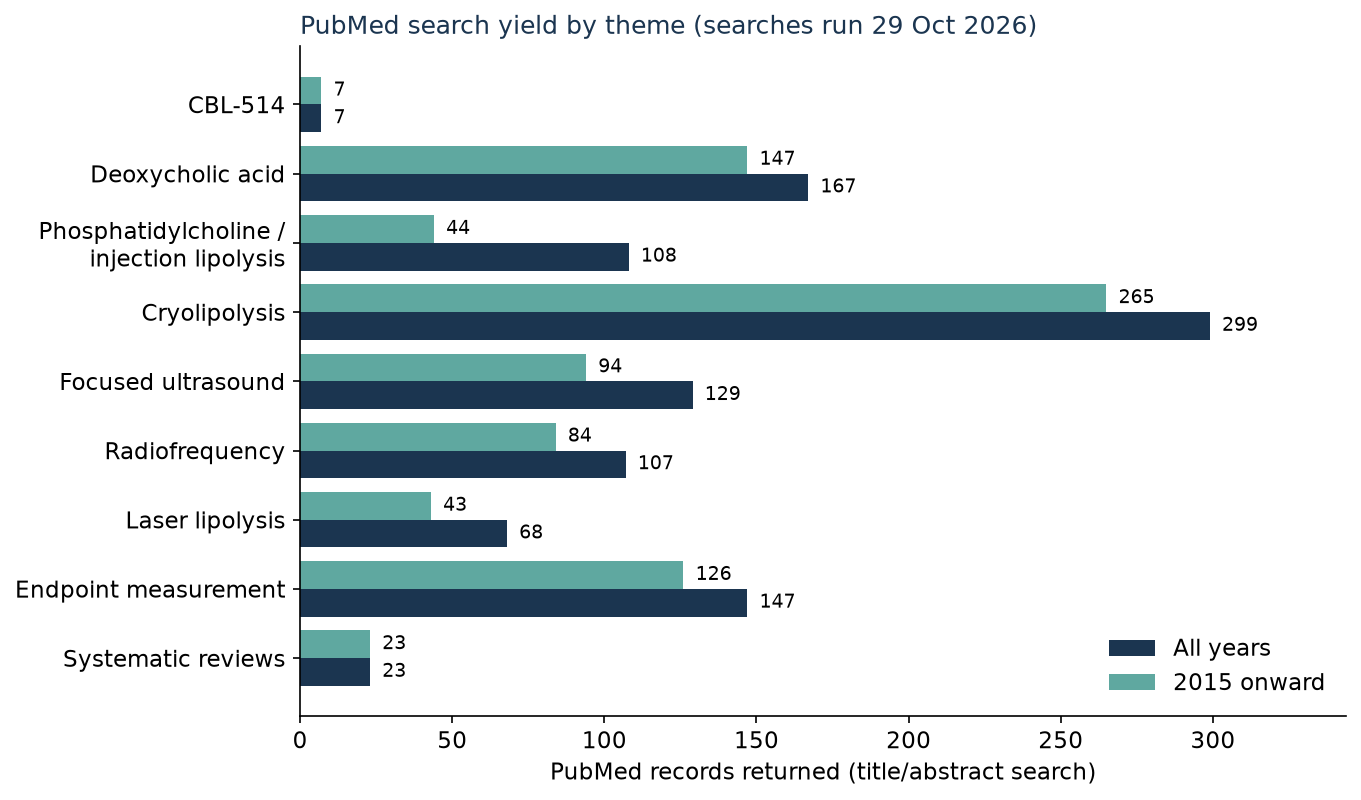
The screen also shows how the systematic-review base differs between modalities. Reviews of cryolipolysis are numerous and include meta-analyses of effectiveness and of a specific adverse event [46, 47, 48, 49, 50, 51, 52, 53]. Focused ultrasound has three systematic or evidence-based reviews [54, 55, 56], and low-level laser has one recent systematic review of randomised trials [57]. Deoxycholic acid in the submental region has a systematic review of placebo-controlled studies [58]. CBL-514 appears in one systematic review of injectable lipolytic agents for non-submental regions, which pooled 25 studies and 3,178 patients across all injectable agents, and in one narrative review of Dercum disease therapies [28, 59]. No systematic review was found that evaluates CBL-514 as its primary subject.
The inclusion fractions reported by earlier reviews show how much of the literature fails basic quality filters. Ingargiola and colleagues included 19 of 319 retrieved articles in their cryolipolysis review, which is 6.0% (19 ÷ 319) [46]. Do and colleagues included 8 of 951 screened articles in a submental cryolipolysis meta-analysis, which is 0.84% (8 ÷ 951), and all eight were pre–post studies [49]. Kumar and colleagues included 11 of 4,584 citations in a review of HIFU, which is 0.24% (11 ÷ 4,584) [55]. Auh and colleagues included 36 of 1,057 articles in their review of measurement methods, which is 3.4% (36 ÷ 1,057), and Ho and Jagdeo included 10 of 314 records on paradoxical adipose hyperplasia, which is 3.2% (10 ÷ 314) [5, 53]. All five percentages are the author’s calculations from counts the reviews published.
The harmonised endpoint framework
Table 2 sets out the seven-tier hierarchy and shows which modalities have used each tier as a primary or key secondary endpoint. Two patterns stand out. First, only two programmes in this map have used MRI volume (Tier 1) in a randomised, placebo-controlled trial: CBL-514 in its phase 2b abdominal trial and deoxycholic acid in its submental phase 3 trials [3, 60, 61]. Among the energy-based devices, MRI volume appears only in a small uncontrolled 1060-nm laser study that also used split-flank comparisons [62]. Second, the device literature relies heavily on circumference (Tier 5) and on photograph identification (Tier 7). Both are the endpoints that measurement research identifies as most confounded or most subjective [5]. The pivotal randomised trial of HIFU used waist circumference as its primary endpoint [63]. The pivotal study for submental cryolipolysis used correct identification of baseline photographs by blinded physicians [64]. The randomised trial of low-level laser used combined circumference across several sites [25].
Table 2. Harmonised endpoint framework: seven tiers ordered by how directly they quantify subcutaneous fat volume in the treated region, with published reliability evidence and the modalities whose principal studies used each tier
| Tier | Endpoint and method | What it captures | Published reliability or validity evidence | Principal studies using this tier |
|---|---|---|---|---|
| E1 | MRI volume of the treated fat compartment | Three-dimensional fat volume, independent of operator compression | Described as accurate but expensive [5] | CBL-514 phase 2b [3]; deoxycholic acid REFINE trials (MRI responders) [4, 60, 61]; 1060-nm laser pilot [62] |
| E2 | Ultrasound-derived volume (thickness × fixed area) or 3D surface volume | Volume estimate built from point thickness, or contour volume from surface imaging | Ultrasound is operator dependent; 3D surface models were early in development when reviewed [5] | CBL-514 phase IIa and phase 2 [1, 2]; CBL-514 Dercum lipomas [12]; cryolipolysis 3D photography [65]; deoxycholic acid 3D case report [66]; hypogastric deoxycholic acid pilot [67] |
| E3 | Ultrasound thickness at marked sites | Fat layer depth at fixed points | Inter-rater ICC 0.755 (95% CI 0.622–0.841) for A-mode ultrasound [40]; high-resolution ultrasound characterised across seven sites [68] | Cryolipolysis [64, 69, 70, 71]; HIFU [72]; RF [73]; 1060-nm laser [74, 75, 76]; PC/DC [77]; deoxycholic acid flank [78] |
| E4 | Caliper skinfold thickness | Double fold of skin plus fat under compression | Inter-rater ICC 0.999 for skinfolds, but agreement with ultrasound poor: Lin’s CCC −0.009 to 0.646 [40]; 0.02 to 0.33 in older adults [41] | Cryolipolysis [65, 71, 79]; deoxycholic acid thigh and submental [80, 81] |
| E5 | Circumference by tape | Girth at a landmark, affected by fat, fluid, muscle tone and posture | Confounded by weight and posture [5] | HIFU pivotal trial [63, 82, 83]; RF [84, 85, 86]; low-level laser [25, 57]; 1060-nm laser [87] |
| E6 | Responder status on a clinician- or patient-rated photonumeric scale | Visible severity grade, rated by clinician and/or participant | Validated scales used as regulatory co-primary endpoints for deoxycholic acid [4] | Deoxycholic acid phase 3 [60, 61, 81, 88]; CBL-514 phase 2b [3] |
| E7 | Blinded identification of baseline vs post-treatment photographs | Whether a visible change is detectable | Subjective; vulnerable to lighting and posture [5, 52] | Submental cryolipolysis pivotal study [64]; 1060-nm laser [74, 87]; deoxycholic acid thigh pilot [80] |
Sources for Table 2: tier ordering is the author’s synthesis from the measurement review by Auh and colleagues and the reliability studies cited in the table; study allocations are from the abstracts or full texts of the cited studies [5, 40, 41, 68].
The reliability data explain why the tiers cannot be pooled across. In 84 volunteers, Pérez-Chirinos Buxadé and colleagues found inter-rater intraclass correlations of 0.999 for skinfold calipers and 0.755 for portable A-mode ultrasound. Yet Lin’s concordance between the two methods ranged from −0.009 to 0.646, so each method was reproducible on its own terms while the two did not measure the same quantity [40]. In 146 older adults, Fernandes and colleagues reported concordance between calipers and ultrasound of 0.02 to 0.33 across four sites, with caliper-to-ultrasound ratios from 1.20 to 2.90 [41]. Among the energy-device studies, the gap appears within single trials. In Garibyan’s split-flank cryolipolysis study, the treated flank’s caliper measurement fell from 45.6 mm to 38.6 mm. That is 7.0 mm, or 15.4% of baseline (7.0 ÷ 45.6), while the control flank fell from 45.3 mm to 44.6 mm (0.7 mm), for a control-adjusted difference of 6.3 mm (7.0 − 0.7). The 3D photography arm of the same study gave volume losses of 56.2 cc treated against 16.6 cc control, a difference of 39.6 cc [65]. The two results agree in direction. However, the control flank’s 16.6 cc volume loss, set against its 0.7 mm caliper change, shows that the two measurements respond differently to non-treatment variation. All arithmetic in this paragraph is the author’s.
CBL-514 fat reduction evidence: what the trials measured
The four peer-reviewed CBL-514 reports differ in design and endpoint tier, so they are described here one at a time before being compared with other modalities. Each study and its registry record are appraised in CBL-514 clinical trials: a systematic evidence map.
Phase IIa (open-label, dose-ranging). Goodman and colleagues allocated participants at random across three dose levels in an open-label study. Ultrasound follow-up took place at 4 and 8 weeks after the final treatment [1]. The registry record shows 43 participants enrolled [89]. The full text reports that 28 enrolled participants completed all study visits, 65.1% on the author’s arithmetic (28 ÷ 43). Fifteen withdrew; 8 of the 15 withdrawals were attributed to adverse events, including injection-site pain, pruritus, swelling, urticaria, rash and fever. Volume was estimated by ultrasound (Tier 2), and the abstract reports a 24.96% mean reduction in abdominal fat volume at the highest dose level, measured against baseline, with no concurrent control [1]. The paper assigned itself an evidence level of 4.
Phase 2 (single-blind, placebo-controlled). Gold and colleagues randomised 76 participants 2:1 to CBL-514 or placebo, with ultrasound-derived volume as the primary measure [2]. The primary endpoint was the proportion losing at least 150 mL of abdominal subcutaneous fat. In the intention-to-treat analyses reported at each visit, 63.9% of the CBL-514 group and 17.4% of the placebo group met that threshold at 4 weeks after the final treatment. At 8 weeks, 69.6% (16 of 23 evaluable) and 0% (0 of 16) did so. On the author’s arithmetic, the 4-week risk difference is 46.5 percentage points (63.9 − 17.4) and the ratio is 3.67 (63.9 ÷ 17.4). The 8-week difference is 69.6 points, and no ratio can be calculated because the placebo proportion is zero. On the ≥200 mL threshold, 58.3% (21/36) against 8.7% (2/23) responded at 4 weeks, and 60.9% (14/23) against 0% (0/16) at 8 weeks. The between-group difference in mean volume change was −206.62 mL at 4 weeks and −216.28 mL at 8 weeks [2]. The full text reports a non-completion rate of 49.3%, attributed mainly to loss to follow-up, withdrawal and weight instability. The evaluable denominators confirm the attrition: 23 CBL-514 participants contributed at 8 weeks out of the 50 the abstract describes, or 46.0% (23 ÷ 50). The per-protocol population was 30 participants, 39.5% of those randomised (30 ÷ 76). Treatment-emergent adverse events were mostly injection-site reactions of mild to moderate severity. One participant had a moderate adverse event of hyperlipidaemia that the investigators judged probably related to treatment [2].
Phase 2b (single-blind, placebo-controlled, MRI and rating scales). Lorenc and colleagues randomised 108 adults with moderate or severe abdominal fat 1:1 to CBL-514 or placebo [3]. The primary endpoint was at least one grade of improvement on a clinician-reported abdominal fat rating scale at the 12-week follow-up (Tier 6), with a patient-reported scale and MRI volume as secondary endpoints. In the full analysis set, 76.7% (23/30) of CBL-514 participants and 18.9% (7/37) of placebo participants met the clinician-scale endpoint. On the patient scale, the figures were 76.7% (23/30) and 19.4% (7/36). MRI showed a least-squares mean volume change of −152.9 mL, or −20.3% from baseline, which the authors report as significantly greater than placebo [3]. On the author’s arithmetic, the clinician-scale risk difference is 57.8 points (76.7 − 18.9) with a ratio of 4.06 (76.7 ÷ 18.9). The patient-scale difference is 57.3 points (76.7 − 19.4) with a ratio of 3.95 (76.7 ÷ 19.4). Those two primary-endpoint denominators are worth noting. If the 108 randomised participants were split evenly, 54 per arm, then 30 contributing active participants are 55.6% of the arm (30 ÷ 54) and 37 placebo participants are 68.5% (37 ÷ 54). Across both arms, 67 of 108 contributed, or 62.0%. The registry entry lists 107 participants and records the masking as double [90], whereas the publication describes the trial as single-blind; the difference is reported here without interpretation.
Phase 2a in Dercum disease lipomas (open-label). Herbst and colleagues reported 12 participants with painful lipomas, randomised 1:1 between two dose levels and followed for 8 weeks after treatment [12]. Lipoma volume, measured by ultrasound, fell by a median of 45.0% and 50.7% in the two dose groups at 8 weeks. Every participant had at least one treatment-related adverse event, mostly injection-site reactions. Severe adverse events occurred in 4 participants, 2 participants discontinued, and no serious adverse events were reported [12]. A narrative review reports that CBL-514 has FDA Fast Track designation for Dercum disease [28]. Fast Track is a process for expediting development and review, not a marketing authorisation [29]. A placebo-controlled phase 2 Dercum trial with 19 participants is recorded as completed in March 2026, with no results posted [91].
Sponsor-reported phase 2b results (not peer reviewed). The sponsor has reported results from a second phase 2b abdominal trial, which matches the completed 173-participant registry record [33, 92]. According to the sponsor, 21.2% of CBL-514 participants and 0% of placebo participants achieved at least a two-grade improvement on both the clinician and patient scales, and 63.6% against 10.8% achieved at least one grade. On the author’s arithmetic, those are risk differences of 21.2 points and 52.8 points (63.6 − 10.8), and the one-grade ratio is 5.89 (63.6 ÷ 10.8). The same release states that, after discussion with the FDA, the phase 3 primary endpoint was refined to at least a two-grade improvement on both scales, with MRI as a key secondary endpoint [33]. A later release reports that the first participant was dosed in the phase 3 SUPREME-01 trial, described as randomised, double-blind and placebo-controlled with about 320 participants [27, 93]. These sponsor figures are shown in this review only where they are labelled as not peer reviewed, and they do not contribute to the certainty rating.
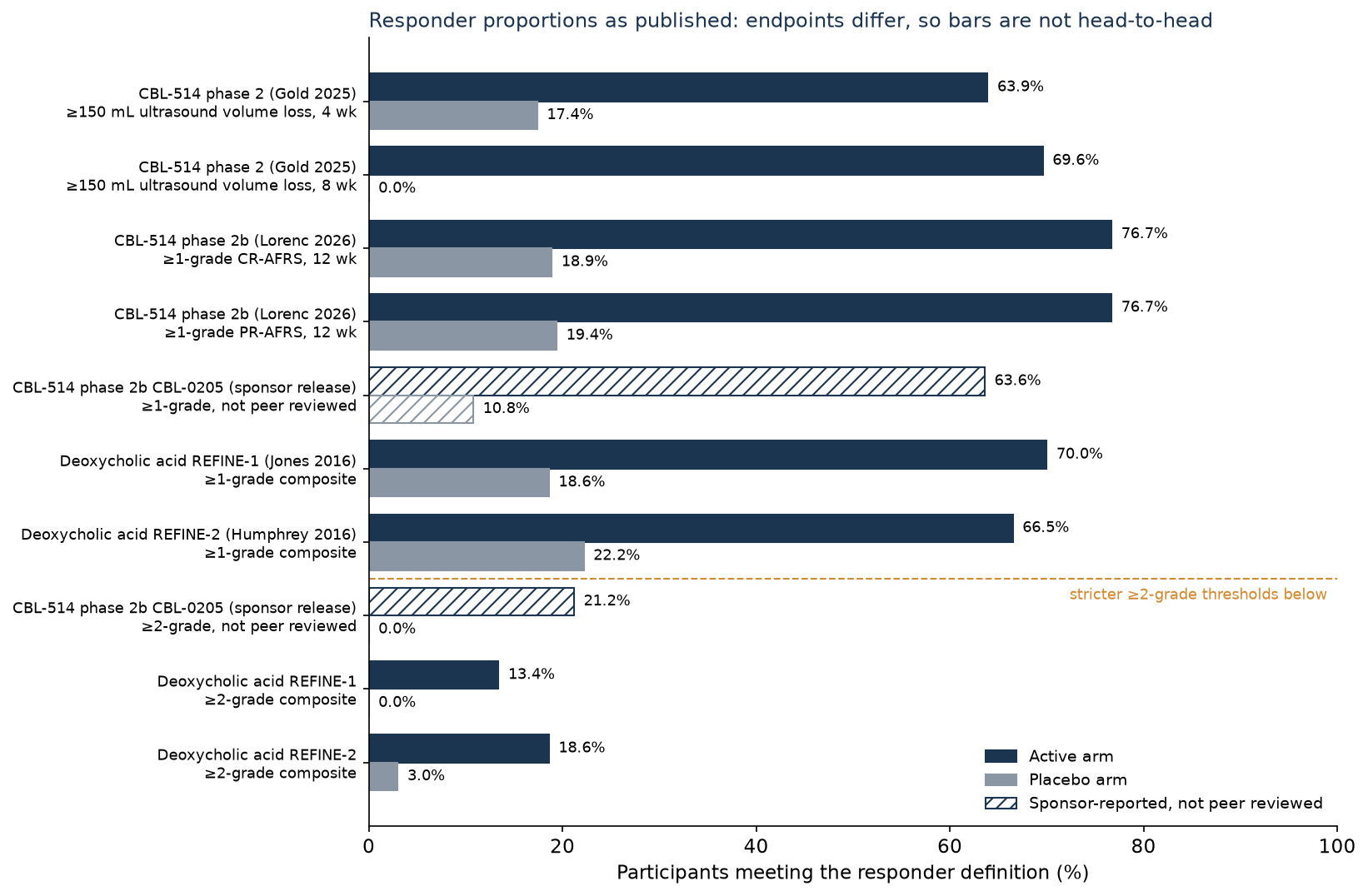
Figure 2 shows why it matters which tier a figure comes from. On the one-grade rating-scale endpoint, the closest like-for-like comparison, the published CBL-514 risk differences (57.8 and 57.3 points) are numerically larger than those of the REFINE-1 and REFINE-2 deoxycholic acid trials. REFINE-1 reported 70.0% against 18.6%, a difference of 51.4 points and a ratio of 3.76 (70.0 ÷ 18.6). REFINE-2 reported 66.5% against 22.2%, a difference of 44.3 points and a ratio of 3.00 (66.5 ÷ 22.2), against a published Mantel–Haenszel risk ratio of 2.98 [60, 61]. Four features stop this from being a like-for-like comparison:
- The CBL-514 figure rests on 67 contributing participants, against 506 and 516 participants in REFINE-1 and REFINE-2 [60, 61].
- The CBL-514 scales are abdominal instruments, whereas the submental scales are a different instrument for a different region.
- The deoxycholic acid figure is a composite requiring improvement on both the clinician and patient scales, while the published CBL-514 figure reports each scale separately.
- The CBL-514 trial was single-blind.
On the stricter two-grade composite, which is now the phase 3 primary endpoint for CBL-514, the REFINE trials reported 13.4% against 0% and 18.6% against 3.0%. Those are risk differences of 13.4 and 15.6 points (18.6 − 3.0), against the sponsor-reported, unreviewed 21.2 points for CBL-514 [33, 60, 61].
Registry–publication audit
The ClinicalTrials.gov query returned 16 CBL-514 records, all with one commercial lead sponsor [8]. Eleven are completed, one is recruiting and four are not yet recruiting. Table 3 lists each record with its publication status. Four of the 11 completed records have a matching journal publication, or 36.4% (4 ÷ 11). Completed records list 539 participants in total (40 + 43 + 25 + 75 + 10 + 12 + 12 + 23 + 107 + 173 + 19 = 539). The published trials account for 237 of them (43 + 75 + 12 + 107), or 44.0% (237 ÷ 539). Four completed but unpublished records have posted registry results: two cellulite studies, one dose-escalation study and one pharmacokinetic study. Three completed records have neither a journal publication nor posted results: the phase 1 study, the 173-participant phase 2b study and the 19-participant placebo-controlled Dercum study.
Two figures put the audit in context. First, the largest unpublished completed trial (173 participants) is 1.62 times the size of the largest published one (107 participants on the registry; 173 ÷ 107 = 1.62). Second, removing the Dercum placebo-controlled trial, which completed in March 2026, leaves 520 participants in 10 completed trials (539 − 19 = 520). The sponsor’s own release refers to 10 completed trials with finalised statistical reports and to more than 544 participants across all CBL-514 trials [33]. Those figures are of the same order as the registry counts, but public records do not show where the difference comes from. The five registered trials that are recruiting or not yet recruiting plan 1,440 participants (250 + 250 + 320 + 320 + 300 = 1,440), which is 2.67 times the completed enrolment (1,440 ÷ 539) [93, 94, 95, 96, 97]. A Canadian trial listing describes one of the phase 3 abdominal trials as randomised, double-blind and placebo-controlled [32].
Table 3. Registry–publication audit of all 16 CBL-514 records on ClinicalTrials.gov (retrieved 29 October 2026). Enrolment is actual for completed records and estimated otherwise. Masking is as recorded in the registry.
| Registry record | Phase; population | Status (primary completion) | Enrolment | Registry masking | Journal publication | Registry results posted |
|---|---|---|---|---|---|---|
| NCT04699669 [98] | 1; abdominal fat | Completed (Aug 2019) | 40 | Double | None found | No |
| NCT04698642 [89] | 2a; abdominal fat | Completed (Nov 2020) | 43 | None | Goodman 2022 [1] | No |
| NCT04575467 [99] | 2 (stage 1); abdominal fat | Completed (Nov 2021) | 25 | None | None found | Yes |
| NCT04897412 [100] | 2 (stage 2); abdominal fat | Completed (Feb 2023) | 75 | Single | Gold 2025 (reports 76 randomised) [2] | No |
| NCT05234736 [101] | 2; pharmacokinetics, healthy volunteers | Completed (Jun 2022) | 10 | None | None found | Yes |
| NCT05387733 [102] | 2a; Dercum disease | Completed (Apr 2023) | 12 | None | Herbst 2026 [12] | No |
| NCT05632926 [103] | 2; cellulite | Completed (May 2023) | 12 | None | None found | Yes |
| NCT05836779 [104] | 2; cellulite | Completed (Nov 2023) | 23 | None | None found | Yes |
| NCT05736107 [90] | 2b; abdominal fat | Completed (May 2024) | 107 | Double | Lorenc 2026 (reports 108 randomised; single-blind) [3] | No |
| NCT06005441 [92] | 2b; abdominal fat | Completed (Oct 2024) | 173 | Double | None found; sponsor-reported only [33] | No |
| NCT06303570 [91] | 2; Dercum disease, placebo-controlled | Completed (Mar 2026) | 19 | Single | None found | No |
| NCT07608770 [94] | 2; abdominal fat | Recruiting (est. Apr 2027) | 250 | Single | Not applicable | No |
| NCT07608757 [95] | 2; abdominal fat | Not yet recruiting (est. Feb 2028) | 250 | None | Not applicable | No |
| NCT07140939 [93] | 3 (SUPREME-01); abdominal fat | Recruiting (est. Jul 2027) | 320 | Triple | Not applicable | No |
| NCT07526974 [96] | 3 (SUPREME-02); abdominal fat | Not yet recruiting (est. Aug 2027) | 320 | Triple | Not applicable | No |
| NCT07733947 [97] | 3; maintenance and long-term safety | Not yet recruiting (est. Aug 2028) | 300 | Triple | Not applicable | No |
Sources for Table 3: ClinicalTrials.gov API v2 records retrieved and parsed on 29 October 2026 [8]; publication matching by registry number cited in each paper, or by design, population and dates where the abstract did not give the number. Totals and percentages are the author’s arithmetic shown in the text. Two records (NCT04575467 and NCT05234736) list phase 2 status but the registry titles indicate dose-escalation and pharmacokinetic aims respectively.
The audit does not imply that anything has been withheld improperly. Phase 1, pharmacokinetic and small exploratory studies are often never published in journals. The sponsor has also announced results from the largest trial, and the Dercum placebo-controlled study completed only seven months before this search. What the audit does show is that the peer-reviewed CBL-514 abdominal evidence covers fewer than half of the participants already studied, and that it does not yet include the largest trial in the programme. For a reader trying to judge the evidence, that is a property of the evidence itself, and the GRADE-style rubric records it under replication and reporting.
Comparator modalities on the same map
Deoxycholic acid. Deoxycholic acid is the only injectable in this map with a marketing authorisation for localised fat reduction. The FDA approved it in April 2015 for moderate to severe convexity or fullness associated with submental fat in adults. Australia’s TGA approved it as a new chemical entity in July 2016, and it was entered on the ARTG that month [13, 14]. Its US label states that safe and effective use outside the submental region has not been established and is not recommended. The label carries warnings about marginal mandibular nerve injury and dysphagia. It also reports pooled phase 3 data from 513 treated and 506 placebo participants, in which 43% against 5% achieved an MRI-measured submental volume reduction of at least 10% [4]. The evidence behind that label is the deepest of any body in this map. REFINE-1 and REFINE-2 together randomised 1,022 participants (506 + 516) in double-blind, placebo-controlled designs with composite rating-scale and MRI co-primary endpoints [60, 61]. Two earlier European phase 3 trials randomised 363 and 360 participants and reported significant caliper and rating-scale effects [81, 88]. A systematic review of placebo-controlled studies pooled 6 studies with 3,488 patients [58].
Durability is better characterised for deoxycholic acid than for any other modality here. In 224 REFINE participants enrolled in long-term follow-up, the proportion maintaining a one-grade clinician response was 86.4% against 56.8% at year 1, 90.6% against 73.8% at year 2 and 82.4% against 65.0% at year 3 [26]. In an open-label study of 165 adults, 86.8% of participants were clinician-rated responders 12 weeks after treatment. At 12 months, 90.4% of clinician-rated and 80.7% of subject-rated responders had maintained their response [105]. A post hoc pooled REFINE analysis reported that 19.1% of active and 3.9% of placebo participants received fewer than the maximum number of sessions. The analysis found that efficacy emerged progressively over the course of treatment [106].
Safety reporting for deoxycholic acid covers trial adverse-event tables, anatomical risk and post-marketing harms. In REFINE-1, marginal mandibular nerve paresis occurred in 4.3% of subjects, or 1.0% of treatment sessions [60]. In REFINE-2, 85.7% of active-arm and 76.9% of placebo-arm adverse events were at the injection site [61]. A cadaver study of 12 hemifaces mapped the course of the marginal mandibular nerve relative to the treatment zone [107]. A systematic review of serious adverse events in real-world use describes arterial injury and other events, most of them procedure related [108]. Case-level reports outside the approved region include subcutaneous calcification after treatment of the knees and an assessment of 3D imaging after treatment, both available here only at title level [66, 109].
Use outside the submental region is studied mainly in small open-label series: 15 participants for the inner thigh, 14 for the hypogastrium and 30 for the flanks [67, 78, 80]. The thigh study reported a mean circumference change of −2.2 cm and a skinfold change of −8.8 mm, and blinded physicians identified the post-treatment photograph for 83% of patients [80]. The hypogastric study reported oedema after 94.4% of treatment sessions, bruising after 90.7% and erythema after 79.6% [67]. The flank study reported aesthetic improvement in 86.7% of participants on the Global Aesthetic Improvement Scale [78]. A systematic review of injectable lipolytic agents for non-submental regions pooled 25 studies with 3,178 patients. Reductions were reported in 93.75% of the studies, but only 37.5% reported statistically significant results [59]. CBL-514 is being developed for exactly this kind of non-submental, larger-area indication, and that is where the deoxycholic acid evidence is thinnest.
Phosphatidylcholine and deoxycholate mixtures. Before deoxycholic acid was approved, injection lipolysis used phosphatidylcholine formulations that contained deoxycholate as a solubiliser. A laboratory study then identified deoxycholate as the major active lytic component [15]. In a small series, 6 patients with 12 lipomas showed a mean reduction in lipoma area of 75% [110]. In a double-blind, randomised, split-body study of 37 women, the mixture and deoxycholate alone performed almost identically. The circumference reductions were 6.46% and 6.77%, and the ultrasound reductions 36.87% and 36.06% respectively, with an overall reduction in 91.9% of patients. No laboratory safety tests were reported [77]. A retrospective review of 1,269 patients over 14 years describes practice in one centre [111]. A practice standard from 2008 and a 2022 commentary on risk set out the case for and against the approach [16, 17]; the commentary is available here only at title level. An animal study has compared a cholic acid formulation with deoxycholic acid [112]. The relevance to CBL-514 is mechanistic. Deoxycholate-containing agents act as detergents that lyse cells. CBL-514 is described as a small molecule that induces adipocyte apoptosis, and the published CBL-514 reports state that no necrosis or nerve injury was observed [1, 3]. Whether that difference in mechanism leads to a difference in clinical outcomes has not been tested head to head.
Cryolipolysis. Controlled cooling of fat was characterised in pig models [113, 114]. Early clinical work included a 40-participant study that found no meaningful change in serum lipids or liver tests over 12 weeks [115]. The first device received De Novo classification in August 2010 under product code OOK, which the FDA defines as a cooling device for disrupting adipocytes for body contouring or circumference reduction [18, 34]. Cryolipolysis has the largest literature in this map, but much of it is uncontrolled. The pivotal submental study treated 60 participants in a single arm. Its primary endpoint was blinded identification of baseline photographs (Tier 7), which was achieved for 91% of participants, with a mean ultrasound fat reduction of 2.0 mm [64]. Other studies used split-body designs [65, 70], single-arm caliper or ultrasound designs [71, 79] and one randomised trial against no treatment [69]. In that randomised trial of 34 women (17 per arm), with concealed allocation and a blinded assessor, no between-group difference was found at any time point. At 90 days, the ultrasound difference was 0.04 cm [69]. In the split-body study, active heating after cooling reduced side effects but also reduced the ultrasound fat reduction, from 14.1% to 9.6% [70].
The meta-analytic evidence for cryolipolysis is large but heterogeneous. One meta-analysis pooled 30 studies with 3,158 participants. It reported a mean difference in circumference of −3.56 cm and in suprailiac skinfold of −5.22 mm, with numbness in 49.5% [51]. Another reported a circumference mean difference of −3.45 with I² of 92% and a fat-thickness mean difference of −3.56 with I² of 95% [50]. A meta-analysis of submental treatment pooled 8 pre–post studies with 206 patients, reporting −2.78 mm in thickness and −19.57 cm³ in volume [49]. Earlier systematic reviews reported caliper reductions of 14.67% to 28.5% and ultrasound reductions of 10.3% to 25.5% [46], as well as a broader 53-article synthesis [47]. A critical review raised concerns about the rigour of the underlying studies [52].
Paradoxical adipose hyperplasia is the most characteristic harm of cryolipolysis, and its estimated frequency has risen as evidence has accumulated. The first report estimated an incidence of 0.0051%, after more than 650,000 treatment cycles worldwide [116]. That is about 1 in 19,608 on the author’s arithmetic (100 ÷ 0.0051). A systematic review of 10 studies identified 16 cases [53]. A 2025 meta-analysis of 28 studies with 13,078 patients estimated a pooled incidence of 0.22% (95% CI 0.10–0.47), based on 29 cases (29 ÷ 13,078 = 0.22%), or about 1 in 455 (100 ÷ 0.22). It also noted that only 4 of the included studies followed patients for 16 weeks or longer [48]. The 2025 estimate is about 43 times the 2014 figure (0.22 ÷ 0.0051 = 43.1). The change illustrates how a rare, late-onset harm can be under-counted when follow-up is short. That lesson applies to every modality here, CBL-514 included, because its longest published follow-up is 12 weeks.
High-intensity focused ultrasound. The first HIFU body-contouring system received 510(k) clearance in August 2011 under product code OHV, which the FDA defines as focused ultrasound for heating or mechanical disruption of tissue in non-invasive aesthetic use [19, 36]. The randomised, sham-controlled trial behind it had a circumference primary endpoint (Tier 5). In the intention-to-treat population, the higher energy level reduced waist circumference by 2.44 cm against sham (p = 0.01), while the lower level reduced it by 2.06 cm (p = 0.13). Both reached significance in the per-protocol population, at −2.52 and −2.10 cm [63]. Twenty-four-week safety follow-up of the same programme reported an adverse-event profile similar to sham [117]. The rest of the literature comprises a retrospective chart review of 85 patients reporting −4.6 cm, with adverse events in 10 of 85 (11.8%) [83]; a 152-patient histology and safety study in which healing was 95% complete at 8 to 14 weeks [118]; earlier mechanistic and clinical reports [119]; a trial reporting a circumference reduction of 3.43 cm [82]; and a 10-participant ultrasound study reporting −4.33 mm in the abdomen [72]. A long-term follow-up letter is available here only at title level [120]. Three reviews describe the evidence as limited. One included 11 of 4,584 citations, one critically appraised the evidence base, and one covered 45 studies reporting circumference reductions of 2.5 to 4.5 cm [54, 55, 56].
Radiofrequency. Studies of non-contact selective-field radiofrequency are small and mostly single-arm, with circumference endpoints. In 40 participants, 35 completed, and the mean circumference reduction was −4.93 cm [84]. In 12 participants, 10 of 12 had a reduction, and a CT volume reduction was shown in one participant [85]. In a 21-participant study, circumference fell from 113.4 cm to 110.7 cm and ultrasound thickness from 40.5 mm to 38.5 mm, a 2.7 cm and 2.0 mm change on the author’s arithmetic, with biopsies taken at subsequent abdominoplasty [73]. A retrospective analysis of 20 people with metabolic syndrome examined circumference and autonomic measures [86]. A newer multi-channel device has been studied in animal tissue [121]. Regulation of these devices is less specific than for the other energy-based modalities. The FDA product code examined, PBX, is defined around minor aches and pains and the temporary reduction of cellulite appearance, not adipocyte disruption [38].
Laser lipolysis (non-invasive). The first 1060-nm laser was cleared in May 2015 under product code PKT, defined as a laser for disrupting adipocytes for body contouring or circumference reduction [20, 35]. A pilot programme combined temperature studies, biopsies, ultrasound and MRI. It reported thickness reductions of 14% to 18% and an MRI volume reduction of 24% at 3 months and 21% at 6 months in a small number of flanks [62]. Later single-arm studies reported blinded photograph identification of 95% with a −2.65 mm ultrasound reduction at 12 weeks in 35 participants [74], and good aesthetic ratings in 60 participants [87]. A combined-wavelength device study in 42 participants reported reductions of 18.62% in the abdomen and 26.4% in the submental area [75]. A 20-participant submental study found a significant reduction at 3 months that was not significant at 6 months [76]. Low-level laser at 635 nm, under product code OLI, has a De Novo record from 2010 [21, 37]. Its pivotal double-blind, sham-controlled trial enrolled 67 participants, 8 of whom had no 2-week measurement. It reported a combined circumference reduction of 3.51 inches against 0.684 inches with sham at the end of a 2-week treatment phase [25]. A systematic review of 3 randomised trials with 160 participants reported 2.48 cm against 0.635 cm [57].
Narrative and cross-modality reviews. Broader reviews place these technologies side by side but do not harmonise endpoints. One reviewed 31 studies of four device classes, including 2,937 patients [23]. Two others, one on mechanisms and one an updated narrative review drawing on 193 references, covered a wider range [22, 24]. A 2023 review surveyed injection lipolysis alongside cryolipolysis, ultrasonic, radiofrequency and laser methods [122], and a 2018 systematic review assessed how changes in subcutaneous fat are quantified [5]. These reviews informed the framework in Table 2. None of them graded certainty with an explicit, reproducible rubric across both drug and device modalities, which is the gap this article addresses.
Safety reporting and post-market surveillance
Safety reporting differs in kind across the map, not only in amount. For CBL-514, all published safety information comes from trial adverse-event tables in four reports with 239 participants between them, taking Gold’s 76 and Lorenc’s 108 randomised (43 + 76 + 108 + 12 = 239). The longest follow-up after the last treatment is 12 weeks [1, 2, 3, 12]. Each report describes mostly mild to moderate injection-site reactions. In the phase 2 trial, nearly all participants (99% overall) reported at least one treatment-related adverse event, and 9 CBL-514 participants reported severe events, all involving injection-site pain [2]. One report records a moderate hyperlipidaemia event judged probably related [2], and one records 8 withdrawals attributed to adverse events among 43 participants [1]. No post-marketing data exist, because the compound is not marketed.
For devices, the US FDA’s MAUDE database records manufacturer and user reports. A cross-sectional analysis of 2014–2020 identified 165 reports for non-invasive fat and cellulite devices. Cryolipolysis accounted for 68 (41.2%), 1060-nm laser for 34 (20.6%) and HIFU for 19 (11.5%) [123]. A 2026 analysis of liposuction and non-invasive fat reduction devices recorded 642 complaints against an estimated 1.8 million procedures, or 0.04% (642 ÷ 1,800,000 = 0.036%). Cryolipolysis accounted for 467 complaints (72.7%), and the authors report that 99% of those concerned paradoxical adipose hyperplasia [124]. Passive reporting under-counts events, so these figures are not incidence rates. They are, however, a category of post-market evidence that does not yet exist for CBL-514.
Metabolic safety has been examined more formally. A dose-response meta-analysis of 22 studies with 676 participants found that changes in serum lipids after non-surgical fat removal were transient [125]. Lipids and liver tests were unchanged after flank cryolipolysis [115], and the HIFU 24-week safety study reported no clinically meaningful lipid changes [117]. Against that background, the single hyperlipidaemia event in the CBL-514 phase 2 trial [2] cannot be interpreted either way from one report. A placebo-controlled lipid analysis in a larger population would be needed.
Regulatory status
The modalities in this map sit in different regulatory categories, and the categories determine what evidence regulators required. Deoxycholic acid holds a drug approval in the US and Australia for one region [4, 13, 14]. Cryolipolysis, HIFU, 1060-nm laser and low-level laser hold device classifications or clearances under specific US product codes, through De Novo or 510(k) substantial-equivalence pathways [18, 19, 20, 21, 34, 35, 36, 37]. A 510(k) clearance rests on substantial equivalence to a predicate device rather than on a new demonstration of efficacy, so it differs in kind from a drug approval. CBL-514 has no marketing authorisation in any jurisdiction located by this search. Its regulatory milestones are trial authorisations and a Fast Track designation for Dercum disease, which expedites development and review but is not approval [28, 29]. In Australia, a product that meets the definition of a therapeutic good is regulated under the Therapeutic Goods Act, whatever its labelling. Marking such a product “research use only” does not change that status [30, 31]. The Australian and international position is analysed in CBL-514 Australia: a comparative regulatory analysis.
Table 4. Comparative design and effect map. Effects are as published, in the authors’ units, for the principal studies of each body of evidence; they are not comparable across tiers.
| Modality (region) | Principal designs and size | Primary endpoint tier | Effect as published | Longest follow-up reported | Safety reporting source | Regulatory status found |
|---|---|---|---|---|---|---|
| CBL-514 (abdomen) | Open-label dose-ranging, 43 [1]; single-blind placebo RCTs, 76 and 108 [2, 3] | E2 (phase 2); E6 with E1 secondary (phase 2b) | ≥150 mL loss 69.6% vs 0% at 8 wk; ≥1-grade CR-AFRS 76.7% vs 18.9%; MRI −152.9 mL (−20.3%) | 12 weeks after treatment | Trial adverse-event tables only | Investigational; no marketing authorisation found |
| CBL-514 (Dercum lipomas) | Open-label two-dose, 12 [12] | E2 | Median lipoma volume −45.0% and −50.7% at 8 wk | 8 weeks | Trial adverse-event table | Investigational; Fast Track designation reported [28] |
| Deoxycholic acid (submental) | Double-blind placebo RCTs, 506, 516, 363, 360 [60, 61, 81, 88] | E6 composite, E1 co-primary | ≥1-grade composite 70.0% vs 18.6% and 66.5% vs 22.2%; MRI responders 46.3% vs 5.3% | 3 years (maintenance) [26] | Trials, labelling, post-market reviews [4, 108] | Approved, US 2015 and Australia 2016, submental only |
| Deoxycholic acid (other regions) | Open-label series, 15, 14, 30 [67, 78, 80] | E4, E5, E7 | Thigh −2.2 cm, −8.8 mm; flank GAIS 86.7% | 12 weeks | Study adverse-event reports | Use outside the submental region not established [4] |
| Phosphatidylcholine/DC | Double-blind split-body, 37 [77]; series, 6 [110] | E3, E5 | Ultrasound −36.87% vs −36.06%; lipoma area −75% | Study duration | Study reports; no laboratory tests in RCT | No approval for fat reduction found |
| Cryolipolysis | No-treatment RCT, 34 [69]; single-arm pivotal, 60 [64]; meta-analysis, 3,158 [51] | E3, E5, E7 | RCT null (0.04 cm at 90 d); circumference MD −3.56 cm; photograph ID 91% | 90 days (RCT); longer in cohorts | Trials, case series, MAUDE [123, 124] | FDA De Novo 2010 (OOK) |
| Focused ultrasound | Sham RCT [63]; retrospective, 85 and 152 [83, 118] | E5 | −2.44 cm vs sham (ITT, higher energy) | 24 weeks (safety) | Trials, MAUDE [123] | FDA 510(k) 2011 (OHV) |
| Radiofrequency | Single-arm, 40, 12, 21; retrospective, 20 [73, 84, 85, 86] | E5 | −4.93 cm; 113.4 → 110.7 cm | 3 months | Study reports | Product code examined (PBX) not defined around adipocyte disruption |
| 1060-nm laser | Single-arm, 35, 60, 42, 20 [74, 75, 76, 87]; pilot with MRI [62] | E3, E7 (E1 in pilot) | Photograph ID 95%; −2.65 mm; MRI −24% at 3 mo | 6 months | Study reports, MAUDE [123] | FDA 510(k) 2015 (PKT) |
| Low-level laser | Double-blind sham RCT, 67 [25]; review of 3 RCTs, 160 [57] | E5 | −3.51 vs −0.684 in combined circumference | End of 2-week treatment | Study reports | FDA De Novo 2010 (OLI) |
Sources for Table 4: the abstracts and full texts cited in each row, openFDA classification and clearance records, and product labelling. Effects are quoted as published; dose and energy parameters are deliberately omitted.
Certainty of evidence under the author’s GRADE-style rubric
Table 5 applies the rubric from the Methods to each body of evidence. Figure 4 shows the downgrades by domain. Only submental deoxycholic acid reaches High certainty. Low-level laser reaches Low, because it has a double-blind randomised trial and a review of randomised trials, but its endpoints are circumference only and its information size is small. Every other body of evidence, including both CBL-514 bodies, is rated Very low. The ratings reach that level for different reasons, so the domain profile is more informative than the final grade. CBL-514 abdominal evidence starts High because it includes placebo-controlled randomised trials with MRI endpoints. It then loses two levels for risk of bias (single-blind trials and more than 20% of participants missing from the primary analyses), one for imprecision (184 randomised) and one for replication and reporting (a single sponsor, and an unpublished trial larger than any published one). Cryolipolysis also starts High, but it loses levels for a mostly uncontrolled literature, an unblinded randomised trial, a null randomised result and pooled heterogeneity of I² = 95%. It does not lose a level for imprecision. Energy-based devices tend to lose a level for indirectness, because their primary endpoint is circumference. CBL-514 does not, because it has MRI.
Table 5. GRADE-style certainty appraisal (the author’s adaptation; see Methods for the rubric). Deductions are shown as levels removed in each domain; the participant basis for imprecision is shown with its arithmetic.
| Body of evidence | Start | Risk of bias | Inconsistency | Indirectness | Imprecision (basis) | Replication and reporting | Final certainty | Durability field |
|---|---|---|---|---|---|---|---|---|
| CBL-514, abdominal fat | High | −2 (single-blind; 49.3% non-completion and 62.0% contributing) | 0 | 0 (MRI, Tier 1) | −1 (76 + 108 = 184) | −1 (single sponsor; 173-participant trial unpublished) | Very low | 12 weeks |
| CBL-514, Dercum lipomas | Low | −1 (open-label, assessment not blinded) | 0 | 0 | −2 (12) | −1 (single sponsor; placebo-controlled trial unpublished) | Very low | 8 weeks |
| Deoxycholic acid, submental | High | 0 (double-blind) | 0 | 0 | 0 (506 + 516 = 1,022) | 0 (independent and post-market studies) | High | 3 years |
| Deoxycholic acid, other regions | Low | −1 (open-label) | 0 | 0 | −2 (15 + 14 + 30 = 59) | 0 | Very low | 12 weeks |
| Phosphatidylcholine/DC | Low | 0 (double-blind split-body) | 0 | 0 | −2 (37 + 6 = 43) | 0 | Very low | Study duration |
| Cryolipolysis | High | −2 (RCT not double-blind; most studies uncontrolled) | −1 (I² 95%; null RCT) | 0 | 0 (3,158 pooled) | 0 | Very low | 90 days (RCT) |
| Focused ultrasound | High | −2 (blinding not reported; most studies uncontrolled) | 0 | −1 (circumference, no Tier 1–3 support) | −1 (85 + 10 + 152 = 247) | 0 | Very low | 24 weeks (safety) |
| Radiofrequency | Low | −1 (assessment not blinded) | 0 | −1 (circumference) | −2 (40 + 12 + 21 + 20 = 93) | 0 | Very low | 3 months |
| 1060-nm laser | Low | 0 (blinded photograph assessment) | 0 | 0 | −1 (35 + 60 + 42 + 20 = 157) | 0 | Very low | 6 months |
| Low-level laser | High | 0 (double-blind; 8 of 67 = 11.9% missing) | 0 | −1 (circumference) | −1 (160 pooled) | 0 | Low | End of 2-week treatment |
Sources for Table 5: rubric from the Methods [9, 10, 11]; inputs from the studies in Table 4 and the meta-analyses [50, 51, 57]. Final certainty is the starting level minus the summed deductions, with Very low as the floor (High − 5 = Very low for CBL-514 abdominal fat).
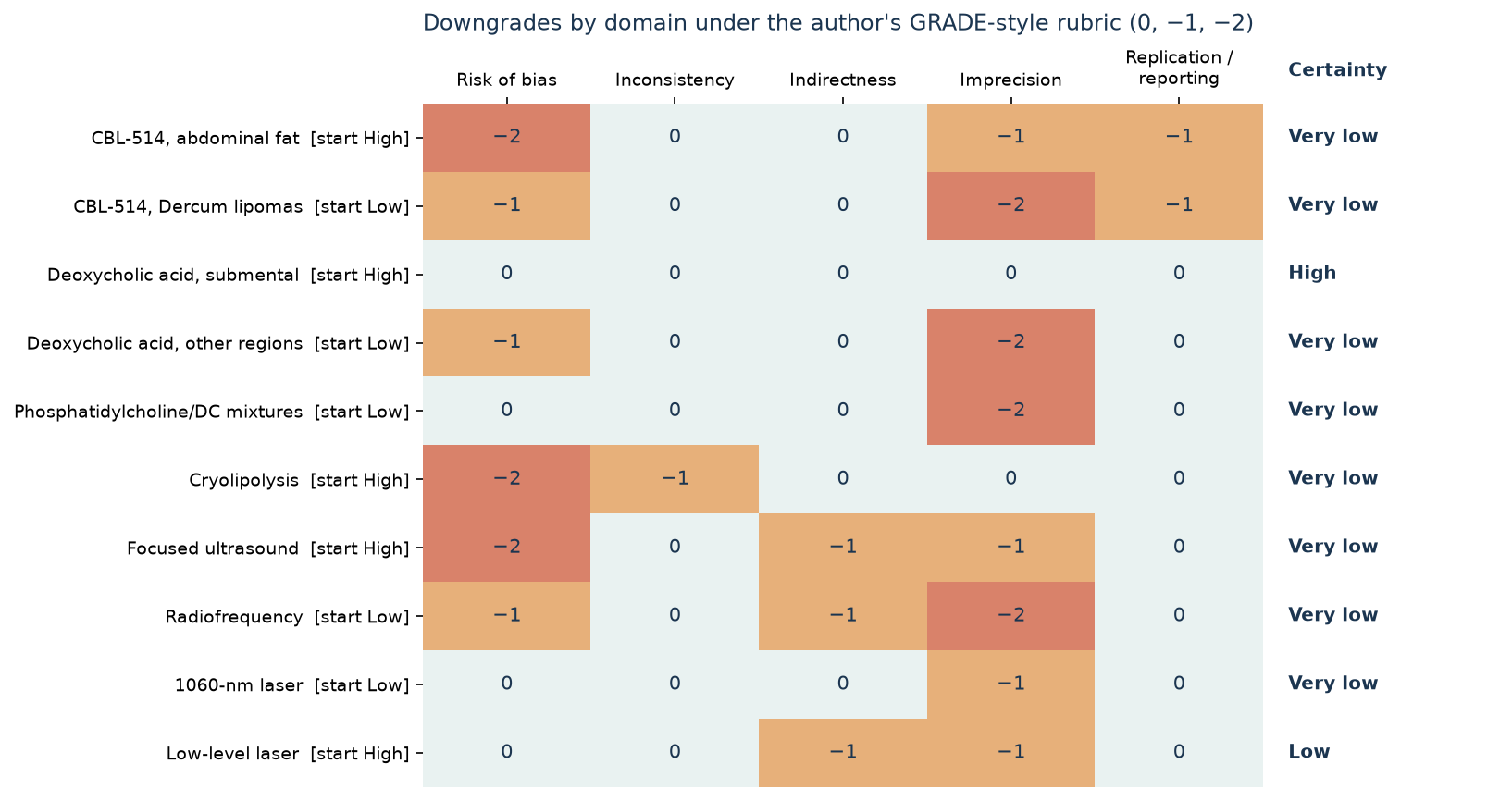
Two sensitivity checks show how robust the ratings are. First, if the sponsor-reported 173-participant phase 2b trial were published with the reported results, the replication domain could remain at −1, because no independent replication would yet exist. However, the imprecision basis would rise to 357 (184 + 173), which is still under 400, so the CBL-514 abdominal rating would not change. Second, if Lorenc’s trial were treated as double-blind, as its registry entry records, risk of bias would move from −2 to −1. The rating would still be Very low (High − 4). The CBL-514 abdominal rating is therefore insensitive to the most plausible alternative inputs. It could rise only through a large, double-blind, completely reported trial, which is what the registered phase 3 programme describes [27, 93, 96].
Discussion: where the CBL-514 evidence is thinner or different
Principal findings
This evidence map set out to place the published CBL-514 fat reduction evidence within the wider literature on non-surgical fat reduction, using one endpoint hierarchy and one explicitly stated appraisal rubric for every modality. Three findings stand out.
First, the CBL-514 record differs from the device literature more in design than in size. Two of the three abdominal trials had a concurrent placebo arm and random allocation [2, 3], and one used MRI as a secondary endpoint [3]. Concurrent control is uncommon in the device literature mapped here. The only randomised, no-treatment-controlled cryolipolysis trial found was small and reported a null result [69]. The largest cryolipolysis meta-analyses pool mostly pre–post studies with very high heterogeneity [50, 51]. The pivotal studies for focused ultrasound and low-level laser were sham-controlled, but their primary endpoints were circumference measures in Tier 5 [25, 63]. On the narrow question of whether a concurrent comparison exists, the CBL-514 programme compares well with most of the energy-based evidence.
Second, the CBL-514 record is thinner than that of the only approved injectable comparator on almost every other dimension. The deoxycholic acid programme was double-blind and randomised over 1,000 participants in two submental trials alone (506 + 516 = 1,022), and it reported follow-up out to three years [26, 60, 61]. Its MRI responder data appear in the US label [4]. The published CBL-514 trials were single-blind, contributed 67 participants to the primary endpoint of the largest trial, and followed participants for 12 weeks or less after the final treatment [2, 3]. Under the author’s rubric, these differences account for the gap between a High rating for submental deoxycholic acid and a Very low rating for abdominal CBL-514 (Table 5).
Third, publication is incomplete. Of the 11 completed CBL-514 registry records, 4 have a journal publication, accounting for 44.0% of completed enrolment [8]. The largest completed trial, with 173 participants, is known only through a sponsor release [33, 92]. Completeness of this kind cannot be compared directly across the map, because few of the device studies were registered prospectively, but the gap matters for any reader trying to weigh the CBL-514 record as a whole.
What the CBL-514 record does well
Three features of the published CBL-514 programme strengthen it relative to much of the comparator literature, and they should be acknowledged before the weaknesses are discussed.
The first is the use of volumetric imaging. Tier 1 and Tier 2 endpoints (MRI and ultrasound volume) are rare in the device literature, where circumference and caliper measures dominate [5, 23, 46]. Circumference is affected by posture, respiration, water balance and the exact tape position, and the agreement studies summarised in Table 2 show how weak agreement between measurement methods can be [40, 41]. The phase 2b trial’s MRI least-squares mean change of −152.9 mL (−20.3%) is the kind of figure that can, in principle, be set against MRI data from deoxycholic acid [3, 4]. The deoxycholic acid MRI figures, however, describe the submental region rather than the abdomen and are expressed as responder thresholds rather than mean volume.
The second is the concurrent placebo arm. Placebo-arm responder rates in the CBL-514 trials were not zero: 17.4% met the 150 mL threshold at 4 weeks in the phase 2 trial, and 18.9% achieved a one-grade clinician-scale improvement in the phase 2b trial [2, 3]. The REFINE placebo arms behaved in a similar way (18.6% and 22.2% one-grade composite responders) [60, 61]. These figures show how much apparent improvement a trial can record without active treatment, and they are the strongest argument against relying on single-arm studies in this field. A single-arm study with an 18% background response and no comparator cannot separate treatment effect from measurement noise, regression to the mean, weight change or rater expectation.
The third is the pre-specification of responder thresholds. A threshold such as at least 150 mL of fat loss, or at least one grade on a scale, makes the result easier to interpret than a mean change alone. It also allows the risk difference and ratio to be recomputed from the published proportions, as this article has done.
Where the CBL-514 record is thinner
Blinding. The published phase 2 and phase 2b trials are described as single-blind [2, 3]. When the primary endpoint is a rating scale (Tier 6), the rater’s knowledge of allocation can bias the result. The phase 2b registry record lists double masking [90], which differs from the publication, and this review does not attempt to reconcile the two. The registered phase 3 trial is described as double-blind [27, 32], which would address this point if reported as registered.
Attrition. The phase 2 trial reported a non-completion rate of 49.3%, and only 23 of the 50 active-arm participants described in the abstract contributed to the 8-week analysis [2]. In the phase 2b trial, 67 of 108 randomised participants contributed to the primary responder analysis, or 62.0% [3]. The phase IIa study had 15 withdrawals among 43 participants, 8 of them attributed to adverse events [1]. Attrition at this level makes the published responder proportions sensitive to how missing data were handled. Those proportions would be more informative alongside a sensitivity analysis that treats non-completers as non-responders.
Sample size and imprecision. The three published abdominal trials together randomised 227 participants (43 + 76 + 108 = 227), and the two controlled trials 184 (76 + 108). Including the unpublished 173-participant trial would bring the controlled total to 357 (184 + 173), which is still below the 400-participant threshold the rubric uses for imprecision (Table 5). Rare harms cannot be detected at this scale. Using the “rule of three”, which estimates the upper bound of a 95% confidence interval for an event not observed in n participants as 3 ÷ n, no harm event in 239 published participants would still be compatible with a true risk of up to about 1.26% (3 ÷ 239 = 0.0126) [45].
Durability. Follow-up after the final treatment was 8 weeks in the phase 2 and Dercum trials and 12 weeks in the phase 2b trial [2, 3, 12]. Deoxycholic acid has three-year maintenance data [26], and an open-label deoxycholic acid study reported maintenance at 12 months [105]. Whether a CBL-514 response persists, and in what proportion of responders, is unknown from the published record.
Sponsor concentration. Every CBL-514 registry record lists the same commercial lead sponsor, and all four publications were funded by that sponsor [1, 2, 3, 8, 12]. Sponsorship does not by itself make results unreliable, but independent replication is one of the features that raise confidence in a body of evidence [9]. For deoxycholic acid, the first indication that deoxycholate was the active lytic component came from an independent laboratory study [15], and independent off-label series have since accumulated [67, 78, 80]. No independent CBL-514 study was located.
Post-market evidence. The cryolipolysis record shows why this matters. The estimated incidence of paradoxical adipose hyperplasia rose from 0.0051% in the first report to a pooled 0.22% in a 2025 meta-analysis, about 43 times higher [48, 116], and passive surveillance continues to record it as the dominant complaint for the modality [123, 124]. A harm with a delayed onset was under-counted while follow-up was short and exposure was limited. CBL-514 has no post-market record, because it is not marketed, so no such signal could yet have emerged. The point is not that CBL-514 carries a similar risk; there is no evidence either way. It is that 12-week trial data cannot exclude late or rare events in any modality.
Endpoint fit across the map. The CBL-514 rating scales are abdominal instruments, the Clinician-Reported Abdominal Fat Rating Scale and a patient-reported counterpart [3]. They are not the submental scales used for deoxycholic acid [60, 61], and the device literature mostly uses circumference, caliper or photograph identification [63, 64, 74]. Table 2 makes the consequence explicit: only a minority of the mapped bodies of evidence report any outcome in the same tier as CBL-514, and fewer still in the same anatomical region. Comparisons that cross tiers or regions should be read as descriptions of different things, not as competing estimates of one quantity.
Where the CBL-514 record is different rather than weaker
Some differences are neither strengths nor weaknesses. CBL-514 was studied first in the abdomen, a large region where deoxycholic acid is not approved [4]. Its development has also extended to lipomas and to Dercum disease, a rare condition with painful lipomas [12, 28]. The Fast Track designation reported for that indication relates to an unmet medical need rather than to aesthetics [29], so the relevant comparators would differ from those in this map. The cellulite studies on the registry have posted results but no publication [99, 103, 104], and they sit outside the fat reduction endpoints analysed here. The proposed mechanism behind these differences is reviewed in CBL-514 mechanism of action: an evidence synthesis.
The mechanism proposed for CBL-514 also differs from that of deoxycholic acid. Deoxycholic acid is a detergent that lyses cell membranes non-selectively, which is why its label is explicit about anatomical risk [4, 15, 107]. The CBL-514 publications describe induction of adipocyte apoptosis [1]. Whether that difference produces a different safety profile in practice cannot be judged from the published trial tables. Comparative mechanistic or head-to-head data would be needed.
What future CBL-514 trials would need to report
The registered phase 3 programme plans 1,440 participants across five trials [93, 94, 95, 96, 97], which on its own would move the imprecision assessment. Within the framework used here, publications would also need to report the following before the certainty rating could rise:
- Double-blind conduct, as registered, with the blinding of outcome assessors stated explicitly.
- The two-grade composite primary endpoint and the MRI key secondary endpoint, both on the full randomised population, with the method of handling missing data stated and a non-responder imputation reported as a sensitivity analysis [33].
- Participant flow showing randomised, treated, evaluable and analysed numbers per arm, following CONSORT [44].
- Follow-up of at least six months after the final treatment, with a durability analysis among responders.
- Adverse events by arm, including laboratory lipid and liver measures, with denominators.
- Prompt posting of results for every completed record, including the phase 1 study, the 173-participant phase 2b study and the placebo-controlled Dercum study [91, 92, 98].
- At least one trial in which outcome assessment is independent of the sponsor.
These points are framed as reporting requirements because the appraisal in this article depends on what is reported, not on the underlying pharmacology. They are not proposals for how CBL-514 should be used.
Implications for comparing non-surgical fat reduction evidence
The harmonised endpoint framework has implications beyond CBL-514. The agreement studies show that a centimetre of circumference, a millimetre of ultrasound thickness and a millilitre of MRI volume are not interchangeable [40, 41], and the measurement review reaches the same conclusion [5]. Readers comparing published figures across modalities should first ask which tier each figure comes from. Second, they should ask whether a concurrent control exists. Third, they should ask how long participants were followed. Effects that look similar in size can carry very different meanings once those three questions are answered.
The same logic applies to certainty. Under the rubric used here, only one body of evidence in the map, submental deoxycholic acid, reached High certainty. Low-level laser circumference outcomes reached Low, and every other body, including every energy-based device class, was rated Very low (Table 5). The sensitivity checks reported with Table 5 show that these ratings are robust to the main judgement calls. The verdict is less a statement about CBL-514 than a description of the field: across non-surgical fat reduction as a whole, evidence that is concurrently controlled, blinded, adequately powered, volumetric and durable remains the exception [23, 24, 52].
Limitations
This evidence map has several limitations, and each affects how the findings should be read.
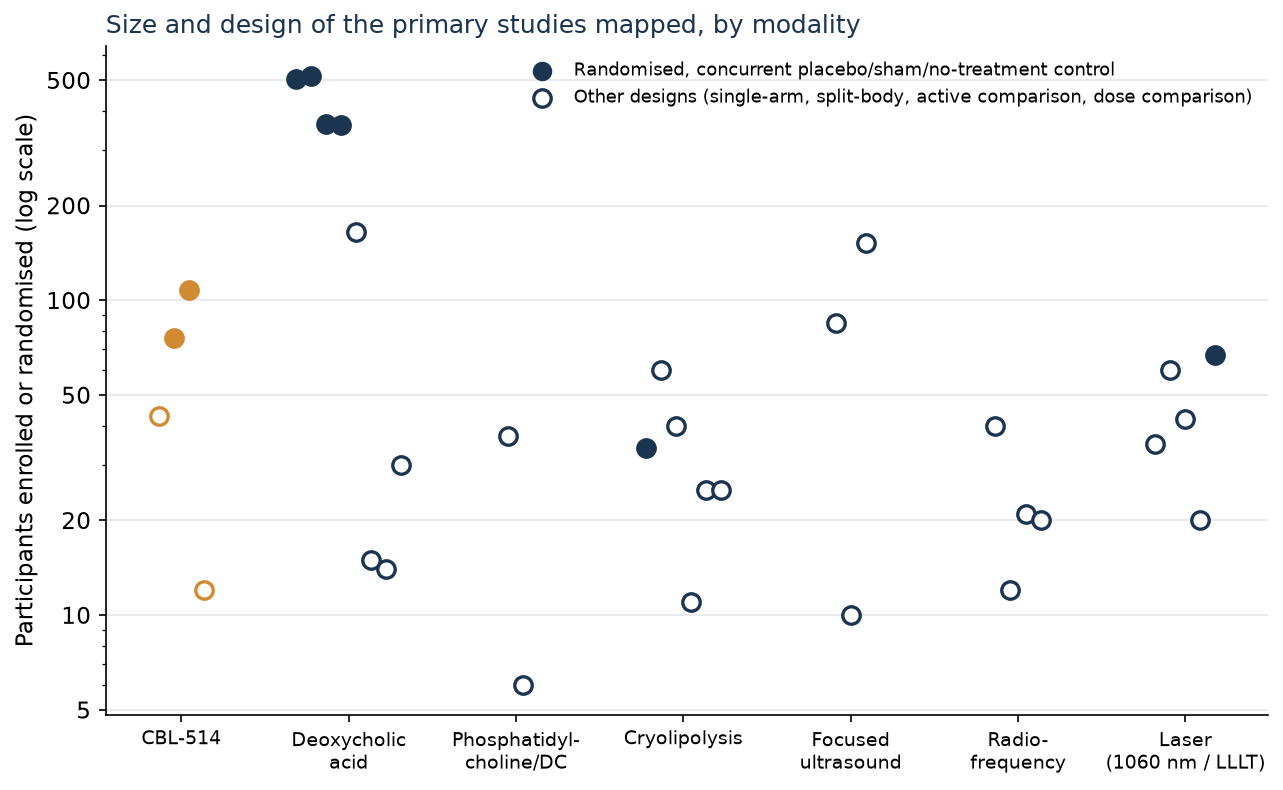
Abstract-level extraction. For most included studies, data were extracted from PubMed abstracts and NCBI metadata. Full texts were used for the three CBL-514 trials where they were openly available [1, 2, 12], and for key regulatory documents. Abstract reporting is selective. Some abstracts omit sample sizes, which is why two HIFU studies could not be plotted in Figure 3, and some report only the most favourable endpoint. Where an abstract and its full text disagree, the full text would normally prevail, but this was possible to check only for the full texts retrieved.
Single reviewer. Screening, extraction and appraisal were carried out by one reviewer. Standard practice for systematic reviews uses two independent reviewers with a reconciliation step [39]. The risk of extraction error was reduced by showing every computed figure with its arithmetic, so that readers can verify each one, but it was not eliminated.
Relevance-ranked screening. For each theme, the top 40 records by PubMed relevance ranking were screened in detail, rather than every record retrieved. Table 1 reports the total yield for each theme, so the fraction screened is transparent. Relevance ranking favours records whose titles and abstracts match the query, and a relevant study with an unusual title could have been missed. Targeted searching was used to add pivotal studies known to be relevant, but this introduces the possibility of selection driven by prior knowledge.
Simplified rubric. The GRADE-style rubric is the author’s adaptation and is deliberately simpler than full GRADE [9, 10, 11]. It assigns fixed deductions and does not use the judgement-based upgrading that GRADE allows for large effects or dose-response gradients. A full GRADE assessment with outcome-specific evidence profiles might rate some bodies of evidence differently. The rubric is stated in full so that others can apply it, alter it and compare the results.
Title-only and grey-literature records. Some records were included only at title level, mostly case reports, and they contribute to the narrative but not to any figure or rating. Sponsor releases were used only where clearly labelled as not peer reviewed, and they do not contribute to the certainty rating.
Time-bound searching. All searches were run on one day, 29 October 2026. Records indexed after that date, including any phase 3 CBL-514 publications, are not included, and the regulatory statuses reported are those found on that date.
No pooling. No meta-analysis was attempted, because the endpoints, regions and designs are too heterogeneous for pooled estimates to be meaningful. The risk differences and ratios shown are descriptive recalculations from published proportions, not pooled effects, and they carry no confidence intervals.
Conclusion
CBL-514 is an investigational injectable whose published fat reduction evidence consists of three abdominal trials and one lipoma study, all from a single sponsor. Placed on one map with deoxycholic acid, phosphatidylcholine mixtures, cryolipolysis, focused ultrasound, radiofrequency and laser, its record has distinctive features. It includes concurrent placebo arms and volumetric imaging, which much of the device literature lacks, and published responder differences against placebo that are numerically large. It is also smaller, single-blind, burdened by high attrition, short in follow-up, incompletely published and without independent replication or post-market data. Under the stated rubric, its certainty is Very low, as is that of most of the energy-based device evidence. Only submental deoxycholic acid reached High.
The harmonised endpoint framework shows that much of the apparent disagreement in this field reflects measurement rather than effect. Ultrasound, MRI, caliper, circumference, rating-scale and photograph endpoints measure different things and agree poorly with each other. The registered phase 3 CBL-514 trials could close several of the gaps identified here if they are reported in full, with blinded assessment, longer follow-up and complete participant flow. Until then, the CBL-514 evidence should be read as promising in design but immature, and nothing in this article should be taken to mean that CBL-514 has been shown to be safe or effective, or that it is approved anywhere.
Relevance to Eternal Peptides Wholesale
Eternal Peptides Wholesale publishes this map as part of a series of evidence reviews on investigational compounds discussed alongside research peptides. It does not describe or assess any product. The CBL-514 fat reduction evidence summarised here comes from small trials of an unapproved, investigational injectable, all funded by one sponsor, and none of it establishes that CBL-514 is safe or effective.
The documentation the site publishes is analytical. Its certificate of analysis library transcribes batch-specific Janoshik Analytical reports, and the testing standards page explains why purity, sterility screening, endotoxin and heavy-metal results are separate measurements, much as this map treats MRI volume, ultrasound thickness and responder rates as different endpoints. A laboratory report records tests on a submitted sample; it does not establish regulatory approval, clinical suitability or safety for human use. More about Eternal Peptides Wholesale is on the About page, and related evidence maps are on the blog.
Glossary
- 510(k) clearance: A US FDA device pathway in which a new device is cleared on the basis of substantial equivalence to a legally marketed predicate device.
- Attrition: Loss of randomised participants from follow-up or analysis, which can bias results when it differs between arms or is related to outcome.
- CBL-514: An investigational small-molecule injectable studied for localised subcutaneous fat reduction and for lipomas; not approved in any jurisdiction located by this review.
- Cryolipolysis: Controlled cooling of subcutaneous fat intended to injure adipocytes while sparing overlying skin.
- De Novo classification: A US FDA pathway for novel low- to moderate-risk devices with no predicate, establishing a new product code.
- Deoxycholic acid: A bile acid that disrupts cell membranes; approved as an injectable for submental fat in the US and Australia.
- Dercum disease: A rare condition characterised by multiple painful lipomas.
- Fast Track designation: A US FDA process intended to facilitate development and expedite review of drugs for serious conditions with unmet need; it is not a marketing approval.
- GRADE: Grading of Recommendations Assessment, Development and Evaluation, a framework for rating certainty of evidence; this article uses a simplified adaptation.
- Harmonised endpoint tier: In this article, one of seven levels (E1 to E7) ranking fat reduction endpoints from MRI volume to photograph identification.
- HIFU: High-intensity focused ultrasound, which heats or mechanically disrupts tissue at a focal depth.
- Paradoxical adipose hyperplasia: Delayed enlargement of fat in a treated area, reported mainly after cryolipolysis.
- Risk difference: The responder proportion in the active arm minus that in the control arm, expressed in percentage points.
- Risk ratio: The responder proportion in the active arm divided by that in the control arm.
- Single-blind: A trial in which one party, usually the participant, does not know the allocation, while investigators or assessors may.
- Tier 6 endpoint: A rating-scale responder endpoint, such as at least one grade of improvement on a clinician- or patient-reported scale.
Frequently asked questions about CBL-514
What is CBL-514?
CBL-514 is an investigational small-molecule injectable being studied for the reduction of localised subcutaneous fat and for lipomas, including in Dercum disease. The published reports describe it as inducing adipocyte apoptosis. It has not been approved for any use in any jurisdiction located by this review.
Is CBL-514 approved by the FDA or the TGA?
No approval was found. As of 29 October 2026, CBL-514 is in clinical development, with phase 3 abdominal trials registered. A Fast Track designation reported for Dercum disease expedites development and review but is not a marketing approval.
What did the published CBL-514 fat reduction trials measure?
The phase IIa and phase 2 trials measured abdominal fat volume by ultrasound. The phase 2b trial used clinician- and patient-reported abdominal fat rating scales as primary endpoints, with MRI volume as a secondary endpoint. The lipoma study measured lipoma volume by ultrasound. Follow-up after the final treatment was 12 weeks or less.
How does the CBL-514 evidence compare with deoxycholic acid?
Both have placebo-controlled trials, but the deoxycholic acid programme was double-blind, enrolled over 1,000 participants in two pivotal trials and reported three-year maintenance data in the submental region. The published CBL-514 trials were single-blind, smaller and shorter, and studied the abdomen. Their endpoints only partly overlap, so the effect sizes are not directly comparable.
Why can’t effect sizes be compared across non-surgical fat reduction methods?
Studies measure different things. MRI and ultrasound volume, ultrasound thickness, caliper skinfold, tape circumference, rating scales and photograph identification each capture a different aspect of change, and agreement between methods is often poor. Designs, regions and follow-up periods also differ, so a centimetre of circumference cannot be equated with a millilitre of MRI volume.
How certain is the evidence for CBL-514?
Under the GRADE-style rubric adapted for this article, the certainty of the abdominal CBL-514 evidence is Very low. Deductions were made for single-blind design and attrition, for imprecision with fewer than 400 participants in controlled trials, and for the absence of independent replication. This rating describes the evidence base, not the compound itself.
What adverse events have been reported in CBL-514 trials?
The published trials describe mostly mild to moderate injection-site reactions. In the phase 2 trial, nearly all participants reported at least one treatment-related adverse event, and 9 CBL-514 participants had severe injection-site pain. One phase 2 participant had a moderate hyperlipidaemia event judged probably related to treatment, and 8 of 43 phase IIa participants withdrew because of adverse events. In the lipoma study, every participant had at least one treatment-related event and 4 had severe events. No post-market safety data exist.
Does “research use only” labelling make an unapproved product legal in Australia?
No. The TGA has stated that labelling a product “research use only” or “not for human use” does not change its regulatory status where it is a therapeutic good, and the supply of therapeutic goods in Australia is governed by the Therapeutic Goods Act 1989. Such labelling is therefore not a form of legal clearance, and it says nothing about whether a product has been evaluated for quality, safety or efficacy.
References
- Goodman GJ, Ho WWS, Chang KJ, Ling YF, Sheu AY. Efficacy of a Novel Injection Lipolysis to Induce Targeted Adipocyte Apoptosis: A Randomized, Phase IIa Study of CBL-514 Injection on Abdominal Subcutaneous Fat Reduction. Aesthet Surg J. 2022;42(11):NP662-NP674. doi:10.1093/asj/sjac162. PMID: 35709509. Available at: https://doi.org/10.1093/asj/sjac162. Accessed 29 October 2026.
- Gold M, Schlessinger J, Goodman GJ, Dayan S, DuBois J, Ling YF, et al. Efficacy and Safety of CBL-514 Injection in Reducing Abdominal Subcutaneous Fat: A Randomized, Single-Blind, Placebo-Controlled Phase II Study. Aesthet Surg J. 2025;45(6):611-620. doi:10.1093/asj/sjaf032. PMID: 40037659. Available at: https://doi.org/10.1093/asj/sjaf032. Accessed 29 October 2026.
- Lorenc ZP, Gold M, Schlessinger J, Lain ET, Smith S, Downie J, et al. Randomized Phase 2b Trial of CBL-514 Injection for Abdominal Subcutaneous Fat Reduction With Clinician- and Patient-reported Outcomes and MRI Assessment. Aesthet Surg J. 2026. Published online ahead of print. doi:10.1093/asj/sjag092. PMID: 42159040. Available at: https://doi.org/10.1093/asj/sjag092. Accessed 29 October 2026.
- U.S. Food and Drug Administration. Deoxycholic acid injection, for subcutaneous use: prescribing information (NDA 206333), 2015. Available at: https://www.accessdata.fda.gov/drugsatfda_docs/label/2015/206333Orig1s000lbl.pdf. Accessed 29 October 2026.
- Auh SL, Iyengar S, Weil A, Bolotin D, Cartee TV, Dover JS, et al. Quantification of noninvasive fat reduction: A systematic review. Lasers Surg Med. 2018;50(2):96-110. doi:10.1002/lsm.22761. PMID: 29210446. Available at: https://doi.org/10.1002/lsm.22761. Accessed 29 October 2026.
- Sayers E. Entrez Programming Utilities Help. National Center for Biotechnology Information. Available at: https://www.ncbi.nlm.nih.gov/books/NBK25501/. Accessed 29 October 2026.
- Europe PMC. Europe PMC RESTful web service: search. Available at: https://www.ebi.ac.uk/europepmc/webservices/rest/search?query=peptide&format=json&pageSize=1. Accessed 29 October 2026.
- ClinicalTrials.gov. API v2 study search: intervention “CBL-514”. U.S. National Library of Medicine. Available at: https://clinicaltrials.gov/api/v2/studies?query.intr=CBL-514&pageSize=50. Accessed 29 October 2026.
- Guyatt GH, Oxman AD, Vist GE, Kunz R, Falck-Ytter Y, Alonso-Coello P, et al. GRADE: an emerging consensus on rating quality of evidence and strength of recommendations. BMJ. 2008;336(7650):924-6. doi:10.1136/bmj.39489.470347.AD. PMID: 18436948. Available at: https://doi.org/10.1136/bmj.39489.470347.AD. Accessed 29 October 2026.
- Balshem H, Helfand M, Schünemann HJ, Oxman AD, Kunz R, Brozek J, et al. GRADE guidelines: 3. Rating the quality of evidence. J Clin Epidemiol. 2011;64(4):401-6. doi:10.1016/j.jclinepi.2010.07.015. PMID: 21208779. Available at: https://doi.org/10.1016/j.jclinepi.2010.07.015. Accessed 29 October 2026.
- Schünemann H, Brożek J, Guyatt G, Oxman A, editors. GRADE Handbook. The GRADE Working Group. Available at: https://gdt.gradepro.org/app/handbook/handbook.html. Accessed 29 October 2026.
- Herbst KL, Ling YF, Sheu AY, Schlessinger DI, Wu SY. Efficacy and safety of CBL-514 for Dercum disease lipomas: A randomized phase 2a study. JAAD Int. 2026;25:1-4. doi:10.1016/j.jdin.2025.11.022. PMID: 41623934. Available at: https://doi.org/10.1016/j.jdin.2025.11.022. Accessed 29 October 2026.
- U.S. Food and Drug Administration. Drugs@FDA: NDA 206333 (deoxycholic acid injection). Available at: https://www.accessdata.fda.gov/scripts/cder/daf/index.cfm?event=overview.process&ApplNo=206333. Accessed 29 October 2026.
- Therapeutic Goods Administration. Australian Public Assessment Report for deoxycholic acid, 6 April 2017. Available at: https://www.tga.gov.au/sites/default/files/auspar-deoxycholic-acid-170406.pdf. Accessed 29 October 2026.
- Rotunda AM, Suzuki H, Moy RL, Kolodney MS. Detergent effects of sodium deoxycholate are a major feature of an injectable phosphatidylcholine formulation used for localized fat dissolution. Dermatol Surg. 2004;30(7):1001-8. doi:10.1111/j.1524-4725.2004.30305.x. PMID: 15209790. Available at: https://doi.org/10.1111/j.1524-4725.2004.30305.x. Accessed 29 October 2026.
- Duncan DI, Palmer M. Fat reduction using phosphatidylcholine/sodium deoxycholate injections: standard of practice. Aesthetic Plast Surg. 2008;32(6):858-72. doi:10.1007/s00266-008-9188-9. PMID: 18612680. Available at: https://doi.org/10.1007/s00266-008-9188-9. Accessed 29 October 2026.
- Frątczak A, Polak K, Szczepanek M, Waliczek M, Bergler-Czop B. Injection lipolysis with phosphatidylcholine and sodium deoxycholate-Is it really worth the risk?. Dermatol Ther. 2022;35(12):e15805. doi:10.1111/dth.15805. PMID: 36068992. Available at: https://doi.org/10.1111/dth.15805. Accessed 29 October 2026.
- U.S. Food and Drug Administration. openFDA premarket (510(k)/De Novo) record DEN090002. Available at: https://api.fda.gov/device/510k.json?search=k_number:DEN090002. Accessed 29 October 2026.
- U.S. Food and Drug Administration. openFDA premarket (510(k)/De Novo) record K100874. Available at: https://api.fda.gov/device/510k.json?search=k_number:K100874. Accessed 29 October 2026.
- U.S. Food and Drug Administration. openFDA premarket (510(k)/De Novo) record K150230. Available at: https://api.fda.gov/device/510k.json?search=k_number:K150230. Accessed 29 October 2026.
- U.S. Food and Drug Administration. openFDA premarket (510(k)/De Novo) record DEN090008. Available at: https://api.fda.gov/device/510k.json?search=k_number:DEN090008. Accessed 29 October 2026.
- Alizadeh Z, Halabchi F, Mazaheri R, Abolhasani M, Tabesh M. Review of the Mechanisms and Effects of Noninvasive Body Contouring Devices on Cellulite and Subcutaneous Fat. Int J Endocrinol Metab. 2016;14(4):e36727. doi:10.5812/ijem.36727. PMID: 28123436. Available at: https://doi.org/10.5812/ijem.36727. Accessed 29 October 2026.
- Kennedy J, Verne S, Griffith R, Falto-Aizpurua L, Nouri K. Non-invasive subcutaneous fat reduction: a review. J Eur Acad Dermatol Venereol. 2015;29(9):1679-88. doi:10.1111/jdv.12994. PMID: 25664493. Available at: https://doi.org/10.1111/jdv.12994. Accessed 29 October 2026.
- Alizadeh Z, Halabchi F, Bodaghabadi Z, Zarandi MM, Abolhasani M, Seifi V, et al. Non-invasive Body Contouring Technologies: An Updated Narrative Review. Aesthetic Plast Surg. 2024;48(4):659-679. doi:10.1007/s00266-023-03647-x. PMID: 37749418. Available at: https://doi.org/10.1007/s00266-023-03647-x. Accessed 29 October 2026.
- Jackson RF, Dedo DD, Roche GC, Turok DI, Maloney RJ. Low-level laser therapy as a non-invasive approach for body contouring: a randomized, controlled study. Lasers Surg Med. 2009;41(10):799-809. doi:10.1002/lsm.20855. PMID: 20014253. Available at: https://doi.org/10.1002/lsm.20855. Accessed 29 October 2026.
- Humphrey S, Cohen JL, Bhatia AC, Green LJ, Green JB, Bowen B. Improvements in Submental Contour up to 3 Years After ATX-101: Efficacy and Safety Follow-Up of the Phase 3 REFINE Trials. Aesthet Surg J. 2021;41(11):NP1532-NP1539. doi:10.1093/asj/sjab100. PMID: 33617632. Available at: https://doi.org/10.1093/asj/sjab100. Accessed 29 October 2026.
- Caliway Biopharmaceuticals. First patient dosed in global phase 3 SUPREME-01 trial (corporate news release), 23 September 2026. Available at: https://www.caliwaybiopharma.com/en/news-detail/-CBL-514-SUPREME-01-FPI-ObesityWeek-2026-ENG/. Accessed 29 October 2026.
- Idris YA, Janis JE. Dercum’s Disease: A Practical Review of Existing and Novel Therapies. Plast Reconstr Surg Glob Open. 2026;14(7):e7907. doi:10.1097/GOX.0000000000007907. PMID: 42488923. Available at: https://doi.org/10.1097/GOX.0000000000007907. Accessed 29 October 2026.
- U.S. Food and Drug Administration. Fast Track. Available at: https://www.fda.gov/patients/fast-track-breakthrough-therapy-accelerated-approval-priority-review/fast-track. Accessed 29 October 2026.
- Therapeutic Goods Administration. How we regulate therapeutic peptide products. Available at: https://www.tga.gov.au/products/medicines/monitoring-and-compliance/how-we-regulate-therapeutic-peptide-products. Accessed 29 October 2026.
- Commonwealth of Australia. Therapeutic Goods Act 1989. Available at: https://www.legislation.gov.au/C2004A03952/latest/text. Accessed 29 October 2026.
- Health Canada. Clinical trial search portal: 298033 – Abdominal subcutaneous fat (phase 3, randomized, double-blind, placebo-controlled study of CBL-514 injection). Available at: https://clinical-trials-search.canada.ca/en/clinical-trial/298033-abdominal-subcutaneous-fat. Accessed 29 October 2026.
- Caliway Biopharmaceuticals. Investor conference key takeaways (corporate news release), 31 August 2026. Available at: https://www.caliwaybiopharma.com/en/news-detail/Caliway_Investor_Conference_Key_Takeaways_20260831_ENG/. Accessed 29 October 2026.
- U.S. Food and Drug Administration. openFDA device classification record, product code OOK. Available at: https://api.fda.gov/device/classification.json?search=product_code:OOK. Accessed 29 October 2026.
- U.S. Food and Drug Administration. openFDA device classification record, product code PKT. Available at: https://api.fda.gov/device/classification.json?search=product_code:PKT. Accessed 29 October 2026.
- U.S. Food and Drug Administration. openFDA device classification record, product code OHV. Available at: https://api.fda.gov/device/classification.json?search=product_code:OHV. Accessed 29 October 2026.
- U.S. Food and Drug Administration. openFDA device classification record, product code OLI. Available at: https://api.fda.gov/device/classification.json?search=product_code:OLI. Accessed 29 October 2026.
- U.S. Food and Drug Administration. openFDA device classification record, product code PBX. Available at: https://api.fda.gov/device/classification.json?search=product_code:PBX. Accessed 29 October 2026.
- Page MJ, McKenzie JE, Bossuyt PM, Boutron I, Hoffmann TC, Mulrow CD, et al. The PRISMA 2020 statement: an updated guideline for reporting systematic reviews. BMJ. 2021;372:n71. doi:10.1136/bmj.n71. PMID: 33782057. Available at: https://doi.org/10.1136/bmj.n71. Accessed 29 October 2026.
- Pérez-Chirinos Buxadé C, Solà-Perez T, Castizo-Olier J, Carrasco-Marginet M, Roy A, Marfell-Jones M, et al. Assessing subcutaneous adipose tissue by simple and portable field instruments: Skinfolds versus A-mode ultrasound measurements. PLoS One. 2018;13(11):e0205226. doi:10.1371/journal.pone.0205226. PMID: 30496211. Available at: https://doi.org/10.1371/journal.pone.0205226. Accessed 29 October 2026.
- Fernandes LV, de Oliveira GB, Valdiviesso R, Amaral TF, Corona LP. Discrepancies between caliper and portable A-mode ultrasound estimates of subcutaneous fat in older adults. Eur J Clin Nutr. 2026;80(8):851-854. doi:10.1038/s41430-026-01756-9. PMID: 42056196. Available at: https://doi.org/10.1038/s41430-026-01756-9. Accessed 29 October 2026.
- Sterne JAC, Savović J, Page MJ, Elbers RG, Blencowe NS, Boutron I, et al. RoB 2: a revised tool for assessing risk of bias in randomised trials. BMJ. 2019;366:l4898. doi:10.1136/bmj.l4898. PMID: 31462531. Available at: https://doi.org/10.1136/bmj.l4898. Accessed 29 October 2026.
- Sterne JA, Hernán MA, Reeves BC, Savović J, Berkman ND, Viswanathan M, et al. ROBINS-I: a tool for assessing risk of bias in non-randomised studies of interventions. BMJ. 2016;355:i4919. doi:10.1136/bmj.i4919. PMID: 27733354. Available at: https://doi.org/10.1136/bmj.i4919. Accessed 29 October 2026.
- Schulz KF, Altman DG, Moher D, CONSORT Group. CONSORT 2010 statement: updated guidelines for reporting parallel group randomised trials. BMJ. 2010;340:c332. doi:10.1136/bmj.c332. PMID: 20332509. Available at: https://doi.org/10.1136/bmj.c332. Accessed 29 October 2026.
- Hanley JA, Lippman-Hand A. If nothing goes wrong, is everything all right? Interpreting zero numerators. JAMA. 1983;249(13):1743-5. PMID: 6827763. Available at: https://pubmed.ncbi.nlm.nih.gov/6827763/. Accessed 29 October 2026.
- Ingargiola MJ, Motakef S, Chung MT, Vasconez HC, Sasaki GH. Cryolipolysis for fat reduction and body contouring: safety and efficacy of current treatment paradigms. Plast Reconstr Surg. 2015;135(6):1581-1590. doi:10.1097/PRS.0000000000001236. PMID: 26017594. Available at: https://doi.org/10.1097/PRS.0000000000001236. Accessed 29 October 2026.
- Hedayati B, Juhász M, Chu S, Mesinkovska NA. Adverse Events Associated With Cryolipolysis: A Systematic Review of the Literature. Dermatol Surg. 2020;46 Suppl 1:S8-S13. doi:10.1097/DSS.0000000000002524. PMID: 32976167. Available at: https://doi.org/10.1097/DSS.0000000000002524. Accessed 29 October 2026.
- Mah AE, Razeghi P, Li C, Datta S, Tao BK, Ahmad J, et al. Incidence of Paradoxical Adipose Hyperplasia After Cryolipolysis: A Systematic Review and Meta-Analysis. Aesthet Surg J Open Forum. 2025;7:ojaf142. doi:10.1093/asjof/ojaf142. PMID: 41322038. Available at: https://doi.org/10.1093/asjof/ojaf142. Accessed 29 October 2026.
- Do K, Ghani N, Lloyd N, Sagalow ES, Young K, Tam B, et al. Cryolipolysis for Submental Fat Reduction: A Systematic Review and Meta-Analysis. Facial Plast Surg. 2025;41(5):650-663. doi:10.1055/a-2628-3831. PMID: 40473257. Available at: https://doi.org/10.1055/a-2628-3831. Accessed 29 October 2026.
- Hakami A, Hakami A, Alghamdi R, Alzahrani H, Alghamdi A, Qureshey A, et al. Effectiveness of Cryolipolysis in Body Contouring and Fat Reduction: A Systematic Review and Meta-analysis. World J Plast Surg. 2025;14(3):16-26. doi:10.61882/wjps.14.3.16. PMID: 41607567. Available at: https://doi.org/10.61882/wjps.14.3.16. Accessed 29 October 2026.
- Ravindran R, Pizzol D, Rahmati M, Caminada S, Yon DK, Shin JI, et al. Cryolipolysis and associated health outcomes, adverse events, and satisfaction: A systematic review and meta-analysis. Obes Rev. 2025;26(8):e13925. doi:10.1111/obr.13925. PMID: 40211915. Available at: https://doi.org/10.1111/obr.13925. Accessed 29 October 2026.
- Atiyeh BS, Fadul R, Chahine F. Cryolipolysis (CLL) for Reduction of Localized Subcutaneous Fat: Review of the Literature and an Evidence-Based Analysis. Aesthetic Plast Surg. 2020;44(6):2163-2172. doi:10.1007/s00266-020-01869-x. PMID: 32696167. Available at: https://doi.org/10.1007/s00266-020-01869-x. Accessed 29 October 2026.
- Ho D, Jagdeo J. A Systematic Review of Paradoxical Adipose Hyperplasia (PAH) Post-Cryolipolysis. J Drugs Dermatol. 2017;16(1):62-67. PMID: 28095535. Available at: https://pubmed.ncbi.nlm.nih.gov/28095535/. Accessed 29 October 2026.
- Atiyeh BS, Chahine F. Evidence-Based Efficacy of High-Intensity Focused Ultrasound (HIFU) in Aesthetic Body Contouring. Aesthetic Plast Surg. 2021;45(2):570-578. doi:10.1007/s00266-020-01863-3. PMID: 32705441. Available at: https://doi.org/10.1007/s00266-020-01863-3. Accessed 29 October 2026.
- Kumar V, Jain A, Vadera S, Shome D, Kapoor R. Effectiveness of HIFU Therapy for Nonsurgical Facial and Body Contouring: A Systematic Review of Prospective and Experimental Studies. Plast Reconstr Surg. 2023;151(3):533-544. doi:10.1097/PRS.0000000000009912. PMID: 36730550. Available at: https://doi.org/10.1097/PRS.0000000000009912. Accessed 29 October 2026.
- Haykal D, Sattler S, Verner I, Madhumita M, Cartier H. A Systematic Review of High-Intensity Focused Ultrasound in Skin Tightening and Body Contouring. Aesthet Surg J. 2025;45(7):690-698. doi:10.1093/asj/sjaf053. PMID: 40184185. Available at: https://doi.org/10.1093/asj/sjaf053. Accessed 29 October 2026.
- Mustafa GA, Alawi YF, Kasem MS, Mohamed HE, Heuotiy R, Ghanem SG, et al. Low-level laser therapy for reducing body circumferences: a systematic review. Lasers Med Sci. 2025;40(1):534. doi:10.1007/s10103-025-04755-7. PMID: 41423522. Available at: https://doi.org/10.1007/s10103-025-04755-7. Accessed 29 October 2026.
- Vertuan M, Honório HM, Queiroz TP, Santos PL. Is deoxycholic acid able to reduce submental fat and increase patient satisfaction when compared to placebo groups? A systematic review. J Plast Reconstr Aesthet Surg. 2022;75(11):4281-4289. doi:10.1016/j.bjps.2022.08.012. PMID: 36123256. Available at: https://doi.org/10.1016/j.bjps.2022.08.012. Accessed 29 October 2026.
- Carrion K, Salingaros S, Bernal C, Barger BT, Lipman KJ, How-Volkman C, et al. A Systematic Review of Injectable Lipolytic Agents for Nonsubmental Fat Reduction. Plast Reconstr Surg. 2026;158(3):414-423. doi:10.1097/PRS.0000000000012648. PMID: 41296813. Available at: https://doi.org/10.1097/PRS.0000000000012648. Accessed 29 October 2026.
- Jones DH, Carruthers J, Joseph JH, Callender VD, Walker P, Lee DR, et al. REFINE-1, a Multicenter, Randomized, Double-Blind, Placebo-Controlled, Phase 3 Trial With ATX-101, an Injectable Drug for Submental Fat Reduction. Dermatol Surg. 2016;42(1):38-49. doi:10.1097/DSS.0000000000000578. PMID: 26673433. Available at: https://doi.org/10.1097/DSS.0000000000000578. Accessed 29 October 2026.
- Humphrey S, Sykes J, Kantor J, Bertucci V, Walker P, Lee DR, et al. ATX-101 for reduction of submental fat: A phase III randomized controlled trial. J Am Acad Dermatol. 2016;75(4):788-797.e7. doi:10.1016/j.jaad.2016.04.028. PMID: 27430612. Available at: https://doi.org/10.1016/j.jaad.2016.04.028. Accessed 29 October 2026.
- Decorato JW, Chen B, Sierra R. Subcutaneous adipose tissue response to a non-invasive hyperthermic treatment using a 1,060 nm laser. Lasers Surg Med. 2017;49(5):480-489. doi:10.1002/lsm.22625. PMID: 28103642. Available at: https://doi.org/10.1002/lsm.22625. Accessed 29 October 2026.
- Jewell ML, Baxter RA, Cox SE, Donofrio LM, Dover JS, Glogau RG, et al. Randomized sham-controlled trial to evaluate the safety and effectiveness of a high-intensity focused ultrasound device for noninvasive body sculpting. Plast Reconstr Surg. 2011;128(1):253-262. doi:10.1097/PRS.0b013e3182174278. PMID: 21701341. Available at: https://doi.org/10.1097/PRS.0b013e3182174278. Accessed 29 October 2026.
- Kilmer SL, Burns AJ, Zelickson BD. Safety and efficacy of cryolipolysis for non-invasive reduction of submental fat. Lasers Surg Med. 2016;48(1):3-13. doi:10.1002/lsm.22440. PMID: 26607045. Available at: https://doi.org/10.1002/lsm.22440. Accessed 29 October 2026.
- Garibyan L, Sipprell WH, Jalian HR, Sakamoto FH, Avram M, Anderson RR. Three-dimensional volumetric quantification of fat loss following cryolipolysis. Lasers Surg Med. 2014;46(2):75-80. doi:10.1002/lsm.22207. PMID: 24535759. Available at: https://doi.org/10.1002/lsm.22207. Accessed 29 October 2026.
- Li MK, Mazur C, McDaniel DH, DaSilva D, Canfield D. Use of 3-Dimensional Imaging in Submental Fat Reduction After Deoxycholic Acid Injection. Dermatol Surg. 2018;44(4):599-602. doi:10.1097/DSS.0000000000001342. PMID: 29059140. Available at: https://doi.org/10.1097/DSS.0000000000001342. Accessed 29 October 2026.
- Salvador L, Benito-Ruiz J. Safety and Efficacy of Deoxycholic Acid Injection for Hypogastric Fat Reduction: A Pilot Study. Dermatol Surg. 2021;47(4):e132-e137. doi:10.1097/DSS.0000000000002823. PMID: 33795572. Available at: https://doi.org/10.1097/DSS.0000000000002823. Accessed 29 October 2026.
- Anvery N, Wan HT, Dirr MA, Christensen RE, Weil A, Raja S, et al. Utility of high-resolution ultrasound in measuring subcutaneous fat thickness. Lasers Surg Med. 2022;54(9):1189-1197. doi:10.1002/lsm.23604. PMID: 36183386. Available at: https://doi.org/10.1002/lsm.23604. Accessed 29 October 2026.
- Falster M, Schardong J, Santos DPD, Machado BC, Peres A, Rosa PVD, et al. Effects of cryolipolysis on lower abdomen fat thickness of healthy women and patient satisfaction: a randomized controlled trial. Braz J Phys Ther. 2020;24(5):441-448. doi:10.1016/j.bjpt.2019.07.005. PMID: 31375459. Available at: https://doi.org/10.1016/j.bjpt.2019.07.005. Accessed 29 October 2026.
- Dahmann S, Sanders A, Saarbeck C, Batsilas I, Meyer-Marcotty M. Active Heating following Cryolipolysis Reduces Efficacy and Side Effects: A Randomized Split-Body Trial. Plast Reconstr Surg. 2023;152(5):965-975. doi:10.1097/PRS.0000000000010366. PMID: 36877615. Available at: https://doi.org/10.1097/PRS.0000000000010366. Accessed 29 October 2026.
- Choi SY, Park JW, Koh YG, Jung YJ, Huh YJ, Ko EJ, et al. Cryolipolysis for abdominal subcutaneous fat reduction: A prospective, multicenter, single arm, clinical study. Dermatol Ther. 2022;35(9):e15717. doi:10.1111/dth.15717. PMID: 35837791. Available at: https://doi.org/10.1111/dth.15717. Accessed 29 October 2026.
- Lee HJ, Lee JH, Bang CH, Jung JY, Park YM. High-intensity focused ultrasound treatment for excessive subcutaneous fat in abdomen, upper arms, and thigh: A pilot study. J Cosmet Dermatol. 2022;21(5):2009-2014. doi:10.1111/jocd.14801. PMID: 35080337. Available at: https://doi.org/10.1111/jocd.14801. Accessed 29 October 2026.
- Boisnic S, Divaris M, Nelson AA, Gharavi NM, Lask GP. A clinical and biological evaluation of a novel, noninvasive radiofrequency device for the long-term reduction of adipose tissue. Lasers Surg Med. 2014;46(2):94-103. doi:10.1002/lsm.22223. PMID: 24535760. Available at: https://doi.org/10.1002/lsm.22223. Accessed 29 October 2026.
- Bass LS, Doherty ST. Safety and Efficacy of a Non-Invasive 1060 nm Diode Laser for Fat Reduction of the Abdomen. J Drugs Dermatol. 2018;17(1):106-112. PMID: 29320595. Available at: https://pubmed.ncbi.nlm.nih.gov/29320595/. Accessed 29 October 2026.
- Moon IJ, Choi JW, Jung CJ, Kim S, Park E, Won CH. Efficacy and safety of a novel combined 1060-nm and 635-nm laser device for non-invasive reduction of abdominal and submental fat. Lasers Med Sci. 2022;37(1):505-512. doi:10.1007/s10103-021-03288-z. PMID: 33797649. Available at: https://doi.org/10.1007/s10103-021-03288-z. Accessed 29 October 2026.
- Wanitphakdeedecha R, Evangelista KER, Yan C, Apinuntham C, Techapichetvanich T, Eimpunth S, et al. The Efficacy of Noninvasive 1060-Nm Diode Lasers for Submental Lipolysis: A Pilot Study. Clin Cosmet Investig Dermatol. 2022;15:2775-2783. doi:10.2147/CCID.S382582. PMID: 36569419. Available at: https://doi.org/10.2147/CCID.S382582. Accessed 29 October 2026.
- Salti G, Ghersetich I, Tantussi F, Bovani B, Lotti T. Phosphatidylcholine and sodium deoxycholate in the treatment of localized fat: a double-blind, randomized study. Dermatol Surg. 2008;34(1):60-6; discussion 66. doi:10.1111/j.1524-4725.2007.34009.x. PMID: 18053049. Available at: https://doi.org/10.1111/j.1524-4725.2007.34009.x. Accessed 29 October 2026.
- Namakizadeh Esfahani N, Khorasanizadeh F, Ehsani A, Nasimi M, Mahmoudi H, Kafi H, et al. Evaluating the Efficacy and Safety of Deoxycholic Acid Injection in Reduction of Flank Fat. J Cosmet Dermatol. 2025;24(9):e70436. doi:10.1111/jocd.70436. PMID: 40888414. Available at: https://doi.org/10.1111/jocd.70436. Accessed 29 October 2026.
- Shek SY, Chan NP, Chan HH. Non-invasive cryolipolysis for body contouring in Chinese–a first commercial experience. Lasers Surg Med. 2012;44(2):125-30. doi:10.1002/lsm.21145. PMID: 22334296. Available at: https://doi.org/10.1002/lsm.21145. Accessed 29 October 2026.
- Yuan J, Shafiq F, Ortiz A. Safety and Efficacy of Deoxycholic Acid for Reduction of Upper Inner Thigh Fat. J Drugs Dermatol. 2022;21(1):66-70. doi:10.36849/JDD.5919. PMID: 35005860. Available at: https://doi.org/10.36849/JDD.5919. Accessed 29 October 2026.
- Rzany B, Griffiths T, Walker P, Lippert S, McDiarmid J, Havlickova B. Reduction of unwanted submental fat with ATX-101 (deoxycholic acid), an adipocytolytic injectable treatment: results from a phase III, randomized, placebo-controlled study. Br J Dermatol. 2014;170(2):445-53. doi:10.1111/bjd.12695. PMID: 24147933. Available at: https://doi.org/10.1111/bjd.12695. Accessed 29 October 2026.
- Hong JY, Ko EJ, Choi SY, Kwon TR, Kim JH, Kim SY, et al. Efficacy and Safety of High-Intensity Focused Ultrasound for Noninvasive Abdominal Subcutaneous Fat Reduction. Dermatol Surg. 2020;46(2):213-219. doi:10.1097/DSS.0000000000002016. PMID: 31490305. Available at: https://doi.org/10.1097/DSS.0000000000002016. Accessed 29 October 2026.
- Fatemi A, Kane MA. High-intensity focused ultrasound effectively reduces waist circumference by ablating adipose tissue from the abdomen and flanks: a retrospective case series. Aesthetic Plast Surg. 2010;34(5):577-82. doi:10.1007/s00266-010-9503-0. PMID: 20383499. Available at: https://doi.org/10.1007/s00266-010-9503-0. Accessed 29 October 2026.
- Fajkošová K, Machovcová A, Onder M, Fritz K. Selective radiofrequency therapy as a non-invasive approach for contactless body contouring and circumferential reduction. J Drugs Dermatol. 2014;13(3):291-6. PMID: 24595574. Available at: https://pubmed.ncbi.nlm.nih.gov/24595574/. Accessed 29 October 2026.
- Suh DH, Kim CM, Lee SJ, Kim H, Yeom SK, Ryu HJ. Safety and efficacy of a non-contact radiofrequency device for body contouring in Asians. J Cosmet Laser Ther. 2017;19(2):89-92. doi:10.1080/14764172.2016.1256486. PMID: 27834494. Available at: https://doi.org/10.1080/14764172.2016.1256486. Accessed 29 October 2026.
- Pumprla J, Howorka K, Kolackova Z, Sovova E. Non-contact radiofrequency-induced reduction of subcutaneous abdominal fat correlates with initial cardiovascular autonomic balance and fat tissue hormones: safety analysis. F1000Res. 2015;4:49. doi:10.12688/f1000research.5708.1. PMID: 26069728. Available at: https://doi.org/10.12688/f1000research.5708.1. Accessed 29 October 2026.
- Bonan P, Fusco I, Madeddu F, Zingoni T, Ibrahim SMA. Clinical Evaluation of a 1060-Nm Laser for Non-Invasive Fat Reduction of the Abdomen and Coulotte/Thighs in Men and Women. J Cosmet Dermatol. 2025;24(12):e70558. doi:10.1111/jocd.70558. PMID: 41319004. Available at: https://doi.org/10.1111/jocd.70558. Accessed 29 October 2026.
- Ascher B, Hoffmann K, Walker P, Lippert S, Wollina U, Havlickova B. Efficacy, patient-reported outcomes and safety profile of ATX-101 (deoxycholic acid), an injectable drug for the reduction of unwanted submental fat: results from a phase III, randomized, placebo-controlled study. J Eur Acad Dermatol Venereol. 2014;28(12):1707-15. doi:10.1111/jdv.12377. PMID: 24605812. Available at: https://doi.org/10.1111/jdv.12377. Accessed 29 October 2026.
- ClinicalTrials.gov. NCT04698642: Phase 2a study of CBL-514 for abdominal subcutaneous fat. U.S. National Library of Medicine. Available at: https://clinicaltrials.gov/study/NCT04698642. Accessed 29 October 2026.
- ClinicalTrials.gov. NCT05736107: Phase 2b study of CBL-514 for abdominal subcutaneous fat. U.S. National Library of Medicine. Available at: https://clinicaltrials.gov/study/NCT05736107. Accessed 29 October 2026.
- ClinicalTrials.gov. NCT06303570: Placebo-controlled phase 2 study of CBL-514 in Dercum disease. U.S. National Library of Medicine. Available at: https://clinicaltrials.gov/study/NCT06303570. Accessed 29 October 2026.
- ClinicalTrials.gov. NCT06005441: Phase 2b study of CBL-514 for abdominal subcutaneous fat. U.S. National Library of Medicine. Available at: https://clinicaltrials.gov/study/NCT06005441. Accessed 29 October 2026.
- ClinicalTrials.gov. NCT07140939: A Study to Evaluate the Efficacy and Safety of CBL-514 Injection for Reducing Subcutaneous Fat (SUPREME-01). U.S. National Library of Medicine. Available at: https://clinicaltrials.gov/study/NCT07140939. Accessed 29 October 2026.
- ClinicalTrials.gov. NCT07608770: Phase 2 study of CBL-514. U.S. National Library of Medicine. Available at: https://clinicaltrials.gov/study/NCT07608770. Accessed 29 October 2026.
- ClinicalTrials.gov. NCT07608757: Phase 2 study of CBL-514. U.S. National Library of Medicine. Available at: https://clinicaltrials.gov/study/NCT07608757. Accessed 29 October 2026.
- ClinicalTrials.gov. NCT07526974: Phase 3 study of CBL-514 (SUPREME-02). U.S. National Library of Medicine. Available at: https://clinicaltrials.gov/study/NCT07526974. Accessed 29 October 2026.
- ClinicalTrials.gov. NCT07733947: Long-term follow-up study of CBL-514. U.S. National Library of Medicine. Available at: https://clinicaltrials.gov/study/NCT07733947. Accessed 29 October 2026.
- ClinicalTrials.gov. NCT04699669: Phase 1 study of CBL-514. U.S. National Library of Medicine. Available at: https://clinicaltrials.gov/study/NCT04699669. Accessed 29 October 2026.
- ClinicalTrials.gov. NCT04575467: Phase 2 study (stage 1) of CBL-514. U.S. National Library of Medicine. Available at: https://clinicaltrials.gov/study/NCT04575467. Accessed 29 October 2026.
- ClinicalTrials.gov. NCT04897412: Phase 2 study (stage 2) of CBL-514. U.S. National Library of Medicine. Available at: https://clinicaltrials.gov/study/NCT04897412. Accessed 29 October 2026.
- ClinicalTrials.gov. NCT05234736: Pharmacokinetic study of CBL-514. U.S. National Library of Medicine. Available at: https://clinicaltrials.gov/study/NCT05234736. Accessed 29 October 2026.
- ClinicalTrials.gov. NCT05387733: Phase 2a study of CBL-514 in Dercum disease. U.S. National Library of Medicine. Available at: https://clinicaltrials.gov/study/NCT05387733. Accessed 29 October 2026.
- ClinicalTrials.gov. NCT05632926: Phase 2 study of CBL-514 for cellulite. U.S. National Library of Medicine. Available at: https://clinicaltrials.gov/study/NCT05632926. Accessed 29 October 2026.
- ClinicalTrials.gov. NCT05836779: Phase 2 study of CBL-514 for cellulite. U.S. National Library of Medicine. Available at: https://clinicaltrials.gov/study/NCT05836779. Accessed 29 October 2026.
- Beer K, Weinkle SH, Cox SE, Rubin MG, Shamban A, Somogyif C. ATX-101 (Deoxycholic Acid Injection) for Reduction of Submental Fat: Results From a 12-Month Open-Label Study. J Drugs Dermatol. 2019;18(9):870-877. PMID: 31524342. Available at: https://pubmed.ncbi.nlm.nih.gov/31524342/. Accessed 29 October 2026.
- Dayan SH, Schlessinger J, Beer K, Donofrio LM, Jones DH, Humphrey S, et al. Efficacy and Safety of ATX-101 by Treatment Session: Pooled Analysis of Data From the Phase 3 REFINE Trials. Aesthet Surg J. 2018;38(9):998-1010. doi:10.1093/asj/sjy008. PMID: 29401213. Available at: https://doi.org/10.1093/asj/sjy008. Accessed 29 October 2026.
- Blandford AD, Ansari W, Young JM, Maley B, Plesec TP, Hwang CJ, et al. Deoxycholic Acid and the Marginal Mandibular Nerve: A Cadaver Study. Aesthetic Plast Surg. 2018;42(5):1394-1398. doi:10.1007/s00266-018-1164-4. PMID: 29869228. Available at: https://doi.org/10.1007/s00266-018-1164-4. Accessed 29 October 2026.
- Shridharani SM, Kennedy ML. Management of Serious Adverse Events Following Deoxycholic Acid Injection for Submental and Jowl Fat Reduction: A Systematic Review and Management Recommendations. Aesthet Surg J Open Forum. 2024;6:ojae061. doi:10.1093/asjof/ojae061. PMID: 39247122. Available at: https://doi.org/10.1093/asjof/ojae061. Accessed 29 October 2026.
- Tan NMG, Darji K, Zarbafian M, Goldman MP. Subcutaneous Calcifications After Use of Synthetic Deoxycholic Acid Injections for Fat Reduction in the Knees. Dermatol Surg. 2026;52(5):508-509. doi:10.1097/DSS.0000000000004879. PMID: 40991922. Available at: https://doi.org/10.1097/DSS.0000000000004879. Accessed 29 October 2026.
- Rotunda AM, Ablon G, Kolodney MS. Lipomas treated with subcutaneous deoxycholate injections. J Am Acad Dermatol. 2005;53(6):973-8. doi:10.1016/j.jaad.2005.07.068. PMID: 16310057. Available at: https://doi.org/10.1016/j.jaad.2005.07.068. Accessed 29 October 2026.
- Thomas MK, D’Silva JA, Borole AJ. Injection Lipolysis: A Systematic Review of Literature and Our Experience with a Combination of Phosphatidylcholine and Deoxycholate over a Period of 14 Years in 1269 Patients of Indian and South East Asian Origin. J Cutan Aesthet Surg. 2018;11(4):222-228. doi:10.4103/JCAS.JCAS_117_18. PMID: 30886477. Available at: https://doi.org/10.4103/JCAS.JCAS_117_18. Accessed 29 October 2026.
- Cho S, Cruz DJM, Shin M, Byun J, Lee J, Kwak S. Comparison of Cholic Acid (MT921) and Deoxycholic Acid (DCA) in Fat Reduction Efficacy and Skin Adverse Reactions in Mini Pigs and Rodent Models. Pharmaceuticals (Basel). 2025;18(11). doi:10.3390/ph18111643. PMID: 41304889. Available at: https://doi.org/10.3390/ph18111643. Accessed 29 October 2026.
- Manstein D, Laubach H, Watanabe K, Farinelli W, Zurakowski D, Anderson RR. Selective cryolysis: a novel method of non-invasive fat removal. Lasers Surg Med. 2008;40(9):595-604. doi:10.1002/lsm.20719. PMID: 18951424. Available at: https://doi.org/10.1002/lsm.20719. Accessed 29 October 2026.
- Zelickson B, Egbert BM, Preciado J, Allison J, Springer K, Rhoades RW, et al. Cryolipolysis for noninvasive fat cell destruction: initial results from a pig model. Dermatol Surg. 2009;35(10):1462-70. doi:10.1111/j.1524-4725.2009.01259.x. PMID: 19614940. Available at: https://doi.org/10.1111/j.1524-4725.2009.01259.x. Accessed 29 October 2026.
- Klein KB, Zelickson B, Riopelle JG, Okamoto E, Bachelor EP, Harry RS, et al. Non-invasive cryolipolysis for subcutaneous fat reduction does not affect serum lipid levels or liver function tests. Lasers Surg Med. 2009;41(10):785-90. doi:10.1002/lsm.20850. PMID: 20014252. Available at: https://doi.org/10.1002/lsm.20850. Accessed 29 October 2026.
- Jalian HR, Avram MM, Garibyan L, Mihm MC, Anderson RR. Paradoxical adipose hyperplasia after cryolipolysis. JAMA Dermatol. 2014;150(3):317-9. doi:10.1001/jamadermatol.2013.8071. PMID: 24382640. Available at: https://doi.org/10.1001/jamadermatol.2013.8071. Accessed 29 October 2026.
- Jewell ML, Weiss RA, Baxter RA, Cox SE, Dover JS, Donofrio LM, et al. Safety and tolerability of high-intensity focused ultrasonography for noninvasive body sculpting: 24-week data from a randomized, sham-controlled study. Aesthet Surg J. 2012;32(7):868-76. doi:10.1177/1090820X12455190. PMID: 22942114. Available at: https://doi.org/10.1177/1090820X12455190. Accessed 29 October 2026.
- Gadsden E, Aguilar MT, Smoller BR, Jewell ML. Evaluation of a novel high-intensity focused ultrasound device for ablating subcutaneous adipose tissue for noninvasive body contouring: safety studies in human volunteers. Aesthet Surg J. 2011;31(4):401-10. doi:10.1177/1090820X11405027. PMID: 21551431. Available at: https://doi.org/10.1177/1090820X11405027. Accessed 29 October 2026.
- Fatemi A. High-intensity focused ultrasound effectively reduces adipose tissue. Semin Cutan Med Surg. 2009;28(4):257-62. doi:10.1016/j.sder.2009.11.005. PMID: 20123425. Available at: https://doi.org/10.1016/j.sder.2009.11.005. Accessed 29 October 2026.
- Lim Y, Park JH, Kang SH, Lee JH. Highly-focused ultrasound in non-invasive body contouring: Long-term follow-up in Korean patients. Dermatol Ther. 2018;31(5):e12664. doi:10.1111/dth.12664. PMID: 30019364. Available at: https://doi.org/10.1111/dth.12664. Accessed 29 October 2026.
- Koo J, Chae Y, Kim SE, Shin S, Shim KM, Jang K, et al. Evaluation of Non-invasive Fat Reduction Using a Resistive Electric Transfer-based Radiofrequency Device With Multi-channel Handpieces. In Vivo. 2024;38(4):1750-1757. doi:10.21873/invivo.13625. PMID: 38936950. Available at: https://doi.org/10.21873/invivo.13625. Accessed 29 October 2026.
- Piłat P, Szpila G, Stojko M, Nocoń J, Smolarczyk J, Żmudka K, et al. Modern and Non-Invasive Methods of Fat Removal. Medicina (Kaunas). 2023;59(8). doi:10.3390/medicina59081378. PMID: 37629668. Available at: https://doi.org/10.3390/medicina59081378. Accessed 29 October 2026.
- Wulkan AJ, Vazirnia A, Avram MM. Complications With Noninvasive Fat and Cellulite Reduction Devices: A Cross-sectional Analysis of the US Food and Drug Administration Manufacturer and User Facility Device Experience Database. Dermatol Surg. 2022;48(7):758-763. doi:10.1097/DSS.0000000000003501. PMID: 35778250. Available at: https://doi.org/10.1097/DSS.0000000000003501. Accessed 29 October 2026.
- Lin A, Dorotan J, Patel S. Complications and Effectiveness of FDA-Approved Liposuction and Noninvasive Fat Reduction Devices: An Analysis of MAUDE Reports. Ann Plast Surg. 2026;96(Suppl 5):S271-S274. doi:10.1097/SAP.0000000000004571. PMID: 42132831. Available at: https://doi.org/10.1097/SAP.0000000000004571. Accessed 29 October 2026.
- Badran S, Doi SA, Iskeirjeh S, Aljassem G, Jafarian N, Clark J, et al. Metabolic changes after nonsurgical fat removal: A dose response meta-analysis. J Plast Reconstr Aesthet Surg. 2023;77:68-77. doi:10.1016/j.bjps.2022.10.054. PMID: 36549125. Available at: https://doi.org/10.1016/j.bjps.2022.10.054. Accessed 29 October 2026.
Related research
- CBL-514 mechanism of action: an evidence synthesis: what is and is not documented about how the investigational injection is proposed to act on adipocytes.
- CBL-514 clinical trials: a systematic evidence map: registered and published studies, registry discrepancies, risk of bias and reporting gaps.
- CBL-514 Australia: a comparative regulatory analysis: how an investigational, unapproved therapeutic good is treated by the TGA, FDA, EMA and Taiwanese law.
About this article
This article is an educational evidence review of published clinical research, trial registry records and regulatory documents on localised non-surgical fat reduction. It is not medical, legal or regulatory advice and it does not recommend any treatment. CBL-514 is an investigational drug: it is not approved by the TGA, the FDA or any other regulator cited here, and nothing in this article states or implies that it is safe or effective. Database and registry searches were run, and every reference and link was checked against its source, on 29 October 2026 (Australia/Brisbane). Sources that block automated access were verified through DOI and NCBI records, as noted in the references ledger.
Related reading
- What are peptides?
- Peptides wholesale: a structured evidence review of supplier qualification, quality standards and Australian regulation
About the author
Dr. Sarah Chen, PhD Pharmacology. Author and reviewer attribution for this article is as confirmed by Eternal Peptides Wholesale.