
Abstract
Copper peptides are short amino-acid chains that hold a copper ion, and the best known is GHK-Cu, the copper complex of the tripeptide glycyl-L-histidyl-L-lysine (Pickart et al. 1980; PubChem CID 71587328). This review brings together what is reliably known about copper peptides from five angles: chemical identity and naming, coordination chemistry, the biology of copper, the laboratory and human evidence for the GHK peptide, and the way GHK-Cu is made, analysed and regulated in Australia. The chemistry is well characterised. In solution at neutral pH, GHK binds Cu(II) as a 1:1 complex through the N-terminal amine, a deprotonated backbone amide nitrogen and the histidine imidazole, leaving a fourth position open to water or other ligands (Freedman et al. 1982; Hureau et al. 2011; Conato et al. 2001). The biological picture is less settled. Cell and animal studies report effects on collagen, glycosaminoglycans, metalloproteinases and gene expression (Maquart et al. 1988; Wegrowski et al. 1992; Siméon et al. 1999; Campbell et al. 2012), but controlled human data are few, small and often old, and a 2026 systematic evidence map described the field as promising but unproven (Mateescu et al. 2026). In Australia, the TGA names GHK-Cu among unapproved peptide products that it has not evaluated for safety, quality or effectiveness, and a “research use only” label does not change a product’s regulatory status (TGA 2026c; TGA n.d.). This is an educational review of published research and regulation. It is not medical or legal advice and it describes no use in people or animals.
Key points
- Copper peptides are peptides that hold a copper ion; the best known is GHK-Cu, the copper(II) complex of glycyl-L-histidyl-L-lysine, also listed as copper tripeptide-1 (PubChem CID 71587328; Pickart et al. 1980).
- At pH 7.4, the GHK peptide binds Cu(II) through its terminal amine, a backbone amide nitrogen and the histidine imidazole, leaving a labile fourth site; the lysine side chain binds only at alkaline pH (Freedman et al. 1982; Hureau et al. 2011; Conato et al. 2001).
- GHK can compete with albumin for copper at equal concentrations, but in plasma-like mixtures albumin still holds most of it (Lau & Sarkar 1981; Rózga et al. 2007).
- Cell and animal studies report effects on collagen, glycosaminoglycans and matrix enzymes; controlled human evidence is limited, and a 2026 systematic review called the field promising but unproven (Maquart et al. 1988; Siméon et al. 1999; Mateescu et al. 2026).
- GHK-Cu is very water-soluble and crosses intact skin poorly; studies of skin delivery usually measure copper, not intact peptide (Badenhorst et al. 2016; Hostynek et al. 2011; Li et al. 2015).
- In Australia, the TGA names GHK-Cu among unapproved peptide products, and a “research use only” label does not change a product’s regulatory status (TGA 2026c; TGA n.d.).
Contents
- What are copper peptides?
- Names and identity: GHK, GHK-Cu, copper tripeptide-1 and prezatide copper
- Discovery: from a plasma growth factor to a copper-carrier hypothesis
- Coordination chemistry: how the GHK peptide binds copper
- GHK copper peptides in context: albumin, ATCUN motifs and other copper-binding peptides
- Copper biology: why the metal matters
- What does the GHK peptide do in laboratory studies?
- Do copper peptides penetrate skin?
- How stable is GHK-Cu? Degradation and formulation chemistry
- Synthetic peptides: how GHK and GHK-Cu are made and verified
- Copper peptides in Australia: cosmetic ingredient, therapeutic good or scheduled poison?
- How to read claims about GHK-Cu and other copper peptides
- Limitations of this review
- Copper peptides and Eternal Peptides Wholesale: relevance of this review
- Glossary
- Frequently asked questions
- References
- Related research
- About this article
- About the author
What are copper peptides?
The phrase “copper peptides” is used in two ways. In chemistry it means any peptide that forms a stable complex with a copper ion, and there are many: the N-terminus of serum albumin, fragments of the amyloid-β peptide, repeats in the prion protein and countless synthetic sequences all bind copper (Harford & Sarkar 1997; Sóvágó & Osz 2006; Faller & Hureau 2009; Millhauser 2007). In everyday and cosmetic use, the phrase usually means one molecule in particular, GHK-Cu, and a handful of close relatives sold as cosmetic ingredients (Gorouhi & Maibach 2009; Schagen 2017). Much of the confusion in online discussion of copper peptides comes from sliding between these two meanings, so this review keeps them apart. When it says “GHK-Cu” it means the copper(II) complex of Gly-His-Lys. When it says “copper peptides” it means the wider chemical family. When it says “the GHK peptide” or “apo-GHK” it means the tripeptide without copper. A 2026 systematic review made the same separation for the same reason: claims made for one form are often borrowed for another (Mateescu et al. 2026).
GHK is unusual among peptides discussed in this field because it is natural, short and well studied as a chemical. It was first reported in 1973 as a factor in human plasma that affected the survival and growth of liver cells in culture (Pickart & Thaler 1973; Pickart et al. 1973), and by 1980 it was clear that it travelled with roughly equimolar copper (Pickart et al. 1980). Crystal structures were reported in the early 1980s (Perkins et al. 1984), and detailed solution studies followed over the next three decades (Lau & Sarkar 1981; Freedman et al. 1982; Conato et al. 2001; Hureau et al. 2011; Trapaidze et al. 2012). In parallel, a large body of cell, animal and gene-expression work grew up, much of it from the group that first described the peptide (Pickart 2008; Pickart et al. 2015; Pickart & Margolina 2018). That history explains why GHK-Cu has an unusually rich chemical literature and, at the same time, a thin clinical one.
This article does not repeat material covered elsewhere on this site. Readers who want a general introduction should start with What are peptides?, and readers who want to know how peptide signals act on cells can read What do peptides do?. The skin studies of GHK-Cu, including what each trial measured, are reviewed separately in GHK-Cu and copper peptides: what skin studies actually measure. This review concentrates on the questions those pages leave open: what GHK-Cu actually is as a chemical species, why copper binding matters, what the non-skin evidence shows, and how a synthetic copper peptide is made, verified and regulated.
Names and identity: GHK, GHK-Cu, copper tripeptide-1 and prezatide copper
A copper peptide can be described by sequence, by chemical name, by registry number and by trade or cosmetic name. These labels do not all point to the same substance, and the difference matters for analysis and for regulation. The free tripeptide, glycyl-L-histidyl-L-lysine, has the molecular formula C14H24N6O4 and a molecular weight of about 340.4 g/mol; it is listed in PubChem under CAS number 49557-75-7, and depositors record the synonyms “prezatide” and “tripeptide-1” (PubChem CID 73587). The 1:1 copper complex is listed separately as prezatide copper, with formula C14H23CuN6O4+, a molecular weight of about 402.9 g/mol, CAS number 89030-95-5 and the cosmetic ingredient name “copper tripeptide-1” among its depositor synonyms (PubChem CID 71587328). A bis complex, in which one copper ion is shared by two peptide molecules, has its own record and registry number (PubChem CID 71587328).
Three practical points follow. First, “tripeptide-1” and “copper tripeptide-1” are different ingredients: one has no copper. Second, the salt form matters. Commercial GHK-Cu is often supplied as an acetate or similar salt, and the copper complex in a published study was described as “glycyl-L-histidyl-L-lysine cuprate diacetate” (Hostynek et al. 2011). The counter-ion changes the mass of material needed to deliver a given amount of peptide or copper, so a label that gives only a total weight says little about either. Third, PubChem synonyms are supplied by depositors and are not a regulatory determination. They are useful for finding records, not for deciding how a product is regulated. Table 1 sets out the identifiers.
Table 1. Names and identifiers for GHK and its copper complexes. Registry data from PubChem; synonyms are depositor-supplied.
| Form | Common names | Formula | Molecular weight (g/mol) | CAS number | Note |
|---|---|---|---|---|---|
| Free peptide (apo-GHK) | GHK; glycyl-L-histidyl-L-lysine; prezatide; tripeptide-1 | C14H24N6O4 | 340.38 | 49557-75-7 | No copper; PubChem CID 73587 (PubChem CID 73587) |
| 1:1 copper complex | GHK-Cu; prezatide copper; copper tripeptide-1 | C14H23CuN6O4+ | 402.92 | 89030-95-5 | Charged complex; supplied with counter-ions; CID 71587328 (PubChem CID 71587328) |
| 2:1 (bis) complex | bisprezatide copper | C28H46CuN12O8 | 742.3 | 130120-56-8 | Two peptides per copper; CID 9831891 (PubChem CID 71587328) |
| Analogue | AHK-Cu (alanyl-histidyl-lysine copper) | — | — | — | Different sequence; studied in hair-follicle models (Pyo et al. 2007) |
| Precursor sequence | KGHK (in SPARC) | — | — | — | Released by proteolysis of SPARC (Lane et al. 1994) |
The table also shows why the “GHK copper peptides” label can mislead. AHK-Cu, for example, is a different tripeptide with alanine in place of glycine; findings for it cannot be transferred to GHK-Cu without evidence (Pyo et al. 2007). Similarly, KGHK, a four-residue sequence released from the matrix protein SPARC, binds copper strongly, yet its angiogenic activity in one study did not require copper to be added (Lane et al. 1994). Identity, in other words, is not just a naming question. It decides which literature applies.
Discovery: from a plasma growth factor to a copper-carrier hypothesis
The story of the GHK peptide begins with an observation about blood. In 1973, Pickart and Thaler reported that a factor in human serum prolonged the survival of normal liver cells in culture and stimulated growth in liver tumour cells (Pickart & Thaler 1973). A synthetic tripeptide with the same activity was described the same year (Pickart et al. 1973). The early work used the abbreviation GHL (glycyl-histidyl-lysine), and it emphasised that the effects varied widely between culture systems. By 1980, the same group reported that the peptide, added at nanomolar concentrations, produced responses ranging from stimulation of growth to outright toxicity, depending on the cells used (Pickart et al. 1980). During isolation, the peptide co-purified with approximately equimolar copper and a smaller amount of iron, and the authors proposed that it worked by helping cells take up copper (Pickart et al. 1980).
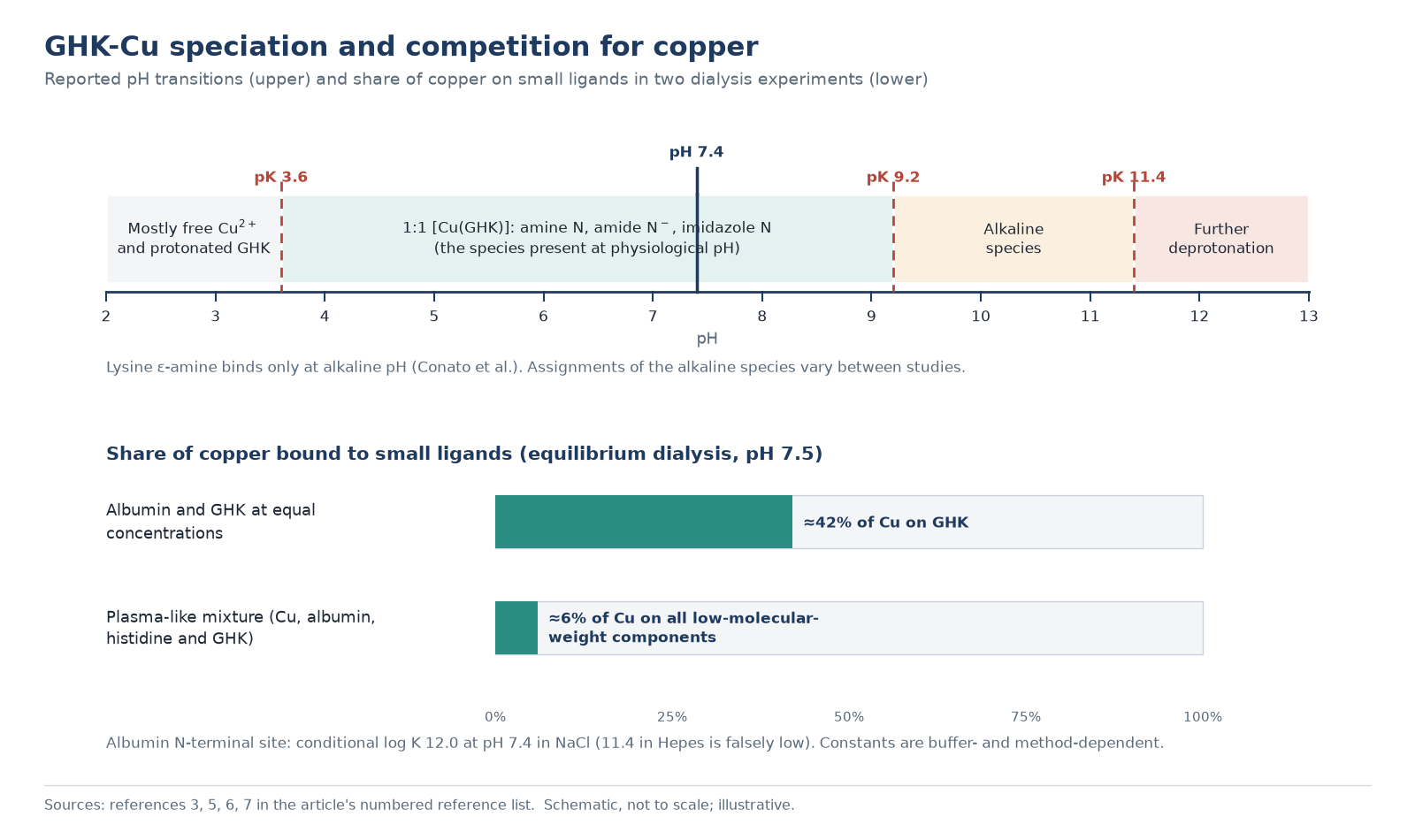
That copper-carrier hypothesis shaped everything that followed. If GHK’s effects depended on copper delivery, then its chemistry, how strongly it binds copper, whether it can hand copper to other molecules, and whether it changes copper’s redox behaviour, would be central to its biology. Lau and Sarkar tested part of this directly. In equilibrium-dialysis experiments at pH 7.5, GHK competed with serum albumin for Cu(II): with equal concentrations of albumin and peptide, about 42% of the copper was bound to the peptide (Lau & Sarkar 1981). At concentrations of copper, albumin, histidine and peptide closer to those in plasma, however, only about 6% of the copper was associated with low-molecular-weight components (Lau & Sarkar 1981). The peptide could take copper from albumin in a test tube, but in plasma-like conditions albumin still held most of it. This is one of the more important and less quoted findings in the field, because it limits how far the carrier idea can be pushed.
A second line of work asked where GHK comes from. Maquart and colleagues noted in 1988 that the sequence Gly-His-Lys occurs in the α2(I) chain of type I collagen, and suggested that proteases at a wound might release it (Maquart et al. 1988). Lane and colleagues later showed that proteolysis of SPARC, a matrix protein expressed during blood-vessel remodelling, released KGHK, GHK and longer peptides containing these sequences (Lane et al. 1994). In their experiments, KGHK and longer fragments stimulated angiogenesis, and both SPARC113–130 and KGHK bound Cu2+ with high affinity, but copper was not needed for the effect, and a second copper-binding SPARC fragment had no activity (Lane et al. 1994). These findings complicate the carrier story: at least one GHK-containing peptide appears to act through its sequence, not its copper.
Plasma concentrations have been reported to fall with age, from about 200 ng/mL at age 20 to about 80 ng/mL at age 60 (Dou et al. 2020). This figure is widely repeated, but it comes from a small number of older measurements, and the same review notes that no studies have linked lower GHK levels to specific ageing processes (Dou et al. 2020). A correlation between age and a plasma peptide level is not evidence that the peptide causes, slows or reverses any change.
Coordination chemistry: how the GHK peptide binds copper
Copper(II) is a d9 metal ion that prefers four strong donors arranged roughly in a square plane, often with one or two weaker donors above and below. Peptides offer three kinds of nitrogen donor: the free N-terminal amine, the nitrogen of a backbone amide once its proton has been removed, and side-chain groups such as the histidine imidazole (Sóvágó & Osz 2006). Amide deprotonation normally needs high pH, but a nearby anchoring group can make it happen at physiological pH by forming fused five- or six-membered chelate rings. Sóvágó and Ősz describe the strongest peptide binders as having a “double anchor”, such as the N-terminal amine plus a histidine in the third position (Sóvágó & Osz 2006). That arrangement is the ATCUN motif (amino-terminal Cu(II)- and Ni(II)-binding motif), NH2-Xaa-Xaa-His, found in serum albumin and many designed peptides (Harford & Sarkar 1997).
GHK has histidine in the second position, not the third, so it cannot complete the four-nitrogen ATCUN set. Spectroscopy shows what happens instead. Freedman and colleagues found that at neutral pH GHK forms a mononuclear 1:1 Cu(II) complex in which copper is bound equatorially by two or three nitrogen atoms, one of them from the imidazole ring (Freedman et al. 1982). A pH titration showed three transitions with apparent pK values of 3.6, 9.2 and 11.4; the complex present at physiological pH forms at the lowest of these (Freedman et al. 1982). Later work combining X-ray crystallography, EPR, X-ray absorption and NMR confirmed that in solution [Cu(GHK)] is monomeric with three nitrogen ligands, the terminal amine, one amidyl nitrogen and the imidazole nitrogen, while the fourth equatorial position is held by a labile oxygen donor (Hureau et al. 2011). In the crystal, the same complex is dimeric, with a carboxylate oxygen from a neighbouring molecule filling that fourth site (Hureau et al. 2011; Perkins et al. 1984).
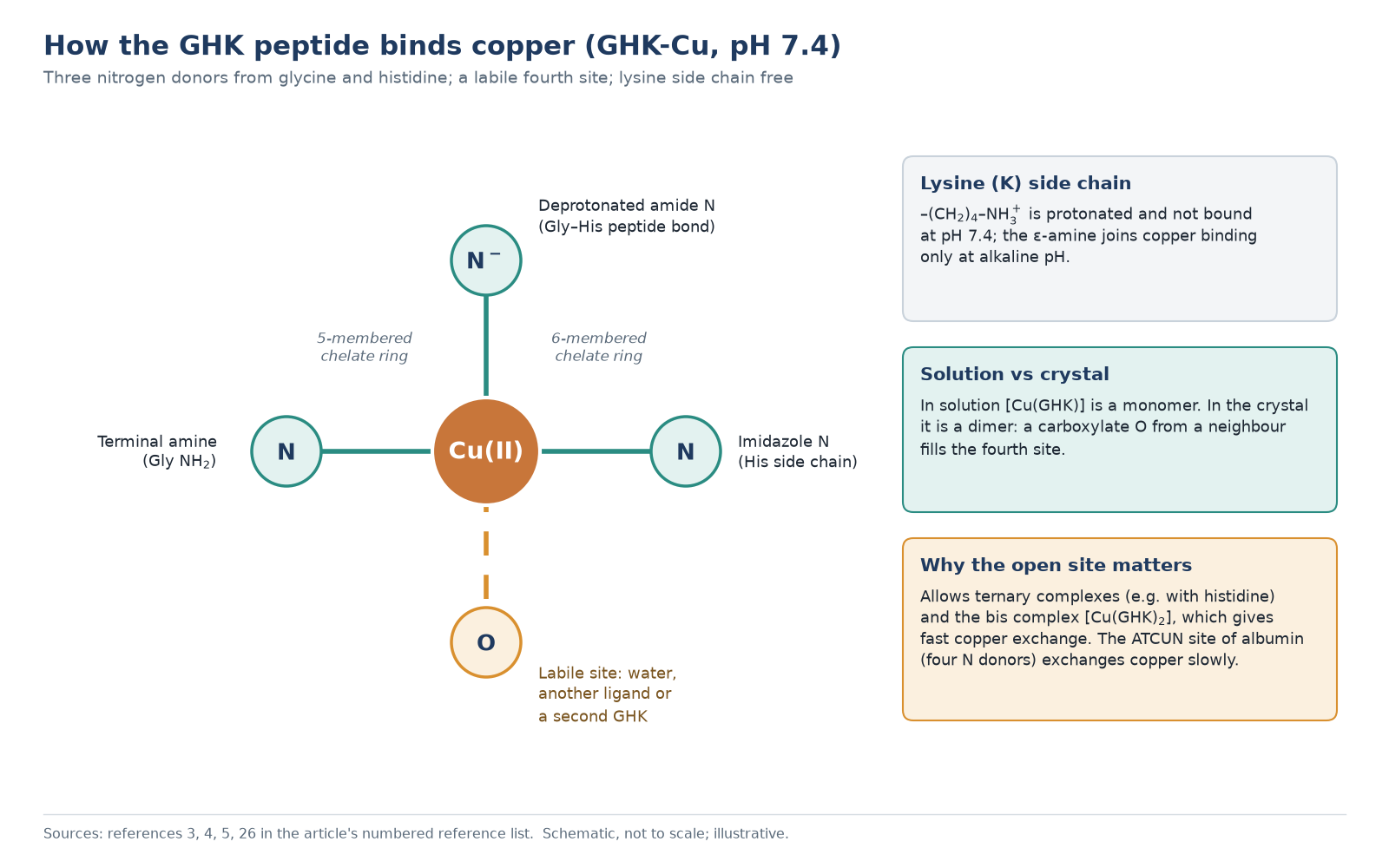
The lysine side chain is often drawn bound to copper in popular diagrams, but the solution data do not support that at physiological pH. Conato and colleagues, using potentiometry, calorimetry, UV-visible, circular dichroism and EPR, concluded that the lysine ε-amino group takes part in copper binding only at alkaline pH; at pH 7.4 it is protonated and free (Conato et al. 2001). They also found complexes of different stoichiometry and evidence for binuclear species (Conato et al. 2001). The open fourth site has practical consequences. It allows ternary complexes with other ligands, such as histidine or glycine (Lau & Sarkar 1981; Hureau et al. 2011), and it allows a second GHK molecule to bind, forming [Cu(GHK)2]. Hureau and colleagues attributed the fast exchange of copper between GHK molecules to this bis species, in contrast to the very slow exchange seen for the ATCUN peptide DAHK (Hureau et al. 2011).
Why is GHK-Cu blue?
The blue or violet colour of GHK-Cu solutions comes from d–d electronic transitions of the copper(II) ion. The exact colour depends on how many nitrogen and oxygen donors surround the metal: more nitrogen donors shift the absorption to shorter wavelengths, moving the colour from pale blue towards violet. This is why the visible absorption spectrum was used in the early speciation work to tell complexes apart (Lau & Sarkar 1981; Freedman et al. 1982). The colour is therefore a useful hint that copper is bound, but it is not an assay. A solution of copper salt with no peptide is also blue, and a degraded or partly complexed sample can look similar to a pure one. Copper content and peptide identity need separate measurements, discussed later in this review.
Affinity and speciation
How tightly does GHK bind copper? The question sounds simple but the answer depends on conditions. Binding constants for copper peptides are conditional: they apply at a given pH, ionic strength, temperature and buffer, and they can be distorted when the buffer itself binds copper. Rózga and colleagues showed this for albumin. In 100 mM NaCl at pH 7.4 they measured a conditional log K of 12.0 ± 0.1 for Cu(II) at the albumin N-terminal site, a picomolar affinity, but obtained a falsely lower value of 11.4 in 100 mM Hepes buffer because of a ternary copper–competitor–buffer complex (Rózga et al. 2007). For high-affinity peptides, direct titration is not enough: Trapaidze and colleagues showed that isothermal titration calorimetry gives accurate values for GHK and DAHK only when a weaker competing ligand, glycine, is included and its contribution corrected for (Trapaidze et al. 2012). They also found that binding to GHK was driven mainly by enthalpy, unlike DAHK (Trapaidze et al. 2012).
The competition data of Lau and Sarkar are, for most purposes, more informative than any single constant. They show that GHK binds copper strongly enough to compete with albumin at equal concentrations, but that in a plasma-like mixture albumin remains the dominant carrier (Lau & Sarkar 1981; Bal et al. 2013). For comparison, published estimates of the conditional dissociation constant of copper bound to amyloid-β span four orders of magnitude, from 10 pM to 100 nM, with a preferred range of 100 pM to 1 nM; much of the spread reflects differences in method (Faller & Hureau 2009). Figure 2 summarises the pH transitions and competition findings for GHK.
Redox behaviour
Free copper ions switch between Cu(II) and Cu(I) and can catalyse the formation of hydroxyl radicals from hydrogen peroxide, a Fenton-type reaction (Valko et al. 2016; Gaetke & Chow 2003). A key question for any copper peptide is whether binding suppresses or permits that chemistry. Hureau and colleagues used cyclic voltammetry and ascorbate oxidation to show that both [Cu(GHK)] and [Cu(DAHK)] are redox-inert under moderate potentials (Hureau et al. 2011). There was one difference: [Cu(GHK)] could be reduced to Cu(I) at about −0.62 V (versus Ag/AgCl), after which the copper was released, whereas [Cu(DAHK)] could not (Hureau et al. 2011). In practical terms, GHK holds copper in a form that is not readily redox-active, but under strongly reducing conditions it can let the metal go. That matters for the stability of formulations, discussed below.
GHK copper peptides in context: albumin, ATCUN motifs and other copper-binding peptides
GHK is one copper-binding peptide among many, and comparing it with its neighbours helps explain both its chemistry and the limits of what it can do. The most important comparison is with human serum albumin, the main copper carrier in blood after ceruloplasmin. Albumin’s N-terminal sequence, Asp-Ala-His-Lys (DAHK), is a classic ATCUN site that binds Cu(II) through the terminal amine, two deprotonated amide nitrogens and the histidine imidazole (Harford & Sarkar 1997; Hureau et al. 2011; Bal et al. 2013). Its picomolar conditional affinity at pH 7.4 (Rózga et al. 2007) and its high concentration in plasma make it the reference point against which any small copper carrier must be judged. Early work also showed that albumin, copper and histidine form a ternary complex, a reminder that small amino acids take part in copper handling in blood (Lau & Sarkar 1971; Lau & Sarkar 1981).
Other biological peptides bind copper for quite different reasons. The amyloid-β peptide, central to research on Alzheimer disease, binds Cu(II) and Zn(II), and the coordination sphere and affinity of these complexes have been debated for years (Faller & Hureau 2009; Viles 2012). The prion protein binds copper through repeated sequences in its unstructured N-terminal region, and the structures of these sites have been studied by a range of spectroscopic methods (Millhauser 2007). These systems are not copper carriers in the GHK sense, but they show that copper binding by a peptide is common and that the same metal can be held in many geometries with very different consequences.
Cosmetic chemistry has its own family of copper peptides. Reviews of topical peptides group ingredients by proposed function into signal peptides, enzyme-inhibitor peptides, neurotransmitter-inhibitor peptides and carrier peptides; copper peptides are the standard example of the carrier group, so named because they are thought to deliver trace metals (Gorouhi & Maibach 2009; Errante et al. 2020; Schagen 2017). The classification is descriptive, not a finding: placing GHK-Cu in the “carrier” box does not show that it delivers copper to any particular cell in skin. Table 2 compares the main binding sites.
Table 2. Copper-binding motifs relevant to copper peptides. Affinities are conditional and method-dependent; values from different studies should not be ranked directly.
| Peptide or site | Main donors at pH 7.4 | Typical complex | Affinity information | Key sources |
|---|---|---|---|---|
| GHK (Gly-His-Lys) | Terminal NH2, one amide N, His imidazole; fourth site labile | 1:1 [Cu(GHK)]; 2:1 [Cu(GHK)2] at peptide excess | Competes with albumin at equimolar concentration (about 42% of Cu on peptide); about 6% of Cu on small ligands in plasma-like mixtures | (Freedman et al. 1982; Hureau et al. 2011; Conato et al. 2001; Lau & Sarkar 1981) |
| Albumin N-terminus (DAHK, ATCUN) | Terminal NH2, two amide N, His imidazole | 1:1, slow exchange | Conditional log K 12.0 at pH 7.4 (picomolar) | (Rózga et al. 2007; Bal et al. 2013; Hureau et al. 2011) |
| ATCUN motif (NH2-Xaa-Xaa-His) generally | “Double anchor”: amine plus His in position 3 | Square-planar, four N | Highest peptide affinities of the classes reviewed | (Harford & Sarkar 1997; Sóvágó & Osz 2006) |
| Amyloid-β | His imidazoles, N-terminus, carboxylates (debated) | Several pH-dependent forms | Conditional Kd 10 pM to 100 nM (most likely 100 pM to 1 nM) | (Faller & Hureau 2009; Viles 2012) |
| Prion protein octarepeats | His imidazole plus amide N | Multiple modes depending on copper load | Site-dependent | (Millhauser 2007) |
| KGHK (SPARC fragment) | Not resolved in the source | — | “High affinity” for Cu2+; activity did not require added copper | (Lane et al. 1994) |
Two lessons come out of the comparison. First, GHK is a strong copper binder, but not the strongest; ATCUN sites hold copper more tightly and exchange it more slowly (Hureau et al. 2011). Second, GHK’s open coordination site and fast exchange make it chemically suited to handing copper on, which is consistent with, but does not prove, the carrier hypothesis (Pickart et al. 1980; Hureau et al. 2011).
Copper biology: why the metal matters
Any discussion of copper peptides has to start from the biology of copper itself, because many reported effects of GHK-Cu could, in principle, be effects of copper. Copper is an essential cofactor for enzymes involved in energy metabolism, peptide hormone maturation, blood clotting and signalling (Kim et al. 2008; Festa & Thiele 2011). In humans, uptake, distribution and export are handled by a network of transporters and chaperone proteins that keeps free copper extremely low inside cells (Lutsenko 2010; Kim et al. 2008). Inherited disorders show what happens when that network fails: Menkes syndrome is a disorder of copper deficiency, and Wilson disease one of copper overload (Linder & Hazegh-Azam 1996).
One copper enzyme is directly relevant to the matrix effects often attributed to GHK-Cu. Lysyl oxidase is a copper-dependent amine oxidase that forms the cross-links holding collagen and elastin fibres together, and its functional activity depends on copper status (Rucker et al. 1998). If a cell-culture medium is short of copper, adding a copper complex could change collagen processing simply by supplying the metal. This is one reason why careful studies compare GHK-Cu with apo-GHK and with copper salts, and why studies that use only GHK-Cu cannot say whether the peptide, the copper or the pair is responsible.
Copper is also toxic in excess. Copper can initiate oxidative damage in vitro and in cell culture, and both excess and deficiency increase cellular susceptibility to oxidative injury (Gaetke & Chow 2003). Redox-active metals including copper can generate reactive oxygen species and modify proteins, lipids and DNA (Valko et al. 2016). In 2022, Tsvetkov and colleagues described a distinct form of copper-dependent regulated cell death in human cells, in which copper binds directly to lipoylated mitochondrial enzymes (Tsvetkov et al. 2022). Metal-catalysed oxidation also damages the very residues that bind metals: histidine can be converted to asparagine or aspartate, and lysine to aminoadipic semialdehyde (Stadtman 1990). For GHK-Cu, whose copper sits on a histidine and next to a lysine, that chemistry is a plausible route to degradation.
This biology cuts both ways. It explains why copper complexes are biologically interesting, and it explains why their effects in culture are hard to interpret. The early observation that GHK produced responses “ranging from the stimulation of growth and differentiation to outright toxicity” across cell systems (Pickart et al. 1980) is exactly what one would expect of a molecule that moves an essential but toxic metal.
What does the GHK peptide do in laboratory studies?
The phrase “what does GHK-Cu do” usually leads to long lists of reported actions. This section takes a narrower approach: it describes what kinds of experiment have been done, what they measured, and what the design allows one to conclude. A fuller discussion of the skin trials is available in the GHK-Cu skin research review, and general guidance on weighing study types is in How to judge the evidence behind a claim. For the wider range of laboratory applications, see what are peptides used for? Synthetic peptides as research tools.
Fibroblasts and the extracellular matrix
The most consistent laboratory findings concern fibroblasts, the cells that make connective-tissue matrix. In 1988, Maquart and colleagues reported that GHK-Cu stimulated collagen synthesis in fibroblast cultures, starting between 10⁻¹² and 10⁻¹¹ M, peaking at 10⁻⁹ M and independent of any change in cell number (Maquart et al. 1988). A follow-up study found that GHK-Cu increased the synthesis of glycosaminoglycans, with a biphasic profile peaking at 10⁻⁹ to 10⁻⁸ M and returning towards control at higher concentrations, and with preferential effects on dermatan sulfate and heparan sulfate (Wegrowski et al. 1992). The same group then used a rat wound-chamber model, in which a small chamber is implanted under the skin and the tissue that grows into it is analysed. Repeated administration of GHK-Cu into the chambers increased wound-tissue mass, type I collagen and glycosaminoglycans (Siméon et al. 2000), and increased both the inactive and active forms of matrix metalloproteinase-2 at later stages of healing (Siméon et al. 1999).
Taken together, these studies suggest that GHK-Cu can influence both the building and the remodelling of matrix in experimental systems. They also illustrate the typical limits. The effective concentrations are very low and the concentration–response curves are bell-shaped, which makes them sensitive to small errors in preparation. The chamber model measures tissue in a chamber, not skin. And most comparisons are between GHK-Cu and an untreated control, not between GHK-Cu, apo-GHK and copper alone.
Keratinocytes, growth factors and inflammatory signals
Other cell studies have looked at keratinocytes, the main cells of the epidermis. In cultured keratinocytes and skin-equivalent models, copper-GHK increased proliferation and raised markers including proliferating cell nuclear antigen, p63 and the integrins α6 and β1 (Kang et al. 2009). Pollard and colleagues exposed normal and irradiated human fibroblasts to 1 nM copper tripeptide and reported faster population doubling and higher production of basic fibroblast growth factor and vascular endothelial growth factor (Pollard et al. 2005). A study in the HS68 fibroblast line examined GHK-Cu combined with light-emitting-diode irradiation, measuring viability, procollagen and growth-factor outputs (Huang et al. 2007). A 2023 study reported that GHK-Cu combined with hyaluronic acid increased collagen IV in fibroblast and ex vivo skin tests; a combination design of this kind cannot isolate the contribution of either ingredient (Jiang et al. 2023). In dermal fibroblasts stimulated with tumour necrosis factor-α, GHK, the related tripeptide GGH, copper chloride and their copper complexes all reduced secretion of interleukin-6 (Gruchlik et al. 2012). That last finding is notable for a reason its authors did not emphasise: copper chloride alone had a similar effect, which points to copper rather than the peptide as at least part of the explanation (Gruchlik et al. 2012).
Analogue work adds another caution. AHK-Cu, a related copper tripeptide, stimulated elongation of human hair follicles ex vivo and proliferation of dermal papilla cells at 10⁻¹² to 10⁻⁹ M (Pyo et al. 2007). These are interesting findings in a model system, but they concern a different molecule and cannot be read as evidence about GHK-Cu.
Animal wound models
Animal studies of GHK and GHK-Cu are mostly in rodent wound models. Besides the chamber studies above, one study incorporated biotin-labelled GHK into a collagen film and applied it to wounds in rats; the treated group showed more wound contraction and cell proliferation, and copper concentration at the wound site rose about ninefold (Arul et al. 2005). That copper increase is relevant to the carrier hypothesis, but the study used a modified peptide bound to a collagen matrix, so it does not tell us what free GHK-Cu would do. Reviews by the discovering group list further effects in several species and organs (Pickart 2008; Pickart et al. 2015), but those are summaries of the authors’ own and others’ studies and need to be checked against the primary papers before being relied on.
Antioxidant chemistry
Because GHK binds copper in a redox-inert form (Hureau et al. 2011), it might be expected to limit metal-driven oxidation. Sakuma and colleagues tested apo-GHK directly. At concentrations up to 10 µM it reduced reactive oxygen species in Caco-2 intestinal cells, and electron spin resonance showed that it diminished hydroxyl and peroxyl radicals but not superoxide (Sakuma et al. 2018). Those are mechanistic chemistry findings in a cell line. They do not show an antioxidant effect in tissue, and the authors’ description of GHK as an “endogenous antioxidant” is a hypothesis drawn from them.
Gene-expression signatures and the Connectivity Map
The most widely repeated modern claim about the GHK peptide is that it changes the expression of thousands of genes. This claim rests on a computational tool, the Connectivity Map, which compares a disease-associated gene-expression signature with a library of expression profiles from cultured cells exposed to many compounds, looking for compounds whose profile runs in the opposite direction (Lamb et al. 2006). The library was later expanded to more than a million profiles using a reduced, lower-cost assay (Subramanian et al. 2017).
Two studies used this approach and named GHK. Campbell and colleagues profiled 64 lung-tissue samples (8 regions from each of 8 lungs) from smokers with chronic obstructive pulmonary disease and identified 127 genes whose expression tracked the severity of emphysema (Campbell et al. 2012). Querying the Connectivity Map with this signature identified GHK as a compound whose profile ran opposite to it. They then tested GHK in cultured fibroblasts from these patients and found that it restored the ability of the cells to contract collagen gels (Campbell et al. 2012). Hong and colleagues derived a 54-gene signature associated with metastasis in early-stage colorectal cancer, and a Connectivity Map query suggested compounds including GHK (Hong et al. 2010).
These are legitimate hypothesis-generating studies, and the Campbell paper backed its prediction with a cell experiment. But the step from “a connectivity score points the other way” to “GHK resets genes to health”, the framing used in some later reviews (Pickart et al. 2014; Pickart & Margolina 2018), is large. Connectivity scores are computed from cell-line profiles under particular conditions; they do not show what happens in a tissue or an organism. Several of the reviews that popularised the gene claims were written by authors affiliated with a company that sells copper-peptide products, and some were proposals for uses that have not been tested (Pickart et al. 2012; Pickart et al. 2014). That does not make them wrong, but it means their conclusions should be weighed as assertions and checked against independent work.
Human studies: a thin and dated record
Controlled human studies of GHK-Cu are few, and most concern cosmetic skin outcomes, reviewed in detail on the skin research page. Two examples show the range. A randomised study after carbon dioxide laser resurfacing, in which 13 patients completed follow-up, found no significant differences in redness or in objective wrinkle and skin-quality measures, although patient-reported satisfaction was higher with the copper tripeptide product (P = .04) (Miller et al. 2006). A 1994 multicentre, vehicle-controlled trial of a GHK-Cu gel in diabetic foot ulcers reported a difference in closure between groups (Mulder et al. 1994). That trial is a historical record. It was conducted more than three decades ago, we did not find an independent replication, and no GHK-Cu medicine is registered for any purpose in Australia (NSW Health 2026; TGA 2026c).
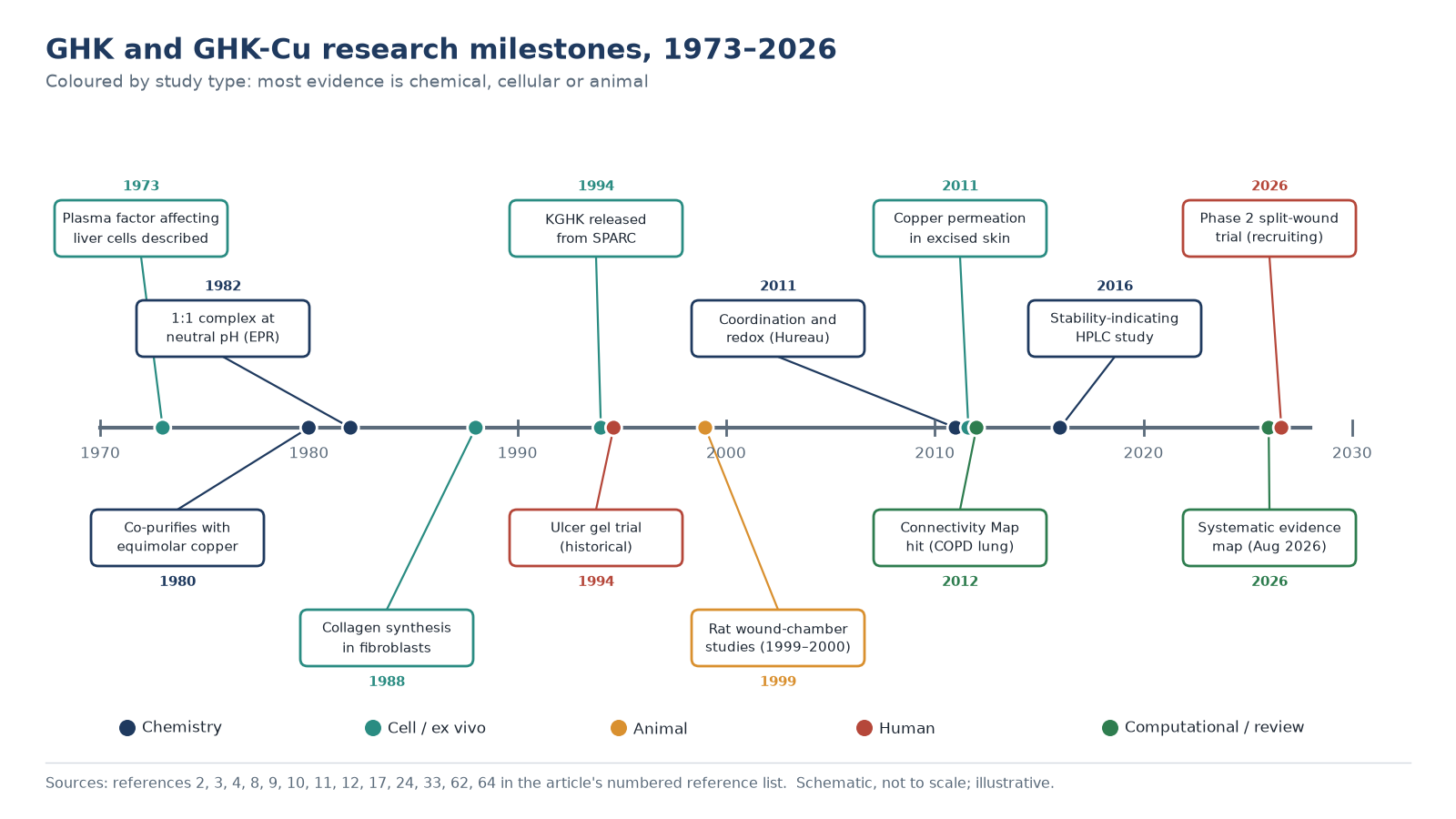
A 2026 systematic evidence-mapping review searched databases, trial registries and regulatory sources to 12 August 2026. It concluded that preclinical data consistently support matrix-remodelling effects, but that clinical evidence is sparse, that delivery studies rarely determine the copper species actually present, and that the field is “promising but unproven” (Mateescu et al. 2026). One registered trial is under way: a phase 2, randomised, double-blind, vehicle-controlled split-wound study of a topical GHK-Cu gel in healthy adults, sponsored by industry, began in February 2026 with an estimated primary completion date of February 2027 and no posted findings (ClinicalTrials.gov NCT07437586). Table 3 maps the evidence by study type and Figure 3 sets it on a timeline.
Table 3. Evidence map for GHK and GHK-Cu by model type, with what each kind of study can and cannot show.
| Study type | Examples in this review | What it measured | What it can show | What it cannot show |
|---|---|---|---|---|
| Chemistry and structure | (Freedman et al. 1982; Perkins et al. 1984; Conato et al. 2001; Hureau et al. 2011; Trapaidze et al. 2012) | Binding sites, stoichiometry, redox behaviour | Which species exist under defined conditions | Biological effect |
| Computational (Connectivity Map) | (Campbell et al. 2012; Hong et al. 2010) | Similarity of expression signatures | Hypotheses for testing | Effects in tissue or people |
| Cell culture | (Maquart et al. 1988; Wegrowski et al. 1992; Kang et al. 2009; Pollard et al. 2005; Gruchlik et al. 2012; Sakuma et al. 2018) | Synthesis of matrix, proliferation, cytokines, radicals | Plausible mechanisms at defined concentrations | Delivery, exposure or effect in vivo |
| Ex vivo skin | (Hostynek et al. 2011; Li et al. 2015) | Copper or peptide passing through excised skin | Permeation under test conditions | Biological effect in living skin |
| Animal models | (Siméon et al. 1999; Siméon et al. 2000; Arul et al. 2005) | Wound tissue, collagen, enzymes | Effects in a whole organism of another species | Effects in humans |
| Controlled human studies | (Miller et al. 2006; Mulder et al. 1994) | Cosmetic or wound endpoints | Effects under trial conditions | Effects beyond the population and product tested |
| Ongoing registered trial | (ClinicalTrials.gov NCT07437586) | Acute wound healing (planned) | Nothing until findings are posted | — |
| Systematic review | (Mateescu et al. 2026) | Whole evidence base to Aug 2026 | Overall strength and gaps | New primary data |
Do copper peptides penetrate skin?
Skin is a barrier designed to keep water-soluble molecules out, and GHK-Cu is very water-soluble. Badenhorst and colleagues measured its distribution coefficient between octanol and buffered saline and found log D values between −2.38 and −2.49 across pH 4.5 to 7.4, which places it firmly on the hydrophilic side (Badenhorst et al. 2016). Molecules like that cross the outer layer of skin, the stratum corneum, poorly. A 2008 study noted that transport of GHK-Cu through the stratum corneum had received very little attention, and used a model membrane built from liquid-crystalline lipids to show that copper complexes could permeate it and that the peptide influenced how copper moved (Mazurowska & Mojski 2008). A 2025 review of permeation methods for anti-ageing peptides reached a similar view, describing limited stratum corneum permeation for GHK-Cu and noting how little work had been done on carrier systems such as liposomes (Ogórek et al. 2025).
The most cited human-skin data come from two papers by Hostynek, Dreher and Maibach. Using flow-through diffusion cells and a 0.68% aqueous solution of the copper tripeptide, they reported a permeability coefficient through dermatomed human skin of 2.43 ± 0.51 × 10⁻⁴ cm/h, with 136.2 ± 17.5 µg/cm² of copper passing through over 48 hours (Hostynek et al. 2010; Hostynek et al. 2011). Two features of this work are often missed. First, the analysis measured copper by inductively coupled plasma mass spectrometry; it did not measure intact peptide, so it cannot show whether copper crossed the skin as GHK-Cu or in some other form (Hostynek et al. 2011). Second, the two papers report the same design and the same permeation figures but different amounts retained in the skin, 82 ± 8.1 µg/cm² in one and 97 ± 6.6 µg/cm² in the other (Hostynek et al. 2010; Hostynek et al. 2011). The difference may reflect separate analyses, but it is a reason to cite the primary numbers with care.
Physical disruption of the barrier changes the picture. When human skin was pre-treated with a polymer microneedle array, 134 ± 12 nmol of peptide and 705 ± 84 nmol of copper passed through in 9 hours, whereas almost none crossed intact skin (Li et al. 2015). The fivefold excess of copper over peptide in the receptor fluid suggests that the complex does not stay intact during transport (Li et al. 2015). That is consistent with the fast exchange chemistry described earlier (Hureau et al. 2011), and it supports the 2026 review’s conclusion that delivery studies rarely establish which copper species reaches the target (Mateescu et al. 2026). Proteases in skin are a further consideration; an assay developed to test cosmetic peptides in skin homogenates showed that protease stability has to be measured, not assumed (Errante et al. 2021).
How stable is GHK-Cu? Degradation and formulation chemistry
The stability of a copper peptide depends on two things: whether the peptide chain stays intact, and whether the copper stays bound. Badenhorst and colleagues developed a stability-indicating reversed-phase HPLC method and stressed GHK-Cu under acid, base and oxidising conditions (Badenhorst et al. 2016). The peptide degraded under basic and oxidative stress, and to a lesser extent under acid, following first-order kinetics. Rather unexpectedly, it was stable in water and in buffers between pH 4.5 and 7.4 for at least two weeks at 60 °C (Badenhorst et al. 2016). HPLC with mass spectrometry identified three main degradation products, one of them free histidine, which indicates cleavage of the peptide backbone (Badenhorst et al. 2016). Compatibility mattered too: GHK-Cu was compatible with niosomes based on a non-ionic surfactant but less stable in the presence of the negatively charged lipid dicetyl phosphate (Badenhorst et al. 2016).
Oxidation deserves particular attention. Metal-catalysed oxidation targets the residues that hold the metal, and histidine and lysine, both present in GHK, are among the residues modified (Stadtman 1990). Oxidation and hydrolysis are also the main chemical routes by which peptides and proteins degrade in solution generally (Manning et al. 2010). Strong reducing agents raise a different issue, since Cu(GHK) can be reduced to Cu(I) with release of the metal (Hureau et al. 2011). In a formulation, ingredients that chelate copper more strongly than GHK, or that change pH, can strip copper from the peptide without breaking a single covalent bond. Neither change is visible by eye.
For laboratory work, these findings argue for a short list of controls: defined pH and buffer, protection from oxidants and strong reductants, avoidance of competing chelators unless they are part of the experiment, and analytical confirmation of both peptide integrity and copper content over time. General handling of freeze-dried peptides is covered in the site’s lyophilised peptide handling checklist. Stability testing for regulated medicines follows International Council for Harmonisation (ICH) guidelines, which set out how storage conditions and time points are chosen (ICH n.d.).
Synthetic peptides: how GHK and GHK-Cu are made and verified
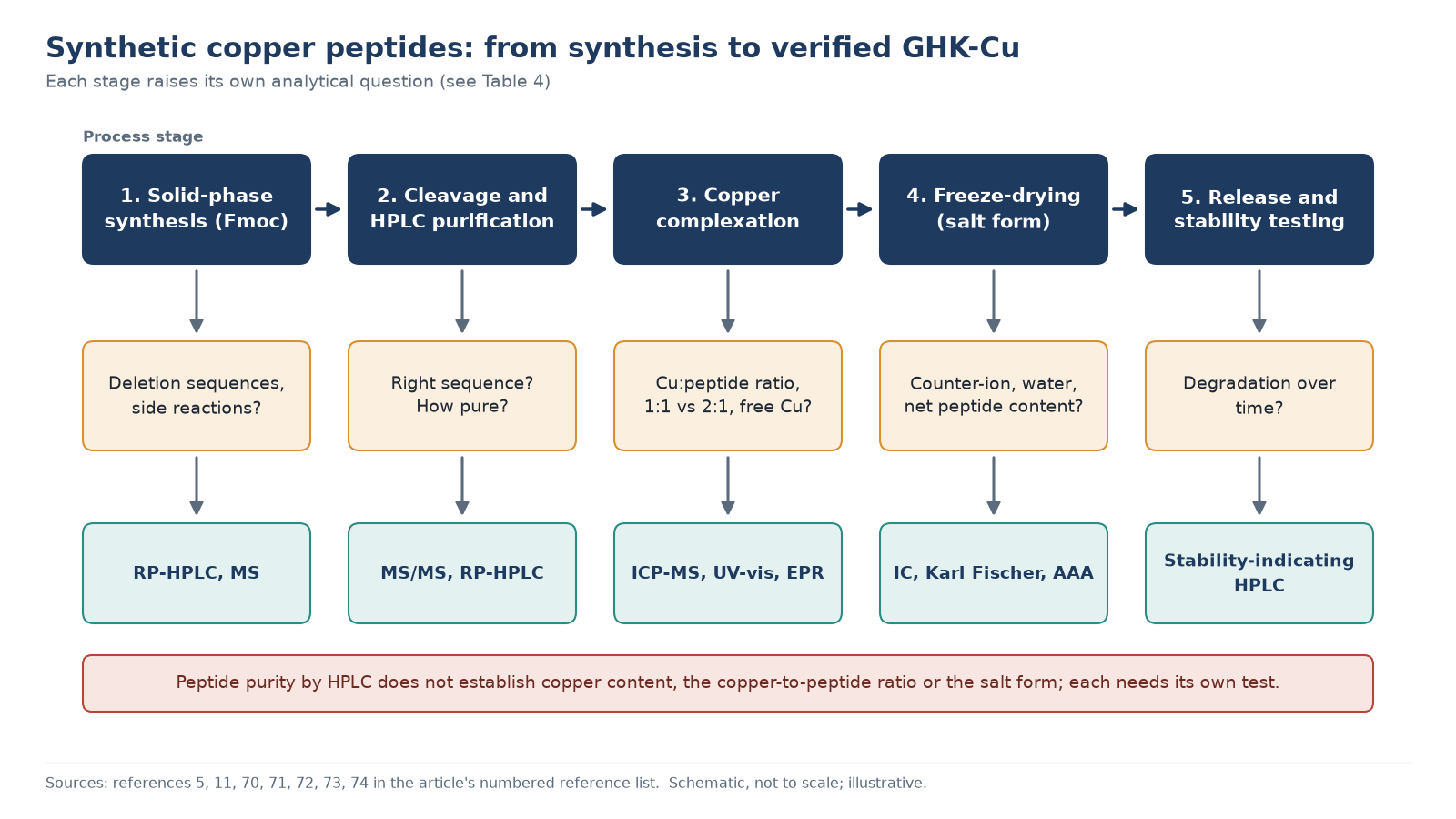
GHK used in research and in cosmetics is made synthetically, not extracted from plasma. Solid-phase peptide synthesis, first described by Merrifield in 1963, builds the chain one amino acid at a time on an insoluble resin (Merrifield 1963). Today the Fmoc version of the method is the standard approach (Behrendt et al. 2016). For a tripeptide the synthesis is short, but the usual sources of impurity still apply: incomplete couplings that give deletion sequences, side reactions on protected side chains, residual reagents and solvents, and counter-ions carried through from purification (Behrendt et al. 2016; Isidro-Llobet et al. 2019). A broader account of how synthetic peptides are made and what impurities they carry is given in Synthetic peptides: manufacture, impurities and analytical verification. How such documentation is assessed across a supply chain is reviewed in peptides wholesale: supplier qualification, quality standards and regulation.
The copper complex adds a step and a set of questions. After synthesis and purification, the peptide is combined with a copper salt and the complex is isolated, typically by freeze-drying. The ratio of copper to peptide determines whether the product is mostly the 1:1 complex, contains the 2:1 bis complex, or carries excess unbound copper (Conato et al. 2001; Hureau et al. 2011; PubChem CID 71587328). A sample can therefore be pure as a peptide and still be wrong as a copper peptide. The European Medicines Agency’s guideline on synthetic peptides, in force from June 2026, sets expectations for characterisation, specifications and analytical control of synthetic peptide substances in medicines (EMA 2025), and ICH guidelines cover analytical validation, impurities and specifications (ICH n.d.). Neither applies to non-medicine research material, but both set out what thorough characterisation looks like. The 2026 review argued that GHK-Cu should be defined as an “active pharmaceutical entity” with a control strategy for both peptide and copper, precisely because so few studies report this (Mateescu et al. 2026).
Table 4 lists the analytical tests that answer each identity and quality question. How to read a chromatogram is explained in How to interpret a peptide HPLC chromatogram, and how those numbers appear on a certificate in How to read a peptide certificate of analysis.
Table 4. Analytical questions for a synthetic copper peptide and the tests that address them.
| Question | Typical test | What it shows | What it does not show |
|---|---|---|---|
| Is the peptide the right sequence? | Mass spectrometry (MS), MS/MS fragmentation | Molecular mass of the peptide and fragment pattern | Copper content; amount of peptide |
| How pure is the peptide? | Reversed-phase HPLC with UV detection; stability-indicating method (Badenhorst et al. 2016) | Proportion of peptide-related impurities and degradation products | Water, salts, counter-ions or copper |
| How much peptide is in the solid? | Amino-acid analysis or quantitative NMR | Net peptide content | Purity profile |
| How much copper is present? | ICP-MS or ICP-OES (Hostynek et al. 2011) | Total copper | Whether copper is bound to the peptide |
| Is copper bound, and in what ratio? | UV-visible and EPR spectroscopy; potentiometric speciation (Freedman et al. 1982; Conato et al. 2001; Lau & Sarkar 1981) | Coordination environment; 1:1 versus 2:1 species | Trace impurities |
| What else is in the solid? | Ion chromatography (counter-ions), Karl Fischer (water), residual solvents | Salt form and non-peptide mass | Peptide identity |
| Does it stay the same over time? | Stability study under defined storage conditions (ICH n.d.; Badenhorst et al. 2016) | Rate and type of degradation | Behaviour in a different formulation |
Copper peptides in Australia: cosmetic ingredient, therapeutic good or scheduled poison?
Searches for “peptides Australia” and “GHK-Cu Australia” often mix three separate regulatory questions. This section sets out the published position as at 26 October 2026. It is a factual summary of public documents, not legal advice, and whether any particular product falls within a given category depends on its facts.
The first question is whether a product is a therapeutic good. Under section 3 of the Therapeutic Goods Act 1989, therapeutic goods include goods represented or likely to be taken to be for therapeutic use, which covers influencing, inhibiting or modifying a physiological process (TGA 2024). The TGA explains that whether a product is a food, a cosmetic or a therapeutic good depends on how it is presented and what is claimed for it (TGA 2024). Peptide products regulated as therapeutic goods must be included in the Australian Register of Therapeutic Goods (ARTG) before they can be imported, manufactured, supplied, exported or advertised, apart from limited exceptions such as a specific approval, authority or exemption (TGA n.d.). The TGA has named GHK-Cu, with several other peptides, as an example of an unapproved peptide product (TGA 2026b), and its June 2026 joint statement with the Chief Medical Officer said that unapproved peptide products not in the ARTG, which can include products containing GHK-Cu, have not been evaluated for safety, quality or effectiveness (TGA 2026c). healthdirect lists GHK-Cu among unapproved peptides not on the ARTG (healthdirect 2026), and a NSW Government release of 19 October 2026 said that none of the peptides it named, including GHK-Cu, is currently approved in Australia for any purpose (NSW Health 2026). The same release reported 1,180 emergency department presentations in NSW associated with peptide use in general between 1 July 2025 and 30 September 2026; that figure is not specific to GHK-Cu (NSW Health 2026).
The second question is whether a product is a cosmetic. The TGA does not assess cosmetics unless they make therapeutic claims, and cosmetic ingredients are generally regulated as industrial chemicals by the Australian Industrial Chemicals Introduction Scheme (AICIS) (TGA 2021). Some products are declared not to be therapeutic goods under the Therapeutic Goods (Declared Goods) Order No. 2 of 2019 (TGA 2021). The TGA’s peptide guidance states that some peptide products may be regulated as cosmetics rather than therapeutic goods if their ingredients, claims, presentation and intended use are limited to cosmetic purposes (TGA 2026a). Copper tripeptide-1 in a skin cream marketed for appearance is a different regulatory case from the same molecule promoted for wound healing or supplied in a vial.
The third question is scheduling under the Poisons Standard. The October 2026 Poisons Standard does not contain an entry naming GHK or GHK-Cu (Poisons Standard 2026). It does contain entries for copper compounds. Schedule 4 lists “COPPER COMPOUNDS for human use” except when separately specified, in preparations for human internal use containing 5 mg or less of copper per recommended daily dose, or in other preparations containing 5% or less of copper compounds (Poisons Standard 2026). Schedule 6 lists copper compounds with a parallel set of exceptions, Schedule 5 covers certain animal feed additives, and Appendix A lists copper compounds in paints (Poisons Standard 2026). Whether a particular copper-peptide preparation falls within any of these entries depends on its composition, concentration and intended use, and is a question for the regulator or a qualified adviser. State and territory laws may impose additional controls (TGA 2026b).
Finally, labels do not change any of this. The TGA states that disclaimers such as “research use only” or “not for human use” do not change whether a product is regulated as a therapeutic good and do not remove advertising, manufacture, import, export or supply obligations (TGA n.d.; TGA 2026b). The Personal Importation Scheme does not allow commercial supply or public advertising of unapproved therapeutic goods (TGA n.d.). Table 5 summarises the pathways.
Table 5. Regulatory pathways relevant to copper peptides in Australia (published position at 26 October 2026; not legal advice).
| Pathway | Who administers it | When it can apply to a copper peptide | Published position on GHK-Cu | Sources |
|---|---|---|---|---|
| Therapeutic good (ARTG) | TGA, under the Therapeutic Goods Act 1989 | Product presented or likely to be taken for therapeutic use | Named as an unapproved peptide product; not evaluated by the TGA | (TGA 2024; TGA n.d.; TGA 2026b; TGA 2026c) |
| Cosmetic | AICIS (ingredients); ACCC (labelling and product safety) | Ingredients, claims, presentation and use limited to cosmetic purposes | TGA does not assess cosmetics without therapeutic claims | (TGA 2021; TGA 2026a) |
| Poisons Standard | TGA delegate; enforced through state and territory law | Depends on composition, concentration and use | No entry naming GHK or GHK-Cu; Schedule 4, 5 and 6 entries for copper compounds with exceptions | (Poisons Standard 2026) |
| Personal importation | TGA, working with Australian Border Force at the border | Individual import where all scheme conditions are met | Does not allow commercial supply or advertising | (TGA n.d.) |
| “Research use only” label | Not a regulatory category | — | Does not change regulatory status or remove obligations | (TGA n.d.; TGA 2026b; healthdirect 2026) |
How to read claims about GHK-Cu and other copper peptides
Because the chemistry of GHK-Cu is solid and the clinical evidence thin, claims about it often borrow authority from the first to support the second. A few questions help separate the two. Which form was studied: apo-GHK, GHK-Cu, the bis complex, an analogue, or a modified peptide in a matrix (PubChem CID 71587328; Pyo et al. 2007; Arul et al. 2005)? Was copper alone tested as a control, so that a copper effect can be distinguished from a peptide effect (Gruchlik et al. 2012)? What kind of model was used, and does the claim stay within it (Table 3)? Is the claim drawn from a primary study or from a review, and do the review’s authors have a commercial interest (Pickart et al. 2015; Pickart & Margolina 2018)? Was a finding from a connectivity score or a cell line restated as an effect in people (Lamb et al. 2006; Campbell et al. 2012)? And has anyone independently repeated it?
General problems in biomedical research apply here as well. Small studies with flexible analyses are more likely to produce findings that do not hold up (Ioannidis 2005), and many preclinical findings in biology could not be reproduced when industry scientists tried (Begley & Ellis 2012). Systems such as GRADE rate the certainty of evidence downwards for risk of bias, imprecision, inconsistency, indirectness and publication bias (Guyatt et al. 2008). By those standards, most claims about GHK-Cu would sit at low or very low certainty for any human outcome, which matches the conclusion of the 2026 systematic review (Mateescu et al. 2026). The site’s guide to judging peptide research evidence sets out these questions in more detail.
Limitations of this review
This review has several limitations. It is a narrative review, not a systematic one, although it draws on a 2026 systematic evidence map for its overall judgement (Mateescu et al. 2026). Sources were found through PubMed, Crossref and official regulatory websites, and were read at the level of the abstract or full text as available; a few older papers were available to us only as abstracts, so details such as exact sample handling could not always be checked. A large share of the GHK literature comes from one research group and its collaborators, some with commercial affiliations, which limits the independence of the evidence base (Pickart et al. 2015; Pickart & Margolina 2018). Binding data come from studies using different buffers and methods, so values cannot be ranked directly (Rózga et al. 2007; Trapaidze et al. 2012). The two skin-permeation papers by Hostynek and colleagues report different amounts of copper retained in skin for apparently the same experiment (Hostynek et al. 2010; Hostynek et al. 2011). Regulatory statements reflect public documents read on 26 October 2026 and may change; some TGA pages could not be re-fetched on the day of the final link check, in which case text read earlier the same day was used. Finally, this review does not cover cosmetic formulation science in depth, and it makes no assessment of any commercial product.
Copper peptides and Eternal Peptides Wholesale: relevance of this review
Eternal Peptides Wholesale distributes research peptides in wholesale boxes of 10 vials, for laboratory research use only and not for human consumption (company background). GHK-Cu is among the materials listed in its Longevity & Skin category, which is why the chemistry, stability and analytical questions about copper peptides set out above matter to the site.
The certificate of analysis library lists Janoshik Analytical reports for purity and content, sterility, heavy metals and endotoxin for the GHK-Cu (100mg) batch, and a purity and content report for the GHK-Cu (50mg) batch. Each report applies only to the batch printed on it. As this review explains, copper content and peptide identity need separate measurements, so a purity figure alone does not settle them. The testing standards page sets out how Eternal Peptides Wholesale reads the four testing areas. Consistent with the Australian section of this review, these reports record laboratory tests on a submitted sample; they do not establish regulatory status, cosmetic or clinical suitability, or safety for human use.
Glossary
- Apo-GHK
- The tripeptide glycyl-L-histidyl-L-lysine without a bound metal ion.
- ATCUN motif
- Amino-terminal Cu(II)- and Ni(II)-binding motif, the sequence NH2-Xaa-Xaa-His, which binds copper through four nitrogen atoms (Harford & Sarkar 1997).
- Conditional binding constant
- A binding constant measured under stated conditions of pH, buffer, ionic strength and temperature; it is not transferable to other conditions (Rózga et al. 2007).
- Connectivity Map
- A reference collection of gene-expression profiles from cultured cells exposed to many compounds, used to look for compounds whose profiles oppose a disease signature (Lamb et al. 2006; Subramanian et al. 2017).
- Copper tripeptide-1
- Cosmetic ingredient name recorded as a synonym for the 1:1 copper complex of GHK (PubChem CID 71587328).
- EPR spectroscopy
- Electron paramagnetic resonance, a method that detects unpaired electrons and is used to probe the environment of Cu(II).
- ICP-MS
- Inductively coupled plasma mass spectrometry, used to measure total metal content; it does not show whether the metal is bound (Hostynek et al. 2011).
- Log D
- Logarithm of the distribution coefficient between octanol and water at a given pH; negative values indicate a water-loving molecule (Badenhorst et al. 2016).
- Lysyl oxidase
- A copper-dependent enzyme that cross-links collagen and elastin (Rucker et al. 1998).
- Speciation
- The distribution of a metal among different chemical forms in a mixture.
- Ternary complex
- A complex in which a metal ion is bound by two different ligands at once, such as copper with GHK and histidine (Lau & Sarkar 1981).
Frequently asked questions
What are copper peptides made from?
Copper peptides are short chains of amino acids that hold a copper ion. The best known, GHK-Cu, is made from three amino acids, glycine, histidine and lysine, bound to one copper(II) ion. Research and cosmetic GHK-Cu is made by chemical synthesis and then combined with a copper salt.
Is GHK-Cu the same as copper tripeptide-1?
Copper tripeptide-1 is a cosmetic ingredient name recorded in PubChem as a synonym for the 1:1 copper complex of GHK, also listed as prezatide copper. Tripeptide-1 without the word copper refers to the free GHK peptide. A product’s salt form and copper ratio should be confirmed by analysis, not by name.
Why is GHK-Cu blue?
The blue to violet colour comes from electronic transitions of the copper(II) ion. The exact shade depends on how many nitrogen and oxygen atoms surround the copper. Copper salts without peptide are also blue, so colour suggests copper is present but does not show that it is bound to GHK.
Is GHK-Cu approved in Australia?
No GHK-Cu medicine is included in the ARTG. The TGA names GHK-Cu among unapproved peptide products that it has not evaluated, and NSW Health has said it is not approved for any purpose. Cosmetic products may be regulated differently. This is a factual summary, not legal advice.
What does the GHK peptide do in lab studies?
In cell cultures, GHK-Cu has been reported to increase collagen and glycosaminoglycan synthesis at very low concentrations, and in rat wound-chamber models to change collagen and matrix metalloproteinase levels. Gene-expression studies used it as a computational hit. These findings come from model systems and do not establish effects in people.
Do copper peptides penetrate skin?
GHK-Cu is highly water-soluble and crosses intact skin poorly. In excised human skin, copper from a GHK-Cu solution permeated slowly over 48 hours, but only copper was measured. When microneedles disrupted the barrier, much more copper than peptide passed through, suggesting the complex does not stay intact.
How stable is GHK-Cu in solution?
In one stability-indicating HPLC study, GHK-Cu was stable in water and buffers from pH 4.5 to 7.4 for two weeks at 60 °C, but degraded under basic and oxidising conditions, forming three main products including free histidine. Strong reducing agents and competing chelators can also remove copper.
How are the identity and copper content of GHK-Cu verified?
Mass spectrometry confirms the peptide’s mass and sequence, and reversed-phase HPLC measures peptide purity. Copper is measured separately, for example by ICP-MS, and spectroscopy such as UV-visible or EPR shows whether it is bound and in what ratio. Net peptide content, counter-ions and water are further checks.
References
- National Center for Biotechnology Information. PubChem Compound Summary for CID 71587328, Prezatide copper. Available at: https://pubchem.ncbi.nlm.nih.gov/compound/71587328. Accessed 26 October 2026.
- Pickart L, Freedman JH, Loker WJ, et al. Growth-modulating plasma tripeptide may function by facilitating copper uptake into cells. Nature. 1980;288(5792):715-7. doi:10.1038/288715a0 PMID: 7453802. Available at: https://doi.org/10.1038/288715a0. Accessed 26 October 2026.
- Freedman JH, Pickart L, Weinstein B, Mims WB, Peisach J. Structure of the Glycyl-L-histidyl-L-lysine–copper(II) complex in solution. Biochemistry. 1982;21(19):4540-4. doi:10.1021/bi00262a004 PMID: 6291585. Available at: https://doi.org/10.1021/bi00262a004. Accessed 26 October 2026.
- Hureau C, Eury H, Guillot R, et al. X-ray and solution structures of Cu(II) GHK and Cu(II) DAHK complexes: influence on their redox properties. Chemistry. 2011;17(36):10151-60. doi:10.1002/chem.201100751 PMID: 21780203. Available at: https://doi.org/10.1002/chem.201100751. Accessed 26 October 2026.
- Conato C, Gavioli R, Guerrini R, et al. Copper complexes of glycyl-histidyl-lysine and two of its synthetic analogues: chemical behaviour and biological activity. Biochim Biophys Acta. 2001;1526(2):199-210. doi:10.1016/s0304-4165(01)00127-1 PMID: 11325542. Available at: https://doi.org/10.1016/s0304-4165(01)00127-1. Accessed 26 October 2026.
- Lau SJ, Sarkar B. The interaction of copper(II) and glycyl-L-histidyl-L-lysine, a growth-modulating tripeptide from plasma. Biochem J. 1981;199(3):649-56. doi:10.1042/bj1990649 PMID: 7340824. Available at: https://doi.org/10.1042/bj1990649. Accessed 26 October 2026.
- Rózga M, Sokołowska M, Protas AM, Bal W. Human serum albumin coordinates Cu(II) at its N-terminal binding site with 1 pM affinity. J Biol Inorg Chem. 2007;12(6):913-8. doi:10.1007/s00775-007-0244-8 PMID: 17516096. Available at: https://doi.org/10.1007/s00775-007-0244-8. Accessed 26 October 2026.
- Maquart FX, Pickart L, Laurent M, Gillery P, Monboisse JC, Borel JP. Stimulation of collagen synthesis in fibroblast cultures by the tripeptide-copper complex glycyl-L-histidyl-L-lysine-Cu2+. FEBS Lett. 1988;238(2):343-6. doi:10.1016/0014-5793(88)80509-x PMID: 3169264. Available at: https://doi.org/10.1016/0014-5793(88)80509-x. Accessed 26 October 2026.
- Siméon A, Monier F, Emonard H, et al. Expression and activation of matrix metalloproteinases in wounds: modulation by the tripeptide-copper complex glycyl-L-histidyl-L-lysine-Cu2+. J Invest Dermatol. 1999;112(6):957-64. doi:10.1046/j.1523-1747.1999.00606.x PMID: 10383745. Available at: https://doi.org/10.1046/j.1523-1747.1999.00606.x. Accessed 26 October 2026.
- Mateescu DM, Gavrilescu DM, Mincioaga RI, et al. GHK-Cu as a Bioactive Metallopeptide and Drug-Delivery Cargo: Coordination Chemistry, Formulation Science, Therapeutic Evidence, and a Translational Roadmap. Pharmaceutics. 2026;18(9):1077. doi:10.3390/pharmaceutics18091077 PMID: 42797253. Available at: https://doi.org/10.3390/pharmaceutics18091077. Accessed 26 October 2026.
- Badenhorst T, Svirskis D, Wu Z. Physicochemical characterization of native glycyl-l-histidyl-l-lysine tripeptide for wound healing and anti-aging: a preformulation study for dermal delivery. Pharm Dev Technol. 2016;21(2):152-60. doi:10.3109/10837450.2014.979944 PMID: 25384620. Available at: https://doi.org/10.3109/10837450.2014.979944. Accessed 26 October 2026.
- Hostynek JJ, Dreher F, Maibach HI. Human skin penetration of a copper tripeptide in vitro as a function of skin layer. Inflamm Res. 2011;60(1):79-86. doi:10.1007/s00011-010-0238-9 PMID: 20721598. Available at: https://doi.org/10.1007/s00011-010-0238-9. Accessed 26 October 2026.
- Li H, Low YS, Chong HP, et al. Microneedle-Mediated Delivery of Copper Peptide Through Skin. Pharm Res. 2015;32(8):2678-89. doi:10.1007/s11095-015-1652-z PMID: 25690343. Available at: https://doi.org/10.1007/s11095-015-1652-z. Accessed 26 October 2026.
- Therapeutic Goods Administration and Chief Medical Officer. Concerns regarding the public health risks associated with unapproved peptide products. Joint statement, 19 June 2026. Available at: https://www.tga.gov.au/news/media-releases/concerns-regarding-public-health-risks-associated-unapproved-peptide-products. Accessed 26 October 2026.
- Therapeutic Goods Administration. How we regulate therapeutic peptide products. (No page date displayed.) Available at: https://www.tga.gov.au/products/medicines/monitoring-and-compliance/how-we-regulate-therapeutic-peptide-products. Accessed 26 October 2026.
- Wegrowski Y, Maquart FX, Borel JP. Stimulation of sulfated glycosaminoglycan synthesis by the tripeptide-copper complex glycyl-L-histidyl-L-lysine-Cu2+. Life Sci. 1992;51(13):1049-56. doi:10.1016/0024-3205(92)90504-i PMID: 1522753. Available at: https://doi.org/10.1016/0024-3205(92)90504-i. Accessed 26 October 2026.
- Campbell JD, McDonough JE, Zeskind JE, et al. A gene expression signature of emphysema-related lung destruction and its reversal by the tripeptide GHK. Genome Med. 2012;4(8):67. doi:10.1186/gm367 PMID: 22937864. Available at: https://doi.org/10.1186/gm367. Accessed 26 October 2026.
- Harford C, Sarkar B. Amino Terminal Cu(II)- and Ni(II)-Binding (ATCUN) Motif of Proteins and Peptides: Metal Binding, DNA Cleavage, and Other Properties. Accounts of Chemical Research. 1997;30(3):123-130. doi:10.1021/ar9501535 Available at: https://doi.org/10.1021/ar9501535. Accessed 26 October 2026.
- Sóvágó I, Osz K. Metal ion selectivity of oligopeptides. Dalton Trans. 2006;(32):3841-54. doi:10.1039/b607515k PMID: 16896443. Available at: https://doi.org/10.1039/b607515k. Accessed 26 October 2026.
- Faller P, Hureau C. Bioinorganic chemistry of copper and zinc ions coordinated to amyloid-beta peptide. Dalton Trans. 2009;(7):1080-94. doi:10.1039/b813398k PMID: 19322475. Available at: https://doi.org/10.1039/b813398k. Accessed 26 October 2026.
- Millhauser GL. Copper and the prion protein: methods, structures, function, and disease. Annu Rev Phys Chem. 2007;58:299-320. doi:10.1146/annurev.physchem.58.032806.104657 PMID: 17076634. Available at: https://doi.org/10.1146/annurev.physchem.58.032806.104657. Accessed 26 October 2026.
- Gorouhi F, Maibach HI. Role of topical peptides in preventing or treating aged skin. Int J Cosmet Sci. 2009;31(5):327-45. doi:10.1111/j.1468-2494.2009.00490.x PMID: 19570099. Available at: https://doi.org/10.1111/j.1468-2494.2009.00490.x. Accessed 26 October 2026.
- Schagen S. Topical Peptide Treatments with Effective Anti-Aging Results. Cosmetics. 2017;4(2):16. doi:10.3390/cosmetics4020016 Available at: https://doi.org/10.3390/cosmetics4020016. Accessed 26 October 2026.
- Pickart L, Thaler MM. Tripeptide in human serum which prolongs survival of normal liver cells and stimulates growth in neoplastic liver. Nat New Biol. 1973;243(124):85-7. PMID: 4349963. Available at: https://pubmed.ncbi.nlm.nih.gov/4349963/. Accessed 26 October 2026.
- Pickart L, Thayer L, Thaler MM. A synthetic tripeptide which increases survival of normal liver cells, and stimulates growth in hepatoma cells. Biochem Biophys Res Commun. 1973;54(2):562-6. doi:10.1016/0006-291x(73)91459-9 PMID: 4356974. Available at: https://doi.org/10.1016/0006-291x(73)91459-9. Accessed 26 October 2026.
- Perkins CM, Rose NJ, Weinstein B, Stenkamp RE, Jensen LH, Pickart L. The structure of a copper complex of the growth factor glycyl-L-histidyl-L-lysine at 1.1 Å resolution. Inorganica Chimica Acta. 1984;82(1):93-99. doi:10.1016/s0020-1693(00)82544-x Available at: https://doi.org/10.1016/s0020-1693(00)82544-x. Accessed 26 October 2026.
- Trapaidze A, Hureau C, Bal W, Winterhalter M, Faller P. Thermodynamic study of Cu2+ binding to the DAHK and GHK peptides by isothermal titration calorimetry (ITC) with the weaker competitor glycine. J Biol Inorg Chem. 2012;17(1):37-47. doi:10.1007/s00775-011-0824-5 PMID: 21898044. Available at: https://doi.org/10.1007/s00775-011-0824-5. Accessed 26 October 2026.
- Pickart L. The human tri-peptide GHK and tissue remodeling. J Biomater Sci Polym Ed. 2008;19(8):969-88. doi:10.1163/156856208784909435 PMID: 18644225. Available at: https://doi.org/10.1163/156856208784909435. Accessed 26 October 2026.
- Pickart L, Vasquez-Soltero JM, Margolina A. GHK Peptide as a Natural Modulator of Multiple Cellular Pathways in Skin Regeneration. Biomed Res Int. 2015;2015:648108. doi:10.1155/2015/648108 PMID: 26236730. Available at: https://doi.org/10.1155/2015/648108. Accessed 26 October 2026.
- Pickart L, Margolina A. Regenerative and Protective Actions of the GHK-Cu Peptide in the Light of the New Gene Data. Int J Mol Sci. 2018;19(7):1987. doi:10.3390/ijms19071987 PMID: 29986520. Available at: https://doi.org/10.3390/ijms19071987. Accessed 26 October 2026.
- National Center for Biotechnology Information. PubChem Compound Summary for CID 73587, Glycyl-histidyl-lysine. Available at: https://pubchem.ncbi.nlm.nih.gov/compound/73587. Accessed 26 October 2026.
- Pyo HK, Yoo HG, Won CH, et al. The effect of tripeptide-copper complex on human hair growth in vitro. Arch Pharm Res. 2007;30(7):834-9. doi:10.1007/BF02978833 PMID: 17703734. Available at: https://doi.org/10.1007/BF02978833. Accessed 26 October 2026.
- Lane TF, Iruela-Arispe ML, Johnson RS, Sage EH. SPARC is a source of copper-binding peptides that stimulate angiogenesis. J Cell Biol. 1994;125(4):929-43. doi:10.1083/jcb.125.4.929 PMID: 7514608. Available at: https://doi.org/10.1083/jcb.125.4.929. Accessed 26 October 2026.
- Dou Y, Lee A, Zhu L, Morton J, Ladiges W. The potential of GHK as an anti-aging peptide. Aging Pathobiol Ther. 2020;2(1):58-61. doi:10.31491/apt.2020.03.014 PMID: 35083444. Available at: https://doi.org/10.31491/apt.2020.03.014. Accessed 26 October 2026.
- Bal W, Sokołowska M, Kurowska E, Faller P. Binding of transition metal ions to albumin: sites, affinities and rates. Biochim Biophys Acta. 2013;1830(12):5444-55. doi:10.1016/j.bbagen.2013.06.018 PMID: 23811338. Available at: https://doi.org/10.1016/j.bbagen.2013.06.018. Accessed 26 October 2026.
- Valko M, Jomova K, Rhodes CJ, Kuča K, Musílek K. Redox- and non-redox-metal-induced formation of free radicals and their role in human disease. Arch Toxicol. 2016;90(1):1-37. doi:10.1007/s00204-015-1579-5 PMID: 26343967. Available at: https://doi.org/10.1007/s00204-015-1579-5. Accessed 26 October 2026.
- Gaetke LM, Chow CK. Copper toxicity, oxidative stress, and antioxidant nutrients. Toxicology. 2003;189(1-2):147-63. doi:10.1016/s0300-483x(03)00159-8 PMID: 12821289. Available at: https://doi.org/10.1016/s0300-483x(03)00159-8. Accessed 26 October 2026.
- Lau SJ, Sarkar B. Ternary coordination complex between human serum albumin, copper (II), and L-histidine. J Biol Chem. 1971;246(19):5938-43. PMID: 5165635. Available at: https://pubmed.ncbi.nlm.nih.gov/5165635/. Accessed 26 October 2026.
- Viles JH. Metal ions and amyloid fiber formation in neurodegenerative diseases. Copper, zinc and iron in Alzheimer’s, Parkinson’s and prion diseases. Coordination Chemistry Reviews. 2012;256(19-20):2271-2284. doi:10.1016/j.ccr.2012.05.003 Available at: https://doi.org/10.1016/j.ccr.2012.05.003. Accessed 26 October 2026.
- Errante F, Ledwoń P, Latajka R, Rovero P, Papini AM. Cosmeceutical Peptides in the Framework of Sustainable Wellness Economy. Front Chem. 2020;8:572923. doi:10.3389/fchem.2020.572923 PMID: 33195061. Available at: https://doi.org/10.3389/fchem.2020.572923. Accessed 26 October 2026.
- Kim BE, Nevitt T, Thiele DJ. Mechanisms for copper acquisition, distribution and regulation. Nat Chem Biol. 2008;4(3):176-85. doi:10.1038/nchembio.72 PMID: 18277979. Available at: https://doi.org/10.1038/nchembio.72. Accessed 26 October 2026.
- Festa RA, Thiele DJ. Copper: an essential metal in biology. Curr Biol. 2011;21(21):R877-83. doi:10.1016/j.cub.2011.09.040 PMID: 22075424. Available at: https://doi.org/10.1016/j.cub.2011.09.040. Accessed 26 October 2026.
- Lutsenko S. Human copper homeostasis: a network of interconnected pathways. Curr Opin Chem Biol. 2010;14(2):211-7. doi:10.1016/j.cbpa.2010.01.003 PMID: 20117961. Available at: https://doi.org/10.1016/j.cbpa.2010.01.003. Accessed 26 October 2026.
- Linder MC, Hazegh-Azam M. Copper biochemistry and molecular biology. Am J Clin Nutr. 1996;63(5):797S-811S. doi:10.1093/ajcn/63.5.797 PMID: 8615367. Available at: https://doi.org/10.1093/ajcn/63.5.797. Accessed 26 October 2026.
- Rucker RB, Kosonen T, Clegg MS, et al. Copper, lysyl oxidase, and extracellular matrix protein cross-linking. Am J Clin Nutr. 1998;67(5 Suppl):996S-1002S. doi:10.1093/ajcn/67.5.996S PMID: 9587142. Available at: https://doi.org/10.1093/ajcn/67.5.996S. Accessed 26 October 2026.
- Tsvetkov P, Coy S, Petrova B, et al. Copper induces cell death by targeting lipoylated TCA cycle proteins. Science. 2022;375(6586):1254-1261. doi:10.1126/science.abf0529 PMID: 35298263. Available at: https://doi.org/10.1126/science.abf0529. Accessed 26 October 2026.
- Stadtman ER. Metal ion-catalyzed oxidation of proteins: biochemical mechanism and biological consequences. Free Radic Biol Med. 1990;9(4):315-25. doi:10.1016/0891-5849(90)90006-5 PMID: 2283087. Available at: https://doi.org/10.1016/0891-5849(90)90006-5. Accessed 26 October 2026.
- Siméon A, Wegrowski Y, Bontemps Y, Maquart FX. Expression of glycosaminoglycans and small proteoglycans in wounds: modulation by the tripeptide-copper complex glycyl-L-histidyl-L-lysine-Cu(2+). J Invest Dermatol. 2000;115(6):962-8. doi:10.1046/j.1523-1747.2000.00166.x PMID: 11121126. Available at: https://doi.org/10.1046/j.1523-1747.2000.00166.x. Accessed 26 October 2026.
- Kang YA, Choi HR, Na JI, et al. Copper-GHK increases integrin expression and p63 positivity by keratinocytes. Arch Dermatol Res. 2009;301(4):301-6. doi:10.1007/s00403-009-0942-x PMID: 19319546. Available at: https://doi.org/10.1007/s00403-009-0942-x. Accessed 26 October 2026.
- Pollard JD, Quan S, Kang T, Koch RJ. Effects of copper tripeptide on the growth and expression of growth factors by normal and irradiated fibroblasts. Arch Facial Plast Surg. 2005;7(1):27-31. doi:10.1001/archfaci.7.1.27 PMID: 15655171. Available at: https://doi.org/10.1001/archfaci.7.1.27. Accessed 26 October 2026.
- Huang PJ, Huang YC, Su MF, Yang TY, Huang JR, Jiang CP. In vitro observations on the influence of copper peptide aids for the LED photoirradiation of fibroblast collagen synthesis. Photomed Laser Surg. 2007;25(3):183-90. doi:10.1089/pho.2007.2062 PMID: 17603859. Available at: https://doi.org/10.1089/pho.2007.2062. Accessed 26 October 2026.
- Jiang F, Wu Y, Liu Z, Hong M, Huang Y. Synergy of GHK-Cu and hyaluronic acid on collagen IV upregulation via fibroblast and ex-vivo skin tests. J Cosmet Dermatol. 2023;22(9):2598-2604. doi:10.1111/jocd.15763 PMID: 37062921. Available at: https://doi.org/10.1111/jocd.15763. Accessed 26 October 2026.
- Gruchlik A, Jurzak M, Chodurek E, Dzierzewicz Z. Effect of Gly-Gly-His, Gly-His-Lys and their copper complexes on TNF-alpha-dependent IL-6 secretion in normal human dermal fibroblasts. Acta Pol Pharm. 2012;69(6):1303-6. PMID: 23285694. Available at: https://pubmed.ncbi.nlm.nih.gov/23285694/. Accessed 26 October 2026.
- Arul V, Gopinath D, Gomathi K, Jayakumar R. Biotinylated GHK peptide incorporated collagenous matrix: A novel biomaterial for dermal wound healing in rats. J Biomed Mater Res B Appl Biomater. 2005;73(2):383-91. doi:10.1002/jbm.b.30246 PMID: 15803494. Available at: https://doi.org/10.1002/jbm.b.30246. Accessed 26 October 2026.
- Sakuma S, Ishimura M, Yuba Y, Itoh Y, Fujimoto Y. The peptide glycyl-ʟ-histidyl-ʟ-lysine is an endogenous antioxidant in living organisms, possibly by diminishing hydroxyl and peroxyl radicals. Int J Physiol Pathophysiol Pharmacol. 2018;10(3):132-138. PMID: 30042814. Available at: https://pubmed.ncbi.nlm.nih.gov/30042814/. Accessed 26 October 2026.
- Lamb J, Crawford ED, Peck D, et al. The Connectivity Map: using gene-expression signatures to connect small molecules, genes, and disease. Science. 2006;313(5795):1929-35. doi:10.1126/science.1132939 PMID: 17008526. Available at: https://doi.org/10.1126/science.1132939. Accessed 26 October 2026.
- Subramanian A, Narayan R, Corsello SM, et al. A Next Generation Connectivity Map: L1000 Platform and the First 1,000,000 Profiles. Cell. 2017;171(6):1437-1452.e17. doi:10.1016/j.cell.2017.10.049 PMID: 29195078. Available at: https://doi.org/10.1016/j.cell.2017.10.049. Accessed 26 October 2026.
- Hong Y, Downey T, Eu KW, Koh PK, Cheah PY. A ‘metastasis-prone’ signature for early-stage mismatch-repair proficient sporadic colorectal cancer patients and its implications for possible therapeutics. Clin Exp Metastasis. 2010;27(2):83-90. doi:10.1007/s10585-010-9305-4 PMID: 20143136. Available at: https://doi.org/10.1007/s10585-010-9305-4. Accessed 26 October 2026.
- Pickart L, Vasquez-Soltero JM, Margolina A. GHK and DNA: resetting the human genome to health. Biomed Res Int. 2014;2014:151479. doi:10.1155/2014/151479 PMID: 25302294. Available at: https://doi.org/10.1155/2014/151479. Accessed 26 October 2026.
- Pickart L, Vasquez-Soltero JM, Margolina A. The human tripeptide GHK-Cu in prevention of oxidative stress and degenerative conditions of aging: implications for cognitive health. Oxid Med Cell Longev. 2012;2012:324832. doi:10.1155/2012/324832 PMID: 22666519. Available at: https://doi.org/10.1155/2012/324832. Accessed 26 October 2026.
- Miller TR, Wagner JD, Baack BR, Eisbach KJ. Effects of topical copper tripeptide complex on CO2 laser-resurfaced skin. Arch Facial Plast Surg. 2006;8(4):252-9. doi:10.1001/archfaci.8.4.252 PMID: 16847171. Available at: https://doi.org/10.1001/archfaci.8.4.252. Accessed 26 October 2026.
- Mulder GD, Patt LM, Sanders L, et al. Enhanced healing of ulcers in patients with diabetes by topical treatment with glycyl-l-histidyl-l-lysine copper. Wound Repair Regen. 1994;2(4):259-69. doi:10.1046/j.1524-475X.1994.20406.x PMID: 17147644. Available at: https://doi.org/10.1046/j.1524-475X.1994.20406.x. Accessed 26 October 2026.
- Minister for Health (NSW). NSW Health warns of surge in hospital presentations linked to peptide use. Ministerial media release, 19 October 2026. Available at: https://www.nsw.gov.au/ministerial-releases/nsw-health-warns-of-surge-hospital-presentations-linked-to-peptide-use. Accessed 26 October 2026.
- ClinicalTrials.gov. Topical GHK-Cu Gel for Acute Skin Wound Healing (CuHeal). NCT07437586. First posted 27 February 2026. Available at: https://clinicaltrials.gov/study/NCT07437586. Accessed 26 October 2026.
- Mazurowska L, Mojski M. Biological activities of selected peptides: skin penetration ability of copper complexes with peptides. J Cosmet Sci. 2008;59(1):59-69. PMID: 18350235. Available at: https://pubmed.ncbi.nlm.nih.gov/18350235/. Accessed 26 October 2026.
- Ogórek K, Nowak K, Wadych E, Ruzik L, Timerbaev AR, Matczuk M. Are We Ready to Measure Skin Permeation of Modern Antiaging GHK-Cu Tripeptide Encapsulated in Liposomes? Molecules. 2025;30(1):136. doi:10.3390/molecules30010136 PMID: 39795193. Available at: https://doi.org/10.3390/molecules30010136. Accessed 26 October 2026.
- Hostynek JJ, Dreher F, Maibach HI. Human skin retention and penetration of a copper tripeptide in vitro as function of skin layer towards anti-inflammatory therapy. Inflamm Res. 2010;59(11):983-8. doi:10.1007/s00011-010-0214-4 PMID: 20703511. Available at: https://doi.org/10.1007/s00011-010-0214-4. Accessed 26 October 2026.
- Errante F, Menicatti M, Pallecchi M, et al. Susceptibility of cosmeceutical peptides to proteases activity: Development of dermal stability test by LC-MS/MS analysis. J Pharm Biomed Anal. 2021;194:113775. doi:10.1016/j.jpba.2020.113775 PMID: 33281001. Available at: https://doi.org/10.1016/j.jpba.2020.113775. Accessed 26 October 2026.
- Manning MC, Chou DK, Murphy BM, Payne RW, Katayama DS. Stability of protein pharmaceuticals: an update. Pharm Res. 2010;27(4):544-75. doi:10.1007/s11095-009-0045-6 PMID: 20143256. Available at: https://doi.org/10.1007/s11095-009-0045-6. Accessed 26 October 2026.
- International Council for Harmonisation. Quality guidelines (including Q1 stability, Q2 analytical validation, Q3 impurities and Q6 specifications). Available at: https://www.ich.org/page/quality-guidelines. Accessed 26 October 2026.
- Merrifield RB. Solid Phase Peptide Synthesis. I. The Synthesis of a Tetrapeptide. Journal of the American Chemical Society. 1963;85(14):2149-2154. doi:10.1021/ja00897a025 Available at: https://doi.org/10.1021/ja00897a025. Accessed 26 October 2026.
- Behrendt R, White P, Offer J. Advances in Fmoc solid-phase peptide synthesis. J Pept Sci. 2016;22(1):4-27. doi:10.1002/psc.2836 PMID: 26785684. Available at: https://doi.org/10.1002/psc.2836. Accessed 26 October 2026.
- Isidro-Llobet A, Kenworthy MN, Mukherjee S, et al. Sustainability Challenges in Peptide Synthesis and Purification: From R&D to Production. J Org Chem. 2019;84(8):4615-4628. doi:10.1021/acs.joc.8b03001 PMID: 30900880. Available at: https://doi.org/10.1021/acs.joc.8b03001. Accessed 26 October 2026.
- European Medicines Agency. Guideline on the development and manufacture of synthetic peptides. EMA/CHMP/CVMP/QWP/367182/2025. First published 9 December 2025; legal effective date 1 June 2026. Available at: https://www.ema.europa.eu/en/scientific-guidelines/development-manufacture-synthetic-peptides. Accessed 26 October 2026.
- Therapeutic Goods Administration. What are ‘therapeutic goods’? Last updated 6 June 2024. Available at: https://www.tga.gov.au/products/regulations-all-products/regulation-essentials/what-are-therapeutic-goods. Accessed 26 October 2026.
- Therapeutic Goods Administration. Understanding your responsibilities when importing, compounding and supplying unapproved peptide products. Safety advisory, 13 April 2026. Available at: https://www.tga.gov.au/safety/safety-monitoring-and-information/safety-alerts/understanding-your-responsibilities-when-importing-compounding-and-supplying-unapproved-peptide-products. Accessed 26 October 2026.
- healthdirect Australia. Peptides and your health in Australia: facts versus hype. Blog post, 20 October 2026. Available at: https://www.healthdirect.gov.au/blog/peptides-and-your-health-in-australia-facts-versus-hype. Accessed 26 October 2026.
- Therapeutic Goods Administration. Cosmetics (explore topic). Last updated 17 May 2021. Available at: https://www.tga.gov.au/resources/explore-topic/cosmetics. Accessed 26 October 2026.
- Therapeutic Goods Administration. Peptide products (explore topic). Last updated 23 September 2026. Available at: https://www.tga.gov.au/resources/explore-topic/peptide-products. Accessed 26 October 2026.
- Therapeutic Goods (Poisons Standard—October 2026) Instrument 2026 (Cth), F2026L01327. Federal Register of Legislation. Available at: https://www.legislation.gov.au/F2026L01327/asmade/text. Accessed 26 October 2026.
- Ioannidis JP. Why most published research findings are false. PLoS Med. 2005;2(8):e124. doi:10.1371/journal.pmed.0020124 PMID: 16060722. Available at: https://doi.org/10.1371/journal.pmed.0020124. Accessed 26 October 2026.
- Begley CG, Ellis LM. Drug development: Raise standards for preclinical cancer research. Nature. 2012;483(7391):531-3. doi:10.1038/483531a PMID: 22460880. Available at: https://doi.org/10.1038/483531a. Accessed 26 October 2026.
- Guyatt GH, Oxman AD, Vist GE, et al. GRADE: an emerging consensus on rating quality of evidence and strength of recommendations. BMJ. 2008;336(7650):924-6. doi:10.1136/bmj.39489.470347.AD PMID: 18436948. Available at: https://doi.org/10.1136/bmj.39489.470347.AD. Accessed 26 October 2026.
Related research
- Synthetic peptides: manufacture, impurities and analytical verification: how synthetic peptides are made, where impurities arise and how identity, purity and content are verified.
- What do peptides do? Signalling, peptide classes and approved medicines: how peptides act as signals through receptors, the main peptide classes and peptide medicines on the ARTG.
- Peptides wholesale: supplier qualification, quality standards and Australian regulation: what supplier documentation can show, impurity thresholds, counterfeits and the 2026 TGA position.
About this article
This article is an educational review of published research and Australian regulatory documents about copper peptides. It is not medical, legal or regulatory advice, and it does not describe or recommend any use of GHK-Cu or other copper peptides in people or animals. Every reference was checked against its source on 26 October 2026 (Australia/Brisbane).
Related reading
- What are peptides?
- What do peptides do? Signalling and approved medicines
- Synthetic peptides: manufacture, impurities and analytical verification
- GHK-Cu and copper peptides: skin research
- Peptides in skin research: what the evidence shows
- How to read a peptide certificate of analysis
About the author
Dr. Sarah Chen, PhD Pharmacology. Author and reviewer attribution for this article is as confirmed by Eternal Peptides Wholesale.