
Abstract
Synthetic peptides are short chains of amino acids assembled by chemistry rather than isolated from tissue or expressed in living cells. This review sets out how they are made, why manufacture leaves predictable related impurities, and which methods show identity, purity and content, set against the standards for authorised peptide medicines. It draws on primary chemistry literature, regulatory texts and the Therapeutic Goods Administration (TGA). It finds that solid-phase peptide synthesis (SPPS) is the dominant manufacturing route (Behrendt et al. 2016; Kekessie et al. 2024). Deletion, insertion, stereochemical, side-reaction and degradation impurities are well documented (D’Hondt et al. 2014; EMA 2025). A single chromatographic purity figure does not establish identity, content, counter-ion composition or freedom from endotoxin (EMA 2025; Li et al. 2019). For medicines, regulators expect orthogonal methods and impurity thresholds of 0.1–1.0% (EMA 2025). In Australia, peptide products regulated as therapeutic goods must be on the Australian Register of Therapeutic Goods (ARTG), and a “research use only” label does not change that status (TGA n.d.). This is an educational review, not medical advice, and it describes no use in people or animals.
Key points
- Solid-phase peptide synthesis, introduced by Merrifield in 1963, is described as the method of choice for peptide synthesis, including at multiton scale (Merrifield 1963; Behrendt et al. 2016).
- The chemistry produces predictable impurity classes: deletion, insertion and truncated sequences, diastereomers, aspartimide-derived species, cleavage adducts, degradants, aggregates and counter-ions (D’Hondt et al. 2014; EMA 2025).
- An HPLC “% purity” figure is a relative peak-area value under one method. It does not establish identity, content, stereochemistry, counter-ion or endotoxin (EMA 2025; McCarthy et al. 2023).
- For EU medicines, the EMA quotes Ph. Eur. thresholds for peptide-related impurities of 0.1% (report), 0.5% (identify) and 1.0% (qualify), and expects at least two orthogonal identity methods (EMA 2025).
- In Australia, peptide products regulated as therapeutic goods must be in the ARTG, and “research use only” disclaimers do not change that status (TGA n.d.).
- Independent testing of products sold outside regulated supply has found marked discrepancies in purity, content and endotoxin, though the evidence base is small (Ashraf et al. 2024; Mendias & Awan 2026, preprint).
Contents
- What are synthetic peptides?
- How do synthetic peptides differ from natural and recombinant peptides?
- How are synthetic peptides made?
- Where do impurities in synthetic peptides come from?
- How are identity, purity and content verified?
- What can a certificate of analysis establish, and what can it not?
- Which quality standards apply to synthetic peptide medicines?
- How do approved peptide medicines in Australia differ from unapproved products?
- What does independent testing of products sold outside regulated supply show?
- Limitations of this review
- Synthetic peptides and Eternal Peptides Wholesale: relevance of this review
- Glossary
- Frequently asked questions
- References
- Related research
- About this article
- About the author
What are synthetic peptides?
Synthetic peptides are peptides produced by chemical synthesis, typically by coupling protected amino acids one at a time on a solid support. They are not extracted from natural sources or expressed in engineered cells. After assembly, the crude product is cleaved, purified (usually by preparative reversed-phase HPLC) and freeze-dried. It is then characterised by chromatography, mass spectrometry and related methods (NHGRI 2026; Merrifield 1963; EMA 2025). For what natural peptides do in the body, see what do peptides do? Peptide signalling and approved medicines.
Peptides, polypeptides and proteins
A peptide is a chain of amino acids joined by amide (peptide) bonds. The US National Human Genome Research Institute describes a peptide as “a short chain of amino acids (typically 2 to 50)”, with a longer chain of 51 or more called a polypeptide (NHGRI 2026). Regulatory boundaries differ from that teaching definition. United States regulations, for example, define a protein as “any alpha amino acid polymer with a specific, defined sequence that is greater than 40 amino acids in size” (21 CFR 600.3). So the word “peptide” does not have one universal size cut-off, and the definition in use depends on context.
At the level of basic biochemistry, Australian public-health sources describe peptides as molecules that occur naturally in the body and act in signalling. The TGA notes that many peptides “are involved in the signalling processes of growth, metabolism and tissue repair” (TGA 2026a). healthdirect describes them as “chemical messengers” (healthdirect 2026). That is a description of what peptides are in biology. It says nothing about the effect of any particular synthetic product, and this article makes no such claim. Readers who want a general introduction can see what peptides are.
Why synthetic peptides sit between two regulatory worlds
The European Medicines Agency (EMA) opens its 2025 guideline with the observation that “synthetic peptides are at the interface of small molecules and proteins” (EMA 2025). They are small enough to build by chemistry but complex enough to aggregate and to carry many closely related impurities. The same guideline notes that synthetic peptides are “fully or partially excluded from the scope of” the main international impurity and specification guidelines (ICH Q3A/B, Q6A/B and M7) (EMA 2025). The ICH guidelines confirm this from the other side. ICH Q3A(R2) states that peptide drug substances “are not covered” (ICH 2006), and ICH Q6B states that it “does not cover… synthetic peptides and polypeptides” (ICH 1999). This gap is discussed under quality standards.
How do synthetic peptides differ from natural and recombinant peptides?
Peptide medicines are an established drug class. Lau and Dunn counted over 60 approved peptide drugs in the United States and other major markets (Lau & Dunn 2018). Muttenthaler and colleagues later counted more than 80 that had reached the market (Muttenthaler et al. 2021). Henninot and colleagues describe a revival of industry interest in peptide drug discovery (Henninot et al. 2018), and Fosgerau and Hoffmann reported about 140 peptide therapeutics in clinical trials in 2015 (Fosgerau & Hoffmann 2015). These counts are dated and depend on the inclusion criteria used. They establish the scale of the field, not the quality of any product.
Peptides used in medicine and research can reach a vial by several routes. Chemical synthesis and biological expression are both established for therapeutic peptides (Wang et al. 2022). Approved medicines show the full range, and their official product labels state the manufacturing route in plain terms.
Table 1. Production routes for peptides, with documented examples from official product information
| Route | What it involves | Documented example (source) | What this establishes |
|---|---|---|---|
| Chemical synthesis (SPPS or solution) | Stepwise coupling of protected amino acids; cleavage; purification | Exenatide is described as “a synthetic peptide”, a 39-amino-acid peptide amide first identified in a lizard (DailyMed: BYETTA 2025). Leuprolide is “a synthetic nonapeptide analog” of GnRH (DailyMed: leuprolide 2026). Desmopressin is “a synthetic analogue” of vasopressin (DailyMed: DDAVP 2021). | Natural sequence origin does not mean natural production. |
| Chemical synthesis chosen to avoid biological contaminants | Synthesis in place of extraction from tissue | Oxytocin injection is “prepared synthetically to avoid possible contamination with vasopressin (ADH) and other small polypeptides” (DailyMed: Pitocin 2026) | Synthesis avoids tissue contaminants but brings its own impurities. |
| Large-scale chemical synthesis of a long peptide | Fragment-based SPPS at commercial scale | Enfuvirtide, a 36-amino-acid peptide, was produced commercially at large scale by chemical synthesis (Bray 2003) | Long peptides can be made chemically at scale. |
| Recombinant DNA expression | Gene expressed in bacteria or yeast; protein-style purification | Insulin chains were expressed in E. coli from chemically synthesised genes (Goeddel et al. 1979). Teriparatide (FORTEO) is “manufactured using a strain of Escherichia coli modified by recombinant DNA technology” (DailyMed: FORTEO 2026). | One sequence can be made biologically or chemically (EMA 2025; FDA 2026a). |
| Semi-synthetic or hybrid | Biologically produced backbone plus chemical modification | For semaglutide tablets, “the peptide backbone is produced by yeast fermentation”, with a chemically attached fatty di-acid side chain (DailyMed: RYBELSUS 2026) | The categories are not exclusive. |
| Convergent chemical (hybrid SPPS/LPPS, ligation) | Fragments made separately and joined | A four-fragment hybrid SPPS/LPPS route and a native-chemical-ligation route were reported for tirzepatide (Jalan et al. 2026) | Route affects the impurity profile. |
Each route leaves a different analytical footprint. Biotechnological products fall within ICH Q6B (ICH 1999), while chemically synthesised products carry synthesis-related peptide impurities, reagents and counter-ions (D’Hondt et al. 2014; EMA 2025).
How are synthetic peptides made?
From solution chemistry to the solid phase
Chemical peptide synthesis predates the solid-phase method by decades. Jaradat traces amide-bond and peptide chemistry back through “thirteen decades” of work (Jaradat 2018). One landmark was Vincent du Vigneaud’s 1955 Nobel Prize, which cited “the first synthesis of a polypeptide hormone” (Nobel Prize Outreach 1955). Classical solution-phase synthesis, however, requires isolating each intermediate.
In 1963, R. Bruce Merrifield described the synthesis of a tetrapeptide on an insoluble polymer support (Merrifield 1963). Because the growing chain stays anchored to the resin, excess reagents can simply be washed away after each step. Merrifield received the 1984 Nobel Prize in Chemistry “for his development of methodology for chemical synthesis on a solid matrix” (Nobel Prize Outreach 1984). He later reviewed the method (Merrifield 1986). Reviews agree that most peptides used today, including peptide medicines, are made by SPPS (D’Hondt et al. 2014; Kekessie et al. 2024).
The SPPS cycle
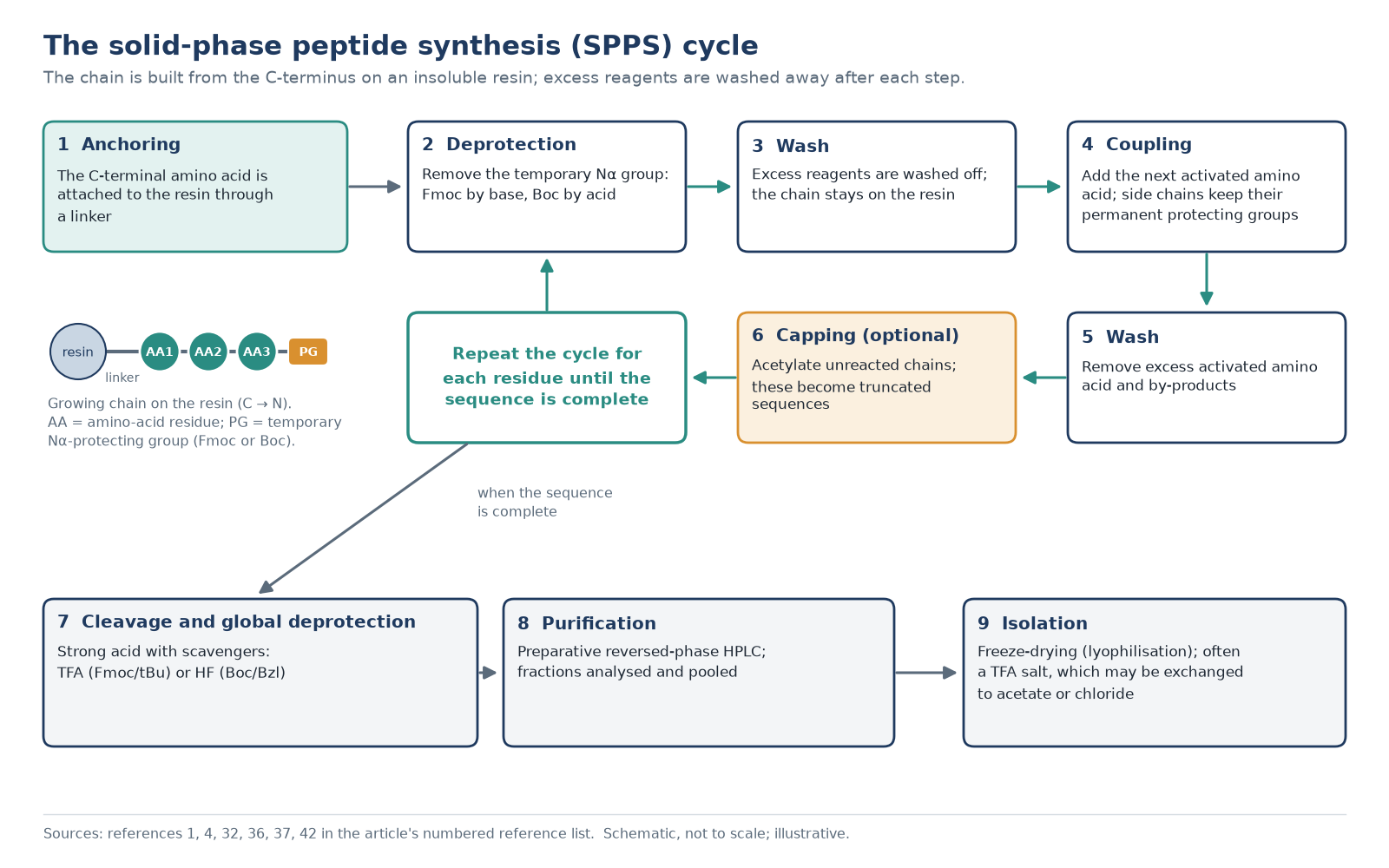
The EMA describes SPPS as building the peptide sequence on a solid support “by repeated cycles of deprotection, washing, coupling and capping steps” (EMA 2025). In outline:
- Anchoring the C-terminal amino acid to a resin through a linker.
- Deprotection of the temporary α-amino protecting group.
- Coupling of the next activated amino acid, with reactive side chains masked by “permanent” protecting groups (Isidro-Llobet et al. 2009).
- Capping (optional): acetylating unreacted chains, which gives truncated sequences (EMA 2025).
- Repetition until the sequence is complete.
- Cleavage and global deprotection, usually in strong acid with “scavengers”.
Two protection schemes dominate (Jaradat 2018; Chandrudu et al. 2013). In Boc/Bzl chemistry, the acid-labile tert-butyloxycarbonyl (Boc) group protects the α-amine. Benzyl-type groups protect side chains, and final cleavage needs a very strong acid, classically hydrogen fluoride. The EMA notes that residual fluoride should be tested where HF is used (EMA 2025). In Fmoc/tBu chemistry, the α-amine carries the base-labile 9-fluorenylmethoxycarbonyl (Fmoc) group, first reported by Carpino and Han in 1970 (Carpino & Han 1970). Side chains carry acid-labile tert-butyl-type groups, so the final cleavage can use trifluoroacetic acid (TFA). Behrendt and colleagues call Fmoc SPPS “the method of choice” for peptide synthesis and note its use to make therapeutic peptides at multiton scale (Behrendt et al. 2016).
Why chain length and sequence matter
No coupling step is perfectly efficient, so errors accumulate with chain length. Chandrudu and colleagues note that, in the original step-by-step method, “the purity of the final product decreased with the number of coupling steps” (Chandrudu et al. 2013). Some sequences are “difficult” because the growing chains aggregate on the resin. Coin and co-workers describe aggregation of the growing peptide chain as “the main cause of failure for peptide chemosynthesis”. They show how special building blocks, such as pseudoproline and depsipeptide units, can make otherwise inaccessible sequences possible (Coin et al. 2007). Their standard protocol produced the 41-residue corticotropin-releasing factor in about 80 working hours (Coin et al. 2007).
Liquid-phase, hybrid and ligation strategies
Liquid-phase peptide synthesis (LPPS) and hybrid strategies are used alongside SPPS. In hybrid strategies, protected fragments are made separately (often by SPPS) and then joined in solution (Kekessie et al. 2024). The EMA notes that combining SPPS with fragment condensation “may become more popular e.g. for large scale production” (EMA 2025). Fragment condensation has a known drawback. Chandrudu and colleagues note that it was popular in the 1980s, but that “the rate of racemization and reaction difficulties proved less than ideal” (Chandrudu et al. 2013).
Native chemical ligation (NCL) offers a different solution. Dawson, Muir, Clark-Lewis and Kent showed that two unprotected peptide segments, one carrying a C-terminal thioester and the other an N-terminal cysteine, react chemoselectively. They form a thioester-linked intermediate that rearranges spontaneously to a native peptide bond (Dawson et al. 1994). Kent later reviewed ligation-based total chemical synthesis of proteins (Kent 2009). A 2026 process-chemistry report on tirzepatide paired a hybrid SPPS/LPPS route with an NCL–desulfurisation route. It reported coupling of unprotected fragments in water “without epimerization” (Jalan et al. 2026).
After assembly: cleavage, purification, isolation and counter-ion exchange
Cleavage generates reactive carbocations from the protecting groups. Unless these are trapped by scavengers, they can alkylate nucleophilic residues; the EMA names tryptophan, tyrosine and methionine (EMA 2025). The crude peptide is a complex mixture, and preparative reversed-phase HPLC is the usual purification step. The EMA states plainly that “complete separation of the desired peptide and structurally related pre- and post-eluting impurities is not always achieved”. Fractions are therefore analysed, pooled against criteria and sometimes re-purified (EMA 2025).
The purified solution is usually freeze-dried. The EMA describes “lyophilisation of synthetic peptides” as “common practice” (EMA 2025). Because TFA is used both in cleavage and as an ion-pairing agent in HPLC, peptides with basic groups are often isolated as trifluoroacetate salts (Roux et al. 2008; Erckes et al. 2025). Where another salt form is wanted, the counter-ion is exchanged, typically to acetate or chloride. Roux and colleagues note that the classical approach, repeated freeze-drying from hydrochloric acid, means “working at pH < 1”, which “can induce peptide degradation”, and they compared alternatives (Roux et al. 2008). Practical handling of the final lyophilised solid is covered in lyophilised peptide handling practice.
The environmental cost of the chemistry
Isidro-Llobet and colleagues described peptide manufacture as relying “primarily [on] legacy technologies” with “large amounts of highly hazardous reagents and solvents” (Isidro-Llobet et al. 2019). Fourteen pharmaceutical companies pooled process data and estimated the average process mass intensity of SPPS at about 13,000, against a median of 168–308 for small molecules and about 8,300 for biopharmaceuticals (Kekessie et al. 2024). This establishes that the chemistry is resource-intensive, not anything about product quality.
Where do impurities in synthetic peptides come from?
Impurities in a synthetic peptide follow from the chemistry above, and the literature and regulators classify them in detail (D’Hondt et al. 2014; EMA 2025). Table 2 summarises the classes and how each is detected. Reading chromatograms is covered separately in how to interpret an HPLC chromatogram.
Impurities carried in from starting materials
The quality of the protected amino-acid building blocks sets a floor for the final product. The EMA lists impurities in amino-acid starting materials that can be carried into the peptide. The guideline lists “enantiomeric and diastereomeric impurities, (partially) unprotected amino acids, dipeptides and β-alanyl impurities”, and elsewhere gives incorrect amino acids (“e.g. Ile in Leu and vice versa”) as examples (EMA 2025). A D-amino-acid impurity in a building block becomes a diastereomeric peptide impurity. An isobaric substitution such as leucine for isoleucine gives a product with exactly the same mass as the target. Both are hard to detect, which is why starting materials are controlled as well as the final substance (EMA 2025; McCarthy et al. 2023).
Errors in chain assembly: deletion, truncation and insertion sequences
- Deletion sequences lack one or more residues. They come from incomplete coupling or incomplete Fmoc removal, which leaves the chain unable to react in that cycle so that it “skips” a residue (D’Hondt et al. 2014; EMA 2025).
- Truncated sequences stop short. Where capping is used, they are typically N-acetylated (EMA 2025).
- Insertion sequences carry an extra residue. They have been linked to the excess of activated amino acid used to drive coupling, for example where a protecting group is lost prematurely and a second residue couples (D’Hondt et al. 2014).
These species can elute very close to the target, so the EMA’s warning about incomplete separation applies directly (EMA 2025).
Stereochemical impurities: racemisation and epimerisation
Activating an amino acid’s carboxyl group can, through an oxazolone intermediate, invert its α-carbon, giving a peptide that is a diastereomer of the target. The EMA notes that urethane-type protecting groups such as Fmoc and Z resist this oxazolone-mediated epimerisation (EMA 2025), which is one reason stepwise urethane-protected coupling is preferred. D’Hondt and colleagues note that Fmoc deprotection can also cause racemisation (D’Hondt et al. 2014). Because a diastereomer has the same mass as the target, mass spectrometry alone cannot exclude it. The EMA states that “control of diastereomers may require the development of specific methods” (EMA 2025), and McCarthy and colleagues note that chiral or isobaric amino acids “may require additional techniques” (McCarthy et al. 2023).
Side reactions: aspartimide and related chemistry
Aspartimide formation is the best-studied sequence-dependent side reaction in Fmoc SPPS. Under the basic conditions used to remove Fmoc, the backbone nitrogen of the residue after an aspartic acid can attack the side-chain ester and form a five-membered succinimide ring (aspartimide). That ring can then reopen to give the normal α-linked peptide, an isomeric β-linked peptide, or epimerised products, and it can react with piperidine to form adducts. Mergler and colleagues quantified the problem in model peptides by RP-HPLC and showed that side-chain and backbone protection strategies can suppress it (Mergler et al. 2003). Samson and colleagues (2019) found that it can also end chain growth altogether: with an N-terminal Xaa-Asp-Yaa motif, the aspartimide intermediate led to piperazine-2,5-diones that terminate the chain, a structure confirmed by NMR (Samson et al. 2019). A 2025 review states that aspartimide formation “remains a persistent challenge” (Kong et al. 2025).
Other documented reactions include diketopiperazine (DKP) formation at the dipeptide stage, pyroglutamate formation from an N-terminal glutamine or glutamic acid, and β-elimination (D’Hondt et al. 2014; EMA 2025).
Impurities from cleavage and deprotection
If side-chain protecting groups are not fully removed, “peptide–protection adducts” remain (D’Hondt et al. 2014). If the carbocations released during cleavage are not trapped, they can alkylate tryptophan, tyrosine or methionine (EMA 2025).
Degradation after manufacture
A peptide that left the reactor correct can still change in storage or in solution. The EMA’s list of degradation pathways includes oxidation, hydrolysis, isomerisation, deamidation, aspartimide formation, DKP and pyroglutamate formation, β-elimination, dehydropeptide formation, disulfide exchange and acetylation (EMA 2025). The protein-pharmaceutical literature describes the same instabilities in solution and in the dried state (Manning et al. 2010). Peptides are also often “very hygroscopic” powders (EMA 2025).
Aggregation and high-molecular-weight (HMW) species are a further class. Zapadka and colleagues reviewed the intrinsic and external factors that influence peptide physical stability (Zapadka et al. 2017). The EMA treats HMW impurities as a specification parameter in their own right (EMA 2025). D’Hondt and colleagues also report dimeric-to-oligomeric impurities among peptide-related impurities (D’Hondt et al. 2014).
Non-peptide impurities and counter-ions
The EMA lists non-peptide impurities as “process reagents, by-products, residual solvents, elemental impurities and nitrosamines”, and the specification also covers counter-ion, residual TFA and water (EMA 2025).
Counter-ions deserve particular attention. For medicines, the EMA notes that “usually acetate is used as counter ion”, that trifluoroacetate or chloride are also possible, and that the counter-ion should be controlled with a justified limit (EMA 2025). Approved peptide drugs use a range of counter-ions (Sikora et al. 2020). In research settings, TFA is more than an accounting item. In an in vitro study, Cornish and colleagues found that trifluoroacetate at 10⁻⁸ to 10⁻⁷ M reduced cell numbers in osteoblast cultures. With the TFA salts of the peptides they tested, this led to “failure to detect a proliferative effect or wrongly attributing an antiproliferative effect”. They recommended converting peptides to the hydrochloride or another biologically equivalent salt before biological testing (Cornish et al. 1999). TFA also interferes with infrared characterisation (Roux et al. 2008). A 2025 study measured residual TFA by FT-IR, ¹⁹F-NMR and HPLC with evaporative light-scattering detection, and it stressed that counter-ion content should be quantified rather than assumed (Erckes et al. 2025). These are findings about laboratory measurement and experimental interpretation. They say nothing about effects in people.
Finally, D’Hondt and colleagues report contamination of peptide products with unrelated peptides, “pointing out the lack of appropriate GMP” (D’Hondt et al. 2014). This is a reminder that cross-contamination is a manufacturing-control issue as much as a chemistry issue.
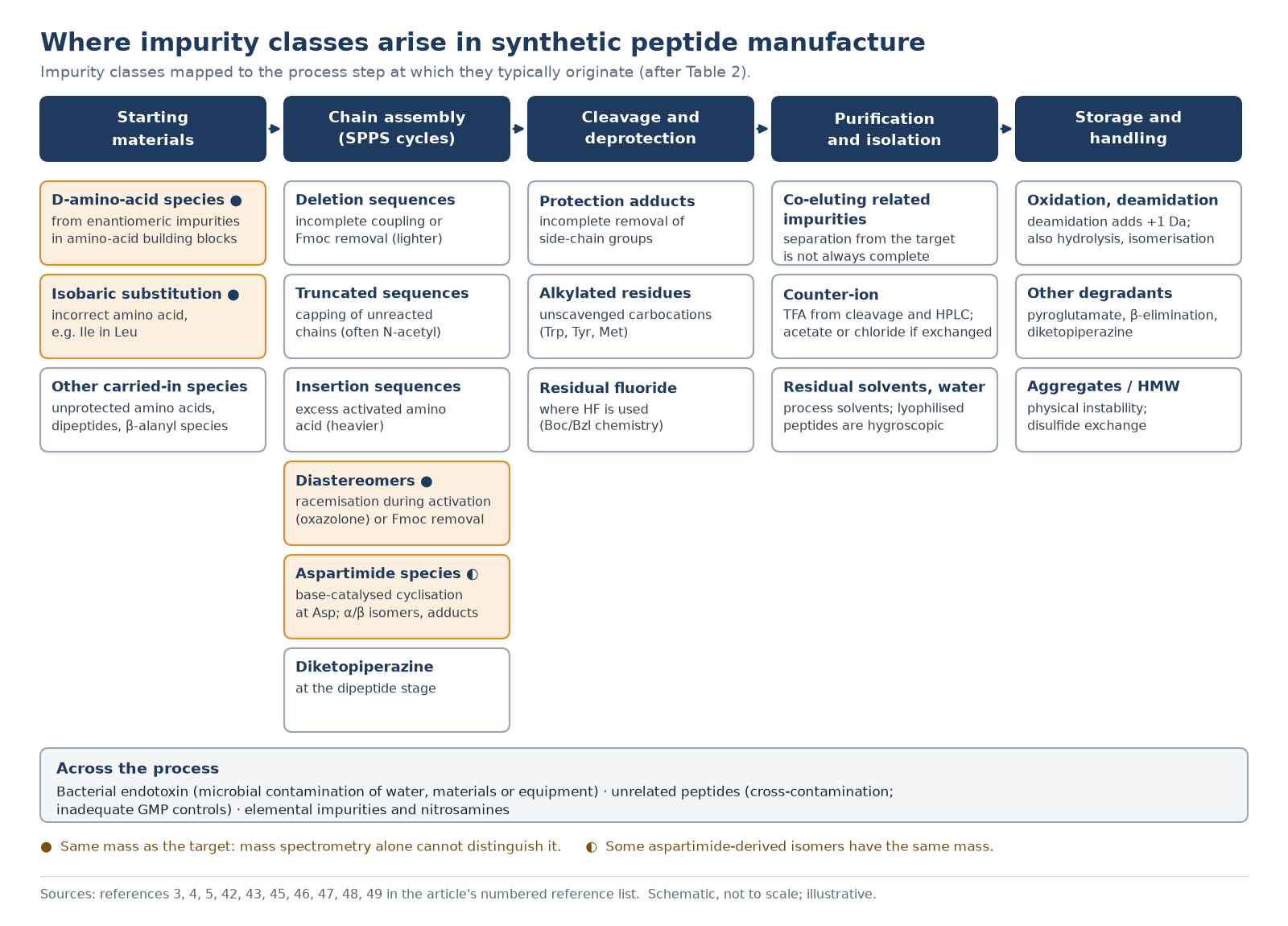
Table 2. Classes of peptide-related and process impurities, their origin and how they are typically detected
| Impurity class | Typical origin | Same mass as target? | Typical detection approach | Key sources |
|---|---|---|---|---|
| Deletion sequences | Incomplete coupling or Fmoc removal | No (lighter) | RP-HPLC resolution plus MS | (D’Hondt et al. 2014; EMA 2025) |
| Truncated (often N-acetyl) sequences | Capping of unreacted chains | No | RP-HPLC plus MS | (EMA 2025) |
| Insertion sequences | Excess activated amino acid; premature deprotection | No (heavier) | RP-HPLC plus MS | (D’Hondt et al. 2014) |
| Diastereomers (epimers, D-amino-acid species) | Activation or deprotection racemisation; starting-material enantiomers | Yes | Specific chromatographic methods; chiral amino-acid analysis after hydrolysis | (EMA 2025; McCarthy et al. 2023) |
| Isobaric substitutions (e.g. Leu/Ile) | Starting-material impurity | Yes | Chromatography; MS/MS sequencing; AAA | (EMA 2025; McCarthy et al. 2023) |
| Aspartimide-derived species (α/β isomers, adducts, piperazine-2,5-diones) | Base-catalysed cyclisation at Asp | Some isomers: yes | High-resolution RP-HPLC; MS; NMR for structure | (Mergler et al. 2003; Samson et al. 2019; Kong et al. 2025) |
| Protection adducts and alkylated residues | Incomplete deprotection; unscavenged carbocations (Trp, Tyr, Met) | No | MS; RP-HPLC | (D’Hondt et al. 2014; EMA 2025) |
| Degradants (oxidation, deamidation, DKP, pyroglutamate, β-elimination) | Storage, solution chemistry, process stress | Deamidation +1 Da; others vary | Stability-indicating RP-HPLC; MS | (D’Hondt et al. 2014; EMA 2025; Manning et al. 2010) |
| HMW species and aggregates | Physical instability; disulfide exchange | No | Size-based methods; specific HMW test | (Zapadka et al. 2017; EMA 2025) |
| Counter-ion (TFA, acetate, chloride) | Cleavage and HPLC conditions; salt exchange | n/a | Ion chromatography, ¹⁹F-NMR, FT-IR, HPLC-ELSD | (Roux et al. 2008; Erckes et al. 2025; EMA 2025) |
| Residual solvents, elemental impurities, nitrosamines | Reagents, process equipment | n/a | GC (solvents); elemental analysis; risk assessment | (EMA 2025) |
| Unrelated peptides (cross-contamination) | Inadequate GMP controls | No | LC-MS screening | (D’Hondt et al. 2014) |
| Bacterial endotoxin | Microbial contamination of water, materials or equipment | n/a | Specific endotoxin assay | (EMA 2025) |
How are identity, purity and content verified?
Three questions should be kept apart:
- Identity: is the main component the intended sequence, with the intended stereochemistry and modifications?
- Purity: what proportion of the peptide-related material is the target, and what are the other components?
- Content (assay): how much of the weighed powder is actually the target peptide, as opposed to water, counter-ion, salts and other non-peptide matter?
Analytical reversed-phase HPLC: what a “% purity” figure is
Chromatographic purity is usually reported as the target peak’s area as a percentage of total integrated UV peak area. That number is relative. It depends on the column, gradient, wavelength and integration, and it covers only what the method separates and detects. The EMA asks applicants to take into account “the risk of co-eluting impurities”. It says that where one method cannot separate all the peptide-related impurities, “additional independent method(s) may be needed” (EMA 2025). Its most pointed sentence is this: “When co-eluting impurities are observed as one peak the qualification threshold of 1.0% applies unless otherwise justified” (EMA 2025). A single “98%” or “99%” figure therefore does not show that nothing hides under the main peak, and it says nothing about non-UV-absorbing components. Our peptide purity guide for Australian laboratories explains how to read the HPLC and MS figures on a report. Synthetic peptides are themselves used as quantitative mass-spectrometry standards, a use reviewed in what are peptides used for in research.
Mass spectrometry: powerful for identity, blind to isomers
Mass spectrometry (MS), usually as LC-MS, confirms the expected molecular mass and helps identify impurities of different mass; tandem MS adds sequence information. But MS on its own does not tell apart species of identical mass, such as diastereomers, some aspartimide-derived isomers and leucine/isoleucine substitutions. Nor does it, by itself, quantify how much peptide is present (McCarthy et al. 2023; EMA 2025). For this reason the EMA recommends “at least two orthogonal methods” for identification as part of release testing. The combination must be suitable “to unambiguously confirm the sequence” (EMA 2025).
Orthogonal and structural methods
The EMA’s characterisation toolkit includes MS and LC-MS/MS; peptide mapping (Ph. Eur. 2.2.55); amino acid analysis (2.2.56); Edman degradation; NMR (2.2.64); chiral GC-MS for enantiomeric purity; ion chromatography for counter-ions, with a Ph. Eur. method for acetic acid in synthetic peptides (2.5.34); and circular dichroism and FT-IR for secondary structure (EMA 2025).
Identifying an unknown preparation can be laborious: two seized samples needed “a plethora of different analyses”, after which an official laboratory validated a dedicated LC-MS/MS screening method (Vanhee et al. 2020).
Content, assay and the “net peptide” problem
A lyophilised peptide is a salt, and usually a hygroscopic one (EMA 2025). Part of its weighed mass is counter-ion and water, so a vial weighed as “10 mg of powder” does not contain 10 mg of peptide free base. The EMA asks that assay by liquid chromatography be “expressed in terms of the counter-ion free, anhydrous substance, unless otherwise justified”. It lists elemental analysis, amino-acid analysis, nitrogen determination by Kjeldahl, and quantitative NMR as alternatives (EMA 2025).
Quantification is harder than it looks. In a multi-laboratory study coordinated by the United States Pharmacopeia (USP), Li and colleagues compared HPLC assay, quantitative ¹H-NMR and amino-acid analysis for the nonapeptide oxytocin (Li et al. 2019). USP normally determines peptide reference-standard content by HPLC assay against an external standard whose purity was set by mass balance (Li et al. 2019), and McCarthy and colleagues describe this two-step value assignment (McCarthy et al. 2023). An assay figure is only as good as the reference standard behind it.
A peer-reviewed study of products sold online found content above the labelled amount alongside very low purity in the same vials (detailed below) (Ashraf et al. 2024). Neither number alone describes the product.
Microbiological quality and endotoxin
Chemical purity says nothing about microbiological quality. The EMA’s specification framework lists bacterial endotoxins and microbiological purity as separate tests (EMA 2025). Absence of viable organisms and absence of endotoxin are different findings (Ashraf et al. 2024). Endotoxin reporting is discussed further in peptide endotoxin test reports explained.
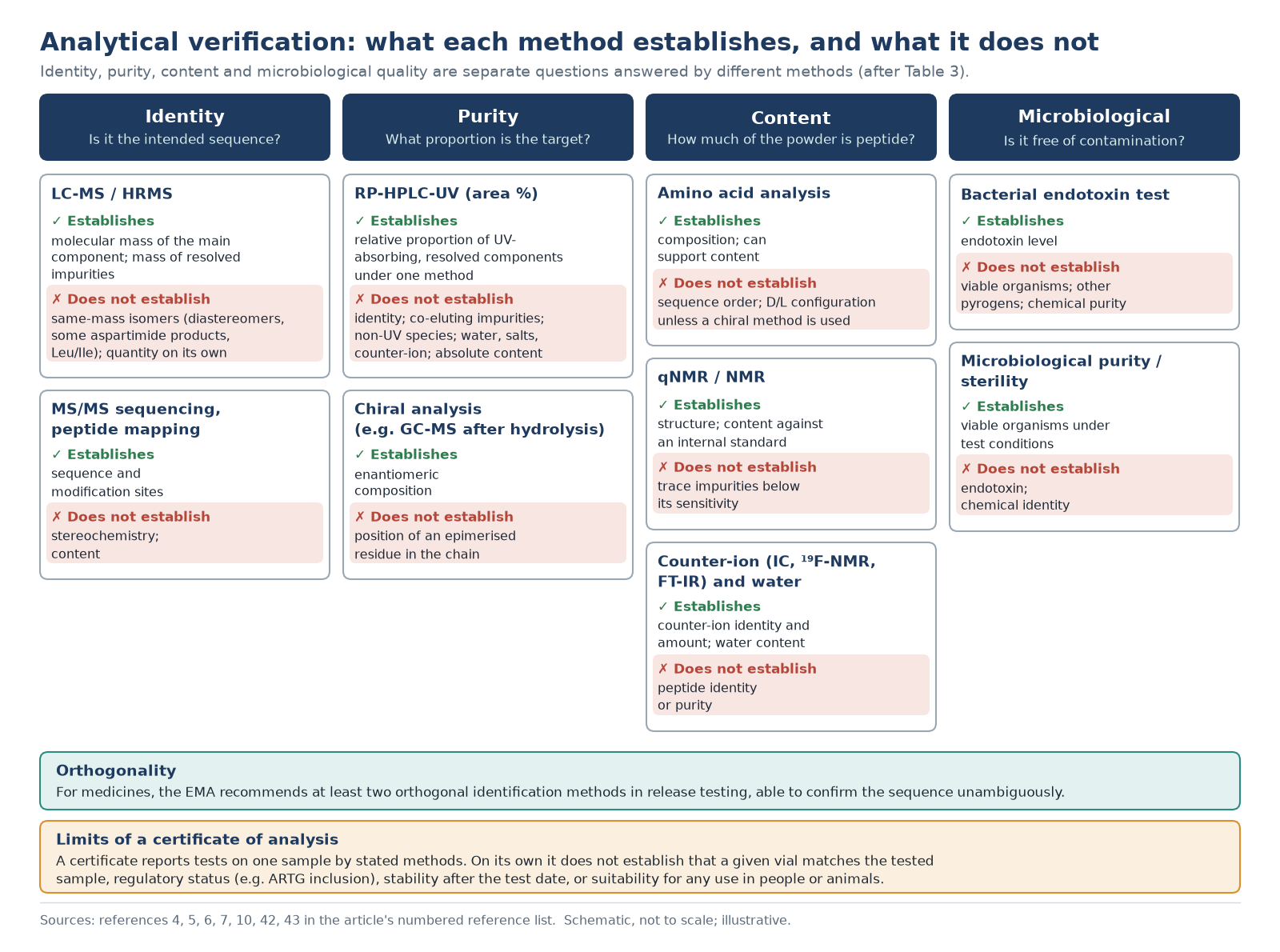
Table 3. What each analytical method establishes, and what it does not establish
| Method | Establishes | Does not establish | Sources |
|---|---|---|---|
| RP-HPLC-UV (area %) | Relative proportion of UV-absorbing, chromatographically resolved components under one method | Identity; co-eluting impurities; non-UV species; water, salts and counter-ion; absolute content | (EMA 2025) |
| LC-MS / HRMS | Molecular mass of main component; mass of resolved impurities | Same-mass isomers (diastereomers, some aspartimide products, Leu/Ile); quantity on its own | (EMA 2025; McCarthy et al. 2023) |
| MS/MS sequencing, peptide mapping | Sequence and modification sites | Stereochemistry; content | (EMA 2025) |
| Amino acid analysis | Composition; can support content | Sequence order; D/L configuration unless a chiral method is used | (EMA 2025; Li et al. 2019) |
| Chiral analysis (e.g. GC-MS after hydrolysis) | Enantiomeric composition | Position of an epimerised residue in the chain | (EMA 2025) |
| qNMR / NMR | Structure; content against an internal standard | Trace impurities below its sensitivity | (Li et al. 2019; EMA 2025) |
| Ion chromatography, ¹⁹F-NMR, FT-IR | Counter-ion identity and amount (TFA, acetate, chloride) | Peptide identity or purity | (Roux et al. 2008; Erckes et al. 2025; EMA 2025) |
| Water determination | Water content (hygroscopic solids) | Anything about the peptide itself | (EMA 2025) |
| Bacterial endotoxin test | Endotoxin level | Viable organisms; other pyrogens; chemical purity | (EMA 2025; Ashraf et al. 2024) |
| Microbiological purity / sterility | Viable organisms under test conditions | Endotoxin; chemical identity | (EMA 2025; Ashraf et al. 2024) |
What can a certificate of analysis establish, and what can it not?
A certificate of analysis (COA) summarises tests on one sample, at one time, by one laboratory, using stated methods. Practical checklists for reading one are covered elsewhere on this site in how to read a peptide certificate of analysis and checking COAs and peptide content. This section looks at the limits of the document type, using the standards discussed above. How certificates fit into wider supplier qualification is examined in peptides wholesale: supplier qualification, quality standards and regulation.
What a COA can establish, if the methods are stated and suitable:
- that the tested sample contained a main component of the expected mass;
- the chromatographic purity of that sample under the stated method;
- where reported, the measured content, counter-ion, water and endotoxin of that sample.
What a COA cannot establish on its own:
- That the material in a given vial is the material that was tested. A COA describes a sample. Traceability from the tested sample to a batch, and from the batch to a container, depends on manufacturing and quality systems that the document itself does not show. Medicines regulators therefore assess manufacture as well as release tests (EMA 2025; TGA 2024).
- The absence of co-eluting or same-mass impurities, unless orthogonal methods were used and reported (EMA 2025).
- Stereochemical integrity, unless a method able to detect diastereomers was used (EMA 2025; McCarthy et al. 2023).
- Content in the vial, if only area-% purity is given. Purity and content are distinct measurements (EMA 2025; Ashraf et al. 2024).
- Microbiological quality, if endotoxin and microbiological tests are not reported (EMA 2025).
- Stability after the test date. Degradation and aggregation continue in storage (EMA 2025; Zapadka et al. 2017).
- Regulatory status. A COA is not a marketing authorisation, a GMP certificate or an ARTG entry. In Australia, peptide products regulated as therapeutic goods must be on the ARTG before supply, whatever accompanying paperwork says (TGA n.d.).
- Suitability for any use in people or animals. No analytical certificate establishes that.
The TGA has observed that unapproved peptide products are often supplied “in poorly labelled or unmarked vials, making it difficult or impossible to verify their ingredients” (TGA 2026c). A COA cannot close that gap if the link between document and container is not demonstrable.
Which quality standards apply to synthetic peptide medicines?
This section describes standards for authorised medicines. It does not suggest that they apply to, or are met by, any research reagent.
European Pharmacopoeia thresholds, as quoted by the EMA
The EMA guideline states: “According to the Ph. Eur. general monograph ‘Substances for Pharmaceutical Use’, peptide-related impurities should be reported above 0.1%, identified above 0.5% and qualified above 1.0%” (EMA 2025). In short: list it above 0.1%, establish its structure above 0.5%, and justify its biological acceptability with data above 1.0%. The guideline also requires analytical methods able to meet “the Ph. Eur. reporting threshold of 0.1% for synthetic peptides” (EMA 2025). The thresholds are given here as quoted by the EMA; the monograph itself was not consulted.
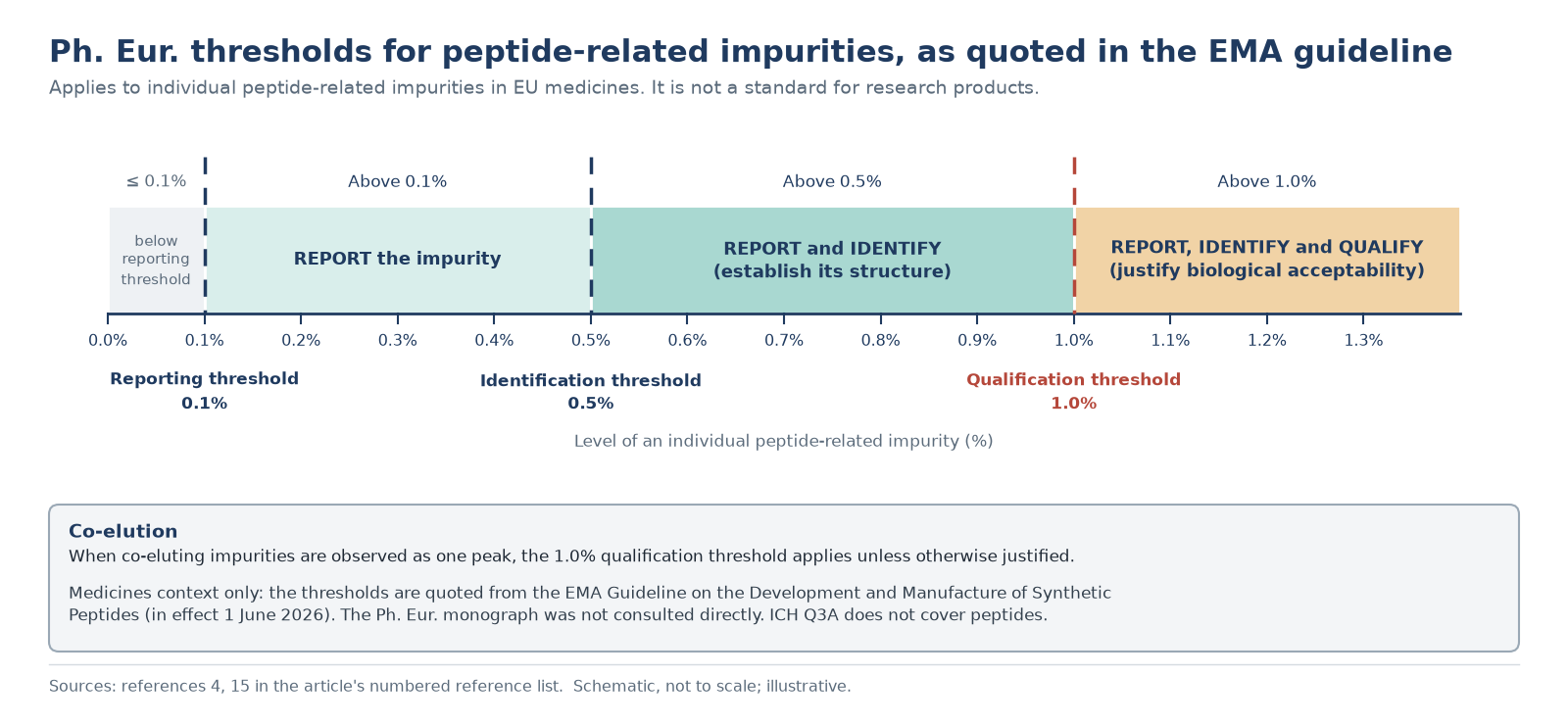
These thresholds concern individual impurities, and they show how far a single headline purity figure is from a medicines specification. A sample reported as “98% pure” could, in principle, contain a 2% unidentified impurity. Under the thresholds quoted above, a medicine would have to identify that impurity and justify it with qualification data. Specifications for approved medicines also vary by product and by pharmacopoeia. The label for one approved oxytocin injection states that it “may contain up to 16% of total impurities” (DailyMed: Pitocin 2026). Vergote and colleagues found that pharmacopoeial peptide specifications were “barely harmonized” between the European and United States pharmacopoeias, and not always consistent within one pharmacopoeia (Vergote et al. 2009). No single “purity percentage” is a universal standard.
Why ICH Q3A and Q6B do not cover synthetic peptides
For most small-molecule drugs, ICH Q3A(R2) sets impurity thresholds linked to daily intake. Peptides are explicitly outside its scope (ICH 2006). ICH Q6B covers biotechnological products made in cell-culture systems and expressly excludes “synthetic peptides and polypeptides” (ICH 1999). This is the gap that peptide-specific pharmacopoeial text and the EMA guideline fill (EMA 2025). A 2026 review by Yang and colleagues surveys regulatory and analytical considerations for the quality assessment of peptide drugs (Yang et al. 2026).
The EMA Guideline on the Development and Manufacture of Synthetic Peptides
The EMA guideline (EMA/CHMP/CVMP/QWP/367182/2025) was adopted by the Committee for Medicinal Products for Human Use on 1 December 2025 and by the veterinary committee on 4 December 2025. It came into effect on 1 June 2026 (EMA 2025). It covers synthetic peptides in EU medicines, not recombinant products. Beyond the manufacturing, impurity, specification, co-elution and orthogonality points already cited, it addresses synthetic copies of recombinant reference products, noting that “immunogenicity of peptides is of lesser concern than that of proteins due to their size” (EMA 2025).
This is a European guideline. Its quotation here does not mean that it has been adopted in Australia.
USP general chapters
The USP has general chapters on synthetic peptides. Chapter 〈1503〉 is titled “Quality Attributes of Synthetic Peptide Drug Substances” (USP n.d.). Its public preview notes that early synthetic peptide development was held back by production cost, short half-lives, “the lack of sensitive and discriminating analytical methods for intermediates” and complex solution-phase manufacture (USP n.d.). The full chapter is behind a subscription paywall, and its detailed content has not been verified for this article.
United States: revised draft guidance for generic peptides (July 2026)
On 28 July 2026 the FDA published 17 revised draft product-specific guidances (PSGs) for generic peptide products. They give updated recommendations in five areas: submission of “recombinantly, synthetically, or semi-synthetically produced peptides” as abbreviated applications, innate immune response testing, impurity thresholds, higher-order structure and biological activity (FDA 2026a). At the same time, the FDA withdrew its May 2021 guidance on abbreviated applications for highly purified synthetic peptides that refer to listed drugs of rDNA origin (FDA 2026b). The Federal Register notice says the guidance “no longer reflects FDA’s current scientific thinking” and that the FDA plans to revise and reissue it (Federal Register 2026). Numerical thresholds from the withdrawn 2021 guidance are therefore not presented in this article as current FDA policy.
Table 4. Selected standards and guidelines relevant to synthetic peptide medicines
| Body / document | Status or date | Scope note | Source |
|---|---|---|---|
| Ph. Eur. general monograph 2034 “Substances for Pharmaceutical Use” | Current pharmacopoeia (subscription) | Peptide-related impurities: report > 0.1%, identify > 0.5%, qualify > 1.0% (as quoted by EMA) | (EMA 2025) |
| EMA/CHMP/CVMP/QWP/367182/2025 | Adopted Dec 2025; in effect 1 June 2026 | Development and manufacture of synthetic peptides in EU medicines; excludes recombinant products | (EMA 2025) |
| ICH Q3A(R2) | Step 4, 25 Oct 2006 | Small-molecule impurities; peptides not covered | (ICH 2006) |
| ICH Q6B | Step 4, 10 Mar 1999 | Biotechnological products; synthetic peptides not covered | (ICH 1999) |
| USP 〈1503〉 | Informational general chapter (subscription) | Quality attributes of synthetic peptide drug substances; detail not verified here | (USP n.d.) |
| FDA revised draft PSGs | 28 July 2026 | 17 generic peptide products; impurity thresholds, immunogenicity, structure, activity | (FDA 2026a) |
| FDA 2021 synthetic-peptide ANDA guidance | Withdrawn 28 July 2026 | No longer current FDA thinking | (FDA 2026b; Federal Register 2026) |
| TGA default standards (BP, Ph. Eur., USP–NF) | Since 1 July 2009 | Standards that medicines must meet in Australia | (TGA 2022; TGA 2024) |
How do approved peptide medicines in Australia differ from unapproved products?
ARTG inclusion
The TGA states that “peptide products that are regulated as therapeutic goods must be included in the Australian Register of Therapeutic Goods (ARTG) before they can be imported, manufactured, supplied, exported or advertised”, subject to limited exceptions (TGA n.d.). Approved peptide-based medicines named by the TGA include insulin and its analogues, GLP-1 receptor agonists such as semaglutide, oxytocin, vasopressin analogues such as desmopressin, and somatostatin analogues such as octreotide (TGA n.d.). Products not in the ARTG have not been assessed by the TGA (TGA n.d.; TGA 2026b).
Whether a peptide product is regulated as a therapeutic good depends on “what it contains, how it is promoted and what it is intended to do” (TGA 2026a). Some may instead be regulated as cosmetics (TGA 2026a).
Default standards, and why a monograph is not enough
Since 1 July 2009 the Therapeutic Goods Act 1989 has used “default standards”, meaning the British Pharmacopoeia, the European Pharmacopoeia and the United States Pharmacopeia–National Formulary (TGA 2022; Therapeutic Goods Act 1989). Meeting them “is not necessarily sufficient to demonstrate quality, safety and efficacy” for registration (TGA 2024). It defines quality as covering “composition, strength, potency, stability, sterility, purity, bioburden, design, construction and performance characteristics” (TGA 2024). Purity is one attribute among many.
What “research use only” does and does not mean
The TGA is explicit: “Disclaimers that a product is for ‘research use only’ or ‘not for human use’ do not change whether a product is regulated as a therapeutic good. These claims do not remove advertising, manufacture, import, export or supply obligations” (TGA n.d.). A label is not a regulatory classification, and this article offers no view on the status of any product.
The TGA also states that Australian manufacturers of therapeutic goods “generally need a manufacturing licence”, unless an exemption applies (TGA n.d.). Its April 2026 alert describes the limited circumstances in which a compounded good is exempt from ARTG inclusion (TGA 2026b).
Scheduling is substance-specific
The current instrument, the Therapeutic Goods (Poisons Standard—October 2026) Instrument 2026 (F2026L01327), is listed on the Federal Register of Legislation as registered and effective on 30 September 2026 (Poisons Standard October 2026). This review does not discuss individual scheduled peptides.
The TGA’s stated concerns about unapproved peptide products
In June 2026 the TGA “expanded its priority focus areas to include unapproved peptide products” (TGA 2026d). It said it “does not have oversight of the composition of ingredients, manufacturing standards, or the safety and efficacy” of such products (TGA 2026c). It noted that unknowns include “how they are manufactured, whether they are sterile… and what substances these products actually contain”, and that product labelling “may be inaccurate or misleading” (TGA 2026b). The TGA’s topic page says that, for unapproved peptide products, “there is no assurance they are safe, effective, correctly labelled, sterile or made to appropriate quality standards” (TGA 2026a).
Table 5. Approved peptide medicines in Australia compared with unapproved peptide products, as described by the TGA
| Attribute | Approved peptide medicine (ARTG-included) | Unapproved peptide product | Sources |
|---|---|---|---|
| Regulatory assessment | Assessed by the TGA before ARTG inclusion | Not assessed by the TGA | (TGA n.d.; TGA 2026b) |
| Applicable standards | Default standards (BP, Ph. Eur., USP–NF) or ministerial standards, plus evaluation of quality beyond the standards | No assurance it is “made to appropriate quality standards” | (TGA 2024; TGA 2026a) |
| Manufacture | Manufacturing licence generally required in Australia | Manufacturing conditions unknown to the regulator | (TGA n.d.; TGA 2026c) |
| Labelling | Assessed product information | Labelling “may be inaccurate or misleading”; vials may be “poorly labelled or unmarked” | (TGA 2026b; TGA 2026c) |
| Sterility (injectables) | Part of the assessed quality case | Unknown whether sterile | (TGA 2024; TGA 2026b) |
| Effect of “research use only” wording | n/a | Does not change regulatory status or remove obligations | (TGA n.d.) |
What does independent testing of products sold outside regulated supply show?
The evidence base here is small and of mixed type. It is summarised neutrally, with each study’s design stated.
Peer-reviewed test purchases (Ashraf et al. 2024). The researchers completed test purchases from six online sellers offering semaglutide without a prescription. Three vials were delivered; none of the three ordered pens arrived (Ashraf et al. 2024). All delivered vials failed more than half (59–63%) of the visual-inspection criteria. Measured content exceeded the label by 28.56–38.69%, while measured purity was 7.7–14.37% against a claimed 99%. No viable microorganisms were found, but endotoxin was present in every sample (Ashraf et al. 2024). With three samples, it establishes that discrepancies occurred, not how often.
A large preprint analysis (Mendias & Awan 2026, preprint, not peer reviewed). This analysis used “a large, publicly available independent testing dataset” of 6,441 samples across fourteen compounds marketed to consumers as research peptides. Applying two quality-acceptance frameworks, it reported that “41.6% to 71.1% of samples failed to meet basic quality criteria”, and that “measurable endotoxin contamination was present in 15% of samples” (Mendias & Awan 2026, preprint). The authors also note that consumer-directed third-party testing “captures only a small fraction” of the profile relevant to people using these preparations (Mendias & Awan 2026, preprint). As unreviewed work on a dataset of submitted samples, its figures are provisional and may not be representative.
Taken together, these studies establish that labelled identity, labelled content and claimed purity cannot be assumed for products outside regulated supply chains. They do not establish the quality of any particular supplier’s product, either positively or negatively. This article makes no claim about the products of Eternal Peptides Wholesale.
Limitations of this review
- Narrative, not systematic. Sources were selected for relevance and verifiability, not by a registered search protocol, so selection bias is possible.
- Secondary access to some standards. The Ph. Eur. thresholds are reported as quoted in the EMA guideline. The monograph text was not consulted directly. USP 〈1503〉 was available only as a public preview. The EDQM technical guide on synthetic peptide monographs could not be retrieved, so it is not relied on.
- Abstract-level reading for some papers. Several journal articles were verified at the level of their indexed bibliographic record and abstract. Statements attributed to them are limited to what those records support.
- Rapidly moving regulation. The FDA’s July 2026 guidance is in draft, and Australian enforcement statements were issued during 2026. Regulatory positions may change after the access date given in the references.
- Medicines standards are a reference point. Describing EMA, Ph. Eur. and TGA standards does not imply that any research reagent meets them or must.
- Market-testing evidence is limited. One peer-reviewed study had three samples. The large dataset is a preprint and may not be representative.
- No product evaluation. This review does not assess any product, supplier or laboratory, including those of the publisher.
- No claims about use. Nothing here establishes the suitability, effect or risk of any peptide for use in people or animals.
Synthetic peptides and Eternal Peptides Wholesale: relevance of this review
Eternal Peptides Wholesale distributes research peptides in wholesale boxes of 10 vials, for laboratory research use only and not for human consumption, as set out on the About Eternal Peptides Wholesale page. The verification questions in this review are therefore practical ones for the site. Its certificate of analysis library transcribes and links 78 report images from Janoshik Analytical, an independent laboratory, for 24 products, giving the batch, task number, tests requested and the result as printed.
In line with the sections above, purity and vial content, sterility screening (TAMC/TYMC), endotoxin and heavy metals are listed there as separate analyses, and each report applies only to the batch printed on it. The site’s guide to reading a Janoshik report also states that mass-spectrometry testing is not part of the programme it describes, which is the identity question discussed under verification methods; its testing standards page explains the four testing areas. As stated earlier, this article makes no claim about any product: a laboratory report records the stated tests on a submitted sample and does not establish regulatory approval, clinical suitability or safety for human use.
Glossary
Aspartimide. A five-membered succinimide ring formed when the backbone nitrogen following an aspartic-acid residue attacks its side chain. It can reopen to give isomeric peptides and adducts.
Assay (content). The amount of the target peptide in a sample, often expressed on a counter-ion-free, anhydrous basis. It is distinct from purity.
Co-elution. Two or more components leaving a chromatographic column together and appearing as one peak.
Counter-ion. The ion (e.g. acetate, chloride, trifluoroacetate) that balances the charge on an ionised peptide in its salt form.
Deletion / insertion / truncated sequence. Peptide impurities that respectively lack a residue, contain an extra residue, or stop short of full length.
Diastereomer (epimer). A stereoisomer that differs at one or more, but not all, stereocentres, for example where one L-amino acid is replaced by its D-form. It has the same mass as the target.
Endotoxin. Lipopolysaccharide from the outer membrane of Gram-negative bacteria. It is measured by a specific test, separate from chemical purity and from tests for viable organisms.
Fmoc / Boc. Temporary α-amino protecting groups; Fmoc is removed by base, Boc by acid.
HMW impurities. High-molecular-weight species such as dimers, oligomers and aggregates.
Native chemical ligation. Joining two unprotected peptide fragments, a C-terminal thioester and an N-terminal cysteine, to form a native peptide bond.
Orthogonal methods. Analytical methods based on different physical or chemical principles, used together so that one can detect what another may miss.
Qualification threshold. The impurity level above which data on biological acceptability are required. For peptide-related impurities in medicines, 1.0% (Ph. Eur., as quoted by EMA).
SPPS. Solid-phase peptide synthesis: stepwise assembly of a peptide on an insoluble resin support.
ARTG. The Australian Register of Therapeutic Goods, the register on which therapeutic goods must generally be included before supply in Australia.
Frequently asked questions
How are synthetic peptides different from natural peptides?
A synthetic peptide is assembled chemically, usually by solid-phase synthesis, whereas a natural peptide is produced by living organisms. The sequence can be identical, but the manufacturing route differs, and so does the impurity profile. Many approved peptide medicines, including exenatide and leuprolide, are described in their official labels as synthetic.
What does a “98% purity” figure on a peptide mean?
It usually means the target peak made up 98% of the integrated UV peak area under one HPLC method. It is a relative figure. It does not show identity, content, counter-ion, water or endotoxin, and co-eluting impurities may sit under the main peak. It is not a universal pharmacopoeial standard.
What is the difference between peptide purity and peptide content?
Purity describes the proportion of peptide-related material that is the target sequence. Content describes how much of the weighed powder is actually the target peptide, after allowing for water, counter-ions and salts. One published study found content above the label alongside very low measured purity in the same samples.
Why are synthetic peptides often supplied as TFA salts?
Trifluoroacetic acid is used to cleave peptides from the resin in Fmoc synthesis and as an ion-pairing agent in HPLC purification, so basic peptides are often isolated as trifluoroacetate salts. In vitro studies show residual TFA can interfere with cell-culture measurements, so counter-ion exchange and quantification are widely discussed.
Why is endotoxin tested separately from chromatographic purity?
Endotoxin is a bacterial lipopolysaccharide that chromatographic purity methods do not measure. The EMA lists bacterial endotoxins and microbiological purity as separate specification tests. One published study found no viable organisms in lyophilised samples but detected endotoxin in all of them, showing that the two findings are distinct.
Does a certificate of analysis show that a peptide is suitable for people?
No. A certificate summarises tests on one sample using stated methods. It does not establish that a given vial matches the tested sample, that same-mass impurities are absent, or that the product has regulatory approval. No analytical certificate establishes suitability for use in people or animals.
How does a research-grade peptide differ from a TGA-approved peptide medicine?
An approved medicine is included in the ARTG after TGA assessment and must meet applicable default standards and other quality requirements. An unapproved product has not been assessed by the TGA. The TGA states that “research use only” disclaimers do not change whether a product is regulated as a therapeutic good.
Which impurity thresholds apply to synthetic peptide medicines?
For EU medicines, the EMA guideline quotes Ph. Eur. thresholds: peptide-related impurities are reported above 0.1%, identified above 0.5% and qualified above 1.0%. Co-eluting peaks fall under the 1.0% qualification threshold unless justified. ICH Q3A does not cover peptides. These are medicine standards, not research-reagent requirements.
References
- Merrifield RB. Solid phase peptide synthesis. I. The synthesis of a tetrapeptide. J Am Chem Soc. 1963;85(14):2149–2154. doi:10.1021/ja00897a025 Available at: https://doi.org/10.1021/ja00897a025. Accessed 25 October 2026.
- Behrendt R, White P, Offer J. Advances in Fmoc solid-phase peptide synthesis. J Pept Sci. 2016;22(1):4–27. doi:10.1002/psc.2836. PMID 26785684; PMCID PMC4745034 Available at: https://doi.org/10.1002/psc.2836. Accessed 25 October 2026.
- D’Hondt M, Bracke N, Taevernier L, et al. Related impurities in peptide medicines. J Pharm Biomed Anal. 2014;101:2–30. doi:10.1016/j.jpba.2014.06.012. PMID 25044089 Available at: https://doi.org/10.1016/j.jpba.2014.06.012. Accessed 25 October 2026.
- European Medicines Agency. Guideline on the Development and Manufacture of Synthetic Peptides. EMA/CHMP/CVMP/QWP/367182/2025. Adopted CHMP 1 December 2025, CVMP 4 December 2025; date of coming into effect 1 June 2026. Available at: https://www.ema.europa.eu/en/documents/scientific-guideline/guideline-development-manufacture-synthetic-peptides_en.pdf. Accessed 25 October 2026.
- McCarthy D, Han Y, Carrick K, et al. Reference standards to support quality of synthetic peptide therapeutics. Pharm Res. 2023;40(6):1317–1328. doi:10.1007/s11095-023-03493-1. PMID 36949371; PMCID PMC10338602 Available at: https://doi.org/10.1007/s11095-023-03493-1. Accessed 25 October 2026.
- Therapeutic Goods Administration. How we regulate therapeutic peptide products. (No page date displayed.) Available at: https://www.tga.gov.au/products/medicines/monitoring-and-compliance/how-we-regulate-therapeutic-peptide-products. Accessed 25 October 2026.
- Ashraf AR, Mackey TK, Vida RG, et al. Multifactor quality and safety analysis of semaglutide products sold by online sellers without a prescription: market surveillance, content analysis, and product purchase evaluation study. J Med Internet Res. 2024;26:e65440. doi:10.2196/65440. PMID 39509151; PMCID PMC11582493 Available at: https://doi.org/10.2196/65440. Accessed 25 October 2026.
- Mendias CL, Awan TM. Evaluation of research grade peptides marketed directly to consumers reveals extensive variability in purity and measured abundance. Preprints.org, 24 April 2026. PREPRINT — NOT PEER REVIEWED. doi:10.20944/preprints202604.1748.v1 (Europe PMC PPR1182497) Available at: https://doi.org/10.20944/preprints202604.1748.v1. Accessed 25 October 2026.
- Kekessie I, Wegner K, Martinez I, et al. Process mass intensity (PMI): a holistic analysis of current peptide manufacturing processes informs sustainability in peptide synthesis. J Org Chem. 2024;89(7):4261–4282. doi:10.1021/acs.joc.3c01494. PMID 38508870 Available at: https://doi.org/10.1021/acs.joc.3c01494. Accessed 25 October 2026.
- Li C, Bhavaraju S, Thibeault MP, et al. Survey of peptide quantification methods and comparison of their reproducibility: a case study using oxytocin. J Pharm Biomed Anal. 2019;166:105–112. doi:10.1016/j.jpba.2018.12.028. PMID 30640042; PMCID PMC6507411 Available at: https://doi.org/10.1016/j.jpba.2018.12.028. Accessed 25 October 2026.
- National Human Genome Research Institute. Peptide. Talking Glossary of Genomic and Genetic Terms. Updated 25 October 2026. Available at: https://www.genome.gov/genetics-glossary/Peptide. Accessed 25 October 2026.
- US Code of Federal Regulations. 21 CFR 600.3(h)(6) — Definitions (protein). eCFR. Available at: https://www.ecfr.gov/current/title-21/chapter-I/subchapter-F/part-600/subpart-A/section-600.3. Accessed 25 October 2026.
- Therapeutic Goods Administration. Peptide products (explore topic). Last updated 23 September 2026. Available at: https://www.tga.gov.au/resources/explore-topic/peptide-products. Accessed 25 October 2026.
- healthdirect Australia. Peptides and your health in Australia: facts versus hype. Blog post, 20 October 2026. Available at: https://www.healthdirect.gov.au/blog/peptides-and-your-health-in-australia-facts-versus-hype. Accessed 25 October 2026.
- International Council for Harmonisation. ICH Q3A(R2): Impurities in New Drug Substances. Step 4, 25 October 2006. Available at: https://database.ich.org/sites/default/files/Q3A%28R2%29%20Guideline.pdf. Accessed 25 October 2026.
- International Council for Harmonisation. ICH Q6B: Specifications: Test Procedures and Acceptance Criteria for Biotechnological/Biological Products. Step 4, 10 March 1999. Available at: https://database.ich.org/sites/default/files/Q6B%20Guideline.pdf. Accessed 25 October 2026.
- Lau JL, Dunn MK. Therapeutic peptides: historical perspectives, current development trends, and future directions. Bioorg Med Chem. 2018;26(10):2700–2707. doi:10.1016/j.bmc.2017.06.052. PMID 28720325 Available at: https://doi.org/10.1016/j.bmc.2017.06.052. Accessed 25 October 2026.
- Muttenthaler M, King GF, Adams DJ, Alewood PF. Trends in peptide drug discovery. Nat Rev Drug Discov. 2021;20(4):309–325. doi:10.1038/s41573-020-00135-8. PMID 33536635 Available at: https://doi.org/10.1038/s41573-020-00135-8. Accessed 25 October 2026.
- Henninot A, Collins JC, Nuss JM. The current state of peptide drug discovery: back to the future? J Med Chem. 2018;61(4):1382–1414. doi:10.1021/acs.jmedchem.7b00318. PMID 28737935 Available at: https://doi.org/10.1021/acs.jmedchem.7b00318. Accessed 25 October 2026.
- Fosgerau K, Hoffmann T. Peptide therapeutics: current status and future directions. Drug Discov Today. 2015;20(1):122–128. doi:10.1016/j.drudis.2014.10.003. PMID 25450771 Available at: https://doi.org/10.1016/j.drudis.2014.10.003. Accessed 25 October 2026.
- Wang L, Wang N, Zhang W, et al. Therapeutic peptides: current applications and future directions. Signal Transduct Target Ther. 2022;7(1):48. doi:10.1038/s41392-022-00904-4. PMID 35165272; PMCID PMC8844085 Available at: https://doi.org/10.1038/s41392-022-00904-4. Accessed 25 October 2026.
- US National Library of Medicine. DailyMed: BYETTA (exenatide) injection — prescribing information, section 11 Description. Set ID 53d03c03-ebf7-418d-88a8-533eabd2ee4f; version effective 2 September 2025. Available at: https://dailymed.nlm.nih.gov/dailymed/drugInfo.cfm?setid=53d03c03-ebf7-418d-88a8-533eabd2ee4f. Accessed 25 October 2026.
- US National Library of Medicine. DailyMed: leuprolide acetate (Lupron Depot) — prescribing information, section 11 Description. Set ID cbc8f94e-7330-4465-05ad-16d64493a5dd; version effective 15 March 2026. Available at: https://dailymed.nlm.nih.gov/dailymed/drugInfo.cfm?setid=cbc8f94e-7330-4465-05ad-16d64493a5dd. Accessed 25 October 2026.
- US National Library of Medicine. DailyMed: DDAVP Tablets (desmopressin acetate) — Description. Set ID 6d55baa9-2b62-469c-93ae-3909ab249332; version effective 3 February 2021. Available at: https://dailymed.nlm.nih.gov/dailymed/drugInfo.cfm?setid=6d55baa9-2b62-469c-93ae-3909ab249332. Accessed 25 October 2026.
- US National Library of Medicine. DailyMed: Pitocin (oxytocin injection, USP) — Description. Set ID 6e5a66fc-e507-497c-b5ce-44a8c95898ad; version effective 5 May 2026. Available at: https://dailymed.nlm.nih.gov/dailymed/drugInfo.cfm?setid=6e5a66fc-e507-497c-b5ce-44a8c95898ad. Accessed 25 October 2026.
- Bray BL. Large-scale manufacture of peptide therapeutics by chemical synthesis. Nat Rev Drug Discov. 2003;2(7):587–593. doi:10.1038/nrd1133. PMID 12815383 Available at: https://doi.org/10.1038/nrd1133. Accessed 25 October 2026.
- Goeddel DV, Kleid DG, Bolivar F, et al. Expression in Escherichia coli of chemically synthesized genes for human insulin. Proc Natl Acad Sci USA. 1979;76(1):106–110. doi:10.1073/pnas.76.1.106. PMID 85300 Available at: https://doi.org/10.1073/pnas.76.1.106. Accessed 25 October 2026.
- US National Library of Medicine. DailyMed: FORTEO (teriparatide) injection — prescribing information, section 11 Description. Set ID aae667c5-381f-4f92-93df-2ed6158d07b0; version effective 3 August 2026. Available at: https://dailymed.nlm.nih.gov/dailymed/drugInfo.cfm?setid=aae667c5-381f-4f92-93df-2ed6158d07b0. Accessed 25 October 2026.
- US Food and Drug Administration. FDA publishes revised draft product-specific guidances for certain generic peptide products. Drug Alerts and Statements, 28 July 2026. Available at: https://www.fda.gov/drugs/drug-alerts-and-statements/fda-publishes-revised-draft-product-specific-guidances-certain-generic-peptide-products. Accessed 25 October 2026.
- US National Library of Medicine. DailyMed: RYBELSUS / OZEMPIC tablets (semaglutide) — prescribing information, section 11 Description. Set ID 27f15fac-7d98-4114-a2ec-92494a91da98; version effective 30 January 2026. Available at: https://dailymed.nlm.nih.gov/dailymed/drugInfo.cfm?setid=27f15fac-7d98-4114-a2ec-92494a91da98. Accessed 25 October 2026.
- Jalan A, Murzinski ES, Jansen PJ, et al. A convergent hybrid gram-scale synthesis of tirzepatide: tangential flow filtration assisted native chemical ligation–desulfurization approach. Angew Chem Int Ed. 2026;65:e202520060. doi:10.1002/anie.202520060. PMID 41437654 Available at: https://doi.org/10.1002/anie.202520060. Accessed 25 October 2026.
- Jaradat DMM. Thirteen decades of peptide synthesis: key developments in solid phase peptide synthesis and amide bond formation utilized in peptide ligation. Amino Acids. 2018;50(1):39–68. doi:10.1007/s00726-017-2516-0. PMID 29185032 Available at: https://doi.org/10.1007/s00726-017-2516-0. Accessed 25 October 2026.
- Nobel Prize Outreach. The Nobel Prize in Chemistry 1955 — summary. Available at: https://www.nobelprize.org/prizes/chemistry/1955/summary/. Accessed 25 October 2026.
- Nobel Prize Outreach. The Nobel Prize in Chemistry 1984 — summary. Available at: https://www.nobelprize.org/prizes/chemistry/1984/summary/. Accessed 25 October 2026.
- Merrifield B. Solid phase synthesis. Science. 1986;232(4748):341–347. doi:10.1126/science.3961484. PMID 3961484 Available at: https://doi.org/10.1126/science.3961484. Accessed 25 October 2026.
- Isidro-Llobet A, Álvarez M, Albericio F. Amino acid-protecting groups. Chem Rev. 2009;109(6):2455–2504. doi:10.1021/cr800323s. PMID 19364121 Available at: https://doi.org/10.1021/cr800323s. Accessed 25 October 2026.
- Chandrudu S, Simerska P, Toth I. Chemical methods for peptide and protein production. Molecules. 2013;18(4):4373–4388. doi:10.3390/molecules18044373. PMID 23584057; PMCID PMC6270108 Available at: https://doi.org/10.3390/molecules18044373. Accessed 25 October 2026.
- Carpino LA, Han GY. 9-Fluorenylmethoxycarbonyl function, a new base-sensitive amino-protecting group. J Am Chem Soc. 1970;92(19):5748–5749. doi:10.1021/ja00722a043 Available at: https://doi.org/10.1021/ja00722a043. Accessed 25 October 2026.
- Coin I, Beyermann M, Bienert M. Solid-phase peptide synthesis: from standard procedures to the synthesis of difficult sequences. Nat Protoc. 2007;2(12):3247–3256. doi:10.1038/nprot.2007.454. PMID 18079725 Available at: https://doi.org/10.1038/nprot.2007.454. Accessed 25 October 2026.
- Dawson PE, Muir TW, Clark-Lewis I, Kent SB. Synthesis of proteins by native chemical ligation. Science. 1994;266(5186):776–779. doi:10.1126/science.7973629. PMID 7973629 Available at: https://doi.org/10.1126/science.7973629. Accessed 25 October 2026.
- Kent SBH. Total chemical synthesis of proteins. Chem Soc Rev. 2009;38(2):338–351. doi:10.1039/b700141j. PMID 19169452 Available at: https://doi.org/10.1039/b700141j. Accessed 25 October 2026.
- Roux S, Zékri E, Rousseau B, Paternostre M, Cintrat JC, Fay N. Elimination and exchange of trifluoroacetate counter-ion from cationic peptides: a critical evaluation of different approaches. J Pept Sci. 2008;14(3):354–359. doi:10.1002/psc.951. PMID 18035848 Available at: https://doi.org/10.1002/psc.951. Accessed 25 October 2026.
- Erckes V, Streuli A, Chamera Rendueles L, Krämer SD, Steuer C. Towards a consensus for the analysis and exchange of TFA as a counterion in synthetic peptides and its influence on membrane permeation. Pharmaceuticals (Basel). 2025;18(8):1163. doi:10.3390/ph18081163. PMID 40872554 Available at: https://doi.org/10.3390/ph18081163. Accessed 25 October 2026.
- Isidro-Llobet A, Kenworthy MN, Mukherjee S, et al. Sustainability challenges in peptide synthesis and purification: from R&D to production. J Org Chem. 2019;84(8):4615–4628. doi:10.1021/acs.joc.8b03001. PMID 30900880 Available at: https://doi.org/10.1021/acs.joc.8b03001. Accessed 25 October 2026.
- Mergler M, Dick F, Sax B, Weiler P, Vorherr T. The aspartimide problem in Fmoc-based SPPS. Part I. J Pept Sci. 2003;9(1):36–46. doi:10.1002/psc.430. PMID 12587881 Available at: https://doi.org/10.1002/psc.430. Accessed 25 October 2026.
- Samson D, Rentsch D, Minuth M, Meier T, Loidl G. The aspartimide problem persists: Fmoc-SPPS chain termination due to formation of N-terminal piperazine-2,5-diones. J Pept Sci. 2019;25(7):e3193. doi:10.1002/psc.3193. PMID 31309675; PMCID PMC6772008 Available at: https://doi.org/10.1002/psc.3193. Accessed 25 October 2026.
- Kong MJW, van den Braak TJHP, Neumann K. Aspartimide formation and its prevention in Fmoc chemistry solid phase peptide synthesis. ChemBioChem. 2025;26(18):e202500490. doi:10.1002/cbic.202500490. PMID 40857621 Available at: https://doi.org/10.1002/cbic.202500490. Accessed 25 October 2026.
- Manning MC, Chou DK, Murphy BM, Payne RW, Katayama DS. Stability of protein pharmaceuticals: an update. Pharm Res. 2010;27(4):544–575. doi:10.1007/s11095-009-0045-6. PMID 20143256 Available at: https://doi.org/10.1007/s11095-009-0045-6. Accessed 25 October 2026.
- Zapadka KL, Becher FJ, Gomes dos Santos AL, Jackson SE. Factors affecting the physical stability (aggregation) of peptide therapeutics. Interface Focus. 2017;7(6):20170030. doi:10.1098/rsfs.2017.0030. PMID 29147559 Available at: https://doi.org/10.1098/rsfs.2017.0030. Accessed 25 October 2026.
- Sikora K, Jaśkiewicz M, Neubauer D, Migoń D, Kamysz W. The role of counter-ions in peptides—an overview. Pharmaceuticals (Basel). 2020;13(12):442. doi:10.3390/ph13120442. PMID 33287352 Available at: https://doi.org/10.3390/ph13120442. Accessed 25 October 2026.
- Cornish J, Callon KE, Lin CQ, et al. Trifluoroacetate, a contaminant in purified proteins, inhibits proliferation of osteoblasts and chondrocytes. Am J Physiol. 1999;277(5):E779–E783. doi:10.1152/ajpendo.1999.277.5.E779. PMID 10567002 Available at: https://doi.org/10.1152/ajpendo.1999.277.5.E779. Accessed 25 October 2026.
- Vanhee C, Francotte A, Janvier S, Deconinck E. The occurrence of putative cognitive enhancing research peptides in seized pharmaceutical preparations. Drug Test Anal. 2020;12(3):371–381. doi:10.1002/dta.2717. PMID 31667971 Available at: https://doi.org/10.1002/dta.2717. Accessed 25 October 2026.
- Therapeutic Goods Administration. Complying with ministerial and default standards for medicines. Published 11 February 2011; last updated 31 October 2024. Available at: https://www.tga.gov.au/resources/guidance/complying-ministerial-and-default-standards-medicines. Accessed 25 October 2026.
- Therapeutic Goods Administration. Concerns regarding public health risks associated with unapproved peptide products. Media release, 19 June 2026. Available at: https://www.tga.gov.au/news/media-releases/concerns-regarding-public-health-risks-associated-unapproved-peptide-products. Accessed 25 October 2026.
- Vergote V, Burvenich C, Van de Wiele C, De Spiegeleer B. Quality specifications for peptide drugs: a regulatory-pharmaceutical approach. J Pept Sci. 2009;15(11):697–710. doi:10.1002/psc.1167. PMID 19750489 Available at: https://doi.org/10.1002/psc.1167. Accessed 25 October 2026.
- Yang EJ, Kim SH, Kim A, Choi J, Jeong HJ, Na DH. Regulatory and analytical considerations for the quality assessment of peptide drugs. J Pharm Investig. 2026 (online 15 July 2026). doi:10.1007/s40005-026-00817-2 Available at: https://doi.org/10.1007/s40005-026-00817-2. Accessed 25 October 2026.
- United States Pharmacopeia. General Chapter 〈1503〉 Quality Attributes of Synthetic Peptide Drug Substances. USP–NF (subscription; public preview only). doi:10.31003/USPNF_M12935_03_01 Available at: https://doi.org/10.31003/uspnf_m12935_03_01. Accessed 25 October 2026.
- US Food and Drug Administration. Withdrawn and expired guidances (drugs) — entry: ‘ANDAs for Certain Highly Purified Synthetic Peptide Drug Products That Refer to Listed Drugs of rDNA Origin’ (issued 20 May 2021; withdrawn 28 July 2026). Available at: https://www.fda.gov/drugs/guidances-drugs/withdrawn-and-expired-guidances-drugs. Accessed 25 October 2026.
- US Food and Drug Administration. Notice, Federal Register Vol. 91, No. 144 (29 July 2026), document 2026-15297. Available at: https://www.govinfo.gov/content/pkg/FR-2026-07-29/pdf/2026-15297.pdf. Accessed 25 October 2026.
- Therapeutic Goods Administration. Pharmacopoeias. Last updated 24 August 2022. Available at: https://www.tga.gov.au/products/regulations-all-products/legislation-and-legislative-instruments/pharmacopoeias. Accessed 25 October 2026.
- Therapeutic Goods Administration. Understanding your responsibilities when importing, compounding and supplying unapproved peptide products. Safety alert, 13 April 2026. Available at: https://www.tga.gov.au/safety/safety-monitoring-and-information/safety-alerts/understanding-your-responsibilities-when-importing-compounding-and-supplying-unapproved-peptide-products. Accessed 25 October 2026.
- Therapeutic Goods Act 1989 (Cth). Federal Register of Legislation, latest compilation. Available at: https://www.legislation.gov.au/C2004A03952/latest/text. Accessed 25 October 2026.
- Therapeutic Goods (Poisons Standard—October 2026) Instrument 2026. F2026L01327. Registered and effective 30 September 2026. Available at: https://www.legislation.gov.au/F2026L01327/latest/details. Accessed 25 October 2026.
- Therapeutic Goods Administration. TGA strengthens compliance focus on unapproved peptide products as part of evolving risk response. Media release, 10 June 2026. Available at: https://www.tga.gov.au/news/media-releases/tga-strengthens-compliance-focus-unapproved-peptide-products-part-evolving-risk-response. Accessed 25 October 2026.
Related research
- Peptides wholesale: supplier qualification, quality standards and Australian regulation: what supplier documentation can show, impurity thresholds, counterfeits and the 2026 TGA position.
- What are peptides used for? Synthetic peptides as research tools: antigens, tags, enzyme substrates, mass-spectrometry standards and peptide materials in laboratory research.
- Copper peptides: GHK-Cu chemistry, copper binding and the limits of the evidence: the coordination chemistry, laboratory biology, stability and Australian regulatory position of GHK-Cu.
About this article
This article is an educational review of peptide chemistry, analytical methods and published regulatory texts. It is not medical or regulatory advice. It does not describe or support any use in people or animals, and it makes no claim about any product. Sources were accessed on 25 October 2026. Regulatory positions may have changed since then.
Related reading
- What are peptides?
- How to interpret a peptide HPLC chromatogram: a practical guide
- How to read a peptide certificate of analysis
- Peptide endotoxin test reports explained
- Lyophilised peptide handling: a laboratory checklist
- Peptide testing beyond purity
About the author
Dr. Sarah Chen, PhD Pharmacology. Author and reviewer attribution for this article is as confirmed by Eternal Peptides Wholesale.