

What if “anti-inflammatory” is a research hypothesis, not a settled property? The phrase anti-inflammatory peptide compounds for study covers substances with different origins, proposed mechanisms and levels of evidence. A finding in cells or animals doesn’t, on its own, show that a peptide has the same effect in people.
Online summaries can make the evidence difficult to assess. Therapeutic-sounding language may blur the line between an early research signal and an established clinical outcome. A careful interpretation starts with the study type, the model used, the endpoints measured and the limitations reported.
This article examines peptide categories discussed in inflammation research, including BPC-157, TB-500 and GHK-Cu. It considers pathways researchers investigate without presenting these compounds as proven treatments. You’ll learn how to compare preclinical findings with human clinical evidence, frame a focused laboratory research question and assess relevant quality documentation. The aim is to clarify what current research can support, and what it cannot establish.
Key Takeaways
- Assess anti-inflammatory peptide compounds for study as research hypotheses, not established treatments.
- Compare findings by study type, model and measured endpoint to understand what the evidence can support.
- Look for compound-specific evidence before linking peptides to immune signalling, cytokines or pathways such as NF-κB.
- Build a rigorous laboratory question by defining the model, controls and endpoints before interpreting results.
- Research-grade supply, including BPC-157, TB-500 and GHK-Cu, does not establish efficacy, safety or suitability for human use.
What Are Anti-inflammatory Peptide Compounds for Study?
Peptides are chains of amino acids. Their sequence and three-dimensional structure influence how they may interact with biological systems. Each peptide is therefore a distinct subject for investigation, not part of a single, predictable class. The phrase anti-inflammatory peptide compounds for study describes research interest, not a shared mechanism or established therapeutic effect.
In research, “anti-inflammatory peptide” describes a peptide investigated for a change in a specified inflammation-related measure under defined experimental conditions; it does not, by itself, establish a therapeutic effect.
Research discussions commonly group peptides by origin:
- Endogenous signalling peptides are produced within the body and can participate in biological signalling.
- Food-derived bioactive peptides are fragments of proteins that may become active during food processing or digestion; their activity depends on characteristics such as sequence.
- Experimental synthetic compounds are produced for investigation, including in laboratory settings. BPC-157, TB-500 and GHK-Cu are among the peptides supplied by Eternal Peptides Wholesale for laboratory research use only.
How does inflammation relate to peptide research?
Inflammation is a regulated biological response, not inherently a disease or a result that can be reduced to one measurement. Researchers may examine immune signalling, including cytokines, within a defined cell, tissue or organism model. Different peptides may be investigated for interactions with different targets or pathways, so findings about one compound shouldn’t be assumed to apply to another.
What does “anti-inflammatory” mean in a laboratory context?
In a laboratory study, the label should refer to an observed change in a specified model, endpoint and experimental condition. For example, a change in a measured cytokine is a result about that biomarker in that setting. It doesn’t, on its own, demonstrate a whole-organism benefit or a clinical outcome. The general overview of Anti-inflammatory agents offers background, but compound-specific research is needed to assess a peptide’s reported activity.
Keep each claim close to the evidence: identify the peptide, model, measured endpoint and conditions. A result linked to one pathway or experimental setting supports a narrow conclusion, not a blanket claim that the compound is anti-inflammatory in every context.
How Peptides May Interact with Inflammatory Pathways
Peptide research can examine interactions with immune signalling, cytokine production or pathways active in a particular tissue. These are possible mechanisms to investigate, not interchangeable explanations. NF-κB, for example, is a signalling pathway often discussed in inflammation research. A claim that a particular peptide affects it requires a primary study identifying the compound, experimental model and relevant measurement. Without that evidence, naming the pathway risks implying more certainty than the data support.
Every mechanism claim should name the peptide, the experimental model and the measured endpoint; a result in one setting doesn’t establish the same mechanism in another.
Which inflammatory markers appear in peptide studies?
Researchers may measure cytokines such as IL-6, TNF-α and IL-1β, but these are examples, not universal endpoints for peptide research. The method matters. Gene-expression analysis measures changes in RNA; a protein assay measures the amount of a cytokine present; a functional assay examines a biological response. These results answer different questions and shouldn’t be treated as equivalent evidence of pathway activity.
For each compound-and-marker pairing, consult the primary study and record the model, assay and experimental conditions. A review can help locate relevant work, but it shouldn’t replace checking the original methods and results. A shared endpoint also doesn’t prove a shared mechanism: two compounds associated with a change in the same cytokine could act through distinct targets, or the measured change could arise through different processes.
Why sequence and experimental context matter
A peptide’s amino-acid sequence shapes its structure and properties. Some food-derived peptide research investigates features such as charge and hydrophobicity in relation to observed activity. Those observations apply to the peptides and conditions examined; they aren’t universal rules for endogenous or synthetic compounds, nor reliable predictors of activity on their own.
Experimental context can change the result. The biological model, concentration, timing and assay design all influence what researchers observe. A finding in cultured cells may not translate to a tissue or whole-organism model, and a change in gene expression may not correspond to a change in protein concentration or function. Mechanistic interpretation therefore depends on the methods and limitations of the specific study.
For laboratory investigations involving BPC-157, TB-500 or GHK-Cu, Eternal Peptides Wholesale supplies these as research materials, not as proven anti-inflammatory interventions or products for human use. Researchers seeking bulk research materials can view research peptide supply.
How Strong Is the Evidence for Anti-inflammatory Peptide Compounds?
Evidence strength varies by compound and study type. Cell and animal findings can help researchers investigate mechanisms and develop hypotheses, but they don’t establish human efficacy or safety. The table separates evidence tiers and highlights where compound-specific details must come from the original study rather than being inferred from a general review.
| Study type | Compound and model | Endpoint to record | Major limitation |
|---|---|---|---|
| In vitro | BPC-157 or TB-500 in the specific cell model reported by the primary study | The paper’s measured outcome, such as a named biomarker, gene-expression result or functional assay. Don’t assume which endpoint was used. | Cell findings don’t show whether the result occurs in an intact organism or people. |
| Animal | BPC-157 or TB-500 in the animal model described in the study | The reported tissue or inflammation-related outcome, recorded alongside the model and method | Animal biology and experimental conditions may not reflect human biology or clinical settings. |
| Human observational | No specific observational study is identified here | If a primary study is located, record the population, exposure and measured outcome | Without a specific study, no compound-specific conclusion can be drawn from this evidence tier. |
| Clinical intervention | KPV has some published human clinical data relating to inflammatory bowel disease | Check the original publication for the intervention, study design and clinical outcome measured | Limited clinical data don’t establish broad efficacy or support conclusions about other peptides. |
What can cell and animal studies establish?
These studies can test focused questions under defined conditions and help generate hypotheses for further investigation. Evidence on BPC-157 and TB-500 is described as predominantly preclinical, with robust human clinical data lacking as of October 2026. That characterisation doesn’t replace checking current primary literature, including the precise model, endpoint and study limitations.
How should human evidence be interpreted?
For any human study, check whether it’s peer-reviewed, controlled, adequately described and replicated. Then distinguish a change in a biomarker from an outcome meaningful to participants. A reported clinical result for one compound or condition isn’t proof of an established treatment effect, and it can’t be transferred to another peptide.
For anti-inflammatory peptide compounds for study, avoid rankings unless they’re supported by a systematic review with clear inclusion criteria. When evidence is absent or limited, state that directly. A research-grade label describes research context; it doesn’t demonstrate efficacy, safety or suitability for human use.
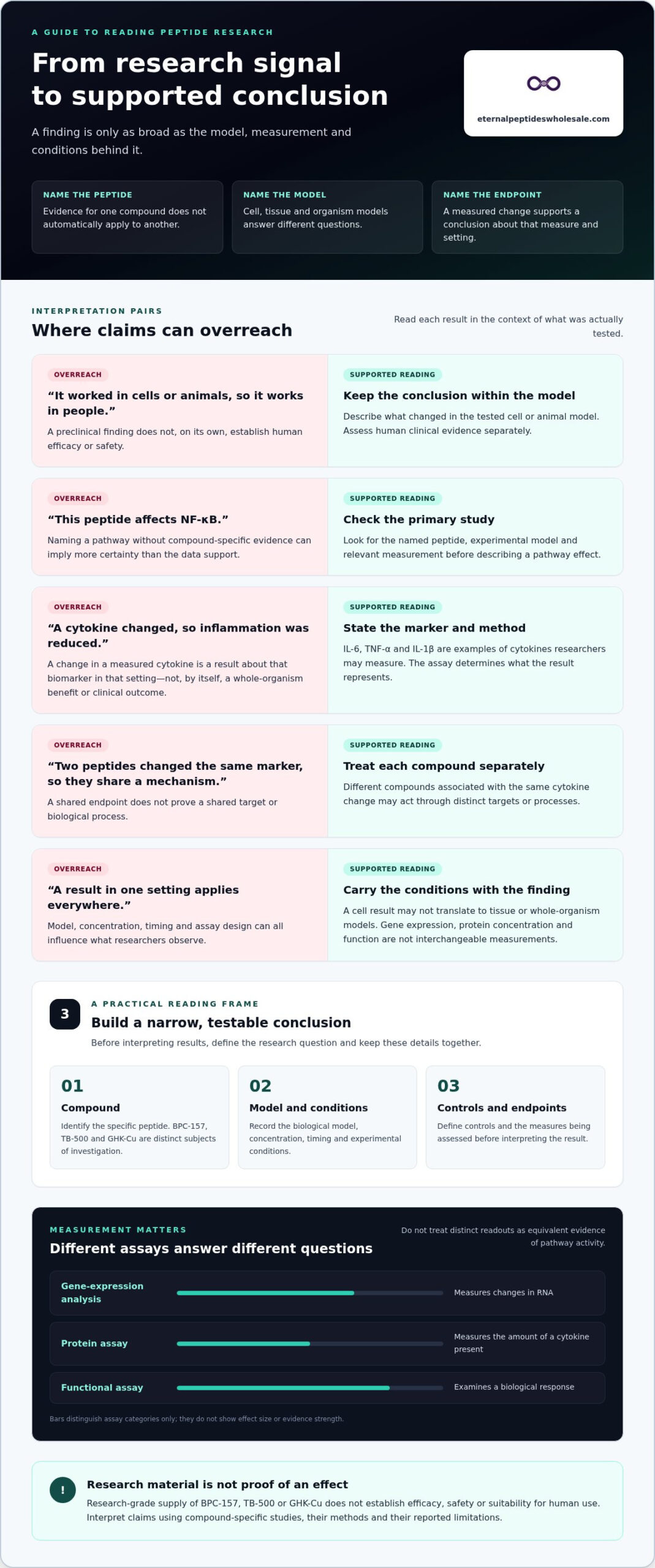
How to Frame a Rigorous Study of Peptide-Related Inflammation
A clear study starts with a narrow question, not a broad claim that a peptide is “anti-inflammatory”. The following workflow helps keep the research question, methods and conclusions aligned. It’s a conceptual framework, not a laboratory protocol or guidance on dosing, administration or treatment.
- Define the question. Specify one compound, a proposed pathway and a measurable primary endpoint. For example, ask whether a defined model shows a change in a named inflammatory marker under stated experimental conditions.
- Select a suitable model. Explain why the chosen cell, tissue or organism model can address the question, and describe its limits. Don’t assume a result in one model will apply to another.
- Set controls and comparisons. Decide on relevant control and comparison conditions before reviewing results. This helps distinguish a compound-associated change from background variation or other experimental factors.
- Choose and define endpoints. Pre-specify the primary outcome and distinguish it from exploratory measures. State how each endpoint will be assessed, since gene expression, protein concentration and functional assays measure different things.
- Document materials and conditions. Record compound identity, batch documentation, storage conditions and relevant assay details. A guide to quality assurance in research peptides can help frame documentation considerations for procurement and study planning.
- Plan interpretation and reporting. Report methods and results transparently, including unexpected or null findings. Where appropriate, pre-register the research question and analysis plan so readers can distinguish pre-specified outcomes from later exploratory analyses.
Account for oversight and reproducibility
Before work begins, researchers in Australia should identify the institutional ethics and biosafety review relevant to the project and its model, where applicable. Requirements depend on the research context, so follow the current guidance of the responsible institution and review bodies rather than assuming one process applies to every study. Clear records, repeatable methods and transparent reporting make it easier for other researchers to assess and reproduce findings.
These steps are particularly relevant when investigating anti-inflammatory peptide compounds for study: sound design can support a defensible interpretation, but it cannot turn a laboratory result into proof of clinical benefit. Eternal Peptides Wholesale supplies research-grade compounds, including BPC-157, TB-500 and GHK-Cu, for research use only, not human consumption or medical use. Explore wholesale research peptide supply.
Research-use Compounds and Responsible Interpretation
Research-grade supply describes the intended research context; it doesn’t establish a compound’s efficacy, safety or suitability for human use. Eternal Peptides Wholesale supplies BPC-157, TB-500 and GHK-Cu as research compounds for laboratory use. Their inclusion in a supplier’s range isn’t evidence that they produce an anti-inflammatory effect.
How should researchers assess compound-specific claims?
Trace each claim to primary literature. Check the publication date, study design, model, measured endpoint and stated limitations. A result from one experimental setting shouldn’t be generalised to other models or treated as proof of a therapeutic effect. Review articles may help identify relevant studies, but the original research is needed to assess what was actually tested and reported.
Keep supplier descriptions separate from independent evidence and peer-reviewed findings. For each material under consideration, review available identity and analytical documentation, then assess whether the compound and its documented characteristics suit the research question. Documentation supports evaluation of the material; it doesn’t establish biological activity. For further category context, see this guide to wholesale tissue repair research compounds.
What research-use boundaries should readers understand?
Eternal Peptides Wholesale supplies research-use products for laboratory contexts, not products for human consumption or medical use. This article doesn’t provide medical advice, human-use protocols or treatment recommendations. Research materials shouldn’t be presented as proven interventions, and a research-use description alone shouldn’t be treated as evidence of quality, efficacy or safety.
For a considered procurement decision, match the material’s documentation to the planned investigation, retain relevant records and interpret findings within the limits of the evidence. These checks matter for all anti-inflammatory peptide compounds for study, regardless of how a compound is described in marketing or secondary sources.
For Australian laboratories assessing research materials, explore wholesale research peptide supply.
Carry Your Research Forward with Clear Evidence Standards
“Anti-inflammatory” is best treated as a research question, not an automatic claim about a peptide. Findings depend on the compound, model and endpoint, and cell or animal results don’t establish human efficacy or safety. A focused question, appropriate controls and transparent reporting help keep conclusions proportionate to the evidence.
For researchers assessing anti-inflammatory peptide compounds for study, material documentation and study design both matter. BPC-157, TB-500 and GHK-Cu are supplied as research compounds, but their availability for laboratory research doesn’t establish therapeutic effects or suitability for human use.
Eternal Peptides Wholesale is an Australian-based wholesale supplier of research-grade peptides for laboratory use. Explore its research supply, including the listed compounds, through wholesale research peptide supply. With careful sourcing and evidence-led interpretation, your next investigation can begin on a clearer, more rigorous footing.
Frequently Asked Questions
Which peptides are studied in relation to inflammation?
Research may examine endogenous signalling peptides, protein fragments derived from foods, and synthetic experimental compounds. Their origins and evidence contexts differ, so these categories shouldn’t be treated as equivalent. BPC-157, TB-500 and GHK-Cu are among the compounds supplied by Eternal Peptides Wholesale for laboratory research; that listing doesn’t establish their mechanism or an anti-inflammatory effect. Assess each compound against primary studies and the specific model used.
How do peptides potentially influence inflammatory pathways?
Depending on the peptide and research model, investigations may examine immune signalling, cytokines or tissue-specific pathways. Markers such as IL-6, TNF-α and IL-1β can be measured, but their relevance depends on the study question and assay. Don’t assume a peptide affects NF-κB or a particular cytokine without compound-specific primary evidence. A shared marker or endpoint also doesn’t prove that different peptides act through the same mechanism.
Are anti-inflammatory peptide findings proven in humans?
No single answer applies to every peptide, because evidence differs by compound and study type. Cell and animal results can support hypotheses, but they don’t establish human efficacy or safety. For human research, examine the design, controls, methods, measured outcomes and whether findings have been independently replicated. A change in a biomarker isn’t necessarily a meaningful clinical benefit, and limited evidence shouldn’t be presented as an established treatment effect.
Can BPC-157 or TB-500 be described as anti-inflammatory?
Only with careful qualification. These compounds may be discussed in research concerning inflammation-related effects, but the claim should identify the study model and measured endpoint rather than present “anti-inflammatory” as an established general property. Available evidence for BPC-157 and TB-500 is predominantly preclinical, with robust human clinical data lacking as of October 2026. Neither research supply nor preclinical findings establish a treatment effect or suitability for human use.
What should a laboratory document when studying peptide-related inflammation?
Document the research question, model, controls, pre-specified primary endpoint and assay methods. Record compound identity, batch documentation, storage conditions and relevant experimental conditions, then report results and limitations transparently, including null findings. Distinguish exploratory measures from planned outcomes. Where applicable, account for institutional ethics and biosafety review. These records help readers assess whether findings relate to the tested material and conditions, and whether another laboratory could interpret or reproduce the work.
Related from Eternal Peptides Wholesale
Eternal Peptides Wholesale publishes batch-specific Janoshik Analytical reports in its certificate of analysis library, so the documentation for a listed batch can be read alongside the evidence discussed in this article.
- Peptide COA library: batch-specific Janoshik Analytical reports with their verification details
- Our peptide testing standards: how independent Janoshik testing is used and reported
- BPC-157 and TB-500 research catalogue
- Evidence review: Peptides for muscle gain: a structured evidence review
- Evidence review: Copper peptides: GHK-Cu chemistry, biology and the limits of the evidence
Related reading: Wholesale BPC-157 Australia: Research Lab Sourcing Guide