
Abstract
Background. Online interest in peptides for muscle gain has grown quickly, and products sold under names such as BPC-157, TB-500, CJC-1295, sermorelin and IGF-1 LR3 are often described as if their effects in people were settled. Australian regulators have recently warned that many such products are unapproved, have not been evaluated for quality or effectiveness, and have been linked to serious adverse events [17, 19, 20]. Yet the scientific literature on peptides and skeletal muscle is large, uneven and spread across very different classes of molecule, from endogenous hormones to experimental fragments studied almost entirely in rats.
Objective. To map and appraise the published evidence on whether peptides and peptide-pathway agents increase skeletal muscle mass or function in humans, to separate human trials from animal and cell research, and to set the findings against the 2026 anti-doping and Australian regulatory position.
Methods. A structured evidence review informed by PRISMA 2020 reporting items [21]. PubMed (via NCBI E-utilities), Europe PMC and the ClinicalTrials.gov registry were searched on 27 October 2026 (Australia/Brisbane) for six evidence classes combined with a block of muscle-outcome terms [1, 22, 23]. Pivotal randomised controlled trials (RCTs), systematic reviews and all primary muscle studies of BPC-157 and thymosin beta-4 that could be identified were read in full or in abstract and appraised with RoB 2 for trials [24], SYRCLE for animal studies [25] and GRADE for certainty [26]. Regulatory status was read from the October 2026 Poisons Standard and the 2026 Prohibited List [14, 16].
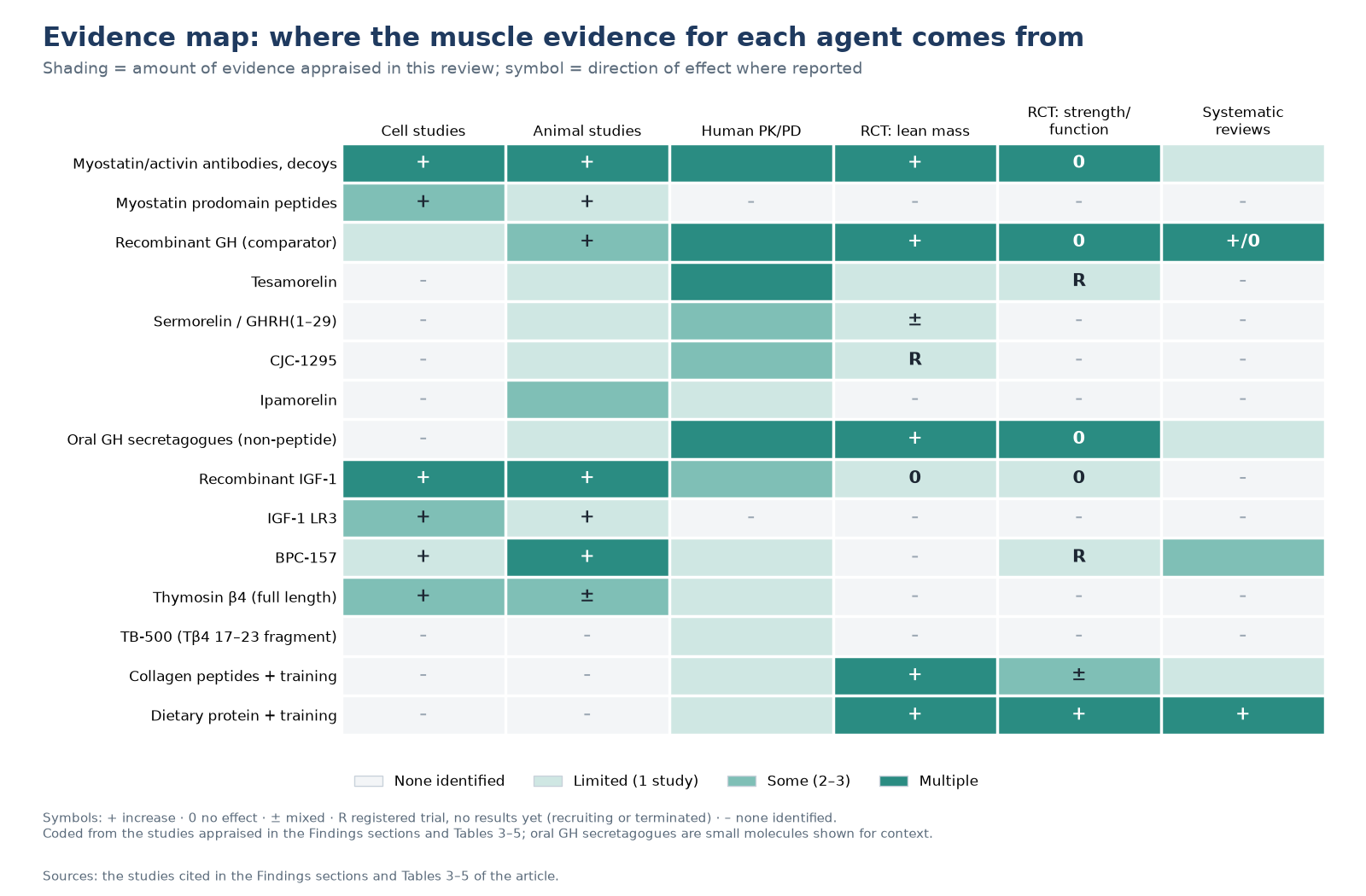
Findings. Agents that block the myostatin and activin pathway, which are mostly antibodies and receptor decoys rather than short peptides, raised lean mass by roughly 2–8% in phase 1 and 2 trials, but improvements in physical function were inconsistent and several primary functional end points were not met [2, 3, 4, 27]. Growth hormone (GH) and GH secretagogues reliably increased lean mass without corresponding gains in strength in healthy, young or older adults [6, 7, 8]. The long-acting growth hormone-releasing hormone (GHRH) analogue CJC-1295 has only pharmacokinetic and hormonal data in humans [10]. No human trial of IGF-1 LR3 was found [11]. Evidence for BPC-157 and thymosin beta-4 (TB-500) on muscle comes almost entirely from rodents; no completed human muscle trial was found, and the first phase 2 trial in hamstring strain is still recruiting [12, 28].
Conclusions. There is no adequate human evidence that BPC-157, TB-500, CJC-1295, ipamorelin or IGF-1 LR3 increase muscle mass, strength or function. For the better-studied pathways, gains in measured lean mass have rarely translated into better function. All of these substances are prohibited in sport, and most are listed in Appendix D of the Poisons Standard, which makes possession without authority an offence [14, 16].
Key points
- Interest in peptides for muscle gain far outstrips the human evidence: the compounds most promoted online have the smallest clinical literatures, with no randomised trial publications indexed in PubMed for BPC-157 or IGF-1 LR3 [1].
- Blocking the myostatin and activin pathway, mostly with antibodies rather than short peptides, raised lean mass by about 2–8% in trials, but physical function generally did not improve [2, 3, 4, 5].
- Growth hormone and GH secretagogues increase measured lean mass without matching gains in strength in healthy young or older adults [6, 7, 8, 9].
- CJC-1295 has hormonal data only, IGF-1 LR3 has no human trial, and BPC-157 and TB-500 evidence on muscle is almost entirely from rodents [10, 11, 12, 13].
- All of these substances are prohibited in sport under WADA sections S0, S2 or S4.3 [14, 15].
- In Australia most are Schedule 4 substances listed in Appendix D of the Poisons Standard, the TGA warned in 2026 of serious adverse events, and a “research use only” label does not change regulatory status [16, 17, 18].
Contents
- Introduction: why peptides for muscle gain need a careful evidence review
- Background: how skeletal muscle mass is regulated
- Methods
- Findings: myostatin and activin pathway inhibitors
- Findings: GHRH analogues, GH secretagogues and the GH/IGF-1 axis
- Findings: IGF-1 and IGF-1 LR3
- Findings: BPC-157 and thymosin beta-4 (TB-500)
- Findings: collagen peptides and dietary protein as comparators
- Approved peptide medicines: regulatory facts only
- Anti-doping status: WADA S0, S2 and S4.3 and Sport Integrity Australia
- Australian regulation: the Poisons Standard and the 2026 TGA statements
- Discussion
- Limitations of this review
- Conclusion
- Relevance to Eternal Peptides Wholesale
- Glossary
- Frequently asked questions
- References
- Related research
- About this article
- About the author
Introduction: why peptides for muscle gain need a careful evidence review
Skeletal muscle makes up about two-fifths of body mass in healthy adults and is central to mobility, metabolism and independence in later life. Its loss with age, disease or disuse, known as sarcopenia when it is accompanied by low strength or poor physical performance, is now recognised as a disease in its own right [29, 30]. It is therefore no surprise that researchers have spent decades looking for molecules that can preserve or rebuild muscle. Many of the candidates are peptides, or act on peptide hormone systems, because the body’s own regulators of muscle growth include peptide hormones such as GH-releasing hormone, ghrelin and insulin-like growth factor 1 (IGF-1), and growth factors of the transforming growth factor beta (TGF-β) family such as myostatin [31, 32].
The phrase “peptides for muscle gain” is used online to bundle together compounds that have little in common. Some are approved medicines with narrow indications, such as the GHRH analogue tesamorelin or recombinant IGF-1 (mecasermin) [33, 34]. Some are investigational antibodies or fusion proteins that went through formal clinical development and largely stalled, such as bimagrumab and ACE-031 [3, 35]. Others, such as BPC-157 and TB-500, have never completed a phase 2 trial for any muscle outcome, yet are widely promoted [36, 37]. Treating these as a single category hides the most important fact a reader needs: how strong the human evidence is for each one.
This review answers a narrow, testable question. For each major class of synthetic peptides and peptide-pathway agents discussed in relation to muscle, what does controlled human research show about lean mass, muscle size, strength and physical function, and where is the evidence only from animals or cells? Because the answer matters for public health and sport as much as for science, the review also sets out how each substance is treated by the World Anti-Doping Agency (WADA), Sport Integrity Australia and the Therapeutic Goods Administration (TGA).
Our earlier explainers cover what peptides are, what peptides do in the body, including approved peptide medicines, and how synthetic peptides are manufactured and analysed. This article does not describe, recommend or support the use of any substance in people or animals. It contains no administration amounts, regimens or sourcing information, and nothing in it should be read as a claim that any product is effective or free of risk.
Background: how skeletal muscle mass is regulated
Building and breaking down muscle protein
Muscle mass reflects the balance between muscle protein synthesis and breakdown, together with the activity of muscle stem cells (satellite cells) that fuse with existing fibres during growth and repair. Mechanical loading, amino acid supply and hormones all shift this balance. At the centre of the growth signal is the phosphoinositide 3-kinase (PI3K)–Akt–mammalian target of rapamycin (mTOR) pathway, which increases protein synthesis and suppresses the ubiquitin ligases that drive atrophy [31]. Studies in genetically modified mice and cultured muscle cells showed that this pathway is necessary for hypertrophy and that activating it can prevent disuse atrophy [38, 39].
The GH and IGF-1 axis
GH is released from the pituitary in pulses under the opposing control of hypothalamic GHRH, which stimulates release, and somatostatin, which inhibits it. A third input comes from ghrelin, a 28-residue acylated peptide made mainly in the stomach, which acts on the GH secretagogue receptor [40, 41]. GH acts partly directly and partly by raising IGF-1, which is produced in the liver and locally in muscle. IGF-1 activates the PI3K–Akt–mTOR pathway in muscle cells [39]. Its activity in blood is buffered by IGF-binding proteins, which is why analogues that bind these proteins weakly, such as Long R3 IGF-I, are more potent in cell culture [42].
In rodents, raising IGF-1 locally in a muscle produces hypertrophy. Local infusion into a rat muscle increased its mass by about 9% [43], and muscle-restricted IGF-1 transgenes or viral gene transfer preserved muscle function in ageing mice [44, 45]. These models deliver IGF-1 to the tissue continuously and at levels that systemic administration cannot reproduce. Reviews of the field have repeatedly noted the gap between these local effects and the weak evidence for systemic GH or IGF-1 in healthy people [32, 46].
The myostatin and activin brake
Myostatin, also called growth and differentiation factor 8 (GDF-8), is a TGF-β family member that limits muscle growth. Mice lacking it have muscles two to three times heavier than normal, from both more and larger fibres [47], and a child with a loss-of-function mutation in the human gene was described with marked muscle hypertrophy [48]. Myostatin signals through activin type II receptors (mainly ActRIIB) and the Smad2/3 transcription factors, and it damps down Akt–mTOR signalling [49, 50, 51]. Other ligands, including activins and GDF11, use the same receptors, so blocking the receptor has larger effects in mice than blocking myostatin alone [52, 53]. Follistatin, a natural binding protein, and the myostatin propeptide both neutralise myostatin [49].
This biology suggested an obvious therapeutic idea, and it generated most of the controlled human trials discussed below. However, larger muscles in myostatin-deficient animals do not always generate proportionally more force; specific force can be lower [54].
What “muscle gain” means in a trial
Three outcome levels should be kept apart. The first is lean mass, usually measured by dual-energy X-ray absorptiometry (DXA) or bioelectrical impedance. Lean mass includes water, organs and connective tissue as well as muscle, and it can change with fluid retention. The second is muscle size, measured more directly by magnetic resonance imaging (MRI) or computed tomography of the thigh, or by muscle fibre cross-sectional area in biopsies. The third is what matters to patients: strength, power and physical function, measured by tests such as handgrip, leg extension, gait speed, stair climb, the 6-minute walk and the Short Physical Performance Battery (SPPB). The European definition of sarcopenia (EWGSOP2) makes low strength, not low mass, its key characteristic [29], and Australian and New Zealand guidance supports that definition and gives resistance training the strongest consensus as management [30]. A substance that increases lean mass but not strength or function has not shown a clinically meaningful benefit.
Methods
Review design
This is a structured evidence review rather than a registered systematic review with meta-analysis. Its reporting follows relevant PRISMA 2020 items, including full search strings, dates, eligibility criteria and a flow diagram [21]. The aim was to map the volume and type of evidence for each class and to appraise the pivotal human trials and the complete set of identifiable primary muscle studies for the least-studied compounds. No review plan was registered in advance and no pooled effect sizes were calculated, because populations, comparators and outcomes differ too much across classes for pooling to be meaningful.
Information sources and searches
Three sources were searched on 27 October 2026 (Australia/Brisbane), using their public programming interfaces so that the exact counts can be reproduced:
- PubMed, through the NCBI E-utilities esearch service [1]. Each class string was restricted to title and abstract fields ([tiab]), combined with a muscle-outcome block, and limited to publication dates from 1 January 1900 to 27 October 2026. Counts were also obtained for records tagged with the MeSH heading Humans, for records tagged Animals but not Humans, and for the publication types randomized controlled trial and systematic review or meta-analysis.
- Europe PMC, through its REST search service, using equivalent strings with a first-publication date limit [22]. Europe PMC also indexes preprints and full text, so its counts are larger and less specific.
- ClinicalTrials.gov, through API version 2, searching the intervention field for each named compound [23]. Individual registrations were then read to record status, phase, start date and planned enrolment.
The muscle-outcome block was: “skeletal muscle”, “muscle mass”, “lean mass”, “lean body mass”, “fat-free mass”, “muscle hypertrophy”, “muscle strength”, sarcopenia, “muscle wasting”, “muscle injury” or “muscle regeneration”. The class strings and counts are shown in Table 1, and compound-level counts in Table 2.
Table 1. Database searches by evidence class, run 27 October 2026 (Australia/Brisbane). PubMed counts are title/abstract matches combined with the muscle-outcome block, dated 1900/01/01 to 2026/10/27. “Humans” and “Animals only” use MeSH tags, so untagged recent records are not counted in either. RCT = randomised controlled trial publication type; SR/MA = systematic review or meta-analysis.
| Evidence class | PubMed search terms (title/abstract), each AND muscle block | PubMed class total (no muscle block) | PubMed with muscle block | Humans | Animals only | RCT | SR/MA | Europe PMC |
|---|---|---|---|---|---|---|---|---|
| Myostatin/activin pathway | myostatin, GDF-8, activin type II receptor, ACVR2B, follistatin, bimagrumab | 7,220 | 3,145 | 1,349 | 1,275 | 140 | 19 | 14,402 |
| GHRH analogues and GH secretagogues | GHRH, sermorelin, tesamorelin, CJC-1295, GH secretagogue, GHRP, ipamorelin, hexarelin, anamorelin, capromorelin, ibutamoren, MK-677 | 7,224 | 286 | 177 | 77 | 22 | 13 | 3,367 |
| IGF-1 and analogues | IGF-1, IGF-I, insulin-like growth factor 1, mecasermin, Long R3, LR3 | 58,013 | 4,118 | 2,224 | 1,466 | 399 | 49 | 36,563 |
| BPC-157 | BPC 157, BPC-157, body protection compound, PL 14736 | 229 | 11 | 4 | 5 | 0 | 0 | 60 |
| Thymosin beta-4 / TB-500 | thymosin beta 4 (variants), TB-500, TB500, Tbeta4 | 1,201 | 24 | 8 | 16 | 0 | 0 | 285 |
| Collagen peptides (comparator) | collagen peptide(s), collagen hydrolysate, hydrolysed/hydrolyzed collagen | 1,807 | 54 | 34 | 7 | 24 | 3 | 714 |
Eligibility criteria
Studies were eligible for appraisal if they reported a muscle-related outcome (lean or fat-free mass, muscle volume or cross-sectional area, fibre size, strength, power, physical function, or histological or functional healing of injured muscle) after exposure to a peptide, peptide analogue or agent acting on a peptide hormone or growth factor pathway relevant to muscle. For humans, priority was given to randomised, placebo-controlled trials and to systematic reviews; uncontrolled studies were included only where nothing stronger existed. For BPC-157 and thymosin beta-4, every primary animal or cell study of skeletal muscle that could be identified was eligible, because these are the compounds for which the evidence base is smallest and most often overstated.
Excluded were case reports of misuse (except where they established a key biological fact), studies without a muscle outcome, conference abstracts without full reports, non-English reports, and sources whose titles named substances outside the scope of this review. Agents acting mainly on appetite or body fat were excluded unless a muscle outcome was a pre-specified end point. Gene therapy was described only where it tested a peptide pathway and is labelled as such.
Selection, data items and appraisal
One reviewer screened records by title and abstract, prioritising the trials and reviews most often cited for each compound, and supplemented the database searches with citation chasing, because the muscle-outcome block missed several primary BPC-157 rat studies whose abstracts use terms such as “transected quadriceps” or “crush injury” [55, 56]. For each study the following were extracted: design, species, sample size, population, comparator, duration, outcome measures and the direction and size of effects on lean mass and on function, as reported in the abstract or full text. Bibliographic details and abstracts were retrieved from PubMed records; DOIs were checked against the DOI resolver.
Risk of bias in randomised trials was judged with the RoB 2 tool across its five domains (randomisation, deviations from intended interventions, missing outcome data, outcome measurement and selection of the reported result) [24]. Animal studies were assessed with SYRCLE’s tool, which adapts these domains to experimental animal research, including random housing, blinding of caregivers and outcome assessors, and baseline comparability [25]. Where the methods sections did not report an item, it was judged “unclear”. Certainty of evidence for each class and outcome was rated with GRADE as high, moderate, low or very low, starting from high for RCTs and from low for observational evidence and downgrading for risk of bias, inconsistency, indirectness, imprecision and publication bias [26]. Animal and cell findings were treated as indirect evidence for human outcomes.
Regulatory and anti-doping sources
The current scheduling of each substance was read from the authorised text of the Therapeutic Goods (Poisons Standard—October 2026) Instrument 2026 on the Federal Register of Legislation [16]. Sport status was read from the WADA 2026 Prohibited List [14, 57] and from Sport Integrity Australia’s education pages [15, 58, 59]. TGA statements were read in full on the TGA website [17, 18, 19, 20, 60]. United States prescribing information for tesamorelin and mecasermin was read through the openFDA label service [33, 34].
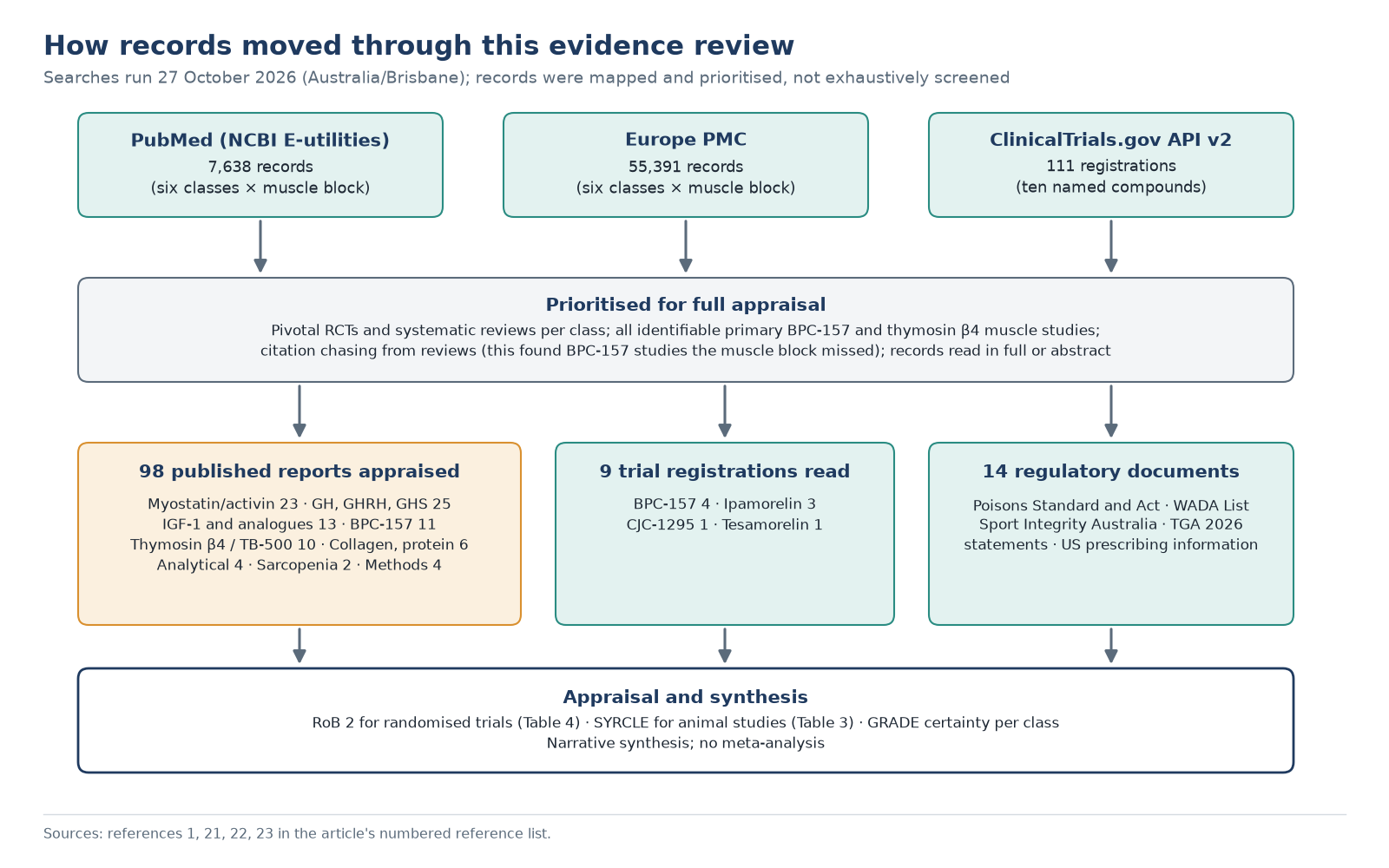
The flow of records is summarised in Figure 2. Database searches identified 7,638 PubMed records across the six classes once the muscle block was applied (classes overlap only slightly), 55,391 Europe PMC records and 111 ClinicalTrials.gov registrations for the ten named compounds in Table 2. From these, 98 published reports were appraised: 23 on the myostatin and activin pathway, 25 on GH, GHRH analogues and secretagogues, 13 on IGF-1 and its analogues, 11 on BPC-157, 10 on thymosin beta-4 and TB-500, 6 on collagen peptides and dietary protein, 4 on analytical detection of peptides in sport, 2 sarcopenia consensus papers and 4 methods papers. Nine trial registrations were read individually (four for BPC-157, three for ipamorelin and one each for CJC-1295 and tesamorelin), and fourteen regulatory, prescribing-information or anti-doping documents were included.
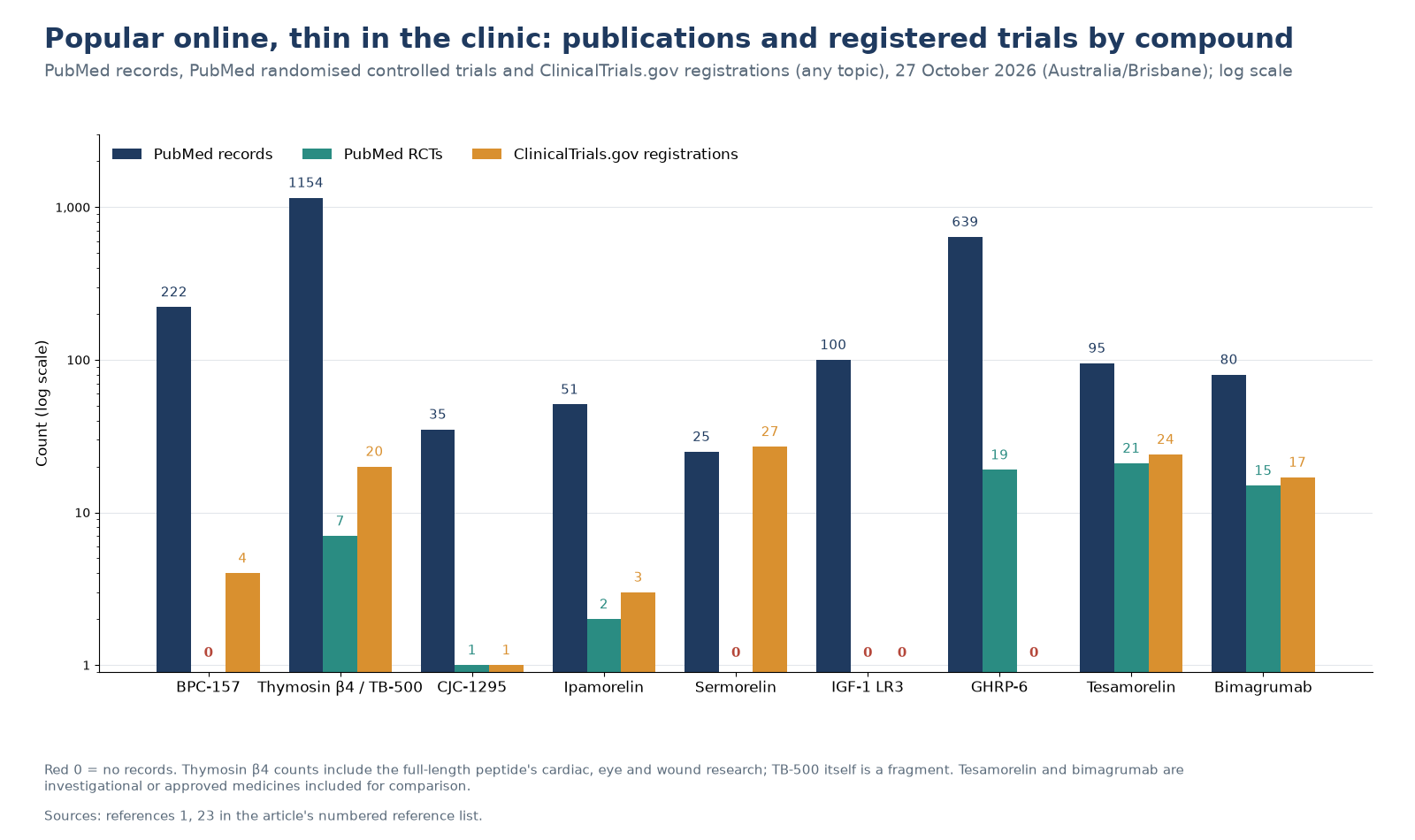
Table 2. Compound-level search counts, 27 October 2026 (Australia/Brisbane). PubMed and Europe PMC counts are for the compound name alone, without the muscle block, so they include all topics. ClinicalTrials.gov counts are intervention-field matches and include completed, terminated, withdrawn and recruiting studies for any condition.
| Compound or group | PubMed records (any topic) | PubMed, Humans tag | PubMed, RCT type | Europe PMC | ClinicalTrials.gov registrations |
|---|---|---|---|---|---|
| BPC-157 | 222 | 53 | 0 | 306 | 4 |
| TB-500 / thymosin beta-4 | 1,154 | 631 | 7 | 2,330 | 20 |
| CJC-1295 | 35 | 22 | 1 | 62 | 1 |
| Ipamorelin | 51 | 25 | 2 | 119 | 3 |
| Sermorelin | 25 | 18 | 0 | 485 | 27 |
| IGF-1 LR3 | 100 | 29 | 0 | 414 | 0 |
| GHRP-6 | 639 | 234 | 19 | 1,106 | 0 |
| Tesamorelin | 95 | 76 | 21 | 374 | 24 |
| Bimagrumab | 80 | 57 | 15 | 591 | 17 |
| Follistatin (any context) | 2,980 | 1,564 | 65 | 11,612 | 15 |
Two features of these counts are worth stating plainly. First, the compounds most promoted online for muscle, BPC-157, CJC-1295 and IGF-1 LR3, have the smallest human literatures, with no PubMed record of the RCT publication type for BPC-157 or IGF-1 LR3. Second, the Humans tag is not a marker of human trials. For BPC-157, the 53 human-tagged records are mostly reviews, commentaries and analytical papers; for thymosin beta-4, they are dominated by studies of its biology in human tissues, eye-drop and wound trials, and cardiac research [61].
Findings: myostatin and activin pathway inhibitors
From mice to clinical trials
The preclinical case for blocking myostatin is among the strongest in muscle biology. Beyond the knockout mouse [47], transgenic mice expressing the myostatin propeptide, follistatin or a dominant-negative receptor in muscle had large increases in muscle mass [49]. A soluble ActRIIB decoy receptor raised muscle mass in normal mice by up to 60% within two weeks, and still had an effect in myostatin-null mice, showing that other ligands also restrain muscle [52]. Bimagrumab, an antibody against the ActRII receptors, caused more hypertrophy in mice than myostatin blockade alone and protected against glucocorticoid-induced atrophy [53]. At the level of signalling, Smad2 and Smad3 drive an atrophy programme that interacts with mTOR, and myostatin lowers Akt–mTOR activity in myoblasts [50, 51].
Among short synthetic peptides, the most relevant work concerns fragments of the myostatin prodomain. Minimal 23- to 24-residue peptides bound myostatin with nanomolar affinity, and one increased muscle mass in a mouse model of Duchenne muscular dystrophy [62]. A 29-residue prodomain peptide suppressed myostatin and GDF11 signalling in cells and reduced atrophy in a limb-girdle dystrophy model [63]. These are early-stage research peptides with no human data.
Human trials
Most clinical candidates in this class are large proteins: monoclonal antibodies (MYO-029, LY2495655, domagrozumab, bimagrumab), an Fc fusion “peptibody” (AMG 745) and a soluble receptor fusion protein (ACE-031). They are relevant here because they test the same pathway that peptide approaches target and because they are the only route by which the myostatin hypothesis has been tested in randomised human trials.
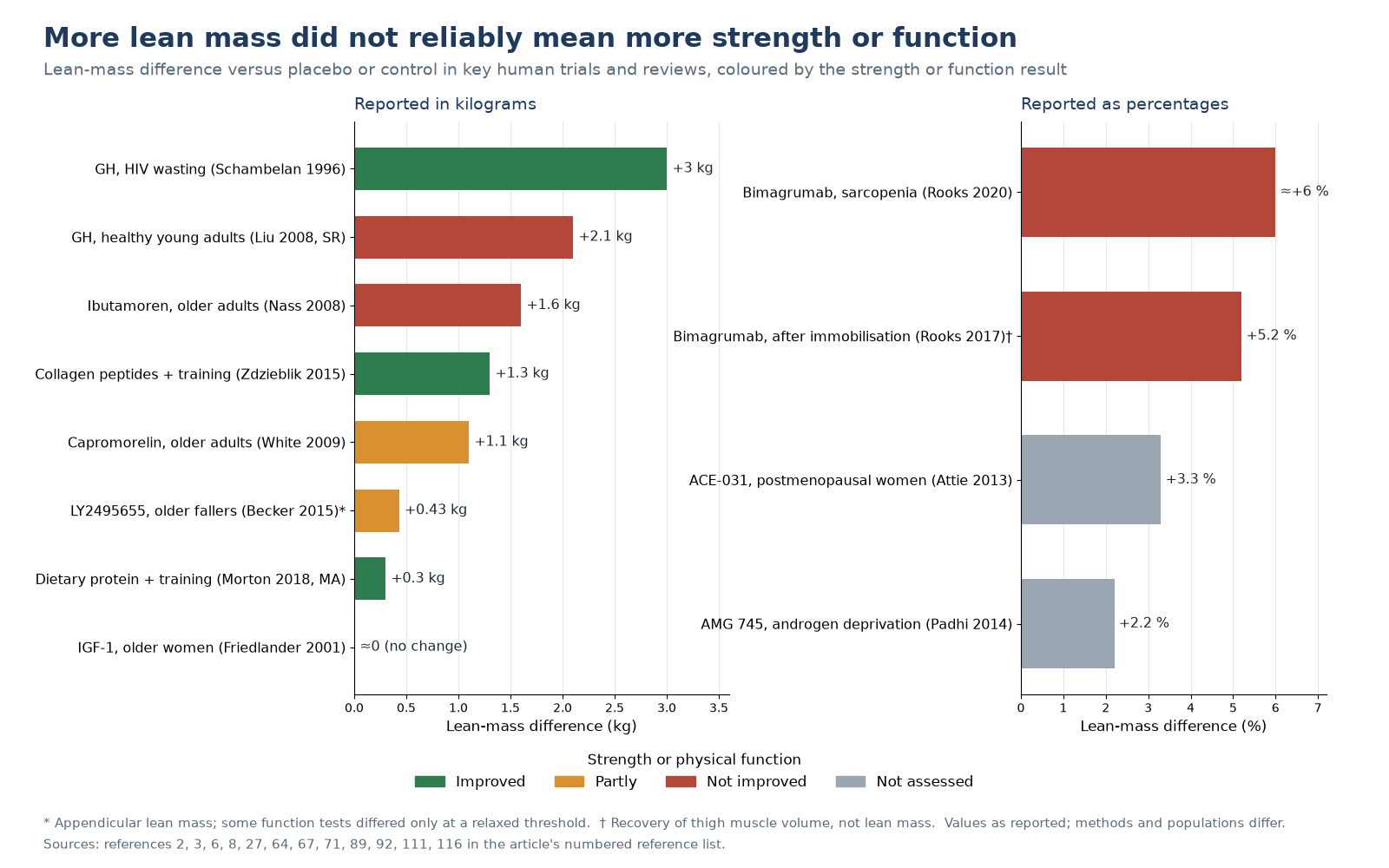
The pattern across these trials is consistent. Lean mass or muscle volume increased, but function rarely followed. A single administration of ACE-031 to 48 healthy postmenopausal women increased total lean mass by 3.3% and thigh muscle volume by 5.1% at day 29 in the highest-exposure group [2]. AMG 745 increased lean body mass by 2.2% relative to placebo in men receiving androgen deprivation [64]. In 201 older adults with recent falls, LY2495655 increased appendicular lean mass by 0.43 kg at 24 weeks; stair climbing, chair rise with arms and fast gait speed differed from placebo only at a relaxed, pre-specified significance threshold of 0.1, and other tests did not [27]. After total hip replacement, the same antibody missed its primary lean-mass objective at week 12 and did not change exploratory functional end points meaningfully [65].
Bimagrumab provides the largest and most rigorous data. In 40 older adults with sarcopenia and mobility limitation, it increased thigh muscle volume at every time point, but gait speed and 6-minute walk distance improved only in the slower-walking subgroup [66]. After two weeks of leg immobilisation in young men, one administration sped up recovery of thigh muscle volume, but knee-extension strength recovered no faster than with placebo [67]. In the phase 2b trial of 180 adults aged 70 or more with sarcopenia, all of whom received dietary support and home exercise, bimagrumab increased lean mass by about 6% more than placebo but did not improve the SPPB, 6-minute walk or gait speed relative to placebo [3]. Both groups improved function, which suggests that the exercise and nutrition programme, not the extra lean mass, drove the functional gains.
In muscular dystrophies, the picture is no better. MYO-029 did not improve strength or function in 116 adults (the trial was not powered for efficacy), and higher exposures caused skin hypersensitivity [68]. Domagrozumab did not differ from placebo on the 4-stair climb or any secondary functional measure in 120 boys with Duchenne muscular dystrophy [4]. ACE-031 in Duchenne boys was stopped early because of nosebleeds and dilated skin blood vessels (telangiectasias), adverse effects that reviewers have linked to the binding of other ligands besides myostatin [5], with only non-significant trends in lean mass and walking distance [35]. One proposed explanation for these disappointing findings is that the myostatin pathway is already down-regulated in many wasting diseases, leaving less to block [69]. An uncontrolled gene-transfer study of follistatin in six men with Becker muscular dystrophy reported improved 6-minute walk distance in four [70], but without a control group this cannot be separated from natural variation and expectation effects.
A review of the field concluded that many myostatin and activin candidates failed, sometimes because of adverse or off-target effects, but more often because muscle mass was preserved or increased without improved function [5]. That conclusion is the single most important lesson for anyone reading claims about peptides for muscle gain: a rise in measured lean mass is a surrogate, and in this class it has repeatedly failed to predict functional benefit.
Certainty (GRADE). Moderate certainty that myostatin and activin pathway inhibition increases lean mass by a small amount over weeks to months; low certainty, downgraded for inconsistency and imprecision, of no clinically important improvement in physical function. There is no human evidence for any short synthetic myostatin-inhibiting peptide.
Findings: GHRH analogues, GH secretagogues and the GH/IGF-1 axis
Growth hormone as the reference point
Because GHRH analogues and GH secretagogues work by raising GH, trials of GH itself set an upper bound on what these agents could achieve through that route. In HIV-associated wasting, a 12-week RCT found that recombinant GH increased lean body mass by 3.0 kg, compared with no change with placebo, and increased treadmill work output [71]. In healthy older men with low IGF-1, an early six-month study reported an 8.8% rise in lean body mass and a 14.4% fall in fat mass [72]. Later RCTs were less encouraging. In healthy older women and men, 26 weeks of GH increased lean mass and reduced fat mass but did not significantly increase strength, except marginally when combined with testosterone in men; diabetes or glucose intolerance occurred more often with GH [73]. In trained older men doing resistance exercise, GH raised IGF-1 and lean mass but added nothing to strength gains [74].
The same dissociation appears in young people. In young men undertaking resistance training, GH increased fat-free mass more than placebo, but muscle protein synthesis, limb circumference and strength did not increase further; the authors concluded that the extra fat-free mass was probably non-muscle lean tissue, including fluid [75]. A systematic review of 27 study samples in young, fit adults found that GH increased lean body mass by 2.1 kg but did not appear to improve strength or exercise capacity [6]. A systematic review in healthy older adults found small increases in lean mass with higher rates of oedema, joint pain, carpal tunnel syndrome and breast enlargement in men, and concluded that GH could not be recommended as an anti-ageing therapy [7]. A later review of GH in sport noted a selective effect on anaerobic sprint capacity in recreational athletes but no significant effect on strength, power or maximal oxygen uptake [76].
GHRH analogues: tesamorelin, sermorelin and CJC-1295
GHRH analogues are genuine synthetic peptides, designed to stimulate the patient’s own pulsatile GH release. Tesamorelin, a stabilised 44-residue analogue, is the best studied. In a phase 3 RCT in people with HIV and abdominal fat accumulation, it reduced visceral fat by 15.2% compared with a 5.0% increase with placebo and raised IGF-1 by 81%; overall adverse event rates did not differ significantly, but more participants withdrew because of an adverse event in the tesamorelin group [77]. A pooled analysis of two phase 3 trials confirmed about a 15% relative reduction in visceral fat at 26 weeks [78], and a smaller RCT showed reductions in visceral and liver fat, with fasting glucose rising at two weeks but not significantly at six months [79]. Its approved use in the United States is limited to reducing excess abdominal fat in adults with HIV-associated lipodystrophy [33]. Muscle function was not the target of these trials, and a phase 2 trial testing whether tesamorelin adds to exercise for physical function in HIV is still recruiting [80].
Sermorelin is the 1–29 fragment of human GHRH, the shortest fully active sequence, and was historically used in children with idiopathic GH deficiency [81]. Its proposed use for adult GH insufficiency has been discussed in commentary [82], but controlled muscle evidence is sparse. In a single-blind, placebo-controlled study of a GHRH(1–29) analogue in 19 adults aged 55 to 71, lean body mass increased in men but not in women [83]. Continuous infusion of full-length GHRH(1–44) for 14 days increased 24-hour GH and IGF-1 in healthy older men [84], demonstrating that the ageing pituitary can still respond, but without muscle outcomes.
CJC-1295 was designed to bind serum albumin after administration, extending its half-life to about a week. In placebo-controlled studies of healthy adults aged 21 to 61, it produced sustained increases in GH (2- to 10-fold for six days or more) and IGF-1 (1.5- to 3-fold), with a half-life of 5.8 to 8.1 days [10]. A further study showed that it raised trough and mean GH while preserving pulsatile secretion [85]. Neither study measured body composition, strength or function. The only CJC-1295 trial registered on ClinicalTrials.gov, a phase 2 study in people with HIV and abdominal obesity, was terminated with no outcome data posted [86]. Its development was not continued. The evidence that CJC-1295 builds muscle in people therefore consists of hormonal surrogate measures from short studies, plus the indirect and largely negative evidence from GH itself.
Ghrelin-receptor agonists: GHRPs, ipamorelin and the oral secretagogues
The growth hormone-releasing peptides (GHRPs) began with a synthetic hexapeptide that released GH in several species without releasing other pituitary hormones [87]. Its receptor was cloned more than a decade later [41], and its natural ligand, ghrelin, was identified in 1999 [40]. Ipamorelin, a pentapeptide, was reported in rats and pigs to release GH with greater selectivity than earlier GHRPs, without the rises in adrenocorticotropic hormone and cortisol seen with some of them [88]. Two of its three ClinicalTrials.gov registrations concerned recovery of bowel function after surgery, not muscle (Table 2). This review found no published human trial of ipamorelin with a muscle mass or function outcome.
The strongest human data in this group come from orally active secretagogues that are not peptides at all: ibutamoren (MK-677), capromorelin and anamorelin are small molecules that act on the same receptor. In 65 healthy older adults, 12 months of ibutamoren increased fat-free mass by 1.1 kg compared with a 0.5 kg fall with placebo; strength and function did not change, although the study was underpowered for these outcomes, and fasting glucose rose while insulin sensitivity fell [8]. In a trial that randomised 395 older adults with mild functional limitation and was stopped early, capromorelin increased lean body mass (1.4 kg versus 0.3 kg), with improvements in tandem walk and later stair climb and small adverse changes in glucose and insulin resistance [89]. In the two ROMANA phase 3 trials in 979 people with cancer cachexia, anamorelin increased lean body mass relative to placebo but did not improve handgrip strength [9]. A review of GH secretagogues concluded that few long-term, rigorously controlled studies exist, that these agents may increase lean mass in wasting states, and that rising blood glucose and unknown long-term risks, including cancer, remain concerns [90].
Certainty (GRADE). For GH, moderate to high certainty of increased lean mass and moderate certainty of no meaningful strength benefit in healthy adults. For oral secretagogues, moderate certainty of increased lean mass in older or ill populations and low certainty for function. For tesamorelin, high certainty of reduced visceral fat in HIV-associated lipodystrophy but no direct evidence on muscle function. For sermorelin and GHRH(1–29) analogues, very low certainty from small, older studies. For CJC-1295 and ipamorelin, no human evidence on muscle outcomes.
Findings: IGF-1 and IGF-1 LR3
Systemic IGF-1 in humans
IGF-1 is the obvious next step down the GH axis. Its role in muscle hypertrophy is well established in cells and rodents, where it drives myotube growth through PI3K–Akt–mTOR and blocks atrophy signalling [31, 38, 39]. Local IGF-1 in rat and mouse muscle produced hypertrophy and preserved function in ageing animals [43, 44, 45]. In dexamethasone-treated rats, IGF-1 partly reversed muscle catabolism [91].
The human evidence is thin and mostly negative. In a one-year RCT in 16 healthy women over 60, IGF-1 raised blood levels to the young-adult range but produced no change in lean mass, fat mass, bone density, strength, mood or memory, and the study was stopped early [92]. Reviewers have noted that there is very little evidence for an anabolic effect of raised systemic GH or IGF-1 on muscle in healthy people, in contrast to the animal data on muscle-specific IGF-1 [32], and that no approved therapy reverses muscle catabolism through this route [46]. The approved medicine, mecasermin, is indicated in the United States only for growth failure in children with severe primary IGF-1 deficiency [34]. In a long-term study of children treated with it, height velocity increased, but hypoglycaemia occurred in 49% [93], a reminder that IGF-1 has insulin-like metabolic actions.
IGF-1 LR3: a laboratory reagent
Long R3 IGF-I (IGF-1 LR3) is a recombinant analogue with a 13-residue N-terminal extension and an arginine substituted at position 3. It was designed for cell culture, where its weak binding to IGF-binding proteins makes it more potent than native IGF-1 in rat L6 myoblasts [42]. In dexamethasone-treated rats, it and another variant were about 2.5 times more potent than IGF-1 at reversing catabolism [91]. These properties made it a useful research reagent. They also mean that, in an intact animal, more of the analogue circulates free, which is the reason its metabolic effects, including on blood glucose, cannot be assumed to resemble those of the native hormone.
No human trial of IGF-1 LR3 was found in PubMed or registered on ClinicalTrials.gov (Table 2). Its appearance in human literature is almost entirely through doping control: analysts identified unpurified long-R3-IGF-1 among confiscated black-market products [94], and a separate black-market product proved by mass spectrometry to be a histidine-tagged version of the analogue, whose effects in humans have not been described [11]. A histidine tag is a purification handle used in recombinant protein production, and its presence in a product suggests material not prepared for human use.
Certainty (GRADE). Low certainty, from a single small RCT, that systemic IGF-1 does not improve lean mass or strength in healthy older women. No human evidence of any kind for IGF-1 LR3 on muscle.
Findings: BPC-157 and thymosin beta-4 (TB-500)
What BPC-157 is
BPC-157 is a synthetic 15-residue peptide (sequence GEPPPGKPADDAGLV) described by its originators as a partial sequence of a “body protection compound” isolated from human gastric juice [55, 95]. It does not correspond to a characterised human hormone with a known receptor, and its mechanism remains uncertain. Cell studies report that it increases outgrowth, migration and survival of rat tendon fibroblasts, with activation of focal adhesion kinase and paxillin [95]. Most of the wider literature describes protective effects across many organ systems in rats, much of it from a single research group [36, 96].
Animal studies of skeletal muscle
The primary muscle studies are all in rats. In a model of complete transection of the quadriceps, daily intraperitoneal BPC-157 improved biomechanical, functional and histological measures of healing over 72 days compared with controls [55]. In a gastrocnemius crush-injury model, BPC-157 given into the abdominal cavity or applied locally as a cream improved macroscopic, microscopic, functional and enzyme measures of healing over 14 days [56], and in the same model it counteracted the impaired healing caused by a corticosteroid [97]. In a rat defect of the junction between quadriceps muscle and tendon, both intraperitoneal and drinking-water administration improved healing and counteracted muscle atrophy [98]. Related work extends to rat models of limb ischaemia–reperfusion injury and other organ damage, which were among the records retrieved by the muscle-block search (Table 1).
These are consistently favourable findings, but they share important weaknesses. Sample sizes, randomisation and blinding are often not reported in the abstracts, the same laboratory conducted most of the experiments, and independent replication is scarce [36]. Several studies report effects across a very wide range of exposure levels, which is unusual pharmacology and makes the findings harder to interpret. None measured muscle mass gain in healthy animals; the outcomes are healing of surgically or mechanically injured tissue. A systematic review in orthopaedic sports medicine, covering literature to June 2024, included 36 studies, of which 35 were preclinical and one was a retrospective clinical series of knee pain; it found no clinical tolerability data and warned of possible adverse effects from unregulated manufacturing or contamination [12]. A 2025 narrative review similarly described robust preclinical signals but extremely limited human data from three small pilot studies, and advised that BPC-157 be regarded as investigational [37]. A 2026 systematic review, written by authors including members of the group responsible for most of the rat studies, concluded that BPC-157 was consistently effective in rats and that clinical studies are still needed [96].
Human data for BPC-157
No completed randomised trial of BPC-157 with a muscle outcome was found. The published human data consist of very small uncontrolled reports, including a pilot study of intravenous BPC-157 in two healthy adults conducted at a private clinic, which reported no measurable changes in biomarkers [99]. On ClinicalTrials.gov, four registrations matched the intervention search. A phase 1 study of tolerability and pharmacokinetics registered in 2015 has an unknown status and no posted outcome data [100]. A phase 2 trial in acute hamstring strain, with a planned enrolment of 120, began recruiting in February 2026 [28], and a phase 1 study after rotator cuff repair is not yet recruiting [101]. The fourth is a completed single-group study of an oral consumer formulation, without a control group or blinding, whose registered outcomes are blood inflammatory markers and self-reported symptoms; by design it cannot show an effect on muscle mass or strength. Until trials like the hamstring study report, the human evidence on BPC-157 for muscle is effectively absent.
BPC-157 also appears in the analytical literature because it has been found in confiscated vials alongside other unapproved peptides, and anti-doping laboratories have validated urine tests for it [102].
Thymosin beta-4 and TB-500
Thymosin beta-4 (Tβ4) is a natural 43-residue peptide found in almost all cells, where its main known role is to bind and sequester monomeric actin. It is released from injured tissue and, in preclinical models, promotes cell migration, new blood vessel formation and reduced scarring [61]. In a rat wound model it increased re-epithelialisation, contraction, collagen deposition and angiogenesis [103]. In mice, it activated integrin-linked kinase and Akt in heart muscle cells and improved cardiac function after coronary artery ligation [104], and it mobilised epicardial progenitor cells [105]. Its clinical development has concentrated on skin wounds, the eye, the heart and the brain, not skeletal muscle [61].
“TB-500” is not Tβ4 itself. Analytical studies identified it as a preparation containing the synthetic N-acetylated fragment LKKTETQ, residues 17 to 23 of Tβ4, which forms part of the actin-binding region and originated as a veterinary product [106, 107]. Evidence about full-length Tβ4 therefore cannot be transferred automatically to this fragment.
The skeletal muscle evidence is limited and mixed. Tβ4 expression rises in regenerating mouse muscle, and Tβ4 attracts myoblasts in culture [108]. In exercised dystrophin-deficient (mdx) mice, six months of Tβ4 increased the number of regenerating muscle fibres but did not improve grip strength, cardiac function or fibrosis [13]. A proteomics study found Tβ4 to be the most up-regulated protein secreted by contracting muscle cells and showed that its blood level rises acutely during exercise in humans; however, treating mice with Tβ4 neither enhanced muscle regeneration nor improved the metabolic effects of a high-fat diet [109]. In humans, a phase 1 trial of intravenous synthetic Tβ4 in 40 healthy volunteers, part of a cardiac programme, reported good tolerability but measured no muscle outcomes [110]. No human trial of TB-500 or of Tβ4 with a skeletal-muscle end point was found.
Table 3. Preclinical skeletal-muscle studies of BPC-157 and thymosin beta-4, with SYRCLE risk-of-bias judgements. Judgements are based on the published abstracts or full text available to this review; “unclear” means the item was not reported. None of these studies tested muscle gain in healthy animals.
| Study | Agent | Species and model | Group sizes | Main outcome reported | SYRCLE: randomisation / blinding | SYRCLE overall |
|---|---|---|---|---|---|---|
| Staresinic et al. 2006 [55] | BPC-157 | Rat, complete quadriceps transection | Not stated in abstract | Better biomechanical, functional and histological healing over 72 days | Unclear / unclear | Unclear; single group |
| Novinscak et al. 2008 [56] | BPC-157 | Rat, gastrocnemius crush injury | Not stated in abstract | Better macroscopic, microscopic, functional and enzyme healing measures | Unclear / unclear | Unclear; single group |
| Pevec et al. 2010 [97] | BPC-157 | Rat, crush injury plus corticosteroid | Not stated in abstract | Counteracted corticosteroid-impaired healing | Unclear / unclear | Unclear; single group |
| Japjec et al. 2021 [98] | BPC-157 | Rat, myotendinous junction defect | Not stated in abstract | Improved healing; reduced atrophy | Unclear / unclear | Unclear; single group |
| Chang et al. 2011 [95] | BPC-157 | Rat tendon fibroblasts in culture | Not applicable | More outgrowth, migration and survival; FAK–paxillin activation | Not applicable (in vitro) | Not assessed |
| Spurney et al. 2010 [13] | Tβ4 | Exercised mdx mouse, 6 months | Not stated in abstract | More regenerating fibres; no gain in strength, cardiac function or fibrosis | Unclear / unclear | Unclear |
| Tokura et al. 2011 [108] | Tβ4 | Mouse muscle injury; myoblasts in culture | Not stated in abstract | Tβ4 up-regulated in regeneration; chemoattractant for myoblasts | Unclear / unclear | Unclear |
| Gonzalez-Franquesa et al. 2021 [109] | Tβ4 | Mouse regeneration and diet models; human plasma | Not stated in abstract | No enhancement of regeneration in mice | Unclear / unclear | Unclear |
Certainty (GRADE). For BPC-157, very low certainty for any human muscle outcome, because all evidence is indirect (rodent injury models), at unclear risk of bias and largely from one research group. For Tβ4 and TB-500, there is no human evidence on skeletal muscle, and the mouse evidence on muscle repair is mixed.
Findings: collagen peptides and dietary protein as comparators
Food-derived peptides offer a useful contrast, because they have been tested in randomised trials with clear training programmes. In 53 older men with sarcopenia completing 12 weeks of resistance training, collagen peptides increased fat-free mass (4.2 versus 2.9 kg) and quadriceps strength more than placebo [111]. Similar trials in 25 young men [112] and 77 premenopausal women [113] reported larger increases in fat-free mass with collagen peptides than with placebo. In 57 young men, however, type II muscle fibre size increased similarly in both groups despite a larger fat-free mass gain with collagen, which led the authors to propose adaptation of connective tissue rather than muscle fibres [114]. Collagen is rich in glycine and proline and is thought to support connective-tissue rather than myofibrillar protein synthesis [115]. These trials are small, several were funded by industry, and they measured fat-free mass by bioimpedance or DXA, so the true effect on muscle tissue is uncertain.
For context, a meta-analysis of 49 RCTs with 1,863 participants found that protein supplementation during prolonged resistance training increased fat-free mass by 0.30 kg and one-repetition-maximum strength by 2.49 kg, with the benefit levelling off at higher habitual protein intakes [116]. The effect is modest, but it rests on far more evidence than any of the research peptides discussed above, and it comes from food. Resistance training remains the intervention with the strongest consensus support for sarcopenia [30].
Certainty (GRADE). Low certainty that collagen peptides with resistance training produce a small additional increase in fat-free mass, downgraded for risk of bias and imprecision; moderate certainty for a modest effect of protein supplementation with training.
Approved peptide medicines: regulatory facts only
Several peptides or peptide-pathway agents discussed here are, or have been, approved medicines for specific conditions. They are listed for regulatory context only; nothing here suggests that they should be used to gain muscle, and none is approved for that purpose. In the United States, tesamorelin is approved to reduce excess abdominal fat in adults with HIV-associated lipodystrophy, and its labelling notes that long-term cardiovascular risk has not been established [33]. Mecasermin, recombinant human IGF-1, is approved for growth failure in children with severe primary IGF-1 deficiency and is not a substitute for GH [34]. Sermorelin was formerly used in the diagnosis and treatment of children with idiopathic GH deficiency [81]. In Australia, mecasermin and sermorelin are Schedule 4 entries in the Poisons Standard [16]. Prescription status does not create evidence for uses outside the approved indication. The broader landscape of approved peptide medicines is described in our article on what peptides do.
Table 4. Key human randomised trials and systematic reviews relevant to muscle, with RoB 2 judgements. Effects are as reported versus placebo or control. RoB 2 judgements are based on published reports; “some concerns” usually reflects small samples, early stopping, multiple outcomes or relaxed significance thresholds.
| Study | Agent (class) | Population, n | Lean mass or muscle size | Strength or function | RoB 2 overall |
|---|---|---|---|---|---|
| Attie et al. 2013 [2] | ACE-031 (ActRIIB decoy) | Healthy postmenopausal women, 48 | +3.3% lean mass; +5.1% thigh volume (highest-exposure group, day 29) | Not assessed | Some concerns |
| Padhi et al. 2014 [64] | AMG 745 (anti-myostatin peptibody) | Men on androgen deprivation | +2.2% lean body mass at day 29 | Not assessed | Some concerns |
| Becker et al. 2015 [27] | LY2495655 (anti-myostatin antibody) | Older adults with falls, 201 | +0.43 kg appendicular lean mass | Some tests differed at alpha 0.1; others did not | Some concerns |
| Woodhouse et al. 2016 [65] | LY2495655 | After hip replacement, 400 | Primary end point missed at week 12 | No meaningful differences | Low |
| Rooks et al. 2017 [66] | Bimagrumab (anti-ActRII antibody) | Sarcopenia with mobility limitation, 40 | Thigh muscle volume increased | Gains only in slower-walking subgroup | Some concerns |
| Rooks et al. 2020 [3] | Bimagrumab | Adults ≥70 with sarcopenia, 180 | About +6% lean mass vs placebo | No difference in SPPB, 6-minute walk or gait speed | Low |
| Wagner et al. 2008 [68] | MYO-029 (anti-myostatin antibody) | Adult muscular dystrophy, 116 | Trend toward larger muscle | No improvement (not powered) | Some concerns |
| Wagner et al. 2020 [4] | Domagrozumab | Boys with Duchenne, 120 | Not the primary outcome | No difference on 4-stair climb or secondary function | Low |
| Campbell et al. 2017 [35] | ACE-031 | Boys with Duchenne | Non-significant trend | Non-significant trend; stopped early for adverse events | Some concerns |
| Schambelan et al. 1996 [71] | Recombinant GH | HIV-associated wasting, 178 | +3.0 kg lean body mass | Treadmill work increased | Some concerns |
| Blackman et al. 2002 [73] | Recombinant GH ± sex steroids | Healthy adults 65–88, 131 | Lean mass increased | No significant strength gain, except marginal with testosterone in men | Low |
| Yarasheski et al. 1992 [75] | Recombinant GH plus training | Young men, 16 | Fat-free mass increased | No added strength or muscle protein synthesis | Some concerns |
| Liu et al. 2008 [6] (systematic review) | Recombinant GH | Young, fit adults; 27 samples | +2.1 kg lean body mass | No apparent strength or exercise-capacity gain | Not applicable |
| Teichman et al. 2006 [10] | CJC-1295 (GHRH analogue) | Healthy adults 21–61 | Not measured | Not measured (GH and IGF-1 only) | Some concerns for its own outcomes |
| Nass et al. 2008 [8] | Ibutamoren (oral, non-peptide) | Healthy older adults, 65 | +1.1 vs −0.5 kg fat-free mass | No change (underpowered) | Some concerns |
| White et al. 2009 [89] | Capromorelin (oral, non-peptide) | Older adults with mild limitation, 395 | +1.4 vs +0.3 kg lean body mass | Tandem walk and later stair climb improved; stopped early | Some concerns |
| Temel et al. 2016 [9] | Anamorelin (oral, non-peptide) | Cancer cachexia, 979 | Lean body mass increased | No handgrip gain | Low |
| Friedlander et al. 2001 [92] | Recombinant IGF-1 | Healthy women over 60, 16 | No change | No change; stopped early | Some concerns |
| Zdzieblik et al. 2015 [111] | Collagen peptides plus training | Older men with sarcopenia, 53 | +4.2 vs +2.9 kg fat-free mass | Greater quadriceps strength gain | Some concerns |
| Morton et al. 2018 [116] (meta-analysis) | Dietary protein plus training | 49 RCTs, 1,863 participants | +0.30 kg fat-free mass | +2.49 kg one-repetition maximum | Not applicable |
No randomised human trial with a muscle outcome was identified for BPC-157, TB-500, Tβ4, IGF-1 LR3, ipamorelin, sermorelin in healthy adults, or CJC-1295.
Anti-doping status: WADA S0, S2 and S4.3 and Sport Integrity Australia
Every substance discussed in this review, apart from dietary protein and collagen, is prohibited in sport. The WADA Prohibited List is published each year as an International Standard under the World Anti-Doping Code [57], and the 2026 List took effect on 1 January 2026 [14]. Three of its sections are relevant:
- S0, non-approved substances. Any pharmacological substance not addressed by another section and with no current approval by any government health regulatory authority for human therapeutic use is prohibited at all times. The 2026 List names BPC-157 as an example [14]. Sport Integrity Australia explains that such substances have no approval by any regulator for human therapeutic use and that their risks in humans are unknown, giving experimental peptides such as BPC-157 sold as supplements as an example [59].
- S2, peptide hormones, growth factors, related substances and mimetics. This section, prohibited at all times, covers GHRH and its analogues (including CJC-1293, CJC-1295, sermorelin and tesamorelin), GH secretagogues (including anamorelin, capromorelin, ibutamoren and ipamorelin), GH-releasing peptides (including GHRP-2, GHRP-6 and hexarelin), IGF-1 (including mecasermin) and its analogues, and thymosin-β4 and its derivatives such as TB-500 [14].
- S4.3, agents preventing activin receptor IIB activation. This class, also prohibited at all times, includes ACE-031, bimagrumab, follistatin and myostatin-neutralising antibodies [14].
Sport Integrity Australia’s page on BPC-157 describes it as an S0 substance that is prohibited at all times and is a Specified Substance; it notes that BPC-157 is not on the Australian Register of Therapeutic Goods (ARTG), is not approved by any regulator worldwide, and that the studies of it were not conducted in humans [58]. Its broader guidance warns that many unapproved peptides, including BPC-157, ipamorelin, ibutamoren, CJC-1295 and thymosin beta-4 (TB-500), are prohibited, that possession or use of such products by athletes can lead to an anti-doping rule violation, and that a therapeutic use exemption is unlikely for an unregistered medicine [15].
These rules are enforced through laboratory testing. Analysts have characterised urinary metabolites of GHRP-1, GHRP-2, GHRP-6, hexarelin and ipamorelin [117], validated urine detection of BPC-157 [102], developed methods for the TB-500 fragment [106, 107] and identified CJC-1295 in seized material [118]. Annual reviews of sports drug testing track continuing methodological advances for peptide hormones [119]. The same analytical studies repeatedly found that black-market products were mislabelled, contained no active ingredient or contained unexpected substances [11, 94].
Australian regulation: the Poisons Standard and the 2026 TGA statements
Scheduling and Appendix D
In Australia, therapeutic goods are regulated under the Therapeutic Goods Act 1989 [120], and the national scheduling of medicines and poisons is set out in the Poisons Standard, a legislative instrument made under that Act. The current consolidated text is the Therapeutic Goods (Poisons Standard—October 2026) Instrument 2026, registered on the Federal Register of Legislation as F2026L01327 [16].
The authorised text lists BPC-157, CJC-1295, TB-500, thymosin beta-4, follistatin, insulin-like growth factor I and the insulin-like growth factors class entry in Schedule 4 (prescription-only medicines) and marks each with “#”, meaning that it is also listed in Appendix D [16]. Appendix D clause 5 lists poisons “for which possession without authority is illegal” and includes these substances along with growth hormone-releasing hormones, growth hormone-releasing peptides and growth hormone secretagogues as classes [16]. Ipamorelin, ibutamoren, capromorelin, hexarelin and GHRP-6 are also individually listed in Schedule 4 with the “#” mark. Mecasermin and sermorelin are Schedule 4 entries without the “#” mark. IGF-1 LR3, tesamorelin, anamorelin and bimagrumab are not named individually; whether a class entry applies to a specific analogue is a question for qualified regulatory advice, not for this review. State and territory laws determine how the scheduling is applied and may impose further controls [18].
What the TGA said in 2026
The TGA issued several statements about unapproved peptides in 2026. On 13 April it stated that a “research use only” disclaimer does not make supply lawful or permit importation, and that state and territory laws may add further controls [18]. Its general guidance makes the same point: labels such as “research use only” or “not for human use” do not change whether a product is regulated as a therapeutic good [60]. A “research use only” label is therefore never regulatory clearance for anything.
On 10 June the TGA added unapproved peptide products to its priority compliance areas, noting that they are often marketed for performance enhancement or anti-ageing, that many are not on the ARTG and that they have not been assessed for quality, risk or effectiveness. It reported a joint operation with Australian Border Force and Victoria Police that seized peptides and other performance and image enhancing drugs with an estimated street value of more than $2 million, and listed possible responses including infringement notices, seizures, import interventions and civil or criminal penalties [19].
On 19 June the TGA and Australia’s Chief Medical Officer warned that TGA reports and state and territory hospitalisation data had identified serious adverse effects, including liver damage, severe allergic reactions requiring hospital care, and inflammation. The statement named unapproved products containing BPC-157, GHK-Cu, TB-500 and CJC-1295 among others, said they had not been evaluated for quality, risk or effectiveness, and said that how they act in the human body and the nature, frequency and severity of their side effects remain unknown; the Chief Medical Officer noted that some had not undergone sufficient human clinical trials [17]. (GHK-Cu, a copper peptide studied mainly in skin biology, is reviewed separately in our article on copper peptides.)
On 20 July the TGA noted that peptide products continued to be promoted online for muscle growth and performance enhancement, among other things, that advertising unapproved therapeutic goods to Australian consumers is generally unlawful, and that consequences range from warning letters to criminal prosecution. It added that unlabelled vials were increasingly intercepted at the border and that products may contain the wrong ingredients, be contaminated or fail sterility standards [20]. Anyone studying the regulation of peptides Australia-wide should read these statements together with the Poisons Standard itself.
Table 5. Evidence summary and regulatory status by compound. GRADE ratings refer to the certainty of evidence for improved muscle strength or function in humans, the outcome that matters clinically. Poisons Standard status is from the October 2026 instrument; WADA status is from the 2026 Prohibited List. This table is descriptive and is not regulatory advice.
| Compound | What it is | Best human evidence on muscle | GRADE (function) | WADA 2026 | Poisons Standard, Oct 2026 |
|---|---|---|---|---|---|
| Bimagrumab, ACE-031, anti-myostatin antibodies | Antibodies and fusion proteins, not short peptides | Phase 2 RCTs: lean mass up 2–8%; function mostly unchanged [3, 4] | Low (no clinically important benefit) | S4.3 | ACE-031 and bimagrumab not named; follistatin Schedule 4 # |
| Myostatin prodomain peptides | Synthetic 23–29-residue research peptides | None (mouse only) [62, 63] | No evidence | S4.3 if they prevent ActRIIB activation (interpretation) | Not named |
| Tesamorelin | GHRH analogue, approved for HIV lipodystrophy (US) | Visceral fat RCTs; function trial recruiting [77, 80] | No evidence | S2 | Not named; GHRH class entry # |
| Sermorelin | GHRH(1–29) | Small older studies [83] | Very low | S2 | Schedule 4 |
| CJC-1295 | Long-acting GHRH analogue | GH and IGF-1 levels only [10] | No evidence | S2 | Schedule 4 # |
| Ipamorelin | GHRP pentapeptide | None on muscle [88] | No evidence | S2 | Schedule 4 # |
| Ibutamoren, capromorelin, anamorelin | Oral non-peptide GH secretagogues | RCTs: lean mass up; strength not [8, 9] | Low | S2 | Ibutamoren and capromorelin Schedule 4 #; anamorelin not named |
| Recombinant IGF-1 (mecasermin) | Approved for severe primary IGF-1 deficiency in children (US) | One small null RCT in older women [92] | Low (no benefit) | S2 | Schedule 4 |
| IGF-1 LR3 | Recombinant laboratory analogue | None [11] | No evidence | S2 (IGF-1 analogues) | Not named; IGF class entry # |
| BPC-157 | Synthetic 15-residue peptide | None completed; phase 2 recruiting [28] | Very low (indirect, rodent) | S0 | Schedule 4 # |
| Thymosin beta-4 / TB-500 | 43-residue peptide / 7-residue fragment | None on skeletal muscle [110] | No evidence | S2 | Schedule 4 # (both) |
| Collagen peptides (food) | Hydrolysed dietary protein | Small RCTs with training [111] | Low (small benefit) | Not prohibited | Food, not scheduled as a medicine |
Discussion
Lean mass is not the same as muscle function
The most consistent finding of this review is a dissociation between lean mass and function. It appears across classes with entirely different mechanisms: antibodies and decoys that block the myostatin and activin pathway [3, 4, 65], recombinant GH in young and older adults [6, 73, 74], and oral GH secretagogues [8, 9]. Several explanations are plausible. Part of the DXA-measured lean mass gain with GH-axis agents is fluid and non-muscle tissue [75]. Myostatin deficiency can produce larger fibres with lower specific force [54]. In older adults and people with chronic disease, function is limited by neural, cardiovascular and joint factors as well as muscle size. And trials of these agents often gave all participants exercise and nutrition support, which itself improves function and leaves little room for the drug to add more [3]. Regulators and sarcopenia guidelines now emphasise strength and physical performance for exactly these reasons [29, 30].
The implication for interpreting claims about peptides for muscle gain is direct. Even where a pathway has been tested in large, well-run RCTs, a change on the scale or the scanner has not reliably meant a stronger or more capable person. For compounds that have never reached such trials, a claimed “gain” cannot be judged at all.
Translation from animals to people
The second theme is the gap between animal and human evidence. Mouse muscle responds dramatically to myostatin loss and local IGF-1 [45, 47, 52], but the human trials of the corresponding pathways produced modest effects [5, 92]. Local, continuous expression of a growth factor in a mouse leg is pharmacologically unlike intermittent systemic exposure in a person. Species differences in GH pulsatility, IGF-binding proteins and muscle fibre composition add further uncertainty. For BPC-157 and Tβ4, this translation problem is compounded by the nature of the models. Healing of a surgically transected rat quadriceps [55] is a different biological question from growth of healthy human muscle, and the one mouse study that tested Tβ4 on regeneration directly found no benefit [109], while long-term Tβ4 in dystrophic mice increased regenerating fibres without improving strength [13].
Concentration of evidence in a few research groups
Most primary BPC-157 studies come from a single research group, and the authors of a recent positive systematic review include members of that group [36, 96]. That does not make the findings wrong, but it raises the risk that shared methods, assumptions and publication choices shape the whole evidence base. Independent replication, pre-registered animal studies with blinded outcome assessment, and reporting of negative findings would substantially strengthen the field. The SYRCLE judgements in Table 3 are mostly “unclear” because key items are rarely reported in abstracts, which is common in preclinical research but limits confidence [25].
Product identity and quality
A third theme comes from analytical chemistry rather than pharmacology. Doping-control laboratories examining seized and black-market products have found GH-labelled vials with no active content, unpurified long-R3-IGF-1, a histidine-tagged recombinant analogue, and peptides that did not match their labels [11, 94]. TB-500 turned out to be a short fragment rather than full-length Tβ4 [106, 107]. The TGA’s 2026 statements warn that products may contain the wrong ingredients, be contaminated or fail sterility standards [20], and the systematic review of BPC-157 flagged unregulated manufacturing as a potential source of harm [12]. For synthetic peptides, identity, purity, related-substance impurities and endotoxin all require proper analytical verification, as described in our article on how synthetic peptides are made and tested. Even where a peptide has published animal data, those data apply only to the characterised material that was studied. What supply documentation can and cannot show about product quality is reviewed in peptides wholesale: supplier qualification, quality standards and regulation.
Adverse effects
Harms are better characterised for the well-studied pathways than for the research peptides. GH in older adults increased oedema, joint pain, carpal tunnel syndrome and breast enlargement in men [7], and raised the incidence of diabetes or glucose intolerance [73]. Oral secretagogues raised fasting glucose and reduced insulin sensitivity [8, 89]. Mecasermin caused hypoglycaemia in about half of treated children [93]. ACE-031 caused nosebleeds and telangiectasias [35], and MYO-029 caused skin hypersensitivity [68]. For BPC-157, TB-500, CJC-1295, ipamorelin and IGF-1 LR3, the absence of adequate trials means that the absence of reported harms is not evidence of their absence. The TGA’s 2026 reports of liver damage, severe allergic reactions and inflammation linked to unapproved peptide products underline this point [17].
Where adequate human evidence is absent
Bringing these strands together, the review can state clearly where there is no adequate human evidence on muscle mass, strength or function:
- BPC-157: no completed controlled human trial; the evidence is rodent injury-healing studies, largely from one group [12, 37].
- TB-500 and thymosin beta-4: no human skeletal-muscle trial; mixed mouse evidence [13, 109].
- CJC-1295: hormonal data only; its one registered trial was terminated [10, 86].
- Ipamorelin: no human muscle trial; animal GH-release data only [88].
- IGF-1 LR3: no human trial of any kind; a laboratory reagent identified in black-market products [11, 42].
- Synthetic myostatin-inhibiting peptides: mouse data only [62, 63].
- Sermorelin in healthy adults: only small, older studies with inconsistent body-composition effects [83].
Limitations of this review
This review has several limitations. It is a structured evidence review, not a registered systematic review, and one reviewer selected and appraised studies, which increases the risk of selection and judgement errors. Database counts were used to map the volume of evidence rather than to screen every record, so some relevant trials, especially small or non-English ones, may have been missed. The muscle-outcome block demonstrably missed some primary BPC-157 studies that were found by citation chasing, and it may have missed others. Risk-of-bias judgements were made from published abstracts and available reports, not from full trial plans or individual participant data, so many items were rated “unclear”. No meta-analysis was attempted, and GRADE ratings are therefore qualitative. Industry funding was common among the human trials of both investigational drugs and collagen peptides and was not formally assessed. Regulatory information reflects documents available on 27 October 2026 (Australia/Brisbane); scheduling and anti-doping lists change, and some Sport Integrity Australia pages could not be retrieved directly and were read from indexed text, one of which still cited the 2025 List. Finally, absence of evidence in this review means that no adequate study was identified, not that a substance has been shown to have no effect.
Conclusion
The question behind searches for peptides for muscle gain has a clear answer at the level of evidence, even if the biology remains interesting. Where muscle-related peptide pathways have been tested properly in humans, they have produced small increases in lean mass and, with few exceptions, no clinically meaningful improvement in strength or physical function. This applies to myostatin and activin pathway inhibitors, to GH and to GH secretagogues. Systemic IGF-1 did not increase lean mass or strength in the one small trial in healthy older women.
For the compounds most often promoted online, the evidence is weaker still. There is no adequate human evidence that BPC-157, TB-500, CJC-1295, ipamorelin, sermorelin in healthy adults or IGF-1 LR3 increase muscle mass, strength or function. BPC-157 and Tβ4 have animal data on healing of injured muscle, of uncertain quality and with limited independent replication; the first phase 2 human trial of BPC-157 in muscle injury is only now recruiting. These substances are prohibited in sport under WADA sections S0, S2 or S4.3, most are Schedule 4 substances listed in Appendix D of the Poisons Standard, and the TGA has warned in 2026 of serious adverse events and unknown product quality. A “research use only” label changes none of this. The scientific priorities are independent, pre-registered animal studies, well-designed human trials with functional primary end points, and reliable product characterisation.
Relevance to Eternal Peptides Wholesale
Eternal Peptides Wholesale distributes research peptides in wholesale boxes of 10 vials, for laboratory research use only and not for human consumption (company background). It publishes this review because questions about peptides for muscle gain are common, and the evidence gives the answer set out in the conclusion. There is no adequate human evidence that the peptides most often promoted online increase muscle mass, strength or function. Several are prohibited in sport, and a “research use only” label does not change their regulatory position in Australia.
What the site documents is analytical, not biological. Its certificate of analysis library transcribes batch-specific reports from Janoshik Analytical, an independent laboratory, and the testing standards page explains how purity and vial content, sterility screening, endotoxin and heavy-metal results are read. Those reports bear on the product-quality question raised in the discussion. They say nothing about effects in people and do not establish regulatory approval, clinical suitability or safety for human use. Related evidence reviews from Eternal Peptides Wholesale are on the blog.
Glossary
- ActRIIB (activin type IIB receptor): a cell-surface receptor through which myostatin, activins and related ligands restrain muscle growth.
- Appendix D: part of the Poisons Standard listing Schedule 4 and 8 substances with additional controls on possession or supply.
- ARTG: Australian Register of Therapeutic Goods, the TGA’s register of goods that can be lawfully supplied in Australia.
- BPC-157: a synthetic 15-residue peptide studied mainly in rat injury models.
- DXA: dual-energy X-ray absorptiometry, a scan that estimates lean, fat and bone mass; lean mass includes water and organs as well as muscle.
- GHRH: growth hormone-releasing hormone, the hypothalamic peptide that stimulates GH release; sermorelin, tesamorelin and CJC-1295 are analogues.
- GH secretagogue: a substance that stimulates GH release through the ghrelin receptor; may be a peptide (for example ipamorelin) or a small molecule (for example ibutamoren).
- GRADE: a system for rating the certainty of a body of evidence as high, moderate, low or very low.
- IGF-1 LR3: Long R3 IGF-I, a recombinant IGF-1 analogue designed for cell culture.
- Lean mass / fat-free mass: body mass that is not fat; a surrogate for, but not the same as, muscle mass.
- Myostatin (GDF-8): a growth factor that limits skeletal muscle growth.
- RCT: randomised controlled trial.
- RoB 2: the Cochrane tool for judging risk of bias in randomised trials.
- Sarcopenia: loss of muscle strength together with low muscle quantity or quality, often with poor physical performance.
- SPPB: Short Physical Performance Battery, a test of balance, gait speed and chair rise.
- SYRCLE: a risk-of-bias tool for animal intervention studies.
- TB-500: a preparation containing a synthetic acetylated 7-residue fragment (LKKTETQ) of thymosin beta-4.
- Thymosin beta-4 (Tβ4): a natural 43-residue actin-binding peptide involved in cell migration and tissue repair.
Frequently asked questions
Do peptides for muscle gain work?
For the compounds most often promoted, there is no adequate human evidence. BPC-157, TB-500, CJC-1295, ipamorelin and IGF-1 LR3 have not been shown in controlled human trials to increase muscle mass, strength or function. Better-studied pathways, such as myostatin blockade and growth hormone, raised lean mass in trials but rarely improved strength or physical function.
What do peptides do in muscle?
The body uses peptide and protein signals to regulate muscle. Growth hormone-releasing hormone and ghrelin control growth hormone release, IGF-1 activates growth signalling inside muscle cells, and myostatin acts as a brake on muscle growth. Synthetic peptides can be designed to mimic or block these signals, but an effect in cells or mice does not show a benefit in people.
Is there human evidence for BPC-157 and muscle?
No completed controlled human trial with a muscle outcome was found. The evidence comes from rat studies of injured muscle and tendon, mostly from one research group, plus tiny uncontrolled human reports. A phase 2 trial in hamstring strain began recruiting in 2026 and has not reported.
What is TB-500, and is it the same as thymosin beta-4?
No. Thymosin beta-4 is a natural 43-amino-acid peptide. Analyses of TB-500 found a synthetic seven-residue fragment of it, originally a veterinary preparation. Evidence about the full peptide cannot be assumed to apply to the fragment, and no human skeletal-muscle trial of either was found.
What is the difference between sermorelin, CJC-1295 and IGF-1 LR3?
Sermorelin is the active 1–29 fragment of growth hormone-releasing hormone. CJC-1295 is a modified, long-acting version of that hormone designed to bind albumin in blood. IGF-1 LR3 is a lengthened recombinant form of IGF-1 made for cell culture. Human muscle evidence is sparse for sermorelin, limited to hormone levels for CJC-1295, and absent for IGF-1 LR3.
Are synthetic peptides for muscle gain allowed in sport?
No. The 2026 WADA Prohibited List bans BPC-157 under S0, GHRH analogues, GH secretagogues, IGF-1 and its analogues and thymosin beta-4 derivatives such as TB-500 under S2, and myostatin and activin receptor blockers under S4.3, at all times. Sport Integrity Australia warns that possession or use can lead to an anti-doping rule violation.
How are these peptides regulated in Australia?
Most are Schedule 4 substances in the Poisons Standard, and many are also listed in Appendix D, which makes possession without authority an offence. In 2026 the TGA made unapproved peptides a compliance priority, warned of serious adverse events, and stated that a research-use-only label does not make supply lawful. This summary is not regulatory advice.
Why does lean mass not always mean stronger muscles?
Lean mass measured by DXA or bioimpedance includes water, organs and connective tissue as well as muscle, and growth hormone in particular can increase fluid. Larger muscles can also have lower force per unit size. That is why clinical guidelines define sarcopenia by strength and physical performance, and why trials need functional end points.
References
- National Center for Biotechnology Information. Entrez Programming Utilities (E-utilities) Help. Available at: https://www.ncbi.nlm.nih.gov/books/NBK25501/. Accessed 27 October 2026.
- Attie KM, Borgstein NG, Yang Y, et al. A single ascending-dose study of muscle regulator ACE-031 in healthy volunteers. Muscle Nerve. 2013;47(3):416-23. doi:10.1002/mus.23539 PMID: 23169607. Available at: https://doi.org/10.1002/mus.23539. Accessed 27 October 2026.
- Rooks D, Swan T, Goswami B, et al. Bimagrumab vs Optimized Standard of Care for Treatment of Sarcopenia in Community-Dwelling Older Adults: A Randomized Clinical Trial. JAMA Netw Open. 2020;3(10):e2020836. doi:10.1001/jamanetworkopen.2020.20836 PMID: 33074327. Available at: https://doi.org/10.1001/jamanetworkopen.2020.20836. Accessed 27 October 2026.
- Wagner KR, Abdel-Hamid HZ, Mah JK, et al. Randomized phase 2 trial and open-label extension of domagrozumab in Duchenne muscular dystrophy. Neuromuscul Disord. 2020;30(6):492-502. doi:10.1016/j.nmd.2020.05.002 PMID: 32522498. Available at: https://doi.org/10.1016/j.nmd.2020.05.002. Accessed 27 October 2026.
- Rodgers BD, Ward CW. Myostatin/Activin Receptor Ligands in Muscle and the Development Status of Attenuating Drugs. Endocr Rev. 2022;43(2):329-365. doi:10.1210/endrev/bnab030 PMID: 34520530. Available at: https://doi.org/10.1210/endrev/bnab030. Accessed 27 October 2026.
- Liu H, Bravata DM, Olkin I, et al. Systematic review: the effects of growth hormone on athletic performance. Ann Intern Med. 2008;148(10):747-58. doi:10.7326/0003-4819-148-10-200805200-00215 PMID: 18347346. Available at: https://doi.org/10.7326/0003-4819-148-10-200805200-00215. Accessed 27 October 2026.
- Liu H, Bravata DM, Olkin I, et al. Systematic review: the safety and efficacy of growth hormone in the healthy elderly. Ann Intern Med. 2007;146(2):104-15. doi:10.7326/0003-4819-146-2-200701160-00005 PMID: 17227934. Available at: https://doi.org/10.7326/0003-4819-146-2-200701160-00005. Accessed 27 October 2026.
- Nass R, Pezzoli SS, Oliveri MC, et al. Effects of an oral ghrelin mimetic on body composition and clinical outcomes in healthy older adults: a randomized trial. Ann Intern Med. 2008;149(9):601-11. doi:10.7326/0003-4819-149-9-200811040-00003 PMID: 18981485. Available at: https://doi.org/10.7326/0003-4819-149-9-200811040-00003. Accessed 27 October 2026.
- Temel JS, Abernethy AP, Currow DC, et al. Anamorelin in patients with non-small-cell lung cancer and cachexia (ROMANA 1 and ROMANA 2): results from two randomised, double-blind, phase 3 trials. Lancet Oncol. 2016;17(4):519-531. doi:10.1016/S1470-2045(15)00558-6 PMID: 26906526. Available at: https://doi.org/10.1016/S1470-2045(15)00558-6. Accessed 27 October 2026.
- Teichman SL, Neale A, Lawrence B, Gagnon C, Castaigne JP, Frohman LA. Prolonged stimulation of growth hormone (GH) and insulin-like growth factor I secretion by CJC-1295, a long-acting analog of GH-releasing hormone, in healthy adults. J Clin Endocrinol Metab. 2006;91(3):799-805. doi:10.1210/jc.2005-1536 PMID: 16352683. Available at: https://doi.org/10.1210/jc.2005-1536. Accessed 27 October 2026.
- Kohler M, Thomas A, Walpurgis K, Terlouw K, Schänzer W, Thevis M. Detection of His-tagged Long-R³-IGF-I in a black market product. Growth Horm IGF Res. 2010;20(5):386-90. doi:10.1016/j.ghir.2010.07.001 PMID: 20675162. Available at: https://doi.org/10.1016/j.ghir.2010.07.001. Accessed 27 October 2026.
- Vasireddi N, Hahamyan H, Salata MJ, et al. Emerging Use of BPC-157 in Orthopaedic Sports Medicine: A Systematic Review. HSS J. 2025;21(4):485-495. doi:10.1177/15563316251355551 PMID: 40756949. Available at: https://doi.org/10.1177/15563316251355551. Accessed 27 October 2026.
- Spurney CF, Cha HJ, Sali A, et al. Evaluation of skeletal and cardiac muscle function after chronic administration of thymosin beta-4 in the dystrophin deficient mouse. PLoS One. 2010;5(1):e8976. doi:10.1371/journal.pone.0008976 PMID: 20126456. Available at: https://doi.org/10.1371/journal.pone.0008976. Accessed 27 October 2026.
- World Anti-Doping Agency. World Anti-Doping Code International Standard: Prohibited List 2026. In effect 1 January 2026. Available at: https://www.wada-ama.org/sites/default/files/2025-09/2026list_en_final_clean_september_2025.pdf. Accessed 27 October 2026.
- Sport Integrity Australia. Peptides (substance education page). Available at: https://www.sportintegrity.gov.au/what-we-do/anti-doping/substance-education/peptides. Accessed 27 October 2026.
- Therapeutic Goods (Poisons Standard—October 2026) Instrument 2026 (Cth), F2026L01327. Made 28 September 2026; registered 30 September 2026. Federal Register of Legislation. Available at: https://www.legislation.gov.au/F2026L01327/asmade/text. Accessed 27 October 2026.
- Therapeutic Goods Administration and the Chief Medical Officer. Concerns regarding the public health risks associated with unapproved peptide products. Joint statement, 19 June 2026. Available at: https://www.tga.gov.au/news/media-releases/concerns-regarding-public-health-risks-associated-unapproved-peptide-products. Accessed 27 October 2026.
- Therapeutic Goods Administration. Understanding your responsibilities when importing, compounding and supplying unapproved peptide products. Safety advisory, 13 April 2026. Available at: https://www.tga.gov.au/safety/safety-monitoring-and-information/safety-alerts/understanding-your-responsibilities-when-importing-compounding-and-supplying-unapproved-peptide-products. Accessed 27 October 2026.
- Therapeutic Goods Administration. TGA strengthens compliance focus on unapproved peptide products as part of evolving risk response. Media release, 10 June 2026. Available at: https://www.tga.gov.au/news/media-releases/tga-strengthens-compliance-focus-unapproved-peptide-products-part-evolving-risk-response. Accessed 27 October 2026.
- Therapeutic Goods Administration. Unapproved peptide product promoters and suppliers are put on notice. Media release, 20 July 2026. Available at: https://www.tga.gov.au/news/media-releases/unapproved-peptide-product-promoters-and-suppliers-are-put-notice. Accessed 27 October 2026.
- Page MJ, McKenzie JE, Bossuyt PM, et al. The PRISMA 2020 statement: an updated guideline for reporting systematic reviews. BMJ. 2021;372:n71. doi:10.1136/bmj.n71 PMID: 33782057. Available at: https://doi.org/10.1136/bmj.n71. Accessed 27 October 2026.
- Europe PMC. RESTful Web Service (Articles API) documentation. Available at: https://europepmc.org/RestfulWebService. Accessed 27 October 2026.
- ClinicalTrials.gov. ClinicalTrials.gov API (version 2) documentation. Available at: https://clinicaltrials.gov/data-api/api. Accessed 27 October 2026.
- Sterne JAC, Savović J, Page MJ, et al. RoB 2: a revised tool for assessing risk of bias in randomised trials. BMJ. 2019;366:l4898. doi:10.1136/bmj.l4898 PMID: 31462531. Available at: https://doi.org/10.1136/bmj.l4898. Accessed 27 October 2026.
- Hooijmans CR, Rovers MM, de Vries RB, Leenaars M, Ritskes-Hoitinga M, Langendam MW. SYRCLE’s risk of bias tool for animal studies. BMC Med Res Methodol. 2014;14:43. doi:10.1186/1471-2288-14-43 PMID: 24667063. Available at: https://doi.org/10.1186/1471-2288-14-43. Accessed 27 October 2026.
- Guyatt GH, Oxman AD, Vist GE, et al. GRADE: an emerging consensus on rating quality of evidence and strength of recommendations. BMJ. 2008;336(7650):924-6. doi:10.1136/bmj.39489.470347.AD PMID: 18436948. Available at: https://doi.org/10.1136/bmj.39489.470347.AD. Accessed 27 October 2026.
- Becker C, Lord SR, Studenski SA, et al. Myostatin antibody (LY2495655) in older weak fallers: a proof-of-concept, randomised, phase 2 trial. Lancet Diabetes Endocrinol. 2015;3(12):948-57. doi:10.1016/S2213-8587(15)00298-3 PMID: 26516121. Available at: https://doi.org/10.1016/S2213-8587(15)00298-3. Accessed 27 October 2026.
- ClinicalTrials.gov. NCT07437547: BPC 157 for Acute Hamstring Muscle Strain Repair. Phase 2; recruiting; actual start 2 February 2026; estimated enrolment 120. Available at: https://clinicaltrials.gov/study/NCT07437547. Accessed 27 October 2026.
- Cruz-Jentoft AJ, Bahat G, Bauer J, et al. Sarcopenia: revised European consensus on definition and diagnosis. Age Ageing. 2019;48(1):16-31. doi:10.1093/ageing/afy169 PMID: 30312372. Available at: https://doi.org/10.1093/ageing/afy169. Accessed 27 October 2026.
- Zanker J, Sim M, Anderson K, et al. Consensus guidelines for sarcopenia prevention, diagnosis and management in Australia and New Zealand. J Cachexia Sarcopenia Muscle. 2023;14(1):142-156. doi:10.1002/jcsm.13115 PMID: 36349684. Available at: https://doi.org/10.1002/jcsm.13115. Accessed 27 October 2026.
- Glass DJ. Skeletal muscle hypertrophy and atrophy signaling pathways. Int J Biochem Cell Biol. 2005;37(10):1974-84. doi:10.1016/j.biocel.2005.04.018 PMID: 16087388. Available at: https://doi.org/10.1016/j.biocel.2005.04.018. Accessed 27 October 2026.
- Velloso CP. Regulation of muscle mass by growth hormone and IGF-I. Br J Pharmacol. 2008;154(3):557-68. doi:10.1038/bjp.2008.153 PMID: 18500379. Available at: https://doi.org/10.1038/bjp.2008.153. Accessed 27 October 2026.
- U.S. Food and Drug Administration. Prescribing information for tesamorelin (BLA 022505), via the openFDA drug label API; label effective 29 July 2026. Available at: https://api.fda.gov/drug/label.json?search=openfda.generic_name:tesamorelin&limit=1. Accessed 27 October 2026.
- U.S. Food and Drug Administration. Prescribing information for mecasermin (BLA 021839), via the openFDA drug label API; label effective 5 August 2025. Available at: https://api.fda.gov/drug/label.json?search=openfda.generic_name:mecasermin&limit=1. Accessed 27 October 2026.
- Campbell C, McMillan HJ, Mah JK, et al. Myostatin inhibitor ACE-031 treatment of ambulatory boys with Duchenne muscular dystrophy: Results of a randomized, placebo-controlled clinical trial. Muscle Nerve. 2017;55(4):458-464. doi:10.1002/mus.25268 PMID: 27462804. Available at: https://doi.org/10.1002/mus.25268. Accessed 27 October 2026.
- Gwyer D, Wragg NM, Wilson SL. Gastric pentadecapeptide body protection compound BPC 157 and its role in accelerating musculoskeletal soft tissue healing. Cell Tissue Res. 2019;377(2):153-159. doi:10.1007/s00441-019-03016-8 PMID: 30915550. Available at: https://doi.org/10.1007/s00441-019-03016-8. Accessed 27 October 2026.
- McGuire FP, Martinez R, Lenz A, Skinner L, Cushman DM. Regeneration or Risk? A Narrative Review of BPC-157 for Musculoskeletal Healing. Curr Rev Musculoskelet Med. 2025;18(12):611-619. doi:10.1007/s12178-025-09990-7 PMID: 40789979. Available at: https://doi.org/10.1007/s12178-025-09990-7. Accessed 27 October 2026.
- Bodine SC, Stitt TN, Gonzalez M, et al. Akt/mTOR pathway is a crucial regulator of skeletal muscle hypertrophy and can prevent muscle atrophy in vivo. Nat Cell Biol. 2001;3(11):1014-9. doi:10.1038/ncb1101-1014 PMID: 11715023. Available at: https://doi.org/10.1038/ncb1101-1014. Accessed 27 October 2026.
- Rommel C, Bodine SC, Clarke BA, et al. Mediation of IGF-1-induced skeletal myotube hypertrophy by PI(3)K/Akt/mTOR and PI(3)K/Akt/GSK3 pathways. Nat Cell Biol. 2001;3(11):1009-13. doi:10.1038/ncb1101-1009 PMID: 11715022. Available at: https://doi.org/10.1038/ncb1101-1009. Accessed 27 October 2026.
- Kojima M, Hosoda H, Date Y, Nakazato M, Matsuo H, Kangawa K. Ghrelin is a growth-hormone-releasing acylated peptide from stomach. Nature. 1999;402(6762):656-60. doi:10.1038/45230 PMID: 10604470. Available at: https://doi.org/10.1038/45230. Accessed 27 October 2026.
- Howard AD, Feighner SD, Cully DF, et al. A receptor in pituitary and hypothalamus that functions in growth hormone release. Science. 1996;273(5277):974-7. doi:10.1126/science.273.5277.974 PMID: 8688086. Available at: https://doi.org/10.1126/science.273.5277.974. Accessed 27 October 2026.
- Francis GL, Ross M, Ballard FJ, et al. Novel recombinant fusion protein analogues of insulin-like growth factor (IGF)-I indicate the relative importance of IGF-binding protein and receptor binding for enhanced biological potency. J Mol Endocrinol. 1992;8(3):213-23. doi:10.1677/jme.0.0080213 PMID: 1378742. Available at: https://doi.org/10.1677/jme.0.0080213. Accessed 27 October 2026.
- Adams GR, McCue SA. Localized infusion of IGF-I results in skeletal muscle hypertrophy in rats. J Appl Physiol (1985). 1998;84(5):1716-22. doi:10.1152/jappl.1998.84.5.1716 PMID: 9572822. Available at: https://doi.org/10.1152/jappl.1998.84.5.1716. Accessed 27 October 2026.
- Barton-Davis ER, Shoturma DI, Musaro A, Rosenthal N, Sweeney HL. Viral mediated expression of insulin-like growth factor I blocks the aging-related loss of skeletal muscle function. Proc Natl Acad Sci U S A. 1998;95(26):15603-7. doi:10.1073/pnas.95.26.15603 PMID: 9861016. Available at: https://doi.org/10.1073/pnas.95.26.15603. Accessed 27 October 2026.
- Musarò A, McCullagh K, Paul A, et al. Localized Igf-1 transgene expression sustains hypertrophy and regeneration in senescent skeletal muscle. Nat Genet. 2001;27(2):195-200. doi:10.1038/84839 PMID: 11175789. Available at: https://doi.org/10.1038/84839. Accessed 27 October 2026.
- Clemmons DR. Role of IGF-I in skeletal muscle mass maintenance. Trends Endocrinol Metab. 2009;20(7):349-56. doi:10.1016/j.tem.2009.04.002 PMID: 19729319. Available at: https://doi.org/10.1016/j.tem.2009.04.002. Accessed 27 October 2026.
- McPherron AC, Lawler AM, Lee SJ. Regulation of skeletal muscle mass in mice by a new TGF-beta superfamily member. Nature. 1997;387(6628):83-90. doi:10.1038/387083a0 PMID: 9139826. Available at: https://doi.org/10.1038/387083a0. Accessed 27 October 2026.
- Schuelke M, Wagner KR, Stolz LE, et al. Myostatin mutation associated with gross muscle hypertrophy in a child. N Engl J Med. 2004;350(26):2682-8. doi:10.1056/NEJMoa040933 PMID: 15215484. Available at: https://doi.org/10.1056/NEJMoa040933. Accessed 27 October 2026.
- Lee SJ, McPherron AC. Regulation of myostatin activity and muscle growth. Proc Natl Acad Sci U S A. 2001;98(16):9306-11. doi:10.1073/pnas.151270098 PMID: 11459935. Available at: https://doi.org/10.1073/pnas.151270098. Accessed 27 October 2026.
- Sartori R, Milan G, Patron M, et al. Smad2 and 3 transcription factors control muscle mass in adulthood. Am J Physiol Cell Physiol. 2009;296(6):C1248-57. doi:10.1152/ajpcell.00104.2009 PMID: 19357234. Available at: https://doi.org/10.1152/ajpcell.00104.2009. Accessed 27 October 2026.
- Trendelenburg AU, Meyer A, Rohner D, Boyle J, Hatakeyama S, Glass DJ. Myostatin reduces Akt/TORC1/p70S6K signaling, inhibiting myoblast differentiation and myotube size. Am J Physiol Cell Physiol. 2009;296(6):C1258-70. doi:10.1152/ajpcell.00105.2009 PMID: 19357233. Available at: https://doi.org/10.1152/ajpcell.00105.2009. Accessed 27 October 2026.
- Lee SJ, Reed LA, Davies MV, et al. Regulation of muscle growth by multiple ligands signaling through activin type II receptors. Proc Natl Acad Sci U S A. 2005;102(50):18117-22. doi:10.1073/pnas.0505996102 PMID: 16330774. Available at: https://doi.org/10.1073/pnas.0505996102. Accessed 27 October 2026.
- Lach-Trifilieff E, Minetti GC, Sheppard K, et al. An antibody blocking activin type II receptors induces strong skeletal muscle hypertrophy and protects from atrophy. Mol Cell Biol. 2014;34(4):606-18. doi:10.1128/MCB.01307-13 PMID: 24298022. Available at: https://doi.org/10.1128/MCB.01307-13. Accessed 27 October 2026.
- Smith RC, Lin BK. Myostatin inhibitors as therapies for muscle wasting associated with cancer and other disorders. Curr Opin Support Palliat Care. 2013;7(4):352-60. doi:10.1097/SPC.0000000000000013 PMID: 24157714. Available at: https://doi.org/10.1097/SPC.0000000000000013. Accessed 27 October 2026.
- Staresinic M, Petrovic I, Novinscak T, et al. Effective therapy of transected quadriceps muscle in rat: Gastric pentadecapeptide BPC 157. J Orthop Res. 2006;24(5):1109-17. doi:10.1002/jor.20089 PMID: 16609979. Available at: https://doi.org/10.1002/jor.20089. Accessed 27 October 2026.
- Novinscak T, Brcic L, Staresinic M, et al. Gastric pentadecapeptide BPC 157 as an effective therapy for muscle crush injury in the rat. Surg Today. 2008;38(8):716-25. doi:10.1007/s00595-007-3706-2 PMID: 18668315. Available at: https://doi.org/10.1007/s00595-007-3706-2. Accessed 27 October 2026.
- World Anti-Doping Agency. The Prohibited List (web page). Available at: https://www.wada-ama.org/en/prohibited-list. Accessed 27 October 2026.
- Sport Integrity Australia. BPC-157 (substance education page). Available at: https://www.sportintegrity.gov.au/what-we-do/anti-doping/substance-education/bpc-157. Accessed 27 October 2026.
- Sport Integrity Australia. Prohibited List explained (web page). Available at: https://www.sportintegrity.gov.au/what-we-do/anti-doping/substance-education/prohibited-list-explained. Accessed 27 October 2026.
- Therapeutic Goods Administration. How we regulate therapeutic peptide products. (No page date displayed.) Available at: https://www.tga.gov.au/products/medicines/monitoring-and-compliance/how-we-regulate-therapeutic-peptide-products. Accessed 27 October 2026.
- Goldstein AL, Hannappel E, Sosne G, Kleinman HK. Thymosin β4: a multi-functional regenerative peptide. Basic properties and clinical applications. Expert Opin Biol Ther. 2012;12(1):37-51. doi:10.1517/14712598.2012.634793 PMID: 22074294. Available at: https://doi.org/10.1517/14712598.2012.634793. Accessed 27 October 2026.
- Takayama K, Noguchi Y, Aoki S, et al. Identification of the minimum peptide from mouse myostatin prodomain for human myostatin inhibition. J Med Chem. 2015;58(3):1544-9. doi:10.1021/jm501170d PMID: 25569186. Available at: https://doi.org/10.1021/jm501170d. Accessed 27 October 2026.
- Ohsawa Y, Takayama K, Nishimatsu S, et al. The Inhibitory Core of the Myostatin Prodomain: Its Interaction with Both Type I and II Membrane Receptors, and Potential to Treat Muscle Atrophy. PLoS One. 2015;10(7):e0133713. doi:10.1371/journal.pone.0133713 PMID: 26226340. Available at: https://doi.org/10.1371/journal.pone.0133713. Accessed 27 October 2026.
- Padhi D, Higano CS, Shore ND, Sieber P, Rasmussen E, Smith MR. Pharmacological inhibition of myostatin and changes in lean body mass and lower extremity muscle size in patients receiving androgen deprivation therapy for prostate cancer. J Clin Endocrinol Metab. 2014;99(10):E1967-75. doi:10.1210/jc.2014-1271 PMID: 24971661. Available at: https://doi.org/10.1210/jc.2014-1271. Accessed 27 October 2026.
- Woodhouse L, Gandhi R, Warden SJ, et al. A Phase 2 Randomized Study Investigating the Efficacy and Safety of Myostatin Antibody LY2495655 versus Placebo in Patients Undergoing Elective Total Hip Arthroplasty. J Frailty Aging. 2016;5(1):62-70. doi:10.14283/jfa.2016.81 PMID: 26980371. Available at: https://doi.org/10.14283/jfa.2016.81. Accessed 27 October 2026.
- Rooks D, Praestgaard J, Hariry S, et al. Treatment of Sarcopenia with Bimagrumab: Results from a Phase II, Randomized, Controlled, Proof-of-Concept Study. J Am Geriatr Soc. 2017;65(9):1988-1995. doi:10.1111/jgs.14927 PMID: 28653345. Available at: https://doi.org/10.1111/jgs.14927. Accessed 27 October 2026.
- Rooks DS, Laurent D, Praestgaard J, Rasmussen S, Bartlett M, Tankó LB. Effect of bimagrumab on thigh muscle volume and composition in men with casting-induced atrophy. J Cachexia Sarcopenia Muscle. 2017;8(5):727-734. doi:10.1002/jcsm.12205 PMID: 28905498. Available at: https://doi.org/10.1002/jcsm.12205. Accessed 27 October 2026.
- Wagner KR, Fleckenstein JL, Amato AA, et al. A phase I/IItrial of MYO-029 in adult subjects with muscular dystrophy. Ann Neurol. 2008;63(5):561-71. doi:10.1002/ana.21338 PMID: 18335515. Available at: https://doi.org/10.1002/ana.21338. Accessed 27 October 2026.
- Mariot V, Joubert R, Hourdé C, et al. Downregulation of myostatin pathway in neuromuscular diseases may explain challenges of anti-myostatin therapeutic approaches. Nat Commun. 2017;8(1):1859. doi:10.1038/s41467-017-01486-4 PMID: 29192144. Available at: https://doi.org/10.1038/s41467-017-01486-4. Accessed 27 October 2026.
- Mendell JR, Sahenk Z, Malik V, et al. A phase 1/2a follistatin gene therapy trial for becker muscular dystrophy. Mol Ther. 2015;23(1):192-201. doi:10.1038/mt.2014.200 PMID: 25322757. Available at: https://doi.org/10.1038/mt.2014.200. Accessed 27 October 2026.
- Schambelan M, Mulligan K, Grunfeld C, et al. Recombinant human growth hormone in patients with HIV-associated wasting. A randomized, placebo-controlled trial. Serostim Study Group. Ann Intern Med. 1996;125(11):873-82. doi:10.7326/0003-4819-125-11-199612010-00002 PMID: 8967667. Available at: https://doi.org/10.7326/0003-4819-125-11-199612010-00002. Accessed 27 October 2026.
- Rudman D, Feller AG, Nagraj HS, et al. Effects of human growth hormone in men over 60 years old. N Engl J Med. 1990;323(1):1-6. doi:10.1056/NEJM199007053230101 PMID: 2355952. Available at: https://doi.org/10.1056/NEJM199007053230101. Accessed 27 October 2026.
- Blackman MR, Sorkin JD, Münzer T, et al. Growth hormone and sex steroid administration in healthy aged women and men: a randomized controlled trial. JAMA. 2002;288(18):2282-92. doi:10.1001/jama.288.18.2282 PMID: 12425705. Available at: https://doi.org/10.1001/jama.288.18.2282. Accessed 27 October 2026.
- Taaffe DR, Pruitt L, Reim J, et al. Effect of recombinant human growth hormone on the muscle strength response to resistance exercise in elderly men. J Clin Endocrinol Metab. 1994;79(5):1361-6. doi:10.1210/jcem.79.5.7525633 PMID: 7525633. Available at: https://doi.org/10.1210/jcem.79.5.7525633. Accessed 27 October 2026.
- Yarasheski KE, Campbell JA, Smith K, Rennie MJ, Holloszy JO, Bier DM. Effect of growth hormone and resistance exercise on muscle growth in young men. Am J Physiol. 1992;262(3 Pt 1):E261-7. doi:10.1152/ajpendo.1992.262.3.E261 PMID: 1550219. Available at: https://doi.org/10.1152/ajpendo.1992.262.3.E261. Accessed 27 October 2026.
- Holt RIG, Ho KKY. The Use and Abuse of Growth Hormone in Sports. Endocr Rev. 2019;40(4):1163-1185. doi:10.1210/er.2018-00265 PMID: 31180479. Available at: https://doi.org/10.1210/er.2018-00265. Accessed 27 October 2026.
- Falutz J, Allas S, Blot K, et al. Metabolic effects of a growth hormone-releasing factor in patients with HIV. N Engl J Med. 2007;357(23):2359-70. doi:10.1056/NEJMoa072375 PMID: 18057338. Available at: https://doi.org/10.1056/NEJMoa072375. Accessed 27 October 2026.
- Falutz J, Mamputu JC, Potvin D, et al. Effects of tesamorelin (TH9507), a growth hormone-releasing factor analog, in human immunodeficiency virus-infected patients with excess abdominal fat: a pooled analysis of two multicenter, double-blind placebo-controlled phase 3 trials with safety extension data. J Clin Endocrinol Metab. 2010;95(9):4291-304. doi:10.1210/jc.2010-0490 PMID: 20554713. Available at: https://doi.org/10.1210/jc.2010-0490. Accessed 27 October 2026.
- Stanley TL, Feldpausch MN, Oh J, et al. Effect of tesamorelin on visceral fat and liver fat in HIV-infected patients with abdominal fat accumulation: a randomized clinical trial. JAMA. 2014;312(4):380-9. doi:10.1001/jama.2014.8334 PMID: 25038357. Available at: https://doi.org/10.1001/jama.2014.8334. Accessed 27 October 2026.
- ClinicalTrials.gov. NCT06554717: Tesamorelin as an Adjunct to Exercise for Improving Physical Function in HIV. Phase 2; recruiting; actual start 10 July 2025; estimated enrolment 100. Available at: https://clinicaltrials.gov/study/NCT06554717. Accessed 27 October 2026.
- Prakash A, Goa KL. Sermorelin: a review of its use in the diagnosis and treatment of children with idiopathic growth hormone deficiency. BioDrugs. 1999;12(2):139-57. doi:10.2165/00063030-199912020-00007 PMID: 18031173. Available at: https://doi.org/10.2165/00063030-199912020-00007. Accessed 27 October 2026.
- Walker RF. Sermorelin: a better approach to management of adult-onset growth hormone insufficiency? Clin Interv Aging. 2006;1(4):307-8. doi:10.2147/ciia.2006.1.4.307 PMID: 18046908. Available at: https://doi.org/10.2147/ciia.2006.1.4.307. Accessed 27 October 2026.
- Khorram O, Laughlin GA, Yen SS. Endocrine and metabolic effects of long-term administration of [Nle27]growth hormone-releasing hormone-(1-29)-NH2 in age-advanced men and women. J Clin Endocrinol Metab. 1997;82(5):1472-9. doi:10.1210/jcem.82.5.3943 PMID: 9141536. Available at: https://doi.org/10.1210/jcem.82.5.3943. Accessed 27 October 2026.
- Corpas E, Harman SM, Piñeyro MA, Roberson R, Blackman MR. Continuous subcutaneous infusions of growth hormone (GH) releasing hormone 1-44 for 14 days increase GH and insulin-like growth factor-I levels in old men. J Clin Endocrinol Metab. 1993;76(1):134-8. doi:10.1210/jcem.76.1.8421077 PMID: 8421077. Available at: https://doi.org/10.1210/jcem.76.1.8421077. Accessed 27 October 2026.
- Ionescu M, Frohman LA. Pulsatile secretion of growth hormone (GH) persists during continuous stimulation by CJC-1295, a long-acting GH-releasing hormone analog. J Clin Endocrinol Metab. 2006;91(12):4792-7. doi:10.1210/jc.2006-1702 PMID: 17018654. Available at: https://doi.org/10.1210/jc.2006-1702. Accessed 27 October 2026.
- ClinicalTrials.gov. NCT00267527: A Study to Evaluate CJC 1295 in HIV Patients With Visceral Obesity. Phase 2; terminated; start December 2005; enrolment 120. Available at: https://clinicaltrials.gov/study/NCT00267527. Accessed 27 October 2026.
- Bowers CY, Momany FA, Reynolds GA, Hong A. On the in vitro and in vivo activity of a new synthetic hexapeptide that acts on the pituitary to specifically release growth hormone. Endocrinology. 1984;114(5):1537-45. doi:10.1210/endo-114-5-1537 PMID: 6714155. Available at: https://doi.org/10.1210/endo-114-5-1537. Accessed 27 October 2026.
- Raun K, Hansen BS, Johansen NL, et al. Ipamorelin, the first selective growth hormone secretagogue. Eur J Endocrinol. 1998;139(5):552-61. doi:10.1530/eje.0.1390552 PMID: 9849822. Available at: https://doi.org/10.1530/eje.0.1390552. Accessed 27 October 2026.
- White HK, Petrie CD, Landschulz W, et al. Effects of an oral growth hormone secretagogue in older adults. J Clin Endocrinol Metab. 2009;94(4):1198-206. doi:10.1210/jc.2008-0632 PMID: 19174493. Available at: https://doi.org/10.1210/jc.2008-0632. Accessed 27 October 2026.
- Sigalos JT, Pastuszak AW. The Safety and Efficacy of Growth Hormone Secretagogues. Sex Med Rev. 2018;6(1):45-53. doi:10.1016/j.sxmr.2017.02.004 PMID: 28400207. Available at: https://doi.org/10.1016/j.sxmr.2017.02.004. Accessed 27 October 2026.
- Tomas FM, Knowles SE, Owens PC, et al. Insulin-like growth factor-I (IGF-I) and especially IGF-I variants are anabolic in dexamethasone-treated rats. Biochem J. 1992;282 ( Pt 1)(Pt 1):91-7. doi:10.1042/bj2820091 PMID: 1371669. Available at: https://doi.org/10.1042/bj2820091. Accessed 27 October 2026.
- Friedlander AL, Butterfield GE, Moynihan S, et al. One year of insulin-like growth factor I treatment does not affect bone density, body composition, or psychological measures in postmenopausal women. J Clin Endocrinol Metab. 2001;86(4):1496-503. doi:10.1210/jcem.86.4.7377 PMID: 11297574. Available at: https://doi.org/10.1210/jcem.86.4.7377. Accessed 27 October 2026.
- Chernausek SD, Backeljauw PF, Frane J, Kuntze J, Underwood LE. Long-term treatment with recombinant insulin-like growth factor (IGF)-I in children with severe IGF-I deficiency due to growth hormone insensitivity. J Clin Endocrinol Metab. 2007;92(3):902-10. doi:10.1210/jc.2006-1610 PMID: 17192294. Available at: https://doi.org/10.1210/jc.2006-1610. Accessed 27 October 2026.
- Kohler M, Thomas A, Geyer H, Petrou M, Schänzer W, Thevis M. Confiscated black market products and nutritional supplements with non-approved ingredients analyzed in the Cologne Doping Control Laboratory 2009. Drug Test Anal. 2010;2(11-12):533-7. doi:10.1002/dta.186 PMID: 21204286. Available at: https://doi.org/10.1002/dta.186. Accessed 27 October 2026.
- Chang CH, Tsai WC, Lin MS, Hsu YH, Pang JH. The promoting effect of pentadecapeptide BPC 157 on tendon healing involves tendon outgrowth, cell survival, and cell migration. J Appl Physiol (1985). 2011;110(3):774-80. doi:10.1152/japplphysiol.00945.2010 PMID: 21030672. Available at: https://doi.org/10.1152/japplphysiol.00945.2010. Accessed 27 October 2026.
- Matek D, Matek I, Japjec M, et al. Tendon, Ligament, and Muscle Injury, Osteotendinous, Myotendinous, and Muscle-to-Bone Junction Therapy Perspectives with Growth Factors and Stable Gastric Pentadecapeptide BPC 157-A Review. Pharmaceuticals (Basel). 2026;19(2). doi:10.3390/ph19020309 PMID: 41754849. Available at: https://doi.org/10.3390/ph19020309. Accessed 27 October 2026.
- Pevec D, Novinscak T, Brcic L, et al. Impact of pentadecapeptide BPC 157 on muscle healing impaired by systemic corticosteroid application. Med Sci Monit. 2010;16(3):BR81-88. PMID: 20190676. Available at: https://pubmed.ncbi.nlm.nih.gov/20190676/. Accessed 27 October 2026.
- Japjec M, Horvat Pavlov K, Petrovic A, et al. Stable Gastric Pentadecapeptide BPC 157 as a Therapy for the Disable Myotendinous Junctions in Rats. Biomedicines. 2021;9(11). doi:10.3390/biomedicines9111547 PMID: 34829776. Available at: https://doi.org/10.3390/biomedicines9111547. Accessed 27 October 2026.
- Lee E, Burgess K. Safety of Intravenous Infusion of BPC157 in Humans: A Pilot Study. Altern Ther Health Med. 2025;31(5):20-24. PMID: 40131143. Available at: https://pubmed.ncbi.nlm.nih.gov/40131143/. Accessed 27 October 2026.
- ClinicalTrials.gov. NCT02637284: PCO-02 – Safety and Pharmacokinetics Trial. Phase 1; status unknown; start October 2015; estimated enrolment 42. Available at: https://clinicaltrials.gov/study/NCT02637284. Accessed 27 October 2026.
- ClinicalTrials.gov. NCT07803250: Impact of BPC-157 on Recovery Following Rotator Cuff Repair Surgery. Phase 1; not yet recruiting; estimated start 1 January 2027; estimated enrolment 30. Available at: https://clinicaltrials.gov/study/NCT07803250. Accessed 27 October 2026.
- Cox HD, Miller GD, Eichner D. Detection and in vitro metabolism of the confiscated peptides BPC 157 and MGF R23H. Drug Test Anal. 2017;9(10):1490-1498. doi:10.1002/dta.2152 PMID: 28035768. Available at: https://doi.org/10.1002/dta.2152. Accessed 27 October 2026.
- Malinda KM, Sidhu GS, Mani H, et al. Thymosin beta4 accelerates wound healing. J Invest Dermatol. 1999;113(3):364-8. doi:10.1046/j.1523-1747.1999.00708.x PMID: 10469335. Available at: https://doi.org/10.1046/j.1523-1747.1999.00708.x. Accessed 27 October 2026.
- Bock-Marquette I, Saxena A, White MD, Dimaio JM, Srivastava D. Thymosin beta4 activates integrin-linked kinase and promotes cardiac cell migration, survival and cardiac repair. Nature. 2004;432(7016):466-72. doi:10.1038/nature03000 PMID: 15565145. Available at: https://doi.org/10.1038/nature03000. Accessed 27 October 2026.
- Smart N, Risebro CA, Melville AA, et al. Thymosin beta4 induces adult epicardial progenitor mobilization and neovascularization. Nature. 2007;445(7124):177-82. doi:10.1038/nature05383 PMID: 17108969. Available at: https://doi.org/10.1038/nature05383. Accessed 27 October 2026.
- Ho EN, Kwok WH, Lau MY, et al. Doping control analysis of TB-500, a synthetic version of an active region of thymosin β₄, in equine urine and plasma by liquid chromatography-mass spectrometry. J Chromatogr A. 2012;1265:57-69. doi:10.1016/j.chroma.2012.09.043 PMID: 23084823. Available at: https://doi.org/10.1016/j.chroma.2012.09.043. Accessed 27 October 2026.
- Esposito S, Deventer K, Goeman J, Van der Eycken J, Van Eenoo P. Synthesis and characterization of the N-terminal acetylated 17-23 fragment of thymosin beta 4 identified in TB-500, a product suspected to possess doping potential. Drug Test Anal. 2012;4(9):733-8. doi:10.1002/dta.1402 PMID: 22962027. Available at: https://doi.org/10.1002/dta.1402. Accessed 27 October 2026.
- Tokura Y, Nakayama Y, Fukada S, et al. Muscle injury-induced thymosin β4 acts as a chemoattractant for myoblasts. J Biochem. 2011;149(1):43-8. doi:10.1093/jb/mvq115 PMID: 20880960. Available at: https://doi.org/10.1093/jb/mvq115. Accessed 27 October 2026.
- Gonzalez-Franquesa A, Stocks B, Borg ML, et al. Discovery of thymosin β4 as a human exerkine and growth factor. Am J Physiol Cell Physiol. 2021;321(5):C770-C778. doi:10.1152/ajpcell.00263.2021 PMID: 34495765. Available at: https://doi.org/10.1152/ajpcell.00263.2021. Accessed 27 October 2026.
- Ruff D, Crockford D, Girardi G, Zhang Y. A randomized, placebo-controlled, single and multiple dose study of intravenous thymosin beta4 in healthy volunteers. Ann N Y Acad Sci. 2010;1194:223-9. doi:10.1111/j.1749-6632.2010.05474.x PMID: 20536472. Available at: https://doi.org/10.1111/j.1749-6632.2010.05474.x. Accessed 27 October 2026.
- Zdzieblik D, Oesser S, Baumstark MW, Gollhofer A, König D. Collagen peptide supplementation in combination with resistance training improves body composition and increases muscle strength in elderly sarcopenic men: a randomised controlled trial. Br J Nutr. 2015;114(8):1237-45. doi:10.1017/S0007114515002810 PMID: 26353786. Available at: https://doi.org/10.1017/S0007114515002810. Accessed 27 October 2026.
- Oertzen-Hagemann V, Kirmse M, Eggers B, et al. Effects of 12 Weeks of Hypertrophy Resistance Exercise Training Combined with Collagen Peptide Supplementation on the Skeletal Muscle Proteome in Recreationally Active Men. Nutrients. 2019;11(5). doi:10.3390/nu11051072 PMID: 31091754. Available at: https://doi.org/10.3390/nu11051072. Accessed 27 October 2026.
- Jendricke P, Centner C, Zdzieblik D, Gollhofer A, König D. Specific Collagen Peptides in Combination with Resistance Training Improve Body Composition and Regional Muscle Strength in Premenopausal Women: A Randomized Controlled Trial. Nutrients. 2019;11(4). doi:10.3390/nu11040892 PMID: 31010031. Available at: https://doi.org/10.3390/nu11040892. Accessed 27 October 2026.
- Kirmse M, Oertzen-Hagemann V, de Marées M, Bloch W, Platen P. Prolonged Collagen Peptide Supplementation and Resistance Exercise Training Affects Body Composition in Recreationally Active Men. Nutrients. 2019;11(5). doi:10.3390/nu11051154 PMID: 31126103. Available at: https://doi.org/10.3390/nu11051154. Accessed 27 October 2026.
- Holwerda AM, van Loon LJC. The impact of collagen protein ingestion on musculoskeletal connective tissue remodeling: a narrative review. Nutr Rev. 2022;80(6):1497-1514. doi:10.1093/nutrit/nuab083 PMID: 34605901. Available at: https://doi.org/10.1093/nutrit/nuab083. Accessed 27 October 2026.
- Morton RW, Murphy KT, McKellar SR, et al. A systematic review, meta-analysis and meta-regression of the effect of protein supplementation on resistance training-induced gains in muscle mass and strength in healthy adults. Br J Sports Med. 2018;52(6):376-384. doi:10.1136/bjsports-2017-097608 PMID: 28698222. Available at: https://doi.org/10.1136/bjsports-2017-097608. Accessed 27 October 2026.
- Semenistaya E, Zvereva I, Thomas A, Thevis M, Krotov G, Rodchenkov G. Determination of growth hormone releasing peptides metabolites in human urine after nasal administration of GHRP-1, GHRP-2, GHRP-6, Hexarelin, and Ipamorelin. Drug Test Anal. 2015;7(10):919-25. doi:10.1002/dta.1787 PMID: 25869809. Available at: https://doi.org/10.1002/dta.1787. Accessed 27 October 2026.
- Henninge J, Pepaj M, Hullstein I, Hemmersbach P. Identification of CJC-1295, a growth-hormone-releasing peptide, in an unknown pharmaceutical preparation. Drug Test Anal. 2010;2(11-12):647-50. doi:10.1002/dta.233 PMID: 21204297. Available at: https://doi.org/10.1002/dta.233. Accessed 27 October 2026.
- Thevis M, Kuuranne T, Geyer H. Annual Banned-Substance Review 17th Edition-Analytical Approaches in Human Sports Drug Testing 2023/2024. Drug Test Anal. 2025;17(8):1417-1442. doi:10.1002/dta.3835 PMID: 39731401. Available at: https://doi.org/10.1002/dta.3835. Accessed 27 October 2026.
- Therapeutic Goods Act 1989 (Cth). Federal Register of Legislation, C2004A03952, latest compilation. Available at: https://www.legislation.gov.au/C2004A03952/latest/text. Accessed 27 October 2026.
Related research
- What do peptides do? Signalling, peptide classes and approved medicines: how peptides act as signals through receptors, the main peptide classes and peptide medicines on the ARTG.
- Synthetic peptides: manufacture, impurities and analytical verification: how synthetic peptides are made, where impurities arise and how identity, purity and content are verified.
- Peptides wholesale: supplier qualification, quality standards and Australian regulation: what supplier documentation can show, impurity thresholds, counterfeits and the 2026 TGA position.
About this article
This article is an educational evidence review of published research and of Australian and international regulatory documents. It is not medical or regulatory advice, and it does not describe or recommend any use of peptides in people or animals. Database searches were run, and every reference and link was checked against its source, on 27 October 2026 (Australia/Brisbane). Sources that block automated access were verified through DOI and NCBI records or indexed page text, as noted in the reference list.
Related reading
- What are peptides?
- What do peptides do? Signalling and approved medicines
- Synthetic peptides: manufacture, impurities and analytical verification
- Copper peptides: GHK-Cu chemistry, biology and evidence
About the author
Dr. Sarah Chen, PhD Pharmacology. Author and reviewer attribution for this article is as confirmed by Eternal Peptides Wholesale.