
Posted on

Avoiding Counterfeit Peptides: Verify COAs and Peptide Content

Avoiding Counterfeit Peptides: Verify COAs and Peptide Content

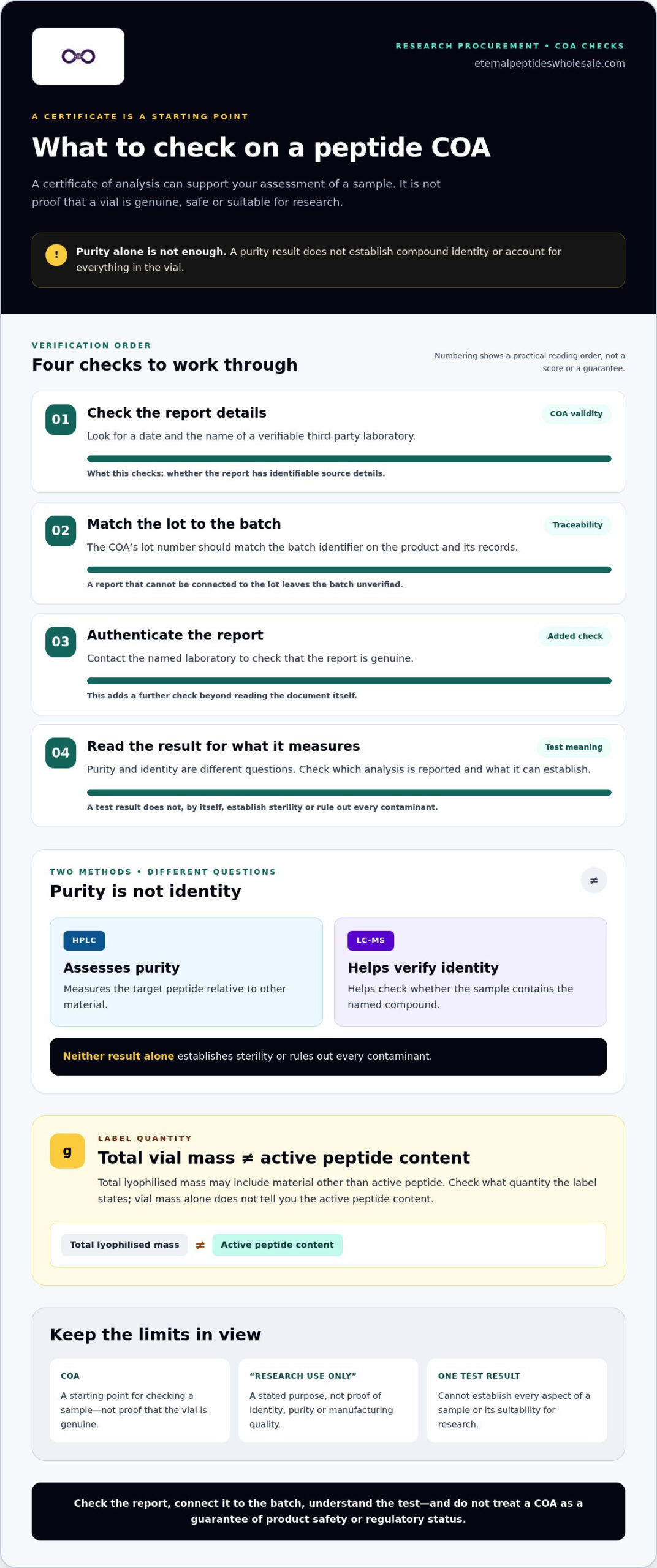
A certificate of analysis is a starting point, not proof that a peptide vial is genuine. A sound approach to avoiding counterfeit peptides in research is to check that the COA is dated, names a verifiable third-party laboratory and carries a lot number matching the batch. Contacting the named laboratory to authenticate the report adds another useful check.

A COA should clarify what a sample contains, but a purity result alone doesn’t establish the compound’s identity or account for everything in the vial. HPLC can assess purity, while LC-MS can help verify identity. Scrutinise the quantity on the label too: total lyophilised mass may not equal active peptide content.

This article explains how to assess those details, spot vendor warning signs and understand why underfilling matters. It also covers risks associated with unapproved products, including Australian reports of acute liver toxicity linked to counterfeit retatrutide. The aim is to support informed research procurement, not to treat a COA as a guarantee of product safety or regulatory status.

Key Takeaways

  • Assess a COA by looking beyond the purity result: its date, laboratory details and batch identifier all matter.
  • Understand why purity testing and identity testing answer different questions about a peptide sample.
  • Compare labelled quantity with active peptide content, as total vial mass can include filler.
  • Recognise that underfilled or incorrectly labelled products can undermine research reliability and create additional risks.
  • Consider the reported liver toxicity associated with counterfeit retatrutide when weighing the risks of unapproved products.

Research-use-only and gray-market peptide products

“Research-use-only” describes a stated purpose, not proof of identity, purity or manufacturing quality. In Australia, the Therapeutic Goods Administration (TGA) says it does not oversee the composition, manufacturing standards, safety or efficacy of unapproved peptide products.

Counterfeit, mislabelled and adulterated products

A counterfeit product imitates a genuine one, a mislabelled product gives inaccurate information, and an adulterated product contains an unintended ingredient or contaminant. Each can make a vial’s contents differ from its label, even when its packaging appears convincing. A study of falsified polypeptide drugs on the Belgian market found samples containing the advertised peptide ranged from 5% to 75% pure peptide. That variation can disrupt experimental comparisons and make results difficult to interpret.

“Research use only” or “not for human consumption” wording does not establish that a product is suitable for laboratory work. In Australia, the Therapeutic Goods Administration advises against purchasing or using unapproved peptide products, particularly those obtained online or from overseas, and advises using only products supplied through Australian pharmacies. It also reported that more than 94,500 unapproved peptide products had been destroyed in Australia in 2026.

For Australian imports, the Therapeutic Goods Act 1989 is relevant: the TGA monitors potential non-compliance involving therapeutic goods under that Act. The TGA published information for suppliers about responsibilities when importing, compounding and supplying unapproved peptide products on 13 April 2026. A research-use label alone does not settle whether an import complies with applicable requirements.

Identity, purity and sterility risks

Identity testing asks whether a vial contains the named compound; purity testing measures the target peptide relative to other material. Neither result alone establishes sterility or rules out every contaminant. A study testing products from five peptide manufacturers found that two-thirds fell below the threshold considered necessary for reliable research results. Unmarked vials and poorly traceable supply chains make it harder to connect a sample to its source and batch.

Injection adds risks associated with contamination, inaccurate concentration and poor handling. Follow the supplied handling conditions for research materials, and record the lot, arrival time, packaging condition and storage handover when a shipment arrives. If a shipment appears counterfeit or fails testing, quarantine it, retain its packaging and batch records, and document the discrepancy for investigation. Don’t use it in experiments in the meantime.

Comparing prices without compromising quality

Compare prices against the amount of active peptide, batch-specific evidence and traceability, not vial price alone. Ask what mass the label states and whether manufacturing tolerances are disclosed. A low price doesn’t establish authenticity, and a higher price can’t replace evidence about the batch.

To compare research suppliers consistently, align the compound, active peptide quantity, analytical evidence and delivery conditions. A COA that cannot be matched to a lot, or a price that obscures whether the stated mass includes filler, makes a like-for-like comparison difficult. For researchers avoiding counterfeit peptides in research, documented content and identity are essential purchasing criteria.

Warning signs of illegitimate peptide vendors

Vendor claims and sales channels can reveal gaps in accountability. Missing batch records, vague product descriptions and pressure to pay through unusual channels are reasons to pause before buying.

Buying research peptides through online marketplaces or social media can expose researchers to mislabelled products, incorrect ingredients or doses, degradation, contamination and non-sterile contents. A polished listing or positive comment doesn’t establish a compound’s identity or quality.

Payment and documentation red flags

Payment and documentation red flags may indicate that a seller is difficult to trace or hold accountable. Be cautious if payment relies on an anonymous link or the seller provides no invoice, batch identifier or consistent product description. Keep order records and compare the label, invoice and accompanying documents. Mismatched compound names or lot details make problems harder to investigate.

Marketplace and social media risks

Marketplace and social media risks arise when sales listings and peer recommendations stand in for traceable quality controls. Online peptide communities may share vendor recommendations, shipping advice, product impressions and protocol changes, but peer trust cannot replace pharmaceutical quality assurance or clinical monitoring. Positive reviews don’t establish what a vial contains.

Look for specific warning signs in the sales process rather than relying on presentation alone. For example, a listing that calls a compound “therapeutic” while offering it as a research chemical blurs its intended use. Claims about purity without batch-specific evidence also leave questions about identity, contamination and manufacturing unanswered. Note each discrepancy before proceeding.

  • Product details: Check whether the compound name and stated amount remain consistent across the listing, invoice and label.
  • Batch traceability: Look for a lot identifier that connects the product to its accompanying records.
  • Sales claims: Treat claims of therapeutic effects or guaranteed outcomes as a warning, not evidence of research quality.
  • Payment trail: Avoid anonymous payment links that leave no clear record of the transaction.

If a shipment arrives with damaged packaging, altered labels or records that don’t match the order, quarantine it and document the discrepancy. Retain the packaging, invoice and communications; these details help connect the concern to the specific shipment and batch. For procurement teams assessing wholesale research peptide supply, research peptide options can be considered alongside the same documentation and traceability criteria.

How can I verify a peptide Certificate of Analysis (COA)?

A COA is useful only when its details connect to the specific vial and test report. Check the date, laboratory identity and batch number, then assess what the reported methods can establish.

Contamination in counterfeit batches

Contamination means a sample contains unwanted material, which may not be identified by a peptide purity result alone. A report detecting retatrutide, for example, doesn’t establish whether the vial also contains contaminants, other drugs or medications. That distinction matters because a single test result can answer only the question its method was designed to examine. Review the reported analysis and its limits before relying on it.

Fake and non-batch-specific certificates

A fake certificate is not an authentic report; a non-batch-specific certificate doesn’t show that the tested sample came from the vial being assessed. Either can create false confidence in a product’s identity or purity. Look for a report date, the named third-party laboratory and a lot number tied to the batch. Contact the laboratory named on the COA to verify that it issued the report.

Warning signs include a missing date, an unverifiable laboratory name, no lot number or details that don’t match the product listing. A COA also doesn’t provide regulatory assurance about a peptide product. Treat its findings as evidence about the tested sample, not a guarantee about every vial or its regulatory status.

Batch numbers and vial matching

Batch matching means comparing the lot identifier on the vial with the one on the COA. Check every character, including letters, numbers and suffixes, then compare the compound name and stated quantity. If a shipment contains vials from different lots, each vial needs records for its own batch. A mismatch breaks the link between the report and the sample.

Keep the vial label, COA and purchase record together. If the COA lists one lot and the vial shows another, don’t treat the report as evidence for that batch. Record the discrepancy and preserve the original documents for follow-up or testing.

Independent laboratory testing

Independent testing can assess identity and purity using methods that answer different questions. LC-MS can help verify peptide identity; HPLC can assess purity, but purity testing alone doesn’t establish identity. Neither result by itself rules out every contaminant. Ask what was tested, which method was used and whether the report identifies the sample’s batch.

For suspected contamination, the laboratory analysis needs to address the specific concern; a purity result alone cannot detect every possible contaminant. Compare the reported methods with the claims made about the product, and retain the test report with the batch records. This helps distinguish a verified finding from a broad claim that a sample is simply “tested”.
Avoiding Counterfeit Peptides: Verify COAs and Peptide Content

Counterfeit retatrutide linked to acute liver toxicity

Australian reports link the use of counterfeit retatrutide with acute liver toxicity, making product identity a serious safety concern. The Therapeutic Goods Administration (TGA) says retatrutide remains in clinical trials and isn’t approved for human use. The TGA also advises Australians not to purchase or use unapproved peptide products. A vial labelled retatrutide shouldn’t be treated as equivalent to a legitimate trial product.

In Victoria, seven patients were hospitalised with acute liver toxicity after using counterfeit retatrutide. One developed severe liver injury after a second dose of unregulated retatrutide. Reported injuries occurred within a few weeks of use. These cases show why a label, seller’s claims or apparent product effects can’t establish which chemical a vial contains.

Canberra Health Services confirmed it had detected liver damage associated with products sold as retatrutide. It didn’t disclose the number of cases because the numbers were low. These reports indicate a safety signal, but don’t establish that every product labelled retatrutide has the same composition or causes the same outcome. They do make unverified products a serious concern.

Testing also illustrates the difference between a product name and its contents. Leeder Analytical tested 18 counterfeit retatrutide samples in 2026, and only one matched its label claim. About 30 per cent had higher concentrations than their labels stated, while about 30 per cent had lower concentrations. One sample contained none of the peptide. A matching label alone could not identify these failures.

For researchers, the practical response is to keep suspect material out of use and preserve evidence. Record the product name, batch details, supplier information and any test results. Keep the vial and packaging with the relevant records. If a sample fails identity or concentration testing, quarantine the affected batch and document the failure before considering further analysis. Don’t assume another vial from the same shipment is legitimate.

Anyone who has used a product sold as retatrutide and feels unwell should seek medical assessment promptly, and provide the product packaging and timing of exposure. The reported Victorian cases included severe liver injury after a second dose, so symptoms following exposure warrant attention. Researchers should also follow institutional procedures to document and report an adverse event or product-quality concern.

Counterfeit retatrutide is not the same product as retatrutide currently in clinical trials. A purity result detecting the named peptide can’t establish that a sample is free of other drugs, medications or contaminants. This limitation matters even when a certificate or vendor description seems credible. Independent testing, batch records and careful incident documentation help distinguish evidence about a sample from claims about a product.

Underfilling and net peptide content

A vial’s labelled mass doesn’t necessarily equal its active peptide content. This distinction matters in research: a sample with less active compound than expected can affect concentration calculations, comparisons between batches and reproducibility. In counterfeit retatrutide tested by Leeder Analytical, labelled quantities didn’t reliably describe vial contents. Underfilling is one possible mismatch, but an apparently full vial doesn’t establish its peptide content.

Leeder Analytical tested 18 counterfeit retatrutide samples in 2026. About 30 per cent had lower concentrations than their labels stated, while one sample contained none of the peptide. About 30 per cent also had higher concentrations than stated, showing that a label discrepancy can mean more or less active peptide, not only underfilling. The result can undermine a study’s intended concentration and make batch comparisons unreliable.

Leeder Analytical reported that peptide usually made up about 10 per cent of the contents in vials it tested. Chemist Grace Hamann said about 90 per cent of those contents was unaccounted for. This illustrates why total vial mass and active peptide mass are different measurements. The remaining material’s identity cannot be inferred from a label stating the vial’s total weight.

Consider a vial labelled as containing 5 mg of peptide. If it contains 1 mg of active peptide and 4 mg of filler, its total mass may still appear consistent with that label. A 10 mg label presents the same interpretive issue if it refers to total lyophilised mass rather than active peptide weight. Without clear labelling, researchers can miscalculate the amount of compound in a sample.

For meaningful comparisons, seek documentation that states active peptide weight and discloses manufacturing tolerances. These details help distinguish the target compound from fillers and make the labelled quantity more useful for experimental planning. A certificate reporting purity alone doesn’t necessarily show the total active peptide in the vial; purity and net content describe different aspects of a sample.

According to the Therapeutic Goods Administration, retatrutide remains in clinical trials and isn’t approved for human use. “Research use only” wording doesn’t resolve underfilling or establish suitability for human consumption. For research procurement, record the labelled quantity, batch details and test findings together. If results conflict, quarantine the sample and document the discrepancy rather than adjusting experimental quantities based on the label alone.

When assessing research-grade retatrutide for laboratory procurement, compare the stated strength with evidence about active peptide content and batch identity. Review wholesale retatrutide options as part of that documented assessment.

Eternal Peptides Wholesale: Retatrutide 10mg (wholesale)

Eternal Peptides Wholesale offers Retatrutide 10mg (wholesale) for laboratory research use. Researchers procuring retatrutide can consider this offering when sourcing wholesale quantities, while applying the same checks discussed above: review batch-specific documentation, confirm the vial and certificate details align, and assess active peptide content rather than relying on the label alone.

According to the Therapeutic Goods Administration, retatrutide remains in clinical trials and isn’t approved for human use. This offering is for research purposes only, not human consumption or medical use. Product selection doesn’t replace an independent assessment of identity, purity or suitability for a particular research protocol.

For wholesale retatrutide enquiries, contact Eternal Peptides Wholesale or visit eternalpeptideswholesale.com.

Make your next procurement decision evidence-led

Turn your findings into a documented procurement process. Set acceptance criteria before ordering, assign responsibility for receiving checks, and keep batch records alongside research results. Consistent records make it easier to identify discrepancies and assess whether material belongs in a study. They also help teams apply the same standard to future orders instead of relying on supplier claims or informal impressions.

A disciplined approach to avoiding counterfeit peptides in research is built into decisions made before a shipment arrives. Eternal Peptides Wholesale offers Retatrutide 10mg (wholesale), Retatrutide 20mg (wholesale) and cjc-1295(without DAC) + Ipamorelin (5/5mg) (Wholesale) for research purposes, not human consumption or medical use.

For wholesale research sourcing, contact Eternal Peptides Wholesale and carry your evidence-led procurement standards into the next stage of your work.

Frequently Asked Questions

How do I know if a peptide COA is real?

Authenticate a COA by confirming its details directly with the named laboratory, using contact information you find independently. Check that the report identifies the tested sample and its batch, and that the compound description matches your vial. A professional-looking document can still be misused or altered. Even a genuine report supports findings only about its tested sample; it doesn’t establish regulatory status or guarantee that every vial matches.

What should I look for in a trustworthy peptide vendor?

Look for traceable business details, consistent product descriptions and records that connect an order to a specific batch. A supplier should distinguish research-use products from therapeutic medicines and avoid claims of treatment effects. Check that invoices, labels and technical documents use the same compound name and identifiers. Online endorsements alone are weak evidence: peer recommendations can’t replace documented quality controls or establish the contents of a particular shipment.

How can researchers verify the identity and purity of research peptides?

Use complementary analytical methods: LC-MS can help assess identity, while HPLC can assess purity. Arrange testing on a sample from the received batch and retain its chain-of-custody details, including who collected and transferred it. Interpret each result within the method’s scope. A purity result doesn’t prove identity, and detecting the expected peptide doesn’t rule out other compounds or contaminants.

What certificates of analysis and batch documents should peptide suppliers provide?

For each batch, keep the COA with the invoice, product label and shipment record. The COA should identify the laboratory, report date, tested sample, analytical methods and batch identifier; the other records should connect that report to the material received. Record discrepancies when the shipment arrives rather than correcting them informally. This creates an auditable trail for later testing, study review or procurement investigations.

How can researchers check whether a peptide supplier is reputable in Australia?

Assess traceability and documentation, but don’t treat an Australian location as proof of product quality or regulatory status. The TGA says it doesn’t oversee the composition, manufacturing standards, safety or efficacy of unapproved peptide products. Eternal Peptides Wholesale supplies bulk products labelled “Research Use Only” and “Not for human consumption”; its batch reports come from Janoshik independent laboratory testing. These details inform procurement, not medical or regulatory approval.

Posted on

TB-500 for Cell Migration Assays: Design, Controls and Interpretation

TB-500 for Cell Migration Assays: Design, Controls and Interpretation

What if a stronger migration signal reflects increased cell growth or improved viability rather than greater movement? That distinction matters when assessing TB-500 for cell migration assays, because both the peptide material and experimental conditions can shape a readout. The name TB-500 may not identify the same material across sources, and migration assays can capture effects other than cell movement.

This article explains how to evaluate TB-500 in cell migration research by matching material identity, assay design and controls to the research question. It also outlines how to interpret results cautiously, without treating an observed change as proof of a specific mechanism or effect.

We compare key assay considerations, including migration readouts and controls for proliferation and viability, then discuss how to document material identity and assess limitations. For Australian laboratory procurement, Eternal Peptides Wholesale supplies TB-500 5mg in wholesale quantities for research use. Product information and research-use status provide procurement context, not evidence of assay performance.

Key Takeaways

  • Define the migration question first, then select an assay format that can address it without implying therapeutic relevance.
  • Compare scratch and transwell readouts against the specific research question and each format’s limitations.
  • Use suitable vehicle, untreated and reference controls to help distinguish migration observations from effects on cell growth or viability.
  • Compare evidence only after considering material identity, cell model, assay format, controls and endpoint.
  • For laboratory procurement, align research-use material documentation and planned study scale with the study’s requirements.

What does TB-500 for cell migration assays actually mean?

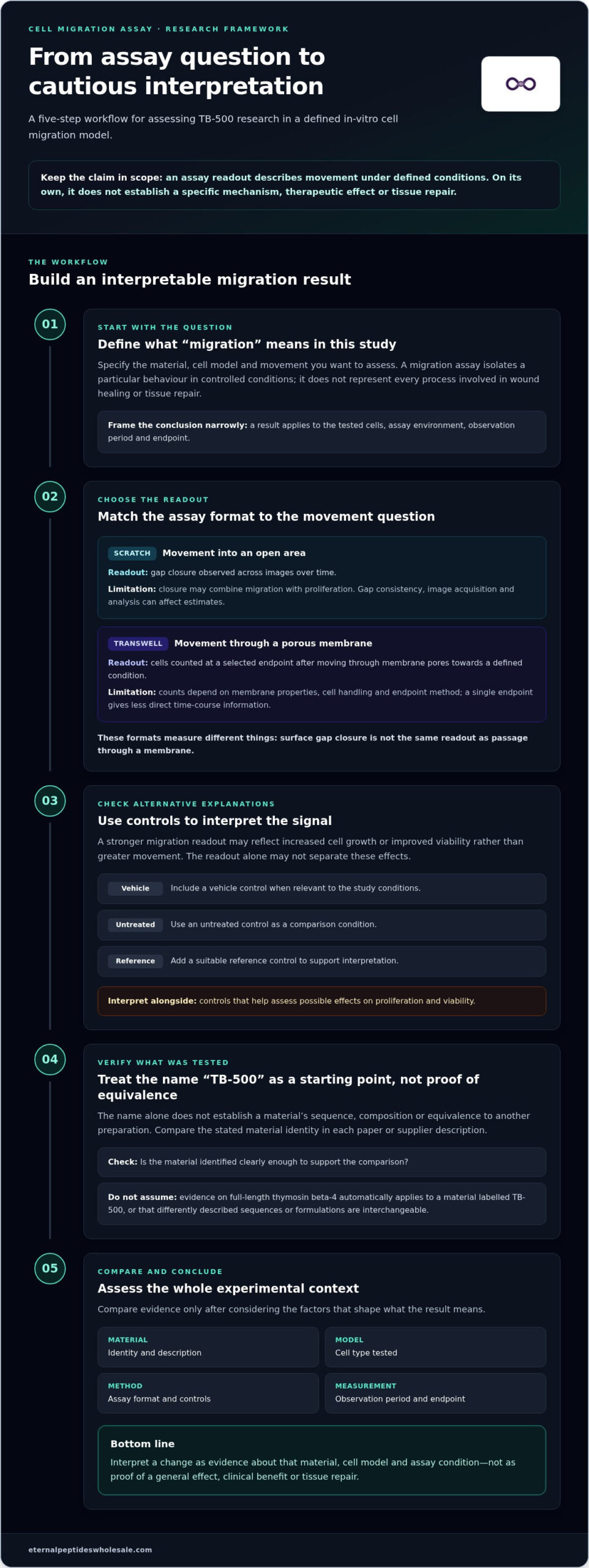
The phrase TB-500 for cell migration assays describes a research question, not a settled biological conclusion: does a specified material alter cell movement in a defined in-vitro model? The answer depends on the material’s identity, the cells tested and how movement is measured. An assay result cannot, by itself, establish a therapeutic effect or predict what may happen in living tissue.

This distinction matters because migration is often discussed alongside wound healing and tissue repair. Those processes involve multiple cell types and biological events, while a migration assay isolates a particular behaviour under controlled experimental conditions. A change in the assay readout is evidence about that model and those conditions. It is not proof of clinical benefit, tissue repair or a general effect across cell types.

How should researchers understand TB-500 terminology?

TB-500 is a name used in research and commercial contexts, but the name alone doesn’t establish a material’s sequence, composition or equivalence to another preparation. Compare the terminology in each paper or supplier description with its stated material identity. The TB-500 Wikipedia page offers general orientation on the name and its relationship to thymosin beta-4. It should not replace primary documentation or study methods.

Evidence explicitly concerning full-length thymosin beta-4 should not automatically be presented as evidence for a material labelled TB-500. Likewise, don’t assume that differently described sequences or formulations are interchangeable. When a source reports an effect, check whether it identifies the material clearly enough to support the comparison being made.

What does a cell migration assay measure?

Migration means movement of cells within a specified assay environment. Depending on the format, the endpoint may reflect movement into an open area or movement through a barrier. These are operational readouts: they quantify a defined observation, rather than revealing every process that contributed to it.

For example, a change in occupied area may be consistent with cell movement, but proliferation can also affect how much area is covered. Cell loss or reduced viability may change the number of cells available to move. Assay design and relevant controls help researchers evaluate these possibilities, but the readout alone may not separate them.

A migration assay records cell movement under defined conditions; its readout doesn’t, on its own, distinguish movement from changes in proliferation or viability.

Keep interpretation close to the experiment: consider the cell model, assay environment, observation period and endpoint. A result in one cell type doesn’t establish the same response in another, and an in-vitro movement signal doesn’t demonstrate tissue repair. Define the research question precisely before interpreting a change as migration-related. This keeps conclusions proportionate to the evidence and gives later comparisons a clear basis.

How do scratch and transwell assays assess cell migration?

Assay choice determines what “migration” means in a study. A scratch assay tracks cells moving across a surface into an initially cell-free area. A transwell assay examines cells moving through a porous membrane towards a defined condition. Neither format answers every cell-movement question. For a TB-500 migration study, the practical question is not which format is universally better, but which readout fits the hypothesis and can be interpreted with its limitations in view.

When is a scratch assay a useful model?

A scratch assay is suited to observing how a cell layer closes a defined gap over time. Images show the changing area, making movement visible as a time course rather than only as a final count. However, closure may also reflect cell proliferation, so it isn’t automatically a pure measure of migration. Scratch consistency, image acquisition and analysis choices can all influence the apparent result and complicate comparisons.

Assay format Question and readout Key limitation
Scratch How does a cell layer move into a cell-free area? Readout: gap closure across images. Closure may combine migration with proliferation; gap shape and image analysis affect estimates.
Transwell How many cells move through a porous membrane towards a defined condition? Readout: cells counted at an endpoint. Counts depend on membrane properties, cell handling and the endpoint method; they provide less direct time-course information.

What does a transwell assay add?

A transwell format asks whether cells pass through membrane pores under the conditions being tested. It can suit a question about movement across a barrier rather than lateral movement along a surface. Results are often expressed as a count of cells that have crossed by the selected endpoint. That differs from repeated surface imaging, which can show how closure changes over time but doesn’t measure passage through a membrane.

Membrane characteristics shape the conditions cells encounter, while cell preparation and handling can influence which cells reach the measured side. An endpoint count also compresses movement over time into one observation. It may not show when movement occurred or distinguish cells that crossed early from those that crossed later. Keep these differences in mind when deciding what a result supports.

A scratch assay observes migration across a surface; a transwell assay counts movement through a porous barrier towards a defined condition. Each is a different operational measure, not a direct substitute for the other. A study focused on gap closure may favour surface imaging, while a question about traversing a barrier may call for a transwell approach. If the research question involves both behaviours, complementary formats can offer different perspectives, but interpret their readouts separately.

For a meaningful comparison, match the assay to the biological question, then consider how growth, viability or technical variation could influence its endpoint. Eternal Peptides Wholesale supplies TB-500 5mg in wholesale quantities for laboratory research use. Procurement context is separate from evidence that a material performs in either assay. Researchers reviewing wholesale TB-500 5mg research material can keep that distinction clear while planning study requirements.

Which controls make TB-500 migration results more interpretable?

Controls help researchers identify what a migration result can and can’t support. They don’t guarantee an outcome or prove a mechanism. In TB-500 migration studies, choose controls with the material, its vehicle, the cell model and assay format in mind. A result is more informative when the comparison helps show whether a difference is associated with the test condition rather than the carrier, baseline behaviour or another cellular effect.

A vehicle control accounts for the solution or carrier used to present the test material. An untreated control provides a baseline without that treatment or vehicle, where appropriate to the design. Comparing these groups can help reveal whether the vehicle itself is associated with a change. An assay-appropriate reference control may also help establish that the model can produce a measurable response. Its role is to contextualise the assay, not to validate TB-500 or guarantee that every experiment will behave as expected.

How can researchers separate migration from proliferation?

Greater scratch closure alone doesn’t establish greater migration. Cells may divide and occupy more of the gap, so an apparent change in closure could reflect a combination of movement and proliferation. Pairing migration observations with a suitable proliferation assessment helps researchers judge whether cell growth offers an alternative explanation. Interpret each measure according to what it can resolve, rather than treating a second readout as automatic proof of cause.

Viability is another relevant consideration. If fewer cells remain viable in one condition, the migration readout may change because the number of cells able to move has changed. Considering viability alongside movement can help distinguish a migration-related observation from a broader effect on cell health. Select these assessments to suit the cell model and research question. No single control or measurement resolves every interpretive issue.

Migration readouts need controls for competing cellular effects, because movement, proliferation and viability can each influence the observed signal.

How do model choice and analysis affect interpretation?

Cell type matters. Models differ in baseline motility and may not represent the biological context a researcher wants to examine. A result in a highly motile cell model may not translate to a model with different behaviour. Choose the model in relation to the question, and describe its limits so the conclusion stays within the evidence generated.

Consistent study conduct and analysis also support fair interpretation. Report the replicate structure clearly, and apply image acquisition and analysis criteria consistently across comparison groups. State how measurements were made and explain any exclusions rather than removing observations without a transparent rationale. Report variability as well as the direction of the result, since a single summary value can conceal differences between replicates.

Read the controls together: vehicle and untreated comparisons address different baselines, while a reference control can provide assay context. Then consider whether proliferation, viability, model behaviour or analysis choices could account for some of the observed signal. Reporting these uncertainties plainly strengthens the interpretation and prevents an in-vitro observation from being presented as more conclusive than the design allows.

TB-500 for Cell Migration Assays: Design, Controls and Interpretation

How should researchers compare evidence and assess assay limitations?

Comparing TB-500 migration studies takes more than lining up reported outcomes. First establish whether the studies tested comparable materials and models, then assess how each experiment measured movement. Different results may reflect different study conditions rather than a contradiction. Treat each paper as evidence for the specific material, cells and assay it describes.

Which details should a study comparison capture?

Build a concise evidence record before comparing conclusions. Capture the reported material identity and analytical characterisation, followed by the cell model, assay format, comparator conditions and measured endpoint. This makes gaps visible and helps distinguish directly comparable studies from adjacent evidence. If a paper proposes a mechanism, record it as the authors’ interpretation, separate from the observation the experiment measured.

  • Material: Note the name, stated sequence or composition, and analytical characterisation reported by the authors. Don’t treat a shared label as proof of equivalence.
  • Model and format: Record the cell type and whether movement was assessed across a surface or through a barrier.
  • Comparison and endpoint: Identify control conditions and what was quantified, such as gap closure or cells counted at an endpoint.
  • Interpretation: Separate measured findings from proposed explanations, and note relevant limitations in the methods.

Analytical characterisation can clarify what a study reports about its test material, but it doesn’t establish that different materials are interchangeable or that an assay finding will be reproduced. For background on the role of these methods in peptide assessment, consult the guide to HPLC and MS analysis for peptide purity.

What can and cannot be concluded from assay results?

Give greater weight to evidence that clearly identifies the material and describes the model, assay, controls and endpoint. Findings involving thymosin beta-4 or another related material may provide context, but they aren’t direct evidence about a material specifically named TB-500 unless identity and composition support that comparison. If nomenclature is inconsistent or methods are incomplete, mark the comparison as uncertain rather than filling gaps with assumptions.

A reported change in movement supports a conclusion about that observation under the conditions studied. It doesn’t, by itself, establish a general mechanism, an effect in other cell models or clinical benefit. Missing controls can leave alternative explanations unresolved, and unclear endpoints can make two results appear similar when they measure different things. State these boundaries plainly. They’re part of the evidence, not a reason to overstate or dismiss a finding.

Use this framework to decide whether a paper offers direct, relevant evidence or only background for a new question. For Australian laboratories planning procurement, Eternal Peptides Wholesale supplies TB-500 5mg in wholesale quantities for laboratory research use. Explore wholesale research peptides as a procurement option, keeping product information separate from evidence of assay performance.

How can laboratories source TB-500 for research responsibly?

Procurement planning should follow the study design, not replace it. Before sourcing TB-500 for an assay, align the material description in the procurement record with the identity criteria in the research plan. A familiar label alone may not establish that materials described differently in papers or supplier information are equivalent. Keeping identity requirements explicit helps laboratories make meaningful comparisons and maintain consistent study records.

What should a laboratory document before procurement?

Set out the material description the study requires, including any identity details essential to its inclusion and reporting criteria. Then estimate quantity from the planned research programme and the laboratory’s procurement workflow. The appropriate amount depends on the work planned; don’t treat a pack size as evidence of how much a particular study needs.

Maintain relevant product and batch records alongside study documentation. Retain relevant product information with the material description and procurement details so the laboratory can trace what was assigned to the work. Record differences between the material description and the terminology used in published studies. This creates a clearer audit trail and helps prevent later comparisons from relying on a name alone.

  • Material identity: Align the recorded description with the study’s defined inclusion criteria.
  • Documentation: File relevant product information with the research records.
  • Batch traceability: Preserve batch details associated with the material used.
  • Planned scale: Base quantity planning on the programme and procurement process.

How does wholesale sourcing fit laboratory research?

Wholesale supply suits institutional and laboratory procurement workflows that plan research material as part of a broader programme. Eternal Peptides Wholesale supplies TB-500 5mg for wholesale research use. That product context is separate from evidence that a material changes cell migration: sourcing information does not establish sequence equivalence, assay validation or experimental performance.

For procurement teams considering related research materials, the wholesale tissue repair procurement guide provides further context for planning. Keep the intended research question, material description and records aligned, and assess experimental findings independently of supplier or product descriptions.

Peptides supplied by Eternal Peptides Wholesale are for research purposes only, not for human consumption or medical use. Keep this boundary clear in laboratory procurement and handling documentation. Responsible sourcing supports organised research records; it does not replace appropriate assay controls or demonstrate a result.

For laboratory research procurement, explore wholesale TB-500 5mg and assess its product information against your study’s documented requirements.

Set up the next research decision with clarity

Before moving from evidence review to procurement, define what a useful result would mean for your study. Set material identity and comparison criteria alongside the assay endpoint, then keep those requirements consistent in the study plan and procurement records. This gives your team a clear basis for evaluating TB-500 in migration assays without treating a product description as evidence of experimental performance.

Eternal Peptides Wholesale is an Australian-based wholesale supplier serving laboratory research needs, and supplies TB-500 5mg for wholesale research use. The material is intended for research purposes only, not human consumption or medical use. Keep procurement decisions aligned with your laboratory’s documented research requirements and assess assay findings on their own evidence.

Explore TB-500 for wholesale research supply as you plan your next laboratory study. A clear question, defined evidence criteria and organised procurement records can help your research proceed with greater confidence.

Frequently Asked Questions

Is TB-500 the same as thymosin beta-4?

No, the names alone don’t establish that two materials are identical. Compare the exact identity and composition reported in a study with the material described in the research record or product documentation. Findings involving thymosin beta-4 shouldn’t automatically be attributed to every material labelled TB-500. If a paper doesn’t provide enough information for that comparison, record the identity as uncertain and avoid treating the terms as interchangeable.

Can a scratch assay prove that TB-500 increases cell migration?

No, a scratch assay observation alone can’t prove that TB-500 increases migration. In a migration assay, apparent gap closure might also be influenced by cell growth, viability, scratch uniformity or image-analysis choices. Compare the result with appropriate controls and relevant supporting measurements, and report the conclusion for the cell model and conditions tested. An in-vitro observation doesn’t establish clinical efficacy or therapeutic benefit.

How do researchers quantify cell migration in a scratch assay?

Researchers can quantify changes in the cell-free area or track movement across images captured over time. For a meaningful comparison, define the measurement method and image-analysis rules in advance, then apply them consistently across groups. For example, changes in image scale, gap boundaries or segmentation criteria can affect calculated closure. Interpret the metric alongside relevant proliferation and viability information, since closure alone can’t identify which cellular processes contributed to it.

Does a transwell assay measure the same thing as a scratch assay?

No, the formats assess different movement contexts. A scratch assay follows closure across a cell-covered surface, while a transwell assay assesses cells passing through a porous membrane under defined conditions. Their endpoints aren’t directly interchangeable: one may quantify area change across images, while the other may count cells at an endpoint. Compare results only after accounting for the cell model, assay setup and measurement method used in each study.

Does an HPLC purity result confirm that TB-500 is active in a migration assay?

No, an HPLC purity result alone doesn’t demonstrate activity in a cell migration assay. It provides analytical information about a sample, not a functional outcome in a specific biological model. Keep analytical characterisation separate from assay evidence and consider the reported material identity, experimental conditions and controls when assessing a result. A purity figure shouldn’t be interpreted as proof of assay validation, biological activity or performance.

Can cell migration assay results show that TB-500 has a therapeutic effect?

No, cell migration assay results can’t establish a therapeutic effect. They are laboratory observations from a particular material, cell model and experimental setting, not evidence of clinical efficacy, safety or suitability for human use. Keep conclusions within the scope of the experiment and avoid translating an in-vitro finding into a medical claim. Research peptides discussed in this context are for research purposes only, not human consumption or medical use.

Related from Eternal Peptides Wholesale

Eternal Peptides Wholesale publishes batch-specific Janoshik Analytical reports in its certificate of analysis library, so the documentation for a listed batch can be read alongside the evidence discussed in this article.

Related reading: TB-500 Actin-Binding Properties Research: Evidence and Limits; Anti-inflammatory Peptide Compounds for Study: Evidence, Mechanisms and Research Considerations

Posted on

In Vitro Studies Using Retatrutide: A Researcher’s Guide

In Vitro Studies Using Retatrutide: A Researcher’s Guide

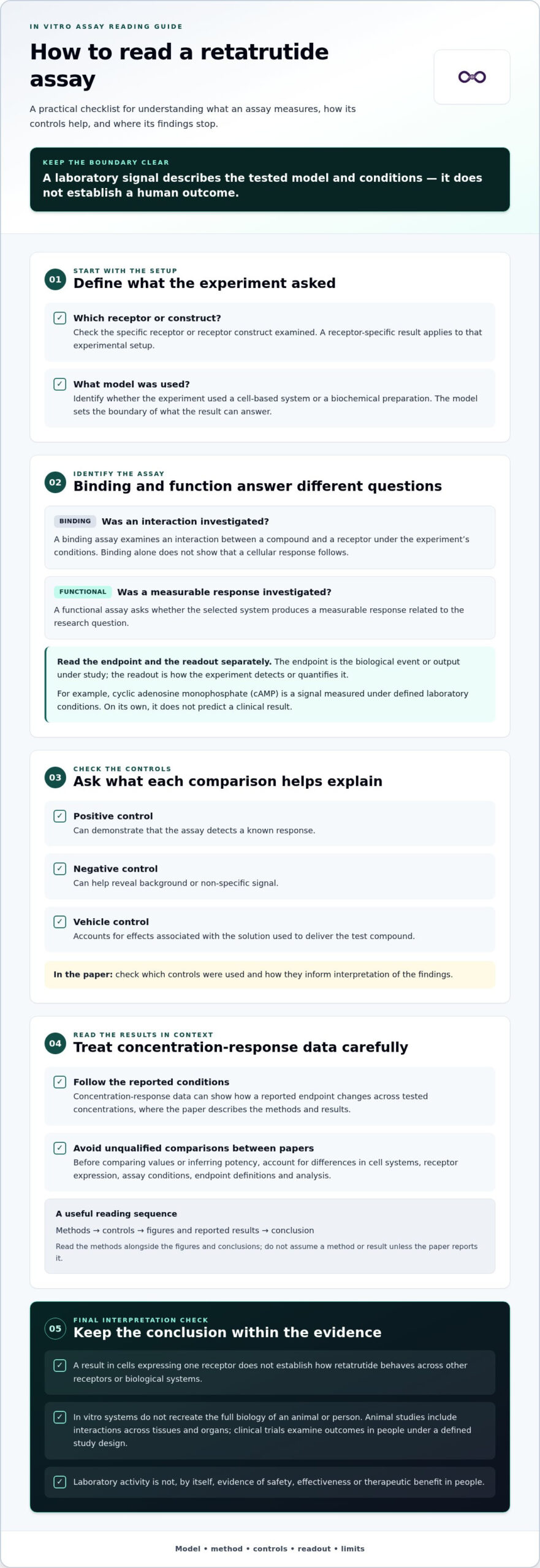
A receptor response in a dish is not proof of a human outcome. In vitro studies using retatrutide can help researchers characterise activity at GLP-1, GIP and glucagon receptors, but they can’t establish whether the compound is safe or effective in people.

Comparing studies takes more than scanning their conclusions. Papers may use different cell models, concentrations and assay endpoints. A change in cyclic adenosine monophosphate (cAMP), for example, describes a signal measured under defined laboratory conditions. On its own, it doesn’t predict a clinical result.

This guide explains what in vitro retatrutide research can show and how to assess the design behind reported results. It covers receptor-specific assay models, concentration-response data, controls and reporting choices that affect comparability. It also explains the limits of extrapolating between experimental systems, distinguishes laboratory evidence from clinical evidence, and outlines practical considerations for responsible research planning. The aim is to help you read the literature critically without treating a promising signal as proof of an outcome in humans.

Key Takeaways

  • Learn what in vitro studies using retatrutide can investigate, and why the research question shapes how results should be interpreted.
  • Distinguish receptor-binding assays from functional assays, and check which readouts the paper actually reports.
  • Compare cell, animal and clinical evidence by the question each model can answer, rather than treating them as interchangeable.
  • Use a structured reading sequence to examine a paper’s model, methods, controls, results and limitations.
  • Translate critical appraisal into responsible study planning, with documented protocols and appropriate institutional oversight.

What in vitro studies using retatrutide investigate

In vitro research examines biological processes outside a whole living organism, using systems such as cultured cells or biochemical preparations. A retatrutide study might investigate whether the compound interacts with a particular receptor or produces a measurable response in a defined model. This approach isolates a question for closer examination. It doesn’t recreate the full biology of an animal or person.

What does in vitro mean in peptide research?

A cell-based experiment uses cells selected or engineered to investigate a biological feature. A biochemical system may focus on a narrower interaction, such as binding between molecules. Both differ from animal studies, which include interactions across tissues and organs, and human clinical trials, which examine outcomes in people under a defined study design.

The model sets the boundary of the answer. A receptor-expressing cell system can help investigate activity at that receptor, but it can’t represent every relevant cell type, organ or whole-body process. In vitro results shouldn’t be treated as a direct substitute for animal or clinical evidence.

Why study retatrutide in laboratory models?

Researchers may use laboratory models to examine specific early questions and decide what further research is warranted. Retatrutide is described as a multi-receptor agonist acting at the GLP-1, GIP and glucagon receptors. The Retatrutide Wikipedia page provides an overview of this reported mechanism. For a scientific assessment, the original research and its methods remain essential.

Investigating receptor activity characterises a biological response under defined conditions. It isn’t evidence, by itself, of therapeutic benefit. A paper’s aim, model, experimental conditions and measured endpoint determine what its findings can support. For example, a result in cells expressing one receptor doesn’t establish how retatrutide behaves across other receptors or biological systems.

An in vitro result describes what was observed in the tested laboratory model, not what will happen in a human body. That distinction is central to interpreting this research responsibly.

When reading a paper, identify the research question first. Check which receptor or process was examined, what model was used, and whether the researchers measured binding, signalling or another outcome. Then compare the conclusion with the evidence reported. If an experiment tested a specific response in a particular cell system, broader claims about safety, effectiveness or outcomes in people go beyond what that result can establish.

How retatrutide in vitro assays measure biological activity

An assay turns a defined research question into a measurable endpoint. For retatrutide, that might mean asking whether it binds a specified receptor or whether a selected cell system produces a measurable response under stated conditions. These are different questions, so the assay type and methods matter as much as the headline result.

Interpret in vitro studies using retatrutide from the primary paper, not a general description of the compound. Check which receptor or receptor construct was examined, what model was used and what the researchers measured. Don’t assume an assay used a particular method or produced a particular result unless the paper reports it.

Binding assays and receptor activity

A binding assay investigates an interaction between a compound and a receptor under the conditions set by the experiment. On its own, it doesn’t show that binding triggers a cellular response or that the compound has a clinical benefit. The receptor construct and assay format also define the interaction being assessed.

For a useful comparison, check the original paper for the receptor studied, how binding was measured and what the reported result represents. A receptor-specific result applies to that experimental setup. Don’t generalise it to other receptors or biological systems without supporting evidence.

Functional assays, controls and readouts

A functional assay asks whether a system produces a measurable response related to the research question. The endpoint is the biological event or output under study; the readout is how the experiment detects or quantifies it. If a paper reports cyclic adenosine monophosphate (cAMP), for example, that signal relates to the assay’s specified conditions and model. It isn’t, by itself, a measure of a human outcome.

Controls help show how to interpret an observed signal. A positive control can demonstrate that an assay detects a known response. A negative control can help reveal background or non-specific signal. A vehicle control accounts for effects associated with the solution used to deliver the test compound. Check which controls the paper used and how they inform the findings.

Concentration-response data can show how a reported endpoint changes across tested concentrations, where the paper describes the methods and results. Don’t infer potency or compare values across papers without considering differences in cell systems, receptor expression, assay conditions, endpoint definitions and analysis. These factors can affect the signal. Read the methods alongside the figures and conclusions.

An assay readout answers a defined experimental question under specified conditions; it doesn’t establish effects beyond that model and endpoint. Eternal Peptides Wholesale supplies research-grade retatrutide for laboratory research purposes, including wholesale 10mg and 20mg offerings. Explore research-purpose retatrutide supply when planning material requirements for a defined study.

In vitro findings versus animal and clinical evidence

Different research models answer different questions. A cell response may support a mechanism worth investigating, but it can’t show how a whole organism responds or establish safety, effectiveness or dosing in people. Read in vitro studies using retatrutide as one type of evidence, not as a shortcut to conclusions that require other models.

Research stage What it can help answer What it can’t establish alone
In vitro Whether a defined response occurs in a specified cell or biochemical system under stated conditions. Whole-body effects, human safety, clinical effectiveness or appropriate dosing.
Animal research How responses occur in an animal model, including interactions across systems within that model. That the same response, risks or dose will apply to people.
Clinical research How an intervention performs in human participants under the particular trial design and conditions. Conclusions beyond the population, outcomes or duration studied.

What cell-based results can support

A cell-based result can support a mechanistic hypothesis within the boundaries of the experiment. If a paper reports a change in a measured endpoint in cells expressing a specified receptor, for instance, that finding supports a statement about that model and endpoint. It doesn’t predict a change in a person.

Interpret the result in light of the cell model, controls, experimental conditions and endpoint. A clear signal with appropriate controls may strengthen confidence that an effect was observed in that system. It still doesn’t show whether the response would persist amid the interacting organs, feedback mechanisms and other factors present in a whole organism.

What requires evidence beyond an in vitro model?

Questions about whole-organism responses require research designs that can assess those responses. Animal studies are preclinical research, not human trials, and their findings relate to the animal model used. Clinical trial findings concern human participants and must be interpreted in light of the trial’s design, population and measured outcomes. Neither type of evidence can be inferred from a cell experiment.

This isn’t a guaranteed, step-by-step evidence pathway. A study at one stage doesn’t, by itself, show what came before or after, or establish the quality of related evidence. Read each source for what it reports.

In Australia, the Australian Clinical Trials search resource can help readers find trial listings. A listing is a discovery tool, not proof that a trial has reported results or that a finding validates a laboratory result. Check the record’s status and linked study information before drawing conclusions.

Keep the claim matched to the model: cell data describe a laboratory observation, animal data describe an animal model, and clinical results describe the human study conducted. Each adds a different kind of evidence, with limits that should remain visible in any summary.

In Vitro Studies Using Retatrutide: A Researcher’s Guide

How to assess an in vitro retatrutide paper

A disciplined reading sequence helps separate what an experiment measured from what its authors infer. For in vitro studies using retatrutide, note the model and methods before weighing the conclusions. Missing detail can make a result harder to evaluate or reproduce, but it doesn’t automatically make the finding invalid.

  1. Research question: Identify the specific question the study set out to answer. Is it testing receptor binding, a functional response or another defined endpoint? Use the stated aim to judge whether the methods and conclusions are aligned.
  2. Model: Record the cell type or assay system and the receptor target, if applicable. Note whether the cells naturally express the relevant target or have been engineered to do so. The model determines which biological question the result can address.
  3. Methods: Look for enough information to understand the experimental conditions, measurement method and analysis. Check how the test material was identified in the paper and whether the reported methods explain the basis for comparisons.
  4. Controls: See which controls were included and what each is intended to assess. Note the number and type of replicates, where reported, and whether the analysis distinguishes independent experiments from repeated measurements within one experiment.
  5. Results: Read the figures, tables and text together. Identify the measured endpoint, the direction and variability of the reported signal, and whether the authors’ interpretation follows from those data.
  6. Limitations: Review the authors’ stated limitations, then consider whether the model, assay conditions or lack of independent replication further constrain interpretation. Ask whether the conclusion stays within the tested system and reported endpoints.

Check the model, methods and controls

Methodological detail is a practical test of interpretability. A paper that names a receptor but gives little information about its cell system, for example, may leave readers uncertain about how to compare its result with another assay. Record what is reported, what is missing and why that detail matters. Treat omissions as limits on assessment, not proof that a result is wrong.

Replicates also need careful reading. Technical repeats can show consistency within a measurement, while independent experiments address repeatability across separate runs. The paper’s definitions and analysis should make clear which kind it reports. Don’t assume that a larger number of measurements necessarily means more independent evidence.

Read results and limitations together

Separate the observed data from the authors’ proposed explanation. A measured signal is a result; a suggested mechanism is an interpretation that may need further testing. Consider whether the discussion acknowledges limitations in model relevance, assay conditions and independent replication.

Analytical methods such as HPLC and mass spectrometry can provide information about material characterisation. That context doesn’t demonstrate biological activity or efficacy. Keep analytical quality questions separate from conclusions about what an assay response means.

Appraise the question, model, methods, controls, results and limitations, then check that every conclusion stays within the evidence reported. For laboratory research planning, explore wholesale research-grade retatrutide from an Australian-based supplier.

Planning responsible laboratory research with retatrutide

A clear study plan links the research question to the model, endpoint, controls and reporting requirements. Before sourcing material, document what the experiment is intended to investigate and what evidence would be needed to interpret the result. This keeps material and method decisions anchored to the research plan, rather than to assumptions about what a laboratory result might mean.

Set the research question and documentation needs

Use a planning checklist to make key decisions visible before work begins:

  • Research question: State the biological question and define what the study is not designed to establish.
  • Model and endpoint: Record the selected system, target and measurable outcome, with a rationale for their fit to the question.
  • Controls and analysis: Specify the planned controls, replication approach and analysis framework in the protocol.
  • Reporting: Decide which methods, conditions and results must be recorded so another reader can assess how the conclusion was reached.
  • Material requirements: Align the material description and any required specifications with the approved institutional plan and the needs of the selected research model.

Document these decisions in the protocol before materials are sourced. This makes it easier to identify what the study depends on and assess whether the final report reflects the authorised work. Research peptide sourcing is one procurement consideration to plan alongside the scientific requirements.

Institutional review and applicable laboratory governance are part of responsible planning. Follow the relevant processes at your institution, including review or approval requirements that apply to the work, and retain the authorised protocol and associated records. This section is a planning framework, not a substitute for institutional oversight or advice on specific Australian regulatory obligations.

Keep research supply separate from medical use

Research-grade peptides are for laboratory research purposes only. They are not for human consumption or medical use, including diagnosis or treatment. Keeping that boundary explicit in procurement records, protocols and research communications helps prevent laboratory supply from being confused with clinical products or evidence.

Eternal Peptides Wholesale is an Australian-based B2B supplier of research-grade peptides, including wholesale Retatrutide 10mg and 20mg. This supply is strictly for laboratory research, not medical use.

Responsible planning brings the scientific question, institutional process and research-purpose sourcing into alignment. For laboratory research, explore wholesale retatrutide for laboratory research.

Carry rigorous interpretation into your next research decision

Make your research question and its boundaries explicit before a project moves into the laboratory. A well-documented plan gives collaborators a shared basis for decisions and makes later reporting easier to assess. It also helps keep the intended purpose of the work clear as findings are reviewed and communicated.

Approach in vitro studies using retatrutide with that discipline: treat each result as a contribution to a defined research question, not as a conclusion beyond the evidence. Clear records and careful interpretation support more useful discussion, comparison and future research.

For Australian laboratory teams planning research-purpose supply, Eternal Peptides Wholesale offers wholesale Retatrutide in 10mg and 20mg options. Supply is strictly for laboratory research, not human consumption or medical use. Explore wholesale Retatrutide for laboratory research for your next project.

Thoughtful research starts with clear questions and responsible decisions. Keep that standard at the centre of the work ahead.

Frequently Asked Questions

What are in vitro studies using retatrutide?

In vitro studies using retatrutide are laboratory experiments that examine the compound in a cell-based or biochemical system outside a whole organism. A researcher might investigate a particular receptor interaction or a cellular response, depending on the model and assay. A paper focused on one receptor doesn’t automatically describe activity at every target. The experimental question and methods define what the result can support.

What can in vitro studies tell us about retatrutide?

They can provide evidence about a measured interaction or response in the specific laboratory system tested. Their usefulness depends on details such as the cell model, assay conditions and controls. If two papers report different signals, compare their methods before deciding whether the results conflict. They may have tested different endpoints or systems. These findings can inform research questions, but they don’t predict a particular outcome in a person.

Are in vitro retatrutide results evidence of clinical effectiveness?

No. A laboratory result isn’t evidence that retatrutide is clinically effective. It describes an observation made under the conditions of that experiment, not a treatment outcome in people. To assess clinical effectiveness, readers need relevant human research with reported outcomes and a study design suited to the question. Even then, findings should be understood in the context of the participants and outcomes studied.

How do researchers measure retatrutide activity in vitro?

Researchers use methods that fit the question. A binding assay examines an interaction with a specified receptor, while a functional assay measures a selected response in a biological system. Some papers may report cAMP as a signalling readout, but don’t assume it was measured unless it appears in the methods and results. To interpret a figure, identify what signal was measured and how the authors define the endpoint.

Can in vitro studies determine a retatrutide dose for people?

No. Cell or biochemical experiments can’t determine a dose for people. An experimental concentration describes the amount used in that particular assay, not a human dosing recommendation. The relationship between laboratory conditions and exposure in a person can’t be established from an in vitro result alone. Dosing questions require appropriate evidence from human research, and research-grade material must not be used to make personal dosing decisions.

How are in vitro studies different from clinical trials?

In vitro studies examine a defined process in cells or another laboratory system. Clinical trials investigate questions in human participants according to a study protocol, which may include specified outcomes and monitoring. The models and evidence are different: a cell assay can’t show how an intervention performs in people, while a trial’s findings apply to the population and outcomes it studied. One type of evidence shouldn’t be substituted for the other.

Where can I find Australian clinical trials involving retatrutide?

Search the Australian Clinical Trials website using “retatrutide” and, if needed, the development code “LY3437943”. Review each record for its status, locations, eligibility details and any linked results. A directory entry helps locate trial information; it doesn’t mean a study has published results or is currently recruiting. Review the record for details relevant to your search.

Are research-grade retatrutide peptides intended for human use?

No. Research-grade retatrutide supplied for laboratory research is not intended for human consumption or medical use, including diagnosis or treatment. It should remain within the documented research purpose and applicable institutional processes. Eternal Peptides Wholesale supplies research-grade peptides on a wholesale basis for laboratory research only. Its retatrutide offerings include 10mg and 20mg quantities; they aren’t clinical products or a basis for personal use.

Related from Eternal Peptides Wholesale

Eternal Peptides Wholesale publishes batch-specific Janoshik Analytical reports in its certificate of analysis library, so the documentation for a listed batch can be read alongside the evidence discussed in this article.

Related reading: Melanotan II receptor binding assay supply: A 2026 buyer’s guide

Posted on

TB-500 Actin-Binding Properties Research: Evidence and Limits

TB-500 Actin-Binding Properties Research: Evidence and Limits

What does an actin-binding result actually tell you about TB-500? In TB-500 actin-binding properties research, TB-500 and full-length thymosin beta-4 (Tβ4) are sometimes treated as interchangeable, even though the molecules tested may differ. Actin interaction is often described as G-actin sequestration, but that mechanism alone doesn’t establish what a specific TB-500 material does in cells, animals or people.

It’s reasonable to look for a clear link between actin binding and proposed tissue effects. The key is to check what the study tested and how: the material, experimental model and assay all shape what researchers can conclude. Evidence from the parent protein shouldn’t automatically be attributed to a synthetic fragment.

This article explains the actin-binding hypothesis and the terminology behind it, then considers how researchers investigate the interaction and where the evidence has limits. You’ll learn how to assess claims in context and why laboratory or animal findings don’t establish outcomes in people.

Key Takeaways

  • Actin binding is a testable research question, not proof that TB-500 controls every actin-related cellular process.
  • Distinguish the specific material tested from full-length thymosin beta-4 before interpreting a result.
  • Assess each finding by its evidence level, experimental model, comparator and measured endpoint.
  • Review material identity, assay methods and controls to judge how much a binding claim can support.
  • Keep laboratory findings separate from conclusions about human outcomes. Research-grade TB-500 is for laboratory research, not human consumption or medical use.

What does TB-500 actin-binding research investigate?

Actin-binding research asks whether a specified peptide preparation associates with actin in a defined laboratory system, and what changes under the conditions tested. That is a narrower question than whether TB-500 “affects healing” or controls cell behaviour. A binding result describes an experimental interaction; its meaning depends on the material, assay and measured outcome.

Actin is a structural protein involved in the cell’s internal framework. Researchers can test whether a molecule binds actin directly, changes the amount of actin available for assembly, or influences a related process in cells. These are separate questions. Evidence for one doesn’t establish the others, or show that one peptide directs every actin-dependent activity.

How TB-500 and thymosin beta-4 terminology relates

TB-500 is commonly described in research and commercial contexts as related to thymosin beta-4 (Tβ4), a naturally occurring protein. However, the label alone doesn’t identify the exact molecule or preparation used in an experiment. Publications and secondary sources may use terms such as “fragment”, “analogue” or “peptide” differently, so check the study’s own description of what was tested.

That distinction matters when comparing results. A study of full-length Tβ4 is evidence about that tested protein, not automatic evidence about every material called TB-500. The Thymosin beta-4 overview provides background on the parent protein and its reported relationship with actin. To establish the identity of a study’s test material, look to the paper’s methods. Check whether the authors clearly describe the molecule, preparation and experimental source before treating two findings as directly comparable.

Why actin is central to the research question

Globular actin, usually called G-actin, is the individual protein unit that can assemble into filamentous actin, or F-actin. These filaments form part of the cytoskeleton, a dynamic network that helps cells maintain their shape and change it in response to their surroundings. Actin organisation can also contribute to cell movement and other cellular processes.

Actin sequestration is the binding and temporary retention of individual G-actin molecules, which can reduce the pool available for filament assembly under the conditions studied. This definition describes a proposed molecular mechanism, not a conclusion about every TB-500 preparation. In foundational descriptions of Tβ4, actin sequestration helps explain how the protein may regulate actin availability. Whether a particular TB-500-labelled material binds actin, and whether that binding affects cellular behaviour, requires experiments using that material.

For TB-500 actin-binding studies, keep the biological context separate from the peptide-specific claim. Actin’s role in cell structure and movement is established background; a proposed link between a particular preparation and those processes must be assessed using the relevant assay or cell study. This distinction prevents general cell biology from being mistaken for evidence of a demonstrated effect.

How the proposed TB-500-actin interaction is studied

The proposed interaction is a molecular hypothesis researchers can test, not a settled description of every preparation sold or studied under the TB-500 name. A careful experiment first defines the test material, then asks whether it associates with actin under specified conditions. Researchers may use purified components to examine binding, followed by cell-based experiments to explore whether an observed interaction corresponds with changes in actin organisation or cell behaviour.

A direct binding result shows an association under the assay conditions; on its own, it doesn’t prove the proposed mechanism operates inside living cells. An assay with isolated molecules lacks much of the cellular environment. Concentrations, solution conditions and the identity of the peptide preparation can all affect what is observed.

G-actin, F-actin and the meaning of sequestration

G-actin refers to individual globular actin units. These units can assemble into F-actin, the longer filaments that help form and remodel a cell’s cytoskeleton. In this context, sequestration means a binding partner may hold some G-actin in a form less available for filament assembly. It doesn’t mean actin is destroyed or permanently removed.

That proposed change in availability can be measured in a defined system, but a result from isolated molecules cannot establish that the same balance occurs in living tissue. Binding alone also doesn’t show whether filament assembly increases, decreases or changes in a particular cell. Those outcomes require suitable experiments and controls.

From molecular interaction to cellular response

Researchers can investigate the next link in cells, measuring endpoints such as actin organisation, cell shape or movement. If a cell-migration assay shows a difference, that is an observed cellular response. It doesn’t identify actin binding as the cause unless the study tests that explanation and rules out plausible alternatives.

For example, a migration result may be consistent with altered cytoskeletal remodelling, but consistency isn’t proof of mechanism. To support the proposed link, a study would need to connect the defined peptide material, evidence of the molecular interaction and the measured cell response. An effect in one cell model also doesn’t establish the same effect in another model or in an organism.

Angiogenesis and tissue-level changes sit further downstream. They involve additional cell types and biological signals, so they are separate research questions, not conclusions that can be drawn from actin binding alone. In this area, the strength of a mechanism claim depends on how directly each step has been tested.

For laboratory work, keep the research material distinct from the evidence generated with it. Eternal Peptides Wholesale supplies TB-500 research material for laboratory use. Supply does not establish a biological effect or validate a particular mechanism.

What does the evidence establish, and what remains uncertain?

Evidence about TB-500 and actin needs to be read in levels. A biochemical assay can test whether a defined material interacts with actin under controlled conditions. Cell and animal studies can examine related responses in more complex models, but they don’t automatically demonstrate the same mechanism or effect in people. For each result, identify the tested material, model, comparator and measured endpoint before deciding what it supports.

This distinction matters when a paper measures cell migration or changes in cell shape. Such findings may be consistent with cytoskeletal changes, but they don’t prove direct actin binding unless the study measures that interaction separately. Evidence from full-length thymosin beta-4 also can’t be transferred to a TB-500-labelled preparation without support showing the materials are comparable.

Direct binding evidence versus downstream findings

Look for the actual measurement. A biochemical experiment may assess association between the stated test material and actin. A cell study may measure movement, morphology or another cellular endpoint. The latter reports a response in that model; it doesn’t establish the molecular explanation on its own. If a paper infers binding from a downstream result, treat the proposed mechanism as an interpretation, not a direct measurement.

Biochemical assay

Shows: Whether the specified preparation associates with actin under the assay conditions and controls used.

Suggests: A possible molecular interaction relevant to further testing.

Cannot establish: That the same interaction occurs in cells, animals or people.

Cell model

Shows: A measured cellular response, such as migration or a change in morphology, compared with the study’s control or comparator.

Suggests: A cellular effect that may warrant investigation of its mechanism.

Cannot establish: Direct binding unless that is independently measured, or an effect beyond the tested cells and conditions.

Animal model

Shows: An outcome in the specific animal model, using the material, comparator and endpoint reported by the researchers.

Suggests: Questions for additional preclinical or clinical research.

Cannot establish: Human benefit, safety or therapeutic effectiveness.

Human study

Shows: Findings only for the tested material, participants, comparator and outcomes. Published human evidence has not established the safety or efficacy of the synthetic TB-500 fragment for a condition.

Cannot establish: Findings for other preparations or outcomes that the study did not assess.

Study limitations that change interpretation

Assay conditions shape results. Consider how the material was identified, what controls were used, which endpoint was measured and whether the methods support the claimed conclusion. Cell type and animal model also set boundaries; results from one system may not reproduce in another. Check whether independent studies report comparable findings using comparable materials and methods. Where results conflict or key details are missing, retain that uncertainty rather than resolving it by assumption.

This evidence-by-evidence approach is central to TB-500 actin-binding properties research: it separates what an experiment measured from what researchers propose it might mean. No laboratory or animal finding alone establishes human benefit, safety or therapeutic effectiveness.

TB-500 Actin-Binding Properties Research: Evidence and Limits

How should researchers assess an actin-binding claim?

A disciplined review follows the evidence from material identity to conclusion. The aim isn’t to decide whether a mechanism sounds plausible, but to check whether the study’s methods support its claim. For an actin-binding claim, that means separating a measured interaction from a proposed explanation of cell behaviour.

  1. Identify the material. Record how the study names and describes the tested peptide or preparation. Don’t assume a label establishes that two studies used the same material.
  2. Inspect the method. Determine whether the experiment directly measures an interaction with actin or records a downstream endpoint, such as a change in cell movement.
  3. Review the controls. Check whether the controls suit the assay and help distinguish a specific signal from background, measurement interference or other explanations.
  4. Compare the endpoints. Keep binding, actin organisation and cell behaviour as separate outcomes unless the study tests their relationship.
  5. Assess the limits. Consider the model, assay conditions, sample limitations and whether independent work supports a comparable conclusion.

Match the claim to the assay and controls

Start with the results, not just the abstract’s mechanism language. A direct interaction assay addresses binding under its specific conditions; a cell-based endpoint addresses what happened in that cellular model. Negative, positive and assay-specific controls can help assess whether the measurement behaves as intended. Assay controls support interpretation, but they don’t prove broader biological effects. Keep the conclusion within the endpoint and controls the authors actually report.

Check material identity and reproducibility

Next, review the reported identity and preparation details, including any analytical characterisation and purity information. These details help readers judge what entered the assay, but a purity statement alone doesn’t establish identity, binding or biological activity. Contamination controls may also matter where they could affect the chosen endpoint. Compare independent results only when the materials, methods and outcomes are meaningfully alike.

Reproducibility depends on enough detail for another laboratory to evaluate the work. Look for a clear description of the test material, assay conditions, comparator, controls, endpoint and analysis. If a key detail is absent, note the limitation rather than filling it in by assumption. If studies reach different conclusions, first check whether they tested comparable preparations and measured the same thing. Different endpoints may explain why results appear inconsistent, but they don’t resolve the question without further evidence.

For Australian laboratories procuring research materials, explore wholesale TB-500 5mg for laboratory research. Product supply and evidence of a biological mechanism are separate considerations; research materials are not for human consumption or medical use.

How TB-500 actin-binding research fits laboratory study

Actin interaction is one defined question within broader peptide and cell-biology research, not a complete account of a peptide’s biological activity. A study might test whether a specified material binds actin, examine cytoskeletal organisation in cells, or measure a downstream endpoint such as cell movement. These questions sit at different levels. Findings from one level shouldn’t be treated as interchangeable with results from another model or method.

Keep the research question narrower than the broad mechanism

State precisely what the experiment examines. A molecular interaction study addresses binding under its assay conditions; a cell study may measure cellular dynamics; an animal study may examine an organism-level endpoint. A result in one model can inform further research, but it doesn’t establish the same result in another. Keep conclusions and summaries aligned with the material, model and endpoint actually studied.

This discipline also helps prevent a proposed mechanism from becoming an assumed outcome. If a cellular response is observed, describe it as the measured response unless the research directly tests the proposed molecular explanation. Broader claims about tissue biology require their own evidence. Laboratory findings don’t establish human benefit, safety or therapeutic effectiveness, and conclusions should make those limits clear.

Connect evidence review with research-material procurement

Material documentation matters when interpreting an experiment because researchers need to know what preparation was used and how it was described. A research peptide quality assurance guide provides adjacent procurement context, while a bulk peptide vials sourcing guide may help when considering laboratory purchasing format. Neither sourcing information nor a product description substitutes for evidence from a study using the specified material.

For researchers working on tissue-repair biology, the wholesale tissue repair procurement guide offers related sourcing context. Eternal Peptides Wholesale lists TB-500 5mg as a wholesale research-material option for laboratory use. This product reference makes no claim about actin binding or experimental performance. Products are for research purposes only, not for human consumption or medical use.

Ultimately, TB-500 actin-binding work is best understood through clearly defined questions, transparent methods and conclusions proportionate to the evidence. The wholesale tissue repair procurement guide also offers adjacent context for laboratory procurement planning.

Set a clear next step for your research

Before extending a laboratory finding, decide what evidence would justify the next stage of investigation. A direct interaction result may support further molecular work; a cellular observation may prompt a carefully designed follow-up in another model. Set the research question and endpoint in advance, and record what would count as support, uncertainty or a reason to revise the hypothesis. This makes the next experiment more informative, even when its result doesn’t match expectations.

Keep the scope explicit in protocols, reports and internal summaries. A finding tied to one material and model should remain attached to those conditions when shared or used to plan subsequent work. That helps colleagues assess the result without turning a preliminary observation into a broader claim about human outcomes. Responsible research in this area depends on maintaining that distinction at each step.

For laboratory research procurement, Eternal Peptides Wholesale is an Australian-based wholesale supplier, with TB-500 5mg listed for research supply. View TB-500 5mg wholesale for laboratory research. Keep the research question precise, and let the evidence guide what comes next.

Frequently Asked Questions

Is TB-500 the same molecule as thymosin beta-4?

No. TB-500 is generally described as a synthetic fragment derived from thymosin beta-4, not the full-length parent protein. However, the TB-500 label can be used inconsistently, so it doesn’t identify a study material precisely on its own. Before comparing findings, check the paper’s methods for how the tested material is named and characterised. Similar labels don’t demonstrate that two preparations are chemically equivalent.

Does an actin-binding result prove that TB-500 changes cell migration?

No. A binding result addresses an interaction measured in a particular assay; cell migration is a separate outcome that needs its own experiment. For example, researchers might measure movement in a cell-based assay and assess cell viability or other relevant factors that could affect the result. Even if both findings appear in one paper, the study needs evidence connecting the interaction to the migration response before that mechanism can be concluded.

What is the difference between G-actin and F-actin?

G-actin refers to individual actin protein units, while F-actin refers to chains or filaments assembled from those units. This distinction matters when interpreting laboratory results: an assay may examine individual actin molecules, filament formation or the organisation of actin inside cells. Those measurements answer different questions. Check the reported endpoint rather than assuming a result about one form of actin also describes the other.

Can thymosin beta-4 findings be used as evidence about TB-500?

They can provide background for developing a hypothesis, but they aren’t direct evidence about every TB-500 preparation. A finding involving full-length thymosin beta-4 applies to the material and model actually studied. To relate it to TB-500, researchers need evidence that the tested materials are sufficiently comparable and that the relevant effect is demonstrated for the TB-500 material itself. Don’t treat a shared name or biological relationship as proof of equivalence.

How can readers tell whether a paper measured direct actin binding?

Look in the methods and results for an experiment designed to measure an interaction between the named test material and actin. The paper should describe the assay’s readout and controls. If the reported outcome is cell migration, cell shape or another cellular response, that alone isn’t a direct binding measurement. Matching the wording of the claim to the actual endpoint is a useful first check.

Do preclinical actin-binding findings establish a human benefit?

No. Findings from biochemical assays, cultured cells or animal models don’t establish that a material benefits people, is safe for human use or effectively treats a condition. As of October 2026, completed, published human clinical trials have not established the safety or efficacy of the synthetic TB-500 fragment for any condition. Keep conclusions within the evidence available, and don’t treat research-grade material as intended for human consumption or medical use.

Related from Eternal Peptides Wholesale

Eternal Peptides Wholesale publishes batch-specific Janoshik Analytical reports in its certificate of analysis library, so the documentation for a listed batch can be read alongside the evidence discussed in this article.

Related reading: TB-500 for Cell Migration Assays: Design, Controls and Interpretation

Posted on

Anti-inflammatory Peptide Compounds for Study: Evidence, Mechanisms and Research Considerations

Anti-inflammatory Peptide Compounds for Study: Evidence, Mechanisms and Research Considerations

What if “anti-inflammatory” is a research hypothesis, not a settled property? The phrase anti-inflammatory peptide compounds for study covers substances with different origins, proposed mechanisms and levels of evidence. A finding in cells or animals doesn’t, on its own, show that a peptide has the same effect in people.

Online summaries can make the evidence difficult to assess. Therapeutic-sounding language may blur the line between an early research signal and an established clinical outcome. A careful interpretation starts with the study type, the model used, the endpoints measured and the limitations reported.

This article examines peptide categories discussed in inflammation research, including BPC-157, TB-500 and GHK-Cu. It considers pathways researchers investigate without presenting these compounds as proven treatments. You’ll learn how to compare preclinical findings with human clinical evidence, frame a focused laboratory research question and assess relevant quality documentation. The aim is to clarify what current research can support, and what it cannot establish.

Key Takeaways

  • Assess anti-inflammatory peptide compounds for study as research hypotheses, not established treatments.
  • Compare findings by study type, model and measured endpoint to understand what the evidence can support.
  • Look for compound-specific evidence before linking peptides to immune signalling, cytokines or pathways such as NF-κB.
  • Build a rigorous laboratory question by defining the model, controls and endpoints before interpreting results.
  • Research-grade supply, including BPC-157, TB-500 and GHK-Cu, does not establish efficacy, safety or suitability for human use.

What Are Anti-inflammatory Peptide Compounds for Study?

Peptides are chains of amino acids. Their sequence and three-dimensional structure influence how they may interact with biological systems. Each peptide is therefore a distinct subject for investigation, not part of a single, predictable class. The phrase anti-inflammatory peptide compounds for study describes research interest, not a shared mechanism or established therapeutic effect.

In research, “anti-inflammatory peptide” describes a peptide investigated for a change in a specified inflammation-related measure under defined experimental conditions; it does not, by itself, establish a therapeutic effect.

Research discussions commonly group peptides by origin:

  • Endogenous signalling peptides are produced within the body and can participate in biological signalling.
  • Food-derived bioactive peptides are fragments of proteins that may become active during food processing or digestion; their activity depends on characteristics such as sequence.
  • Experimental synthetic compounds are produced for investigation, including in laboratory settings. BPC-157, TB-500 and GHK-Cu are among the peptides supplied by Eternal Peptides Wholesale for laboratory research use only.

How does inflammation relate to peptide research?

Inflammation is a regulated biological response, not inherently a disease or a result that can be reduced to one measurement. Researchers may examine immune signalling, including cytokines, within a defined cell, tissue or organism model. Different peptides may be investigated for interactions with different targets or pathways, so findings about one compound shouldn’t be assumed to apply to another.

What does “anti-inflammatory” mean in a laboratory context?

In a laboratory study, the label should refer to an observed change in a specified model, endpoint and experimental condition. For example, a change in a measured cytokine is a result about that biomarker in that setting. It doesn’t, on its own, demonstrate a whole-organism benefit or a clinical outcome. The general overview of Anti-inflammatory agents offers background, but compound-specific research is needed to assess a peptide’s reported activity.

Keep each claim close to the evidence: identify the peptide, model, measured endpoint and conditions. A result linked to one pathway or experimental setting supports a narrow conclusion, not a blanket claim that the compound is anti-inflammatory in every context.

How Peptides May Interact with Inflammatory Pathways

Peptide research can examine interactions with immune signalling, cytokine production or pathways active in a particular tissue. These are possible mechanisms to investigate, not interchangeable explanations. NF-κB, for example, is a signalling pathway often discussed in inflammation research. A claim that a particular peptide affects it requires a primary study identifying the compound, experimental model and relevant measurement. Without that evidence, naming the pathway risks implying more certainty than the data support.

Every mechanism claim should name the peptide, the experimental model and the measured endpoint; a result in one setting doesn’t establish the same mechanism in another.

Which inflammatory markers appear in peptide studies?

Researchers may measure cytokines such as IL-6, TNF-α and IL-1β, but these are examples, not universal endpoints for peptide research. The method matters. Gene-expression analysis measures changes in RNA; a protein assay measures the amount of a cytokine present; a functional assay examines a biological response. These results answer different questions and shouldn’t be treated as equivalent evidence of pathway activity.

For each compound-and-marker pairing, consult the primary study and record the model, assay and experimental conditions. A review can help locate relevant work, but it shouldn’t replace checking the original methods and results. A shared endpoint also doesn’t prove a shared mechanism: two compounds associated with a change in the same cytokine could act through distinct targets, or the measured change could arise through different processes.

Why sequence and experimental context matter

A peptide’s amino-acid sequence shapes its structure and properties. Some food-derived peptide research investigates features such as charge and hydrophobicity in relation to observed activity. Those observations apply to the peptides and conditions examined; they aren’t universal rules for endogenous or synthetic compounds, nor reliable predictors of activity on their own.

Experimental context can change the result. The biological model, concentration, timing and assay design all influence what researchers observe. A finding in cultured cells may not translate to a tissue or whole-organism model, and a change in gene expression may not correspond to a change in protein concentration or function. Mechanistic interpretation therefore depends on the methods and limitations of the specific study.

For laboratory investigations involving BPC-157, TB-500 or GHK-Cu, Eternal Peptides Wholesale supplies these as research materials, not as proven anti-inflammatory interventions or products for human use. Researchers seeking bulk research materials can view research peptide supply.

How Strong Is the Evidence for Anti-inflammatory Peptide Compounds?

Evidence strength varies by compound and study type. Cell and animal findings can help researchers investigate mechanisms and develop hypotheses, but they don’t establish human efficacy or safety. The table separates evidence tiers and highlights where compound-specific details must come from the original study rather than being inferred from a general review.

Study type Compound and model Endpoint to record Major limitation
In vitro BPC-157 or TB-500 in the specific cell model reported by the primary study The paper’s measured outcome, such as a named biomarker, gene-expression result or functional assay. Don’t assume which endpoint was used. Cell findings don’t show whether the result occurs in an intact organism or people.
Animal BPC-157 or TB-500 in the animal model described in the study The reported tissue or inflammation-related outcome, recorded alongside the model and method Animal biology and experimental conditions may not reflect human biology or clinical settings.
Human observational No specific observational study is identified here If a primary study is located, record the population, exposure and measured outcome Without a specific study, no compound-specific conclusion can be drawn from this evidence tier.
Clinical intervention KPV has some published human clinical data relating to inflammatory bowel disease Check the original publication for the intervention, study design and clinical outcome measured Limited clinical data don’t establish broad efficacy or support conclusions about other peptides.

What can cell and animal studies establish?

These studies can test focused questions under defined conditions and help generate hypotheses for further investigation. Evidence on BPC-157 and TB-500 is described as predominantly preclinical, with robust human clinical data lacking as of October 2026. That characterisation doesn’t replace checking current primary literature, including the precise model, endpoint and study limitations.

How should human evidence be interpreted?

For any human study, check whether it’s peer-reviewed, controlled, adequately described and replicated. Then distinguish a change in a biomarker from an outcome meaningful to participants. A reported clinical result for one compound or condition isn’t proof of an established treatment effect, and it can’t be transferred to another peptide.

For anti-inflammatory peptide compounds for study, avoid rankings unless they’re supported by a systematic review with clear inclusion criteria. When evidence is absent or limited, state that directly. A research-grade label describes research context; it doesn’t demonstrate efficacy, safety or suitability for human use.

Anti-inflammatory Peptide Compounds for Study: Evidence, Mechanisms and Research Considerations

How to Frame a Rigorous Study of Peptide-Related Inflammation

A clear study starts with a narrow question, not a broad claim that a peptide is “anti-inflammatory”. The following workflow helps keep the research question, methods and conclusions aligned. It’s a conceptual framework, not a laboratory protocol or guidance on dosing, administration or treatment.

  1. Define the question. Specify one compound, a proposed pathway and a measurable primary endpoint. For example, ask whether a defined model shows a change in a named inflammatory marker under stated experimental conditions.
  2. Select a suitable model. Explain why the chosen cell, tissue or organism model can address the question, and describe its limits. Don’t assume a result in one model will apply to another.
  3. Set controls and comparisons. Decide on relevant control and comparison conditions before reviewing results. This helps distinguish a compound-associated change from background variation or other experimental factors.
  4. Choose and define endpoints. Pre-specify the primary outcome and distinguish it from exploratory measures. State how each endpoint will be assessed, since gene expression, protein concentration and functional assays measure different things.
  5. Document materials and conditions. Record compound identity, batch documentation, storage conditions and relevant assay details. A guide to quality assurance in research peptides can help frame documentation considerations for procurement and study planning.
  6. Plan interpretation and reporting. Report methods and results transparently, including unexpected or null findings. Where appropriate, pre-register the research question and analysis plan so readers can distinguish pre-specified outcomes from later exploratory analyses.

Account for oversight and reproducibility

Before work begins, researchers in Australia should identify the institutional ethics and biosafety review relevant to the project and its model, where applicable. Requirements depend on the research context, so follow the current guidance of the responsible institution and review bodies rather than assuming one process applies to every study. Clear records, repeatable methods and transparent reporting make it easier for other researchers to assess and reproduce findings.

These steps are particularly relevant when investigating anti-inflammatory peptide compounds for study: sound design can support a defensible interpretation, but it cannot turn a laboratory result into proof of clinical benefit. Eternal Peptides Wholesale supplies research-grade compounds, including BPC-157, TB-500 and GHK-Cu, for research use only, not human consumption or medical use. Explore wholesale research peptide supply.

Research-use Compounds and Responsible Interpretation

Research-grade supply describes the intended research context; it doesn’t establish a compound’s efficacy, safety or suitability for human use. Eternal Peptides Wholesale supplies BPC-157, TB-500 and GHK-Cu as research compounds for laboratory use. Their inclusion in a supplier’s range isn’t evidence that they produce an anti-inflammatory effect.

How should researchers assess compound-specific claims?

Trace each claim to primary literature. Check the publication date, study design, model, measured endpoint and stated limitations. A result from one experimental setting shouldn’t be generalised to other models or treated as proof of a therapeutic effect. Review articles may help identify relevant studies, but the original research is needed to assess what was actually tested and reported.

Keep supplier descriptions separate from independent evidence and peer-reviewed findings. For each material under consideration, review available identity and analytical documentation, then assess whether the compound and its documented characteristics suit the research question. Documentation supports evaluation of the material; it doesn’t establish biological activity. For further category context, see this guide to wholesale tissue repair research compounds.

What research-use boundaries should readers understand?

Eternal Peptides Wholesale supplies research-use products for laboratory contexts, not products for human consumption or medical use. This article doesn’t provide medical advice, human-use protocols or treatment recommendations. Research materials shouldn’t be presented as proven interventions, and a research-use description alone shouldn’t be treated as evidence of quality, efficacy or safety.

For a considered procurement decision, match the material’s documentation to the planned investigation, retain relevant records and interpret findings within the limits of the evidence. These checks matter for all anti-inflammatory peptide compounds for study, regardless of how a compound is described in marketing or secondary sources.

For Australian laboratories assessing research materials, explore wholesale research peptide supply.

Carry Your Research Forward with Clear Evidence Standards

“Anti-inflammatory” is best treated as a research question, not an automatic claim about a peptide. Findings depend on the compound, model and endpoint, and cell or animal results don’t establish human efficacy or safety. A focused question, appropriate controls and transparent reporting help keep conclusions proportionate to the evidence.

For researchers assessing anti-inflammatory peptide compounds for study, material documentation and study design both matter. BPC-157, TB-500 and GHK-Cu are supplied as research compounds, but their availability for laboratory research doesn’t establish therapeutic effects or suitability for human use.

Eternal Peptides Wholesale is an Australian-based wholesale supplier of research-grade peptides for laboratory use. Explore its research supply, including the listed compounds, through wholesale research peptide supply. With careful sourcing and evidence-led interpretation, your next investigation can begin on a clearer, more rigorous footing.

Frequently Asked Questions

Which peptides are studied in relation to inflammation?

Research may examine endogenous signalling peptides, protein fragments derived from foods, and synthetic experimental compounds. Their origins and evidence contexts differ, so these categories shouldn’t be treated as equivalent. BPC-157, TB-500 and GHK-Cu are among the compounds supplied by Eternal Peptides Wholesale for laboratory research; that listing doesn’t establish their mechanism or an anti-inflammatory effect. Assess each compound against primary studies and the specific model used.

How do peptides potentially influence inflammatory pathways?

Depending on the peptide and research model, investigations may examine immune signalling, cytokines or tissue-specific pathways. Markers such as IL-6, TNF-α and IL-1β can be measured, but their relevance depends on the study question and assay. Don’t assume a peptide affects NF-κB or a particular cytokine without compound-specific primary evidence. A shared marker or endpoint also doesn’t prove that different peptides act through the same mechanism.

Are anti-inflammatory peptide findings proven in humans?

No single answer applies to every peptide, because evidence differs by compound and study type. Cell and animal results can support hypotheses, but they don’t establish human efficacy or safety. For human research, examine the design, controls, methods, measured outcomes and whether findings have been independently replicated. A change in a biomarker isn’t necessarily a meaningful clinical benefit, and limited evidence shouldn’t be presented as an established treatment effect.

Can BPC-157 or TB-500 be described as anti-inflammatory?

Only with careful qualification. These compounds may be discussed in research concerning inflammation-related effects, but the claim should identify the study model and measured endpoint rather than present “anti-inflammatory” as an established general property. Available evidence for BPC-157 and TB-500 is predominantly preclinical, with robust human clinical data lacking as of October 2026. Neither research supply nor preclinical findings establish a treatment effect or suitability for human use.

What should a laboratory document when studying peptide-related inflammation?

Document the research question, model, controls, pre-specified primary endpoint and assay methods. Record compound identity, batch documentation, storage conditions and relevant experimental conditions, then report results and limitations transparently, including null findings. Distinguish exploratory measures from planned outcomes. Where applicable, account for institutional ethics and biosafety review. These records help readers assess whether findings relate to the tested material and conditions, and whether another laboratory could interpret or reproduce the work.

Related from Eternal Peptides Wholesale

Eternal Peptides Wholesale publishes batch-specific Janoshik Analytical reports in its certificate of analysis library, so the documentation for a listed batch can be read alongside the evidence discussed in this article.

Related reading: Wholesale BPC-157 Australia: Research Lab Sourcing Guide