

A receptor response in a dish is not proof of a human outcome. In vitro studies using retatrutide can help researchers characterise activity at GLP-1, GIP and glucagon receptors, but they can’t establish whether the compound is safe or effective in people.
Comparing studies takes more than scanning their conclusions. Papers may use different cell models, concentrations and assay endpoints. A change in cyclic adenosine monophosphate (cAMP), for example, describes a signal measured under defined laboratory conditions. On its own, it doesn’t predict a clinical result.
This guide explains what in vitro retatrutide research can show and how to assess the design behind reported results. It covers receptor-specific assay models, concentration-response data, controls and reporting choices that affect comparability. It also explains the limits of extrapolating between experimental systems, distinguishes laboratory evidence from clinical evidence, and outlines practical considerations for responsible research planning. The aim is to help you read the literature critically without treating a promising signal as proof of an outcome in humans.
Key Takeaways
- Learn what in vitro studies using retatrutide can investigate, and why the research question shapes how results should be interpreted.
- Distinguish receptor-binding assays from functional assays, and check which readouts the paper actually reports.
- Compare cell, animal and clinical evidence by the question each model can answer, rather than treating them as interchangeable.
- Use a structured reading sequence to examine a paper’s model, methods, controls, results and limitations.
- Translate critical appraisal into responsible study planning, with documented protocols and appropriate institutional oversight.
What in vitro studies using retatrutide investigate
In vitro research examines biological processes outside a whole living organism, using systems such as cultured cells or biochemical preparations. A retatrutide study might investigate whether the compound interacts with a particular receptor or produces a measurable response in a defined model. This approach isolates a question for closer examination. It doesn’t recreate the full biology of an animal or person.
What does in vitro mean in peptide research?
A cell-based experiment uses cells selected or engineered to investigate a biological feature. A biochemical system may focus on a narrower interaction, such as binding between molecules. Both differ from animal studies, which include interactions across tissues and organs, and human clinical trials, which examine outcomes in people under a defined study design.
The model sets the boundary of the answer. A receptor-expressing cell system can help investigate activity at that receptor, but it can’t represent every relevant cell type, organ or whole-body process. In vitro results shouldn’t be treated as a direct substitute for animal or clinical evidence.
Why study retatrutide in laboratory models?
Researchers may use laboratory models to examine specific early questions and decide what further research is warranted. Retatrutide is described as a multi-receptor agonist acting at the GLP-1, GIP and glucagon receptors. The Retatrutide Wikipedia page provides an overview of this reported mechanism. For a scientific assessment, the original research and its methods remain essential.
Investigating receptor activity characterises a biological response under defined conditions. It isn’t evidence, by itself, of therapeutic benefit. A paper’s aim, model, experimental conditions and measured endpoint determine what its findings can support. For example, a result in cells expressing one receptor doesn’t establish how retatrutide behaves across other receptors or biological systems.
An in vitro result describes what was observed in the tested laboratory model, not what will happen in a human body. That distinction is central to interpreting this research responsibly.
When reading a paper, identify the research question first. Check which receptor or process was examined, what model was used, and whether the researchers measured binding, signalling or another outcome. Then compare the conclusion with the evidence reported. If an experiment tested a specific response in a particular cell system, broader claims about safety, effectiveness or outcomes in people go beyond what that result can establish.
How retatrutide in vitro assays measure biological activity
An assay turns a defined research question into a measurable endpoint. For retatrutide, that might mean asking whether it binds a specified receptor or whether a selected cell system produces a measurable response under stated conditions. These are different questions, so the assay type and methods matter as much as the headline result.
Interpret in vitro studies using retatrutide from the primary paper, not a general description of the compound. Check which receptor or receptor construct was examined, what model was used and what the researchers measured. Don’t assume an assay used a particular method or produced a particular result unless the paper reports it.
Binding assays and receptor activity
A binding assay investigates an interaction between a compound and a receptor under the conditions set by the experiment. On its own, it doesn’t show that binding triggers a cellular response or that the compound has a clinical benefit. The receptor construct and assay format also define the interaction being assessed.
For a useful comparison, check the original paper for the receptor studied, how binding was measured and what the reported result represents. A receptor-specific result applies to that experimental setup. Don’t generalise it to other receptors or biological systems without supporting evidence.
Functional assays, controls and readouts
A functional assay asks whether a system produces a measurable response related to the research question. The endpoint is the biological event or output under study; the readout is how the experiment detects or quantifies it. If a paper reports cyclic adenosine monophosphate (cAMP), for example, that signal relates to the assay’s specified conditions and model. It isn’t, by itself, a measure of a human outcome.
Controls help show how to interpret an observed signal. A positive control can demonstrate that an assay detects a known response. A negative control can help reveal background or non-specific signal. A vehicle control accounts for effects associated with the solution used to deliver the test compound. Check which controls the paper used and how they inform the findings.
Concentration-response data can show how a reported endpoint changes across tested concentrations, where the paper describes the methods and results. Don’t infer potency or compare values across papers without considering differences in cell systems, receptor expression, assay conditions, endpoint definitions and analysis. These factors can affect the signal. Read the methods alongside the figures and conclusions.
An assay readout answers a defined experimental question under specified conditions; it doesn’t establish effects beyond that model and endpoint. Eternal Peptides Wholesale supplies research-grade retatrutide for laboratory research purposes, including wholesale 10mg and 20mg offerings. Explore research-purpose retatrutide supply when planning material requirements for a defined study.
In vitro findings versus animal and clinical evidence
Different research models answer different questions. A cell response may support a mechanism worth investigating, but it can’t show how a whole organism responds or establish safety, effectiveness or dosing in people. Read in vitro studies using retatrutide as one type of evidence, not as a shortcut to conclusions that require other models.
| Research stage | What it can help answer | What it can’t establish alone |
|---|---|---|
| In vitro | Whether a defined response occurs in a specified cell or biochemical system under stated conditions. | Whole-body effects, human safety, clinical effectiveness or appropriate dosing. |
| Animal research | How responses occur in an animal model, including interactions across systems within that model. | That the same response, risks or dose will apply to people. |
| Clinical research | How an intervention performs in human participants under the particular trial design and conditions. | Conclusions beyond the population, outcomes or duration studied. |
What cell-based results can support
A cell-based result can support a mechanistic hypothesis within the boundaries of the experiment. If a paper reports a change in a measured endpoint in cells expressing a specified receptor, for instance, that finding supports a statement about that model and endpoint. It doesn’t predict a change in a person.
Interpret the result in light of the cell model, controls, experimental conditions and endpoint. A clear signal with appropriate controls may strengthen confidence that an effect was observed in that system. It still doesn’t show whether the response would persist amid the interacting organs, feedback mechanisms and other factors present in a whole organism.
What requires evidence beyond an in vitro model?
Questions about whole-organism responses require research designs that can assess those responses. Animal studies are preclinical research, not human trials, and their findings relate to the animal model used. Clinical trial findings concern human participants and must be interpreted in light of the trial’s design, population and measured outcomes. Neither type of evidence can be inferred from a cell experiment.
This isn’t a guaranteed, step-by-step evidence pathway. A study at one stage doesn’t, by itself, show what came before or after, or establish the quality of related evidence. Read each source for what it reports.
In Australia, the Australian Clinical Trials search resource can help readers find trial listings. A listing is a discovery tool, not proof that a trial has reported results or that a finding validates a laboratory result. Check the record’s status and linked study information before drawing conclusions.
Keep the claim matched to the model: cell data describe a laboratory observation, animal data describe an animal model, and clinical results describe the human study conducted. Each adds a different kind of evidence, with limits that should remain visible in any summary.
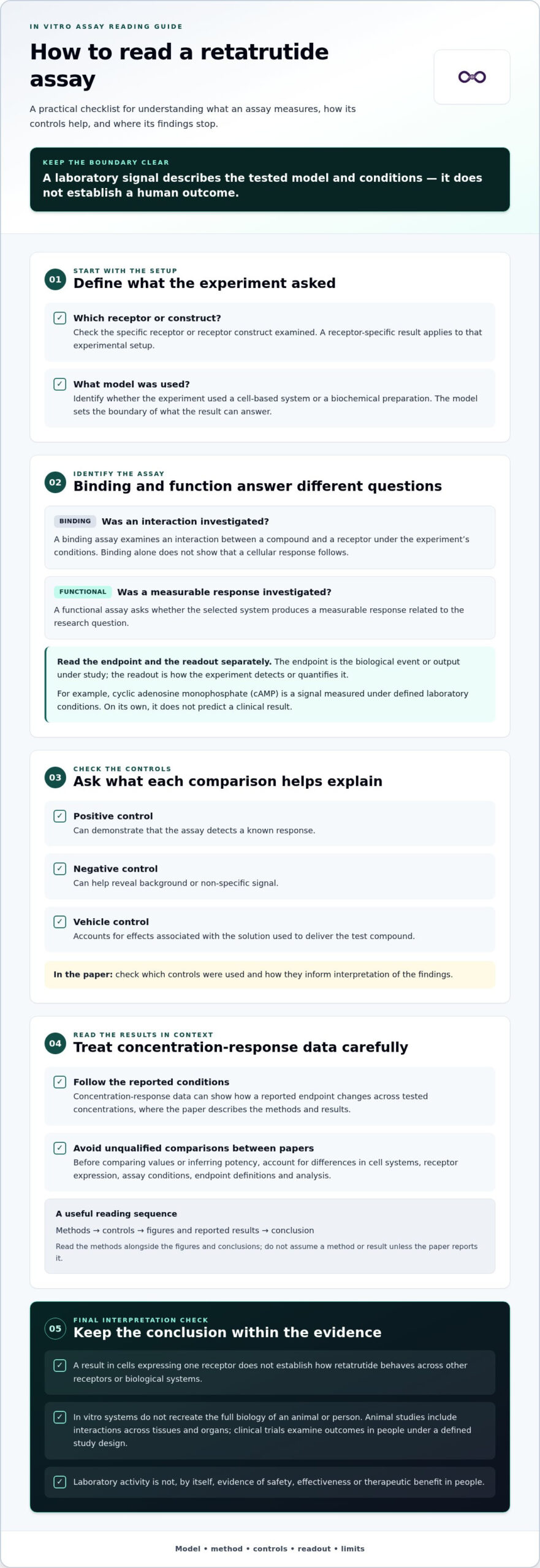
How to assess an in vitro retatrutide paper
A disciplined reading sequence helps separate what an experiment measured from what its authors infer. For in vitro studies using retatrutide, note the model and methods before weighing the conclusions. Missing detail can make a result harder to evaluate or reproduce, but it doesn’t automatically make the finding invalid.
- Research question: Identify the specific question the study set out to answer. Is it testing receptor binding, a functional response or another defined endpoint? Use the stated aim to judge whether the methods and conclusions are aligned.
- Model: Record the cell type or assay system and the receptor target, if applicable. Note whether the cells naturally express the relevant target or have been engineered to do so. The model determines which biological question the result can address.
- Methods: Look for enough information to understand the experimental conditions, measurement method and analysis. Check how the test material was identified in the paper and whether the reported methods explain the basis for comparisons.
- Controls: See which controls were included and what each is intended to assess. Note the number and type of replicates, where reported, and whether the analysis distinguishes independent experiments from repeated measurements within one experiment.
- Results: Read the figures, tables and text together. Identify the measured endpoint, the direction and variability of the reported signal, and whether the authors’ interpretation follows from those data.
- Limitations: Review the authors’ stated limitations, then consider whether the model, assay conditions or lack of independent replication further constrain interpretation. Ask whether the conclusion stays within the tested system and reported endpoints.
Check the model, methods and controls
Methodological detail is a practical test of interpretability. A paper that names a receptor but gives little information about its cell system, for example, may leave readers uncertain about how to compare its result with another assay. Record what is reported, what is missing and why that detail matters. Treat omissions as limits on assessment, not proof that a result is wrong.
Replicates also need careful reading. Technical repeats can show consistency within a measurement, while independent experiments address repeatability across separate runs. The paper’s definitions and analysis should make clear which kind it reports. Don’t assume that a larger number of measurements necessarily means more independent evidence.
Read results and limitations together
Separate the observed data from the authors’ proposed explanation. A measured signal is a result; a suggested mechanism is an interpretation that may need further testing. Consider whether the discussion acknowledges limitations in model relevance, assay conditions and independent replication.
Analytical methods such as HPLC and mass spectrometry can provide information about material characterisation. That context doesn’t demonstrate biological activity or efficacy. Keep analytical quality questions separate from conclusions about what an assay response means.
Appraise the question, model, methods, controls, results and limitations, then check that every conclusion stays within the evidence reported. For laboratory research planning, explore wholesale research-grade retatrutide from an Australian-based supplier.
Planning responsible laboratory research with retatrutide
A clear study plan links the research question to the model, endpoint, controls and reporting requirements. Before sourcing material, document what the experiment is intended to investigate and what evidence would be needed to interpret the result. This keeps material and method decisions anchored to the research plan, rather than to assumptions about what a laboratory result might mean.
Set the research question and documentation needs
Use a planning checklist to make key decisions visible before work begins:
- Research question: State the biological question and define what the study is not designed to establish.
- Model and endpoint: Record the selected system, target and measurable outcome, with a rationale for their fit to the question.
- Controls and analysis: Specify the planned controls, replication approach and analysis framework in the protocol.
- Reporting: Decide which methods, conditions and results must be recorded so another reader can assess how the conclusion was reached.
- Material requirements: Align the material description and any required specifications with the approved institutional plan and the needs of the selected research model.
Document these decisions in the protocol before materials are sourced. This makes it easier to identify what the study depends on and assess whether the final report reflects the authorised work. Research peptide sourcing is one procurement consideration to plan alongside the scientific requirements.
Institutional review and applicable laboratory governance are part of responsible planning. Follow the relevant processes at your institution, including review or approval requirements that apply to the work, and retain the authorised protocol and associated records. This section is a planning framework, not a substitute for institutional oversight or advice on specific Australian regulatory obligations.
Keep research supply separate from medical use
Research-grade peptides are for laboratory research purposes only. They are not for human consumption or medical use, including diagnosis or treatment. Keeping that boundary explicit in procurement records, protocols and research communications helps prevent laboratory supply from being confused with clinical products or evidence.
Eternal Peptides Wholesale is an Australian-based B2B supplier of research-grade peptides, including wholesale Retatrutide 10mg and 20mg. This supply is strictly for laboratory research, not medical use.
Responsible planning brings the scientific question, institutional process and research-purpose sourcing into alignment. For laboratory research, explore wholesale retatrutide for laboratory research.
Carry rigorous interpretation into your next research decision
Make your research question and its boundaries explicit before a project moves into the laboratory. A well-documented plan gives collaborators a shared basis for decisions and makes later reporting easier to assess. It also helps keep the intended purpose of the work clear as findings are reviewed and communicated.
Approach in vitro studies using retatrutide with that discipline: treat each result as a contribution to a defined research question, not as a conclusion beyond the evidence. Clear records and careful interpretation support more useful discussion, comparison and future research.
For Australian laboratory teams planning research-purpose supply, Eternal Peptides Wholesale offers wholesale Retatrutide in 10mg and 20mg options. Supply is strictly for laboratory research, not human consumption or medical use. Explore wholesale Retatrutide for laboratory research for your next project.
Thoughtful research starts with clear questions and responsible decisions. Keep that standard at the centre of the work ahead.
Frequently Asked Questions
What are in vitro studies using retatrutide?
In vitro studies using retatrutide are laboratory experiments that examine the compound in a cell-based or biochemical system outside a whole organism. A researcher might investigate a particular receptor interaction or a cellular response, depending on the model and assay. A paper focused on one receptor doesn’t automatically describe activity at every target. The experimental question and methods define what the result can support.
What can in vitro studies tell us about retatrutide?
They can provide evidence about a measured interaction or response in the specific laboratory system tested. Their usefulness depends on details such as the cell model, assay conditions and controls. If two papers report different signals, compare their methods before deciding whether the results conflict. They may have tested different endpoints or systems. These findings can inform research questions, but they don’t predict a particular outcome in a person.
Are in vitro retatrutide results evidence of clinical effectiveness?
No. A laboratory result isn’t evidence that retatrutide is clinically effective. It describes an observation made under the conditions of that experiment, not a treatment outcome in people. To assess clinical effectiveness, readers need relevant human research with reported outcomes and a study design suited to the question. Even then, findings should be understood in the context of the participants and outcomes studied.
How do researchers measure retatrutide activity in vitro?
Researchers use methods that fit the question. A binding assay examines an interaction with a specified receptor, while a functional assay measures a selected response in a biological system. Some papers may report cAMP as a signalling readout, but don’t assume it was measured unless it appears in the methods and results. To interpret a figure, identify what signal was measured and how the authors define the endpoint.
Can in vitro studies determine a retatrutide dose for people?
No. Cell or biochemical experiments can’t determine a dose for people. An experimental concentration describes the amount used in that particular assay, not a human dosing recommendation. The relationship between laboratory conditions and exposure in a person can’t be established from an in vitro result alone. Dosing questions require appropriate evidence from human research, and research-grade material must not be used to make personal dosing decisions.
How are in vitro studies different from clinical trials?
In vitro studies examine a defined process in cells or another laboratory system. Clinical trials investigate questions in human participants according to a study protocol, which may include specified outcomes and monitoring. The models and evidence are different: a cell assay can’t show how an intervention performs in people, while a trial’s findings apply to the population and outcomes it studied. One type of evidence shouldn’t be substituted for the other.
Where can I find Australian clinical trials involving retatrutide?
Search the Australian Clinical Trials website using “retatrutide” and, if needed, the development code “LY3437943”. Review each record for its status, locations, eligibility details and any linked results. A directory entry helps locate trial information; it doesn’t mean a study has published results or is currently recruiting. Review the record for details relevant to your search.
Are research-grade retatrutide peptides intended for human use?
No. Research-grade retatrutide supplied for laboratory research is not intended for human consumption or medical use, including diagnosis or treatment. It should remain within the documented research purpose and applicable institutional processes. Eternal Peptides Wholesale supplies research-grade peptides on a wholesale basis for laboratory research only. Its retatrutide offerings include 10mg and 20mg quantities; they aren’t clinical products or a basis for personal use.
Related from Eternal Peptides Wholesale
Eternal Peptides Wholesale publishes batch-specific Janoshik Analytical reports in its certificate of analysis library, so the documentation for a listed batch can be read alongside the evidence discussed in this article.
- Peptide COA library: batch-specific Janoshik Analytical reports with their verification details
- Our peptide testing standards: how independent Janoshik testing is used and reported
- Janoshik reports explained: what each test measures and its limits
- Evidence review: What do peptides do? Peptide signalling and classes
- Evidence review: What are peptides used for? Synthetic peptides as research tools
Related reading: Melanotan II receptor binding assay supply: A 2026 buyer’s guide