
What if a stronger migration signal reflects increased cell growth or improved viability rather than greater movement? That distinction matters when assessing TB-500 for cell migration assays, because both the peptide material and experimental conditions can shape a readout. The name TB-500 may not identify the same material across sources, and migration assays can capture effects other than cell movement.
This article explains how to evaluate TB-500 in cell migration research by matching material identity, assay design and controls to the research question. It also outlines how to interpret results cautiously, without treating an observed change as proof of a specific mechanism or effect.
We compare key assay considerations, including migration readouts and controls for proliferation and viability, then discuss how to document material identity and assess limitations. For Australian laboratory procurement, Eternal Peptides Wholesale supplies TB-500 5mg in wholesale quantities for research use. Product information and research-use status provide procurement context, not evidence of assay performance.
Key Takeaways
- Define the migration question first, then select an assay format that can address it without implying therapeutic relevance.
- Compare scratch and transwell readouts against the specific research question and each format’s limitations.
- Use suitable vehicle, untreated and reference controls to help distinguish migration observations from effects on cell growth or viability.
- Compare evidence only after considering material identity, cell model, assay format, controls and endpoint.
- For laboratory procurement, align research-use material documentation and planned study scale with the study’s requirements.
What does TB-500 for cell migration assays actually mean?
The phrase TB-500 for cell migration assays describes a research question, not a settled biological conclusion: does a specified material alter cell movement in a defined in-vitro model? The answer depends on the material’s identity, the cells tested and how movement is measured. An assay result cannot, by itself, establish a therapeutic effect or predict what may happen in living tissue.
This distinction matters because migration is often discussed alongside wound healing and tissue repair. Those processes involve multiple cell types and biological events, while a migration assay isolates a particular behaviour under controlled experimental conditions. A change in the assay readout is evidence about that model and those conditions. It is not proof of clinical benefit, tissue repair or a general effect across cell types.
How should researchers understand TB-500 terminology?
TB-500 is a name used in research and commercial contexts, but the name alone doesn’t establish a material’s sequence, composition or equivalence to another preparation. Compare the terminology in each paper or supplier description with its stated material identity. The TB-500 Wikipedia page offers general orientation on the name and its relationship to thymosin beta-4. It should not replace primary documentation or study methods.
Evidence explicitly concerning full-length thymosin beta-4 should not automatically be presented as evidence for a material labelled TB-500. Likewise, don’t assume that differently described sequences or formulations are interchangeable. When a source reports an effect, check whether it identifies the material clearly enough to support the comparison being made.
What does a cell migration assay measure?
Migration means movement of cells within a specified assay environment. Depending on the format, the endpoint may reflect movement into an open area or movement through a barrier. These are operational readouts: they quantify a defined observation, rather than revealing every process that contributed to it.
For example, a change in occupied area may be consistent with cell movement, but proliferation can also affect how much area is covered. Cell loss or reduced viability may change the number of cells available to move. Assay design and relevant controls help researchers evaluate these possibilities, but the readout alone may not separate them.
A migration assay records cell movement under defined conditions; its readout doesn’t, on its own, distinguish movement from changes in proliferation or viability.
Keep interpretation close to the experiment: consider the cell model, assay environment, observation period and endpoint. A result in one cell type doesn’t establish the same response in another, and an in-vitro movement signal doesn’t demonstrate tissue repair. Define the research question precisely before interpreting a change as migration-related. This keeps conclusions proportionate to the evidence and gives later comparisons a clear basis.
How do scratch and transwell assays assess cell migration?
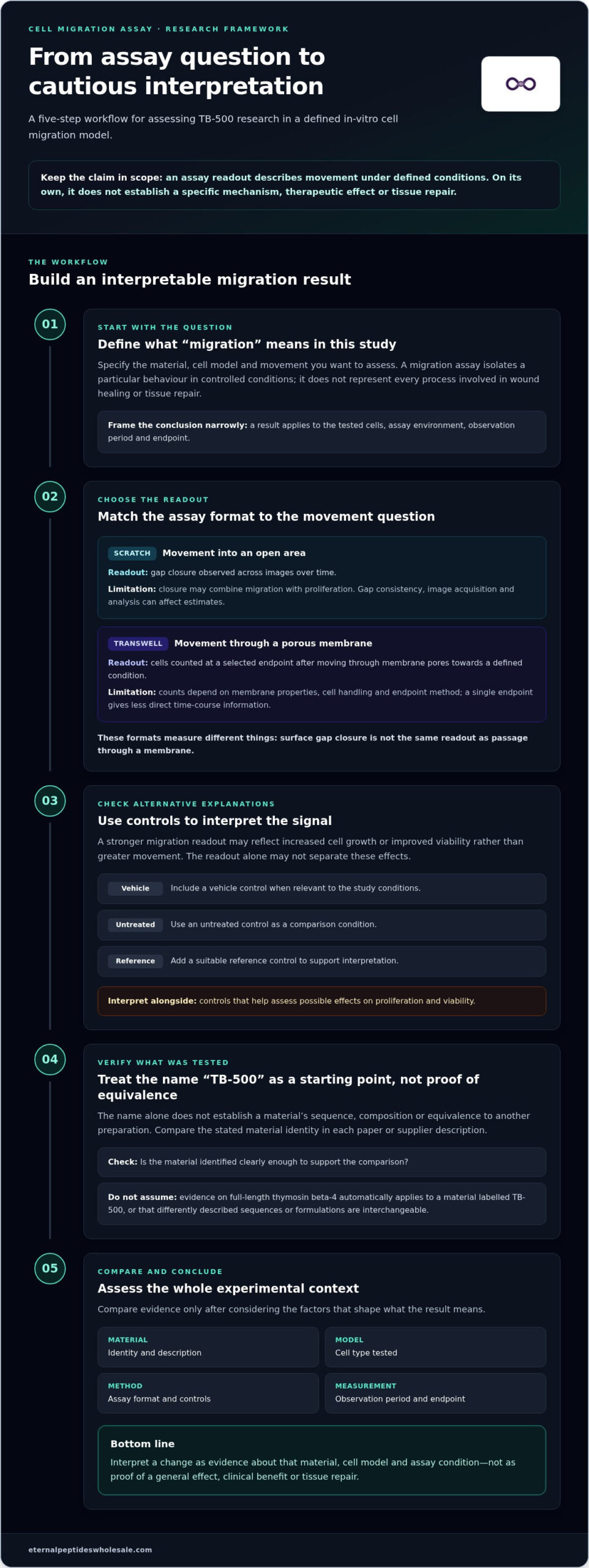
Assay choice determines what “migration” means in a study. A scratch assay tracks cells moving across a surface into an initially cell-free area. A transwell assay examines cells moving through a porous membrane towards a defined condition. Neither format answers every cell-movement question. For a TB-500 migration study, the practical question is not which format is universally better, but which readout fits the hypothesis and can be interpreted with its limitations in view.
When is a scratch assay a useful model?
A scratch assay is suited to observing how a cell layer closes a defined gap over time. Images show the changing area, making movement visible as a time course rather than only as a final count. However, closure may also reflect cell proliferation, so it isn’t automatically a pure measure of migration. Scratch consistency, image acquisition and analysis choices can all influence the apparent result and complicate comparisons.
| Assay format | Question and readout | Key limitation |
|---|---|---|
| Scratch | How does a cell layer move into a cell-free area? Readout: gap closure across images. | Closure may combine migration with proliferation; gap shape and image analysis affect estimates. |
| Transwell | How many cells move through a porous membrane towards a defined condition? Readout: cells counted at an endpoint. | Counts depend on membrane properties, cell handling and the endpoint method; they provide less direct time-course information. |
What does a transwell assay add?
A transwell format asks whether cells pass through membrane pores under the conditions being tested. It can suit a question about movement across a barrier rather than lateral movement along a surface. Results are often expressed as a count of cells that have crossed by the selected endpoint. That differs from repeated surface imaging, which can show how closure changes over time but doesn’t measure passage through a membrane.
Membrane characteristics shape the conditions cells encounter, while cell preparation and handling can influence which cells reach the measured side. An endpoint count also compresses movement over time into one observation. It may not show when movement occurred or distinguish cells that crossed early from those that crossed later. Keep these differences in mind when deciding what a result supports.
A scratch assay observes migration across a surface; a transwell assay counts movement through a porous barrier towards a defined condition. Each is a different operational measure, not a direct substitute for the other. A study focused on gap closure may favour surface imaging, while a question about traversing a barrier may call for a transwell approach. If the research question involves both behaviours, complementary formats can offer different perspectives, but interpret their readouts separately.
For a meaningful comparison, match the assay to the biological question, then consider how growth, viability or technical variation could influence its endpoint. Eternal Peptides Wholesale supplies TB-500 5mg in wholesale quantities for laboratory research use. Procurement context is separate from evidence that a material performs in either assay. Researchers reviewing wholesale TB-500 5mg research material can keep that distinction clear while planning study requirements.
Which controls make TB-500 migration results more interpretable?
Controls help researchers identify what a migration result can and can’t support. They don’t guarantee an outcome or prove a mechanism. In TB-500 migration studies, choose controls with the material, its vehicle, the cell model and assay format in mind. A result is more informative when the comparison helps show whether a difference is associated with the test condition rather than the carrier, baseline behaviour or another cellular effect.
A vehicle control accounts for the solution or carrier used to present the test material. An untreated control provides a baseline without that treatment or vehicle, where appropriate to the design. Comparing these groups can help reveal whether the vehicle itself is associated with a change. An assay-appropriate reference control may also help establish that the model can produce a measurable response. Its role is to contextualise the assay, not to validate TB-500 or guarantee that every experiment will behave as expected.
How can researchers separate migration from proliferation?
Greater scratch closure alone doesn’t establish greater migration. Cells may divide and occupy more of the gap, so an apparent change in closure could reflect a combination of movement and proliferation. Pairing migration observations with a suitable proliferation assessment helps researchers judge whether cell growth offers an alternative explanation. Interpret each measure according to what it can resolve, rather than treating a second readout as automatic proof of cause.
Viability is another relevant consideration. If fewer cells remain viable in one condition, the migration readout may change because the number of cells able to move has changed. Considering viability alongside movement can help distinguish a migration-related observation from a broader effect on cell health. Select these assessments to suit the cell model and research question. No single control or measurement resolves every interpretive issue.
Migration readouts need controls for competing cellular effects, because movement, proliferation and viability can each influence the observed signal.
How do model choice and analysis affect interpretation?
Cell type matters. Models differ in baseline motility and may not represent the biological context a researcher wants to examine. A result in a highly motile cell model may not translate to a model with different behaviour. Choose the model in relation to the question, and describe its limits so the conclusion stays within the evidence generated.
Consistent study conduct and analysis also support fair interpretation. Report the replicate structure clearly, and apply image acquisition and analysis criteria consistently across comparison groups. State how measurements were made and explain any exclusions rather than removing observations without a transparent rationale. Report variability as well as the direction of the result, since a single summary value can conceal differences between replicates.
Read the controls together: vehicle and untreated comparisons address different baselines, while a reference control can provide assay context. Then consider whether proliferation, viability, model behaviour or analysis choices could account for some of the observed signal. Reporting these uncertainties plainly strengthens the interpretation and prevents an in-vitro observation from being presented as more conclusive than the design allows.
How should researchers compare evidence and assess assay limitations?
Comparing TB-500 migration studies takes more than lining up reported outcomes. First establish whether the studies tested comparable materials and models, then assess how each experiment measured movement. Different results may reflect different study conditions rather than a contradiction. Treat each paper as evidence for the specific material, cells and assay it describes.
Which details should a study comparison capture?
Build a concise evidence record before comparing conclusions. Capture the reported material identity and analytical characterisation, followed by the cell model, assay format, comparator conditions and measured endpoint. This makes gaps visible and helps distinguish directly comparable studies from adjacent evidence. If a paper proposes a mechanism, record it as the authors’ interpretation, separate from the observation the experiment measured.
- Material: Note the name, stated sequence or composition, and analytical characterisation reported by the authors. Don’t treat a shared label as proof of equivalence.
- Model and format: Record the cell type and whether movement was assessed across a surface or through a barrier.
- Comparison and endpoint: Identify control conditions and what was quantified, such as gap closure or cells counted at an endpoint.
- Interpretation: Separate measured findings from proposed explanations, and note relevant limitations in the methods.
Analytical characterisation can clarify what a study reports about its test material, but it doesn’t establish that different materials are interchangeable or that an assay finding will be reproduced. For background on the role of these methods in peptide assessment, consult the guide to HPLC and MS analysis for peptide purity.
What can and cannot be concluded from assay results?
Give greater weight to evidence that clearly identifies the material and describes the model, assay, controls and endpoint. Findings involving thymosin beta-4 or another related material may provide context, but they aren’t direct evidence about a material specifically named TB-500 unless identity and composition support that comparison. If nomenclature is inconsistent or methods are incomplete, mark the comparison as uncertain rather than filling gaps with assumptions.
A reported change in movement supports a conclusion about that observation under the conditions studied. It doesn’t, by itself, establish a general mechanism, an effect in other cell models or clinical benefit. Missing controls can leave alternative explanations unresolved, and unclear endpoints can make two results appear similar when they measure different things. State these boundaries plainly. They’re part of the evidence, not a reason to overstate or dismiss a finding.
Use this framework to decide whether a paper offers direct, relevant evidence or only background for a new question. For Australian laboratories planning procurement, Eternal Peptides Wholesale supplies TB-500 5mg in wholesale quantities for laboratory research use. Explore wholesale research peptides as a procurement option, keeping product information separate from evidence of assay performance.
How can laboratories source TB-500 for research responsibly?
Procurement planning should follow the study design, not replace it. Before sourcing TB-500 for an assay, align the material description in the procurement record with the identity criteria in the research plan. A familiar label alone may not establish that materials described differently in papers or supplier information are equivalent. Keeping identity requirements explicit helps laboratories make meaningful comparisons and maintain consistent study records.
What should a laboratory document before procurement?
Set out the material description the study requires, including any identity details essential to its inclusion and reporting criteria. Then estimate quantity from the planned research programme and the laboratory’s procurement workflow. The appropriate amount depends on the work planned; don’t treat a pack size as evidence of how much a particular study needs.
Maintain relevant product and batch records alongside study documentation. Retain relevant product information with the material description and procurement details so the laboratory can trace what was assigned to the work. Record differences between the material description and the terminology used in published studies. This creates a clearer audit trail and helps prevent later comparisons from relying on a name alone.
- Material identity: Align the recorded description with the study’s defined inclusion criteria.
- Documentation: File relevant product information with the research records.
- Batch traceability: Preserve batch details associated with the material used.
- Planned scale: Base quantity planning on the programme and procurement process.
How does wholesale sourcing fit laboratory research?
Wholesale supply suits institutional and laboratory procurement workflows that plan research material as part of a broader programme. Eternal Peptides Wholesale supplies TB-500 5mg for wholesale research use. That product context is separate from evidence that a material changes cell migration: sourcing information does not establish sequence equivalence, assay validation or experimental performance.
For procurement teams considering related research materials, the wholesale tissue repair procurement guide provides further context for planning. Keep the intended research question, material description and records aligned, and assess experimental findings independently of supplier or product descriptions.
Peptides supplied by Eternal Peptides Wholesale are for research purposes only, not for human consumption or medical use. Keep this boundary clear in laboratory procurement and handling documentation. Responsible sourcing supports organised research records; it does not replace appropriate assay controls or demonstrate a result.
For laboratory research procurement, explore wholesale TB-500 5mg and assess its product information against your study’s documented requirements.
Set up the next research decision with clarity
Before moving from evidence review to procurement, define what a useful result would mean for your study. Set material identity and comparison criteria alongside the assay endpoint, then keep those requirements consistent in the study plan and procurement records. This gives your team a clear basis for evaluating TB-500 in migration assays without treating a product description as evidence of experimental performance.
Eternal Peptides Wholesale is an Australian-based wholesale supplier serving laboratory research needs, and supplies TB-500 5mg for wholesale research use. The material is intended for research purposes only, not human consumption or medical use. Keep procurement decisions aligned with your laboratory’s documented research requirements and assess assay findings on their own evidence.
Explore TB-500 for wholesale research supply as you plan your next laboratory study. A clear question, defined evidence criteria and organised procurement records can help your research proceed with greater confidence.
Frequently Asked Questions
Is TB-500 the same as thymosin beta-4?
No, the names alone don’t establish that two materials are identical. Compare the exact identity and composition reported in a study with the material described in the research record or product documentation. Findings involving thymosin beta-4 shouldn’t automatically be attributed to every material labelled TB-500. If a paper doesn’t provide enough information for that comparison, record the identity as uncertain and avoid treating the terms as interchangeable.
Can a scratch assay prove that TB-500 increases cell migration?
No, a scratch assay observation alone can’t prove that TB-500 increases migration. In a migration assay, apparent gap closure might also be influenced by cell growth, viability, scratch uniformity or image-analysis choices. Compare the result with appropriate controls and relevant supporting measurements, and report the conclusion for the cell model and conditions tested. An in-vitro observation doesn’t establish clinical efficacy or therapeutic benefit.
How do researchers quantify cell migration in a scratch assay?
Researchers can quantify changes in the cell-free area or track movement across images captured over time. For a meaningful comparison, define the measurement method and image-analysis rules in advance, then apply them consistently across groups. For example, changes in image scale, gap boundaries or segmentation criteria can affect calculated closure. Interpret the metric alongside relevant proliferation and viability information, since closure alone can’t identify which cellular processes contributed to it.
Does a transwell assay measure the same thing as a scratch assay?
No, the formats assess different movement contexts. A scratch assay follows closure across a cell-covered surface, while a transwell assay assesses cells passing through a porous membrane under defined conditions. Their endpoints aren’t directly interchangeable: one may quantify area change across images, while the other may count cells at an endpoint. Compare results only after accounting for the cell model, assay setup and measurement method used in each study.
Does an HPLC purity result confirm that TB-500 is active in a migration assay?
No, an HPLC purity result alone doesn’t demonstrate activity in a cell migration assay. It provides analytical information about a sample, not a functional outcome in a specific biological model. Keep analytical characterisation separate from assay evidence and consider the reported material identity, experimental conditions and controls when assessing a result. A purity figure shouldn’t be interpreted as proof of assay validation, biological activity or performance.
Can cell migration assay results show that TB-500 has a therapeutic effect?
No, cell migration assay results can’t establish a therapeutic effect. They are laboratory observations from a particular material, cell model and experimental setting, not evidence of clinical efficacy, safety or suitability for human use. Keep conclusions within the scope of the experiment and avoid translating an in-vitro finding into a medical claim. Research peptides discussed in this context are for research purposes only, not human consumption or medical use.
Related from Eternal Peptides Wholesale
Eternal Peptides Wholesale publishes batch-specific Janoshik Analytical reports in its certificate of analysis library, so the documentation for a listed batch can be read alongside the evidence discussed in this article.
- Peptide COA library: batch-specific Janoshik Analytical reports with their verification details
- Our peptide testing standards: how independent Janoshik testing is used and reported
- BPC-157 and TB-500 research catalogue
- Evidence review: Peptides for muscle gain: a structured evidence review
- Evidence review: What are peptides used for? Synthetic peptides as research tools
Related reading: TB-500 Actin-Binding Properties Research: Evidence and Limits; Anti-inflammatory Peptide Compounds for Study: Evidence, Mechanisms and Research Considerations