
Abstract
Background. BPC157 (also written BPC 157 or BPC-157) is a synthetic 15-amino-acid peptide whose online reputation has grown far faster than its clinical record. Australian regulators added it to Schedule 4 of the Poisons Standard, with additional possession controls, from 1 June 2024, and in 2026 the TGA, the Chief Medical Officer and NSW Health issued repeated warnings about unapproved peptides [1, 2, 3, 4, 5]. Existing reviews either summarise the animal findings narratively or, in the two systematic reviews, cover only orthopaedic use or human studies [6, 7, 8]. No published work has mapped the whole BPC157 literature, measured how it is distributed across models, research groups and years, or audited how it is reported.
Objective. To build a reproducible evidence map of every PubMed-indexed BPC157 record; to classify each primary study by outcome domain, model and research group; to audit reporting quality in the open-access animal studies; to reconcile the human evidence across journals, meeting abstracts, trial registries and regulator reviews; and to set out a verified regulatory timeline for Australia, anti-doping and the United States.
Methods. A systematic evidence map with reporting informed by PRISMA 2020 [9]. PubMed was searched through NCBI E-utilities on 30 October 2026 (Australia/Brisbane) with a title/abstract block covering eight synonyms. Europe PMC and ClinicalTrials.gov were searched as cross-checks [10, 11, 12]. All 236 PubMed records were screened and classified by hand. Open-access full texts of in vivo animal studies published from 2013 were audited against core items from ARRIVE 2.0 and the SYRCLE risk-of-bias tool [13, 14]. Regulatory facts were read at the primary source.
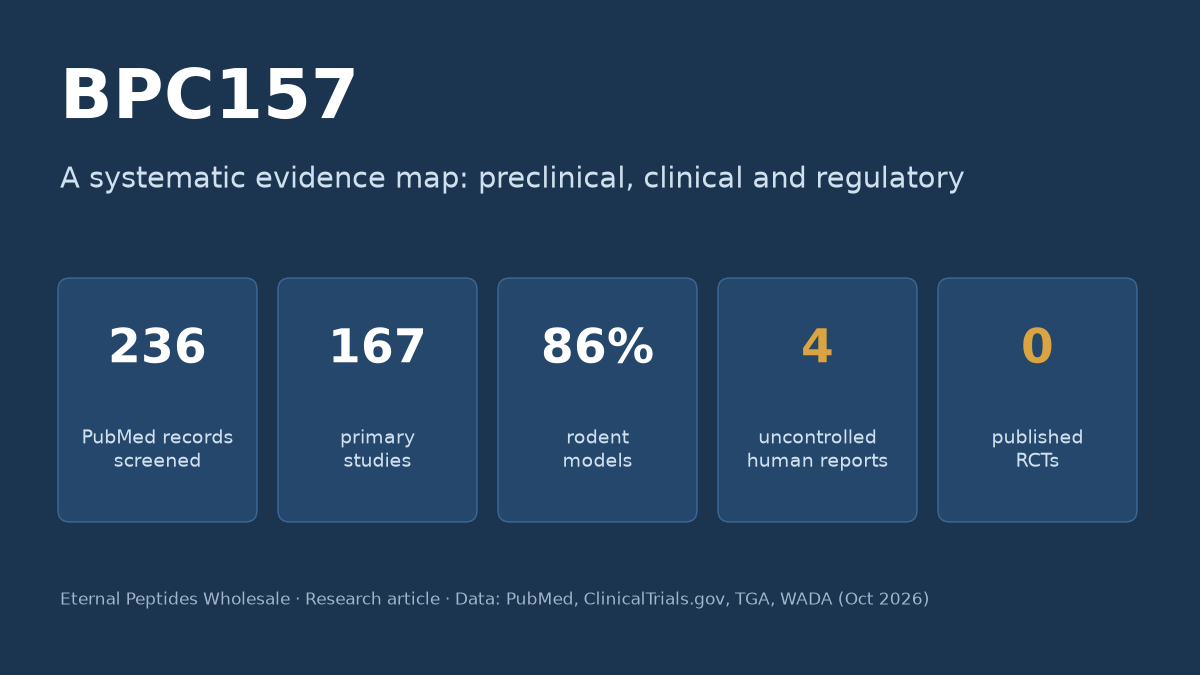
Results. Of 236 records, 3 were excluded, 167 were primary studies and 66 were reviews, editorials or comments. Rodent models accounted for 144 of the 167 primary studies (86.2%), and only 4 (2.4%) reported data from people. Authors from the Zagreb group (any author named Sikirić, or any Zagreb affiliation) wrote 140 of 167 primary studies (83.8%) and 139 of 148 in vivo animal studies (93.9%). In 47 audited full texts, 42 (89.4%) said animals were randomised but only 3 (6.4%) described how. Three (6.4%) reported a sample-size calculation, 5 (10.6%) cited ARRIVE and 42 (89.4%) used male animals only. Human evidence comprised four uncontrolled published reports (33 people) and, outside PubMed, three meeting abstracts from 2002–2005 identified by the US FDA. One was a randomised, placebo-controlled trial in 53 people with ulcerative colitis whose between-group confidence interval included zero [15]. None of four ClinicalTrials.gov registrations has posted results, and three of the four were registered after the study had started. In 2025–26, secondary publications outnumbered primary studies by 33 to 16.
Conclusions. The BPC157 evidence base is large in count but narrow in origin and design: mostly short rodent studies from one research network, with low reporting of the safeguards that protect against bias and no peer-reviewed controlled human trial. Claims about effects in people are therefore not supported by the record. In Australia BPC-157 is a Schedule 4 substance listed in Appendix D, it is prohibited at all times in sport, and the TGA states that a “research use only” label does not change a product’s regulatory status [16, 17, 18].
What is new here. This is, to our knowledge, the first whole-corpus BPC157 evidence map: every PubMed record classified by domain, model and research group, with counts that can be reproduced from the published search strings. It adds a full-text reporting audit, a registry audit, a reconciliation of journal, meeting-abstract and regulator sources on human data, and a regulatory timeline checked against the legislation, TGA decisions and the 2027 WADA List. Top-ranking pages describe BPC157 in general terms. None of them quantifies how concentrated, how rodent-based or how incompletely reported the evidence is.
Key findings
- A systematic PubMed search found 236 BPC157 records. After screening, 167 were primary studies: 144 in rodents, 4 in other animals, 6 in vitro or ex vivo, 2 nonclinical pharmacokinetic or safety studies, 7 chemistry or analytical studies and 4 human reports [10].
- One research network produced 84% of all primary studies and 94% of in vivo animal studies. Only 9 in vivo animal efficacy studies came from other groups.
- Full texts rarely reported the safeguards that reduce bias. 89% said animals were randomised, 6% said how, 6% reported a sample-size calculation and 89% used only male animals [14, 19].
- No randomised trial of BPC-157 has been published in a peer-reviewed journal. The only randomised human data are a 2005 meeting abstract that the US FDA judged inadequate to show efficacy or safety [15].
- Since 1 June 2024 BPC-157 has been a Schedule 4 substance listed in Appendix D of the Poisons Standard, so possession without authority is illegal. “Research use only” disclaimers do not change that position [2, 18, 3].
- BPC-157 is named in the S0 section of the WADA Prohibited List and is prohibited at all times. The 2027 List, in force from 1 January 2027, keeps it there [17, 20].
Contents
- Introduction: why BPC157 needs an evidence map
- What BPC157 is: identity, names and origin
- Methods: search, classification and audits
- Results: search yield and publication trends
- Results: the BPC157 evidence map by domain and model
- Results: concentration of BPC-157 research in one network
- Results: reporting quality of BPC157 animal studies
- Results: BPC-157 human studies, abstracts and registrations
- Results: BPC-157 regulatory status in Australia, sport and the United States
- Discussion
- Gap analysis: research questions for BPC157
- Limitations
- Conclusion
- Relevance to Eternal Peptides Wholesale
- Frequently asked questions about BPC157
- Glossary
- References
- Related research
- About this article
- About the author
Introduction: why BPC157 needs an evidence map
Few research peptides have drawn as much public attention as BPC157. Search interest, social media and online commentary often present it as well established. The scientific record is different. Most of the literature consists of short experiments in rats, most of those experiments come from one research network, and the human record is sparse enough that a systematic review published in 2026 found only three eligible human studies involving 30 people. That review rated the certainty of evidence as very low [6]. A 2025 systematic review limited to orthopaedic sports medicine reached a similar conclusion about the shortage of human data [7]. A narrative review of musculoskeletal healing set out the gap between preclinical promise and clinical uncertainty [8].
These reviews answer the question “what does the human evidence show?” They do not answer a prior question that matters just as much for anyone trying to interpret BPC157 research: what kind of evidence base is this? How many studies are there, in which models, from which groups, and how well were they reported? The answers determine how much weight any single finding can bear. A literature of 150 rat studies from many independent laboratories with transparent randomisation and adequate sample sizes would carry far more weight than the same number of studies from one network with sparse reporting of bias safeguards. Meta-research across preclinical science shows that unreported randomisation and blinding are associated with larger apparent effects [19], that small samples inflate effect sizes and reduce reproducibility [21], and that only a minority of highly cited animal findings translate into human benefit [22].
A second reason for an evidence map is regulatory. On 1 June 2024 Australia created a Schedule 4 entry for BPC-157 and listed it in Appendix D, clause 5, of the Poisons Standard. That listing places additional controls on possession, and the Explanatory Statement records that possession without authority is illegal [1, 2]. The TGA delegate’s reasons cited “a limited evidence base” made up of “a small number of peer-reviewed studies that largely originate from a single laboratory”, and “only a single registered phase 1 clinical trial conducted in 2015” [23]. Those are empirical statements about the literature. This review tests them with a full count.
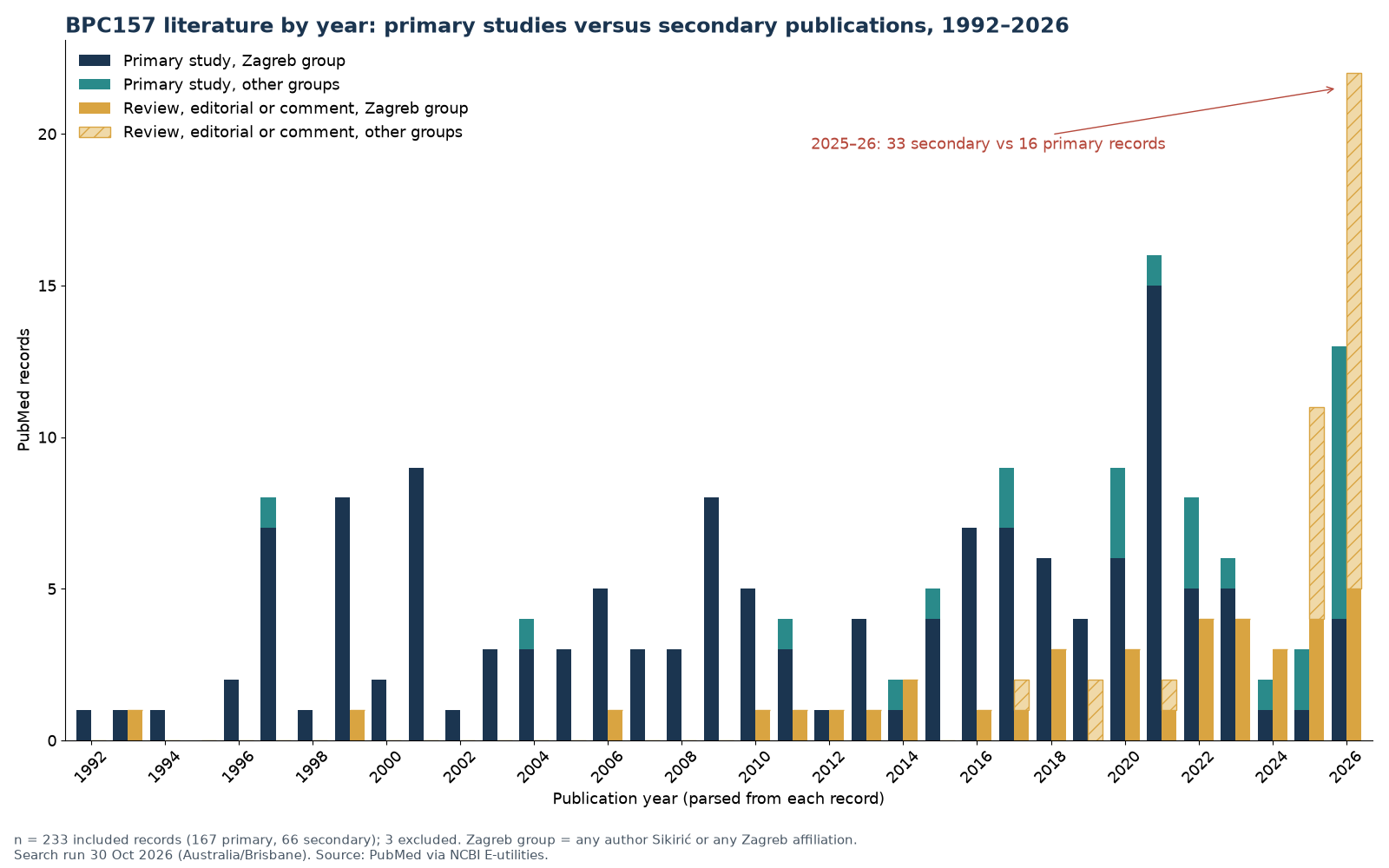
A third reason is the quality of secondary literature. Between 2025 and October 2026, reviews, editorials and comments about BPC-157 outnumbered new primary studies two to one (33 versus 16 PubMed records; see Figure 1). As secondary publications multiply, errors can propagate. One 2025 literature and patent review stated that BPC-157 was not listed as banned by WADA [24]. Yet both the 2025 Prohibited List, in force when the review appeared, and the 2026 List name BPC-157 under S0 [25, 26]. A whole-corpus map gives readers a check against such drift.
This article therefore sets out to do five things: (1) report a reproducible search with real counts; (2) classify every primary BPC157 study by outcome domain, model, species and research group; (3) audit how the recent open-access animal studies report the safeguards that limit bias; (4) reconcile the human evidence across journals, meeting abstracts, trial registries and a regulator’s review; and (5) assemble a verified regulatory timeline for Australia, anti-doping and the United States. It does not assess whether BPC-157 works in people, and it makes no recommendation about use. The aim is to describe the evidence accurately, so that researchers, reviewers and regulators can see where its limits lie.
What BPC157 is: identity, names and origin
BPC-157 is a linear pentadecapeptide. PubChem lists it as compound CID 9941957 with molecular formula C62H98N16O22 and a molecular weight of about 1,419.5 g/mol [27]. Its sequence, Gly-Glu-Pro-Pro-Pro-Gly-Lys-Pro-Ala-Asp-Asp-Ala-Gly-Leu-Val (GEPPPGKPADDAGLV), was confirmed by mass spectrometry in vials confiscated during an anti-doping investigation [28]. The name comes from “body protection compound”. The originating group described BPC as a new gastric juice peptide in a 1993 overview of its stomach-stress-organoprotection hypothesis [29], and later papers from the same group call BPC 157 a “stable gastric pentadecapeptide” [30]. The word “stable” refers to a reported resistance to hydrolysis in gastric juice. The FDA’s 2026 briefing document notes that, despite this, the reported half-life after injection in animals is short [15, 31].
The peptide appears under several names and development codes. The literature and regulators use BPC 157, BPC-157 and BPC157 interchangeably, as well as PL 14736 (also written PL14736), PL-10, PLD-116 and Bepecin [32, 20]. That spread of names matters for searching. A query for one spelling misses records that use another, so the search strategy in this review combined all of them (Table 1). Sport Integrity Australia lists the same aliases on its BPC-157 substance page [20].
BPC-157 is not an approved medicine in Australia. Sport Integrity Australia notes that it is not included on the Australian Register of Therapeutic Goods (ARTG) [20]. In the United States, the FDA’s 2026 briefing document records that it has no pharmacopeial monograph and is not a component of any FDA-approved drug [15]. For broader context on how signalling peptides relate to approved peptide medicines, see the EPW review What do peptides do? Signalling, receptors and approved medicines.
Methods: search, classification and audits
Design and reporting standards for the BPC157 evidence map
This is a systematic evidence map, a form of evidence synthesis that describes the extent and character of a literature rather than pooling effect sizes. Searching, screening and reporting followed the relevant items of PRISMA 2020 [9]. The audit of animal studies used core items from the ARRIVE 2.0 guidelines and the SYRCLE risk-of-bias tool for animal intervention studies [13, 14], together with the reporting items proposed by Landis and colleagues for preclinical research [33]. The review was not prospectively registered. That is a limitation, but because every search string and count is published here and every classification rule is stated, the work can be repeated. All searches were run on 30 October 2026 between about 04:00 and 04:20 Australia/Brisbane time (AEST).
Information sources and search strings
The primary source was PubMed, queried through the NCBI Entrez Programming Utilities (E-utilities) so that counts were captured exactly [10]. The core search combined eight title/abstract synonyms: “BPC 157”, “BPC-157”, “BPC157”, “body protection compound”, “pentadecapeptide BPC”, “PL 14736”, “PL14736” and “bepecin”. It was limited to publication dates up to 30 October 2026. The core search returned 236 records, and a re-run about 15 minutes later returned the same count. Standard PubMed filters were then applied as descriptive subsets (Table 1). Europe PMC was queried through its REST interface as a cross-check, returning 247 records for a title/abstract search and 325 for an all-fields search [11]. ClinicalTrials.gov was searched through its version 2 API for each synonym [12]. The Australian New Zealand Clinical Trials Registry could not be queried programmatically because it blocked automated requests (HTTP 403). This is recorded as a limitation.
Table 1. Reproducible search strings and record counts for BPC157, run 30 October 2026 (Australia/Brisbane).
| Source and search | Query (abbreviated where noted) | Records |
|---|---|---|
| PubMed, core search | (“BPC 157″[tiab] OR “BPC-157″[tiab] OR “BPC157″[tiab] OR “body protection compound”[tiab] OR “pentadecapeptide BPC”[tiab] OR “PL 14736″[tiab] OR “PL14736″[tiab] OR bepecin[tiab]) AND 1900/01/01:2026/10/30[dp] | 236 |
| PubMed, core AND humans[mh] | Core search AND humans[mh] | 59 |
| PubMed, animals only | Core search AND animals[mh] NOT humans[mh] | 109 |
| PubMed, reviews | Core search AND review[pt] | 54 |
| PubMed, systematic reviews or meta-analyses | Core search AND (systematic review[pt] OR meta-analysis[pt]) | 1 |
| PubMed, clinical trials | Core search AND clinical trial[pt] | 0 |
| PubMed, randomised controlled trials | Core search AND randomized controlled trial[pt] | 0 |
| PubMed, case reports | Core search AND case reports[pt] | 1 |
| PubMed, rats / mice | Core search AND rats[mh]; core search AND mice[mh] | 114 / 20 |
| PubMed, published 2020 onward | Core search AND 2020/01/01:2026/10/30[dp] | 109 |
| Europe PMC, title/abstract | TITLE_ABS: same eight synonyms | 247 |
| Europe PMC, all fields | Same eight synonyms, all fields | 325 |
| ClinicalTrials.gov (API v2) | Each synonym searched separately; results de-duplicated | 4 unique studies |
The PubMed filter counts in Table 1 show why automated subsets cannot replace screening. The humans[mh] filter returned 59 records, yet only 4 primary studies reported data from people. The tag mostly attaches to reviews and to in vitro work on human cells or tissue. Conversely, the clinical trial and randomised controlled trial publication-type filters each returned zero records. That is the correct count for peer-reviewed trials, but it says nothing about trials reported only as conference abstracts, which PubMed does not index (see BPC-157 human studies).
Eligibility, screening and classification
Every one of the 236 records was screened on title, abstract and publication type. Records were classified as primary studies (reporting new data), secondary publications (reviews, editorials, comments, letters and replies) or excluded. Each primary study was assigned to one main outcome domain and one model category. The eight domains were gastrointestinal; vascular and cardiac; nervous system; musculoskeletal (muscle, tendon, ligament and bone); skin wounds and eye; liver, kidney and other organs; toxicity-antagonism models (studies in which BPC-157 was tested against injury caused by another drug or toxin); and chemistry, pharmacokinetics and safety. The six model categories were rodent in vivo, other animal in vivo, in vitro or ex vivo, nonclinical pharmacokinetic or safety study, chemistry or analytical study, and human report. Species were extracted from the title, abstract and MeSH terms. A study that spanned domains was counted once, in the domain of its primary outcome, so every count in this review refers to unique records.
Author-group attribution
A research group was treated as the Zagreb group when any author was named Sikirić (any spelling) or any author affiliation included Zagreb. Both were read from the PubMed XML record. The rule is deliberately broad, because the question is whether the evidence is independent of the originating network, not who led each paper. It may count a small number of unrelated Zagreb studies as part of the network. That would slightly overstate concentration, so the non-Zagreb records were also checked by hand.
Full-text reporting audit
Every primary in vivo animal study with a full text available as PubMed Central (PMC) XML was retrieved, with the reference lists removed: 47 studies published between 2013 and 2026, of which 42 were by the Zagreb group. Each was screened with predefined text patterns, and matching passages were then read to confirm eight reporting items: a statement that animals were randomised; a description of the randomisation method; a statement of blinding; a sample-size calculation; citation of ARRIVE; the sex of the animals; a conflict-of-interest statement; and a data-availability statement. These items map onto the core ARRIVE 2.0 set [13] and onto SYRCLE domains for selection, performance and detection bias [14]. Each item was scored present or absent from the text as published. Absence means “not reported”, which is not the same as “not done” [34].
Trial-registry audit
Each ClinicalTrials.gov record was retrieved as structured JSON. For each one, the review extracted phase, design, masking, planned or actual enrolment, country, overall status, start date, first-submitted date, primary completion date and whether results had been posted. A registration was classed as retrospective when its first-submitted date fell after its start date. Prospective registration has been a condition of publication in member journals of the International Committee of Medical Journal Editors since 2005, because it guards against selective reporting [35].
Verification of regulatory facts
Every regulatory statement in this review was read at the primary source on 30 October 2026. The sources were the TGA’s interim and final scheduling decisions [23, 1], the Explanatory Statement and text of the June 2024 Poisons Standard instrument [2, 36], the Poisons Standard in force from 1 October 2026 [16], TGA guidance and media releases [18, 3, 37, 4, 38, 39], the WADA Prohibited Lists for 2025, 2026 and 2027 [25, 26, 17, 40], Sport Integrity Australia [20], the US FDA [41, 15] and NSW Health [5]. Secondary commentary was not used as a source for any legal or regulatory fact. Where a TGA web page could not be rendered, the decision PDF was cited instead.
Results: search yield and publication trends
Screening flow from 236 records to 167 BPC157 primary studies
The core PubMed search returned 236 records. Three were excluded: a 2021 corrigendum, a 2025 article whose PubMed record is titled “Withdrawn”, and a 2025 paper on another class of compounded medicines in which BPC-157 was mentioned but not studied. Of the remaining 233 records, 167 were primary studies (71.7%; 167 ÷ 233) and 66 were secondary publications (28.3%). The earliest primary study in the set dates from 1992 [42]. Europe PMC returned slightly more records (247 by title and abstract) because it also indexes preprints and records outside MEDLINE [11]. Those extra records were not screened, which is a limitation discussed below.
Publication trend: the rise of secondary BPC-157 literature
The balance between new data and commentary has changed over time (Figure 1). In the 1990s the PubMed record held 22 primary studies and 2 secondary publications. In the 2000s it held 41 and 1, and in the 2010s 47 and 14. From 2020 to October 2026 there were 57 primary studies and 49 secondary publications. The sharpest shift came at the end of the period. In 2025 and 2026 combined, PubMed indexed 16 primary studies and 33 secondary publications, about 2.1 secondary records for every primary one (33 ÷ 16 = 2.06). Of those 33 secondary records, 24 came from authors outside the Zagreb group. The new commentary is coming largely from orthopaedics, sports medicine, pharmacy and public health [43, 44, 45, 46, 47, 48]. The record suggests that BPC-157 is now being written about much faster than it is being studied.
Results: the BPC157 evidence map by domain and model
Models and species: an overwhelmingly rodent BPC-157 literature
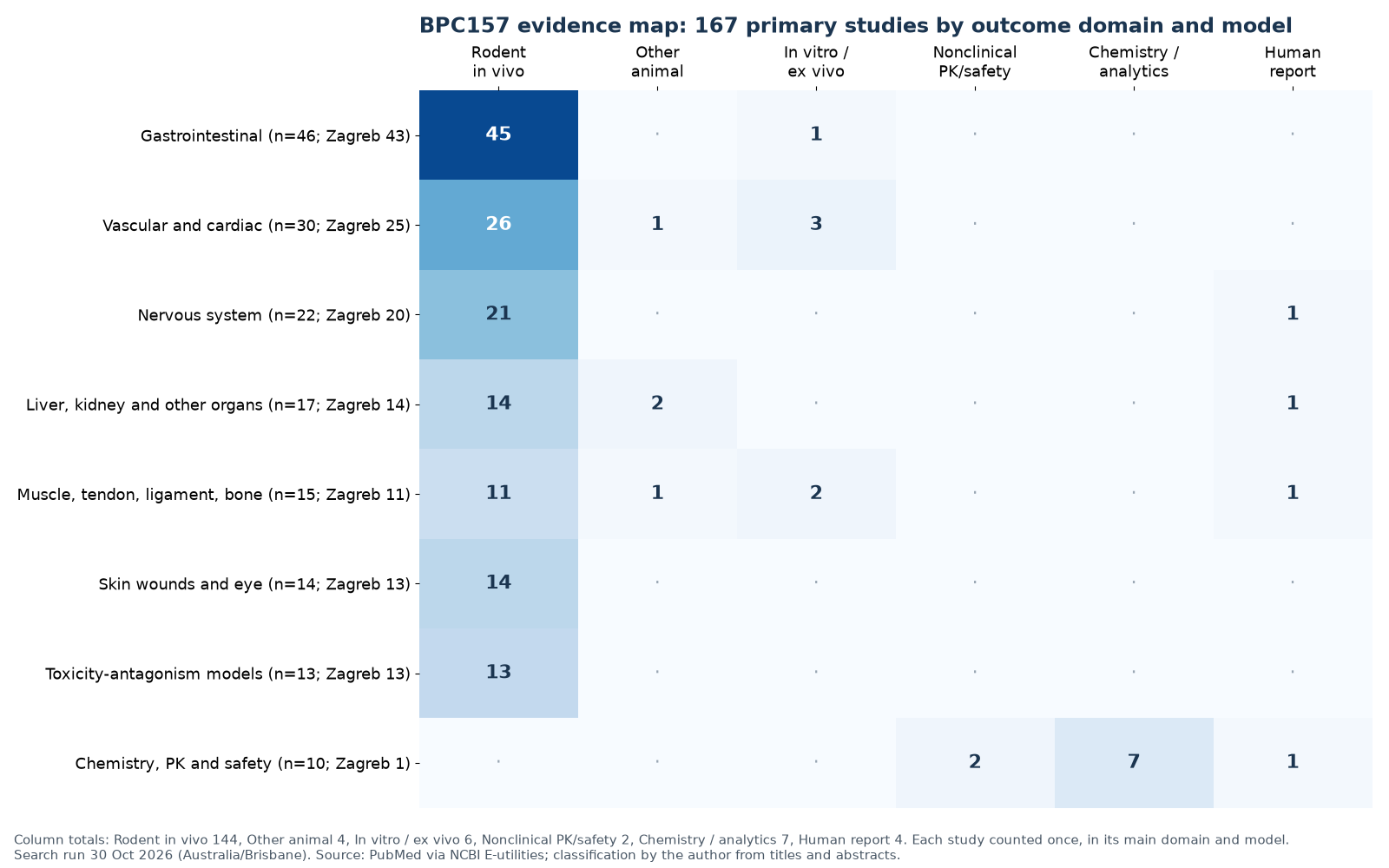
Of the 167 primary studies, 144 (86.2%; 144 ÷ 167) were in vivo rodent experiments (Table 2; Figure 2). Within those 144, rats alone were used in 122 studies (84.7%), mice alone in 10, both species in 9, and the species was not clear from the record in 3. Only four primary studies used another animal species. Two were in honeybees, investigating an apiculture parasite [49]. One was a 1999 rabbit bone-defect study [50], and one was a 1997 study in broiler chicks [51]. No efficacy study in a large mammal was identified. Six studies were in vitro or ex vivo, including tendon-fibroblast experiments [52, 53], isolated rat aorta and endothelial-cell work [54, 55] and an ex vivo study of human internal mammary artery segments obtained during surgery [56]. Two were nonclinical pharmacokinetic or safety studies [57, 31], seven were chemistry, analytical or formulation studies [28, 58, 59, 60, 61], and four reported data from people.
Table 2. BPC157 evidence map: 167 primary studies by main outcome domain and model (number of studies; Zagreb-group studies in brackets).
| Outcome domain | Rodent in vivo | Other animal | In vitro / ex vivo | Nonclinical PK/safety | Chemistry / analytics | Human report | Total (Zagreb) |
|---|---|---|---|---|---|---|---|
| Gastrointestinal | 45 | 0 | 1 | 0 | 0 | 0 | 46 (43) |
| Vascular and cardiac | 26 | 1 | 3 | 0 | 0 | 0 | 30 (25) |
| Nervous system | 21 | 0 | 0 | 0 | 0 | 1 | 22 (20) |
| Liver, kidney and other organs | 14 | 2 | 0 | 0 | 0 | 1 | 17 (14) |
| Muscle, tendon, ligament and bone | 11 | 1 | 2 | 0 | 0 | 1 | 15 (11) |
| Skin wounds and eye | 14 | 0 | 0 | 0 | 0 | 0 | 14 (13) |
| Toxicity-antagonism models | 13 | 0 | 0 | 0 | 0 | 0 | 13 (13) |
| Chemistry, pharmacokinetics and safety | 0 | 0 | 0 | 2 | 7 | 1 | 10 (1) |
| Total (Zagreb) | 144 (135) | 4 (4) | 6 (0) | 2 (0) | 7 (1) | 4 (0) | 167 (140) |
Source: author classification of the PubMed core search (Table 1). Each study is counted once. Row and column totals were checked by summation: 46 + 30 + 22 + 17 + 15 + 14 + 13 + 10 = 167, and 144 + 4 + 6 + 2 + 7 + 4 = 167.
Outcome domains: from gastric lesions to nearly every organ
The gastrointestinal domain was the largest (46 studies). It is also the oldest: work on gastric and duodenal lesion models began in 1992 and continued through fistula, oesophageal-sphincter and periodontitis models [42, 62, 63, 64]. The most recent gastrointestinal primary study in the PubMed set was published in 2024. The vascular and cardiac domain (30 studies) is now the second largest. Since 2018 it has been dominated by a series of rat “occlusion” models, in which major vessels are ligated and outcomes across several organs are recorded [65, 66, 67]. Earlier work examined bleeding after amputation in anticoagulated rats [68]. Nervous system studies (22) range from behavioural models involving dopamine-active drugs to traumatic brain and spinal cord injury in rodents [69, 70, 71]. Thirteen studies tested BPC-157 against injury caused by an overdose of another drug or a toxic exposure, such as paracetamol or electrolyte disturbance. All 13 came from the Zagreb group [72, 73, 74, 75].
The musculoskeletal domain is the one most often cited online, yet it is comparatively small. It contains 15 primary studies: 11 rodent experiments on transected or crushed muscle, tendon, ligament and bone [76, 77, 78, 79, 80, 81], one rabbit bone study [50], two tendon-fibroblast studies [52, 53] and one human chart review [82]. Only one musculoskeletal animal study came from an independent group. That 2026 rat study of Achilles tendon healing included a TB-500 arm and a combined arm, and it reported that BPC-157 alone produced numerically lower injury scores that were not statistically significant on total scores [83]. It is the only independent in vivo test of a tendon outcome in the PubMed record, and it did not reproduce a clear effect for BPC-157 alone. One study does not refute a literature. It does show why independent replication matters.
Results: concentration of BPC-157 research in one network
By the attribution rule set out in the Methods, the Zagreb group authored 140 of 167 primary studies (83.8%). Concentration was highest in exactly the categories that make up the efficacy literature. The group wrote 135 of 144 rodent studies (93.8%), all 4 other-animal studies, and 139 of 148 in vivo animal studies overall (93.9%; 139 ÷ 148). It wrote none of the 6 in vitro or ex vivo studies, none of the 2 nonclinical pharmacokinetic or safety studies, 1 of the 7 chemistry studies and none of the 4 human reports. The group also wrote 38 of the 66 secondary publications (57.6%), including several large narrative reviews of its own findings [30, 84, 85, 86].
Only nine in vivo animal efficacy studies in the PubMed record came from outside the Zagreb network, and all nine were in rodents. They covered a gastric ulcer model (2004) [87], an alkali-burn skin wound model (2015) [88], an angiogenesis and hind-limb ischaemia model (2017) [89], clopidogrel-induced gastric injury (2020) [90], incisional pain (2022) [91], radiation-induced liver injury (2022) [92], distant organ injury after limb ischaemia-reperfusion (2025) [93], lower-limb ischaemia (2026) [94] and Achilles tendon healing (2026) [83]. Each tested a different outcome, so none replicates another, and none was designed or reported as a direct replication of a specific Zagreb experiment. This review treats a finding as independently replicated when a second, unrelated group reproduces the same outcome in the same model and says so. By that standard, the review found no independently replicated BPC-157 finding in the PubMed record.
Concentration in one group is not evidence of error. Specialist laboratories often build large bodies of work on a single compound. But the TGA delegate’s 2024 observation that the studies “largely originate from a single laboratory” [23] is confirmed and quantified here. The lack of independent replication is directly relevant to the reproducibility concerns that meta-research has documented across preclinical science [21, 33]. A critical review of the rodent ischaemia-reperfusion literature published in 2026 reached a compatible conclusion. It found heterogeneous models and outcomes that precluded meta-analysis [95].
Results: reporting quality of BPC157 animal studies
The full-text audit covered 47 in vivo animal studies published between 2013 and 2026 (42 Zagreb, 5 other groups). Results are shown in Figure 3. Forty-two studies (89.4%; 42 ÷ 47) stated that animals were randomised, but only 3 (6.4%) described how the allocation sequence was generated. Thirty-nine (83.0%) stated that some assessment was blinded. Three (6.4%) reported a sample-size calculation, and 5 (10.6%) cited the ARRIVE guidelines. Forty-two (89.4%) used only male animals. Of the other five, four included female animals and one did not report sex. Conflict-of-interest statements were present in 44 (93.6%) and data-availability statements in 36 (76.6%). The three studies that described a randomisation method were also the three that reported a sample-size calculation, and all three were published in 2026 [96, 97, 98]. This suggests that reporting has recently begun to improve.
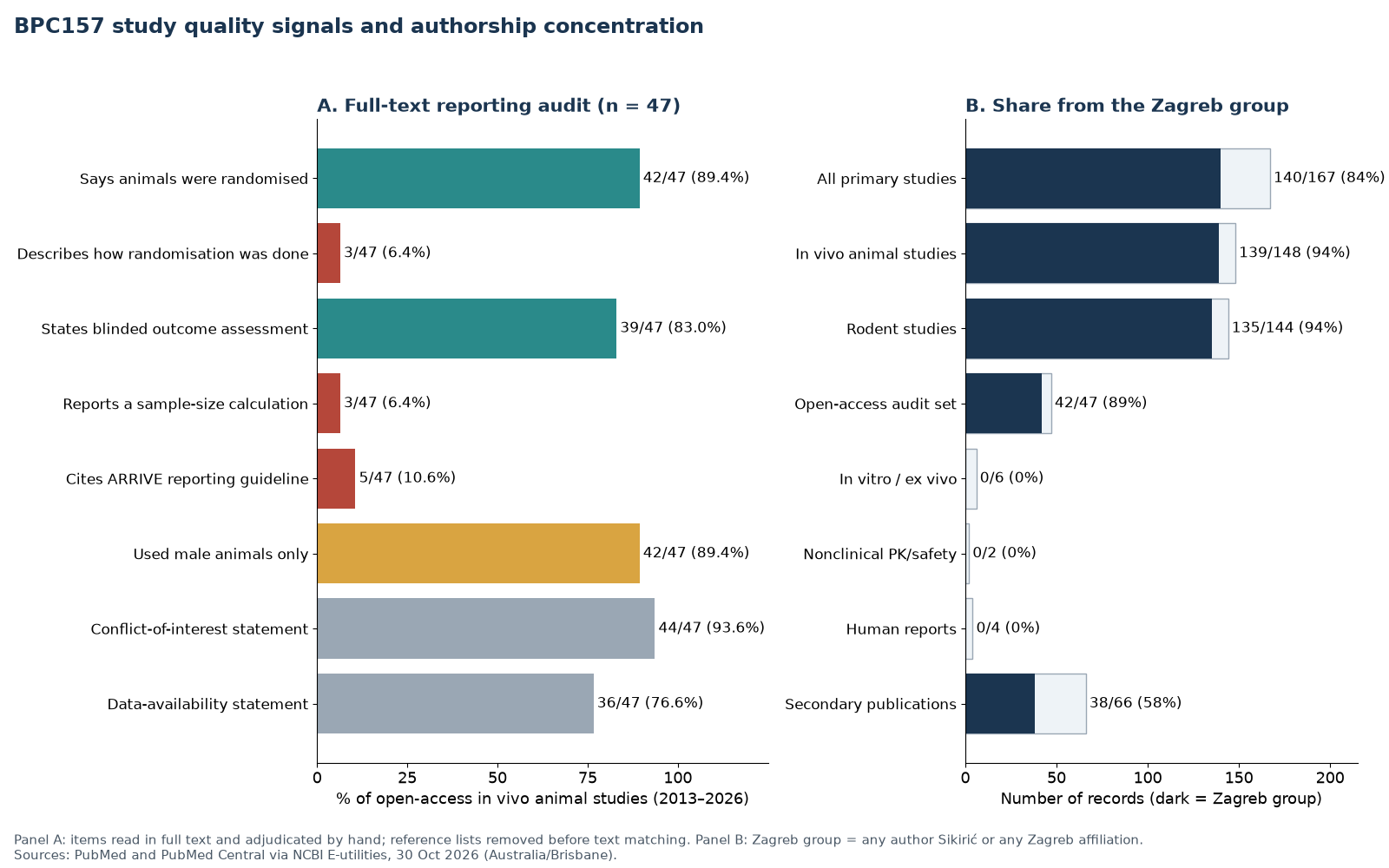
These figures matter because unreported randomisation and blinding are associated with inflated effect estimates in animal research [19, 34]. Small, underpowered studies also produce exaggerated and less reproducible effects [21]. A statement that animals were “randomly assigned”, with no method, does not let a reader judge whether allocation was truly random. SYRCLE rates such studies as “unclear” risk for sequence generation [14]. On the items that can be assessed from text, the recent BPC-157 animal literature would therefore be rated mostly unclear risk of selection bias. The near-universal use of male animals means that findings in female animals are largely untested.
Results: BPC-157 human studies, abstracts and registrations
Peer-reviewed human reports: four uncontrolled studies
Four primary records in the PubMed set reported data from people (Table 3). Two others involved human material but not people: the ex vivo artery study [56] and in vitro work on human cells. The first peer-reviewed human report was a 2021 retrospective chart review from a single clinic in Florida. Seventeen patients with knee pain were identified who had received intra-articular injections of BPC-157, alone or combined with thymosin beta-4. Sixteen were contacted, and 12 had received BPC-157 alone. Outcomes were gathered by telephone without a validated instrument, and there was no comparison group [82]. The second was a 2024 single-arm pilot study of 12 women with interstitial cystitis who were treated during a single procedure at a private clinic. It reported symptom change on the Global Response Assessment questionnaire and no adverse events, again with no control group [99]. The third, published in 2025, described intravenous infusion in two adults at a private clinic, both of whom had received intravenous BPC-157 before. Its title describes it as a study of safety, and its abstract concludes that the results “showed the safety of BPC-157 in humans” [100]. Two participants cannot characterise the safety of anything, and prior exposure selects for people who had already tolerated the substance. The fourth, published in 2026, was a case report with narrative review. It described three people with inferior alveolar nerve injury, a complication of oral and maxillofacial surgery, who were managed with peptide agents together with dexamethasone and local anaesthetic. Because several interventions were given at once, the authors’ framing as “hypothesis-generating” is the appropriate reading [101].
Together, these four reports describe 33 people (16 + 12 + 2 + 3). The 2026 systematic review by Poolton and colleagues, which searched to 1 June 2026 and so predated the case report, included the first three (30 people). It rated all three as poor quality and the certainty of evidence as very low on GRADE [6]. The 2025 systematic review by Vasireddi and colleagues, which searched to June 2024, also found very limited human data in orthopaedic sports medicine [7]. None of the four peer-reviewed reports randomised participants, used a control or comparison group, or blinded outcome assessment.
Meeting abstracts outside PubMed: the 2002–2005 enema studies
A whole-corpus search of PubMed misses one set of human data. In its July 2026 briefing document for the Pharmacy Compounding Advisory Committee, the US FDA searched PubMed and Embase and identified three conference abstracts from 2002, 2003 and 2005 [15]. The 2002 and 2003 abstracts described a placebo-controlled phase 1 tolerability and pharmacokinetic study of BPC-157 given by rectal enema to healthy male volunteers. Thirty-two people were randomised, 24 of whom received BPC-157. The most frequently reported adverse events were headache and flatulence, with no obvious difference from placebo, and BPC-157 was reported as not detected, or mostly below the limit of quantification, in plasma [15]. The 2005 abstract described a multicentre, randomised, double-blind, placebo-controlled trial in 53 people with mild to moderate ulcerative colitis, of whom 46 completed. The FDA reported that the confidence interval for the between-group difference in the primary disease-activity score included zero. It judged that, because the study existed only as a meeting abstract lacking key details, the data were “inadequate to support the efficacy and safety” of BPC-157 for that use [15].
These abstracts are the only randomised, placebo-controlled human data on BPC-157 that this review could find. None was followed by a peer-reviewed full paper indexed in PubMed. That matters in two ways. First, phrases such as “in trials for inflammatory bowel disease” in older review titles [32], or statements in primary papers that BPC-157 had been “successful” in clinical use for ulcerative colitis [64], have no peer-reviewed trial report behind them. Second, the one randomised result that is visible, through the FDA’s description, did not show a clear difference from placebo. Including the abstracts, the FDA counted 81 people exposed to BPC-157 across five human studies, with the longest treatment lasting two weeks [102]. Those five studies are the two studies described in the abstracts and the three peer-reviewed reports published from 2021 to 2025; the published analysis does not break the total down by study, and no serious adverse events were reported in them [102]. The FDA also found three reports in its adverse event reporting system (FAERS), and it stressed that such reports cannot establish causation or safety in either direction [15].
Trial registrations: none with results
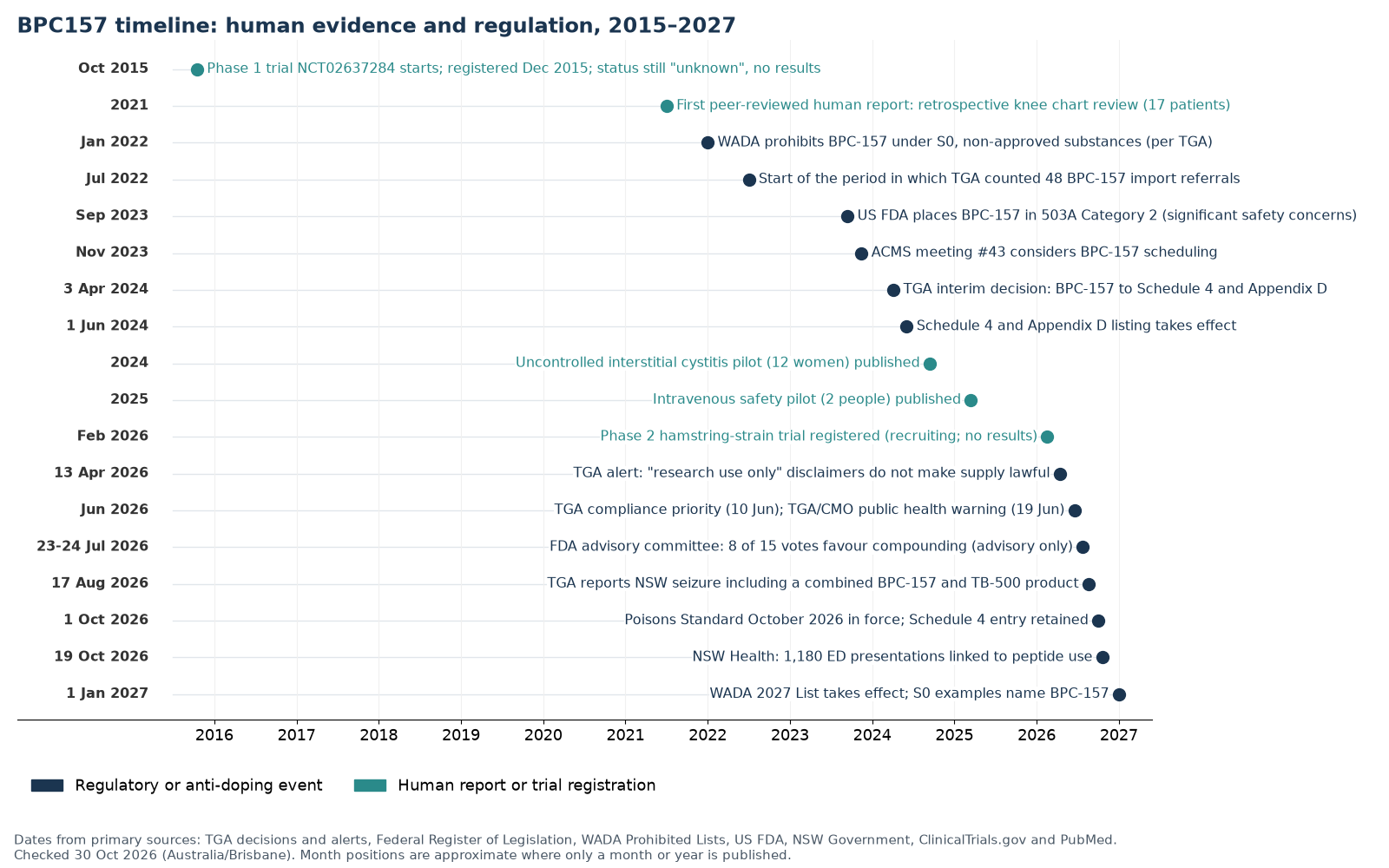
ClinicalTrials.gov held four unique BPC-157 registrations on 30 October 2026 [12]. The oldest, NCT02637284, is a randomised, quadruple-masked phase 1 study in healthy volunteers in Mexico with an estimated enrolment of 42. It started in October 2015 and was first submitted in December 2015, about two months after it started. Its estimated completion was March 2016, its record was last updated in December 2015, and its status is “unknown”. No results have been posted in the roughly 10 years and 7 months since its estimated completion, and the FDA could not find an associated publication [103, 15]. This is the “single registered phase 1 clinical trial conducted in 2015” cited by the TGA delegate in 2024 [23].
Three more registrations appeared in 2026. NCT07437547 is a randomised, quadruple-masked phase 2 study of hamstring strain in China with an estimated enrolment of 120. It started on 2 February 2026, was first submitted on 22 February 2026 (20 days after it started), and was recruiting at the time of the search [104]. NCT07803250 is a randomised, quadruple-masked phase 1 study in people undergoing rotator cuff repair in the United States, with an estimated enrolment of 30. It was registered before its planned start in January 2027 [105]. NCT07752381 is an open-label, single-group study of 40 people in the United States testing an oral product that contains BPC-157. It was recorded as completed on 1 November 2025 but first submitted on 3 August 2026, about nine months after completion, and no results have been posted [106]. In summary, none of the four registrations has posted results, three of the four were registered after the study began, and only one was registered prospectively. Retrospective registration weakens the protection that registries offer against selective outcome reporting [35].
Table 3. BPC-157 human studies, meeting abstracts and trial registrations identified on 30 October 2026 (doses deliberately omitted).
| Source | Design | Population and size | Comparator / masking | Status and key limitation |
|---|---|---|---|---|
| Meeting abstracts, 2002 and 2003 [15] | Phase 1 tolerability and pharmacokinetics, rectal enema | Healthy male volunteers; 32 randomised, 24 exposed | Placebo-controlled | Abstract only; no peer-reviewed full report; BPC-157 largely undetectable in plasma |
| Meeting abstract, 2005 [15] | Multicentre randomised trial, rectal enema | Mild to moderate ulcerative colitis; 53 randomised, 46 completed | Placebo-controlled, double-blind | Abstract only; confidence interval for difference included zero; FDA: inadequate |
| Lee & Padgett 2021 [82] | Retrospective chart review | Knee pain; 17 identified, 16 contacted, 12 BPC-157 only | None | Single clinic; telephone follow-up; no validated outcome measure |
| Lee et al. 2024 [99] | Single-arm pilot | Interstitial cystitis; 12 women | None | Uncontrolled; single procedure; small sample |
| Lee & Burgess 2025 [100] | Pilot case series | 2 adults with prior BPC-157 use | None | Two participants; prior exposure; cannot characterise safety |
| Froum et al. 2026 [101] | Case report with narrative review | 3 people with inferior alveolar nerve injury | None | Several concurrent interventions; causality cannot be assessed |
| NCT02637284 [103] | Phase 1, randomised | Healthy volunteers, Mexico; estimated 42 | Quadruple-masked | Status unknown since 2015; registered about 2 months after start; no results |
| NCT07437547 [104] | Phase 2, randomised | Hamstring strain, China; estimated 120 | Quadruple-masked | Recruiting; registered 20 days after start; no results |
| NCT07803250 [105] | Phase 1, randomised | Rotator cuff repair, United States; estimated 30 | Quadruple-masked | Not yet recruiting (start January 2027); registered prospectively |
| NCT07752381 [106] | Single group, open-label | Adults, United States; 40 enrolled | None | Completed November 2025; registered about 9 months after completion; no results |
Results: BPC-157 regulatory status in Australia, sport and the United States
Is BPC-157 legal in Australia? The Schedule 4 and Appendix D listing
BPC-157 entered the Poisons Standard through a scheduling process that ran from November 2023 to June 2024. The proposal was considered at the November 2023 meeting of the Advisory Committee on Medicines Scheduling. It cited 48 referrals for importation of BPC-157 received by the TGA since 1 July 2022 [23]. The delegate’s interim decision, published in April 2024, was to create a Schedule 4 entry and to list BPC-157 in Appendix D, clause 5. The decision document stated that the putative human benefits were “largely unsubstantiated”, that the toxicity profile was “largely uncharacterised”, and that marketing the substance as “not for therapeutic use” or “for research only” was “insufficient to deter consumer misuse” [23]. The final decision confirmed the listing with an implementation date of 1 June 2024 [1]. The legislative instrument’s Explanatory Statement records that the entry added BPC-157 to Schedule 4 for the first time, and that the Appendix D listing means possession without authority is illegal [2, 36].
The Poisons Standard that commenced on 1 October 2026 retains the Schedule 4 entry and the Appendix D, clause 5 listing [16]. Schedule 4 covers prescription-only medicines. Under the Therapeutic Goods Act 1989, medicines supplied in Australia must generally be included in the ARTG unless an exemption, approval or authority applies [107], and BPC-157 is not on the ARTG [20]. On the question “is BPC-157 legal in Australia?”, the primary sources therefore support a precise answer. BPC-157 is not an approved medicine in Australia. It is a Schedule 4 substance with additional possession controls, and the TGA states that labels such as “research use only” or “not for human use” do not change whether a product is regulated as a therapeutic good [18, 3]. This review does not offer legal advice. Anyone with a specific question should consult the TGA, the relevant state or territory health department, or a lawyer.
TGA and state action in 2026
Regulatory attention increased sharply in 2026 (Figure 4). On 13 April 2026 the TGA published guidance on responsibilities when importing, compounding, supplying and advertising peptides. It named BPC-157 among unapproved peptides and stated that research-use disclaimers do not make supply lawful [3]. On 10 June the TGA added unapproved peptide products to its compliance priorities [37]. On 19 June the TGA and Australia’s Chief Medical Officer issued a joint statement on public health risks. It named BPC-157 and noted that the TGA has no oversight of the composition of unapproved products [4]. On 20 July the TGA put promoters and suppliers of unapproved peptides on notice [38]. On 17 August it reported that more than $120,000 of goods had been seized in New South Wales after warrants were executed on 4 August 2026, including a combined BPC-157 and TB-500 product [39]. On 19 October NSW Health reported 1,180 emergency department presentations associated with peptide use between 1 July 2025 and 30 September 2026, rising from 5 in July 2025 to more than 217 in September 2026 [5]. Over those 15 months that is an average of about 79 presentations a month (1,180 ÷ 15 = 78.7). The release attributes presentations to peptide use generally, not to BPC-157 specifically, and should not be read as a BPC-157 harm estimate.
BPC-157 and WADA: prohibited at all times in sport
BPC-157 falls under section S0 (Non-Approved Substances) of the WADA Prohibited List. S0 covers pharmacological substances not approved by any government health authority for human therapeutic use, and they are prohibited at all times, in and out of competition. According to the TGA delegate, the listing applied from January 2022 [23]. BPC-157 is named as an example in the S0 text of the 2025 and 2026 Lists [25, 26]. The 2027 List, approved by WADA’s Executive Committee on 10 September 2026 and in force from 1 January 2027, retains it [17, 40]. Sport Integrity Australia states that BPC-157 is prohibited and that a Therapeutic Use Exemption would not be granted for it [20]. The United States Anti-Doping Agency describes it as an experimental peptide that creates risk for athletes [108, 109]. A validated urine detection method for BPC-157 was reported after the peptide was identified in confiscated vials [28]. A harmonised anti-doping workflow covering peptidic agents was published in 2026 [59], and in vitro metabolite profiling has also been reported [58].
United States: FDA safety concerns and the 2026 advisory committee
The US FDA lists BPC-157 on its page of bulk drug substances that may present significant safety risks in compounding. It states that the substance may pose a risk for immunogenicity and for peptide-related impurities, and that the agency lacks sufficient information to know whether it would cause harm when administered to humans [41]. In July 2026 the FDA’s Pharmacy Compounding Advisory Committee considered whether BPC-157 should be added to the list of bulk substances eligible for compounding. FDA scientists proposed that it should not. They cited inadequate physicochemical characterisation, insufficient safety and immunogenicity information, insufficient evidence of effectiveness, and the fact that its molecular targets had not been identified [15]. According to a published analysis of the meeting, 15 members voted on BPC-157: 8 supported adding it, 6 voted against and 1 abstained. That recommendation is advisory and does not itself change BPC-157’s status [102]. The FDA had not announced a final decision in the sources reviewed on 30 October 2026.
Table 4. BPC-157 regulatory and anti-doping status, verified at primary sources on 30 October 2026.
| Jurisdiction or body | Instrument or source | Status of BPC-157 | Effective or published |
|---|---|---|---|
| Australia: Poisons Standard | F2024L00589; current instrument F2026L01327 [2, 16] | Schedule 4 entry; Appendix D, clause 5 (possession without authority illegal) | From 1 June 2024; retained in the 1 October 2026 instrument |
| Australia: ARTG | Sport Integrity Australia substance page [20] | Not included on the ARTG (not an approved medicine) | Checked 30 October 2026 |
| Australia: TGA guidance | Therapeutic peptide regulation page; 13 April 2026 alert [18, 3] | “Research use only” or “not for human use” wording does not change regulatory status | 2026 |
| Australia: TGA enforcement | Media releases [37, 4, 38, 39] | Compliance priority; joint public health warning; seizure including a combined BPC-157 and TB-500 product | June–August 2026 |
| World Anti-Doping Agency | Prohibited List 2025, 2026, 2027 [25, 26, 17] | S0 Non-Approved Substances; prohibited at all times; named in S0 text | Since January 2022; 2027 List from 1 January 2027 |
| Sport Integrity Australia | BPC-157 substance page [20] | Prohibited; Therapeutic Use Exemption would not be granted | Checked 30 October 2026 |
| United States: FDA | Compounding safety-risk page; PCAC briefing [41, 15] | Not approved; safety-risk listing; FDA scientists proposed against compounding eligibility | Page current as of 22 April 2026; PCAC 23–24 July 2026 |
| United States: advisory committee | Published analysis of the vote [102] | 8 of 15 votes in favour of compounding eligibility; advisory only | July 2026; no final FDA decision found |
Discussion: what the BPC157 evidence map shows
A large animal literature with almost no human translation
The central finding of this review is the gap between the volume and the type of BPC157 evidence. The corpus is large, with 167 primary records over 34 years, and it covers almost every organ system. It is also almost entirely preclinical: 86% of primary records are rodent studies, and only four peer-reviewed reports describe data from people. Those four reports are uncontrolled and together describe 33 people. The only randomised, placebo-controlled human data are three meeting abstracts from 2002 to 2005, which were never published as full papers and are visible today only through the FDA’s description of them [15]. The one randomised efficacy comparison reported in those abstracts did not show a clear difference from placebo. On the question “what do BPC-157 human studies show?”, this is the most accurate one-sentence answer the record supports: very little, and nothing from a peer-reviewed controlled trial.
This gap is not unusual in itself. Most compounds that look promising in rodents never show a benefit in people. Systematic reviews of animal research have repeatedly found that poor reporting of randomisation, blinding and sample size is associated with larger estimated effects [34, 21]. What is unusual about BPC-157 is the combination of three features: the length of time the animal record has grown without a clinical programme reaching publication, the concentration of that record in one group, and the extent to which the substance is promoted online as though human efficacy had been established. The TGA delegate made the same observation in 2024, describing a small number of peer-reviewed studies “that largely originate from a single laboratory” and “only a single registered phase 1 clinical trial conducted in 2015” [23]. Two years later, the number of registrations has risen to four, but none has posted results.
Why concentration in one group matters
The single-group pattern is the most distinctive feature of this literature. Of the 167 primary studies, 140 (83.8%) came from the Zagreb group, and the proportion was higher still among in vivo animal studies (139 of 148, 93.9%). The group has been prolific and consistent, and its papers describe a coherent mechanistic programme centred on nitric oxide, angiogenesis and a proposed “cytoprotective” action [30, 86, 85]. Concentration is not evidence of error. It does mean, however, that the credibility of almost every BPC-157 finding depends on the methods of one laboratory. It also means that the field has had little of the independent testing that normally separates robust effects from chance or method-specific results.
The few independent studies identified here are informative precisely because they are independent. A 2026 rat study of Achilles tendon healing from an independent group reported that BPC-157 alone produced numerically lower injury scores that were not statistically significant on total scores [83]. Work from a Taiwanese group on tendon fibroblasts and vessel tone added mechanistic detail but did not test the Zagreb in vivo models [52, 53, 54]. A pharmacokinetic and toxicology programme in China reported data from mice, rats, rabbits and dogs, and it remains the most systematic published safety work [57, 31]. None of these studies was designed as a replication. The field therefore still lacks the most basic test of robustness: an independent laboratory, using a pre-registered protocol and blinded assessment, repeating a key Zagreb experiment.
Reporting quality and what it implies
The reporting audit in this review (Figure 3) found that randomisation was stated in 42 of 47 full texts, but its method was described in only 3. Blinding was mentioned in 39, a sample size calculation was reported in only 3, and only 5 referred to the ARRIVE guidelines. These are not trivial omissions. ARRIVE 2.0 places randomisation, blinding and sample size among its “essential 10” items because inadequate reporting of them is associated with biased estimates [13, 34]. The audit also found that 42 of the 47 studies used male animals only. That limits generalisability, and it means that any sex differences in response have not been examined. The improvements seen in 2026, when three Zagreb papers described their randomisation method or sample size, are welcome. They are also recent, few and not yet the norm.
How errors propagate in secondary literature
Secondary literature now outnumbers new primary research: in 2025 and 2026, this review counted 33 secondary records against 16 primary studies. That shift matters because errors in reviews tend to be copied. Three examples emerged from this review. First, older review titles describe BPC-157 as being “in trials for inflammatory bowel disease” [32, 110], and a 2008 primary paper describes it as “in clinical trials” [111]. Some primary papers go further and describe clinical use in ulcerative colitis as successful [64]. The only trial-level data visible today are meeting abstracts, and the FDA judged them inadequate [15]. Second, a 2025 literature and patent review states that BPC-157 is “not currently listed as banned by the WADA” [24]. The 2025 Prohibited List names BPC-157 in S0 [25], as do the 2026 and 2027 Lists [26, 17]. Third, online commentary often treats the 2015 registration NCT02637284 as evidence of human testing. Its record shows no results, an unknown status and no update since 2015 [103]. Each of these points can be checked in minutes against a primary source. Each is also repeated widely, which is why this review verified every regulatory and registry statement at source.
The secondary literature is also contested. In 2025, the Zagreb group published a commentary on the Józwiak review, followed by the authors’ reply [112, 113], and a separate commentary responded to a lengthy 2024 Zagreb review [114]. Several reviews written for clinicians in 2026 emphasise limited clinical validation, product quality concerns, regulatory status and anti-doping implications [48, 46, 47, 43, 45]. One, searching to June 2026, found that human musculoskeletal evidence was limited to one small retrospective uncontrolled case series [47]. A 2026 review from a drug-development perspective noted that BPC-157 has no approved formulation and no completed phase II clinical trial, and that its pharmaceutical development remains rudimentary [115].
How this review differs from earlier BPC-157 reviews
Four recent reviews are the closest to this one. The systematic review by Vasireddi and colleagues searched to 3 June 2024 and included 36 studies relevant to orthopaedic sports medicine, of which 35 were preclinical and one was clinical [7]. The systematic review by Poolton and colleagues searched to 1 June 2026, included only human studies, and found three (30 people) of poor quality, with very low certainty of evidence [6]. The narrative review by McGuire and colleagues considered musculoskeletal healing and framed the question as regeneration or risk [8]. The critical review by Demirtaş, published in September 2026, examined rodent ischaemia–reperfusion models and concluded that the evidence was heterogeneous, often relied on short observation periods and single-dose designs, and supported BPC-157 only as a “hypothesis-generating” preclinical candidate [95].
This review adds four things those reviews do not provide. It counts the whole PubMed corpus with a reproducible search and classifies every record. It quantifies the single-group concentration rather than describing it. It audits reporting quality across all open-access full texts. And it reconciles the peer-reviewed human reports with the meeting abstracts, the trial registrations and the FDA’s 2026 count of exposed participants, all checked against primary sources. Its conclusions are consistent with the earlier reviews. They also show that the pattern those reviews describe in specific fields, mostly animal data from one group with very little human evidence, holds across the whole literature.
BPC-157 side effects and safety: what the evidence can and cannot say
Questions about BPC-157 side effects and safety are common, and the honest answer is that its safety in people has not been characterised. The preclinical safety work by Xu and colleagues reported that the peptide was well tolerated in mice, rats, rabbits and dogs, with no genetic or embryo-fetal toxicity observed [57]. Pharmacokinetic work in rats and dogs reported an elimination half-life of under 30 minutes and rapid metabolism [31]. These data are useful, but they cannot be extrapolated to people, to repeated or long-term exposure, or to products of unknown composition. The human reports are too small and too poorly controlled to detect anything but the most common adverse effects. A study of two people cannot establish safety, even when its title says otherwise [100], and the Poolton review rated the overall certainty as very low [6].
Regulators have reached the same conclusion. The TGA delegate described the toxicity profile as “largely uncharacterised” [23]. The FDA states that it lacks sufficient information to know whether BPC-157 would cause harm when administered to humans, and it has raised concerns about immunogenicity and peptide-related impurities [41]. A published analysis of the 2026 advisory committee materials noted that certificates of analysis for these products lacked peptide-specific testing [102]. The TGA has warned that it has no oversight of the composition of unapproved peptide products [4], and NSW Health has reported a rise in emergency department presentations associated with peptide use in general [5]. None of these sources establishes a specific harm from BPC-157. Together they show that the absence of reported harm in small studies is not evidence of safety.
What “research use only” does and does not mean
Products containing BPC-157 are often labelled “for research use only” or “not for human consumption”. The regulatory position on this point is clear. The TGA delegate noted in 2024 that such disclaimers were used “to circumvent existing controls on therapeutic goods” [23]. In 2026 the TGA stated that wording such as “research use only” does not change whether a product is a therapeutic good or whether its supply is lawful [18, 3]. A label describes intended use. It does not change a substance’s scheduling, approval status or anti-doping status. For an Australian reader, the relevant facts are that BPC-157 is a Schedule 4 substance listed in Appendix D, that it is not on the ARTG, and that it is prohibited at all times in sport [16, 20, 17].
Human-evidence gap analysis: research questions for BPC-157
The evidence map points to specific, answerable questions. Table 5 sets out seven of them, the gap each addresses, and the type of study that could answer it. The table deliberately specifies designs and outcomes, not doses or protocols. Any human study would need ethics approval and, in Australia, would need to operate within the clinical trial and scheduling frameworks that apply to an unapproved Schedule 4 substance [107, 16].
Table 5. Priority research questions arising from the BPC-157 evidence map (designs only; no doses or protocols).
| # | Research question | Evidence gap identified in this review | Study design that could answer it |
|---|---|---|---|
| 1 | Do key Zagreb findings replicate independently? | 83.8% of attributable primary studies from one group; no reported direct replication | Pre-registered, multi-laboratory replication of a high-priority rodent model, with blinded outcome assessment and ARRIVE 2.0 reporting [13] |
| 2 | Are effects present in female animals? | 42 of 47 audited full texts used male animals only | Replication studies powered to test sex as a biological variable |
| 3 | What happened in the 2002–2005 randomised studies? | Only meeting abstracts; full results never published | Full publication or data release of the original studies, with the original protocol and outcomes |
| 4 | What was found in NCT02637284? | Status unknown since 2015; no results | Results posting or a documented reason for non-completion |
| 5 | Does BPC-157 differ from placebo in a defined musculoskeletal condition? | No peer-reviewed controlled human trial | Completion and full reporting of the registered randomised, masked trials, with pre-specified outcomes [104, 105] |
| 6 | What is the safety and immunogenicity profile in people? | 81 exposed participants in total; longest treatment two weeks; no immunogenicity data | Phase 1 studies with characterised material, anti-drug antibody testing and systematic adverse event collection [15] |
| 7 | What is actually in unregulated products? | Regulators report no oversight of composition; certificates lack peptide-specific tests | Independent analytical surveys of seized or purchased samples for identity, content and impurities [28, 4] |
Questions 1, 3 and 4 could be answered without exposing anyone to BPC-157. Publishing the 2002–2005 data and the outcome of NCT02637284 would provide the first peer-reviewed randomised human evidence on BPC-157, of which there is currently none. Independent preclinical replication would show whether the large Zagreb literature is reproducible. Question 6 reflects the FDA’s view that immunogenicity has not been addressed [41], and question 7 reflects the TGA’s warning about the composition of unapproved products [4].
Limitations of this review
This review has several limitations. The main corpus came from PubMed, so studies indexed only in Embase, Scopus or regional databases may have been missed. The Europe PMC count was used as a cross-check [11], and the FDA’s PubMed and Embase search identified the meeting abstracts that PubMed alone misses [15]. Records were screened and classified by one reviewer using a pre-specified scheme, without independent duplicate screening. Classification of study models and domains involved judgement, and a second reviewer might classify some records differently. Affiliation-based attribution relied on author and affiliation data and may misattribute some collaborative studies. The reporting audit was limited to 47 open-access full texts, which may not represent studies without open full text, and it recorded whether items were reported, not whether they were done well. The Australian New Zealand Clinical Trials Registry blocked automated access, so registrations there could not be checked systematically. Regulatory sources change. Every regulatory statement here was checked on 30 October 2026, and later changes are not reflected. Finally, this review did not assess risk of bias in individual studies or pool effect sizes, because the heterogeneity of models and outcomes would make a pooled estimate misleading.
Conclusion: the state of BPC157 evidence in 2026
BPC157 has one of the largest single-group literatures of any investigational peptide. That literature is overwhelmingly preclinical, concentrated in one laboratory, poorly reported on the items most linked to bias, and largely untested in female animals. In people, the peer-reviewed record consists of four uncontrolled reports describing 33 people. The only randomised data are meeting abstracts from 20 years ago, and four trial registrations have produced no results. In Australia, BPC-157 is a Schedule 4 substance listed in Appendix D and is not on the ARTG. In sport, it is prohibited at all times under the WADA S0 category, including in the 2027 List. In the United States, it is unapproved and the FDA has raised safety and quality concerns. Labels such as “research use only” change none of this. Until independent replications and controlled human trials are completed and fully reported, statements that BPC-157 has been shown to have specific effects in people are not supported by the evidence.
Relevance to Eternal Peptides Wholesale
Eternal Peptides Wholesale distributes research peptides in wholesale boxes of 10 vials, for laboratory research use only and not for human consumption (company background). It publishes this review because BPC157 is one of the most searched peptide names, and an accurate summary of its evidence and regulatory position is more useful to researchers than marketing claims. As this review shows, a “research use only” label is not legal clearance, and BPC-157 is a Schedule 4 and Appendix D substance in Australia.
What the site documents is analytical, not biological. Its certificate of analysis library transcribes batch-specific reports from Janoshik Analytical, an independent laboratory, and the testing standards page explains how identity, purity and content results are read. Those reports bear on the analytical gap identified in question 7 of Table 5. They say nothing about effects in people and do not establish regulatory approval, clinical suitability or safety for human use. Related evidence reviews from Eternal Peptides Wholesale are on the blog, including an analysis of peptides for muscle gain and a guide to reading peptide research claims.
Glossary
- Appendix D (clause 5): part of the Poisons Standard listing poisons for which possession without authority is illegal; BPC-157 is item 5.
- ARRIVE 2.0: reporting guidelines for animal research, including an “essential 10” set of items such as randomisation, blinding and sample size.
- ARTG: Australian Register of Therapeutic Goods, the TGA’s register of goods that can be lawfully supplied in Australia.
- BPC157 (BPC-157, BPC 157): a synthetic 15-amino-acid peptide (GEPPPGKPADDAGLV), also coded PL 14736, studied mainly in rat injury models.
- Evidence map: a systematic description of what research exists on a topic, by design, model and domain, without pooling results.
- FAERS: the FDA Adverse Event Reporting System, a database of voluntary reports that cannot establish causation.
- GRADE: a framework for rating the certainty of a body of evidence as high, moderate, low or very low.
- Meeting abstract: a short summary presented at a conference, usually not peer reviewed in full and often lacking methods and results detail.
- PCAC: the FDA’s Pharmacy Compounding Advisory Committee, whose recommendations are advisory.
- Prospective registration: registering a trial before its first participant is enrolled, so that planned outcomes are on record.
- S0 (Non-Approved Substances): the WADA Prohibited List section for substances with no current approval for human therapeutic use; prohibited at all times.
- Schedule 4: the Poisons Standard schedule for prescription-only medicines.
- Zagreb group: the University of Zagreb research network that has produced most BPC-157 studies, defined for this review by the attribution rule in the Methods.
BPC157 frequently asked questions
What is BPC157?
BPC157, also written BPC-157 or BPC 157, is a synthetic peptide of 15 amino acids. It was first described in the early 1990s by researchers in Zagreb in connection with a peptide found in gastric juice. Almost all research on it consists of rodent studies, and 83.8% of primary studies come from one research group in Zagreb. It is not an approved medicine in Australia or the United States.
Is BPC-157 legal in Australia?
BPC-157 is not an approved medicine in Australia and is not on the ARTG. Since 1 June 2024 it has been a Schedule 4 (prescription-only) substance, and it is listed in Appendix D, clause 5, which makes possession without authority illegal. The current Poisons Standard, in force from 1 October 2026, retains both entries. This summary is not legal advice.
Why is BPC-157 Schedule 4?
The TGA delegate’s 2024 reasons cited putative human benefits that were “largely unsubstantiated”, a toxicity profile that was “largely uncharacterised”, a limited evidence base largely from a single laboratory, and the risk of misuse, particularly among athletes. The proposal followed 48 import referrals for BPC-157 received by the TGA since 1 July 2022.
Is BPC-157 banned by WADA?
Yes. BPC-157 is prohibited at all times, in and out of competition, under section S0 (Non-Approved Substances) of the WADA Prohibited List. It is named in the 2025, 2026 and 2027 Lists. Sport Integrity Australia states that a Therapeutic Use Exemption would not be granted for it.
Are there BPC-157 human studies?
Very few. Four peer-reviewed reports describe 33 people, and none had a control group. Randomised, placebo-controlled data exist only as meeting abstracts from 2002 to 2005, which the FDA judged inadequate. Four trials are registered on ClinicalTrials.gov, and none has posted results.
What is known about BPC-157 side effects and safety?
Its safety in people has not been established. Animal toxicology reported it was well tolerated, but the human reports are too small to characterise side effects. The TGA described its toxicity profile as largely uncharacterised, and the FDA has raised concerns about immunogenicity and impurities. The absence of reported harm in small studies is not evidence of safety.
Is BPC-157 approved by the FDA?
No. The FDA lists BPC-157 among bulk drug substances that may present significant safety risks in compounding. In July 2026 FDA scientists proposed that it should not be made eligible for compounding. An advisory committee vote of 8 in favour, 6 against and 1 abstention is advisory only, and no final FDA decision had been announced by 30 October 2026.
Does a “research use only” label change the legal status of BPC 157?
No. The TGA states that wording such as “research use only” or “not for human use” does not change whether a product is regulated as a therapeutic good or make its supply lawful. BPC 157 remains a Schedule 4 and Appendix D substance whatever the label says.
References
- Therapeutic Goods Administration. Notice of final decisions to amend (or not amend) the current Poisons Standard (ACMS #43, ACCS #37 and Joint ACMS/ACCS #35, November 2023). Canberra: TGA; May 2024. Available at: https://www.tga.gov.au/sites/default/files/2024-05/notice-final-decisions-amend-not-amend-current-poisons-standard-november-2023.pdf. Accessed 30 October 2026.
- Therapeutic Goods (Poisons Standard—June 2024) Instrument 2024 (F2024L00589). Explanatory Statement. Federal Register of Legislation. Available at: https://www.legislation.gov.au/F2024L00589/asmade/es/original/pdf. Accessed 30 October 2026.
- Therapeutic Goods Administration. Understanding your responsibilities when importing, compounding and supplying unapproved peptide products. Safety alert, 13 April 2026. Available at: https://www.tga.gov.au/safety/safety-monitoring-and-information/safety-alerts/understanding-your-responsibilities-when-importing-compounding-and-supplying-unapproved-peptide-products. Accessed 30 October 2026.
- Therapeutic Goods Administration. Concerns regarding public health risks associated with unapproved peptide products. Media release, 19 June 2026. Available at: https://www.tga.gov.au/news/media-releases/concerns-regarding-public-health-risks-associated-unapproved-peptide-products. Accessed 30 October 2026.
- NSW Government. NSW Health warns of surge in hospital presentations linked to peptide use. Ministerial release, 19 October 2026. Available at: https://www.nsw.gov.au/ministerial-releases/nsw-health-warns-of-surge-hospital-presentations-linked-to-peptide-use. Accessed 30 October 2026.
- Poolton JT, Minett J, Kazmi A. Human evidence for BPC-157 in orthopaedic and regenerative medicine: a systematic review of efficacy and safety. Acta Orthop Belg. 2026;92(3). doi:10.52628/92.3.15837 PMID: 42885452. Available at: https://doi.org/10.52628/92.3.15837. Accessed 30 October 2026.
- Vasireddi N, Hahamyan H, Salata MJ, et al. Emerging Use of BPC-157 in Orthopaedic Sports Medicine: A Systematic Review. HSS J. 2025;21(4):485-495. doi:10.1177/15563316251355551 PMID: 40756949. Available at: https://doi.org/10.1177/15563316251355551. Accessed 30 October 2026.
- McGuire FP, Martinez R, Lenz A, et al. Regeneration or Risk? A Narrative Review of BPC-157 for Musculoskeletal Healing. Curr Rev Musculoskelet Med. 2025;18(12):611-619. doi:10.1007/s12178-025-09990-7 PMID: 40789979. Available at: https://doi.org/10.1007/s12178-025-09990-7. Accessed 30 October 2026.
- Page MJ, McKenzie JE, Bossuyt PM, et al. The PRISMA 2020 statement: an updated guideline for reporting systematic reviews. BMJ. 2021;372:n71. doi:10.1136/bmj.n71 PMID: 33782057. Available at: https://doi.org/10.1136/bmj.n71. Accessed 30 October 2026.
- National Center for Biotechnology Information. Entrez Programming Utilities (E-utilities) Help. Bethesda (MD): National Library of Medicine. Available at: https://www.ncbi.nlm.nih.gov/books/NBK25501/. Accessed 30 October 2026.
- Europe PMC. Europe PMC RESTful Web Service: search endpoint (query BPC-157). Available at: https://www.ebi.ac.uk/europepmc/webservices/rest/search?query=BPC-157&format=json. Accessed 30 October 2026.
- ClinicalTrials.gov. ClinicalTrials.gov API (version 2). U.S. National Library of Medicine. Available at: https://clinicaltrials.gov/data-api/api. Accessed 30 October 2026.
- Percie du Sert N, Hurst V, Ahluwalia A, et al. The ARRIVE guidelines 2.0: Updated guidelines for reporting animal research. PLoS Biol. 2020;18(7):e3000410. doi:10.1371/journal.pbio.3000410 PMID: 32663219. Available at: https://doi.org/10.1371/journal.pbio.3000410. Accessed 30 October 2026.
- Hooijmans CR, Rovers MM, de Vries RB, et al. SYRCLE's risk of bias tool for animal studies. BMC Med Res Methodol. 2014;14:43. doi:10.1186/1471-2288-14-43 PMID: 24667063. Available at: https://doi.org/10.1186/1471-2288-14-43. Accessed 30 October 2026.
- U.S. Food and Drug Administration. FDA Briefing Document: Pharmacy Compounding Advisory Committee (PCAC) meeting, July 23–24, 2026. BPC-157 (free base) and BPC-157 acetate. Silver Spring (MD): FDA; 2026. Available at: https://www.fda.gov/media/193343/download. Accessed 30 October 2026.
- Therapeutic Goods (Poisons Standard—October 2026) Instrument 2026 (F2026L01327). Federal Register of Legislation. Available at: https://www.legislation.gov.au/F2026L01327/asmade/text. Accessed 30 October 2026.
- World Anti-Doping Agency. World Anti-Doping Code International Standard: Prohibited List 2027. Montreal: WADA; 2026. Available at: https://www.wada-ama.org/sites/default/files/2026-09/2027list_en_final_clean_26_august_2026_2.pdf. Accessed 30 October 2026.
- Therapeutic Goods Administration. How we regulate therapeutic peptide products. Available at: https://www.tga.gov.au/products/medicines/monitoring-and-compliance/how-we-regulate-therapeutic-peptide-products. Accessed 30 October 2026.
- Macleod MR, Lawson McLean A, Kyriakopoulou A, et al. Risk of Bias in Reports of In Vivo Research: A Focus for Improvement. PLoS Biol. 2015;13(10):e1002273. doi:10.1371/journal.pbio.1002273 PMID: 26460723. Available at: https://doi.org/10.1371/journal.pbio.1002273. Accessed 30 October 2026.
- Sport Integrity Australia. BPC-157. Substance education. Available at: https://www.sportintegrity.gov.au/what-we-do/anti-doping/substance-education/bpc-157. Accessed 30 October 2026.
- Button KS, Ioannidis JP, Mokrysz C, et al. Power failure: why small sample size undermines the reliability of neuroscience. Nat Rev Neurosci. 2013;14(5):365-76. doi:10.1038/nrn3475 PMID: 23571845. Available at: https://doi.org/10.1038/nrn3475. Accessed 30 October 2026.
- Hackam DG, Redelmeier DA. Translation of research evidence from animals to humans. JAMA. 2006;296(14):1731-2. doi:10.1001/jama.296.14.1731 PMID: 17032985. Available at: https://doi.org/10.1001/jama.296.14.1731. Accessed 30 October 2026.
- Therapeutic Goods Administration. Notice of interim decisions to amend (or not amend) the current Poisons Standard: ACMS #43, ACCS #37 and Joint ACMS/ACCS #35 (November 2023). Canberra: TGA; published April 2024. Available at: https://www.tga.gov.au/sites/default/files/2024-04/public-notice-of-interim-decisions-acms-43-accs-37-joint-acms-accs-35.pdf. Accessed 30 October 2026.
- Józwiak M, Bauer M, Kamysz W, et al. Multifunctionality and Possible Medical Application of the BPC 157 Peptide-Literature and Patent Review. Pharmaceuticals (Basel). 2025;18(2). doi:10.3390/ph18020185 PMID: 40005999. Available at: https://doi.org/10.3390/ph18020185. Accessed 30 October 2026.
- World Anti-Doping Agency. World Anti-Doping Code International Standard: Prohibited List 2025. Montreal: WADA; 2024. Available at: https://www.wada-ama.org/sites/default/files/2024-09/2025list_en_final_clean_12_september_2024.pdf. Accessed 30 October 2026.
- World Anti-Doping Agency. World Anti-Doping Code International Standard: Prohibited List 2026. Montreal: WADA; 2025. Available at: https://www.wada-ama.org/sites/default/files/2025-09/2026list_en_final_clean_september_2025.pdf. Accessed 30 October 2026.
- National Center for Biotechnology Information. PubChem Compound Summary for CID 9941957, BPC-157. Available at: https://pubchem.ncbi.nlm.nih.gov/compound/9941957. Accessed 30 October 2026.
- Cox HD, Miller GD, Eichner D. Detection and in vitro metabolism of the confiscated peptides BPC 157 and MGF R23H. Drug Test Anal. 2017;9(10):1490-1498. doi:10.1002/dta.2152 PMID: 28035768. Available at: https://doi.org/10.1002/dta.2152. Accessed 30 October 2026.
- Sikirić P, Petek M, Rucman R, et al. A new gastric juice peptide, BPC. An overview of the stomach-stress-organoprotection hypothesis and beneficial effects of BPC. J Physiol Paris. 1993;87(5):313-27. doi:10.1016/0928-4257(93)90038-u PMID: 8298609. Available at: https://doi.org/10.1016/0928-4257(93)90038-u. Accessed 30 October 2026.
- Sikiric P, Boban Blagaic A, Strbe S, et al. The Stable Gastric Pentadecapeptide BPC 157 Pleiotropic Beneficial Activity and Its Possible Relations with Neurotransmitter Activity. Pharmaceuticals (Basel). 2024;17(4). doi:10.3390/ph17040461 PMID: 38675421. Available at: https://doi.org/10.3390/ph17040461. Accessed 30 October 2026.
- He L, Feng D, Guo H, et al. Pharmacokinetics, distribution, metabolism, and excretion of body-protective compound 157, a potential drug for treating various wounds, in rats and dogs. Front Pharmacol. 2022;13:1026182. doi:10.3389/fphar.2022.1026182 PMID: 36588717. Available at: https://doi.org/10.3389/fphar.2022.1026182. Accessed 30 October 2026.
- Sikiric P, Seiwerth S, Brcic L, et al. Stable gastric pentadecapeptide BPC 157 in trials for inflammatory bowel disease (PL-10, PLD-116, PL 14736, Pliva, Croatia). Full and distended stomach, and vascular response. Inflammopharmacology. 2006;14(5-6):214-21. doi:10.1007/s10787-006-1531-7 PMID: 17186181. Available at: https://doi.org/10.1007/s10787-006-1531-7. Accessed 30 October 2026.
- Landis SC, Amara SG, Asadullah K, et al. A call for transparent reporting to optimize the predictive value of preclinical research. Nature. 2012;490(7419):187-91. doi:10.1038/nature11556 PMID: 23060188. Available at: https://doi.org/10.1038/nature11556. Accessed 30 October 2026.
- Kilkenny C, Parsons N, Kadyszewski E, et al. Survey of the quality of experimental design, statistical analysis and reporting of research using animals. PLoS One. 2009;4(11):e7824. doi:10.1371/journal.pone.0007824 PMID: 19956596. Available at: https://doi.org/10.1371/journal.pone.0007824. Accessed 30 October 2026.
- De Angelis C, Drazen JM, Frizelle FA, et al. Clinical trial registration: a statement from the International Committee of Medical Journal Editors. N Engl J Med. 2004;351(12):1250-1. doi:10.1056/NEJMe048225 PMID: 15356289. Available at: https://doi.org/10.1056/NEJMe048225. Accessed 30 October 2026.
- Therapeutic Goods (Poisons Standard—June 2024) Instrument 2024 (F2024L00589). Federal Register of Legislation. Available at: https://www.legislation.gov.au/F2024L00589/asmade/text. Accessed 30 October 2026.
- Therapeutic Goods Administration. TGA strengthens compliance focus on unapproved peptide products as part of evolving risk response. Media release, 10 June 2026. Available at: https://www.tga.gov.au/news/media-releases/tga-strengthens-compliance-focus-unapproved-peptide-products-part-evolving-risk-response. Accessed 30 October 2026.
- Therapeutic Goods Administration. Unapproved peptide product promoters and suppliers are put on notice. Media release, 20 July 2026. Available at: https://www.tga.gov.au/news/media-releases/unapproved-peptide-product-promoters-and-suppliers-are-put-notice. Accessed 30 October 2026.
- Therapeutic Goods Administration. TGA flexes its muscle against illegal peptides and steroids. Media release, 17 August 2026. Available at: https://www.tga.gov.au/news/media-releases/tga-flexes-its-muscle-against-illegal-peptides-and-steroids. Accessed 30 October 2026.
- World Anti-Doping Agency. WADA publishes 2027 Prohibited List. News release, 21 September 2026. Available at: https://www.wada-ama.org/en/news/wada-publishes-2027-prohibited-list. Accessed 30 October 2026.
- U.S. Food and Drug Administration. Certain bulk drug substances for use in compounding that may present significant safety risks. Content current as of 22 April 2026. Available at: https://www.fda.gov/drugs/human-drug-compounding/certain-bulk-drug-substances-use-compounding-may-present-significant-safety-risks. Accessed 30 October 2026.
- Sikiric P, Petek M, Rucman R, et al. The significance of the gastroprotective effect of body protection compound (BPC): modulation by different procedures. Acta Physiol Hung. 1992;80(1-4):89-98. PMID: 1345210. Available at: https://pubmed.ncbi.nlm.nih.gov/1345210/. Accessed 30 October 2026.
- Mendias CL, Awan TM. Safety and Efficacy of Approved and Unapproved Peptide Therapies for Musculoskeletal Injuries and Athletic Performance. Sports Med. 2026;56(8):1921-1935. doi:10.1007/s40279-026-02437-0 PMID: 41966639. Available at: https://doi.org/10.1007/s40279-026-02437-0. Accessed 30 October 2026.
- Willis J, Vu N. Synthetic Peptides in Pharmacy Compounding: Analysis of PCAC Recommendations and Industry Safety Standards. Int J Pharm Compd. 2026;30(4):329-336. PMID: 42752426. Available at: https://pubmed.ncbi.nlm.nih.gov/42752426/. Accessed 30 October 2026.
- Moiz A, O’Keefe EL, O’Keefe JH. Dangers of Injectable Peptides and Other Unregulated "Biohacking" Drugs. Mo Med. 2026;123(4):337-343. PMID: 42757290. Available at: https://pubmed.ncbi.nlm.nih.gov/42757290/. Accessed 30 October 2026.
- Villegas Meza AD, Nocek M, Mitchell BC, et al. Injectable Peptides in Sports Medicine: A Structured Narrative Review of Evidence, Safety, and Antidoping Implications. JBJS Rev. 2026;14(5). doi:10.2106/JBJS.RVW.26.00027 PMID: 42160466. Available at: https://doi.org/10.2106/JBJS.RVW.26.00027. Accessed 30 October 2026.
- Tham A, Hodgkins CW, Kennedy JG. Investigational Peptides in Orthopaedic Practice: Evidence, Safety, and Patient Counseling for BPC-157, Thymosin Beta-4, and TB-500. J Am Acad Orthop Surg. 2026. doi:10.5435/JAAOS-D-26-00049 PMID: 42937313. Available at: https://doi.org/10.5435/JAAOS-D-26-00049. Accessed 30 October 2026.
- Mayfield CK, Bolia IK, Feingold CL, et al. Injectable Peptide Therapy: A Primer for Orthopaedic and Sports Medicine Physicians. Am J Sports Med. 2026;54(1):223-229. doi:10.1177/03635465251357593 PMID: 41476424. Available at: https://doi.org/10.1177/03635465251357593. Accessed 30 October 2026.
- Tlak Gajger I, Ribarić J, Smodiš Škerl M, et al. Stable gastric pentadecapeptide BPC 157 in honeybee (Apis mellifera) therapy, to control Nosema ceranae invasions in apiary conditions. J Vet Pharmacol Ther. 2018;41(4):614-621. doi:10.1111/jvp.12509 PMID: 29682749. Available at: https://doi.org/10.1111/jvp.12509. Accessed 30 October 2026.
- Sebecić B, Nikolić V, Sikirić P, et al. Osteogenic effect of a gastric pentadecapeptide, BPC-157, on the healing of segmental bone defect in rabbits: a comparison with bone marrow and autologous cortical bone implantation. Bone. 1999;24(3):195-202. doi:10.1016/s8756-3282(98)00180-x PMID: 10071911. Available at: https://doi.org/10.1016/s8756-3282(98)00180-x. Accessed 30 October 2026.
- Grabarevic Z, Tisljar M, Artukovic B, et al. The influence of BPC 157 on nitric oxide agonist and antagonist induced lesions in broiler chicks. J Physiol Paris. 1997;91(3-5):139-49. doi:10.1016/s0928-4257(97)89478-8 PMID: 9403788. Available at: https://doi.org/10.1016/s0928-4257(97)89478-8. Accessed 30 October 2026.
- Chang CH, Tsai WC, Lin MS, et al. The promoting effect of pentadecapeptide BPC 157 on tendon healing involves tendon outgrowth, cell survival, and cell migration. J Appl Physiol (1985). 2011;110(3):774-80. doi:10.1152/japplphysiol.00945.2010 PMID: 21030672. Available at: https://doi.org/10.1152/japplphysiol.00945.2010. Accessed 30 October 2026.
- Chang CH, Tsai WC, Hsu YH, et al. Pentadecapeptide BPC 157 enhances the growth hormone receptor expression in tendon fibroblasts. Molecules. 2014;19(11):19066-77. doi:10.3390/molecules191119066 PMID: 25415472. Available at: https://doi.org/10.3390/molecules191119066. Accessed 30 October 2026.
- Hsieh MJ, Lee CH, Chueh HY, et al. Modulatory effects of BPC 157 on vasomotor tone and the activation of Src-Caveolin-1-endothelial nitric oxide synthase pathway. Sci Rep. 2020;10(1):17078. doi:10.1038/s41598-020-74022-y PMID: 33051481. Available at: https://doi.org/10.1038/s41598-020-74022-y. Accessed 30 October 2026.
- Zhang J, Liu M, Ou H, et al. BPC157 drives angiogenesis through FBXO22-dependent stabilization of BACH1. Cell Commun Signal. 2026;24(1). doi:10.1186/s12964-026-02694-6 PMID: 41606641. Available at: https://doi.org/10.1186/s12964-026-02694-6. Accessed 30 October 2026.
- Yildirim AK, Dastan AO, Demeli Ertus M, et al. Endothelium-Dependent Nitric Oxide-Mediated Vasorelaxant Effects of BPC 157 in Human Internal Mammary Artery. J Clin Med. 2026;15(9). doi:10.3390/jcm15093488 PMID: 42123221. Available at: https://doi.org/10.3390/jcm15093488. Accessed 30 October 2026.
- Xu C, Sun L, Ren F, et al. Preclinical safety evaluation of body protective compound-157, a potential drug for treating various wounds. Regul Toxicol Pharmacol. 2020;114:104665. doi:10.1016/j.yrtph.2020.104665 PMID: 32334036. Available at: https://doi.org/10.1016/j.yrtph.2020.104665. Accessed 30 October 2026.
- Tian T, Jing J, Li Y, et al. Stable Isotope Labeling-Based Nontargeted Strategy for Characterization of the In Vitro Metabolic Profile of a Novel Doping BPC-157 in Doping Control by UHPLC-HRMS. Molecules. 2023;28(21). doi:10.3390/molecules28217345 PMID: 37959764. Available at: https://doi.org/10.3390/molecules28217345. Accessed 30 October 2026.
- Mazzarino M, Colpaert T, Deventer K, et al. Rapid and harmonized analytical workflow for the determination of peptidic and non-peptidic doping agents in dried and liquid blood matrices. Analyst. 2026;151(15):4398-4413. doi:10.1039/d6an00455e PMID: 42328738. Available at: https://doi.org/10.1039/d6an00455e. Accessed 30 October 2026.
- Škrlec K, Ručman R, Jarc E, et al. Engineering recombinant Lactococcus lactis as a delivery vehicle for BPC-157 peptide with antioxidant activities. Appl Microbiol Biotechnol. 2018;102(23):10103-10117. doi:10.1007/s00253-018-9333-6 PMID: 30191288. Available at: https://doi.org/10.1007/s00253-018-9333-6. Accessed 30 October 2026.
- Jelińska J, Józwiak M, Szeleszczuk Ł, et al. BPC-157 and Its Novel Hybrid Analogs as Inhibitors of Acetylcholinesterase. Int J Mol Sci. 2026;27(11). doi:10.3390/ijms27114984 PMID: 42278509. Available at: https://doi.org/10.3390/ijms27114984. Accessed 30 October 2026.
- Sikiric P, Seiwerth S, Grabarevic Z, et al. The beneficial effect of BPC 157, a 15 amino acid peptide BPC fragment, on gastric and duodenal lesions induced by restraint stress, cysteamine and 96% ethanol in rats. A comparative study with H2 receptor antagonists, dopamine promotors and gut peptides. Life Sci. 1994;54(5):PL63-8. doi:10.1016/0024-3205(94)00796-9 PMID: 7904712. Available at: https://doi.org/10.1016/0024-3205(94)00796-9. Accessed 30 October 2026.
- Sikirić P, Seiwerth S, Grabarević Z, et al. Beneficial effect of a novel pentadecapeptide BPC 157 on gastric lesions induced by restraint stress, ethanol, indomethacin, and capsaicin neurotoxicity. Dig Dis Sci. 1996;41(8):1604-14. doi:10.1007/BF02087908 PMID: 8769287. Available at: https://doi.org/10.1007/BF02087908. Accessed 30 October 2026.
- Grgic T, Grgic D, Drmic D, et al. Stable gastric pentadecapeptide BPC 157 heals rat colovesical fistula. Eur J Pharmacol. 2016;780:1-7. doi:10.1016/j.ejphar.2016.02.038 PMID: 26875638. Available at: https://doi.org/10.1016/j.ejphar.2016.02.038. Accessed 30 October 2026.
- Amic F, Drmic D, Bilic Z, et al. Bypassing major venous occlusion and duodenal lesions in rats, and therapy with the stable gastric pentadecapeptide BPC 157, L-NAME and L-arginine. World J Gastroenterol. 2018;24(47):5366-5378. doi:10.3748/wjg.v24.i47.5366 PMID: 30598581. Available at: https://doi.org/10.3748/wjg.v24.i47.5366. Accessed 30 October 2026.
- Gojkovic S, Krezic I, Vrdoljak B, et al. Pentadecapeptide BPC 157 resolves suprahepatic occlusion of the inferior caval vein, Budd-Chiari syndrome model in rats. World J Gastrointest Pathophysiol. 2020;11(1):1-19. doi:10.4291/wjgp.v11.i1.1 PMID: 32226643. Available at: https://doi.org/10.4291/wjgp.v11.i1.1. Accessed 30 October 2026.
- Knezevic M, Gojkovic S, Krezic I, et al. Occluded Superior Mesenteric Artery and Vein. Therapy with the Stable Gastric Pentadecapeptide BPC 157. Biomedicines. 2021;9(7). doi:10.3390/biomedicines9070792 PMID: 34356860. Available at: https://doi.org/10.3390/biomedicines9070792. Accessed 30 October 2026.
- Stupnisek M, Franjic S, Drmic D, et al. Pentadecapeptide BPC 157 reduces bleeding time and thrombocytopenia after amputation in rats treated with heparin, warfarin or aspirin. Thromb Res. 2012;129(5):652-9. doi:10.1016/j.thromres.2011.07.035 PMID: 21840572. Available at: https://doi.org/10.1016/j.thromres.2011.07.035. Accessed 30 October 2026.
- Jelovac N, Sikirić P, Rucman R, et al. A novel pentadecapeptide, BPC 157, blocks the stereotypy produced acutely by amphetamine and the development of haloperidol-induced supersensitivity to amphetamine. Biol Psychiatry. 1998;43(7):511-9. doi:10.1016/s0006-3223(97)00277-1 PMID: 9547930. Available at: https://doi.org/10.1016/s0006-3223(97)00277-1. Accessed 30 October 2026.
- Tudor M, Jandric I, Marovic A, et al. Traumatic brain injury in mice and pentadecapeptide BPC 157 effect. Regul Pept. 2010;160(1-3):26-32. doi:10.1016/j.regpep.2009.11.012 PMID: 19931318. Available at: https://doi.org/10.1016/j.regpep.2009.11.012. Accessed 30 October 2026.
- Perovic D, Kolenc D, Bilic V, et al. Stable gastric pentadecapeptide BPC 157 can improve the healing course of spinal cord injury and lead to functional recovery in rats. J Orthop Surg Res. 2019;14(1):199. doi:10.1186/s13018-019-1242-6 PMID: 31266512. Available at: https://doi.org/10.1186/s13018-019-1242-6. Accessed 30 October 2026.
- Ilic S, Drmic D, Zarkovic K, et al. High hepatotoxic dose of paracetamol produces generalized convulsions and brain damage in rats. A counteraction with the stable gastric pentadecapeptide BPC 157 (PL 14736). J Physiol Pharmacol. 2010;61(2):241-50. PMID: 20436226. Available at: https://pubmed.ncbi.nlm.nih.gov/20436226/. Accessed 30 October 2026.
- Barisic I, Balenovic D, Klicek R, et al. Mortal hyperkalemia disturbances in rats are NO-system related. The life saving effect of pentadecapeptide BPC 157. Regul Pept. 2013;181:50-66. doi:10.1016/j.regpep.2012.12.007 PMID: 23327997. Available at: https://doi.org/10.1016/j.regpep.2012.12.007. Accessed 30 October 2026.
- Strbe S, Gojkovic S, Krezic I, et al. Over-Dose Lithium Toxicity as an Occlusive-like Syndrome in Rats and Gastric Pentadecapeptide BPC 157. Biomedicines. 2021;9(11). doi:10.3390/biomedicines9111506 PMID: 34829735. Available at: https://doi.org/10.3390/biomedicines9111506. Accessed 30 October 2026.
- Vukoja I, Vlainic J, Francina M, et al. Stable pentadecapeptide therapy counteracts gentamicin-induced nephrotoxicity via nitric oxide-system modulation: evidence from a triple nitric oxide-agent approach in rats. J Physiol Pharmacol. 2026;77(3):377-395. doi:10.26402/jpp.2026.3.08 PMID: 42533460. Available at: https://doi.org/10.26402/jpp.2026.3.08. Accessed 30 October 2026.
- Staresinic M, Sebecic B, Patrlj L, et al. Gastric pentadecapeptide BPC 157 accelerates healing of transected rat Achilles tendon and in vitro stimulates tendocytes growth. J Orthop Res. 2003;21(6):976-83. doi:10.1016/S0736-0266(03)00110-4 PMID: 14554208. Available at: https://doi.org/10.1016/S0736-0266(03)00110-4. Accessed 30 October 2026.
- Staresinic M, Petrovic I, Novinscak T, et al. Effective therapy of transected quadriceps muscle in rat: Gastric pentadecapeptide BPC 157. J Orthop Res. 2006;24(5):1109-17. doi:10.1002/jor.20089 PMID: 16609979. Available at: https://doi.org/10.1002/jor.20089. Accessed 30 October 2026.
- Novinscak T, Brcic L, Staresinic M, et al. Gastric pentadecapeptide BPC 157 as an effective therapy for muscle crush injury in the rat. Surg Today. 2008;38(8):716-25. doi:10.1007/s00595-007-3706-2 PMID: 18668315. Available at: https://doi.org/10.1007/s00595-007-3706-2. Accessed 30 October 2026.
- Pevec D, Novinscak T, Brcic L, et al. Impact of pentadecapeptide BPC 157 on muscle healing impaired by systemic corticosteroid application. Med Sci Monit. 2010;16(3):BR81-88. PMID: 20190676. Available at: https://pubmed.ncbi.nlm.nih.gov/20190676/. Accessed 30 October 2026.
- Japjec M, Horvat Pavlov K, Petrovic A, et al. Stable Gastric Pentadecapeptide BPC 157 as a Therapy for the Disable Myotendinous Junctions in Rats. Biomedicines. 2021;9(11). doi:10.3390/biomedicines9111547 PMID: 34829776. Available at: https://doi.org/10.3390/biomedicines9111547. Accessed 30 October 2026.
- Matek D, Matek I, Staresinic E, et al. Stable Gastric Pentadecapeptide BPC 157 as Therapy After Surgical Detachment of the Quadriceps Muscle from Its Attachments for Muscle-to-Bone Reattachment in Rats. Pharmaceutics. 2025;17(1). doi:10.3390/pharmaceutics17010119 PMID: 39861766. Available at: https://doi.org/10.3390/pharmaceutics17010119. Accessed 30 October 2026.
- Lee E, Padgett B. Intra-Articular Injection of BPC 157 for Multiple Types of Knee Pain. Altern Ther Health Med. 2021;27(4):8-13. PMID: 34324435. Available at: https://pubmed.ncbi.nlm.nih.gov/34324435/. Accessed 30 October 2026.
- Biçer O, Adanir O, Güleryüz Y, et al. Effects of BPC-157 and TB-500 on Achilles tendon healing in rats: A histopathological and biomechanical study. Jt Dis Relat Surg. 2026;37(3):822-837. doi:10.52312/jdrs.2026.2951 PMID: 42542926. Available at: https://doi.org/10.52312/jdrs.2026.2951. Accessed 30 October 2026.
- Matek D, Matek I, Japjec M, et al. Tendon, Ligament, and Muscle Injury, Osteotendinous, Myotendinous, and Muscle-to-Bone Junction Therapy Perspectives with Growth Factors and Stable Gastric Pentadecapeptide BPC 157-A Review. Pharmaceuticals (Basel). 2026;19(2). doi:10.3390/ph19020309 PMID: 41754849. Available at: https://doi.org/10.3390/ph19020309. Accessed 30 October 2026.
- Vukojevic J, Milavić M, Perović D, et al. Pentadecapeptide BPC 157 and the central nervous system. Neural Regen Res. 2022;17(3):482-487. doi:10.4103/1673-5374.320969 PMID: 34380875. Available at: https://doi.org/10.4103/1673-5374.320969. Accessed 30 October 2026.
- Seiwerth S, Milavic M, Vukojevic J, et al. Stable Gastric Pentadecapeptide BPC 157 and Wound Healing. Front Pharmacol. 2021;12:627533. doi:10.3389/fphar.2021.627533 PMID: 34267654. Available at: https://doi.org/10.3389/fphar.2021.627533. Accessed 30 October 2026.
- Xue XC, Wu YJ, Gao MT, et al. Protective effects of pentadecapeptide BPC 157 on gastric ulcer in rats. World J Gastroenterol. 2004;10(7):1032-6. doi:10.3748/wjg.v10.i7.1032 PMID: 15052688. Available at: https://doi.org/10.3748/wjg.v10.i7.1032. Accessed 30 October 2026.
- Huang T, Zhang K, Sun L, et al. Body protective compound-157 enhances alkali-burn wound healing in vivo and promotes proliferation, migration, and angiogenesis in vitro. Drug Des Devel Ther. 2015;9:2485-99. doi:10.2147/DDDT.S82030 PMID: 25995620. Available at: https://doi.org/10.2147/DDDT.S82030. Accessed 30 October 2026.
- Hsieh MJ, Liu HT, Wang CN, et al. Therapeutic potential of pro-angiogenic BPC157 is associated with VEGFR2 activation and up-regulation. J Mol Med (Berl). 2017;95(3):323-333. doi:10.1007/s00109-016-1488-y PMID: 27847966. Available at: https://doi.org/10.1007/s00109-016-1488-y. Accessed 30 October 2026.
- Wu H, Wei M, Li N, et al. Clopidogrel-Induced Gastric Injury in Rats is Attenuated by Stable Gastric Pentadecapeptide BPC 157. Drug Des Devel Ther. 2020;14:5599-5610. doi:10.2147/DDDT.S284163 PMID: 33376304. Available at: https://doi.org/10.2147/DDDT.S284163. Accessed 30 October 2026.
- Jung YH, Kim H, Kim H, et al. The anti-nociceptive effect of BPC-157 on the incisional pain model in rats. J Dent Anesth Pain Med. 2022;22(2):97-105. doi:10.17245/jdapm.2022.22.2.97 PMID: 35449779. Available at: https://doi.org/10.17245/jdapm.2022.22.2.97. Accessed 30 October 2026.
- Huang BS, Huang SC, Chen FH, et al. Pentadecapeptide BPC 157 efficiently reduces radiation-induced liver injury and lipid accumulation through Kruppel-like factor 4 upregulation both in vivo and in vitro. Life Sci. 2022;310:121072. doi:10.1016/j.lfs.2022.121072 PMID: 36228773. Available at: https://doi.org/10.1016/j.lfs.2022.121072. Accessed 30 October 2026.
- Demirtaş H, Özer A, Yıldırım AK, et al. Protective Effects of BPC 157 on Liver, Kidney, and Lung Distant Organ Damage in Rats with Experimental Lower-Extremity Ischemia-Reperfusion Injury. Medicina (Kaunas). 2025;61(2). doi:10.3390/medicina61020291 PMID: 40005408. Available at: https://doi.org/10.3390/medicina61020291. Accessed 30 October 2026.
- Yıldırım AK, Demirtaş H, Özer A, et al. Protective effects of BPC 157 in rats with experimentally induced lower extremity ischemia-reperfusion injury. Sci Rep. 2026;16(1). doi:10.1038/s41598-026-55449-1 PMID: 42204242. Available at: https://doi.org/10.1038/s41598-026-55449-1. Accessed 30 October 2026.
- Demirtaş H. BPC 157 in Rodent Ischemia-Reperfusion Injury: A Critical Review of Preclinical Evidence. Int J Mol Sci. 2026;27(18). doi:10.3390/ijms27188344 PMID: 42794771. Available at: https://doi.org/10.3390/ijms27188344. Accessed 30 October 2026.
- Smoday IM, Vukovic V, Oroz K, et al. Unilateral Adrenalectomy, and the Stable Pentadecapeptide BPC 157 as Therapy in Rats-A Cytoprotection Approach. Pharmaceuticals (Basel). 2026;19(6). doi:10.3390/ph19060873 PMID: 42356491. Available at: https://doi.org/10.3390/ph19060873. Accessed 30 October 2026.
- Smoday IM, Vukovic V, Oroz K, et al. Fourier Transform Infrared Spectroscopic Characterization of Aortic Wall Remodeling by Stable Gastric Pentadecapeptide BPC 157 After Unilateral Adrenalectomy in Rats. Pharmaceuticals (Basel). 2026;19(1). doi:10.3390/ph19010191 PMID: 41599787. Available at: https://doi.org/10.3390/ph19010191. Accessed 30 October 2026.
- Madzarac G, Becejac T, Penovic T, et al. Tracheocutaneous Fistula Resolved by Pentadecapeptide BPC 157 Therapy Through the NO-System-Triple NO-Agent Approach in Rats. Pharmaceuticals (Basel). 2026;19(1). doi:10.3390/ph19010145 PMID: 41599743. Available at: https://doi.org/10.3390/ph19010145. Accessed 30 October 2026.
- Lee E, Walker C, Ayadi B. Effect of BPC-157 on Symptoms in Patients with Interstitial Cystitis: A Pilot Study. Altern Ther Health Med. 2024;30(10):12-17. PMID: 39325560. Available at: https://pubmed.ncbi.nlm.nih.gov/39325560/. Accessed 30 October 2026.
- Lee E, Burgess K. Safety of Intravenous Infusion of BPC157 in Humans: A Pilot Study. Altern Ther Health Med. 2025;31(5):20-24. PMID: 40131143. Available at: https://pubmed.ncbi.nlm.nih.gov/40131143/. Accessed 30 October 2026.
- Froum S, Estrin N, Pico G, et al. Case Report: Regenerative peptides for Inferior alveolar nerve injury: a narrative review with hypothesis-generating three clinical cases. Front Oral Health. 2026;7:1907109. doi:10.3389/froh.2026.1907109 PMID: 42876687. Available at: https://doi.org/10.3389/froh.2026.1907109. Accessed 30 October 2026.
- Fu M, Ross JS, Nguyen NTAH, Ramachandran R. FDA advisory committee’s vote may open a drug-compounding back door for unapproved peptides. Health Affairs Forefront. 2026 Aug. doi:10.1377/forefront.20260803.287322. Available at: https://www.healthaffairs.org/content/forefront/fda-advisory-committee-s-vote-may-open-drug-compounding-back-door-unapproved-peptides. Accessed 30 October 2026.
- ClinicalTrials.gov. NCT02637284: study record (BPC-157 pharmacokinetics and safety, phase 1). Record status: unknown. Available at: https://clinicaltrials.gov/study/NCT02637284. Accessed 30 October 2026.
- ClinicalTrials.gov. NCT07437547: study record. Available at: https://clinicaltrials.gov/study/NCT07437547. Accessed 30 October 2026.
- ClinicalTrials.gov. NCT07803250: study record. Available at: https://clinicaltrials.gov/study/NCT07803250. Accessed 30 October 2026.
- ClinicalTrials.gov. NCT07752381: study record. Available at: https://clinicaltrials.gov/study/NCT07752381. Accessed 30 October 2026.
- Therapeutic Goods Act 1989 (Cth). Federal Register of Legislation, C2004A03952, latest compilation. Available at: https://www.legislation.gov.au/C2004A03952/latest/text. Accessed 30 October 2026.
- U.S. Anti-Doping Agency. BPC-157: experimental peptide creates risk for athletes. Spirit of Sport. Available at: https://www.usada.org/spirit-of-sport/bpc-157-peptide-prohibited/. Accessed 30 October 2026.
- U.S. Anti-Doping Agency. Athlete advisory: 2027 Prohibited List. Available at: https://www.usada.org/spirit-of-sport/athlete-advisory-2027-prohibited-list/. Accessed 30 October 2026.
- Vuksic T, Zoricic I, Brcic L, et al. Stable gastric pentadecapeptide BPC 157 in trials for inflammatory bowel disease (PL-10, PLD-116, PL14736, Pliva, Croatia) heals ileoileal anastomosis in the rat. Surg Today. 2007;37(9):768-77. doi:10.1007/s00595-006-3498-9 PMID: 17713731. Available at: https://doi.org/10.1007/s00595-006-3498-9. Accessed 30 October 2026.
- Klicek R, Sever M, Radic B, et al. Pentadecapeptide BPC 157, in clinical trials as a therapy for inflammatory bowel disease (PL14736), is effective in the healing of colocutaneous fistulas in rats: role of the nitric oxide-system. J Pharmacol Sci. 2008;108(1):7-17. doi:10.1254/jphs.fp0072161 PMID: 18818478. Available at: https://doi.org/10.1254/jphs.fp0072161. Accessed 30 October 2026.
- Sikiric P, Seiwerth S, Skrtic A, et al. BPC 157 Therapy: Targeting Angiogenesis and Nitric Oxide's Cytotoxic and Damaging Actions, but Maintaining, Promoting, or Recovering Their Essential Protective Functions. Comment on Józwiak et al. Multifunctionality and Possible Medical Application of the BPC 157 Peptide-Literature and Patent Review. Pharmaceuticals 2025, 18, 185. Pharmaceuticals (Basel). 2025;18(10). doi:10.3390/ph18101450 PMID: 41155565. Available at: https://doi.org/10.3390/ph18101450. Accessed 30 October 2026.
- Józwiak M, Bauer M, Kamysz W, et al. Reply to Sikiric et al. BPC 157 Therapy: Targeting Angiogenesis and Nitric Oxide's Cytotoxic and Damaging Actions, but Maintaining, Promoting, or Recovering Their Essential Protective Functions. Comment on "Józwiak et al. Multifunctionality and Possible Medical Application of the BPC 157 Peptide-Literature and Patent Review. Pharmaceuticals 2025, 18, 185". Pharmaceuticals (Basel). 2025;18(10). doi:10.3390/ph18101451 PMID: 41155566. Available at: https://doi.org/10.3390/ph18101451. Accessed 30 October 2026.
- Whitehouse M. Concerning BPC-157, a natural pentadecapeptide, that acts as a cytoprotectant and is believed to protect the gastro-intestinal tract (GIT). Inflammopharmacology. 2025;33(8):4879-4881. doi:10.1007/s10787-025-01882-z PMID: 40759852. Available at: https://doi.org/10.1007/s10787-025-01882-z. Accessed 30 October 2026.
- Mateescu DM, Gavrilescu DM, Constantinescu FE, et al. BPC-157 as an Investigational Peptide Therapeutic: Biopharmaceutical Challenges, Formulation Strategies, and Translational Development Barriers. Pharmaceutics. 2026;18(5). doi:10.3390/pharmaceutics18050625 PMID: 42198317. Available at: https://doi.org/10.3390/pharmaceutics18050625. Accessed 30 October 2026.
Related research
- Peptides for muscle gain: an evidence review: what controlled human trials show for the peptides most often promoted for muscle, including BPC-157.
- Peptide research evidence: how to judge a claim: how to weigh animal studies, case reports and trials when reading peptide research.
- CBL-514 in Australia: regulatory status analysis: how an unapproved investigational substance is regulated in Australia.
- Peptides wholesale: supplier qualification, quality standards and Australian regulation: what supplier documentation can show, impurity thresholds and the 2026 TGA position.
About this article
This article is an educational evidence review of published research and of Australian and international regulatory documents. It is not medical or regulatory advice, and it does not describe or recommend any use of BPC-157 or other peptides in people or animals. Database searches were run, and every reference and link was checked against its source, on 30 October 2026 (Australia/Brisbane). Sources that block automated access were verified through DOI and NCBI records or indexed page text, as noted in the reference list.
Related reading
- What do peptides do? Signalling and approved medicines
- Peptides for muscle gain: an evidence review
- Peptides wholesale: supplier qualification, quality and regulation
About the author
Dr. Sarah Chen, PhD Pharmacology. Author and reviewer attribution for this article is as confirmed by Eternal Peptides Wholesale.