
Posted on

Avoiding Counterfeit Peptides: Verify COAs and Peptide Content

Avoiding Counterfeit Peptides: Verify COAs and Peptide Content

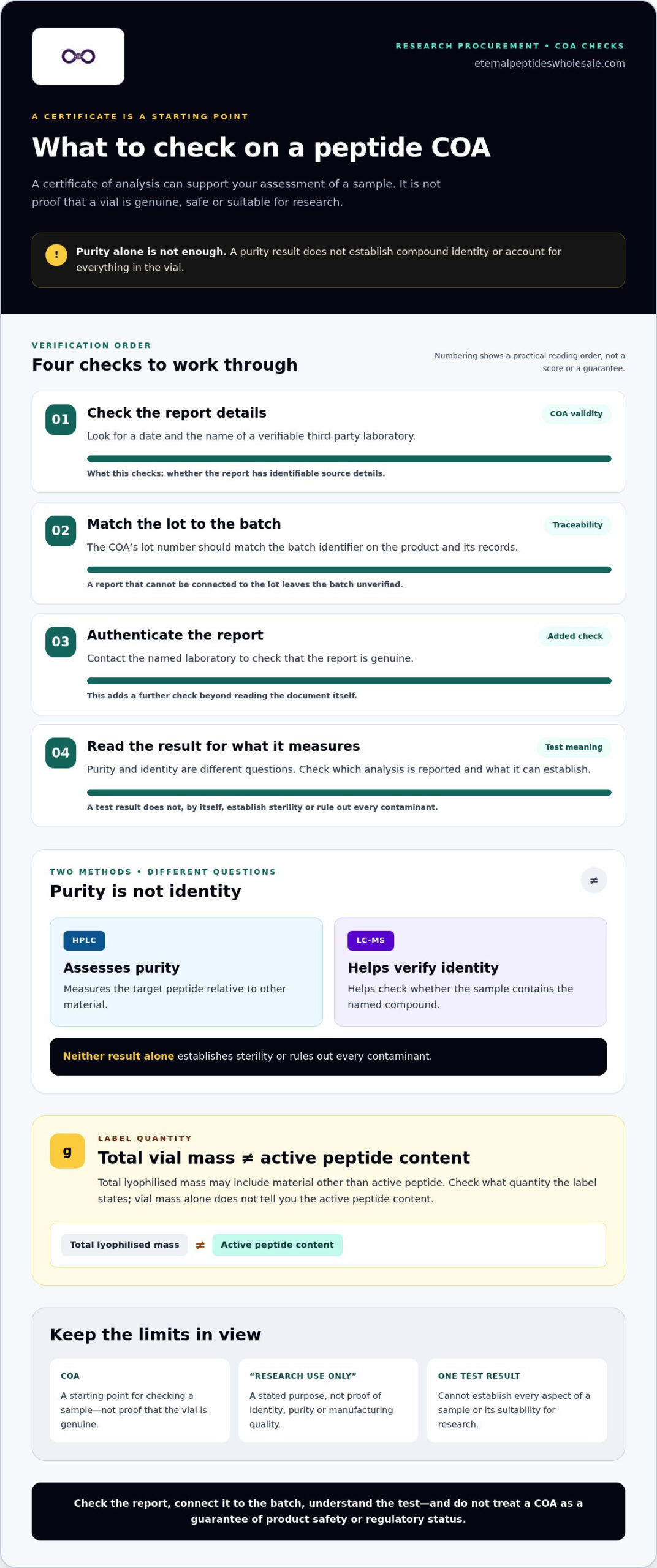
A certificate of analysis is a starting point, not proof that a peptide vial is genuine. A sound approach to avoiding counterfeit peptides in research is to check that the COA is dated, names a verifiable third-party laboratory and carries a lot number matching the batch. Contacting the named laboratory to authenticate the report adds another useful check.

A COA should clarify what a sample contains, but a purity result alone doesn’t establish the compound’s identity or account for everything in the vial. HPLC can assess purity, while LC-MS can help verify identity. Scrutinise the quantity on the label too: total lyophilised mass may not equal active peptide content.

This article explains how to assess those details, spot vendor warning signs and understand why underfilling matters. It also covers risks associated with unapproved products, including Australian reports of acute liver toxicity linked to counterfeit retatrutide. The aim is to support informed research procurement, not to treat a COA as a guarantee of product safety or regulatory status.

Key Takeaways

  • Assess a COA by looking beyond the purity result: its date, laboratory details and batch identifier all matter.
  • Understand why purity testing and identity testing answer different questions about a peptide sample.
  • Compare labelled quantity with active peptide content, as total vial mass can include filler.
  • Recognise that underfilled or incorrectly labelled products can undermine research reliability and create additional risks.
  • Consider the reported liver toxicity associated with counterfeit retatrutide when weighing the risks of unapproved products.

Research-use-only and gray-market peptide products

“Research-use-only” describes a stated purpose, not proof of identity, purity or manufacturing quality. In Australia, the Therapeutic Goods Administration (TGA) says it does not oversee the composition, manufacturing standards, safety or efficacy of unapproved peptide products.

Counterfeit, mislabelled and adulterated products

A counterfeit product imitates a genuine one, a mislabelled product gives inaccurate information, and an adulterated product contains an unintended ingredient or contaminant. Each can make a vial’s contents differ from its label, even when its packaging appears convincing. A study of falsified polypeptide drugs on the Belgian market found samples containing the advertised peptide ranged from 5% to 75% pure peptide. That variation can disrupt experimental comparisons and make results difficult to interpret.

“Research use only” or “not for human consumption” wording does not establish that a product is suitable for laboratory work. In Australia, the Therapeutic Goods Administration advises against purchasing or using unapproved peptide products, particularly those obtained online or from overseas, and advises using only products supplied through Australian pharmacies. It also reported that more than 94,500 unapproved peptide products had been destroyed in Australia in 2026.

For Australian imports, the Therapeutic Goods Act 1989 is relevant: the TGA monitors potential non-compliance involving therapeutic goods under that Act. The TGA published information for suppliers about responsibilities when importing, compounding and supplying unapproved peptide products on 13 April 2026. A research-use label alone does not settle whether an import complies with applicable requirements.

Identity, purity and sterility risks

Identity testing asks whether a vial contains the named compound; purity testing measures the target peptide relative to other material. Neither result alone establishes sterility or rules out every contaminant. A study testing products from five peptide manufacturers found that two-thirds fell below the threshold considered necessary for reliable research results. Unmarked vials and poorly traceable supply chains make it harder to connect a sample to its source and batch.

Injection adds risks associated with contamination, inaccurate concentration and poor handling. Follow the supplied handling conditions for research materials, and record the lot, arrival time, packaging condition and storage handover when a shipment arrives. If a shipment appears counterfeit or fails testing, quarantine it, retain its packaging and batch records, and document the discrepancy for investigation. Don’t use it in experiments in the meantime.

Comparing prices without compromising quality

Compare prices against the amount of active peptide, batch-specific evidence and traceability, not vial price alone. Ask what mass the label states and whether manufacturing tolerances are disclosed. A low price doesn’t establish authenticity, and a higher price can’t replace evidence about the batch.

To compare research suppliers consistently, align the compound, active peptide quantity, analytical evidence and delivery conditions. A COA that cannot be matched to a lot, or a price that obscures whether the stated mass includes filler, makes a like-for-like comparison difficult. For researchers avoiding counterfeit peptides in research, documented content and identity are essential purchasing criteria.

Warning signs of illegitimate peptide vendors

Vendor claims and sales channels can reveal gaps in accountability. Missing batch records, vague product descriptions and pressure to pay through unusual channels are reasons to pause before buying.

Buying research peptides through online marketplaces or social media can expose researchers to mislabelled products, incorrect ingredients or doses, degradation, contamination and non-sterile contents. A polished listing or positive comment doesn’t establish a compound’s identity or quality.

Payment and documentation red flags

Payment and documentation red flags may indicate that a seller is difficult to trace or hold accountable. Be cautious if payment relies on an anonymous link or the seller provides no invoice, batch identifier or consistent product description. Keep order records and compare the label, invoice and accompanying documents. Mismatched compound names or lot details make problems harder to investigate.

Marketplace and social media risks

Marketplace and social media risks arise when sales listings and peer recommendations stand in for traceable quality controls. Online peptide communities may share vendor recommendations, shipping advice, product impressions and protocol changes, but peer trust cannot replace pharmaceutical quality assurance or clinical monitoring. Positive reviews don’t establish what a vial contains.

Look for specific warning signs in the sales process rather than relying on presentation alone. For example, a listing that calls a compound “therapeutic” while offering it as a research chemical blurs its intended use. Claims about purity without batch-specific evidence also leave questions about identity, contamination and manufacturing unanswered. Note each discrepancy before proceeding.

  • Product details: Check whether the compound name and stated amount remain consistent across the listing, invoice and label.
  • Batch traceability: Look for a lot identifier that connects the product to its accompanying records.
  • Sales claims: Treat claims of therapeutic effects or guaranteed outcomes as a warning, not evidence of research quality.
  • Payment trail: Avoid anonymous payment links that leave no clear record of the transaction.

If a shipment arrives with damaged packaging, altered labels or records that don’t match the order, quarantine it and document the discrepancy. Retain the packaging, invoice and communications; these details help connect the concern to the specific shipment and batch. For procurement teams assessing wholesale research peptide supply, research peptide options can be considered alongside the same documentation and traceability criteria.

How can I verify a peptide Certificate of Analysis (COA)?

A COA is useful only when its details connect to the specific vial and test report. Check the date, laboratory identity and batch number, then assess what the reported methods can establish.

Contamination in counterfeit batches

Contamination means a sample contains unwanted material, which may not be identified by a peptide purity result alone. A report detecting retatrutide, for example, doesn’t establish whether the vial also contains contaminants, other drugs or medications. That distinction matters because a single test result can answer only the question its method was designed to examine. Review the reported analysis and its limits before relying on it.

Fake and non-batch-specific certificates

A fake certificate is not an authentic report; a non-batch-specific certificate doesn’t show that the tested sample came from the vial being assessed. Either can create false confidence in a product’s identity or purity. Look for a report date, the named third-party laboratory and a lot number tied to the batch. Contact the laboratory named on the COA to verify that it issued the report.

Warning signs include a missing date, an unverifiable laboratory name, no lot number or details that don’t match the product listing. A COA also doesn’t provide regulatory assurance about a peptide product. Treat its findings as evidence about the tested sample, not a guarantee about every vial or its regulatory status.

Batch numbers and vial matching

Batch matching means comparing the lot identifier on the vial with the one on the COA. Check every character, including letters, numbers and suffixes, then compare the compound name and stated quantity. If a shipment contains vials from different lots, each vial needs records for its own batch. A mismatch breaks the link between the report and the sample.

Keep the vial label, COA and purchase record together. If the COA lists one lot and the vial shows another, don’t treat the report as evidence for that batch. Record the discrepancy and preserve the original documents for follow-up or testing.

Independent laboratory testing

Independent testing can assess identity and purity using methods that answer different questions. LC-MS can help verify peptide identity; HPLC can assess purity, but purity testing alone doesn’t establish identity. Neither result by itself rules out every contaminant. Ask what was tested, which method was used and whether the report identifies the sample’s batch.

For suspected contamination, the laboratory analysis needs to address the specific concern; a purity result alone cannot detect every possible contaminant. Compare the reported methods with the claims made about the product, and retain the test report with the batch records. This helps distinguish a verified finding from a broad claim that a sample is simply “tested”.
Avoiding Counterfeit Peptides: Verify COAs and Peptide Content

Counterfeit retatrutide linked to acute liver toxicity

Australian reports link the use of counterfeit retatrutide with acute liver toxicity, making product identity a serious safety concern. The Therapeutic Goods Administration (TGA) says retatrutide remains in clinical trials and isn’t approved for human use. The TGA also advises Australians not to purchase or use unapproved peptide products. A vial labelled retatrutide shouldn’t be treated as equivalent to a legitimate trial product.

In Victoria, seven patients were hospitalised with acute liver toxicity after using counterfeit retatrutide. One developed severe liver injury after a second dose of unregulated retatrutide. Reported injuries occurred within a few weeks of use. These cases show why a label, seller’s claims or apparent product effects can’t establish which chemical a vial contains.

Canberra Health Services confirmed it had detected liver damage associated with products sold as retatrutide. It didn’t disclose the number of cases because the numbers were low. These reports indicate a safety signal, but don’t establish that every product labelled retatrutide has the same composition or causes the same outcome. They do make unverified products a serious concern.

Testing also illustrates the difference between a product name and its contents. Leeder Analytical tested 18 counterfeit retatrutide samples in 2026, and only one matched its label claim. About 30 per cent had higher concentrations than their labels stated, while about 30 per cent had lower concentrations. One sample contained none of the peptide. A matching label alone could not identify these failures.

For researchers, the practical response is to keep suspect material out of use and preserve evidence. Record the product name, batch details, supplier information and any test results. Keep the vial and packaging with the relevant records. If a sample fails identity or concentration testing, quarantine the affected batch and document the failure before considering further analysis. Don’t assume another vial from the same shipment is legitimate.

Anyone who has used a product sold as retatrutide and feels unwell should seek medical assessment promptly, and provide the product packaging and timing of exposure. The reported Victorian cases included severe liver injury after a second dose, so symptoms following exposure warrant attention. Researchers should also follow institutional procedures to document and report an adverse event or product-quality concern.

Counterfeit retatrutide is not the same product as retatrutide currently in clinical trials. A purity result detecting the named peptide can’t establish that a sample is free of other drugs, medications or contaminants. This limitation matters even when a certificate or vendor description seems credible. Independent testing, batch records and careful incident documentation help distinguish evidence about a sample from claims about a product.

Underfilling and net peptide content

A vial’s labelled mass doesn’t necessarily equal its active peptide content. This distinction matters in research: a sample with less active compound than expected can affect concentration calculations, comparisons between batches and reproducibility. In counterfeit retatrutide tested by Leeder Analytical, labelled quantities didn’t reliably describe vial contents. Underfilling is one possible mismatch, but an apparently full vial doesn’t establish its peptide content.

Leeder Analytical tested 18 counterfeit retatrutide samples in 2026. About 30 per cent had lower concentrations than their labels stated, while one sample contained none of the peptide. About 30 per cent also had higher concentrations than stated, showing that a label discrepancy can mean more or less active peptide, not only underfilling. The result can undermine a study’s intended concentration and make batch comparisons unreliable.

Leeder Analytical reported that peptide usually made up about 10 per cent of the contents in vials it tested. Chemist Grace Hamann said about 90 per cent of those contents was unaccounted for. This illustrates why total vial mass and active peptide mass are different measurements. The remaining material’s identity cannot be inferred from a label stating the vial’s total weight.

Consider a vial labelled as containing 5 mg of peptide. If it contains 1 mg of active peptide and 4 mg of filler, its total mass may still appear consistent with that label. A 10 mg label presents the same interpretive issue if it refers to total lyophilised mass rather than active peptide weight. Without clear labelling, researchers can miscalculate the amount of compound in a sample.

For meaningful comparisons, seek documentation that states active peptide weight and discloses manufacturing tolerances. These details help distinguish the target compound from fillers and make the labelled quantity more useful for experimental planning. A certificate reporting purity alone doesn’t necessarily show the total active peptide in the vial; purity and net content describe different aspects of a sample.

According to the Therapeutic Goods Administration, retatrutide remains in clinical trials and isn’t approved for human use. “Research use only” wording doesn’t resolve underfilling or establish suitability for human consumption. For research procurement, record the labelled quantity, batch details and test findings together. If results conflict, quarantine the sample and document the discrepancy rather than adjusting experimental quantities based on the label alone.

When assessing research-grade retatrutide for laboratory procurement, compare the stated strength with evidence about active peptide content and batch identity. Review wholesale retatrutide options as part of that documented assessment.

Eternal Peptides Wholesale: Retatrutide 10mg (wholesale)

Eternal Peptides Wholesale offers Retatrutide 10mg (wholesale) for laboratory research use. Researchers procuring retatrutide can consider this offering when sourcing wholesale quantities, while applying the same checks discussed above: review batch-specific documentation, confirm the vial and certificate details align, and assess active peptide content rather than relying on the label alone.

According to the Therapeutic Goods Administration, retatrutide remains in clinical trials and isn’t approved for human use. This offering is for research purposes only, not human consumption or medical use. Product selection doesn’t replace an independent assessment of identity, purity or suitability for a particular research protocol.

For wholesale retatrutide enquiries, contact Eternal Peptides Wholesale or visit eternalpeptideswholesale.com.

Make your next procurement decision evidence-led

Turn your findings into a documented procurement process. Set acceptance criteria before ordering, assign responsibility for receiving checks, and keep batch records alongside research results. Consistent records make it easier to identify discrepancies and assess whether material belongs in a study. They also help teams apply the same standard to future orders instead of relying on supplier claims or informal impressions.

A disciplined approach to avoiding counterfeit peptides in research is built into decisions made before a shipment arrives. Eternal Peptides Wholesale offers Retatrutide 10mg (wholesale), Retatrutide 20mg (wholesale) and cjc-1295(without DAC) + Ipamorelin (5/5mg) (Wholesale) for research purposes, not human consumption or medical use.

For wholesale research sourcing, contact Eternal Peptides Wholesale and carry your evidence-led procurement standards into the next stage of your work.

Frequently Asked Questions

How do I know if a peptide COA is real?

Authenticate a COA by confirming its details directly with the named laboratory, using contact information you find independently. Check that the report identifies the tested sample and its batch, and that the compound description matches your vial. A professional-looking document can still be misused or altered. Even a genuine report supports findings only about its tested sample; it doesn’t establish regulatory status or guarantee that every vial matches.

What should I look for in a trustworthy peptide vendor?

Look for traceable business details, consistent product descriptions and records that connect an order to a specific batch. A supplier should distinguish research-use products from therapeutic medicines and avoid claims of treatment effects. Check that invoices, labels and technical documents use the same compound name and identifiers. Online endorsements alone are weak evidence: peer recommendations can’t replace documented quality controls or establish the contents of a particular shipment.

How can researchers verify the identity and purity of research peptides?

Use complementary analytical methods: LC-MS can help assess identity, while HPLC can assess purity. Arrange testing on a sample from the received batch and retain its chain-of-custody details, including who collected and transferred it. Interpret each result within the method’s scope. A purity result doesn’t prove identity, and detecting the expected peptide doesn’t rule out other compounds or contaminants.

What certificates of analysis and batch documents should peptide suppliers provide?

For each batch, keep the COA with the invoice, product label and shipment record. The COA should identify the laboratory, report date, tested sample, analytical methods and batch identifier; the other records should connect that report to the material received. Record discrepancies when the shipment arrives rather than correcting them informally. This creates an auditable trail for later testing, study review or procurement investigations.

How can researchers check whether a peptide supplier is reputable in Australia?

Assess traceability and documentation, but don’t treat an Australian location as proof of product quality or regulatory status. The TGA says it doesn’t oversee the composition, manufacturing standards, safety or efficacy of unapproved peptide products. Eternal Peptides Wholesale supplies bulk products labelled “Research Use Only” and “Not for human consumption”; its batch reports come from Janoshik independent laboratory testing. These details inform procurement, not medical or regulatory approval.

Posted on

Peptide Purity Guide for Australian Laboratories

Peptide Purity Guide for Australian Laboratories

Shipping and evidence maintenance — 29 September 2026: Shipping, stock-location and transport-service claims in this article have been corrected against the current Shipping Policy. These edits are not a new clinical or regulatory review.

Purity-threshold correction — 25 October 2026: Purity-threshold statements were corrected against EMA/CHMP/CVMP/QWP/367182/2025, European Pharmacopoeia general monograph 2034 and TGA impurity guidance.


In high-stakes laboratory environments, the difference between a breakthrough and a compromised dataset often rests on a fraction of a percentage point. For Australian researchers, inconsistent batch quality and the challenge of interpreting complex HPLC/MS reports aren’t just administrative hurdles; they’re direct threats to the integrity of scientific outcomes. It’s frustrating to invest months into a study only to find that trace impurities have skewed your results. This guide provides a definitive framework for peptide purity verification for research, ensuring you can navigate the technical nuances of Certificates of Analysis (COAs) with greater confidence.

You’ll learn to master the analytical techniques and reporting standards required to verify peptide integrity, moving beyond supplier claims to objective data. We will examine the critical role of High-Performance Liquid Chromatography and Mass Spectrometry, explain how impurity thresholds are described in pharmacopoeial and regulatory guidance (for example, the 0.1%, 0.5% and 1.0% reporting, identification and qualification thresholds the European Pharmacopoeia sets for synthetic peptides used in medicines), and outline a documented procurement process. The aim is to help you read batch documentation critically. No purity figure on its own guarantees reproducible results, and the standards discussed here are reference points written for medicines, not a specification for research materials. [11][12] [Evidence note 1]

Key Takeaways

  • Understand what an HPLC purity percentage does and does not measure, and why the acceptance criterion should be a method-specific specification set for your application, not a single “industry standard” figure. [Evidence note 1]
  • Master the technical distinctions between HPLC and Mass Spectrometry to establish a definitive framework for peptide purity verification for research.
  • Learn to critically evaluate Certificates of Analysis by cross-referencing batch numbers and verifying analytical conditions against physical inventory.
  • Implement a standardised procurement SOP that utilises objective analytical data to establish clear acceptance or rejection criteria for incoming compounds.
  • Optimise your laboratory’s supply chain by sourcing from Australian-based wholesale specialists who provide batch-specific documentation and maintain rigorous logistical integrity.

The Critical Role of Purity in Modern Peptide Research

In analytical reports, peptide “purity” usually means chromatographic purity. It is the proportion of the UV-absorbing material detected by HPLC that corresponds to the target peptide, expressed as a percentage of total peak area. It is not the same as the mass of peptide in the vial. Water, counter-ions (such as acetate or trifluoroacetate) and other non-UV-absorbing material are addressed by a separate measurement, net peptide content. No Australian or international standard sets a single minimum purity percentage for research materials. The appropriate specification depends on the peptide, the analytical method and the intended experiment, and should be agreed before purchase. [2] Using unverified compounds in long-term trials doesn’t just waste financial resources; it risks the scientific credibility of the institution. [Evidence note 1]

Distinguishing between grades is vital. Industrial-grade products are often “crude” and contain a high volume of synthesis byproducts. Research-grade compounds undergo rigorous purification to ensure that the biological activity observed in the lab is solely attributable to the target sequence. Without strict peptide purity verification for research, scientists cannot differentiate between the effects of the peptide and the interference of contaminants. High-purity compounds help laboratories produce reproducible data that stands up to peer review and scrutiny.

Common Impurities in Synthetic Peptides

Chemical synthesis is rarely perfect. Deletion sequences occur when an amino acid fails to couple during the synthesis cycle. This is particularly problematic in GLP-1 research where a single missing residue can radically alter receptor binding affinity. Truncated sequences happen when the peptide chain terminates prematurely, resulting in shorter fragments. Incomplete deprotection leaves residual chemical groups from the synthesis process attached to the peptide. These groups can obstruct active sites and lead to erroneous data. Identifying these specific impurities is the first step in maintaining a robust research environment.

Impact on Research Reproducibility

Trace contaminants are the primary cause of false-positive or false-negative results in cellular assays. In receptor-ligand interaction studies, byproducts may compete for the same binding sites as the target peptide, artificially depressing the observed potency. Maintaining the integrity of the research peptide quality assurance chain is essential for ensuring that every batch remains consistent across multi-year trials. When batch quality fluctuates, the reproducibility of the research is lost. Consistent procurement of high purity peptides wholesale is the only way to ensure that your findings are both accurate and repeatable.

Which purity standards apply in Australia?

For therapeutic goods, the Therapeutic Goods Act 1989 defines the “default standards” as the British Pharmacopoeia, the European Pharmacopoeia and the United States Pharmacopeia–National Formulary. Ministerial standards (Therapeutic Goods Orders) take precedence where they exist. The TGA’s guidance on impurities in prescription medicines notes that the qualification thresholds in ICH Q3A and Q3B do not apply to synthetic peptides, and points instead to the European Pharmacopoeia monograph Substances for pharmaceutical use. [13][14]

That monograph sets thresholds for peptide-related impurities in synthetic peptides: reporting above 0.1%, identification above 0.5% and qualification above 1.0%. The European Medicines Agency’s 2025 guideline on synthetic peptides restates the same thresholds. [11][12]

These frameworks apply to medicines. They do not define a “research grade”, and the TGA has stated that labelling a product “for research use only” does not by itself remove regulatory obligations. Products sold for laboratory research should not be described as meeting pharmacopoeial or GMP requirements unless that has been specifically demonstrated. [8]

Analytical Gold Standards: Understanding HPLC and Mass Spectrometry

Rigorous peptide purity verification for research relies on two distinct but complementary analytical techniques. While a supplier might claim a high purity percentage, professional laboratories require objective data to confirm both the concentration of the target molecule and its chemical identity. Relying on a single metric is a significant risk. HPLC (for chromatographic purity) and mass spectrometry (for molecular mass) are complementary and widely used together. Regulatory guidance for peptide medicines recommends at least two orthogonal identification methods. Mass agreement alone may not distinguish sequence isomers, so additional methods may be needed depending on the question being asked. [1][11] These tools allow researchers to look beyond the surface and identify the specific molecular profile of their compounds.

USP general chapter <1503> (Quality Attributes of Synthetic Peptide Drug Substances) and the European Pharmacopoeia describe how peptide purity, impurities and content are characterised for medicines. They are useful background for interpreting a report, although they are written for pharmaceutical substances, not research materials. [12][14] When interpreting a chromatogram, a high-purity sample should display one dominant, sharp peak. Any smaller peaks, or “shoulders” on the main peak, represent impurities or degradation products that could interfere with your experimental variables.

The HPLC Process: Separating the Analytes

HPLC functions by passing a liquid sample through a column packed with a stationary phase. As the mobile phase moves through the column, different molecules interact with the packing material at varying intensities. This causes the components to elute at different times, known as retention times. HPLC is the separation of components based on molecular interactions to determine relative purity percentages. Peptide bonds absorb strongly in the low-UV range, so detection is commonly performed at about 210–220 nm. The result is a relative peak-area percentage among UV-absorbing components, not a measure of peptide concentration or content. [2]

For institutions requiring consistent batch quality, sourcing from a dedicated wholesale peptide partner ensures that these HPLC profiles are provided for every compound. This allows procurement officers to check the reported result against the specification agreed for the order before the material enters the laboratory. [1] [Evidence note 1]

Mass Spectrometry and Molecular Weight Confirmation

While HPLC tells you how pure a sample is, Mass Spectrometry confirms exactly what is in the vial. MS works by ionising the peptide molecules and measuring their mass-to-charge (m/z) ratios. This process allows researchers to verify that the synthesized sequence matches the theoretical molecular weight of the target peptide. It can reveal peptide-related impurities, such as deletion or modified sequences, that co-elute with the target peptide in HPLC but have a different mass. It cannot distinguish impurities of identical mass, such as some isomers, and it does not measure water, salts or counter-ions. [1][11] [Evidence note 1]

Analytical reports must show a primary mass peak that corresponds precisely to the expected value of the peptide. If the m/z ratio deviates from the theoretical mass, it indicates an error in the synthesis or a contamination event. Used alongside HPLC, MS adds an independent identity check. It increases confidence but does not provide certainty on its own. It ensures that the biological responses you observe are triggered by the correct molecular structure, not a synthesis byproduct.

Deciphering the Certificate of Analysis (COA)

The Certificate of Analysis (COA) serves as the primary document for peptide purity verification for research. It isn’t merely a summary sheet; it’s a technical record that must include a unique batch number, the date of analysis, and the specific analytical conditions used during testing. Researchers should always cross-reference the batch number on the report with the label on the physical vial. Any discrepancy between these two points is an immediate indicator of logistical failure or compromised compound integrity. A valid report provides the transparency needed to trust the chemical identity of the sample.

Spotting fraudulent or “recycled” reports is a critical skill for procurement officers. Red flags include inconsistent formatting, missing analysis dates, or blurred text that suggests an image has been manipulated from a previous batch. A legitimate COA provides clear, high-resolution chromatograms that match the specific lot you’ve received. While manufacturer-provided reports offer a baseline, independent third-party analysis provides an additional layer of security for high-stakes studies. This independent oversight ensures that the data is objective and hasn’t been filtered to meet sales quotas.

Key Metrics to Audit in Every Report

Every audit should begin with the purity percentage. Compare the reported purity with the specification agreed for your order. The figure that is appropriate depends on the peptide, the method and the sensitivity of your experiment, and no single percentage is a regulatory requirement for research materials. Check that the appearance and solubility reported match the lot specification. Many peptides are supplied as white to off-white lyophilised powders, but this varies by compound and salt form. [1][2] Storage recommendations are also vital. The COA must clearly state temperature requirements to ensure the material was handled correctly before it reached your facility. [Evidence note 1]

Verifying Authenticity in the Australian Market

The Australian research landscape has shifted toward a model of independent verification. Many institutions now utilise online verification portals to authenticate batch reports directly from the testing facility. This level of transparency is essential because wholesale research peptides australia require traceable data to meet institutional compliance and safety standards. Verifying the source of the analytical data prevents the use of sub-standard compounds. It ensures that your peptide purity verification for research is grounded in verifiable facts rather than supplier assertions. Establishing this chain of custody is the only way to guarantee that the compounds in your lab meet the rigorous standards of modern science. [Evidence note 4]

Actionable Procurement Protocols for Australian Institutions

Establishing a standardised operating procedure (SOP) for peptide intake is the final safeguard in the procurement chain. It transforms the analytical data discussed in previous sections into a clear decision-making framework. For Australian institutions, this protocol ensures that every compound entering the laboratory environment meets the specific requirements of the study. A robust SOP dictates that no material is released for research use until the batch-specific documentation has been reviewed and archived. This systematic approach eliminates the risk of using sub-standard materials that could compromise longitudinal data.

A critical component of this SOP is the “Acceptance/Rejection” criteria. This framework should be based on objective analytical benchmarks. Define acceptance criteria in advance in your SOP: the purity specification, the mass tolerance and any other required tests. Treat a batch that falls outside them as non-conforming under your laboratory’s procedure. The thresholds should be set by your institution for the intended use. They are not a universal standard. [1] Maintaining a digital library of these reports is essential for troubleshooting future experimental variances. It allows researchers to trace results back to specific chemical profiles, ensuring the long-term integrity of the peptide purity verification for research process. [Evidence note 1]

The Procurement Checklist for Lab Managers

Lab managers should utilise a rigorous checklist before finalising bulk orders. This process begins with requesting batch-specific HPLC and MS data rather than relying on “typical” or “representative” reports. It’s also vital to assess the wholesaler’s track record for batch-to-batch consistency. Inconsistent quality between shipments can derail months of progress. Finally, verify the supplier’s commitment to research-only distribution. Ask each supplier what documentation they provide for every lot, and assess it against your institution’s own procurement and quality requirements. [4] For a comprehensive overview of the analytical standards and logistical frameworks that underpin large-scale procurement, the technical guidance on high purity peptides wholesale for Australian research laboratories provides an essential reference for institutional procurement officers.

To ensure your facility maintains these high standards, consider partnering with a specialised supplier. You can source research-grade compounds from providers who prioritise analytical transparency and logistical reliability. When evaluating potential partners, the 2026 laboratory procurement checklist for identifying reliable peptide wholesalers in Australia offers a structured framework for assessing supplier documentation, TGA compliance priorities, and domestic logistical capabilities. [Evidence note 4]

Storage and Handling Post-Verification

Transport conditions need to be confirmed for the specific product and shipment. National delivery does not by itself establish refrigerated transport, insulated packaging, temperature logging or a validated cold chain. If a study requires controlled transport, obtain written confirmation of the packaging, temperature range and monitoring before ordering. On receipt, assess available records and any excursion against the product-specific stability documentation and the laboratory’s procedures.

Reconstitution protocols must be followed with precision to maintain purity after the vial is opened. Use only high-quality, sterile solvents and avoid unnecessary agitation. It’s also critical to avoid repeated freeze-thaw cycles. These cycles introduce mechanical stress that can compromise the molecular structure of the peptide. Aliquoting the reconstituted solution into single-use volumes is the most effective way to preserve the integrity of your verified compounds. This level of care ensures that the high purity you’ve verified at the procurement stage remains intact throughout the duration of your study. [Evidence note 2]

Securing High-Purity Wholesale Peptides in Australia

Australian business ownership and Australian stockholding are different facts. Confirm the dispatch country and availability for the specific order rather than inferring them from a supplier’s address. EPW’s Shipping Policy allows offshore fulfilment, so a local business relationship does not guarantee domestic dispatch, freedom from customs delays or uninterrupted availability. Plan procurement around the confirmed route and current estimates.

Establishing a reliable system for peptide purity verification for research is particularly challenging when managing high-volume procurement. Many suppliers provide data for small retail batches but fail to maintain that same level of scrutiny at scale. Eternal Peptides Wholesale addresses this by specialising in bulk distribution for institutions, where consistency across hundreds of vials is a non-negotiable requirement. This focus on wholesale integrity ensures that long-term research projects aren’t derailed by sudden shifts in batch quality. It’s a professional partnership built on the understanding that your data is only as good as your source materials.

Commitment to Scientific Integrity

Transparency is the foundation of any long-term institutional partnership. By providing the logistical backbone for Australian innovative research, a dedicated wholesaler acts as a professional partner rather than just a vendor. This no-nonsense approach to business prioritises the success of the client’s larger-scale operations over transactional speed. Where a batch report has been published, it is linked from the product page so researchers can check the documentation before ordering. This commitment to peptide purity verification for research allows your team to focus on discovery without questioning the integrity of the base compounds. We invite you to review our wholesale standards for your next project to ensure your procurement process supports the highest levels of scientific integrity.

Advancing Scientific Outcomes through Analytical Certainty

Achieving precision in your laboratory requires more than just high-quality equipment; it demands a fundamental commitment to the integrity of your base compounds. By mastering the nuances of HPLC chromatograms and Mass Spectrometry data, your institution can establish a definitive framework for peptide purity verification for research. A documented approach helps confirm that each batch meets the specification your laboratory has set, and reduces the risk of unrecognised impurities affecting your results. Transitioning to a standardised procurement SOP provides the stability needed for longitudinal studies and ensures the reproducibility of your findings. [Evidence note 1]

Reliable results depend on a transparent supply chain. We specialise in bulk distribution for Australian institutions, providing rigorous HPLC/MS verification on wholesale batches within a strictly research-only compliant supply chain. Secure the compounds your project requires with confidence. Explore our wholesale research-grade peptide catalogue for your laboratory and check the batch documentation before your next laboratory study. Your commitment to these rigorous standards will drive the success of your larger-scale operations.

Frequently Asked Questions

What is the minimum purity required for peptide research?

There is no single regulatory or pharmacopoeial minimum purity for research peptides. Standards such as the European Pharmacopoeia set impurity thresholds for synthetic peptides used in medicines: impurities above 0.1% are reported, above 0.5% identified and above 1.0% qualified. Specifications are set for each product. For research materials, the appropriate purity figure depends on the peptide, the analytical method and the sensitivity of the experiment, and it should be agreed with the supplier before purchase. HPLC purity also does not measure net peptide content. [11][12][13] [Evidence note 1]

How do I read an HPLC chromatogram for a peptide sample?

You should look for a single, dominant, and sharp peak that represents the target peptide sequence. The x-axis indicates the retention time, while the y-axis shows the absorbance, typically measured at about 210–220 nm. Any smaller peaks or “shoulders” appearing on the main peak signify the presence of impurities or degradation products. For comparison, the European Pharmacopoeia’s thresholds for synthetic peptides used in medicines are 0.1% (report), 0.5% (identify) and 1.0% (qualify) for individual peptide-related impurities. These are pharmacopoeial thresholds for pharmaceutical substances, not a definition of “high purity” for research materials. [11][12]

Why is mass spectrometry necessary if I already have an HPLC report?

Mass spectrometry is essential because it confirms the molecular identity of the compound, whereas HPLC only measures its relative purity. HPLC can occasionally fail to distinguish between the target peptide and an impurity if both substances have identical retention times. MS measures the mass-to-charge ratio, allowing researchers to verify that the synthesized sequence matches the theoretical molecular weight. This dual-method approach is a critical component of peptide purity verification for research in professional laboratory settings.

Can I rely on the manufacturer’s COA for wholesale orders?

You can use a manufacturer’s Certificate of Analysis as a baseline, but independent third-party verification is the gold standard for wholesale procurement. Reliable B2B partners provide batch-specific reports that include both HPLC and MS data. It’s vital to cross-reference the batch number on the report with the physical vial label to ensure the data is current. For large-scale institutional orders, relying solely on a “typical” report rather than a batch-specific analysis introduces unnecessary risk to your dataset.

What are the most common contaminants found in research-grade peptides?

The most frequent contaminants are deletion sequences, where an amino acid fails to couple, and truncated sequences, which occur when the peptide chain terminates prematurely. Residual chemical groups from incomplete deprotection and trace amounts of salts or solvents from the synthesis process are also common. These impurities can obstruct active sites or trigger unintended biological responses. Identifying these specific analytes through rigorous testing is the only way to maintain the integrity of your research-grade biochemicals.

How does peptide degradation affect purity verification over time?

Peptide degradation, often caused by oxidation or hydrolysis, will gradually lower the purity percentage by increasing the concentration of breakdown products. This process is accelerated by improper storage conditions or repeated freeze-thaw cycles. Over time, a batch that originally met its specification may fall outside it. Regular re-verification is necessary for older inventory to ensure that the chemical profile remains consistent with the original data provided at the time of procurement. [Evidence note 1, 2]

What should I do if a batch fails to meet the verified purity on the COA?

If a batch fails to meet the purity levels stated on the COA, you should immediately quarantine the material and document the discrepancy. Contact your wholesale supplier and provide your independent analytical data as evidence. Reputable suppliers who prioritise scientific integrity will have a clear rejection protocol in place for sub-standard batches. It’s essential to resolve these issues before the compounds are integrated into your study to prevent the introduction of uncontrolled variables into your research.

Does third-party verification guarantee that a peptide is safe for human use?

No, third-party verification only confirms the chemical identity and purity of the compound for laboratory use. All products supplied by Eternal Peptides Wholesale are strictly for research purposes only and are not for human consumption or medical use. Verification does not imply safety for clinical applications or therapeutic use. Researchers must adhere to institutional safety protocols and regulatory guidelines, ensuring that these biochemicals are handled exclusively within controlled, non-clinical laboratory environments for scientific study. [Evidence note 4]

Reading peptide purity without conflating measurements

The report’s unit tells you what question it can answer. A percentage chromatographic result, an amount in milligrams and an endotoxin result in EU are not interchangeable. Read the stated method and the sample identity before interpreting the number. [1][9]

The oxytocin interlaboratory study by Li and colleagues illustrates method-dependent quantification using HPLC, quantitative NMR and amino-acid analysis. It is an analytical example, not a validation study of the Eternal Peptides Wholesale catalogue. [10]

For the next step, review the Australian research peptide buying guide and the batch-verification checklist. Contact Eternal Peptides Wholesale with the exact product and any unanswered documentation questions.

Related from Eternal Peptides Wholesale

Eternal Peptides Wholesale publishes batch-specific Janoshik Analytical reports in its certificate of analysis library, so the documentation for a listed batch can be read alongside the evidence discussed in this article.

References and bibliography

  1. McCarthy D, Han Y, Carrick K, Schmidt D, Workman W, Matejtschuk P, Duru C, Atouf F. 2023. Reference Standards to Support Quality of Synthetic Peptide Therapeutics. Pharmaceutical research. 40(6):1317-1328. doi:10.1007/s11095-023-03493-1.
  2. Bachem. 2021. FAQ: Analysis and handling of peptides. Accessed 27 September 2026.
  3. U.S. Food and Drug Administration / International Council for Harmonisation. Q6A Specifications: Test Procedures and Acceptance Criteria for New Drug Substances and New Drug Products: Chemical Substances. Accessed 27 September 2026.
  4. Eternal Peptides Wholesale. Peptide testing standards and report directory. Accessed 27 September 2026.
  5. Eternal Peptides Wholesale. Research product catalogue. Accessed 27 September 2026.
  6. Eternal Peptides Wholesale. Terms of service. Accessed 27 September 2026.
  7. Eternal Peptides Wholesale. Contact and Australian store locations. Accessed 27 September 2026.
  8. Therapeutic Goods Administration. 2026. How we regulate therapeutic peptide products. Accessed 27 September 2026.
  9. U.S. Food and Drug Administration. 2026. Pyrogen and Endotoxins Testing: Questions and Answers. Accessed 27 September 2026.
  10. Li C et al. 2019. Survey of peptide quantification methods and comparison of their reproducibility: A case study using oxytocin. Journal of pharmaceutical and biomedical analysis. 166:105-112. doi:10.1016/j.jpba.2018.12.028.
  11. European Medicines Agency. 2025. Guideline on the Development and Manufacture of Synthetic Peptides. EMA/CHMP/CVMP/QWP/367182/2025. Accessed 25 October 2026.
  12. European Pharmacopoeia. General monograph 2034, Substances for pharmaceutical use, Table 2034.-2. European Directorate for the Quality of Medicines & HealthCare (cited via reference 11).
  13. Therapeutic Goods Administration. 2024. Complying with requirements relating to impurities in prescription medicines. Last updated 15 November 2024. Accessed 25 October 2026.
  14. Therapeutic Goods Administration. Pharmacopoeias (default standards). Accessed 25 October 2026.