

What if the lowest quote is the hardest to approve? A peptide procurement proposal can look complete yet leave reviewers unsure whether the specification, supporting evidence and supply terms are comparable. If you’re deciding how to write a peptide procurement proposal, the task is not simply to list a compound and quantity. It’s to make the research requirement, documentation and supplier commitments independently reviewable. A price alone can’t show whether two offers meet the same requirements.
That uncertainty is familiar to research teams balancing technical needs with internal procurement processes. A clear proposal gives decision-makers a consistent basis for assessment and helps identify what needs clarification before approval or ordering. This guide explains how to set out the research purpose, peptide specifications, quantity, required documentation and commercial terms, then compare supplier responses against the same criteria. It also covers practical next steps for seeking quotations and confirming details directly with prospective suppliers. For research-use procurement, keep intended laboratory use explicit and check that availability and relevant documentation are current. The result is a structured, evidence-led proposal that supports a fair review without overstating what a supplier can provide.
Key Takeaways
- Learn how to write a peptide procurement proposal that sets out the research requirement, requested presentation, quantity and decision sought.
- Identify the reviewers who may need to assess the proposal, then organise its information so each can evaluate the request.
- Use a consistent comparison framework to assess supplier specifications, documentation, availability, communication and supply terms.
- Structure the proposal from request through recommendation and approval, making gaps in evidence or information easier to spot.
- Turn reviewer feedback into clear supplier questions before moving to a quotation or order confirmation.
What a peptide procurement proposal needs to help decision-makers assess
A peptide procurement proposal is an internal decision document. It explains the research requirement, the specifications being requested, the evidence reviewers need to assess and the proposed procurement pathway. Its purpose is to help an organisation determine whether a supply request is sufficiently defined and supported to move forward, not to serve as a supplier’s offer or an experimental guide.
Keep the document distinct from related procurement materials. A Request for Proposal (RFP) is generally used to invite supplier responses; a supplier quotation sets out that supplier’s offered terms. A purchase order records an authorised purchase, while an experimental protocol describes research methods. The proposal can inform these steps, but shouldn’t be used as a substitute for them.
Who reads the proposal and what must they decide?
Potential reviewers include the principal investigator, laboratory manager and procurement officer. Researchers need enough technical detail to check that the requested material aligns with the approved research requirement. Non-specialist reviewers need the rationale, evidence and approval pathway in clear language.
Be explicit about the decision sought. Is the review for approval of the requirement, a supplier, funding or a specific order? A short executive summary can state the request, its research purpose and the decision required, helping reviewers understand what action is expected before they examine supporting details.
What belongs in scope, and what does not?
Describe the application at a suitable, non-clinical level, then keep the rationale focused on procurement. State that the products discussed are for laboratory research only, not for human or veterinary use. This boundary should be clear in the proposal and in any supplier evaluation.
For a practical starting point, identify the information reviewers need to assess:
- Research need: A concise explanation of why the material is being requested.
- Decision required: The approval, funding or procurement step under consideration.
- Evidence and pathway: The supporting supplier information and the proposed next step.
Leave out medical, therapeutic or efficacy claims, along with protocol instructions and unsupported statements about product performance. Those details don’t establish whether a supplier’s offer meets an organisation’s procurement requirements. Keeping the boundaries clear is central to how to write a peptide procurement proposal that researchers and procurement staff can review consistently, without confusing the request with claims or instructions outside its purpose.
Build the proposal around research needs and verifiable peptide specifications
Once the research requirement is approved, translate it into a concise specification that suppliers and internal reviewers can interpret consistently. Use the project’s approved documentation as the source for the compound name and requested presentation. Don’t infer a format, quantity or delivery date from a supplier’s catalogue or assume a supplier can meet a requested timeframe. Record these as requirements to be confirmed.
How to describe compound requirements precisely
For each requested item, record the exact compound name, requested presentation, quantity, intended laboratory research use and required delivery timeframe. Keep the research-use description high-level and non-clinical. For example, state the relevant project or research area without adding experimental steps or claims about expected outcomes.
Separate what the institution requires from what a supplier confirms it can provide. A timeframe in the proposal is a requested requirement, not a promised delivery date. Check product information and terms directly with prospective suppliers, and confirm applicable institutional procurement requirements before proceeding.
How to assess quality and documentation evidence
List the evidence requested for review, where applicable. This may include a Certificate of Analysis (COA), High-Performance Liquid Chromatography (HPLC) results and mass spectrometry data. These methods provide different analytical information: HPLC data can inform a purity assessment, while mass spectrometry can support identity assessment. Don’t treat one as a substitute for the other.
Record each item’s status so reviewers can distinguish evidence from supplier statements:
- Received: Identify the document and the compound or batch it relates to.
- Pending: Note what has been requested and when it will be reviewed.
- Unverified: Flag claims that lack supporting documentation or confirmation.
Check that identifiers, such as the compound name and batch reference where supplied, align across the records. If information is missing or inconsistent, log the question rather than filling the gap with an assumption. This makes the evidence trail clearer and shows what remains unresolved before approval.
The US Research and Development (R&D) contracting framework offers context on structuring research procurement, but it isn’t Australian procurement guidance. Apply your organisation’s own review process and verify relevant Australian requirements. For a practical sourcing discussion, you can also review the research peptide wholesale range, intended for laboratory research only and subject to direct confirmation of current availability and documentation.
Compare peptide suppliers with a consistent procurement evaluation framework
A side-by-side comparison helps reviewers assess supplier responses against the same approved requirement, rather than relying on different claims or formats. Use one matrix for every supplier and ask the same questions. Include the response, its supporting evidence and any conditions or unanswered points beside each criterion. Missing information isn’t a pass; it’s an item to clarify before a decision.
Which criteria make supplier comparisons useful?
Focus on whether each supplier can address the requested specification and wholesale quantity, and whether the information is supported by relevant documentation. Evaluate the written response, not assumptions about a supplier’s capability or quality.
- Specification fit: Does the supplier confirm the requested compound name and presentation?
- Documentation: Are records available, identifiable and relevant to the material under consideration?
- Availability: Has the supplier confirmed current availability and the requested quantity?
- Communication: Are responses clear, complete and consistent with the questions asked?
- Supply terms: What do the written terms state about fulfilment, shipping and how issues are handled?
Record the source and date of each response where practical. If a supplier hasn’t confirmed a point, mark it as pending rather than treating silence as agreement. This gives reviewers a clear view of what is known and what still needs verification.
How to present the comparison fairly
Distinguish evidence from claims. For example, label a point “document received”, “supplier statement” or “awaiting confirmation”, then note any condition attached to it. If a record doesn’t clearly relate to the requested material or batch, flag that gap for follow-up rather than assuming it applies.
Use the organisation’s approved evaluation method. If it assigns weight to criteria, describe how that weighting is applied so reviewers can understand the recommendation. If no formal scoring method is in place, don’t invent scores or present a subjective ranking as objective. A concise written explanation of trade-offs and unresolved questions can be more useful than an unexplained total.
For instance, one supplier might confirm the requested quantity but leave shipping terms unclear, while another provides terms but hasn’t supplied a relevant document. Record both conditions in the matrix. The comparison then supports a reasoned decision without implying that either supplier has passed a criterion that remains unverified.
This evidence-led approach is a practical part of how to write a peptide procurement proposal: it helps reviewers compare like with like and direct follow-up where it’s needed. Wholesale supply may be considered where it suits the organisation’s requirements, subject to institutional review and direct confirmation of documentation, availability and terms. Ensure any products under consideration are for laboratory research only, not human or veterinary use.
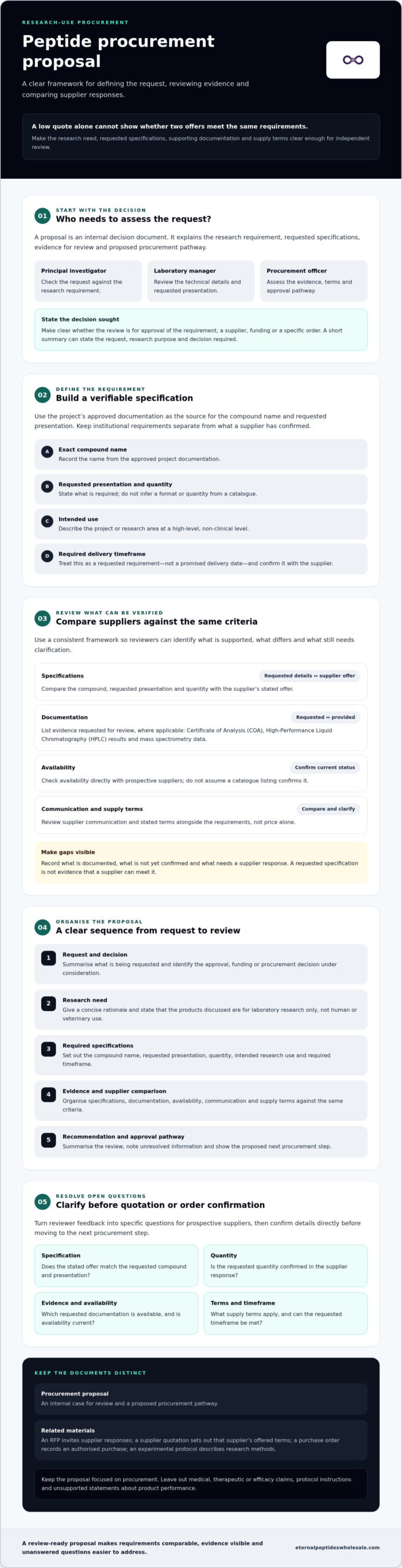
Write and review the peptide procurement proposal in a clear sequence
A consistent order makes the proposal easier to draft and review. Begin with the request, define its scope, set out the specifications, attach supplier evidence, compare responses, then present a recommendation and identify the approval required. This sequence helps reviewers trace the decision from the research need to the proposed procurement step.
What sections should the proposal contain?
Organise the document so readers can find the rationale and supporting information without searching through dense narrative. A practical structure is:
- Purpose and executive summary: State why procurement is being considered and the specific decision sought.
- Scope and requirements: Record the research-use context, requested specifications and any exclusions.
- Supplier assessment: Present the comparison criteria, evidence and unresolved points.
- Risks and assumptions: Identify dependencies, conditions and information that has not been verified.
- Recommendation and approval: Explain the proposed next step and who needs to approve it.
Place supporting records in labelled appendices, then refer to them consistently in the proposal. Add a document register with each item’s source, date received, status and reviewer. This gives the team a practical way to locate evidence and see whether it has been checked. State assumptions and exclusions plainly rather than leaving them buried in paragraphs.
How to make the recommendation review-ready
Connect the recommendation to the criteria and evidence already presented. Avoid promotional language or unsupported claims. If the choice depends on a supplier confirming a document, availability or term, name that dependency and make clear that the point remains open.
Before circulation, summarise outstanding questions, approval dependencies and follow-up responsibilities. Assign each action to a role or named reviewer where appropriate, so requests don’t disappear between review and the next procurement step. A recommendation can be clear without suggesting every detail has been settled.
Use this final check before sending the proposal:
- Does the executive summary identify the decision sought and reason for procurement?
- Do specifications, supplier evidence and comparison criteria use consistent terminology?
- Are evidence sources, dates, review status and open questions recorded?
- Is research-only wording clear, with no human-use or veterinary-use implication?
- Are assumptions, exclusions and required approvals explicit?
These steps make how to write a peptide procurement proposal a repeatable review process, not just a document-writing exercise. For an eligible laboratory procurement, you can review wholesale research peptide supply and confirm current availability, documentation and terms directly. Products are for research purposes only, not for human consumption or medical use.
Submit the proposal, resolve supplier questions and prepare the next procurement step
Once circulated, the proposal should produce a clear review outcome. Give reviewers a simple way to record approval, rejection or a request for additional evidence, with space for comments and any conditions. If the request isn’t approved, note the reason and whether the requirement needs revision or further review. If approval is conditional, record what must be resolved and who will follow it up.
Approval of an internal proposal doesn’t confirm that a supplier can fulfil the request. Treat it as authority to proceed to the next step in your organisation’s process, subject to any conditions. Keep the approved specification and decision record together so the enquiry that follows reflects what reviewers actually authorised.
What to confirm with a supplier before proceeding
Convert outstanding points into written questions. Ask the supplier to confirm current availability, the requested presentation and any applicable wholesale order requirements. Seek clarification on the documentation available for review, fulfilment arrangements, shipping and payment terms. Keep responses with the procurement record, and note any conditions or details that remain unconfirmed.
Don’t treat a proposal, catalogue entry or supplier statement as a guarantee of availability or acceptance. If the supplier’s response differs from the approved requirement, pause and return to the relevant internal reviewer before changing the scope. This keeps the procurement record aligned with the decision and prevents an informal adjustment from being mistaken for approval.
How to move from an approved proposal to an enquiry
Prepare the approved compound name, requested presentation, quantity and evidence requirements before contacting a supplier. Include the relevant timeframe as a request for confirmation, not as an assumed delivery commitment. Ask for a written response that addresses each point, and retain it for review before requesting an order confirmation.
Keep intended use explicit throughout the handover: products discussed are for laboratory research only, not for human consumption, medical use or veterinary use. This boundary should remain clear in the proposal, supplier correspondence and internal records.
Eternal Peptides Wholesale is an Australian-based wholesale supplier of research-grade peptides for laboratory use. Wholesale supply may be considered where it fits the organisation’s requirements and is subject to institutional review. Confirm current product availability, relevant documentation and supply terms directly before proceeding.
Review wholesale research peptide supply options
A disciplined handover completes the process of how to write a peptide procurement proposal: the approved need becomes a precise enquiry, open questions stay visible, and the next decision can be based on written information rather than assumptions.
Put your procurement decision on a clear footing
A strong proposal gives reviewers a consistent basis for deciding what is needed, what supplier evidence supports the request and what remains to be confirmed. Keep specifications tied to the approved research requirement, compare supplier responses using the same criteria, and document approval conditions and follow-up questions. These steps make how to write a peptide procurement proposal a practical process that supports clear decisions rather than assumptions.
For eligible laboratory procurement, Eternal Peptides Wholesale is an Australian-based national wholesale supplier of research-grade peptides for laboratory use. Assess any potential supply against your organisation’s requirements, and confirm current availability, documentation and terms directly. Products are for research purposes only, not for human consumption or medical use.
Review wholesale research peptide supply options as you prepare your next procurement step. With a well-documented request and a clear approval pathway, your team can move forward with confidence.
Frequently Asked Questions
What should a peptide procurement proposal include?
A peptide procurement proposal should set out the research need, requested compound and presentation, quantity, intended laboratory use, supplier evidence and approval sought. Include a consistent comparison of supplier responses, relevant supply terms, assumptions and unresolved questions. A concise executive summary helps reviewers see the decision required. Keep the proposal separate from a supplier quotation, purchase order and experimental protocol, as each serves a different purpose in the procurement process.
How do you compare peptide suppliers for laboratory research?
Compare suppliers against the same criteria and ask each the same questions. Assess whether they can confirm the requested specification and wholesale quantity, what relevant documentation they provide, and what they state about availability, fulfilment, shipping and issue resolution. Record whether each point is supported by evidence, based on a supplier statement or still awaiting confirmation. Treat missing information as a gap to clarify, not as evidence that a requirement has been met.
What documentation should a research peptide supplier provide?
Ask what documentation is available for the specific material or batch under consideration. Where applicable, review a Certificate of Analysis (COA), High-Performance Liquid Chromatography (HPLC) results and mass spectrometry data. HPLC data can inform a purity assessment, while mass spectrometry can support identity assessment; they aren’t interchangeable. Check that the compound and batch identifiers align across records, and mark documents as received, pending or unverified in the proposal.
Can a procurement proposal include more than one peptide supplier?
Yes. Including multiple suppliers can help reviewers compare responses against one approved requirement, provided each is assessed using the same criteria and evidence standards. Set out each supplier’s specification fit, documentation, availability and written terms in a side-by-side matrix. Note differences, missing information and conditions clearly. Follow your organisation’s procurement process, and avoid implying that a supplier has been selected or approved until the relevant decision-makers have recorded their decision.
How do you write a supplier recommendation for a research purchase?
Base the recommendation on the stated requirements and the evidence recorded in the proposal. Explain why the proposed option appears to fit, identify any gaps or conditions, and list follow-up questions and approval dependencies. Avoid unsupported quality claims or promotional language. A useful recommendation distinguishes confirmed information from supplier statements and matters awaiting verification, so reviewers can see both the rationale and what must be resolved before the next procurement step.
What is the difference between a procurement proposal and a purchase order?
A procurement proposal supports an internal decision by explaining the research requirement, assessing supplier information and stating the approval sought. A purchase order is a separate procurement document used to record an authorised purchase under an organisation’s process. The proposal may inform whether to proceed and with whom, but it doesn’t replace the supplier’s quotation, internal approval steps or purchase order. Confirm the required sequence with your institution’s procurement team.
Can research-grade peptides be proposed for human or veterinary use?
No. Research-grade peptides discussed in this procurement context are for laboratory research only, not for human consumption, medical use or veterinary use. State that limitation clearly in the proposal and related supplier correspondence. Keep the rationale focused on the laboratory research requirement, and don’t include therapeutic, clinical or efficacy claims. If your organisation has questions about applicable Australian requirements, check them with the appropriate institutional or regulatory contact rather than making assumptions.
Add an evidence appendix to a peptide procurement proposal
Give each acceptance criterion its own evidence field. A request for identity data, for example, should name the method or document that will answer it; a price quotation answers a commercial question. Keep unresolved items visible instead of allowing a favourable overall score to conceal a missing essential specification.
A useful appendix records the exact material, source, lot, analytical method, document version and reviewer decision. NIH resource-authentication guidance and OECD data-integrity guidance offer useful technical principles for traceability; neither document automatically imposes a purchasing rule on an Australian laboratory. [1][2]
For the next step, review the Australian research peptide buying guide and the batch-verification checklist. Contact Eternal Peptides Wholesale with the exact product and any unanswered documentation questions.
Related from Eternal Peptides Wholesale
Eternal Peptides Wholesale publishes batch-specific Janoshik Analytical reports in its certificate of analysis library, so the documentation for a listed batch can be read alongside the evidence discussed in this article.
- Peptide COA library: batch-specific Janoshik Analytical reports with their verification details
- Our peptide testing standards: how independent Janoshik testing is used and reported
- Janoshik reports explained: what each test measures and its limits
- Evidence review: Peptides wholesale: supplier qualification and quality standards
- Evidence review: Synthetic peptides: manufacture, impurities and analytical verification
References and bibliography
- National Institutes of Health. 2017. Reminder: Authentication of Key Biological and/or Chemical Resources (NOT-OD-17-068). Accessed 27 September 2026.
- Organisation for Economic Co-operation and Development. 2021. GLP Data Integrity. Accessed 27 September 2026.