
What if a peptide COA’s most prominent number tells you less than you think? A purity result can look conclusive, but it doesn’t identify the batch by itself or explain everything the test measured. For research procurement, a certificate of analysis for research peptides is useful only when its results are read in context and tied to the exact batch under consideration.
Technical terms and abbreviations can make a report difficult to assess, particularly when it’s unclear whether the document matches the product lot. A COA can provide valuable evidence about a tested sample, but its findings have limits. Understanding those limits helps researchers make consistent, informed procurement decisions for laboratory work.
This guide explains the key fields to review, including batch details, laboratory information, HPLC purity results and mass spectrometry identity findings. It also clarifies what a purity percentage can and can’t establish, why peptide content and test scope matter, and how to use a repeatable document-review process. The aim is practical: assess the report, check that it applies to the batch, and interpret each result within its stated scope.
Key Takeaways
- Use a certificate of analysis for research peptides as one part of procurement review, not as a blanket guarantee of quality or fitness for purpose.
- Follow each result from sample identifier to test method, reported value and any stated acceptance criteria.
- Interpret identity and purity findings within the scope of the methods and sample described in the report.
- Use a consistent checklist to review batch identifiers, test dates, methods, results and limitations.
- Retain COAs with procurement and experimental records to support traceability and research planning.
What a Certificate of Analysis for Research Peptides Actually Shows
A Certificate of Analysis (COA) records specified analytical results for an identified sample or batch. In a certificate of analysis for research peptides, the document can help researchers connect reported findings to material under review and keep procurement decisions traceable. Its value depends on what was tested, how the results were reported and whether the identifiers match the relevant material.
A COA is a record of specified test results for an identified sample or batch; it is not, by itself, a guarantee of quality, safety or suitability for a research purpose.
Researchers use these records to document the information available when material was procured and to support consistent record-keeping alongside study plans and experimental results. A COA’s findings are evidence about the sample and analyses described in that document. They don’t establish attributes that weren’t tested or show that a material is suitable for every research method. For general background on the document’s role across industries, see What is a Certificate of Analysis (COA)?
Which details identify the sample and batch?
Start with the product name, batch or lot identifier, and report date. These details help distinguish one material or production lot from another and link the report to procurement records. The product name should describe the material being considered, while the batch or lot number should match the identifier on the relevant packaging or accompanying documentation. A report date provides context for when the document was issued; it isn’t necessarily the date every test was performed.
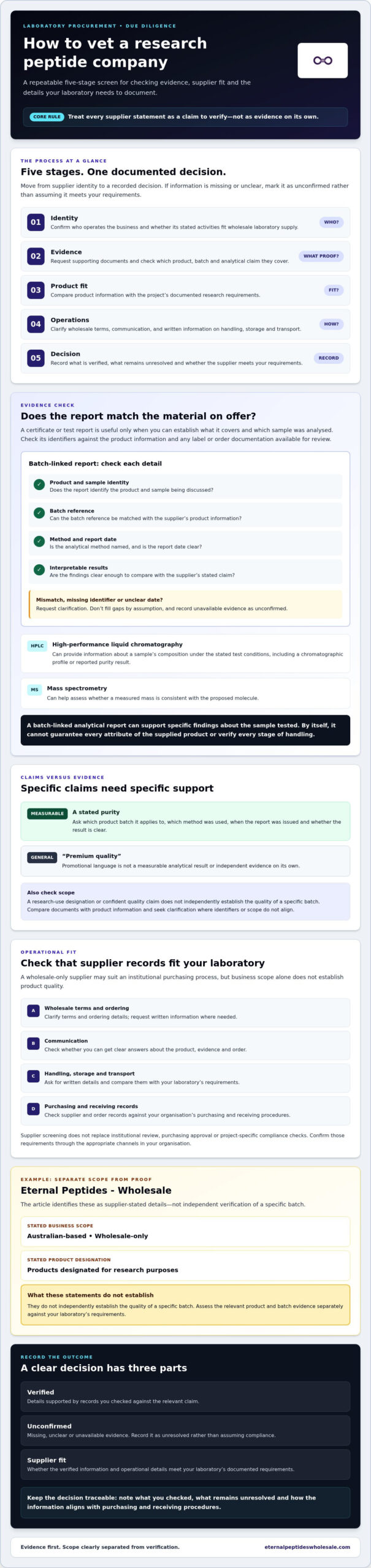
Compare identifiers character by character. A missing lot number, a product name that could refer to multiple materials, or a mismatch between the report and the material weakens the connection. The results may still describe the sample named in the document, but their relevance to the material under review is limited. Record any discrepancy rather than treating similar-looking identifiers as interchangeable.
What is the difference between a COA and a product specification?
A specification states acceptance criteria, such as the required range or limit for a defined attribute. A COA reports analytical results for a particular sample. Some documents present both, but layouts and reporting conventions vary, so identify which values are criteria and which are measured findings.
A specification alone doesn’t show what an analysed sample actually measured. For example, a document might state a required purity threshold without reporting a sample’s result. Conversely, a reported result without a stated acceptance criterion tells you what was measured, but not whether it meets a particular specification. Read the headings, units and notes together before drawing a conclusion.
Keep the distinction clear during procurement: the specification describes the intended standard, while the COA provides reported evidence about a tested sample. Neither should be read beyond its stated scope. For research-use-only procurement, retain both documents with the relevant batch and purchasing records to support a clearer audit trail.
How to Read Identity, Purity, and Test Results on a Peptide COA
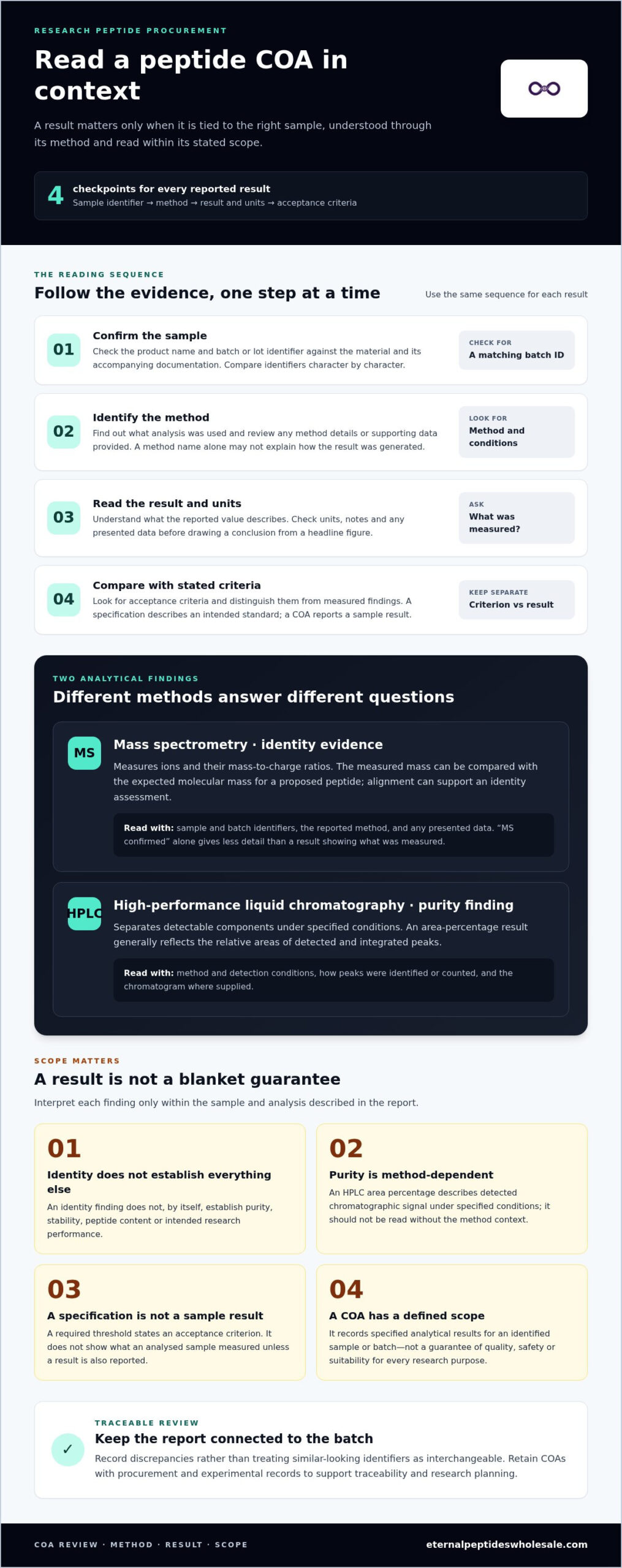
Read each result as a sequence: confirm the sample identifier, identify the analytical method, find the reported result and units, then check any stated acceptance criteria. This helps prevent a method name or headline figure from being mistaken for a complete assessment. Interpret a certificate of analysis for research peptides according to the data it actually reports, not the conclusions a reader hopes it will support.
Look for enough information to understand how each result was generated. A method may be named without conditions or supporting data, while a numerical result can be difficult to interpret without units or a stated criterion. The FDA’s Guidance on GMP for Pharmaceutical Ingredients provides broader context for quality control and documentation in pharmaceutical ingredient manufacturing. It is not a peptide-specific interpretation guide, but it illustrates why methods and records matter.
What can mass spectrometry indicate about peptide identity?
Mass spectrometry (MS) measures ions and their mass-to-charge ratios. These measurements can be used to derive a measured mass and compare it with the expected molecular mass for a proposed peptide. A result that aligns with the expected value can support an identity assessment. Review the reported method and presented data alongside the sample and batch identifiers. A label saying “MS confirmed” alone gives less detail than a result showing what was measured.
Identity evidence has a defined scope. It doesn’t, by itself, establish purity, stability, peptide content or intended research performance. Treat it as one analytical finding, not a stand-alone conclusion about every attribute of the material.
How should researchers interpret an HPLC purity result?
High-performance liquid chromatography (HPLC) separates detectable components under specified conditions. A purity figure reported as area percentage generally reflects the relative areas of peaks detected and integrated by that method. The result depends on the method, detection conditions and how peaks are identified or counted. Where supplied, examine the chromatogram and method details rather than relying only on the summary percentage.
An HPLC area-percentage purity result describes the detected chromatographic signal; it is not automatically a measurement of the total mass of peptide in the sample. Total peptide content is a separate question that requires an appropriate content or assay measurement. A high area percentage cannot establish how much peptide is present in the material as a whole, and the two values shouldn’t be used interchangeably.
For meaningful comparisons, check that reports use comparable methods, sample preparation, units and reporting conventions. Different figures may reflect different analytical conditions rather than a straightforward difference in material. Don’t apply a universal purity threshold without considering the research method’s requirements and the evidence reported.
Keep this distinction in view when planning laboratory procurement: identity, chromatographic purity and content answer different questions. Research teams sourcing material wholesale for laboratory research and development can review the wholesale research peptide range from Eternal Peptides Wholesale as part of their procurement planning.
What a Peptide COA Cannot Prove: Limits, Gaps, and Misreadings
A Certificate of Analysis is not a blanket guarantee of quality or fitness for purpose. It reports findings for specified analyses on a sample. What those findings support depends on the tests performed, the methods used and how the sample relates to the batch being considered. Even a clear result can leave important questions unanswered.
Every COA supports only the conclusions justified by its reported tests, methods and identified sample. A purity result, for example, doesn’t establish sterility, endotoxin status, stability or regulatory compliance. Those attributes require relevant evidence; they can’t be inferred from a strong result in another test. A general statement such as “quality tested” also doesn’t specify what was assessed.
Traceability matters. A report tied to an identified sample is not automatically evidence about every unit associated with a batch. The document should make its sample and batch connection clear. If that link is missing or ambiguous, readers can’t confidently apply the reported findings to the material under review. Treat uncertain traceability as a limitation in the evidence, not as proof that a test failed.
Does a COA establish safety or suitability for human use?
No. Analytical documentation does not make research products suitable for human use. A COA describes specified analytical findings; it doesn’t establish suitability for diagnosis, treatment, dosing or any other human use. Products discussed in this context are for laboratory research and development only. A COA also doesn’t replace the institutional, ethical or regulatory review relevant to a research project.
Which absent results should researchers avoid assuming?
Don’t infer an unreported test from a purity percentage or broad quality statement. Depending on the material and research requirements, relevant questions might include whether endotoxin, water content, residual solvents or stability were assessed. These are examples, not a universal checklist: the need for each analysis depends on the research context and applicable protocols.
There’s an important difference between a missing result and a failed result. If a COA doesn’t include an endotoxin test, that means the document doesn’t report the finding. It doesn’t show that the sample passed or failed. Likewise, the absence of stability data establishes neither stability nor instability. Record the gap accurately and avoid filling it with assumptions.
When evaluating a certificate of analysis for research peptides, separate reported findings from untested attributes and consider whether the sample identification supports applying those findings to the material being procured. A COA can inform a research procurement decision, but it can’t answer questions outside its stated scope or replace the research team’s review of requirements.
A Practical Checklist for Reviewing a Research Peptide COA
A repeatable review makes a Certificate of Analysis more useful in procurement and research records. Work through the document in order, separating what it reports from what you infer. This five-step process keeps batch traceability and evidence gaps visible without treating a single result as a complete quality assessment.
- Match the identifiers. Compare the product name and batch or lot identifier on the report with the accompanying product documentation. Note any mismatch, missing field or unclear sample description as a traceability limitation.
- Inspect the dates. Record the report date and any test dates shown. Check that the timing and sample description make sense for the material under review, and don’t assume a report applies to a different lot.
- Read the methods. Identify which analytical method supports each result. Note whether the report provides enough method detail to interpret the finding, rather than relying only on a general statement that testing was performed.
- Interpret each result. Record the reported value, units and any stated acceptance criteria. Keep different analyses separate; an identity result, for instance, answers a different question from a purity result.
- Record limitations. List relevant attributes the COA doesn’t report, and distinguish these gaps from failed results. Don’t infer a finding for a test that isn’t shown.
How to match a report to the material under review
Use the product and batch identifiers as the link between the report and the material’s accompanying documentation. Record the identifiers exactly as written, including letters, numbers and any suffixes. If the report describes a sample but doesn’t clearly connect it to the batch being considered, note that uncertainty in the procurement record rather than assuming a match.
Dates also need context. A report date may differ from the date testing took place, so capture both when available. Preserve the original document and note where it came from and which procurement record it relates to. This lets a later reviewer see what was assessed and which material the assessment was intended to cover.
How to record findings without overinterpreting them
Keep reported data distinct from interpretation. For each analysis, record the method, result, units and any stated criterion. Then add a separate note explaining what the result supports and what remains unanswered. A missing stability result, for example, is an unreported attribute, not evidence of either stability or instability. Review the method and reported findings together to understand what the HPLC or MS result supports.
Retain the COA with procurement documentation and relevant experimental records. If the batch identifier is unclear or a test is absent, state that plainly and follow the research team’s documented review process before deciding how the material fits the project. This approach supports traceable, research-use-only procurement without overstating what the paperwork establishes.
For laboratory research and development procurement, explore the wholesale research peptide range from Eternal Peptides Wholesale.
Using COA Literacy in Wholesale Research Peptide Procurement
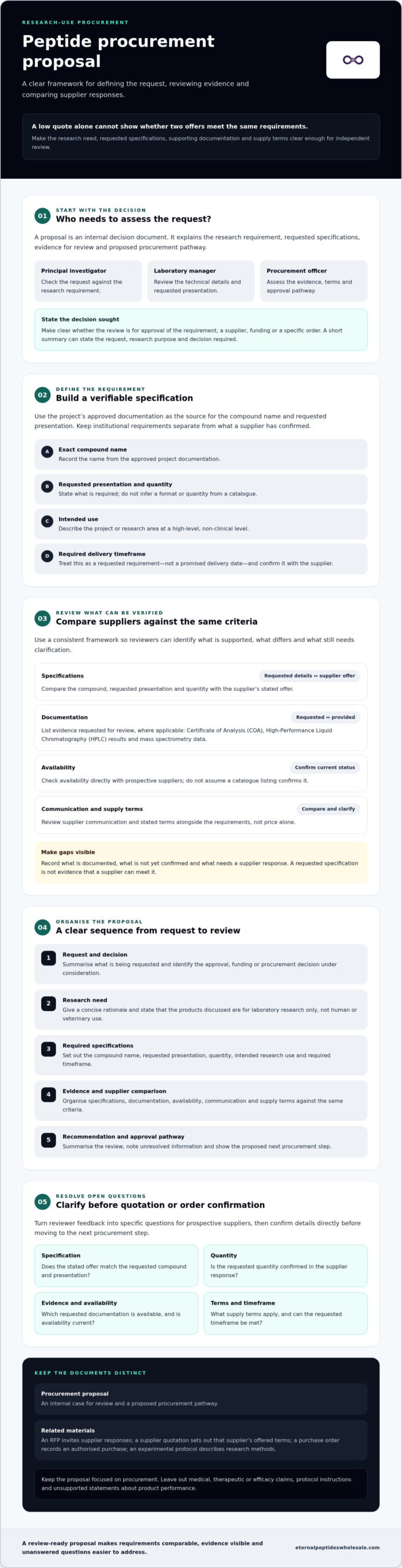
COA review is most useful when it forms part of a consistent procurement record, rather than sitting as an isolated file. For laboratory research and development, linking the document to the relevant purchase, batch and project helps teams understand which evidence informed a decision and which questions remain open. This supports continuity when records are revisited during project planning or review.
How can laboratories make COA review repeatable?
Use the same record fields each time: product identity, batch identifier, report and test dates, method, result and units, stated acceptance criteria, reviewer and review date. Add a brief note on the scope and any unresolved gaps. Consistent fields make documents easier to compare, but they don’t make different analytical methods interchangeable. Link each review record to the relevant procurement file and project documentation.
A shared template can also clarify responsibility. The reviewer records what the document states; a separate interpretation field captures how the finding relates to the project’s requirements. Keep the original COA with the record, so another team member can trace a summary back to its source instead of relying on a second-hand description.
- Log the procurement link. Record the purchase reference and the material’s product and batch identifiers.
- Capture the evidence. Enter each method and result with its units, dates and any stated criteria.
- Separate findings from assessment. Note what the result supports without extending it to untested attributes.
- Flag open questions. Describe missing or unclear information as an evidence gap, not as a pass or failure.
- Connect the record. File the review with the project documentation and retain the source report for traceability.
This structure can help teams identify why two documents aren’t directly comparable. Differences in method, units or sample description should remain visible in the record, rather than being reduced to a single headline figure. Broader procurement considerations, such as sourcing research peptides wholesale in Australia, also sit alongside document review. A COA alone doesn’t answer them.
Where does COA review fit in Australian research procurement?
In Australia, treat COA interpretation as one component of procurement due diligence, not a substitute for an organisation’s applicable obligations, research governance or project-specific review. A document can inform planning, but it doesn’t decide whether a material is appropriate for a particular protocol. Keep the research purpose clear and assess the paperwork against the requirements established for the work.
Eternal Peptides Wholesale is an Australian wholesale supplier of research-grade peptides for laboratory research and development. Its products are for research purposes only, not for human consumption or medical use. If you’re planning laboratory research procurement, explore Eternal Peptides Wholesale’s wholesale research peptide offerings as one part of that process.
Make COA Review Part of Your Procurement Routine
Make your next step a practical one: build COA review into the way your team plans and documents laboratory procurement. A consistent process gives researchers a clearer basis for assessing whether available documentation aligns with a project’s requirements, while keeping unanswered questions visible for review. The aim isn’t to make a document prove more than it can, but to use its evidence carefully as part of sound research planning.
Apply the same disciplined approach when considering a certificate of analysis for research peptides: keep the document connected to the relevant procurement and project records, and interpret its findings within their stated scope. This supports more traceable decisions as research work progresses.
Eternal Peptides Wholesale is an Australian-based wholesale supplier of research-grade peptides for laboratory research and development. Its products are for research purposes only, not for human consumption or medical use. For laboratory procurement, explore Eternal Peptides Wholesale’s research peptide range. A clear, consistent review process helps your team make better use of its documentation.
Frequently Asked Questions
What is a Certificate of Analysis for research peptides?
A Certificate of Analysis (COA) is a report of analytical findings for an identified sample or batch. A certificate of analysis for research peptides can help a laboratory document what information accompanied a procurement decision. For example, a record can note whether the report identifies a sample, names the analysis and gives a result with units. Researchers should read those details in relation to their project requirements, rather than treating the document as a general quality endorsement.
How do I check whether a peptide COA matches the batch I am reviewing?
Compare the report’s product and batch identifiers with the accompanying material documentation, then note any differences in your procurement record. Check whether the sample description is specific enough to identify what was analysed. For digital filing, use a consistent file name that includes the product, batch identifier and report date. Keep the original report with the purchase record so another team member can retrace the match without relying on a summary.
Does an HPLC purity percentage show the total amount of peptide in a sample?
No. An HPLC purity percentage shouldn’t automatically be read as the total peptide amount. It commonly describes relative chromatographic signal under the stated method, while a content assay addresses how much peptide is present in a sample. For instance, a report may state an area-percentage result but provide no content measurement. Record the result under the analysis actually reported, and don’t relabel it as concentration or potency.
What does mass spectrometry tell you about a research peptide?
Mass spectrometry can provide evidence relevant to whether a measured mass is consistent with the expected molecular mass. When reviewing a report, check that the result relates to the identified sample and note the method and data presented. A mass match is one piece of evidence, not a full characterisation of the material. It doesn’t independently answer questions about purity, storage stability or how the material will perform in a specific experiment.
Is a third-party COA enough to prove a peptide is safe or suitable for human use?
No. A third-party report doesn’t make a research peptide suitable for human consumption or medical use. It remains documentation of defined analytical results, and its meaning depends on the analyses and sample described. Research-grade peptides supplied by Eternal Peptides Wholesale are for laboratory research and development only. Keep assessment within that research context, and don’t use a COA as a basis for personal or clinical use.
What should I do if a peptide COA does not list a test I need?
Record the missing analysis as an information gap, then compare the available documentation with the requirements set for the planned research. For example, if a project’s documented review calls for a particular test but the COA doesn’t report it, note that the report provides no result for that attribute. Don’t mark it as passed or failed. Retain the note with the procurement file so the decision is clear to later reviewers.
Related from Eternal Peptides Wholesale
Eternal Peptides Wholesale publishes batch-specific Janoshik Analytical reports in its certificate of analysis library, so the documentation for a listed batch can be read alongside the evidence discussed in this article.
- Peptide COA library: batch-specific Janoshik Analytical reports with their verification details
- Our peptide testing standards: how independent Janoshik testing is used and reported
- Janoshik reports explained: what each test measures and its limits
- Evidence review: Synthetic peptides: manufacture, impurities and analytical verification
- Evidence review: Peptides wholesale: supplier qualification and quality standards