

A supplier’s most persuasive claim may tell you less than a document linked to the batch on offer. Knowing how to vet a research peptide company means looking beyond product descriptions to assess whether its evidence is verifiable and its operations suit your laboratory’s procurement requirements.
It’s reasonable to expect documentation that matches the product and batch under consideration, along with clear answers about wholesale terms, ordering and communication. A research-use designation or confident quality claim isn’t independent evidence on its own. Check and record each detail before you commit.
This guide sets out a repeatable due diligence process: what to request, how to review batch-specific analytical documents, and which business and operational details to clarify. For example, Eternal Peptides Wholesale identifies itself as an Australian-based, wholesale-only supplier, with products designated for research purposes. Those statements describe its business scope, but they don’t independently establish the quality of a specific batch. Use the checklist to distinguish stated facts from evidence, assess supplier fit and document a decision against your laboratory’s requirements.
Key Takeaways
- Use a five-stage process to assess company identity, evidence, product fit, operations and your procurement decision.
- When learning how to vet a research peptide company, check whether documents identify the specific product and batch being offered.
- Compare suppliers using verifiable criteria. Record unavailable evidence as unconfirmed rather than assuming it meets your requirements.
- Check that supplier and order records align with your laboratory’s purchasing and receiving procedures. Request written details where needed.
- Separate stated business scope from independently verified quality evidence when assessing whether a wholesale supplier fits your laboratory.
How to vet a research peptide company before your laboratory buys
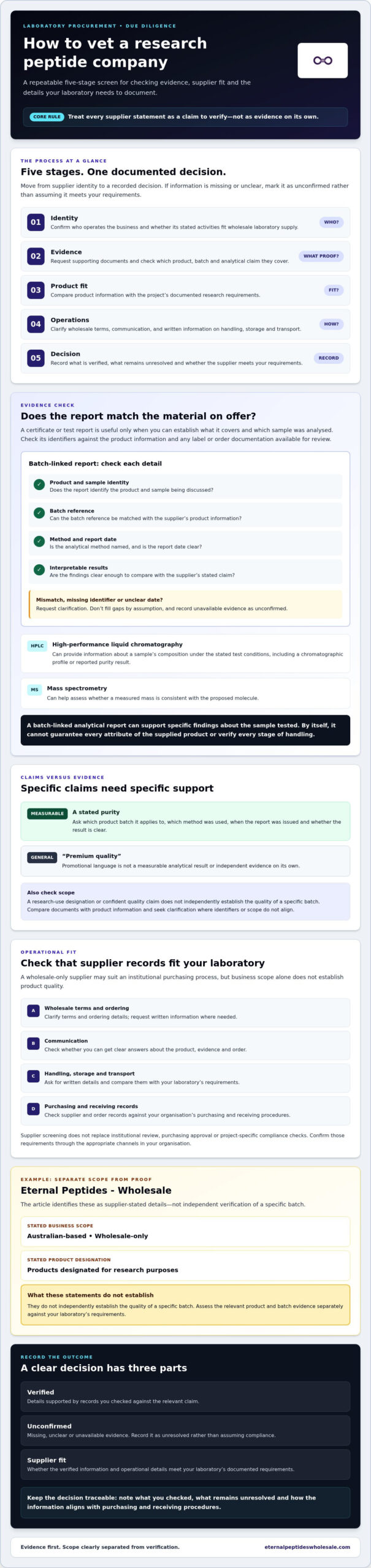
A defensible supplier decision relies on records you can check against your laboratory’s requirements, not confidence created by polished marketing. To understand how to vet a research peptide company, treat each statement as a claim to verify. Check it against documents, references where relevant, and your organisation’s purchasing and receiving criteria.
Use a consistent five-stage screen:
- Identity: Confirm who operates the business and whether its stated activities fit wholesale laboratory supply.
- Evidence: Request supporting documents and check which product, batch and analytical claim they cover.
- Product fit: Compare the product information with the project’s documented research requirements.
- Operations: Clarify wholesale terms, communication, and written information about handling, storage and transport.
- Decision: Record what is verified, what remains unresolved and whether the supplier meets your requirements.
What should supplier vetting establish?
Start by confirming the supplier’s identity and stated business scope. A wholesale-only supplier may suit an institutional purchasing process, but that alone doesn’t establish product quality. Ask what evidence supports the specific product and any claims about quality or handling. Check that documents relate to the product under consideration, rather than relying on a generic example. Log missing or unclear information as unconfirmed and assign follow-up. Don’t treat silence as evidence of compliance.
Questions about product manufacture are another reason to be precise, not to make assumptions. A basic explanation of chemical peptide synthesis can provide context for why manufacturing or analytical statements need clear supporting records. The explanation itself doesn’t verify a supplier’s process or establish the quality of a particular batch.
Which claims deserve closer scrutiny?
Separate measurable statements from broad promotional language. A stated purity is a specific analytical claim; “premium quality” is not. For each measurable claim, ask which product batch it applies to, which method was used, when the report was issued and whether the result is clear. Compare those details with the product information and the supplier’s explanation. If identifiers or scope don’t align, seek clarification before relying on the claim.
Keep the review within laboratory procurement. Language that implies human use, treatment or performance outcomes isn’t evidence of suitability for a research project and falls outside this research-use guide. Supplier screening also doesn’t replace institutional review, purchasing approval or project-specific compliance checks. Confirm those requirements through the appropriate channels at your organisation before proceeding.
Check company identity and research peptide quality evidence
A certificate or test report is useful only if you can establish what it covers and which sample was analysed. A polished document without a clear product identifier, batch reference or testing scope may be impossible to connect to the material being offered. When working out how to vet a research peptide company, ask not just whether a report exists, but whether its details can be checked against the supplier’s claims.
A batch-linked analytical report can support specific findings about the sample tested. It cannot, by itself, guarantee every attribute of the supplied product or verify every stage of its handling. Treat the report as one piece of evidence and assess its scope against your laboratory’s requirements.
How to assess HPLC and mass spectrometry reports
Check that the report identifies the sample and relevant batch, names the analytical method, and provides a date and interpretable results. Compare its product name and batch reference with the supplier’s product information and any label or order documentation available for review. Differences, missing identifiers or unclear dates are reasons to request clarification, not details to fill in by assumption.
Methods answer different questions. High-performance liquid chromatography (HPLC) can provide information about a sample’s composition under the stated test conditions, including a chromatographic profile or reported purity result. Mass spectrometry (MS) can help assess whether a measured mass is consistent with the proposed molecular identity. Neither result proves every quality attribute. A chromatogram or mass spectrum is not, on its own, a complete quality guarantee or evidence about handling and storage.
Ask what the report’s conclusions actually support. If a supplier makes a claim about identity, purity or another attribute, request the relevant result and method rather than treating one test as evidence for everything.
How to confirm business and document consistency
Compare the company name on the report with the supplier’s stated business identity. If a separate laboratory performed the analysis, ask which laboratory it was and whether the supplier can clarify the relationship between that laboratory, the report and the sample. A third-party name alone doesn’t establish that the document relates to the batch under consideration.
Record the answers and any gaps. For more context on evaluating quality systems in procurement, consult this research peptide quality assurance guide. Eternal Peptides Wholesale identifies itself as an Australian-based, wholesale-only supplier of research-use products. Those stated business details are separate from batch-specific analytical evidence, which buyers should confirm for the product being considered.
Reviewing a supplier’s stated scope can help you assess wholesale fit alongside technical evidence. You can review Eternal Peptides Wholesale’s supplier information as part of that assessment, while requesting any product-specific documentation your procurement process requires.
Compare suppliers using evidence, transparency and procurement fit
A structured comparison makes supplier differences easier to assess and reduces the influence of persuasive but unsupported claims. To understand how to vet a research peptide company, compare like with like: the same product, comparable batch context and the same documentation requests. Laboratories apply these same verification principles to batch testing and purity documentation when evaluating any supplier, including overseas suppliers. Keep technical evidence separate from business reliability. A report may support a specific analytical claim, while communication, terms and wholesale fit determine whether the supplier suits your procurement process.
Use a comparison table and score only criteria you can verify. Mark missing or unclear information as unconfirmed, not as a low-risk assumption.
| Criterion | What to check | Record |
|---|---|---|
| Evidence | Does the documentation identify the product and explain its relationship to the sample or batch? | Verified, unconfirmed or follow-up required |
| Communication | Are answers accurate, complete and consistent with the documents? | Examples and unresolved questions |
| Product fit | Does the available product information align with the laboratory’s documented project requirements? | Fit confirmed or not established |
| Terms | Are wholesale conditions and purchasing details clear in writing? | Terms reviewed or clarification needed |
| Open questions | What information is still missing or needs institutional review? | Owner and next step |
What to ask before accepting a supplier’s claims
Request the documentation relevant to the product under consideration, then ask how it relates to the sample or batch being offered. Check whether product identifiers connect across the quotation, packaging information and supporting records. If names, references or descriptions differ, ask the supplier to explain the discrepancy in writing.
Record the quality of the response, not just whether a reply arrived. Does it address the question directly? Are limitations acknowledged? Can the supplier clarify what a document does and doesn’t establish? Score only observable answers and records. Don’t award points for claims you can’t independently assess.
How to compare wholesale suitability
Technical quality evidence and procurement suitability are separate assessments. Confirm whether the supplier’s wholesale model, written terms, product information and support channels align with your laboratory’s order and approval process. When assessing direct-supply arrangements, compare the terms and documentation each supplier provides. A supplier may be a potential operational fit while specific quality evidence remains unconfirmed, or the reverse. Keep both findings visible in your comparison rather than blending them into one overall impression.
For broader sourcing considerations, consult this Australian wholesale research peptide procurement guide. You can also review Eternal Peptides Wholesale’s stated supplier scope as one input to a comparison, while assessing product-specific evidence and procurement fit separately.
Verify Australian operating, documentation and institutional requirements
An Australian operating presence can be relevant to procurement, but it doesn’t establish that a product is lawful for a particular purpose, that an import is permitted or that the product is suitable for your research. Check the supplier, product and proposed activity against the requirements that apply to your organisation. Keep those checks separate from technical quality assessment.
What Australian buyers should confirm
Requirements can depend on the compound, intended research activity and institutional setting. Don’t rely on a supplier’s location or a research-use-only statement as a substitute for checking. Consult current information from the relevant Australian regulator, such as the Therapeutic Goods Administration where applicable, and seek advice from your institution’s compliance staff or a qualified adviser if the position is unclear. Don’t apply a general statement to a specific compound or project without confirmation.
Before progressing an order, check the proposed purchase against your institution’s procedures. Confirm who can approve it, which records must be retained and what receiving checks are required. Make sure the order and product identifiers can be reconciled with the paperwork your team needs to file. These internal controls help turn supplier information into a reviewable procurement record.
How to assess fulfilment and communication
Ask the supplier for written details on handling, storage and transport, and confirm that the instructions are clear enough for your receiving process. Verify supplier-specific statements rather than assuming standard practices apply. You can also ask what order, dispatch and delivery information will be provided, and how the supplier would respond if a document or identifier didn’t match the order.
- Can the supplier explain which records accompany the order?
- Are product identifiers consistent across the order information and supporting documents?
- Who should your procurement team contact about a discrepancy, and how will the issue be documented?
Record unanswered questions as unresolved. If instructions are vague, request clarification before approval rather than filling gaps with assumptions. This is a practical part of how to vet a research peptide company: assess what can be verified, then refer remaining questions to the relevant institutional or regulatory contact.
Eternal Peptides Wholesale describes itself as an Australian-based, wholesale-only supplier of research-use products. Those details can inform an initial business-fit review, but they don’t establish regulatory status, product suitability or specific handling and delivery arrangements. Confirm those points independently before relying on them.
For a supplier-scope review alongside your institutional checks, review Eternal Peptides Wholesale’s stated business information and verify any product or operational details your procurement process requires.
Make a documented supplier decision and assess Eternal Peptides Wholesale
Turn your checks into a decision record before seeking procurement approval. This gives reviewers a clear account of what the supplier has demonstrated, what remains uncertain and why the supplier is or isn’t suitable for the laboratory’s requirements. It also makes reassessment easier if product information, terms or institutional requirements change.
A practical supplier approval checklist
Record each finding under one of four statuses: verified, unverified, unsuitable or follow-up required. Check the supplier’s stated business scope, product identity, available product-specific documentation and written wholesale terms. Resolve discrepancies between claims, records and your laboratory’s specifications before approval.
- Verified: A claim supported by records you’ve reviewed.
- Unverified: Information that is missing or hasn’t been independently checked.
- Unsuitable: A requirement the supplier or product doesn’t meet.
- Follow-up required: A question awaiting clarification or institutional review.
Include who completed the review, which documents were considered, outstanding questions and the date or trigger for reassessment. Don’t treat an unanswered request as confirmation. If a key requirement remains unresolved, state that clearly in the record and follow your organisation’s approval process.
When to contact a wholesale supplier
Prepare a concise enquiry before contacting a supplier. Identify the product under consideration, the order volume your laboratory requires, and the documentation or written operational details needed for review. Ask whether product-specific evidence is available and how its identifiers relate to the product offered. Keep the discussion within research procurement. Supplier enquiries aren’t a substitute for medical advice or guidance on human use.
Assess Eternal Peptides Wholesale against confirmed scope only: it identifies itself as Australian-based and wholesale-only, and its products are designated for research purposes. Those facts may help establish whether its stated business model aligns with your purchasing needs. They don’t confirm that a particular product meets your specifications or that batch-specific reports, certifications, handling processes or other supporting records are available. Request and review the relevant information directly rather than assuming it exists.
A careful approach to how to vet a research peptide company ends with a measured decision, not automatic approval. Confirm business fit, documentation and outstanding requirements with the supplier, then complete your institution’s review before procurement approval. To check the stated wholesale range and raise product-specific questions, review Eternal Peptides Wholesale’s wholesale research range.
Make your next supplier decision evidence-led
A repeatable vetting process turns supplier claims into a decision your laboratory can explain and review. Match documents to the product and batch, assess wholesale and operational fit separately from technical evidence, and record what is verified, unresolved or unsuitable. Knowing how to vet a research peptide company also means checking project and institutional requirements rather than assuming a supplier’s stated location or scope settles them.
Eternal Peptides Wholesale describes itself as an Australian-based, wholesale-only supplier, with products designated for research purposes. Its listed wholesale offerings include Retatrutide 10mg. These are stated business details, not a substitute for requesting product-specific documentation or completing your laboratory’s own review.
For a practical next step, review Eternal Peptides Wholesale’s wholesale research range and confirm the product information and documentation relevant to your procurement requirements directly. A careful, recorded assessment gives your team a clearer basis for deciding whether to proceed.
Frequently Asked Questions
How do I vet a research peptide company?
Use a documented process to check the supplier’s identity, product-specific evidence, wholesale fit and operational information against your laboratory’s requirements. Compare product and batch identifiers across available records, clarify what analytical reports establish, and record gaps as unverified. Confirm institutional approvals and any applicable Australian requirements separately. A supplier’s location or research-use-only designation isn’t, by itself, proof of product quality, compliance or suitability for a particular project.
What documents should a research peptide supplier provide?
Ask what product-specific records are available for the item under consideration. Depending on your procurement requirements, these may include an analytical report with clear product and sample identifiers, order or quotation details, and written information about handling, storage and transport. Check whether the documents relate to the product or batch being offered, and ask who prepared any test report. Don’t assume a particular document, certification or quality system is available without confirmation.
Can I rely on a certificate of analysis for research peptides?
A certificate of analysis can support specific findings about the sample it identifies, but it shouldn’t be treated as a complete quality guarantee. Check the named product, sample or batch reference, date, analytical methods and reported results. Consider whether the report addresses the attribute being claimed, such as identity or purity. It won’t necessarily establish other product attributes, handling history or suitability for your laboratory’s research requirements.
How can I check whether a peptide test report matches the product batch?
Compare the report’s product name and batch or sample reference with the supplier’s product information and the records associated with the proposed order. Check that dates, identifiers and descriptions are consistent, and ask the supplier to explain any difference in writing. If the report doesn’t identify a relevant batch or sample, its connection to the product being offered remains unconfirmed. Record that gap and seek clarification before relying on the result.
Are research peptides from an Australian supplier automatically compliant for my laboratory?
No. An Australian-based supplier’s location doesn’t establish that a product or proposed research activity meets applicable requirements. The relevant considerations can depend on the compound, project and institution. Check current information with the appropriate Australian regulator or a qualified compliance adviser, and confirm your organisation’s purchasing, approval and receiving procedures. Treat supplier statements as information to verify, not as a substitute for institutional review or project-specific checks.
What should I do if a peptide supplier cannot answer technical questions?
Pause the assessment and record which questions remain unanswered. Request clarification on the specific product, report scope, sample or batch identifiers, and any stated analytical results. If the response remains incomplete or doesn’t match the available records, mark the point as unverified and follow your laboratory’s escalation or approval process. Don’t interpret a confident sales response, or the absence of an answer, as technical evidence.
Can research peptides be purchased for personal use?
This supplier’s products are designated for research purposes only, not for human consumption or medical use. A research-use label doesn’t establish that a product is appropriate or authorised for personal use. Rules may depend on the substance and circumstances, so don’t rely on supplier marketing to determine personal-use status. Check current Australian guidance with the relevant regulator and consult a qualified health professional for personal health questions. The supplier doesn’t provide medical consultations.
Trusted Australian peptide suppliers: separate three kinds of evidence
Company identity, analytical findings and suitability for your experiment require different evidence. Contact information helps establish who is making the offer. A laboratory report describes a tested sample. Your acceptance criteria determine whether those findings are sufficient for the intended work. None of these checks can stand in for the other two. [1][2]
When a supplier describes its peptides as independently tested, request the report identifier and confirm the exact product and lot relationship. Janoshik provides a report-verification facility, but verification of a report alone is not proof that an untested consignment is identical to its submitted sample. [3]
For the next step, review the Australian research peptide buying guide and the batch-verification checklist. Contact Eternal Peptides Wholesale with the exact product and any unanswered documentation questions.
Related from Eternal Peptides Wholesale
Eternal Peptides Wholesale publishes batch-specific Janoshik Analytical reports in its certificate of analysis library, so the documentation for a listed batch can be read alongside the evidence discussed in this article.
- Peptide COA library: batch-specific Janoshik Analytical reports with their verification details
- Our peptide testing standards: how independent Janoshik testing is used and reported
- Janoshik reports explained: what each test measures and its limits
- Evidence review: Peptides wholesale: supplier qualification and quality standards
- Evidence review: Synthetic peptides: manufacture, impurities and analytical verification
Related reading: How to Write a Peptide Procurement Proposal: A Practical Guide; TGA Research Peptide Guidelines: 2026 Compliance Guide
References and bibliography
- Eternal Peptides Wholesale. Contact and Australian store locations. Accessed 27 September 2026.
- McCarthy D, Han Y, Carrick K, Schmidt D, Workman W, Matejtschuk P, Duru C, Atouf F. 2023. Reference Standards to Support Quality of Synthetic Peptide Therapeutics. Pharmaceutical research. 40(6):1317-1328. doi:10.1007/s11095-023-03493-1.
- Janoshik Analytical. Report verification. Accessed 27 September 2026.