

Posted on

Wholesale Tissue Repair: Australian Procurement Guide

Wholesale Tissue Repair: Australian Procurement Guide

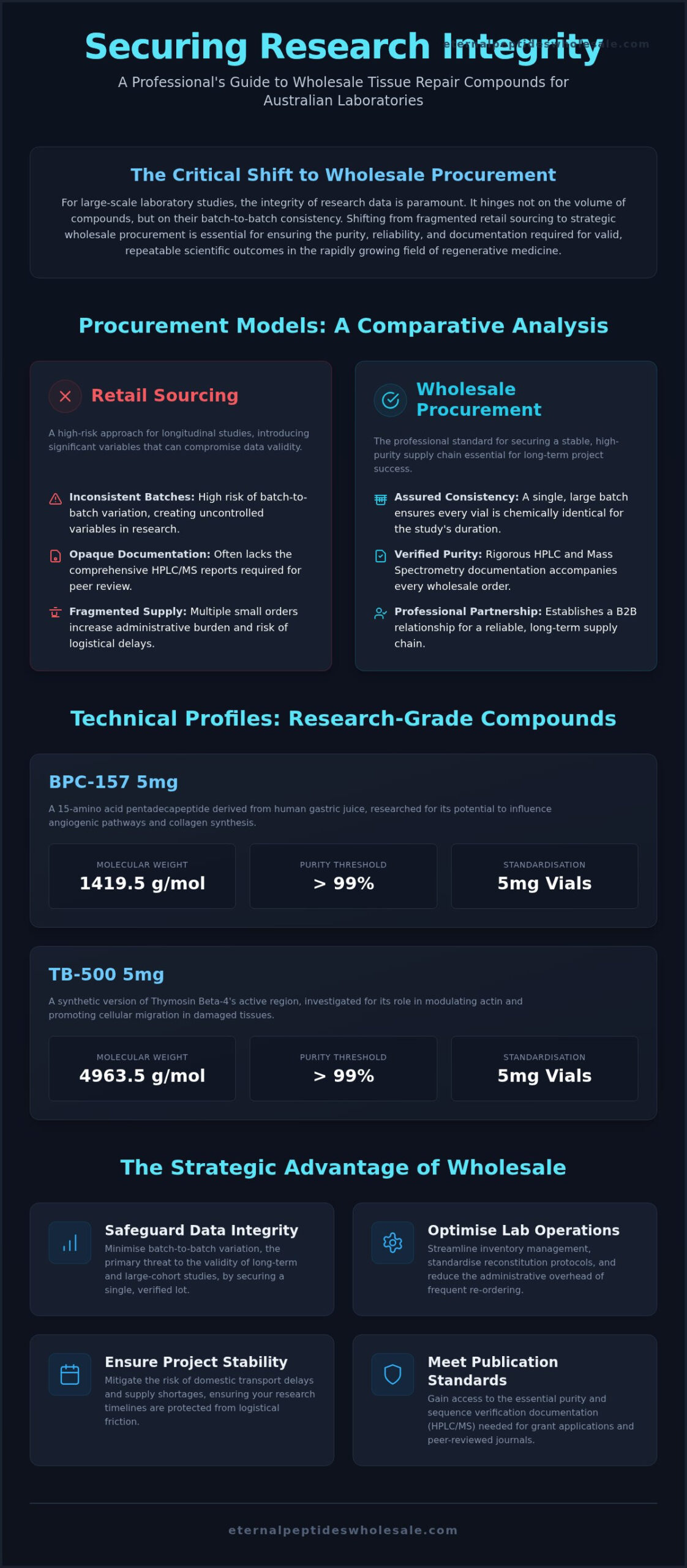
In large-scale research, the value of tissue repair compounds is defined by batch-to-batch consistency, not just volume. For Australian laboratories, the primary bottleneck in progress is frequently the reliability of wholesale tissue repair compounds rather than the hypothesis itself. Procurement professionals understand that sourcing bulk BPC-157 and TB-500 often involves navigating a landscape of inconsistent batches and opaque documentation. You need a supply chain that prioritises clinical reliability over transactional speed.

This guide provides a professional analysis of the Australian wholesale landscape, specifically focusing on establishing stable procurement for BPC-157 5mg and TB-500 5mg. We’ll examine how to verify HPLC/MS documentation, mitigate logistical delays, and ensure your research-grade materials meet the rigorous standards required for valid, large-scale data collection. By the end, you’ll have a clear framework for securing high-purity biochemicals that support long-term project stability without the friction of retail-level supply issues.

Key Takeaways

  • Understand the operational shift required when moving from retail sourcing to strategic wholesale procurement for large-scale laboratory studies.
  • Identify the technical specifications and solubility requirements for wholesale tissue repair compounds to ensure precise research planning and reconstitution.
  • Learn how to safeguard the integrity of long-term data by minimising batch-to-batch variation through rigorous documentation and purity verification.
  • Optimise laboratory inventory management by addressing the specific logistical requirements and lead times of the Australian biotech environment.
  • Discover the advantages of establishing a professional B2B partnership to secure a consistent, high-purity supply of research-grade biochemicals.

Defining Wholesale Tissue Repair Compounds in a Research Context

Tissue repair compounds are essential biochemicals in modern regenerative medicine research. They’re primarily utilised to investigate the underlying mechanisms of tissue healing, cellular signalling, and inflammatory modulation. The Australian research sector is currently seeing a surge in regenerative medicine projects, with the legal peptide therapeutics market projected to reach USD 3,711.1 million by 2033. This growth highlights the importance of reliable supply chains for researchers investigating cellular recovery. While retail vendors focus on small-scale transactions, laboratory procurement requires a dedicated logistical backbone that can provide high-volume quantities without compromising on purity.

For scientific validity, volume and purity must be perfectly balanced. A study’s integrity depends on the assumption that every vial used is identical to the last. This is why professional labs avoid the retail market, where batch documentation is often insufficient. Securing wholesale tissue repair compounds through dedicated B2B channels ensures that researchers have access to the documentation required for peer-reviewed publication and repeatable results.

The Role of BPC-157 and TB-500 in Scientific Study

Researchers frequently focus on BPC-157 and TB-500 due to their roles in gastric and musculoskeletal repair models. These compounds are often studied in tandem because researchers look for synergistic effects that might exceed the results of isolated application. BPC-157 is a pentadecapeptide derived from human gastric juice for research. Scientific interest in BPC-157 (Body Protection Compound 157) centres on its potential to influence angiogenic pathways and collagen synthesis within controlled laboratory settings. Its companion, TB-500, is a synthetic version of Thymosin Beta-4, often investigated for its potential to modulate actin and promote cellular migration in damaged tissues.

Wholesale vs. Retail: The Necessity of Scale

Sourcing single vials for longitudinal or large-cohort studies creates significant variables. Every new batch from a retail source introduces a potential point of failure in data consistency. Strategic procurement of wholesale tissue repair compounds allows laboratories to secure a single, massive batch of 5mg vials. This ensures every subject in a study receives a chemically identical compound. Maintaining a bulk inventory also offers logistical advantages. It reduces the frequency of domestic transport delays, which is critical when working with time-sensitive research protocols.

Standardised 5mg vial sizes allow for uniform reconstitution protocols across the entire laboratory team. This level of standardisation is difficult to achieve when relying on fragmented retail supplies. By centralising procurement, labs can focus on their scientific objectives rather than the administrative burden of managing multiple small-scale orders. This approach provides the economic stability and logistical transparency necessary for high-volume biotech operations.

Technical Profiles: BPC-157 and TB-500 Specifications

Precision in biochemical research requires exact molecular specifications. Sourcing wholesale tissue repair compounds demands a focus on molecular weight and sequence integrity. BPC-157 (1419.5 g/mol) and TB-500 (4963.5 g/mol) have distinct profiles that dictate their roles in regenerative models. These technical parameters influence everything from reconstitution volumes to the final concentration used in laboratory assays.

BPC-157 5mg: Research Grade Standards

BPC-157 consists of 15 amino acids. Its sequence, Gly-Glu-Pro-Pro-Pro-Gly-Lys-Pro-Ala-Asp-Asp-Ala-Gly-Leu-Val, must be verified via HPLC. Purity thresholds for wholesale lots should exceed 99% to ensure experimental repeatability. This compound is notably prohibited by the World Anti-Doping Agency for athletic use, which underscores the necessity of strictly research-grade procurement. Verification of these standards is detailed in our guide on Quality Assurance in Research Peptides.

TB-500 5mg: Synthetic Thymosin Beta-4 Analogues

TB-500 is a synthetic peptide fragment representing the active region of the naturally occurring protein Thymosin Beta-4. In research, it’s primarily studied for its role in actin-binding and cellular migration. Unlike the full-length protein, the 5mg TB-500 wholesale format offers a more targeted approach for investigating tissue organisation. High-volume procurement requires rigorous screening for truncated sequences or residual solvents from the synthesis process. Laboratories managing large-scale inventories should review the technical standards for bulk TB-500 for laboratories to ensure every synthesis run meets the minimum purity thresholds required for valid longitudinal data.

Solubility is a critical factor in laboratory preparation. Both compounds are typically reconstituted using bacteriostatic water or sterile saline. Procuring wholesale tissue repair compounds requires a robust understanding of these stability profiles. Lyophilised powders remain stable at room temperature for short durations, but long-term storage in Australian laboratories should be maintained at -20°C. Once reconstituted, vials must be refrigerated at 2-8°C and used within a specific window to prevent degradation. For labs managing large-scale projects, maintaining these cold-chain standards across bulk inventory is non-negotiable.

Researchers seeking to procure high-purity biochemicals can rely on our systematic approach to technical verification and logistical reliability.

Ensuring Batch Consistency in High-Volume Peptide Sourcing

For large-scale biotech projects, the integrity of the data relies on the uniformity of the biochemicals used. When procuring wholesale tissue repair compounds, the greatest risk isn’t just the price; it’s the variation between batches. Inconsistent purity levels can lead to skewed results in long-term studies, forcing researchers to discard months of work. Standardising procurement ensures that every vial in a bulk order, whether it’s 50 or 500 units, shares an identical chemical profile. In an environment where the TGA has made unapproved peptides a compliance priority for 2026, maintaining transparent, high-level documentation is a necessity for any legitimate research facility.

The Importance of HPLC and MS Reports

High-Performance Liquid Chromatography (HPLC) is the industry standard for verifying the purity of peptides like BPC-157 and TB-500. It separates the compound from any synthesis by-products or residual reagents. Complementary to this, Mass Spectrometry (MS) confirms the molecular weight, ensuring the peptide sequence is correct. For wholesale orders, these reports shouldn’t be generic; they must be batch-specific. Researchers should demand these documents to confirm that the wholesale tissue repair compounds they receive meet the exact specifications required for their protocols. This level of transparency is what separates a professional B2B partner from a standard retail vendor.

Standardising Purity Across Wholesale Batches

In the Australian research sector, “Research Grade” typically denotes a purity threshold of 98% or higher. However, even within this range, slight variances between synthesis runs can occur. A professional wholesaler acts as a steadfast logistical backbone by screening these runs before they reach the laboratory. If a batch shows a variance that exceeds the acceptable threshold for a specific longitudinal study, it must be flagged or rejected. Maintaining this level of operational excellence allows labs to focus on their data rather than worrying about the chemical reliability of their supply chain. It’s about creating a narrative of competence through systematic processes and rigorous standards.

By centralising bulk orders through a single, reliable source, labs can mitigate the risks associated with fragmented supply chains. This approach ensures that the “no-nonsense” professional partnership valued by procurement professionals is maintained through every stage of the project. Reliable batch-to-batch consistency isn’t just a logistical advantage; it’s the foundation of valid scientific outcomes.
Wholesale Tissue Repair: Australian Procurement Guide

Strategic Procurement: Optimising the Laboratory Supply Chain

Effective procurement in the 2026 Australian research landscape involves more than just selecting a supplier; it requires a comprehensive strategy for supply chain management. Laboratories must navigate a market where regulatory enforcement is a priority, making the reliability of wholesale tissue repair compounds a central concern for operational continuity. Reducing procurement lag is achievable only through established national distribution networks that bypass the delays common in international retail shipping. For a deeper look at current market dynamics, see our Sourcing Research Peptides Wholesale in Australia guide.

Managing Large-Scale Peptide Inventories

Successful longitudinal studies depend on the potency of the biochemicals from the first day to the last. Bulk lyophilised peptides require specific environmental controls to prevent degradation over time. Organising stock rotation is vital to maintain potency across multi-year trials. When receiving large wholesale shipments, laboratories should follow a systematic verification protocol to ensure every unit meets the required standards.

  • Maintain long-term storage at -20°C in a dedicated laboratory freezer with backup power.
  • Utilise a First-In, First-Out (FIFO) rotation to ensure stock freshness across different synthesis runs.
  • Conduct a visual inspection of vials for vacuum seal integrity and lyophilisation quality upon arrival.
  • Cross-reference batch numbers with the provided HPLC/MS documentation immediately to confirm consistency.

B2B Logistics and Shipping within Australia

Biochemical sensitivity makes standard courier services unsuitable for high-value research materials. Temperature-controlled shipping is mandatory for maintaining the structural integrity of wholesale tissue repair compounds during transit, especially during the summer months in regional Australia. National distribution networks that specialise in cold-chain logistics help laboratories overcome common hurdles like regional transport delays and heat exposure at sorting centres. These logistical requirements often mirror those found in Wholesale GLP-1 Research Chemicals, where stability is equally paramount for valid research data. Procurement professionals expanding their research portfolios should also consider how ipamorelin wholesale Australia sourcing strategies align with the same domestic supply chain principles that protect longitudinal study timelines.

Establishing a steadfast logistical backbone allows your team to focus on scientific discovery rather than administrative friction. To secure a reliable supply for your next large-scale biotech project, you can view our wholesale procurement options and speak with a specialist about your specific research requirements.

Eternal Peptides Wholesale: Your Professional Research Partner

Eternal Peptides Wholesale functions as more than a supplier; we serve as a steadfast logistical backbone for the Australian biotech sector. Our operations are built on a foundation of clinical reliability and transparency, specifically designed to meet the high-volume needs of professional laboratories. Unlike generic marketplaces that offer a broad range of unrelated goods, we specialise exclusively in high-purity biochemicals. This focus ensures that our procurement protocols, documentation standards, and distribution networks are all optimised for the scientific community. By providing a consistent supply of wholesale tissue repair compounds, we allow researchers to maintain the momentum of their projects without the disruptions caused by fragmented supply chains.

A Steadfast Logistical Backbone for Australian Labs

Our “no-nonsense” approach to business prioritises precision and operational excellence. Procurement professionals value a partner who understands that research success depends on more than just a product; it requires a systematic process. Eternal Peptides Wholesale provides BPC-157 5mg and TB-500 5mg at scale, ensuring every shipment is backed by batch-specific documentation. We do not offer retail sales. Our focus remains entirely on B2B logistical excellence. This clinical, business-oriented partnership is designed to reduce administrative friction and provide the long-term stability needed for multi-year research programmes. We strictly adhere to research-only standards, ensuring that all compounds are provided for laboratory use and are not for human consumption or medical application.

Securing Your Supply Chain for 2026

As the TGA intensifies its focus on peptide compliance in 2026, the value of a transparent, Australian-based partner becomes even more significant. Establishing a wholesale account for your institution provides a direct channel to a reliable supply of research-grade materials. Our process for batch verification is rigorous, ensuring that every synthesis run meets our internal purity thresholds before it enters our national distribution network. We focus on building long-term professional relationships that evolve with your laboratory’s needs. This steady cadence of supply mirrors the reliability required for a well-oiled research facility. Enquire about wholesale tissue repair compounds today to discuss your procurement requirements and secure your research timeline for the coming year.

Securing Your Research Infrastructure for 2026

Establishing a stable supply of wholesale tissue repair compounds is a foundational step for any high-volume laboratory project. By prioritising batch-to-batch consistency and rigorous HPLC/MS verification, researchers can eliminate variables that otherwise compromise long-term data integrity. A professional B2B partnership ensures that your procurement process remains transparent and predictable, allowing your team to focus on scientific outcomes rather than logistical hurdles. This methodical approach to supply chain management mirrors the precision required in your own experimental protocols, creating a narrative of operational excellence throughout the study.

Reliable national distribution across Australia provides the security needed to maintain project timelines without the risks associated with fragmented retail sourcing. Our commitment to providing strictly research-grade biochemicals means your facility receives materials that meet the highest technical standards for every synthesis run. Using a dependable logistical backbone is essential for navigating the complexities of the modern biotech landscape while ensuring your research remains on schedule and within budget.

Contact Eternal Peptides Wholesale for bulk research compound enquiries to discuss your specific laboratory requirements. We look forward to supporting the success of your next large-scale biotech initiative and helping you achieve valid research data.

Frequently Asked Questions

Are these tissue repair compounds suitable for human consumption?

No, these compounds are strictly for laboratory research purposes only and are not for human consumption or medical use. Every order of our wholesale tissue repair compounds is supplied under the condition that it’s used within a controlled scientific environment. We don’t provide medical consultations or advice on therapeutic applications. Researchers must ensure their protocols comply with institutional biosafety and ethics requirements while handling these biochemicals.

What is the standard purity of your wholesale BPC-157 and TB-500?

We maintain a “research grade” standard, which requires a minimum purity threshold of 98% or higher for all batches. This level of purity is essential for ensuring that laboratory data remains valid and repeatable across large-scale studies. Our quality control processes screen every synthesis run to ensure that residual solvents and synthesis by-products are kept within acceptable limits for peer-reviewed scientific investigation.

Do you provide HPLC and MS reports for bulk peptide orders?

Yes, we provide comprehensive High-Performance Liquid Chromatography (HPLC) and Mass Spectrometry (MS) reports for every wholesale order. These documents verify the peptide’s purity and confirm its molecular weight against the expected sequence. Providing batch-specific documentation is a core part of our commitment to logistical transparency and clinical reliability. This allows procurement officers to maintain a clear audit trail for their laboratory’s inventory.

Can I purchase single vials for individual research use?

No, we do not engage in retail single-vial sales. Our business model is exclusively focused on B2B distribution and bulk supply for laboratories, biotech companies, and research institutions. This wholesale focus allows us to maintain the steadfast logistical backbone necessary for large-scale operations. By specialising in high-volume procurement, we ensure that our clients receive consistent, high-purity batches that support long-term scientific projects.

How are wholesale peptide orders shipped within Australia?

All orders are shipped via our national distribution network using temperature-controlled logistics to maintain compound integrity. We understand the sensitivity of biochemicals like BPC-157 and TB-500, especially during transit across various Australian climates. Our shipping protocols are designed to overcome regional hurdles and prevent heat exposure. This ensures that lyophilised peptides arrive at your facility in optimal condition for laboratory storage and eventual reconstitution.

What is the shelf life of bulk lyophilised peptides in laboratory storage?

Bulk lyophilised peptides typically remain stable for up to 24 months when stored in a dedicated laboratory freezer at -20°C. Once reconstituted, the compounds are much more sensitive and should be kept at 2-8°C and used within a specific window, usually 7 to 14 days, depending on the buffer used. Maintaining these strict storage conditions is critical for preserving the potency of your wholesale tissue repair compounds throughout multi-year trials.

Do you offer wholesale discounts for university research projects?

We specialise in providing tailored supply solutions for university research projects and large-scale biotech institutions. While we don’t offer retail-style discounts, our wholesale pricing structures are designed to accommodate the budgetary and logistical needs of high-volume laboratory environments. We focus on building long-term professional relationships with procurement departments to ensure a reliable and cost-effective supply chain for their ongoing scientific investigations.

Are these compounds regulated for research use in Australia?

In Australia, BPC-157 and TB-500 are unapproved therapeutic goods and are not included in the ARTG for human use. However, they’re available for legitimate laboratory research purposes within highly regulated scientific channels. It’s the responsibility of the purchasing institution to ensure they have the legal authority and necessary permits to possess and use these substances for their specific research protocols in accordance with state and federal laws.

Related from Eternal Peptides Wholesale

Eternal Peptides Wholesale publishes batch-specific Janoshik Analytical reports in its certificate of analysis library, so the documentation for a listed batch can be read alongside the evidence discussed in this article.

Related reading: Wholesale BPC-157 Australia: Research Lab Sourcing Guide; Anti-inflammatory Peptide Compounds for Study: Evidence, Mechanisms and Research Considerations; TGA Research Peptide Guidelines: 2026 Compliance Guide

Posted on

How to Write a Peptide Procurement Proposal: A Practical Guide

How to Write a Peptide Procurement Proposal: A Practical Guide

What if the lowest quote is the hardest to approve? A peptide procurement proposal can look complete yet leave reviewers unsure whether the specification, supporting evidence and supply terms are comparable. If you’re deciding how to write a peptide procurement proposal, the task is not simply to list a compound and quantity. It’s to make the research requirement, documentation and supplier commitments independently reviewable. A price alone can’t show whether two offers meet the same requirements.

That uncertainty is familiar to research teams balancing technical needs with internal procurement processes. A clear proposal gives decision-makers a consistent basis for assessment and helps identify what needs clarification before approval or ordering. This guide explains how to set out the research purpose, peptide specifications, quantity, required documentation and commercial terms, then compare supplier responses against the same criteria. It also covers practical next steps for seeking quotations and confirming details directly with prospective suppliers. For research-use procurement, keep intended laboratory use explicit and check that availability and relevant documentation are current. The result is a structured, evidence-led proposal that supports a fair review without overstating what a supplier can provide.

Key Takeaways

  • Learn how to write a peptide procurement proposal that sets out the research requirement, requested presentation, quantity and decision sought.
  • Identify the reviewers who may need to assess the proposal, then organise its information so each can evaluate the request.
  • Use a consistent comparison framework to assess supplier specifications, documentation, availability, communication and supply terms.
  • Structure the proposal from request through recommendation and approval, making gaps in evidence or information easier to spot.
  • Turn reviewer feedback into clear supplier questions before moving to a quotation or order confirmation.

What a peptide procurement proposal needs to help decision-makers assess

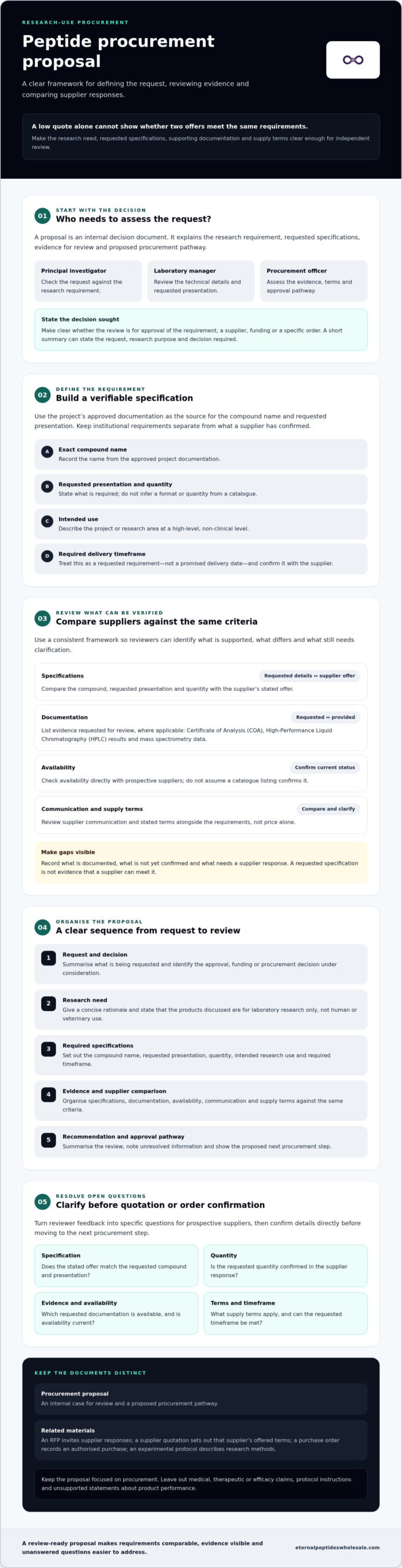
A peptide procurement proposal is an internal decision document. It explains the research requirement, the specifications being requested, the evidence reviewers need to assess and the proposed procurement pathway. Its purpose is to help an organisation determine whether a supply request is sufficiently defined and supported to move forward, not to serve as a supplier’s offer or an experimental guide.

Keep the document distinct from related procurement materials. A Request for Proposal (RFP) is generally used to invite supplier responses; a supplier quotation sets out that supplier’s offered terms. A purchase order records an authorised purchase, while an experimental protocol describes research methods. The proposal can inform these steps, but shouldn’t be used as a substitute for them.

Who reads the proposal and what must they decide?

Potential reviewers include the principal investigator, laboratory manager and procurement officer. Researchers need enough technical detail to check that the requested material aligns with the approved research requirement. Non-specialist reviewers need the rationale, evidence and approval pathway in clear language.

Be explicit about the decision sought. Is the review for approval of the requirement, a supplier, funding or a specific order? A short executive summary can state the request, its research purpose and the decision required, helping reviewers understand what action is expected before they examine supporting details.

What belongs in scope, and what does not?

Describe the application at a suitable, non-clinical level, then keep the rationale focused on procurement. State that the products discussed are for laboratory research only, not for human or veterinary use. This boundary should be clear in the proposal and in any supplier evaluation.

For a practical starting point, identify the information reviewers need to assess:

  • Research need: A concise explanation of why the material is being requested.
  • Decision required: The approval, funding or procurement step under consideration.
  • Evidence and pathway: The supporting supplier information and the proposed next step.

Leave out medical, therapeutic or efficacy claims, along with protocol instructions and unsupported statements about product performance. Those details don’t establish whether a supplier’s offer meets an organisation’s procurement requirements. Keeping the boundaries clear is central to how to write a peptide procurement proposal that researchers and procurement staff can review consistently, without confusing the request with claims or instructions outside its purpose.

Build the proposal around research needs and verifiable peptide specifications

Once the research requirement is approved, translate it into a concise specification that suppliers and internal reviewers can interpret consistently. Use the project’s approved documentation as the source for the compound name and requested presentation. Don’t infer a format, quantity or delivery date from a supplier’s catalogue or assume a supplier can meet a requested timeframe. Record these as requirements to be confirmed.

How to describe compound requirements precisely

For each requested item, record the exact compound name, requested presentation, quantity, intended laboratory research use and required delivery timeframe. Keep the research-use description high-level and non-clinical. For example, state the relevant project or research area without adding experimental steps or claims about expected outcomes.

Separate what the institution requires from what a supplier confirms it can provide. A timeframe in the proposal is a requested requirement, not a promised delivery date. Check product information and terms directly with prospective suppliers, and confirm applicable institutional procurement requirements before proceeding.

How to assess quality and documentation evidence

List the evidence requested for review, where applicable. This may include a Certificate of Analysis (COA), High-Performance Liquid Chromatography (HPLC) results and mass spectrometry data. These methods provide different analytical information: HPLC data can inform a purity assessment, while mass spectrometry can support identity assessment. Don’t treat one as a substitute for the other.

Record each item’s status so reviewers can distinguish evidence from supplier statements:

  • Received: Identify the document and the compound or batch it relates to.
  • Pending: Note what has been requested and when it will be reviewed.
  • Unverified: Flag claims that lack supporting documentation or confirmation.

Check that identifiers, such as the compound name and batch reference where supplied, align across the records. If information is missing or inconsistent, log the question rather than filling the gap with an assumption. This makes the evidence trail clearer and shows what remains unresolved before approval.

The US Research and Development (R&D) contracting framework offers context on structuring research procurement, but it isn’t Australian procurement guidance. Apply your organisation’s own review process and verify relevant Australian requirements. For a practical sourcing discussion, you can also review the research peptide wholesale range, intended for laboratory research only and subject to direct confirmation of current availability and documentation.

Compare peptide suppliers with a consistent procurement evaluation framework

A side-by-side comparison helps reviewers assess supplier responses against the same approved requirement, rather than relying on different claims or formats. Use one matrix for every supplier and ask the same questions. Include the response, its supporting evidence and any conditions or unanswered points beside each criterion. Missing information isn’t a pass; it’s an item to clarify before a decision.

Which criteria make supplier comparisons useful?

Focus on whether each supplier can address the requested specification and wholesale quantity, and whether the information is supported by relevant documentation. Evaluate the written response, not assumptions about a supplier’s capability or quality.

  • Specification fit: Does the supplier confirm the requested compound name and presentation?
  • Documentation: Are records available, identifiable and relevant to the material under consideration?
  • Availability: Has the supplier confirmed current availability and the requested quantity?
  • Communication: Are responses clear, complete and consistent with the questions asked?
  • Supply terms: What do the written terms state about fulfilment, shipping and how issues are handled?

Record the source and date of each response where practical. If a supplier hasn’t confirmed a point, mark it as pending rather than treating silence as agreement. This gives reviewers a clear view of what is known and what still needs verification.

How to present the comparison fairly

Distinguish evidence from claims. For example, label a point “document received”, “supplier statement” or “awaiting confirmation”, then note any condition attached to it. If a record doesn’t clearly relate to the requested material or batch, flag that gap for follow-up rather than assuming it applies.

Use the organisation’s approved evaluation method. If it assigns weight to criteria, describe how that weighting is applied so reviewers can understand the recommendation. If no formal scoring method is in place, don’t invent scores or present a subjective ranking as objective. A concise written explanation of trade-offs and unresolved questions can be more useful than an unexplained total.

For instance, one supplier might confirm the requested quantity but leave shipping terms unclear, while another provides terms but hasn’t supplied a relevant document. Record both conditions in the matrix. The comparison then supports a reasoned decision without implying that either supplier has passed a criterion that remains unverified.

This evidence-led approach is a practical part of how to write a peptide procurement proposal: it helps reviewers compare like with like and direct follow-up where it’s needed. Wholesale supply may be considered where it suits the organisation’s requirements, subject to institutional review and direct confirmation of documentation, availability and terms. Ensure any products under consideration are for laboratory research only, not human or veterinary use.

How to Write a Peptide Procurement Proposal: A Practical Guide

Write and review the peptide procurement proposal in a clear sequence

A consistent order makes the proposal easier to draft and review. Begin with the request, define its scope, set out the specifications, attach supplier evidence, compare responses, then present a recommendation and identify the approval required. This sequence helps reviewers trace the decision from the research need to the proposed procurement step.

What sections should the proposal contain?

Organise the document so readers can find the rationale and supporting information without searching through dense narrative. A practical structure is:

  • Purpose and executive summary: State why procurement is being considered and the specific decision sought.
  • Scope and requirements: Record the research-use context, requested specifications and any exclusions.
  • Supplier assessment: Present the comparison criteria, evidence and unresolved points.
  • Risks and assumptions: Identify dependencies, conditions and information that has not been verified.
  • Recommendation and approval: Explain the proposed next step and who needs to approve it.

Place supporting records in labelled appendices, then refer to them consistently in the proposal. Add a document register with each item’s source, date received, status and reviewer. This gives the team a practical way to locate evidence and see whether it has been checked. State assumptions and exclusions plainly rather than leaving them buried in paragraphs.

How to make the recommendation review-ready

Connect the recommendation to the criteria and evidence already presented. Avoid promotional language or unsupported claims. If the choice depends on a supplier confirming a document, availability or term, name that dependency and make clear that the point remains open.

Before circulation, summarise outstanding questions, approval dependencies and follow-up responsibilities. Assign each action to a role or named reviewer where appropriate, so requests don’t disappear between review and the next procurement step. A recommendation can be clear without suggesting every detail has been settled.

Use this final check before sending the proposal:

  • Does the executive summary identify the decision sought and reason for procurement?
  • Do specifications, supplier evidence and comparison criteria use consistent terminology?
  • Are evidence sources, dates, review status and open questions recorded?
  • Is research-only wording clear, with no human-use or veterinary-use implication?
  • Are assumptions, exclusions and required approvals explicit?

These steps make how to write a peptide procurement proposal a repeatable review process, not just a document-writing exercise. For an eligible laboratory procurement, you can review wholesale research peptide supply and confirm current availability, documentation and terms directly. Products are for research purposes only, not for human consumption or medical use.

Submit the proposal, resolve supplier questions and prepare the next procurement step

Once circulated, the proposal should produce a clear review outcome. Give reviewers a simple way to record approval, rejection or a request for additional evidence, with space for comments and any conditions. If the request isn’t approved, note the reason and whether the requirement needs revision or further review. If approval is conditional, record what must be resolved and who will follow it up.

Approval of an internal proposal doesn’t confirm that a supplier can fulfil the request. Treat it as authority to proceed to the next step in your organisation’s process, subject to any conditions. Keep the approved specification and decision record together so the enquiry that follows reflects what reviewers actually authorised.

What to confirm with a supplier before proceeding

Convert outstanding points into written questions. Ask the supplier to confirm current availability, the requested presentation and any applicable wholesale order requirements. Seek clarification on the documentation available for review, fulfilment arrangements, shipping and payment terms. Keep responses with the procurement record, and note any conditions or details that remain unconfirmed.

Don’t treat a proposal, catalogue entry or supplier statement as a guarantee of availability or acceptance. If the supplier’s response differs from the approved requirement, pause and return to the relevant internal reviewer before changing the scope. This keeps the procurement record aligned with the decision and prevents an informal adjustment from being mistaken for approval.

How to move from an approved proposal to an enquiry

Prepare the approved compound name, requested presentation, quantity and evidence requirements before contacting a supplier. Include the relevant timeframe as a request for confirmation, not as an assumed delivery commitment. Ask for a written response that addresses each point, and retain it for review before requesting an order confirmation.

Keep intended use explicit throughout the handover: products discussed are for laboratory research only, not for human consumption, medical use or veterinary use. This boundary should remain clear in the proposal, supplier correspondence and internal records.

Eternal Peptides Wholesale is an Australian-based wholesale supplier of research-grade peptides for laboratory use. Wholesale supply may be considered where it fits the organisation’s requirements and is subject to institutional review. Confirm current product availability, relevant documentation and supply terms directly before proceeding.

Review wholesale research peptide supply options

A disciplined handover completes the process of how to write a peptide procurement proposal: the approved need becomes a precise enquiry, open questions stay visible, and the next decision can be based on written information rather than assumptions.

Put your procurement decision on a clear footing

A strong proposal gives reviewers a consistent basis for deciding what is needed, what supplier evidence supports the request and what remains to be confirmed. Keep specifications tied to the approved research requirement, compare supplier responses using the same criteria, and document approval conditions and follow-up questions. These steps make how to write a peptide procurement proposal a practical process that supports clear decisions rather than assumptions.

For eligible laboratory procurement, Eternal Peptides Wholesale is an Australian-based national wholesale supplier of research-grade peptides for laboratory use. Assess any potential supply against your organisation’s requirements, and confirm current availability, documentation and terms directly. Products are for research purposes only, not for human consumption or medical use.

Review wholesale research peptide supply options as you prepare your next procurement step. With a well-documented request and a clear approval pathway, your team can move forward with confidence.

Frequently Asked Questions

What should a peptide procurement proposal include?

A peptide procurement proposal should set out the research need, requested compound and presentation, quantity, intended laboratory use, supplier evidence and approval sought. Include a consistent comparison of supplier responses, relevant supply terms, assumptions and unresolved questions. A concise executive summary helps reviewers see the decision required. Keep the proposal separate from a supplier quotation, purchase order and experimental protocol, as each serves a different purpose in the procurement process.

How do you compare peptide suppliers for laboratory research?

Compare suppliers against the same criteria and ask each the same questions. Assess whether they can confirm the requested specification and wholesale quantity, what relevant documentation they provide, and what they state about availability, fulfilment, shipping and issue resolution. Record whether each point is supported by evidence, based on a supplier statement or still awaiting confirmation. Treat missing information as a gap to clarify, not as evidence that a requirement has been met.

What documentation should a research peptide supplier provide?

Ask what documentation is available for the specific material or batch under consideration. Where applicable, review a Certificate of Analysis (COA), High-Performance Liquid Chromatography (HPLC) results and mass spectrometry data. HPLC data can inform a purity assessment, while mass spectrometry can support identity assessment; they aren’t interchangeable. Check that the compound and batch identifiers align across records, and mark documents as received, pending or unverified in the proposal.

Can a procurement proposal include more than one peptide supplier?

Yes. Including multiple suppliers can help reviewers compare responses against one approved requirement, provided each is assessed using the same criteria and evidence standards. Set out each supplier’s specification fit, documentation, availability and written terms in a side-by-side matrix. Note differences, missing information and conditions clearly. Follow your organisation’s procurement process, and avoid implying that a supplier has been selected or approved until the relevant decision-makers have recorded their decision.

How do you write a supplier recommendation for a research purchase?

Base the recommendation on the stated requirements and the evidence recorded in the proposal. Explain why the proposed option appears to fit, identify any gaps or conditions, and list follow-up questions and approval dependencies. Avoid unsupported quality claims or promotional language. A useful recommendation distinguishes confirmed information from supplier statements and matters awaiting verification, so reviewers can see both the rationale and what must be resolved before the next procurement step.

What is the difference between a procurement proposal and a purchase order?

A procurement proposal supports an internal decision by explaining the research requirement, assessing supplier information and stating the approval sought. A purchase order is a separate procurement document used to record an authorised purchase under an organisation’s process. The proposal may inform whether to proceed and with whom, but it doesn’t replace the supplier’s quotation, internal approval steps or purchase order. Confirm the required sequence with your institution’s procurement team.

Can research-grade peptides be proposed for human or veterinary use?

No. Research-grade peptides discussed in this procurement context are for laboratory research only, not for human consumption, medical use or veterinary use. State that limitation clearly in the proposal and related supplier correspondence. Keep the rationale focused on the laboratory research requirement, and don’t include therapeutic, clinical or efficacy claims. If your organisation has questions about applicable Australian requirements, check them with the appropriate institutional or regulatory contact rather than making assumptions.

Add an evidence appendix to a peptide procurement proposal

Give each acceptance criterion its own evidence field. A request for identity data, for example, should name the method or document that will answer it; a price quotation answers a commercial question. Keep unresolved items visible instead of allowing a favourable overall score to conceal a missing essential specification.

A useful appendix records the exact material, source, lot, analytical method, document version and reviewer decision. NIH resource-authentication guidance and OECD data-integrity guidance offer useful technical principles for traceability; neither document automatically imposes a purchasing rule on an Australian laboratory. [1][2]

For the next step, review the Australian research peptide buying guide and the batch-verification checklist. Contact Eternal Peptides Wholesale with the exact product and any unanswered documentation questions.

Related from Eternal Peptides Wholesale

Eternal Peptides Wholesale publishes batch-specific Janoshik Analytical reports in its certificate of analysis library, so the documentation for a listed batch can be read alongside the evidence discussed in this article.

References and bibliography

  1. National Institutes of Health. 2017. Reminder: Authentication of Key Biological and/or Chemical Resources (NOT-OD-17-068). Accessed 27 September 2026.
  2. Organisation for Economic Co-operation and Development. 2021. GLP Data Integrity. Accessed 27 September 2026.