

In large-scale research, the value of tissue repair compounds is defined by batch-to-batch consistency, not just volume. For Australian laboratories, the primary bottleneck in progress is frequently the reliability of wholesale tissue repair compounds rather than the hypothesis itself. Procurement professionals understand that sourcing bulk BPC-157 and TB-500 often involves navigating a landscape of inconsistent batches and opaque documentation. You need a supply chain that prioritises clinical reliability over transactional speed.
This guide provides a professional analysis of the Australian wholesale landscape, specifically focusing on establishing stable procurement for BPC-157 5mg and TB-500 5mg. We’ll examine how to verify HPLC/MS documentation, mitigate logistical delays, and ensure your research-grade materials meet the rigorous standards required for valid, large-scale data collection. By the end, you’ll have a clear framework for securing high-purity biochemicals that support long-term project stability without the friction of retail-level supply issues.
Key Takeaways
- Understand the operational shift required when moving from retail sourcing to strategic wholesale procurement for large-scale laboratory studies.
- Identify the technical specifications and solubility requirements for wholesale tissue repair compounds to ensure precise research planning and reconstitution.
- Learn how to safeguard the integrity of long-term data by minimising batch-to-batch variation through rigorous documentation and purity verification.
- Optimise laboratory inventory management by addressing the specific logistical requirements and lead times of the Australian biotech environment.
- Discover the advantages of establishing a professional B2B partnership to secure a consistent, high-purity supply of research-grade biochemicals.
Defining Wholesale Tissue Repair Compounds in a Research Context
Tissue repair compounds are essential biochemicals in modern regenerative medicine research. They’re primarily utilised to investigate the underlying mechanisms of tissue healing, cellular signalling, and inflammatory modulation. The Australian research sector is currently seeing a surge in regenerative medicine projects, with the legal peptide therapeutics market projected to reach USD 3,711.1 million by 2033. This growth highlights the importance of reliable supply chains for researchers investigating cellular recovery. While retail vendors focus on small-scale transactions, laboratory procurement requires a dedicated logistical backbone that can provide high-volume quantities without compromising on purity.
For scientific validity, volume and purity must be perfectly balanced. A study’s integrity depends on the assumption that every vial used is identical to the last. This is why professional labs avoid the retail market, where batch documentation is often insufficient. Securing wholesale tissue repair compounds through dedicated B2B channels ensures that researchers have access to the documentation required for peer-reviewed publication and repeatable results.
The Role of BPC-157 and TB-500 in Scientific Study
Researchers frequently focus on BPC-157 and TB-500 due to their roles in gastric and musculoskeletal repair models. These compounds are often studied in tandem because researchers look for synergistic effects that might exceed the results of isolated application. BPC-157 is a pentadecapeptide derived from human gastric juice for research. Scientific interest in BPC-157 (Body Protection Compound 157) centres on its potential to influence angiogenic pathways and collagen synthesis within controlled laboratory settings. Its companion, TB-500, is a synthetic version of Thymosin Beta-4, often investigated for its potential to modulate actin and promote cellular migration in damaged tissues.
Wholesale vs. Retail: The Necessity of Scale
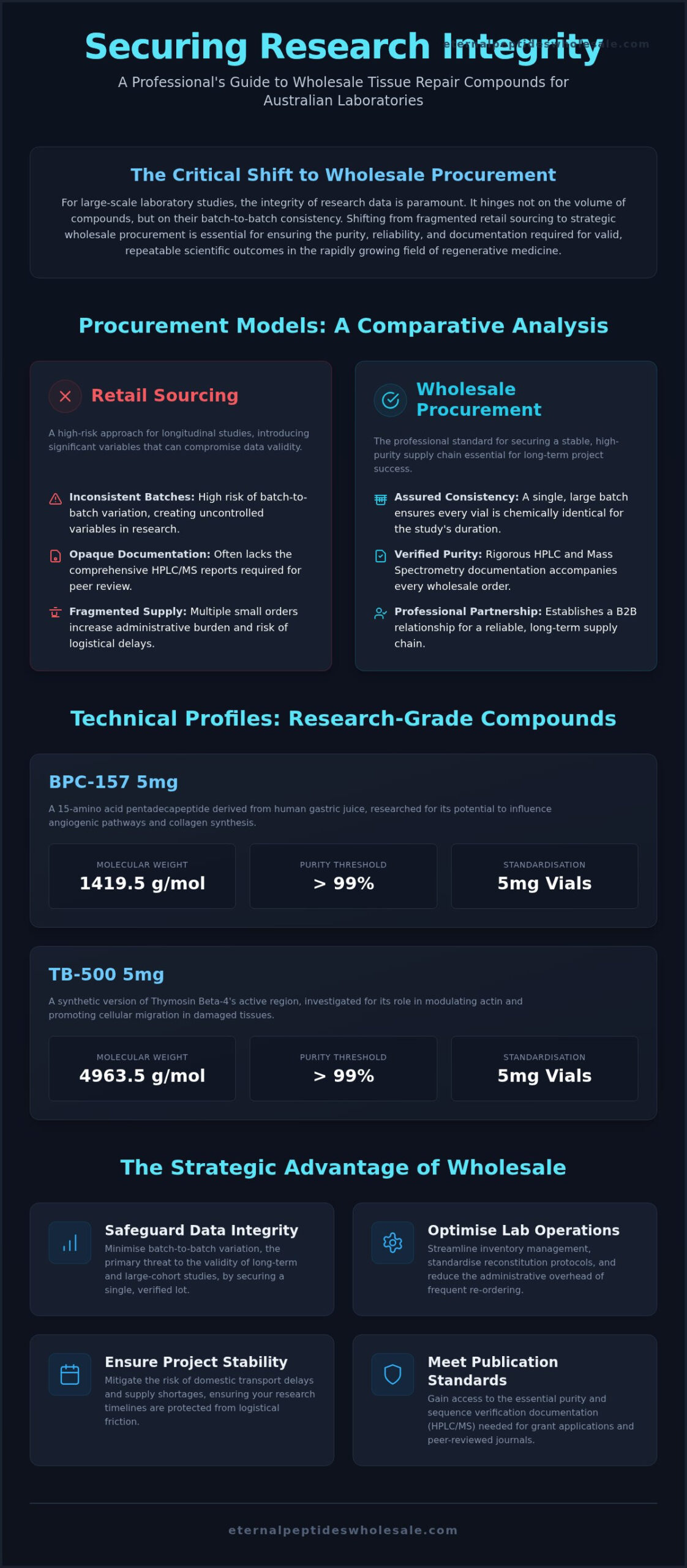
Sourcing single vials for longitudinal or large-cohort studies creates significant variables. Every new batch from a retail source introduces a potential point of failure in data consistency. Strategic procurement of wholesale tissue repair compounds allows laboratories to secure a single, massive batch of 5mg vials. This ensures every subject in a study receives a chemically identical compound. Maintaining a bulk inventory also offers logistical advantages. It reduces the frequency of domestic transport delays, which is critical when working with time-sensitive research protocols.
Standardised 5mg vial sizes allow for uniform reconstitution protocols across the entire laboratory team. This level of standardisation is difficult to achieve when relying on fragmented retail supplies. By centralising procurement, labs can focus on their scientific objectives rather than the administrative burden of managing multiple small-scale orders. This approach provides the economic stability and logistical transparency necessary for high-volume biotech operations.
Technical Profiles: BPC-157 and TB-500 Specifications
Precision in biochemical research requires exact molecular specifications. Sourcing wholesale tissue repair compounds demands a focus on molecular weight and sequence integrity. BPC-157 (1419.5 g/mol) and TB-500 (4963.5 g/mol) have distinct profiles that dictate their roles in regenerative models. These technical parameters influence everything from reconstitution volumes to the final concentration used in laboratory assays.
BPC-157 5mg: Research Grade Standards
BPC-157 consists of 15 amino acids. Its sequence, Gly-Glu-Pro-Pro-Pro-Gly-Lys-Pro-Ala-Asp-Asp-Ala-Gly-Leu-Val, must be verified via HPLC. Purity thresholds for wholesale lots should exceed 99% to ensure experimental repeatability. This compound is notably prohibited by the World Anti-Doping Agency for athletic use, which underscores the necessity of strictly research-grade procurement. Verification of these standards is detailed in our guide on Quality Assurance in Research Peptides.
TB-500 5mg: Synthetic Thymosin Beta-4 Analogues
TB-500 is a synthetic peptide fragment representing the active region of the naturally occurring protein Thymosin Beta-4. In research, it’s primarily studied for its role in actin-binding and cellular migration. Unlike the full-length protein, the 5mg TB-500 wholesale format offers a more targeted approach for investigating tissue organisation. High-volume procurement requires rigorous screening for truncated sequences or residual solvents from the synthesis process. Laboratories managing large-scale inventories should review the technical standards for bulk TB-500 for laboratories to ensure every synthesis run meets the minimum purity thresholds required for valid longitudinal data.
Solubility is a critical factor in laboratory preparation. Both compounds are typically reconstituted using bacteriostatic water or sterile saline. Procuring wholesale tissue repair compounds requires a robust understanding of these stability profiles. Lyophilised powders remain stable at room temperature for short durations, but long-term storage in Australian laboratories should be maintained at -20°C. Once reconstituted, vials must be refrigerated at 2-8°C and used within a specific window to prevent degradation. For labs managing large-scale projects, maintaining these cold-chain standards across bulk inventory is non-negotiable.
Researchers seeking to procure high-purity biochemicals can rely on our systematic approach to technical verification and logistical reliability.
Ensuring Batch Consistency in High-Volume Peptide Sourcing
For large-scale biotech projects, the integrity of the data relies on the uniformity of the biochemicals used. When procuring wholesale tissue repair compounds, the greatest risk isn’t just the price; it’s the variation between batches. Inconsistent purity levels can lead to skewed results in long-term studies, forcing researchers to discard months of work. Standardising procurement ensures that every vial in a bulk order, whether it’s 50 or 500 units, shares an identical chemical profile. In an environment where the TGA has made unapproved peptides a compliance priority for 2026, maintaining transparent, high-level documentation is a necessity for any legitimate research facility.
The Importance of HPLC and MS Reports
High-Performance Liquid Chromatography (HPLC) is the industry standard for verifying the purity of peptides like BPC-157 and TB-500. It separates the compound from any synthesis by-products or residual reagents. Complementary to this, Mass Spectrometry (MS) confirms the molecular weight, ensuring the peptide sequence is correct. For wholesale orders, these reports shouldn’t be generic; they must be batch-specific. Researchers should demand these documents to confirm that the wholesale tissue repair compounds they receive meet the exact specifications required for their protocols. This level of transparency is what separates a professional B2B partner from a standard retail vendor.
Standardising Purity Across Wholesale Batches
In the Australian research sector, “Research Grade” typically denotes a purity threshold of 98% or higher. However, even within this range, slight variances between synthesis runs can occur. A professional wholesaler acts as a steadfast logistical backbone by screening these runs before they reach the laboratory. If a batch shows a variance that exceeds the acceptable threshold for a specific longitudinal study, it must be flagged or rejected. Maintaining this level of operational excellence allows labs to focus on their data rather than worrying about the chemical reliability of their supply chain. It’s about creating a narrative of competence through systematic processes and rigorous standards.
By centralising bulk orders through a single, reliable source, labs can mitigate the risks associated with fragmented supply chains. This approach ensures that the “no-nonsense” professional partnership valued by procurement professionals is maintained through every stage of the project. Reliable batch-to-batch consistency isn’t just a logistical advantage; it’s the foundation of valid scientific outcomes.
Strategic Procurement: Optimising the Laboratory Supply Chain
Effective procurement in the 2026 Australian research landscape involves more than just selecting a supplier; it requires a comprehensive strategy for supply chain management. Laboratories must navigate a market where regulatory enforcement is a priority, making the reliability of wholesale tissue repair compounds a central concern for operational continuity. Reducing procurement lag is achievable only through established national distribution networks that bypass the delays common in international retail shipping. For a deeper look at current market dynamics, see our Sourcing Research Peptides Wholesale in Australia guide.
Managing Large-Scale Peptide Inventories
Successful longitudinal studies depend on the potency of the biochemicals from the first day to the last. Bulk lyophilised peptides require specific environmental controls to prevent degradation over time. Organising stock rotation is vital to maintain potency across multi-year trials. When receiving large wholesale shipments, laboratories should follow a systematic verification protocol to ensure every unit meets the required standards.
- Maintain long-term storage at -20°C in a dedicated laboratory freezer with backup power.
- Utilise a First-In, First-Out (FIFO) rotation to ensure stock freshness across different synthesis runs.
- Conduct a visual inspection of vials for vacuum seal integrity and lyophilisation quality upon arrival.
- Cross-reference batch numbers with the provided HPLC/MS documentation immediately to confirm consistency.
B2B Logistics and Shipping within Australia
Biochemical sensitivity makes standard courier services unsuitable for high-value research materials. Temperature-controlled shipping is mandatory for maintaining the structural integrity of wholesale tissue repair compounds during transit, especially during the summer months in regional Australia. National distribution networks that specialise in cold-chain logistics help laboratories overcome common hurdles like regional transport delays and heat exposure at sorting centres. These logistical requirements often mirror those found in Wholesale GLP-1 Research Chemicals, where stability is equally paramount for valid research data. Procurement professionals expanding their research portfolios should also consider how ipamorelin wholesale Australia sourcing strategies align with the same domestic supply chain principles that protect longitudinal study timelines.
Establishing a steadfast logistical backbone allows your team to focus on scientific discovery rather than administrative friction. To secure a reliable supply for your next large-scale biotech project, you can view our wholesale procurement options and speak with a specialist about your specific research requirements.
Eternal Peptides Wholesale: Your Professional Research Partner
Eternal Peptides Wholesale functions as more than a supplier; we serve as a steadfast logistical backbone for the Australian biotech sector. Our operations are built on a foundation of clinical reliability and transparency, specifically designed to meet the high-volume needs of professional laboratories. Unlike generic marketplaces that offer a broad range of unrelated goods, we specialise exclusively in high-purity biochemicals. This focus ensures that our procurement protocols, documentation standards, and distribution networks are all optimised for the scientific community. By providing a consistent supply of wholesale tissue repair compounds, we allow researchers to maintain the momentum of their projects without the disruptions caused by fragmented supply chains.
A Steadfast Logistical Backbone for Australian Labs
Our “no-nonsense” approach to business prioritises precision and operational excellence. Procurement professionals value a partner who understands that research success depends on more than just a product; it requires a systematic process. Eternal Peptides Wholesale provides BPC-157 5mg and TB-500 5mg at scale, ensuring every shipment is backed by batch-specific documentation. We do not offer retail sales. Our focus remains entirely on B2B logistical excellence. This clinical, business-oriented partnership is designed to reduce administrative friction and provide the long-term stability needed for multi-year research programmes. We strictly adhere to research-only standards, ensuring that all compounds are provided for laboratory use and are not for human consumption or medical application.
Securing Your Supply Chain for 2026
As the TGA intensifies its focus on peptide compliance in 2026, the value of a transparent, Australian-based partner becomes even more significant. Establishing a wholesale account for your institution provides a direct channel to a reliable supply of research-grade materials. Our process for batch verification is rigorous, ensuring that every synthesis run meets our internal purity thresholds before it enters our national distribution network. We focus on building long-term professional relationships that evolve with your laboratory’s needs. This steady cadence of supply mirrors the reliability required for a well-oiled research facility. Enquire about wholesale tissue repair compounds today to discuss your procurement requirements and secure your research timeline for the coming year.
Securing Your Research Infrastructure for 2026
Establishing a stable supply of wholesale tissue repair compounds is a foundational step for any high-volume laboratory project. By prioritising batch-to-batch consistency and rigorous HPLC/MS verification, researchers can eliminate variables that otherwise compromise long-term data integrity. A professional B2B partnership ensures that your procurement process remains transparent and predictable, allowing your team to focus on scientific outcomes rather than logistical hurdles. This methodical approach to supply chain management mirrors the precision required in your own experimental protocols, creating a narrative of operational excellence throughout the study.
Reliable national distribution across Australia provides the security needed to maintain project timelines without the risks associated with fragmented retail sourcing. Our commitment to providing strictly research-grade biochemicals means your facility receives materials that meet the highest technical standards for every synthesis run. Using a dependable logistical backbone is essential for navigating the complexities of the modern biotech landscape while ensuring your research remains on schedule and within budget.
Contact Eternal Peptides Wholesale for bulk research compound enquiries to discuss your specific laboratory requirements. We look forward to supporting the success of your next large-scale biotech initiative and helping you achieve valid research data.
Frequently Asked Questions
Are these tissue repair compounds suitable for human consumption?
No, these compounds are strictly for laboratory research purposes only and are not for human consumption or medical use. Every order of our wholesale tissue repair compounds is supplied under the condition that it’s used within a controlled scientific environment. We don’t provide medical consultations or advice on therapeutic applications. Researchers must ensure their protocols comply with institutional biosafety and ethics requirements while handling these biochemicals.
What is the standard purity of your wholesale BPC-157 and TB-500?
We maintain a “research grade” standard, which requires a minimum purity threshold of 98% or higher for all batches. This level of purity is essential for ensuring that laboratory data remains valid and repeatable across large-scale studies. Our quality control processes screen every synthesis run to ensure that residual solvents and synthesis by-products are kept within acceptable limits for peer-reviewed scientific investigation.
Do you provide HPLC and MS reports for bulk peptide orders?
Yes, we provide comprehensive High-Performance Liquid Chromatography (HPLC) and Mass Spectrometry (MS) reports for every wholesale order. These documents verify the peptide’s purity and confirm its molecular weight against the expected sequence. Providing batch-specific documentation is a core part of our commitment to logistical transparency and clinical reliability. This allows procurement officers to maintain a clear audit trail for their laboratory’s inventory.
Can I purchase single vials for individual research use?
No, we do not engage in retail single-vial sales. Our business model is exclusively focused on B2B distribution and bulk supply for laboratories, biotech companies, and research institutions. This wholesale focus allows us to maintain the steadfast logistical backbone necessary for large-scale operations. By specialising in high-volume procurement, we ensure that our clients receive consistent, high-purity batches that support long-term scientific projects.
How are wholesale peptide orders shipped within Australia?
All orders are shipped via our national distribution network using temperature-controlled logistics to maintain compound integrity. We understand the sensitivity of biochemicals like BPC-157 and TB-500, especially during transit across various Australian climates. Our shipping protocols are designed to overcome regional hurdles and prevent heat exposure. This ensures that lyophilised peptides arrive at your facility in optimal condition for laboratory storage and eventual reconstitution.
What is the shelf life of bulk lyophilised peptides in laboratory storage?
Bulk lyophilised peptides typically remain stable for up to 24 months when stored in a dedicated laboratory freezer at -20°C. Once reconstituted, the compounds are much more sensitive and should be kept at 2-8°C and used within a specific window, usually 7 to 14 days, depending on the buffer used. Maintaining these strict storage conditions is critical for preserving the potency of your wholesale tissue repair compounds throughout multi-year trials.
Do you offer wholesale discounts for university research projects?
We specialise in providing tailored supply solutions for university research projects and large-scale biotech institutions. While we don’t offer retail-style discounts, our wholesale pricing structures are designed to accommodate the budgetary and logistical needs of high-volume laboratory environments. We focus on building long-term professional relationships with procurement departments to ensure a reliable and cost-effective supply chain for their ongoing scientific investigations.
Are these compounds regulated for research use in Australia?
In Australia, BPC-157 and TB-500 are unapproved therapeutic goods and are not included in the ARTG for human use. However, they’re available for legitimate laboratory research purposes within highly regulated scientific channels. It’s the responsibility of the purchasing institution to ensure they have the legal authority and necessary permits to possess and use these substances for their specific research protocols in accordance with state and federal laws.
Related from Eternal Peptides Wholesale
Eternal Peptides Wholesale publishes batch-specific Janoshik Analytical reports in its certificate of analysis library, so the documentation for a listed batch can be read alongside the evidence discussed in this article.
- Peptide COA library: batch-specific Janoshik Analytical reports with their verification details
- Our peptide testing standards: how independent Janoshik testing is used and reported
- BPC-157 and TB-500 research catalogue
- Evidence review: Peptides for muscle gain: a structured evidence review
- Evidence review: Peptides wholesale: supplier qualification and quality standards
Related reading: Wholesale BPC-157 Australia: Research Lab Sourcing Guide; Anti-inflammatory Peptide Compounds for Study: Evidence, Mechanisms and Research Considerations; TGA Research Peptide Guidelines: 2026 Compliance Guide