

Posted on

Melanotan II receptor binding assay supply: A 2026 buyer’s guide

Melanotan II receptor binding assay supply: A 2026 buyer’s guide

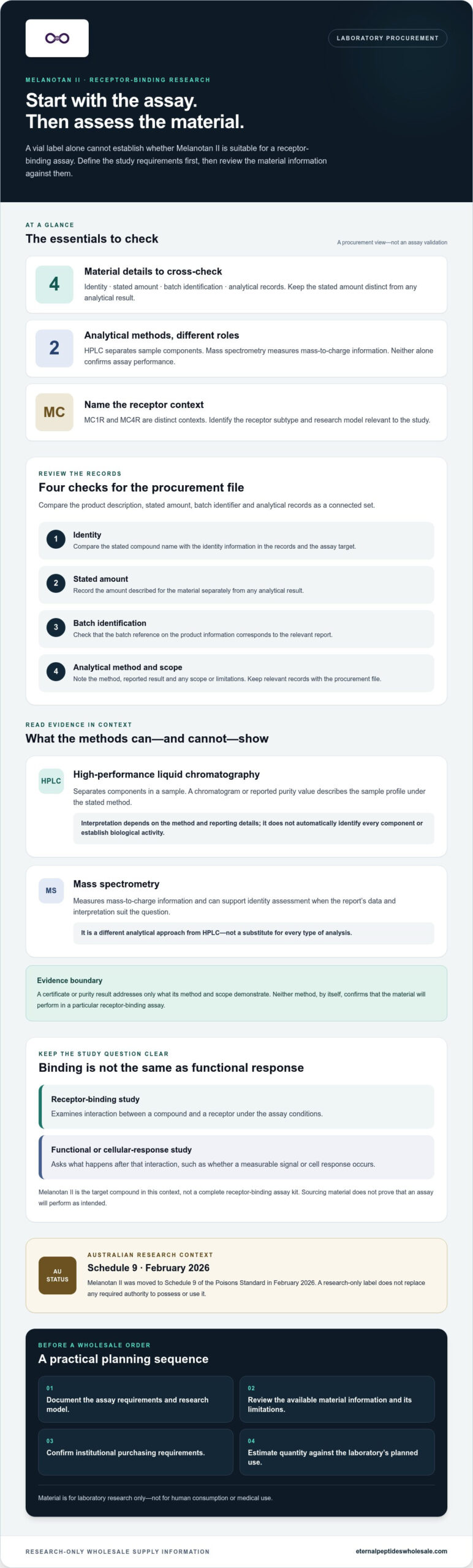
A vial label can’t establish whether Melanotan II is suitable for a receptor-binding assay. For Australian laboratories, Melanotan II receptor binding assay supply decisions should start with the study requirements, relevant analytical information and lawful research context, not the product name alone.

Before committing to a wholesale order, compare the information available about the material with the laboratory’s requirements. A certificate or purity result addresses only what its method and scope demonstrate. It doesn’t, by itself, validate a product for a particular assay or establish permission to possess or use it. In Australia, Melanotan II was moved to Schedule 9 of the Poisons Standard in February 2026. A research-only label doesn’t replace any required authority.

This guide explains how to define procurement criteria for receptor-binding research, assess analytical information without overstating its evidential value, and plan quantities and purchasing needs for laboratory use. It also outlines Eternal Peptides Wholesale’s research-only wholesale supply of Melanotan II 10mg for professional B2B purchasing.

Key Takeaways

  • Define the receptor-binding assay’s requirements before assessing Melanotan II. The compound is not a complete assay kit.
  • Use a supply checklist to compare identity, stated amount, batch identification and analytical records.
  • Interpret HPLC and mass spectrometry as distinct methods, and consider what each record can and cannot establish.
  • Compare supply routes by assay fit, evidence access, traceability and suitability for your laboratory’s purchasing scale.
  • Plan a wholesale order by documenting assay needs, reviewing available material information, confirming institutional purchasing requirements and estimating quantity. Eternal Peptides Wholesale offers Melanotan II 10mg for research purposes.

Melanotan II receptor-binding assay supply: define the research need first

Procurement should begin with the assay, not the vial. For Melanotan II receptor binding assay supply, the research team should identify what its method requires from the test material and what information it needs to retain. This gives the team a clearer basis for comparing supply options than selecting a product by name alone.

Melanotan II is the target compound in this context, not a complete receptor-binding assay kit. The assay depends on the research method and its components. Binding studies examine interaction between a compound and a receptor under the assay conditions. Functional or cellular-response studies ask what happens after that interaction, such as whether a measurable signal or cell response occurs. These are related but distinct research questions. Sourcing material does not prove that an assay will perform as intended.

For general background on the compound, the Melanotan II Wikipedia article provides an overview of its history and context. It is not an assay protocol or evidence that a particular material is suitable for a laboratory method.

What does a receptor-binding assay need from its test material?

The research question determines which material attributes matter. A team may need to record the compound’s identity, stated amount and batch identifier, then assess relevant analytical information against its method requirements. Keep those material details separate from assay performance. A label or analytical result does not establish that a compound has been validated in a specific assay.

  • Identity: Record how the material is identified and compare that information with the assay’s target.
  • Stated amount: Note the quantity described for the material and how the laboratory will account for it in its own records.
  • Batch information: Capture identifiers that connect the material to its associated documentation.
  • Method fit: Document any requirements the assay protocol places on the test material. Don’t assume a catalogue description answers them.

A catalogue name is a starting point for procurement, not a suitability determination. The laboratory remains responsible for assessing material information within its study design and quality processes.

Which melanocortin receptor context should buyers identify?

Specify the receptor subtype and research model relevant to the study. MC1R and MC4R are distinct melanocortin receptor contexts. Naming one without clarifying the model can leave procurement records ambiguous. Identify the receptor construct or model described by the assay, then align purchasing documentation with that context. This is research planning, not guidance about tanning, medical outcomes or human use.

Supplied material is for laboratory research only, not human consumption or medical use. Keeping the receptor-binding question, experimental model and any downstream functional work distinct gives researchers and procurement teams a consistent basis for evaluating supply.

Assess Melanotan II documentation before matching it to an assay

Once assay requirements are defined, review material records as a connected set rather than treating a single certificate or percentage as a complete assessment. When comparing Melanotan II records, the practical questions are whether the records identify the material and batch clearly, and whether their scope is relevant to the laboratory’s purchasing and research records.

How should buyers interpret analytical records?

Start with a cross-check. Compare the product description, stated amount, batch identifier and analytical records, noting any differences or missing links. A report is more useful when its identifiers correspond clearly to the product and batch being considered. Keep relevant records with the procurement file so the team can trace which information informed its decision.

  • Identity: Compare the stated compound name with the identity information in the records.
  • Stated amount: Record the amount declared for the material, separately from any analytical result.
  • Batch identification: Match the batch reference on the product information to the relevant report.
  • Analytical method: Note the method used, the result reported and the scope or limitations described.

High-performance liquid chromatography (HPLC) separates components in a sample. A chromatogram or reported purity value can describe the sample’s profile under the stated method, but interpretation depends on the method and reporting details. It doesn’t automatically identify every component or establish biological activity.

Mass spectrometry measures mass-to-charge information and can support identity assessment when the report’s data and interpretation suit the question. It is a different analytical approach from HPLC, not a substitute for every type of analysis. Neither method, by itself, confirms that the material will perform in a particular receptor-binding assay.

For a broader procurement framework, the research peptide quality assurance guide can help place document review within a consistent purchasing process.

Which claims need stronger evidence?

Separate supplier descriptions from conclusions supported by experimental evidence. A supplier-provided purity statement describes a reported analytical result. On its own, it doesn’t demonstrate receptor-binding activity, validate an assay or show that the material is suitable for a specific research model. These are distinct claims and require evidence that directly addresses them.

Analytical purity alone does not prove receptor-binding activity or performance in a particular assay.

When reviewing a claim, ask what was measured, by which method, on which batch and under what stated conditions. Distinguish those documented facts from inferences the study team may need to test independently within its research framework. This helps prevent a precise-looking figure from carrying more weight than its supporting record warrants.

For Australian laboratories planning a wholesale research order, Eternal Peptides Wholesale supplies Melanotan II 10mg for research purposes. The Australian wholesale research supply pathway is part of a procurement process grounded in clear assay requirements and appropriately interpreted documentation.

Compare supply options using assay fit, evidence and procurement scale

Compare purchasing routes against the same research criteria rather than relying on broad quality labels. A catalogue may help identify a compound and stated vial amount, while batch-linked records can support traceability. Neither catalogue wording nor a purchasing route alone establishes suitability for a particular assay. Keep the comparison tied to the documented study plan, purchasing policy and required evidence.

How does a research buyer compare catalogue information?

Start by matching the compound name and stated amount to the study plan. Then assess whether batch identifiers connect the product details to supporting records. Catalogue descriptions are useful for an initial comparison, but they are supplier-provided information, not independent validation of assay fit.

Assay fit
Compare the described material and amount with the study’s documented requirements. A product listing cannot establish performance in the laboratory’s method.

Identity evidence
Compare the stated compound name with identity information in associated records. Note the source and scope of each piece of evidence.

Batch traceability
Look for identifiers linking product details to the corresponding batch documentation. Record any mismatch or missing connection for procurement review.

Order scale
Consider whether the purchasing route suits the approved study plan, institutional process and planned quantity. Wholesale procurement is distinct from retail single-vial purchasing.

This comparison focuses on documentation and procurement suitability, not on ranking routes as inherently better or worse. For example, clear links between batch details and records can make document review more straightforward. The appropriate order scale still depends on the programme’s approved requirements.

The Melanotan II wholesale specifications guide is relevant when reviewing product information for research procurement. Treat catalogue details as one part of the assessment, and keep conclusions within the scope of the records provided.

When does wholesale procurement fit a research programme?

Wholesale purchasing can suit a laboratory programme when its planned quantity, purchasing policy and research schedule align. Before setting an order scale, compare the approved study design with the laboratory’s capacity to manage the material and the institution’s procurement requirements. Avoid ordering based on an assumed assay outcome or a quantity chosen without reference to the study plan.

Eternal Peptides Wholesale is an Australian wholesale supplier of research-grade peptides, including Melanotan II 10mg for research purposes only. This is a laboratory research supply pathway, not retail single-vial purchasing or a clinical-use option. The Australian wholesale research supply is relevant to procurement teams assessing the offer against their research requirements.
Melanotan II receptor binding assay supply: A 2026 buyer’s guide

Plan an Australian wholesale order for laboratory research

A clear order workflow helps researchers, procurement staff and laboratory administrators work from the same requirements. Keep study design decisions separate from commercial decisions, and document the basis for each before approving an order.

  1. Define the assay need. Record the research question, receptor context, study design and material attributes required by the laboratory’s method. Establish these requirements before comparing order quantities or purchasing routes.
  2. Review the product and batch documentation. Record the stated compound name, amount and relevant batch identifier, then link these details to available supporting records. Keep this information in the laboratory’s purchasing and research documentation, distinguishing supplier descriptions from conclusions established by the study.
  3. Confirm institutional purchasing requirements. Follow the organisation’s processes for supplier records, approvals and purchase documentation. Where Australian regulatory or import questions apply, verify current requirements directly through authoritative Australian sources, such as the relevant government agency. Don’t rely on an unverified summary or assume a research-use description resolves regulatory questions.
  4. Plan the quantity. Align the requested amount with the approved research plan, purchasing policy and the laboratory’s capacity to manage the order. Avoid choosing a quantity based on assumptions about experimental performance or unverified storage specifications.

What should procurement teams settle before ordering?

Agree on one written specification that researchers and purchasing staff can use consistently. It should identify the research purpose, requested material, amount, batch-recording needs and institutional approval pathway. This gives the team a shared reference for preparing purchasing records and receiving documentation, without adding unsupported assumptions about shipping timelines or handling conditions.

Keep regulatory and import statements out of order notes unless they have been checked against current, authoritative Australian guidance and are relevant to the circumstances. Rules can be technical and may depend on the activity and context. This guide doesn’t establish an organisation’s legal authority or replace formal institutional review. Check official sources rather than inferring obligations from catalogue wording.

How can teams reduce avoidable sourcing friction?

Use the same written specification across the research plan, purchasing request and laboratory records. That helps prevent inconsistencies, such as a purchasing request naming a different amount from the study plan or a batch identifier being omitted from the receiving record. Keep assay design choices with the research team and commercial ordering decisions within the relevant procurement process.

Checklist: define the assay need, review product and batch records, confirm institutional purchasing requirements, then align quantity with the approved plan before order approval.

The Australian wholesale research peptide procurement guide provides additional context for structuring a purchasing workflow. The Melanotan II 10mg wholesale supply pathway from Eternal Peptides Wholesale is for laboratory research customers nationally.

Source Melanotan II 10mg wholesale for research through Eternal Peptides Wholesale

Once assay requirements, documentation criteria and purchasing approvals are aligned, assess the supply decision against a defined laboratory need. Eternal Peptides Wholesale is an Australian wholesale supplier of research-grade peptides, including Melanotan II 10mg supplied for research purposes. The offer is for research use only, not for human consumption or medical use.

This distinction matters for procurement records. Wholesale supply is intended for professional purchasing, not retail single-vial sales. Eternal Peptides Wholesale does not sell retail single-vial products or provide medical consultations. Its role here is research supply, not advice on treatment, tanning or other personal use.

What can buyers expect from the confirmed supply offer?

The wholesale offer is Melanotan II 10mg for research purposes. That product description does not establish assay validation, analytical results or performance outcomes. Laboratories should assess the product information available against their study documentation and institutional purchasing process, keeping supplier details distinct from conclusions established by their own research.

That distinction supports a professional B2B decision. The appropriate basis for an order is a documented laboratory requirement and an approved quantity, not assumptions about biological effect or suitability for a particular method. Evaluation of research material remains within the laboratory’s own scientific and institutional framework.

What is the next step for a laboratory buyer?

Bring the key procurement records together: the assay requirements, product and batch information under review, documentation criteria, institutional purchasing approvals and the quantity supported by the research plan. This gives researchers and procurement staff a shared basis for evaluating the order and filing its records.

The Melanotan II wholesale supply information is relevant for buyers reviewing the research supply offer. Use it alongside documented study needs, not as a substitute for assay-specific assessment or institutional processes.

For laboratories whose approved research requirements align with the wholesale offer, explore Melanotan II 10mg wholesale for research through Eternal Peptides Wholesale. A disciplined approach to sourcing assay material keeps the decision focused on research purpose, evidence review and appropriate order planning.

Move from assay criteria to a considered order

A sound purchasing decision begins with a clear record of why the material is needed and how the laboratory will assess its suitability. Keep the study’s requirements, evidence review and purchasing approval connected, while treating them as distinct steps. This gives researchers and procurement teams a practical basis for making decisions and maintaining clear records.

For receptor-binding work, align documented research needs with a supply pathway designed for laboratory use. Eternal Peptides Wholesale is an Australian supplier serving research customers nationally, with Melanotan II 10mg available wholesale for research purposes only. The supply is not for human consumption or medical use.

Research teams can explore Melanotan II 10mg wholesale for research and assess the offer against their procurement requirements. A defined study plan and considered purchasing process give the team a clear basis for its decision.

Frequently Asked Questions

What is Melanotan II receptor-binding assay supply?

It means sourcing Melanotan II material for a laboratory study examining receptor binding, rather than purchasing a complete assay kit. The term describes a procurement requirement, not evidence that a product will work in a particular experimental system. Before sourcing, specify the receptor and research model, then decide which records the laboratory needs to retain. Eternal Peptides Wholesale supplies Melanotan II for research purposes only, not for human consumption or medical use.

Can Melanotan II be used in a receptor-binding assay?

Its suitability depends on the study design, receptor system, assay format and evidence available for the relevant batch. For example, a research team working with a particular receptor model should assess material information against that model’s protocol, rather than infer fit from a catalogue name. A purity figure alone can’t establish binding performance. This supply is strictly for laboratory research, not human or medical use.

How do HPLC and mass spectrometry help assess research peptide supply?

HPLC provides chromatographic information about a sample, while mass spectrometry can support assessment of molecular identity. These methods address different analytical questions, so interpret each report according to its method details and stated scope. For example, check that a report’s batch identifier corresponds to the material being considered. Neither method, by itself, demonstrates how a sample will behave in a particular receptor-binding assay.

Does a purity report prove receptor-binding activity?

No. A purity report provides analytical information about a sample, but it doesn’t independently show receptor binding, assay performance or suitability for a specific research model. Those conclusions need evidence relevant to the experimental system and its validation. Avoid treating one reported figure as a complete assessment. In laboratory records, note which batch the report describes and keep analytical findings distinct from functional or biological evidence.

Is Melanotan II 10mg available for wholesale research supply in Australia?

Eternal Peptides Wholesale offers Melanotan II 10mg through its wholesale research supply in Australia. The offer is for research purposes only, not for human consumption or medical use. It’s a wholesale product, rather than a retail single-vial purchase. Research buyers can use the stated amount when preparing an institutional purchasing request, then align the proposed order with study documentation and internal procurement procedures.

What should a laboratory check before ordering Melanotan II for an assay?

Begin by recording the receptor and assay context in the purchasing request, then identify the product details and batch records needed for laboratory files. Compare the stated compound and vial amount with the approved study plan. If the research protocol changes, update the purchasing documentation before ordering so the rationale and requested quantity remain aligned. Follow institutional purchasing procedures and verify applicable requirements through authoritative sources.

Is Melanotan II supplied for human consumption or medical use?

No. Eternal Peptides Wholesale supplies research-grade peptides for laboratory research purposes only. Its Melanotan II wholesale offering isn’t intended for human consumption, tanning, diagnosis or treatment, and the business doesn’t provide medical consultations. Research supply information should not be interpreted as guidance about personal use. Keep procurement and research activity within the relevant institutional framework, with study documentation and purchasing records reflecting the laboratory purpose.

Related from Eternal Peptides Wholesale

Eternal Peptides Wholesale publishes batch-specific Janoshik Analytical reports in its certificate of analysis library, so the documentation for a listed batch can be read alongside the evidence discussed in this article.

Related reading: Melanotan II Bulk Wholesale: Technical Specifications for Australian Research

Posted on

Melanotan II Bulk Wholesale: Technical Specifications for Australian Research
Melanotan II Bulk Wholesale: Technical Specifications for Australian Research

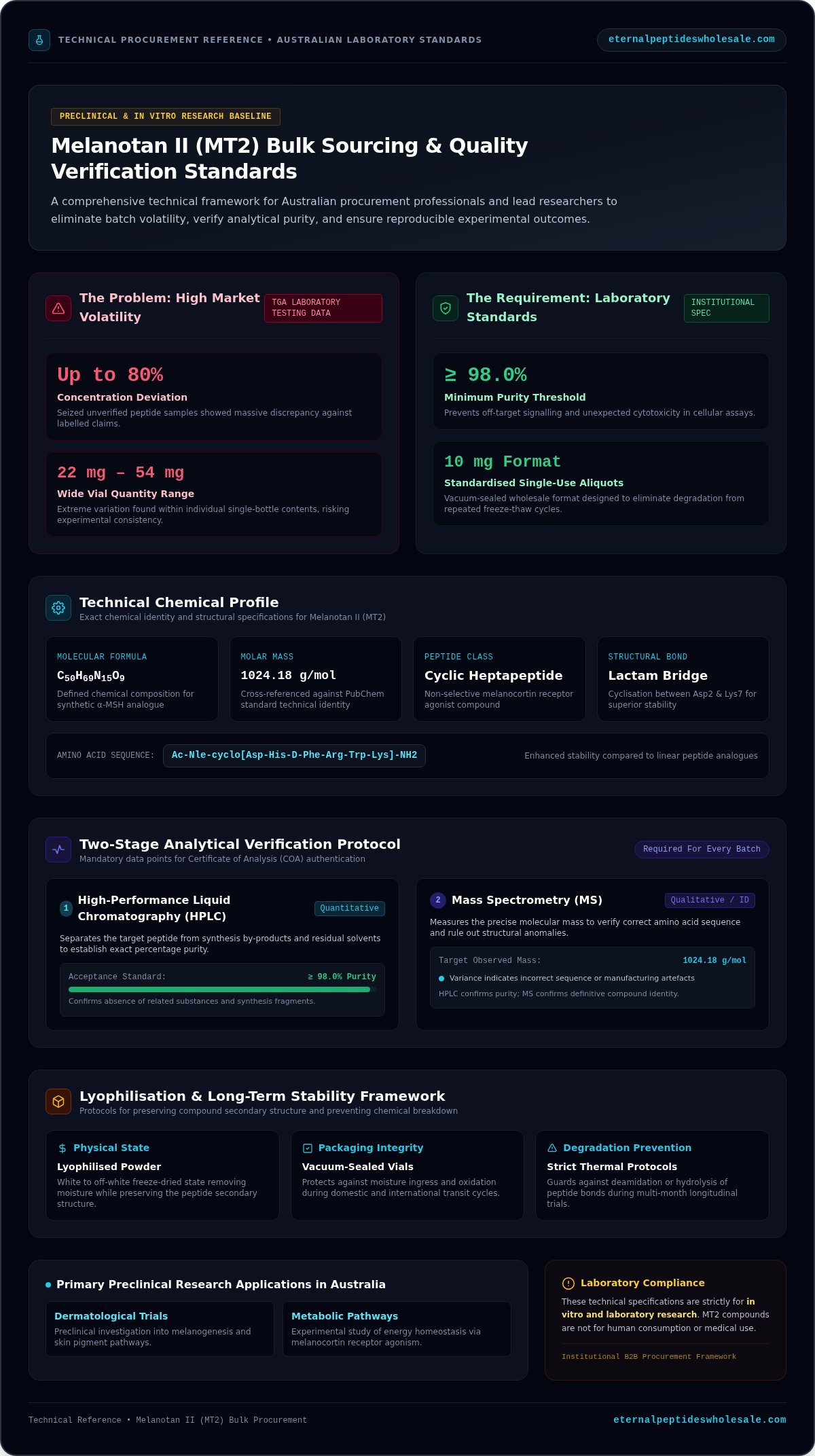
Recent TGA laboratory testing revealed that some seized peptide samples contained up to an 80% deviation from their labelled concentration, with quantities ranging from 22 mg to 54 mg in a single bottle. For procurement professionals and lead researchers in Australia, this level of volatility makes securing a reliable melanotan ii bulk wholesale partner a matter of scientific integrity rather than just cost. You’ve likely dealt with the frustration of batch-to-batch inconsistency or the logistical headaches of long international lead times that stall your projects. We understand that laboratory environments require precision, not guesswork.

This article provides a definitive technical reference for sourcing research-grade Melanotan II, ensuring your operations are backed by verifiable purity and stable supply chains. It’s designed to help you move past the uncertainty of unverified reports and towards a more professional B2B procurement model. We’ll examine critical HPLC and MS verification standards, logistical strategies to streamline your acquisition process, and the specific technical requirements for maintaining the stability of lyophilised powder in a professional setting. By the end of this guide, you’ll have the data needed to organise a more resilient and transparent procurement process for your institution.

Key Takeaways

  • Identify the essential chemical specifications and physical properties required to ensure the stability of Melanotan II acetate in professional research environments.
  • Master the interpretation of HPLC and Mass Spectrometry data to confirm batch-to-batch purity and precise molecular weight before deployment.
  • Optimise your procurement strategy by evaluating minimum order quantities and technical tiers for melanotan ii bulk wholesale to support large-scale laboratory operations.
  • Implement rigorous storage protocols to maintain the chemical integrity of lyophilised powder and prevent degradation during long-term experimental cycles.
  • Streamline institutional acquisition through professional B2B frameworks that prioritise logistical reliability and transparent batch verification within Australia.

Technical Specifications of Melanotan II (MT2) for Laboratory Study

Establishing a rigorous technical baseline is the first step in successful procurement for Australian research institutions. Melanotan II (MT2) is a synthetic analogue of the naturally occurring alpha-melanocyte stimulating hormone (α-MSH). In a laboratory setting, it’s identified as a cyclic heptapeptide that acts as a non-selective melanocortin receptor agonist. For procurement officers managing melanotan ii bulk wholesale acquisitions, verifying the chemical identity is paramount. The molecular formula is C50H69N15O9, and it possesses a precise molar mass of 1024.18 g/mol. These specifications are strictly for in vitro and laboratory research; these compounds are not for human consumption or medical use.

High-purity sourcing reduces experimental variables that can otherwise compromise longitudinal data. Impurities or residual solvents from the synthesis process can lead to off-target signalling or unexpected cytotoxicity in cellular assays. Securing melanotan ii bulk wholesale supplies that meet a minimum purity threshold of 98% ensures that researchers can attribute observed biological responses solely to the peptide itself, maintaining the integrity of the scientific record.

Molecular Profile and Research Utility

The amino acid sequence follows a specific lactam bridge structure: Ac-Nle-cyclo[Asp-His-D-Phe-Arg-Trp-Lys]-NH2. This cyclisation between the Asp2 and Lys7 residues provides the molecule with enhanced chemical stability compared to linear analogues. This structural robustness allows researchers to study its effects on various physiological pathways, including melanogenesis and energy homeostasis. In Australia, MT2 is frequently utilised in preclinical dermatological trials and metabolic studies. Because these trials often span several months, the use of research-grade standards is essential for producing reproducible, peer-reviewed outcomes.

Lyophilisation and Compound Integrity

The standard physical state for bulk MT2 is a white to off-white lyophilised powder. This state is achieved through a controlled freeze-drying process that removes moisture while preserving the peptide’s secondary structure. Vacuum-sealed vials are necessary to prevent oxidation and moisture ingress during international or domestic transit. Lyophilisation is a critical step for wholesale longevity, as it allows the compound to remain stable at ambient temperatures for short durations. For long-term storage, however, researchers must adhere to strict thermal protocols to prevent deamidation or hydrolysis of the peptide bonds. Using 10mg vials in a wholesale format allows for single-use aliquoting, which minimises the risk of degradation caused by repeated freeze-thaw cycles.

Verifying Purity: HPLC and Mass Spectrometry in Bulk Procurement

In the specialised field of melanotan ii bulk wholesale, the primary concern for any procurement professional is batch-to-batch consistency. Large-scale research projects depend on the premise that every vial in a 100-unit order performs identically to the last. Laboratory-grade verification relies on two primary analytical techniques: High-Performance Liquid Chromatography (HPLC) and Mass Spectrometry (MS). While HPLC determines the purity percentage by separating the peptide from any related substances, it doesn’t confirm that the substance is actually the intended compound. Accuracy defines the result. This is where MS becomes essential, as it measures the precise molecular mass of the sample.

A standard Certificate of Analysis (COA) for a bulk order should be scrutinised for specific data points. Buyers must cross-reference the observed molecular weight against the PubChem technical specifications for Melanotan II, which confirms a molar mass of 1024.18 g/mol. Any significant variance suggests either an incorrect amino acid sequence or the presence of manufacturing by-products. For those managing complex institutional supply chains, understanding these reports is vital to ensuring that the research remains reproducible and scientifically sound.

Analytical Standards for Wholesale Batches

Institutional buyers must distinguish between technical-grade materials and research-grade purity. Technical grade may suffice for basic calibration, but longitudinal research requires a purity level typically exceeding 98%. Beyond the peptide itself, the COA should report on residual solvents and Trifluoroacetic Acid (TFA) levels. TFA is a common counter-ion used during the purification process; however, excessive levels can alter the pH of laboratory assays. You can find further details in our guide on research peptide quality assurance to better understand these technical thresholds.

Third-Party Verification Protocols

Relying solely on in-house manufacturer reports can introduce a single point of failure in the procurement process. Independent third-party laboratory testing provides an objective layer of transparency, ensuring the supply chain isn’t compromised by batch substitution. Mass Spectrometry analysis is non-negotiable for identity confirmation because it provides the unique molecular fingerprint that HPLC alone cannot replicate. This rigorous approach to validation allows research institutions to maintain a dependable logistical backbone. If you’re looking to secure verified reference materials for your next project, you can view our wholesale catalogue for batch-tested options.

Strategic Wholesale Sourcing: Comparing Bulk Tiers and MOQs

Procuring reference materials for large-scale studies requires a shift from transactional purchasing to strategic logistical planning. When evaluating melanotan ii bulk wholesale options, research institutions must weigh the benefits of tiered pricing against their specific inventory turnover rates. Minimum Order Quantities (MOQs) serve as a baseline for B2B engagement; they ensure that the cost of analytical verification and logistical overhead is distributed efficiently across the batch. For many Australian laboratories, the 10mg vial format has become the industry standard for wholesale procurement. This specific volume allows for precise aliquoting and reduces the risk of sample contamination that often occurs with larger multi-gram bulk formats. It’s a practical approach that balances volume with the delicate nature of peptide stability.

Effective procurement management involves balancing the immediate needs of a study with the long-term stability of the compound. While larger tiers offer economies of scale, they also require more robust storage infrastructure to maintain chemical integrity over time. Researchers can verify the specific properties of their order by consulting the PubChem compound database for Melanotan II, which provides the necessary CAS registry data and molecular identifiers to ensure the batch matches institutional records. This technical alignment is essential for maintaining the high-purity standards required in longitudinal trials. Managing a procurement budget through these tiered structures allows for better allocation of grant funding across a multi-year research programme.

Optimising Laboratory Procurement

Consolidating orders into larger wholesale batches significantly reduces administrative labour and shipping costs. When conducting multi-phase studies, a cost-benefit analysis often reveals that sourcing a single large batch provides better data consistency than multiple smaller orders. You can learn more about navigating these complexities in our guide to wholesale research peptides australia. By streamlining the B2B process, institutions can lower their operational overhead and focus resources on the actual scientific output. This methodical approach ensures that inventory turnover aligns perfectly with the experimental timeline.

Australian Logistical Advantages

The “procurement lag” often associated with international peptide shipments can stall time-sensitive trials for weeks. Sourcing from a partner with a dependable logistical backbone in Australia minimises these transit risks. Local distribution ensures that temperature-sensitive lyophilised powders aren’t subjected to prolonged customs delays or uncontrolled environmental conditions at international borders. This reliability is vital for maintaining a consistent supply chain, especially when experimental timelines are rigid. By prioritising logistical integrity, Australian research sectors can ensure their projects remain on schedule without compromising on the quality of their reference materials. It’s about building a predictable supply chain that supports scientific excellence. Institutions seeking to formalise their sourcing strategy can benefit from reviewing the practical benchmarks outlined in our guide to b2b peptide suppliers australia, which details how to evaluate and verify commercial distributors against rigorous due diligence standards.

Melanotan II Bulk Wholesale: Technical Specifications for Australian Research

Storage and Stability Protocols for Large-Scale Research

When managing a high-volume inventory, the preservation of chemical structure is as vital as the initial purity verification. Lyophilised Melanotan II is inherently more stable than its liquid counterpart, yet it remains susceptible to environmental degradation if stored incorrectly. Heat, light, and moisture are the primary catalysts for peptide deamidation and oxidation. For organisations investing in melanotan ii bulk wholesale, establishing strict environmental controls is a prerequisite for maintaining the validity of longitudinal research data. Light sensitivity is a particularly critical factor; UV exposure can trigger photo-oxidation of the tryptophan residue within the MT2 sequence, potentially altering experimental results. Consequently, bulk stocks should be kept in light-shielded containers within a temperature-controlled environment.

Maintaining Batch Integrity

Standard Operating Procedures (SOPs) should dictate that all bulk vials remain in their vacuum-sealed state until the exact moment of reconstitution. Exposure to atmospheric moisture can lead to hygroscopic absorption, which compromises the integrity of the lyophilised cake. While the cyclic lactam bridge between Asp2 and Lys7 makes MT2 more resilient than linear peptides, it’s not immune to the stresses of thermal fluctuation. For optimal results and to ensure maximum compound longevity, the lyophilised powder must be stored in a desiccated environment at -20°C for a 24-month stability window. Repeated freeze-thaw cycles are notably damaging to the peptide’s molecular stability, as each cycle can introduce micro-fractures in the secondary structure, leading to a measurable loss in potency over time.

Laboratory Preparation and Solubility

Reconstitution requires a methodical approach to maintain the peptide’s secondary structure during the transition to a liquid state. While Melanotan II is highly soluble in sterile water or bacteriostatic water, the diluent should be added slowly along the side of the vial to avoid aggressive agitation or foaming. Once in solution, the peptide is far more prone to hydrolysis and should be refrigerated at 2°C to 8°C. Researchers should implement an aliquoting strategy, dividing the reconstituted solution into single-use volumes to prevent the need for re-freezing bulk supplies. Every interaction with the batch must be documented, including the date of reconstitution and the specific diluent used, to ensure a transparent audit trail for the study. You can order batch-verified vials to support your laboratory’s long-term stability requirements.

Consistent documentation of storage conditions is essential for identifying any variables that might affect assay performance. By monitoring freezer temperatures and limiting the duration that vials spend at ambient temperatures during handling, procurement officers can protect the institution’s investment in melanotan ii bulk wholesale materials. This rigorous attention to stability protocols ensures that every vial provides the reliable data necessary for high-level scientific inquiry.

Sourcing Melanotan II Bulk Wholesale from Eternal Peptides Wholesale

Eternal Peptides Wholesale operates as a dedicated partner for the Australian scientific community, providing the logistical backbone necessary for high-level research. While the technical specifications and analytical verification of peptides are paramount, the success of a longitudinal study often hinges on the reliability of the supplier. Securing melanotan ii bulk wholesale materials requires a partner that prioritises clinical reliability over transactional speed. We provide 10mg vials specifically designed for laboratory environments, ensuring that every batch meets the precise molecular standards required by procurement professionals. Our focus remains on establishing long-term professional relationships with research institutions across Australia, providing a sense of stability that retail-oriented vendors can’t replicate.

The Eternal Peptides Wholesale Advantage

Our commitment to excellence is reflected in our rigorous quality control and batch-specific documentation. We provide the HPLC and MS analysis reports discussed in previous sections as a standard part of our B2B service, ensuring total transparency for every wholesale order. This methodical approach ensures that your laboratory data remains untainted by batch-to-batch inconsistency. Our localised Australian logistical support is designed to minimise the procurement lag that often stalls time-sensitive projects. You can find this same dedication to logistical integrity throughout our product range, as detailed in our guide to ipamorelin wholesale australia. We treat every scientific project with the professional gravity it deserves.

Establishing a Wholesale Partnership

The process of becoming a verified research partner with Eternal Peptides Wholesale is straightforward yet thorough. We specialise in customised supply solutions tailored to the specific scale of your laboratory’s needs, whether you’re conducting initial assays or multi-year trials. Our account management team understands the complexities of institutional funding and procurement cycles, offering a streamlined experience that reduces administrative overhead. We don’t participate in the retail market; our focus is entirely on the success of your institution’s large-scale operations. This seasoned expertise ensures that your melanotan ii bulk wholesale supply chain remains resilient and your research stays on schedule. Contact our team to discuss your wholesale research needs.

Optimising Institutional Supply Chains for Australian Research

Reliable procurement serves as the fundamental basis for reproducible scientific outcomes. We’ve explored how batch-to-batch consistency depends on rigorous analytical verification, specifically utilising HPLC and MS to confirm molecular identity. By prioritising specialised Australian B2B distribution, research institutions can effectively bypass the logistical friction and lead-time volatility commonly associated with international suppliers. These technical standards, when paired with strict storage protocols, ensure that your reference materials maintain their chemical integrity throughout the entire experimental lifecycle.

Managing a melanotan ii bulk wholesale account requires a professional partner dedicated to a research-grade compound focus and total operational transparency. Eternal Peptides Wholesale provides the stability needed to support large-scale laboratory projects through high-purity, HPLC-verified batches. This methodical approach allows your team to focus on scientific output rather than managing supply chain variables. It’s about building a predictable framework for success. We invite you to enquire about bulk Melanotan II wholesale for your research project to establish a dependable logistical backbone for your institution. We look forward to supporting your next breakthrough in the lab.

Frequently Asked Questions

What is the standard purity level for bulk Melanotan II for research?

The standard purity threshold for research-grade Melanotan II is typically 98% or higher, as determined by High-Performance Liquid Chromatography (HPLC). This level of refinement is necessary to ensure that experimental results aren’t skewed by synthesis by-products or residual solvents. For institutional procurement, verifying these levels through batch-specific reports is a standard requirement to maintain the integrity of longitudinal studies and prevent off-target signalling in cellular assays.

How is Melanotan II wholesale shipped to ensure stability?

Wholesale orders are shipped as a stable lyophilised powder within vacuum-sealed glass vials to prevent moisture ingress. While the dry powder remains chemically resilient at ambient temperatures for short durations during transit, we utilise a dependable logistical backbone to minimise time spent in uncontrolled environments. This methodical approach ensures that the peptide’s secondary structure remains intact from the point of distribution to its arrival at your laboratory.

What is the typical shelf life of lyophilised Melanotan II in a lab setting?

Lyophilised Melanotan II typically maintains its stability for 12 to 24 months when stored in a desiccated environment at -20°C. If kept at -80°C, the compound can remain viable for even longer durations. It’s essential to keep the vials in their original vacuum-sealed state until the moment of use. Once the seal is broken or the compound is reconstituted, the stability window decreases significantly, necessitating immediate refrigeration at 2°C to 8°C.

Do you provide HPLC and MS reports for bulk wholesale orders?

Yes, we provide batch-specific HPLC and Mass Spectrometry (MS) analysis for all melanotan ii bulk wholesale orders. The HPLC report confirms the purity percentage, while the MS analysis provides the unique molecular fingerprint required to verify the compound’s identity. These reports are essential for procurement professionals who must document the technical specifications of their reference materials to meet institutional quality assurance standards and ensure experimental reproducibility.

Are there specific MOQs for institutional peptide procurement in Australia?

Our wholesale structure is designed to support the needs of research institutions with tiered minimum order quantities for melanotan ii bulk wholesale. Standard wholesale volumes typically begin with boxes of ten 10mg vials, allowing for easier aliquoting and inventory management. For larger multi-phase studies, we offer increased bulk tiers that provide greater economies of scale. This professional B2B framework helps procurement officers manage grant budgets effectively while securing a consistent supply of reference materials.

Can Melanotan II be used for any purpose other than laboratory research?

No, Melanotan II is strictly for laboratory research and in vitro study purposes only. These compounds are not for human consumption, medical use, or therapeutic applications. Eternal Peptides Wholesale does not provide medical consultations or retail single-vial sales. All procurement must be conducted by verified research partners who adhere to the strict guidelines governing the use of unapproved therapeutic substances in a scientific or academic capacity.

How does local Australian distribution reduce procurement risks?

Local distribution significantly reduces the risks associated with international “procurement lag” and customs interceptions. By utilising an Australian-based logistical network, we minimise the time vials spend in transit and eliminate the uncertainty of international border delays. This reliability ensures a consistent supply chain for time-sensitive trials, allowing researchers to plan their experimental cycles without the threat of inventory depletion or environmental degradation during long-haul shipping. Research teams looking to formalise their supplier evaluation process can consult our comprehensive resource on b2b peptide suppliers australia for detailed due diligence benchmarks and verification protocols.

What storage conditions are required for bulk peptide vials?

Bulk peptide vials require specific thermal management to prevent chemical degradation. Lyophilised powder should be stored in a freezer at -20°C to ensure long-term stability. Once reconstituted with a suitable diluent, the solution must be kept refrigerated between 2°C and 8°C. It’s vital to avoid repeated freeze-thaw cycles, as these can cause micro-fractures in the peptide’s structure; instead, researchers should use single-use aliquots for their specific laboratory assays.

Related from Eternal Peptides Wholesale

Eternal Peptides Wholesale publishes batch-specific Janoshik Analytical reports in its certificate of analysis library, so the documentation for a listed batch can be read alongside the evidence discussed in this article.

Related reading: Melanotan II receptor binding assay supply: A 2026 buyer’s guide