
A freezer setting alone isn’t a handling plan. Effective lyophilized peptide handling best practices account for the sample’s full chain of custody, from receipt and storage through opening, preparation and any later transfer. Gaps in that process can make it difficult to determine whether a deviation affected sample integrity.
Handling requirements can differ between peptides, and generic storage advice may not match the documentation for a specific material. A consistent process distinguishes unopened lyophilised vials from prepared samples, follows product-specific instructions and makes each decision traceable.
This checklist provides a repeatable framework for laboratory teams. It covers what to verify before opening a vial, how to align handling with supplier documentation and laboratory procedures, and what to record when storing, preparing or transferring a sample. It also highlights the details that help staff investigate deviations and maintain consistent records across shifts, without assuming one set of conditions applies to every peptide.
Key Takeaways
- Understand lyophilisation as freeze-drying, while recognising that handling requirements can vary by peptide.
- Use product-specific supplier documentation to guide storage decisions rather than relying on a universal condition.
- Apply lyophilized peptide handling best practices through a sequence-based checklist aligned with your laboratory’s procedures and risk assessment.
- Keep records of sample identity, receipt, storage, access and handling so deviations can be reviewed consistently.
- Set clear responsibilities for sample receipt, storage and record review, and distinguish unopened material from prepared samples.
Lyophilised peptide handling best practices start with understanding the sample
A reliable workflow begins by identifying the vial contents and confirming which instructions apply. Lyophilisation is a freeze-drying process: material is frozen, then water is removed under conditions that allow ice to pass directly into vapour. This describes the process, not a guarantee that every peptide has the same characteristics or handling requirements. The lyophilization overview provides background on the technique.
For laboratory research, controlled handling supports sample integrity and traceable work. Treat unopened, dry material as distinct from anything prepared under an approved laboratory protocol. Preparation changes the sample’s state, so the applicable instructions, storage decisions and records may also differ. This checklist concerns research handling only. Peptides discussed here are not for human consumption or medical use.
What does lyophilised mean for a research peptide?
A lyophilised peptide is supplied in a dry, freeze-dried form. Its appearance may help staff notice an unexpected change, but it cannot confirm identity, purity or integrity. Don’t infer suitability or stability from colour, texture or the presence of a visible cake or powder. Check the specific product documentation for stated characteristics and handling information, and record any concern for review.
Which instructions take priority when handling a peptide?
Before handling, consult the supplier’s product documentation, the Safety Data Sheet (SDS), the laboratory’s approved standard operating procedure (SOP) and any relevant risk assessment. The SDS informs hazard controls; product-specific documents and approved procedures guide sample handling. Generic guidance is a reference, not a substitute for validated instructions. If information is missing or conflicts, pause and seek clarification from a supervisor or supplier before proceeding.
A defensible routine starts with confirming the material, matching instructions to its current state and checking that the planned work is covered by laboratory procedures. There is no single set of conditions that applies to every peptide.
- Identify the material: match the vial label to its accompanying product documentation.
- Confirm the handling basis: check the relevant product instructions, SDS and approved SOP.
- Separate sample states: distinguish unopened lyophilised material from prepared material in records and procedures.
- Resolve uncertainty: document missing or conflicting guidance and refer it for review before handling.
This initial review creates a clear starting point for receiving, storing and accessing the vial under documented conditions. It also helps staff apply the same decision process across shifts, rather than relying on memory or assumptions about how another peptide was handled.
Receiving and storing lyophilised peptides: control the documented conditions
Receipt is the first opportunity for a laboratory to establish a reliable record of sample custody. Check the shipment before adding it to routine inventory, then assign responsibility for reviewing the material and its documentation. A familiar label or package format alone does not confirm that the correct item has arrived.
What should a laboratory check when a shipment arrives?
Compare the received item with the purchase record and supplier documents. Record the product identifier and any batch or lot details provided, the date received and the staff member completing the check. Inspect the outer packaging and vial for visible damage, compromised seals or discrepancies. If anything appears irregular, follow institutional procedures before adding the item to routine inventory.
Check that the documents needed for your laboratory’s review are present and match the item. If transport or storage history is unclear, don’t put the material into use until the concern has been referred to the appropriate supervisor or supplier. A defined hold-and-review process is more defensible than making assumptions at receipt.
How should storage conditions be recorded?
Use the relevant supplier documentation and approved laboratory procedures to determine the storage condition for that specific material. Technical references, including Bachem Handling and Storage Guidelines, can provide useful general context, but they shouldn’t replace product-specific instructions. Don’t apply a temperature, stability period or excursion limit unless it’s supported by the documentation for the material and your laboratory’s approved process.
Once the applicable condition is confirmed, record it alongside the storage location, date, responsible person and any condition-monitoring details required by the SOP. Use clear vial labels and an inventory system that lets authorised staff identify the material and review its handling history. Consistent entries and access controls help prevent unrecorded transfers and uncertainty about where a vial has been kept.
- At receipt: match identifiers and documents, inspect packaging, and record who completed the check.
- Before storage: confirm the material-specific condition and resolve missing or conflicting instructions.
- During storage: record location, access and required monitoring information.
- If a deviation occurs: document what happened and seek review rather than assuming the sample remains suitable.
These steps create an auditable receiving and storage workflow without treating one condition as suitable for every peptide. Laboratories reviewing potential research-grade peptide suppliers can also consult Eternal Peptides Wholesale research peptide information and assess the product documentation relevant to their own procedures.
Opening and handling lyophilised peptide vials without avoidable contamination
Opening a vial should be a planned step in an approved research workflow, not an improvised task. Handling requirements depend on the material, procedure and assessed risks, so staff should follow the current product documentation, laboratory SOP and risk assessment. The aim is to control access, reduce avoidable exposure and make each handling event consistent and traceable.
What should staff prepare before opening a vial?
First, confirm the vial’s identity against its label and laboratory records. Check that the intended research procedure is covered by approved instructions, and review any material-specific handling guidance. If instructions are absent or unclear, pause and ask a supervisor to resolve the uncertainty before proceeding.
Prepare the designated workspace and required controls before bringing the vial into the work area. Only trained, authorised personnel should perform the task. Follow the institution’s risk assessment for personal protective equipment (PPE), hygiene, workspace controls and waste handling. PPE and workspace requirements should reflect the assessed activity and local procedures, not an assumed one-size-fits-all standard.
How can teams reduce contamination and handling variability?
Use the same documented sequence each time. A practical workflow can prompt the handler to:
- Verify: match the vial identity to the planned procedure and records.
- Prepare: confirm the workspace, controls, PPE and required materials are ready.
- Handle: follow the approved SOP and product-specific instructions without adding unapproved steps.
- Close out: secure the vial and return it to its documented storage conditions as directed.
- Record: enter the handler, date, access event and any relevant observations or deviations.
Keep the vial open only for the steps required by the procedure. Avoid unnecessary transfers, repeated access and unrecorded handling. These controls help limit opportunities for contamination and reduce variation between staff. They don’t replace product-specific instructions or demonstrate that a sample remains suitable after a deviation.
If a seal, vial or work area raises concern, stop and follow the laboratory’s escalation process rather than continuing on assumption. Record what was observed, who handled the sample and what action was taken. A repeatable workflow is most useful when laboratory staff can follow it consistently and review the record. This guidance is for laboratory research handling only, not for human use.
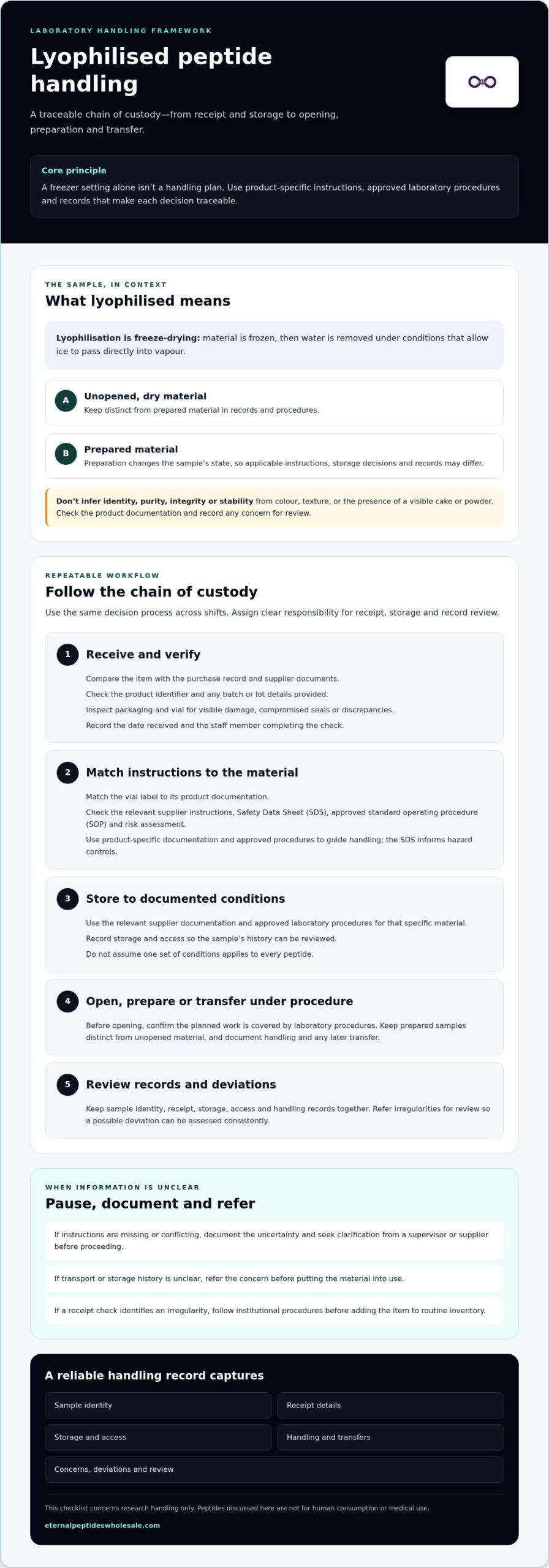
A lyophilised peptide handling checklist for records, deviations and prepared samples
Good records let laboratory staff reconstruct a sample’s history without relying on memory. Use a controlled form or electronic record system consistently, and make sure each entry can be linked to the relevant vial and supporting documents. The checklist below can be adapted to institutional procedures.
What information belongs in a sample handling record?
For unopened lyophilised material, record the details needed to identify and trace the sample. These typically include:
- Identity: sample identifier and any batch or lot details provided.
- Receipt: date received, source and relevant supplier documentation.
- Storage: approved condition, location and any monitoring details required by the SOP.
- Access and handling: date, handler, reason for access and relevant actions or observations.
- Discrepancies: unexpected package condition, label mismatch or other concern, plus any follow-up.
Keep the record aligned with the laboratory’s controlled process. If a sample is prepared under an approved protocol, treat it as a distinct material state: link it to the original sample, document the preparation event and follow the protocol’s requirements for identification, storage and use. Don’t carry over stability assumptions from the unopened lyophilised material. Confirm any product-specific stability information before relying on it.
What should staff do after a storage or handling deviation?
If a suspected deviation occurs, follow the laboratory’s deviation procedure and preserve relevant records, such as access logs and condition-monitoring information. Where the SOP requires it, identify the affected material and place it on hold so it isn’t used before review. Don’t assume it remains suitable, but don’t discard it without authorised direction either.
Record what happened, when it was identified, which material may be affected and who was notified. An authorised reviewer should determine and document the disposition and rationale under institutional controls. This creates a clear basis for follow-up and helps prevent an unresolved event from being treated as routine handling.
Link sample identity, handling history and decisions about prepared material in one traceable record. Adapt the checklist to your approved protocols, and assign responsibility for maintaining and reviewing entries.
For laboratory research purposes, review Eternal Peptides Wholesale research peptide supply options.
Apply these research peptide handling practices across a laboratory workflow
A checklist is effective only if it fits the way your laboratory works. Map each step to an existing SOP, a responsible role and the location where its record is kept. This turns lyophilized peptide handling best practices into a repeatable process rather than a set of informal reminders.
How can a laboratory make its handling checklist repeatable?
Use institutional review to confirm that the checklist reflects approved procedures and the risks of the planned research activity. Assign responsibility for receipt, storage, access and record review, including who can resolve uncertainties or escalate deviations. Train relevant staff to use the same controlled forms or electronic records. Review the checklist when product documentation, laboratory procedures or workflows change, and address gaps through internal review rather than assumptions.
Procurement teams also have a role. Before material enters a laboratory workflow, obtain the available product-specific documentation and confirm that identifiers can be matched to the expected item. Researchers and supervisors can then assess whether the information supports the intended research process and whether clarification is needed before the sample is handled.
- Before receipt: confirm what identifiers and documents are expected.
- At receipt: assign a trained person to check and record the item.
- During storage and access: follow documented conditions and record relevant events.
- At review: check records for gaps and refer deviations through the approved process.
Keep this checklist adaptable. It should support your laboratory’s approved procedures, not replace them or introduce unreviewed handling steps.
When should a laboratory contact its supplier?
Ask for clarification if product identifiers don’t match, relevant handling documents are missing, or instructions appear incomplete or inconsistent. Request information for the specific product rather than applying another peptide’s conditions by analogy. If a question concerns an internal procedure or an assessed risk, refer it to the appropriate laboratory supervisor as well. Supplier documentation informs the workflow; responsibility for approving laboratory procedures remains with the institution.
Eternal Peptides Wholesale is an Australian-based wholesale supplier of research-grade peptides for laboratory research purposes only. Its role is to supply research-use products, not to advise on or approve laboratory handling procedures. For wholesale research supply information, review Eternal Peptides Wholesale.
Make your peptide handling checklist part of routine practice
Reliable sample management depends on a documented process, not a single storage decision. Confirm product-specific instructions before handling, distinguish unopened lyophilised material from prepared samples, and record receipt, access and any deviations. Clear responsibilities help staff apply the same approved procedure and make sample history easier to review.
Use lyophilised peptide handling best practices as a framework to check your laboratory’s procedures, not as a universal set of conditions. Keep supplier documentation with the relevant records, and refer uncertainties to the appropriate supervisor before material enters a research workflow.
Eternal Peptides Wholesale is an Australian-based wholesale supplier serving laboratory research needs nationally. Its peptides are supplied for research purposes only, not for human consumption or medical use. Procurement teams can review wholesale research peptide supply information as part of their documentation checks.
With clear roles, consistent records and product-specific guidance, your team can build a handling workflow that is practical, traceable and ready for review. To explore wholesale research peptide supply, contact Eternal Peptides Wholesale.
Frequently Asked Questions
Is lyophilised peptide stable at room temperature?
There isn’t a universal yes or no: room-temperature stability depends on the specific peptide and its documented conditions. Check the current supplier information and your approved laboratory SOP before deciding where to store a vial. Record the applicable storage condition and location in the laboratory system. If the documentation doesn’t specify the requirement or appears incomplete, ask a supervisor or supplier for clarification before relying on the material.
How should a lyophilised peptide be stored?
Follow the product-specific documentation, Safety Data Sheet and institutional procedure. Don’t apply a default temperature or storage duration to every peptide. Record the approved condition, storage location and relevant handling events so staff can trace the material’s history. If instructions are missing or conflict, seek clarification through the laboratory’s review process before relying on the material. Keep the records with the sample’s controlled documentation.
Can lyophilised peptides be exposed to moisture or air?
Avoidable exposure to air or moisture may be a handling concern, but its effect depends on the material and conditions. Follow the supplier’s instructions and laboratory SOP, and limit unnecessary vial access. Don’t assume there is a universal exposure threshold. If exposure is suspected, document what happened and when, then follow your laboratory’s deviation-review process before making decisions about further handling or use.
What should I do if a peptide vial arrives damaged?
Document the visible condition and relevant identifiers, such as the sample label and batch details provided. Follow institutional procedures for discrepancies, including separating the item from routine use if required, and notify the responsible laboratory lead or supplier. Don’t judge suitability from appearance alone. Record the review and any authorised disposition decision. Avoid assuming a replacement or refund will be provided; confirm any commercial outcome directly with the supplier.
Does a lyophilised peptide need to be reconstituted before laboratory use?
Preparation depends on the approved research protocol and product-specific documentation. Consult the validated laboratory method and relevant supplier information before proceeding. This FAQ doesn’t provide preparation quantities, procedural directions or human-use advice. If preparation is approved, record the event and manage the resulting material under the institution’s requirements for identification, storage and subsequent handling. Don’t assume instructions for unopened lyophilised material also apply to a prepared sample.
How can a laboratory prevent contamination when handling peptide vials?
Use trained personnel, the workspace controls and protective equipment identified by the laboratory risk assessment, and follow the approved SOP. Prepare the work area before opening the vial, limit unnecessary handling and record relevant events. The appropriate controls depend on the material, activity and institutional procedures, so avoid treating one technique as suitable for every situation. If the planned work falls outside the SOP, seek review before proceeding.
What records should be kept for lyophilised peptide handling?
Maintain traceable records of sample identifiers, batch details provided, receipt date, source documentation, storage location, access and relevant handling or deviation events. Use the laboratory’s controlled forms or electronic record system consistently, and follow the retention requirements set by your institution. Requirements can vary, so don’t assume a universal Australian retention period. Clear entries help staff review the sample’s history and investigate discrepancies.
Related from Eternal Peptides Wholesale
Eternal Peptides Wholesale publishes batch-specific Janoshik Analytical reports in its certificate of analysis library, so the documentation for a listed batch can be read alongside the evidence discussed in this article.
- Peptide COA library: batch-specific Janoshik Analytical reports with their verification details
- Our peptide testing standards: how independent Janoshik testing is used and reported
- Janoshik reports explained: what each test measures and its limits
- Evidence review: Synthetic peptides: manufacture, impurities and analytical verification
- Evidence review: What are peptides used for? Synthetic peptides as research tools