
Posted on

Wholesale BPC-157 Australia: Research Lab Sourcing Guide

Wholesale BPC-157 Australia: Research Lab Sourcing Guide

A wholesale listing is only the starting point for laboratory procurement. If you’re assessing wholesale bpc 157 australia options, first define the research requirement, then consider whether the product details and purchasing arrangement fit your institution’s processes and applicable Australian requirements. A “research use only” label does not, by itself, establish that supply or possession is authorised.

Eternal Peptides Wholesale lists BPC-157 5mg for laboratory research purposes only, not for human consumption or medical use. This guide explains how to assess product identity, compare wholesale supply with retail-oriented listings, and interpret batch documentation without treating marketing claims as evidence. It also covers how to plan quantities around a documented research requirement and why regulatory considerations belong at the start of procurement. The aim is to help laboratory buyers make an evidence-led assessment without assuming product quality or documentation beyond what has been substantiated.

Key Takeaways

  • Define the research scope and check institutional purchasing requirements before comparing wholesale bpc 157 australia options.
  • Eternal Peptides Wholesale lists BPC-157 5mg for laboratory research only, not for human consumption or medical use.
  • Assess documentation by matching product identity and batch details, then reviewing the analytical method and report scope.
  • Separate the listed compound and quantity from claims about biological effects or research outcomes.
  • Build procurement around internal approval and clear order records, and account for applicable Australian regulatory requirements.

Wholesale BPC-157 Australia: What Laboratory Buyers Need to Know

Wholesale BPC-157 supply is a laboratory research procurement arrangement, not a consumer or therapeutic product category. For Australian laboratories, comparing wholesale bpc 157 australia options means starting with the research purpose, product identity and institutional purchasing requirements. A bulk listing alone does not demonstrate suitability or permission to purchase.

Eternal Peptides Wholesale lists BPC-157 5mg for laboratory research purposes only. It is not for human consumption or medical use. The listed quantity identifies the product offering, but does not establish research outcomes, product performance or suitability for a particular project.

What does wholesale BPC-157 supply mean for a laboratory?

Wholesale procurement is organised around a laboratory’s documented requirements and purchasing processes. A single-vial retail listing is generally framed for an individual transaction, while a wholesale offering is intended for business or institutional purchasing. This describes the purchasing context, not a particular pack size, discount, testing standard or scientific benefit.

Before comparing listings, record the project scope, required material identity and reason for the quantity requested. Base the plan on the documented need, not assumed pack sizes or a desire to buy more. A supply arrangement concerns procurement; it does not establish conclusions about the compound or replace a research protocol.

  • Define the research requirement and the basis for the quantity.
  • Record the exact product identity and listed amount under review.
  • Keep procurement documentation separate from scientific interpretation.

Who is this Australian sourcing guide for?

This guide is for laboratory researchers, procurement staff and research institutions operating across Australia. It provides a framework for assessing product fit, documentation and internal processes. It is not a research protocol and does not provide directions for handling, administration or use in people.

Product decisions remain subject to institutional procedures and applicable Australian requirements. A research-use-only description does not, on its own, determine whether a particular acquisition is authorised or appropriate. Include regulatory and institutional review in procurement planning, and consult current official guidance where needed. The BPC-157 Wikipedia article offers a general overview of the compound, but is not a substitute for regulatory advice or product-specific evidence.

The distinction between wholesale and retail matters because the purchasing record should reflect the laboratory’s actual requirement, not an individual consumer transaction. A disciplined assessment also prevents a listed quantity or supplier description from being mistaken for evidence about quality or research relevance. The following sections cover product fit, documentation and procurement planning in more detail.

BPC-157 Product Fit: Define the Research Requirement Before Sourcing

Product fit starts with the research requirement, not a supplier’s description. Before comparing wholesale bpc 157 australia listings, document the laboratory context, the required material identity and the reason for the requested quantity. This gives researchers and procurement staff a consistent basis for assessing a listing while keeping product selection within institutional procedures.

Make the brief specific. For example, it can name BPC-157 as the compound under consideration, describe the laboratory research context and explain how the required quantity was determined. Don’t add assumptions about formulation, storage conditions or other specifications that aren’t stated in the product information.

Match product identity and stated quantity to the project

Eternal Peptides Wholesale lists BPC-157 5mg as a wholesale offering for laboratory research. Treat the compound name and stated quantity as product-identification details, then compare them with the written requirement. The listing does not establish suitability for a particular study, and the quantity does not indicate how much a project needs.

A clear internal brief can record:

  • The compound identity required for the project.
  • The stated quantity being assessed.
  • The intended laboratory research context.
  • The institutional process that governs purchasing decisions.

This record helps separate procurement fit from scientific interpretation. A product description can identify what is being offered; it cannot establish the material’s relevance to a hypothesis or predict a study result. Keep those judgements within the research team’s established review process.

Keep research-use language precise

Descriptions of research interest provide context, not proof. References to a topic or model do not demonstrate efficacy, confirm suitability for a specific study or support claims about health outcomes. Use neutral terms such as “research interest” and “laboratory study”, and assess scientific claims separately through appropriate evidence and institutional review.

BPC-157 products supplied by Eternal Peptides Wholesale are strictly for laboratory research. They are not for human consumption or medical use. Avoid language that blurs this boundary, such as turning a research-area description into a treatment benefit or an expected result.

Before progressing a purchase review, check that the proposed product identity and quantity align with the project brief and that the decision follows institutional requirements. For a procurement starting point, review Eternal Peptides Wholesale’s wholesale BPC-157 5mg offering against the documented research need.

Assess Wholesale BPC-157 Documentation and Quality Claims

Documentation is useful when it supports a specific procurement decision. When assessing wholesale bpc 157 australia options for research, distinguish a general quality statement from evidence tied to the exact product and batch under review. A marketing description may explain how a supplier presents an offering, but it cannot replace a document that identifies what was assessed and reports results within a defined scope.

Marketing claims and batch-specific evidence are not interchangeable. Keep that distinction clear in the procurement record. A certificate or analytical report should be interpreted according to its stated contents, not treated as a blanket assurance of research suitability, biological performance or compliance with institutional requirements. The steps below help make the limits of the paperwork clear.

What should a laboratory review in product documentation?

Use a four-step review: confirm product identity, match the record to the relevant batch, identify the analytical method and read the report scope. If an element is absent or ambiguous, record that limitation rather than filling the gap with an assumption. This creates a traceable basis for internal review without overstating what the paperwork establishes.

  1. Product identity: Check that the document names the compound being assessed and corresponds to the product under consideration.
  2. Batch link: Look for a batch identifier connecting the report to the material under review, rather than relying on a general supplier statement.
  3. Analytical method: Note the method named in the report and what it is used to assess.
  4. Report scope: Record the reported results, stated limits and any information the document does not cover.

A certificate is relevant only to the extent that its identity and batch details match the product and batch being assessed. A document for a different batch, or one that names no batch, may not support the same procurement conclusion. Include the document date and any stated limitations in the institution’s records so reviewers can see exactly what evidence informed the decision.

How to interpret purity and testing language

HPLC, or high-performance liquid chromatography, is an analytical technique used to separate components in a sample. Mass spectrometry measures the mass-to-charge ratios of ions and can contribute to characterising material. These terms describe methods. They do not guarantee that a particular supplier used them or that a report answers every question relevant to a laboratory’s requirements.

Read a stated purity percentage within the test’s scope and reporting basis. On its own, it does not prove suitability for a specific study, biological activity or performance. Don’t infer additional tests from the mention of one method. When reviewing an analytical claim, use current product documentation that directly supports it.

For a more structured procurement review, the research peptide quality assurance guide provides related context. Documentation review is one part of a broader institutional assessment; it does not replace applicable approval or regulatory review.
Wholesale BPC-157 Australia: Research Lab Sourcing Guide

Plan Wholesale BPC-157 Procurement for an Australian Laboratory

A sound procurement process connects the research requirement, institutional review and purchasing record. For wholesale bpc 157 australia enquiries, treat regulatory and institutional approval as prerequisites, not paperwork to complete after selecting a product. A research-use-only description does not, by itself, establish that a proposed supply or acquisition is authorised. The institution should assess applicable Australian requirements before a purchasing decision proceeds.

A procurement sequence from requirements to records

Use a documented sequence so each decision has a clear basis. The exact review pathway depends on institutional procedures and the requirements that apply to the proposed research.

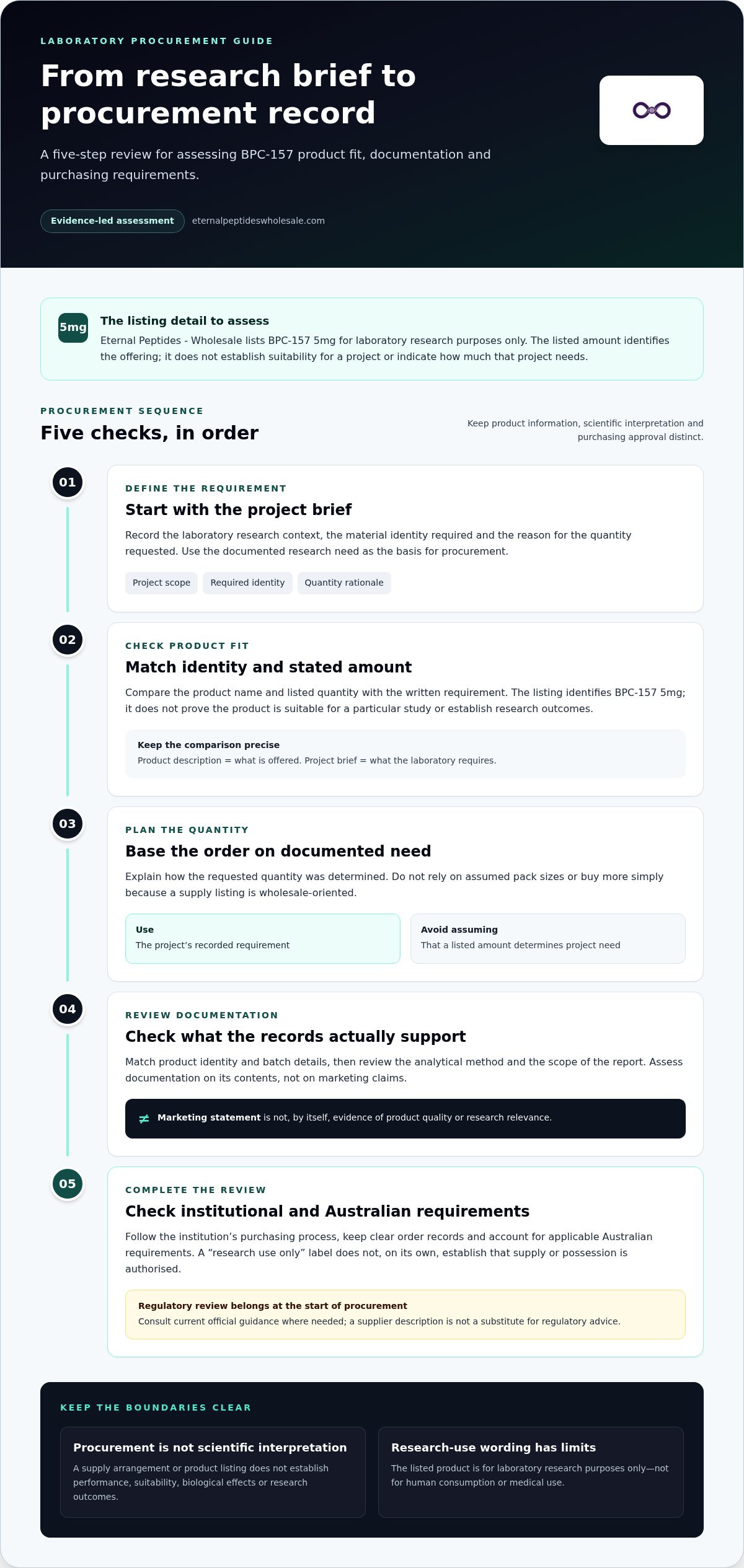
  1. Define the requirement. Record the compound identity, stated quantity and authorised research context. Explain how the quantity relates to the project rather than relying on an assumed pack size.
  2. Complete institutional review. Route the proposed procurement through the relevant purchasing, research governance and compliance processes. Resolve authorisation questions before proceeding.
  3. Assess product information. Review available product details and any batch documentation. Record what the documents establish, their scope and any limitations. Don’t infer tests or specifications that aren’t stated.
  4. Document the decision. Retain the review outcome, approval records, relevant product information and order records according to institutional procedures.

This sequence creates a traceable record from need through approval. It also distinguishes a decision to assess an offering from a conclusion that it is authorised or appropriate for a particular project. Align research-use procedures with purchasing controls, and refer unresolved regulatory questions to the institution’s designated compliance personnel.

Wholesale versus retail: choose the right purchasing context

Compare the project’s documented requirements with the supplier’s stated wholesale offer. Eternal Peptides Wholesale operates as a wholesale supplier, and its listed BPC-157 offering is BPC-157 5mg for laboratory research purposes only. The business does not sell retail single vials. Wholesale purchasing is therefore distinct from a retail-oriented single-vial listing, but that distinction does not establish the permissions, documentation or suitability required for a particular institutional purchase.

Keep the assessment focused on verifiable details. Don’t infer minimum quantities, pricing, payment terms, shipping arrangements or delivery timeframes unless those details are explicitly documented for the transaction. A general fulfilment statement is not a commitment to a specific order. For a broader framework on Australian purchasing workflows, the Australian wholesale research peptide procurement guide can help structure internal review.

Once institutional approval and relevant requirements are clear, review the BPC-157 5mg wholesale listing as part of the documented assessment. Products are for laboratory research only, not for human consumption or medical use.

Source Wholesale BPC-157 from Eternal Peptides Wholesale for Research Use

Eternal Peptides Wholesale is an Australian-based wholesale supplier of research-grade peptides. Its listed BPC-157 offering is BPC-157 5mg, supplied strictly for laboratory research. It is not intended for human consumption or medical use. These details define the offer; they do not establish suitability for a particular study or make claims about effects.

The wholesale model is distinct from retail single-vial purchasing. Eternal Peptides Wholesale does not sell retail single vials, and its BPC-157 listing is presented as a wholesale research offering. This purchasing context is relevant to laboratory procurement, but it is not evidence of product quality, research performance or legal authority to acquire or supply the compound.

What Eternal Peptides Wholesale’s wholesale offer is designed for

The offering is for laboratory research within an appropriate institutional and regulatory framework. Before proceeding, define the research requirement, establish that the proposed procurement aligns with organisational procedures and assess product information against that requirement. A research-use label does not, by itself, establish that acquisition is authorised under applicable Australian controls.

Keep these points distinct in procurement records:

  • Product identity: BPC-157.
  • Listed quantity: 5mg.
  • Purchasing context: wholesale supply for laboratory research.
  • Use restriction: not for human consumption or medical use.

This summary is a starting point, not a substitute for the product-fit and documentation review described above. A laboratory still needs to assess whether the stated identity and quantity match its documented requirement, consider what product or batch records establish, and follow its own approval and purchasing processes. Avoid drawing conclusions beyond the stated scope of product descriptions.

Take the next step with a research-led purchasing decision

Before considering a transaction, address applicable Australian requirements and institutional approvals. BPC-157’s regulatory status means a research-only description should not be treated as an exemption or proof that a proposed supply arrangement is authorised. If regulatory obligations are uncertain, consult current authoritative Australian guidance and the institution’s compliance processes before proceeding.

For laboratory buyers whose procurement has passed the relevant review, compare the documented project need with the wholesale listing and retain the basis for the decision. Review the BPC-157 5mg wholesale research listing as part of that assessment. Base the decision on product identity, quantity fit, documentation scope and applicable approvals, not unverified claims about performance, fulfilment or quality.

Make the Next Procurement Decision Evidence-Led

Turn your review into a clear internal decision record. Document why the proposed material fits the project, what the available evidence does and does not establish, and which institutional approvals apply. This gives researchers and procurement staff a shared basis for deciding whether to proceed, pause or seek further review.

For teams evaluating wholesale bpc 157 australia options, a research-use label alone does not establish authority to acquire or supply the product. Resolve applicable Australian regulatory requirements and institutional approvals before procurement. Keep that assessment distinct from product identity and batch documentation so each part of the decision is supported by appropriate evidence.

Eternal Peptides Wholesale is an Australian-based wholesale supplier, with BPC-157 5mg listed for laboratory research only, not for human consumption or medical use. If the offering aligns with your documented requirements and relevant approvals, review Eternal Peptides Wholesale’s wholesale research peptide range as part of your purchasing assessment. A careful, well-recorded decision is a sound foundation for responsible research procurement.

Frequently Asked Questions

Can laboratories source wholesale BPC-157 in Australia?

Not as an unrestricted purchase based solely on a supplier’s listing. BPC-157 is classified as a Schedule 4 prescription-only medicine in Australia, so a “research use only” description does not itself establish that supply or acquisition is authorised. Eternal Peptides Wholesale lists BPC-157 5mg as a wholesale research offering, but laboratories must assess applicable regulatory requirements and institutional approvals before considering procurement. A listing is not proof of legal authority.

What does research-use-only mean for BPC-157?

Research-use-only describes the stated purpose of a product. It does not make it a medicine, support human use or establish that a purchase is lawful. Laboratories should consider the Australian regulatory framework separately from the supplier’s label and follow their organisation’s governance and handling procedures. Eternal Peptides Wholesale’s products are for laboratory research only, not human consumption or medical use. The business does not provide medical consultations.

What should a laboratory check before purchasing wholesale BPC-157?

Begin with the institution’s authority to acquire the material, then assess whether the product information matches the approved research requirement. A procurement record can note the compound name, stated quantity, relevant batch identifier and documents reviewed, alongside the approval reference. Keep promotional descriptions separate from evidence. If a proposed acquisition raises regulatory or governance questions, pause the purchasing process and refer them through the institution’s established compliance pathway.

Is a certificate of analysis enough to assess a BPC-157 product?

No. A certificate of analysis may inform a review, but its usefulness depends on whether it identifies the specific material and batch and clearly describes its methods and results. A generic document, or one that cannot be linked to the product under consideration, offers a limited basis for assessment. Record the document’s scope and omissions, and don’t treat reported results as proof of suitability for a particular project or of biological outcomes.

How much BPC-157 should a laboratory order wholesale?

There’s no universal quantity for every laboratory. The amount should follow an approved project requirement and institutional purchasing process. Avoid basing the decision on consumer advice, an assumed pack size or a supplier’s general description. Eternal Peptides Wholesale lists BPC-157 5mg as a wholesale offering. Assess that stated quantity against the authorised need rather than interpreting it as a recommendation about study design or use.

Does wholesale BPC-157 have a human medical use?

Eternal Peptides Wholesale’s BPC-157 offering is for laboratory research only, not human consumption or medical use. The business does not provide medical consultations, and a wholesale listing is not medical advice, a treatment recommendation or an instruction for human use. Don’t infer a medical purpose from research-related descriptions. Questions about a person’s health or treatment belong with an appropriately qualified health professional, not a research product listing.

How can Australian laboratories compare wholesale and retail BPC-157 listings?

Compare the purchasing format with the institution’s procurement needs, but don’t assume that format determines legality or product quality. Wholesale and single-vial retail listings may describe different purchasing contexts; details such as quantity, testing, price and delivery terms are supplier-specific. For a wholesale bpc 157 australia assessment, record each listing’s stated product identity and supporting documents separately, then assess the proposed acquisition under institutional procedures and applicable Australian requirements.

Related from Eternal Peptides Wholesale

Eternal Peptides Wholesale publishes batch-specific Janoshik Analytical reports in its certificate of analysis library, so the documentation for a listed batch can be read alongside the evidence discussed in this article.

Posted on

Melanotan II receptor binding assay supply: A 2026 buyer’s guide

Melanotan II receptor binding assay supply: A 2026 buyer’s guide

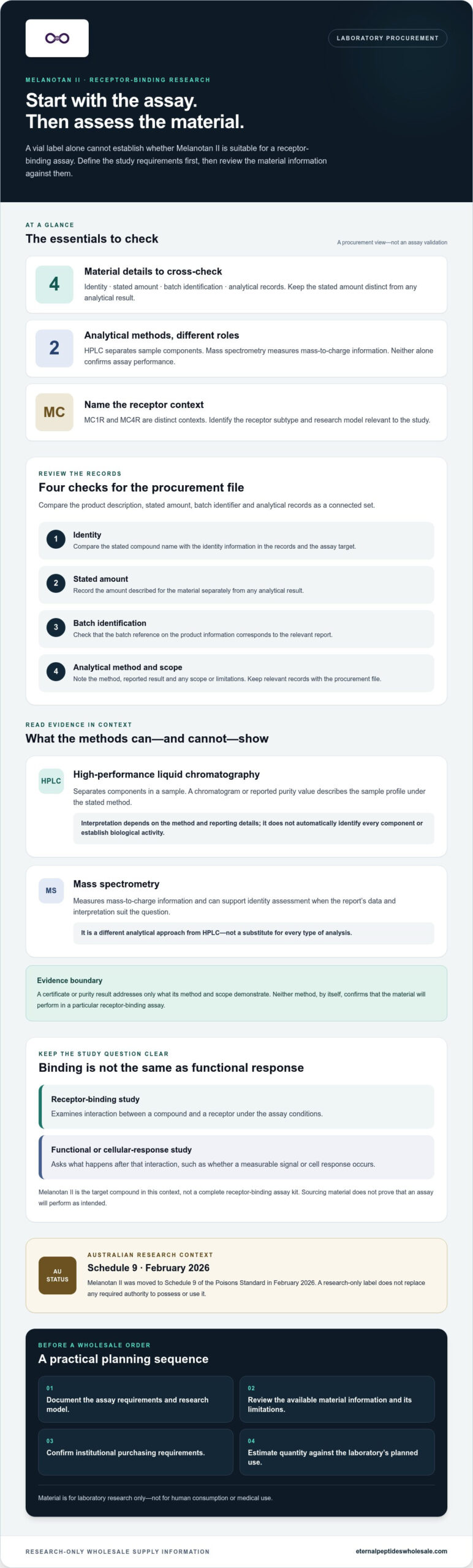
A vial label can’t establish whether Melanotan II is suitable for a receptor-binding assay. For Australian laboratories, Melanotan II receptor binding assay supply decisions should start with the study requirements, relevant analytical information and lawful research context, not the product name alone.

Before committing to a wholesale order, compare the information available about the material with the laboratory’s requirements. A certificate or purity result addresses only what its method and scope demonstrate. It doesn’t, by itself, validate a product for a particular assay or establish permission to possess or use it. In Australia, Melanotan II was moved to Schedule 9 of the Poisons Standard in February 2026. A research-only label doesn’t replace any required authority.

This guide explains how to define procurement criteria for receptor-binding research, assess analytical information without overstating its evidential value, and plan quantities and purchasing needs for laboratory use. It also outlines Eternal Peptides Wholesale’s research-only wholesale supply of Melanotan II 10mg for professional B2B purchasing.

Key Takeaways

  • Define the receptor-binding assay’s requirements before assessing Melanotan II. The compound is not a complete assay kit.
  • Use a supply checklist to compare identity, stated amount, batch identification and analytical records.
  • Interpret HPLC and mass spectrometry as distinct methods, and consider what each record can and cannot establish.
  • Compare supply routes by assay fit, evidence access, traceability and suitability for your laboratory’s purchasing scale.
  • Plan a wholesale order by documenting assay needs, reviewing available material information, confirming institutional purchasing requirements and estimating quantity. Eternal Peptides Wholesale offers Melanotan II 10mg for research purposes.

Melanotan II receptor-binding assay supply: define the research need first

Procurement should begin with the assay, not the vial. For Melanotan II receptor binding assay supply, the research team should identify what its method requires from the test material and what information it needs to retain. This gives the team a clearer basis for comparing supply options than selecting a product by name alone.

Melanotan II is the target compound in this context, not a complete receptor-binding assay kit. The assay depends on the research method and its components. Binding studies examine interaction between a compound and a receptor under the assay conditions. Functional or cellular-response studies ask what happens after that interaction, such as whether a measurable signal or cell response occurs. These are related but distinct research questions. Sourcing material does not prove that an assay will perform as intended.

For general background on the compound, the Melanotan II Wikipedia article provides an overview of its history and context. It is not an assay protocol or evidence that a particular material is suitable for a laboratory method.

What does a receptor-binding assay need from its test material?

The research question determines which material attributes matter. A team may need to record the compound’s identity, stated amount and batch identifier, then assess relevant analytical information against its method requirements. Keep those material details separate from assay performance. A label or analytical result does not establish that a compound has been validated in a specific assay.

  • Identity: Record how the material is identified and compare that information with the assay’s target.
  • Stated amount: Note the quantity described for the material and how the laboratory will account for it in its own records.
  • Batch information: Capture identifiers that connect the material to its associated documentation.
  • Method fit: Document any requirements the assay protocol places on the test material. Don’t assume a catalogue description answers them.

A catalogue name is a starting point for procurement, not a suitability determination. The laboratory remains responsible for assessing material information within its study design and quality processes.

Which melanocortin receptor context should buyers identify?

Specify the receptor subtype and research model relevant to the study. MC1R and MC4R are distinct melanocortin receptor contexts. Naming one without clarifying the model can leave procurement records ambiguous. Identify the receptor construct or model described by the assay, then align purchasing documentation with that context. This is research planning, not guidance about tanning, medical outcomes or human use.

Supplied material is for laboratory research only, not human consumption or medical use. Keeping the receptor-binding question, experimental model and any downstream functional work distinct gives researchers and procurement teams a consistent basis for evaluating supply.

Assess Melanotan II documentation before matching it to an assay

Once assay requirements are defined, review material records as a connected set rather than treating a single certificate or percentage as a complete assessment. When comparing Melanotan II records, the practical questions are whether the records identify the material and batch clearly, and whether their scope is relevant to the laboratory’s purchasing and research records.

How should buyers interpret analytical records?

Start with a cross-check. Compare the product description, stated amount, batch identifier and analytical records, noting any differences or missing links. A report is more useful when its identifiers correspond clearly to the product and batch being considered. Keep relevant records with the procurement file so the team can trace which information informed its decision.

  • Identity: Compare the stated compound name with the identity information in the records.
  • Stated amount: Record the amount declared for the material, separately from any analytical result.
  • Batch identification: Match the batch reference on the product information to the relevant report.
  • Analytical method: Note the method used, the result reported and the scope or limitations described.

High-performance liquid chromatography (HPLC) separates components in a sample. A chromatogram or reported purity value can describe the sample’s profile under the stated method, but interpretation depends on the method and reporting details. It doesn’t automatically identify every component or establish biological activity.

Mass spectrometry measures mass-to-charge information and can support identity assessment when the report’s data and interpretation suit the question. It is a different analytical approach from HPLC, not a substitute for every type of analysis. Neither method, by itself, confirms that the material will perform in a particular receptor-binding assay.

For a broader procurement framework, the research peptide quality assurance guide can help place document review within a consistent purchasing process.

Which claims need stronger evidence?

Separate supplier descriptions from conclusions supported by experimental evidence. A supplier-provided purity statement describes a reported analytical result. On its own, it doesn’t demonstrate receptor-binding activity, validate an assay or show that the material is suitable for a specific research model. These are distinct claims and require evidence that directly addresses them.

Analytical purity alone does not prove receptor-binding activity or performance in a particular assay.

When reviewing a claim, ask what was measured, by which method, on which batch and under what stated conditions. Distinguish those documented facts from inferences the study team may need to test independently within its research framework. This helps prevent a precise-looking figure from carrying more weight than its supporting record warrants.

For Australian laboratories planning a wholesale research order, Eternal Peptides Wholesale supplies Melanotan II 10mg for research purposes. The Australian wholesale research supply pathway is part of a procurement process grounded in clear assay requirements and appropriately interpreted documentation.

Compare supply options using assay fit, evidence and procurement scale

Compare purchasing routes against the same research criteria rather than relying on broad quality labels. A catalogue may help identify a compound and stated vial amount, while batch-linked records can support traceability. Neither catalogue wording nor a purchasing route alone establishes suitability for a particular assay. Keep the comparison tied to the documented study plan, purchasing policy and required evidence.

How does a research buyer compare catalogue information?

Start by matching the compound name and stated amount to the study plan. Then assess whether batch identifiers connect the product details to supporting records. Catalogue descriptions are useful for an initial comparison, but they are supplier-provided information, not independent validation of assay fit.

Assay fit
Compare the described material and amount with the study’s documented requirements. A product listing cannot establish performance in the laboratory’s method.

Identity evidence
Compare the stated compound name with identity information in associated records. Note the source and scope of each piece of evidence.

Batch traceability
Look for identifiers linking product details to the corresponding batch documentation. Record any mismatch or missing connection for procurement review.

Order scale
Consider whether the purchasing route suits the approved study plan, institutional process and planned quantity. Wholesale procurement is distinct from retail single-vial purchasing.

This comparison focuses on documentation and procurement suitability, not on ranking routes as inherently better or worse. For example, clear links between batch details and records can make document review more straightforward. The appropriate order scale still depends on the programme’s approved requirements.

The Melanotan II wholesale specifications guide is relevant when reviewing product information for research procurement. Treat catalogue details as one part of the assessment, and keep conclusions within the scope of the records provided.

When does wholesale procurement fit a research programme?

Wholesale purchasing can suit a laboratory programme when its planned quantity, purchasing policy and research schedule align. Before setting an order scale, compare the approved study design with the laboratory’s capacity to manage the material and the institution’s procurement requirements. Avoid ordering based on an assumed assay outcome or a quantity chosen without reference to the study plan.

Eternal Peptides Wholesale is an Australian wholesale supplier of research-grade peptides, including Melanotan II 10mg for research purposes only. This is a laboratory research supply pathway, not retail single-vial purchasing or a clinical-use option. The Australian wholesale research supply is relevant to procurement teams assessing the offer against their research requirements.

Melanotan II receptor binding assay supply: A 2026 buyer’s guide

Plan an Australian wholesale order for laboratory research

A clear order workflow helps researchers, procurement staff and laboratory administrators work from the same requirements. Keep study design decisions separate from commercial decisions, and document the basis for each before approving an order.

  1. Define the assay need. Record the research question, receptor context, study design and material attributes required by the laboratory’s method. Establish these requirements before comparing order quantities or purchasing routes.
  2. Review the product and batch documentation. Record the stated compound name, amount and relevant batch identifier, then link these details to available supporting records. Keep this information in the laboratory’s purchasing and research documentation, distinguishing supplier descriptions from conclusions established by the study.
  3. Confirm institutional purchasing requirements. Follow the organisation’s processes for supplier records, approvals and purchase documentation. Where Australian regulatory or import questions apply, verify current requirements directly through authoritative Australian sources, such as the relevant government agency. Don’t rely on an unverified summary or assume a research-use description resolves regulatory questions.
  4. Plan the quantity. Align the requested amount with the approved research plan, purchasing policy and the laboratory’s capacity to manage the order. Avoid choosing a quantity based on assumptions about experimental performance or unverified storage specifications.

What should procurement teams settle before ordering?

Agree on one written specification that researchers and purchasing staff can use consistently. It should identify the research purpose, requested material, amount, batch-recording needs and institutional approval pathway. This gives the team a shared reference for preparing purchasing records and receiving documentation, without adding unsupported assumptions about shipping timelines or handling conditions.

Keep regulatory and import statements out of order notes unless they have been checked against current, authoritative Australian guidance and are relevant to the circumstances. Rules can be technical and may depend on the activity and context. This guide doesn’t establish an organisation’s legal authority or replace formal institutional review. Check official sources rather than inferring obligations from catalogue wording.

How can teams reduce avoidable sourcing friction?

Use the same written specification across the research plan, purchasing request and laboratory records. That helps prevent inconsistencies, such as a purchasing request naming a different amount from the study plan or a batch identifier being omitted from the receiving record. Keep assay design choices with the research team and commercial ordering decisions within the relevant procurement process.

Checklist: define the assay need, review product and batch records, confirm institutional purchasing requirements, then align quantity with the approved plan before order approval.

The Australian wholesale research peptide procurement guide provides additional context for structuring a purchasing workflow. The Melanotan II 10mg wholesale supply pathway from Eternal Peptides Wholesale is for laboratory research customers nationally.

Source Melanotan II 10mg wholesale for research through Eternal Peptides Wholesale

Once assay requirements, documentation criteria and purchasing approvals are aligned, assess the supply decision against a defined laboratory need. Eternal Peptides Wholesale is an Australian wholesale supplier of research-grade peptides, including Melanotan II 10mg supplied for research purposes. The offer is for research use only, not for human consumption or medical use.

This distinction matters for procurement records. Wholesale supply is intended for professional purchasing, not retail single-vial sales. Eternal Peptides Wholesale does not sell retail single-vial products or provide medical consultations. Its role here is research supply, not advice on treatment, tanning or other personal use.

What can buyers expect from the confirmed supply offer?

The wholesale offer is Melanotan II 10mg for research purposes. That product description does not establish assay validation, analytical results or performance outcomes. Laboratories should assess the product information available against their study documentation and institutional purchasing process, keeping supplier details distinct from conclusions established by their own research.

That distinction supports a professional B2B decision. The appropriate basis for an order is a documented laboratory requirement and an approved quantity, not assumptions about biological effect or suitability for a particular method. Evaluation of research material remains within the laboratory’s own scientific and institutional framework.

What is the next step for a laboratory buyer?

Bring the key procurement records together: the assay requirements, product and batch information under review, documentation criteria, institutional purchasing approvals and the quantity supported by the research plan. This gives researchers and procurement staff a shared basis for evaluating the order and filing its records.

The Melanotan II wholesale supply information is relevant for buyers reviewing the research supply offer. Use it alongside documented study needs, not as a substitute for assay-specific assessment or institutional processes.

For laboratories whose approved research requirements align with the wholesale offer, explore Melanotan II 10mg wholesale for research through Eternal Peptides Wholesale. A disciplined approach to sourcing assay material keeps the decision focused on research purpose, evidence review and appropriate order planning.

Move from assay criteria to a considered order

A sound purchasing decision begins with a clear record of why the material is needed and how the laboratory will assess its suitability. Keep the study’s requirements, evidence review and purchasing approval connected, while treating them as distinct steps. This gives researchers and procurement teams a practical basis for making decisions and maintaining clear records.

For receptor-binding work, align documented research needs with a supply pathway designed for laboratory use. Eternal Peptides Wholesale is an Australian supplier serving research customers nationally, with Melanotan II 10mg available wholesale for research purposes only. The supply is not for human consumption or medical use.

Research teams can explore Melanotan II 10mg wholesale for research and assess the offer against their procurement requirements. A defined study plan and considered purchasing process give the team a clear basis for its decision.

Frequently Asked Questions

What is Melanotan II receptor-binding assay supply?

It means sourcing Melanotan II material for a laboratory study examining receptor binding, rather than purchasing a complete assay kit. The term describes a procurement requirement, not evidence that a product will work in a particular experimental system. Before sourcing, specify the receptor and research model, then decide which records the laboratory needs to retain. Eternal Peptides Wholesale supplies Melanotan II for research purposes only, not for human consumption or medical use.

Can Melanotan II be used in a receptor-binding assay?

Its suitability depends on the study design, receptor system, assay format and evidence available for the relevant batch. For example, a research team working with a particular receptor model should assess material information against that model’s protocol, rather than infer fit from a catalogue name. A purity figure alone can’t establish binding performance. This supply is strictly for laboratory research, not human or medical use.

How do HPLC and mass spectrometry help assess research peptide supply?

HPLC provides chromatographic information about a sample, while mass spectrometry can support assessment of molecular identity. These methods address different analytical questions, so interpret each report according to its method details and stated scope. For example, check that a report’s batch identifier corresponds to the material being considered. Neither method, by itself, demonstrates how a sample will behave in a particular receptor-binding assay.

Does a purity report prove receptor-binding activity?

No. A purity report provides analytical information about a sample, but it doesn’t independently show receptor binding, assay performance or suitability for a specific research model. Those conclusions need evidence relevant to the experimental system and its validation. Avoid treating one reported figure as a complete assessment. In laboratory records, note which batch the report describes and keep analytical findings distinct from functional or biological evidence.

Is Melanotan II 10mg available for wholesale research supply in Australia?

Eternal Peptides Wholesale offers Melanotan II 10mg through its wholesale research supply in Australia. The offer is for research purposes only, not for human consumption or medical use. It’s a wholesale product, rather than a retail single-vial purchase. Research buyers can use the stated amount when preparing an institutional purchasing request, then align the proposed order with study documentation and internal procurement procedures.

What should a laboratory check before ordering Melanotan II for an assay?

Begin by recording the receptor and assay context in the purchasing request, then identify the product details and batch records needed for laboratory files. Compare the stated compound and vial amount with the approved study plan. If the research protocol changes, update the purchasing documentation before ordering so the rationale and requested quantity remain aligned. Follow institutional purchasing procedures and verify applicable requirements through authoritative sources.

Is Melanotan II supplied for human consumption or medical use?

No. Eternal Peptides Wholesale supplies research-grade peptides for laboratory research purposes only. Its Melanotan II wholesale offering isn’t intended for human consumption, tanning, diagnosis or treatment, and the business doesn’t provide medical consultations. Research supply information should not be interpreted as guidance about personal use. Keep procurement and research activity within the relevant institutional framework, with study documentation and purchasing records reflecting the laboratory purpose.

Related from Eternal Peptides Wholesale

Eternal Peptides Wholesale publishes batch-specific Janoshik Analytical reports in its certificate of analysis library, so the documentation for a listed batch can be read alongside the evidence discussed in this article.

Related reading: Melanotan II Bulk Wholesale: Technical Specifications for Australian Research

Posted on

How to Vet a Research Peptide Company: An Australian Lab Checklist

How to Vet a Research Peptide Company: An Australian Lab Checklist

A supplier’s most persuasive claim may tell you less than a document linked to the batch on offer. Knowing how to vet a research peptide company means looking beyond product descriptions to assess whether its evidence is verifiable and its operations suit your laboratory’s procurement requirements.

It’s reasonable to expect documentation that matches the product and batch under consideration, along with clear answers about wholesale terms, ordering and communication. A research-use designation or confident quality claim isn’t independent evidence on its own. Check and record each detail before you commit.

This guide sets out a repeatable due diligence process: what to request, how to review batch-specific analytical documents, and which business and operational details to clarify. For example, Eternal Peptides Wholesale identifies itself as an Australian-based, wholesale-only supplier, with products designated for research purposes. Those statements describe its business scope, but they don’t independently establish the quality of a specific batch. Use the checklist to distinguish stated facts from evidence, assess supplier fit and document a decision against your laboratory’s requirements.

Key Takeaways

  • Use a five-stage process to assess company identity, evidence, product fit, operations and your procurement decision.
  • When learning how to vet a research peptide company, check whether documents identify the specific product and batch being offered.
  • Compare suppliers using verifiable criteria. Record unavailable evidence as unconfirmed rather than assuming it meets your requirements.
  • Check that supplier and order records align with your laboratory’s purchasing and receiving procedures. Request written details where needed.
  • Separate stated business scope from independently verified quality evidence when assessing whether a wholesale supplier fits your laboratory.

How to vet a research peptide company before your laboratory buys

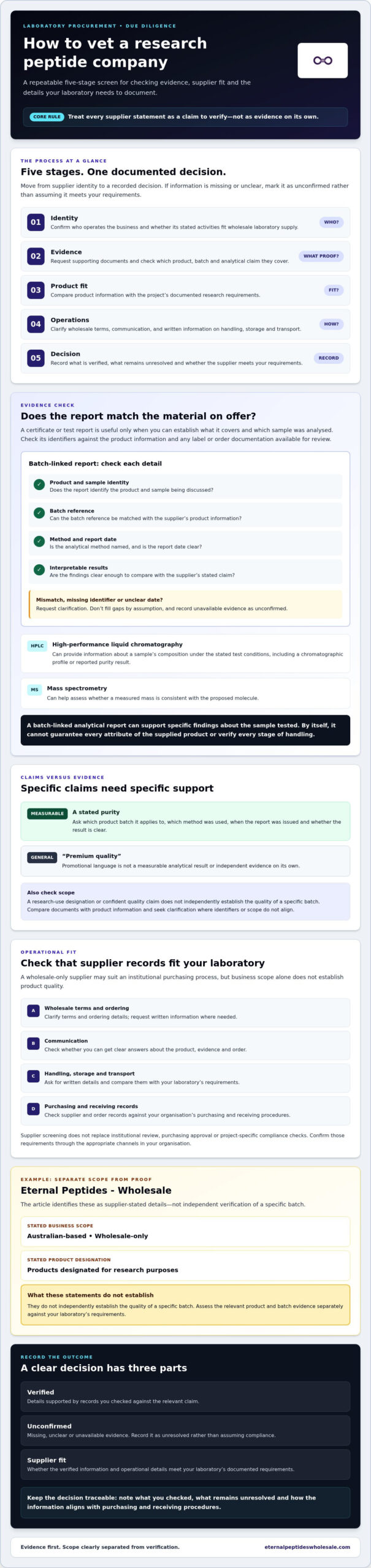
A defensible supplier decision relies on records you can check against your laboratory’s requirements, not confidence created by polished marketing. To understand how to vet a research peptide company, treat each statement as a claim to verify. Check it against documents, references where relevant, and your organisation’s purchasing and receiving criteria.

Use a consistent five-stage screen:

  • Identity: Confirm who operates the business and whether its stated activities fit wholesale laboratory supply.
  • Evidence: Request supporting documents and check which product, batch and analytical claim they cover.
  • Product fit: Compare the product information with the project’s documented research requirements.
  • Operations: Clarify wholesale terms, communication, and written information about handling, storage and transport.
  • Decision: Record what is verified, what remains unresolved and whether the supplier meets your requirements.

What should supplier vetting establish?

Start by confirming the supplier’s identity and stated business scope. A wholesale-only supplier may suit an institutional purchasing process, but that alone doesn’t establish product quality. Ask what evidence supports the specific product and any claims about quality or handling. Check that documents relate to the product under consideration, rather than relying on a generic example. Log missing or unclear information as unconfirmed and assign follow-up. Don’t treat silence as evidence of compliance.

Questions about product manufacture are another reason to be precise, not to make assumptions. A basic explanation of chemical peptide synthesis can provide context for why manufacturing or analytical statements need clear supporting records. The explanation itself doesn’t verify a supplier’s process or establish the quality of a particular batch.

Which claims deserve closer scrutiny?

Separate measurable statements from broad promotional language. A stated purity is a specific analytical claim; “premium quality” is not. For each measurable claim, ask which product batch it applies to, which method was used, when the report was issued and whether the result is clear. Compare those details with the product information and the supplier’s explanation. If identifiers or scope don’t align, seek clarification before relying on the claim.

Keep the review within laboratory procurement. Language that implies human use, treatment or performance outcomes isn’t evidence of suitability for a research project and falls outside this research-use guide. Supplier screening also doesn’t replace institutional review, purchasing approval or project-specific compliance checks. Confirm those requirements through the appropriate channels at your organisation before proceeding.

Check company identity and research peptide quality evidence

A certificate or test report is useful only if you can establish what it covers and which sample was analysed. A polished document without a clear product identifier, batch reference or testing scope may be impossible to connect to the material being offered. When working out how to vet a research peptide company, ask not just whether a report exists, but whether its details can be checked against the supplier’s claims.

A batch-linked analytical report can support specific findings about the sample tested. It cannot, by itself, guarantee every attribute of the supplied product or verify every stage of its handling. Treat the report as one piece of evidence and assess its scope against your laboratory’s requirements.

How to assess HPLC and mass spectrometry reports

Check that the report identifies the sample and relevant batch, names the analytical method, and provides a date and interpretable results. Compare its product name and batch reference with the supplier’s product information and any label or order documentation available for review. Differences, missing identifiers or unclear dates are reasons to request clarification, not details to fill in by assumption.

Methods answer different questions. High-performance liquid chromatography (HPLC) can provide information about a sample’s composition under the stated test conditions, including a chromatographic profile or reported purity result. Mass spectrometry (MS) can help assess whether a measured mass is consistent with the proposed molecular identity. Neither result proves every quality attribute. A chromatogram or mass spectrum is not, on its own, a complete quality guarantee or evidence about handling and storage.

Ask what the report’s conclusions actually support. If a supplier makes a claim about identity, purity or another attribute, request the relevant result and method rather than treating one test as evidence for everything.

How to confirm business and document consistency

Compare the company name on the report with the supplier’s stated business identity. If a separate laboratory performed the analysis, ask which laboratory it was and whether the supplier can clarify the relationship between that laboratory, the report and the sample. A third-party name alone doesn’t establish that the document relates to the batch under consideration.

Record the answers and any gaps. For more context on evaluating quality systems in procurement, consult this research peptide quality assurance guide. Eternal Peptides Wholesale identifies itself as an Australian-based, wholesale-only supplier of research-use products. Those stated business details are separate from batch-specific analytical evidence, which buyers should confirm for the product being considered.

Reviewing a supplier’s stated scope can help you assess wholesale fit alongside technical evidence. You can review Eternal Peptides Wholesale’s supplier information as part of that assessment, while requesting any product-specific documentation your procurement process requires.

Compare suppliers using evidence, transparency and procurement fit

A structured comparison makes supplier differences easier to assess and reduces the influence of persuasive but unsupported claims. To understand how to vet a research peptide company, compare like with like: the same product, comparable batch context and the same documentation requests. Laboratories apply these same verification principles to batch testing and purity documentation when evaluating any supplier, including overseas suppliers. Keep technical evidence separate from business reliability. A report may support a specific analytical claim, while communication, terms and wholesale fit determine whether the supplier suits your procurement process.

Use a comparison table and score only criteria you can verify. Mark missing or unclear information as unconfirmed, not as a low-risk assumption.

Criterion What to check Record
Evidence Does the documentation identify the product and explain its relationship to the sample or batch? Verified, unconfirmed or follow-up required
Communication Are answers accurate, complete and consistent with the documents? Examples and unresolved questions
Product fit Does the available product information align with the laboratory’s documented project requirements? Fit confirmed or not established
Terms Are wholesale conditions and purchasing details clear in writing? Terms reviewed or clarification needed
Open questions What information is still missing or needs institutional review? Owner and next step

What to ask before accepting a supplier’s claims

Request the documentation relevant to the product under consideration, then ask how it relates to the sample or batch being offered. Check whether product identifiers connect across the quotation, packaging information and supporting records. If names, references or descriptions differ, ask the supplier to explain the discrepancy in writing.

Record the quality of the response, not just whether a reply arrived. Does it address the question directly? Are limitations acknowledged? Can the supplier clarify what a document does and doesn’t establish? Score only observable answers and records. Don’t award points for claims you can’t independently assess.

How to compare wholesale suitability

Technical quality evidence and procurement suitability are separate assessments. Confirm whether the supplier’s wholesale model, written terms, product information and support channels align with your laboratory’s order and approval process. When assessing direct-supply arrangements, compare the terms and documentation each supplier provides. A supplier may be a potential operational fit while specific quality evidence remains unconfirmed, or the reverse. Keep both findings visible in your comparison rather than blending them into one overall impression.

For broader sourcing considerations, consult this Australian wholesale research peptide procurement guide. You can also review Eternal Peptides Wholesale’s stated supplier scope as one input to a comparison, while assessing product-specific evidence and procurement fit separately.

How to Vet a Research Peptide Company: An Australian Lab Checklist

Verify Australian operating, documentation and institutional requirements

An Australian operating presence can be relevant to procurement, but it doesn’t establish that a product is lawful for a particular purpose, that an import is permitted or that the product is suitable for your research. Check the supplier, product and proposed activity against the requirements that apply to your organisation. Keep those checks separate from technical quality assessment.

What Australian buyers should confirm

Requirements can depend on the compound, intended research activity and institutional setting. Don’t rely on a supplier’s location or a research-use-only statement as a substitute for checking. Consult current information from the relevant Australian regulator, such as the Therapeutic Goods Administration where applicable, and seek advice from your institution’s compliance staff or a qualified adviser if the position is unclear. Don’t apply a general statement to a specific compound or project without confirmation.

Before progressing an order, check the proposed purchase against your institution’s procedures. Confirm who can approve it, which records must be retained and what receiving checks are required. Make sure the order and product identifiers can be reconciled with the paperwork your team needs to file. These internal controls help turn supplier information into a reviewable procurement record.

How to assess fulfilment and communication

Ask the supplier for written details on handling, storage and transport, and confirm that the instructions are clear enough for your receiving process. Verify supplier-specific statements rather than assuming standard practices apply. You can also ask what order, dispatch and delivery information will be provided, and how the supplier would respond if a document or identifier didn’t match the order.

  • Can the supplier explain which records accompany the order?
  • Are product identifiers consistent across the order information and supporting documents?
  • Who should your procurement team contact about a discrepancy, and how will the issue be documented?

Record unanswered questions as unresolved. If instructions are vague, request clarification before approval rather than filling gaps with assumptions. This is a practical part of how to vet a research peptide company: assess what can be verified, then refer remaining questions to the relevant institutional or regulatory contact.

Eternal Peptides Wholesale describes itself as an Australian-based, wholesale-only supplier of research-use products. Those details can inform an initial business-fit review, but they don’t establish regulatory status, product suitability or specific handling and delivery arrangements. Confirm those points independently before relying on them.

For a supplier-scope review alongside your institutional checks, review Eternal Peptides Wholesale’s stated business information and verify any product or operational details your procurement process requires.

Make a documented supplier decision and assess Eternal Peptides Wholesale

Turn your checks into a decision record before seeking procurement approval. This gives reviewers a clear account of what the supplier has demonstrated, what remains uncertain and why the supplier is or isn’t suitable for the laboratory’s requirements. It also makes reassessment easier if product information, terms or institutional requirements change.

A practical supplier approval checklist

Record each finding under one of four statuses: verified, unverified, unsuitable or follow-up required. Check the supplier’s stated business scope, product identity, available product-specific documentation and written wholesale terms. Resolve discrepancies between claims, records and your laboratory’s specifications before approval.

  • Verified: A claim supported by records you’ve reviewed.
  • Unverified: Information that is missing or hasn’t been independently checked.
  • Unsuitable: A requirement the supplier or product doesn’t meet.
  • Follow-up required: A question awaiting clarification or institutional review.

Include who completed the review, which documents were considered, outstanding questions and the date or trigger for reassessment. Don’t treat an unanswered request as confirmation. If a key requirement remains unresolved, state that clearly in the record and follow your organisation’s approval process.

When to contact a wholesale supplier

Prepare a concise enquiry before contacting a supplier. Identify the product under consideration, the order volume your laboratory requires, and the documentation or written operational details needed for review. Ask whether product-specific evidence is available and how its identifiers relate to the product offered. Keep the discussion within research procurement. Supplier enquiries aren’t a substitute for medical advice or guidance on human use.

Assess Eternal Peptides Wholesale against confirmed scope only: it identifies itself as Australian-based and wholesale-only, and its products are designated for research purposes. Those facts may help establish whether its stated business model aligns with your purchasing needs. They don’t confirm that a particular product meets your specifications or that batch-specific reports, certifications, handling processes or other supporting records are available. Request and review the relevant information directly rather than assuming it exists.

A careful approach to how to vet a research peptide company ends with a measured decision, not automatic approval. Confirm business fit, documentation and outstanding requirements with the supplier, then complete your institution’s review before procurement approval. To check the stated wholesale range and raise product-specific questions, review Eternal Peptides Wholesale’s wholesale research range.

Make your next supplier decision evidence-led

A repeatable vetting process turns supplier claims into a decision your laboratory can explain and review. Match documents to the product and batch, assess wholesale and operational fit separately from technical evidence, and record what is verified, unresolved or unsuitable. Knowing how to vet a research peptide company also means checking project and institutional requirements rather than assuming a supplier’s stated location or scope settles them.

Eternal Peptides Wholesale describes itself as an Australian-based, wholesale-only supplier, with products designated for research purposes. Its listed wholesale offerings include Retatrutide 10mg. These are stated business details, not a substitute for requesting product-specific documentation or completing your laboratory’s own review.

For a practical next step, review Eternal Peptides Wholesale’s wholesale research range and confirm the product information and documentation relevant to your procurement requirements directly. A careful, recorded assessment gives your team a clearer basis for deciding whether to proceed.

Frequently Asked Questions

How do I vet a research peptide company?

Use a documented process to check the supplier’s identity, product-specific evidence, wholesale fit and operational information against your laboratory’s requirements. Compare product and batch identifiers across available records, clarify what analytical reports establish, and record gaps as unverified. Confirm institutional approvals and any applicable Australian requirements separately. A supplier’s location or research-use-only designation isn’t, by itself, proof of product quality, compliance or suitability for a particular project.

What documents should a research peptide supplier provide?

Ask what product-specific records are available for the item under consideration. Depending on your procurement requirements, these may include an analytical report with clear product and sample identifiers, order or quotation details, and written information about handling, storage and transport. Check whether the documents relate to the product or batch being offered, and ask who prepared any test report. Don’t assume a particular document, certification or quality system is available without confirmation.

Can I rely on a certificate of analysis for research peptides?

A certificate of analysis can support specific findings about the sample it identifies, but it shouldn’t be treated as a complete quality guarantee. Check the named product, sample or batch reference, date, analytical methods and reported results. Consider whether the report addresses the attribute being claimed, such as identity or purity. It won’t necessarily establish other product attributes, handling history or suitability for your laboratory’s research requirements.

How can I check whether a peptide test report matches the product batch?

Compare the report’s product name and batch or sample reference with the supplier’s product information and the records associated with the proposed order. Check that dates, identifiers and descriptions are consistent, and ask the supplier to explain any difference in writing. If the report doesn’t identify a relevant batch or sample, its connection to the product being offered remains unconfirmed. Record that gap and seek clarification before relying on the result.

Are research peptides from an Australian supplier automatically compliant for my laboratory?

No. An Australian-based supplier’s location doesn’t establish that a product or proposed research activity meets applicable requirements. The relevant considerations can depend on the compound, project and institution. Check current information with the appropriate Australian regulator or a qualified compliance adviser, and confirm your organisation’s purchasing, approval and receiving procedures. Treat supplier statements as information to verify, not as a substitute for institutional review or project-specific checks.

What should I do if a peptide supplier cannot answer technical questions?

Pause the assessment and record which questions remain unanswered. Request clarification on the specific product, report scope, sample or batch identifiers, and any stated analytical results. If the response remains incomplete or doesn’t match the available records, mark the point as unverified and follow your laboratory’s escalation or approval process. Don’t interpret a confident sales response, or the absence of an answer, as technical evidence.

Can research peptides be purchased for personal use?

This supplier’s products are designated for research purposes only, not for human consumption or medical use. A research-use label doesn’t establish that a product is appropriate or authorised for personal use. Rules may depend on the substance and circumstances, so don’t rely on supplier marketing to determine personal-use status. Check current Australian guidance with the relevant regulator and consult a qualified health professional for personal health questions. The supplier doesn’t provide medical consultations.

Trusted Australian peptide suppliers: separate three kinds of evidence

Company identity, analytical findings and suitability for your experiment require different evidence. Contact information helps establish who is making the offer. A laboratory report describes a tested sample. Your acceptance criteria determine whether those findings are sufficient for the intended work. None of these checks can stand in for the other two. [1][2]

When a supplier describes its peptides as independently tested, request the report identifier and confirm the exact product and lot relationship. Janoshik provides a report-verification facility, but verification of a report alone is not proof that an untested consignment is identical to its submitted sample. [3]

For the next step, review the Australian research peptide buying guide and the batch-verification checklist. Contact Eternal Peptides Wholesale with the exact product and any unanswered documentation questions.

Related from Eternal Peptides Wholesale

Eternal Peptides Wholesale publishes batch-specific Janoshik Analytical reports in its certificate of analysis library, so the documentation for a listed batch can be read alongside the evidence discussed in this article.

Related reading: How to Write a Peptide Procurement Proposal: A Practical Guide; TGA Research Peptide Guidelines: 2026 Compliance Guide

References and bibliography

  1. Eternal Peptides Wholesale. Contact and Australian store locations. Accessed 27 September 2026.
  2. McCarthy D, Han Y, Carrick K, Schmidt D, Workman W, Matejtschuk P, Duru C, Atouf F. 2023. Reference Standards to Support Quality of Synthetic Peptide Therapeutics. Pharmaceutical research. 40(6):1317-1328. doi:10.1007/s11095-023-03493-1.
  3. Janoshik Analytical. Report verification. Accessed 27 September 2026.