Melanotan 2, also written Melanotan II, is not approved as a tanning agent in Australia. Recent regulator testing illustrates why label claims need verification. (TGA, 2026b)
What did the TGA find?
In its 17 August 2026 advisory, the TGA reported testing five bottles labelled as containing 30 mg. Estimated Melanotan II content ranged from 22 mg to 54 mg, based on the labelled bottle volume. The regulator also stated that Melanotan II is prescription-only and that no products containing it were included in the ARTG at the time of that advisory. (TGA, 2026b)
How far were those measurements from the label?
The following is our arithmetic using the TGA’s published range, not new laboratory testing:
Editorial calculations from TGA measurements and the 30 mg label claim (TGA, 2026b)
Reported end of range
Difference from 30 mg
Percentage difference
22 mg
8 mg below
26.7% below
54 mg
24 mg above
80.0% above
Method: percentage difference = (reported amount − label amount) ÷ label amount × 100. Values are rounded to one decimal place. The highest reported estimate was approximately 2.45 times the lowest.
These figures describe five seized samples. They do not establish a market-wide failure rate, and the public range does not supply every bottle’s result or the mean. That limitation matters as much as the arithmetic.
Why a percentage on a label is not enough
Identity, amount and consistency are separate questions. A product could be described with a high purity percentage while its amount differs from the label. A report concerning one submitted sample also cannot by itself establish the contents of every unit sold.
The practical reading habit is to ask exactly what was measured. “Contains the named substance”, “contains the claimed amount” and “has been assessed for a proposed human use” should never be collapsed into a single quality claim.
Does a melanotan tan protect against sunlight?
No. The TGA warns that increased pigmentation from melanotan does not provide the protection of suitable sunscreen. Its consumer warning also describes adverse effects and advises people who have used unapproved melanotan tanning products to stop and speak with a health professional. (TGA, 2025)
Is a nasal spray fundamentally different from an injection?
A change in route does not establish approval or safety. The relevant questions remain the substance, the product, its intended use and the supporting evidence. A route-specific claim needs evidence for that route; it cannot be inferred from the product’s packaging or convenience.
Are Melanotan I and Melanotan II interchangeable?
Do not treat similar names as interchangeable product identities. Check the exact substance in the source being quoted. Information about another compound or an authorised medicine for a specific condition cannot automatically support a tanning product.
What should a useful Melanotan 2 article include?
It should identify the date and scope of regulatory information, explain the limits of any test data and avoid implying that appearance of a tan is a health benefit. A numerical result is most useful when readers can see its denominator, calculation and source.
For any health-related claim, keep the source and wording together. A useful page lets readers check whether the conclusion follows from the evidence cited.
References
Linked author–year citations identify the source for the nearby statement. Publication years refer to the journal issue where available; earlier online dates are noted below. “n.d.” means no publication date is displayed; letter suffixes distinguish sources by the same organisation. Tables labelled as editorial interpretation are our reading of the cited evidence.
MOTS-c is studied in connection with mitochondrial biology, metabolism and exercise. One essential distinction is often lost in summaries: measuring a person’s own MOTS-c after exercise is not the same as giving that person a MOTS-c product and testing whether it improves health or performance.
What did the widely discussed 2021 paper study?
Reynolds and colleagues investigated MOTS-c in cell and mouse experiments and measured its response to exercise in humans. The administered-peptide performance experiments were in mice. The human exercise component measured naturally occurring MOTS-c in muscle and circulation; it was not a trial of MOTS-c injections in athletes. (Reynolds et al., 2021)
The distinction is not a technical footnote. It changes the conclusion a reader can draw. The human work supports a question about exercise biology, while the animal work supports questions for further investigation.
What other human exercise evidence is available?
A separate 2021 secondary analysis followed a 16-week exercise intervention in 49 breast-cancer survivors. Changes in measured MOTS-c differed between the two groups of participants described in that paper. Exercise was the intervention; administering MOTS-c was not. (Dieli-Conwright et al., 2021)
Another study randomised 30 participants between endurance exercise, resistance exercise and a control condition, measuring mitochondrial peptides and other responses. Its design again concerns exercise-associated biology. (von Walden et al., 2021)
Three claims that need different studies
Claim
Required evidence
Exercise changes endogenous MOTS-c.
Measurements before and after exercise with suitable comparisons.
Administering MOTS-c improves human performance.
A controlled human intervention measuring performance and harms.
A retail product reproduces a trial result.
Evidence matching the product, identity, formulation and use to the study.
Why correlation does not settle the treatment question
Suppose a biological marker rises after an activity associated with improved fitness. The marker might contribute to the response, reflect another change or vary with several processes at once. The observation alone does not show that supplying the marker externally reproduces the full effect of exercise.
This is a general reasoning point, not a claim that the mechanism is unimportant. Mechanistic findings can be valuable while the clinical question remains open. Good science is able to hold both statements at the same time.
Is MOTS-c an exercise replacement?
The selected papers do not establish that conclusion. “Exercise mimetic” is a research description that can refer to particular measured pathways or animal outcomes. It should not be read as evidence that a product reproduces the broad effects of physical activity in people.
Does the research establish weight-loss benefits?
A study designed around a molecular response or mouse performance cannot supply a reliable estimate of weight change in humans. That question needs a relevant human population, an appropriate comparison, a defined follow-up period and systematic collection of adverse events.
How to read the next MOTS-c headline
Look for the subject of the sentence: cells, animals or people. Then identify the intervention: exercise, a measurement, or administration of a defined compound. Finally, identify the endpoint. That three-step check often reveals whether the headline is summarising the actual experiment or extending its conclusion.
This article uses selected primary studies to explain those distinctions. It does not claim to catalogue every MOTS-c publication or establish an approved medical use. The useful outcome is a more precise question to take into the next paper.
References
Linked author–year citations identify the source for the nearby statement. Publication years refer to the journal issue where available; earlier online dates are noted below. “n.d.” means no publication date is displayed; letter suffixes distinguish sources by the same organisation. Tables labelled as editorial interpretation are our reading of the cited evidence.
Copper peptides are short amino-acid chains that hold a copper ion, and the best known is GHK-Cu, the copper complex of the tripeptide glycyl-L-histidyl-L-lysine (Pickart et al. 1980; PubChem CID 71587328). This review brings together what is reliably known about copper peptides from five angles: chemical identity and naming, coordination chemistry, the biology of copper, the laboratory and human evidence for the GHK peptide, and the way GHK-Cu is made, analysed and regulated in Australia. The chemistry is well characterised. In solution at neutral pH, GHK binds Cu(II) as a 1:1 complex through the N-terminal amine, a deprotonated backbone amide nitrogen and the histidine imidazole, leaving a fourth position open to water or other ligands (Freedman et al. 1982; Hureau et al. 2011; Conato et al. 2001). The biological picture is less settled. Cell and animal studies report effects on collagen, glycosaminoglycans, metalloproteinases and gene expression (Maquart et al. 1988; Wegrowski et al. 1992; Siméon et al. 1999; Campbell et al. 2012), but controlled human data are few, small and often old, and a 2026 systematic evidence map described the field as promising but unproven (Mateescu et al. 2026). In Australia, the TGA names GHK-Cu among unapproved peptide products that it has not evaluated for safety, quality or effectiveness, and a “research use only” label does not change a product’s regulatory status (TGA 2026c; TGA n.d.). This is an educational review of published research and regulation. It is not medical or legal advice and it describes no use in people or animals.
Key points
Copper peptides are peptides that hold a copper ion; the best known is GHK-Cu, the copper(II) complex of glycyl-L-histidyl-L-lysine, also listed as copper tripeptide-1 (PubChem CID 71587328; Pickart et al. 1980).
At pH 7.4, the GHK peptide binds Cu(II) through its terminal amine, a backbone amide nitrogen and the histidine imidazole, leaving a labile fourth site; the lysine side chain binds only at alkaline pH (Freedman et al. 1982; Hureau et al. 2011; Conato et al. 2001).
GHK can compete with albumin for copper at equal concentrations, but in plasma-like mixtures albumin still holds most of it (Lau & Sarkar 1981; Rózga et al. 2007).
Cell and animal studies report effects on collagen, glycosaminoglycans and matrix enzymes; controlled human evidence is limited, and a 2026 systematic review called the field promising but unproven (Maquart et al. 1988; Siméon et al. 1999; Mateescu et al. 2026).
In Australia, the TGA names GHK-Cu among unapproved peptide products, and a “research use only” label does not change a product’s regulatory status (TGA 2026c; TGA n.d.).
The phrase “copper peptides” is used in two ways. In chemistry it means any peptide that forms a stable complex with a copper ion, and there are many: the N-terminus of serum albumin, fragments of the amyloid-β peptide, repeats in the prion protein and countless synthetic sequences all bind copper (Harford & Sarkar 1997; Sóvágó & Osz 2006; Faller & Hureau 2009; Millhauser 2007). In everyday and cosmetic use, the phrase usually means one molecule in particular, GHK-Cu, and a handful of close relatives sold as cosmetic ingredients (Gorouhi & Maibach 2009; Schagen 2017). Much of the confusion in online discussion of copper peptides comes from sliding between these two meanings, so this review keeps them apart. When it says “GHK-Cu” it means the copper(II) complex of Gly-His-Lys. When it says “copper peptides” it means the wider chemical family. When it says “the GHK peptide” or “apo-GHK” it means the tripeptide without copper. A 2026 systematic review made the same separation for the same reason: claims made for one form are often borrowed for another (Mateescu et al. 2026).
GHK is unusual among peptides discussed in this field because it is natural, short and well studied as a chemical. It was first reported in 1973 as a factor in human plasma that affected the survival and growth of liver cells in culture (Pickart & Thaler 1973; Pickart et al. 1973), and by 1980 it was clear that it travelled with roughly equimolar copper (Pickart et al. 1980). Crystal structures were reported in the early 1980s (Perkins et al. 1984), and detailed solution studies followed over the next three decades (Lau & Sarkar 1981; Freedman et al. 1982; Conato et al. 2001; Hureau et al. 2011; Trapaidze et al. 2012). In parallel, a large body of cell, animal and gene-expression work grew up, much of it from the group that first described the peptide (Pickart 2008; Pickart et al. 2015; Pickart & Margolina 2018). That history explains why GHK-Cu has an unusually rich chemical literature and, at the same time, a thin clinical one.
This article does not repeat material covered elsewhere on this site. Readers who want a general introduction should start with What are peptides?, and readers who want to know how peptide signals act on cells can read What do peptides do?. The skin studies of GHK-Cu, including what each trial measured, are reviewed separately in GHK-Cu and copper peptides: what skin studies actually measure. This review concentrates on the questions those pages leave open: what GHK-Cu actually is as a chemical species, why copper binding matters, what the non-skin evidence shows, and how a synthetic copper peptide is made, verified and regulated.
Names and identity: GHK, GHK-Cu, copper tripeptide-1 and prezatide copper
A copper peptide can be described by sequence, by chemical name, by registry number and by trade or cosmetic name. These labels do not all point to the same substance, and the difference matters for analysis and for regulation. The free tripeptide, glycyl-L-histidyl-L-lysine, has the molecular formula C14H24N6O4 and a molecular weight of about 340.4 g/mol; it is listed in PubChem under CAS number 49557-75-7, and depositors record the synonyms “prezatide” and “tripeptide-1” (PubChem CID 73587). The 1:1 copper complex is listed separately as prezatide copper, with formula C14H23CuN6O4+, a molecular weight of about 402.9 g/mol, CAS number 89030-95-5 and the cosmetic ingredient name “copper tripeptide-1” among its depositor synonyms (PubChem CID 71587328). A bis complex, in which one copper ion is shared by two peptide molecules, has its own record and registry number (PubChem CID 71587328).
Three practical points follow. First, “tripeptide-1” and “copper tripeptide-1” are different ingredients: one has no copper. Second, the salt form matters. Commercial GHK-Cu is often supplied as an acetate or similar salt, and the copper complex in a published study was described as “glycyl-L-histidyl-L-lysine cuprate diacetate” (Hostynek et al. 2011). The counter-ion changes the mass of material needed to deliver a given amount of peptide or copper, so a label that gives only a total weight says little about either. Third, PubChem synonyms are supplied by depositors and are not a regulatory determination. They are useful for finding records, not for deciding how a product is regulated. Table 1 sets out the identifiers.
Table 1. Names and identifiers for GHK and its copper complexes. Registry data from PubChem; synonyms are depositor-supplied.
The table also shows why the “GHK copper peptides” label can mislead. AHK-Cu, for example, is a different tripeptide with alanine in place of glycine; findings for it cannot be transferred to GHK-Cu without evidence (Pyo et al. 2007). Similarly, KGHK, a four-residue sequence released from the matrix protein SPARC, binds copper strongly, yet its angiogenic activity in one study did not require copper to be added (Lane et al. 1994). Identity, in other words, is not just a naming question. It decides which literature applies.
Discovery: from a plasma growth factor to a copper-carrier hypothesis
The story of the GHK peptide begins with an observation about blood. In 1973, Pickart and Thaler reported that a factor in human serum prolonged the survival of normal liver cells in culture and stimulated growth in liver tumour cells (Pickart & Thaler 1973). A synthetic tripeptide with the same activity was described the same year (Pickart et al. 1973). The early work used the abbreviation GHL (glycyl-histidyl-lysine), and it emphasised that the effects varied widely between culture systems. By 1980, the same group reported that the peptide, added at nanomolar concentrations, produced responses ranging from stimulation of growth to outright toxicity, depending on the cells used (Pickart et al. 1980). During isolation, the peptide co-purified with approximately equimolar copper and a smaller amount of iron, and the authors proposed that it worked by helping cells take up copper (Pickart et al. 1980).
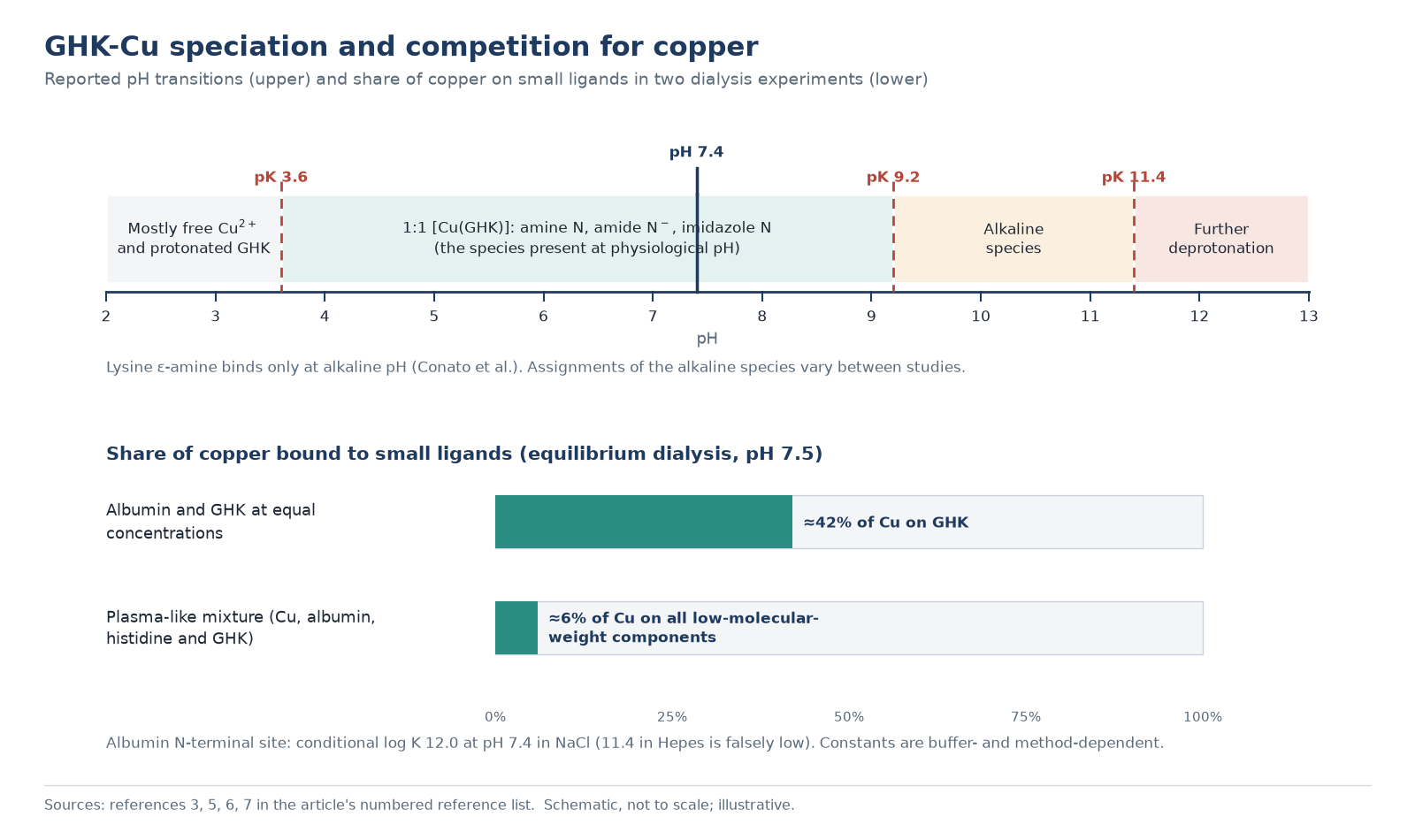
That copper-carrier hypothesis shaped everything that followed. If GHK’s effects depended on copper delivery, then its chemistry, how strongly it binds copper, whether it can hand copper to other molecules, and whether it changes copper’s redox behaviour, would be central to its biology. Lau and Sarkar tested part of this directly. In equilibrium-dialysis experiments at pH 7.5, GHK competed with serum albumin for Cu(II): with equal concentrations of albumin and peptide, about 42% of the copper was bound to the peptide (Lau & Sarkar 1981). At concentrations of copper, albumin, histidine and peptide closer to those in plasma, however, only about 6% of the copper was associated with low-molecular-weight components (Lau & Sarkar 1981). The peptide could take copper from albumin in a test tube, but in plasma-like conditions albumin still held most of it. This is one of the more important and less quoted findings in the field, because it limits how far the carrier idea can be pushed.
A second line of work asked where GHK comes from. Maquart and colleagues noted in 1988 that the sequence Gly-His-Lys occurs in the α2(I) chain of type I collagen, and suggested that proteases at a wound might release it (Maquart et al. 1988). Lane and colleagues later showed that proteolysis of SPARC, a matrix protein expressed during blood-vessel remodelling, released KGHK, GHK and longer peptides containing these sequences (Lane et al. 1994). In their experiments, KGHK and longer fragments stimulated angiogenesis, and both SPARC113–130 and KGHK bound Cu2+ with high affinity, but copper was not needed for the effect, and a second copper-binding SPARC fragment had no activity (Lane et al. 1994). These findings complicate the carrier story: at least one GHK-containing peptide appears to act through its sequence, not its copper.
Plasma concentrations have been reported to fall with age, from about 200 ng/mL at age 20 to about 80 ng/mL at age 60 (Dou et al. 2020). This figure is widely repeated, but it comes from a small number of older measurements, and the same review notes that no studies have linked lower GHK levels to specific ageing processes (Dou et al. 2020). A correlation between age and a plasma peptide level is not evidence that the peptide causes, slows or reverses any change.
Coordination chemistry: how the GHK peptide binds copper
Copper(II) is a d9 metal ion that prefers four strong donors arranged roughly in a square plane, often with one or two weaker donors above and below. Peptides offer three kinds of nitrogen donor: the free N-terminal amine, the nitrogen of a backbone amide once its proton has been removed, and side-chain groups such as the histidine imidazole (Sóvágó & Osz 2006). Amide deprotonation normally needs high pH, but a nearby anchoring group can make it happen at physiological pH by forming fused five- or six-membered chelate rings. Sóvágó and Ősz describe the strongest peptide binders as having a “double anchor”, such as the N-terminal amine plus a histidine in the third position (Sóvágó & Osz 2006). That arrangement is the ATCUN motif (amino-terminal Cu(II)- and Ni(II)-binding motif), NH2-Xaa-Xaa-His, found in serum albumin and many designed peptides (Harford & Sarkar 1997).
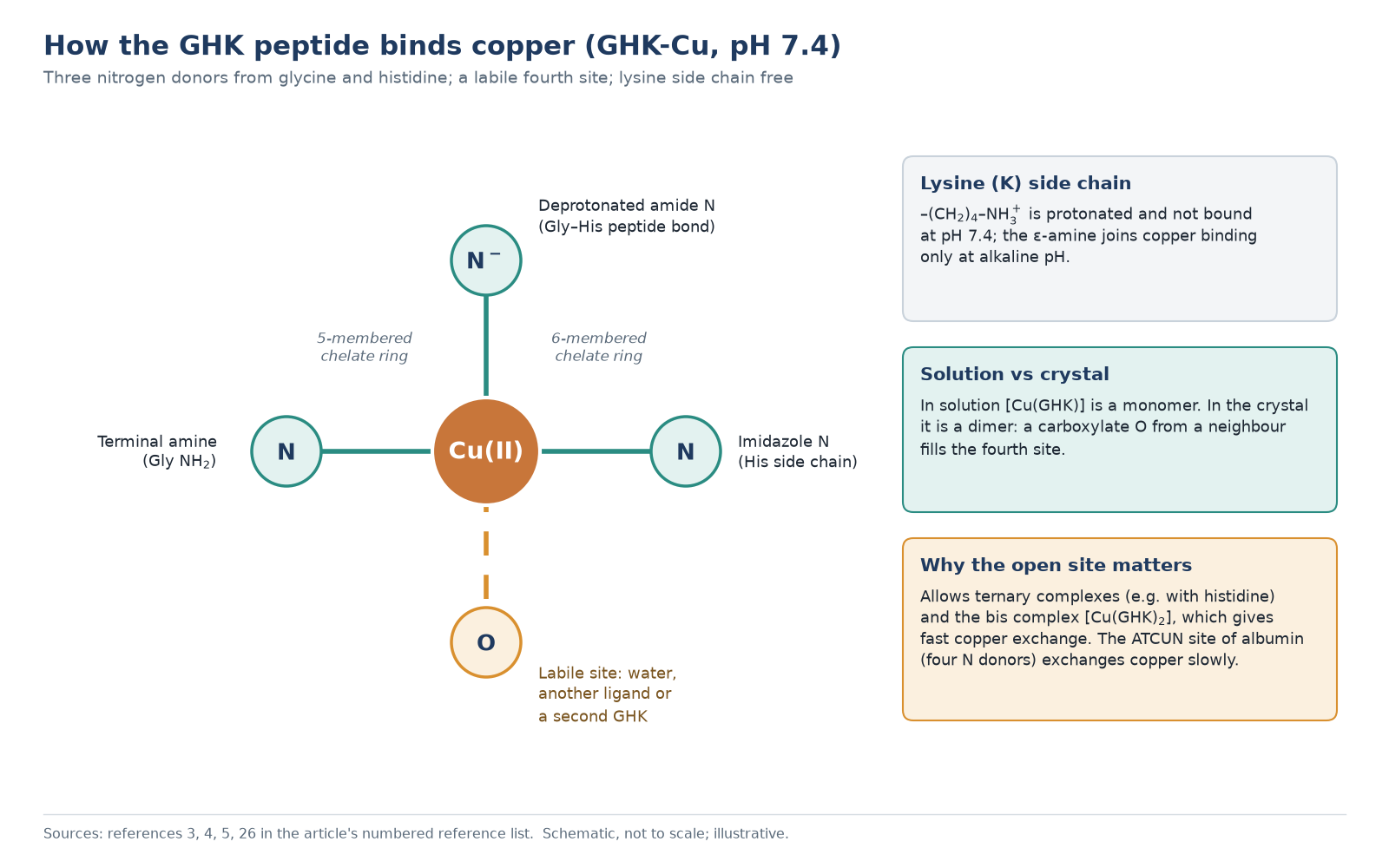
GHK has histidine in the second position, not the third, so it cannot complete the four-nitrogen ATCUN set. Spectroscopy shows what happens instead. Freedman and colleagues found that at neutral pH GHK forms a mononuclear 1:1 Cu(II) complex in which copper is bound equatorially by two or three nitrogen atoms, one of them from the imidazole ring (Freedman et al. 1982). A pH titration showed three transitions with apparent pK values of 3.6, 9.2 and 11.4; the complex present at physiological pH forms at the lowest of these (Freedman et al. 1982). Later work combining X-ray crystallography, EPR, X-ray absorption and NMR confirmed that in solution [Cu(GHK)] is monomeric with three nitrogen ligands, the terminal amine, one amidyl nitrogen and the imidazole nitrogen, while the fourth equatorial position is held by a labile oxygen donor (Hureau et al. 2011). In the crystal, the same complex is dimeric, with a carboxylate oxygen from a neighbouring molecule filling that fourth site (Hureau et al. 2011; Perkins et al. 1984).
Figure 1. How the GHK peptide binds copper at pH 7.4. Three nitrogen donors hold Cu(II) in GHK-Cu; the fourth equatorial site is labile and can be taken by water, another ligand or a second GHK molecule. The lysine side chain binds only at alkaline pH. Sources: Freedman et al. 1982 [3]; Hureau et al. 2011 [4]; Conato et al. 2001 [5]; Perkins et al. 1984 [26]. Schematic, not to scale; illustrative.
The lysine side chain is often drawn bound to copper in popular diagrams, but the solution data do not support that at physiological pH. Conato and colleagues, using potentiometry, calorimetry, UV-visible, circular dichroism and EPR, concluded that the lysine ε-amino group takes part in copper binding only at alkaline pH; at pH 7.4 it is protonated and free (Conato et al. 2001). They also found complexes of different stoichiometry and evidence for binuclear species (Conato et al. 2001). The open fourth site has practical consequences. It allows ternary complexes with other ligands, such as histidine or glycine (Lau & Sarkar 1981; Hureau et al. 2011), and it allows a second GHK molecule to bind, forming [Cu(GHK)2]. Hureau and colleagues attributed the fast exchange of copper between GHK molecules to this bis species, in contrast to the very slow exchange seen for the ATCUN peptide DAHK (Hureau et al. 2011).
Why is GHK-Cu blue?
The blue or violet colour of GHK-Cu solutions comes from d–d electronic transitions of the copper(II) ion. The exact colour depends on how many nitrogen and oxygen donors surround the metal: more nitrogen donors shift the absorption to shorter wavelengths, moving the colour from pale blue towards violet. This is why the visible absorption spectrum was used in the early speciation work to tell complexes apart (Lau & Sarkar 1981; Freedman et al. 1982). The colour is therefore a useful hint that copper is bound, but it is not an assay. A solution of copper salt with no peptide is also blue, and a degraded or partly complexed sample can look similar to a pure one. Copper content and peptide identity need separate measurements, discussed later in this review.
Affinity and speciation
How tightly does GHK bind copper? The question sounds simple but the answer depends on conditions. Binding constants for copper peptides are conditional: they apply at a given pH, ionic strength, temperature and buffer, and they can be distorted when the buffer itself binds copper. Rózga and colleagues showed this for albumin. In 100 mM NaCl at pH 7.4 they measured a conditional log K of 12.0 ± 0.1 for Cu(II) at the albumin N-terminal site, a picomolar affinity, but obtained a falsely lower value of 11.4 in 100 mM Hepes buffer because of a ternary copper–competitor–buffer complex (Rózga et al. 2007). For high-affinity peptides, direct titration is not enough: Trapaidze and colleagues showed that isothermal titration calorimetry gives accurate values for GHK and DAHK only when a weaker competing ligand, glycine, is included and its contribution corrected for (Trapaidze et al. 2012). They also found that binding to GHK was driven mainly by enthalpy, unlike DAHK (Trapaidze et al. 2012).
The competition data of Lau and Sarkar are, for most purposes, more informative than any single constant. They show that GHK binds copper strongly enough to compete with albumin at equal concentrations, but that in a plasma-like mixture albumin remains the dominant carrier (Lau & Sarkar 1981; Bal et al. 2013). For comparison, published estimates of the conditional dissociation constant of copper bound to amyloid-β span four orders of magnitude, from 10 pM to 100 nM, with a preferred range of 100 pM to 1 nM; much of the spread reflects differences in method (Faller & Hureau 2009). Figure 2 summarises the pH transitions and competition findings for GHK.
Figure 2. GHK-Cu speciation and competition. Upper panel: pH transitions reported for the Cu(II)–GHK system. Lower panel: share of copper held by small ligands in two equilibrium-dialysis conditions. Values are conditional and depend on buffer and method. Sources: Freedman et al. 1982 [3]; Conato et al. 2001 [5]; Lau & Sarkar 1981 [6]; Rózga et al. 2007 [7]. Schematic, not to scale; illustrative.
Redox behaviour
Free copper ions switch between Cu(II) and Cu(I) and can catalyse the formation of hydroxyl radicals from hydrogen peroxide, a Fenton-type reaction (Valko et al. 2016; Gaetke & Chow 2003). A key question for any copper peptide is whether binding suppresses or permits that chemistry. Hureau and colleagues used cyclic voltammetry and ascorbate oxidation to show that both [Cu(GHK)] and [Cu(DAHK)] are redox-inert under moderate potentials (Hureau et al. 2011). There was one difference: [Cu(GHK)] could be reduced to Cu(I) at about −0.62 V (versus Ag/AgCl), after which the copper was released, whereas [Cu(DAHK)] could not (Hureau et al. 2011). In practical terms, GHK holds copper in a form that is not readily redox-active, but under strongly reducing conditions it can let the metal go. That matters for the stability of formulations, discussed below.
GHK copper peptides in context: albumin, ATCUN motifs and other copper-binding peptides
GHK is one copper-binding peptide among many, and comparing it with its neighbours helps explain both its chemistry and the limits of what it can do. The most important comparison is with human serum albumin, the main copper carrier in blood after ceruloplasmin. Albumin’s N-terminal sequence, Asp-Ala-His-Lys (DAHK), is a classic ATCUN site that binds Cu(II) through the terminal amine, two deprotonated amide nitrogens and the histidine imidazole (Harford & Sarkar 1997; Hureau et al. 2011; Bal et al. 2013). Its picomolar conditional affinity at pH 7.4 (Rózga et al. 2007) and its high concentration in plasma make it the reference point against which any small copper carrier must be judged. Early work also showed that albumin, copper and histidine form a ternary complex, a reminder that small amino acids take part in copper handling in blood (Lau & Sarkar 1971; Lau & Sarkar 1981).
Other biological peptides bind copper for quite different reasons. The amyloid-β peptide, central to research on Alzheimer disease, binds Cu(II) and Zn(II), and the coordination sphere and affinity of these complexes have been debated for years (Faller & Hureau 2009; Viles 2012). The prion protein binds copper through repeated sequences in its unstructured N-terminal region, and the structures of these sites have been studied by a range of spectroscopic methods (Millhauser 2007). These systems are not copper carriers in the GHK sense, but they show that copper binding by a peptide is common and that the same metal can be held in many geometries with very different consequences.
Cosmetic chemistry has its own family of copper peptides. Reviews of topical peptides group ingredients by proposed function into signal peptides, enzyme-inhibitor peptides, neurotransmitter-inhibitor peptides and carrier peptides; copper peptides are the standard example of the carrier group, so named because they are thought to deliver trace metals (Gorouhi & Maibach 2009; Errante et al. 2020; Schagen 2017). The classification is descriptive, not a finding: placing GHK-Cu in the “carrier” box does not show that it delivers copper to any particular cell in skin. Table 2 compares the main binding sites.
Table 2. Copper-binding motifs relevant to copper peptides. Affinities are conditional and method-dependent; values from different studies should not be ranked directly.
Peptide or site
Main donors at pH 7.4
Typical complex
Affinity information
Key sources
GHK (Gly-His-Lys)
Terminal NH2, one amide N, His imidazole; fourth site labile
1:1 [Cu(GHK)]; 2:1 [Cu(GHK)2] at peptide excess
Competes with albumin at equimolar concentration (about 42% of Cu on peptide); about 6% of Cu on small ligands in plasma-like mixtures
Two lessons come out of the comparison. First, GHK is a strong copper binder, but not the strongest; ATCUN sites hold copper more tightly and exchange it more slowly (Hureau et al. 2011). Second, GHK’s open coordination site and fast exchange make it chemically suited to handing copper on, which is consistent with, but does not prove, the carrier hypothesis (Pickart et al. 1980; Hureau et al. 2011).
Copper biology: why the metal matters
Any discussion of copper peptides has to start from the biology of copper itself, because many reported effects of GHK-Cu could, in principle, be effects of copper. Copper is an essential cofactor for enzymes involved in energy metabolism, peptide hormone maturation, blood clotting and signalling (Kim et al. 2008; Festa & Thiele 2011). In humans, uptake, distribution and export are handled by a network of transporters and chaperone proteins that keeps free copper extremely low inside cells (Lutsenko 2010; Kim et al. 2008). Inherited disorders show what happens when that network fails: Menkes syndrome is a disorder of copper deficiency, and Wilson disease one of copper overload (Linder & Hazegh-Azam 1996).
One copper enzyme is directly relevant to the matrix effects often attributed to GHK-Cu. Lysyl oxidase is a copper-dependent amine oxidase that forms the cross-links holding collagen and elastin fibres together, and its functional activity depends on copper status (Rucker et al. 1998). If a cell-culture medium is short of copper, adding a copper complex could change collagen processing simply by supplying the metal. This is one reason why careful studies compare GHK-Cu with apo-GHK and with copper salts, and why studies that use only GHK-Cu cannot say whether the peptide, the copper or the pair is responsible.
Copper is also toxic in excess. Copper can initiate oxidative damage in vitro and in cell culture, and both excess and deficiency increase cellular susceptibility to oxidative injury (Gaetke & Chow 2003). Redox-active metals including copper can generate reactive oxygen species and modify proteins, lipids and DNA (Valko et al. 2016). In 2022, Tsvetkov and colleagues described a distinct form of copper-dependent regulated cell death in human cells, in which copper binds directly to lipoylated mitochondrial enzymes (Tsvetkov et al. 2022). Metal-catalysed oxidation also damages the very residues that bind metals: histidine can be converted to asparagine or aspartate, and lysine to aminoadipic semialdehyde (Stadtman 1990). For GHK-Cu, whose copper sits on a histidine and next to a lysine, that chemistry is a plausible route to degradation.
This biology cuts both ways. It explains why copper complexes are biologically interesting, and it explains why their effects in culture are hard to interpret. The early observation that GHK produced responses “ranging from the stimulation of growth and differentiation to outright toxicity” across cell systems (Pickart et al. 1980) is exactly what one would expect of a molecule that moves an essential but toxic metal.
What does the GHK peptide do in laboratory studies?
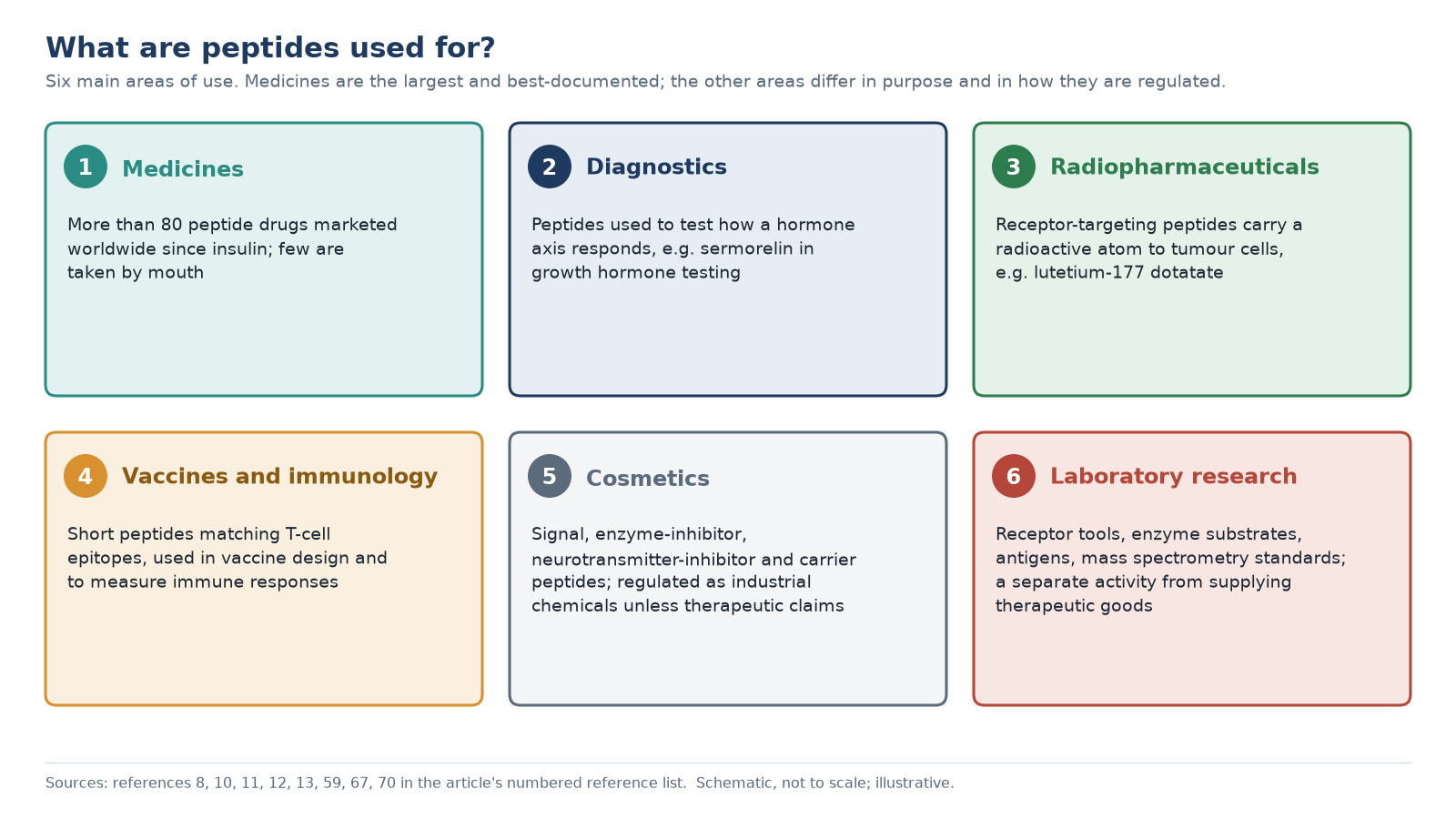
The phrase “what does GHK-Cu do” usually leads to long lists of reported actions. This section takes a narrower approach: it describes what kinds of experiment have been done, what they measured, and what the design allows one to conclude. A fuller discussion of the skin trials is available in the GHK-Cu skin research review, and general guidance on weighing study types is in How to judge the evidence behind a claim. For the wider range of laboratory applications, see what are peptides used for? Synthetic peptides as research tools.
Fibroblasts and the extracellular matrix
The most consistent laboratory findings concern fibroblasts, the cells that make connective-tissue matrix. In 1988, Maquart and colleagues reported that GHK-Cu stimulated collagen synthesis in fibroblast cultures, starting between 10⁻¹² and 10⁻¹¹ M, peaking at 10⁻⁹ M and independent of any change in cell number (Maquart et al. 1988). A follow-up study found that GHK-Cu increased the synthesis of glycosaminoglycans, with a biphasic profile peaking at 10⁻⁹ to 10⁻⁸ M and returning towards control at higher concentrations, and with preferential effects on dermatan sulfate and heparan sulfate (Wegrowski et al. 1992). The same group then used a rat wound-chamber model, in which a small chamber is implanted under the skin and the tissue that grows into it is analysed. Repeated administration of GHK-Cu into the chambers increased wound-tissue mass, type I collagen and glycosaminoglycans (Siméon et al. 2000), and increased both the inactive and active forms of matrix metalloproteinase-2 at later stages of healing (Siméon et al. 1999).
Taken together, these studies suggest that GHK-Cu can influence both the building and the remodelling of matrix in experimental systems. They also illustrate the typical limits. The effective concentrations are very low and the concentration–response curves are bell-shaped, which makes them sensitive to small errors in preparation. The chamber model measures tissue in a chamber, not skin. And most comparisons are between GHK-Cu and an untreated control, not between GHK-Cu, apo-GHK and copper alone.
Keratinocytes, growth factors and inflammatory signals
Other cell studies have looked at keratinocytes, the main cells of the epidermis. In cultured keratinocytes and skin-equivalent models, copper-GHK increased proliferation and raised markers including proliferating cell nuclear antigen, p63 and the integrins α6 and β1 (Kang et al. 2009). Pollard and colleagues exposed normal and irradiated human fibroblasts to 1 nM copper tripeptide and reported faster population doubling and higher production of basic fibroblast growth factor and vascular endothelial growth factor (Pollard et al. 2005). A study in the HS68 fibroblast line examined GHK-Cu combined with light-emitting-diode irradiation, measuring viability, procollagen and growth-factor outputs (Huang et al. 2007). A 2023 study reported that GHK-Cu combined with hyaluronic acid increased collagen IV in fibroblast and ex vivo skin tests; a combination design of this kind cannot isolate the contribution of either ingredient (Jiang et al. 2023). In dermal fibroblasts stimulated with tumour necrosis factor-α, GHK, the related tripeptide GGH, copper chloride and their copper complexes all reduced secretion of interleukin-6 (Gruchlik et al. 2012). That last finding is notable for a reason its authors did not emphasise: copper chloride alone had a similar effect, which points to copper rather than the peptide as at least part of the explanation (Gruchlik et al. 2012).
Analogue work adds another caution. AHK-Cu, a related copper tripeptide, stimulated elongation of human hair follicles ex vivo and proliferation of dermal papilla cells at 10⁻¹² to 10⁻⁹ M (Pyo et al. 2007). These are interesting findings in a model system, but they concern a different molecule and cannot be read as evidence about GHK-Cu.
Animal wound models
Animal studies of GHK and GHK-Cu are mostly in rodent wound models. Besides the chamber studies above, one study incorporated biotin-labelled GHK into a collagen film and applied it to wounds in rats; the treated group showed more wound contraction and cell proliferation, and copper concentration at the wound site rose about ninefold (Arul et al. 2005). That copper increase is relevant to the carrier hypothesis, but the study used a modified peptide bound to a collagen matrix, so it does not tell us what free GHK-Cu would do. Reviews by the discovering group list further effects in several species and organs (Pickart 2008; Pickart et al. 2015), but those are summaries of the authors’ own and others’ studies and need to be checked against the primary papers before being relied on.
Antioxidant chemistry
Because GHK binds copper in a redox-inert form (Hureau et al. 2011), it might be expected to limit metal-driven oxidation. Sakuma and colleagues tested apo-GHK directly. At concentrations up to 10 µM it reduced reactive oxygen species in Caco-2 intestinal cells, and electron spin resonance showed that it diminished hydroxyl and peroxyl radicals but not superoxide (Sakuma et al. 2018). Those are mechanistic chemistry findings in a cell line. They do not show an antioxidant effect in tissue, and the authors’ description of GHK as an “endogenous antioxidant” is a hypothesis drawn from them.
Gene-expression signatures and the Connectivity Map
The most widely repeated modern claim about the GHK peptide is that it changes the expression of thousands of genes. This claim rests on a computational tool, the Connectivity Map, which compares a disease-associated gene-expression signature with a library of expression profiles from cultured cells exposed to many compounds, looking for compounds whose profile runs in the opposite direction (Lamb et al. 2006). The library was later expanded to more than a million profiles using a reduced, lower-cost assay (Subramanian et al. 2017).
Two studies used this approach and named GHK. Campbell and colleagues profiled 64 lung-tissue samples (8 regions from each of 8 lungs) from smokers with chronic obstructive pulmonary disease and identified 127 genes whose expression tracked the severity of emphysema (Campbell et al. 2012). Querying the Connectivity Map with this signature identified GHK as a compound whose profile ran opposite to it. They then tested GHK in cultured fibroblasts from these patients and found that it restored the ability of the cells to contract collagen gels (Campbell et al. 2012). Hong and colleagues derived a 54-gene signature associated with metastasis in early-stage colorectal cancer, and a Connectivity Map query suggested compounds including GHK (Hong et al. 2010).
These are legitimate hypothesis-generating studies, and the Campbell paper backed its prediction with a cell experiment. But the step from “a connectivity score points the other way” to “GHK resets genes to health”, the framing used in some later reviews (Pickart et al. 2014; Pickart & Margolina 2018), is large. Connectivity scores are computed from cell-line profiles under particular conditions; they do not show what happens in a tissue or an organism. Several of the reviews that popularised the gene claims were written by authors affiliated with a company that sells copper-peptide products, and some were proposals for uses that have not been tested (Pickart et al. 2012; Pickart et al. 2014). That does not make them wrong, but it means their conclusions should be weighed as assertions and checked against independent work.
Human studies: a thin and dated record
Controlled human studies of GHK-Cu are few, and most concern cosmetic skin outcomes, reviewed in detail on the skin research page. Two examples show the range. A randomised study after carbon dioxide laser resurfacing, in which 13 patients completed follow-up, found no significant differences in redness or in objective wrinkle and skin-quality measures, although patient-reported satisfaction was higher with the copper tripeptide product (P = .04) (Miller et al. 2006). A 1994 multicentre, vehicle-controlled trial of a GHK-Cu gel in diabetic foot ulcers reported a difference in closure between groups (Mulder et al. 1994). That trial is a historical record. It was conducted more than three decades ago, we did not find an independent replication, and no GHK-Cu medicine is registered for any purpose in Australia (NSW Health 2026; TGA 2026c).
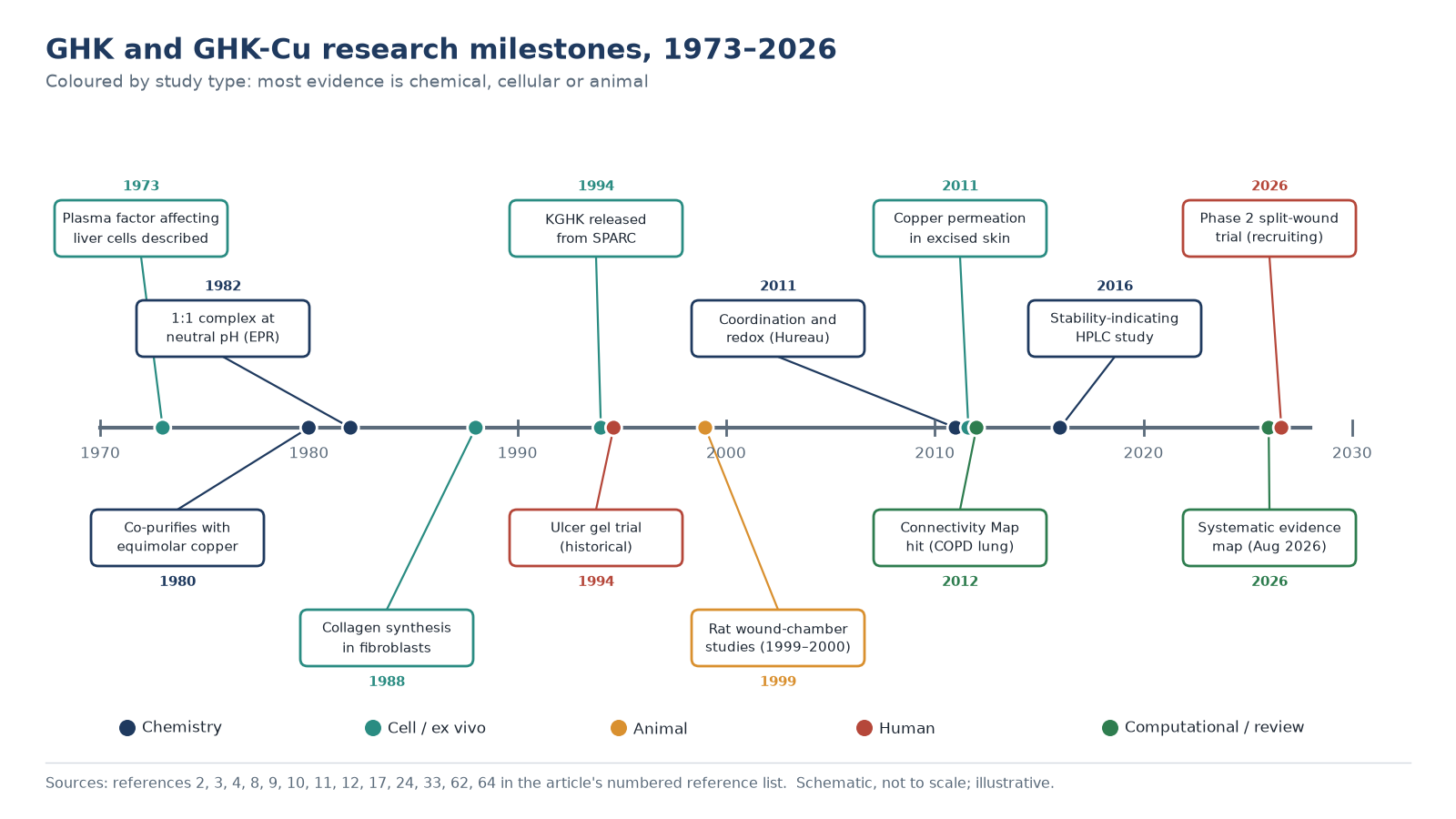
A 2026 systematic evidence-mapping review searched databases, trial registries and regulatory sources to 12 August 2026. It concluded that preclinical data consistently support matrix-remodelling effects, but that clinical evidence is sparse, that delivery studies rarely determine the copper species actually present, and that the field is “promising but unproven” (Mateescu et al. 2026). One registered trial is under way: a phase 2, randomised, double-blind, vehicle-controlled split-wound study of a topical GHK-Cu gel in healthy adults, sponsored by industry, began in February 2026 with an estimated primary completion date of February 2027 and no posted findings (ClinicalTrials.gov NCT07437586). Table 3 maps the evidence by study type and Figure 3 sets it on a timeline.
Table 3. Evidence map for GHK and GHK-Cu by model type, with what each kind of study can and cannot show.
Skin is a barrier designed to keep water-soluble molecules out, and GHK-Cu is very water-soluble. Badenhorst and colleagues measured its distribution coefficient between octanol and buffered saline and found log D values between −2.38 and −2.49 across pH 4.5 to 7.4, which places it firmly on the hydrophilic side (Badenhorst et al. 2016). Molecules like that cross the outer layer of skin, the stratum corneum, poorly. A 2008 study noted that transport of GHK-Cu through the stratum corneum had received very little attention, and used a model membrane built from liquid-crystalline lipids to show that copper complexes could permeate it and that the peptide influenced how copper moved (Mazurowska & Mojski 2008). A 2025 review of permeation methods for anti-ageing peptides reached a similar view, describing limited stratum corneum permeation for GHK-Cu and noting how little work had been done on carrier systems such as liposomes (Ogórek et al. 2025).
The most cited human-skin data come from two papers by Hostynek, Dreher and Maibach. Using flow-through diffusion cells and a 0.68% aqueous solution of the copper tripeptide, they reported a permeability coefficient through dermatomed human skin of 2.43 ± 0.51 × 10⁻⁴ cm/h, with 136.2 ± 17.5 µg/cm² of copper passing through over 48 hours (Hostynek et al. 2010; Hostynek et al. 2011). Two features of this work are often missed. First, the analysis measured copper by inductively coupled plasma mass spectrometry; it did not measure intact peptide, so it cannot show whether copper crossed the skin as GHK-Cu or in some other form (Hostynek et al. 2011). Second, the two papers report the same design and the same permeation figures but different amounts retained in the skin, 82 ± 8.1 µg/cm² in one and 97 ± 6.6 µg/cm² in the other (Hostynek et al. 2010; Hostynek et al. 2011). The difference may reflect separate analyses, but it is a reason to cite the primary numbers with care.
Physical disruption of the barrier changes the picture. When human skin was pre-treated with a polymer microneedle array, 134 ± 12 nmol of peptide and 705 ± 84 nmol of copper passed through in 9 hours, whereas almost none crossed intact skin (Li et al. 2015). The fivefold excess of copper over peptide in the receptor fluid suggests that the complex does not stay intact during transport (Li et al. 2015). That is consistent with the fast exchange chemistry described earlier (Hureau et al. 2011), and it supports the 2026 review’s conclusion that delivery studies rarely establish which copper species reaches the target (Mateescu et al. 2026). Proteases in skin are a further consideration; an assay developed to test cosmetic peptides in skin homogenates showed that protease stability has to be measured, not assumed (Errante et al. 2021).
How stable is GHK-Cu? Degradation and formulation chemistry
The stability of a copper peptide depends on two things: whether the peptide chain stays intact, and whether the copper stays bound. Badenhorst and colleagues developed a stability-indicating reversed-phase HPLC method and stressed GHK-Cu under acid, base and oxidising conditions (Badenhorst et al. 2016). The peptide degraded under basic and oxidative stress, and to a lesser extent under acid, following first-order kinetics. Rather unexpectedly, it was stable in water and in buffers between pH 4.5 and 7.4 for at least two weeks at 60 °C (Badenhorst et al. 2016). HPLC with mass spectrometry identified three main degradation products, one of them free histidine, which indicates cleavage of the peptide backbone (Badenhorst et al. 2016). Compatibility mattered too: GHK-Cu was compatible with niosomes based on a non-ionic surfactant but less stable in the presence of the negatively charged lipid dicetyl phosphate (Badenhorst et al. 2016).
Oxidation deserves particular attention. Metal-catalysed oxidation targets the residues that hold the metal, and histidine and lysine, both present in GHK, are among the residues modified (Stadtman 1990). Oxidation and hydrolysis are also the main chemical routes by which peptides and proteins degrade in solution generally (Manning et al. 2010). Strong reducing agents raise a different issue, since Cu(GHK) can be reduced to Cu(I) with release of the metal (Hureau et al. 2011). In a formulation, ingredients that chelate copper more strongly than GHK, or that change pH, can strip copper from the peptide without breaking a single covalent bond. Neither change is visible by eye.
For laboratory work, these findings argue for a short list of controls: defined pH and buffer, protection from oxidants and strong reductants, avoidance of competing chelators unless they are part of the experiment, and analytical confirmation of both peptide integrity and copper content over time. General handling of freeze-dried peptides is covered in the site’s lyophilised peptide handling checklist. Stability testing for regulated medicines follows International Council for Harmonisation (ICH) guidelines, which set out how storage conditions and time points are chosen (ICH n.d.).
Synthetic peptides: how GHK and GHK-Cu are made and verified
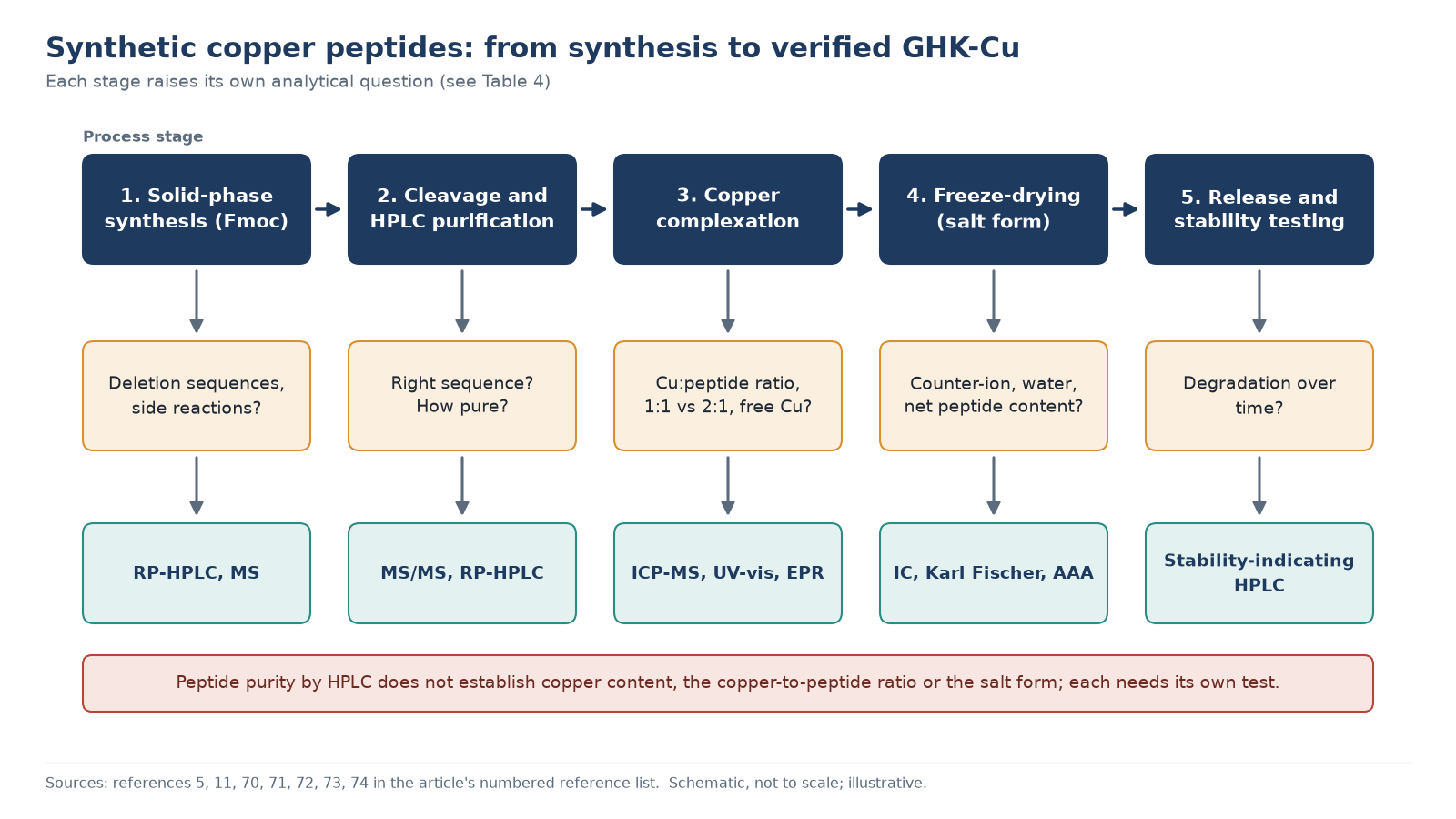
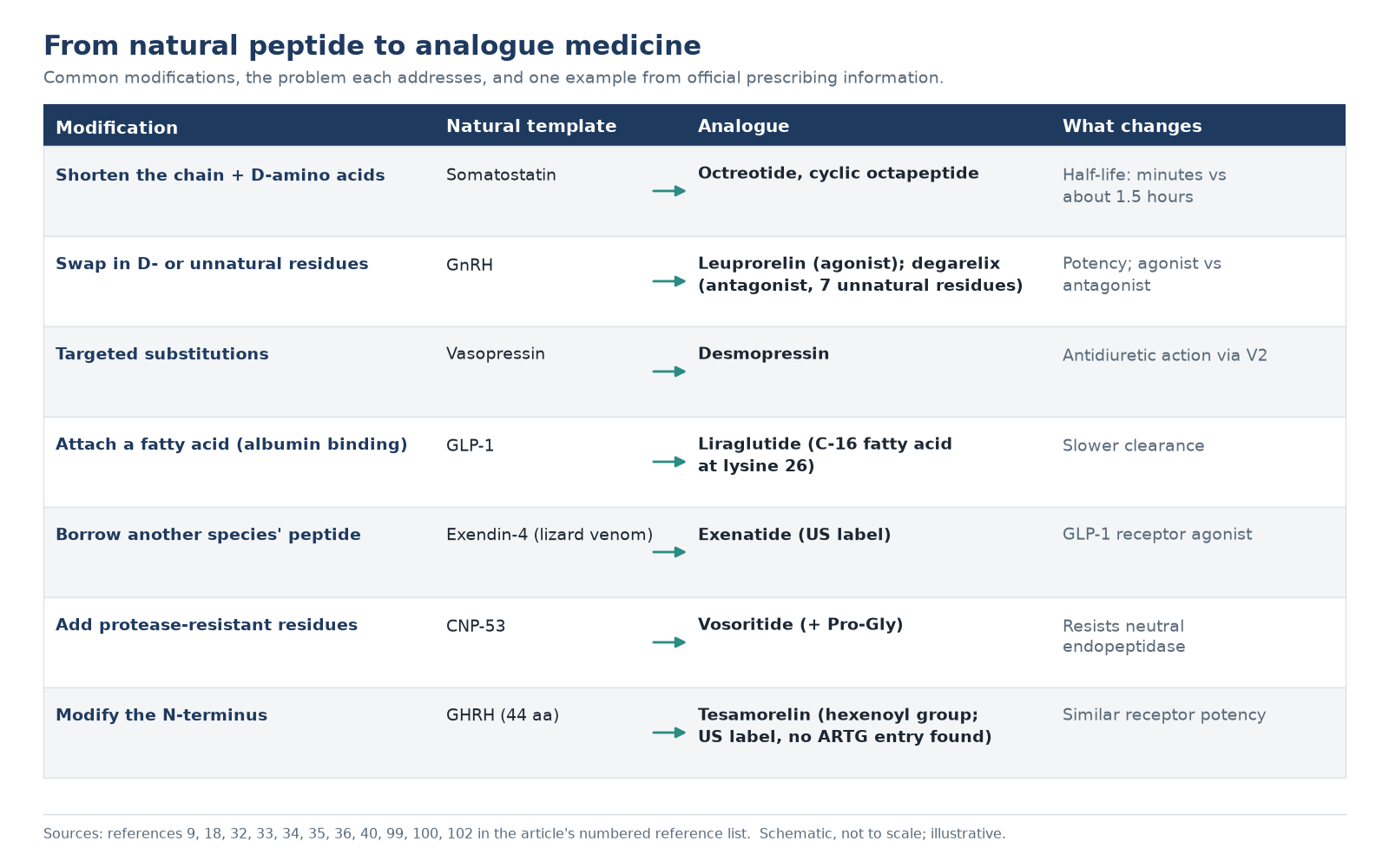
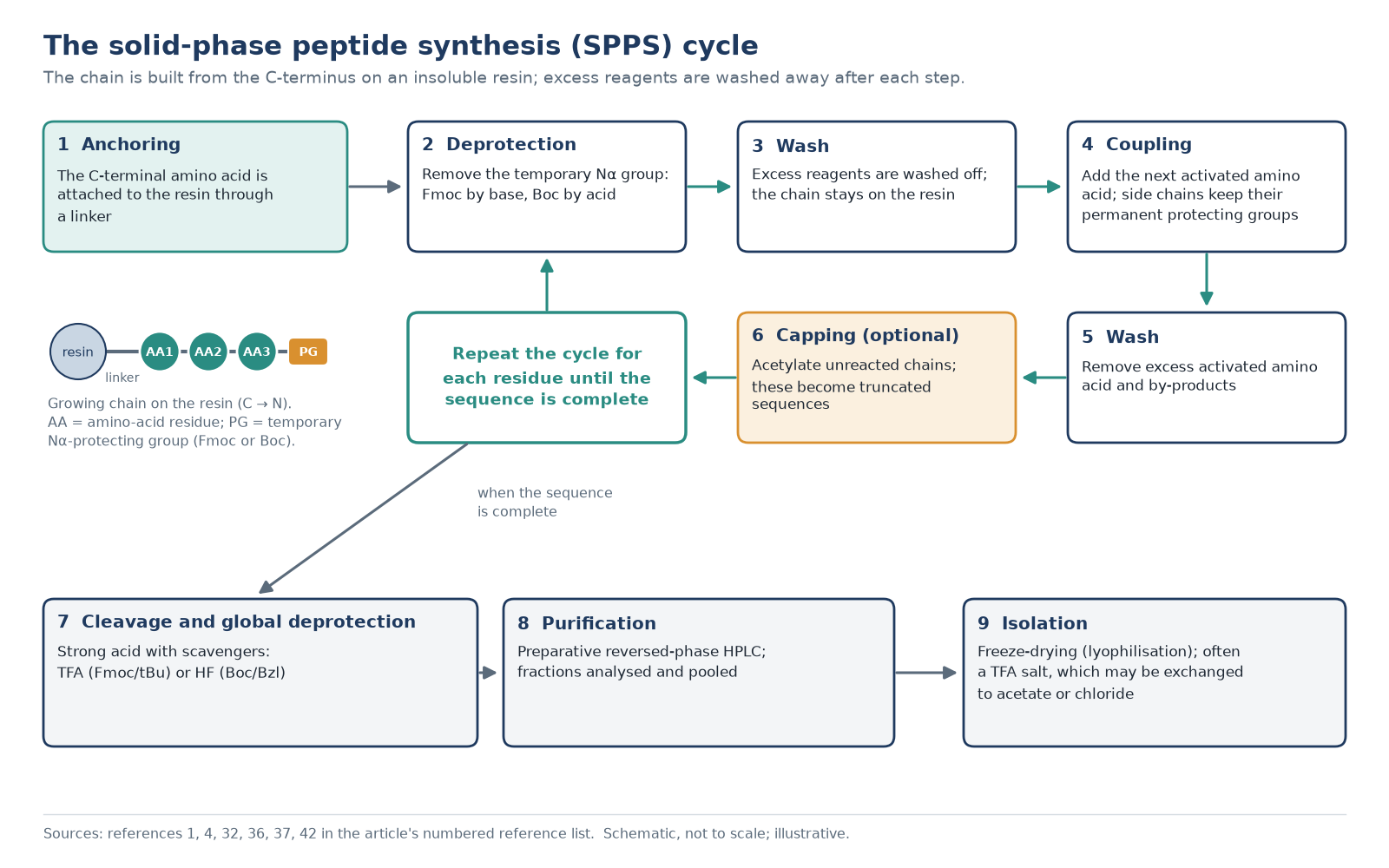
GHK used in research and in cosmetics is made synthetically, not extracted from plasma. Solid-phase peptide synthesis, first described by Merrifield in 1963, builds the chain one amino acid at a time on an insoluble resin (Merrifield 1963). Today the Fmoc version of the method is the standard approach (Behrendt et al. 2016). For a tripeptide the synthesis is short, but the usual sources of impurity still apply: incomplete couplings that give deletion sequences, side reactions on protected side chains, residual reagents and solvents, and counter-ions carried through from purification (Behrendt et al. 2016; Isidro-Llobet et al. 2019). A broader account of how synthetic peptides are made and what impurities they carry is given in Synthetic peptides: manufacture, impurities and analytical verification. How such documentation is assessed across a supply chain is reviewed in peptides wholesale: supplier qualification, quality standards and regulation.
The copper complex adds a step and a set of questions. After synthesis and purification, the peptide is combined with a copper salt and the complex is isolated, typically by freeze-drying. The ratio of copper to peptide determines whether the product is mostly the 1:1 complex, contains the 2:1 bis complex, or carries excess unbound copper (Conato et al. 2001; Hureau et al. 2011; PubChem CID 71587328). A sample can therefore be pure as a peptide and still be wrong as a copper peptide. The European Medicines Agency’s guideline on synthetic peptides, in force from June 2026, sets expectations for characterisation, specifications and analytical control of synthetic peptide substances in medicines (EMA 2025), and ICH guidelines cover analytical validation, impurities and specifications (ICH n.d.). Neither applies to non-medicine research material, but both set out what thorough characterisation looks like. The 2026 review argued that GHK-Cu should be defined as an “active pharmaceutical entity” with a control strategy for both peptide and copper, precisely because so few studies report this (Mateescu et al. 2026).
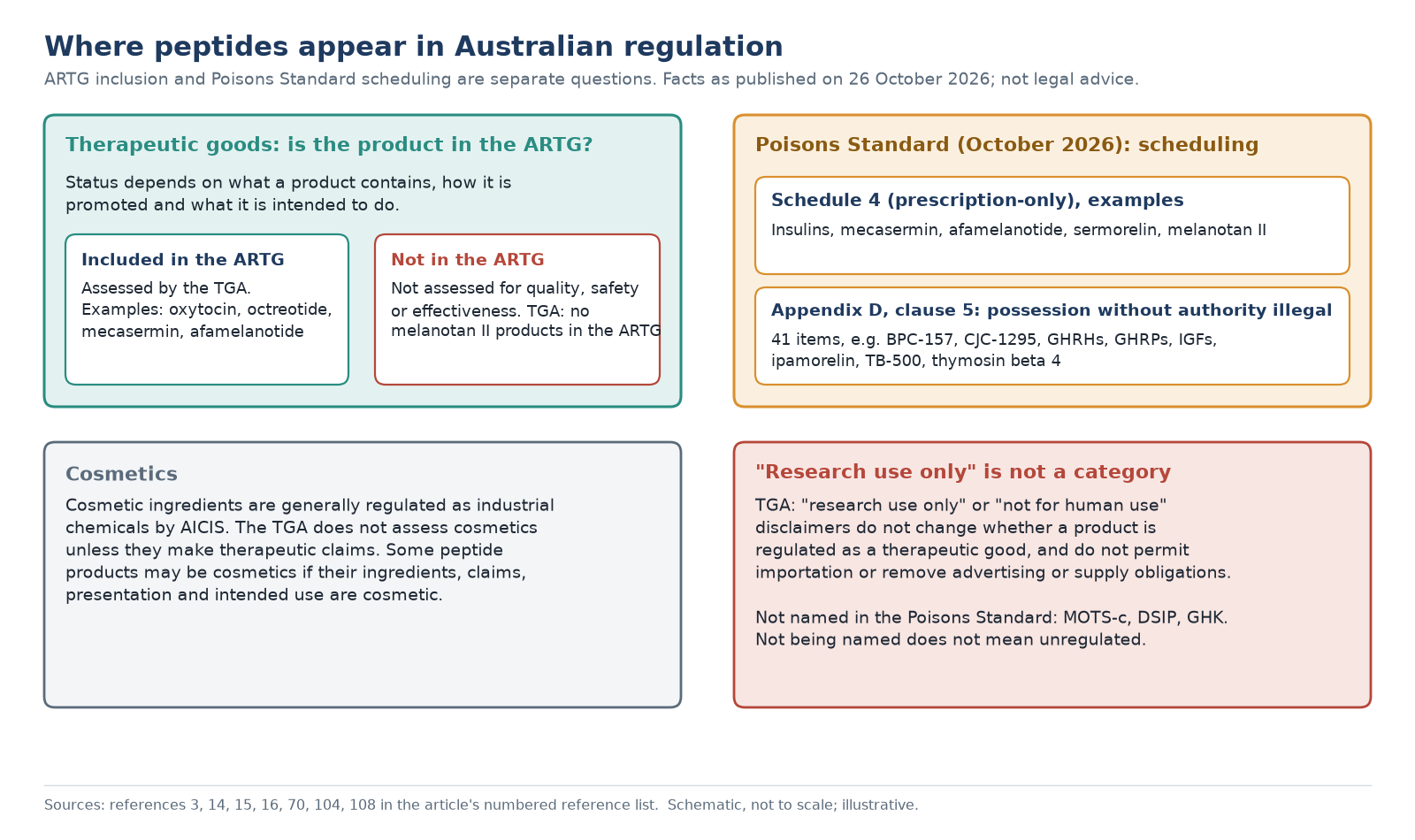
Copper peptides in Australia: cosmetic ingredient, therapeutic good or scheduled poison?
Searches for “peptides Australia” and “GHK-Cu Australia” often mix three separate regulatory questions. This section sets out the published position as at 26 October 2026. It is a factual summary of public documents, not legal advice, and whether any particular product falls within a given category depends on its facts.
The first question is whether a product is a therapeutic good. Under section 3 of the Therapeutic Goods Act 1989, therapeutic goods include goods represented or likely to be taken to be for therapeutic use, which covers influencing, inhibiting or modifying a physiological process (TGA 2024). The TGA explains that whether a product is a food, a cosmetic or a therapeutic good depends on how it is presented and what is claimed for it (TGA 2024). Peptide products regulated as therapeutic goods must be included in the Australian Register of Therapeutic Goods (ARTG) before they can be imported, manufactured, supplied, exported or advertised, apart from limited exceptions such as a specific approval, authority or exemption (TGA n.d.). The TGA has named GHK-Cu, with several other peptides, as an example of an unapproved peptide product (TGA 2026b), and its June 2026 joint statement with the Chief Medical Officer said that unapproved peptide products not in the ARTG, which can include products containing GHK-Cu, have not been evaluated for safety, quality or effectiveness (TGA 2026c). healthdirect lists GHK-Cu among unapproved peptides not on the ARTG (healthdirect 2026), and a NSW Government release of 19 October 2026 said that none of the peptides it named, including GHK-Cu, is currently approved in Australia for any purpose (NSW Health 2026). The same release reported 1,180 emergency department presentations in NSW associated with peptide use in general between 1 July 2025 and 30 September 2026; that figure is not specific to GHK-Cu (NSW Health 2026).
The second question is whether a product is a cosmetic. The TGA does not assess cosmetics unless they make therapeutic claims, and cosmetic ingredients are generally regulated as industrial chemicals by the Australian Industrial Chemicals Introduction Scheme (AICIS) (TGA 2021). Some products are declared not to be therapeutic goods under the Therapeutic Goods (Declared Goods) Order No. 2 of 2019 (TGA 2021). The TGA’s peptide guidance states that some peptide products may be regulated as cosmetics rather than therapeutic goods if their ingredients, claims, presentation and intended use are limited to cosmetic purposes (TGA 2026a). Copper tripeptide-1 in a skin cream marketed for appearance is a different regulatory case from the same molecule promoted for wound healing or supplied in a vial.
The third question is scheduling under the Poisons Standard. The October 2026 Poisons Standard does not contain an entry naming GHK or GHK-Cu (Poisons Standard 2026). It does contain entries for copper compounds. Schedule 4 lists “COPPER COMPOUNDS for human use” except when separately specified, in preparations for human internal use containing 5 mg or less of copper per recommended daily dose, or in other preparations containing 5% or less of copper compounds (Poisons Standard 2026). Schedule 6 lists copper compounds with a parallel set of exceptions, Schedule 5 covers certain animal feed additives, and Appendix A lists copper compounds in paints (Poisons Standard 2026). Whether a particular copper-peptide preparation falls within any of these entries depends on its composition, concentration and intended use, and is a question for the regulator or a qualified adviser. State and territory laws may impose additional controls (TGA 2026b).
Finally, labels do not change any of this. The TGA states that disclaimers such as “research use only” or “not for human use” do not change whether a product is regulated as a therapeutic good and do not remove advertising, manufacture, import, export or supply obligations (TGA n.d.; TGA 2026b). The Personal Importation Scheme does not allow commercial supply or public advertising of unapproved therapeutic goods (TGA n.d.). Table 5 summarises the pathways.
Table 5. Regulatory pathways relevant to copper peptides in Australia (published position at 26 October 2026; not legal advice).
Pathway
Who administers it
When it can apply to a copper peptide
Published position on GHK-Cu
Sources
Therapeutic good (ARTG)
TGA, under the Therapeutic Goods Act 1989
Product presented or likely to be taken for therapeutic use
Named as an unapproved peptide product; not evaluated by the TGA
How to read claims about GHK-Cu and other copper peptides
Because the chemistry of GHK-Cu is solid and the clinical evidence thin, claims about it often borrow authority from the first to support the second. A few questions help separate the two. Which form was studied: apo-GHK, GHK-Cu, the bis complex, an analogue, or a modified peptide in a matrix (PubChem CID 71587328; Pyo et al. 2007; Arul et al. 2005)? Was copper alone tested as a control, so that a copper effect can be distinguished from a peptide effect (Gruchlik et al. 2012)? What kind of model was used, and does the claim stay within it (Table 3)? Is the claim drawn from a primary study or from a review, and do the review’s authors have a commercial interest (Pickart et al. 2015; Pickart & Margolina 2018)? Was a finding from a connectivity score or a cell line restated as an effect in people (Lamb et al. 2006; Campbell et al. 2012)? And has anyone independently repeated it?
General problems in biomedical research apply here as well. Small studies with flexible analyses are more likely to produce findings that do not hold up (Ioannidis 2005), and many preclinical findings in biology could not be reproduced when industry scientists tried (Begley & Ellis 2012). Systems such as GRADE rate the certainty of evidence downwards for risk of bias, imprecision, inconsistency, indirectness and publication bias (Guyatt et al. 2008). By those standards, most claims about GHK-Cu would sit at low or very low certainty for any human outcome, which matches the conclusion of the 2026 systematic review (Mateescu et al. 2026). The site’s guide to judging peptide research evidence sets out these questions in more detail.
Limitations of this review
This review has several limitations. It is a narrative review, not a systematic one, although it draws on a 2026 systematic evidence map for its overall judgement (Mateescu et al. 2026). Sources were found through PubMed, Crossref and official regulatory websites, and were read at the level of the abstract or full text as available; a few older papers were available to us only as abstracts, so details such as exact sample handling could not always be checked. A large share of the GHK literature comes from one research group and its collaborators, some with commercial affiliations, which limits the independence of the evidence base (Pickart et al. 2015; Pickart & Margolina 2018). Binding data come from studies using different buffers and methods, so values cannot be ranked directly (Rózga et al. 2007; Trapaidze et al. 2012). The two skin-permeation papers by Hostynek and colleagues report different amounts of copper retained in skin for apparently the same experiment (Hostynek et al. 2010; Hostynek et al. 2011). Regulatory statements reflect public documents read on 26 October 2026 and may change; some TGA pages could not be re-fetched on the day of the final link check, in which case text read earlier the same day was used. Finally, this review does not cover cosmetic formulation science in depth, and it makes no assessment of any commercial product.
Copper peptides and Eternal Peptides Wholesale: relevance of this review
Eternal Peptides Wholesale distributes research peptides in wholesale boxes of 10 vials, for laboratory research use only and not for human consumption (company background). GHK-Cu is among the materials listed in its Longevity & Skin category, which is why the chemistry, stability and analytical questions about copper peptides set out above matter to the site.
The certificate of analysis library lists Janoshik Analytical reports for purity and content, sterility, heavy metals and endotoxin for the GHK-Cu (100mg) batch, and a purity and content report for the GHK-Cu (50mg) batch. Each report applies only to the batch printed on it. As this review explains, copper content and peptide identity need separate measurements, so a purity figure alone does not settle them. The testing standards page sets out how Eternal Peptides Wholesale reads the four testing areas. Consistent with the Australian section of this review, these reports record laboratory tests on a submitted sample; they do not establish regulatory status, cosmetic or clinical suitability, or safety for human use.
Glossary
Apo-GHK
The tripeptide glycyl-L-histidyl-L-lysine without a bound metal ion.
ATCUN motif
Amino-terminal Cu(II)- and Ni(II)-binding motif, the sequence NH2-Xaa-Xaa-His, which binds copper through four nitrogen atoms (Harford & Sarkar 1997).
Conditional binding constant
A binding constant measured under stated conditions of pH, buffer, ionic strength and temperature; it is not transferable to other conditions (Rózga et al. 2007).
Connectivity Map
A reference collection of gene-expression profiles from cultured cells exposed to many compounds, used to look for compounds whose profiles oppose a disease signature (Lamb et al. 2006; Subramanian et al. 2017).
Copper tripeptide-1
Cosmetic ingredient name recorded as a synonym for the 1:1 copper complex of GHK (PubChem CID 71587328).
EPR spectroscopy
Electron paramagnetic resonance, a method that detects unpaired electrons and is used to probe the environment of Cu(II).
ICP-MS
Inductively coupled plasma mass spectrometry, used to measure total metal content; it does not show whether the metal is bound (Hostynek et al. 2011).
Log D
Logarithm of the distribution coefficient between octanol and water at a given pH; negative values indicate a water-loving molecule (Badenhorst et al. 2016).
Lysyl oxidase
A copper-dependent enzyme that cross-links collagen and elastin (Rucker et al. 1998).
Speciation
The distribution of a metal among different chemical forms in a mixture.
Ternary complex
A complex in which a metal ion is bound by two different ligands at once, such as copper with GHK and histidine (Lau & Sarkar 1981).
Frequently asked questions
What are copper peptides made from?
Copper peptides are short chains of amino acids that hold a copper ion. The best known, GHK-Cu, is made from three amino acids, glycine, histidine and lysine, bound to one copper(II) ion. Research and cosmetic GHK-Cu is made by chemical synthesis and then combined with a copper salt.
Is GHK-Cu the same as copper tripeptide-1?
Copper tripeptide-1 is a cosmetic ingredient name recorded in PubChem as a synonym for the 1:1 copper complex of GHK, also listed as prezatide copper. Tripeptide-1 without the word copper refers to the free GHK peptide. A product’s salt form and copper ratio should be confirmed by analysis, not by name.
Why is GHK-Cu blue?
The blue to violet colour comes from electronic transitions of the copper(II) ion. The exact shade depends on how many nitrogen and oxygen atoms surround the copper. Copper salts without peptide are also blue, so colour suggests copper is present but does not show that it is bound to GHK.
Is GHK-Cu approved in Australia?
No GHK-Cu medicine is included in the ARTG. The TGA names GHK-Cu among unapproved peptide products that it has not evaluated, and NSW Health has said it is not approved for any purpose. Cosmetic products may be regulated differently. This is a factual summary, not legal advice.
What does the GHK peptide do in lab studies?
In cell cultures, GHK-Cu has been reported to increase collagen and glycosaminoglycan synthesis at very low concentrations, and in rat wound-chamber models to change collagen and matrix metalloproteinase levels. Gene-expression studies used it as a computational hit. These findings come from model systems and do not establish effects in people.
Do copper peptides penetrate skin?
GHK-Cu is highly water-soluble and crosses intact skin poorly. In excised human skin, copper from a GHK-Cu solution permeated slowly over 48 hours, but only copper was measured. When microneedles disrupted the barrier, much more copper than peptide passed through, suggesting the complex does not stay intact.
How stable is GHK-Cu in solution?
In one stability-indicating HPLC study, GHK-Cu was stable in water and buffers from pH 4.5 to 7.4 for two weeks at 60 °C, but degraded under basic and oxidising conditions, forming three main products including free histidine. Strong reducing agents and competing chelators can also remove copper.
How are the identity and copper content of GHK-Cu verified?
Mass spectrometry confirms the peptide’s mass and sequence, and reversed-phase HPLC measures peptide purity. Copper is measured separately, for example by ICP-MS, and spectroscopy such as UV-visible or EPR shows whether it is bound and in what ratio. Net peptide content, counter-ions and water are further checks.
Pickart L, Freedman JH, Loker WJ, et al. Growth-modulating plasma tripeptide may function by facilitating copper uptake into cells. Nature. 1980;288(5792):715-7. doi:10.1038/288715a0 PMID: 7453802. Available at: https://doi.org/10.1038/288715a0. Accessed 26 October 2026.
Freedman JH, Pickart L, Weinstein B, Mims WB, Peisach J. Structure of the Glycyl-L-histidyl-L-lysine–copper(II) complex in solution. Biochemistry. 1982;21(19):4540-4. doi:10.1021/bi00262a004 PMID: 6291585. Available at: https://doi.org/10.1021/bi00262a004. Accessed 26 October 2026.
Hureau C, Eury H, Guillot R, et al. X-ray and solution structures of Cu(II) GHK and Cu(II) DAHK complexes: influence on their redox properties. Chemistry. 2011;17(36):10151-60. doi:10.1002/chem.201100751 PMID: 21780203. Available at: https://doi.org/10.1002/chem.201100751. Accessed 26 October 2026.
Conato C, Gavioli R, Guerrini R, et al. Copper complexes of glycyl-histidyl-lysine and two of its synthetic analogues: chemical behaviour and biological activity. Biochim Biophys Acta. 2001;1526(2):199-210. doi:10.1016/s0304-4165(01)00127-1 PMID: 11325542. Available at: https://doi.org/10.1016/s0304-4165(01)00127-1. Accessed 26 October 2026.
Lau SJ, Sarkar B. The interaction of copper(II) and glycyl-L-histidyl-L-lysine, a growth-modulating tripeptide from plasma. Biochem J. 1981;199(3):649-56. doi:10.1042/bj1990649 PMID: 7340824. Available at: https://doi.org/10.1042/bj1990649. Accessed 26 October 2026.
Rózga M, Sokołowska M, Protas AM, Bal W. Human serum albumin coordinates Cu(II) at its N-terminal binding site with 1 pM affinity. J Biol Inorg Chem. 2007;12(6):913-8. doi:10.1007/s00775-007-0244-8 PMID: 17516096. Available at: https://doi.org/10.1007/s00775-007-0244-8. Accessed 26 October 2026.
Maquart FX, Pickart L, Laurent M, Gillery P, Monboisse JC, Borel JP. Stimulation of collagen synthesis in fibroblast cultures by the tripeptide-copper complex glycyl-L-histidyl-L-lysine-Cu2+. FEBS Lett. 1988;238(2):343-6. doi:10.1016/0014-5793(88)80509-x PMID: 3169264. Available at: https://doi.org/10.1016/0014-5793(88)80509-x. Accessed 26 October 2026.
Siméon A, Monier F, Emonard H, et al. Expression and activation of matrix metalloproteinases in wounds: modulation by the tripeptide-copper complex glycyl-L-histidyl-L-lysine-Cu2+. J Invest Dermatol. 1999;112(6):957-64. doi:10.1046/j.1523-1747.1999.00606.x PMID: 10383745. Available at: https://doi.org/10.1046/j.1523-1747.1999.00606.x. Accessed 26 October 2026.
Mateescu DM, Gavrilescu DM, Mincioaga RI, et al. GHK-Cu as a Bioactive Metallopeptide and Drug-Delivery Cargo: Coordination Chemistry, Formulation Science, Therapeutic Evidence, and a Translational Roadmap. Pharmaceutics. 2026;18(9):1077. doi:10.3390/pharmaceutics18091077 PMID: 42797253. Available at: https://doi.org/10.3390/pharmaceutics18091077. Accessed 26 October 2026.
Badenhorst T, Svirskis D, Wu Z. Physicochemical characterization of native glycyl-l-histidyl-l-lysine tripeptide for wound healing and anti-aging: a preformulation study for dermal delivery. Pharm Dev Technol. 2016;21(2):152-60. doi:10.3109/10837450.2014.979944 PMID: 25384620. Available at: https://doi.org/10.3109/10837450.2014.979944. Accessed 26 October 2026.
Hostynek JJ, Dreher F, Maibach HI. Human skin penetration of a copper tripeptide in vitro as a function of skin layer. Inflamm Res. 2011;60(1):79-86. doi:10.1007/s00011-010-0238-9 PMID: 20721598. Available at: https://doi.org/10.1007/s00011-010-0238-9. Accessed 26 October 2026.
Li H, Low YS, Chong HP, et al. Microneedle-Mediated Delivery of Copper Peptide Through Skin. Pharm Res. 2015;32(8):2678-89. doi:10.1007/s11095-015-1652-z PMID: 25690343. Available at: https://doi.org/10.1007/s11095-015-1652-z. Accessed 26 October 2026.
Wegrowski Y, Maquart FX, Borel JP. Stimulation of sulfated glycosaminoglycan synthesis by the tripeptide-copper complex glycyl-L-histidyl-L-lysine-Cu2+. Life Sci. 1992;51(13):1049-56. doi:10.1016/0024-3205(92)90504-i PMID: 1522753. Available at: https://doi.org/10.1016/0024-3205(92)90504-i. Accessed 26 October 2026.
Campbell JD, McDonough JE, Zeskind JE, et al. A gene expression signature of emphysema-related lung destruction and its reversal by the tripeptide GHK. Genome Med. 2012;4(8):67. doi:10.1186/gm367 PMID: 22937864. Available at: https://doi.org/10.1186/gm367. Accessed 26 October 2026.
Harford C, Sarkar B. Amino Terminal Cu(II)- and Ni(II)-Binding (ATCUN) Motif of Proteins and Peptides: Metal Binding, DNA Cleavage, and Other Properties. Accounts of Chemical Research. 1997;30(3):123-130. doi:10.1021/ar9501535 Available at: https://doi.org/10.1021/ar9501535. Accessed 26 October 2026.
Sóvágó I, Osz K. Metal ion selectivity of oligopeptides. Dalton Trans. 2006;(32):3841-54. doi:10.1039/b607515k PMID: 16896443. Available at: https://doi.org/10.1039/b607515k. Accessed 26 October 2026.
Faller P, Hureau C. Bioinorganic chemistry of copper and zinc ions coordinated to amyloid-beta peptide. Dalton Trans. 2009;(7):1080-94. doi:10.1039/b813398k PMID: 19322475. Available at: https://doi.org/10.1039/b813398k. Accessed 26 October 2026.
Millhauser GL. Copper and the prion protein: methods, structures, function, and disease. Annu Rev Phys Chem. 2007;58:299-320. doi:10.1146/annurev.physchem.58.032806.104657 PMID: 17076634. Available at: https://doi.org/10.1146/annurev.physchem.58.032806.104657. Accessed 26 October 2026.
Gorouhi F, Maibach HI. Role of topical peptides in preventing or treating aged skin. Int J Cosmet Sci. 2009;31(5):327-45. doi:10.1111/j.1468-2494.2009.00490.x PMID: 19570099. Available at: https://doi.org/10.1111/j.1468-2494.2009.00490.x. Accessed 26 October 2026.
Schagen S. Topical Peptide Treatments with Effective Anti-Aging Results. Cosmetics. 2017;4(2):16. doi:10.3390/cosmetics4020016 Available at: https://doi.org/10.3390/cosmetics4020016. Accessed 26 October 2026.
Pickart L, Thaler MM. Tripeptide in human serum which prolongs survival of normal liver cells and stimulates growth in neoplastic liver. Nat New Biol. 1973;243(124):85-7. PMID: 4349963. Available at: https://pubmed.ncbi.nlm.nih.gov/4349963/. Accessed 26 October 2026.
Pickart L, Thayer L, Thaler MM. A synthetic tripeptide which increases survival of normal liver cells, and stimulates growth in hepatoma cells. Biochem Biophys Res Commun. 1973;54(2):562-6. doi:10.1016/0006-291x(73)91459-9 PMID: 4356974. Available at: https://doi.org/10.1016/0006-291x(73)91459-9. Accessed 26 October 2026.
Perkins CM, Rose NJ, Weinstein B, Stenkamp RE, Jensen LH, Pickart L. The structure of a copper complex of the growth factor glycyl-L-histidyl-L-lysine at 1.1 Å resolution. Inorganica Chimica Acta. 1984;82(1):93-99. doi:10.1016/s0020-1693(00)82544-x Available at: https://doi.org/10.1016/s0020-1693(00)82544-x. Accessed 26 October 2026.
Trapaidze A, Hureau C, Bal W, Winterhalter M, Faller P. Thermodynamic study of Cu2+ binding to the DAHK and GHK peptides by isothermal titration calorimetry (ITC) with the weaker competitor glycine. J Biol Inorg Chem. 2012;17(1):37-47. doi:10.1007/s00775-011-0824-5 PMID: 21898044. Available at: https://doi.org/10.1007/s00775-011-0824-5. Accessed 26 October 2026.
Pickart L. The human tri-peptide GHK and tissue remodeling. J Biomater Sci Polym Ed. 2008;19(8):969-88. doi:10.1163/156856208784909435 PMID: 18644225. Available at: https://doi.org/10.1163/156856208784909435. Accessed 26 October 2026.
Pickart L, Vasquez-Soltero JM, Margolina A. GHK Peptide as a Natural Modulator of Multiple Cellular Pathways in Skin Regeneration. Biomed Res Int. 2015;2015:648108. doi:10.1155/2015/648108 PMID: 26236730. Available at: https://doi.org/10.1155/2015/648108. Accessed 26 October 2026.
Pickart L, Margolina A. Regenerative and Protective Actions of the GHK-Cu Peptide in the Light of the New Gene Data. Int J Mol Sci. 2018;19(7):1987. doi:10.3390/ijms19071987 PMID: 29986520. Available at: https://doi.org/10.3390/ijms19071987. Accessed 26 October 2026.
National Center for Biotechnology Information. PubChem Compound Summary for CID 73587, Glycyl-histidyl-lysine. Available at: https://pubchem.ncbi.nlm.nih.gov/compound/73587. Accessed 26 October 2026.
Pyo HK, Yoo HG, Won CH, et al. The effect of tripeptide-copper complex on human hair growth in vitro. Arch Pharm Res. 2007;30(7):834-9. doi:10.1007/BF02978833 PMID: 17703734. Available at: https://doi.org/10.1007/BF02978833. Accessed 26 October 2026.
Lane TF, Iruela-Arispe ML, Johnson RS, Sage EH. SPARC is a source of copper-binding peptides that stimulate angiogenesis. J Cell Biol. 1994;125(4):929-43. doi:10.1083/jcb.125.4.929 PMID: 7514608. Available at: https://doi.org/10.1083/jcb.125.4.929. Accessed 26 October 2026.
Dou Y, Lee A, Zhu L, Morton J, Ladiges W. The potential of GHK as an anti-aging peptide. Aging Pathobiol Ther. 2020;2(1):58-61. doi:10.31491/apt.2020.03.014 PMID: 35083444. Available at: https://doi.org/10.31491/apt.2020.03.014. Accessed 26 October 2026.
Bal W, Sokołowska M, Kurowska E, Faller P. Binding of transition metal ions to albumin: sites, affinities and rates. Biochim Biophys Acta. 2013;1830(12):5444-55. doi:10.1016/j.bbagen.2013.06.018 PMID: 23811338. Available at: https://doi.org/10.1016/j.bbagen.2013.06.018. Accessed 26 October 2026.
Valko M, Jomova K, Rhodes CJ, Kuča K, Musílek K. Redox- and non-redox-metal-induced formation of free radicals and their role in human disease. Arch Toxicol. 2016;90(1):1-37. doi:10.1007/s00204-015-1579-5 PMID: 26343967. Available at: https://doi.org/10.1007/s00204-015-1579-5. Accessed 26 October 2026.
Gaetke LM, Chow CK. Copper toxicity, oxidative stress, and antioxidant nutrients. Toxicology. 2003;189(1-2):147-63. doi:10.1016/s0300-483x(03)00159-8 PMID: 12821289. Available at: https://doi.org/10.1016/s0300-483x(03)00159-8. Accessed 26 October 2026.
Lau SJ, Sarkar B. Ternary coordination complex between human serum albumin, copper (II), and L-histidine. J Biol Chem. 1971;246(19):5938-43. PMID: 5165635. Available at: https://pubmed.ncbi.nlm.nih.gov/5165635/. Accessed 26 October 2026.
Viles JH. Metal ions and amyloid fiber formation in neurodegenerative diseases. Copper, zinc and iron in Alzheimer’s, Parkinson’s and prion diseases. Coordination Chemistry Reviews. 2012;256(19-20):2271-2284. doi:10.1016/j.ccr.2012.05.003 Available at: https://doi.org/10.1016/j.ccr.2012.05.003. Accessed 26 October 2026.
Errante F, Ledwoń P, Latajka R, Rovero P, Papini AM. Cosmeceutical Peptides in the Framework of Sustainable Wellness Economy. Front Chem. 2020;8:572923. doi:10.3389/fchem.2020.572923 PMID: 33195061. Available at: https://doi.org/10.3389/fchem.2020.572923. Accessed 26 October 2026.
Kim BE, Nevitt T, Thiele DJ. Mechanisms for copper acquisition, distribution and regulation. Nat Chem Biol. 2008;4(3):176-85. doi:10.1038/nchembio.72 PMID: 18277979. Available at: https://doi.org/10.1038/nchembio.72. Accessed 26 October 2026.
Festa RA, Thiele DJ. Copper: an essential metal in biology. Curr Biol. 2011;21(21):R877-83. doi:10.1016/j.cub.2011.09.040 PMID: 22075424. Available at: https://doi.org/10.1016/j.cub.2011.09.040. Accessed 26 October 2026.
Lutsenko S. Human copper homeostasis: a network of interconnected pathways. Curr Opin Chem Biol. 2010;14(2):211-7. doi:10.1016/j.cbpa.2010.01.003 PMID: 20117961. Available at: https://doi.org/10.1016/j.cbpa.2010.01.003. Accessed 26 October 2026.
Linder MC, Hazegh-Azam M. Copper biochemistry and molecular biology. Am J Clin Nutr. 1996;63(5):797S-811S. doi:10.1093/ajcn/63.5.797 PMID: 8615367. Available at: https://doi.org/10.1093/ajcn/63.5.797. Accessed 26 October 2026.
Rucker RB, Kosonen T, Clegg MS, et al. Copper, lysyl oxidase, and extracellular matrix protein cross-linking. Am J Clin Nutr. 1998;67(5 Suppl):996S-1002S. doi:10.1093/ajcn/67.5.996S PMID: 9587142. Available at: https://doi.org/10.1093/ajcn/67.5.996S. Accessed 26 October 2026.
Tsvetkov P, Coy S, Petrova B, et al. Copper induces cell death by targeting lipoylated TCA cycle proteins. Science. 2022;375(6586):1254-1261. doi:10.1126/science.abf0529 PMID: 35298263. Available at: https://doi.org/10.1126/science.abf0529. Accessed 26 October 2026.
Stadtman ER. Metal ion-catalyzed oxidation of proteins: biochemical mechanism and biological consequences. Free Radic Biol Med. 1990;9(4):315-25. doi:10.1016/0891-5849(90)90006-5 PMID: 2283087. Available at: https://doi.org/10.1016/0891-5849(90)90006-5. Accessed 26 October 2026.
Siméon A, Wegrowski Y, Bontemps Y, Maquart FX. Expression of glycosaminoglycans and small proteoglycans in wounds: modulation by the tripeptide-copper complex glycyl-L-histidyl-L-lysine-Cu(2+). J Invest Dermatol. 2000;115(6):962-8. doi:10.1046/j.1523-1747.2000.00166.x PMID: 11121126. Available at: https://doi.org/10.1046/j.1523-1747.2000.00166.x. Accessed 26 October 2026.
Kang YA, Choi HR, Na JI, et al. Copper-GHK increases integrin expression and p63 positivity by keratinocytes. Arch Dermatol Res. 2009;301(4):301-6. doi:10.1007/s00403-009-0942-x PMID: 19319546. Available at: https://doi.org/10.1007/s00403-009-0942-x. Accessed 26 October 2026.
Pollard JD, Quan S, Kang T, Koch RJ. Effects of copper tripeptide on the growth and expression of growth factors by normal and irradiated fibroblasts. Arch Facial Plast Surg. 2005;7(1):27-31. doi:10.1001/archfaci.7.1.27 PMID: 15655171. Available at: https://doi.org/10.1001/archfaci.7.1.27. Accessed 26 October 2026.
Huang PJ, Huang YC, Su MF, Yang TY, Huang JR, Jiang CP. In vitro observations on the influence of copper peptide aids for the LED photoirradiation of fibroblast collagen synthesis. Photomed Laser Surg. 2007;25(3):183-90. doi:10.1089/pho.2007.2062 PMID: 17603859. Available at: https://doi.org/10.1089/pho.2007.2062. Accessed 26 October 2026.
Jiang F, Wu Y, Liu Z, Hong M, Huang Y. Synergy of GHK-Cu and hyaluronic acid on collagen IV upregulation via fibroblast and ex-vivo skin tests. J Cosmet Dermatol. 2023;22(9):2598-2604. doi:10.1111/jocd.15763 PMID: 37062921. Available at: https://doi.org/10.1111/jocd.15763. Accessed 26 October 2026.
Gruchlik A, Jurzak M, Chodurek E, Dzierzewicz Z. Effect of Gly-Gly-His, Gly-His-Lys and their copper complexes on TNF-alpha-dependent IL-6 secretion in normal human dermal fibroblasts. Acta Pol Pharm. 2012;69(6):1303-6. PMID: 23285694. Available at: https://pubmed.ncbi.nlm.nih.gov/23285694/. Accessed 26 October 2026.
Arul V, Gopinath D, Gomathi K, Jayakumar R. Biotinylated GHK peptide incorporated collagenous matrix: A novel biomaterial for dermal wound healing in rats. J Biomed Mater Res B Appl Biomater. 2005;73(2):383-91. doi:10.1002/jbm.b.30246 PMID: 15803494. Available at: https://doi.org/10.1002/jbm.b.30246. Accessed 26 October 2026.
Sakuma S, Ishimura M, Yuba Y, Itoh Y, Fujimoto Y. The peptide glycyl-ʟ-histidyl-ʟ-lysine is an endogenous antioxidant in living organisms, possibly by diminishing hydroxyl and peroxyl radicals. Int J Physiol Pathophysiol Pharmacol. 2018;10(3):132-138. PMID: 30042814. Available at: https://pubmed.ncbi.nlm.nih.gov/30042814/. Accessed 26 October 2026.
Lamb J, Crawford ED, Peck D, et al. The Connectivity Map: using gene-expression signatures to connect small molecules, genes, and disease. Science. 2006;313(5795):1929-35. doi:10.1126/science.1132939 PMID: 17008526. Available at: https://doi.org/10.1126/science.1132939. Accessed 26 October 2026.
Subramanian A, Narayan R, Corsello SM, et al. A Next Generation Connectivity Map: L1000 Platform and the First 1,000,000 Profiles. Cell. 2017;171(6):1437-1452.e17. doi:10.1016/j.cell.2017.10.049 PMID: 29195078. Available at: https://doi.org/10.1016/j.cell.2017.10.049. Accessed 26 October 2026.
Hong Y, Downey T, Eu KW, Koh PK, Cheah PY. A ‘metastasis-prone’ signature for early-stage mismatch-repair proficient sporadic colorectal cancer patients and its implications for possible therapeutics. Clin Exp Metastasis. 2010;27(2):83-90. doi:10.1007/s10585-010-9305-4 PMID: 20143136. Available at: https://doi.org/10.1007/s10585-010-9305-4. Accessed 26 October 2026.
Pickart L, Vasquez-Soltero JM, Margolina A. GHK and DNA: resetting the human genome to health. Biomed Res Int. 2014;2014:151479. doi:10.1155/2014/151479 PMID: 25302294. Available at: https://doi.org/10.1155/2014/151479. Accessed 26 October 2026.
Pickart L, Vasquez-Soltero JM, Margolina A. The human tripeptide GHK-Cu in prevention of oxidative stress and degenerative conditions of aging: implications for cognitive health. Oxid Med Cell Longev. 2012;2012:324832. doi:10.1155/2012/324832 PMID: 22666519. Available at: https://doi.org/10.1155/2012/324832. Accessed 26 October 2026.
Miller TR, Wagner JD, Baack BR, Eisbach KJ. Effects of topical copper tripeptide complex on CO2 laser-resurfaced skin. Arch Facial Plast Surg. 2006;8(4):252-9. doi:10.1001/archfaci.8.4.252 PMID: 16847171. Available at: https://doi.org/10.1001/archfaci.8.4.252. Accessed 26 October 2026.
Mulder GD, Patt LM, Sanders L, et al. Enhanced healing of ulcers in patients with diabetes by topical treatment with glycyl-l-histidyl-l-lysine copper. Wound Repair Regen. 1994;2(4):259-69. doi:10.1046/j.1524-475X.1994.20406.x PMID: 17147644. Available at: https://doi.org/10.1046/j.1524-475X.1994.20406.x. Accessed 26 October 2026.
ClinicalTrials.gov. Topical GHK-Cu Gel for Acute Skin Wound Healing (CuHeal). NCT07437586. First posted 27 February 2026. Available at: https://clinicaltrials.gov/study/NCT07437586. Accessed 26 October 2026.
Mazurowska L, Mojski M. Biological activities of selected peptides: skin penetration ability of copper complexes with peptides. J Cosmet Sci. 2008;59(1):59-69. PMID: 18350235. Available at: https://pubmed.ncbi.nlm.nih.gov/18350235/. Accessed 26 October 2026.
Ogórek K, Nowak K, Wadych E, Ruzik L, Timerbaev AR, Matczuk M. Are We Ready to Measure Skin Permeation of Modern Antiaging GHK-Cu Tripeptide Encapsulated in Liposomes? Molecules. 2025;30(1):136. doi:10.3390/molecules30010136 PMID: 39795193. Available at: https://doi.org/10.3390/molecules30010136. Accessed 26 October 2026.
Hostynek JJ, Dreher F, Maibach HI. Human skin retention and penetration of a copper tripeptide in vitro as function of skin layer towards anti-inflammatory therapy. Inflamm Res. 2010;59(11):983-8. doi:10.1007/s00011-010-0214-4 PMID: 20703511. Available at: https://doi.org/10.1007/s00011-010-0214-4. Accessed 26 October 2026.
Errante F, Menicatti M, Pallecchi M, et al. Susceptibility of cosmeceutical peptides to proteases activity: Development of dermal stability test by LC-MS/MS analysis. J Pharm Biomed Anal. 2021;194:113775. doi:10.1016/j.jpba.2020.113775 PMID: 33281001. Available at: https://doi.org/10.1016/j.jpba.2020.113775. Accessed 26 October 2026.
Manning MC, Chou DK, Murphy BM, Payne RW, Katayama DS. Stability of protein pharmaceuticals: an update. Pharm Res. 2010;27(4):544-75. doi:10.1007/s11095-009-0045-6 PMID: 20143256. Available at: https://doi.org/10.1007/s11095-009-0045-6. Accessed 26 October 2026.
International Council for Harmonisation. Quality guidelines (including Q1 stability, Q2 analytical validation, Q3 impurities and Q6 specifications). Available at: https://www.ich.org/page/quality-guidelines. Accessed 26 October 2026.
Merrifield RB. Solid Phase Peptide Synthesis. I. The Synthesis of a Tetrapeptide. Journal of the American Chemical Society. 1963;85(14):2149-2154. doi:10.1021/ja00897a025 Available at: https://doi.org/10.1021/ja00897a025. Accessed 26 October 2026.
Behrendt R, White P, Offer J. Advances in Fmoc solid-phase peptide synthesis. J Pept Sci. 2016;22(1):4-27. doi:10.1002/psc.2836 PMID: 26785684. Available at: https://doi.org/10.1002/psc.2836. Accessed 26 October 2026.
Isidro-Llobet A, Kenworthy MN, Mukherjee S, et al. Sustainability Challenges in Peptide Synthesis and Purification: From R&D to Production. J Org Chem. 2019;84(8):4615-4628. doi:10.1021/acs.joc.8b03001 PMID: 30900880. Available at: https://doi.org/10.1021/acs.joc.8b03001. Accessed 26 October 2026.
Ioannidis JP. Why most published research findings are false. PLoS Med. 2005;2(8):e124. doi:10.1371/journal.pmed.0020124 PMID: 16060722. Available at: https://doi.org/10.1371/journal.pmed.0020124. Accessed 26 October 2026.
Begley CG, Ellis LM. Drug development: Raise standards for preclinical cancer research. Nature. 2012;483(7391):531-3. doi:10.1038/483531a PMID: 22460880. Available at: https://doi.org/10.1038/483531a. Accessed 26 October 2026.
Guyatt GH, Oxman AD, Vist GE, et al. GRADE: an emerging consensus on rating quality of evidence and strength of recommendations. BMJ. 2008;336(7650):924-6. doi:10.1136/bmj.39489.470347.AD PMID: 18436948. Available at: https://doi.org/10.1136/bmj.39489.470347.AD. Accessed 26 October 2026.
This article is an educational review of published research and Australian regulatory documents about copper peptides. It is not medical, legal or regulatory advice, and it does not describe or recommend any use of GHK-Cu or other copper peptides in people or animals. Every reference was checked against its source on 26 October 2026 (Australia/Brisbane).
Peptides are short chains of amino acids, and in the body most of them work as signals. They are released by one cell and recognised by receptors on another, changing what the target cell does (TGA 2026a; healthdirect 2026). This review answers the question “what do peptides do?” at the level of receptors and cells, groups natural peptides by biological role, and sets out what peptides are used for in medicine, diagnostics, vaccines, cosmetics and laboratory research. It also lists, class by class, peptide medicines that have entries in the Australian Register of Therapeutic Goods (ARTG). Peptides act mainly through G protein-coupled receptors, receptor tyrosine kinases and guanylyl cyclase receptors, with smaller groups that block ion channels, inhibit enzymes or disrupt microbial membranes (Hauser et al. 2017; Hubbard 2013; Potter et al. 2009). More than 80 peptide drugs have reached the market worldwide (Muttenthaler et al. 2021). Most began as a natural peptide that was shortened, cyclised, given unnatural amino acids or attached to a fatty acid to make it last longer in the body (Werle & Bernkop-Schnürch 2006; Knudsen et al. 2000). In Australia, a peptide product regulated as a therapeutic good must be in the ARTG, and a “research use only” label does not change that (TGA n.d.). This is an educational review, not medical advice, and it describes no use in people or animals.
Key points
Most natural peptides are messengers: they are cut from larger precursors, released by cells and act on receptors on other cells (Russo 2017; Seidah & Prat 2012; TGA 2026a).
Peptides act mainly through G protein-coupled receptors, receptor tyrosine kinases and guanylyl cyclase receptors; smaller groups block ion channels, inhibit enzymes or disrupt microbial membranes (Hauser et al. 2017; Hubbard 2013; Potter et al. 2009; Zasloff 2002).
More than 80 peptide drugs have reached the market worldwide, and most are engineered analogues of natural peptides, made to resist breakdown and last longer (Muttenthaler et al. 2021; Werle & Bernkop-Schnürch 2006).
Many peptide medicines have entries in the Australian Register of Therapeutic Goods (ARTG); a keyword search on 26 October 2026 found none for several widely discussed research peptides (TGA 2021; TGA 2026d).
In Australia, “research use only” disclaimers do not change whether a peptide product is regulated as a therapeutic good (TGA n.d.).
A peptide is a chain of amino acids joined by peptide (amide) bonds. Teaching definitions usually put the size range at about 2 to 50 amino acids, with longer chains called polypeptides and proteins made from one or more polypeptides (NHGRI 2026). There is no single legal or scientific cut-off, so whether a 40- or 60-residue molecule is called a “peptide” or a “protein” depends on context. Our introductory guide, What are peptides?, covers the basic chemistry. Our evidence review of synthetic peptides covers how peptides are made and tested.
This article takes up the next questions: what do peptides do, and what are peptides used for? The short answer from the Therapeutic Goods Administration (TGA) is that many peptides exist naturally in the body and “are involved in the signalling processes of growth, metabolism and tissue repair” (TGA 2026a). The rest of this review explains what that means mechanistically, and how the same biology underlies the peptide medicines in use today.
A few landmark peptides
Several landmarks of twentieth-century biology were peptides:
Insulin was discovered at the University of Toronto in work that began in 1921 (Rosenfeld 2002). Sanger’s group reported the positions of its disulphide bonds in 1955 (Ryle et al. 1955).
Oxytocin was the first peptide hormone to be chemically synthesised: in 1953 du Vigneaud and colleagues made an octapeptide amide with the hormonal activity of oxytocin (du Vigneaud et al. 1953).
The enkephalins, two pentapeptides identified from brain in 1975, showed that the brain makes its own ligands for opiate receptors (Hughes et al. 1975).
Ghrelin, a 28-amino-acid stomach peptide reported in 1999, carries a fatty-acid (octanoyl) group on its third residue that is essential for its activity (Kojima et al. 1999).
These examples already show the range of jobs peptides do: metabolic hormone, reproductive hormone, neurotransmitter-like modulator and gut–brain signal.
What do peptides do in the body?
Most endogenous peptides are messengers. A cell makes the peptide, releases it, and the peptide acts on receptors on the same cell, a neighbouring cell or a distant tissue. Neuropeptides illustrate the general pattern. A 2017 review counted more than 100 known human neuropeptides and over 1,000 predicted peptides encoded in the genome. It described three shared features: processing after translation and release from vesicles, activation of cell-surface receptors over relatively large distances, and modulation of target cells in the brain and periphery (Russo 2017).
Peptides are cut from larger precursors
Peptide hormones and neuropeptides are usually not made directly as the final short chain. They are made as longer precursor proteins and then cut at specific points by processing enzymes. In mammals, seven of the nine proprotein convertases activate precursors by cutting at single or paired basic residues (lysine and arginine) (Seidah & Prat 2012). One precursor can therefore give rise to several active peptides, and processing differs between tissues. Many peptides are further modified after cleavage, for example by C-terminal amidation or, in ghrelin’s case, by attachment of a fatty acid (Kojima et al. 1999).
Peptide signals are short-lived by design
Natural peptide signals tend to be cleared quickly. Peptides are filtered by the kidney and broken down by peptidases. A review of half-life extension strategies gave somatostatin’s plasma half-life as a few minutes (Werle & Bernkop-Schnürch 2006). Native GLP-1 is likewise degraded rapidly (Drucker 2018). Fast clearance suits a hormone that needs to switch on and off with meals or circadian rhythms. It is also the main problem drug developers have had to solve, as later sections show.
Peptides act at receptors, often with high selectivity
Because a peptide presents a large, specific surface, it can bind its receptor selectively and potently. Reviews of peptide therapeutics describe them as selective and efficacious, with a tendency to have predictable metabolism. They also note the weaknesses: poor oral availability, short half-life and limited membrane permeability (Fosgerau & Hoffmann 2015; Wang et al. 2022). That trade-off between precision and fragility explains much of what peptides do as signals and why peptide medicines look the way they do.
How do peptides act on cells?
Peptides do not share one mechanism. The receptor that a peptide engages determines what happens inside the cell. Table 1 summarises the main mechanism families with natural and medicinal examples. Figure 1 shows them schematically.
Table 1. Main ways peptides act on cells, with examples. Medicine examples are drawn from US prescribing information; Australian ARTG entries are listed in Tables 3 and 4.
G protein-coupled receptors: the largest group
GPCRs are the most common target for medicines in general. A 2017 analysis found that 475 drugs, about 34% of those approved by the US Food and Drug Administration (FDA), act at 108 GPCRs (Hauser et al. 2017). Many endogenous GPCR ligands are peptides. A 2020 review counted nearly 50 approved peptide drugs targeting GPCRs and noted that most of them are agonists, that is, they switch the receptor on (Davenport et al. 2020).
The oxytocin receptor is a typical example. It is a class I GPCR that couples mainly through Gq to phospholipase C, raising intracellular calcium, and it mediates uterine contraction and milk ejection (Gimpl & Fahrenholz 2001). The US label for synthetic oxytocin describes the same mechanism in clinical terms: specific receptors in the myometrium and an increase in intracellular calcium (Pitocin US label). Vasopressin shows how one peptide can act through different GPCR subtypes. Its V1 receptors couple to the Gq/11–phospholipase C pathway and cause vasoconstriction, whereas its V2 receptors are coupled to adenylyl cyclase and mediate antidiuresis (Vasostrict US label).
Receptor tyrosine kinases: insulin and IGF-1
Insulin does not use a GPCR. The insulin receptor is a preformed, covalently linked tetramer of two extracellular α subunits and two membrane-spanning β subunits that carry tyrosine kinase domains. A single insulin molecule binds the extracellular domain, which triggers trans-phosphorylation of the kinase domains and recruitment of signalling proteins such as insulin receptor substrate (IRS) proteins (Hubbard 2013). The downstream effect is the familiar one: insulin lowers blood glucose by stimulating glucose uptake into muscle and fat and by inhibiting glucose production in the liver (Lantus US label). IGF-1 acts through the closely related type 1 IGF receptor, which the US mecasermin label describes as homologous to the insulin receptor (Increlex US label).
Guanylyl cyclase receptors: natriuretic peptides and guanylin
Natriuretic peptides act on receptors that are themselves enzymes. ANP and BNP activate natriuretic peptide receptor A (NPR-A), and CNP activates NPR-B; both receptors are guanylyl cyclases that generate cGMP. A third receptor, NPR-C, mainly clears natriuretic peptides from the circulation. CNP signalling through NPR-B stimulates long-bone growth (Potter et al. 2009). That biology is the basis of vosoritide, a CNP analogue that binds NPR-B and counteracts overactive FGFR3 signalling in achondroplasia (Voxzogo US label). In the gut, linaclotide, a 14-amino-acid peptide related to the intestinal peptides guanylin and uroguanylin, activates guanylate cyclase-C on the intestinal lining and raises cGMP (Linzess US label).
Ion channels, enzymes and membranes
Some peptides act directly on channels or enzymes rather than on signalling receptors. Ziconotide is the synthetic form of ω-conotoxin MVIIA from the venom of the cone snail Conus magus and blocks N-type voltage-sensitive calcium channels (Miljanich 2004). Its US label notes that the mechanism has not been established in humans and rests on animal data (Prialt US label). Bivalirudin, a synthetic 20-amino-acid peptide, inhibits thrombin directly by binding both its catalytic site and an exosite (Bivalirudin US label). Bortezomib is a modified dipeptidyl boronic acid, a small peptide-like molecule that reversibly inhibits the proteasome (Velcade US label).
Many organisms also make host-defence peptides. These are present in virtually every life form, and many act on microbial membranes (Hancock & Sahl 2006; Zasloff 2002). In clinical use, the cyclic lipopeptide daptomycin binds bacterial membranes and causes rapid depolarisation (Cubicin RF US label), and the polymyxins, including colistin, are last-resort antibiotics for multidrug-resistant Gram-negative infections (Poirel et al. 2017). Even for daptomycin, a 2020 review concluded that the precise mode of action is still debated (Gray & Wenzel 2020). A mechanism label in a table is a summary, not the full story.
What do peptides do by class? Peptide classes by biological role
Peptides can also be grouped by what they do biologically. Table 2 summarises the main classes discussed in the research literature, with the strength of evidence for each. The classes overlap. For example, oxytocin is both a hormone and a neuropeptide, and some host-defence peptides also signal to immune cells.
Class
What they do
Examples
Evidence base (summary)
Peptide hormones
Carry signals through the blood to distant tissues
Cell and animal studies; clinical trial programmes described as ongoing or projected in 2012 (Goldstein et al. 2012)
Table 2. Peptide classes by biological role. The “evidence base” column summarises the cited reviews and is not a judgement on any product.
Hormones and releasing factors
The best-understood peptides are hormones. Glucagon, for example, is a 29-amino-acid single-chain polypeptide that raises blood glucose by acting on liver glycogen (Glucagon US label). Parathyroid hormone (PTH) is an 84-amino-acid hormone and the primary regulator of calcium and phosphate metabolism in bone and kidney. Its first 34 residues are the biologically active region, which is why the medicine teriparatide consists of PTH(1-34) (Forteo US label).
Hypothalamic releasing factors show how timing can matter as much as the molecule. In a classic 1978 experiment in monkeys, continuous infusion of gonadotropin-releasing hormone (GnRH) suppressed pituitary gonadotropin secretion, whereas intermittent (pulsatile) delivery restored it (Belchetz et al. 1978). The same receptor can therefore be switched on or effectively switched off depending on the pattern of exposure. This principle underlies the clinical use of long-acting GnRH agonists such as leuprorelin. The US leuprolide label describes an initial stimulation followed, with continuous administration, by suppression of gonadal steroid production (Lupron Depot US label).
Neuropeptides and gut peptides
Neuropeptides act in the brain and periphery. Within the brain they can strengthen or weaken signalling by co-released neurotransmitters, and outside it they can act much like hormones (Russo 2017). Gut peptides link nutrient intake to metabolism. GLP-1 released from gut enteroendocrine cells augments insulin and inhibits glucagon secretion after meals (Drucker 2018). GLP-2, a related intestinal peptide, is the template for teduglutide, which binds GLP-2 receptors in the intestine (Gattex US label).
Copper peptides, mitochondrial peptides and less-resolved cases
Some peptides that attract wide interest are much less well characterised than the hormones above. GHK (glycyl-L-histidyl-L-lysine) is a tripeptide that forms a complex with copper(II) (Pickart & Margolina 2018). It was first reported in 1973 as a tripeptide in human serum that affected liver cells in culture (Pickart & Thaler 1973). Much of the later literature on GHK and copper peptides comes from cell, animal and cosmetic studies. Our article on GHK-Cu and copper peptides looks at what those skin studies actually measure. The chemistry and evidence are reviewed in detail in copper peptides: GHK-Cu chemistry, biology and the limits of the evidence.
Mitochondrial-derived peptides are encoded by short open reading frames in mitochondrial DNA. Eight have been described. MOTS-c is encoded in the 12S ribosomal RNA gene, and humanin and six small humanin-like peptides in the 16S ribosomal RNA gene (Merry et al. 2020). Humanin was identified in 2001 as a peptide that suppressed neuronal cell death in cell models (Hashimoto et al. 2001). A 2020 review noted that most of the evidence comes from cells and rodents. It concluded that the therapeutic potential of these peptides “remains to be fully determined” (Merry et al. 2020).
Delta sleep-inducing peptide (DSIP) was isolated in 1977 from rabbit cerebral venous blood. A 2006 review titled it “a still unresolved riddle”. The DSIP gene, precursor protein and any specific receptor had not been isolated, and the reviewer described the hypothesis that it is a sleep factor as extremely poorly documented (Kovalzon & Strekalova 2006). Thymosin β4 is a naturally occurring peptide that binds actin and promotes cell migration in experimental systems (Goldstein et al. 2012). Synthetic fragments and analogues marketed under other names should not be assumed to share its properties.
What are peptides used for?
Because peptides are natural signals, they have been used in medicine for a century, from insulin onward (Rosenfeld 2002; Lau & Dunn 2018). Their uses now extend well beyond replacing a missing hormone. Figure 2 groups the main areas.
Peptide medicines are the largest and best-documented use. A 2021 review counted more than 80 peptide drugs on the market worldwide since insulin (Muttenthaler et al. 2021). A 2018 review counted more than 60 approved peptide drugs and over 150 in active clinical development (Lau & Dunn 2018). These medicines span metabolic disease, endocrinology, reproductive medicine, cardiology, haematology, infectious disease, oncology and rare disease (Wang et al. 2022). Few are taken by mouth. Oral delivery of peptides is difficult because they are digested by gastrointestinal enzymes and poorly absorbed across the gut wall, so oral peptides remain a specialised area of development (Drucker 2020).
Diagnostics and imaging
Some peptides are used to test how a hormone system responds rather than to treat it. The growth hormone-releasing hormone analogue sermorelin, the shortest synthetic peptide with full GHRH activity, was reviewed in 1999 for use in diagnosing growth hormone deficiency as well as in paediatric treatment (Prakash & Goa 1999). Radiolabelled peptides extend the same targeting idea to imaging and therapy (below).
Radiopharmaceuticals
Peptides that bind receptors overexpressed on tumours can carry a radioactive atom to those cells. Lutetium-177 dotatate is a radiolabelled somatostatin analogue. It binds somatostatin receptors, with the highest affinity for subtype 2, and is internalised, delivering beta radiation to the cell (Lutathera US label). It was the first radiopharmaceutical approved by both the European Medicines Agency (2017) and the FDA (2018) for peptide receptor radionuclide therapy (Hennrich & Kopka 2019). It also has an ARTG entry (ARTG 455452).
Vaccines and immunology
Short peptides corresponding to T-cell epitopes are studied as vaccine components and as tools to measure immune responses. A review by University of Melbourne authors discussed both the rationale and the limitations of peptide-based vaccine design (Purcell et al. 2007).
Cosmetics
Peptides are common cosmetic ingredients. A review of topical anti-ageing peptides grouped them as signal peptides, enzyme-inhibitor peptides, neurotransmitter-inhibitor peptides and carrier peptides, such as copper-binding GHK, and assessed the published studies (Gorouhi & Maibach 2009). In Australia, the TGA does not assess cosmetics unless they make therapeutic claims. Cosmetic ingredients are generally regulated as industrial chemicals by the Australian Industrial Chemicals Introduction Scheme (AICIS) (TGA 2021b). The TGA notes that some peptide products may be cosmetics rather than therapeutic goods, if their ingredients, claims, presentation and intended use are limited to cosmetic purposes (TGA 2026a).
Laboratory research
Peptides are also everyday laboratory tools. Researchers use them as receptor agonists and antagonists, enzyme substrates, antigens for antibody production, standards for mass spectrometry and probes of protein–protein interactions. Analogues developed in research laboratories have often become reagents in their own right. One example is Long R3 IGF-I, developed at CSIRO in Adelaide and discussed below (Francis et al. 1992). Using a peptide as a laboratory reagent is a different activity from supplying it as a therapeutic good, and the regulatory section below explains why the label alone does not settle which applies.
Peptide medicines included in the ARTG
The TGA does not publish a single list of approved peptide medicines. Its peptide guidance names examples, including insulin and insulin analogues, oxytocin, vasopressin analogues such as desmopressin and somatostatin analogues such as octreotide (TGA n.d.). Beyond that, it directs people to the ARTG. The ARTG is the TGA’s reference database of therapeutic goods that can be supplied in Australia. It is searchable by active ingredient, and it is “not intended to provide guidance, advice or recommendations” on the goods it lists (TGA 2021).
To give a class-by-class picture, we searched the ARTG by active ingredient on 26 October 2026 and recorded one current example entry for each peptide or peptide-like medicine. Tables 3 and 4 show the results, each paired with the mechanism stated in the corresponding US prescribing information. Each row cites a specific ARTG entry. These tables are a map of the field, not a prescribing guide or a complete register extract. Many actives have several ARTG entries from different sponsors. An entry does not mean the product is currently marketed, subsidised or suitable for any individual.
Active (generic)
Natural template
Main target and action
Example ARTG entry
Insulin glargine
Insulin
Insulin receptor (tyrosine kinase); lowers blood glucose (Lantus US label)
Table 3. Hormone- and receptor-based peptide medicines with an ARTG entry: one example entry per active, recorded 26 October 2026. Mechanisms are summarised from US prescribing information.
Table 4. Peptide and peptide-like medicines acting through other mechanisms that have an ARTG entry: one example entry per active, recorded 26 October 2026. Mechanisms are summarised from US prescribing information.
Searching the ARTG by active ingredient on the same day returned no entry for several peptides that are approved in the United States or discussed widely online. These included tesamorelin, sermorelin, ziconotide and exenatide, and the research peptides BPC-157, CJC-1295, ipamorelin and melanotan II. A keyword search is not proof of absence: the register can change and names vary. For melanotan II, however, the TGA has itself stated that no products containing it are included in the ARTG (TGA 2026d).
From natural peptide to medicine: how analogues are engineered
Few peptide medicines are simply the natural molecule. Most are analogues, modified versions designed to resist breakdown, stay in the circulation longer, or bind a receptor more strongly or more selectively. A review of half-life extension strategies identified renal clearance and enzymatic degradation as the main reasons natural peptides are short-lived. Its examples included shortening the chain, replacing L-amino acids with D-amino acids, modifying the N- and C-termini and attaching polyethylene glycol (PEGylation) (Werle & Bernkop-Schnürch 2006). Cyclisation, as in octreotide and eptifibatide, is another common approach (Sandostatin US label; Eptifibatide US label). Figure 3 summarises the common modifications, and the examples below are drawn from official prescribing information.
Shortening and cyclisation: somatostatin to octreotide
Somatostatin has a plasma half-life of only a few minutes. Octreotide, made by shortening the chain and replacing L-amino acids with D-amino acids, has a half-life of about 1.5 hours (Werle & Bernkop-Schnürch 2006). The US label describes octreotide as a cyclic octapeptide whose actions mimic somatostatin. It is a more potent inhibitor of growth hormone, glucagon and insulin than the natural hormone (Sandostatin US label). Somatostatin analogues are now an established option in the diagnosis and treatment of several pituitary and neuroendocrine conditions (Gomes-Porras et al. 2020).
D-amino acids and unnatural residues: GnRH analogues
Leuprolide (leuprorelin) is a synthetic nonapeptide analogue of GnRH. Its chemical name shows a D-leucine at position 6 and an N-ethylprolinamide at the C-terminus. Its label describes it as more potent than the natural hormone (Lupron Depot US label). Degarelix goes further: it is a decapeptide amide containing seven unnatural amino acids, five of them D-amino acids, and it blocks rather than activates the GnRH receptor (Firmagon US label). Icatibant, a bradykinin B2 receptor antagonist, is a decapeptide containing five non-proteinogenic amino acids (Firazyr US label).
Targeted substitutions: vasopressin to desmopressin
Desmopressin is 1-(3-mercaptopropionic acid)-8-D-arginine vasopressin. Two changes to the natural hormone produce an analogue whose antidiuretic action runs through V2 receptors (Desmopressin US label). Natural vasopressin, by contrast, acts on both V1 receptors, constricting blood vessels, and V2 receptors (Vasostrict US label).
Fatty-acid attachment and albumin binding: GLP-1 to liraglutide
Attaching a fatty acid lets a peptide bind reversibly to albumin, the most abundant blood protein, which slows its clearance. In 2000, researchers reported that fatty-acid derivatives of GLP-1 bound albumin and acted for longer than the natural peptide (Knudsen et al. 2000). Liraglutide is the clinical result. It has 97% sequence homology to native GLP-1, with arginine substituted at position 34 and a C-16 palmitic acid attached through a glutamic acid spacer at lysine 26 (Victoza US label). Ghrelin shows that nature uses lipid attachment too, since its octanoyl group is required for activity (Kojima et al. 1999).
Borrowing from other species: exendin-4 and salmon calcitonin
Some analogues come from other animals. Exendin-4, a 39-amino-acid peptide, was isolated from the venom of the Gila monster (Heloderma suspectum) (Eng et al. 1992). Its synthetic version, exenatide, is a GLP-1 receptor agonist in US use (Byetta US label). Salmon calcitonin is a 32-amino-acid peptide with the same sequence as calcitonin of salmon origin. Its label states that it is more potent per milligram than mammalian calcitonins and acts for longer (Miacalcin US label). Ziconotide, as noted above, is derived from a cone-snail toxin (Prialt US label).
Protease resistance by design: CNP to vosoritide
Vosoritide consists of the 37 C-terminal amino acids of human CNP-53 plus two extra residues (Pro-Gly) at the N-terminus. The label states that these confer resistance to degradation by neutral endopeptidase (Voxzogo US label).
Three families that people often search for
Three families of peptides are searched for often and are also widely misunderstood. In each, a natural peptide, an approved medicine and research analogues sit side by side. Comparing them shows why a shared name or receptor does not make molecules interchangeable. This section describes structure, origin and regulatory listing only. It does not describe or support any use. Table 5 summarises the comparison.
Family
Natural peptide
Analogue with an ARTG entry
Research or other analogues
How each analogue appears in the Poisons Standard (October 2026)
Mecasermin and insulin-like growth factor I are named in Schedule 4. “Insulin-like growth factors” are named in Appendix D, clause 5 (Poisons Standard October 2026)
Table 5. Natural peptides, approved analogues and research analogues in three families. The Poisons Standard column reports named entries only; whether a substance falls under a group entry is a legal question not answered here.
The GHRH family
Growth hormone-releasing hormone was characterised in 1982 from human pancreatic tumours. One team reported a 44-amino-acid peptide whose synthetic replicate had full biological activity (Guillemin et al. 1982), and a second team characterised the factor independently (Rivier et al. 1982). Sermorelin corresponds to the first 29 amino acids and is described as the shortest synthetic peptide with full GHRH activity (Prakash & Goa 1999). Tesamorelin keeps all 44 amino acids and adds a hexenoyl group at the N-terminal tyrosine. Its US label states that it binds human GRF receptors with similar potency to the natural hormone (Egrifta WR US label). CJC-1295 is a different design. It is a GHRH(1-29) analogue with four amino acid substitutions and a reactive maleimide group that binds covalently to albumin. In rats it was still detectable more than 72 hours after administration (Jetté et al. 2005). The GHRH receptor is distinct from the growth hormone secretagogue receptor, a separate GPCR that responds to ghrelin (Howard et al. 1996; Kojima et al. 1999). Our article on CJC-1295 hormone studies discusses what the published studies measured. Whether GHRH-family or IGF-1-family peptides change muscle mass or strength in people is appraised in peptides for muscle gain: a structured evidence review.
The IGF-1 family
Mecasermin is recombinant human IGF-1. It has 70 amino acids and three disulfide bridges, and its sequence is identical to the natural hormone (Increlex US label). It has an ARTG entry (ARTG 308494). Long R3 IGF-I is a research analogue developed at CSIRO in Adelaide. It replaces glutamic acid at position 3 with arginine and adds a 13-amino-acid N-terminal extension. Its developers attributed its higher potency in cell culture to reduced binding to IGF-binding proteins (Francis et al. 1992). Mecasermin is therefore an approved medicine with the natural sequence, whereas Long R3 IGF-I is a deliberately altered laboratory molecule. They should not be treated as the same substance.
The melanocortin family
Afamelanotide is a synthetic 13-amino-acid analogue of α-melanocyte-stimulating hormone (α-MSH) containing norleucine and D-phenylalanine. It binds mainly to the melanocortin 1 receptor and increases eumelanin in the skin (Scenesse US label). It was studied in randomised trials in erythropoietic protoporphyria, a rare light-sensitivity disorder (Langendonk et al. 2015), and it has an ARTG entry (ARTG 327947). Melanotan I is linear, whereas melanotan II is a cyclic, truncated α-MSH analogue (Hadley & Dorr 2006). In August 2026, the TGA stated that melanotan II is a prescription-only medicine in Australia and that no products containing it are in the ARTG. It reported that its laboratory testing of seized nasal sprays carrying the same labelled strength found widely varying amounts of the peptide (TGA 2026d).
Where peptides sit in Australian regulation
This section states published facts. It is not legal advice. Our synthetic peptides review covers the differences between approved and unapproved peptide products in more detail. Figure 4 summarises the categories.
Under the Therapeutic Goods Act 1989, therapeutic goods are broadly products for use in humans in connection with preventing, diagnosing, curing or alleviating a disease, ailment, defect or injury, or influencing, inhibiting or modifying a physiological process (TGA 2024). The TGA states that how a peptide product is regulated “depends on what it contains, how it is promoted and what it is intended to do” (TGA 2026a). Peptide products regulated as therapeutic goods must be included in the ARTG before they can be imported, manufactured, supplied, exported or advertised, subject to limited exceptions (TGA n.d.). Products not in the ARTG are generally called “unapproved”. The TGA has not assessed them for quality, safety or effectiveness (TGA n.d.; TGA 2026b).
“Research use only” is not a regulatory category
The TGA states that disclaimers that a product is for “research use only” or “not for human use” do not change whether it is regulated as a therapeutic good, and that such disclaimers do not permit importation or remove advertising or supply obligations (TGA n.d.; TGA 2026b). A research-use label describes how a seller intends a product to be used. It does not decide its legal status. The TGA has also said it does not have oversight of the composition or manufacturing standards of unapproved peptide products, which are often supplied in poorly labelled or unmarked vials (TGA 2026c). The consequences for supply-chain documentation are discussed in peptides wholesale: supplier qualification, quality standards and Australian regulation.
The Poisons Standard
The Poisons Standard sets out how substances are scheduled. The current instrument, the Poisons Standard October 2026, was registered on 30 September 2026. Several peptides discussed in this review are named in it (Poisons Standard October 2026):
Schedule 4 (prescription-only medicine) names, among others, sermorelin, melanotan II, mecasermin, afamelanotide, insulins and insulin-like growth factor I.
Appendix D, clause 5, headed “Poisons for which possession without authority is illegal”, lists 41 items. Among them are AOD-9604, BPC-157, CJC-1295, growth hormone releasing hormones (stated to include those separately specified in Schedule 4), growth hormone releasing peptides, growth hormone secretagogues, hexarelin, ibutamoren, insulin-like growth factors, ipamorelin, pralmorelin (GHRP-2), somatropin, TB-500 and thymosin beta 4.
Not named by those names: MOTS-c, DSIP and GHK (including GHK-Cu). Not being named does not mean a substance is unregulated. Group entries, the presentation of a product and the therapeutic goods framework can all still apply, as can other laws.
The detailed status of any substance in a particular state or territory, and whether a group entry captures a particular molecule, are legal questions for the relevant regulator or a qualified adviser.
What do peptides do? What the evidence can and cannot tell us
The research literature answers some questions about peptides much better than others.
Well established. How peptide hormones and neuropeptides are made, processed and recognised by receptors, and how approved analogues act at those receptors. Human physiology, decades of pharmacology and the clinical trials behind each approved medicine support these points (Russo 2017; Seidah & Prat 2012; Hauser et al. 2017; TGA n.d.).
Established in the laboratory, uncertain beyond it. Many peptides have effects in cell culture or animals that have not been confirmed in controlled human studies. The mitochondrial-derived peptides and thymosin β4 are examples where reviews themselves describe human relevance as unsettled or still under investigation (Merry et al. 2020; Goldstein et al. 2012). Host-defence peptides have well-characterised antimicrobial activity, but at the time of a major 2006 review, clinical efficacy had been shown only for topical applications (Hancock & Sahl 2006).
Unresolved. For a few peptides, even basic biology is uncertain. Nearly three decades after DSIP was isolated, a 2006 review reported that its gene, precursor protein and receptor had still not been identified (Kovalzon & Strekalova 2006).
What a shared name or receptor does not establish. An analogue that acts at the same receptor as an approved medicine is a different molecule. It has a different structure, a different time course and an evidence base that has to be judged on its own. Tesamorelin, sermorelin and CJC-1295 all act on the GHRH axis but differ in length, modification and duration of action (Egrifta WR US label; Prakash & Goa 1999; Jetté et al. 2005). The same applies to mecasermin and Long R3 IGF-I, and to afamelanotide and melanotan II (Increlex US label; Francis et al. 1992; Scenesse US label; Hadley & Dorr 2006).
Not a systematic review. Sources were selected to explain mechanisms and classes. They were not identified through a pre-registered search, so the review may miss relevant work.
ARTG snapshot. Tables 3 and 4 list one example entry per active, recorded on 26 October 2026. The ARTG changes daily, and entries can be added, varied or cancelled (TGA 2021). The absence of an entry from a keyword search is not conclusive.
Mechanisms from US labels. Mechanism summaries come from US FDA prescribing information, accessed through DailyMed, because it is openly accessible and structured. Australian Product Information documents may word things differently.
Reviews and abstracts. Several statements rely on review articles or published abstracts rather than independent re-analysis of primary data.
Regulatory content is time-limited. The Poisons Standard and TGA guidance are amended regularly. The entries described here are those in the October 2026 instrument (Poisons Standard October 2026). This review is not legal advice.
Scope. The review covers what peptides do and how they are used. It deliberately does not cover use in people or animals, and nothing in it should be read as describing such use.
What do peptides do in a laboratory setting? Relevance to Eternal Peptides Wholesale
This review answers the question “what do peptides do?” for physiology and medicine. Eternal Peptides Wholesale works at a narrower point: it distributes research peptides in wholesale boxes of 10 vials, for laboratory research use only and not for human consumption (see company background). The biological actions described above belong to endogenous peptides and to medicines assessed by regulators. They are not claims about research materials, and, as the regulation section explains, a “research use only” label does not change how a product is regulated.
A molecule that binds a receptor and activates it.
Albumin binding
Reversible or covalent attachment of a peptide to serum albumin, used to slow clearance (for example, by fatty-acid acylation).
Analogue
A modified version of a natural peptide, with changed amino acids, length, cyclisation or attached groups.
Antagonist
A molecule that binds a receptor and blocks activation by the natural ligand.
ARTG
Australian Register of Therapeutic Goods. The TGA’s register of therapeutic goods that can be supplied in Australia.
cGMP
Cyclic guanosine monophosphate. A second messenger made by guanylyl cyclase receptors.
Cyclisation
Joining parts of a peptide chain into a ring, often through a disulfide bond, to improve stability or receptor fit.
D-amino acid
The mirror-image form of an amino acid. It is rarely found in natural human peptides and resists many peptidases.
GPCR
G protein-coupled receptor. A seven-transmembrane receptor that signals through G proteins.
Host-defence peptide
A peptide of the innate immune system, often antimicrobial. Also called an antimicrobial peptide.
Neuropeptide
A peptide released by neurons that modulates other neurons or target tissues.
Poisons Standard
The national instrument that schedules medicines and poisons in Australia. Its formal name is the Standard for the Uniform Scheduling of Medicines and Poisons.
Proprotein convertase
An enzyme that cuts precursor proteins to release active peptides.
Receptor tyrosine kinase
A receptor whose intracellular part is a kinase enzyme that phosphorylates tyrosine residues.
Schedule 4
The Poisons Standard schedule for prescription-only medicines.
Frequently asked questions
What do peptides do in the body?
Most natural peptides act as chemical messengers. A cell releases the peptide, and it binds receptors on the same or other cells, changing their activity. Peptide hormones such as insulin, oxytocin and glucagon, and neuropeptides such as the enkephalins, work this way. A few peptides act directly on microbes, ion channels or enzymes instead.
What are peptides used for?
Peptides are used as prescription medicines, as diagnostic agents, in radiopharmaceuticals that target tumour receptors, as vaccine and immunology tools, as cosmetic ingredients and as laboratory reagents. Medicines are the largest and best-documented use, with more than 80 peptide drugs marketed worldwide since insulin.
How do peptides work on cells?
A peptide binds a specific receptor. G protein-coupled receptors change second messengers such as cAMP or calcium. Receptor tyrosine kinases, used by insulin and IGF-1, phosphorylate signalling proteins. Guanylyl cyclase receptors, used by natriuretic peptides, make cGMP. The receptor, not the peptide alone, determines the cellular response.
What is the difference between a peptide and a protein?
Both are chains of amino acids joined by peptide bonds. Peptides are short chains, often given as about 2 to 50 amino acids, while proteins are longer and made from one or more polypeptides. There is no single universal cut-off, and regulators and textbooks draw the line in different places.
Which peptide medicines are approved in Australia?
The TGA does not publish a single list. Its guidance names examples such as insulin and its analogues, oxytocin, desmopressin and octreotide. Searching the ARTG by active ingredient shows entries for many others, including leuprorelin, teriparatide, calcitonin, mecasermin, afamelanotide, vosoritide, bivalirudin and daptomycin. An ARTG entry does not mean a product is suitable for any individual.
Why are most peptide medicines analogues rather than natural peptides?
Natural peptides are cleared quickly by the kidney and broken down by enzymes; somatostatin lasts only minutes in plasma. Developers shorten chains, add D-amino acids, cyclise peptides or attach fatty acids that bind albumin, as in octreotide, leuprorelin and liraglutide, to make them more stable or longer acting.
Does a “research use only” label change how a peptide is regulated in Australia?
No. The TGA states that “research use only” or “not for human use” disclaimers do not change whether a product is regulated as a therapeutic good. They also do not permit importation or remove advertising or supply obligations. Whether a product is a therapeutic good depends on what it contains, how it is promoted and its intended purpose.
Are peptides in skin care regulated the same way as peptide medicines?
Not usually. Cosmetic ingredients in Australia are generally regulated as industrial chemicals by AICIS, and the TGA does not assess cosmetics unless they make therapeutic claims. A peptide product presented or promoted for a therapeutic purpose can be regulated as a therapeutic good regardless of its format.
References
Russo AF. Overview of neuropeptides: awakening the senses? Headache. 2017;57 Suppl 2:37-46. doi:10.1111/head.13084 PMID: 28485842. Available at: https://doi.org/10.1111/head.13084. Accessed 26 October 2026.
Seidah NG, Prat A. The biology and therapeutic targeting of the proprotein convertases. Nat Rev Drug Discov. 2012;11(5):367-83. doi:10.1038/nrd3699 PMID: 22679642. Available at: https://doi.org/10.1038/nrd3699. Accessed 26 October 2026.
Hauser AS, Attwood MM, Rask-Andersen M, Schiöth HB, Gloriam DE. Trends in GPCR drug discovery: new agents, targets and indications. Nat Rev Drug Discov. 2017;16(12):829-842. doi:10.1038/nrd.2017.178 PMID: 29075003. Available at: https://doi.org/10.1038/nrd.2017.178. Accessed 26 October 2026.
Hubbard SR. The insulin receptor: both a prototypical and atypical receptor tyrosine kinase. Cold Spring Harb Perspect Biol. 2013;5(3):a008946. doi:10.1101/cshperspect.a008946 PMID: 23457259. Available at: https://doi.org/10.1101/cshperspect.a008946. Accessed 26 October 2026.
Potter LR, Yoder AR, Flora DR, Antos LK, Dickey DM. Natriuretic peptides: their structures, receptors, physiologic functions and therapeutic applications. Handb Exp Pharmacol. 2009;(191):341-66. doi:10.1007/978-3-540-68964-5_15 PMID: 19089336. Available at: https://doi.org/10.1007/978-3-540-68964-5_15. Accessed 26 October 2026.
Zasloff M. Antimicrobial peptides of multicellular organisms. Nature. 2002;415(6870):389-95. doi:10.1038/415389a PMID: 11807545. Available at: https://doi.org/10.1038/415389a. Accessed 26 October 2026.
Muttenthaler M, King GF, Adams DJ, Alewood PF. Trends in peptide drug discovery. Nat Rev Drug Discov. 2021;20(4):309-325. doi:10.1038/s41573-020-00135-8 PMID: 33536635. Available at: https://doi.org/10.1038/s41573-020-00135-8. Accessed 26 October 2026.
Werle M, Bernkop-Schnürch A. Strategies to improve plasma half life time of peptide and protein drugs. Amino Acids. 2006;30(4):351-67. doi:10.1007/s00726-005-0289-3 PMID: 16622600. Available at: https://doi.org/10.1007/s00726-005-0289-3. Accessed 26 October 2026.
Lau JL, Dunn MK. Therapeutic peptides: Historical perspectives, current development trends, and future directions. Bioorg Med Chem. 2018;26(10):2700-2707. doi:10.1016/j.bmc.2017.06.052 PMID: 28720325. Available at: https://doi.org/10.1016/j.bmc.2017.06.052. Accessed 26 October 2026.
Hennrich U, Kopka K. Lutathera: the first FDA- and EMA-approved radiopharmaceutical for peptide receptor radionuclide therapy. Pharmaceuticals (Basel). 2019;12(3):114. doi:10.3390/ph12030114 PMID: 31362406. Available at: https://doi.org/10.3390/ph12030114. Accessed 26 October 2026.
Purcell AW, McCluskey J, Rossjohn J. More than one reason to rethink the use of peptides in vaccine design. Nat Rev Drug Discov. 2007;6(5):404-14. doi:10.1038/nrd2224 PMID: 17473845. Available at: https://doi.org/10.1038/nrd2224. Accessed 26 October 2026.
Gorouhi F, Maibach HI. Role of topical peptides in preventing or treating aged skin. Int J Cosmet Sci. 2009;31(5):327-45. doi:10.1111/j.1468-2494.2009.00490.x PMID: 19570099. Available at: https://doi.org/10.1111/j.1468-2494.2009.00490.x. Accessed 26 October 2026.
Knudsen LB, Nielsen PF, Huusfeldt PO, Johansen NL, Madsen K, Pedersen FZ, et al. Potent derivatives of glucagon-like peptide-1 with pharmacokinetic properties suitable for once daily administration. J Med Chem. 2000;43(9):1664-9. doi:10.1021/jm9909645 PMID: 10794683. Available at: https://doi.org/10.1021/jm9909645. Accessed 26 October 2026.
National Human Genome Research Institute. Peptide. Talking Glossary of Genomic and Genetic Terms. Updated 25 October 2026. Available at: https://www.genome.gov/genetics-glossary/Peptide. Accessed 26 October 2026.
Rosenfeld L. Insulin: discovery and controversy. Clin Chem. 2002;48(12):2270-88. PMID: 12446492. Available at: https://pubmed.ncbi.nlm.nih.gov/12446492/. Accessed 26 October 2026.
Ryle AP, Sanger F, Smith LF, Kitai R. The disulphide bonds of insulin. Biochem J. 1955;60(4):541-56. doi:10.1042/bj0600541 PMID: 13249947. Available at: https://doi.org/10.1042/bj0600541. Accessed 26 October 2026.
du Vigneaud V, Ressler C, Swan JM, et al. The synthesis of an octapeptide amide with the hormonal activity of oxytocin. J Am Chem Soc. 1953;75(19):4879-4880. doi:10.1021/ja01115a553 Available at: https://doi.org/10.1021/ja01115a553. Accessed 26 October 2026.
Hughes J, Smith TW, Kosterlitz HW, Fothergill LA, Morgan BA, Morris HR. Identification of two related pentapeptides from the brain with potent opiate agonist activity. Nature. 1975;258(5536):577-80. doi:10.1038/258577a0 PMID: 1207728. Available at: https://doi.org/10.1038/258577a0. Accessed 26 October 2026.
Kojima M, Hosoda H, Date Y, Nakazato M, Matsuo H, Kangawa K. Ghrelin is a growth-hormone-releasing acylated peptide from stomach. Nature. 1999;402(6762):656-60. doi:10.1038/45230 PMID: 10604470. Available at: https://doi.org/10.1038/45230. Accessed 26 October 2026.
Drucker DJ. Mechanisms of Action and Therapeutic Application of Glucagon-like Peptide-1. Cell Metab. 2018;27(4):740-756. doi:10.1016/j.cmet.2018.03.001 PMID: 29617641. Available at: https://doi.org/10.1016/j.cmet.2018.03.001. Accessed 26 October 2026.
Fosgerau K, Hoffmann T. Peptide therapeutics: current status and future directions. Drug Discov Today. 2015;20(1):122-8. doi:10.1016/j.drudis.2014.10.003 PMID: 25450771. Available at: https://doi.org/10.1016/j.drudis.2014.10.003. Accessed 26 October 2026.
Wang L, Wang N, Zhang W, Cheng X, Yan Z, Shao G, et al. Therapeutic peptides: current applications and future directions. Signal Transduct Target Ther. 2022;7(1):48. doi:10.1038/s41392-022-00904-4 PMID: 35165272. Available at: https://doi.org/10.1038/s41392-022-00904-4. Accessed 26 October 2026.
Davenport AP, Scully CCG, de Graaf C, Brown AJH, Maguire JJ. Advances in therapeutic peptides targeting G protein-coupled receptors. Nat Rev Drug Discov. 2020;19(6):389-413. doi:10.1038/s41573-020-0062-z PMID: 32494050. Available at: https://doi.org/10.1038/s41573-020-0062-z. Accessed 26 October 2026.
Gimpl G, Fahrenholz F. The oxytocin receptor system: structure, function, and regulation. Physiol Rev. 2001;81(2):629-83. doi:10.1152/physrev.2001.81.2.629 PMID: 11274341. Available at: https://doi.org/10.1152/physrev.2001.81.2.629. Accessed 26 October 2026.
Howard AD, Feighner SD, Cully DF, Arena JP, Liberator PA, Rosenblum CI, et al. A receptor in pituitary and hypothalamus that functions in growth hormone release. Science. 1996;273(5277):974-7. doi:10.1126/science.273.5277.974 PMID: 8688086. Available at: https://doi.org/10.1126/science.273.5277.974. Accessed 26 October 2026.
US Food and Drug Administration-approved prescribing information. Desmopressin acetate injection (Sun Pharmaceutical). DailyMed (US National Library of Medicine), set ID 539d7da2-72b8-45f9-836c-4e3351dd488e, label version published Oct 19, 2026. Available at: https://dailymed.nlm.nih.gov/dailymed/drugInfo.cfm?setid=539d7da2-72b8-45f9-836c-4e3351dd488e. Accessed 26 October 2026.
Hancock RE, Sahl HG. Antimicrobial and host-defense peptides as new anti-infective therapeutic strategies. Nat Biotechnol. 2006;24(12):1551-7. doi:10.1038/nbt1267 PMID: 17160061. Available at: https://doi.org/10.1038/nbt1267. Accessed 26 October 2026.
US Food and Drug Administration-approved prescribing information. COLY-MYCIN M (colistimethate) for injection. DailyMed (US National Library of Medicine), set ID 6d6e13e2-dc33-4b7b-84d0-66146a57c552, label version published Jun 22, 2026. Available at: https://dailymed.nlm.nih.gov/dailymed/drugInfo.cfm?setid=6d6e13e2-dc33-4b7b-84d0-66146a57c552. Accessed 26 October 2026.
Poirel L, Jayol A, Nordmann P. Polymyxins: Antibacterial Activity, Susceptibility Testing, and Resistance Mechanisms Encoded by Plasmids or Chromosomes. Clin Microbiol Rev. 2017;30(2):557-596. doi:10.1128/CMR.00064-16 PMID: 28275006. Available at: https://doi.org/10.1128/CMR.00064-16. Accessed 26 October 2026.
Gray DA, Wenzel M. More Than a Pore: A Current Perspective on the In Vivo Mode of Action of the Lipopeptide Antibiotic Daptomycin. Antibiotics (Basel). 2020;9(1):. doi:10.3390/antibiotics9010017 PMID: 31947747. Available at: https://doi.org/10.3390/antibiotics9010017. Accessed 26 October 2026.
US Food and Drug Administration-approved prescribing information. Glucagon for Injection (glucagon) kit, Healthfirst. DailyMed (US National Library of Medicine), set ID 789ab694-3ad8-a122-e053-2991aa0a9ab3, label version published Dec 12, 2022. Available at: https://dailymed.nlm.nih.gov/dailymed/drugInfo.cfm?setid=789ab694-3ad8-a122-e053-2991aa0a9ab3. Accessed 26 October 2026.
Belchetz PE, Plant TM, Nakai Y, Keogh EJ, Knobil E. Hypophysial responses to continuous and intermittent delivery of hypopthalamic gonadotropin-releasing hormone. Science. 1978;202(4368):631-3. doi:10.1126/science.100883 PMID: 100883. Available at: https://doi.org/10.1126/science.100883. Accessed 26 October 2026.
Guillemin R, Brazeau P, Böhlen P, Esch F, Ling N, Wehrenberg WB. Growth hormone-releasing factor from a human pancreatic tumor that caused acromegaly. Science. 1982;218(4572):585-7. doi:10.1126/science.6812220 PMID: 6812220. Available at: https://doi.org/10.1126/science.6812220. Accessed 26 October 2026.
Francis GL, Ross M, Ballard FJ, Milner SJ, Senn C, McNeil KA, et al. Novel recombinant fusion protein analogues of insulin-like growth factor (IGF)-I indicate the relative importance of IGF-binding protein and receptor binding for enhanced biological potency. J Mol Endocrinol. 1992;8(3):213-23. doi:10.1677/jme.0.0080213 PMID: 1378742. Available at: https://doi.org/10.1677/jme.0.0080213. Accessed 26 October 2026.
Pickart L, Margolina A. Regenerative and protective actions of the GHK-Cu peptide in the light of the new gene data. Int J Mol Sci. 2018;19(7):1987. doi:10.3390/ijms19071987 PMID: 29986520. Available at: https://doi.org/10.3390/ijms19071987. Accessed 26 October 2026.
Pickart L, Thaler MM. Tripeptide in human serum which prolongs survival of normal liver cells and stimulates growth in neoplastic liver. Nat New Biol. 1973;243(124):85-7. PMID: 4349963. Available at: https://pubmed.ncbi.nlm.nih.gov/4349963/. Accessed 26 October 2026.
Merry TL, Chan A, Woodhead JST, Reynolds JC, Kumagai H, Kim SJ, et al. Mitochondrial-derived peptides in energy metabolism. Am J Physiol Endocrinol Metab. 2020;319(4):E659-E666. doi:10.1152/ajpendo.00249.2020 PMID: 32776825. Available at: https://doi.org/10.1152/ajpendo.00249.2020. Accessed 26 October 2026.
Hashimoto Y, Niikura T, Tajima H, Yasukawa T, Sudo H, Ito Y, et al. A rescue factor abolishing neuronal cell death by a wide spectrum of familial Alzheimer’s disease genes and Abeta. Proc Natl Acad Sci U S A. 2001;98(11):6336-41. doi:10.1073/pnas.101133498 PMID: 11371646. Available at: https://doi.org/10.1073/pnas.101133498. Accessed 26 October 2026.
Kovalzon VM, Strekalova TV. Delta sleep-inducing peptide (DSIP): a still unresolved riddle. J Neurochem. 2006;97(2):303-9. doi:10.1111/j.1471-4159.2006.03693.x PMID: 16539679. Available at: https://doi.org/10.1111/j.1471-4159.2006.03693.x. Accessed 26 October 2026.
Goldstein AL, Hannappel E, Sosne G, Kleinman HK. Thymosin β4: a multi-functional regenerative peptide. Basic properties and clinical applications. Expert Opin Biol Ther. 2012;12(1):37-51. doi:10.1517/14712598.2012.634793 PMID: 22074294. Available at: https://doi.org/10.1517/14712598.2012.634793. Accessed 26 October 2026.
Drucker DJ. Advances in oral peptide therapeutics. Nat Rev Drug Discov. 2020;19(4):277-289. doi:10.1038/s41573-019-0053-0 PMID: 31848464. Available at: https://doi.org/10.1038/s41573-019-0053-0. Accessed 26 October 2026.
Prakash A, Goa KL. Sermorelin: a review of its use in the diagnosis and treatment of children with idiopathic growth hormone deficiency. BioDrugs. 1999;12(2):139-57. doi:10.2165/00063030-199912020-00007 PMID: 18031173. Available at: https://doi.org/10.2165/00063030-199912020-00007. Accessed 26 October 2026.
US Food and Drug Administration-approved prescribing information. LUTATHERA (lutetium Lu 177 dotatate) injection. DailyMed (US National Library of Medicine), set ID 72d1a024-00b7-418a-b36e-b2cb48f2ab55, label version published Jan 16, 2026. Available at: https://dailymed.nlm.nih.gov/dailymed/drugInfo.cfm?setid=72d1a024-00b7-418a-b36e-b2cb48f2ab55. Accessed 26 October 2026.
Therapeutic Goods Administration. Australian Register of Therapeutic Goods entry 455452: LUTATHERA (lutetium (177Lu) oxodotreotide). Sponsor: Novartis Pharmaceuticals Australia Pty Ltd. ARTG date 17 November 2025. Available at: https://www.tga.gov.au/resources/artg/455452. Accessed 26 October 2026.
Therapeutic Goods Administration. Australian Register of Therapeutic Goods entry 215551: BASAGLAR (insulin glargine). Sponsor: Eli Lilly Australia Pty Ltd. ARTG date 21 November 2014. Available at: https://www.tga.gov.au/resources/artg/215551. Accessed 26 October 2026.
Therapeutic Goods Administration. Australian Register of Therapeutic Goods entry 308494: INCRELEX (mecasermin). Sponsor: Asteri Pharma Pty Ltd. ARTG date 22 November 2019. Available at: https://www.tga.gov.au/resources/artg/308494. Accessed 26 October 2026.
Therapeutic Goods Administration. Australian Register of Therapeutic Goods entry 47105: GLUCAGEN HYPOKIT (glucagon). Sponsor: Novo Nordisk Pharmaceuticals Pty Ltd. ARTG date 28 February 1994. Available at: https://www.tga.gov.au/resources/artg/47105. Accessed 26 October 2026.
Therapeutic Goods Administration. Australian Register of Therapeutic Goods entry 425471: SYNTOCINON (oxytocin). Sponsor: Arrotex Pharmaceuticals Pty Ltd. ARTG date 16 February 2024. Available at: https://www.tga.gov.au/resources/artg/425471. Accessed 26 October 2026.
Therapeutic Goods Administration. Australian Register of Therapeutic Goods entry 286437: PITRESSIN (argipressin). Sponsor: Link Medical Products Pty Ltd T/A Link Pharmaceuticals. ARTG date 9 June 2017. Available at: https://www.tga.gov.au/resources/artg/286437. Accessed 26 October 2026.
Therapeutic Goods Administration. Australian Register of Therapeutic Goods entry 446930: Desmopressin Medicianz (desmopressin acetate). Sponsor: Medsurge Pharma Pty Ltd. ARTG date 27 August 2025. Available at: https://www.tga.gov.au/resources/artg/446930. Accessed 26 October 2026.
Therapeutic Goods Administration. Australian Register of Therapeutic Goods entry 381260: DBL Octreotide Injection (octreotide). Sponsor: Pfizer Australia Pty Ltd. ARTG date 22 December 2021. Available at: https://www.tga.gov.au/resources/artg/381260. Accessed 26 October 2026.
Therapeutic Goods Administration. Australian Register of Therapeutic Goods entry 302572: LERIN (leuprorelin acetate). Sponsor: Sandoz Pty Ltd. ARTG date 31 July 2019. Available at: https://www.tga.gov.au/resources/artg/302572. Accessed 26 October 2026.
Therapeutic Goods Administration. Australian Register of Therapeutic Goods entry 200047: FIRMAGON (degarelix). Sponsor: Ferring Pharmaceuticals Pty Ltd. ARTG date 31 October 2012. Available at: https://www.tga.gov.au/resources/artg/200047. Accessed 26 October 2026.
Therapeutic Goods Administration. Australian Register of Therapeutic Goods entry 407484: SONDELBAY (teriparatide). Sponsor: Accord Healthcare Pty Ltd. ARTG date 1 October 2025. Available at: https://www.tga.gov.au/resources/artg/407484. Accessed 26 October 2026.
Therapeutic Goods Administration. Australian Register of Therapeutic Goods entry 13363: MIACALCIC (calcitonin salmon). Sponsor: Chiesi Australia Pty Ltd. ARTG date 21 August 1991. Available at: https://www.tga.gov.au/resources/artg/13363. Accessed 26 October 2026.
Therapeutic Goods Administration. Australian Register of Therapeutic Goods entry 462668: Liraglutide Lupin (liraglutide). Sponsor: Taevas Life Sciences Pty Ltd. ARTG date 3 February 2026. Available at: https://www.tga.gov.au/resources/artg/462668. Accessed 26 October 2026.
Therapeutic Goods Administration. Australian Register of Therapeutic Goods entry 481566: Cipla Teduglutide (teduglutide). Sponsor: Cipla Australia Pty Ltd. ARTG date 22 June 2026. Available at: https://www.tga.gov.au/resources/artg/481566. Accessed 26 October 2026.
Therapeutic Goods Administration. Australian Register of Therapeutic Goods entry 327947: SCENESSE (afamelanotide). Sponsor: Clinuvel Pharmaceuticals Ltd. ARTG date 18 November 2020. Available at: https://www.tga.gov.au/resources/artg/327947. Accessed 26 October 2026.
Therapeutic Goods Administration. Australian Register of Therapeutic Goods entry 376616: VOXZOGO (vosoritide). Sponsor: BioMarin Pharmaceutical Australia Pty Ltd. ARTG date 6 July 2022. Available at: https://www.tga.gov.au/resources/artg/376616. Accessed 26 October 2026.
Therapeutic Goods Administration. Australian Register of Therapeutic Goods entry 297703: CONSTELLA (linaclotide). Sponsor: AbbVie Pty Ltd. ARTG date 18 June 2019. Available at: https://www.tga.gov.au/resources/artg/297703. Accessed 26 October 2026.
Therapeutic Goods Administration. Australian Register of Therapeutic Goods entry 353731: Icatibant WKT (icatibant). Sponsor: Wockhardt Bio Pty Ltd. ARTG date 17 July 2024. Available at: https://www.tga.gov.au/resources/artg/353731. Accessed 26 October 2026.
Therapeutic Goods Administration. Australian Register of Therapeutic Goods entry 427182: Bivalirudin Medsurge (bivalirudin). Sponsor: Medsurge Pharma Pty Ltd. ARTG date 9 July 2025. Available at: https://www.tga.gov.au/resources/artg/427182. Accessed 26 October 2026.
Therapeutic Goods Administration. Australian Register of Therapeutic Goods entry 512469: Eptifibatide-AFT (eptifibatide). Sponsor: AFT Pharmaceuticals Pty Ltd. ARTG date 23 October 2026. Available at: https://www.tga.gov.au/resources/artg/512469. Accessed 26 October 2026.
Therapeutic Goods Administration. Australian Register of Therapeutic Goods entry 526667: ZILBRYSQ (zilucoplan). Sponsor: UCB Australia Pty Ltd T/A UCB Pharma Division of UCB Australia. ARTG date 17 September 2026. Available at: https://www.tga.gov.au/resources/artg/526667. Accessed 26 October 2026.
Therapeutic Goods Administration. Australian Register of Therapeutic Goods entry 460171: Bortezomib Medsurge (bortezomib). Sponsor: Medsurge Pharma Pty Ltd. ARTG date 9 October 2025. Available at: https://www.tga.gov.au/resources/artg/460171. Accessed 26 October 2026.
US Food and Drug Administration-approved prescribing information. NEORAL (cyclosporine) capsules and oral solution. DailyMed (US National Library of Medicine), set ID 94461af3-11f1-4670-95d4-2965b9538ae3, label version published Aug 11, 2026. Available at: https://dailymed.nlm.nih.gov/dailymed/drugInfo.cfm?setid=94461af3-11f1-4670-95d4-2965b9538ae3. Accessed 26 October 2026.
Therapeutic Goods Administration. Australian Register of Therapeutic Goods entry 422902: Ciclosporin STR (ciclosporin). Sponsor: Strides Pharma Science Pty Ltd. ARTG date 20 August 2025. Available at: https://www.tga.gov.au/resources/artg/422902. Accessed 26 October 2026.
Therapeutic Goods Administration. Australian Register of Therapeutic Goods entry 469726: Daptomycin Demogen (daptomycin). Sponsor: Demogen Australia Pty Ltd trading as DEMOGEN Pharmaceuticals. ARTG date 5 November 2025. Available at: https://www.tga.gov.au/resources/artg/469726. Accessed 26 October 2026.
Therapeutic Goods Administration. Australian Register of Therapeutic Goods entry 14667: Colistin Link (colistimethate sodium). Sponsor: Link Medical Products Pty Ltd T/A Link Pharmaceuticals. ARTG date 20 September 1991. Available at: https://www.tga.gov.au/resources/artg/14667. Accessed 26 October 2026.
Gomes-Porras M, Cárdenas-Salas J, Álvarez-Escolá C. Somatostatin analogs in clinical practice: a review. Int J Mol Sci. 2020;21(5):1682. doi:10.3390/ijms21051682 PMID: 32121432. Available at: https://doi.org/10.3390/ijms21051682. Accessed 26 October 2026.
Eng J, Kleinman WA, Singh L, Singh G, Raufman JP. Isolation and characterization of exendin-4, an exendin-3 analogue, from Heloderma suspectum venom. Further evidence for an exendin receptor on dispersed acini from guinea pig pancreas. J Biol Chem. 1992;267(11):7402-5. PMID: 1313797. Available at: https://pubmed.ncbi.nlm.nih.gov/1313797/. Accessed 26 October 2026.
Rivier J, Spiess J, Thorner M, Vale W. Characterization of a growth hormone-releasing factor from a human pancreatic islet tumour. Nature. 1982;300(5889):276-8. doi:10.1038/300276a0 PMID: 6292724. Available at: https://doi.org/10.1038/300276a0. Accessed 26 October 2026.
Jetté L, Léger R, Thibaudeau K, Benquet C, Robitaille M, Pellerin I, et al. Human growth hormone-releasing factor (hGRF)1-29-albumin bioconjugates activate the GRF receptor on the anterior pituitary in rats: identification of CJC-1295 as a long-lasting GRF analog. Endocrinology. 2005;146(7):3052-8. doi:10.1210/en.2004-1286 PMID: 15817669. Available at: https://doi.org/10.1210/en.2004-1286. Accessed 26 October 2026.
Therapeutic Goods (Poisons Standard—October 2026) Instrument 2026. F2026L01327. Federal Register of Legislation; registered and commenced 30 September 2026. Available at: https://www.legislation.gov.au/F2026L01327/asmade/text. Accessed 26 October 2026.
Hadley ME, Dorr RT. Melanocortin peptide therapeutics: historical milestones, clinical studies and commercialization. Peptides. 2006;27(4):921-30. doi:10.1016/j.peptides.2005.01.029 PMID: 16412534. Available at: https://doi.org/10.1016/j.peptides.2005.01.029. Accessed 26 October 2026.
Langendonk JG, Balwani M, Anderson KE, Bonkovsky HL, Anstey AV, Bissell DM, et al. Afamelanotide for Erythropoietic Protoporphyria. N Engl J Med. 2015;373(1):48-59. doi:10.1056/NEJMoa1411481 PMID: 26132941. Available at: https://doi.org/10.1056/NEJMoa1411481. Accessed 26 October 2026.
This article is an educational review of peptide biology, pharmacology and published regulatory texts. It is not medical, legal or regulatory advice. It does not describe or support any use in people or animals, and it makes no claim about any product. ARTG entries, prescribing information and regulatory sources were accessed on 26 October 2026. Regulatory positions may have changed since then.
Synthetic peptides are short chains of amino acids assembled by chemistry rather than isolated from tissue or expressed in living cells. This review sets out how they are made, why manufacture leaves predictable related impurities, and which methods show identity, purity and content, set against the standards for authorised peptide medicines. It draws on primary chemistry literature, regulatory texts and the Therapeutic Goods Administration (TGA). It finds that solid-phase peptide synthesis (SPPS) is the dominant manufacturing route (Behrendt et al. 2016; Kekessie et al. 2024). Deletion, insertion, stereochemical, side-reaction and degradation impurities are well documented (D’Hondt et al. 2014; EMA 2025). A single chromatographic purity figure does not establish identity, content, counter-ion composition or freedom from endotoxin (EMA 2025; Li et al. 2019). For medicines, regulators expect orthogonal methods and impurity thresholds of 0.1–1.0% (EMA 2025). In Australia, peptide products regulated as therapeutic goods must be on the Australian Register of Therapeutic Goods (ARTG), and a “research use only” label does not change that status (TGA n.d.). This is an educational review, not medical advice, and it describes no use in people or animals.
Key points
Solid-phase peptide synthesis, introduced by Merrifield in 1963, is described as the method of choice for peptide synthesis, including at multiton scale (Merrifield 1963; Behrendt et al. 2016).
The chemistry produces predictable impurity classes: deletion, insertion and truncated sequences, diastereomers, aspartimide-derived species, cleavage adducts, degradants, aggregates and counter-ions (D’Hondt et al. 2014; EMA 2025).
An HPLC “% purity” figure is a relative peak-area value under one method. It does not establish identity, content, stereochemistry, counter-ion or endotoxin (EMA 2025; McCarthy et al. 2023).
For EU medicines, the EMA quotes Ph. Eur. thresholds for peptide-related impurities of 0.1% (report), 0.5% (identify) and 1.0% (qualify), and expects at least two orthogonal identity methods (EMA 2025).
In Australia, peptide products regulated as therapeutic goods must be in the ARTG, and “research use only” disclaimers do not change that status (TGA n.d.).
Independent testing of products sold outside regulated supply has found marked discrepancies in purity, content and endotoxin, though the evidence base is small (Ashraf et al. 2024; Mendias & Awan 2026, preprint).
Synthetic peptides are peptides produced by chemical synthesis, typically by coupling protected amino acids one at a time on a solid support. They are not extracted from natural sources or expressed in engineered cells. After assembly, the crude product is cleaved, purified (usually by preparative reversed-phase HPLC) and freeze-dried. It is then characterised by chromatography, mass spectrometry and related methods (NHGRI 2026; Merrifield 1963; EMA 2025). For what natural peptides do in the body, see what do peptides do? Peptide signalling and approved medicines.
Peptides, polypeptides and proteins
A peptide is a chain of amino acids joined by amide (peptide) bonds. The US National Human Genome Research Institute describes a peptide as “a short chain of amino acids (typically 2 to 50)”, with a longer chain of 51 or more called a polypeptide (NHGRI 2026). Regulatory boundaries differ from that teaching definition. United States regulations, for example, define a protein as “any alpha amino acid polymer with a specific, defined sequence that is greater than 40 amino acids in size” (21 CFR 600.3). So the word “peptide” does not have one universal size cut-off, and the definition in use depends on context.
At the level of basic biochemistry, Australian public-health sources describe peptides as molecules that occur naturally in the body and act in signalling. The TGA notes that many peptides “are involved in the signalling processes of growth, metabolism and tissue repair” (TGA 2026a). healthdirect describes them as “chemical messengers” (healthdirect 2026). That is a description of what peptides are in biology. It says nothing about the effect of any particular synthetic product, and this article makes no such claim. Readers who want a general introduction can see what peptides are.
Why synthetic peptides sit between two regulatory worlds
The European Medicines Agency (EMA) opens its 2025 guideline with the observation that “synthetic peptides are at the interface of small molecules and proteins” (EMA 2025). They are small enough to build by chemistry but complex enough to aggregate and to carry many closely related impurities. The same guideline notes that synthetic peptides are “fully or partially excluded from the scope of” the main international impurity and specification guidelines (ICH Q3A/B, Q6A/B and M7) (EMA 2025). The ICH guidelines confirm this from the other side. ICH Q3A(R2) states that peptide drug substances “are not covered” (ICH 2006), and ICH Q6B states that it “does not cover… synthetic peptides and polypeptides” (ICH 1999). This gap is discussed under quality standards.
How do synthetic peptides differ from natural and recombinant peptides?
Peptide medicines are an established drug class. Lau and Dunn counted over 60 approved peptide drugs in the United States and other major markets (Lau & Dunn 2018). Muttenthaler and colleagues later counted more than 80 that had reached the market (Muttenthaler et al. 2021). Henninot and colleagues describe a revival of industry interest in peptide drug discovery (Henninot et al. 2018), and Fosgerau and Hoffmann reported about 140 peptide therapeutics in clinical trials in 2015 (Fosgerau & Hoffmann 2015). These counts are dated and depend on the inclusion criteria used. They establish the scale of the field, not the quality of any product.
Peptides used in medicine and research can reach a vial by several routes. Chemical synthesis and biological expression are both established for therapeutic peptides (Wang et al. 2022). Approved medicines show the full range, and their official product labels state the manufacturing route in plain terms.
Table 1. Production routes for peptides, with documented examples from official product information
Route
What it involves
Documented example (source)
What this establishes
Chemical synthesis (SPPS or solution)
Stepwise coupling of protected amino acids; cleavage; purification
Exenatide is described as “a synthetic peptide”, a 39-amino-acid peptide amide first identified in a lizard (DailyMed: BYETTA 2025). Leuprolide is “a synthetic nonapeptide analog” of GnRH (DailyMed: leuprolide 2026). Desmopressin is “a synthetic analogue” of vasopressin (DailyMed: DDAVP 2021).
Natural sequence origin does not mean natural production.
Chemical synthesis chosen to avoid biological contaminants
Synthesis in place of extraction from tissue
Oxytocin injection is “prepared synthetically to avoid possible contamination with vasopressin (ADH) and other small polypeptides” (DailyMed: Pitocin 2026)
Synthesis avoids tissue contaminants but brings its own impurities.
Large-scale chemical synthesis of a long peptide
Fragment-based SPPS at commercial scale
Enfuvirtide, a 36-amino-acid peptide, was produced commercially at large scale by chemical synthesis (Bray 2003)
Long peptides can be made chemically at scale.
Recombinant DNA expression
Gene expressed in bacteria or yeast; protein-style purification
Insulin chains were expressed in E. coli from chemically synthesised genes (Goeddel et al. 1979). Teriparatide (FORTEO) is “manufactured using a strain of Escherichia coli modified by recombinant DNA technology” (DailyMed: FORTEO 2026).
One sequence can be made biologically or chemically (EMA 2025; FDA 2026a).
Semi-synthetic or hybrid
Biologically produced backbone plus chemical modification
For semaglutide tablets, “the peptide backbone is produced by yeast fermentation”, with a chemically attached fatty di-acid side chain (DailyMed: RYBELSUS 2026)
The categories are not exclusive.
Convergent chemical (hybrid SPPS/LPPS, ligation)
Fragments made separately and joined
A four-fragment hybrid SPPS/LPPS route and a native-chemical-ligation route were reported for tirzepatide (Jalan et al. 2026)
Route affects the impurity profile.
Each route leaves a different analytical footprint. Biotechnological products fall within ICH Q6B (ICH 1999), while chemically synthesised products carry synthesis-related peptide impurities, reagents and counter-ions (D’Hondt et al. 2014; EMA 2025).
How are synthetic peptides made?
From solution chemistry to the solid phase
Chemical peptide synthesis predates the solid-phase method by decades. Jaradat traces amide-bond and peptide chemistry back through “thirteen decades” of work (Jaradat 2018). One landmark was Vincent du Vigneaud’s 1955 Nobel Prize, which cited “the first synthesis of a polypeptide hormone” (Nobel Prize Outreach 1955). Classical solution-phase synthesis, however, requires isolating each intermediate.
In 1963, R. Bruce Merrifield described the synthesis of a tetrapeptide on an insoluble polymer support (Merrifield 1963). Because the growing chain stays anchored to the resin, excess reagents can simply be washed away after each step. Merrifield received the 1984 Nobel Prize in Chemistry “for his development of methodology for chemical synthesis on a solid matrix” (Nobel Prize Outreach 1984). He later reviewed the method (Merrifield 1986). Reviews agree that most peptides used today, including peptide medicines, are made by SPPS (D’Hondt et al. 2014; Kekessie et al. 2024).
The SPPS cycle
The EMA describes SPPS as building the peptide sequence on a solid support “by repeated cycles of deprotection, washing, coupling and capping steps” (EMA 2025). In outline:
Anchoring the C-terminal amino acid to a resin through a linker.
Deprotection of the temporary α-amino protecting group.
Coupling of the next activated amino acid, with reactive side chains masked by “permanent” protecting groups (Isidro-Llobet et al. 2009).
Cleavage and global deprotection, usually in strong acid with “scavengers”.
Two protection schemes dominate (Jaradat 2018; Chandrudu et al. 2013). In Boc/Bzl chemistry, the acid-labile tert-butyloxycarbonyl (Boc) group protects the α-amine. Benzyl-type groups protect side chains, and final cleavage needs a very strong acid, classically hydrogen fluoride. The EMA notes that residual fluoride should be tested where HF is used (EMA 2025). In Fmoc/tBu chemistry, the α-amine carries the base-labile 9-fluorenylmethoxycarbonyl (Fmoc) group, first reported by Carpino and Han in 1970 (Carpino & Han 1970). Side chains carry acid-labile tert-butyl-type groups, so the final cleavage can use trifluoroacetic acid (TFA). Behrendt and colleagues call Fmoc SPPS “the method of choice” for peptide synthesis and note its use to make therapeutic peptides at multiton scale (Behrendt et al. 2016).
No coupling step is perfectly efficient, so errors accumulate with chain length. Chandrudu and colleagues note that, in the original step-by-step method, “the purity of the final product decreased with the number of coupling steps” (Chandrudu et al. 2013). Some sequences are “difficult” because the growing chains aggregate on the resin. Coin and co-workers describe aggregation of the growing peptide chain as “the main cause of failure for peptide chemosynthesis”. They show how special building blocks, such as pseudoproline and depsipeptide units, can make otherwise inaccessible sequences possible (Coin et al. 2007). Their standard protocol produced the 41-residue corticotropin-releasing factor in about 80 working hours (Coin et al. 2007).
Liquid-phase, hybrid and ligation strategies
Liquid-phase peptide synthesis (LPPS) and hybrid strategies are used alongside SPPS. In hybrid strategies, protected fragments are made separately (often by SPPS) and then joined in solution (Kekessie et al. 2024). The EMA notes that combining SPPS with fragment condensation “may become more popular e.g. for large scale production” (EMA 2025). Fragment condensation has a known drawback. Chandrudu and colleagues note that it was popular in the 1980s, but that “the rate of racemization and reaction difficulties proved less than ideal” (Chandrudu et al. 2013).
Native chemical ligation (NCL) offers a different solution. Dawson, Muir, Clark-Lewis and Kent showed that two unprotected peptide segments, one carrying a C-terminal thioester and the other an N-terminal cysteine, react chemoselectively. They form a thioester-linked intermediate that rearranges spontaneously to a native peptide bond (Dawson et al. 1994). Kent later reviewed ligation-based total chemical synthesis of proteins (Kent 2009). A 2026 process-chemistry report on tirzepatide paired a hybrid SPPS/LPPS route with an NCL–desulfurisation route. It reported coupling of unprotected fragments in water “without epimerization” (Jalan et al. 2026).
After assembly: cleavage, purification, isolation and counter-ion exchange
Cleavage generates reactive carbocations from the protecting groups. Unless these are trapped by scavengers, they can alkylate nucleophilic residues; the EMA names tryptophan, tyrosine and methionine (EMA 2025). The crude peptide is a complex mixture, and preparative reversed-phase HPLC is the usual purification step. The EMA states plainly that “complete separation of the desired peptide and structurally related pre- and post-eluting impurities is not always achieved”. Fractions are therefore analysed, pooled against criteria and sometimes re-purified (EMA 2025).
The purified solution is usually freeze-dried. The EMA describes “lyophilisation of synthetic peptides” as “common practice” (EMA 2025). Because TFA is used both in cleavage and as an ion-pairing agent in HPLC, peptides with basic groups are often isolated as trifluoroacetate salts (Roux et al. 2008; Erckes et al. 2025). Where another salt form is wanted, the counter-ion is exchanged, typically to acetate or chloride. Roux and colleagues note that the classical approach, repeated freeze-drying from hydrochloric acid, means “working at pH < 1”, which “can induce peptide degradation”, and they compared alternatives (Roux et al. 2008). Practical handling of the final lyophilised solid is covered in lyophilised peptide handling practice.
The environmental cost of the chemistry
Isidro-Llobet and colleagues described peptide manufacture as relying “primarily [on] legacy technologies” with “large amounts of highly hazardous reagents and solvents” (Isidro-Llobet et al. 2019). Fourteen pharmaceutical companies pooled process data and estimated the average process mass intensity of SPPS at about 13,000, against a median of 168–308 for small molecules and about 8,300 for biopharmaceuticals (Kekessie et al. 2024). This establishes that the chemistry is resource-intensive, not anything about product quality.
Where do impurities in synthetic peptides come from?
Impurities in a synthetic peptide follow from the chemistry above, and the literature and regulators classify them in detail (D’Hondt et al. 2014; EMA 2025). Table 2 summarises the classes and how each is detected. Reading chromatograms is covered separately in how to interpret an HPLC chromatogram.
Impurities carried in from starting materials
The quality of the protected amino-acid building blocks sets a floor for the final product. The EMA lists impurities in amino-acid starting materials that can be carried into the peptide. The guideline lists “enantiomeric and diastereomeric impurities, (partially) unprotected amino acids, dipeptides and β-alanyl impurities”, and elsewhere gives incorrect amino acids (“e.g. Ile in Leu and vice versa”) as examples (EMA 2025). A D-amino-acid impurity in a building block becomes a diastereomeric peptide impurity. An isobaric substitution such as leucine for isoleucine gives a product with exactly the same mass as the target. Both are hard to detect, which is why starting materials are controlled as well as the final substance (EMA 2025; McCarthy et al. 2023).
Errors in chain assembly: deletion, truncation and insertion sequences
Deletion sequences lack one or more residues. They come from incomplete coupling or incomplete Fmoc removal, which leaves the chain unable to react in that cycle so that it “skips” a residue (D’Hondt et al. 2014; EMA 2025).
Truncated sequences stop short. Where capping is used, they are typically N-acetylated (EMA 2025).
Insertion sequences carry an extra residue. They have been linked to the excess of activated amino acid used to drive coupling, for example where a protecting group is lost prematurely and a second residue couples (D’Hondt et al. 2014).
These species can elute very close to the target, so the EMA’s warning about incomplete separation applies directly (EMA 2025).
Stereochemical impurities: racemisation and epimerisation
Activating an amino acid’s carboxyl group can, through an oxazolone intermediate, invert its α-carbon, giving a peptide that is a diastereomer of the target. The EMA notes that urethane-type protecting groups such as Fmoc and Z resist this oxazolone-mediated epimerisation (EMA 2025), which is one reason stepwise urethane-protected coupling is preferred. D’Hondt and colleagues note that Fmoc deprotection can also cause racemisation (D’Hondt et al. 2014). Because a diastereomer has the same mass as the target, mass spectrometry alone cannot exclude it. The EMA states that “control of diastereomers may require the development of specific methods” (EMA 2025), and McCarthy and colleagues note that chiral or isobaric amino acids “may require additional techniques” (McCarthy et al. 2023).
Side reactions: aspartimide and related chemistry
Aspartimide formation is the best-studied sequence-dependent side reaction in Fmoc SPPS. Under the basic conditions used to remove Fmoc, the backbone nitrogen of the residue after an aspartic acid can attack the side-chain ester and form a five-membered succinimide ring (aspartimide). That ring can then reopen to give the normal α-linked peptide, an isomeric β-linked peptide, or epimerised products, and it can react with piperidine to form adducts. Mergler and colleagues quantified the problem in model peptides by RP-HPLC and showed that side-chain and backbone protection strategies can suppress it (Mergler et al. 2003). Samson and colleagues (2019) found that it can also end chain growth altogether: with an N-terminal Xaa-Asp-Yaa motif, the aspartimide intermediate led to piperazine-2,5-diones that terminate the chain, a structure confirmed by NMR (Samson et al. 2019). A 2025 review states that aspartimide formation “remains a persistent challenge” (Kong et al. 2025).
Other documented reactions include diketopiperazine (DKP) formation at the dipeptide stage, pyroglutamate formation from an N-terminal glutamine or glutamic acid, and β-elimination (D’Hondt et al. 2014; EMA 2025).
Impurities from cleavage and deprotection
If side-chain protecting groups are not fully removed, “peptide–protection adducts” remain (D’Hondt et al. 2014). If the carbocations released during cleavage are not trapped, they can alkylate tryptophan, tyrosine or methionine (EMA 2025).
Degradation after manufacture
A peptide that left the reactor correct can still change in storage or in solution. The EMA’s list of degradation pathways includes oxidation, hydrolysis, isomerisation, deamidation, aspartimide formation, DKP and pyroglutamate formation, β-elimination, dehydropeptide formation, disulfide exchange and acetylation (EMA 2025). The protein-pharmaceutical literature describes the same instabilities in solution and in the dried state (Manning et al. 2010). Peptides are also often “very hygroscopic” powders (EMA 2025).
Aggregation and high-molecular-weight (HMW) species are a further class. Zapadka and colleagues reviewed the intrinsic and external factors that influence peptide physical stability (Zapadka et al. 2017). The EMA treats HMW impurities as a specification parameter in their own right (EMA 2025). D’Hondt and colleagues also report dimeric-to-oligomeric impurities among peptide-related impurities (D’Hondt et al. 2014).
Non-peptide impurities and counter-ions
The EMA lists non-peptide impurities as “process reagents, by-products, residual solvents, elemental impurities and nitrosamines”, and the specification also covers counter-ion, residual TFA and water (EMA 2025).
Counter-ions deserve particular attention. For medicines, the EMA notes that “usually acetate is used as counter ion”, that trifluoroacetate or chloride are also possible, and that the counter-ion should be controlled with a justified limit (EMA 2025). Approved peptide drugs use a range of counter-ions (Sikora et al. 2020). In research settings, TFA is more than an accounting item. In an in vitro study, Cornish and colleagues found that trifluoroacetate at 10⁻⁸ to 10⁻⁷ M reduced cell numbers in osteoblast cultures. With the TFA salts of the peptides they tested, this led to “failure to detect a proliferative effect or wrongly attributing an antiproliferative effect”. They recommended converting peptides to the hydrochloride or another biologically equivalent salt before biological testing (Cornish et al. 1999). TFA also interferes with infrared characterisation (Roux et al. 2008). A 2025 study measured residual TFA by FT-IR, ¹⁹F-NMR and HPLC with evaporative light-scattering detection, and it stressed that counter-ion content should be quantified rather than assumed (Erckes et al. 2025). These are findings about laboratory measurement and experimental interpretation. They say nothing about effects in people.
Finally, D’Hondt and colleagues report contamination of peptide products with unrelated peptides, “pointing out the lack of appropriate GMP” (D’Hondt et al. 2014). This is a reminder that cross-contamination is a manufacturing-control issue as much as a chemistry issue.
Identity: is the main component the intended sequence, with the intended stereochemistry and modifications?
Purity: what proportion of the peptide-related material is the target, and what are the other components?
Content (assay): how much of the weighed powder is actually the target peptide, as opposed to water, counter-ion, salts and other non-peptide matter?
Analytical reversed-phase HPLC: what a “% purity” figure is
Chromatographic purity is usually reported as the target peak’s area as a percentage of total integrated UV peak area. That number is relative. It depends on the column, gradient, wavelength and integration, and it covers only what the method separates and detects. The EMA asks applicants to take into account “the risk of co-eluting impurities”. It says that where one method cannot separate all the peptide-related impurities, “additional independent method(s) may be needed” (EMA 2025). Its most pointed sentence is this: “When co-eluting impurities are observed as one peak the qualification threshold of 1.0% applies unless otherwise justified” (EMA 2025). A single “98%” or “99%” figure therefore does not show that nothing hides under the main peak, and it says nothing about non-UV-absorbing components. Our peptide purity guide for Australian laboratories explains how to read the HPLC and MS figures on a report. Synthetic peptides are themselves used as quantitative mass-spectrometry standards, a use reviewed in what are peptides used for in research.
Mass spectrometry: powerful for identity, blind to isomers
Mass spectrometry (MS), usually as LC-MS, confirms the expected molecular mass and helps identify impurities of different mass; tandem MS adds sequence information. But MS on its own does not tell apart species of identical mass, such as diastereomers, some aspartimide-derived isomers and leucine/isoleucine substitutions. Nor does it, by itself, quantify how much peptide is present (McCarthy et al. 2023; EMA 2025). For this reason the EMA recommends “at least two orthogonal methods” for identification as part of release testing. The combination must be suitable “to unambiguously confirm the sequence” (EMA 2025).
Orthogonal and structural methods
The EMA’s characterisation toolkit includes MS and LC-MS/MS; peptide mapping (Ph. Eur. 2.2.55); amino acid analysis (2.2.56); Edman degradation; NMR (2.2.64); chiral GC-MS for enantiomeric purity; ion chromatography for counter-ions, with a Ph. Eur. method for acetic acid in synthetic peptides (2.5.34); and circular dichroism and FT-IR for secondary structure (EMA 2025).
Identifying an unknown preparation can be laborious: two seized samples needed “a plethora of different analyses”, after which an official laboratory validated a dedicated LC-MS/MS screening method (Vanhee et al. 2020).
Content, assay and the “net peptide” problem
A lyophilised peptide is a salt, and usually a hygroscopic one (EMA 2025). Part of its weighed mass is counter-ion and water, so a vial weighed as “10 mg of powder” does not contain 10 mg of peptide free base. The EMA asks that assay by liquid chromatography be “expressed in terms of the counter-ion free, anhydrous substance, unless otherwise justified”. It lists elemental analysis, amino-acid analysis, nitrogen determination by Kjeldahl, and quantitative NMR as alternatives (EMA 2025).
Quantification is harder than it looks. In a multi-laboratory study coordinated by the United States Pharmacopeia (USP), Li and colleagues compared HPLC assay, quantitative ¹H-NMR and amino-acid analysis for the nonapeptide oxytocin (Li et al. 2019). USP normally determines peptide reference-standard content by HPLC assay against an external standard whose purity was set by mass balance (Li et al. 2019), and McCarthy and colleagues describe this two-step value assignment (McCarthy et al. 2023). An assay figure is only as good as the reference standard behind it.
A peer-reviewed study of products sold online found content above the labelled amount alongside very low purity in the same vials (detailed below) (Ashraf et al. 2024). Neither number alone describes the product.
Microbiological quality and endotoxin
Chemical purity says nothing about microbiological quality. The EMA’s specification framework lists bacterial endotoxins and microbiological purity as separate tests (EMA 2025). Absence of viable organisms and absence of endotoxin are different findings (Ashraf et al. 2024). Endotoxin reporting is discussed further in peptide endotoxin test reports explained.
What a COA can establish, if the methods are stated and suitable:
that the tested sample contained a main component of the expected mass;
the chromatographic purity of that sample under the stated method;
where reported, the measured content, counter-ion, water and endotoxin of that sample.
What a COA cannot establish on its own:
That the material in a given vial is the material that was tested. A COA describes a sample. Traceability from the tested sample to a batch, and from the batch to a container, depends on manufacturing and quality systems that the document itself does not show. Medicines regulators therefore assess manufacture as well as release tests (EMA 2025; TGA 2024).
The absence of co-eluting or same-mass impurities, unless orthogonal methods were used and reported (EMA 2025).
Stereochemical integrity, unless a method able to detect diastereomers was used (EMA 2025; McCarthy et al. 2023).
Content in the vial, if only area-% purity is given. Purity and content are distinct measurements (EMA 2025; Ashraf et al. 2024).
Microbiological quality, if endotoxin and microbiological tests are not reported (EMA 2025).
Stability after the test date. Degradation and aggregation continue in storage (EMA 2025; Zapadka et al. 2017).
Regulatory status. A COA is not a marketing authorisation, a GMP certificate or an ARTG entry. In Australia, peptide products regulated as therapeutic goods must be on the ARTG before supply, whatever accompanying paperwork says (TGA n.d.).
Suitability for any use in people or animals. No analytical certificate establishes that.
The TGA has observed that unapproved peptide products are often supplied “in poorly labelled or unmarked vials, making it difficult or impossible to verify their ingredients” (TGA 2026c). A COA cannot close that gap if the link between document and container is not demonstrable.
Which quality standards apply to synthetic peptide medicines?
This section describes standards for authorised medicines. It does not suggest that they apply to, or are met by, any research reagent.
European Pharmacopoeia thresholds, as quoted by the EMA
The EMA guideline states: “According to the Ph. Eur. general monograph ‘Substances for Pharmaceutical Use’, peptide-related impurities should be reported above 0.1%, identified above 0.5% and qualified above 1.0%” (EMA 2025). In short: list it above 0.1%, establish its structure above 0.5%, and justify its biological acceptability with data above 1.0%. The guideline also requires analytical methods able to meet “the Ph. Eur. reporting threshold of 0.1% for synthetic peptides” (EMA 2025). The thresholds are given here as quoted by the EMA; the monograph itself was not consulted.
Figure 4. European Pharmacopoeia thresholds for individual peptide-related impurities, as quoted in the EMA guideline for medicines: report above 0.1%, identify above 0.5% and qualify above 1.0%. Co-eluting impurities observed as one peak fall under the 1.0% qualification threshold unless otherwise justified. These are medicines standards, not a standard for research products. Sources: EMA 2025 [4]; ICH 2006 [15]. Schematic, not to scale; illustrative.
These thresholds concern individual impurities, and they show how far a single headline purity figure is from a medicines specification. A sample reported as “98% pure” could, in principle, contain a 2% unidentified impurity. Under the thresholds quoted above, a medicine would have to identify that impurity and justify it with qualification data. Specifications for approved medicines also vary by product and by pharmacopoeia. The label for one approved oxytocin injection states that it “may contain up to 16% of total impurities” (DailyMed: Pitocin 2026). Vergote and colleagues found that pharmacopoeial peptide specifications were “barely harmonized” between the European and United States pharmacopoeias, and not always consistent within one pharmacopoeia (Vergote et al. 2009). No single “purity percentage” is a universal standard.
Why ICH Q3A and Q6B do not cover synthetic peptides
For most small-molecule drugs, ICH Q3A(R2) sets impurity thresholds linked to daily intake. Peptides are explicitly outside its scope (ICH 2006). ICH Q6B covers biotechnological products made in cell-culture systems and expressly excludes “synthetic peptides and polypeptides” (ICH 1999). This is the gap that peptide-specific pharmacopoeial text and the EMA guideline fill (EMA 2025). A 2026 review by Yang and colleagues surveys regulatory and analytical considerations for the quality assessment of peptide drugs (Yang et al. 2026).
The EMA Guideline on the Development and Manufacture of Synthetic Peptides
The EMA guideline (EMA/CHMP/CVMP/QWP/367182/2025) was adopted by the Committee for Medicinal Products for Human Use on 1 December 2025 and by the veterinary committee on 4 December 2025. It came into effect on 1 June 2026 (EMA 2025). It covers synthetic peptides in EU medicines, not recombinant products. Beyond the manufacturing, impurity, specification, co-elution and orthogonality points already cited, it addresses synthetic copies of recombinant reference products, noting that “immunogenicity of peptides is of lesser concern than that of proteins due to their size” (EMA 2025).
This is a European guideline. Its quotation here does not mean that it has been adopted in Australia.
USP general chapters
The USP has general chapters on synthetic peptides. Chapter 〈1503〉 is titled “Quality Attributes of Synthetic Peptide Drug Substances” (USP n.d.). Its public preview notes that early synthetic peptide development was held back by production cost, short half-lives, “the lack of sensitive and discriminating analytical methods for intermediates” and complex solution-phase manufacture (USP n.d.). The full chapter is behind a subscription paywall, and its detailed content has not been verified for this article.
United States: revised draft guidance for generic peptides (July 2026)
On 28 July 2026 the FDA published 17 revised draft product-specific guidances (PSGs) for generic peptide products. They give updated recommendations in five areas: submission of “recombinantly, synthetically, or semi-synthetically produced peptides” as abbreviated applications, innate immune response testing, impurity thresholds, higher-order structure and biological activity (FDA 2026a). At the same time, the FDA withdrew its May 2021 guidance on abbreviated applications for highly purified synthetic peptides that refer to listed drugs of rDNA origin (FDA 2026b). The Federal Register notice says the guidance “no longer reflects FDA’s current scientific thinking” and that the FDA plans to revise and reissue it (Federal Register 2026). Numerical thresholds from the withdrawn 2021 guidance are therefore not presented in this article as current FDA policy.
Table 4. Selected standards and guidelines relevant to synthetic peptide medicines
Body / document
Status or date
Scope note
Source
Ph. Eur. general monograph 2034 “Substances for Pharmaceutical Use”
How do approved peptide medicines in Australia differ from unapproved products?
ARTG inclusion
The TGA states that “peptide products that are regulated as therapeutic goods must be included in the Australian Register of Therapeutic Goods (ARTG) before they can be imported, manufactured, supplied, exported or advertised”, subject to limited exceptions (TGA n.d.). Approved peptide-based medicines named by the TGA include insulin and its analogues, GLP-1 receptor agonists such as semaglutide, oxytocin, vasopressin analogues such as desmopressin, and somatostatin analogues such as octreotide (TGA n.d.). Products not in the ARTG have not been assessed by the TGA (TGA n.d.; TGA 2026b).
Whether a peptide product is regulated as a therapeutic good depends on “what it contains, how it is promoted and what it is intended to do” (TGA 2026a). Some may instead be regulated as cosmetics (TGA 2026a).
Default standards, and why a monograph is not enough
Since 1 July 2009 the Therapeutic Goods Act 1989 has used “default standards”, meaning the British Pharmacopoeia, the European Pharmacopoeia and the United States Pharmacopeia–National Formulary (TGA 2022; Therapeutic Goods Act 1989). Meeting them “is not necessarily sufficient to demonstrate quality, safety and efficacy” for registration (TGA 2024). It defines quality as covering “composition, strength, potency, stability, sterility, purity, bioburden, design, construction and performance characteristics” (TGA 2024). Purity is one attribute among many.
What “research use only” does and does not mean
The TGA is explicit: “Disclaimers that a product is for ‘research use only’ or ‘not for human use’ do not change whether a product is regulated as a therapeutic good. These claims do not remove advertising, manufacture, import, export or supply obligations” (TGA n.d.). A label is not a regulatory classification, and this article offers no view on the status of any product.
The TGA also states that Australian manufacturers of therapeutic goods “generally need a manufacturing licence”, unless an exemption applies (TGA n.d.). Its April 2026 alert describes the limited circumstances in which a compounded good is exempt from ARTG inclusion (TGA 2026b).
Scheduling is substance-specific
The current instrument, the Therapeutic Goods (Poisons Standard—October 2026) Instrument 2026 (F2026L01327), is listed on the Federal Register of Legislation as registered and effective on 30 September 2026 (Poisons Standard October 2026). This review does not discuss individual scheduled peptides.
The TGA’s stated concerns about unapproved peptide products
In June 2026 the TGA “expanded its priority focus areas to include unapproved peptide products” (TGA 2026d). It said it “does not have oversight of the composition of ingredients, manufacturing standards, or the safety and efficacy” of such products (TGA 2026c). It noted that unknowns include “how they are manufactured, whether they are sterile… and what substances these products actually contain”, and that product labelling “may be inaccurate or misleading” (TGA 2026b). The TGA’s topic page says that, for unapproved peptide products, “there is no assurance they are safe, effective, correctly labelled, sterile or made to appropriate quality standards” (TGA 2026a).
Table 5. Approved peptide medicines in Australia compared with unapproved peptide products, as described by the TGA
What does independent testing of products sold outside regulated supply show?
The evidence base here is small and of mixed type. It is summarised neutrally, with each study’s design stated.
Peer-reviewed test purchases (Ashraf et al. 2024). The researchers completed test purchases from six online sellers offering semaglutide without a prescription. Three vials were delivered; none of the three ordered pens arrived (Ashraf et al. 2024). All delivered vials failed more than half (59–63%) of the visual-inspection criteria. Measured content exceeded the label by 28.56–38.69%, while measured purity was 7.7–14.37% against a claimed 99%. No viable microorganisms were found, but endotoxin was present in every sample (Ashraf et al. 2024). With three samples, it establishes that discrepancies occurred, not how often.
A large preprint analysis (Mendias & Awan 2026, preprint, not peer reviewed). This analysis used “a large, publicly available independent testing dataset” of 6,441 samples across fourteen compounds marketed to consumers as research peptides. Applying two quality-acceptance frameworks, it reported that “41.6% to 71.1% of samples failed to meet basic quality criteria”, and that “measurable endotoxin contamination was present in 15% of samples” (Mendias & Awan 2026, preprint). The authors also note that consumer-directed third-party testing “captures only a small fraction” of the profile relevant to people using these preparations (Mendias & Awan 2026, preprint). As unreviewed work on a dataset of submitted samples, its figures are provisional and may not be representative.
Taken together, these studies establish that labelled identity, labelled content and claimed purity cannot be assumed for products outside regulated supply chains. They do not establish the quality of any particular supplier’s product, either positively or negatively. This article makes no claim about the products of Eternal Peptides Wholesale.
Limitations of this review
Narrative, not systematic. Sources were selected for relevance and verifiability, not by a registered search protocol, so selection bias is possible.
Secondary access to some standards. The Ph. Eur. thresholds are reported as quoted in the EMA guideline. The monograph text was not consulted directly. USP 〈1503〉 was available only as a public preview. The EDQM technical guide on synthetic peptide monographs could not be retrieved, so it is not relied on.
Abstract-level reading for some papers. Several journal articles were verified at the level of their indexed bibliographic record and abstract. Statements attributed to them are limited to what those records support.
Rapidly moving regulation. The FDA’s July 2026 guidance is in draft, and Australian enforcement statements were issued during 2026. Regulatory positions may change after the access date given in the references.
Medicines standards are a reference point. Describing EMA, Ph. Eur. and TGA standards does not imply that any research reagent meets them or must.
Market-testing evidence is limited. One peer-reviewed study had three samples. The large dataset is a preprint and may not be representative.
No product evaluation. This review does not assess any product, supplier or laboratory, including those of the publisher.
No claims about use. Nothing here establishes the suitability, effect or risk of any peptide for use in people or animals.
Synthetic peptides and Eternal Peptides Wholesale: relevance of this review
Eternal Peptides Wholesale distributes research peptides in wholesale boxes of 10 vials, for laboratory research use only and not for human consumption, as set out on the About Eternal Peptides Wholesale page. The verification questions in this review are therefore practical ones for the site. Its certificate of analysis library transcribes and links 78 report images from Janoshik Analytical, an independent laboratory, for 24 products, giving the batch, task number, tests requested and the result as printed.
In line with the sections above, purity and vial content, sterility screening (TAMC/TYMC), endotoxin and heavy metals are listed there as separate analyses, and each report applies only to the batch printed on it. The site’s guide to reading a Janoshik report also states that mass-spectrometry testing is not part of the programme it describes, which is the identity question discussed under verification methods; its testing standards page explains the four testing areas. As stated earlier, this article makes no claim about any product: a laboratory report records the stated tests on a submitted sample and does not establish regulatory approval, clinical suitability or safety for human use.
Glossary
Aspartimide. A five-membered succinimide ring formed when the backbone nitrogen following an aspartic-acid residue attacks its side chain. It can reopen to give isomeric peptides and adducts.
Assay (content). The amount of the target peptide in a sample, often expressed on a counter-ion-free, anhydrous basis. It is distinct from purity.
Co-elution. Two or more components leaving a chromatographic column together and appearing as one peak.
Counter-ion. The ion (e.g. acetate, chloride, trifluoroacetate) that balances the charge on an ionised peptide in its salt form.
Deletion / insertion / truncated sequence. Peptide impurities that respectively lack a residue, contain an extra residue, or stop short of full length.
Diastereomer (epimer). A stereoisomer that differs at one or more, but not all, stereocentres, for example where one L-amino acid is replaced by its D-form. It has the same mass as the target.
Endotoxin. Lipopolysaccharide from the outer membrane of Gram-negative bacteria. It is measured by a specific test, separate from chemical purity and from tests for viable organisms.
Fmoc / Boc. Temporary α-amino protecting groups; Fmoc is removed by base, Boc by acid.
HMW impurities. High-molecular-weight species such as dimers, oligomers and aggregates.
Native chemical ligation. Joining two unprotected peptide fragments, a C-terminal thioester and an N-terminal cysteine, to form a native peptide bond.
Orthogonal methods. Analytical methods based on different physical or chemical principles, used together so that one can detect what another may miss.
Qualification threshold. The impurity level above which data on biological acceptability are required. For peptide-related impurities in medicines, 1.0% (Ph. Eur., as quoted by EMA).
SPPS. Solid-phase peptide synthesis: stepwise assembly of a peptide on an insoluble resin support.
ARTG. The Australian Register of Therapeutic Goods, the register on which therapeutic goods must generally be included before supply in Australia.
Frequently asked questions
How are synthetic peptides different from natural peptides?
A synthetic peptide is assembled chemically, usually by solid-phase synthesis, whereas a natural peptide is produced by living organisms. The sequence can be identical, but the manufacturing route differs, and so does the impurity profile. Many approved peptide medicines, including exenatide and leuprolide, are described in their official labels as synthetic.
What does a “98% purity” figure on a peptide mean?
It usually means the target peak made up 98% of the integrated UV peak area under one HPLC method. It is a relative figure. It does not show identity, content, counter-ion, water or endotoxin, and co-eluting impurities may sit under the main peak. It is not a universal pharmacopoeial standard.
What is the difference between peptide purity and peptide content?
Purity describes the proportion of peptide-related material that is the target sequence. Content describes how much of the weighed powder is actually the target peptide, after allowing for water, counter-ions and salts. One published study found content above the label alongside very low measured purity in the same samples.
Why are synthetic peptides often supplied as TFA salts?
Trifluoroacetic acid is used to cleave peptides from the resin in Fmoc synthesis and as an ion-pairing agent in HPLC purification, so basic peptides are often isolated as trifluoroacetate salts. In vitro studies show residual TFA can interfere with cell-culture measurements, so counter-ion exchange and quantification are widely discussed.
Why is endotoxin tested separately from chromatographic purity?
Endotoxin is a bacterial lipopolysaccharide that chromatographic purity methods do not measure. The EMA lists bacterial endotoxins and microbiological purity as separate specification tests. One published study found no viable organisms in lyophilised samples but detected endotoxin in all of them, showing that the two findings are distinct.
Does a certificate of analysis show that a peptide is suitable for people?
No. A certificate summarises tests on one sample using stated methods. It does not establish that a given vial matches the tested sample, that same-mass impurities are absent, or that the product has regulatory approval. No analytical certificate establishes suitability for use in people or animals.
How does a research-grade peptide differ from a TGA-approved peptide medicine?
An approved medicine is included in the ARTG after TGA assessment and must meet applicable default standards and other quality requirements. An unapproved product has not been assessed by the TGA. The TGA states that “research use only” disclaimers do not change whether a product is regulated as a therapeutic good.
Which impurity thresholds apply to synthetic peptide medicines?
For EU medicines, the EMA guideline quotes Ph. Eur. thresholds: peptide-related impurities are reported above 0.1%, identified above 0.5% and qualified above 1.0%. Co-eluting peaks fall under the 1.0% qualification threshold unless justified. ICH Q3A does not cover peptides. These are medicine standards, not research-reagent requirements.
References
Merrifield RB. Solid phase peptide synthesis. I. The synthesis of a tetrapeptide. J Am Chem Soc. 1963;85(14):2149–2154. doi:10.1021/ja00897a025 Available at: https://doi.org/10.1021/ja00897a025. Accessed 25 October 2026.
Behrendt R, White P, Offer J. Advances in Fmoc solid-phase peptide synthesis. J Pept Sci. 2016;22(1):4–27. doi:10.1002/psc.2836. PMID 26785684; PMCID PMC4745034 Available at: https://doi.org/10.1002/psc.2836. Accessed 25 October 2026.
D’Hondt M, Bracke N, Taevernier L, et al. Related impurities in peptide medicines. J Pharm Biomed Anal. 2014;101:2–30. doi:10.1016/j.jpba.2014.06.012. PMID 25044089 Available at: https://doi.org/10.1016/j.jpba.2014.06.012. Accessed 25 October 2026.
McCarthy D, Han Y, Carrick K, et al. Reference standards to support quality of synthetic peptide therapeutics. Pharm Res. 2023;40(6):1317–1328. doi:10.1007/s11095-023-03493-1. PMID 36949371; PMCID PMC10338602 Available at: https://doi.org/10.1007/s11095-023-03493-1. Accessed 25 October 2026.
Ashraf AR, Mackey TK, Vida RG, et al. Multifactor quality and safety analysis of semaglutide products sold by online sellers without a prescription: market surveillance, content analysis, and product purchase evaluation study. J Med Internet Res. 2024;26:e65440. doi:10.2196/65440. PMID 39509151; PMCID PMC11582493 Available at: https://doi.org/10.2196/65440. Accessed 25 October 2026.
Mendias CL, Awan TM. Evaluation of research grade peptides marketed directly to consumers reveals extensive variability in purity and measured abundance. Preprints.org, 24 April 2026. PREPRINT — NOT PEER REVIEWED. doi:10.20944/preprints202604.1748.v1 (Europe PMC PPR1182497) Available at: https://doi.org/10.20944/preprints202604.1748.v1. Accessed 25 October 2026.
Kekessie I, Wegner K, Martinez I, et al. Process mass intensity (PMI): a holistic analysis of current peptide manufacturing processes informs sustainability in peptide synthesis. J Org Chem. 2024;89(7):4261–4282. doi:10.1021/acs.joc.3c01494. PMID 38508870 Available at: https://doi.org/10.1021/acs.joc.3c01494. Accessed 25 October 2026.
Li C, Bhavaraju S, Thibeault MP, et al. Survey of peptide quantification methods and comparison of their reproducibility: a case study using oxytocin. J Pharm Biomed Anal. 2019;166:105–112. doi:10.1016/j.jpba.2018.12.028. PMID 30640042; PMCID PMC6507411 Available at: https://doi.org/10.1016/j.jpba.2018.12.028. Accessed 25 October 2026.
National Human Genome Research Institute. Peptide. Talking Glossary of Genomic and Genetic Terms. Updated 25 October 2026. Available at: https://www.genome.gov/genetics-glossary/Peptide. Accessed 25 October 2026.
International Council for Harmonisation. ICH Q6B: Specifications: Test Procedures and Acceptance Criteria for Biotechnological/Biological Products. Step 4, 10 March 1999. Available at: https://database.ich.org/sites/default/files/Q6B%20Guideline.pdf. Accessed 25 October 2026.
Lau JL, Dunn MK. Therapeutic peptides: historical perspectives, current development trends, and future directions. Bioorg Med Chem. 2018;26(10):2700–2707. doi:10.1016/j.bmc.2017.06.052. PMID 28720325 Available at: https://doi.org/10.1016/j.bmc.2017.06.052. Accessed 25 October 2026.
Muttenthaler M, King GF, Adams DJ, Alewood PF. Trends in peptide drug discovery. Nat Rev Drug Discov. 2021;20(4):309–325. doi:10.1038/s41573-020-00135-8. PMID 33536635 Available at: https://doi.org/10.1038/s41573-020-00135-8. Accessed 25 October 2026.
Henninot A, Collins JC, Nuss JM. The current state of peptide drug discovery: back to the future? J Med Chem. 2018;61(4):1382–1414. doi:10.1021/acs.jmedchem.7b00318. PMID 28737935 Available at: https://doi.org/10.1021/acs.jmedchem.7b00318. Accessed 25 October 2026.
Fosgerau K, Hoffmann T. Peptide therapeutics: current status and future directions. Drug Discov Today. 2015;20(1):122–128. doi:10.1016/j.drudis.2014.10.003. PMID 25450771 Available at: https://doi.org/10.1016/j.drudis.2014.10.003. Accessed 25 October 2026.
Wang L, Wang N, Zhang W, et al. Therapeutic peptides: current applications and future directions. Signal Transduct Target Ther. 2022;7(1):48. doi:10.1038/s41392-022-00904-4. PMID 35165272; PMCID PMC8844085 Available at: https://doi.org/10.1038/s41392-022-00904-4. Accessed 25 October 2026.
Bray BL. Large-scale manufacture of peptide therapeutics by chemical synthesis. Nat Rev Drug Discov. 2003;2(7):587–593. doi:10.1038/nrd1133. PMID 12815383 Available at: https://doi.org/10.1038/nrd1133. Accessed 25 October 2026.
Goeddel DV, Kleid DG, Bolivar F, et al. Expression in Escherichia coli of chemically synthesized genes for human insulin. Proc Natl Acad Sci USA. 1979;76(1):106–110. doi:10.1073/pnas.76.1.106. PMID 85300 Available at: https://doi.org/10.1073/pnas.76.1.106. Accessed 25 October 2026.
Jalan A, Murzinski ES, Jansen PJ, et al. A convergent hybrid gram-scale synthesis of tirzepatide: tangential flow filtration assisted native chemical ligation–desulfurization approach. Angew Chem Int Ed. 2026;65:e202520060. doi:10.1002/anie.202520060. PMID 41437654 Available at: https://doi.org/10.1002/anie.202520060. Accessed 25 October 2026.
Jaradat DMM. Thirteen decades of peptide synthesis: key developments in solid phase peptide synthesis and amide bond formation utilized in peptide ligation. Amino Acids. 2018;50(1):39–68. doi:10.1007/s00726-017-2516-0. PMID 29185032 Available at: https://doi.org/10.1007/s00726-017-2516-0. Accessed 25 October 2026.
Merrifield B. Solid phase synthesis. Science. 1986;232(4748):341–347. doi:10.1126/science.3961484. PMID 3961484 Available at: https://doi.org/10.1126/science.3961484. Accessed 25 October 2026.
Isidro-Llobet A, Álvarez M, Albericio F. Amino acid-protecting groups. Chem Rev. 2009;109(6):2455–2504. doi:10.1021/cr800323s. PMID 19364121 Available at: https://doi.org/10.1021/cr800323s. Accessed 25 October 2026.
Chandrudu S, Simerska P, Toth I. Chemical methods for peptide and protein production. Molecules. 2013;18(4):4373–4388. doi:10.3390/molecules18044373. PMID 23584057; PMCID PMC6270108 Available at: https://doi.org/10.3390/molecules18044373. Accessed 25 October 2026.
Carpino LA, Han GY. 9-Fluorenylmethoxycarbonyl function, a new base-sensitive amino-protecting group. J Am Chem Soc. 1970;92(19):5748–5749. doi:10.1021/ja00722a043 Available at: https://doi.org/10.1021/ja00722a043. Accessed 25 October 2026.
Coin I, Beyermann M, Bienert M. Solid-phase peptide synthesis: from standard procedures to the synthesis of difficult sequences. Nat Protoc. 2007;2(12):3247–3256. doi:10.1038/nprot.2007.454. PMID 18079725 Available at: https://doi.org/10.1038/nprot.2007.454. Accessed 25 October 2026.
Dawson PE, Muir TW, Clark-Lewis I, Kent SB. Synthesis of proteins by native chemical ligation. Science. 1994;266(5186):776–779. doi:10.1126/science.7973629. PMID 7973629 Available at: https://doi.org/10.1126/science.7973629. Accessed 25 October 2026.
Kent SBH. Total chemical synthesis of proteins. Chem Soc Rev. 2009;38(2):338–351. doi:10.1039/b700141j. PMID 19169452 Available at: https://doi.org/10.1039/b700141j. Accessed 25 October 2026.
Roux S, Zékri E, Rousseau B, Paternostre M, Cintrat JC, Fay N. Elimination and exchange of trifluoroacetate counter-ion from cationic peptides: a critical evaluation of different approaches. J Pept Sci. 2008;14(3):354–359. doi:10.1002/psc.951. PMID 18035848 Available at: https://doi.org/10.1002/psc.951. Accessed 25 October 2026.
Erckes V, Streuli A, Chamera Rendueles L, Krämer SD, Steuer C. Towards a consensus for the analysis and exchange of TFA as a counterion in synthetic peptides and its influence on membrane permeation. Pharmaceuticals (Basel). 2025;18(8):1163. doi:10.3390/ph18081163. PMID 40872554 Available at: https://doi.org/10.3390/ph18081163. Accessed 25 October 2026.
Isidro-Llobet A, Kenworthy MN, Mukherjee S, et al. Sustainability challenges in peptide synthesis and purification: from R&D to production. J Org Chem. 2019;84(8):4615–4628. doi:10.1021/acs.joc.8b03001. PMID 30900880 Available at: https://doi.org/10.1021/acs.joc.8b03001. Accessed 25 October 2026.
Mergler M, Dick F, Sax B, Weiler P, Vorherr T. The aspartimide problem in Fmoc-based SPPS. Part I. J Pept Sci. 2003;9(1):36–46. doi:10.1002/psc.430. PMID 12587881 Available at: https://doi.org/10.1002/psc.430. Accessed 25 October 2026.
Samson D, Rentsch D, Minuth M, Meier T, Loidl G. The aspartimide problem persists: Fmoc-SPPS chain termination due to formation of N-terminal piperazine-2,5-diones. J Pept Sci. 2019;25(7):e3193. doi:10.1002/psc.3193. PMID 31309675; PMCID PMC6772008 Available at: https://doi.org/10.1002/psc.3193. Accessed 25 October 2026.
Kong MJW, van den Braak TJHP, Neumann K. Aspartimide formation and its prevention in Fmoc chemistry solid phase peptide synthesis. ChemBioChem. 2025;26(18):e202500490. doi:10.1002/cbic.202500490. PMID 40857621 Available at: https://doi.org/10.1002/cbic.202500490. Accessed 25 October 2026.
Manning MC, Chou DK, Murphy BM, Payne RW, Katayama DS. Stability of protein pharmaceuticals: an update. Pharm Res. 2010;27(4):544–575. doi:10.1007/s11095-009-0045-6. PMID 20143256 Available at: https://doi.org/10.1007/s11095-009-0045-6. Accessed 25 October 2026.
Zapadka KL, Becher FJ, Gomes dos Santos AL, Jackson SE. Factors affecting the physical stability (aggregation) of peptide therapeutics. Interface Focus. 2017;7(6):20170030. doi:10.1098/rsfs.2017.0030. PMID 29147559 Available at: https://doi.org/10.1098/rsfs.2017.0030. Accessed 25 October 2026.
Sikora K, Jaśkiewicz M, Neubauer D, Migoń D, Kamysz W. The role of counter-ions in peptides—an overview. Pharmaceuticals (Basel). 2020;13(12):442. doi:10.3390/ph13120442. PMID 33287352 Available at: https://doi.org/10.3390/ph13120442. Accessed 25 October 2026.
Cornish J, Callon KE, Lin CQ, et al. Trifluoroacetate, a contaminant in purified proteins, inhibits proliferation of osteoblasts and chondrocytes. Am J Physiol. 1999;277(5):E779–E783. doi:10.1152/ajpendo.1999.277.5.E779. PMID 10567002 Available at: https://doi.org/10.1152/ajpendo.1999.277.5.E779. Accessed 25 October 2026.
Vanhee C, Francotte A, Janvier S, Deconinck E. The occurrence of putative cognitive enhancing research peptides in seized pharmaceutical preparations. Drug Test Anal. 2020;12(3):371–381. doi:10.1002/dta.2717. PMID 31667971 Available at: https://doi.org/10.1002/dta.2717. Accessed 25 October 2026.
Vergote V, Burvenich C, Van de Wiele C, De Spiegeleer B. Quality specifications for peptide drugs: a regulatory-pharmaceutical approach. J Pept Sci. 2009;15(11):697–710. doi:10.1002/psc.1167. PMID 19750489 Available at: https://doi.org/10.1002/psc.1167. Accessed 25 October 2026.
Yang EJ, Kim SH, Kim A, Choi J, Jeong HJ, Na DH. Regulatory and analytical considerations for the quality assessment of peptide drugs. J Pharm Investig. 2026 (online 15 July 2026). doi:10.1007/s40005-026-00817-2 Available at: https://doi.org/10.1007/s40005-026-00817-2. Accessed 25 October 2026.
United States Pharmacopeia. General Chapter 〈1503〉 Quality Attributes of Synthetic Peptide Drug Substances. USP–NF (subscription; public preview only). doi:10.31003/USPNF_M12935_03_01 Available at: https://doi.org/10.31003/uspnf_m12935_03_01. Accessed 25 October 2026.
US Food and Drug Administration. Withdrawn and expired guidances (drugs) — entry: ‘ANDAs for Certain Highly Purified Synthetic Peptide Drug Products That Refer to Listed Drugs of rDNA Origin’ (issued 20 May 2021; withdrawn 28 July 2026). Available at: https://www.fda.gov/drugs/guidances-drugs/withdrawn-and-expired-guidances-drugs. Accessed 25 October 2026.
This article is an educational review of peptide chemistry, analytical methods and published regulatory texts. It is not medical or regulatory advice. It does not describe or support any use in people or animals, and it makes no claim about any product. Sources were accessed on 25 October 2026. Regulatory positions may have changed since then.
GHK is a three-amino-acid peptide; GHK-Cu is its copper complex. “Copper peptides” is a broader label. Evidence for a particular skin formulation should be judged on that formulation and study, rather than transferred to every serum, blend or injectable product using similar terminology.
GHK, GHK-Cu and copper peptides: what is the difference?
GHK refers to glycyl-histidyl-lysine. Adding “Cu” identifies its association with copper. (Li et al., 2015) These names describe related chemistry, but they do not specify how much active material reaches skin, what else is in a formula or what benefit a person should expect.
That distinction matters when comparing articles. A cell experiment involving a copper complex and a trial of a finished cream are answering different questions. The ingredient name is only the beginning of an evidence match.
What happened in a controlled human skin study?
A 2006 study compared skin-care regimens with and without GHK-Cu after carbon-dioxide laser resurfacing. Thirteen participants completed it. Objective assessments did not find significant between-group improvements in redness resolution, wrinkles or overall skin quality. Participants using GHK-Cu reported higher satisfaction with overall skin quality. (Miller et al., 2006)
Both parts belong in a fair summary. “People were more satisfied” and “objective measures improved” are different claims. Removing the negative objective findings would give readers a distorted account.
Why laboratory collagen results need context
A 2023 study examined combinations of GHK-Cu and hyaluronic acid in fibroblast experiments and an ex-vivo skin model. The authors measured collagen-related responses under those conditions. That work can inform formulation research, but it was not a controlled trial demonstrating a visible reduction in facial wrinkles in consumers. (Jiang et al., 2023)
Match the evidence to the question
Study setting
Useful information
Unanswered question
Cells in a laboratory
Whether a measured pathway or marker responds.
Whether a finished product benefits people.
Skin outside the living body
Behaviour in a tissue model.
Long-term outcomes in routine use.
Controlled human formulation study
Outcomes for that formula and population.
Whether another route or formulation has the same effects.
Can topical evidence support injectable claims?
It cannot establish them by itself. Delivery changes exposure, and the relevant benefits and harms need to be studied for the proposed route. A 2015 investigation of GHK-Cu skin penetration used laboratory skin models and microneedle-assisted delivery. It should not be represented as proof of clinical effectiveness or long-term safety for home microneedling or injections. (Li et al., 2015)
A practical reading test is to underline every detail that would have to match: the exact material, formulation, route, study population, outcome and follow-up. If several are missing, confidence in the comparison should fall.
Does a higher percentage mean a better result?
A percentage needs a definition. It may describe an ingredient’s share of a finished formula, a laboratory purity result or a proportion within a blend. Those numbers answer different questions. None independently establishes the amount reaching the relevant tissue or a clinical benefit.
What should an honest copper-peptide article say?
It should tell you which preparation was studied, distinguish measured outcomes from proposed mechanisms, report limitations and avoid borrowing results from another route. “Promising” is a description of research interest, not an approval status.
For the question “what do copper peptides do for skin?”, the most accurate answer is therefore specific: explain what a particular study measured, how it was designed and what its results leave uncertain. That is more informative than a universal list of anti-ageing benefits.
References
Linked author–year citations identify the source for the nearby statement. Publication years refer to the journal issue where available; earlier online dates are noted below. “n.d.” means no publication date is displayed; letter suffixes distinguish sources by the same organisation. Tables labelled as editorial interpretation are our reading of the cited evidence.
If you search “buy peptides Australia”, the first useful distinction is between a medicine, a cosmetic product and a laboratory material. They are not interchangeable. A seller’s location, a purity percentage or a research-only label does not establish that a product is authorised for personal treatment.
Start with the product, not the checkout
Write down the exact substance, product name, formulation and intended use. Those details matter more than the broad word “peptides”. A search result may group together items with different identities and legal positions, even when the pictures look similar.
For a health concern, discuss the relevant medicine and access pathway with a qualified Australian practitioner or pharmacist. Laboratory procurement should be assessed through the institution’s own purchasing and compliance processes. An online shopping category is not a substitute for either process.
What does an ARTG entry establish?
The Australian Register of Therapeutic Goods contains information about therapeutic goods authorised for supply, including product and sponsor details. Check the exact entry rather than accepting a general statement that an ingredient is “approved”. Limited pathways also exist for access to certain unapproved goods; these have specific conditions. (TGA, n.d.-a)
A useful record includes the date checked, the product details searched and the document found. If the listing and the regulatory record do not match, resolve the mismatch before drawing a conclusion. Do not treat absence from a quick keyword search as a complete legal assessment.
Four documents that answer different questions
What each document can help establish
Document
Useful question
What it does not establish alone
Regulatory entry or specific authority
What supply or use is authorised?
That every product with the ingredient has the same status.
Batch laboratory report
What was measured in the submitted sample?
Clinical effectiveness or blanket authorisation.
Published study
What happened under the study conditions?
That an unrelated seller’s stock matches the study material.
Supplier specifications
What identity, quantity and handling conditions are claimed?
Independent verification of those claims.
Does “research use only” resolve the legal question?
No. The TGA says research-only and not-for-human-use disclaimers do not remove obligations where a product is regulated as a therapeutic good. Classification and lawful supply depend on the actual circumstances. (TGA, n.d.-b)
The same discipline applies to a certificate of analysis. Read which tests were performed, which sample was submitted and whether its batch identifier matches. A document answering a chemistry question should not be presented as though it also answers a medical or regulatory question.
Are sponsored search results proof of legitimacy?
No. An advertisement’s visibility is not a regulatory assessment. Australian restrictions generally prohibit public advertising of prescription medicines, subject to limited exceptions. A product’s appearance in search does not settle whether those exceptions apply. (TGA, 2026a)
A useful question to send a supplier
For an institutional enquiry, ask: “Please identify the exact substance and batch, provide the original analytical report and its verification method, explain any limits of the testing, and identify the basis on which the proposed supply is authorised.” This requests evidence without assuming the answer.
Does Australian distribution mean Australian manufacture?
Those are separate claims. Ask where the product was manufactured, where it is dispatched and which entity is responsible for the proposed supply. Record each answer separately. A local address can be useful contact information, but it does not replace the underlying product documentation.
References
Linked author–year citations identify the source for the nearby statement. Publication years refer to the journal issue where available; earlier online dates are noted below. “n.d.” means no publication date is displayed; letter suffixes distinguish sources by the same organisation. Tables labelled as editorial interpretation are our reading of the cited evidence.
A certificate of analysis is a starting point, not proof that a peptide vial is genuine. A sound approach to avoiding counterfeit peptides in research is to check that the COA is dated, names a verifiable third-party laboratory and carries a lot number matching the batch. Contacting the named laboratory to authenticate the report adds another useful check.
A COA should clarify what a sample contains, but a purity result alone doesn’t establish the compound’s identity or account for everything in the vial. HPLC can assess purity, while LC-MS can help verify identity. Scrutinise the quantity on the label too: total lyophilised mass may not equal active peptide content.
This article explains how to assess those details, spot vendor warning signs and understand why underfilling matters. It also covers risks associated with unapproved products, including Australian reports of acute liver toxicity linked to counterfeit retatrutide. The aim is to support informed research procurement, not to treat a COA as a guarantee of product safety or regulatory status.
Key Takeaways
Assess a COA by looking beyond the purity result: its date, laboratory details and batch identifier all matter.
Understand why purity testing and identity testing answer different questions about a peptide sample.
Compare labelled quantity with active peptide content, as total vial mass can include filler.
Recognise that underfilled or incorrectly labelled products can undermine research reliability and create additional risks.
Consider the reported liver toxicity associated with counterfeit retatrutide when weighing the risks of unapproved products.
Research-use-only and gray-market peptide products
“Research-use-only” describes a stated purpose, not proof of identity, purity or manufacturing quality. In Australia, the Therapeutic Goods Administration (TGA) says it does not oversee the composition, manufacturing standards, safety or efficacy of unapproved peptide products.
Counterfeit, mislabelled and adulterated products
A counterfeit product imitates a genuine one, a mislabelled product gives inaccurate information, and an adulterated product contains an unintended ingredient or contaminant. Each can make a vial’s contents differ from its label, even when its packaging appears convincing. A study of falsified polypeptide drugs on the Belgian market found samples containing the advertised peptide ranged from 5% to 75% pure peptide. That variation can disrupt experimental comparisons and make results difficult to interpret.
“Research use only” or “not for human consumption” wording does not establish that a product is suitable for laboratory work. In Australia, the Therapeutic Goods Administration advises against purchasing or using unapproved peptide products, particularly those obtained online or from overseas, and advises using only products supplied through Australian pharmacies. It also reported that more than 94,500 unapproved peptide products had been destroyed in Australia in 2026.
For Australian imports, the Therapeutic Goods Act 1989 is relevant: the TGA monitors potential non-compliance involving therapeutic goods under that Act. The TGA published information for suppliers about responsibilities when importing, compounding and supplying unapproved peptide products on 13 April 2026. A research-use label alone does not settle whether an import complies with applicable requirements.
Identity, purity and sterility risks
Identity testing asks whether a vial contains the named compound; purity testing measures the target peptide relative to other material. Neither result alone establishes sterility or rules out every contaminant. A study testing products from five peptide manufacturers found that two-thirds fell below the threshold considered necessary for reliable research results. Unmarked vials and poorly traceable supply chains make it harder to connect a sample to its source and batch.
Injection adds risks associated with contamination, inaccurate concentration and poor handling. Follow the supplied handling conditions for research materials, and record the lot, arrival time, packaging condition and storage handover when a shipment arrives. If a shipment appears counterfeit or fails testing, quarantine it, retain its packaging and batch records, and document the discrepancy for investigation. Don’t use it in experiments in the meantime.
Comparing prices without compromising quality
Compare prices against the amount of active peptide, batch-specific evidence and traceability, not vial price alone. Ask what mass the label states and whether manufacturing tolerances are disclosed. A low price doesn’t establish authenticity, and a higher price can’t replace evidence about the batch.
To compare research suppliers consistently, align the compound, active peptide quantity, analytical evidence and delivery conditions. A COA that cannot be matched to a lot, or a price that obscures whether the stated mass includes filler, makes a like-for-like comparison difficult. For researchers avoiding counterfeit peptides in research, documented content and identity are essential purchasing criteria.
Warning signs of illegitimate peptide vendors
Vendor claims and sales channels can reveal gaps in accountability. Missing batch records, vague product descriptions and pressure to pay through unusual channels are reasons to pause before buying.
Buying research peptides through online marketplaces or social media can expose researchers to mislabelled products, incorrect ingredients or doses, degradation, contamination and non-sterile contents. A polished listing or positive comment doesn’t establish a compound’s identity or quality.
Payment and documentation red flags
Payment and documentation red flags may indicate that a seller is difficult to trace or hold accountable. Be cautious if payment relies on an anonymous link or the seller provides no invoice, batch identifier or consistent product description. Keep order records and compare the label, invoice and accompanying documents. Mismatched compound names or lot details make problems harder to investigate.
Marketplace and social media risks
Marketplace and social media risks arise when sales listings and peer recommendations stand in for traceable quality controls. Online peptide communities may share vendor recommendations, shipping advice, product impressions and protocol changes, but peer trust cannot replace pharmaceutical quality assurance or clinical monitoring. Positive reviews don’t establish what a vial contains.
Look for specific warning signs in the sales process rather than relying on presentation alone. For example, a listing that calls a compound “therapeutic” while offering it as a research chemical blurs its intended use. Claims about purity without batch-specific evidence also leave questions about identity, contamination and manufacturing unanswered. Note each discrepancy before proceeding.
Product details: Check whether the compound name and stated amount remain consistent across the listing, invoice and label.
Batch traceability: Look for a lot identifier that connects the product to its accompanying records.
Sales claims: Treat claims of therapeutic effects or guaranteed outcomes as a warning, not evidence of research quality.
Payment trail: Avoid anonymous payment links that leave no clear record of the transaction.
If a shipment arrives with damaged packaging, altered labels or records that don’t match the order, quarantine it and document the discrepancy. Retain the packaging, invoice and communications; these details help connect the concern to the specific shipment and batch. For procurement teams assessing wholesale research peptide supply, research peptide options can be considered alongside the same documentation and traceability criteria.
How can I verify a peptide Certificate of Analysis (COA)?
A COA is useful only when its details connect to the specific vial and test report. Check the date, laboratory identity and batch number, then assess what the reported methods can establish.
Contamination in counterfeit batches
Contamination means a sample contains unwanted material, which may not be identified by a peptide purity result alone. A report detecting retatrutide, for example, doesn’t establish whether the vial also contains contaminants, other drugs or medications. That distinction matters because a single test result can answer only the question its method was designed to examine. Review the reported analysis and its limits before relying on it.
Fake and non-batch-specific certificates
A fake certificate is not an authentic report; a non-batch-specific certificate doesn’t show that the tested sample came from the vial being assessed. Either can create false confidence in a product’s identity or purity. Look for a report date, the named third-party laboratory and a lot number tied to the batch. Contact the laboratory named on the COA to verify that it issued the report.
Warning signs include a missing date, an unverifiable laboratory name, no lot number or details that don’t match the product listing. A COA also doesn’t provide regulatory assurance about a peptide product. Treat its findings as evidence about the tested sample, not a guarantee about every vial or its regulatory status.
Batch numbers and vial matching
Batch matching means comparing the lot identifier on the vial with the one on the COA. Check every character, including letters, numbers and suffixes, then compare the compound name and stated quantity. If a shipment contains vials from different lots, each vial needs records for its own batch. A mismatch breaks the link between the report and the sample.
Keep the vial label, COA and purchase record together. If the COA lists one lot and the vial shows another, don’t treat the report as evidence for that batch. Record the discrepancy and preserve the original documents for follow-up or testing.
Independent laboratory testing
Independent testing can assess identity and purity using methods that answer different questions. LC-MS can help verify peptide identity; HPLC can assess purity, but purity testing alone doesn’t establish identity. Neither result by itself rules out every contaminant. Ask what was tested, which method was used and whether the report identifies the sample’s batch.
For suspected contamination, the laboratory analysis needs to address the specific concern; a purity result alone cannot detect every possible contaminant. Compare the reported methods with the claims made about the product, and retain the test report with the batch records. This helps distinguish a verified finding from a broad claim that a sample is simply “tested”.
Counterfeit retatrutide linked to acute liver toxicity
Australian reports link the use of counterfeit retatrutide with acute liver toxicity, making product identity a serious safety concern. The Therapeutic Goods Administration (TGA) says retatrutide remains in clinical trials and isn’t approved for human use. The TGA also advises Australians not to purchase or use unapproved peptide products. A vial labelled retatrutide shouldn’t be treated as equivalent to a legitimate trial product.
In Victoria, seven patients were hospitalised with acute liver toxicity after using counterfeit retatrutide. One developed severe liver injury after a second dose of unregulated retatrutide. Reported injuries occurred within a few weeks of use. These cases show why a label, seller’s claims or apparent product effects can’t establish which chemical a vial contains.
Canberra Health Services confirmed it had detected liver damage associated with products sold as retatrutide. It didn’t disclose the number of cases because the numbers were low. These reports indicate a safety signal, but don’t establish that every product labelled retatrutide has the same composition or causes the same outcome. They do make unverified products a serious concern.
Testing also illustrates the difference between a product name and its contents. Leeder Analytical tested 18 counterfeit retatrutide samples in 2026, and only one matched its label claim. About 30 per cent had higher concentrations than their labels stated, while about 30 per cent had lower concentrations. One sample contained none of the peptide. A matching label alone could not identify these failures.
For researchers, the practical response is to keep suspect material out of use and preserve evidence. Record the product name, batch details, supplier information and any test results. Keep the vial and packaging with the relevant records. If a sample fails identity or concentration testing, quarantine the affected batch and document the failure before considering further analysis. Don’t assume another vial from the same shipment is legitimate.
Anyone who has used a product sold as retatrutide and feels unwell should seek medical assessment promptly, and provide the product packaging and timing of exposure. The reported Victorian cases included severe liver injury after a second dose, so symptoms following exposure warrant attention. Researchers should also follow institutional procedures to document and report an adverse event or product-quality concern.
Counterfeit retatrutide is not the same product as retatrutide currently in clinical trials. A purity result detecting the named peptide can’t establish that a sample is free of other drugs, medications or contaminants. This limitation matters even when a certificate or vendor description seems credible. Independent testing, batch records and careful incident documentation help distinguish evidence about a sample from claims about a product.
Underfilling and net peptide content
A vial’s labelled mass doesn’t necessarily equal its active peptide content. This distinction matters in research: a sample with less active compound than expected can affect concentration calculations, comparisons between batches and reproducibility. In counterfeit retatrutide tested by Leeder Analytical, labelled quantities didn’t reliably describe vial contents. Underfilling is one possible mismatch, but an apparently full vial doesn’t establish its peptide content.
Leeder Analytical tested 18 counterfeit retatrutide samples in 2026. About 30 per cent had lower concentrations than their labels stated, while one sample contained none of the peptide. About 30 per cent also had higher concentrations than stated, showing that a label discrepancy can mean more or less active peptide, not only underfilling. The result can undermine a study’s intended concentration and make batch comparisons unreliable.
Leeder Analytical reported that peptide usually made up about 10 per cent of the contents in vials it tested. Chemist Grace Hamann said about 90 per cent of those contents was unaccounted for. This illustrates why total vial mass and active peptide mass are different measurements. The remaining material’s identity cannot be inferred from a label stating the vial’s total weight.
Consider a vial labelled as containing 5 mg of peptide. If it contains 1 mg of active peptide and 4 mg of filler, its total mass may still appear consistent with that label. A 10 mg label presents the same interpretive issue if it refers to total lyophilised mass rather than active peptide weight. Without clear labelling, researchers can miscalculate the amount of compound in a sample.
For meaningful comparisons, seek documentation that states active peptide weight and discloses manufacturing tolerances. These details help distinguish the target compound from fillers and make the labelled quantity more useful for experimental planning. A certificate reporting purity alone doesn’t necessarily show the total active peptide in the vial; purity and net content describe different aspects of a sample.
According to the Therapeutic Goods Administration, retatrutide remains in clinical trials and isn’t approved for human use. “Research use only” wording doesn’t resolve underfilling or establish suitability for human consumption. For research procurement, record the labelled quantity, batch details and test findings together. If results conflict, quarantine the sample and document the discrepancy rather than adjusting experimental quantities based on the label alone.
When assessing research-grade retatrutide for laboratory procurement, compare the stated strength with evidence about active peptide content and batch identity. Review wholesale retatrutide options as part of that documented assessment.
Eternal Peptides Wholesale offers Retatrutide 10mg (wholesale) for laboratory research use. Researchers procuring retatrutide can consider this offering when sourcing wholesale quantities, while applying the same checks discussed above: review batch-specific documentation, confirm the vial and certificate details align, and assess active peptide content rather than relying on the label alone.
According to the Therapeutic Goods Administration, retatrutide remains in clinical trials and isn’t approved for human use. This offering is for research purposes only, not human consumption or medical use. Product selection doesn’t replace an independent assessment of identity, purity or suitability for a particular research protocol.
For wholesale retatrutide enquiries, contact Eternal Peptides Wholesale or visit eternalpeptideswholesale.com.
Make your next procurement decision evidence-led
Turn your findings into a documented procurement process. Set acceptance criteria before ordering, assign responsibility for receiving checks, and keep batch records alongside research results. Consistent records make it easier to identify discrepancies and assess whether material belongs in a study. They also help teams apply the same standard to future orders instead of relying on supplier claims or informal impressions.
A disciplined approach to avoiding counterfeit peptides in research is built into decisions made before a shipment arrives. Eternal Peptides Wholesale offers Retatrutide 10mg (wholesale), Retatrutide 20mg (wholesale) and cjc-1295(without DAC) + Ipamorelin (5/5mg) (Wholesale) for research purposes, not human consumption or medical use.
For wholesale research sourcing, contact Eternal Peptides Wholesale and carry your evidence-led procurement standards into the next stage of your work.
Frequently Asked Questions
How do I know if a peptide COA is real?
Authenticate a COA by confirming its details directly with the named laboratory, using contact information you find independently. Check that the report identifies the tested sample and its batch, and that the compound description matches your vial. A professional-looking document can still be misused or altered. Even a genuine report supports findings only about its tested sample; it doesn’t establish regulatory status or guarantee that every vial matches.
What should I look for in a trustworthy peptide vendor?
Look for traceable business details, consistent product descriptions and records that connect an order to a specific batch. A supplier should distinguish research-use products from therapeutic medicines and avoid claims of treatment effects. Check that invoices, labels and technical documents use the same compound name and identifiers. Online endorsements alone are weak evidence: peer recommendations can’t replace documented quality controls or establish the contents of a particular shipment.
How can researchers verify the identity and purity of research peptides?
Use complementary analytical methods: LC-MS can help assess identity, while HPLC can assess purity. Arrange testing on a sample from the received batch and retain its chain-of-custody details, including who collected and transferred it. Interpret each result within the method’s scope. A purity result doesn’t prove identity, and detecting the expected peptide doesn’t rule out other compounds or contaminants.
What certificates of analysis and batch documents should peptide suppliers provide?
For each batch, keep the COA with the invoice, product label and shipment record. The COA should identify the laboratory, report date, tested sample, analytical methods and batch identifier; the other records should connect that report to the material received. Record discrepancies when the shipment arrives rather than correcting them informally. This creates an auditable trail for later testing, study review or procurement investigations.
How can researchers check whether a peptide supplier is reputable in Australia?
Assess traceability and documentation, but don’t treat an Australian location as proof of product quality or regulatory status. The TGA says it doesn’t oversee the composition, manufacturing standards, safety or efficacy of unapproved peptide products. Eternal Peptides Wholesale supplies bulk products labelled “Research Use Only” and “Not for human consumption”; its batch reports come from Janoshik independent laboratory testing. These details inform procurement, not medical or regulatory approval.
Peptides are molecules made from linked amino acids. The word describes a chemical family, not a single treatment: different peptides have different functions, evidence and risks. Knowing that something is a peptide does not tell you whether it works for a particular health problem.
What is a peptide in plain English?
Amino acids are building blocks that can join into chains. A peptide contains at least two amino acids; longer chains are often described as polypeptides or proteins. Boundaries between those labels are not a universal test of biological activity. (National Cancer Institute, n.d.) The order of the building blocks matters. Two chains can contain similar ingredients and still interact differently with the body.
This is why a list of “peptide benefits” can be misleading. It often combines the properties of unrelated substances as though they belong to one product. A better starting question is: which exact molecule, in which preparation, for which purpose?
What do peptides do?
Some participate in biological signalling. Others are studied as tools for understanding cells or developing treatments. Insulin is a familiar example of an approved peptide-based medicine. That example establishes that certain peptide medicines have clinical uses; it does not validate every substance marketed under the same broad label. (TGA, n.d.-b)
Insulin illustrates what a specific function looks like: the pancreas makes this hormone, which helps glucose enter cells for use as energy. (NIDDK, 2023) That is a defined biological role. It would be inaccurate to turn it into a claim that all peptides improve energy or blood glucose.
Four questions that should be answered separately
Question
Evidence that helps answer it
What is it?
Exact name, sequence, chemical form and identity testing.
Does it affect a biological process?
Experiments measuring a relevant response with appropriate controls.
Does it help people?
Human studies measuring meaningful outcomes and harms.
Is this particular product authorised?
Regulatory information for the product and proposed use.
What are peptides used for?
The answer depends on the setting. A clinician may prescribe a particular approved medicine. A laboratory may use a peptide to investigate a receptor. A cosmetic formulation may contain a peptide ingredient. These are different activities, with different products and different standards of evidence.
To assess a claim, put its setting back into the sentence. “Changed a marker in cultured cells” means something different from “improved symptoms in a controlled human trial.” If the setting disappears from a summary, the summary may sound more conclusive than the underlying experiment.
Does a study prove the product in front of me works?
Start by matching the molecule, formulation, route and intended outcome. Research on a topical cream cannot simply establish the effects of an injectable vial. A trial of one named peptide cannot establish the effects of a blend containing several. An animal experiment does not tell you the size of a benefit in people.
Then check what the researchers measured. A change in a blood marker may show biological activity without demonstrating better strength, less pain or longer life. A useful article should state both the measured outcome and the question that remains unanswered.
Three quick answers
Are all peptides medicines?
No. “Peptide” is a chemical description. A product’s purpose, presentation and regulatory classification require a separate assessment.
Does natural mean safe?
No. A label about origin is not a safety study. Ask for evidence about the actual substance, exposure and use being proposed.
What should I read next?
Choose the article about your actual question: Australian product status, copper-peptide skin evidence, or the difference between laboratory experiments and clinical outcomes. A precise question is more useful than a general search for the “best peptide”.
References
Linked author–year citations identify the source for the nearby statement. Publication years refer to the journal issue where available; earlier online dates are noted below. “n.d.” means no publication date is displayed; letter suffixes distinguish sources by the same organisation. Tables labelled as editorial interpretation are our reading of the cited evidence.
Could a clean-looking peptide HPLC trace tell you less than its purity figure suggests? When you’re interpreting a peptide HPLC chromatogram, a prominent main peak and a high area percentage can seem conclusive. But the figure reflects the relative signal from detected compounds under a particular method. It doesn’t, by itself, confirm the peptide’s identity or account for everything in the sample.
Retention times, peak labels and area percentages are useful when read in context. Column chemistry, mobile phase and gradient can all change how a trace appears, so results from different methods may not be directly comparable. This guide explains how to read the axes, baseline, peaks and retention times, then assess what area-percentage purity can and can’t tell you. It also covers features that may not indicate an impurity and provides a consistent checklist for reviewing the method alongside the result.
Key Takeaways
Start with the method notes, then read the axes and baseline before drawing conclusions from the peaks.
When interpreting a peptide HPLC chromatogram, treat the peak apex as an observed retention time, not proof of identity.
Use area percentage to understand the relative detector response under that method, not the sample’s total composition.
Compare chromatograms cautiously: column chemistry, gradient and other conditions can affect peak appearance and retention time.
Review integration and possible artefacts, then record what the trace supports and what remains unestablished.
What a peptide HPLC chromatogram shows, and what it cannot show
A chromatogram records detector response as separated components elute over time. In peptide analysis, it is a visual record of signals produced under a particular set of conditions. It can help you assess when detected components appear and how their signals compare, but it isn’t a complete inventory of everything in the sample.
The x-axis shows time, often expressed as retention time, while the y-axis shows detector response. The method behind the trace matters: High-performance liquid chromatography (HPLC) separates components through their interactions with a column and mobile phase. The detector then records a response as components pass through it. Read the trace alongside the method, detector, integration settings and peak assignments.
A visible peak is evidence of a detected signal, not automatic proof that a particular peptide is present. A component may produce little or no response with the detector used, overlap with another component, or be obscured by baseline noise. A peak may also be a signal that needs investigation rather than a confirmed impurity. The trace shows what the method detected and resolved, not necessarily every constituent in the sample.
As a first pass, separate observations from interpretations:
Observation: a peak appears at a recorded retention time.
Interpretation: the peak is assigned to a particular compound based on supporting evidence.
This distinction is central to interpreting a peptide HPLC chromatogram. The trace is an analytical result, but its meaning depends on how it was produced and how its peaks were evaluated.
Read the axes before interpreting the peaks
Retention time is the time associated with a component eluting from the column, usually measured from injection to the observed peak. It can help compare results produced using the same method, but it isn’t a universal identifier. The y-axis records detector response, which depends on the detector configuration and analytical conditions. Peak height describes the signal’s maximum; peak area reflects the signal integrated across the peak. They are not interchangeable measures.
For example, a narrow peak may be tall but have less area than a broader, shorter peak. Detector settings, including the selected wavelength for UV detection, also affect the displayed response. Read the axis labels and units first, then note the detector and method conditions before comparing signal size or retention times.
Separate an observation from a conclusion
A peak apex gives an observed retention time, not definitive chemical identity. Assignment requires supporting evidence, such as comparison with a suitable reference or confirmation by an orthogonal technique. Likewise, a trace without a distinct extra peak doesn’t establish that no other components are present. Undetected signals and unresolved compounds may not appear as separate peaks.
Keep the conclusion proportional to the evidence: A chromatographic peak is an observed detector signal, not a confirmed chemical identity. This describes what the trace directly supports while leaving identity claims to evidence that can establish them.
How to read the main peak, retention time, and baseline
Use a consistent sequence rather than starting with the tallest feature. The method notes establish the conditions behind the trace, the baseline helps you judge whether a signal is distinct, and peak assignments and integration show how the report has interpreted those signals. This order makes it easier to identify where the evidence is clear and where interpretation needs qualification.
Review the method notes. Record the column, mobile phase and gradient, flow rate, temperature, detector settings and injection details. These conditions affect retention time and signal appearance, so they are essential context for interpreting a peptide HPLC chromatogram.
Inspect the baseline. Check whether it remains steady across the run or shows drift, noise or abrupt changes. A stable baseline makes peaks easier to distinguish; movement or noise can make small features harder to assess.
Locate the peaks. Note each peak’s position, shape and relative size. The apex indicates the observed retention time, while the integrated area depends on how the signal is bounded and calculated.
Check assignments and integration. Compare peak labels with the report’s assignment rationale, and review where integration begins and ends. These choices affect which signals are counted and how much area is attributed to each peak.
Assess the assigned main peak and retention time
Look for how the report identifies the proposed target peak and whether it describes evidence for that assignment. Retention time is useful for comparison when analytical conditions are comparable, but it isn’t an identity test on its own. If the column, gradient or other settings differ, a change in retention time may reflect the method rather than a different compound.
Don’t assume the largest peak is the target: peak size shows signal intensity, not chemical identity. A prominent peak may be consistent with the proposed assignment, but its size alone cannot establish what produced it.
Check the baseline and integration boundaries
A steady baseline provides a clearer reference for distinguishing a peak from background response. Drift can tilt the apparent baseline, while noise can make a small feature look more pronounced or obscure it. Inspect the trace around each minor peak, not just the main signal, and note whether a baseline change occurs near the feature.
Integration boundaries determine which part of the detector response is included in a peak’s area. If boundaries differ between reports, the calculated area can differ too, even when traces look broadly similar. Treat small signals close to baseline movement or noise cautiously, and don’t label them impurities based on appearance alone.
For laboratory research procurement, wholesale research peptides from Eternal Peptides Wholesale are supplied for laboratory research purposes. Keep procurement decisions separate from trace interpretation: a chromatogram can inform an assessment, but conclusions should remain limited to what the method and report support.
What peptide HPLC area percentage means for purity
Area percentage describes the share of integrated detector response attributed to a peak, relative to the peaks included in the calculation. If a report assigns one peak to the target, its area is compared with the total integrated area included in the calculation. The result describes the measured signal profile under that method; it is not a direct measurement of every substance in the sample.
Compounds can produce different detector responses. A component that absorbs strongly at the selected wavelength may contribute more signal than an equal amount of a component that absorbs weakly. Integration choices matter too: excluding a peak, setting different boundaries or handling the baseline differently can change the reported percentage. Read the calculation basis and integration rules before comparing figures.
An HPLC area-percentage result is specific to the method and detector; it isn’t a universal measure of sample mass. Don’t convert it into a mass or molar percentage unless validated evidence supports that conversion.
Area percentage versus sample mass
Area normalisation typically expresses an assigned peak’s integrated area as a proportion of the total area counted in the calculation. The denominator matters. If some signals are excluded, unresolved or not detected, they won’t contribute to that total. Two reports can therefore show different percentages because of their integration approach, even before differences in method conditions are considered.
For practical interpretation, note which peaks were included, whether any were excluded, and how the baseline was integrated. A percentage without this context can give a false sense of comparability. When interpreting a peptide HPLC chromatogram, treat the figure as a measure of relative detector response under the stated method, not a stand-alone mass balance.
Purity, identity, and net peptide content answer different questions
These terms describe separate types of evidence. Use the comparison below to keep their meanings distinct when reviewing a report.
Measure
What it indicates
What it doesn’t establish alone
Area percentage
The assigned peak’s share of the integrated detector response included under a defined method.
The target’s identity or its percentage of total sample mass.
Identity evidence
Whether the proposed compound assignment is supported by suitable analytical evidence, such as orthogonal analysis.
The sample’s total peptide content or overall composition.
Net peptide content
The amount of peptide relative to the total material, assessed using an appropriate content measurement.
The relative profile of detected chromatographic peaks by itself.
A high area percentage may indicate that one detected signal dominates the integrated profile. It doesn’t tell you how much of the total powder mass is peptide, nor does it confirm the peak’s identity. Net content can be affected by material that the chromatographic area calculation doesn’t measure as a peptide peak, such as water or counter-ions. Keep each conclusion tied to the evidence designed to answer that specific question.
How method conditions and artefacts change a peptide chromatogram
A chromatogram’s appearance depends on more than the sample. Column chemistry, gradient, flow rate, temperature and detector settings all influence how components separate and how their signals appear. Injection volume, sample preparation and the injection solvent can also affect peak shape. As a result, two traces may look different even if they come from the same material.
Before comparing separate reports, use this checklist to establish whether the methods are sufficiently alike:
Column: compare the stationary-phase chemistry, dimensions and particle characteristics where reported.
Elution conditions: check the mobile phase, gradient programme and flow rate.
Temperature: note the column temperature, as it can affect separation and retention.
Detection: compare detector type and wavelength; different settings can alter the recorded response.
Injection and preparation: review the sample solvent, preparation and injection conditions.
If these details differ, retention time and peak shape may shift for method-related reasons. Treat traces produced by different methods as separate analytical contexts, not interchangeable measurements. Matching retention times alone doesn’t make two chromatograms comparable.
Compare method notes before comparing traces
Start with the column chemistry and dimensions, then compare the gradient, flow rate, temperature and detector wavelength. Check sample preparation and injection details as well. If a report omits a parameter, record that gap rather than assuming it matches another run. This method-first check helps distinguish a difference in the observed profile from one that may reflect changed analytical conditions.
Recognise peak-shape issues without overdiagnosing
Tailing is a peak with an extended slope after its apex; fronting is an asymmetry that extends before it. Broadening describes a peak spread over more time, while co-elution occurs when components overlap rather than separating into distinct peaks. Each can complicate assessment, but shape alone doesn’t identify the cause.
Some features may be associated with the sample, while others may arise from the analytical system, solvent or injection conditions. Baseline drift and noise can also obscure smaller signals or make them appear more prominent. A solvent-front feature or a signal appearing unexpectedly in a run may warrant review, but its appearance alone doesn’t establish whether it belongs to the sample. Avoid labelling a feature as an impurity or a system artefact without supporting evidence.
For unresolved findings, review the method documentation and seek qualified analytical review. When interpreting a peptide HPLC chromatogram, describe what is visible, note the method context and keep any proposed cause separate from the observation. This supports more reliable comparisons without overstating what a trace proves.
For laboratory research procurement, explore wholesale research peptides from an Australian-based supplier. A chromatogram remains one part of an assessment, not a stand-alone validation of a material.
A practical checklist for reviewing peptide HPLC documentation
A repeatable review helps keep observations separate from assumptions. Work through the method first, then the trace and its calculations, and finally state what the evidence can support. This approach makes it easier to review reports consistently, including when documents differ in detail or presentation.
Use a repeatable chromatogram review checklist
Identify the method. Record the separation approach, column details, mobile phase or gradient, flow rate, temperature and detector conditions where reported. Note missing details rather than assuming they match another analysis.
Inspect the trace. Check the axes, baseline and visible peaks. Note whether the baseline is stable, whether signals are resolved, and whether noise or unusual peak shape could affect interpretation.
Assess assignments and integration. Review how the proposed target peak is labelled and whether the report describes supporting assignment evidence. Check integration boundaries, included peaks and any excluded signals, as these can affect reported area percentages.
Qualify the conclusion. Separate direct observations from claims about identity, chromatographic purity or total sample composition. State which conclusions the method supports and which remain unestablished.
For example, a review note might record that a dominant signal appears at a stated retention time and accounts for a reported proportion of the included detector response. It should not extend that observation into a claim about confirmed identity or total peptide content unless other evidence supports it. This distinction is central to interpreting a peptide HPLC chromatogram.
Reports vary in the information they provide. A missing method parameter doesn’t automatically invalidate a trace, but it limits how confidently you can compare that trace with another result. Preserve the report’s own terms and note the boundaries of your interpretation.
Apply the interpretation in research procurement
Analytical documentation is one part of a broader review of research materials. Read it alongside other available material-specific information, and keep conclusions tied to evidence for that particular sample or batch. A chromatogram alone doesn’t verify a product or establish every aspect of its composition.
For a wider procurement framework, see Quality Assurance in Research Peptides: A Wholesale Procurement Guide. The same evidence-led approach applies: assess what the documents show, identify what they don’t establish, and avoid treating a single analytical result as a complete quality determination.
Use these notes to support clear, consistent research procurement decisions, not to overstate what a trace proves. Explore research-grade peptides for laboratory use through an Australian-based wholesale supplier serving research customers nationally.
Carry a clearer evidence standard into your next decision
Use your review notes to set a practical boundary for each result: what the documentation supports, what requires further evidence, and what should remain an open question. That boundary helps research teams apply consistent judgement when reviewing analytical records and planning procurement. Interpreting a peptide HPLC chromatogram is most useful when it informs a wider evidence-based decision rather than standing in for one.
For research materials, consider the supplier’s purpose and scope alongside the documentation. Eternal Peptides Wholesale is an Australian-based wholesale supplier of research-grade peptides for laboratory research purposes only. Its products are not for human consumption or medical use, and a chromatogram alone shouldn’t be treated as product verification.
What do the x-axis and y-axis show on a peptide HPLC chromatogram?
The x-axis shows elapsed time, often labelled as retention time, and the y-axis shows the detector’s response. A peak positioned later along the x-axis eluted later in that run, while its vertical height reflects the recorded signal at its apex. Axis labels and units can vary between reports, so check them before comparing traces or interpreting a displayed value.
Does a higher chromatogram peak mean there is more peptide in the sample?
Not necessarily. Peak height is the maximum detector response, and a tall, narrow peak may have a different integrated area from a shorter, broader one. Signal size also depends on detector settings, the compound’s response and the amount injected. A higher peak doesn’t, on its own, establish that the sample contains more peptide. When interpreting a peptide HPLC chromatogram, distinguish peak height from measured quantity.
Can an HPLC chromatogram confirm a peptide’s identity?
No, a chromatogram alone generally can’t confirm chemical identity. Retention time or comparison with a reference can support a proposed assignment, but another compound may produce a signal in a similar position. Identity is more robustly assessed using suitable supporting evidence, such as mass spectrometry, which provides information about molecular mass. The evidence needed depends on the analytical question and the method used.
Why might the same peptide have different retention times in two HPLC runs?
Retention time can shift if the runs use different columns, mobile phases, gradient programmes, flow rates or temperatures. Sample preparation and injection conditions may also affect the observed result. A report using different column chemistry, for example, isn’t directly comparable just because the sample is described as the same peptide. Check the method details first, then interpret any difference in context.
What does a flat baseline between peaks indicate?
A flat baseline indicates that the detector response appears relatively steady in that interval, with no distinct signal resolved above it under the conditions used. It doesn’t prove that the interval contains no compounds. A component might produce a weak response, overlap with another signal or remain below the method’s detection capability. Consider the detector, scale and trace quality before treating a flat section as evidence of absence.
Can a peptide impurity be missed in an HPLC chromatogram?
Yes. An impurity may be difficult to see if it produces a weak detector response, co-elutes with the main component or appears close to background noise. Sample preparation and method conditions can also affect whether signals are resolved. A trace therefore describes what that analysis detected, not every possible component. If a specific impurity matters to the research question, consider the method’s suitability and detection capability.
What information should accompany an HPLC chromatogram?
A useful report should identify the method and detector conditions, including the column, mobile phase or gradient, flow rate, temperature and detection wavelength where applicable. It should also show the trace with labelled axes, peak assignments, retention times and integration results. Sample identification and preparation details help put the run in context. For comparisons, include the corresponding information for each analysis so differences can be assessed fairly.
Related from Eternal Peptides Wholesale
Eternal Peptides Wholesale publishes batch-specific Janoshik Analytical reports in its certificate of analysis library, so the documentation for a listed batch can be read alongside the evidence discussed in this article.
Peptide COA library: batch-specific Janoshik Analytical reports with their verification details