
Posted on

Certificate of Analysis: 2026 Research Peptides Guide

Certificate of Analysis: 2026 Research Peptides Guide

What if a peptide COA’s most prominent number tells you less than you think? A purity result can look conclusive, but it doesn’t identify the batch by itself or explain everything the test measured. For research procurement, a certificate of analysis for research peptides is useful only when its results are read in context and tied to the exact batch under consideration.

Technical terms and abbreviations can make a report difficult to assess, particularly when it’s unclear whether the document matches the product lot. A COA can provide valuable evidence about a tested sample, but its findings have limits. Understanding those limits helps researchers make consistent, informed procurement decisions for laboratory work.

This guide explains the key fields to review, including batch details, laboratory information, HPLC purity results and mass spectrometry identity findings. It also clarifies what a purity percentage can and can’t establish, why peptide content and test scope matter, and how to use a repeatable document-review process. The aim is practical: assess the report, check that it applies to the batch, and interpret each result within its stated scope.

Key Takeaways

  • Use a certificate of analysis for research peptides as one part of procurement review, not as a blanket guarantee of quality or fitness for purpose.
  • Follow each result from sample identifier to test method, reported value and any stated acceptance criteria.
  • Interpret identity and purity findings within the scope of the methods and sample described in the report.
  • Use a consistent checklist to review batch identifiers, test dates, methods, results and limitations.
  • Retain COAs with procurement and experimental records to support traceability and research planning.

What a Certificate of Analysis for Research Peptides Actually Shows

A Certificate of Analysis (COA) records specified analytical results for an identified sample or batch. In a certificate of analysis for research peptides, the document can help researchers connect reported findings to material under review and keep procurement decisions traceable. Its value depends on what was tested, how the results were reported and whether the identifiers match the relevant material.

A COA is a record of specified test results for an identified sample or batch; it is not, by itself, a guarantee of quality, safety or suitability for a research purpose.

Researchers use these records to document the information available when material was procured and to support consistent record-keeping alongside study plans and experimental results. A COA’s findings are evidence about the sample and analyses described in that document. They don’t establish attributes that weren’t tested or show that a material is suitable for every research method. For general background on the document’s role across industries, see What is a Certificate of Analysis (COA)?

Which details identify the sample and batch?

Start with the product name, batch or lot identifier, and report date. These details help distinguish one material or production lot from another and link the report to procurement records. The product name should describe the material being considered, while the batch or lot number should match the identifier on the relevant packaging or accompanying documentation. A report date provides context for when the document was issued; it isn’t necessarily the date every test was performed.

Compare identifiers character by character. A missing lot number, a product name that could refer to multiple materials, or a mismatch between the report and the material weakens the connection. The results may still describe the sample named in the document, but their relevance to the material under review is limited. Record any discrepancy rather than treating similar-looking identifiers as interchangeable.

What is the difference between a COA and a product specification?

A specification states acceptance criteria, such as the required range or limit for a defined attribute. A COA reports analytical results for a particular sample. Some documents present both, but layouts and reporting conventions vary, so identify which values are criteria and which are measured findings.

A specification alone doesn’t show what an analysed sample actually measured. For example, a document might state a required purity threshold without reporting a sample’s result. Conversely, a reported result without a stated acceptance criterion tells you what was measured, but not whether it meets a particular specification. Read the headings, units and notes together before drawing a conclusion.

Keep the distinction clear during procurement: the specification describes the intended standard, while the COA provides reported evidence about a tested sample. Neither should be read beyond its stated scope. For research-use-only procurement, retain both documents with the relevant batch and purchasing records to support a clearer audit trail.

How to Read Identity, Purity, and Test Results on a Peptide COA

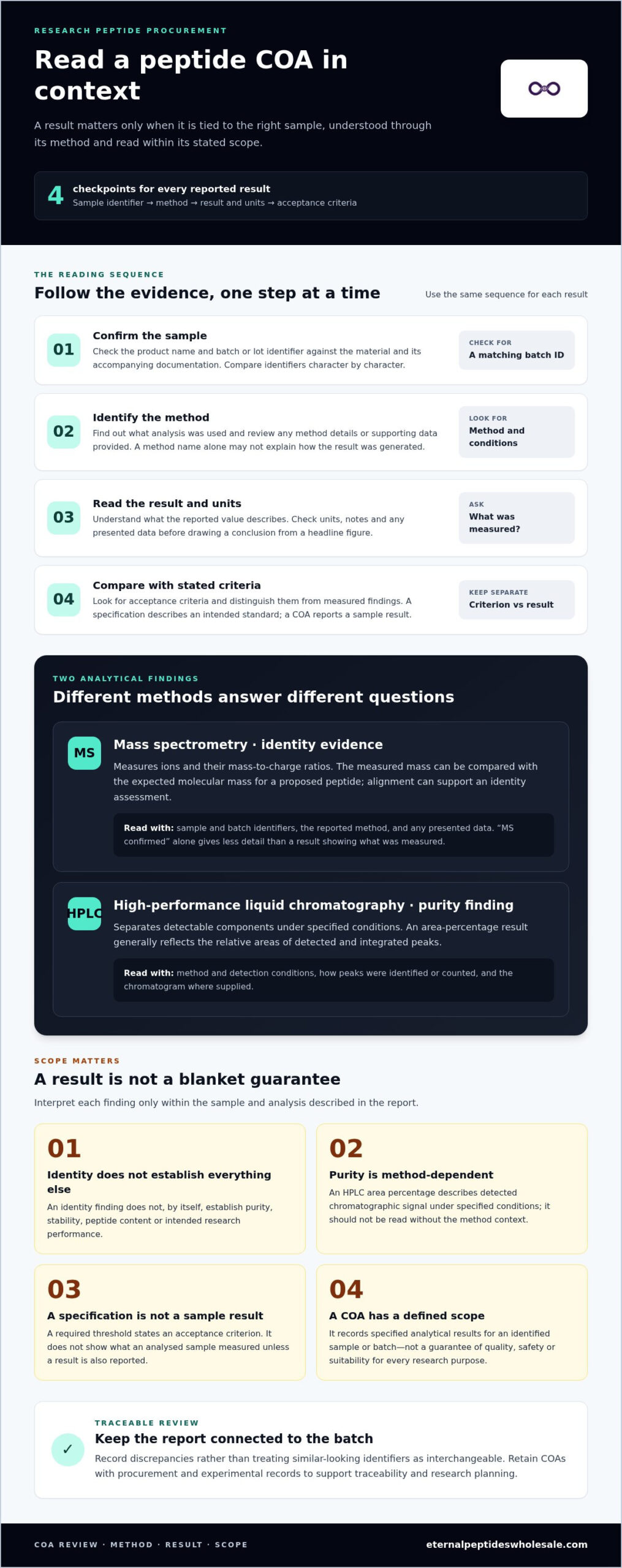
Read each result as a sequence: confirm the sample identifier, identify the analytical method, find the reported result and units, then check any stated acceptance criteria. This helps prevent a method name or headline figure from being mistaken for a complete assessment. Interpret a certificate of analysis for research peptides according to the data it actually reports, not the conclusions a reader hopes it will support.

Look for enough information to understand how each result was generated. A method may be named without conditions or supporting data, while a numerical result can be difficult to interpret without units or a stated criterion. The FDA’s Guidance on GMP for Pharmaceutical Ingredients provides broader context for quality control and documentation in pharmaceutical ingredient manufacturing. It is not a peptide-specific interpretation guide, but it illustrates why methods and records matter.

What can mass spectrometry indicate about peptide identity?

Mass spectrometry (MS) measures ions and their mass-to-charge ratios. These measurements can be used to derive a measured mass and compare it with the expected molecular mass for a proposed peptide. A result that aligns with the expected value can support an identity assessment. Review the reported method and presented data alongside the sample and batch identifiers. A label saying “MS confirmed” alone gives less detail than a result showing what was measured.

Identity evidence has a defined scope. It doesn’t, by itself, establish purity, stability, peptide content or intended research performance. Treat it as one analytical finding, not a stand-alone conclusion about every attribute of the material.

How should researchers interpret an HPLC purity result?

High-performance liquid chromatography (HPLC) separates detectable components under specified conditions. A purity figure reported as area percentage generally reflects the relative areas of peaks detected and integrated by that method. The result depends on the method, detection conditions and how peaks are identified or counted. Where supplied, examine the chromatogram and method details rather than relying only on the summary percentage.

An HPLC area-percentage purity result describes the detected chromatographic signal; it is not automatically a measurement of the total mass of peptide in the sample. Total peptide content is a separate question that requires an appropriate content or assay measurement. A high area percentage cannot establish how much peptide is present in the material as a whole, and the two values shouldn’t be used interchangeably.

For meaningful comparisons, check that reports use comparable methods, sample preparation, units and reporting conventions. Different figures may reflect different analytical conditions rather than a straightforward difference in material. Don’t apply a universal purity threshold without considering the research method’s requirements and the evidence reported.

Keep this distinction in view when planning laboratory procurement: identity, chromatographic purity and content answer different questions. Research teams sourcing material wholesale for laboratory research and development can review the wholesale research peptide range from Eternal Peptides Wholesale as part of their procurement planning.

What a Peptide COA Cannot Prove: Limits, Gaps, and Misreadings

A Certificate of Analysis is not a blanket guarantee of quality or fitness for purpose. It reports findings for specified analyses on a sample. What those findings support depends on the tests performed, the methods used and how the sample relates to the batch being considered. Even a clear result can leave important questions unanswered.

Every COA supports only the conclusions justified by its reported tests, methods and identified sample. A purity result, for example, doesn’t establish sterility, endotoxin status, stability or regulatory compliance. Those attributes require relevant evidence; they can’t be inferred from a strong result in another test. A general statement such as “quality tested” also doesn’t specify what was assessed.

Traceability matters. A report tied to an identified sample is not automatically evidence about every unit associated with a batch. The document should make its sample and batch connection clear. If that link is missing or ambiguous, readers can’t confidently apply the reported findings to the material under review. Treat uncertain traceability as a limitation in the evidence, not as proof that a test failed.

Does a COA establish safety or suitability for human use?

No. Analytical documentation does not make research products suitable for human use. A COA describes specified analytical findings; it doesn’t establish suitability for diagnosis, treatment, dosing or any other human use. Products discussed in this context are for laboratory research and development only. A COA also doesn’t replace the institutional, ethical or regulatory review relevant to a research project.

Which absent results should researchers avoid assuming?

Don’t infer an unreported test from a purity percentage or broad quality statement. Depending on the material and research requirements, relevant questions might include whether endotoxin, water content, residual solvents or stability were assessed. These are examples, not a universal checklist: the need for each analysis depends on the research context and applicable protocols.

There’s an important difference between a missing result and a failed result. If a COA doesn’t include an endotoxin test, that means the document doesn’t report the finding. It doesn’t show that the sample passed or failed. Likewise, the absence of stability data establishes neither stability nor instability. Record the gap accurately and avoid filling it with assumptions.

When evaluating a certificate of analysis for research peptides, separate reported findings from untested attributes and consider whether the sample identification supports applying those findings to the material being procured. A COA can inform a research procurement decision, but it can’t answer questions outside its stated scope or replace the research team’s review of requirements.
Certificate of Analysis: 2026 Research Peptides Guide

A Practical Checklist for Reviewing a Research Peptide COA

A repeatable review makes a Certificate of Analysis more useful in procurement and research records. Work through the document in order, separating what it reports from what you infer. This five-step process keeps batch traceability and evidence gaps visible without treating a single result as a complete quality assessment.

  1. Match the identifiers. Compare the product name and batch or lot identifier on the report with the accompanying product documentation. Note any mismatch, missing field or unclear sample description as a traceability limitation.
  2. Inspect the dates. Record the report date and any test dates shown. Check that the timing and sample description make sense for the material under review, and don’t assume a report applies to a different lot.
  3. Read the methods. Identify which analytical method supports each result. Note whether the report provides enough method detail to interpret the finding, rather than relying only on a general statement that testing was performed.
  4. Interpret each result. Record the reported value, units and any stated acceptance criteria. Keep different analyses separate; an identity result, for instance, answers a different question from a purity result.
  5. Record limitations. List relevant attributes the COA doesn’t report, and distinguish these gaps from failed results. Don’t infer a finding for a test that isn’t shown.

How to match a report to the material under review

Use the product and batch identifiers as the link between the report and the material’s accompanying documentation. Record the identifiers exactly as written, including letters, numbers and any suffixes. If the report describes a sample but doesn’t clearly connect it to the batch being considered, note that uncertainty in the procurement record rather than assuming a match.

Dates also need context. A report date may differ from the date testing took place, so capture both when available. Preserve the original document and note where it came from and which procurement record it relates to. This lets a later reviewer see what was assessed and which material the assessment was intended to cover.

How to record findings without overinterpreting them

Keep reported data distinct from interpretation. For each analysis, record the method, result, units and any stated criterion. Then add a separate note explaining what the result supports and what remains unanswered. A missing stability result, for example, is an unreported attribute, not evidence of either stability or instability. Review the method and reported findings together to understand what the HPLC or MS result supports.

Retain the COA with procurement documentation and relevant experimental records. If the batch identifier is unclear or a test is absent, state that plainly and follow the research team’s documented review process before deciding how the material fits the project. This approach supports traceable, research-use-only procurement without overstating what the paperwork establishes.

For laboratory research and development procurement, explore the wholesale research peptide range from Eternal Peptides Wholesale.

Using COA Literacy in Wholesale Research Peptide Procurement

COA review is most useful when it forms part of a consistent procurement record, rather than sitting as an isolated file. For laboratory research and development, linking the document to the relevant purchase, batch and project helps teams understand which evidence informed a decision and which questions remain open. This supports continuity when records are revisited during project planning or review.

How can laboratories make COA review repeatable?

Use the same record fields each time: product identity, batch identifier, report and test dates, method, result and units, stated acceptance criteria, reviewer and review date. Add a brief note on the scope and any unresolved gaps. Consistent fields make documents easier to compare, but they don’t make different analytical methods interchangeable. Link each review record to the relevant procurement file and project documentation.

A shared template can also clarify responsibility. The reviewer records what the document states; a separate interpretation field captures how the finding relates to the project’s requirements. Keep the original COA with the record, so another team member can trace a summary back to its source instead of relying on a second-hand description.

  1. Log the procurement link. Record the purchase reference and the material’s product and batch identifiers.
  2. Capture the evidence. Enter each method and result with its units, dates and any stated criteria.
  3. Separate findings from assessment. Note what the result supports without extending it to untested attributes.
  4. Flag open questions. Describe missing or unclear information as an evidence gap, not as a pass or failure.
  5. Connect the record. File the review with the project documentation and retain the source report for traceability.

This structure can help teams identify why two documents aren’t directly comparable. Differences in method, units or sample description should remain visible in the record, rather than being reduced to a single headline figure. Broader procurement considerations, such as sourcing research peptides wholesale in Australia, also sit alongside document review. A COA alone doesn’t answer them.

Where does COA review fit in Australian research procurement?

In Australia, treat COA interpretation as one component of procurement due diligence, not a substitute for an organisation’s applicable obligations, research governance or project-specific review. A document can inform planning, but it doesn’t decide whether a material is appropriate for a particular protocol. Keep the research purpose clear and assess the paperwork against the requirements established for the work.

Eternal Peptides Wholesale is an Australian wholesale supplier of research-grade peptides for laboratory research and development. Its products are for research purposes only, not for human consumption or medical use. If you’re planning laboratory research procurement, explore Eternal Peptides Wholesale’s wholesale research peptide offerings as one part of that process.

Make COA Review Part of Your Procurement Routine

Make your next step a practical one: build COA review into the way your team plans and documents laboratory procurement. A consistent process gives researchers a clearer basis for assessing whether available documentation aligns with a project’s requirements, while keeping unanswered questions visible for review. The aim isn’t to make a document prove more than it can, but to use its evidence carefully as part of sound research planning.

Apply the same disciplined approach when considering a certificate of analysis for research peptides: keep the document connected to the relevant procurement and project records, and interpret its findings within their stated scope. This supports more traceable decisions as research work progresses.

Eternal Peptides Wholesale is an Australian-based wholesale supplier of research-grade peptides for laboratory research and development. Its products are for research purposes only, not for human consumption or medical use. For laboratory procurement, explore Eternal Peptides Wholesale’s research peptide range. A clear, consistent review process helps your team make better use of its documentation.

Frequently Asked Questions

What is a Certificate of Analysis for research peptides?

A Certificate of Analysis (COA) is a report of analytical findings for an identified sample or batch. A certificate of analysis for research peptides can help a laboratory document what information accompanied a procurement decision. For example, a record can note whether the report identifies a sample, names the analysis and gives a result with units. Researchers should read those details in relation to their project requirements, rather than treating the document as a general quality endorsement.

How do I check whether a peptide COA matches the batch I am reviewing?

Compare the report’s product and batch identifiers with the accompanying material documentation, then note any differences in your procurement record. Check whether the sample description is specific enough to identify what was analysed. For digital filing, use a consistent file name that includes the product, batch identifier and report date. Keep the original report with the purchase record so another team member can retrace the match without relying on a summary.

Does an HPLC purity percentage show the total amount of peptide in a sample?

No. An HPLC purity percentage shouldn’t automatically be read as the total peptide amount. It commonly describes relative chromatographic signal under the stated method, while a content assay addresses how much peptide is present in a sample. For instance, a report may state an area-percentage result but provide no content measurement. Record the result under the analysis actually reported, and don’t relabel it as concentration or potency.

What does mass spectrometry tell you about a research peptide?

Mass spectrometry can provide evidence relevant to whether a measured mass is consistent with the expected molecular mass. When reviewing a report, check that the result relates to the identified sample and note the method and data presented. A mass match is one piece of evidence, not a full characterisation of the material. It doesn’t independently answer questions about purity, storage stability or how the material will perform in a specific experiment.

Is a third-party COA enough to prove a peptide is safe or suitable for human use?

No. A third-party report doesn’t make a research peptide suitable for human consumption or medical use. It remains documentation of defined analytical results, and its meaning depends on the analyses and sample described. Research-grade peptides supplied by Eternal Peptides Wholesale are for laboratory research and development only. Keep assessment within that research context, and don’t use a COA as a basis for personal or clinical use.

What should I do if a peptide COA does not list a test I need?

Record the missing analysis as an information gap, then compare the available documentation with the requirements set for the planned research. For example, if a project’s documented review calls for a particular test but the COA doesn’t report it, note that the report provides no result for that attribute. Don’t mark it as passed or failed. Retain the note with the procurement file so the decision is clear to later reviewers.

Related from Eternal Peptides Wholesale

Eternal Peptides Wholesale publishes batch-specific Janoshik Analytical reports in its certificate of analysis library, so the documentation for a listed batch can be read alongside the evidence discussed in this article.

Posted on

Wholesale BPC-157 Australia: Research Lab Sourcing Guide

Wholesale BPC-157 Australia: Research Lab Sourcing Guide

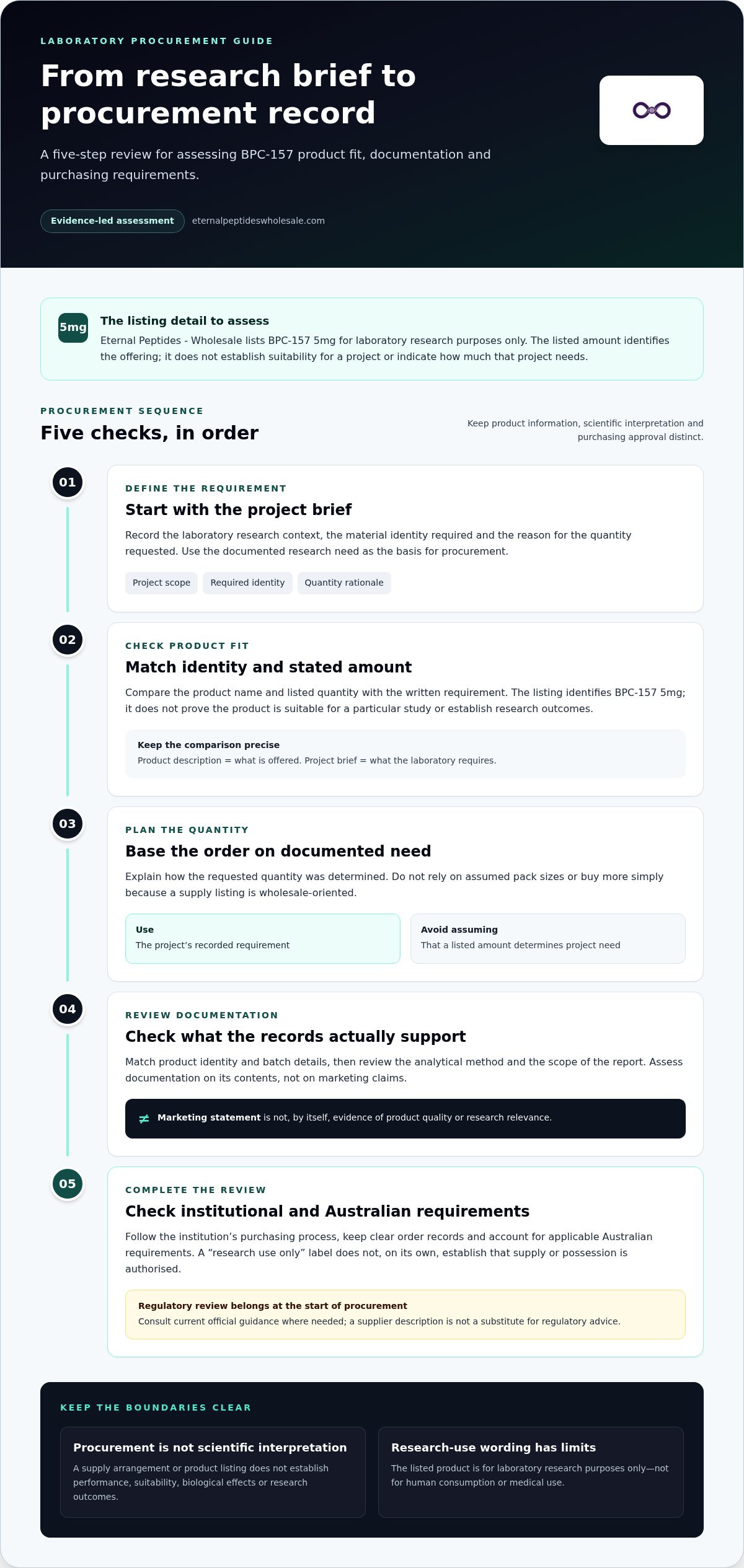
A wholesale listing is only the starting point for laboratory procurement. If you’re assessing wholesale bpc 157 australia options, first define the research requirement, then consider whether the product details and purchasing arrangement fit your institution’s processes and applicable Australian requirements. A “research use only” label does not, by itself, establish that supply or possession is authorised.

Eternal Peptides Wholesale lists BPC-157 5mg for laboratory research purposes only, not for human consumption or medical use. This guide explains how to assess product identity, compare wholesale supply with retail-oriented listings, and interpret batch documentation without treating marketing claims as evidence. It also covers how to plan quantities around a documented research requirement and why regulatory considerations belong at the start of procurement. The aim is to help laboratory buyers make an evidence-led assessment without assuming product quality or documentation beyond what has been substantiated.

Key Takeaways

  • Define the research scope and check institutional purchasing requirements before comparing wholesale bpc 157 australia options.
  • Eternal Peptides Wholesale lists BPC-157 5mg for laboratory research only, not for human consumption or medical use.
  • Assess documentation by matching product identity and batch details, then reviewing the analytical method and report scope.
  • Separate the listed compound and quantity from claims about biological effects or research outcomes.
  • Build procurement around internal approval and clear order records, and account for applicable Australian regulatory requirements.

Wholesale BPC-157 Australia: What Laboratory Buyers Need to Know

Wholesale BPC-157 supply is a laboratory research procurement arrangement, not a consumer or therapeutic product category. For Australian laboratories, comparing wholesale bpc 157 australia options means starting with the research purpose, product identity and institutional purchasing requirements. A bulk listing alone does not demonstrate suitability or permission to purchase.

Eternal Peptides Wholesale lists BPC-157 5mg for laboratory research purposes only. It is not for human consumption or medical use. The listed quantity identifies the product offering, but does not establish research outcomes, product performance or suitability for a particular project.

What does wholesale BPC-157 supply mean for a laboratory?

Wholesale procurement is organised around a laboratory’s documented requirements and purchasing processes. A single-vial retail listing is generally framed for an individual transaction, while a wholesale offering is intended for business or institutional purchasing. This describes the purchasing context, not a particular pack size, discount, testing standard or scientific benefit.

Before comparing listings, record the project scope, required material identity and reason for the quantity requested. Base the plan on the documented need, not assumed pack sizes or a desire to buy more. A supply arrangement concerns procurement; it does not establish conclusions about the compound or replace a research protocol.

  • Define the research requirement and the basis for the quantity.
  • Record the exact product identity and listed amount under review.
  • Keep procurement documentation separate from scientific interpretation.

Who is this Australian sourcing guide for?

This guide is for laboratory researchers, procurement staff and research institutions operating across Australia. It provides a framework for assessing product fit, documentation and internal processes. It is not a research protocol and does not provide directions for handling, administration or use in people.

Product decisions remain subject to institutional procedures and applicable Australian requirements. A research-use-only description does not, on its own, determine whether a particular acquisition is authorised or appropriate. Include regulatory and institutional review in procurement planning, and consult current official guidance where needed. The BPC-157 Wikipedia article offers a general overview of the compound, but is not a substitute for regulatory advice or product-specific evidence.

The distinction between wholesale and retail matters because the purchasing record should reflect the laboratory’s actual requirement, not an individual consumer transaction. A disciplined assessment also prevents a listed quantity or supplier description from being mistaken for evidence about quality or research relevance. The following sections cover product fit, documentation and procurement planning in more detail.

BPC-157 Product Fit: Define the Research Requirement Before Sourcing

Product fit starts with the research requirement, not a supplier’s description. Before comparing wholesale bpc 157 australia listings, document the laboratory context, the required material identity and the reason for the requested quantity. This gives researchers and procurement staff a consistent basis for assessing a listing while keeping product selection within institutional procedures.

Make the brief specific. For example, it can name BPC-157 as the compound under consideration, describe the laboratory research context and explain how the required quantity was determined. Don’t add assumptions about formulation, storage conditions or other specifications that aren’t stated in the product information.

Match product identity and stated quantity to the project

Eternal Peptides Wholesale lists BPC-157 5mg as a wholesale offering for laboratory research. Treat the compound name and stated quantity as product-identification details, then compare them with the written requirement. The listing does not establish suitability for a particular study, and the quantity does not indicate how much a project needs.

A clear internal brief can record:

  • The compound identity required for the project.
  • The stated quantity being assessed.
  • The intended laboratory research context.
  • The institutional process that governs purchasing decisions.

This record helps separate procurement fit from scientific interpretation. A product description can identify what is being offered; it cannot establish the material’s relevance to a hypothesis or predict a study result. Keep those judgements within the research team’s established review process.

Keep research-use language precise

Descriptions of research interest provide context, not proof. References to a topic or model do not demonstrate efficacy, confirm suitability for a specific study or support claims about health outcomes. Use neutral terms such as “research interest” and “laboratory study”, and assess scientific claims separately through appropriate evidence and institutional review.

BPC-157 products supplied by Eternal Peptides Wholesale are strictly for laboratory research. They are not for human consumption or medical use. Avoid language that blurs this boundary, such as turning a research-area description into a treatment benefit or an expected result.

Before progressing a purchase review, check that the proposed product identity and quantity align with the project brief and that the decision follows institutional requirements. For a procurement starting point, review Eternal Peptides Wholesale’s wholesale BPC-157 5mg offering against the documented research need.

Assess Wholesale BPC-157 Documentation and Quality Claims

Documentation is useful when it supports a specific procurement decision. When assessing wholesale bpc 157 australia options for research, distinguish a general quality statement from evidence tied to the exact product and batch under review. A marketing description may explain how a supplier presents an offering, but it cannot replace a document that identifies what was assessed and reports results within a defined scope.

Marketing claims and batch-specific evidence are not interchangeable. Keep that distinction clear in the procurement record. A certificate or analytical report should be interpreted according to its stated contents, not treated as a blanket assurance of research suitability, biological performance or compliance with institutional requirements. The steps below help make the limits of the paperwork clear.

What should a laboratory review in product documentation?

Use a four-step review: confirm product identity, match the record to the relevant batch, identify the analytical method and read the report scope. If an element is absent or ambiguous, record that limitation rather than filling the gap with an assumption. This creates a traceable basis for internal review without overstating what the paperwork establishes.

  1. Product identity: Check that the document names the compound being assessed and corresponds to the product under consideration.
  2. Batch link: Look for a batch identifier connecting the report to the material under review, rather than relying on a general supplier statement.
  3. Analytical method: Note the method named in the report and what it is used to assess.
  4. Report scope: Record the reported results, stated limits and any information the document does not cover.

A certificate is relevant only to the extent that its identity and batch details match the product and batch being assessed. A document for a different batch, or one that names no batch, may not support the same procurement conclusion. Include the document date and any stated limitations in the institution’s records so reviewers can see exactly what evidence informed the decision.

How to interpret purity and testing language

HPLC, or high-performance liquid chromatography, is an analytical technique used to separate components in a sample. Mass spectrometry measures the mass-to-charge ratios of ions and can contribute to characterising material. These terms describe methods. They do not guarantee that a particular supplier used them or that a report answers every question relevant to a laboratory’s requirements.

Read a stated purity percentage within the test’s scope and reporting basis. On its own, it does not prove suitability for a specific study, biological activity or performance. Don’t infer additional tests from the mention of one method. When reviewing an analytical claim, use current product documentation that directly supports it.

For a more structured procurement review, the research peptide quality assurance guide provides related context. Documentation review is one part of a broader institutional assessment; it does not replace applicable approval or regulatory review.

Wholesale BPC-157 Australia: Research Lab Sourcing Guide

Plan Wholesale BPC-157 Procurement for an Australian Laboratory

A sound procurement process connects the research requirement, institutional review and purchasing record. For wholesale bpc 157 australia enquiries, treat regulatory and institutional approval as prerequisites, not paperwork to complete after selecting a product. A research-use-only description does not, by itself, establish that a proposed supply or acquisition is authorised. The institution should assess applicable Australian requirements before a purchasing decision proceeds.

A procurement sequence from requirements to records

Use a documented sequence so each decision has a clear basis. The exact review pathway depends on institutional procedures and the requirements that apply to the proposed research.

  1. Define the requirement. Record the compound identity, stated quantity and authorised research context. Explain how the quantity relates to the project rather than relying on an assumed pack size.
  2. Complete institutional review. Route the proposed procurement through the relevant purchasing, research governance and compliance processes. Resolve authorisation questions before proceeding.
  3. Assess product information. Review available product details and any batch documentation. Record what the documents establish, their scope and any limitations. Don’t infer tests or specifications that aren’t stated.
  4. Document the decision. Retain the review outcome, approval records, relevant product information and order records according to institutional procedures.

This sequence creates a traceable record from need through approval. It also distinguishes a decision to assess an offering from a conclusion that it is authorised or appropriate for a particular project. Align research-use procedures with purchasing controls, and refer unresolved regulatory questions to the institution’s designated compliance personnel.

Wholesale versus retail: choose the right purchasing context

Compare the project’s documented requirements with the supplier’s stated wholesale offer. Eternal Peptides Wholesale operates as a wholesale supplier, and its listed BPC-157 offering is BPC-157 5mg for laboratory research purposes only. The business does not sell retail single vials. Wholesale purchasing is therefore distinct from a retail-oriented single-vial listing, but that distinction does not establish the permissions, documentation or suitability required for a particular institutional purchase.

Keep the assessment focused on verifiable details. Don’t infer minimum quantities, pricing, payment terms, shipping arrangements or delivery timeframes unless those details are explicitly documented for the transaction. A general fulfilment statement is not a commitment to a specific order. For a broader framework on Australian purchasing workflows, the Australian wholesale research peptide procurement guide can help structure internal review.

Once institutional approval and relevant requirements are clear, review the BPC-157 5mg wholesale listing as part of the documented assessment. Products are for laboratory research only, not for human consumption or medical use.

Source Wholesale BPC-157 from Eternal Peptides Wholesale for Research Use

Eternal Peptides Wholesale is an Australian-based wholesale supplier of research-grade peptides. Its listed BPC-157 offering is BPC-157 5mg, supplied strictly for laboratory research. It is not intended for human consumption or medical use. These details define the offer; they do not establish suitability for a particular study or make claims about effects.

The wholesale model is distinct from retail single-vial purchasing. Eternal Peptides Wholesale does not sell retail single vials, and its BPC-157 listing is presented as a wholesale research offering. This purchasing context is relevant to laboratory procurement, but it is not evidence of product quality, research performance or legal authority to acquire or supply the compound.

What Eternal Peptides Wholesale’s wholesale offer is designed for

The offering is for laboratory research within an appropriate institutional and regulatory framework. Before proceeding, define the research requirement, establish that the proposed procurement aligns with organisational procedures and assess product information against that requirement. A research-use label does not, by itself, establish that acquisition is authorised under applicable Australian controls.

Keep these points distinct in procurement records:

  • Product identity: BPC-157.
  • Listed quantity: 5mg.
  • Purchasing context: wholesale supply for laboratory research.
  • Use restriction: not for human consumption or medical use.

This summary is a starting point, not a substitute for the product-fit and documentation review described above. A laboratory still needs to assess whether the stated identity and quantity match its documented requirement, consider what product or batch records establish, and follow its own approval and purchasing processes. Avoid drawing conclusions beyond the stated scope of product descriptions.

Take the next step with a research-led purchasing decision

Before considering a transaction, address applicable Australian requirements and institutional approvals. BPC-157’s regulatory status means a research-only description should not be treated as an exemption or proof that a proposed supply arrangement is authorised. If regulatory obligations are uncertain, consult current authoritative Australian guidance and the institution’s compliance processes before proceeding.

For laboratory buyers whose procurement has passed the relevant review, compare the documented project need with the wholesale listing and retain the basis for the decision. Review the BPC-157 5mg wholesale research listing as part of that assessment. Base the decision on product identity, quantity fit, documentation scope and applicable approvals, not unverified claims about performance, fulfilment or quality.

Make the Next Procurement Decision Evidence-Led

Turn your review into a clear internal decision record. Document why the proposed material fits the project, what the available evidence does and does not establish, and which institutional approvals apply. This gives researchers and procurement staff a shared basis for deciding whether to proceed, pause or seek further review.

For teams evaluating wholesale bpc 157 australia options, a research-use label alone does not establish authority to acquire or supply the product. Resolve applicable Australian regulatory requirements and institutional approvals before procurement. Keep that assessment distinct from product identity and batch documentation so each part of the decision is supported by appropriate evidence.

Eternal Peptides Wholesale is an Australian-based wholesale supplier, with BPC-157 5mg listed for laboratory research only, not for human consumption or medical use. If the offering aligns with your documented requirements and relevant approvals, review Eternal Peptides Wholesale’s wholesale research peptide range as part of your purchasing assessment. A careful, well-recorded decision is a sound foundation for responsible research procurement.

Frequently Asked Questions

Can laboratories source wholesale BPC-157 in Australia?

Not as an unrestricted purchase based solely on a supplier’s listing. BPC-157 is classified as a Schedule 4 prescription-only medicine in Australia, so a “research use only” description does not itself establish that supply or acquisition is authorised. Eternal Peptides Wholesale lists BPC-157 5mg as a wholesale research offering, but laboratories must assess applicable regulatory requirements and institutional approvals before considering procurement. A listing is not proof of legal authority.

What does research-use-only mean for BPC-157?

Research-use-only describes the stated purpose of a product. It does not make it a medicine, support human use or establish that a purchase is lawful. Laboratories should consider the Australian regulatory framework separately from the supplier’s label and follow their organisation’s governance and handling procedures. Eternal Peptides Wholesale’s products are for laboratory research only, not human consumption or medical use. The business does not provide medical consultations.

What should a laboratory check before purchasing wholesale BPC-157?

Begin with the institution’s authority to acquire the material, then assess whether the product information matches the approved research requirement. A procurement record can note the compound name, stated quantity, relevant batch identifier and documents reviewed, alongside the approval reference. Keep promotional descriptions separate from evidence. If a proposed acquisition raises regulatory or governance questions, pause the purchasing process and refer them through the institution’s established compliance pathway.

Is a certificate of analysis enough to assess a BPC-157 product?

No. A certificate of analysis may inform a review, but its usefulness depends on whether it identifies the specific material and batch and clearly describes its methods and results. A generic document, or one that cannot be linked to the product under consideration, offers a limited basis for assessment. Record the document’s scope and omissions, and don’t treat reported results as proof of suitability for a particular project or of biological outcomes.

How much BPC-157 should a laboratory order wholesale?

There’s no universal quantity for every laboratory. The amount should follow an approved project requirement and institutional purchasing process. Avoid basing the decision on consumer advice, an assumed pack size or a supplier’s general description. Eternal Peptides Wholesale lists BPC-157 5mg as a wholesale offering. Assess that stated quantity against the authorised need rather than interpreting it as a recommendation about study design or use.

Does wholesale BPC-157 have a human medical use?

Eternal Peptides Wholesale’s BPC-157 offering is for laboratory research only, not human consumption or medical use. The business does not provide medical consultations, and a wholesale listing is not medical advice, a treatment recommendation or an instruction for human use. Don’t infer a medical purpose from research-related descriptions. Questions about a person’s health or treatment belong with an appropriately qualified health professional, not a research product listing.

How can Australian laboratories compare wholesale and retail BPC-157 listings?

Compare the purchasing format with the institution’s procurement needs, but don’t assume that format determines legality or product quality. Wholesale and single-vial retail listings may describe different purchasing contexts; details such as quantity, testing, price and delivery terms are supplier-specific. For a wholesale bpc 157 australia assessment, record each listing’s stated product identity and supporting documents separately, then assess the proposed acquisition under institutional procedures and applicable Australian requirements.

Related from Eternal Peptides Wholesale

Eternal Peptides Wholesale publishes batch-specific Janoshik Analytical reports in its certificate of analysis library, so the documentation for a listed batch can be read alongside the evidence discussed in this article.

Posted on

TB-500 for Cell Migration Assays: Design, Controls and Interpretation

TB-500 for Cell Migration Assays: Design, Controls and Interpretation

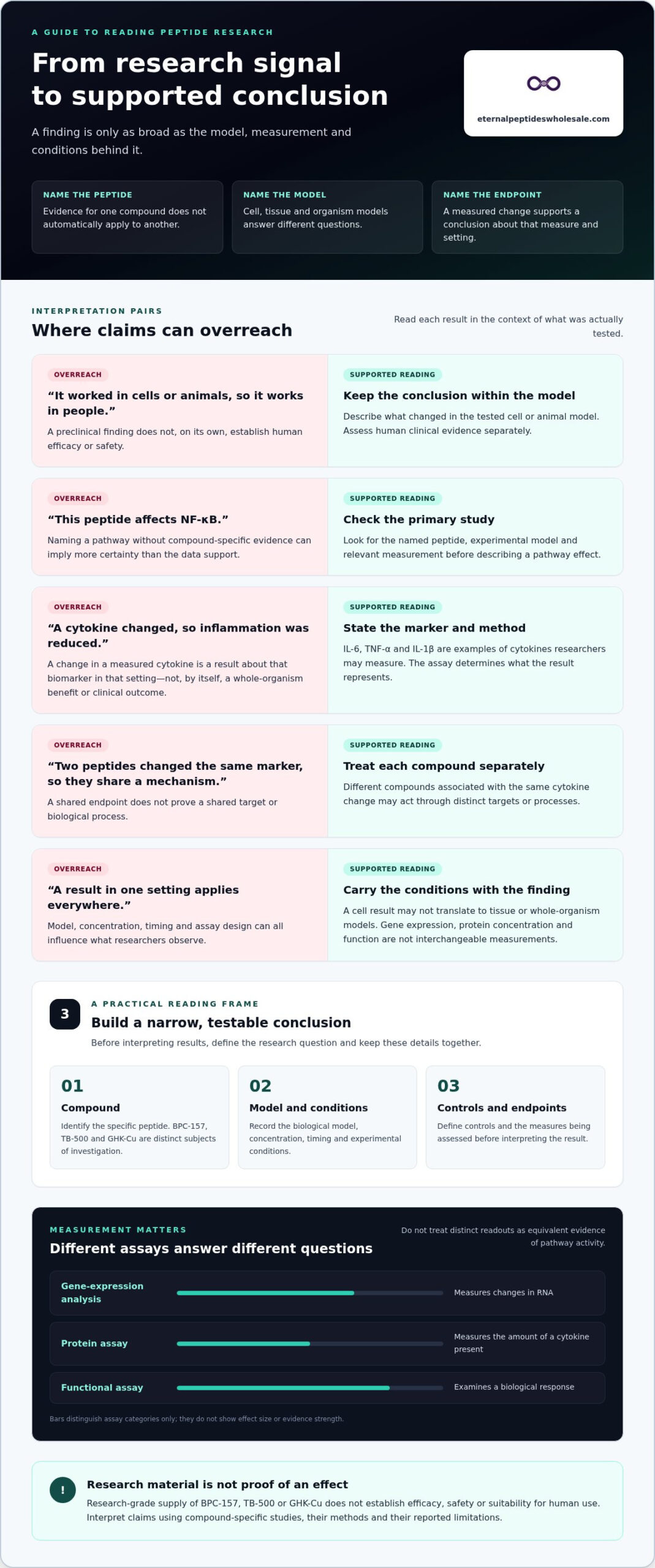
What if a stronger migration signal reflects increased cell growth or improved viability rather than greater movement? That distinction matters when assessing TB-500 for cell migration assays, because both the peptide material and experimental conditions can shape a readout. The name TB-500 may not identify the same material across sources, and migration assays can capture effects other than cell movement.

This article explains how to evaluate TB-500 in cell migration research by matching material identity, assay design and controls to the research question. It also outlines how to interpret results cautiously, without treating an observed change as proof of a specific mechanism or effect.

We compare key assay considerations, including migration readouts and controls for proliferation and viability, then discuss how to document material identity and assess limitations. For Australian laboratory procurement, Eternal Peptides Wholesale supplies TB-500 5mg in wholesale quantities for research use. Product information and research-use status provide procurement context, not evidence of assay performance.

Key Takeaways

  • Define the migration question first, then select an assay format that can address it without implying therapeutic relevance.
  • Compare scratch and transwell readouts against the specific research question and each format’s limitations.
  • Use suitable vehicle, untreated and reference controls to help distinguish migration observations from effects on cell growth or viability.
  • Compare evidence only after considering material identity, cell model, assay format, controls and endpoint.
  • For laboratory procurement, align research-use material documentation and planned study scale with the study’s requirements.

What does TB-500 for cell migration assays actually mean?

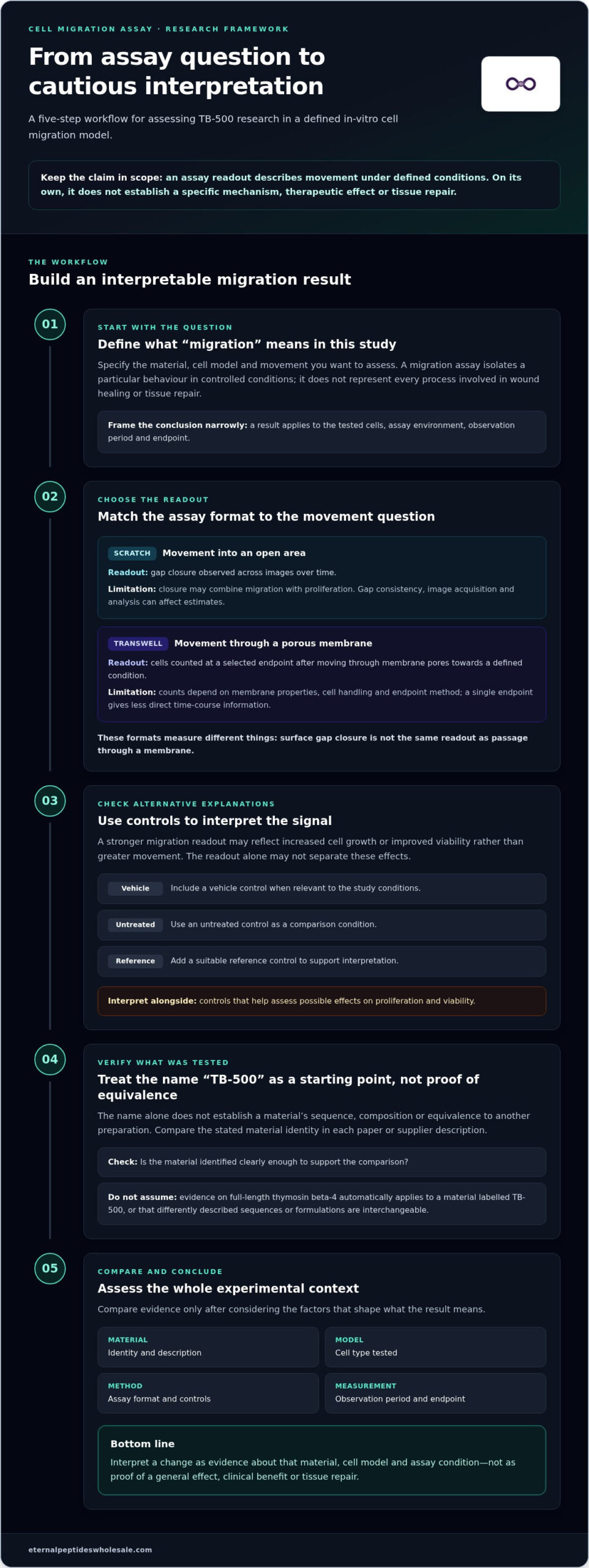
The phrase TB-500 for cell migration assays describes a research question, not a settled biological conclusion: does a specified material alter cell movement in a defined in-vitro model? The answer depends on the material’s identity, the cells tested and how movement is measured. An assay result cannot, by itself, establish a therapeutic effect or predict what may happen in living tissue.

This distinction matters because migration is often discussed alongside wound healing and tissue repair. Those processes involve multiple cell types and biological events, while a migration assay isolates a particular behaviour under controlled experimental conditions. A change in the assay readout is evidence about that model and those conditions. It is not proof of clinical benefit, tissue repair or a general effect across cell types.

How should researchers understand TB-500 terminology?

TB-500 is a name used in research and commercial contexts, but the name alone doesn’t establish a material’s sequence, composition or equivalence to another preparation. Compare the terminology in each paper or supplier description with its stated material identity. The TB-500 Wikipedia page offers general orientation on the name and its relationship to thymosin beta-4. It should not replace primary documentation or study methods.

Evidence explicitly concerning full-length thymosin beta-4 should not automatically be presented as evidence for a material labelled TB-500. Likewise, don’t assume that differently described sequences or formulations are interchangeable. When a source reports an effect, check whether it identifies the material clearly enough to support the comparison being made.

What does a cell migration assay measure?

Migration means movement of cells within a specified assay environment. Depending on the format, the endpoint may reflect movement into an open area or movement through a barrier. These are operational readouts: they quantify a defined observation, rather than revealing every process that contributed to it.

For example, a change in occupied area may be consistent with cell movement, but proliferation can also affect how much area is covered. Cell loss or reduced viability may change the number of cells available to move. Assay design and relevant controls help researchers evaluate these possibilities, but the readout alone may not separate them.

A migration assay records cell movement under defined conditions; its readout doesn’t, on its own, distinguish movement from changes in proliferation or viability.

Keep interpretation close to the experiment: consider the cell model, assay environment, observation period and endpoint. A result in one cell type doesn’t establish the same response in another, and an in-vitro movement signal doesn’t demonstrate tissue repair. Define the research question precisely before interpreting a change as migration-related. This keeps conclusions proportionate to the evidence and gives later comparisons a clear basis.

How do scratch and transwell assays assess cell migration?

Assay choice determines what “migration” means in a study. A scratch assay tracks cells moving across a surface into an initially cell-free area. A transwell assay examines cells moving through a porous membrane towards a defined condition. Neither format answers every cell-movement question. For a TB-500 migration study, the practical question is not which format is universally better, but which readout fits the hypothesis and can be interpreted with its limitations in view.

When is a scratch assay a useful model?

A scratch assay is suited to observing how a cell layer closes a defined gap over time. Images show the changing area, making movement visible as a time course rather than only as a final count. However, closure may also reflect cell proliferation, so it isn’t automatically a pure measure of migration. Scratch consistency, image acquisition and analysis choices can all influence the apparent result and complicate comparisons.

Assay format Question and readout Key limitation
Scratch How does a cell layer move into a cell-free area? Readout: gap closure across images. Closure may combine migration with proliferation; gap shape and image analysis affect estimates.
Transwell How many cells move through a porous membrane towards a defined condition? Readout: cells counted at an endpoint. Counts depend on membrane properties, cell handling and the endpoint method; they provide less direct time-course information.

What does a transwell assay add?

A transwell format asks whether cells pass through membrane pores under the conditions being tested. It can suit a question about movement across a barrier rather than lateral movement along a surface. Results are often expressed as a count of cells that have crossed by the selected endpoint. That differs from repeated surface imaging, which can show how closure changes over time but doesn’t measure passage through a membrane.

Membrane characteristics shape the conditions cells encounter, while cell preparation and handling can influence which cells reach the measured side. An endpoint count also compresses movement over time into one observation. It may not show when movement occurred or distinguish cells that crossed early from those that crossed later. Keep these differences in mind when deciding what a result supports.

A scratch assay observes migration across a surface; a transwell assay counts movement through a porous barrier towards a defined condition. Each is a different operational measure, not a direct substitute for the other. A study focused on gap closure may favour surface imaging, while a question about traversing a barrier may call for a transwell approach. If the research question involves both behaviours, complementary formats can offer different perspectives, but interpret their readouts separately.

For a meaningful comparison, match the assay to the biological question, then consider how growth, viability or technical variation could influence its endpoint. Eternal Peptides Wholesale supplies TB-500 5mg in wholesale quantities for laboratory research use. Procurement context is separate from evidence that a material performs in either assay. Researchers reviewing wholesale TB-500 5mg research material can keep that distinction clear while planning study requirements.

Which controls make TB-500 migration results more interpretable?

Controls help researchers identify what a migration result can and can’t support. They don’t guarantee an outcome or prove a mechanism. In TB-500 migration studies, choose controls with the material, its vehicle, the cell model and assay format in mind. A result is more informative when the comparison helps show whether a difference is associated with the test condition rather than the carrier, baseline behaviour or another cellular effect.

A vehicle control accounts for the solution or carrier used to present the test material. An untreated control provides a baseline without that treatment or vehicle, where appropriate to the design. Comparing these groups can help reveal whether the vehicle itself is associated with a change. An assay-appropriate reference control may also help establish that the model can produce a measurable response. Its role is to contextualise the assay, not to validate TB-500 or guarantee that every experiment will behave as expected.

How can researchers separate migration from proliferation?

Greater scratch closure alone doesn’t establish greater migration. Cells may divide and occupy more of the gap, so an apparent change in closure could reflect a combination of movement and proliferation. Pairing migration observations with a suitable proliferation assessment helps researchers judge whether cell growth offers an alternative explanation. Interpret each measure according to what it can resolve, rather than treating a second readout as automatic proof of cause.

Viability is another relevant consideration. If fewer cells remain viable in one condition, the migration readout may change because the number of cells able to move has changed. Considering viability alongside movement can help distinguish a migration-related observation from a broader effect on cell health. Select these assessments to suit the cell model and research question. No single control or measurement resolves every interpretive issue.

Migration readouts need controls for competing cellular effects, because movement, proliferation and viability can each influence the observed signal.

How do model choice and analysis affect interpretation?

Cell type matters. Models differ in baseline motility and may not represent the biological context a researcher wants to examine. A result in a highly motile cell model may not translate to a model with different behaviour. Choose the model in relation to the question, and describe its limits so the conclusion stays within the evidence generated.

Consistent study conduct and analysis also support fair interpretation. Report the replicate structure clearly, and apply image acquisition and analysis criteria consistently across comparison groups. State how measurements were made and explain any exclusions rather than removing observations without a transparent rationale. Report variability as well as the direction of the result, since a single summary value can conceal differences between replicates.

Read the controls together: vehicle and untreated comparisons address different baselines, while a reference control can provide assay context. Then consider whether proliferation, viability, model behaviour or analysis choices could account for some of the observed signal. Reporting these uncertainties plainly strengthens the interpretation and prevents an in-vitro observation from being presented as more conclusive than the design allows.

TB-500 for Cell Migration Assays: Design, Controls and Interpretation

How should researchers compare evidence and assess assay limitations?

Comparing TB-500 migration studies takes more than lining up reported outcomes. First establish whether the studies tested comparable materials and models, then assess how each experiment measured movement. Different results may reflect different study conditions rather than a contradiction. Treat each paper as evidence for the specific material, cells and assay it describes.

Which details should a study comparison capture?

Build a concise evidence record before comparing conclusions. Capture the reported material identity and analytical characterisation, followed by the cell model, assay format, comparator conditions and measured endpoint. This makes gaps visible and helps distinguish directly comparable studies from adjacent evidence. If a paper proposes a mechanism, record it as the authors’ interpretation, separate from the observation the experiment measured.

  • Material: Note the name, stated sequence or composition, and analytical characterisation reported by the authors. Don’t treat a shared label as proof of equivalence.
  • Model and format: Record the cell type and whether movement was assessed across a surface or through a barrier.
  • Comparison and endpoint: Identify control conditions and what was quantified, such as gap closure or cells counted at an endpoint.
  • Interpretation: Separate measured findings from proposed explanations, and note relevant limitations in the methods.

Analytical characterisation can clarify what a study reports about its test material, but it doesn’t establish that different materials are interchangeable or that an assay finding will be reproduced. For background on the role of these methods in peptide assessment, consult the guide to HPLC and MS analysis for peptide purity.

What can and cannot be concluded from assay results?

Give greater weight to evidence that clearly identifies the material and describes the model, assay, controls and endpoint. Findings involving thymosin beta-4 or another related material may provide context, but they aren’t direct evidence about a material specifically named TB-500 unless identity and composition support that comparison. If nomenclature is inconsistent or methods are incomplete, mark the comparison as uncertain rather than filling gaps with assumptions.

A reported change in movement supports a conclusion about that observation under the conditions studied. It doesn’t, by itself, establish a general mechanism, an effect in other cell models or clinical benefit. Missing controls can leave alternative explanations unresolved, and unclear endpoints can make two results appear similar when they measure different things. State these boundaries plainly. They’re part of the evidence, not a reason to overstate or dismiss a finding.

Use this framework to decide whether a paper offers direct, relevant evidence or only background for a new question. For Australian laboratories planning procurement, Eternal Peptides Wholesale supplies TB-500 5mg in wholesale quantities for laboratory research use. Explore wholesale research peptides as a procurement option, keeping product information separate from evidence of assay performance.

How can laboratories source TB-500 for research responsibly?

Procurement planning should follow the study design, not replace it. Before sourcing TB-500 for an assay, align the material description in the procurement record with the identity criteria in the research plan. A familiar label alone may not establish that materials described differently in papers or supplier information are equivalent. Keeping identity requirements explicit helps laboratories make meaningful comparisons and maintain consistent study records.

What should a laboratory document before procurement?

Set out the material description the study requires, including any identity details essential to its inclusion and reporting criteria. Then estimate quantity from the planned research programme and the laboratory’s procurement workflow. The appropriate amount depends on the work planned; don’t treat a pack size as evidence of how much a particular study needs.

Maintain relevant product and batch records alongside study documentation. Retain relevant product information with the material description and procurement details so the laboratory can trace what was assigned to the work. Record differences between the material description and the terminology used in published studies. This creates a clearer audit trail and helps prevent later comparisons from relying on a name alone.

  • Material identity: Align the recorded description with the study’s defined inclusion criteria.
  • Documentation: File relevant product information with the research records.
  • Batch traceability: Preserve batch details associated with the material used.
  • Planned scale: Base quantity planning on the programme and procurement process.

How does wholesale sourcing fit laboratory research?

Wholesale supply suits institutional and laboratory procurement workflows that plan research material as part of a broader programme. Eternal Peptides Wholesale supplies TB-500 5mg for wholesale research use. That product context is separate from evidence that a material changes cell migration: sourcing information does not establish sequence equivalence, assay validation or experimental performance.

For procurement teams considering related research materials, the wholesale tissue repair procurement guide provides further context for planning. Keep the intended research question, material description and records aligned, and assess experimental findings independently of supplier or product descriptions.

Peptides supplied by Eternal Peptides Wholesale are for research purposes only, not for human consumption or medical use. Keep this boundary clear in laboratory procurement and handling documentation. Responsible sourcing supports organised research records; it does not replace appropriate assay controls or demonstrate a result.

For laboratory research procurement, explore wholesale TB-500 5mg and assess its product information against your study’s documented requirements.

Set up the next research decision with clarity

Before moving from evidence review to procurement, define what a useful result would mean for your study. Set material identity and comparison criteria alongside the assay endpoint, then keep those requirements consistent in the study plan and procurement records. This gives your team a clear basis for evaluating TB-500 in migration assays without treating a product description as evidence of experimental performance.

Eternal Peptides Wholesale is an Australian-based wholesale supplier serving laboratory research needs, and supplies TB-500 5mg for wholesale research use. The material is intended for research purposes only, not human consumption or medical use. Keep procurement decisions aligned with your laboratory’s documented research requirements and assess assay findings on their own evidence.

Explore TB-500 for wholesale research supply as you plan your next laboratory study. A clear question, defined evidence criteria and organised procurement records can help your research proceed with greater confidence.

Frequently Asked Questions

Is TB-500 the same as thymosin beta-4?

No, the names alone don’t establish that two materials are identical. Compare the exact identity and composition reported in a study with the material described in the research record or product documentation. Findings involving thymosin beta-4 shouldn’t automatically be attributed to every material labelled TB-500. If a paper doesn’t provide enough information for that comparison, record the identity as uncertain and avoid treating the terms as interchangeable.

Can a scratch assay prove that TB-500 increases cell migration?

No, a scratch assay observation alone can’t prove that TB-500 increases migration. In a migration assay, apparent gap closure might also be influenced by cell growth, viability, scratch uniformity or image-analysis choices. Compare the result with appropriate controls and relevant supporting measurements, and report the conclusion for the cell model and conditions tested. An in-vitro observation doesn’t establish clinical efficacy or therapeutic benefit.

How do researchers quantify cell migration in a scratch assay?

Researchers can quantify changes in the cell-free area or track movement across images captured over time. For a meaningful comparison, define the measurement method and image-analysis rules in advance, then apply them consistently across groups. For example, changes in image scale, gap boundaries or segmentation criteria can affect calculated closure. Interpret the metric alongside relevant proliferation and viability information, since closure alone can’t identify which cellular processes contributed to it.

Does a transwell assay measure the same thing as a scratch assay?

No, the formats assess different movement contexts. A scratch assay follows closure across a cell-covered surface, while a transwell assay assesses cells passing through a porous membrane under defined conditions. Their endpoints aren’t directly interchangeable: one may quantify area change across images, while the other may count cells at an endpoint. Compare results only after accounting for the cell model, assay setup and measurement method used in each study.

Does an HPLC purity result confirm that TB-500 is active in a migration assay?

No, an HPLC purity result alone doesn’t demonstrate activity in a cell migration assay. It provides analytical information about a sample, not a functional outcome in a specific biological model. Keep analytical characterisation separate from assay evidence and consider the reported material identity, experimental conditions and controls when assessing a result. A purity figure shouldn’t be interpreted as proof of assay validation, biological activity or performance.

Can cell migration assay results show that TB-500 has a therapeutic effect?

No, cell migration assay results can’t establish a therapeutic effect. They are laboratory observations from a particular material, cell model and experimental setting, not evidence of clinical efficacy, safety or suitability for human use. Keep conclusions within the scope of the experiment and avoid translating an in-vitro finding into a medical claim. Research peptides discussed in this context are for research purposes only, not human consumption or medical use.

Related from Eternal Peptides Wholesale

Eternal Peptides Wholesale publishes batch-specific Janoshik Analytical reports in its certificate of analysis library, so the documentation for a listed batch can be read alongside the evidence discussed in this article.

Related reading: TB-500 Actin-Binding Properties Research: Evidence and Limits; Anti-inflammatory Peptide Compounds for Study: Evidence, Mechanisms and Research Considerations

Posted on

In Vitro Studies Using Retatrutide: A Researcher’s Guide

In Vitro Studies Using Retatrutide: A Researcher’s Guide

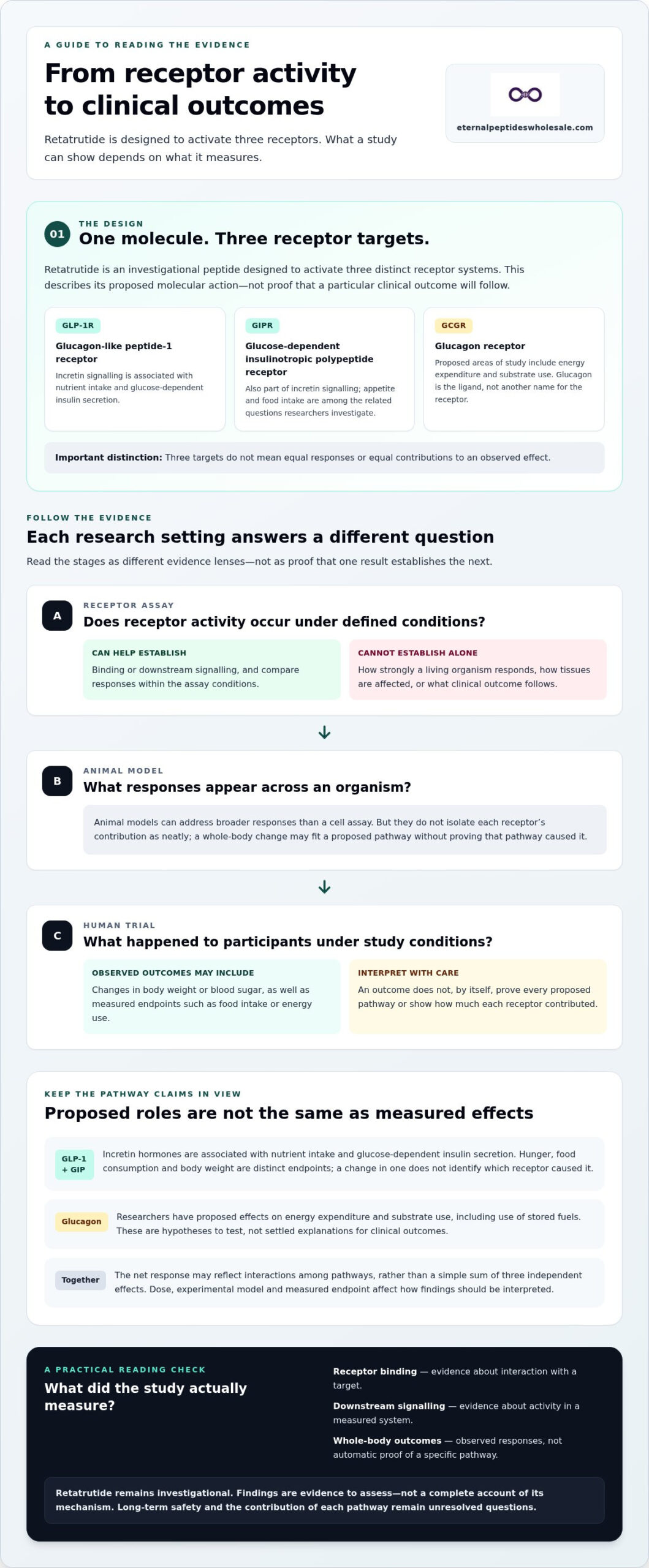
A receptor response in a dish is not proof of a human outcome. In vitro studies using retatrutide can help researchers characterise activity at GLP-1, GIP and glucagon receptors, but they can’t establish whether the compound is safe or effective in people.

Comparing studies takes more than scanning their conclusions. Papers may use different cell models, concentrations and assay endpoints. A change in cyclic adenosine monophosphate (cAMP), for example, describes a signal measured under defined laboratory conditions. On its own, it doesn’t predict a clinical result.

This guide explains what in vitro retatrutide research can show and how to assess the design behind reported results. It covers receptor-specific assay models, concentration-response data, controls and reporting choices that affect comparability. It also explains the limits of extrapolating between experimental systems, distinguishes laboratory evidence from clinical evidence, and outlines practical considerations for responsible research planning. The aim is to help you read the literature critically without treating a promising signal as proof of an outcome in humans.

Key Takeaways

  • Learn what in vitro studies using retatrutide can investigate, and why the research question shapes how results should be interpreted.
  • Distinguish receptor-binding assays from functional assays, and check which readouts the paper actually reports.
  • Compare cell, animal and clinical evidence by the question each model can answer, rather than treating them as interchangeable.
  • Use a structured reading sequence to examine a paper’s model, methods, controls, results and limitations.
  • Translate critical appraisal into responsible study planning, with documented protocols and appropriate institutional oversight.

What in vitro studies using retatrutide investigate

In vitro research examines biological processes outside a whole living organism, using systems such as cultured cells or biochemical preparations. A retatrutide study might investigate whether the compound interacts with a particular receptor or produces a measurable response in a defined model. This approach isolates a question for closer examination. It doesn’t recreate the full biology of an animal or person.

What does in vitro mean in peptide research?

A cell-based experiment uses cells selected or engineered to investigate a biological feature. A biochemical system may focus on a narrower interaction, such as binding between molecules. Both differ from animal studies, which include interactions across tissues and organs, and human clinical trials, which examine outcomes in people under a defined study design.

The model sets the boundary of the answer. A receptor-expressing cell system can help investigate activity at that receptor, but it can’t represent every relevant cell type, organ or whole-body process. In vitro results shouldn’t be treated as a direct substitute for animal or clinical evidence.

Why study retatrutide in laboratory models?

Researchers may use laboratory models to examine specific early questions and decide what further research is warranted. Retatrutide is described as a multi-receptor agonist acting at the GLP-1, GIP and glucagon receptors. The Retatrutide Wikipedia page provides an overview of this reported mechanism. For a scientific assessment, the original research and its methods remain essential.

Investigating receptor activity characterises a biological response under defined conditions. It isn’t evidence, by itself, of therapeutic benefit. A paper’s aim, model, experimental conditions and measured endpoint determine what its findings can support. For example, a result in cells expressing one receptor doesn’t establish how retatrutide behaves across other receptors or biological systems.

An in vitro result describes what was observed in the tested laboratory model, not what will happen in a human body. That distinction is central to interpreting this research responsibly.

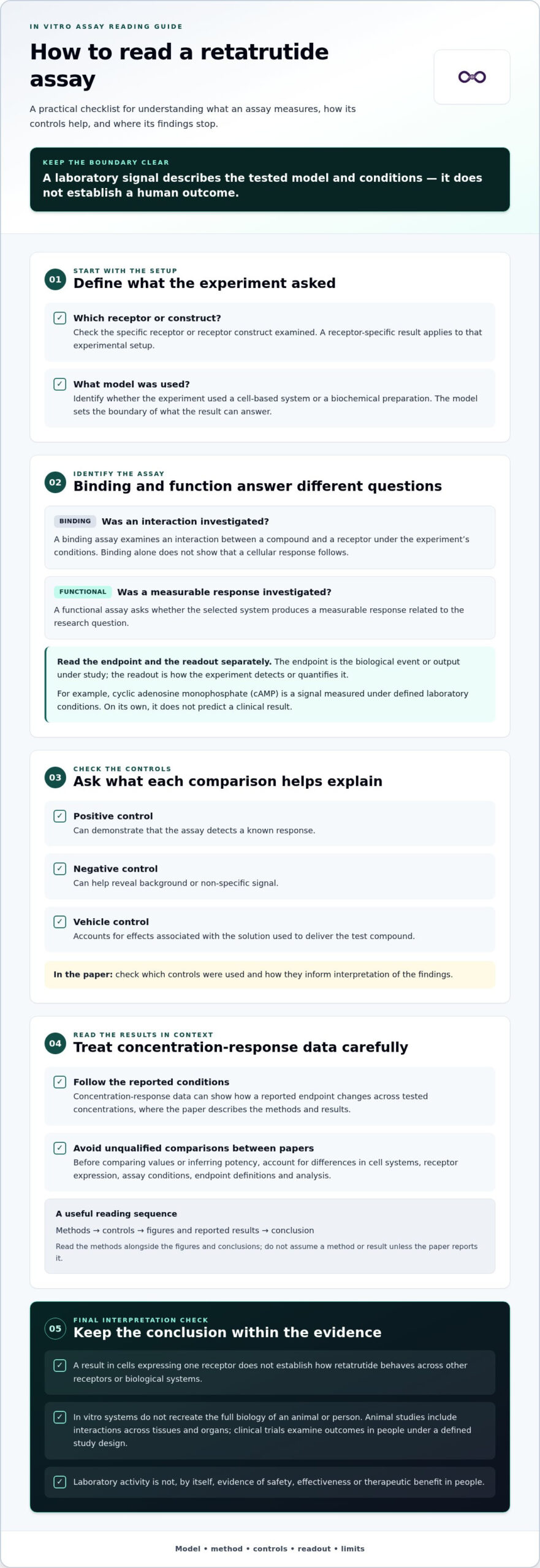
When reading a paper, identify the research question first. Check which receptor or process was examined, what model was used, and whether the researchers measured binding, signalling or another outcome. Then compare the conclusion with the evidence reported. If an experiment tested a specific response in a particular cell system, broader claims about safety, effectiveness or outcomes in people go beyond what that result can establish.

How retatrutide in vitro assays measure biological activity

An assay turns a defined research question into a measurable endpoint. For retatrutide, that might mean asking whether it binds a specified receptor or whether a selected cell system produces a measurable response under stated conditions. These are different questions, so the assay type and methods matter as much as the headline result.

Interpret in vitro studies using retatrutide from the primary paper, not a general description of the compound. Check which receptor or receptor construct was examined, what model was used and what the researchers measured. Don’t assume an assay used a particular method or produced a particular result unless the paper reports it.

Binding assays and receptor activity

A binding assay investigates an interaction between a compound and a receptor under the conditions set by the experiment. On its own, it doesn’t show that binding triggers a cellular response or that the compound has a clinical benefit. The receptor construct and assay format also define the interaction being assessed.

For a useful comparison, check the original paper for the receptor studied, how binding was measured and what the reported result represents. A receptor-specific result applies to that experimental setup. Don’t generalise it to other receptors or biological systems without supporting evidence.

Functional assays, controls and readouts

A functional assay asks whether a system produces a measurable response related to the research question. The endpoint is the biological event or output under study; the readout is how the experiment detects or quantifies it. If a paper reports cyclic adenosine monophosphate (cAMP), for example, that signal relates to the assay’s specified conditions and model. It isn’t, by itself, a measure of a human outcome.

Controls help show how to interpret an observed signal. A positive control can demonstrate that an assay detects a known response. A negative control can help reveal background or non-specific signal. A vehicle control accounts for effects associated with the solution used to deliver the test compound. Check which controls the paper used and how they inform the findings.

Concentration-response data can show how a reported endpoint changes across tested concentrations, where the paper describes the methods and results. Don’t infer potency or compare values across papers without considering differences in cell systems, receptor expression, assay conditions, endpoint definitions and analysis. These factors can affect the signal. Read the methods alongside the figures and conclusions.

An assay readout answers a defined experimental question under specified conditions; it doesn’t establish effects beyond that model and endpoint. Eternal Peptides Wholesale supplies research-grade retatrutide for laboratory research purposes, including wholesale 10mg and 20mg offerings. Explore research-purpose retatrutide supply when planning material requirements for a defined study.

In vitro findings versus animal and clinical evidence

Different research models answer different questions. A cell response may support a mechanism worth investigating, but it can’t show how a whole organism responds or establish safety, effectiveness or dosing in people. Read in vitro studies using retatrutide as one type of evidence, not as a shortcut to conclusions that require other models.

Research stage What it can help answer What it can’t establish alone
In vitro Whether a defined response occurs in a specified cell or biochemical system under stated conditions. Whole-body effects, human safety, clinical effectiveness or appropriate dosing.
Animal research How responses occur in an animal model, including interactions across systems within that model. That the same response, risks or dose will apply to people.
Clinical research How an intervention performs in human participants under the particular trial design and conditions. Conclusions beyond the population, outcomes or duration studied.

What cell-based results can support

A cell-based result can support a mechanistic hypothesis within the boundaries of the experiment. If a paper reports a change in a measured endpoint in cells expressing a specified receptor, for instance, that finding supports a statement about that model and endpoint. It doesn’t predict a change in a person.

Interpret the result in light of the cell model, controls, experimental conditions and endpoint. A clear signal with appropriate controls may strengthen confidence that an effect was observed in that system. It still doesn’t show whether the response would persist amid the interacting organs, feedback mechanisms and other factors present in a whole organism.

What requires evidence beyond an in vitro model?

Questions about whole-organism responses require research designs that can assess those responses. Animal studies are preclinical research, not human trials, and their findings relate to the animal model used. Clinical trial findings concern human participants and must be interpreted in light of the trial’s design, population and measured outcomes. Neither type of evidence can be inferred from a cell experiment.

This isn’t a guaranteed, step-by-step evidence pathway. A study at one stage doesn’t, by itself, show what came before or after, or establish the quality of related evidence. Read each source for what it reports.

In Australia, the Australian Clinical Trials search resource can help readers find trial listings. A listing is a discovery tool, not proof that a trial has reported results or that a finding validates a laboratory result. Check the record’s status and linked study information before drawing conclusions.

Keep the claim matched to the model: cell data describe a laboratory observation, animal data describe an animal model, and clinical results describe the human study conducted. Each adds a different kind of evidence, with limits that should remain visible in any summary.

In Vitro Studies Using Retatrutide: A Researcher’s Guide

How to assess an in vitro retatrutide paper

A disciplined reading sequence helps separate what an experiment measured from what its authors infer. For in vitro studies using retatrutide, note the model and methods before weighing the conclusions. Missing detail can make a result harder to evaluate or reproduce, but it doesn’t automatically make the finding invalid.

  1. Research question: Identify the specific question the study set out to answer. Is it testing receptor binding, a functional response or another defined endpoint? Use the stated aim to judge whether the methods and conclusions are aligned.
  2. Model: Record the cell type or assay system and the receptor target, if applicable. Note whether the cells naturally express the relevant target or have been engineered to do so. The model determines which biological question the result can address.
  3. Methods: Look for enough information to understand the experimental conditions, measurement method and analysis. Check how the test material was identified in the paper and whether the reported methods explain the basis for comparisons.
  4. Controls: See which controls were included and what each is intended to assess. Note the number and type of replicates, where reported, and whether the analysis distinguishes independent experiments from repeated measurements within one experiment.
  5. Results: Read the figures, tables and text together. Identify the measured endpoint, the direction and variability of the reported signal, and whether the authors’ interpretation follows from those data.
  6. Limitations: Review the authors’ stated limitations, then consider whether the model, assay conditions or lack of independent replication further constrain interpretation. Ask whether the conclusion stays within the tested system and reported endpoints.

Check the model, methods and controls

Methodological detail is a practical test of interpretability. A paper that names a receptor but gives little information about its cell system, for example, may leave readers uncertain about how to compare its result with another assay. Record what is reported, what is missing and why that detail matters. Treat omissions as limits on assessment, not proof that a result is wrong.

Replicates also need careful reading. Technical repeats can show consistency within a measurement, while independent experiments address repeatability across separate runs. The paper’s definitions and analysis should make clear which kind it reports. Don’t assume that a larger number of measurements necessarily means more independent evidence.

Read results and limitations together

Separate the observed data from the authors’ proposed explanation. A measured signal is a result; a suggested mechanism is an interpretation that may need further testing. Consider whether the discussion acknowledges limitations in model relevance, assay conditions and independent replication.

Analytical methods such as HPLC and mass spectrometry can provide information about material characterisation. That context doesn’t demonstrate biological activity or efficacy. Keep analytical quality questions separate from conclusions about what an assay response means.

Appraise the question, model, methods, controls, results and limitations, then check that every conclusion stays within the evidence reported. For laboratory research planning, explore wholesale research-grade retatrutide from an Australian-based supplier.

Planning responsible laboratory research with retatrutide

A clear study plan links the research question to the model, endpoint, controls and reporting requirements. Before sourcing material, document what the experiment is intended to investigate and what evidence would be needed to interpret the result. This keeps material and method decisions anchored to the research plan, rather than to assumptions about what a laboratory result might mean.

Set the research question and documentation needs

Use a planning checklist to make key decisions visible before work begins:

  • Research question: State the biological question and define what the study is not designed to establish.
  • Model and endpoint: Record the selected system, target and measurable outcome, with a rationale for their fit to the question.
  • Controls and analysis: Specify the planned controls, replication approach and analysis framework in the protocol.
  • Reporting: Decide which methods, conditions and results must be recorded so another reader can assess how the conclusion was reached.
  • Material requirements: Align the material description and any required specifications with the approved institutional plan and the needs of the selected research model.

Document these decisions in the protocol before materials are sourced. This makes it easier to identify what the study depends on and assess whether the final report reflects the authorised work. Research peptide sourcing is one procurement consideration to plan alongside the scientific requirements.

Institutional review and applicable laboratory governance are part of responsible planning. Follow the relevant processes at your institution, including review or approval requirements that apply to the work, and retain the authorised protocol and associated records. This section is a planning framework, not a substitute for institutional oversight or advice on specific Australian regulatory obligations.

Keep research supply separate from medical use

Research-grade peptides are for laboratory research purposes only. They are not for human consumption or medical use, including diagnosis or treatment. Keeping that boundary explicit in procurement records, protocols and research communications helps prevent laboratory supply from being confused with clinical products or evidence.

Eternal Peptides Wholesale is an Australian-based B2B supplier of research-grade peptides, including wholesale Retatrutide 10mg and 20mg. This supply is strictly for laboratory research, not medical use.

Responsible planning brings the scientific question, institutional process and research-purpose sourcing into alignment. For laboratory research, explore wholesale retatrutide for laboratory research.

Carry rigorous interpretation into your next research decision

Make your research question and its boundaries explicit before a project moves into the laboratory. A well-documented plan gives collaborators a shared basis for decisions and makes later reporting easier to assess. It also helps keep the intended purpose of the work clear as findings are reviewed and communicated.

Approach in vitro studies using retatrutide with that discipline: treat each result as a contribution to a defined research question, not as a conclusion beyond the evidence. Clear records and careful interpretation support more useful discussion, comparison and future research.

For Australian laboratory teams planning research-purpose supply, Eternal Peptides Wholesale offers wholesale Retatrutide in 10mg and 20mg options. Supply is strictly for laboratory research, not human consumption or medical use. Explore wholesale Retatrutide for laboratory research for your next project.

Thoughtful research starts with clear questions and responsible decisions. Keep that standard at the centre of the work ahead.

Frequently Asked Questions

What are in vitro studies using retatrutide?

In vitro studies using retatrutide are laboratory experiments that examine the compound in a cell-based or biochemical system outside a whole organism. A researcher might investigate a particular receptor interaction or a cellular response, depending on the model and assay. A paper focused on one receptor doesn’t automatically describe activity at every target. The experimental question and methods define what the result can support.

What can in vitro studies tell us about retatrutide?

They can provide evidence about a measured interaction or response in the specific laboratory system tested. Their usefulness depends on details such as the cell model, assay conditions and controls. If two papers report different signals, compare their methods before deciding whether the results conflict. They may have tested different endpoints or systems. These findings can inform research questions, but they don’t predict a particular outcome in a person.

Are in vitro retatrutide results evidence of clinical effectiveness?

No. A laboratory result isn’t evidence that retatrutide is clinically effective. It describes an observation made under the conditions of that experiment, not a treatment outcome in people. To assess clinical effectiveness, readers need relevant human research with reported outcomes and a study design suited to the question. Even then, findings should be understood in the context of the participants and outcomes studied.

How do researchers measure retatrutide activity in vitro?

Researchers use methods that fit the question. A binding assay examines an interaction with a specified receptor, while a functional assay measures a selected response in a biological system. Some papers may report cAMP as a signalling readout, but don’t assume it was measured unless it appears in the methods and results. To interpret a figure, identify what signal was measured and how the authors define the endpoint.

Can in vitro studies determine a retatrutide dose for people?

No. Cell or biochemical experiments can’t determine a dose for people. An experimental concentration describes the amount used in that particular assay, not a human dosing recommendation. The relationship between laboratory conditions and exposure in a person can’t be established from an in vitro result alone. Dosing questions require appropriate evidence from human research, and research-grade material must not be used to make personal dosing decisions.

How are in vitro studies different from clinical trials?

In vitro studies examine a defined process in cells or another laboratory system. Clinical trials investigate questions in human participants according to a study protocol, which may include specified outcomes and monitoring. The models and evidence are different: a cell assay can’t show how an intervention performs in people, while a trial’s findings apply to the population and outcomes it studied. One type of evidence shouldn’t be substituted for the other.

Where can I find Australian clinical trials involving retatrutide?

Search the Australian Clinical Trials website using “retatrutide” and, if needed, the development code “LY3437943”. Review each record for its status, locations, eligibility details and any linked results. A directory entry helps locate trial information; it doesn’t mean a study has published results or is currently recruiting. Review the record for details relevant to your search.

Are research-grade retatrutide peptides intended for human use?

No. Research-grade retatrutide supplied for laboratory research is not intended for human consumption or medical use, including diagnosis or treatment. It should remain within the documented research purpose and applicable institutional processes. Eternal Peptides Wholesale supplies research-grade peptides on a wholesale basis for laboratory research only. Its retatrutide offerings include 10mg and 20mg quantities; they aren’t clinical products or a basis for personal use.

Related from Eternal Peptides Wholesale

Eternal Peptides Wholesale publishes batch-specific Janoshik Analytical reports in its certificate of analysis library, so the documentation for a listed batch can be read alongside the evidence discussed in this article.

Related reading: Melanotan II receptor binding assay supply: A 2026 buyer’s guide

Posted on

Melanotan II receptor binding assay supply: A 2026 buyer’s guide

Melanotan II receptor binding assay supply: A 2026 buyer’s guide

A vial label can’t establish whether Melanotan II is suitable for a receptor-binding assay. For Australian laboratories, Melanotan II receptor binding assay supply decisions should start with the study requirements, relevant analytical information and lawful research context, not the product name alone.

Before committing to a wholesale order, compare the information available about the material with the laboratory’s requirements. A certificate or purity result addresses only what its method and scope demonstrate. It doesn’t, by itself, validate a product for a particular assay or establish permission to possess or use it. In Australia, Melanotan II was moved to Schedule 9 of the Poisons Standard in February 2026. A research-only label doesn’t replace any required authority.

This guide explains how to define procurement criteria for receptor-binding research, assess analytical information without overstating its evidential value, and plan quantities and purchasing needs for laboratory use. It also outlines Eternal Peptides Wholesale’s research-only wholesale supply of Melanotan II 10mg for professional B2B purchasing.

Key Takeaways

  • Define the receptor-binding assay’s requirements before assessing Melanotan II. The compound is not a complete assay kit.
  • Use a supply checklist to compare identity, stated amount, batch identification and analytical records.
  • Interpret HPLC and mass spectrometry as distinct methods, and consider what each record can and cannot establish.
  • Compare supply routes by assay fit, evidence access, traceability and suitability for your laboratory’s purchasing scale.
  • Plan a wholesale order by documenting assay needs, reviewing available material information, confirming institutional purchasing requirements and estimating quantity. Eternal Peptides Wholesale offers Melanotan II 10mg for research purposes.

Melanotan II receptor-binding assay supply: define the research need first

Procurement should begin with the assay, not the vial. For Melanotan II receptor binding assay supply, the research team should identify what its method requires from the test material and what information it needs to retain. This gives the team a clearer basis for comparing supply options than selecting a product by name alone.

Melanotan II is the target compound in this context, not a complete receptor-binding assay kit. The assay depends on the research method and its components. Binding studies examine interaction between a compound and a receptor under the assay conditions. Functional or cellular-response studies ask what happens after that interaction, such as whether a measurable signal or cell response occurs. These are related but distinct research questions. Sourcing material does not prove that an assay will perform as intended.

For general background on the compound, the Melanotan II Wikipedia article provides an overview of its history and context. It is not an assay protocol or evidence that a particular material is suitable for a laboratory method.

What does a receptor-binding assay need from its test material?

The research question determines which material attributes matter. A team may need to record the compound’s identity, stated amount and batch identifier, then assess relevant analytical information against its method requirements. Keep those material details separate from assay performance. A label or analytical result does not establish that a compound has been validated in a specific assay.

  • Identity: Record how the material is identified and compare that information with the assay’s target.
  • Stated amount: Note the quantity described for the material and how the laboratory will account for it in its own records.
  • Batch information: Capture identifiers that connect the material to its associated documentation.
  • Method fit: Document any requirements the assay protocol places on the test material. Don’t assume a catalogue description answers them.

A catalogue name is a starting point for procurement, not a suitability determination. The laboratory remains responsible for assessing material information within its study design and quality processes.

Which melanocortin receptor context should buyers identify?

Specify the receptor subtype and research model relevant to the study. MC1R and MC4R are distinct melanocortin receptor contexts. Naming one without clarifying the model can leave procurement records ambiguous. Identify the receptor construct or model described by the assay, then align purchasing documentation with that context. This is research planning, not guidance about tanning, medical outcomes or human use.

Supplied material is for laboratory research only, not human consumption or medical use. Keeping the receptor-binding question, experimental model and any downstream functional work distinct gives researchers and procurement teams a consistent basis for evaluating supply.

Assess Melanotan II documentation before matching it to an assay

Once assay requirements are defined, review material records as a connected set rather than treating a single certificate or percentage as a complete assessment. When comparing Melanotan II records, the practical questions are whether the records identify the material and batch clearly, and whether their scope is relevant to the laboratory’s purchasing and research records.

How should buyers interpret analytical records?

Start with a cross-check. Compare the product description, stated amount, batch identifier and analytical records, noting any differences or missing links. A report is more useful when its identifiers correspond clearly to the product and batch being considered. Keep relevant records with the procurement file so the team can trace which information informed its decision.

  • Identity: Compare the stated compound name with the identity information in the records.
  • Stated amount: Record the amount declared for the material, separately from any analytical result.
  • Batch identification: Match the batch reference on the product information to the relevant report.
  • Analytical method: Note the method used, the result reported and the scope or limitations described.

High-performance liquid chromatography (HPLC) separates components in a sample. A chromatogram or reported purity value can describe the sample’s profile under the stated method, but interpretation depends on the method and reporting details. It doesn’t automatically identify every component or establish biological activity.

Mass spectrometry measures mass-to-charge information and can support identity assessment when the report’s data and interpretation suit the question. It is a different analytical approach from HPLC, not a substitute for every type of analysis. Neither method, by itself, confirms that the material will perform in a particular receptor-binding assay.

For a broader procurement framework, the research peptide quality assurance guide can help place document review within a consistent purchasing process.

Which claims need stronger evidence?

Separate supplier descriptions from conclusions supported by experimental evidence. A supplier-provided purity statement describes a reported analytical result. On its own, it doesn’t demonstrate receptor-binding activity, validate an assay or show that the material is suitable for a specific research model. These are distinct claims and require evidence that directly addresses them.

Analytical purity alone does not prove receptor-binding activity or performance in a particular assay.

When reviewing a claim, ask what was measured, by which method, on which batch and under what stated conditions. Distinguish those documented facts from inferences the study team may need to test independently within its research framework. This helps prevent a precise-looking figure from carrying more weight than its supporting record warrants.

For Australian laboratories planning a wholesale research order, Eternal Peptides Wholesale supplies Melanotan II 10mg for research purposes. The Australian wholesale research supply pathway is part of a procurement process grounded in clear assay requirements and appropriately interpreted documentation.

Compare supply options using assay fit, evidence and procurement scale

Compare purchasing routes against the same research criteria rather than relying on broad quality labels. A catalogue may help identify a compound and stated vial amount, while batch-linked records can support traceability. Neither catalogue wording nor a purchasing route alone establishes suitability for a particular assay. Keep the comparison tied to the documented study plan, purchasing policy and required evidence.

How does a research buyer compare catalogue information?

Start by matching the compound name and stated amount to the study plan. Then assess whether batch identifiers connect the product details to supporting records. Catalogue descriptions are useful for an initial comparison, but they are supplier-provided information, not independent validation of assay fit.

Assay fit
Compare the described material and amount with the study’s documented requirements. A product listing cannot establish performance in the laboratory’s method.

Identity evidence
Compare the stated compound name with identity information in associated records. Note the source and scope of each piece of evidence.

Batch traceability
Look for identifiers linking product details to the corresponding batch documentation. Record any mismatch or missing connection for procurement review.

Order scale
Consider whether the purchasing route suits the approved study plan, institutional process and planned quantity. Wholesale procurement is distinct from retail single-vial purchasing.

This comparison focuses on documentation and procurement suitability, not on ranking routes as inherently better or worse. For example, clear links between batch details and records can make document review more straightforward. The appropriate order scale still depends on the programme’s approved requirements.

The Melanotan II wholesale specifications guide is relevant when reviewing product information for research procurement. Treat catalogue details as one part of the assessment, and keep conclusions within the scope of the records provided.

When does wholesale procurement fit a research programme?

Wholesale purchasing can suit a laboratory programme when its planned quantity, purchasing policy and research schedule align. Before setting an order scale, compare the approved study design with the laboratory’s capacity to manage the material and the institution’s procurement requirements. Avoid ordering based on an assumed assay outcome or a quantity chosen without reference to the study plan.

Eternal Peptides Wholesale is an Australian wholesale supplier of research-grade peptides, including Melanotan II 10mg for research purposes only. This is a laboratory research supply pathway, not retail single-vial purchasing or a clinical-use option. The Australian wholesale research supply is relevant to procurement teams assessing the offer against their research requirements.

Melanotan II receptor binding assay supply: A 2026 buyer’s guide

Plan an Australian wholesale order for laboratory research

A clear order workflow helps researchers, procurement staff and laboratory administrators work from the same requirements. Keep study design decisions separate from commercial decisions, and document the basis for each before approving an order.

  1. Define the assay need. Record the research question, receptor context, study design and material attributes required by the laboratory’s method. Establish these requirements before comparing order quantities or purchasing routes.
  2. Review the product and batch documentation. Record the stated compound name, amount and relevant batch identifier, then link these details to available supporting records. Keep this information in the laboratory’s purchasing and research documentation, distinguishing supplier descriptions from conclusions established by the study.
  3. Confirm institutional purchasing requirements. Follow the organisation’s processes for supplier records, approvals and purchase documentation. Where Australian regulatory or import questions apply, verify current requirements directly through authoritative Australian sources, such as the relevant government agency. Don’t rely on an unverified summary or assume a research-use description resolves regulatory questions.
  4. Plan the quantity. Align the requested amount with the approved research plan, purchasing policy and the laboratory’s capacity to manage the order. Avoid choosing a quantity based on assumptions about experimental performance or unverified storage specifications.

What should procurement teams settle before ordering?

Agree on one written specification that researchers and purchasing staff can use consistently. It should identify the research purpose, requested material, amount, batch-recording needs and institutional approval pathway. This gives the team a shared reference for preparing purchasing records and receiving documentation, without adding unsupported assumptions about shipping timelines or handling conditions.

Keep regulatory and import statements out of order notes unless they have been checked against current, authoritative Australian guidance and are relevant to the circumstances. Rules can be technical and may depend on the activity and context. This guide doesn’t establish an organisation’s legal authority or replace formal institutional review. Check official sources rather than inferring obligations from catalogue wording.

How can teams reduce avoidable sourcing friction?

Use the same written specification across the research plan, purchasing request and laboratory records. That helps prevent inconsistencies, such as a purchasing request naming a different amount from the study plan or a batch identifier being omitted from the receiving record. Keep assay design choices with the research team and commercial ordering decisions within the relevant procurement process.

Checklist: define the assay need, review product and batch records, confirm institutional purchasing requirements, then align quantity with the approved plan before order approval.

The Australian wholesale research peptide procurement guide provides additional context for structuring a purchasing workflow. The Melanotan II 10mg wholesale supply pathway from Eternal Peptides Wholesale is for laboratory research customers nationally.

Source Melanotan II 10mg wholesale for research through Eternal Peptides Wholesale

Once assay requirements, documentation criteria and purchasing approvals are aligned, assess the supply decision against a defined laboratory need. Eternal Peptides Wholesale is an Australian wholesale supplier of research-grade peptides, including Melanotan II 10mg supplied for research purposes. The offer is for research use only, not for human consumption or medical use.

This distinction matters for procurement records. Wholesale supply is intended for professional purchasing, not retail single-vial sales. Eternal Peptides Wholesale does not sell retail single-vial products or provide medical consultations. Its role here is research supply, not advice on treatment, tanning or other personal use.

What can buyers expect from the confirmed supply offer?

The wholesale offer is Melanotan II 10mg for research purposes. That product description does not establish assay validation, analytical results or performance outcomes. Laboratories should assess the product information available against their study documentation and institutional purchasing process, keeping supplier details distinct from conclusions established by their own research.

That distinction supports a professional B2B decision. The appropriate basis for an order is a documented laboratory requirement and an approved quantity, not assumptions about biological effect or suitability for a particular method. Evaluation of research material remains within the laboratory’s own scientific and institutional framework.

What is the next step for a laboratory buyer?

Bring the key procurement records together: the assay requirements, product and batch information under review, documentation criteria, institutional purchasing approvals and the quantity supported by the research plan. This gives researchers and procurement staff a shared basis for evaluating the order and filing its records.

The Melanotan II wholesale supply information is relevant for buyers reviewing the research supply offer. Use it alongside documented study needs, not as a substitute for assay-specific assessment or institutional processes.

For laboratories whose approved research requirements align with the wholesale offer, explore Melanotan II 10mg wholesale for research through Eternal Peptides Wholesale. A disciplined approach to sourcing assay material keeps the decision focused on research purpose, evidence review and appropriate order planning.

Move from assay criteria to a considered order

A sound purchasing decision begins with a clear record of why the material is needed and how the laboratory will assess its suitability. Keep the study’s requirements, evidence review and purchasing approval connected, while treating them as distinct steps. This gives researchers and procurement teams a practical basis for making decisions and maintaining clear records.

For receptor-binding work, align documented research needs with a supply pathway designed for laboratory use. Eternal Peptides Wholesale is an Australian supplier serving research customers nationally, with Melanotan II 10mg available wholesale for research purposes only. The supply is not for human consumption or medical use.

Research teams can explore Melanotan II 10mg wholesale for research and assess the offer against their procurement requirements. A defined study plan and considered purchasing process give the team a clear basis for its decision.

Frequently Asked Questions

What is Melanotan II receptor-binding assay supply?

It means sourcing Melanotan II material for a laboratory study examining receptor binding, rather than purchasing a complete assay kit. The term describes a procurement requirement, not evidence that a product will work in a particular experimental system. Before sourcing, specify the receptor and research model, then decide which records the laboratory needs to retain. Eternal Peptides Wholesale supplies Melanotan II for research purposes only, not for human consumption or medical use.

Can Melanotan II be used in a receptor-binding assay?

Its suitability depends on the study design, receptor system, assay format and evidence available for the relevant batch. For example, a research team working with a particular receptor model should assess material information against that model’s protocol, rather than infer fit from a catalogue name. A purity figure alone can’t establish binding performance. This supply is strictly for laboratory research, not human or medical use.

How do HPLC and mass spectrometry help assess research peptide supply?

HPLC provides chromatographic information about a sample, while mass spectrometry can support assessment of molecular identity. These methods address different analytical questions, so interpret each report according to its method details and stated scope. For example, check that a report’s batch identifier corresponds to the material being considered. Neither method, by itself, demonstrates how a sample will behave in a particular receptor-binding assay.

Does a purity report prove receptor-binding activity?

No. A purity report provides analytical information about a sample, but it doesn’t independently show receptor binding, assay performance or suitability for a specific research model. Those conclusions need evidence relevant to the experimental system and its validation. Avoid treating one reported figure as a complete assessment. In laboratory records, note which batch the report describes and keep analytical findings distinct from functional or biological evidence.

Is Melanotan II 10mg available for wholesale research supply in Australia?

Eternal Peptides Wholesale offers Melanotan II 10mg through its wholesale research supply in Australia. The offer is for research purposes only, not for human consumption or medical use. It’s a wholesale product, rather than a retail single-vial purchase. Research buyers can use the stated amount when preparing an institutional purchasing request, then align the proposed order with study documentation and internal procurement procedures.

What should a laboratory check before ordering Melanotan II for an assay?

Begin by recording the receptor and assay context in the purchasing request, then identify the product details and batch records needed for laboratory files. Compare the stated compound and vial amount with the approved study plan. If the research protocol changes, update the purchasing documentation before ordering so the rationale and requested quantity remain aligned. Follow institutional purchasing procedures and verify applicable requirements through authoritative sources.

Is Melanotan II supplied for human consumption or medical use?

No. Eternal Peptides Wholesale supplies research-grade peptides for laboratory research purposes only. Its Melanotan II wholesale offering isn’t intended for human consumption, tanning, diagnosis or treatment, and the business doesn’t provide medical consultations. Research supply information should not be interpreted as guidance about personal use. Keep procurement and research activity within the relevant institutional framework, with study documentation and purchasing records reflecting the laboratory purpose.

Related from Eternal Peptides Wholesale

Eternal Peptides Wholesale publishes batch-specific Janoshik Analytical reports in its certificate of analysis library, so the documentation for a listed batch can be read alongside the evidence discussed in this article.

Related reading: Melanotan II Bulk Wholesale: Technical Specifications for Australian Research

Posted on

TB-500 Actin-Binding Properties Research: Evidence and Limits

TB-500 Actin-Binding Properties Research: Evidence and Limits

What does an actin-binding result actually tell you about TB-500? In TB-500 actin-binding properties research, TB-500 and full-length thymosin beta-4 (Tβ4) are sometimes treated as interchangeable, even though the molecules tested may differ. Actin interaction is often described as G-actin sequestration, but that mechanism alone doesn’t establish what a specific TB-500 material does in cells, animals or people.

It’s reasonable to look for a clear link between actin binding and proposed tissue effects. The key is to check what the study tested and how: the material, experimental model and assay all shape what researchers can conclude. Evidence from the parent protein shouldn’t automatically be attributed to a synthetic fragment.

This article explains the actin-binding hypothesis and the terminology behind it, then considers how researchers investigate the interaction and where the evidence has limits. You’ll learn how to assess claims in context and why laboratory or animal findings don’t establish outcomes in people.

Key Takeaways

  • Actin binding is a testable research question, not proof that TB-500 controls every actin-related cellular process.
  • Distinguish the specific material tested from full-length thymosin beta-4 before interpreting a result.
  • Assess each finding by its evidence level, experimental model, comparator and measured endpoint.
  • Review material identity, assay methods and controls to judge how much a binding claim can support.
  • Keep laboratory findings separate from conclusions about human outcomes. Research-grade TB-500 is for laboratory research, not human consumption or medical use.

What does TB-500 actin-binding research investigate?

Actin-binding research asks whether a specified peptide preparation associates with actin in a defined laboratory system, and what changes under the conditions tested. That is a narrower question than whether TB-500 “affects healing” or controls cell behaviour. A binding result describes an experimental interaction; its meaning depends on the material, assay and measured outcome.

Actin is a structural protein involved in the cell’s internal framework. Researchers can test whether a molecule binds actin directly, changes the amount of actin available for assembly, or influences a related process in cells. These are separate questions. Evidence for one doesn’t establish the others, or show that one peptide directs every actin-dependent activity.

How TB-500 and thymosin beta-4 terminology relates

TB-500 is commonly described in research and commercial contexts as related to thymosin beta-4 (Tβ4), a naturally occurring protein. However, the label alone doesn’t identify the exact molecule or preparation used in an experiment. Publications and secondary sources may use terms such as “fragment”, “analogue” or “peptide” differently, so check the study’s own description of what was tested.

That distinction matters when comparing results. A study of full-length Tβ4 is evidence about that tested protein, not automatic evidence about every material called TB-500. The Thymosin beta-4 overview provides background on the parent protein and its reported relationship with actin. To establish the identity of a study’s test material, look to the paper’s methods. Check whether the authors clearly describe the molecule, preparation and experimental source before treating two findings as directly comparable.

Why actin is central to the research question

Globular actin, usually called G-actin, is the individual protein unit that can assemble into filamentous actin, or F-actin. These filaments form part of the cytoskeleton, a dynamic network that helps cells maintain their shape and change it in response to their surroundings. Actin organisation can also contribute to cell movement and other cellular processes.

Actin sequestration is the binding and temporary retention of individual G-actin molecules, which can reduce the pool available for filament assembly under the conditions studied. This definition describes a proposed molecular mechanism, not a conclusion about every TB-500 preparation. In foundational descriptions of Tβ4, actin sequestration helps explain how the protein may regulate actin availability. Whether a particular TB-500-labelled material binds actin, and whether that binding affects cellular behaviour, requires experiments using that material.

For TB-500 actin-binding studies, keep the biological context separate from the peptide-specific claim. Actin’s role in cell structure and movement is established background; a proposed link between a particular preparation and those processes must be assessed using the relevant assay or cell study. This distinction prevents general cell biology from being mistaken for evidence of a demonstrated effect.

How the proposed TB-500-actin interaction is studied

The proposed interaction is a molecular hypothesis researchers can test, not a settled description of every preparation sold or studied under the TB-500 name. A careful experiment first defines the test material, then asks whether it associates with actin under specified conditions. Researchers may use purified components to examine binding, followed by cell-based experiments to explore whether an observed interaction corresponds with changes in actin organisation or cell behaviour.

A direct binding result shows an association under the assay conditions; on its own, it doesn’t prove the proposed mechanism operates inside living cells. An assay with isolated molecules lacks much of the cellular environment. Concentrations, solution conditions and the identity of the peptide preparation can all affect what is observed.

G-actin, F-actin and the meaning of sequestration

G-actin refers to individual globular actin units. These units can assemble into F-actin, the longer filaments that help form and remodel a cell’s cytoskeleton. In this context, sequestration means a binding partner may hold some G-actin in a form less available for filament assembly. It doesn’t mean actin is destroyed or permanently removed.

That proposed change in availability can be measured in a defined system, but a result from isolated molecules cannot establish that the same balance occurs in living tissue. Binding alone also doesn’t show whether filament assembly increases, decreases or changes in a particular cell. Those outcomes require suitable experiments and controls.

From molecular interaction to cellular response

Researchers can investigate the next link in cells, measuring endpoints such as actin organisation, cell shape or movement. If a cell-migration assay shows a difference, that is an observed cellular response. It doesn’t identify actin binding as the cause unless the study tests that explanation and rules out plausible alternatives.

For example, a migration result may be consistent with altered cytoskeletal remodelling, but consistency isn’t proof of mechanism. To support the proposed link, a study would need to connect the defined peptide material, evidence of the molecular interaction and the measured cell response. An effect in one cell model also doesn’t establish the same effect in another model or in an organism.

Angiogenesis and tissue-level changes sit further downstream. They involve additional cell types and biological signals, so they are separate research questions, not conclusions that can be drawn from actin binding alone. In this area, the strength of a mechanism claim depends on how directly each step has been tested.

For laboratory work, keep the research material distinct from the evidence generated with it. Eternal Peptides Wholesale supplies TB-500 research material for laboratory use. Supply does not establish a biological effect or validate a particular mechanism.

What does the evidence establish, and what remains uncertain?

Evidence about TB-500 and actin needs to be read in levels. A biochemical assay can test whether a defined material interacts with actin under controlled conditions. Cell and animal studies can examine related responses in more complex models, but they don’t automatically demonstrate the same mechanism or effect in people. For each result, identify the tested material, model, comparator and measured endpoint before deciding what it supports.

This distinction matters when a paper measures cell migration or changes in cell shape. Such findings may be consistent with cytoskeletal changes, but they don’t prove direct actin binding unless the study measures that interaction separately. Evidence from full-length thymosin beta-4 also can’t be transferred to a TB-500-labelled preparation without support showing the materials are comparable.

Direct binding evidence versus downstream findings

Look for the actual measurement. A biochemical experiment may assess association between the stated test material and actin. A cell study may measure movement, morphology or another cellular endpoint. The latter reports a response in that model; it doesn’t establish the molecular explanation on its own. If a paper infers binding from a downstream result, treat the proposed mechanism as an interpretation, not a direct measurement.

Biochemical assay

Shows: Whether the specified preparation associates with actin under the assay conditions and controls used.

Suggests: A possible molecular interaction relevant to further testing.

Cannot establish: That the same interaction occurs in cells, animals or people.

Cell model

Shows: A measured cellular response, such as migration or a change in morphology, compared with the study’s control or comparator.

Suggests: A cellular effect that may warrant investigation of its mechanism.

Cannot establish: Direct binding unless that is independently measured, or an effect beyond the tested cells and conditions.

Animal model

Shows: An outcome in the specific animal model, using the material, comparator and endpoint reported by the researchers.

Suggests: Questions for additional preclinical or clinical research.

Cannot establish: Human benefit, safety or therapeutic effectiveness.

Human study

Shows: Findings only for the tested material, participants, comparator and outcomes. Published human evidence has not established the safety or efficacy of the synthetic TB-500 fragment for a condition.

Cannot establish: Findings for other preparations or outcomes that the study did not assess.

Study limitations that change interpretation

Assay conditions shape results. Consider how the material was identified, what controls were used, which endpoint was measured and whether the methods support the claimed conclusion. Cell type and animal model also set boundaries; results from one system may not reproduce in another. Check whether independent studies report comparable findings using comparable materials and methods. Where results conflict or key details are missing, retain that uncertainty rather than resolving it by assumption.

This evidence-by-evidence approach is central to TB-500 actin-binding properties research: it separates what an experiment measured from what researchers propose it might mean. No laboratory or animal finding alone establishes human benefit, safety or therapeutic effectiveness.

TB-500 Actin-Binding Properties Research: Evidence and Limits

How should researchers assess an actin-binding claim?

A disciplined review follows the evidence from material identity to conclusion. The aim isn’t to decide whether a mechanism sounds plausible, but to check whether the study’s methods support its claim. For an actin-binding claim, that means separating a measured interaction from a proposed explanation of cell behaviour.

  1. Identify the material. Record how the study names and describes the tested peptide or preparation. Don’t assume a label establishes that two studies used the same material.
  2. Inspect the method. Determine whether the experiment directly measures an interaction with actin or records a downstream endpoint, such as a change in cell movement.
  3. Review the controls. Check whether the controls suit the assay and help distinguish a specific signal from background, measurement interference or other explanations.
  4. Compare the endpoints. Keep binding, actin organisation and cell behaviour as separate outcomes unless the study tests their relationship.
  5. Assess the limits. Consider the model, assay conditions, sample limitations and whether independent work supports a comparable conclusion.

Match the claim to the assay and controls

Start with the results, not just the abstract’s mechanism language. A direct interaction assay addresses binding under its specific conditions; a cell-based endpoint addresses what happened in that cellular model. Negative, positive and assay-specific controls can help assess whether the measurement behaves as intended. Assay controls support interpretation, but they don’t prove broader biological effects. Keep the conclusion within the endpoint and controls the authors actually report.

Check material identity and reproducibility

Next, review the reported identity and preparation details, including any analytical characterisation and purity information. These details help readers judge what entered the assay, but a purity statement alone doesn’t establish identity, binding or biological activity. Contamination controls may also matter where they could affect the chosen endpoint. Compare independent results only when the materials, methods and outcomes are meaningfully alike.

Reproducibility depends on enough detail for another laboratory to evaluate the work. Look for a clear description of the test material, assay conditions, comparator, controls, endpoint and analysis. If a key detail is absent, note the limitation rather than filling it in by assumption. If studies reach different conclusions, first check whether they tested comparable preparations and measured the same thing. Different endpoints may explain why results appear inconsistent, but they don’t resolve the question without further evidence.

For Australian laboratories procuring research materials, explore wholesale TB-500 5mg for laboratory research. Product supply and evidence of a biological mechanism are separate considerations; research materials are not for human consumption or medical use.

How TB-500 actin-binding research fits laboratory study

Actin interaction is one defined question within broader peptide and cell-biology research, not a complete account of a peptide’s biological activity. A study might test whether a specified material binds actin, examine cytoskeletal organisation in cells, or measure a downstream endpoint such as cell movement. These questions sit at different levels. Findings from one level shouldn’t be treated as interchangeable with results from another model or method.

Keep the research question narrower than the broad mechanism

State precisely what the experiment examines. A molecular interaction study addresses binding under its assay conditions; a cell study may measure cellular dynamics; an animal study may examine an organism-level endpoint. A result in one model can inform further research, but it doesn’t establish the same result in another. Keep conclusions and summaries aligned with the material, model and endpoint actually studied.

This discipline also helps prevent a proposed mechanism from becoming an assumed outcome. If a cellular response is observed, describe it as the measured response unless the research directly tests the proposed molecular explanation. Broader claims about tissue biology require their own evidence. Laboratory findings don’t establish human benefit, safety or therapeutic effectiveness, and conclusions should make those limits clear.

Connect evidence review with research-material procurement

Material documentation matters when interpreting an experiment because researchers need to know what preparation was used and how it was described. A research peptide quality assurance guide provides adjacent procurement context, while a bulk peptide vials sourcing guide may help when considering laboratory purchasing format. Neither sourcing information nor a product description substitutes for evidence from a study using the specified material.

For researchers working on tissue-repair biology, the wholesale tissue repair procurement guide offers related sourcing context. Eternal Peptides Wholesale lists TB-500 5mg as a wholesale research-material option for laboratory use. This product reference makes no claim about actin binding or experimental performance. Products are for research purposes only, not for human consumption or medical use.

Ultimately, TB-500 actin-binding work is best understood through clearly defined questions, transparent methods and conclusions proportionate to the evidence. The wholesale tissue repair procurement guide also offers adjacent context for laboratory procurement planning.

Set a clear next step for your research

Before extending a laboratory finding, decide what evidence would justify the next stage of investigation. A direct interaction result may support further molecular work; a cellular observation may prompt a carefully designed follow-up in another model. Set the research question and endpoint in advance, and record what would count as support, uncertainty or a reason to revise the hypothesis. This makes the next experiment more informative, even when its result doesn’t match expectations.

Keep the scope explicit in protocols, reports and internal summaries. A finding tied to one material and model should remain attached to those conditions when shared or used to plan subsequent work. That helps colleagues assess the result without turning a preliminary observation into a broader claim about human outcomes. Responsible research in this area depends on maintaining that distinction at each step.

For laboratory research procurement, Eternal Peptides Wholesale is an Australian-based wholesale supplier, with TB-500 5mg listed for research supply. View TB-500 5mg wholesale for laboratory research. Keep the research question precise, and let the evidence guide what comes next.

Frequently Asked Questions

Is TB-500 the same molecule as thymosin beta-4?

No. TB-500 is generally described as a synthetic fragment derived from thymosin beta-4, not the full-length parent protein. However, the TB-500 label can be used inconsistently, so it doesn’t identify a study material precisely on its own. Before comparing findings, check the paper’s methods for how the tested material is named and characterised. Similar labels don’t demonstrate that two preparations are chemically equivalent.

Does an actin-binding result prove that TB-500 changes cell migration?

No. A binding result addresses an interaction measured in a particular assay; cell migration is a separate outcome that needs its own experiment. For example, researchers might measure movement in a cell-based assay and assess cell viability or other relevant factors that could affect the result. Even if both findings appear in one paper, the study needs evidence connecting the interaction to the migration response before that mechanism can be concluded.

What is the difference between G-actin and F-actin?

G-actin refers to individual actin protein units, while F-actin refers to chains or filaments assembled from those units. This distinction matters when interpreting laboratory results: an assay may examine individual actin molecules, filament formation or the organisation of actin inside cells. Those measurements answer different questions. Check the reported endpoint rather than assuming a result about one form of actin also describes the other.

Can thymosin beta-4 findings be used as evidence about TB-500?

They can provide background for developing a hypothesis, but they aren’t direct evidence about every TB-500 preparation. A finding involving full-length thymosin beta-4 applies to the material and model actually studied. To relate it to TB-500, researchers need evidence that the tested materials are sufficiently comparable and that the relevant effect is demonstrated for the TB-500 material itself. Don’t treat a shared name or biological relationship as proof of equivalence.

How can readers tell whether a paper measured direct actin binding?

Look in the methods and results for an experiment designed to measure an interaction between the named test material and actin. The paper should describe the assay’s readout and controls. If the reported outcome is cell migration, cell shape or another cellular response, that alone isn’t a direct binding measurement. Matching the wording of the claim to the actual endpoint is a useful first check.

Do preclinical actin-binding findings establish a human benefit?

No. Findings from biochemical assays, cultured cells or animal models don’t establish that a material benefits people, is safe for human use or effectively treats a condition. As of October 2026, completed, published human clinical trials have not established the safety or efficacy of the synthetic TB-500 fragment for any condition. Keep conclusions within the evidence available, and don’t treat research-grade material as intended for human consumption or medical use.

Related from Eternal Peptides Wholesale

Eternal Peptides Wholesale publishes batch-specific Janoshik Analytical reports in its certificate of analysis library, so the documentation for a listed batch can be read alongside the evidence discussed in this article.

Related reading: TB-500 for Cell Migration Assays: Design, Controls and Interpretation

Posted on

Retatrutide Mechanism of Action: What Studies Show

Retatrutide Mechanism of Action: What Studies Show

What if one molecule could activate three metabolic hormone receptors, while the reasons for its clinical effects remained only partly understood? That distinction matters when reading retatrutide mechanism of action studies: receptor activity describes how the molecule is designed to act, while trial outcomes show what happened to participants under specific study conditions.

Retatrutide targets GLP-1, GIP and glucagon receptors, and clinical trials have reported changes in body weight and blood sugar. Those results do not, by themselves, prove every proposed pathway or show how much each receptor contributes.

This article explains the three targets and their proposed roles, then considers what laboratory research and clinical trials can establish. It separates evidence about receptor binding and physiological effects from observed outcomes, and highlights unresolved questions, including long-term safety and the contribution of each pathway. Retatrutide remains investigational, so its findings should be assessed as evidence, not treated as a complete account of its mechanism.

Key Takeaways

  • Identify the three receptors retatrutide is designed to activate, and distinguish receptor agonism from proof of a clinical effect.
  • See how GLP-1, GIP and glucagon pathways may contribute differently to appetite, glucose regulation and energy balance.
  • Compare what receptor assays, animal models and human trials can, and cannot, establish.
  • Assess mechanistic claims by checking what a study measured: receptor binding, downstream signalling or whole-body outcomes.
  • Separate established findings from proposed explanations and unresolved questions. Research materials are for laboratory research only, not human consumption or medical use.

Retatrutide mechanism of action: what triple agonism means

Retatrutide is an investigational peptide designed to activate three receptor targets: the GLP-1 receptor, the GIP receptor and the glucagon receptor. A receptor is a molecular structure through which a cell responds to specific signals. An agonist binds to a receptor and activates it, prompting activity in the cell. This describes a proposed molecular action, not proof that a particular health or clinical outcome will follow.

Receptor activation is only one step in a complex chain. A laboratory assay may show that a molecule activates a receptor under defined conditions. By itself, that result does not establish how strongly the receptor will respond in a living organism, how different tissues will be affected, or what clinical outcome will follow. The Retatrutide Wikipedia page offers a general overview of the molecule and its triple-agonist design. Interpret mechanistic claims in light of the methods and findings of the underlying studies.

A triple agonist is a single molecule designed to activate three distinct receptor systems. A single agonist targets one receptor, while a dual agonist targets two.

Which three receptors does retatrutide target?

The target names refer to receptors, not simply to the hormones associated with them:

  • GLP-1R is the glucagon-like peptide-1 receptor.
  • GIPR is the glucose-dependent insulinotropic polypeptide receptor.
  • GCGR is the glucagon receptor. Glucagon is its ligand, not another name for the receptor.

These abbreviations help researchers specify which receptor they examine. They do not indicate that each target produces an equal response or contributes equally to an observed effect.

What does triple agonism mean in study terms?

In study terms, retatrutide’s design means researchers can assess its activity at three separate receptor systems. They can test each target individually, then investigate how receptor activation relates to signalling in cells or responses in a whole organism. The experimental setup determines what a result can support.

A receptor assay can measure binding or downstream signalling in a controlled system. It can help establish whether receptor activity occurs and compare responses under the assay’s conditions. It cannot recreate the full physiological environment, including interactions among tissues and feedback between biological systems. Results also depend on factors such as the cells and measurement methods used.

Animal models and human trials address broader questions by measuring responses across an organism, but they do not isolate each receptor’s contribution as neatly. A change observed in a whole-body study may be consistent with a proposed pathway without proving that the pathway caused the outcome. When reading retatrutide mechanism of action studies, remember that target activity, downstream signalling and clinical outcomes are related forms of evidence, but they are not interchangeable.

The three-receptor design gives researchers a framework for testing retatrutide’s actions, not a complete explanation in itself. The next step is to examine the proposed physiological pathways and the evidence for each one. Retatrutide research materials are for laboratory research only, not human consumption or medical use.

How retatrutide’s receptor activity may influence metabolic pathways

Activating three receptors may affect several connected processes, but a proposed pathway is not automatically the explanation for every outcome in a study. Researchers need to distinguish direct measurements, such as receptor signalling, from broader observations, such as changes in food intake or energy use. The receptors may also interact, making it difficult to assign a whole-body effect to one target alone.

GLP-1 and GIP receptor pathways

GLP-1 and GIP are incretin hormones, signals associated with nutrient intake that help regulate insulin secretion. Their insulin-related effects are glucose-dependent: they are linked to insulin release when blood glucose is elevated, rather than acting as a constant switch. Studies can examine this signalling directly or assess related outcomes such as glucose levels. Neither receptor activation nor a study result guarantees the same response in every individual.

Appetite and food intake are related but distinct research questions. Investigators may measure reported hunger, food consumption or changes in body weight. These endpoints do not all reveal the same mechanism. A change in intake could be consistent with appetite-related signalling, for example, but it does not identify which receptor caused it. This distinction helps separate proposed GLP-1 and GIP contributions from measured outcomes.

The glucagon receptor pathway

Retatrutide’s glucagon receptor activity is included to investigate metabolic effects beyond incretin signalling. Researchers have proposed that this pathway may influence energy expenditure and substrate use, including how the body uses stored fuels. These remain hypotheses to test, not settled explanations for clinical outcomes. Findings depend on the dose, the experimental model and the endpoint measured, such as energy use or a change in body composition.

Glucagon signalling also has a role in glucose regulation, so it cannot be treated as a standalone weight-loss mechanism. In a molecule that activates multiple receptors, the net response may reflect interactions among pathways, rather than a simple sum of three independent effects. A useful overview of the proposed metabolic rationale is Radiology Key on retatrutide’s triple-agonist mechanism. Check mechanistic interpretations against the study design and measurements.

Shared outcomes do not establish equal contributions from all three receptors. For example, if a study records a change in food intake alongside altered glucose measures, those observations alone cannot show how much each receptor contributed. Stronger attribution requires experiments designed to isolate pathways, with clear reporting of the model, dose and measured outcome. Read retatrutide mechanism of action studies as a body of evidence, not as proof that each proposed pathway has the same effect.

For research teams reviewing these questions, Eternal Peptides Wholesale lists retatrutide for laboratory research. Research materials are for laboratory use only, not human consumption or medical use.

What retatrutide mechanism-of-action studies actually show

Different study types answer different questions. A receptor assay can test whether retatrutide activates a target in a controlled system. An animal model can explore broader physiological responses, while a human trial can measure outcomes in participants. None of these designs, on its own, establishes the full chain from receptor activity to a clinical result.

Study type What it can show Key limitation
Receptor assay Whether target activity or downstream signalling occurs under defined laboratory conditions. Does not reproduce the interactions, feedback or complexity of a whole organism.
Animal model How physiological responses may develop across systems in a living model. Species differences mean findings do not establish human responses.
Human clinical study Measured pharmacodynamic or clinical outcomes in a defined participant group. Outcomes do not necessarily identify which receptor caused them.

What preclinical studies can establish

Receptor assays provide evidence of target activity only within the conditions tested, including the chosen cells, measurements and controls. Animal studies can explore broader responses, but their relevance to humans must be assessed rather than assumed. Researchers also consider species differences, suitable comparison groups and whether independent studies reproduce a result. Together, these methods can strengthen a mechanistic explanation, but they do not prove a human clinical effect.

What human trials can, and cannot, establish

A landmark example is the 2023 phase 2 trial by Jastreboff and colleagues, published in the New England Journal of Medicine as “Triple-Hormone-Receptor Agonist Retatrutide for Obesity.” It enrolled 338 adults with obesity, or overweight with a weight-related condition, who did not have diabetes. At 48 weeks, the highest-dose group had a mean body-weight change of −24.2%, compared with −2.1% for placebo. These are clinical outcome data, not a direct measurement of each receptor’s contribution.

Separate pharmacodynamic observations, such as measured changes in biological activity, from clinical endpoints, such as body weight or glycaemic measures. A trial may assess both, but observing them together does not prove that one precisely caused the other. Study design, population, comparator and follow-up period all shape how findings should be interpreted.

An observed clinical outcome supports an efficacy assessment, but it does not prove the precise mechanism that produced it. Trials can show what happened to their participants, while targeted experiments are needed to test causal explanations. For wider context on related compounds and research categories, see the wholesale GLP-1 research chemicals guide.

Retatrutide Mechanism of Action: What Studies Show

How to assess claims in retatrutide mechanism studies

A mechanistic claim is only as strong as the evidence behind it. Before accepting that a particular receptor explains an outcome, trace the claim back to what researchers measured. Use this checklist to separate direct evidence from interpretation in retatrutide mechanism of action studies.

  1. Identify the experimental system. Was the work conducted in a receptor assay, an animal model or a human trial? Each answers different questions, so evidence from one type should not be treated as interchangeable with another.
  2. Check the measurement. Did researchers measure receptor binding, downstream signalling or a whole-body outcome such as food intake or body weight? A change in an outcome does not necessarily identify the pathway that produced it.
  3. Review the comparison. Look for the comparator or control group, the number of observations or participants, and whether the comparison suits the research question. These details help show how confidently a result can be attributed to the tested conditions.
  4. Match the conclusion to the endpoint. Check what was measured and for how long. A short-term signalling result supports a different conclusion from a clinical endpoint tracked over a longer period.
  5. Look for corroboration. Ask whether other studies using suitable methods support the same interpretation, and whether the authors distinguish measured results from proposed explanations.

Check the model, methods and endpoint

Start with the methods, not the headline. Note the experimental system, comparator, sample size and prespecified endpoint, if reported. A receptor-selectivity assay tests a narrower question than animal physiology or human clinical measurement. If key methods are missing or reporting is incomplete, be cautious about broad claims. The model sets the boundaries of what the findings can reasonably support.

Endpoints matter, too. A study measuring downstream cellular signalling can support a statement about that signal under the test conditions. It cannot establish a whole-body effect unless that effect was measured. Likewise, an animal outcome may suggest a physiological pathway for further investigation, but it does not establish that the same response occurs in humans.

Separate association, mechanism and clinical relevance

Ask whether the experiment directly tests the proposed pathway or simply records an outcome that could be consistent with it. Direct pathway tests may strengthen causal interpretation; an observed association alone leaves other explanations open. Look for replication and converging evidence from different methods before treating a mechanism as established. Keep conclusions within the study’s model, comparator, endpoint and duration.

Analytical quality and biological interpretation are related but separate considerations. The research peptide quality assurance guide provides context for assessing material quality; it does not validate a biological result or prove a proposed mechanism. For laboratory research procurement, explore retatrutide research materials from Eternal Peptides Wholesale. These materials are for laboratory research only, not human consumption or medical use. Research findings should not be translated into dosing, treatment or personal medical advice.

Retatrutide research context: interpreting findings and sourcing responsibly

Read the evidence in three layers. It is established that retatrutide is designed to activate GLP-1, GIP and glucagon receptors, and that studies have measured biological and clinical responses. It is plausible that activity across these pathways contributes to observed metabolic effects. What remains unresolved is how much each receptor contributes, how the pathways interact, and how fully current findings explain outcomes across different research settings.

This distinction is central to interpreting retatrutide mechanism of action studies. A measured response can support a proposed explanation without proving it. Keep the study design, population, endpoints and follow-up period in view, and avoid treating a mechanistic hypothesis as a settled account of every observed effect.

What remains uncertain in the mechanism evidence?

Because the molecule activates multiple receptor systems, isolating the relative contribution of each one can be difficult. Long-term safety and responses across different populations also require continued evaluation. Findings from a defined trial group do not automatically answer questions about groups or time periods it did not study. For Australian readers, check current official sources before relying on claims about retatrutide’s Australian regulatory status.

Useful questions for future research include whether effects are consistent across study designs, which endpoints most directly reflect each proposed pathway, and whether longer follow-up changes the interpretation of earlier findings. Until those questions are addressed, distinguish what has been measured from what researchers propose may explain it.

Keep laboratory research distinct from medical use

Retatrutide research materials are for laboratory research only, not human consumption or medical use. Research findings are not instructions for treatment, dosing or individual health decisions. Laboratory materials are intended for research, not clinical care.

Eternal Peptides Wholesale is an Australian wholesale supplier of research-grade peptides. Its Retatrutide 10mg and Retatrutide 20mg are wholesale research offerings for laboratory purposes. For institutional procurement considerations, the strategic retatrutide sourcing guide provides relevant context. Sourcing information supports procurement planning, not conclusions about biological activity or clinical outcomes.

For research teams reviewing the evidence, pair careful study appraisal with clear procurement processes. Explore wholesale retatrutide research materials from Eternal Peptides Wholesale for laboratory research only. Receptor activity defines the research question, while study methods determine what the evidence can support.

Track the next evidence, not just the headline

As new research emerges, focus on whether studies are designed to test the mechanism directly or simply report an outcome that may fit a proposed explanation. Clear methods, appropriate comparators and repeatable findings can help refine what researchers understand about retatrutide’s receptor activity. The useful question is not only whether a result sounds promising, but what the study was actually able to establish.

Use that approach when reviewing future retatrutide mechanism of action studies, and keep laboratory research separate from clinical use. For Australian research teams planning procurement, Eternal Peptides Wholesale supplies research-grade peptides nationally, including Retatrutide 10mg and 20mg as wholesale research offerings. These materials are for laboratory research only, not human consumption or medical use.

Explore Retatrutide wholesale research supply and continue your work with a clear, evidence-led perspective.

Frequently Asked Questions

What receptors does retatrutide activate?

Retatrutide is designed to activate the GLP-1, GIP and glucagon receptors, commonly abbreviated as GLP-1R, GIPR and GCGR. In a paper, check whether researchers tested all three targets directly or inferred activity from other results. For example, an assay of GLP-1R signalling alone cannot establish the molecule’s activity at GIPR or GCGR, or show how those targets behave together in a more complex biological system.

Is retatrutide a triple agonist?

Yes. Retatrutide is described as a triple agonist because its design targets three receptor types: GLP-1R, GIPR and GCGR. The label describes target activity, not the size or importance of each pathway’s contribution. To assess a claim about a particular effect, look for experiments that tested the relevant pathway and consider whether the finding has been replicated using suitable methods.

How does retatrutide differ from a dual agonist?

A dual agonist is designed to activate two receptor targets; retatrutide is designed to activate three, including the glucagon receptor. This difference describes molecular design, not a direct measure of comparative performance. For a meaningful comparison, check whether studies used similar participant groups, comparators, follow-up periods and outcome measures. Results from separate trials cannot necessarily be compared as if the compounds were tested head-to-head.

Can clinical trial results prove how retatrutide works?

No. Clinical trials measure outcomes in a defined population and under specified conditions, but a change in an outcome does not by itself identify the receptor or pathway responsible. For example, a trial may record a change in a clinical measure without testing which receptor caused it. Retatrutide mechanism of action studies offer stronger mechanistic support when clinical observations align with targeted receptor experiments and relevant preclinical evidence.

What is the difference between receptor activity and a downstream effect?

Receptor activity is a measured interaction or signal at a target; a downstream effect is a later response in a cell, tissue or whole organism. For instance, an assay may detect receptor signalling, while a separate experiment measures a physiological change. The second result can be consistent with the first, but the link needs testing. Check the methods and controls to see whether a study examined that connection directly.

Are retatrutide mechanism studies conducted in humans or animals?

They can include laboratory assays, animal studies and human clinical trials. Each type addresses a different scale of question: an assay examines target activity, an animal model explores responses in a living system, and a clinical trial measures specified outcomes in participants. When reading a paper, check its model and population before applying its conclusions elsewhere. A result from one research setting does not automatically establish what happens in another.

Is retatrutide approved for medical use in Australia?

Check the Therapeutic Goods Administration’s current records before relying on any claim about Australian approval, as regulatory status can change. Do not treat a research listing or study result as evidence of approval for medical use. Eternal Peptides Wholesale supplies research-grade peptides for laboratory research only; its materials are not for human consumption or medical use. This information is not medical advice and does not provide guidance on treatment or dosing.

Related from Eternal Peptides Wholesale

Eternal Peptides Wholesale publishes batch-specific Janoshik Analytical reports in its certificate of analysis library, so the documentation for a listed batch can be read alongside the evidence discussed in this article.

Posted on

Anti-inflammatory Peptide Compounds for Study: Evidence, Mechanisms and Research Considerations

Anti-inflammatory Peptide Compounds for Study: Evidence, Mechanisms and Research Considerations

What if “anti-inflammatory” is a research hypothesis, not a settled property? The phrase anti-inflammatory peptide compounds for study covers substances with different origins, proposed mechanisms and levels of evidence. A finding in cells or animals doesn’t, on its own, show that a peptide has the same effect in people.

Online summaries can make the evidence difficult to assess. Therapeutic-sounding language may blur the line between an early research signal and an established clinical outcome. A careful interpretation starts with the study type, the model used, the endpoints measured and the limitations reported.

This article examines peptide categories discussed in inflammation research, including BPC-157, TB-500 and GHK-Cu. It considers pathways researchers investigate without presenting these compounds as proven treatments. You’ll learn how to compare preclinical findings with human clinical evidence, frame a focused laboratory research question and assess relevant quality documentation. The aim is to clarify what current research can support, and what it cannot establish.

Key Takeaways

  • Assess anti-inflammatory peptide compounds for study as research hypotheses, not established treatments.
  • Compare findings by study type, model and measured endpoint to understand what the evidence can support.
  • Look for compound-specific evidence before linking peptides to immune signalling, cytokines or pathways such as NF-κB.
  • Build a rigorous laboratory question by defining the model, controls and endpoints before interpreting results.
  • Research-grade supply, including BPC-157, TB-500 and GHK-Cu, does not establish efficacy, safety or suitability for human use.

What Are Anti-inflammatory Peptide Compounds for Study?

Peptides are chains of amino acids. Their sequence and three-dimensional structure influence how they may interact with biological systems. Each peptide is therefore a distinct subject for investigation, not part of a single, predictable class. The phrase anti-inflammatory peptide compounds for study describes research interest, not a shared mechanism or established therapeutic effect.

In research, “anti-inflammatory peptide” describes a peptide investigated for a change in a specified inflammation-related measure under defined experimental conditions; it does not, by itself, establish a therapeutic effect.

Research discussions commonly group peptides by origin:

  • Endogenous signalling peptides are produced within the body and can participate in biological signalling.
  • Food-derived bioactive peptides are fragments of proteins that may become active during food processing or digestion; their activity depends on characteristics such as sequence.
  • Experimental synthetic compounds are produced for investigation, including in laboratory settings. BPC-157, TB-500 and GHK-Cu are among the peptides supplied by Eternal Peptides Wholesale for laboratory research use only.

How does inflammation relate to peptide research?

Inflammation is a regulated biological response, not inherently a disease or a result that can be reduced to one measurement. Researchers may examine immune signalling, including cytokines, within a defined cell, tissue or organism model. Different peptides may be investigated for interactions with different targets or pathways, so findings about one compound shouldn’t be assumed to apply to another.

What does “anti-inflammatory” mean in a laboratory context?

In a laboratory study, the label should refer to an observed change in a specified model, endpoint and experimental condition. For example, a change in a measured cytokine is a result about that biomarker in that setting. It doesn’t, on its own, demonstrate a whole-organism benefit or a clinical outcome. The general overview of Anti-inflammatory agents offers background, but compound-specific research is needed to assess a peptide’s reported activity.

Keep each claim close to the evidence: identify the peptide, model, measured endpoint and conditions. A result linked to one pathway or experimental setting supports a narrow conclusion, not a blanket claim that the compound is anti-inflammatory in every context.

How Peptides May Interact with Inflammatory Pathways

Peptide research can examine interactions with immune signalling, cytokine production or pathways active in a particular tissue. These are possible mechanisms to investigate, not interchangeable explanations. NF-κB, for example, is a signalling pathway often discussed in inflammation research. A claim that a particular peptide affects it requires a primary study identifying the compound, experimental model and relevant measurement. Without that evidence, naming the pathway risks implying more certainty than the data support.

Every mechanism claim should name the peptide, the experimental model and the measured endpoint; a result in one setting doesn’t establish the same mechanism in another.

Which inflammatory markers appear in peptide studies?

Researchers may measure cytokines such as IL-6, TNF-α and IL-1β, but these are examples, not universal endpoints for peptide research. The method matters. Gene-expression analysis measures changes in RNA; a protein assay measures the amount of a cytokine present; a functional assay examines a biological response. These results answer different questions and shouldn’t be treated as equivalent evidence of pathway activity.

For each compound-and-marker pairing, consult the primary study and record the model, assay and experimental conditions. A review can help locate relevant work, but it shouldn’t replace checking the original methods and results. A shared endpoint also doesn’t prove a shared mechanism: two compounds associated with a change in the same cytokine could act through distinct targets, or the measured change could arise through different processes.

Why sequence and experimental context matter

A peptide’s amino-acid sequence shapes its structure and properties. Some food-derived peptide research investigates features such as charge and hydrophobicity in relation to observed activity. Those observations apply to the peptides and conditions examined; they aren’t universal rules for endogenous or synthetic compounds, nor reliable predictors of activity on their own.

Experimental context can change the result. The biological model, concentration, timing and assay design all influence what researchers observe. A finding in cultured cells may not translate to a tissue or whole-organism model, and a change in gene expression may not correspond to a change in protein concentration or function. Mechanistic interpretation therefore depends on the methods and limitations of the specific study.

For laboratory investigations involving BPC-157, TB-500 or GHK-Cu, Eternal Peptides Wholesale supplies these as research materials, not as proven anti-inflammatory interventions or products for human use. Researchers seeking bulk research materials can view research peptide supply.

How Strong Is the Evidence for Anti-inflammatory Peptide Compounds?

Evidence strength varies by compound and study type. Cell and animal findings can help researchers investigate mechanisms and develop hypotheses, but they don’t establish human efficacy or safety. The table separates evidence tiers and highlights where compound-specific details must come from the original study rather than being inferred from a general review.

Study type Compound and model Endpoint to record Major limitation
In vitro BPC-157 or TB-500 in the specific cell model reported by the primary study The paper’s measured outcome, such as a named biomarker, gene-expression result or functional assay. Don’t assume which endpoint was used. Cell findings don’t show whether the result occurs in an intact organism or people.
Animal BPC-157 or TB-500 in the animal model described in the study The reported tissue or inflammation-related outcome, recorded alongside the model and method Animal biology and experimental conditions may not reflect human biology or clinical settings.
Human observational No specific observational study is identified here If a primary study is located, record the population, exposure and measured outcome Without a specific study, no compound-specific conclusion can be drawn from this evidence tier.
Clinical intervention KPV has some published human clinical data relating to inflammatory bowel disease Check the original publication for the intervention, study design and clinical outcome measured Limited clinical data don’t establish broad efficacy or support conclusions about other peptides.

What can cell and animal studies establish?

These studies can test focused questions under defined conditions and help generate hypotheses for further investigation. Evidence on BPC-157 and TB-500 is described as predominantly preclinical, with robust human clinical data lacking as of October 2026. That characterisation doesn’t replace checking current primary literature, including the precise model, endpoint and study limitations.

How should human evidence be interpreted?

For any human study, check whether it’s peer-reviewed, controlled, adequately described and replicated. Then distinguish a change in a biomarker from an outcome meaningful to participants. A reported clinical result for one compound or condition isn’t proof of an established treatment effect, and it can’t be transferred to another peptide.

For anti-inflammatory peptide compounds for study, avoid rankings unless they’re supported by a systematic review with clear inclusion criteria. When evidence is absent or limited, state that directly. A research-grade label describes research context; it doesn’t demonstrate efficacy, safety or suitability for human use.

Anti-inflammatory Peptide Compounds for Study: Evidence, Mechanisms and Research Considerations

How to Frame a Rigorous Study of Peptide-Related Inflammation

A clear study starts with a narrow question, not a broad claim that a peptide is “anti-inflammatory”. The following workflow helps keep the research question, methods and conclusions aligned. It’s a conceptual framework, not a laboratory protocol or guidance on dosing, administration or treatment.

  1. Define the question. Specify one compound, a proposed pathway and a measurable primary endpoint. For example, ask whether a defined model shows a change in a named inflammatory marker under stated experimental conditions.
  2. Select a suitable model. Explain why the chosen cell, tissue or organism model can address the question, and describe its limits. Don’t assume a result in one model will apply to another.
  3. Set controls and comparisons. Decide on relevant control and comparison conditions before reviewing results. This helps distinguish a compound-associated change from background variation or other experimental factors.
  4. Choose and define endpoints. Pre-specify the primary outcome and distinguish it from exploratory measures. State how each endpoint will be assessed, since gene expression, protein concentration and functional assays measure different things.
  5. Document materials and conditions. Record compound identity, batch documentation, storage conditions and relevant assay details. A guide to quality assurance in research peptides can help frame documentation considerations for procurement and study planning.
  6. Plan interpretation and reporting. Report methods and results transparently, including unexpected or null findings. Where appropriate, pre-register the research question and analysis plan so readers can distinguish pre-specified outcomes from later exploratory analyses.

Account for oversight and reproducibility

Before work begins, researchers in Australia should identify the institutional ethics and biosafety review relevant to the project and its model, where applicable. Requirements depend on the research context, so follow the current guidance of the responsible institution and review bodies rather than assuming one process applies to every study. Clear records, repeatable methods and transparent reporting make it easier for other researchers to assess and reproduce findings.

These steps are particularly relevant when investigating anti-inflammatory peptide compounds for study: sound design can support a defensible interpretation, but it cannot turn a laboratory result into proof of clinical benefit. Eternal Peptides Wholesale supplies research-grade compounds, including BPC-157, TB-500 and GHK-Cu, for research use only, not human consumption or medical use. Explore wholesale research peptide supply.

Research-use Compounds and Responsible Interpretation

Research-grade supply describes the intended research context; it doesn’t establish a compound’s efficacy, safety or suitability for human use. Eternal Peptides Wholesale supplies BPC-157, TB-500 and GHK-Cu as research compounds for laboratory use. Their inclusion in a supplier’s range isn’t evidence that they produce an anti-inflammatory effect.

How should researchers assess compound-specific claims?

Trace each claim to primary literature. Check the publication date, study design, model, measured endpoint and stated limitations. A result from one experimental setting shouldn’t be generalised to other models or treated as proof of a therapeutic effect. Review articles may help identify relevant studies, but the original research is needed to assess what was actually tested and reported.

Keep supplier descriptions separate from independent evidence and peer-reviewed findings. For each material under consideration, review available identity and analytical documentation, then assess whether the compound and its documented characteristics suit the research question. Documentation supports evaluation of the material; it doesn’t establish biological activity. For further category context, see this guide to wholesale tissue repair research compounds.

What research-use boundaries should readers understand?

Eternal Peptides Wholesale supplies research-use products for laboratory contexts, not products for human consumption or medical use. This article doesn’t provide medical advice, human-use protocols or treatment recommendations. Research materials shouldn’t be presented as proven interventions, and a research-use description alone shouldn’t be treated as evidence of quality, efficacy or safety.

For a considered procurement decision, match the material’s documentation to the planned investigation, retain relevant records and interpret findings within the limits of the evidence. These checks matter for all anti-inflammatory peptide compounds for study, regardless of how a compound is described in marketing or secondary sources.

For Australian laboratories assessing research materials, explore wholesale research peptide supply.

Carry Your Research Forward with Clear Evidence Standards

“Anti-inflammatory” is best treated as a research question, not an automatic claim about a peptide. Findings depend on the compound, model and endpoint, and cell or animal results don’t establish human efficacy or safety. A focused question, appropriate controls and transparent reporting help keep conclusions proportionate to the evidence.

For researchers assessing anti-inflammatory peptide compounds for study, material documentation and study design both matter. BPC-157, TB-500 and GHK-Cu are supplied as research compounds, but their availability for laboratory research doesn’t establish therapeutic effects or suitability for human use.

Eternal Peptides Wholesale is an Australian-based wholesale supplier of research-grade peptides for laboratory use. Explore its research supply, including the listed compounds, through wholesale research peptide supply. With careful sourcing and evidence-led interpretation, your next investigation can begin on a clearer, more rigorous footing.

Frequently Asked Questions

Which peptides are studied in relation to inflammation?

Research may examine endogenous signalling peptides, protein fragments derived from foods, and synthetic experimental compounds. Their origins and evidence contexts differ, so these categories shouldn’t be treated as equivalent. BPC-157, TB-500 and GHK-Cu are among the compounds supplied by Eternal Peptides Wholesale for laboratory research; that listing doesn’t establish their mechanism or an anti-inflammatory effect. Assess each compound against primary studies and the specific model used.

How do peptides potentially influence inflammatory pathways?

Depending on the peptide and research model, investigations may examine immune signalling, cytokines or tissue-specific pathways. Markers such as IL-6, TNF-α and IL-1β can be measured, but their relevance depends on the study question and assay. Don’t assume a peptide affects NF-κB or a particular cytokine without compound-specific primary evidence. A shared marker or endpoint also doesn’t prove that different peptides act through the same mechanism.

Are anti-inflammatory peptide findings proven in humans?

No single answer applies to every peptide, because evidence differs by compound and study type. Cell and animal results can support hypotheses, but they don’t establish human efficacy or safety. For human research, examine the design, controls, methods, measured outcomes and whether findings have been independently replicated. A change in a biomarker isn’t necessarily a meaningful clinical benefit, and limited evidence shouldn’t be presented as an established treatment effect.

Can BPC-157 or TB-500 be described as anti-inflammatory?

Only with careful qualification. These compounds may be discussed in research concerning inflammation-related effects, but the claim should identify the study model and measured endpoint rather than present “anti-inflammatory” as an established general property. Available evidence for BPC-157 and TB-500 is predominantly preclinical, with robust human clinical data lacking as of October 2026. Neither research supply nor preclinical findings establish a treatment effect or suitability for human use.

What should a laboratory document when studying peptide-related inflammation?

Document the research question, model, controls, pre-specified primary endpoint and assay methods. Record compound identity, batch documentation, storage conditions and relevant experimental conditions, then report results and limitations transparently, including null findings. Distinguish exploratory measures from planned outcomes. Where applicable, account for institutional ethics and biosafety review. These records help readers assess whether findings relate to the tested material and conditions, and whether another laboratory could interpret or reproduce the work.

Related from Eternal Peptides Wholesale

Eternal Peptides Wholesale publishes batch-specific Janoshik Analytical reports in its certificate of analysis library, so the documentation for a listed batch can be read alongside the evidence discussed in this article.

Related reading: Wholesale BPC-157 Australia: Research Lab Sourcing Guide

Posted on

Best Practices for Aliquoting Peptides: Research Lab Guide

Best Practices for Aliquoting Peptides: Research Lab Guide

A repeatable peptide aliquoting workflow depends on more than dividing a vial evenly. First decide how each portion will be used and how it will be recorded. For research teams, the best practices for aliquoting peptides address practical questions: how many portions planned experiments need, how to limit repeated sample handling, and how to keep every portion traceable to its source batch. There’s no universal aliquot size or handling procedure for every peptide or study.

This guide offers a practical framework for making those decisions consistently. You’ll learn how to estimate aliquot needs from planned research, align handling and storage choices with product information and your laboratory’s approved SOP, and record key details so samples remain identifiable across batches and experiments. It also includes a checklist for reviewing the workflow before and after aliquoting. The aim is to reduce unnecessary sample access and improve record clarity, with every decision grounded in your laboratory’s procedures. Peptides discussed are for research purposes only, not for human consumption or medical use.

Key Takeaways

  • Plan aliquot numbers and portions around the research workflow to reduce unnecessary access to the source sample.
  • Distinguish aliquoting from reconstitution and dilution, and use product documentation and your laboratory SOP to guide handling decisions.
  • Compare aliquoting approaches by considering sample access, handling events, traceability and workflow complexity.
  • The best practices for aliquoting peptides include a controlled sequence for planning, handling, labelling and recording, carried out by trained personnel under approved procedures.
  • Record source identity, batch identifier, date, operator, procedure reference and storage location to support traceability and investigations.

What does aliquoting peptides mean, and when is it useful?

Aliquoting is the planned division of a sample into separate portions for later research use. Put simply, aliquoting creates traceable portions for defined research needs; the appropriate approach depends on the material, study and approved laboratory method. This use aligns with What is aliquoting, which describes the verb in a scientific context.

Separating a sample into portions may help limit repeated access to the source material, support clearer tracking and make handling more consistent across planned experiments. These benefits depend on a suitable workflow. Each additional transfer involves more handling, so aliquoting isn’t automatically the right choice for every study. It doesn’t improve a sample, establish its quality or replace product-specific handling information. Follow the relevant documentation and your laboratory’s approved procedures.

How aliquoting differs from reconstitution

Aliquoting divides material into portions. Reconstitution changes a sample’s physical state, such as preparing material in a form specified for a research method. Dilution is a separate sample-preparation step that changes concentration. These processes can be related, but they aren’t interchangeable. The appropriate sequence depends on the supplied material and validated research method. Follow approved product documentation and your laboratory SOP for handling directions.

When a laboratory may consider aliquoting

Consider the planned study size, how often the source sample will be accessed, and the level of sample tracking required. For example, a study with separate, scheduled uses may benefit from portions that can be identified and recorded individually. By contrast, if dividing the material creates unnecessary transfers or complicates the method, aliquoting may add work without a clear benefit.

The best practices for aliquoting peptides start with the research plan, not a universal portion size or routine. Map expected sample use to the workflow, then decide whether separate portions will make access and records easier to control. Keep decisions consistent with the material’s supplied form, product information and SOP. Handling should be performed by trained personnel under approved procedures. Peptides supplied for this context are for research purposes only, not for human consumption or medical use.

Which variables matter before aliquoting a peptide sample?

Before planning portions, review the product documentation, safety information and laboratory SOP. These sources help distinguish confirmed handling requirements from assumptions that need method validation. The best practices for aliquoting peptides don’t prescribe universal temperatures, solvents or portion sizes. Requirements depend on the specific material and research workflow.

Build the plan around four factors:

  • Supplied form and formulation: Identify the material’s stated form and any formulation details in its documentation. Don’t assume that instructions for another peptide apply.
  • Available quantity: Compare the amount available with realistic study needs, including any analytical or research uses specified by the method.
  • Workflow requirements: Determine whether the method calls for separate portions, controlled comparative samples or another sample-preparation approach.
  • Handling controls: Use validated procedures to address container compatibility, sample recovery and contamination control.

Match the plan to the peptide and research method

Product documentation may state some handling details; others may need to be established through method validation. For instance, don’t treat compatibility with a selected container or assumptions about stability as confirmed unless the documentation or approved procedure supports them. If a study requires comparative samples, define how they’ll be identified and handled consistently. Refer uncertainties to the laboratory SOP and responsible personnel.

Keep product-specific questions separate from general aliquoting principles. Don’t infer a suitable temperature, solvent, storage duration or sequence from a general example online. Those decisions must follow relevant product information and the validated research method.

Plan sample quantity and container selection

Set portion sizes according to the validated method and a realistic use plan, rather than adopting a generic online example. The laboratory’s approved procedure should define suitable container materials, labelling requirements and controls for reducing contamination or sample loss. If vial sourcing is part of the wider workflow, the guide to bulk peptide vials provides broader sourcing context.

A disciplined plan also avoids transfers that don’t serve a clear research or tracking purpose. Before handling, confirm what the product documentation establishes, what the method requires and what the SOP governs. For laboratory research and development, research-grade peptide supply is one part of a broader quality-assurance process. Peptides are for research purposes only, not for human consumption or medical use.

How should laboratories compare aliquoting approaches?

The right approach depends on the validated method, documented stability and study schedule. A laboratory might divide a sample when it arrives, prepare portions shortly before a study, or avoid aliquoting unless the method requires it. Each option affects how often the source is accessed, how many transfers take place and how much coordination the workflow needs.

Use the comparison below to identify trade-offs, then assess them against your laboratory’s controls and available capacity.

Aliquot at receipt: Organises portions early and may reduce later access to the source. It adds handling upfront and requires labels and records to be ready at receipt.

Aliquot before a study: Aligns portions with a defined research plan. It may mean accessing the source later, but can avoid preparing portions that aren’t needed.

Aliquot only when the method calls for it: Keeps the workflow simpler when separate portions aren’t required. The source may need to be accessed for later uses, and those events need to be controlled and recorded.

These are workflow comparisons, not claims that one timing strategy is universally safer or more stable. Fewer access events can be useful, but preparing many portions may require extra transfers, creating further opportunities for variation, contamination or mix-ups. Base timing decisions on product-specific stability information and the intended research schedule.

Aliquot once or divide closer to use?

Upfront organisation can support planned, separately tracked uses, while dividing closer to a study may avoid unnecessary preparation. Weigh the expected access events against the transfers involved in each option. Base the decision on documented stability, the research schedule and approved procedures, not on a general rule that one approach suits every peptide.

How to balance convenience with sample integrity

Compare each approach using the same criteria: source-vial access events, transfers, opportunities for identification errors, staff consistency, workflow capacity and traceability. For example, a process that one operator can manage may be harder to standardise across shifts unless responsibilities and records are clear. The simplest approach isn’t necessarily the one with the fewest steps. It’s the one that meets the validated method and laboratory controls without adding avoidable complexity.

Supplier and batch documentation form part of the wider quality-assurance picture. For that context, see quality assurance in research peptides. A planned, traceable sourcing process can complement a well-controlled laboratory workflow. The best practices for aliquoting peptides balance sample access, handling variation and practical execution. Research-grade peptides are for research purposes only, not for human consumption or medical use. Explore wholesale research peptides as part of your laboratory sourcing considerations.

Best Practices for Aliquoting Peptides: Research Lab Guide

What does a controlled peptide aliquoting workflow include?

A controlled workflow makes each decision and transfer accountable, from reviewing source information to confirming where each portion is stored. It should support the study without becoming a generic bench protocol. Define the aliquoting workflow through the validated method, and have trained personnel carry it out under the laboratory’s approved SOP.

At a high level, the sequence is:

  • Confirm: Review current product documentation, safety information, risk controls and the applicable SOP.
  • Plan: Define the portions needed for the approved research workflow and how each will be identified.
  • Prepare: Establish the laboratory-defined controls, materials, records and personnel responsibilities.
  • Handle and label: Follow approved procedures for transfers, container closure and sample identification.
  • Record and review: Link each portion to its source and batch, then account for it in the laboratory’s records.

Prepare the work area and records

Before work begins, confirm that the correct SOP and product documentation are available and that required controls are in place. Laboratory procedures should define clean-handling requirements, suitable materials and staff responsibilities, rather than relying on assumptions. Create or check the source sample’s identity and batch record before any transfer, so the information can be linked accurately to every resulting portion.

Label, transfer and review each aliquot

Use the approved procedure for transfer, sealing and identification. Apply a consistent label convention that links each aliquot to its source and batch, and maintain accountability as the work progresses. Record deviations or unexpected appearance through the laboratory’s quality system rather than making undocumented adjustments. At completion, review the records against the sample labels and storage locations.

These controls make sample identity and handling history easier to review if results vary. They also clarify where the process followed the approved method and where an issue may need investigation. The best practices for aliquoting peptides are procedural as well as practical: trained personnel, current documentation, defined controls and records that remain linked from source sample to aliquot.

For laboratory research and development, explore wholesale research-grade peptides as part of your sourcing workflow. Peptides are for research purposes only, not for human consumption or medical use.

How can records and supplier documentation support aliquot traceability?

Traceability depends on being able to follow each aliquot back to its original sample and batch. Supplier documentation and laboratory records support that chain in different ways: supplier records identify and describe the sourced material, while laboratory records show how a sample was handled, divided and tracked within a study. Neither replaces the other.

Build a traceable record from source to aliquot

Assign each portion an identifier that links it to the source sample and batch documentation. Record the details your laboratory’s system requires, including:

  • Source identity and batch identifier, linked to the relevant product documentation.
  • Aliquot identifier, handling date and operator, so each portion has a clear history.
  • Procedure reference and applicable SOP version, where required by laboratory records.
  • Storage location, so the portion can be found and accounted for.

Maintain the relationship between source and aliquot identifiers in the laboratory inventory or record system. A procurement record can help establish where the source material originated, but it won’t show on its own when the laboratory divided it or who handled it. For broader procurement context, read about wholesale research peptide sourcing in Australia.

Review the process when results or records differ

If results vary between samples or batches, begin with a structured record review rather than assuming the cause. Check sample identifiers against source and batch information, confirm records are complete, and review whether handling followed the approved workflow. These checks can help clarify whether a difference may relate to sample identity, documentation or a procedural deviation.

Escalate discrepancies or deviations through the institution’s quality procedures. Don’t improvise corrective handling or alter records without following the applicable process. The best practices for aliquoting peptides include keeping records that let authorised staff reconstruct the sample’s path and review relevant decisions.

Reliable documentation supports a more controlled research workflow from sourcing through laboratory use. For research purposes only, you can explore research-grade peptide supply for laboratory research and development. Peptides are not for human consumption or medical use.

Put a consistent aliquoting approach into practice

Reliable aliquoting starts with a plan built around the material, research method and laboratory SOP, not a universal recipe. Decide whether separate portions are useful for the study, and keep handling and identification consistent with approved procedures. Link each aliquot to its source and batch through clear records, so sample history can be reviewed if results differ.

The best practices for aliquoting peptides combine considered planning, controlled handling and traceable documentation. Review the workflow when methods or study requirements change, and use relevant product information to guide material-specific decisions. Peptides are supplied for research purposes only, not for human consumption or medical use.

Eternal Peptides Wholesale is an Australian-based wholesale supplier serving laboratory research needs nationally, with a wholesale range of research-grade peptide compounds. Explore the wholesale range of research-grade peptides for laboratory use as part of your laboratory sourcing process. A clear, documented approach helps research teams work with greater consistency and confidence.

Frequently Asked Questions

What is the purpose of aliquoting peptides?

Aliquoting divides a sample into separately identified portions for planned laboratory use. It can reduce repeated access to the source container and support traceability, but it doesn’t improve sample quality or guarantee stability. Whether it’s appropriate depends on the peptide, supplied form, research method and laboratory procedure. Use product documentation and the current laboratory SOP to define the approach. These principles underpin the best practices for aliquoting peptides.

How do you decide how much peptide to put in each aliquot?

Base aliquot size on the laboratory’s validated method, expected use and handling requirements. There’s no universal portion size for every peptide or research workflow. Plan enough for the intended use while avoiding unnecessary transfers or unused portions. Check product documentation and the approved SOP before planning. A general online example can provide context, but it can’t replace method-specific validation or establish a suitable amount for your sample.

Can aliquoting affect peptide stability?

Yes, handling can affect sample integrity, although the impact depends on the material, formulation and conditions. Aliquoting may reduce repeated access to a source container, while additional transfers can introduce other risks. Don’t assume a particular temperature, storage period or freeze-thaw limit applies to every peptide. Follow product-specific documentation and the laboratory’s validated stability and handling procedures for the material and research method.

Should peptides be aliquoted before or after reconstitution?

The appropriate sequence depends on the supplied form, research method and product-specific instructions. Aliquoting divides material into portions; reconstitution changes its physical state, so they aren’t interchangeable steps. This guide doesn’t provide reconstitution or human-use preparation instructions. For approved research work, use the relevant product documentation and laboratory SOP to determine the sequence, and ensure handling is performed by trained personnel under established procedures.

What information should be recorded on peptide aliquot labels?

Follow the laboratory’s label and traceability system so each portion can be linked to its source. Records may include source identity, batch identifier, preparation date, operator, procedure reference and storage location, where required. The label itself should remain legible and unambiguous under the laboratory’s conditions. Use institutional procedures to set mandatory fields, and keep the record system aligned with the label convention rather than relying on memory or informal shorthand.

How can a laboratory reduce contamination during aliquoting?

Use trained personnel and follow the laboratory’s approved handling procedures, risk controls and material requirements. Organise the work area and sample identification before handling, and minimise transfers that aren’t required by the method. Record deviations through the established quality system. Appropriate controls depend on the sample and workflow, so a generic checklist can’t replace the current SOP or product-specific safety information. Peptides are for research purposes only, not for human consumption or medical use.

Related from Eternal Peptides Wholesale

Eternal Peptides Wholesale publishes batch-specific Janoshik Analytical reports in its certificate of analysis library, so the documentation for a listed batch can be read alongside the evidence discussed in this article.

Posted on

Calculating Peptide Concentrations: A Practical Guide

Calculating Peptide Concentrations: A Practical Guide

A stock concentration can be mathematically correct and still be wrong for an assay. When calculating peptide concentrations for assays, the result depends on more than the mass weighed and volume added. You also need to interpret the vial’s stated content, peptide purity and molecular weight correctly.

If converting milligrams to micromolar or planning a serial dilution feels easy to get wrong, that concern is justified. Mass concentration and molar concentration describe different things. Using gross powder weight as the peptide amount may overstate the concentration when water or counterions contribute to the vial’s mass.

This guide sets out a practical, traceable workflow for calculating stock and working concentrations with consistent units. It covers conversions between mass and molar units, dilution planning, and the product details to verify before starting, including net peptide content, molecular weight, salt form and batch documentation. The aim is to make the arithmetic clear and the assumptions visible, so assay preparation is easier to review and reproduce.

Key Takeaways

  • Distinguish mass concentration from molar concentration before choosing units for your assay calculations.
  • Calculate stock concentration using peptide mass and final solution volume, keeping units consistent throughout.
  • Use C1V1 = C2V2 to plan dilutions, and make sure both volumes use the same units.
  • When calculating peptide concentrations for assays, verify net peptide content and molecular weight instead of treating purity and peptide amount as equivalent.
  • Record source details, assumptions and final concentration, and follow validated research protocols for peptide-specific preparation.

What does peptide concentration mean in an assay?

Peptide concentration is the amount of peptide in a defined volume of solution. In laboratory assays, distinguish how that amount is expressed and which preparation stage the value describes. Start by checking the protocol’s units and concentration labels.

Mass concentration expresses peptide mass per solution volume, while molar concentration expresses the number of moles per volume. They describe the same solution in different ways, but you need a molecular-weight conversion to move between them. These examples apply to laboratory research assays only, not human use or administration.

Mass concentration and molar concentration are not interchangeable

Common mass-concentration units include mg/mL, µg/mL and g/L. Molar concentration is expressed in mol/L, often written as M, or in micromoles per litre, written as µM. For a concise chemistry reference, see Molar concentration.

To convert mass concentration to molar concentration, divide the mass concentration in g/L by the confirmed molecular weight in g/mol. The result is mol/L. For example, if a hypothetical peptide has a molecular weight of 2,000 g/mol, a solution at 1 g/L corresponds to 0.0005 mol/L, or 500 µM. This is an illustrative conversion, not a product specification.

Use a molecular weight that matches the peptide being used. Sequence, chemical modifications and salt form can affect the value. Check the relevant product or batch records instead of relying on an assumed molecular weight.

Which concentration does an assay protocol specify?

Protocols may specify a stock concentration for the prepared source solution, a working concentration for an intermediate dilution, or a final concentration for the assay mixture. A per-well concentration generally refers to the concentration after the specified components have been combined, but confirm the protocol’s definition.

Check whether the stated value applies before or after sample addition. Adding sample to an existing assay volume changes the total volume and can therefore change the final concentration. Don’t treat the stock or working concentration as the per-well value unless the protocol explicitly says they are the same.

Assay-specific instructions determine which concentration matters and how to prepare it. Record the preparation stage alongside the value and units. This makes calculations easier to review and helps prevent a correct stock calculation from being mistaken for the assay’s final concentration.

How to calculate peptide stock concentration from mass and volume

For a stock solution, calculate mass concentration by dividing peptide mass by the final solution volume:

Mass concentration = peptide mass ÷ final solution volume

Use the peptide amount appropriate to the calculation, and express mass and volume in compatible units. For example, if an illustrative preparation contains 2 mg of peptide in a final volume of 1 mL:

  • 2 mg ÷ 1 mL = 2 mg/mL
  • 2 mg = 2,000 µg, so the concentration is also 2,000 µg/mL
  • 2 mg = 0.002 g and 1 mL = 0.001 L, so the concentration is 2 g/L

These are equivalent expressions of the same mass concentration. This generic example is for calculation practice only, not a product-specific preparation instruction.

Convert mass and volume before dividing

Keep the units visible at each step instead of converting mentally. One milligram equals 1,000 micrograms, and 1,000 millilitres equal 1 litre. To report a result in g/L, for example, convert the mass to grams and the volume to litres before dividing. The units should reduce to the one you intend to report, such as mg/mL or g/L.

Distinguish the volume of diluent added from the final solution volume. If powder contributes to the total volume, adding a measured volume of diluent does not necessarily produce that same final volume. Use the final volume specified by the validated research protocol. Before accepting the result, check that the denominator is the intended final volume and that the calculated units match the label you’ll record.

Convert a mass concentration into molarity

To convert mass concentration to molarity, divide the mass concentration in g/L by the confirmed molecular weight in g/mol:

Concentration (mol/L) = mass concentration (g/L) ÷ molecular weight (g/mol)

Illustrative example: Assume a hypothetical mass concentration of 0.5 g/L and a confirmed molecular weight of 2,500 g/mol. The calculation is 0.5 g/L ÷ 2,500 g/mol = 0.0002 mol/L, or 200 µM. Both inputs are illustrative, not specifications for a particular peptide.

Don’t use an assumed molecular weight if the peptide’s sequence, modification or salt form is uncertain. Verify the applicable value against the relevant product or batch records before converting. Laboratory buyers reviewing research-grade peptide options can find supplier information from Eternal Peptides Wholesale; that information does not establish suitability for a specific assay.

How to calculate peptide dilutions for assay working concentrations

Use C1V1 = C2V2 to plan a dilution when the stock and target concentrations use compatible units. C1 is the starting stock concentration, V1 is the stock volume to transfer, C2 is the required working concentration, and V2 is the final volume of the diluted solution. Keep volume units consistent, for example, use microlitres for both V1 and V2.

For an illustrative direct dilution, to prepare 1 mL of 10 µM solution from a 100 µM stock: V1 = (10 µM × 1 mL) ÷ 100 µM = 0.1 mL, or 100 µL. Add diluent to bring the solution to a final volume of 1 mL. This example demonstrates the calculation only; follow validated research protocols for peptide-specific preparation.

Plan direct and serial dilutions

A direct dilution is suitable when the required transfer volume is practical to measure and the target volume is manageable. For a concentration series, serial dilution can produce a planned range through repeated, defined transfers. Each step also carries forward variation from the previous step, so use an appropriate pipette and mix consistently. Avoid transfer volumes that are too small for reliable handling.

Example of a generic 1:2 serial dilution using equal volumes at each step:

  • Starting solution: 100 µM stock.
  • Step 1: Transfer 500 µL stock into 500 µL diluent, giving 1 mL at 50 µM.
  • Step 2: Transfer 500 µL of the 50 µM solution into 500 µL diluent, giving 1 mL at 25 µM.
  • Step 3: Transfer 500 µL of the 25 µM solution into 500 µL diluent, giving 1 mL at 12.5 µM.

Label each tube with its concentration and record the transfer sequence. Calculating peptide concentrations for assays means tracking the dilution path, not just the final number.

Account for concentration changes in the assay well

The working solution’s concentration isn’t necessarily the concentration in the well. Calculate the well concentration from the amount of peptide added and the total final volume, including peptide solution, cells, buffer and any other reagents. For example, adding 20 µL of a 10 µM working solution to a well with a final volume of 100 µL gives 2 µM peptide in the well: 10 µM × 20 µL ÷ 100 µL.

Use the assay protocol’s final-volume convention. Confirm whether its stated target refers to the prepared working solution or the complete well after all additions, and document the volumes used for each condition.

Calculating Peptide Concentrations: A Practical Guide

How to check assay concentration calculations and prevent common errors

A calculation is only as dependable as its inputs. Before using a stock or dilution in an assay, check the units, volume basis and peptide information used. If the actual net peptide content has not been established, label the result as an estimate.

  • Units: Confirm that the mass and volume units produce the concentration unit you intend to report.
  • Final volume: Check that the denominator is the final solution volume, not automatically the volume of diluent added.
  • Molecular weight: Verify the value against the relevant peptide sequence, modification and salt form before converting to molarity.
  • Dilution arithmetic: Recheck the transfer volume, diluent volume and dilution factor at each step.
  • Assay conditions: Confirm whether the protocol’s concentration refers to the prepared solution or the complete assay mixture.

Avoid common unit, volume and purity assumptions

Chromatographic purity and net peptide content describe different properties. HPLC area percentage indicates the relative chromatographic signal attributed to components under the method used. It is not, by itself, a validated correction factor for the actual peptide mass in a vial. Water and counterions can contribute to gross powder weight, so don’t assume that stated purity equals net peptide content.

Review product documentation for the basis of the stated amount and batch-specific information, such as identity and purity results. If net content has not been quantified, record that limitation instead of presenting a mass-based calculation as an exact measured concentration. Amino acid analysis can be used to determine peptide content when accurate quantification is required.

Solubility, adsorption to labware, solution stability and compatibility with the assay matrix can also affect how a prepared solution performs. These are protocol-dependent variables that arithmetic alone cannot confirm. Check the validated research protocol and relevant documentation before preparation.

Make calculations traceable and repeatable

When calculating peptide concentrations for assays, retain enough detail for another researcher to retrace the work. Record the peptide identifier, batch documentation, calculation date and preparer, along with the stock concentration, each dilution step, the diluent and the final assay volume. Include assumptions, such as whether the stated vial amount represents net peptide content.

Before preparing solutions, independently check the arithmetic or use a validated spreadsheet with reviewed formulas. Compare the result with the protocol’s target and confirm that each transfer is practical to measure. A clear record helps distinguish an input or documentation issue from a calculation error.

For laboratory buyers reviewing research-use peptide information, Eternal Peptides Wholesale provides supplier information. Check product details against applicable batch records. Products are for research purposes only, not human consumption or medical use.

A repeatable peptide concentration workflow for research assays

A reproducible result starts before the calculation. Review the applicable product and batch documentation, then follow the assay’s validated research protocol for peptide-specific preparation, solvent, handling and concentration requirements. Product information can support input checks, but product supply does not validate a particular assay or establish that a peptide is suitable for it.

Use a preparation record for each assay run

Keep a record that allows another researcher to reconstruct how the final concentration was obtained. Capture:

  • Peptide identity and batch reference, with the relevant product documentation.
  • Input mass, the basis of that amount, final stock volume and calculated stock concentration.
  • Diluent, each transfer and dilution step, and the resulting working concentration.
  • Final assay volume and the concentration convention used by the protocol.
  • Calculation date, preparer, assumptions, deviations and relevant observations.

Distinguish calculated values from measured or independently verified values. If net peptide content is uncertain, record that limitation rather than presenting the concentration as exact. A clear preparation record makes it easier to identify whether a difference between runs came from an input, dilution step or assay condition.

When to verify inputs before preparing solutions

Pause before preparation if the identity, molecular weight, salt form or basis of the stated peptide content is unclear. Check applicable product and batch records, and confirm the assay protocol’s requirements for solvent, concentration range, sample addition and final-volume convention. Use the protocol’s validated instructions for solubility, stability and compatibility. Don’t substitute a generic preparation assumption for peptide-specific directions.

For a broader assessment of documentation and batch checks, consult your laboratory’s research peptide quality assurance guidance. A bulk peptide sourcing guide can also help structure procurement checks, but neither supplier selection nor sourcing information replaces assay-specific validation.

In practice, calculating peptide concentrations for assays is most reliable when each input is documented, units and volumes are checked, and the final value is recorded with its assumptions. Australian laboratory buyers seeking research-use wholesale supply can find information from Eternal Peptides Wholesale. Its products are for research purposes only, not human consumption or medical use; supplier information does not validate a specific assay.

Make every assay concentration traceable

Reliable assay preparation depends on more than the calculation. Keep units consistent, calculate with the intended final volume, and distinguish the prepared stock or working concentration from the concentration in the assay well. For molar conversions, verify the molecular weight and peptide form against applicable documentation.

When calculating peptide concentrations for assays, record the inputs, dilution steps and assumptions so another researcher can follow the same workflow. Check product and batch information, then use validated research protocols for peptide-specific preparation and assay requirements. Supplier information can help you review product details, but it does not validate an assay.

Eternal Peptides Wholesale is an Australian-based wholesale supplier of research-grade peptides for laboratory use. Products are supplied for research purposes only, not for human consumption or medical use. Australian laboratory buyers can review wholesale research peptide supply and check relevant product documentation before making procurement decisions.

With verified inputs and clear records, your calculations become easier to review and repeat. Build that consistency into each assay run.

Frequently Asked Questions

How do you calculate peptide concentration from mass and volume?

Divide the peptide mass by the solution’s final volume, using consistent units. For example, 2 mg of peptide in a final volume of 1 mL gives 2 mg/mL, equivalent to 2,000 µg/mL. Use the intended final volume, not automatically the volume of diluent added. If the vial’s stated mass may include water or counterions, check the product documentation to establish what amount the calculation represents.

How do I convert a peptide concentration from mg/mL to µM?

Convert the mass concentration to g/L, then divide by the confirmed molecular weight in g/mol to get mol/L. Since 1 mg/mL equals 1 g/L, a hypothetical 1 mg/mL solution of a peptide with a molecular weight of 2,000 g/mol is 0.0005 mol/L, or 500 µM. Confirm the molecular weight for the relevant sequence, modifications and salt form before converting.

What is the difference between peptide stock concentration and final assay concentration?

Stock concentration describes the prepared source solution, while final assay concentration describes the peptide concentration after all assay components have been combined. The stock is often diluted to make a working solution, which may then be added to a well with cells, buffer or other reagents. Calculate the final concentration using the total well volume and follow the protocol’s convention for when that volume is defined.

How do you calculate a peptide dilution using C1V1 = C2V2?

Use C1V1 = C2V2, rearranged as V1 = C2V2 ÷ C1. C1 is the stock concentration, C2 the target concentration, V2 the required final volume, and V1 the stock volume to transfer. Keep concentration units compatible and both volume units consistent. Add diluent to reach the final volume, rather than adding it to the stock volume.

Does peptide purity change the concentration calculation?

Chromatographic purity and net peptide content aren’t equivalent. HPLC purity describes the relative chromatographic signal attributed to components under the method used; it isn’t automatically a validated correction for the peptide mass in a vial. Check the batch documentation for the basis of stated content. If net peptide content is unknown, label a mass-and-volume calculation as an estimate based on its stated input, not an exact measured concentration.

How do I prepare a peptide dilution series for an assay?

Use the assay protocol to set the concentration range, diluent and final volumes. A direct dilution can prepare an individual target, while serial dilution creates a series through successive, defined transfers. For a generic 1:2 series, mix equal volumes of stock and diluent, then transfer an equal volume of that mixture into fresh diluent for the next step. Label each concentration and record every transfer. Follow validated research protocols for peptide-specific preparation.

What information should I record when calculating peptide concentrations for assays?

Record the peptide identity, batch reference and documentation, input mass, final stock volume, calculated concentration and units. Include the diluent, molecular weight and peptide form used for any molar conversion, plus each dilution step and the final assay volume. Note the calculation date, preparer, assumptions and deviations from the protocol. These details make calculating peptide concentrations for assays traceable and help another researcher reproduce the preparation.

Related from Eternal Peptides Wholesale

Eternal Peptides Wholesale publishes batch-specific Janoshik Analytical reports in its certificate of analysis library, so the documentation for a listed batch can be read alongside the evidence discussed in this article.