Searches for peptides for hair often bring together three different subjects: laboratory work on hair follicles, finished cosmetic products and treatment of hair loss. Evidence from one subject cannot automatically answer the questions raised by another.
For copper peptides in particular, the exact molecule matters. A paper about AHK-Cu should not be presented as a clinical trial of GHK-Cu, and a study involving isolated human follicles is not the same as a trial in people using a finished product.
What the copper-peptide hair study actually investigated
Pyo and colleagues studied AHK-Cu in cultured dermal papilla cells and isolated human hair follicles. They reported effects on follicle elongation and cell proliferation in those experimental settings. These were laboratory and ex vivo observations, not a clinical demonstration of hair regrowth in people with hair loss. [1]
The study is useful because it identifies both the tested molecule and the experimental model. Those details should remain attached to any summary of its findings. “Human hair follicle” describes the origin of the tissue; it does not mean that participants received a treatment and were followed for a clinical outcome.
AHK-Cu and GHK-Cu are different compounds
The first amino acid differs: AHK refers to alanine-histidine-lysine, while GHK refers to glycine-histidine-lysine. Both names may appear under the broad description “copper peptides,” but that category does not make their evidence interchangeable. Pyo’s hair-follicle paper specifically identifies AHK-Cu. [1]
GHK-Cu has been investigated in skin-related systems. For example, Maquart and colleagues studied collagen synthesis in fibroblast cultures, and Jiang and colleagues investigated GHK-Cu with hyaluronic acid in fibroblast and skin models. Neither study is a clinical hair-regrowth trial. [2][3]
Source or product description
What it can tell you
What it cannot establish by itself
Isolated hair-follicle experiment
Responses in the tested tissue model
Sustained regrowth in people
Cultured-cell study
A cellular response under specified conditions
Cosmetic performance or clinical benefit
Finished cosmetic trial
Outcomes for the tested formulation and participants
Equivalent outcomes for another formulation
Research-vial certificate
Findings about the tested sample and methods
A hair-loss treatment claim
How to judge a “peptides for hair” claim
Begin with the claim’s endpoint. Hair density, shaft diameter, shedding, scalp appearance and a cellular marker are different measurements. A claim should identify which one was assessed and over what period.
Next, match the molecule and formulation. Look for the exact ingredient, the experimental route and whether other active ingredients were present. A positive finding for a multi-ingredient preparation cannot isolate the contribution of one ingredient without a suitable comparison.
Finally, inspect the design. Was there a control group? Was the outcome assessed in people or tissue outside the body? Were results statistically convincing, and were adverse effects or withdrawals reported? These questions keep a plausible mechanism from being mistaken for established clinical performance. The FDA’s description of clinical research explains why human studies have distinct phases and purposes. [4]
Where Eternal Peptides Wholesale fits
The company lists GHK-Cu research products as CU10 and CU50. Check the current listing for nominal amount, box contents and available documentation. These research products are not presented here as finished scalp cosmetics or personal hair-loss treatments. [5]
For laboratory work, the GHK-Cu buying and research guide explains the catalogue context. The testing directory provides available sample reports. Neither the catalogue nor a certificate proves that a product will regrow hair. [6]
If you are evaluating a personal hair concern, an article about research ingredients cannot determine its cause or select an appropriate treatment. A qualified health professional can assess that question. In Australia, research-only wording does not remove the requirements applying to a product’s classification and use. [7]
Common questions
Does the AHK-Cu study prove GHK-Cu grows hair?
No. It tested a different peptide in laboratory and ex vivo models. The distinction should remain explicit whenever the study is cited. [1]
Is a skin-collagen finding also evidence for hair growth?
It may motivate a research question, but it does not measure the same outcome. The cited fibroblast and skin studies need to be described within their actual experimental scope. [2][3]
What should a laboratory specify when buying copper peptides?
Record the exact compound, nominal presentation and required identity and content evidence. Analytical reference-standard research shows why those measurements should be distinguished. Then request documents for the offered lot rather than relying on a broad “copper peptide” label. [8]
Peptides for hair growth and hair loss: what would support the claim?
A claim about peptides for hair growth needs evidence about hair outcomes, not just a change in a skin-related marker. Look for the exact formulation, a defined population, a comparison group, the measurement method and the time followed. A photograph without those details cannot answer the same question as a controlled trial.
The often-cited copper-peptide experiment studied AHK-Cu in isolated human hair follicles and cultured cells. It helps explain research interest in copper peptides for hair, but it does not establish that a GHK-Cu research vial treats hair loss. [1]
What is the best peptide for hair growth?
This article's cited evidence does not justify a universal winner. Comparing peptides for hair loss requires clinical evidence that matches the condition and formulation under consideration. A “best” claim also needs a meaningful comparator and safety information. An early laboratory finding can be a reason to investigate a question without answering which product a person should use. Clinical research evaluates questions that earlier laboratory work cannot settle. [4]
Related from Eternal Peptides Wholesale
Eternal Peptides Wholesale publishes batch-specific Janoshik Analytical reports in its certificate of analysis library, so the documentation for a listed batch can be read alongside the evidence discussed in this article.
Peptide COA library: batch-specific Janoshik Analytical reports with their verification details
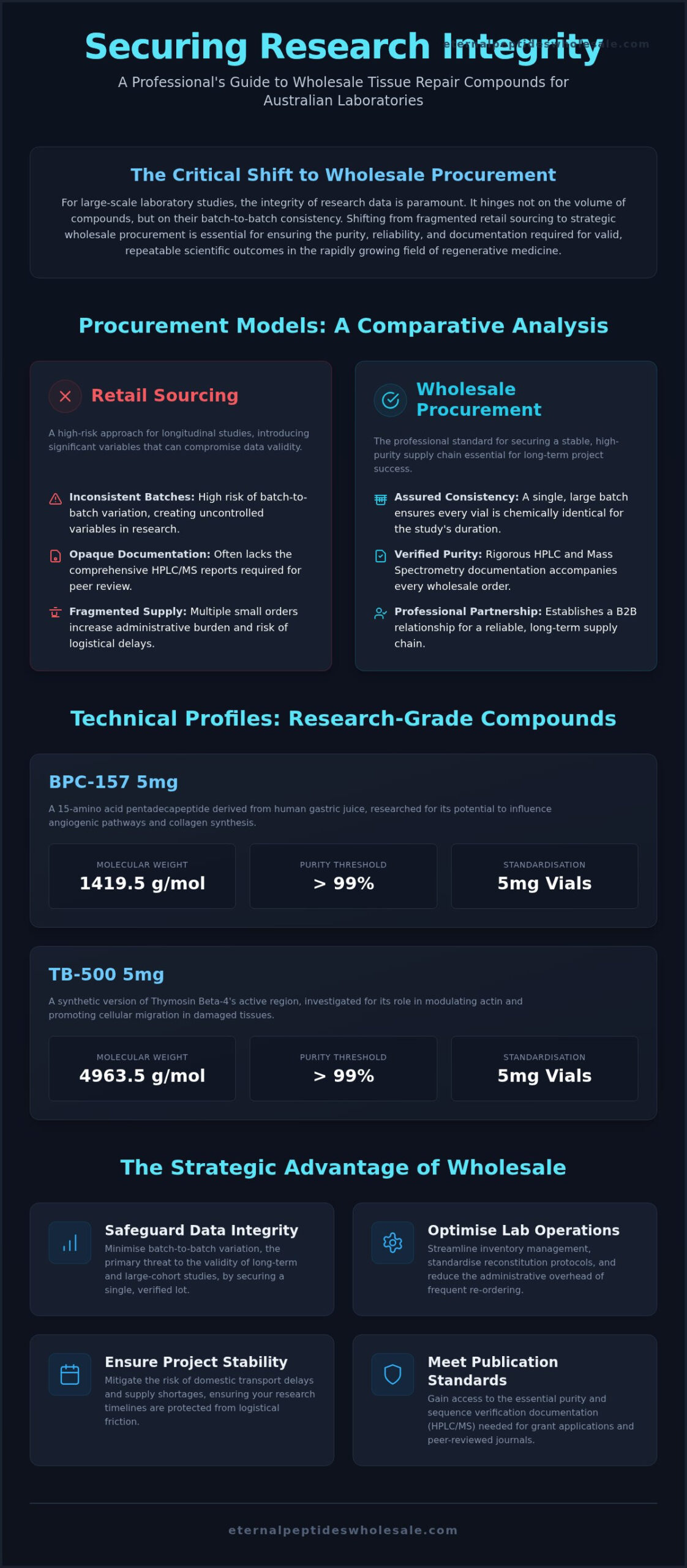
In large-scale research, the value of tissue repair compounds is defined by batch-to-batch consistency, not just volume. For Australian laboratories, the primary bottleneck in progress is frequently the reliability of wholesale tissue repair compounds rather than the hypothesis itself. Procurement professionals understand that sourcing bulk BPC-157 and TB-500 often involves navigating a landscape of inconsistent batches and opaque documentation. You need a supply chain that prioritises clinical reliability over transactional speed.
This guide provides a professional analysis of the Australian wholesale landscape, specifically focusing on establishing stable procurement for BPC-157 5mg and TB-500 5mg. We’ll examine how to verify HPLC/MS documentation, mitigate logistical delays, and ensure your research-grade materials meet the rigorous standards required for valid, large-scale data collection. By the end, you’ll have a clear framework for securing high-purity biochemicals that support long-term project stability without the friction of retail-level supply issues.
Key Takeaways
Understand the operational shift required when moving from retail sourcing to strategic wholesale procurement for large-scale laboratory studies.
Identify the technical specifications and solubility requirements for wholesale tissue repair compounds to ensure precise research planning and reconstitution.
Learn how to safeguard the integrity of long-term data by minimising batch-to-batch variation through rigorous documentation and purity verification.
Optimise laboratory inventory management by addressing the specific logistical requirements and lead times of the Australian biotech environment.
Discover the advantages of establishing a professional B2B partnership to secure a consistent, high-purity supply of research-grade biochemicals.
Defining Wholesale Tissue Repair Compounds in a Research Context
Tissue repair compounds are essential biochemicals in modern regenerative medicine research. They’re primarily utilised to investigate the underlying mechanisms of tissue healing, cellular signalling, and inflammatory modulation. The Australian research sector is currently seeing a surge in regenerative medicine projects, with the legal peptide therapeutics market projected to reach USD 3,711.1 million by 2033. This growth highlights the importance of reliable supply chains for researchers investigating cellular recovery. While retail vendors focus on small-scale transactions, laboratory procurement requires a dedicated logistical backbone that can provide high-volume quantities without compromising on purity.
For scientific validity, volume and purity must be perfectly balanced. A study’s integrity depends on the assumption that every vial used is identical to the last. This is why professional labs avoid the retail market, where batch documentation is often insufficient. Securing wholesale tissue repair compounds through dedicated B2B channels ensures that researchers have access to the documentation required for peer-reviewed publication and repeatable results.
The Role of BPC-157 and TB-500 in Scientific Study
Researchers frequently focus on BPC-157 and TB-500 due to their roles in gastric and musculoskeletal repair models. These compounds are often studied in tandem because researchers look for synergistic effects that might exceed the results of isolated application. BPC-157 is a pentadecapeptide derived from human gastric juice for research. Scientific interest in BPC-157 (Body Protection Compound 157) centres on its potential to influence angiogenic pathways and collagen synthesis within controlled laboratory settings. Its companion, TB-500, is a synthetic version of Thymosin Beta-4, often investigated for its potential to modulate actin and promote cellular migration in damaged tissues.
Wholesale vs. Retail: The Necessity of Scale
Sourcing single vials for longitudinal or large-cohort studies creates significant variables. Every new batch from a retail source introduces a potential point of failure in data consistency. Strategic procurement of wholesale tissue repair compounds allows laboratories to secure a single, massive batch of 5mg vials. This ensures every subject in a study receives a chemically identical compound. Maintaining a bulk inventory also offers logistical advantages. It reduces the frequency of domestic transport delays, which is critical when working with time-sensitive research protocols.
Standardised 5mg vial sizes allow for uniform reconstitution protocols across the entire laboratory team. This level of standardisation is difficult to achieve when relying on fragmented retail supplies. By centralising procurement, labs can focus on their scientific objectives rather than the administrative burden of managing multiple small-scale orders. This approach provides the economic stability and logistical transparency necessary for high-volume biotech operations.
Technical Profiles: BPC-157 and TB-500 Specifications
Precision in biochemical research requires exact molecular specifications. Sourcing wholesale tissue repair compounds demands a focus on molecular weight and sequence integrity. BPC-157 (1419.5 g/mol) and TB-500 (4963.5 g/mol) have distinct profiles that dictate their roles in regenerative models. These technical parameters influence everything from reconstitution volumes to the final concentration used in laboratory assays.
BPC-157 5mg: Research Grade Standards
BPC-157 consists of 15 amino acids. Its sequence, Gly-Glu-Pro-Pro-Pro-Gly-Lys-Pro-Ala-Asp-Asp-Ala-Gly-Leu-Val, must be verified via HPLC. Purity thresholds for wholesale lots should exceed 99% to ensure experimental repeatability. This compound is notably prohibited by the World Anti-Doping Agency for athletic use, which underscores the necessity of strictly research-grade procurement. Verification of these standards is detailed in our guide on Quality Assurance in Research Peptides.
TB-500 5mg: Synthetic Thymosin Beta-4 Analogues
TB-500 is a synthetic peptide fragment representing the active region of the naturally occurring protein Thymosin Beta-4. In research, it’s primarily studied for its role in actin-binding and cellular migration. Unlike the full-length protein, the 5mg TB-500 wholesale format offers a more targeted approach for investigating tissue organisation. High-volume procurement requires rigorous screening for truncated sequences or residual solvents from the synthesis process. Laboratories managing large-scale inventories should review the technical standards for bulk TB-500 for laboratories to ensure every synthesis run meets the minimum purity thresholds required for valid longitudinal data.
Solubility is a critical factor in laboratory preparation. Both compounds are typically reconstituted using bacteriostatic water or sterile saline. Procuring wholesale tissue repair compounds requires a robust understanding of these stability profiles. Lyophilised powders remain stable at room temperature for short durations, but long-term storage in Australian laboratories should be maintained at -20°C. Once reconstituted, vials must be refrigerated at 2-8°C and used within a specific window to prevent degradation. For labs managing large-scale projects, maintaining these cold-chain standards across bulk inventory is non-negotiable.
Researchers seeking to procure high-purity biochemicals can rely on our systematic approach to technical verification and logistical reliability.
Ensuring Batch Consistency in High-Volume Peptide Sourcing
For large-scale biotech projects, the integrity of the data relies on the uniformity of the biochemicals used. When procuring wholesale tissue repair compounds, the greatest risk isn’t just the price; it’s the variation between batches. Inconsistent purity levels can lead to skewed results in long-term studies, forcing researchers to discard months of work. Standardising procurement ensures that every vial in a bulk order, whether it’s 50 or 500 units, shares an identical chemical profile. In an environment where the TGA has made unapproved peptides a compliance priority for 2026, maintaining transparent, high-level documentation is a necessity for any legitimate research facility.
The Importance of HPLC and MS Reports
High-Performance Liquid Chromatography (HPLC) is the industry standard for verifying the purity of peptides like BPC-157 and TB-500. It separates the compound from any synthesis by-products or residual reagents. Complementary to this, Mass Spectrometry (MS) confirms the molecular weight, ensuring the peptide sequence is correct. For wholesale orders, these reports shouldn’t be generic; they must be batch-specific. Researchers should demand these documents to confirm that the wholesale tissue repair compounds they receive meet the exact specifications required for their protocols. This level of transparency is what separates a professional B2B partner from a standard retail vendor.
Standardising Purity Across Wholesale Batches
In the Australian research sector, “Research Grade” typically denotes a purity threshold of 98% or higher. However, even within this range, slight variances between synthesis runs can occur. A professional wholesaler acts as a steadfast logistical backbone by screening these runs before they reach the laboratory. If a batch shows a variance that exceeds the acceptable threshold for a specific longitudinal study, it must be flagged or rejected. Maintaining this level of operational excellence allows labs to focus on their data rather than worrying about the chemical reliability of their supply chain. It’s about creating a narrative of competence through systematic processes and rigorous standards.
By centralising bulk orders through a single, reliable source, labs can mitigate the risks associated with fragmented supply chains. This approach ensures that the “no-nonsense” professional partnership valued by procurement professionals is maintained through every stage of the project. Reliable batch-to-batch consistency isn’t just a logistical advantage; it’s the foundation of valid scientific outcomes.
Strategic Procurement: Optimising the Laboratory Supply Chain
Effective procurement in the 2026 Australian research landscape involves more than just selecting a supplier; it requires a comprehensive strategy for supply chain management. Laboratories must navigate a market where regulatory enforcement is a priority, making the reliability of wholesale tissue repair compounds a central concern for operational continuity. Reducing procurement lag is achievable only through established national distribution networks that bypass the delays common in international retail shipping. For a deeper look at current market dynamics, see our Sourcing Research Peptides Wholesale in Australia guide.
Managing Large-Scale Peptide Inventories
Successful longitudinal studies depend on the potency of the biochemicals from the first day to the last. Bulk lyophilised peptides require specific environmental controls to prevent degradation over time. Organising stock rotation is vital to maintain potency across multi-year trials. When receiving large wholesale shipments, laboratories should follow a systematic verification protocol to ensure every unit meets the required standards.
Maintain long-term storage at -20°C in a dedicated laboratory freezer with backup power.
Utilise a First-In, First-Out (FIFO) rotation to ensure stock freshness across different synthesis runs.
Conduct a visual inspection of vials for vacuum seal integrity and lyophilisation quality upon arrival.
Cross-reference batch numbers with the provided HPLC/MS documentation immediately to confirm consistency.
B2B Logistics and Shipping within Australia
Biochemical sensitivity makes standard courier services unsuitable for high-value research materials. Temperature-controlled shipping is mandatory for maintaining the structural integrity of wholesale tissue repair compounds during transit, especially during the summer months in regional Australia. National distribution networks that specialise in cold-chain logistics help laboratories overcome common hurdles like regional transport delays and heat exposure at sorting centres. These logistical requirements often mirror those found in Wholesale GLP-1 Research Chemicals, where stability is equally paramount for valid research data. Procurement professionals expanding their research portfolios should also consider how ipamorelin wholesale Australia sourcing strategies align with the same domestic supply chain principles that protect longitudinal study timelines.
Establishing a steadfast logistical backbone allows your team to focus on scientific discovery rather than administrative friction. To secure a reliable supply for your next large-scale biotech project, you can view our wholesale procurement options and speak with a specialist about your specific research requirements.
Eternal Peptides Wholesale: Your Professional Research Partner
Eternal Peptides Wholesale functions as more than a supplier; we serve as a steadfast logistical backbone for the Australian biotech sector. Our operations are built on a foundation of clinical reliability and transparency, specifically designed to meet the high-volume needs of professional laboratories. Unlike generic marketplaces that offer a broad range of unrelated goods, we specialise exclusively in high-purity biochemicals. This focus ensures that our procurement protocols, documentation standards, and distribution networks are all optimised for the scientific community. By providing a consistent supply of wholesale tissue repair compounds, we allow researchers to maintain the momentum of their projects without the disruptions caused by fragmented supply chains.
A Steadfast Logistical Backbone for Australian Labs
Our “no-nonsense” approach to business prioritises precision and operational excellence. Procurement professionals value a partner who understands that research success depends on more than just a product; it requires a systematic process. Eternal Peptides Wholesale provides BPC-157 5mg and TB-500 5mg at scale, ensuring every shipment is backed by batch-specific documentation. We do not offer retail sales. Our focus remains entirely on B2B logistical excellence. This clinical, business-oriented partnership is designed to reduce administrative friction and provide the long-term stability needed for multi-year research programmes. We strictly adhere to research-only standards, ensuring that all compounds are provided for laboratory use and are not for human consumption or medical application.
Securing Your Supply Chain for 2026
As the TGA intensifies its focus on peptide compliance in 2026, the value of a transparent, Australian-based partner becomes even more significant. Establishing a wholesale account for your institution provides a direct channel to a reliable supply of research-grade materials. Our process for batch verification is rigorous, ensuring that every synthesis run meets our internal purity thresholds before it enters our national distribution network. We focus on building long-term professional relationships that evolve with your laboratory’s needs. This steady cadence of supply mirrors the reliability required for a well-oiled research facility. Enquire about wholesale tissue repair compounds today to discuss your procurement requirements and secure your research timeline for the coming year.
Securing Your Research Infrastructure for 2026
Establishing a stable supply of wholesale tissue repair compounds is a foundational step for any high-volume laboratory project. By prioritising batch-to-batch consistency and rigorous HPLC/MS verification, researchers can eliminate variables that otherwise compromise long-term data integrity. A professional B2B partnership ensures that your procurement process remains transparent and predictable, allowing your team to focus on scientific outcomes rather than logistical hurdles. This methodical approach to supply chain management mirrors the precision required in your own experimental protocols, creating a narrative of operational excellence throughout the study.
Reliable national distribution across Australia provides the security needed to maintain project timelines without the risks associated with fragmented retail sourcing. Our commitment to providing strictly research-grade biochemicals means your facility receives materials that meet the highest technical standards for every synthesis run. Using a dependable logistical backbone is essential for navigating the complexities of the modern biotech landscape while ensuring your research remains on schedule and within budget.
Are these tissue repair compounds suitable for human consumption?
No, these compounds are strictly for laboratory research purposes only and are not for human consumption or medical use. Every order of our wholesale tissue repair compounds is supplied under the condition that it’s used within a controlled scientific environment. We don’t provide medical consultations or advice on therapeutic applications. Researchers must ensure their protocols comply with institutional biosafety and ethics requirements while handling these biochemicals.
What is the standard purity of your wholesale BPC-157 and TB-500?
We maintain a “research grade” standard, which requires a minimum purity threshold of 98% or higher for all batches. This level of purity is essential for ensuring that laboratory data remains valid and repeatable across large-scale studies. Our quality control processes screen every synthesis run to ensure that residual solvents and synthesis by-products are kept within acceptable limits for peer-reviewed scientific investigation.
Do you provide HPLC and MS reports for bulk peptide orders?
Yes, we provide comprehensive High-Performance Liquid Chromatography (HPLC) and Mass Spectrometry (MS) reports for every wholesale order. These documents verify the peptide’s purity and confirm its molecular weight against the expected sequence. Providing batch-specific documentation is a core part of our commitment to logistical transparency and clinical reliability. This allows procurement officers to maintain a clear audit trail for their laboratory’s inventory.
Can I purchase single vials for individual research use?
No, we do not engage in retail single-vial sales. Our business model is exclusively focused on B2B distribution and bulk supply for laboratories, biotech companies, and research institutions. This wholesale focus allows us to maintain the steadfast logistical backbone necessary for large-scale operations. By specialising in high-volume procurement, we ensure that our clients receive consistent, high-purity batches that support long-term scientific projects.
How are wholesale peptide orders shipped within Australia?
All orders are shipped via our national distribution network using temperature-controlled logistics to maintain compound integrity. We understand the sensitivity of biochemicals like BPC-157 and TB-500, especially during transit across various Australian climates. Our shipping protocols are designed to overcome regional hurdles and prevent heat exposure. This ensures that lyophilised peptides arrive at your facility in optimal condition for laboratory storage and eventual reconstitution.
What is the shelf life of bulk lyophilised peptides in laboratory storage?
Bulk lyophilised peptides typically remain stable for up to 24 months when stored in a dedicated laboratory freezer at -20°C. Once reconstituted, the compounds are much more sensitive and should be kept at 2-8°C and used within a specific window, usually 7 to 14 days, depending on the buffer used. Maintaining these strict storage conditions is critical for preserving the potency of your wholesale tissue repair compounds throughout multi-year trials.
Do you offer wholesale discounts for university research projects?
We specialise in providing tailored supply solutions for university research projects and large-scale biotech institutions. While we don’t offer retail-style discounts, our wholesale pricing structures are designed to accommodate the budgetary and logistical needs of high-volume laboratory environments. We focus on building long-term professional relationships with procurement departments to ensure a reliable and cost-effective supply chain for their ongoing scientific investigations.
Are these compounds regulated for research use in Australia?
In Australia, BPC-157 and TB-500 are unapproved therapeutic goods and are not included in the ARTG for human use. However, they’re available for legitimate laboratory research purposes within highly regulated scientific channels. It’s the responsibility of the purchasing institution to ensure they have the legal authority and necessary permits to possess and use these substances for their specific research protocols in accordance with state and federal laws.
Related from Eternal Peptides Wholesale
Eternal Peptides Wholesale publishes batch-specific Janoshik Analytical reports in its certificate of analysis library, so the documentation for a listed batch can be read alongside the evidence discussed in this article.
Peptide COA library: batch-specific Janoshik Analytical reports with their verification details
Researchers looking to buy Bacteriostatic Water in Australia need more than a product name and an attractive price. The purchasing decision should connect the exact material, the amount being offered, the supporting laboratory documents and the requirements of the research project.
This guide follows that decision from the research background to supplier selection, report verification, ten-vial options and catalogue pricing. It focuses on Bacteriostatic Water, including the details that make its purchasing specification different from other products.
Eternal Peptides Wholesale currently lists 10ml (BW10). The quantities and prices in this guide reflect the catalogue snapshot of 27 September 2026; the linked product pages remain the place to check the current offer. 1
What is Bacteriostatic Water? Understanding the Research Material
Bacteriostatic water is a solvent product, so the purchasing questions differ from those for a peptide. The catalogue describes a 10ml presentation containing 0.9% benzyl alcohol, sold in ten-vial boxes for research use. Treat that composition as the supplier’s stated specification. 1
An official medicinal-product label describes benzyl alcohol as a preservative in bacteriostatic water. That separate label explains the term; it does not establish that the Eternal Peptides Wholesale product has the same regulatory status or independently verified sterility. 2
The purchasing scope here is laboratory research. Eternal Peptides Wholesale’s terms restrict products to the stated research audience and exclude human or animal consumption and therapeutic use. A catalogue listing or “research use only” wording is not, by itself, a regulatory exemption; the Therapeutic Goods Administration explains that product classification and applicable obligations still matter. 34
Why Bacteriostatic Water Attracts Laboratory Solvent And Formulation Research Interest
A preservative can affect the material placed into a solution. Primary formulation research found that benzyl alcohol affected recombinant interferon-gamma structure and aggregation under the studied conditions. This is a specific protein-formulation finding, not proof that every peptide behaves the same way. 5
The procurement implication is to check solvent compatibility with the laboratory’s actual material and assay. A product described as bacteriostatic is not automatically a universal diluent.
For buying bacteriostatic water in Australia, focus on composition, preservative assay, applicable microbial and endotoxin evidence, container integrity and the supplier’s lot-specific specification. A peptide-style “purity” headline does not answer all of those questions.
Use each reference for the question it actually studied. An analytical paper may support identification; a cellular or animal experiment may support a mechanism; a clinical trial may support findings in its specified population and formulation. None of these replaces a certificate for the lot being considered. The references are a starting set for scientific review, rather than a claim to exhaust the literature.
Where to Buy Bacteriostatic Water Australia: Evaluation Criteria
Start with a supplier whose listing lets you identify exactly what you are buying. For Bacteriostatic Water, that means a named product, a stated vial quantity, a clear box size and documentation that can be connected to the offered material. The catalogue options are linked above so these details can be checked directly.
Eternal Peptides Wholesale describes an Australia-based research-supply operation, provides product pages and a testing directory, and offers contact through its published enquiry channels. Those are checkable website features. They do not, on their own, establish Australian manufacture, institutional endorsement or that every current lot has undergone every available test. 678
Before an order, establish four practical points:
The exact Bacteriostatic Water specification required by the laboratory.
The SKU, nominal amount and number of vials in the offer.
Which analytical reports relate to the lot that would be supplied.
How an unresolved specification or documentation question will be answered in writing.
The nominal quantity is 10ml per vial and 100ml per box. The displayed composition report lists benzyl alcohol at 9.95mg/ml, equivalent by arithmetic to 0.995% w/v; the catalogue description says 0.9%. Ask how the measured value relates to the stated specification and acceptance limits. 19
Quality Verification: Beyond Marketing Claims
Quality verification should answer the laboratory’s acceptance questions. It should not collapse identity, content, contamination and biological suitability into one marketing percentage.
Pillar 1: Composition and preservative content
For bacteriostatic water, start with the stated composition and the measured benzyl-alcohol content. The displayed report is a composition assay, rather than a peptide-purity certificate. Review the actual value against a documented specification. 19
Pillar 2: Microbial quality and the meaning of sterility
Ask which microbial method was used. Total aerobic microbial count and total yeast/mould count measure recoverable organisms under their test conditions; they should not be relabelled as a compendial sterility test. Preservative content is a different question again. 1011
Pillar 3: Endotoxin measurement
Read the numerical result, its unit and the method. For a liquid, a result may be expressed per millilitre. Agree appropriate acceptance criteria for the laboratory application, instead of importing a generic threshold from a peptide advertisement. 12
Pillar 4: Additional contaminants and compatibility
Decide which chemical-contaminant tests the application requires and what the available panel actually measures. A screen for arsenic, cadmium, lead and mercury does not cover every possible impurity. 13 Independently assess whether the preserved solvent is compatible with the intended research material; the interferon study illustrates why this is formulation dependent. 5
Evidence
What it helps establish
What it does not establish by itself
Composition assay
The specified analyte and measured concentration
Sterility or universal solvent compatibility
Microbial test
Organisms recoverable by the stated method
All organisms absent under every condition
Endotoxin analysis
Endotoxin result in the reported unit
All microbial or chemical hazards excluded
Contaminant panel
The named substances and detection limits
Every possible contaminant excluded
Bacteriostatic Water purchasing check: The displayed composition assay measures benzyl alcohol; it does not itself prove sterility, endotoxin compliance or suitability for a particular peptide. Obtain the actual microbial method and relevant current-lot reports.
Janoshik Testing Explained: What the Reports Actually Show
Eternal Peptides Wholesale links sample reports through product pages and its testing directory. Use these as documents to examine, not as a blanket certification of the catalogue. 7
Report links displayed for these catalogue options
The product pages checked on 27 September 2026 displayed the following report links. Link labels describe the published files, not independent confirmation of the test method, authenticity or current-lot coverage.
Check each report independently. A document for another strength or ingredient does not automatically cover this product. Where an analysis is not displayed, ask whether a matching report is available rather than assuming the result.
Janoshik provides an independent verification page for checking report details. Where a report supplies a task number and unique key, enter them at the laboratory’s own site and compare the returned record with the displayed document. A logo or copied image is not the same as a completed verification. 14
Keep the verification record with the laboratory’s purchasing file. Match the sample name, stated batch, dates, requested analyses and results. If the supplier cannot connect a displayed sample report to the material being offered, record that as an unresolved lot-matching question. Do not assume that a successful check of the report’s authenticity proves the chain between that submitted sample and every vial in stock.
For Bacteriostatic Water, give particular attention to the product-specific check above. Ask for readable source documents when a small image or an ambiguous label prevents review. Complete report authentication and batch matching before relying on a displayed image for an upcoming order.
Vial Quantities: Catalogue Options and Purchasing Considerations
The following table translates the catalogue into purchasing quantities. It uses nominal labels, not independently measured box contents.
Millilitres describe volume. Benzyl-alcohol concentration is a separate measurement, so a 10ml label does not establish preservative content, microbial quality or compatibility with a research material.
This snapshot contains one Bacteriostatic Water presentation. There is no verified second strength in this family to use for a within-catalogue price comparison. Evaluate the listed box against the laboratory’s actual requirement and any documented supplier quotation.
Document any required storage period and handling conditions before choosing a larger quantity. General peptide-handling guidance cannot validate a shelf life for a specific sequence, solvent or lot; request product-specific stability information where the project needs it. 15
The Wholesale Advantage: Box of 10 Vials
The listed Bacteriostatic Water offers use a box of ten vials. This provides a defined purchasing unit for budgeting and inventory, with the amounts shown above. 1
For a laboratory, the possible value is practical: a known number of containers can be allocated across planned work and recorded against one purchasing decision. These are planning considerations, not a claim that buying a box improves the compound’s biological performance.
A ten-vial box also does not, by itself, guarantee a single manufacturing lot or uniform measured content. If a project needs all vials from one lot, make that an explicit purchasing requirement and obtain confirmation. Record batch changes rather than treating every future reorder as the same experimental material.
Do not infer a percentage saving against single-vial retail prices without an actual comparable offer. This guide calculates the catalogue’s per-vial equivalent so the arithmetic is visible; it does not invent a market-wide discount.
Australian vs. International Suppliers: Critical Differences
An Australian buyer can compare suppliers using the same evidence standard, regardless of where a business is based. A domestic website can make contact and commercial terms easier to evaluate, but location alone does not establish product quality, manufacturing origin or regulatory status.
Purchasing issue
What can be checked for Eternal Peptides Wholesale
What to check with another supplier
Business description
Published Australia-based positioning and company information 6
The Australian Competition and Consumer Commission explains that Australian Consumer Law can apply to overseas businesses selling directly to Australian consumers, although resolving problems can be harder. Business-to-business rights also depend on the transaction. Avoid simplistic claims that every overseas purchase has no protection or every local purchase is automatically protected in the same way. 17
For Bacteriostatic Water, prioritise an answerable specification and a documented lot over general claims about geography. The regulatory classification of the actual product and intended activity must also be checked; a research label alone does not settle it. 4
Red Flags: Warning Signs of Unreliable Suppliers
Treat the following as reasons to ask for clarification before buying Bacteriostatic Water:
A product name that does not resolve its precise molecular form or blend composition.
A report with an unreadable result, missing sample identification or no clear connection to the offered lot.
A purity percentage being used to imply sterility, clinical safety or guaranteed biological performance.
Studies of a different compound, formulation or population being presented as proof about the catalogue item.
A price comparison that mixes vial amounts, box quantities or total blend mass without explaining the basis.
Refusal to address a material mismatch between the product specification and the supporting documents.
These are procurement checks, not a basis for declaring an unfamiliar business fraudulent. A low price, an overseas address or a missing telephone number alone does not establish misconduct. Make the assessment from the actual evidence and the requirements of the intended work.
Documentation Requirements for Research Institutions
Prepare the purchasing file before the material is accepted into a project. A useful record for Bacteriostatic Water includes:
The saved product specification, SKU, nominal amount and agreed box quantity.
Supplier identity, written quotation or order record, and the terms used for the purchase.
The batch or lot identifier, report files, test methods and any verification record.
The laboratory’s acceptance criteria and explanation of how the supplied evidence addresses them.
Product-specific handling and stability information, with any unresolved gaps recorded.
Written clarification of differences between the label, the order and a displayed report.
Institutional requirements vary. Ask for a safety data sheet, additional analytical work or other documentation if the purchasing institution requires it; this guide does not claim that every such document is publicly available from the supplier. The published contact page provides the route for these enquiries. 8
Keep experimental evidence in a separate part of the file from the product’s quality documents. The scientific references explain the research rationale, while the lot documents explain the material used. This makes it easier for another researcher to understand both decisions later.
Pricing Analysis: Understanding Wholesale Costs
The following prices were displayed in Australian dollars at the 27 September 2026 catalogue snapshot. The per-vial and per-ml figures are calculations from the box price and nominal label amount, rounded to cents. They are not separately advertised sale units or an independent assay of the contents.
For bacteriostatic water, compare volume and composition together. Use the current product page and final written offer when making a purchasing decision.
This snapshot contains one Bacteriostatic Water presentation. There is no verified second strength in this family to use for a within-catalogue price comparison. Evaluate the listed box against the laboratory’s actual requirement and any documented supplier quotation.
The lower nominal unit price is only one input. Consider whether the material specification is complete, whether the lot documents meet the institution’s requirements and whether the quantity can be used within supported handling and stability conditions. A price table cannot resolve missing evidence.
Frequently Asked Questions
Where can researchers buy Bacteriostatic Water in Australia?
Eternal Peptides Wholesale lists 10ml (BW10). Check the current offer, the supplier’s eligibility terms and matching lot documents before an order. A published listing is not independent evidence that every acceptance requirement has been met. 13
What makes a Bacteriostatic Water supplier worth considering?
A clear product specification, transparent box quantity and price, readable analytical documentation, and a working route for written questions make the offer easier to evaluate. Assess those points against the actual laboratory requirement rather than relying on a claim that a supplier is “trusted”.
How should a buyer verify the laboratory reports?
Use the laboratory’s own verification route when identifiers are available, then check the sample, batch and method. Authenticate the document and establish the current-lot connection as separate steps. A report image on a product page does not complete both checks. 14
Does a benzyl-alcohol assay prove the water is sterile or suitable for every peptide?
No. Preservative content, sterility, endotoxin content and material compatibility are separate questions. The displayed report addresses benzyl alcohol, while compatibility research demonstrates why formulation-specific assessment matters. 95
Who is the catalogue intended for?
The company’s terms specify the research audience, including qualified researchers or laboratory professionals and age eligibility. They exclude human or animal consumption and therapeutic use. Product classification and applicable requirements still need assessment; a research disclaimer does not create an automatic exemption. 34
How should storage and handling be assessed before buying?
Request information specific to Bacteriostatic Water, its form and the actual lot. Match the order quantity to the laboratory’s validated protocol and supported stability period. General advice about peptides or solvents cannot establish a universal expiry or compatibility rule. 15
Choosing Bacteriostatic Water for Research in Australia
Buying Bacteriostatic Water in Australia is a decision about an identified material, a documented quantity and evidence that fits the project. The scientific literature helps explain the research interest; the supplier’s specification and matching reports help evaluate the offered product.
Catalogue and policy sources checked for this review on 27 September 2026. Research papers are cited for the study described, not as certification of the commercial product.
Before purchasing Bacteriostatic Water for research
Keep the chosen product URL, nominal vial amount, box quantity and offered batch identifier in one enquiry. Ask which displayed report corresponds to that lot and which questions remain unanswered. Use the batch-verification checklist when reviewing the documents and the endotoxin results guide when interpreting EU units.
Researchers looking to buy KLOW Blend in Australia need more than a product name and an attractive price. The purchasing decision should connect the exact material, the amount being offered, the supporting laboratory documents and the requirements of the research project.
This guide follows that decision from the research background to supplier selection, report verification, ten-vial options and catalogue pricing. It focuses on KLOW Blend, including the details that make its purchasing specification different from other products.
Eternal Peptides Wholesale currently lists 80mg total blend (KLOW80). The quantities and prices in this guide reflect the catalogue snapshot of 27 September 2026; the linked product pages remain the place to check the current offer. 1
What is KLOW Blend? Understanding the Research Compound
KLOW Blend is listed as a nominal 80mg research blend. Its displayed report names GHK-Cu, BPC-157 and TB-500 (TB4), with KPV recorded in the comments. Those names identify reported sample components, while the nominal formulation still requires supplier confirmation. 12
The product name should not be treated as evidence that all ingredients have been clinically tested together. A blend needs both a composition record and evidence relevant to any claim made about the combination.
The purchasing scope here is laboratory research. Eternal Peptides Wholesale’s terms restrict products to the stated research audience and exclude human or animal consumption and therapeutic use. A catalogue listing or “research use only” wording is not, by itself, a regulatory exemption; the Therapeutic Goods Administration explains that product classification and applicable obligations still matter. 34
Why KLOW Blend Attracts Multi-Peptide And Inflammatory-Signalling Research Interest
KPV has been investigated in inflammatory-signalling and mouse colitis models. 5 GHK-Cu has a separate rat wound-research background, and BPC-157 has separate experimental tendon literature. 67
These findings cannot be added together to establish the effects of KLOW Blend. They also do not answer whether the mixture has the same analytical stability or biological behaviour as each component studied separately.
When buying KLOW Blend in Australia, first resolve the component amounts and the exact TB-500 form. The cited analytical literature shows why a TB-500 label alone is insufficient to identify the complete structure. 8
Use each reference for the question it actually studied. An analytical paper may support identification; a cellular or animal experiment may support a mechanism; a clinical trial may support findings in its specified population and formulation. None of these replaces a certificate for the lot being considered. The references are a starting set for scientific review, rather than a claim to exhaust the literature.
Where to Buy KLOW Blend Australia: Evaluation Criteria
Start with a supplier whose listing lets you identify exactly what you are buying. For KLOW Blend, that means a named product, a stated vial quantity, a clear box size and documentation that can be connected to the offered material. The catalogue options are linked above so these details can be checked directly.
Eternal Peptides Wholesale describes an Australia-based research-supply operation, provides product pages and a testing directory, and offers contact through its published enquiry channels. Those are checkable website features. They do not, on their own, establish Australian manufacture, institutional endorsement or that every current lot has undergone every available test. 91011
Before an order, establish four practical points:
The exact KLOW Blend specification required by the laboratory.
The SKU, nominal amount and number of vials in the offer.
Which analytical reports relate to the lot that would be supplied.
How an unresolved specification or documentation question will be answered in writing.
The displayed report lists GHK-Cu 46.50mg, BPC-157 12.22mg, TB-500 (TB4) 10.58mg and KPV 10.71mg. Their calculated total is 80.01mg. These sample measurements do not establish the nominal formulation or content of every offered vial. 2
Quality Verification: Beyond Marketing Claims
Quality verification should answer the laboratory’s acceptance questions. It should not collapse identity, content, contamination and biological suitability into one marketing percentage.
Pillar 1: Identity, purity and measured content
A percentage and a milligram amount answer different questions. Chromatographic purity describes the material detected by that method; it is not automatically the proportion of every substance in a vial. Net peptide content can also differ from gross material weight because of water, counterions or other constituents. Review identity data and the content method alongside the chromatogram. 12
Pillar 2: Microbial assessment
Read the actual method rather than relying on a “sterility” label. Total aerobic microbial count and total yeast/mould count are enumeration tests. They are not interchangeable with a compendial sterility test, even when a supplier groups them under a broad testing heading. 1314
Pillar 3: Endotoxin measurement
Record the measured result and its unit. A value per vial is different from a value per millilitre, and an appropriate acceptance limit depends on the intended work and method. An endotoxin result does not replace microbial testing or establish overall safety. 15
Pillar 4: Heavy-metals screening
Read the analyte list and reporting limits. The linked Janoshik panel covers arsenic, cadmium, lead and mercury; it is not an unlimited screen for every metal or impurity. Decide whether those results answer the laboratory’s actual acceptance requirements. 16
Evidence
What it helps establish
What it does not establish by itself
Identity and content
The tested identity and measured analyte amount, within method scope
All containers contain the same amount
Chromatographic purity
The reported analytical purity under the method
Sterility, total net content or clinical safety
Microbial assessment
Recoverable counts under the stated conditions
A different sterility method was performed
Endotoxin and metals
Specified analytes and numerical results
Every contaminant has been excluded
KLOW Blend purchasing check: Request the nominal amount of all four ingredients, including KPV, and a current-lot report identifying each. Do not infer a standard recipe from the product name or total mass.
Janoshik Testing Explained: What the Reports Actually Show
Eternal Peptides Wholesale links sample reports through product pages and its testing directory. Use these as documents to examine, not as a blanket certification of the catalogue. 10
Report links displayed for these catalogue options
The product pages checked on 27 September 2026 displayed the following report links. Link labels describe the published files, not independent confirmation of the test method, authenticity or current-lot coverage.
Check each report independently. A document for another strength or ingredient does not automatically cover this product. Where an analysis is not displayed, ask whether a matching report is available rather than assuming the result.
Janoshik provides an independent verification page for checking report details. Where a report supplies a task number and unique key, enter them at the laboratory’s own site and compare the returned record with the displayed document. A logo or copied image is not the same as a completed verification. 17
Keep the verification record with the laboratory’s purchasing file. Match the sample name, stated batch, dates, requested analyses and results. If the supplier cannot connect a displayed sample report to the material being offered, record that as an unresolved lot-matching question. Do not assume that a successful check of the report’s authenticity proves the chain between that submitted sample and every vial in stock.
For KLOW Blend, give particular attention to the product-specific check above. Ask for readable source documents when a small image or an ambiguous label prevents review. Complete report authentication and batch matching before relying on a displayed image for an upcoming order.
Vial Quantities: Catalogue Options and Purchasing Considerations
The following table translates the catalogue into purchasing quantities. It uses nominal labels, not independently measured box contents.
For this blend, total milligrams are the sum of nominal component amounts where those amounts are declared. Total blend mass is not the amount of each ingredient. Where the recipe is not published, obtain it before comparing composition with another product.
This snapshot contains one KLOW Blend presentation. There is no verified second strength in this family to use for a within-catalogue price comparison. Evaluate the listed box against the laboratory’s actual requirement and any documented supplier quotation.
Document any required storage period and handling conditions before choosing a larger quantity. General peptide-handling guidance cannot validate a shelf life for a specific sequence, solvent or lot; request product-specific stability information where the project needs it. 12
The Wholesale Advantage: Box of 10 Vials
The listed KLOW Blend offers use a box of ten vials. This provides a defined purchasing unit for budgeting and inventory, with the amounts shown above. 1
For a laboratory, the possible value is practical: a known number of containers can be allocated across planned work and recorded against one purchasing decision. These are planning considerations, not a claim that buying a box improves the compound’s biological performance.
A ten-vial box also does not, by itself, guarantee a single manufacturing lot or uniform measured content. If a project needs all vials from one lot, make that an explicit purchasing requirement and obtain confirmation. Record batch changes rather than treating every future reorder as the same experimental material.
Do not infer a percentage saving against single-vial retail prices without an actual comparable offer. This guide calculates the catalogue’s per-vial equivalent so the arithmetic is visible; it does not invent a market-wide discount.
Australian vs. International Suppliers: Critical Differences
An Australian buyer can compare suppliers using the same evidence standard, regardless of where a business is based. A domestic website can make contact and commercial terms easier to evaluate, but location alone does not establish product quality, manufacturing origin or regulatory status.
Purchasing issue
What can be checked for Eternal Peptides Wholesale
What to check with another supplier
Business description
Published Australia-based positioning and company information 9
The Australian Competition and Consumer Commission explains that Australian Consumer Law can apply to overseas businesses selling directly to Australian consumers, although resolving problems can be harder. Business-to-business rights also depend on the transaction. Avoid simplistic claims that every overseas purchase has no protection or every local purchase is automatically protected in the same way. 19
For KLOW Blend, prioritise an answerable specification and a documented lot over general claims about geography. The regulatory classification of the actual product and intended activity must also be checked; a research label alone does not settle it. 4
Red Flags: Warning Signs of Unreliable Suppliers
Treat the following as reasons to ask for clarification before buying KLOW Blend:
A product name that does not resolve its precise molecular form or blend composition.
A report with an unreadable result, missing sample identification or no clear connection to the offered lot.
A purity percentage being used to imply sterility, clinical safety or guaranteed biological performance.
Studies of a different compound, formulation or population being presented as proof about the catalogue item.
A price comparison that mixes vial amounts, box quantities or total blend mass without explaining the basis.
Refusal to address a material mismatch between the product specification and the supporting documents.
These are procurement checks, not a basis for declaring an unfamiliar business fraudulent. A low price, an overseas address or a missing telephone number alone does not establish misconduct. Make the assessment from the actual evidence and the requirements of the intended work.
Documentation Requirements for Research Institutions
Prepare the purchasing file before the material is accepted into a project. A useful record for KLOW Blend includes:
The saved product specification, SKU, nominal amount and agreed box quantity.
Supplier identity, written quotation or order record, and the terms used for the purchase.
The batch or lot identifier, report files, test methods and any verification record.
The laboratory’s acceptance criteria and explanation of how the supplied evidence addresses them.
Product-specific handling and stability information, with any unresolved gaps recorded.
Written clarification of differences between the label, the order and a displayed report.
Institutional requirements vary. Ask for a safety data sheet, additional analytical work or other documentation if the purchasing institution requires it; this guide does not claim that every such document is publicly available from the supplier. The published contact page provides the route for these enquiries. 11
Keep experimental evidence in a separate part of the file from the product’s quality documents. The scientific references explain the research rationale, while the lot documents explain the material used. This makes it easier for another researcher to understand both decisions later.
Pricing Analysis: Understanding Wholesale Costs
The following prices were displayed in Australian dollars at the 27 September 2026 catalogue snapshot. The per-vial and per-mg figures are calculations from the box price and nominal label amount, rounded to cents. They are not separately advertised sale units or an independent assay of the contents.
For this blend, cost per milligram refers to total nominal blend mass, not to each ingredient. Use the current product page and final written offer when making a purchasing decision.
This snapshot contains one KLOW Blend presentation. There is no verified second strength in this family to use for a within-catalogue price comparison. Evaluate the listed box against the laboratory’s actual requirement and any documented supplier quotation.
The lower nominal unit price is only one input. Consider whether the material specification is complete, whether the lot documents meet the institution’s requirements and whether the quantity can be used within supported handling and stability conditions. A price table cannot resolve missing evidence.
Frequently Asked Questions
Where can researchers buy KLOW Blend in Australia?
Eternal Peptides Wholesale lists 80mg total blend (KLOW80). Check the current offer, the supplier’s eligibility terms and matching lot documents before an order. A published listing is not independent evidence that every acceptance requirement has been met. 13
What makes a KLOW Blend supplier worth considering?
A clear product specification, transparent box quantity and price, readable analytical documentation, and a working route for written questions make the offer easier to evaluate. Assess those points against the actual laboratory requirement rather than relying on a claim that a supplier is “trusted”.
How should a buyer verify the laboratory reports?
Use the laboratory’s own verification route when identifiers are available, then check the sample, batch and method. Authenticate the document and establish the current-lot connection as separate steps. A report image on a product page does not complete both checks. 17
Is KLOW Blend simply interchangeable with Glow Blend plus a standalone KPV vial?
That equivalence has not been established. A complete formulation, component amounts and relevant compatibility data are needed before comparing mixtures in that way. The displayed reports describe different submitted samples. 220
Who is the catalogue intended for?
The company’s terms specify the research audience, including qualified researchers or laboratory professionals and age eligibility. They exclude human or animal consumption and therapeutic use. Product classification and applicable requirements still need assessment; a research disclaimer does not create an automatic exemption. 34
How should storage and handling be assessed before buying?
Request information specific to KLOW Blend, its form and the actual lot. Match the order quantity to the laboratory’s validated protocol and supported stability period. General advice about peptides or solvents cannot establish a universal expiry or compatibility rule. 12
Choosing KLOW Blend for Research in Australia
Buying KLOW Blend in Australia is a decision about an identified material, a documented quantity and evidence that fits the project. The scientific literature helps explain the research interest; the supplier’s specification and matching reports help evaluate the offered product.
Catalogue and policy sources checked for this review on 27 September 2026. Research papers are cited for the study described, not as certification of the commercial product.
Keep the chosen product URL, nominal vial amount, box quantity and offered batch identifier in one enquiry. Ask which displayed report corresponds to that lot and which questions remain unanswered. Use the batch-verification checklist when reviewing the documents and the endotoxin results guide when interpreting EU units.
Researchers looking to buy Glow Blend in Australia need more than a product name and an attractive price. The purchasing decision should connect the exact material, the amount being offered, the supporting laboratory documents and the requirements of the research project.
This guide follows that decision from the research background to supplier selection, report verification, ten-vial options and catalogue pricing. It focuses on Glow Blend, including the details that make its purchasing specification different from other products.
Eternal Peptides Wholesale currently lists 70mg total blend (GL70). The quantities and prices in this guide reflect the catalogue snapshot of 27 September 2026; the linked product pages remain the place to check the current offer. 1
What is Glow Blend? Understanding the Research Compound
Glow Blend is listed as a nominal 70mg research blend. The displayed supplier report names GHK-Cu, BPC-157 and TB-500 (TB4), with separate reported sample amounts. The public product description does not establish a complete nominal ingredient ratio, so a purchasing specification is still needed. 12
“Glow” is a product name, not a scientifically established endpoint. Buying the blend requires clarity about its composition before evidence for any ingredient is applied to it.
The purchasing scope here is laboratory research. Eternal Peptides Wholesale’s terms restrict products to the stated research audience and exclude human or animal consumption and therapeutic use. A catalogue listing or “research use only” wording is not, by itself, a regulatory exemption; the Therapeutic Goods Administration explains that product classification and applicable obligations still matter. 34
Why Glow Blend Attracts Multi-Peptide And Extracellular-Matrix Research Interest
Ingredient literature includes rat GHK-Cu wound research and BPC-157 tendon-model work. Those are separate experiments, not tests of the finished Glow Blend. 56
TB-500 terminology adds another boundary: an analytical publication used the name for an acetylated fragment, so the exact ingredient identity needs confirmation. 7
These references provide background for evaluating individual ingredients. They do not demonstrate that combining them gives better skin, faster repair or synergistic activity. For an Australian buyer, a complete component specification is more informative than a broad cosmetic narrative.
Use each reference for the question it actually studied. An analytical paper may support identification; a cellular or animal experiment may support a mechanism; a clinical trial may support findings in its specified population and formulation. None of these replaces a certificate for the lot being considered. The references are a starting set for scientific review, rather than a claim to exhaust the literature.
Where to Buy Glow Blend Australia: Evaluation Criteria
Start with a supplier whose listing lets you identify exactly what you are buying. For Glow Blend, that means a named product, a stated vial quantity, a clear box size and documentation that can be connected to the offered material. The catalogue options are linked above so these details can be checked directly.
Eternal Peptides Wholesale describes an Australia-based research-supply operation, provides product pages and a testing directory, and offers contact through its published enquiry channels. Those are checkable website features. They do not, on their own, establish Australian manufacture, institutional endorsement or that every current lot has undergone every available test. 8910
Before an order, establish four practical points:
The exact Glow Blend specification required by the laboratory.
The SKU, nominal amount and number of vials in the offer.
Which analytical reports relate to the lot that would be supplied.
How an unresolved specification or documentation question will be answered in writing.
The displayed sample report lists GHK-Cu 57.27mg, BPC-157 12.54mg and TB-500 (TB4) 10.45mg. Their calculated sum is 80.26mg. These are sample results shown on a supplier-hosted image, not confirmed nominal ratios or a promise about every 70mg-labelled vial. 2
Quality Verification: Beyond Marketing Claims
Quality verification should answer the laboratory’s acceptance questions. It should not collapse identity, content, contamination and biological suitability into one marketing percentage.
Pillar 1: Identity, purity and measured content
A percentage and a milligram amount answer different questions. Chromatographic purity describes the material detected by that method; it is not automatically the proportion of every substance in a vial. Net peptide content can also differ from gross material weight because of water, counterions or other constituents. Review identity data and the content method alongside the chromatogram. 11
Pillar 2: Microbial assessment
Read the actual method rather than relying on a “sterility” label. Total aerobic microbial count and total yeast/mould count are enumeration tests. They are not interchangeable with a compendial sterility test, even when a supplier groups them under a broad testing heading. 1213
Pillar 3: Endotoxin measurement
Record the measured result and its unit. A value per vial is different from a value per millilitre, and an appropriate acceptance limit depends on the intended work and method. An endotoxin result does not replace microbial testing or establish overall safety. 14
Pillar 4: Heavy-metals screening
Read the analyte list and reporting limits. The linked Janoshik panel covers arsenic, cadmium, lead and mercury; it is not an unlimited screen for every metal or impurity. Decide whether those results answer the laboratory’s actual acceptance requirements. 15
Evidence
What it helps establish
What it does not establish by itself
Identity and content
The tested identity and measured analyte amount, within method scope
All containers contain the same amount
Chromatographic purity
The reported analytical purity under the method
Sterility, total net content or clinical safety
Microbial assessment
Recoverable counts under the stated conditions
A different sterility method was performed
Endotoxin and metals
Specified analytes and numerical results
Every contaminant has been excluded
Glow Blend purchasing check: Obtain the nominal recipe, component identity and current-lot acceptance limits. Reconcile the 70mg product label with the displayed sample results before making a precise formulation claim.
Janoshik Testing Explained: What the Reports Actually Show
Eternal Peptides Wholesale links sample reports through product pages and its testing directory. Use these as documents to examine, not as a blanket certification of the catalogue. 9
Report links displayed for these catalogue options
The product pages checked on 27 September 2026 displayed the following report links. Link labels describe the published files, not independent confirmation of the test method, authenticity or current-lot coverage.
Check each report independently. A document for another strength or ingredient does not automatically cover this product. Where an analysis is not displayed, ask whether a matching report is available rather than assuming the result.
Janoshik provides an independent verification page for checking report details. Where a report supplies a task number and unique key, enter them at the laboratory’s own site and compare the returned record with the displayed document. A logo or copied image is not the same as a completed verification. 16
Keep the verification record with the laboratory’s purchasing file. Match the sample name, stated batch, dates, requested analyses and results. If the supplier cannot connect a displayed sample report to the material being offered, record that as an unresolved lot-matching question. Do not assume that a successful check of the report’s authenticity proves the chain between that submitted sample and every vial in stock.
For Glow Blend, give particular attention to the product-specific check above. Ask for readable source documents when a small image or an ambiguous label prevents review. Complete report authentication and batch matching before relying on a displayed image for an upcoming order.
Vial Quantities: Catalogue Options and Purchasing Considerations
The following table translates the catalogue into purchasing quantities. It uses nominal labels, not independently measured box contents.
For this blend, total milligrams are the sum of nominal component amounts where those amounts are declared. Total blend mass is not the amount of each ingredient. Where the recipe is not published, obtain it before comparing composition with another product.
This snapshot contains one Glow Blend presentation. There is no verified second strength in this family to use for a within-catalogue price comparison. Evaluate the listed box against the laboratory’s actual requirement and any documented supplier quotation.
Document any required storage period and handling conditions before choosing a larger quantity. General peptide-handling guidance cannot validate a shelf life for a specific sequence, solvent or lot; request product-specific stability information where the project needs it. 11
The Wholesale Advantage: Box of 10 Vials
The listed Glow Blend offers use a box of ten vials. This provides a defined purchasing unit for budgeting and inventory, with the amounts shown above. 1
For a laboratory, the possible value is practical: a known number of containers can be allocated across planned work and recorded against one purchasing decision. These are planning considerations, not a claim that buying a box improves the compound’s biological performance.
A ten-vial box also does not, by itself, guarantee a single manufacturing lot or uniform measured content. If a project needs all vials from one lot, make that an explicit purchasing requirement and obtain confirmation. Record batch changes rather than treating every future reorder as the same experimental material.
Do not infer a percentage saving against single-vial retail prices without an actual comparable offer. This guide calculates the catalogue’s per-vial equivalent so the arithmetic is visible; it does not invent a market-wide discount.
Australian vs. International Suppliers: Critical Differences
An Australian buyer can compare suppliers using the same evidence standard, regardless of where a business is based. A domestic website can make contact and commercial terms easier to evaluate, but location alone does not establish product quality, manufacturing origin or regulatory status.
Purchasing issue
What can be checked for Eternal Peptides Wholesale
What to check with another supplier
Business description
Published Australia-based positioning and company information 8
The Australian Competition and Consumer Commission explains that Australian Consumer Law can apply to overseas businesses selling directly to Australian consumers, although resolving problems can be harder. Business-to-business rights also depend on the transaction. Avoid simplistic claims that every overseas purchase has no protection or every local purchase is automatically protected in the same way. 18
For Glow Blend, prioritise an answerable specification and a documented lot over general claims about geography. The regulatory classification of the actual product and intended activity must also be checked; a research label alone does not settle it. 4
Red Flags: Warning Signs of Unreliable Suppliers
Treat the following as reasons to ask for clarification before buying Glow Blend:
A product name that does not resolve its precise molecular form or blend composition.
A report with an unreadable result, missing sample identification or no clear connection to the offered lot.
A purity percentage being used to imply sterility, clinical safety or guaranteed biological performance.
Studies of a different compound, formulation or population being presented as proof about the catalogue item.
A price comparison that mixes vial amounts, box quantities or total blend mass without explaining the basis.
Refusal to address a material mismatch between the product specification and the supporting documents.
These are procurement checks, not a basis for declaring an unfamiliar business fraudulent. A low price, an overseas address or a missing telephone number alone does not establish misconduct. Make the assessment from the actual evidence and the requirements of the intended work.
Documentation Requirements for Research Institutions
Prepare the purchasing file before the material is accepted into a project. A useful record for Glow Blend includes:
The saved product specification, SKU, nominal amount and agreed box quantity.
Supplier identity, written quotation or order record, and the terms used for the purchase.
The batch or lot identifier, report files, test methods and any verification record.
The laboratory’s acceptance criteria and explanation of how the supplied evidence addresses them.
Product-specific handling and stability information, with any unresolved gaps recorded.
Written clarification of differences between the label, the order and a displayed report.
Institutional requirements vary. Ask for a safety data sheet, additional analytical work or other documentation if the purchasing institution requires it; this guide does not claim that every such document is publicly available from the supplier. The published contact page provides the route for these enquiries. 10
Keep experimental evidence in a separate part of the file from the product’s quality documents. The scientific references explain the research rationale, while the lot documents explain the material used. This makes it easier for another researcher to understand both decisions later.
Pricing Analysis: Understanding Wholesale Costs
The following prices were displayed in Australian dollars at the 27 September 2026 catalogue snapshot. The per-vial and per-mg figures are calculations from the box price and nominal label amount, rounded to cents. They are not separately advertised sale units or an independent assay of the contents.
For this blend, cost per milligram refers to total nominal blend mass, not to each ingredient. Use the current product page and final written offer when making a purchasing decision.
This snapshot contains one Glow Blend presentation. There is no verified second strength in this family to use for a within-catalogue price comparison. Evaluate the listed box against the laboratory’s actual requirement and any documented supplier quotation.
The lower nominal unit price is only one input. Consider whether the material specification is complete, whether the lot documents meet the institution’s requirements and whether the quantity can be used within supported handling and stability conditions. A price table cannot resolve missing evidence.
Frequently Asked Questions
Where can researchers buy Glow Blend in Australia?
Eternal Peptides Wholesale lists 70mg total blend (GL70). Check the current offer, the supplier’s eligibility terms and matching lot documents before an order. A published listing is not independent evidence that every acceptance requirement has been met. 13
What makes a Glow Blend supplier worth considering?
A clear product specification, transparent box quantity and price, readable analytical documentation, and a working route for written questions make the offer easier to evaluate. Assess those points against the actual laboratory requirement rather than relying on a claim that a supplier is “trusted”.
How should a buyer verify the laboratory reports?
Use the laboratory’s own verification route when identifiers are available, then check the sample, batch and method. Authenticate the document and establish the current-lot connection as separate steps. A report image on a product page does not complete both checks. 16
Does a 70mg Glow Blend label disclose the amount of each ingredient?
No. It gives a nominal total. The displayed report lists component sample results, which should not be substituted for the manufacturer’s declared formulation or assumed to describe every lot. 12
Who is the catalogue intended for?
The company’s terms specify the research audience, including qualified researchers or laboratory professionals and age eligibility. They exclude human or animal consumption and therapeutic use. Product classification and applicable requirements still need assessment; a research disclaimer does not create an automatic exemption. 34
How should storage and handling be assessed before buying?
Request information specific to Glow Blend, its form and the actual lot. Match the order quantity to the laboratory’s validated protocol and supported stability period. General advice about peptides or solvents cannot establish a universal expiry or compatibility rule. 11
Choosing Glow Blend for Research in Australia
Buying Glow Blend in Australia is a decision about an identified material, a documented quantity and evidence that fits the project. The scientific literature helps explain the research interest; the supplier’s specification and matching reports help evaluate the offered product.
Catalogue and policy sources checked for this review on 27 September 2026. Research papers are cited for the study described, not as certification of the commercial product.
Keep the chosen product URL, nominal vial amount, box quantity and offered batch identifier in one enquiry. Ask which displayed report corresponds to that lot and which questions remain unanswered. Use the batch-verification checklist when reviewing the documents and the endotoxin results guide when interpreting EU units.
Researchers looking to buy MOTS-C in Australia need more than a product name and an attractive price. The purchasing decision should connect the exact material, the amount being offered, the supporting laboratory documents and the requirements of the research project.
This guide follows that decision from the research background to supplier selection, report verification, ten-vial options and catalogue pricing. It focuses on MOTS-C, including the details that make its purchasing specification different from other products.
Eternal Peptides Wholesale currently lists 10mg (MC10). The quantities and prices in this guide reflect the catalogue snapshot of 27 September 2026; the linked product pages remain the place to check the current offer. 1
What is MOTS-C? Understanding the Research Compound
MOTS-c is a 16-amino-acid peptide linked to a short open reading frame in mitochondrial DNA. The discovery study investigated metabolic signalling in experimental systems, including mouse work on insulin sensitivity and metabolic homeostasis. 2
The catalogue uses the name MOTS-C and lists 10mg per vial. That listing identifies a research purchasing option; it does not by itself establish performance or longevity benefits. 1
The purchasing scope here is laboratory research. Eternal Peptides Wholesale’s terms restrict products to the stated research audience and exclude human or animal consumption and therapeutic use. A catalogue listing or “research use only” wording is not, by itself, a regulatory exemption; the Therapeutic Goods Administration explains that product classification and applicable obligations still matter. 34
Why MOTS-C Attracts Mitochondrial Signalling Research Interest
Lee and colleagues connected MOTS-c with cellular metabolic pathways and reported findings in mouse models. 2 Later research investigated physical capacity and muscle homeostasis in mice and observed exercise-associated changes in endogenous MOTS-c in humans. 5
The human observations concern the body’s own peptide during exercise. They are not proof that administering a catalogue research product improves human performance or lifespan.
For an Australian buying comparison, distinguish the biological observation from the material purchase. A study can motivate a research question while lot-specific analytical data determine whether an offered vial fits that question.
Use each reference for the question it actually studied. An analytical paper may support identification; a cellular or animal experiment may support a mechanism; a clinical trial may support findings in its specified population and formulation. None of these replaces a certificate for the lot being considered. The references are a starting set for scientific review, rather than a claim to exhaust the literature.
Where to Buy MOTS-C Australia: Evaluation Criteria
Start with a supplier whose listing lets you identify exactly what you are buying. For MOTS-C, that means a named product, a stated vial quantity, a clear box size and documentation that can be connected to the offered material. The catalogue options are linked above so these details can be checked directly.
Eternal Peptides Wholesale describes an Australia-based research-supply operation, provides product pages and a testing directory, and offers contact through its published enquiry channels. Those are checkable website features. They do not, on their own, establish Australian manufacture, institutional endorsement or that every current lot has undergone every available test. 678
Before an order, establish four practical points:
The exact MOTS-C specification required by the laboratory.
The SKU, nominal amount and number of vials in the offer.
Which analytical reports relate to the lot that would be supplied.
How an unresolved specification or documentation question will be answered in writing.
The 10mg amount is a nominal inventory quantity. It does not establish equivalence to a modified MOTS-c analogue or convert animal findings into a human protocol.
Quality Verification: Beyond Marketing Claims
Quality verification should answer the laboratory’s acceptance questions. It should not collapse identity, content, contamination and biological suitability into one marketing percentage.
Pillar 1: Identity, purity and measured content
A percentage and a milligram amount answer different questions. Chromatographic purity describes the material detected by that method; it is not automatically the proportion of every substance in a vial. Net peptide content can also differ from gross material weight because of water, counterions or other constituents. Review identity data and the content method alongside the chromatogram. 9
Pillar 2: Microbial assessment
Read the actual method rather than relying on a “sterility” label. Total aerobic microbial count and total yeast/mould count are enumeration tests. They are not interchangeable with a compendial sterility test, even when a supplier groups them under a broad testing heading. 1011
Pillar 3: Endotoxin measurement
Record the measured result and its unit. A value per vial is different from a value per millilitre, and an appropriate acceptance limit depends on the intended work and method. An endotoxin result does not replace microbial testing or establish overall safety. 12
Pillar 4: Heavy-metals screening
Read the analyte list and reporting limits. The linked Janoshik panel covers arsenic, cadmium, lead and mercury; it is not an unlimited screen for every metal or impurity. Decide whether those results answer the laboratory’s actual acceptance requirements. 13
Evidence
What it helps establish
What it does not establish by itself
Identity and content
The tested identity and measured analyte amount, within method scope
All containers contain the same amount
Chromatographic purity
The reported analytical purity under the method
Sterility, total net content or clinical safety
Microbial assessment
Recoverable counts under the stated conditions
A different sterility method was performed
Endotoxin and metals
Specified analytes and numerical results
Every contaminant has been excluded
MOTS-C purchasing check: Confirm native-sequence MOTS-c versus any modified analogue, along with the lot identity and content. Avoid assigning another analogue’s development results to this product.
Janoshik Testing Explained: What the Reports Actually Show
Eternal Peptides Wholesale links sample reports through product pages and its testing directory. Use these as documents to examine, not as a blanket certification of the catalogue. 7
Report links displayed for these catalogue options
The product pages checked on 27 September 2026 displayed the following report links. Link labels describe the published files, not independent confirmation of the test method, authenticity or current-lot coverage.
Check each report independently. A document for another strength or ingredient does not automatically cover this product. Where an analysis is not displayed, ask whether a matching report is available rather than assuming the result.
Janoshik provides an independent verification page for checking report details. Where a report supplies a task number and unique key, enter them at the laboratory’s own site and compare the returned record with the displayed document. A logo or copied image is not the same as a completed verification. 14
Keep the verification record with the laboratory’s purchasing file. Match the sample name, stated batch, dates, requested analyses and results. If the supplier cannot connect a displayed sample report to the material being offered, record that as an unresolved lot-matching question. Do not assume that a successful check of the report’s authenticity proves the chain between that submitted sample and every vial in stock.
For MOTS-C, give particular attention to the product-specific check above. Ask for readable source documents when a small image or an ambiguous label prevents review. Complete report authentication and batch matching before relying on a displayed image for an upcoming order.
Vial Quantities: Catalogue Options and Purchasing Considerations
The following table translates the catalogue into purchasing quantities. It uses nominal labels, not independently measured box contents.
Milligrams describe a nominal amount of material per vial. They are not a concentration, a biological potency score or an administration instruction. If a laboratory needs a particular solution, that belongs in its validated protocol and product-specific handling assessment.
This snapshot contains one MOTS-C presentation. There is no verified second strength in this family to use for a within-catalogue price comparison. Evaluate the listed box against the laboratory’s actual requirement and any documented supplier quotation.
Document any required storage period and handling conditions before choosing a larger quantity. General peptide-handling guidance cannot validate a shelf life for a specific sequence, solvent or lot; request product-specific stability information where the project needs it. 9
The Wholesale Advantage: Box of 10 Vials
The listed MOTS-C offers use a box of ten vials. This provides a defined purchasing unit for budgeting and inventory, with the amounts shown above. 1
For a laboratory, the possible value is practical: a known number of containers can be allocated across planned work and recorded against one purchasing decision. These are planning considerations, not a claim that buying a box improves the compound’s biological performance.
A ten-vial box also does not, by itself, guarantee a single manufacturing lot or uniform measured content. If a project needs all vials from one lot, make that an explicit purchasing requirement and obtain confirmation. Record batch changes rather than treating every future reorder as the same experimental material.
Do not infer a percentage saving against single-vial retail prices without an actual comparable offer. This guide calculates the catalogue’s per-vial equivalent so the arithmetic is visible; it does not invent a market-wide discount.
Australian vs. International Suppliers: Critical Differences
An Australian buyer can compare suppliers using the same evidence standard, regardless of where a business is based. A domestic website can make contact and commercial terms easier to evaluate, but location alone does not establish product quality, manufacturing origin or regulatory status.
Purchasing issue
What can be checked for Eternal Peptides Wholesale
What to check with another supplier
Business description
Published Australia-based positioning and company information 6
The Australian Competition and Consumer Commission explains that Australian Consumer Law can apply to overseas businesses selling directly to Australian consumers, although resolving problems can be harder. Business-to-business rights also depend on the transaction. Avoid simplistic claims that every overseas purchase has no protection or every local purchase is automatically protected in the same way. 16
For MOTS-C, prioritise an answerable specification and a documented lot over general claims about geography. The regulatory classification of the actual product and intended activity must also be checked; a research label alone does not settle it. 4
Red Flags: Warning Signs of Unreliable Suppliers
Treat the following as reasons to ask for clarification before buying MOTS-C:
A product name that does not resolve its precise molecular form or blend composition.
A report with an unreadable result, missing sample identification or no clear connection to the offered lot.
A purity percentage being used to imply sterility, clinical safety or guaranteed biological performance.
Studies of a different compound, formulation or population being presented as proof about the catalogue item.
A price comparison that mixes vial amounts, box quantities or total blend mass without explaining the basis.
Refusal to address a material mismatch between the product specification and the supporting documents.
These are procurement checks, not a basis for declaring an unfamiliar business fraudulent. A low price, an overseas address or a missing telephone number alone does not establish misconduct. Make the assessment from the actual evidence and the requirements of the intended work.
Documentation Requirements for Research Institutions
Prepare the purchasing file before the material is accepted into a project. A useful record for MOTS-C includes:
The saved product specification, SKU, nominal amount and agreed box quantity.
Supplier identity, written quotation or order record, and the terms used for the purchase.
The batch or lot identifier, report files, test methods and any verification record.
The laboratory’s acceptance criteria and explanation of how the supplied evidence addresses them.
Product-specific handling and stability information, with any unresolved gaps recorded.
Written clarification of differences between the label, the order and a displayed report.
Institutional requirements vary. Ask for a safety data sheet, additional analytical work or other documentation if the purchasing institution requires it; this guide does not claim that every such document is publicly available from the supplier. The published contact page provides the route for these enquiries. 8
Keep experimental evidence in a separate part of the file from the product’s quality documents. The scientific references explain the research rationale, while the lot documents explain the material used. This makes it easier for another researcher to understand both decisions later.
Pricing Analysis: Understanding Wholesale Costs
The following prices were displayed in Australian dollars at the 27 September 2026 catalogue snapshot. The per-vial and per-mg figures are calculations from the box price and nominal label amount, rounded to cents. They are not separately advertised sale units or an independent assay of the contents.
The unit-price calculation uses the nominal MOTS-C amount. Compare offers with the same material specification, and use the current product page and final written offer when making a purchasing decision.
This snapshot contains one MOTS-C presentation. There is no verified second strength in this family to use for a within-catalogue price comparison. Evaluate the listed box against the laboratory’s actual requirement and any documented supplier quotation.
The lower nominal unit price is only one input. Consider whether the material specification is complete, whether the lot documents meet the institution’s requirements and whether the quantity can be used within supported handling and stability conditions. A price table cannot resolve missing evidence.
Frequently Asked Questions
Where can researchers buy MOTS-C in Australia?
Eternal Peptides Wholesale lists 10mg (MC10). Check the current offer, the supplier’s eligibility terms and matching lot documents before an order. A published listing is not independent evidence that every acceptance requirement has been met. 13
What makes a MOTS-C supplier worth considering?
A clear product specification, transparent box quantity and price, readable analytical documentation, and a working route for written questions make the offer easier to evaluate. Assess those points against the actual laboratory requirement rather than relying on a claim that a supplier is “trusted”.
How should a buyer verify the laboratory reports?
Use the laboratory’s own verification route when identifiers are available, then check the sample, batch and method. Authenticate the document and establish the current-lot connection as separate steps. A report image on a product page does not complete both checks. 14
Do exercise-related human MOTS-c observations validate supplementation with these vials?
No. Observations of endogenous MOTS-c during exercise are different from testing an externally supplied research product. The cited intervention findings principally concern experimental models. 5
Who is the catalogue intended for?
The company’s terms specify the research audience, including qualified researchers or laboratory professionals and age eligibility. They exclude human or animal consumption and therapeutic use. Product classification and applicable requirements still need assessment; a research disclaimer does not create an automatic exemption. 34
How should storage and handling be assessed before buying?
Request information specific to MOTS-C, its form and the actual lot. Match the order quantity to the laboratory’s validated protocol and supported stability period. General advice about peptides or solvents cannot establish a universal expiry or compatibility rule. 9
Choosing MOTS-C for Research in Australia
Buying MOTS-C in Australia is a decision about an identified material, a documented quantity and evidence that fits the project. The scientific literature helps explain the research interest; the supplier’s specification and matching reports help evaluate the offered product.
Catalogue and policy sources checked for this review on 27 September 2026. Research papers are cited for the study described, not as certification of the commercial product.
Keep the chosen product URL, nominal vial amount, box quantity and offered batch identifier in one enquiry. Ask which displayed report corresponds to that lot and which questions remain unanswered. Use the batch-verification checklist when reviewing the documents and the endotoxin results guide when interpreting EU units.
Researchers looking to buy IGF-1 LR3 in Australia need more than a product name and an attractive price. The purchasing decision should connect the exact material, the amount being offered, the supporting laboratory documents and the requirements of the research project.
This guide follows that decision from the research background to supplier selection, report verification, ten-vial options and catalogue pricing. It focuses on IGF-1 LR3, including the details that make its purchasing specification different from other products.
Eternal Peptides Wholesale currently lists 1mg (IG10). The quantities and prices in this guide reflect the catalogue snapshot of 27 September 2026; the linked product pages remain the place to check the current offer. 1
What is IGF-1 LR3? Understanding the Research Compound
IGF-1 LR3, also described as Long-[Arg3]IGF-I, is a modified IGF-I analogue. Structural work describes an arginine substitution and an added N-terminal extension, distinguishing it from native IGF-I. 2
The catalogue amount is 1mg per vial, despite the product code IG10. When buying in Australia, the title and specification should determine the amount entered into procurement records. 1
The purchasing scope here is laboratory research. Eternal Peptides Wholesale’s terms restrict products to the stated research audience and exclude human or animal consumption and therapeutic use. A catalogue listing or “research use only” wording is not, by itself, a regulatory exemption; the Therapeutic Goods Administration explains that product classification and applicable obligations still matter. 34
Why IGF-1 LR3 Attracts Igf Signalling And Cell-Culture Research Interest
Research on recombinant IGF-I analogues examined receptor interactions and the influence of IGF-binding proteins on activity in experimental systems. This provides a rationale for using a defined analogue in cell-signalling research. 5
The structural study adds evidence about molecular conformation and flexibility, not a clinical performance claim. 2 Neither source establishes that an IGF-1 LR3 research vial produces safe muscle growth or predictable systemic effects in people.
For procurement, identity and biological activity are different questions. A chemically characterised material may still need a relevant functional assessment for a particular cell-based assay. Set that requirement before treating a purity percentage as sufficient.
Use each reference for the question it actually studied. An analytical paper may support identification; a cellular or animal experiment may support a mechanism; a clinical trial may support findings in its specified population and formulation. None of these replaces a certificate for the lot being considered. The references are a starting set for scientific review, rather than a claim to exhaust the literature.
Where to Buy IGF-1 LR3 Australia: Evaluation Criteria
Start with a supplier whose listing lets you identify exactly what you are buying. For IGF-1 LR3, that means a named product, a stated vial quantity, a clear box size and documentation that can be connected to the offered material. The catalogue options are linked above so these details can be checked directly.
Eternal Peptides Wholesale describes an Australia-based research-supply operation, provides product pages and a testing directory, and offers contact through its published enquiry channels. Those are checkable website features. They do not, on their own, establish Australian manufacture, institutional endorsement or that every current lot has undergone every available test. 678
Before an order, establish four practical points:
The exact IGF-1 LR3 specification required by the laboratory.
The SKU, nominal amount and number of vials in the offer.
Which analytical reports relate to the lot that would be supplied.
How an unresolved specification or documentation question will be answered in writing.
Each nominal 1mg vial contributes to a 10mg total box amount. Do not misread IG10 as a 10mg vial; that would create a tenfold purchasing error. 1
Quality Verification: Beyond Marketing Claims
Quality verification should answer the laboratory’s acceptance questions. It should not collapse identity, content, contamination and biological suitability into one marketing percentage.
Pillar 1: Identity, purity and measured content
A percentage and a milligram amount answer different questions. Chromatographic purity describes the material detected by that method; it is not automatically the proportion of every substance in a vial. Net peptide content can also differ from gross material weight because of water, counterions or other constituents. Review identity data and the content method alongside the chromatogram. 9
Pillar 2: Microbial assessment
Read the actual method rather than relying on a “sterility” label. Total aerobic microbial count and total yeast/mould count are enumeration tests. They are not interchangeable with a compendial sterility test, even when a supplier groups them under a broad testing heading. 1011
Pillar 3: Endotoxin measurement
Record the measured result and its unit. A value per vial is different from a value per millilitre, and an appropriate acceptance limit depends on the intended work and method. An endotoxin result does not replace microbial testing or establish overall safety. 12
Pillar 4: Heavy-metals screening
Read the analyte list and reporting limits. The linked Janoshik panel covers arsenic, cadmium, lead and mercury; it is not an unlimited screen for every metal or impurity. Decide whether those results answer the laboratory’s actual acceptance requirements. 13
Evidence
What it helps establish
What it does not establish by itself
Identity and content
The tested identity and measured analyte amount, within method scope
All containers contain the same amount
Chromatographic purity
The reported analytical purity under the method
Sterility, total net content or clinical safety
Microbial assessment
Recoverable counts under the stated conditions
A different sterility method was performed
Endotoxin and metals
Specified analytes and numerical results
Every contaminant has been excluded
IGF-1 LR3 purchasing check: The product page displayed purity, endotoxin and heavy-metals report links in this review. A separate microbial report was not identified in that set, and an endotoxin image label referred to sterility. Read the report itself; endotoxin analysis is not a sterility test. 11211
Janoshik Testing Explained: What the Reports Actually Show
Eternal Peptides Wholesale links sample reports through product pages and its testing directory. Use these as documents to examine, not as a blanket certification of the catalogue. 7
Report links displayed for these catalogue options
The product pages checked on 27 September 2026 displayed the following report links. Link labels describe the published files, not independent confirmation of the test method, authenticity or current-lot coverage.
Check each report independently. A document for another strength or ingredient does not automatically cover this product. Where an analysis is not displayed, ask whether a matching report is available rather than assuming the result.
Janoshik provides an independent verification page for checking report details. Where a report supplies a task number and unique key, enter them at the laboratory’s own site and compare the returned record with the displayed document. A logo or copied image is not the same as a completed verification. 14
Keep the verification record with the laboratory’s purchasing file. Match the sample name, stated batch, dates, requested analyses and results. If the supplier cannot connect a displayed sample report to the material being offered, record that as an unresolved lot-matching question. Do not assume that a successful check of the report’s authenticity proves the chain between that submitted sample and every vial in stock.
For IGF-1 LR3, give particular attention to the product-specific check above. Ask for readable source documents when a small image or an ambiguous label prevents review. Complete report authentication and batch matching before relying on a displayed image for an upcoming order.
Vial Quantities: Catalogue Options and Purchasing Considerations
The following table translates the catalogue into purchasing quantities. It uses nominal labels, not independently measured box contents.
Milligrams describe a nominal amount of material per vial. They are not a concentration, a biological potency score or an administration instruction. If a laboratory needs a particular solution, that belongs in its validated protocol and product-specific handling assessment.
This snapshot contains one IGF-1 LR3 presentation. There is no verified second strength in this family to use for a within-catalogue price comparison. Evaluate the listed box against the laboratory’s actual requirement and any documented supplier quotation.
Document any required storage period and handling conditions before choosing a larger quantity. General peptide-handling guidance cannot validate a shelf life for a specific sequence, solvent or lot; request product-specific stability information where the project needs it. 9
The Wholesale Advantage: Box of 10 Vials
The listed IGF-1 LR3 offers use a box of ten vials. This provides a defined purchasing unit for budgeting and inventory, with the amounts shown above. 1
For a laboratory, the possible value is practical: a known number of containers can be allocated across planned work and recorded against one purchasing decision. These are planning considerations, not a claim that buying a box improves the compound’s biological performance.
A ten-vial box also does not, by itself, guarantee a single manufacturing lot or uniform measured content. If a project needs all vials from one lot, make that an explicit purchasing requirement and obtain confirmation. Record batch changes rather than treating every future reorder as the same experimental material.
Do not infer a percentage saving against single-vial retail prices without an actual comparable offer. This guide calculates the catalogue’s per-vial equivalent so the arithmetic is visible; it does not invent a market-wide discount.
Australian vs. International Suppliers: Critical Differences
An Australian buyer can compare suppliers using the same evidence standard, regardless of where a business is based. A domestic website can make contact and commercial terms easier to evaluate, but location alone does not establish product quality, manufacturing origin or regulatory status.
Purchasing issue
What can be checked for Eternal Peptides Wholesale
What to check with another supplier
Business description
Published Australia-based positioning and company information 6
The Australian Competition and Consumer Commission explains that Australian Consumer Law can apply to overseas businesses selling directly to Australian consumers, although resolving problems can be harder. Business-to-business rights also depend on the transaction. Avoid simplistic claims that every overseas purchase has no protection or every local purchase is automatically protected in the same way. 16
For IGF-1 LR3, prioritise an answerable specification and a documented lot over general claims about geography. The regulatory classification of the actual product and intended activity must also be checked; a research label alone does not settle it. 4
Red Flags: Warning Signs of Unreliable Suppliers
Treat the following as reasons to ask for clarification before buying IGF-1 LR3:
A product name that does not resolve its precise molecular form or blend composition.
A report with an unreadable result, missing sample identification or no clear connection to the offered lot.
A purity percentage being used to imply sterility, clinical safety or guaranteed biological performance.
Studies of a different compound, formulation or population being presented as proof about the catalogue item.
A price comparison that mixes vial amounts, box quantities or total blend mass without explaining the basis.
Refusal to address a material mismatch between the product specification and the supporting documents.
These are procurement checks, not a basis for declaring an unfamiliar business fraudulent. A low price, an overseas address or a missing telephone number alone does not establish misconduct. Make the assessment from the actual evidence and the requirements of the intended work.
Documentation Requirements for Research Institutions
Prepare the purchasing file before the material is accepted into a project. A useful record for IGF-1 LR3 includes:
The saved product specification, SKU, nominal amount and agreed box quantity.
Supplier identity, written quotation or order record, and the terms used for the purchase.
The batch or lot identifier, report files, test methods and any verification record.
The laboratory’s acceptance criteria and explanation of how the supplied evidence addresses them.
Product-specific handling and stability information, with any unresolved gaps recorded.
Written clarification of differences between the label, the order and a displayed report.
Institutional requirements vary. Ask for a safety data sheet, additional analytical work or other documentation if the purchasing institution requires it; this guide does not claim that every such document is publicly available from the supplier. The published contact page provides the route for these enquiries. 8
Keep experimental evidence in a separate part of the file from the product’s quality documents. The scientific references explain the research rationale, while the lot documents explain the material used. This makes it easier for another researcher to understand both decisions later.
Pricing Analysis: Understanding Wholesale Costs
The following prices were displayed in Australian dollars at the 27 September 2026 catalogue snapshot. The per-vial and per-mg figures are calculations from the box price and nominal label amount, rounded to cents. They are not separately advertised sale units or an independent assay of the contents.
The unit-price calculation uses the nominal IGF-1 LR3 amount. Compare offers with the same material specification, and use the current product page and final written offer when making a purchasing decision.
This snapshot contains one IGF-1 LR3 presentation. There is no verified second strength in this family to use for a within-catalogue price comparison. Evaluate the listed box against the laboratory’s actual requirement and any documented supplier quotation.
The lower nominal unit price is only one input. Consider whether the material specification is complete, whether the lot documents meet the institution’s requirements and whether the quantity can be used within supported handling and stability conditions. A price table cannot resolve missing evidence.
Frequently Asked Questions
Where can researchers buy IGF-1 LR3 in Australia?
Eternal Peptides Wholesale lists 1mg (IG10). Check the current offer, the supplier’s eligibility terms and matching lot documents before an order. A published listing is not independent evidence that every acceptance requirement has been met. 13
What makes a IGF-1 LR3 supplier worth considering?
A clear product specification, transparent box quantity and price, readable analytical documentation, and a working route for written questions make the offer easier to evaluate. Assess those points against the actual laboratory requirement rather than relying on a claim that a supplier is “trusted”.
How should a buyer verify the laboratory reports?
Use the laboratory’s own verification route when identifiers are available, then check the sample, batch and method. Authenticate the document and establish the current-lot connection as separate steps. A report image on a product page does not complete both checks. 14
Does SKU IG10 mean the vial contains 10mg?
No. The current product title specifies 1mg per vial, with ten vials in a box. Always use the stated product amount and matching report rather than decoding the SKU. 1
Who is the catalogue intended for?
The company’s terms specify the research audience, including qualified researchers or laboratory professionals and age eligibility. They exclude human or animal consumption and therapeutic use. Product classification and applicable requirements still need assessment; a research disclaimer does not create an automatic exemption. 34
How should storage and handling be assessed before buying?
Request information specific to IGF-1 LR3, its form and the actual lot. Match the order quantity to the laboratory’s validated protocol and supported stability period. General advice about peptides or solvents cannot establish a universal expiry or compatibility rule. 9
Choosing IGF-1 LR3 for Research in Australia
Buying IGF-1 LR3 in Australia is a decision about an identified material, a documented quantity and evidence that fits the project. The scientific literature helps explain the research interest; the supplier’s specification and matching reports help evaluate the offered product.
Catalogue and policy sources checked for this review on 27 September 2026. Research papers are cited for the study described, not as certification of the commercial product.
2. [Laajoki LG et al. (2000). Solution structure and backbone dynamics of long-[Arg(3)]insulin-like growth factor-I.](https://pubmed.ncbi.nlm.nih.gov/10744677/) — Primary research.
Keep the chosen product URL, nominal vial amount, box quantity and offered batch identifier in one enquiry. Ask which displayed report corresponds to that lot and which questions remain unanswered. Use the batch-verification checklist when reviewing the documents and the endotoxin results guide when interpreting EU units.
Researchers looking to buy KPV in Australia need more than a product name and an attractive price. The purchasing decision should connect the exact material, the amount being offered, the supporting laboratory documents and the requirements of the research project.
This guide follows that decision from the research background to supplier selection, report verification, ten-vial options and catalogue pricing. It focuses on KPV, including the details that make its purchasing specification different from other products.
Eternal Peptides Wholesale currently lists 10mg (KPV10). The quantities and prices in this guide reflect the catalogue snapshot of 27 September 2026; the linked product pages remain the place to check the current offer. 1
KPV is the tripeptide lysine-proline-valine, associated with the C-terminal region of alpha-melanocyte-stimulating hormone. Primary studies investigated it in cellular inflammatory-signalling experiments and mouse models of intestinal inflammation. 23
The catalogue lists a 10mg research presentation. Its scientific relevance depends on the model and endpoint being investigated, rather than on unqualified claims that it repairs the gut. 1
The purchasing scope here is laboratory research. Eternal Peptides Wholesale’s terms restrict products to the stated research audience and exclude human or animal consumption and therapeutic use. A catalogue listing or “research use only” wording is not, by itself, a regulatory exemption; the Therapeutic Goods Administration explains that product classification and applicable obligations still matter. 45
Why KPV Attracts Intestinal Inflammatory-Signalling Research Interest
Dalmasso and colleagues investigated PepT1-mediated uptake and inflammatory signalling using intestinal and immune-cell systems, alongside mouse colitis models. 2 A separate study examined KPV in two murine inflammatory-bowel-disease models. 3
These studies support a preclinical research rationale. They do not establish efficacy for people with inflammatory bowel disease or validate a catalogue product as a clinical intervention.
For Australian purchasing, connect the research rationale to the actual KPV specification. A clearly identified standalone compound is different from a blend containing KPV, and the evidence for one ingredient does not determine the behaviour of the complete mixture.
Use each reference for the question it actually studied. An analytical paper may support identification; a cellular or animal experiment may support a mechanism; a clinical trial may support findings in its specified population and formulation. None of these replaces a certificate for the lot being considered. The references are a starting set for scientific review, rather than a claim to exhaust the literature.
Where to Buy KPV Australia: Evaluation Criteria
Start with a supplier whose listing lets you identify exactly what you are buying. For KPV, that means a named product, a stated vial quantity, a clear box size and documentation that can be connected to the offered material. The catalogue options are linked above so these details can be checked directly.
Eternal Peptides Wholesale describes an Australia-based research-supply operation, provides product pages and a testing directory, and offers contact through its published enquiry channels. Those are checkable website features. They do not, on their own, establish Australian manufacture, institutional endorsement or that every current lot has undergone every available test. 678
Before an order, establish four practical points:
The exact KPV specification required by the laboratory.
The SKU, nominal amount and number of vials in the offer.
Which analytical reports relate to the lot that would be supplied.
How an unresolved specification or documentation question will be answered in writing.
The standalone 10mg product is not the same procurement unit as an 80mg blend that includes several ingredients. Compare KPV content explicitly rather than comparing total blend mass with pure-component nominal mass.
Quality Verification: Beyond Marketing Claims
Quality verification should answer the laboratory’s acceptance questions. It should not collapse identity, content, contamination and biological suitability into one marketing percentage.
Pillar 1: Identity, purity and measured content
A percentage and a milligram amount answer different questions. Chromatographic purity describes the material detected by that method; it is not automatically the proportion of every substance in a vial. Net peptide content can also differ from gross material weight because of water, counterions or other constituents. Review identity data and the content method alongside the chromatogram. 9
Pillar 2: Microbial assessment
Read the actual method rather than relying on a “sterility” label. Total aerobic microbial count and total yeast/mould count are enumeration tests. They are not interchangeable with a compendial sterility test, even when a supplier groups them under a broad testing heading. 1011
Pillar 3: Endotoxin measurement
Record the measured result and its unit. A value per vial is different from a value per millilitre, and an appropriate acceptance limit depends on the intended work and method. An endotoxin result does not replace microbial testing or establish overall safety. 12
Pillar 4: Heavy-metals screening
Read the analyte list and reporting limits. The linked Janoshik panel covers arsenic, cadmium, lead and mercury; it is not an unlimited screen for every metal or impurity. Decide whether those results answer the laboratory’s actual acceptance requirements. 13
Evidence
What it helps establish
What it does not establish by itself
Identity and content
The tested identity and measured analyte amount, within method scope
All containers contain the same amount
Chromatographic purity
The reported analytical purity under the method
Sterility, total net content or clinical safety
Microbial assessment
Recoverable counts under the stated conditions
A different sterility method was performed
Endotoxin and metals
Specified analytes and numerical results
Every contaminant has been excluded
KPV purchasing check: Verify KPV identity and the content measurement for the actual lot. Keep the standalone product distinct from KLOW Blend documentation.
Janoshik Testing Explained: What the Reports Actually Show
Eternal Peptides Wholesale links sample reports through product pages and its testing directory. Use these as documents to examine, not as a blanket certification of the catalogue. 7
Report links displayed for these catalogue options
The product pages checked on 27 September 2026 displayed the following report links. Link labels describe the published files, not independent confirmation of the test method, authenticity or current-lot coverage.
Check each report independently. A document for another strength or ingredient does not automatically cover this product. Where an analysis is not displayed, ask whether a matching report is available rather than assuming the result.
Janoshik provides an independent verification page for checking report details. Where a report supplies a task number and unique key, enter them at the laboratory’s own site and compare the returned record with the displayed document. A logo or copied image is not the same as a completed verification. 14
Keep the verification record with the laboratory’s purchasing file. Match the sample name, stated batch, dates, requested analyses and results. If the supplier cannot connect a displayed sample report to the material being offered, record that as an unresolved lot-matching question. Do not assume that a successful check of the report’s authenticity proves the chain between that submitted sample and every vial in stock.
For KPV, give particular attention to the product-specific check above. Ask for readable source documents when a small image or an ambiguous label prevents review. Complete report authentication and batch matching before relying on a displayed image for an upcoming order.
Vial Quantities: Catalogue Options and Purchasing Considerations
The following table translates the catalogue into purchasing quantities. It uses nominal labels, not independently measured box contents.
Milligrams describe a nominal amount of material per vial. They are not a concentration, a biological potency score or an administration instruction. If a laboratory needs a particular solution, that belongs in its validated protocol and product-specific handling assessment.
This snapshot contains one KPV presentation. There is no verified second strength in this family to use for a within-catalogue price comparison. Evaluate the listed box against the laboratory’s actual requirement and any documented supplier quotation.
Document any required storage period and handling conditions before choosing a larger quantity. General peptide-handling guidance cannot validate a shelf life for a specific sequence, solvent or lot; request product-specific stability information where the project needs it. 9
The Wholesale Advantage: Box of 10 Vials
The listed KPV offers use a box of ten vials. This provides a defined purchasing unit for budgeting and inventory, with the amounts shown above. 1
For a laboratory, the possible value is practical: a known number of containers can be allocated across planned work and recorded against one purchasing decision. These are planning considerations, not a claim that buying a box improves the compound’s biological performance.
A ten-vial box also does not, by itself, guarantee a single manufacturing lot or uniform measured content. If a project needs all vials from one lot, make that an explicit purchasing requirement and obtain confirmation. Record batch changes rather than treating every future reorder as the same experimental material.
Do not infer a percentage saving against single-vial retail prices without an actual comparable offer. This guide calculates the catalogue’s per-vial equivalent so the arithmetic is visible; it does not invent a market-wide discount.
Australian vs. International Suppliers: Critical Differences
An Australian buyer can compare suppliers using the same evidence standard, regardless of where a business is based. A domestic website can make contact and commercial terms easier to evaluate, but location alone does not establish product quality, manufacturing origin or regulatory status.
Purchasing issue
What can be checked for Eternal Peptides Wholesale
What to check with another supplier
Business description
Published Australia-based positioning and company information 6
The Australian Competition and Consumer Commission explains that Australian Consumer Law can apply to overseas businesses selling directly to Australian consumers, although resolving problems can be harder. Business-to-business rights also depend on the transaction. Avoid simplistic claims that every overseas purchase has no protection or every local purchase is automatically protected in the same way. 16
For KPV, prioritise an answerable specification and a documented lot over general claims about geography. The regulatory classification of the actual product and intended activity must also be checked; a research label alone does not settle it. 5
Red Flags: Warning Signs of Unreliable Suppliers
Treat the following as reasons to ask for clarification before buying KPV:
A product name that does not resolve its precise molecular form or blend composition.
A report with an unreadable result, missing sample identification or no clear connection to the offered lot.
A purity percentage being used to imply sterility, clinical safety or guaranteed biological performance.
Studies of a different compound, formulation or population being presented as proof about the catalogue item.
A price comparison that mixes vial amounts, box quantities or total blend mass without explaining the basis.
Refusal to address a material mismatch between the product specification and the supporting documents.
These are procurement checks, not a basis for declaring an unfamiliar business fraudulent. A low price, an overseas address or a missing telephone number alone does not establish misconduct. Make the assessment from the actual evidence and the requirements of the intended work.
Documentation Requirements for Research Institutions
Prepare the purchasing file before the material is accepted into a project. A useful record for KPV includes:
The saved product specification, SKU, nominal amount and agreed box quantity.
Supplier identity, written quotation or order record, and the terms used for the purchase.
The batch or lot identifier, report files, test methods and any verification record.
The laboratory’s acceptance criteria and explanation of how the supplied evidence addresses them.
Product-specific handling and stability information, with any unresolved gaps recorded.
Written clarification of differences between the label, the order and a displayed report.
Institutional requirements vary. Ask for a safety data sheet, additional analytical work or other documentation if the purchasing institution requires it; this guide does not claim that every such document is publicly available from the supplier. The published contact page provides the route for these enquiries. 8
Keep experimental evidence in a separate part of the file from the product’s quality documents. The scientific references explain the research rationale, while the lot documents explain the material used. This makes it easier for another researcher to understand both decisions later.
Pricing Analysis: Understanding Wholesale Costs
The following prices were displayed in Australian dollars at the 27 September 2026 catalogue snapshot. The per-vial and per-mg figures are calculations from the box price and nominal label amount, rounded to cents. They are not separately advertised sale units or an independent assay of the contents.
The unit-price calculation uses the nominal KPV amount. Compare offers with the same material specification, and use the current product page and final written offer when making a purchasing decision.
This snapshot contains one KPV presentation. There is no verified second strength in this family to use for a within-catalogue price comparison. Evaluate the listed box against the laboratory’s actual requirement and any documented supplier quotation.
The lower nominal unit price is only one input. Consider whether the material specification is complete, whether the lot documents meet the institution’s requirements and whether the quantity can be used within supported handling and stability conditions. A price table cannot resolve missing evidence.
Frequently Asked Questions
Where can researchers buy KPV in Australia?
Eternal Peptides Wholesale lists 10mg (KPV10). Check the current offer, the supplier’s eligibility terms and matching lot documents before an order. A published listing is not independent evidence that every acceptance requirement has been met. 14
What makes a KPV supplier worth considering?
A clear product specification, transparent box quantity and price, readable analytical documentation, and a working route for written questions make the offer easier to evaluate. Assess those points against the actual laboratory requirement rather than relying on a claim that a supplier is “trusted”.
How should a buyer verify the laboratory reports?
Use the laboratory’s own verification route when identifiers are available, then check the sample, batch and method. Authenticate the document and establish the current-lot connection as separate steps. A report image on a product page does not complete both checks. 14
Does KPV research in mouse colitis establish a human gut-treatment benefit?
No. The cited studies concern experimental models. They provide a reason for further research, not proof of clinical benefit from the catalogue material. 23
Who is the catalogue intended for?
The company’s terms specify the research audience, including qualified researchers or laboratory professionals and age eligibility. They exclude human or animal consumption and therapeutic use. Product classification and applicable requirements still need assessment; a research disclaimer does not create an automatic exemption. 45
How should storage and handling be assessed before buying?
Request information specific to KPV, its form and the actual lot. Match the order quantity to the laboratory’s validated protocol and supported stability period. General advice about peptides or solvents cannot establish a universal expiry or compatibility rule. 9
Choosing KPV for Research in Australia
Buying KPV in Australia is a decision about an identified material, a documented quantity and evidence that fits the project. The scientific literature helps explain the research interest; the supplier’s specification and matching reports help evaluate the offered product.
Catalogue and policy sources checked for this review on 27 September 2026. Research papers are cited for the study described, not as certification of the commercial product.
Keep the chosen product URL, nominal vial amount, box quantity and offered batch identifier in one enquiry. Ask which displayed report corresponds to that lot and which questions remain unanswered. Use the batch-verification checklist when reviewing the documents and the endotoxin results guide when interpreting EU units.
Researchers looking to buy Glutathione in Australia need more than a product name and an attractive price. The purchasing decision should connect the exact material, the amount being offered, the supporting laboratory documents and the requirements of the research project.
This guide follows that decision from the research background to supplier selection, report verification, ten-vial options and catalogue pricing. It focuses on Glutathione, including the details that make its purchasing specification different from other products.
Eternal Peptides Wholesale currently lists 1500mg (GT15). The quantities and prices in this guide reflect the catalogue snapshot of 27 September 2026; the linked product pages remain the place to check the current offer. 1
What is Glutathione? Understanding the Research Compound
Glutathione is a tripeptide involved in cellular redox biology. Research distinguishes reduced glutathione from oxidised forms and measures different biological compartments and outcomes. A procurement specification should identify the intended form, rather than relying on the broad word “antioxidant”. 23
The catalogue lists a nominal 1500mg research product. This material quantity is separate from the oral formulations examined in the human studies discussed below. 1
The purchasing scope here is laboratory research. Eternal Peptides Wholesale’s terms restrict products to the stated research audience and exclude human or animal consumption and therapeutic use. A catalogue listing or “research use only” wording is not, by itself, a regulatory exemption; the Therapeutic Goods Administration explains that product classification and applicable obligations still matter. 45
Why Glutathione Attracts Redox And Antioxidant Research Interest
A six-month randomised trial in 54 adults reported increases in glutathione stores after oral supplementation. 2 A shorter, four-week randomised study did not find significant changes in its measured oxidative-stress biomarkers or glutathione status. 3
Different designs and endpoints matter when interpreting those results. Neither study validates this catalogue vial, and neither establishes a general “detox”, skin-whitening or anti-ageing benefit for it.
For a laboratory buying glutathione in Australia, the useful procurement questions concern chemical form, analytical content and suitability for the intended assay. A large milligram amount does not resolve those questions.
Use each reference for the question it actually studied. An analytical paper may support identification; a cellular or animal experiment may support a mechanism; a clinical trial may support findings in its specified population and formulation. None of these replaces a certificate for the lot being considered. The references are a starting set for scientific review, rather than a claim to exhaust the literature.
Where to Buy Glutathione Australia: Evaluation Criteria
Start with a supplier whose listing lets you identify exactly what you are buying. For Glutathione, that means a named product, a stated vial quantity, a clear box size and documentation that can be connected to the offered material. The catalogue options are linked above so these details can be checked directly.
Eternal Peptides Wholesale describes an Australia-based research-supply operation, provides product pages and a testing directory, and offers contact through its published enquiry channels. Those are checkable website features. They do not, on their own, establish Australian manufacture, institutional endorsement or that every current lot has undergone every available test. 678
Before an order, establish four practical points:
The exact Glutathione specification required by the laboratory.
The SKU, nominal amount and number of vials in the offer.
Which analytical reports relate to the lot that would be supplied.
How an unresolved specification or documentation question will be answered in writing.
1500mg means 1.5g per nominal vial and 15g across a ten-vial box. The larger mass compared with other catalogue products reflects a different compound and cannot be used to rank biological potency.
Quality Verification: Beyond Marketing Claims
Quality verification should answer the laboratory’s acceptance questions. It should not collapse identity, content, contamination and biological suitability into one marketing percentage.
Pillar 1: Identity, purity and measured content
A percentage and a milligram amount answer different questions. Chromatographic purity describes the material detected by that method; it is not automatically the proportion of every substance in a vial. Net peptide content can also differ from gross material weight because of water, counterions or other constituents. Review identity data and the content method alongside the chromatogram. 9
Pillar 2: Microbial assessment
Read the actual method rather than relying on a “sterility” label. Total aerobic microbial count and total yeast/mould count are enumeration tests. They are not interchangeable with a compendial sterility test, even when a supplier groups them under a broad testing heading. 1011
Pillar 3: Endotoxin measurement
Record the measured result and its unit. A value per vial is different from a value per millilitre, and an appropriate acceptance limit depends on the intended work and method. An endotoxin result does not replace microbial testing or establish overall safety. 12
Pillar 4: Heavy-metals screening
Read the analyte list and reporting limits. The linked Janoshik panel covers arsenic, cadmium, lead and mercury; it is not an unlimited screen for every metal or impurity. Decide whether those results answer the laboratory’s actual acceptance requirements. 13
Evidence
What it helps establish
What it does not establish by itself
Identity and content
The tested identity and measured analyte amount, within method scope
All containers contain the same amount
Chromatographic purity
The reported analytical purity under the method
Sterility, total net content or clinical safety
Microbial assessment
Recoverable counts under the stated conditions
A different sterility method was performed
Endotoxin and metals
Specified analytes and numerical results
Every contaminant has been excluded
Glutathione purchasing check: Confirm reduced versus oxidised form, content basis and applicable stability information. Do not infer the redox composition of a lot from its product name alone.
Janoshik Testing Explained: What the Reports Actually Show
Eternal Peptides Wholesale links sample reports through product pages and its testing directory. Use these as documents to examine, not as a blanket certification of the catalogue. 7
Report links displayed for these catalogue options
The product pages checked on 27 September 2026 displayed the following report links. Link labels describe the published files, not independent confirmation of the test method, authenticity or current-lot coverage.
Check each report independently. A document for another strength or ingredient does not automatically cover this product. Where an analysis is not displayed, ask whether a matching report is available rather than assuming the result.
Janoshik provides an independent verification page for checking report details. Where a report supplies a task number and unique key, enter them at the laboratory’s own site and compare the returned record with the displayed document. A logo or copied image is not the same as a completed verification. 14
Keep the verification record with the laboratory’s purchasing file. Match the sample name, stated batch, dates, requested analyses and results. If the supplier cannot connect a displayed sample report to the material being offered, record that as an unresolved lot-matching question. Do not assume that a successful check of the report’s authenticity proves the chain between that submitted sample and every vial in stock.
For Glutathione, give particular attention to the product-specific check above. Ask for readable source documents when a small image or an ambiguous label prevents review. Complete report authentication and batch matching before relying on a displayed image for an upcoming order.
Vial Quantities: Catalogue Options and Purchasing Considerations
The following table translates the catalogue into purchasing quantities. It uses nominal labels, not independently measured box contents.
Milligrams describe a nominal amount of material per vial. They are not a concentration, a biological potency score or an administration instruction. If a laboratory needs a particular solution, that belongs in its validated protocol and product-specific handling assessment.
This snapshot contains one Glutathione presentation. There is no verified second strength in this family to use for a within-catalogue price comparison. Evaluate the listed box against the laboratory’s actual requirement and any documented supplier quotation.
Document any required storage period and handling conditions before choosing a larger quantity. General peptide-handling guidance cannot validate a shelf life for a specific sequence, solvent or lot; request product-specific stability information where the project needs it. 9
The Wholesale Advantage: Box of 10 Vials
The listed Glutathione offers use a box of ten vials. This provides a defined purchasing unit for budgeting and inventory, with the amounts shown above. 1
For a laboratory, the possible value is practical: a known number of containers can be allocated across planned work and recorded against one purchasing decision. These are planning considerations, not a claim that buying a box improves the compound’s biological performance.
A ten-vial box also does not, by itself, guarantee a single manufacturing lot or uniform measured content. If a project needs all vials from one lot, make that an explicit purchasing requirement and obtain confirmation. Record batch changes rather than treating every future reorder as the same experimental material.
Do not infer a percentage saving against single-vial retail prices without an actual comparable offer. This guide calculates the catalogue’s per-vial equivalent so the arithmetic is visible; it does not invent a market-wide discount.
Australian vs. International Suppliers: Critical Differences
An Australian buyer can compare suppliers using the same evidence standard, regardless of where a business is based. A domestic website can make contact and commercial terms easier to evaluate, but location alone does not establish product quality, manufacturing origin or regulatory status.
Purchasing issue
What can be checked for Eternal Peptides Wholesale
What to check with another supplier
Business description
Published Australia-based positioning and company information 6
The Australian Competition and Consumer Commission explains that Australian Consumer Law can apply to overseas businesses selling directly to Australian consumers, although resolving problems can be harder. Business-to-business rights also depend on the transaction. Avoid simplistic claims that every overseas purchase has no protection or every local purchase is automatically protected in the same way. 16
For Glutathione, prioritise an answerable specification and a documented lot over general claims about geography. The regulatory classification of the actual product and intended activity must also be checked; a research label alone does not settle it. 5
Red Flags: Warning Signs of Unreliable Suppliers
Treat the following as reasons to ask for clarification before buying Glutathione:
A product name that does not resolve its precise molecular form or blend composition.
A report with an unreadable result, missing sample identification or no clear connection to the offered lot.
A purity percentage being used to imply sterility, clinical safety or guaranteed biological performance.
Studies of a different compound, formulation or population being presented as proof about the catalogue item.
A price comparison that mixes vial amounts, box quantities or total blend mass without explaining the basis.
Refusal to address a material mismatch between the product specification and the supporting documents.
These are procurement checks, not a basis for declaring an unfamiliar business fraudulent. A low price, an overseas address or a missing telephone number alone does not establish misconduct. Make the assessment from the actual evidence and the requirements of the intended work.
Documentation Requirements for Research Institutions
Prepare the purchasing file before the material is accepted into a project. A useful record for Glutathione includes:
The saved product specification, SKU, nominal amount and agreed box quantity.
Supplier identity, written quotation or order record, and the terms used for the purchase.
The batch or lot identifier, report files, test methods and any verification record.
The laboratory’s acceptance criteria and explanation of how the supplied evidence addresses them.
Product-specific handling and stability information, with any unresolved gaps recorded.
Written clarification of differences between the label, the order and a displayed report.
Institutional requirements vary. Ask for a safety data sheet, additional analytical work or other documentation if the purchasing institution requires it; this guide does not claim that every such document is publicly available from the supplier. The published contact page provides the route for these enquiries. 8
Keep experimental evidence in a separate part of the file from the product’s quality documents. The scientific references explain the research rationale, while the lot documents explain the material used. This makes it easier for another researcher to understand both decisions later.
Pricing Analysis: Understanding Wholesale Costs
The following prices were displayed in Australian dollars at the 27 September 2026 catalogue snapshot. The per-vial and per-mg figures are calculations from the box price and nominal label amount, rounded to cents. They are not separately advertised sale units or an independent assay of the contents.
The unit-price calculation uses the nominal Glutathione amount. Compare offers with the same material specification, and use the current product page and final written offer when making a purchasing decision.
This snapshot contains one Glutathione presentation. There is no verified second strength in this family to use for a within-catalogue price comparison. Evaluate the listed box against the laboratory’s actual requirement and any documented supplier quotation.
The lower nominal unit price is only one input. Consider whether the material specification is complete, whether the lot documents meet the institution’s requirements and whether the quantity can be used within supported handling and stability conditions. A price table cannot resolve missing evidence.
Frequently Asked Questions
Where can researchers buy Glutathione in Australia?
Eternal Peptides Wholesale lists 1500mg (GT15). Check the current offer, the supplier’s eligibility terms and matching lot documents before an order. A published listing is not independent evidence that every acceptance requirement has been met. 14
What makes a Glutathione supplier worth considering?
A clear product specification, transparent box quantity and price, readable analytical documentation, and a working route for written questions make the offer easier to evaluate. Assess those points against the actual laboratory requirement rather than relying on a claim that a supplier is “trusted”.
How should a buyer verify the laboratory reports?
Use the laboratory’s own verification route when identifiers are available, then check the sample, batch and method. Authenticate the document and establish the current-lot connection as separate steps. A report image on a product page does not complete both checks. 14
Do oral glutathione studies prove the effects of the 1500mg catalogue vial?
No. The cited trials used oral formulations and different study designs. Their results do not establish clinical performance or equivalence of the research vial. 23
Who is the catalogue intended for?
The company’s terms specify the research audience, including qualified researchers or laboratory professionals and age eligibility. They exclude human or animal consumption and therapeutic use. Product classification and applicable requirements still need assessment; a research disclaimer does not create an automatic exemption. 45
How should storage and handling be assessed before buying?
Request information specific to Glutathione, its form and the actual lot. Match the order quantity to the laboratory’s validated protocol and supported stability period. General advice about peptides or solvents cannot establish a universal expiry or compatibility rule. 9
Choosing Glutathione for Research in Australia
Buying Glutathione in Australia is a decision about an identified material, a documented quantity and evidence that fits the project. The scientific literature helps explain the research interest; the supplier’s specification and matching reports help evaluate the offered product.
Catalogue and policy sources checked for this review on 27 September 2026. Research papers are cited for the study described, not as certification of the commercial product.
Keep the chosen product URL, nominal vial amount, box quantity and offered batch identifier in one enquiry. Ask which displayed report corresponds to that lot and which questions remain unanswered. Use the batch-verification checklist when reviewing the documents and the endotoxin results guide when interpreting EU units.
Researchers looking to buy GHK-Cu in Australia need more than a product name and an attractive price. The purchasing decision should connect the exact material, the amount being offered, the supporting laboratory documents and the requirements of the research project.
This guide follows that decision from the research background to supplier selection, report verification, ten-vial options and catalogue pricing. It focuses on GHK-Cu, including the details that make its purchasing specification different from other products.
Eternal Peptides Wholesale currently lists 50mg (CU50); 100mg (CU10). The quantities and prices in this guide reflect the catalogue snapshot of 27 September 2026; the linked product pages remain the place to check the current offer. 12
What is GHK-Cu? Understanding the Research Compound
GHK-Cu is the copper complex of the tripeptide glycyl-histidyl-lysine. Published laboratory work investigated collagen synthesis in fibroblast cultures, while animal work examined connective-tissue accumulation in experimental wounds. 34
For buyers in Australia, copper-complex identity matters. Free GHK, GHK-Cu and an unspecified blue powder are not equivalent purchasing descriptions. The catalogue lists 50mg and 100mg GHK-Cu options. 12
The purchasing scope here is laboratory research. Eternal Peptides Wholesale’s terms restrict products to the stated research audience and exclude human or animal consumption and therapeutic use. A catalogue listing or “research use only” wording is not, by itself, a regulatory exemption; the Therapeutic Goods Administration explains that product classification and applicable obligations still matter. 56
Why GHK-Cu Attracts Copper-Peptide And Extracellular-Matrix Research Interest
The fibroblast study provides a cell-culture basis for interest in extracellular-matrix processes. 3 The rat wound-chamber study measured changes in tissue components in an experimental setting. 4
These findings do not establish anti-ageing, hair-growth or wound-treatment benefits from every GHK-Cu presentation. The experimental context and material form remain relevant when a researcher selects supporting literature.
Australian sourcing should therefore combine a clear copper-peptide specification with reports that match the strength and lot being purchased. A report linked beside a product needs to be read for its sample details, even when the catalogue places several reports together.
Use each reference for the question it actually studied. An analytical paper may support identification; a cellular or animal experiment may support a mechanism; a clinical trial may support findings in its specified population and formulation. None of these replaces a certificate for the lot being considered. The references are a starting set for scientific review, rather than a claim to exhaust the literature.
Where to Buy GHK-Cu Australia: Evaluation Criteria
Start with a supplier whose listing lets you identify exactly what you are buying. For GHK-Cu, that means a named product, a stated vial quantity, a clear box size and documentation that can be connected to the offered material. The catalogue options are linked above so these details can be checked directly.
Eternal Peptides Wholesale describes an Australia-based research-supply operation, provides product pages and a testing directory, and offers contact through its published enquiry channels. Those are checkable website features. They do not, on their own, establish Australian manufacture, institutional endorsement or that every current lot has undergone every available test. 789
Before an order, establish four practical points:
The exact GHK-Cu specification required by the laboratory.
The SKU, nominal amount and number of vials in the offer.
Which analytical reports relate to the lot that would be supplied.
How an unresolved specification or documentation question will be answered in writing.
The 50mg product uses SKU CU50, while the 100mg product uses SKU CU10. Read the product title and nominal amount rather than interpreting the SKU suffix as a strength. 12
Quality Verification: Beyond Marketing Claims
Quality verification should answer the laboratory’s acceptance questions. It should not collapse identity, content, contamination and biological suitability into one marketing percentage.
Pillar 1: Identity, purity and measured content
A percentage and a milligram amount answer different questions. Chromatographic purity describes the material detected by that method; it is not automatically the proportion of every substance in a vial. Net peptide content can also differ from gross material weight because of water, counterions or other constituents. Review identity data and the content method alongside the chromatogram. 10
Pillar 2: Microbial assessment
Read the actual method rather than relying on a “sterility” label. Total aerobic microbial count and total yeast/mould count are enumeration tests. They are not interchangeable with a compendial sterility test, even when a supplier groups them under a broad testing heading. 1112
Pillar 3: Endotoxin measurement
Record the measured result and its unit. A value per vial is different from a value per millilitre, and an appropriate acceptance limit depends on the intended work and method. An endotoxin result does not replace microbial testing or establish overall safety. 13
Pillar 4: Heavy-metals screening
Read the analyte list and reporting limits. The linked Janoshik panel covers arsenic, cadmium, lead and mercury; it is not an unlimited screen for every metal or impurity. Decide whether those results answer the laboratory’s actual acceptance requirements. 14
Evidence
What it helps establish
What it does not establish by itself
Identity and content
The tested identity and measured analyte amount, within method scope
All containers contain the same amount
Chromatographic purity
The reported analytical purity under the method
Sterility, total net content or clinical safety
Microbial assessment
Recoverable counts under the stated conditions
A different sterility method was performed
Endotoxin and metals
Specified analytes and numerical results
Every contaminant has been excluded
GHK-Cu purchasing check: At the review snapshot, the 50mg page linked purity documentation for 50mg but other report assets were named for 100mg. The linked microbial report was inspected and explicitly identifies a 100mg sample. Do not assume it establishes coverage of a 50mg lot; request the correct matching documents. 1
Janoshik Testing Explained: What the Reports Actually Show
Eternal Peptides Wholesale links sample reports through product pages and its testing directory. Use these as documents to examine, not as a blanket certification of the catalogue. 8
Report links displayed for these catalogue options
The product pages checked on 27 September 2026 displayed the following report links. Link labels describe the published files, not independent confirmation of the test method, authenticity or current-lot coverage.
Check each report independently. A document for another strength or ingredient does not automatically cover this product. Where an analysis is not displayed, ask whether a matching report is available rather than assuming the result.
Janoshik provides an independent verification page for checking report details. Where a report supplies a task number and unique key, enter them at the laboratory’s own site and compare the returned record with the displayed document. A logo or copied image is not the same as a completed verification. 15
Keep the verification record with the laboratory’s purchasing file. Match the sample name, stated batch, dates, requested analyses and results. If the supplier cannot connect a displayed sample report to the material being offered, record that as an unresolved lot-matching question. Do not assume that a successful check of the report’s authenticity proves the chain between that submitted sample and every vial in stock.
For GHK-Cu, give particular attention to the product-specific check above. Ask for readable source documents when a small image or an ambiguous label prevents review. Complete report authentication and batch matching before relying on a displayed image for an upcoming order.
Vial Quantities: Catalogue Options and Purchasing Considerations
The following table translates the catalogue into purchasing quantities. It uses nominal labels, not independently measured box contents.
Milligrams describe a nominal amount of material per vial. They are not a concentration, a biological potency score or an administration instruction. If a laboratory needs a particular solution, that belongs in its validated protocol and product-specific handling assessment.
The catalogue gives a choice of 2 nominal amounts. Compare the actual cost per required amount alongside documentation and stability requirements. A lower cost per mg may be useful for a suitable project, but buying unused material does not create value.
Document any required storage period and handling conditions before choosing a larger quantity. General peptide-handling guidance cannot validate a shelf life for a specific sequence, solvent or lot; request product-specific stability information where the project needs it. 10
The Wholesale Advantage: Box of 10 Vials
The listed GHK-Cu offers use a box of ten vials. This provides a defined purchasing unit for budgeting and inventory, with the amounts shown above. 12
For a laboratory, the possible value is practical: a known number of containers can be allocated across planned work and recorded against one purchasing decision. These are planning considerations, not a claim that buying a box improves the compound’s biological performance.
A ten-vial box also does not, by itself, guarantee a single manufacturing lot or uniform measured content. If a project needs all vials from one lot, make that an explicit purchasing requirement and obtain confirmation. Record batch changes rather than treating every future reorder as the same experimental material.
Do not infer a percentage saving against single-vial retail prices without an actual comparable offer. This guide calculates the catalogue’s per-vial equivalent so the arithmetic is visible; it does not invent a market-wide discount.
Australian vs. International Suppliers: Critical Differences
An Australian buyer can compare suppliers using the same evidence standard, regardless of where a business is based. A domestic website can make contact and commercial terms easier to evaluate, but location alone does not establish product quality, manufacturing origin or regulatory status.
Purchasing issue
What can be checked for Eternal Peptides Wholesale
What to check with another supplier
Business description
Published Australia-based positioning and company information 7
The Australian Competition and Consumer Commission explains that Australian Consumer Law can apply to overseas businesses selling directly to Australian consumers, although resolving problems can be harder. Business-to-business rights also depend on the transaction. Avoid simplistic claims that every overseas purchase has no protection or every local purchase is automatically protected in the same way. 17
For GHK-Cu, prioritise an answerable specification and a documented lot over general claims about geography. The regulatory classification of the actual product and intended activity must also be checked; a research label alone does not settle it. 6
Red Flags: Warning Signs of Unreliable Suppliers
Treat the following as reasons to ask for clarification before buying GHK-Cu:
A product name that does not resolve its precise molecular form or blend composition.
A report with an unreadable result, missing sample identification or no clear connection to the offered lot.
A purity percentage being used to imply sterility, clinical safety or guaranteed biological performance.
Studies of a different compound, formulation or population being presented as proof about the catalogue item.
A price comparison that mixes vial amounts, box quantities or total blend mass without explaining the basis.
Refusal to address a material mismatch between the product specification and the supporting documents.
These are procurement checks, not a basis for declaring an unfamiliar business fraudulent. A low price, an overseas address or a missing telephone number alone does not establish misconduct. Make the assessment from the actual evidence and the requirements of the intended work.
Documentation Requirements for Research Institutions
Prepare the purchasing file before the material is accepted into a project. A useful record for GHK-Cu includes:
The saved product specification, SKU, nominal amount and agreed box quantity.
Supplier identity, written quotation or order record, and the terms used for the purchase.
The batch or lot identifier, report files, test methods and any verification record.
The laboratory’s acceptance criteria and explanation of how the supplied evidence addresses them.
Product-specific handling and stability information, with any unresolved gaps recorded.
Written clarification of differences between the label, the order and a displayed report.
Institutional requirements vary. Ask for a safety data sheet, additional analytical work or other documentation if the purchasing institution requires it; this guide does not claim that every such document is publicly available from the supplier. The published contact page provides the route for these enquiries. 9
Keep experimental evidence in a separate part of the file from the product’s quality documents. The scientific references explain the research rationale, while the lot documents explain the material used. This makes it easier for another researcher to understand both decisions later.
Pricing Analysis: Understanding Wholesale Costs
The following prices were displayed in Australian dollars at the 27 September 2026 catalogue snapshot. The per-vial and per-mg figures are calculations from the box price and nominal label amount, rounded to cents. They are not separately advertised sale units or an independent assay of the contents.
The unit-price calculation uses the nominal GHK-Cu amount. Compare offers with the same material specification, and use the current product page and final written offer when making a purchasing decision.
The catalogue gives a choice of 2 nominal amounts. Compare the actual cost per required amount alongside documentation and stability requirements. A lower cost per mg may be useful for a suitable project, but buying unused material does not create value.
The lower nominal unit price is only one input. Consider whether the material specification is complete, whether the lot documents meet the institution’s requirements and whether the quantity can be used within supported handling and stability conditions. A price table cannot resolve missing evidence.
Frequently Asked Questions
Where can researchers buy GHK-Cu in Australia?
Eternal Peptides Wholesale lists 50mg (CU50); 100mg (CU10). Check the current offer, the supplier’s eligibility terms and matching lot documents before an order. A published listing is not independent evidence that every acceptance requirement has been met. 125
What makes a GHK-Cu supplier worth considering?
A clear product specification, transparent box quantity and price, readable analytical documentation, and a working route for written questions make the offer easier to evaluate. Assess those points against the actual laboratory requirement rather than relying on a claim that a supplier is “trusted”.
How should a buyer verify the laboratory reports?
Use the laboratory’s own verification route when identifiers are available, then check the sample, batch and method. Authenticate the document and establish the current-lot connection as separate steps. A report image on a product page does not complete both checks. 15
Do all reports linked on the 50mg page necessarily cover the 50mg material?
No. Check the sample and batch on each report. The microbial report linked on the 50mg page identifies a 100mg sample, so current-lot and strength matching need confirmation. 1
Who is the catalogue intended for?
The company’s terms specify the research audience, including qualified researchers or laboratory professionals and age eligibility. They exclude human or animal consumption and therapeutic use. Product classification and applicable requirements still need assessment; a research disclaimer does not create an automatic exemption. 56
How should storage and handling be assessed before buying?
Request information specific to GHK-Cu, its form and the actual lot. Match the order quantity to the laboratory’s validated protocol and supported stability period. General advice about peptides or solvents cannot establish a universal expiry or compatibility rule. 10
Choosing GHK-Cu for Research in Australia
Buying GHK-Cu in Australia is a decision about an identified material, a documented quantity and evidence that fits the project. The scientific literature helps explain the research interest; the supplier’s specification and matching reports help evaluate the offered product.
Catalogue and policy sources checked for this review on 27 September 2026. Research papers are cited for the study described, not as certification of the commercial product.
Keep the chosen product URL, nominal vial amount, box quantity and offered batch identifier in one enquiry. Ask which displayed report corresponds to that lot and which questions remain unanswered. Use the batch-verification checklist when reviewing the documents and the endotoxin results guide when interpreting EU units.
A 2026 paper studied a ferment-extract and GHK-Cu combination in laboratory, skin-explant and clinical settings. Results for that formulated combination should not be attributed to GHK-Cu alone or to the catalogue vial. [1]